BAB BALLADS AND SAVOY SONGS
W. H. GILBERT
PHILADELPHIA
HENRY ALTEMUS
CONTENTS.
- THE BAB BALLADS
- The Yarn of the "Nancy Bell"
- Captain Reece
- The Bishop and the Busman
- The Folly of Brown
- The Three Kings of Chickeraboo
- To the Terrestrial Globe
- The Bishop of Rum-Ti-Foo
- General John
- Sir Guy the Crusader
- King Borria Bungalee Boo
- The Troubadour
- The Force of Argument
- Only a Dancing Girl
- The Sensation Captain
- The Periwinkle Girl
- Bob Polter
- Gentle Alice Brown
- Ben Allah Achmet
- SONGS OF A SAVOYARD
- The Englishman
- The Disagreeable Man
- The Modern Major-General
- The Heavy Dragoon
- Only Roses
- They'll None of 'Em Be Missed
- The Policeman's Lot
- An Appeal
- Eheu Fugaces—!
- A Recipe
- The First Lord's Song
- When a Merry Maiden Marries
- The Suicide's Grave
- He and She
- The Lord Chancellor's Song
- Willow Waly
- The Usher's Charge
- King Goodheart
- The Tangled Skein
- Girl Graduates
- The Ape and the Lady
- Sans Souci
- The British Tar
- The Coming Bye and Bye
- The Sorcerer's Song
- Speculation
- The Duke Of Plaza-Toro
- The Reward Of Merit
- When I First Put This Uniform On
- Said I To Myself, Said I
- The Family Fool
- The Philosophic Pill
- The Contemplative Sentry
- Sorry Her Lot
- The Judge's Song
- True Diffidence
- The Highly Respectable Gondolier
- Don't Forget
- The Darned Mounseer
- The Humane Mikado
- The House of Peers
- The Æsthete
- Proper Pride
- The Baffled Grumbler
- The Working Monarch
- The Rover's Apology
- Would You Know
- The Magnet And The Churn
- Braid The Raven Hair
- Is Life A Boon?
- A Mirage
- A Merry Madrigal
- The Love-Sick Boy
THE BAB BALLADS.
THE YARN OF THE "NANCY BELL."
From Deal to Ramsgate span,
That I found alone, on a piece of stone,
An elderly naval man.
And weedy and long was he,
And I heard this wight on the shore recite,
In a singular minor key:
And the mate of the Nancy brig,
And a bo'sun tight, and a midshipmite,
And the crew of the captain's gig."
Till I really felt afraid;
For I couldn't help thinking the man had been drinking,
And so I simply said:
Of the duties of men of the sea,
And I'll eat my hand if I understand
How you can possibly be
And the mate of the Nancy brig,
And a bo'sun tight and a midshipmite,
And the crew of the captain's gig."
Is a trick all seamen larn,
And having got rid of a thumping quid,
He spun this painful yarn:
That we sailed to the Indian sea,
And there on a reef we come to grief,
Which has often occurred to me.
(There was seventy-seven o' soul),
And only ten of the Nancy's men
Said 'Here!' to the muster roll.
And the mate of the Nancy brig,
And the bo'sun tight and a midshipmite,
And the crew of the captain's gig.
Till a-hungry we did feel,
So, we drawed a lot, and, accordin' shot
The captain for our meal.
And a delicate dish he made;
Then our appetite with the midshipmite
We seven survivors stayed.
And he much resembled pig;
Then we wittled free, did the cook and me,
On the crew of the captain's gig.
And the delicate question, 'Which
Of us two goes to the kettle?' arose,
And we argued it out as sich.
And the cook he worshipped me;
But we'd both be blowed if we'd either be stowed
In the other chap's hold, you see.
'Yes, that,' says I, 'you'll be,'—
'I'm boiled if I die, my friend,' quoth I,
And 'Exactly so,' quoth he.
Were a foolish thing to do,
For don't you see that you can't cook me,
While I can—and will—cook you!'
And the pepper in portions true
(Which he never forgot), and some chopped shalot,
And some sage and parsley too.
Which his smiling features tell,
''T will soothing be if I let you see,
How extremely nice you'll smell,'
And he sniffed the foaming froth;
When I ups with his heels, and smothers his squeals
In the scum of the boiling broth.
And—as I eating be
The last of his chops, why I almost drops,
For a wessel in sight I see.
And I never lark nor play,
But I sit and croak, and a single joke
I have—which is to say:
And the mate of the Nancy brig,
And a bo'sun tight, and a midshipmite,
And the crew of the captain's gig!"
CAPTAIN REECE.
No ship contained a better crew
Than that of worthy Captain Reece.
Commanding of The Mantelpiece.
For worthy Captain Reece, R.N.,
Did all that lay within him to
Promote the comfort of his crew.
Their captain danced to them like mad,
Or told, to make the time pass by,
Droll legends of his infancy.
Warm slippers and hot-water can,
Brown windsor from the captain's store,
A valet, too, to every four.
Lo, seltzogenes at every turn.
And on all very sultry days
Cream ices handed round on trays.
Stood handily on all the "tops:"
And, also, with amusement rife,
A "Zoetrope, or Wheel of Life."
From Mister Mudie's libraree;
The Times and Saturday Review
Beguiled the leisure of the crew.
Was quite devoted to his men;
In point of fact, good Captain Reece
Beatified The Mantelpiece.
He said (addressing all his men):
"Come, tell me, please, what I can do
To please and gratify my crew.
I'll make you happy if I can;
My own convenience count as nil;
It is my duty, and I will."
(The kindly captain's coxswain he,
A nervous, shy, low-spoken man)
He cleared his throat and thus began:
Ten female cousins and a niece,
A ma, if what I'm told is true,
Six sisters, and an aunt or two.
More friendly-like we all should be.
If you united of 'em to
Unmarried members of the crew.
Let each select from them a wife;
And as for nervous me, old pal,
Give me your own enchanting gal!"
Debated on his coxswain's plan:
"I quite agree," he said. "O Bill;
It is my duty, and I will.
has just been promised to an earl,
And all my other familee
To peers of various degree.
The happiness of all my crew?
The word I gave you I'll fulfil;
It is my duty, and I will.
I'll settle thousands on you all,
And I shall be, despite my hoard,
The only bachelor on board."
He blushed and spoke to Captain Reece:
"I beg your honor's leave," he said,
"If you wish to go and wed,
Would be the very thing for you—
She long has loved you from afar,
She washes for you, Captain R."
Addressed her in his playful way—
"And did it want a wedding ring?
It was a tempting ickle sing!
We'll all be married this day week—
At yonder church upon the hill;
It is my duty, and I will!"
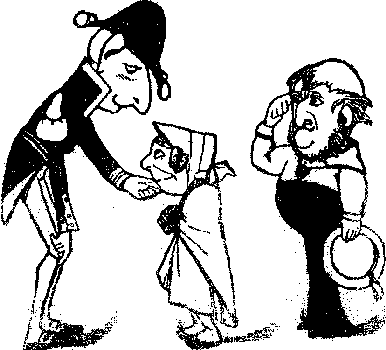
THE BISHOP AND THE BUSMAN.
And London was his see,
He was short and stout and round about,
And zealous as could be.
Who drove a Putney bus—
For flesh of swine however fine
He did not care a cuss.
And Jedediah too,
And Solomon and Zabulon—
This bus-directing Jew.
"I'll see what I can do
To Christianize and make you wise,
You poor benighted Jew."
That bus he rode outside,
From Fulham town, both up and down,
And loudly thus he cried:—
And Jedediah too,
And Solomon and Zabulon—
This bus-directing Jew."
And rather liked the fun—
He merely smiled, that Hebrew child,
And said, "Eccentric one!"
To see the bus go by
(These gay young dogs in striking togs)
To hear the Bishop cry:—
His race it clearly shows,
He sticks no fork in ham or pork:—
Observe, my friends, his nose.
Yet after seven years,
This Hebrew child got awful riled,
And busted into tears.
To leave his poor abode,
His nose, and name, and beard became
A byword on that road.
The reason he would know—
"I'll call and see why ever he
Does persecute me so."
On his ancestral chair,
The busman came, sent up his name,
And laid his grievance bare.
(And chuckled loud with joy)
"Be Christian you, instead of Jew—
Become a Christian boy.
"Indeed?" replied the Jew.
"Shall I be freed?" "You will, indeed!"
Then "Done!" said he, "with you!"
Between the eyebrows grows,
Fell from his face, and in its place,
He found a Christian nose.
Which to his waist came down,
Was now a pair of whiskers fair—
His name, Adolphus Brown.
That prelate's daughter Jane;
He's grown quite fair—has auburn hair—
His wife is far from plain.
THE FOLLY OF BROWN.
BY A GENERAL AGENT.
(His only friends were pigs and cows and
The poultry of a small farmyard)
Who came into two hundred thousand.
Though she's a mighty social chymist:
He was a clown—and by a clown
I do not mean a pantomimist.
Though hardly knowing what a crown was—
You can't imagine what a fool
Poor rich, uneducated Brown was!
And give him monetary schooling;
And I propose to give you some
Idea of his insensate fooling.
(Of course I don't know what the rest meant,
I formed them solely with a view
To help him to a sound investment).
To justify their Boards in showing
A handsome dividend on shares,
And keep their good promoter going.
Though shares at par I freely proffer:
Yes—will it be believed?—the ass
Declines, with thanks, my well-meant offer!
(A weakly intellect denoting)
He'd rather not invest it in
A company of my promoting!
Said I. "You'll waste it, lose it, lend it.
Come, take my furnished second floor,
I'll gladly show you how to spend it."
With grin upon his face of poppy,
Declined my aid, while thanking me
For what he called my "philanthroppy?"
In doubting friends who wouldn't harm them;
They will not hear the charmer's voice,
However wisely he may charm them.
Top boots and cords provoked compassion,
And proved that men of station must
Conform to the decrees of fashion.
To coat him, trouser him, and boot him;
But no—he wouldn't hear of that—
"He didn't think the style would suit him!"
And made no end of an oration;
I made it certainly complete,
And introduced the deputation.
(The worth of birth it surely teaches!)
"Why should I want to spend my nights
In Parliament, a-making speeches?
I ain't had not no eddication—
And I should surely be a fool
To publish that to all the nation!"
No hack had ever trotted faster—
I also offered him, of course,
A rare and curious "old Master."
Wines fit for one in his position—
But, though an ass in all his deeds,
He'd learnt the meaning of "commission."
And daily from his door he thrusts me;
Much more of this, and soon I may
Begin to think that Brown mistrusts me.
This poor uneducated clown is,
You cannot fancy what a fool
Poor rich uneducated Brown is.
THE THREE KINGS OF CHICKERABOO.
Pacifico, Bang-Bang, Popchop—who
Exclaimed, one terribly sultry day,
"Oh, let's be kings in a humble way."
The next elicited banjo tones,
The third was a quiet, retiring chap,
Who danced an excellent break-down "flap."
By which, whenever we like, we can
Extemporize islands near the beach,
And then we'll collar an island each.
Shall rep-per-esent our island shores,
Their sides the ocean wide shall lave,
Their heads just topping the briny wave.
And everywhere her ships they be,
She'll recognize our rank, perhaps,
When she discovers we're Royal Chaps.
It's quite sufficient that you're a king:
She does not push inquiry far
To learn what sort of king you are."
And mounting seventy-something guns,
Ploughed, every year, the ocean blue,
Discovering kings and countries new.
Commanding that superior ship,
Perceived one day, his glasses through,
The kings that came from Chickeraboo.
Three flourishing islands on our lee.
And, bless me! most extror'nary thing!
On every island stands a king!
"And over the dancing waves I'll glide;
That low obeisance I may do
To those three kings of Chickeraboo!"
The kings saluted him graciouslee.
The admiral, pleased at his welcome warm,
Pulled out a printed Alliance form.
I come in a friendly kind of way—
I come, if you please, with the best intents,
And Queen Victoria's compliments."
The most retiring of all the three,
In a "cellar-flap" to his joy gave vent
With a banjo-bones accompaniment.
Embarked on board his jolly big ship,
Blue Peter flew from his lofty fore,
And off he sailed to his native shore.
To the Lord at the head of the Government,
Who made him, by a stroke of a quill,
Baron de Pippe, of Pippetonneville.
That he should quarter upon his shield
Three islands, vert, on a field of blue,
With the pregnant motto "Chickeraboo."
Are going to sail for Chickeraboo,
And, see, on the good ship's crowded deck,
A bishop, who's going out there on spec.
May come of alliance with darkey kings.
Oh, may we never, whatever we do,
Declare a war with Chickeraboo!
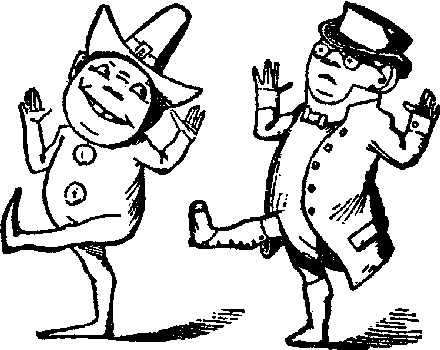
THE BISHOP OF RUM-TI-FOO.
Of bishops gathered, to a man;
To synod, called Pan-Anglican;
In flocking crowds they came.
Among them was a Bishop, who
Had lately been appointed to
The balmy isle of Rum-ti-Foo,
And Peter was his name.
They played the eloquent tum-tum
And lived on scalps served up in rum—
The only sauce they knew,
When, first good Bishop Peter came
(For Peter was that Bishop's name),
To humor them, he did the same
As they of Rum-ti-Foo.
(His name was Peter) loved him well,
And summoned by the sound of bell,
In crowds together came.
"Oh, massa, why you go away?
Oh, Massa Peter, please to stay."
(They called him Peter, people say,
Because it was his name.)
And sailed away across the sea.
At London Bridge that Bishop he
Arrived one Tuesday night—
And as that night he homeward strode
To his Pan-Anglican abode,
He passed along the Borough Road
And saw a gruesome sight.
A person dancing on the ground,
Who straight began to leap and bound
With all his might and main.
To see that dancing man he stopped.
Who twirled and wriggled, skipped and hopped,
Then down incontinently dropped,
And then sprang up again.
"This style of dancing would delight
A simple Rum-ti-Foozle-ite.
I'll learn it, if I can,
To please the tribe when I get back."
He begged the man to teach his knack.
"Right Reverend Sir, in half a crack,"
Replied that dancing man.
And taught the Bishop every day—
The dancer skipped like any fay—
Good Peter did the same.
The Bishop buckled to his task
With battements, cuts, and pas de basque
(I'll tell you, if you care to ask,
That Peter was his name).
"Stick out your toes—stick in your head.
Stalk on with quick, galvanic tread—
Your fingers thus extend;
The attitude's considered quaint,"
The weary Bishop, feeling faint,
Replied, "I do not say it ain't,
But 'Time!' my Christian friend!"
Dance as the Paynes and Lauris do,
Like this—one, two—one, two—one, two."
The Bishop, never proud,
But in an overwhelming heat
(His name was Peter, I repeat),
Performed the Payne and Lauri feat,
And puffed his thanks aloud.
"Just take your ankle in your hand,
And try, my lord, if you can stand—
Your body stiff and stark.
If, when revisiting your see,
You learnt to hop on shore—like me—
The novelty must striking be,
And must excite remark."
That is a length to which, I trow,
Colonial Bishops cannot go.
You may express surprise
At finding Bishops deal in pride—
But, if that trick I ever tried,
I should appear undignified
In Rum-ti-Foozle's eyes.
Are well-conducted persons, who
Approve a joke as much as you,
And laugh at it as such;
But if they saw their Bishop land,
His leg supported in his hand,
The joke they wouldn't understand—
'Twould pain them very much!"
TO THE TERRESTRIAL GLOBE.
BY A MISERABLE WRETCH.
Through pathless realms of Space
Roll on!
What, though I'm in a sorry case?
What, though I cannot meet my bills?
What, though I suffer toothache's ills?
What, though I swallow countless pills?
Never you mind!
Roll on!
Through seas of inky air
Roll on!
It's true I've got no shirts to wear;
It's true my butcher's bill is due;
It's true my prospects all look blue—
But don't let that unsettle you!
Never you mind!
Roll on!
GENERAL JOHN.
And all that mortal durst,
Were General John and Private James,
Of the Sixty-seventy-first.
A chief of warlike dons;
A haughty stride and a withering pride
Were Major-General John's.
Superior birth to show;
"Pish!" was a favorite word of his,
And he often said "Ho! ho!"
As a man of a mournful mind;
No characteristic trait had he
Of any distinctive kind.
"Oh! Major-General John,
I've doubts of our respective names,
My mournful mind upon.
(Its source I can't unearth)
But I've a kind of notion we
Were cruelly changed at birth.
That we have each got on,
Such things have been," said Private James.
"They have!" sneered General John.
My oath I think 'tis so"—
"Pish!" proudly sneered his General John,
And he also said "Ho! ho!"
My General John!" quoth he,
"This aristocratical sneer upon
Your face I blush to see!
Deserving of them names
Would sneer at a fixed idea that's drove
In the mind of a Private James!"
No need your breath to waste;
If this is a joke, Full-Private James,
It's a joke of doubtful taste.
If you feel certain quite
That we were probably changed at birth,
I'll venture to say you're right."
Fell in, parade upon;
And Private James, by change of names,
Was Major-General John.
SIR GUY THE CRUSADER.
A muscular knight,
Ever ready to fight,
A very determined invader.
And Dickey de Lion's delight.
Brunette, statuesque,
The reverse of grotesque;
Her pa was a bagman at Aden,
Her mother she played in burlesque.
In amber and red,
The ballet she led;
Her mother performed at the Royal,
Lenore at the Saracen's Head.
She dazzled the cits—
Ecstaticized pits;—
Her troubles were only domestic,
But drove her half out of her wits.
On water and bread
She was grudgingly fed;
Whenever her father he thrashed her
Her mother sat down on her head.
For beauty so bright,
Set him mad with delight;
He purchased a stall for the season
And sat in it every night.
He wanted to wed,
So he called at her shed
And saw her progenitor whop her—
Her mother sit down on her head.
You brute of a dad,
You unprincipled cad,
Your conduct is really disgusting.
Come, come, now, admit it's too bad!
Your daughter Lenore
I intensely adore
And I cannot help feeling indignant,
A fact that I hinted before.
A deuce of a knout
For to bang her about.
To a sensitive lover's annoying."
Said the bagman, "Crusader, get out!"
With a big spiky knob.
Stand idly and sob.
While a beautiful Saracen maiden
Is whipped by a Saracen snob?
Which he did, with his loot
(Seven hats and a flute),
And was nabbed for his Sydenham armor,
At Mr. Ben-Samuel's suit.
Her pa, in a rage,
Died (don't know his age),
His daughter, she married the prompter,
Grew bulky and quitted the stage.
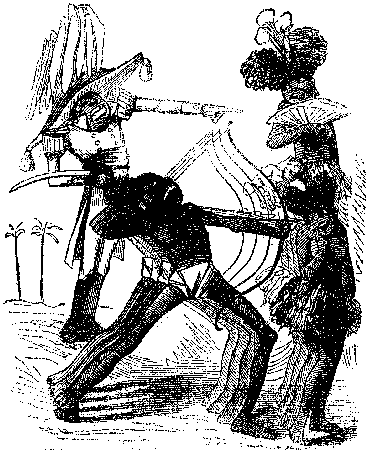
KING BORRIA BUNGALEE BOO.
Was a man-eating African swell;
His sigh was a hullaballoo,
His whisper a horrible yell—
A horrible, horrible yell!
To Borria doubled the knee,
They were once on a far larger scale,
But he'd eaten the balance, you see
("Scale" and "balance" is punning, you see.)
There was lumbering Doodle-Dum-Deh,
Despairing Alack-a-Dey-Ah,
And good little Tootle-Tum-Teh—
Exemplary Tootle-Tum-Teh.
For they hadn't a morsel of meat,
And Borria Bungalee Boo
Was dying for something to eat—
"Come provide me with something to eat!"
Oh, good little Tootle-Tum-Teh,
Where on earth shall I look for a meal?
For I haven't no dinner to-day!—
Not a morsel of dinner to-day!
Come, get us a meal, or in truth,
If you don't we shall have to eat you,
Oh, adorable friend of our youth!
Thou beloved little friend of our youth!"
For a moment I hope you will wait—
Tippy-Wippity Tol-the-Rol-Loo
Is the queen of a neighboring state—
A remarkably neighboring state.
She would pickle deliciously cold—
And her four pretty Amazons, too,
Are enticing, and not very old—
Twenty-seven is not very old.
There is rollicking Tral-the-Ral-Lah,
There is jocular Waggety-Weh.
There is musical Doh-Reh-Mi-Fah—
There's the nightingale Doh-Reh-Mi-Fah!"
Marched forth in a terrible row,
And the ladies who fought for Queen Loo
Prepared to encounter the foe—
This dreadful insatiate foe!
And they poisoned no arrows—not they!
They made ready to conquer or fall
In a totally different way—
An entirely different way.
They endeavored to make themselves fair,
With black they encircled each eye,
And with yellow they painted their hair
(It was wool, but they thought it was hair).
And the men of King Borria said,
"Amazonians, immediately yield!"
And their arrows they drew to the head,
Yes, drew them right up to the head.
Ogled Doodle-Dum-Deh (which was wrong)
And neat little Titty-Fol-Leh,
Said, "Tootle-Tum, you go along!
You naughty old dear, go along!"
Tapped Alack-a-Dey-Ah with her fan;
And musical Doh-Reh-Mi-Fah,
Said "Pish, go away, you bad man!
Go away, you delightful young man!"
And they ogled, and giggled, and flushed,
And they opened their pretty eyes wide,
And they chuckled, and flirted, and blushed
(At least, if they could, they'd have blushed).
Said, "Alack-a-Dey, what does this mean?"
And despairing Alack-a-Dey-Ah
Said, "They think us uncommonly green,
Ha! ha! most uncommonly green!"
Was insensible quite to their leers
And said good little Tootle-Tum-Teh,
"It's your blood we desire, pretty dears—
We have come for our dinners, my dears!"
To Borria Bungalee Boo,
In a mouthful he gulped, with a yell,
Tippy-Wippity Tol-the-Rol-Loo—
The pretty Queen Tol-the-Rol-Loo.
Was eaten by Pish-Pooh-Bah,
And light-hearted Waggety-Weh
By dismal Alack-a-Deh-Ah—
Despairing Alack-a-Deh-Ah.
Was eaten by Doodle-Dum-Deh,
And musical Doh-Reh-Mi-Fah
By good little Tootle-Tum-Teh—
Exemplary Tootle-Tum-Teh!
THE TROUBADOUR.
Without a castle wall,
Within, a hapless maid
Responded to his call.
Alack and well-a-day!
If I were only free
I'd hie me far away!"
But this he knew right well,
The maiden's wailing came
From out a dungeon cell.
Within that dungeon grim—
That fact, I've heard him say.
Was quite enough for him.
Her wails no longer rang,
And tuneful in her woe
The prisoned maiden sang:
I recognize your touch;
And all that I can say
Is, thank you very much."
And blew thereat, until
A warden oped the gate,
"Oh, what might be your will?"
The master of these halls:
A maid unwillingly
Lies prisoned in their walls."
That porter drooped his head,
With teardrops in his eye,
"A many, sir," he said.
But pushed that porter by,
And shortly stood before
Sir Hugh de Peckham Rye.
"What would you, sir, with me?"
The troubadour he downed
Upon his bended knee.
To do a Christian task;
You ask me what would I?
It is not much I ask.
Whom you dominion o'er—
Particularly her
Upon the second floor.
He here stood bolt upright,
And tapped a tailor's sword—
"Come out, you cad, and fight!"
The warden from the gate:
"Go, show this gentleman
The maid in forty-eight."
And stopped at length before
A portal, bolted fast:
The man unlocked the door.
With coarse and brutal shout,
"Come, step it, Forty-eight!"
And Forty-eight stepped out.
The maidens what we cotch—
Two years this lady's got
For collaring a wotch."
The troubadour exclaimed—
"If I may make so free,
How is this castle named?"
And sighing, he replied,
"Of gloomy Pentonville
This is the female side!"
The warden stout to thank,
But recollected straight
He'd business at the Bank.
THE FORCE OF ARGUMENT.
Who came of illustrious stocks,
He was thirty or forty years old,
And several feet in his socks.
This elegant nobleman went,
For that was a borough that he
Was anxious to rep-per-re-sent.
Until he felt thoroughly ill—
He waltzed, and he galloped, and lanced,
And threaded the mazy quadrille.
Were simple—ingenuous—pure—
And they all worked away with a will
The nobleman's heart to secure.
Imagined their chances looked well—
The one was the lively Ann Pond,
The other sad Mary Morell.
And carry the Earl with a rush.
Her principal feature was eye,
Her greatest accomplishment—gush.
Whenever he looked in her eye
She'd blush and turn quickly away,
And flitter and flutter and sigh.
As she worked out the scheme she had planned—
A fact he endeavored to hide
With his aristocratical hand.
And so was old Tommy Morell,
In a humble and pottering way
They were doing exceedingly well.
The Earl was a dangerous man,
So nervously clearing his throat,
One morning old Tommy began:
I'm a plain-spoken Zommerzet man—
Now what do 'ee mean by my Poll,
And what do 'ee mean by his Ann?"
I mean them uncommonly well,
Believe me, my excellent Pond,
And credit me, worthy Morell.
I'll prove it with singular ease,
You shall have it in 'Barbara' or
'Celarent'—whichever you please.
To the yoke of intentional sin—
If the state of the country allows,
Homogeny always steps in.
As any mere ploughboy can tell"—
"Of course," replied puzzled old Pond.
"I see," said old Tommy Morell.
"When its fooled to the top of its bent,
With a sweep of a Damocles sword
The web of intention is rent.
As any mere schoolboy can tell."
Pond answered, "Of course it's quite clear;"
And so did that humbug Morell.
I trust that I make myself clear?"—
Morell only answered "Of course,"—
While Pond slowly muttered, "Hear, hear."
Pellucid as porphyry cell—
Is based on a principle wise."
"Quite so," exclaimed Pond and Morell.
That I couldn't wed either—in fine,
By nature's unchanging decree
Your daughters could never be mine.
My hands of the matter I've rinsed."
So they take up their hats and their sticks,
And exeunt ambo, convinced.
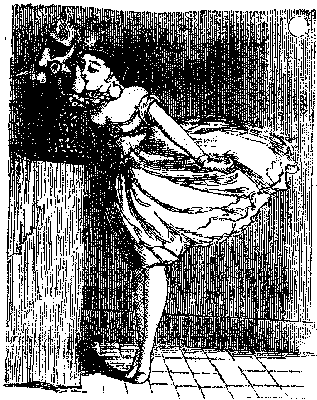
ONLY A DANCING GIRL.
With an unromantic style,
With borrowed color and curl,
With fixed mechanical smile,
With many a hackneyed wile,
With ungrammatical lips,
And corns that mar her trips!
She acts a palpable lie,
She's as little a fairy there
As unpoetical I!
I hear you asking, Why—
Why in the world I sing
This tawdry, tinselled thing?
As she hangs in arsenic green,
From a highly impossible tree,
In a highly impossible scene
(Herself not over clean).
For fays don't suffer, I'm told,
From bunions, coughs, or cold.
Their daughters there to see,
Pronounce the "dancing thing"
No better than she should be.
With her skirt at her shameful knee,
And her painted, tainted phiz:
Ah, matron, which of us is?
That while these matrons sigh,
Their dresses are lower than hers,
And sometimes half as high;
And their hair is hair they buy,
And they use their glasses, too,
In a way she'd blush to do.)
For a coarse merino gown,
And see her upon the scene
Of her home, when coaxing down
Her drunken father's frown,
In his squalid, cheerless den:
She's a fairy truly, then!
THE SENSATION CAPTAIN.
Than Captain Parklebury Todd,
So good—so wise—so brave, he!
But still, as all his friends would own,
He had one folly—one alone—
This Captain in the Navy.
A man so wholly given to
Creating a sensation;
Or p'r'aps I should in justice say—
To what in an Adelphi play
Is known as "Situation."
To flurry unsuspicious chaps—
The taste was his innately—
He couldn't walk into a room
Without ejaculating "Boom!"
Which startled ladies greatly.
Not, you will understand, in joke,
As some assume disguises.
He did it, actuated by
A simple love of mystery
And fondness for surprises.
His eloquence threw into shade
All others who adored her:
The maid, though pleased at first, I know,
Found, after several years or so,
Her startling lover bored her.
She did not faint or scream or wail,
Or with her tears anoint him.
She shook his hand, and said "Good-bye;"
With laughter dancing in her eye—
Which seemed to disappoint him.
He placed around her little throat
A ribbon blue and yellow,
On which he hung a double tooth—
A simple token this, in sooth—
'Twas all he had, poor fellow!
When very, very far away,
"If Angelina wears it!
A plan has entered in my head,
I will pretend that I am dead,
And see how Angy bears it!"
His Angelina bore it well,
No sign gave she of crazing;
But, steady as the Inchcape rock
His Angelina stood the shock
With fortitude amazing.
Poor Angelina to protect
From all who wish to harm her.
Since worthy Captain Todd is dead
I rather feel inclined to wed
A comfortable farmer."
(Bassanio Tyler was his name)
Who had no end of treasure:
He said, "My noble gal, be mine!"
The noble gal did not decline,
But simply said, "With pleasure."
At first he thought it rather odd,
And felt some perturbation;
But very long he did not grieve,
He thought he could a way perceive
To such a situation!
"Till they are both in the Eccle-
siastical Arena;
Then suddenly I will appear,
And paralyzing them with fear,
Demand my Angelina!"
Accoutred in the usual way
Appeared the bridal body—
The worthy clergyman began,
When in the gallant captain ran
And cried, "Behold your Toddy!"
And also possibly the bride—
The bridesmaids were affrighted;
But Angelina, noble soul,
Contrived her feelings to control,
And really seemed delighted.
"She's mine, uninteresting clod,
My own, my darling charmer!"
"Oh, dear," said she, "you're just too late,
I'm married to, I beg to state,
This comfortable farmer!"
You've been and cut it far too fine!"
"I see," said Todd, "I'm beaten."
And so he went to sea once more,
"Sensation" he for aye forswore,
And married on her native shore
A lady whom he'd met before—
A lovely Otaheitan.
THE PERIWINKLE GIRL.
Of decent education,
Determine all-important truths
With strange precipitation.
Of logical illusions,
And in a self-assertive way
They jump at strange conclusions.
My ample forehead wrinkle,
I had determined that I would
Not like to be a winkle.
With readiness provoking,
"Can seldom flirt, and never dance
Or soothe his mind by smoking."
And spoke with strange decision—
Men pointed to me as a boy
Who held them in derision.
Or I had been more wary,
I knew not then that winkles are
The stock-in-trade of Mary.
As o'er their shells it dances,
I've seen those winkles almost writhe
Beneath her beaming glances.
I surely had been chary,
If I had known they formed the food
And stock-in-trade of Mary.
Fell prostrate at her tootsies,
They all were noblemen, and all
Had balances at Coutts's.
Duke Bailey and Duke Humphy,
Who eat her winkles till they felt
Exceedingly uncomfy.
And sticks, they say, at no-thing.
He wears a pair of golden boots
And silver underclothing.
Though mentally acuter,
His boots are only silver, and
His underclothing pewter.
A man of lowly station—
A miserable grov'ling earl
Besought her approbation.
With much contempt and loathing;
He wore a pair of leather shoes
And cambric underclothing!
Well, really—come, I never!
Oh, go along, it's too absurd!
My goodness! Did you ever?
And from her foes defend her"—
"Well, not exactly that," they cried,
"We offer guilty splendor.
So please dismiss the notion!"
"Oh, dear," said she, "that alters quite
The state of my emotion."
"Dismiss them to their orgies,
For I am game to marry thee
Quite reg'lar at St. George's."
A decent education;
His views would have befitted well
A far superior station.
She never heard him grumble;
She saw his soul was good and pure
Although his rank was humble.
All underwent expansion;
Come, Virtue in an earldom's cot!
Go, Vice in ducal mansion!
BOB POLTER.
His hands were coarse, and dirty too,
His homely face was rough and tanned,
His time of life was thirty-two.
(A wife he hadn't got at all),
A decent, steady, sober man—
No saint, however—not at all.
Because he thought he needed it;
He drank a pot of beer a day,
And sometimes he exceeded it.
A loud convivial night or two,
With, very likely, now and then,
On Saturdays, a fight or two.
A labor-never-shirking man,
Who paid his way—upon the whole
A decent English working man.
(For which he may be blamed of you)
A holy man appeared and said,
"Oh, Robert, I'm ashamed of you."
Before he could drink up any,
And on the floor, with sigh and tear,
He poured the pot of "thruppenny."
A truth you'll be discovering,
A good and evil genius are
Around your noddle hovering.
The other one's society,
For Total Abstinence is one,
The other Inebriety."
A wizard, Polter reckoned him:
A bogy rose and called his name,
And with his finger beckoned him.
His heavy breath was portery;
His glowing nose suggested rum;
His eyes were gin-and-wortery.
And slops of gin had rusted it;
His pimpled face was wan and pale,
Where filth had not encrusted it.
And keep the bowl a-flowing on—
A working-man needs pints of gin
To keep his clockwork going on."
If you take me for one of you—
You filthy beast, get out of this—
Bob Polter don't want none of you."
And crept away in stealthiness,
And lo, instead, a person sleek
Who seemed to burst with healthiness.
Of Abstinence you have got a type—
Of Mr. Tweedle's pretty prints
I am the happy prototype.
And pipes, and such frivolities,
You possibly some day may boast
My prepossessing qualities!"
"You almost make me tremble, you!
If I abjure fermented drink,
Shall I, indeed, resemble you?
My cheeks grow smug and muttony?
My face become so red and white?
My coat so blue and buttony?
Extremities inferior?
Will chubbiness assert its sway
All over my exterior?
To work in heavy boots I comes,
Will pumps henceforward decorate
My tiddle toddle tootsicums?
And look no longer seedily?
My skin will henceforth fit my flesh
So tightly and so Tweedie-ly?"
You'll know no kind of huffiness,
Your life will be one chubby bliss,
One long unruffled puffiness!"
"Why come you here to bother one?
You pharisaical old snob,
You're wuss almost than t'other one!
GENTLE ALICE BROWN.
Her father was the terror of a small Italian town;
Her mother was a foolish, weak, but amiable old thing;
But it isn't of her parents that I'm going for to sing.
A beautiful young gentleman he chanced to pass that way;
She cast her eyes upon him, and he looked so good and true,
That she thought, "I could be happy with a gentleman like you!"
She knew she might expect him at a quarter unto ten,
A sorter in the Custom-house, it was his daily road
(The Custom-house was fifteen minutes' walk from her abode).
To look at strange young sorters with expressive purple eyes;
So she sought the village priest, to whom her family confessed,
The priest by whom their little sins were carefully assessed.
To discover that I was a most disreputable lot!
Of all unhappy sinners I'm the most unhappy one!"
The padre said, "Whatever have you been and gone and done?"
I've assisted dear papa in cutting up a little lad,
I've planned a little burglary and forged a little check,
And slain a little baby for the coral on its neck!"
And said, "You mustn't judge yourself too heavily, my dear—
It's wrong to murder babies, little corals for to fleece:
But sins like that one expiates at half-a-crown apiece.
Old heads upon young shoulders we must not expect to find;
We mustn't be too hard upon these little girlish tricks—
Let's see—five crimes at half-a-crown—exactly twelve-and-six."
You do these little things for me so singularly cheap—
Your thoughtful liberality I never can forget;
But, O, there is another crime I haven't mentioned yet!"
I've noticed at my window, as I've sat a-catching flies:
He passes by it every day as certain as can be—
I blush to say I've winked at him and he has winked at me!"
This is the most distressing news that I have ever heard.
Why, naughty girl, your excellent papa has pledged your hand
To a promising young robber, the lieutenant of his band!
They are the most remunerative customers I know;
For many years they've kept starvation from my doors,
I never knew so criminal a family as yours!
Have nothing to confess, they're so ridiculously good;
And if you marry any one respectable at all,
Why, you'll reform, and what will then become of Father Paul?"
And started off in haste to tell the news to Robber Brown;
To tell him how his daughter, who now was for marriage fit,
Had winked upon a sorter, who reciprocated it.
He said "I have a notion, and that notion I will tell;
I will nab this gay young sorter, terrify him into fits,
And get my gentle wife to chop him into little bits.
Though a girl may fondly love a living gent, as many do—
A feeling of disgust upon her senses there will fall
When she looks upon his body chopped particularly small."
He watched his opportunity and seized him unaware;
He took a life-preserver and he hit him on the head,
And Mrs. Brown dissected him before she went to bed.
She never more was guilty of a weakness of the kind,
Until at length good Robber Brown bestowed her pretty hand
On the promising young robber, the lieutenant of his band.
BEN ALLAH ACHMET;
OR, THE FATAL TUM.
Whom I upon a two-pair-back met,
His name it was Effendi Khan
Backsheesh Pasha Ben Allah Achmet.
I've often eaten of his bounty—
The Turk and he they lived at Hooe,
In Sussex, that delightful county.
Her name was Isabella Sherson,
And though she wore another's hair,
She was an interesting person.
(Although his harem would have shocked her);
But Brown adored that maiden, too:
He was a most seductive doctor.
A course of action most improper;
She neither knew by sight, and so
For neither of them cared a copper.
He might have been his sainted mother:
The people in this simple tale
Are total strangers to each other.
Which threw him straight into a sharp pet;
He threw himself upon the floor
And rolled about upon his—carpet.
And almost wore him to a mummy:
Why should I hesitate to own
That pain was in his little tummy?
(As Allah Achmet had desired)
Who felt his pulse, looked up his tongue,
And hummed and hawed, and then inquired:
Upon you in so sad a way, sir?"
The Turk he giggled, blushed, and said,
"I don't exactly like to say, sir."
"So this is Turkish coyness, is it?
You must contrive to fight it down—
Come, come, sir, please to be explicit."
And coyly blushed like one half-witted,
"The pain is in my little tum,"
He, whispering, at length admitted.
Your blood flows sluggish in its channel—
You must get rid of all this fat,
And wear my medicated flannel.
My name is Brown—your life I've saved it!"
"My rival!" shrieked the invalid,
And drew a mighty sword and waved it.
Aloud the Turk in frenzy yelled it,
And drove right through the Doctor's chest
The sabre and the hand that held it.
And Doctor Brown grew deadly pasty—
"Now see the mischief that you've done,—
You Turks are so extremely hasty.
He's short and stout—I'm tall and wizen;
You've been and run the wrong one through,
That's how the error has arisen."
Apologies were only heard now:
"At my mistake I'm really pained,
I am, indeed, upon my word now."
A Mausoleum grand awaits me"—
"Oh, pray don't say another word,
I'm sure that more than compensates me.
SONGS OF A SAVOYARD
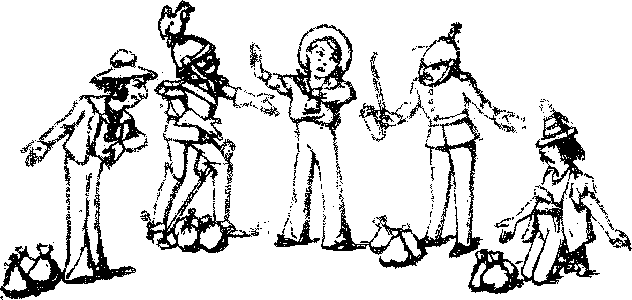
THE ENGLISHMAN.
For he himself has said it,
And it's greatly to his credit,
That he is an Englishman!
For he might have been a Roosian,
A French, or Turk, or Proosian,
Or perhaps Itali-an!
But in spite of all temptations,
To belong to other nations,
He remains an Englishman!
Hurrah!
For the true born Englishman!
THE DISAGREEABLE MAN.
I'm a genuine philanthropist—all other kinds are sham.
Each little fault of temper and each social defect
In my erring fellow creatures, I endeavor to correct.
To all their little weaknesses I open people's eyes
And little plans to snub the self-sufficient I devise;
I love my fellow creatures—I do all the good I can—
Yet everybody say I'm such a disagreeable man!
And I can't think why!
And vanity I always do my best to mortify;
A charitable action I can skilfully dissect:
And interested motives I'm delighted to detect.
I know everybody's income and what everybody earns,
And I carefully compare it with the income tax returns;
But to benefit humanity, however much I plan,
Yet everybody says I'm such a disagreeable man!
And I can't think why!
You'll always find me ready with a crushing repartee;
I've an irritating chuckle; I've a celebrated sneer;
I've an entertaining snigger; I've a fascinating leer;
To everybody's prejudice I know a thing or two;
I can tell a woman's age in half a minute—and I do—
But although I try to make myself as pleasant as I can,
Yet everybody says I'm such a disagreeable man!
And I can't think why!
THE MODERN MAJOR-GENERAL.
I've information vegetable, animal, and mineral;
I know the kings of England, and I quote the fights historical,
From Marathon to Waterloo, in order categorical;
I'm very well acquainted too with matters mathematical,
I understand equations, both the simple and quadratical,
About binomial theorem I'm teeming with a lot o' news,
With many cheerful facts about the square of the hypotenuse.
I'm very good at integral and differential calculus,
I know the scientific names of beings animalculous,
In short in matters vegetable, animal and mineral,
I am the very model of a modern Major-Gineral.
I answer hard acrostics, I've a pretty taste for paradox,
I quote in elegiacs all the crimes of Heliogabalus,
In conies I can floor peculiarities parabolous.
I can tell undoubted Raphaels from Gerard Dows and Zoffanies,
I know the croaking chorus from the "Frogs" of Aristophanes,
Then I can hum a fugue of which I've heard the music's din afore,
And whistle all the airs from that confounded nonsense "Pinafore."
Then I can write a washing bill in Babylonic cuneiform,
And tell you every detail of Caractacus's uniform.
In short in matters vegetable, animal and mineral,
I am the very model of a modern Major-Gineral.
When I can tell at sight a Chassepot rifle from a javelin,
When such affairs as sorties and surprises I'm more wary at,
And when I know precisely what is meant by Commissariat,
When I have learn what progress has been made in modern gunnery,
When I know more of tactics than a novice in a nunnery,
In short when I've a smattering of elementary strategy,
You'll say a better Major-General has never sat a gee—
For my military knowledge, though I'm plucky and adventury,
Has only been brought down to the beginning of the century,
But still in learning vegetable, animal and mineral,
I am the very model of a modern Major-Gineral.
THE HEAVY DRAGOON.
Known to the world as a Heavy Dragoon,
Take all the remarkable people in history,
Rattle them off to a popular tune!
The pluck of Lord Nelson on board of the Victory—
Genius of Bismarck devising a plan;
The humor of Fielding (which sounds contradictory)—
Coolness of Paget about to trepan—
The grace of Mozart, that unparalleled musico—
Wit of Macaulay, who wrote of Queen Anne—
The pathos of Paddy, as rendered by Boucicault—
Style of the Bishop of Sodor and Man—
The dash of a D'Orsay, divested of quackery—
Narrative powers of Dickens and Thackeray
Victor Emmanuel—peak-haunting Peveril—
Thomas Aquinas, and Doctor Sacheverell—
Tupper and Tennyson—Daniel Defoe—
Anthony Trollope and Mister Guizot!
Melt them all down in a pipkin or crucible,
Set them to simmer and take off the scum,
And a Heavy Dragoon is the residuum!
Get at the wealth of the Czar (if you can)—
The family pride of a Spaniard from Arragon—
Force of Mephisto pronouncing a ban—
A smack of Lord Waterford, reckless and rollicky—
Swagger of Roderick, heading his clan—
The keen penetration of Paddington Pollaky—
Grace of an Odalisque on a divan—
The genius strategic of Cæsar or Hannibal—
Skill of Lord Wolseley in thrashing a cannibal
Flavor of Hamlet—the Stranger, a touch of him—
Little of Manfred, (but not very much of him)—
Beadle of Burlington—Richardson's show;
Mr. Micawber and Madame Tussaud!
Melt them all down in a pipkin or crucible,
Set them to simmer and take off the scum,
And a Heavy Dragoon is the residuum!
ONLY ROSES!
Cometh one to gather flowers,
And he wanders through its bowers
Toying with the wanton roses,
Who, uprising from their beds,
Hold on high their shameless heads
With their pretty lips a-pouting,
Never doubting—never doubting
That for Cytherean posies
He would gather aught but roses!
Lay a violet, half hidden,
Hoping that his glance unbidden
Yet might fall upon her petals,
Though she lived alone, apart,
Hope lay nestling at her heart,
But, alas! the cruel awaking
Set her little heart a-breaking,
For he gathered for his posies
Only roses—only roses!
THEY'LL NONE OF 'EM BE MISSED.
I've got a little list—I've got a little list
Of social offenders who might well be underground,
And who never would be missed—who never would be missed!
There's the pestilential nuisances who write for autographs—
All people who have flabby hands and irritating laughs—
All children who are up in dates, and floor you with 'em flat—
All persons who in shaking hands, shake hands with you like that—
And all third persons who on spoiling tete-a-tetes insist—
They'd none of 'em be missed—they'd none of 'em be missed!
And the piano organist—I've got him on the list!
And the people who eat peppermint and puff it in your face,
They never would be missed—they never would be missed!
Then the idiot who praises, with enthusiastic tone,
All centuries but this, and every country but his own;
And the lady from the provinces, who dresses like a guy,
And who doesn't think she waltzes, but would rather like to try;
And that singular anomaly, the lady novelist—
I don't think she'd be missed—I'm sure she'd not be missed!
The Judicial humorist—I've got him on the list!
All funny fellows, comic men, and clowns of private life—
They'd none of 'em be missed—they'd none of them be missed.
And apologetic statesmen of the compromising kind,
Such as—What-d'ye-call-him—Thing'em-Bob, and likewise—Never-mind,
And 'St—'st—'st—and What's-his-name, and also—You-know-who—
(The task of filling up the blanks I'd rather leave to you!)
But it really doesn't matter whom you put upon the list,
For they'd none of 'em be missed—they'd none of 'em be missed!
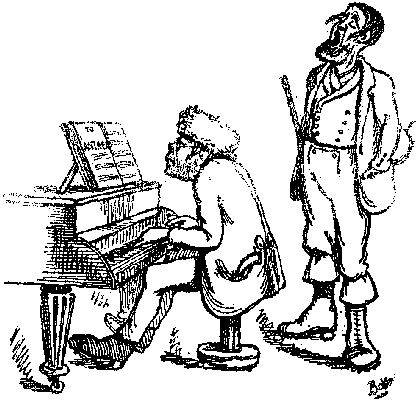
THE POLICEMAN'S LOT.
Or maturing his felonious little plans.
His capacity for innocent enjoyment,
Is just as great as any honest man's
Our feelings we with difficulty smother
When constabulary duty's to be done:
Ah, take one consideration with another,
A policeman's lot is not a happy one!
When the cut-throat isn't occupied in crime,
He loves to hear the little brook a-gurgling,
And listen to the merry village chime.
When the coster's finished jumping on his mother,
He loves to lie a-basking in the sun:
Ah, take one consideration with another,
The policeman's lot is not a happy one!
AN APPEAL.
Which does not feel the moral beauty
Of making worldly interest
Subordinate to sense of duly?
Who would not give up willingly
All matrimonial ambition,
To rescue such a one as I
From his unfortunate position?
Whose homely face and bad complexion
Have caused all hopes to disappear
Of ever winning man's affection?
To such a one, if such there be,
I swear by Heaven's arch above you,
If you will cast your eyes on me,—
However plain you be—I'll love you!
EHEU FUGACES—!
Soft madrigals, and dreamy lovers' lays.
Peace, peace, old heart! Why waken from its slumbers
The aching memory of the old, old days?
Time was when we walked ever hand in hand;
A saintly youth, with worldly thought untainted,
None better-loved than I in all the land!
Time was, when maidens of the noblest station,
Forsaking even military men,
Would gaze upon me, rapt in adoration—
Ah, me, I was a fair young curate then!
Had I a cold? welled forth the silent tear;
Did I look pale? then half a parish trembled;
And when I coughed all thought the end was near!
I, had no care—no jealous doubts hung o'er me—
For I was loved beyond all other men.
Fled gilded dukes and belted earls before me!
Ah, me! I was a pale young curate then!
A RECIPE.
Hidden, ever and anon,
In a merciful eclipse—
Do not heed their mild surprise—
Having passed the Rubicon.
Take a pair of rosy lips;
Take a figure trimly planned—
Such as admiration whets
(Be particular in this);
Take a tender little hand,
Fringed with dainty fingerettes,
Press it—in parenthesis;—
Take all these, you lucky man—
Take and keep them, if you can.
Quite a miniature affair—
Hung about with trellised vine,
Furnish it upon the spot
With the treasures rich and rare
I've endeavored to define.
Live to love and love to live
You will ripen at your ease,
Growing on the sunny side—
Fate has nothing more to give.
You're a dainty man to please
If you are not satisfied.
Take my counsel, happy man:
Act upon it, if you can!
THE FIRST LORD'S SONG.
As office boy to an Attorney's firm.
I cleaned the windows and I swept the floor,
And I polished up the handle of the big front door.
I polished up that handle so successfullee
That now I am the Ruler of the Queen's Navee!
That they gave me the post of a junior clerk.
I served the writs with a smile so bland,
And I copied all the letters in a big round hand.
I copied all the letters in a hand so free,
That now I am the Ruler of the Queen's Navee!
That an articled clerk I soon became;
I wore clean collars and a brand-new suit
For the Pass Examination at the Institute.
And that Pass Examination did so well for me,
That now I am the Ruler of the Queen's Navee!
That they took me into the partnership.
And that junior partnership, I ween,
Was the only ship that I ever had seen,
But that kind of ship so suited me,
That now I am the Ruler of the Queen's Navee!
By a pocket borough into Parliament.
I always voted at my party's call,
And I never thought of thinking for myself at all.
I thought so little, they rewarded me,
By making me the Ruler of the Queen's Navee!
If you want to rise to the top of the tree,
If your soul isn't fettered to an office stool,
Be careful to be guided by this golden rule—
Stick close to your desks and never go to sea,
And you all may be Rulers of the Queen's Navee!
WHEN A MERRY MAIDEN MARRIES.
Sorrow goes and pleasure tarries;
Every sound becomes a song,
All is right and nothing's wrong!
From to-day and ever after
Let your tears be tears of laughter—
Every sigh that finds a vent
Be a sigh of sweet content!
When you marry merry maiden,
Then the air with love is laden;
Every flower is a rose,
Every goose becomes a swan,
Every kind of trouble goes
Where the last year's snows have gone!
Sunlight takes the place of shade
When you marry merry maid!
Sorrow goes and pleasure tarries;
Every sound becomes a song,
All is right, and nothing's wrong.
Gnawing Care and aching Sorrow,
Get ye gone until to-morrow;
Jealousies in grim array,
Ye are things of yesterday!
When you marry merry maiden,
Then the air with joy is laden;
All the corners of the earth
Ring with music sweetly played,
Worry is melodious mirth.
Grief is joy in masquerade;
Sullen night is laughing day—
All the year is merry May!
THE SUICIDE'S GRAVE.
Sang "Willow, titwillow, titwillow!"
And I said to him, "Dicky-bird, why do you sit
Singing 'Willow, titwillow, titwillow?'
Is it weakness of intellect, birdie?" I cried,
"Or a rather tough worm in your little inside?"
With a shake of his poor little head he replied,
"Oh, willow, titwillow, titwillow!"
Singing "Willow, titwillow, titwillow!"
And a cold perspiration bespangled his brow,
Oh, willow, titwillow, titwillow!
He sobbed and he sighed, and a gurgle he gave,
Then he threw himself into the billowy wave,
And an echo arose from the suicide's grave—
"Oh, willow, titwillow, titwillow!"
Isn't Willow, titwillow, titwillow,
That 'twas blighted affection that made him exclaim,
"Oh, willow, titwillow, titwillow!"
And if you remain callous and obdurate, I
Shall perish as he did, and you will know why,
Though I probably shall not exclaim as I die,
"Oh, willow, titwillow, titwillow!"
HE AND SHE.
I know a youth who loves a little maid—
(Hey, but his face is a sight for to see!)
Silent is he, for he's modest and afraid—
(Hey, but he's timid as a youth can be!)
I know a maid who loves a gallant youth,
(Hey, but she sickens as the days go by!)
She cannot tell him all the sad, sad truth—
(Hey, but I think that little maid will die!)
Now tell me pray, and tell me true,
What in the world should the poor soul do?
He cannot eat and he cannot sleep—
(Hey, but his face is a sight for to see!)
Daily he goes for to wail—for to weep—
(Hey, but he's wretched as a youth can be!)
She's very thin and she's very pale—
(Hey, but she sickens as the days go by!)
Daily she goes for to weep—for to wail—
(Hey, but I think that little maid will die!)
If I were the youth I should offer her my name—
(Hey, but her face is a sight for to see!)
If I were the maid I should feed his honest flame—
(Hey, but he's bashful as a youth can be!)
If I were the youth I should speak to her to-day—
(Hey, but she sickens as the days go by!)
If I were the maid I should meet the lad half way—
(For I really do believe that timid youth will die'!)
I thank you much for your counsel true;
I've learnt what that poor soul ought to do!
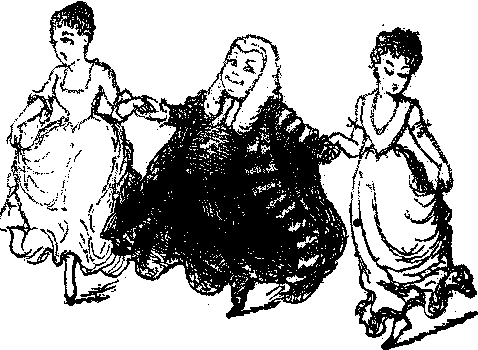
THE LORD CHANCELLOR'S SONG.
Of everything that's excellent.
It has no kind of fault or flaw,
And I, my lords, embody the Law.
The constitutional guardian I
Of pretty young Wards in Chancery,
All very agreeable girls—and none
Are over the age of twenty-one.
A pleasant occupation for
A rather susceptible Chancellor!
Inflates me with legitimate pride,
It nevertheless can't be denied
That it has its inconvenient side.
For I'm not so old, and not so plain,
And I'm quite prepared to marry again,
But there'd be the deuce to pay in the Lords
If I fell in love with one of my Wards:
Which rather tries my temper, for
I'm such a susceptible Chancellor!
Must come to me for my accord:
So in my court I sit all day,
Giving agreeable girls away,
With one for him—and one for he—
And one for you—and one for ye—
And one for thou—and one for thee—
But never, oh never a one for me!
Which is exasperating, for
A highly susceptible Chancellor!
WILLOW WALY!
Prithee, pretty maiden—prithee, tell me true
(Hey, but I'm doleful, willow, willow waly!)
Have you e'er a lover a-dangling after you?
Hey, willow waly O!
I fain would discover
If you have a lover?
Hey, willow waly O!
Gentle sir, my heart is frolicsome and free—
(Hey but he's doleful, willow, willow waly!)
Nobody I care for comes a-courting me—
Hey, willow waly O!
Nobody I care for
Comes a-courting—therefore,
Hey, willow waly O!
Prithee, pretty maiden, will you marry me?
(Hey, but I'm hopeful, willow, willow waly!)
I may say, at once, I'm a man of propertee
Hey, willow waly O!
Money, I despise it,
But many people prize it,
Hey, willow waly O!
Gentle sir, although to marry I design—
(Hey, but I'm hopeful, willow, willow waly!)
As yet I do not know you, and so I must decline.
Hey, willow waly O!
To other maidens go you—
As yet I do not know you,
Hey, willow waly O!
THE USHER'S CHARGE.
All kinds of vulgar prejudice
I pray you set aside:
With stern judicial frame of mind,
From bias free of every kind,
This trial must be tried!
Observe the features of her face—
The broken-hearted bride!
Condole with her distress of mind:
From bias free of every kind,
This trial must be tried!
The ruffianly defendant speaks—
Upon the other side;
What he may say you needn't mind—
From bias free of every kind,
This trial must be tried!
KING GOODHEART.
In the wonder-working days of old,
When hearts were twice as good as gold,
And twenty times as mellow.
Good temper triumphed in his face,
And in his heart he found a place
For all the erring human race
And every wretched fellow.
When he had Rhenish wine to drink
It made him very sad to think
That some, at junket or at jink,
Must be content with toddy.
He wished all men as rich as he
(And he was rich as rich could be),
So to the top of every tree
Promoted everybody.
Prime Ministers and such as they
Grew like asparagus in May,
And Dukes were three a penny.
Lord Chancellors were cheap as sprats.
And Bishops in their shovel hats
Were plentiful as tabby cats—
If possible, too many.
On every side Field-Marshals gleamed,
Small beer were Lords Lieutenant deemed
With Admirals the ocean teemed
All round his wide dominions;
And Party Leaders you might meet
In twos and threes in every street
Maintaining, with no little heat,
Their various opinions.
His heart was of abnormal size,
Yet he'd have acted otherwise
If he had been acuter.
The end is easily foretold,
When every blessed thing you hold
Is made of silver, or of gold,
You long for simple pewter.
When you have nothing else to wear
But cloth of gold and satins rare,
For cloth of gold you cease to care—
Up goes the price of shoddy.
In short, whoever you may be,
To this conclusion you'll agree,
When every one is somebodee,
Then no one's anybody!
THE TANGLED SKEIN.
Straighten out life's tangled skein,
Why should we, in vain endeavor,
Guess and guess and guess again?
Life's a pudding full of plums;
Care's a canker that benumbs.
Wherefore waste our elocution
On impossible solution?
Life's a pleasant institution,
Let us take it as it comes!
We shall guess it all too soon;
Failure brings no kind of stigma—
Dance we to another tune!
String the lyre and fill the cup,
Lest on sorrow we should sup.
Hop and skip to Fancy's fiddle,
Hands across and down the middle—
Life's perhaps the only riddle
That we shrink from giving up!
GIRL GRADUATES.
To the moon;
And they'll set the Thames on fire
Very soon;
Then they learn to make silk purses
With their rigs
From the ears of Lady Circe's
Piggy-wigs.
And weazels at their slumbers
They'll trepan;
To get sunbeams from cucumbers
They've a plan.
They've a firmly rooted notion
They can cross the Polar Ocean,
And they'll find Perpetual Motion
If they can!
So they say,
And the circle—they will square it
Some fine day;
Then the little pigs they're teaching
For to fly;
And the niggers they'll be bleaching
Bye and bye!
Each newly joined aspirant
To the clan
Must repudiate the tyrant
Known as Man;
They mock at him and flout him,
For they do not care about him,
And they're "going to do without him"
If they can!
That every pretty domina
Hopes that we shall see
At this Universitee!
THE APE AND THE LADY.
Was loved by an Ape, in the days gone by—
The Maid was radiant as the sun,
The Ape was a most unsightly one—
So it would not do—
His scheme fell through;
For the Maid, when his love took formal shape,
Expressed such terror
At his monstrous error,
That he stammered an apology and made his 'scape,
The picture of a disconcerted Ape.
He shaved his bristles, and he docked his tail,
He grew moustachios, and he took his tub,
And he paid a guinea to a toilet club.
But it would not do,
The scheme fell through—
For the Maid was Beauty's fairest Queen
With golden tresses,
Like a real princess's,
While the Ape, despite his razor keen,
Was the apiest Ape that ever was seen!
He crammed his feet into bright tight boots,
And to start his life on a brand-new plan,
He christened himself Darwinian Man!
But it would not do.
The scheme fell through—
For the Maiden fair, whom the monkey craved,
Was a radiant Being,
With a brain far-seeing—
While a Man, however well-behaved,
At best is only a monkey shaved!
SANS SOUCI
That cometh to all but not to me.
It cannot be kind as they'd imply,
Or why do these gentle ladies sigh?
It cannot be joy and rapture deep,
Or why do these gentle ladies weep?
It cannot be blissful, as 'tis said,
Or why are their eyes so wondrous red?
Who foolishly hug and foster it.
If love is a weed, how simple they
Who gather and gather it, day by day!
If love is a nettle that makes you smart,
Why do you wear it next your heart?
And if it be neither of these, say I,
Why do you sit and sob and sigh?
THE BRITISH TAR.
As free as a mountain bird,
His energetic fist should be ready to resist
A dictatorial word
His nose should pant and his lips should curl,
His cheeks should flame and his brow should furl,
His bosom should heave and his heart should glow,
And his fist be ever ready for a knock-down blow.
His brow with scorn be rung;
He never should bow down to a domineering frown,
Or the tang of a tyrant tongue.
His foot should stamp and his throat should growl,
His hair should twirl and his face should scowl:
His eyes should flash and his breast protrude,
And this should be his customary attitude!
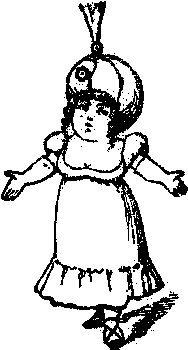
THE COMING BYE AND BYE.
Sees, one by one, her beauties disappear;
As Time, grown weary of her heart-drawn sighs,
Impatiently begins to "dim her eyes!"
Herself compelled, in life's uncertain gloamings,
To wreathe her wrinkled brow with well saved "combings"—
Reduced, with rouge, lipsalve, and pearly grey,
To "make up" for lost time, as best she may!
Spreading is the parting straight,
Mottled the complexion fair,
Halting is the youthful gait.
Hollow is the laughter free,
Spectacled the limpid eye,
Little will be left of me,
In the coming bye and bye!
Shapeless grows the shapely limb,
And although securely laced,
Spreading is the figure trim!
Stouter than I used to be,
Still more corpulent grow I—
There will be too much of me
In the coming bye and bye!
THE SORCERER'S SONG.
I'm a dealer in magic and spells,
In blessings and curses,
And ever filled purses,
In prophecies, witches and knells!
If you want a proud foe to "make tracks"—
If you'd melt a rich uncle in wax—
You've but to look in
On our resident Djinn,
Number seventy, Simmery Axe.
And for raising a posthumous shade
With effects that are comic or tragic,
There's no cheaper house in the trade.
Love-philtre—we've quantities of it;
And for knowledge if any one burns,
We keep an extremely small prophet, a prophet
Who brings us unbounded returns:
For he can prophesy
With a wink of his eye,
Peep with security
Into futurity,
Sum up your history,
Clear up a mystery,
Humor proclivity
For a nativity.
With mirrors so magical,
Tetrapods tragical,
Bogies spectacular,
Answers oracular,
Facts astronomical,
Solemn or comical,
And, if you want it, he
Makes a reduction on taking a quantity!
Oh!
If any one anything lacks,
He'll find it all ready in stacks,
If he'll only look in
On the resident Djinn,
Number seventy, Simmery Axe!
Of ghosts,
And that without reflectors;
And creepy things
With wings,
And gaunt and grisly spectres!
He can fill you crowds
Of shrouds,
And horrify you vastly;
He can rack your brains
With chains,
And gibberings grim and ghastly.
Then, if you plan it, he
Changes organity,
With an urbanity,
Full of Satanity,
Vexes humanity
With an inanity
Fatal to vanity—
Driving your foes to the verge of insanity!
Barring tautology,
In demonology,
'Lectro biology,
Mystic nosology,
Spirit philology,
High class astrology,
Such is his knowledge, he
Isn't the man to require an apology!
Oh!
My name is John Wellington Wells,
I'm a dealer in magic and spells,
In blessings and curses,
And ever filled purses
In prophecies, witches and knells!
If any one anything lacks,
He'll find it all ready in stacks,
If he'll only look in
On the resident Djinn,
Number seventy, Simmery Axe!
SPECULATION.
From scholastic trammels free,
Each a little bit afraid is,
Wondering what the world can be!
Sadness set to song?
Is its beauty but a bubble
Bound to break ere long?
Fantasies that fade?
And the glories of its treasures
Shadow of a shade?
From scholastic trammels free,
And we wonder—how we wonder!—
What on earth the world can be!
THE DUKE OF PLAZA-TORO.
When there was any fighting,
He led his regiment from behind,
He found it less exciting.
But when away his regiment ran,
His place was at the fore, O—
That celebrated,
Cultivated,
Underrated
Nobleman,
The Duke of Plaza-Toro!
In the first and foremost flight, ha, ha!
You always found that knight, ha, ha!
That celebrated,
Cultivated,
Underrated
Nobleman,
The Duke of Plaza-Toro!
To hide they all proceeded,
No soldier in that gallant band
Hid half as well as he did.
He lay concealed throughout the war,
And so preserved his gore, O!
That unaffected,
Undetected,
Well connected
Warrior,
The Duke of Plaza-Toro!
In every doughty deed, ha ha!
He always took the lead, ha ha!
That unaffected,
Undetected,
Well connected
Warrior,
The Duke of Plaza-Toro!
Unless they left the service,
The hero hesitated not,
So marvellous his nerve is.
He sent his resignation in,
The first of all his corps, O!
That very knowing,
Overflowing,
Easy-going
Paladin,
The Duke of Plaza-Toro!
To men of grosser clay, ha, ha!
He always showed the way, ha, ha!
That very knowing,
Overflowing,
Easy-going
Paladin,
The Duke of Plaza-Toro!
THE REWARD OF MERIT.
His tragedies were reckoned much too thoughtful for the stage;
His poems held a noble rank, although it's very true
That, being very proper, they were read by very few.
He was a famous Painter, too, and shone upon the "line,"
And even Mr. Ruskin came and worshipped at his shrine;
But, alas, the school he followed was heroically high—
The kind of Art men rave about, but very seldom buy—
And everybody said
"How can he be repaid—
This very great—this very good—this very gifted man?"
But nobody could hit upon a practicable plan!
A plan for making everybody's fortune but his own;
For, in business, an Inventor's little better than a fool,
And my highly gifted friend was no exception to the rule.
His poems—people read them in the Quarterly Reviews—
His pictures—they engraved them in the Illustrated News—
His inventions—they, perhaps, might have enriched him by degrees,
But all his little income went in Patent Office fees;
And everybody said
"How can he be repaid—
This very great—this very good—this very gifted man?"
But nobody could hit upon a practicable plan!
When a distant cousin died, and he became a millionaire,
With a county seat in Parliament, a moor or two of grouse,
And a taste for making inconvenient speeches in the House!
Then it flashed upon Britannia that the fittest of rewards
Was, to take him from the Commons and to put him in the Lords!
And who so fit to sit in it, deny it if you can,
As this very great—this very good—this very gifted man?
(Though I'm more than half afraid
That it sometimes may be said
That we never should have revelled in that source of proper pride,
However great his merits—if his cousin hadn't died!)
WHEN I FIRST PUT THIS UNIFORM ON.
I said as I looked in the glass.
"It's one to a million
That any civilian
My figure and form will surpass.
Gold lace has a charm for the fair,
And I've plenty of that, and to spare,
While a lover's professions,
When uttered in Hessians,
Are eloquent everywhere!
A fact that I counted upon,
When I first put this uniform on!"
"It is plain to the veriest dunce
That every beauty
Will feel it her duty
To yield to its glamor at once.
They will see that I'm freely gold-laced
In a uniform handsome and chaste—
But the peripatetics
Of long-haired æsthetics,
Are very much more to their taste—
Which I never counted upon
When I first put this uniform on!"
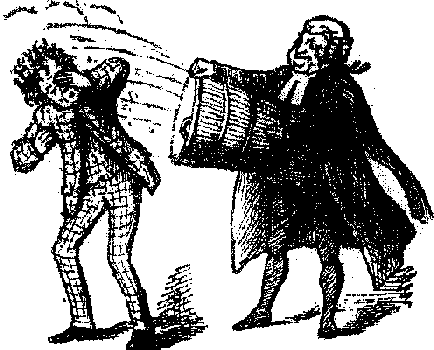
SAID I TO MYSELF, SAID I.
(Said I to myself—said I),
I'll work on a new and original plan
(Said I to myself—said I),
I'll never assume that a rogue or a thief
Is a gentleman worthy implicit belief,
Because his attorney has sent me a brief
(Said I to myself—said I!).
(Said I to myself—said I),
Or hoodwink a judge who is not over-wise
(Said I to myself—said I),
Or assume that the witnesses summoned in force
In Exchequer, Queen's Bench, Common Pleas, or Divorce,
Have perjured themselves as a matter of course
(Said I to myself—said I).
(Said I to myself—said I),
And I'll never take work I'm unable to do
(Said I to myself—said I).
My learned profession I'll never disgrace
By taking a fee with a grin on my face,
When I haven't been there to attend to the case
(Said I to myself—said I!).
(Said I to myself—said I),
The Army, the Navy, the Church, and the Stage
(Said I to myself—said I),
Professional license, if carried too far,
Your chance of promotion will certainly mar
And I fancy the rule might apply to the Bar
(Said I to myself—said I!).
THE FAMILY FOOL.
If you listen to popular rumor;
From morning to night he's so joyous and bright,
And he bubbles with wit and good-humor!
He's so quaint and so terse, both in prose and in verse;
Yet though people forgive his transgression,
There are one or two rules that all Family Fools
Must observe, if they love their profession.
There are one or two rules
Half a dozen, maybe,
That all family fools,
Of whatever degree,
Must observe, if they love their profession.
To consider each person auricular:
What is all right for B would quite scandalize C
(For C is so very particular);
And D may be dull, and E's very thick skull
Is as empty of brains as a ladle;
While F is F sharp, and will cry with a carp,
That he's known your best joke from his cradle!
When your humor they flout,
You can't let yourself go;
And it does put you out
When a person says, "Oh!
I have known that old joke from my cradle!"
(And tempers are short in the morning),
An inopportune joke is enough to provoke
Him to give you, at once, a month's warning
Then if you refrain, he is at you again,
For he likes to get value for money.
He'll ask then and there, with an insolent stare,
If you know that you're paid to be funny?"
It adds to the task
Of a merryman's place,
When your principal asks,
With a scowl on his face,
If you know that you're paid to be funny?"
Oh, beware of his anger provoking!
Better not pull his hair—don't stick pins in his chair;
He don't understand practical joking.
If the jests that you crack have an orthodox smack,
You may get a bland smile from these sages;
But should it, by chance, be imported from France,
Half-a-crown is stopped out of your wages!
It's a general rule,
Though your zeal it may quench,
If the Family Fool
Makes a joke that's too French,
Half-a-crown is stopped out of his wages!
And your senses with toothache you're losing,
Don't be mopy and flat—they don't fine you for that,
If you're properly quaint and amusing!
Though your wife ran away with a soldier that day,
And took with her your trifle of money;
Bless your heart, they don't mind—they're exceedingly kind—
They don't blame you—as long as you're funny!
It's a comfort to feel
If your partner should flit,
Though you suffer a deal,
They don't mind it a bit—
They don't blame you—so long as you're funny!
THE PHILOSOPHIC PILL.
That's subject to no academic rule:
You may find it in the jeering of a jest,
Or distil it from the folly of a fool.
I can teach you with a quip, if I've a mind!
I can trick you into learning with a laugh;
Oh, winnow all my folly, and you'll find
A grain or two of truth among the chaff!
The upstart I can wither with a whim;
He may wear a merry laugh upon his lip,
But his laughter has an echo that is grim.
When they're offered to the world in merry guise,
Unpleasant truths are swallowed with a will—
For he who'd make his fellow creatures wise
Should always gild the philosophic pill!
THE CONTEMPLATIVE SENTRY.
On sentry-go, to chase monotony
He exercises of his brains,
That is, assuming that he's got any,
Though never nurtured in the lap
Of luxury, yet I admonish you,
I am an intellectual chap,
And think of things that would astonish you.
I often think it's comical
How Nature always does contrive
That every boy and every gal
That's born into the world alive
Is either a little Liberal,
Or else a little Conservative!
Fal lal la!
If they've a brain and cerebellum, too.
They're got to leave that brain outside.
And vote just as their leaders tell 'em to.
But then the prospect of a lot
Of statesmen, all in close proximity.
A-thinking for themselves, is what
No man can face with equanimity.
Then let's rejoice with loud Fal lal
That Nature wisely does contrive
That every boy and every gal
That's born into the world alive,
Is either a little Liberal,
Or else a little Conservative!
Fal lal la!
SORRY HER LOT.
Heavy the heart that hopes but vainly,
Had are the sighs that own the spell
Uttered by eyes that speak too plainly;
Heavy the sorrow that bows the head
When Love is alive and Hope is dead!
Dark is the night to Earth's poor daughters
When to the ark the wearied one
Flies from the empty waste of waters!
Heavy the sorrow that bows the head
When Love is alive and Hope is dead!
THE JUDGE'S SONG.
I'd an appetite fresh and hearty,
But I was, as many young barristers are,
An impecunious party.
I'd a swallow-tail coat of a beautiful blue—
A brief which I bought of a booby—
A couple of shirts and a collar or two,
And a ring that looked like a ruby!
Like a semi-despondent fury;
For I thought I should never hit on a chance
Of addressing a British Jury—
But I soon got tired of third class journeys,
And dinners of bread and water;
So I fell in love with a rich attorney's
Elderly, ugly daughter.
And replied to my fond professions:
"You shall reap the reward of your enterprise,
At the Bailey and Middlesex Sessions.
You'll soon get used to her looks," said he,
"And a very nice girl you'll find her—
She may very well pass for forty-three
In the dusk, with a light behind her!"
The briefs came trooping gaily,
And every day my voice was heard
At the Sessions or Ancient Bailey.
All thieves who could my fees afford
Relied on my orations,
And many a burglar I've restored
To his friends and his relations.
An incubus then I thought her,
So I threw over that rich attorney's
Elderly, ugly daughter.
The rich attorney my character high
Tried vainly to disparage—
And now, if you please, I'm ready to try
This Breach of Promise of Marriage!
TRUE DIFFIDENCE.
That of all the afflictions accurst
With which a man's saddled
And hampered and addled,
diffident nature's the worst.
Though clever as clever can be—
A Crichton of early romance—
You must stir it and stump it,
And blow your own trumpet,
Or, trust me, you haven't a chance.
I've a bright intellectual brain—
In all London city
There's no one so witty—
I've thought so again and again.
I've a highly intelligent face—
My features cannot be denied—
But, whatever I try, sir,
I fail in—and why, sir?
I'm modesty personified!
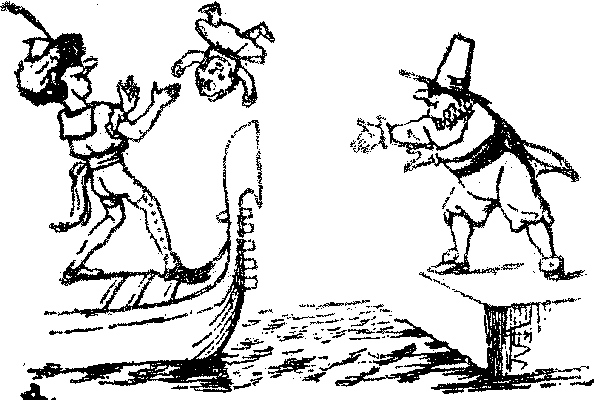
THE HIGHLY RESPECTABLE GONDOLIER.
And left him, gaily prattling
With a highly respectable Gondolier,
Who promised the Royal babe to rear,
And teach him the trade of a timoneer
With his own beloved bratling.
And, considering all things, clever.
Of that there is no manner of doubt—
No probable, possible shadow of doubt—
No possible doubt whatever.
I sought that infant cherished,
That highly respectable Gondolier
Was lying a corpse on his humble bier—
I dropped a Grand Inquisitor's tear—
That Gondolier had perished.
Had doubled him up for ever.
Of that there is no manner of doubt—
No probable, possible shadow of doubt—
No possible doubt whatever.
To his terrible taste for tippling,
That highly respectable Gondolier
Could never declare with a mind sincere
Which of the two was his offspring dear,
And which the Royal stripling!
Despite his best endeavour.
Of that there is no manner of doubt—
No probable, possible shadow of doubt—
No possible doubt whatever.
(This statement can't be parried)
Of a highly respectable Gondolier:
Well, one of the two (who will soon be here)—
But which of the two is not quite clear—
Is the Royal Prince you married!
And you'll discover never
A tale so free from every doubt—
All probable, possible shadow of doubt—
All possible doubt whatever!
DON'T FORGET.
My wishes hear:
While you're away
It's understood
You will be good,
And not too gay.
To every trace
Of maiden grace
You will be blind,
And will not glance
By any chance
On womankind!
If you are wise,
You'll shut your eyes
'Till we arrive,
And not address
A lady less
Than forty-five;
You'll please to frown
On every gown
That you may see;
And O, my pet,
You won't forget
You've married me!
Whatever else you may forget,
In yonder isle beyond the sea,
O, don't forget you've married me!
Upon your bed
At set of sun.
You will not sing
Of anything
To any one:
You'll sit and mope
All day, I hope,
And shed a tear
Upon the life
Your little wife
Is passing here!
And if so be
You think of me,
Please tell the moon:
I'll read it all
In rays that fall
On the lagoon:
You'll be so kind
As tell the wind
How you may be,
And send me words
By little birds
To comfort me!
Whatever else you may forget,
In yonder isle beyond the sea,
O, don't forget you've married me!
THE DARNED MOUNSEER.
And, off Cape Finistere,
A merchantman we see,
A Frenchman, going free,
So we made for the bold Mounseer.
D'ye see?
We made for the bold Mounseer!
But she proved to be a Frigate—and she up with her ports,
And fires with a thirty-two!
It come uncommon near,
But we answered with a cheer,
Which paralyzed the Parley-voo,
D'ye see?
Which paralyzed the Parley-voo!
"That chap we need not fear,—
We can take her, if we like,
She is sartin for to strike,
For she's only a darned Mounseer,
D'ye see?
She's only a darned Mounseer!
But to fight a French fal-lal—it's like hittin' of a gal—
It's a lubberly thing for to do;
For we, with all our faults,
Why, we're sturdy British salts,
While she's but a Parley-voo,
D'ye see?
A miserable Parley-voo!"
As we gives a compassionating cheer;
Froggee answers with a shout
As he sees us go about,
Which was grateful of the poor Mounseer,
D'ye see?
Which was grateful of the poor Mounseer!
And I'll wager in their joy they kissed each other's cheek
(Which is what them, furriners do),
And they blessed their lucky stars?
We were hardy British tars
Who had pity on a poor Parley-voo,
D'ye see?
Who had pity on a poor Parley-voo!
THE HUMANE MIKADO.
Did in Japan exist,
To nobody second,
I'm certainly reckoned
A true philanthropist,
It is my very humane endeavor
To make, to some extent,
Each evil liver
A running river
Of harmless merriment.
My object all sublime
I shall achieve in time—
To let the punishment fit the crime—
The punishment fit the crime;
And make each prisoner pent
Unwillingly represent
A source of innocent merriment,
Of innocent merriment!
Who chatter and bleat and bore,
Are sent to hear sermons
From mystical Germans
Who preach from ten to four,
The amateur tenor, whose vocal villanies
All desire to shirk,
Shall, during off hours,
Exhibit his powers
To Madame Tussaud's waxwork.
The lady who dyes a chemical yellow,
Or stains her grey hair puce,
Or pinches her figger,
Is blacked like a nigger
With permanent walnut juice.
The idiot who, in railway carriages,
Scribbles on window panes,
We only suffer
To ride on a buffer
In Parliamentary trains.
My object all sublime
I shall achieve in time—
To let the punishment fit the crime—
The punishment fit the crime;
And make each prisoner pent
Unwillingly represent
A source of innocent merriment,
Of innocent merriment!
With tales of countless cures.
His teeth, I've enacted,
Shall all be extracted
By terrified amateurs.
The music hall singer attends a series
Of masses and fugues and "ops"
By Bach, interwoven
With Sophr and Beethoven,
At classical Monday Pops.
The billiard sharp whom any one catches,
His doom's extremely hard—
He's made to dwell
In a dungeon cell
On a spot that's always barred.
And there he plays extravagant matches
In fitless finger-stalls,
On a cloth untrue
With a twisted cue,
And elliptical billiard balls!
I shall achieve in time—
To let the punishment fit the crime—
The punishment fit the crime;
And make each prisoner pent
Unwillingly represent
A source of innocent merriment,
Of innocent merriment!
THE HOUSE OF PEERS.
(In good Queen Bess's time)
The House of Peers made no pretence
To intellectual eminence,
Or scholarship sublime;
Yet Britain won her proudest bays
In good Queen Bess's glorious days!
As every child can tell,
The House of Peers, throughout the war,
Did nothing in particular,
And did it very well;
Yet Britain set the world a-blaze
In good King George's glorious days!
Its legislative hand.
And noble statesmen do not itch
To interfere with matters which
They do not understand,
As bright will shine Great Britain's rays,
As in King George's glorious days!
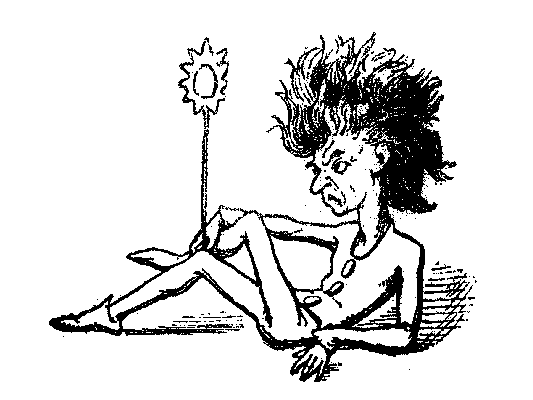
THE ÆSTHETE.
You must get up all the germs of the transcendental terms, and plant them everywhere.
You must lie upon the daisies and discourse in novel phrases of your complicated state of mind,
The meaning doesn't matter if it's only idle chatter of a transcendental kind.
And everyone will say,
As you walk your mystic way,
"If this young man expresses himself in terms too deep for me,
Why, what a very singularly deep young man this deep young man must be!"
And convince 'em if you can, that the reign of good Queen Anne was Culture's palmiest day.
Of course you will pooh-pooh whatever's fresh and new, and declare it's crude and mean,
And that art stopped short in the cultivated court of the Empress Josephine,
And everyone will say,
As you walk your mystic way,
"If that's not good enough for him which is good enough for me,
Why, what a very cultivated kind of youth this kind of youth must be!"
An attachment a la Plato for a bashful young potato, or a not-too-French French bean.
Though the Philistines may jostle, you will rank as an apostle in the high æsthetic band,
If you walk down Picadilly with a poppy or a lily in your mediæval hand.
And everyone will say,
As you walk your flowery way,
"If he's content with a vegetable love which would certainly not suit me,
Why, what a most particularly pure young man this pure young man must be!"
PROPER PRIDE.
Are all ablaze
With ever living glory,
Does not deny
His majesty—
He scorns to tell a story!
He don't exclaim
"I blush for shame,
So kindly be indulgent,"
But, fierce and bold,
In fiery gold,
He glories all effulgent!
As he the sky—
We really know our worth,
The Sun and I!
That placid dame,
The Moon's Celestial Highness;
There's not a trace
Upon her face
Of diffidence or shyness:
She borrows light
That, through the night,
Mankind may all acclaim her!
And, truth to tell,
She lights up well,
So I, for one, don't blame her!
We are not shy;
We're very wide awake,
The Moon and I!
THE BAFFLED GRUMBLER.
Sarcastic joke
Replete with malice spiteful,
The people vile
Politely smile
And vote me quite delightful!
Now, when a wight
Sits up all night
Ill-natured jokes devising,
And all his wiles
Are met with smiles,
It's hard, there's no disguising!
Oh, don't the days seem lank and long
When all goes right and nothing goes wrong,
And isn't your life extremely flat
With nothing whatever to grumble at!
From music stands
Play Wagner imperfectly—
I bid them go—
They don't say no,
But off they trot directly!
The organ boys
They stop their noise
With readiness surprising,
And grinning herds
Of hurdy-gurds
Retire apologizing!
Oh, don't the days seem lank and long
When all goes right and nothing goes wrong,
And isn't your life extremely flat
With nothing whatever to grumble at!
In sums untold,
To all who'd contradict me—
I've said I'd pay
A pound a day
To any one who kicked me—
I've bribed with toys
Great vulgar boys
To utter something spiteful,
But, bless you, no!
They will be so
Confoundedly politeful!
In short, these aggravating lads
They tickle my tastes, they feed my fads,
They give me this and they give me that,
And I've nothing whatever to grumble at!
THE WORKING MONARCH.
We proceed to light our fire;
Then our Majesty adorning
In its work-a-day attire,
We embark without delay
On the duties of the day.
Of political dispatches,
And foreign politicians circumvent;
Then, if business isn't heavy,
We may hold a Royal levee,
Or ratify some acts of Parliament;
Then we probably review the household troops—
With the usual "Shalloo humps!" and "Shalloo hoops!"
Or receive with ceremonial and state
An interesting Eastern Potentate,
After that we generally
Go and dress our private valet—
(It's rather a nervous duty—he's a touchy little man)
Write some letters literary
For our private secretary—
He is shaky in his spelling, so we help him if we can.
Then, in view of cravings inner,
We go down and order dinner;
Or we polish the Regalia and the Coronation Plate—
Spend an hour in titivating
All our Gentlemen-in-Waiting;
Or we run on little errands for the Ministers of State.
Oh, philosophers may sing
Of the troubles of a King;
Yet the duties are delightful, and the privileges great;
But the privilege and pleasure
That we treasure beyond measure
Is to run on little errands for the Ministers of State!
On a bun and glass of sherry),
If we've nothing particular to do,
We may make a Proclamation,
Or receive a Deputation—
Then we possibly create a Peer or two.
Then we help a fellow creature on his path
With the Garter or the Thistle or the Bath:
Or we dress and toddle off in semi-State
To a festival, a function, or a fete.
Then we go and stand as sentry
At the Palace (private entry),
Marching hither, marching thither, up and down and to and fro,
While the warrior on duty
Goes in search of beer and beauty
(And it generally happens that he hasn't far to go).
He relieves us, if he's able,
Just in time to lay the table,
Then we dine and serve the coffee; and at half-past twelve or one,
With a pleasure that's emphatic,
We retire to our attic
With the gratifying feeling that our duty has been done.
Oh, philosophers may sing
Of the troubles of a King,
But of pleasures there are many and of troubles there are none;
And the culminating pleasure
That we treasure beyond measure
Is the gratifying feeling that our duty has been done!
THE ROVER'S APOLOGY.
Though I own that my heart has been ranging,
Of nature the laws I obey,
For nature is constantly changing.
The moon in her phases is found,
The time and the wind and the weather,
The months in succession come round,
And you don't find two Mondays together.
Consider the moral, I pray,
Nor bring a young fellow to sorrow,
Who loves this young lady to-day,
And loves that young lady to-morrow.
Nor is it the act of a sinner,
When breakfast is taken away
To turn your attention to dinner;
And it's not in the range of belief,
That you could hold him as a glutton,
Who, when he is tired of beef,
Determines to tackle the mutton.
But this I am ready to say,
If it will diminish their sorrow,
I'll marry this lady to-day,
And I'll marry that lady to-morrow!
WOULD YOU KNOW?
Sets my heart a flame-a?
Eyes must be downcast and staid,
Cheeks must flush for shame-a!
She may neither dance nor sing,
But, demure in everything,
Hang her head in modest way,
With pouting lips that seem to say
"Kiss me, kiss me, kiss me, kiss me,
Though I die of shame-a."
Please you, that's the kind of maid
Sets my heart a flame-a!
With a tongue goes clang-a,
Flaunting it in brave array,
Maiden may go hang-a!
Sunflower gay and hollyhock
Never shall my garden stock;
Mine the blushing rose of May,
With pouting lips that seem to say,
"Oh, kiss me, kiss me, kiss me, kiss me,
Though I die for shame-a!"
Please you, that's the kind of maid
Sets my heart a flame-a!
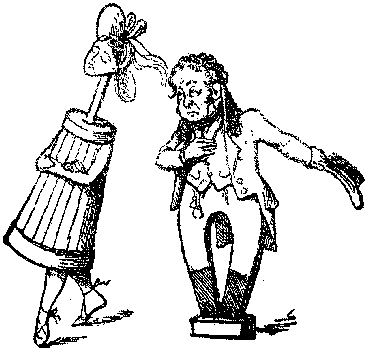
THE MAGNET AND THE CHURN.
And all around was a loving crop
Of scissors and needles, nails and knives,
Offering love for all their lives;
But for iron the magnet felt no whim,
Though he charmed iron, it charmed not him,
From needles and nails and knives he'd turn,
For he'd set his love on a Silver Churn!
His most æsthetic,
Very magnetic
Fancy took this turn—
"If I can wheedle
A knife or needle,
Why not a Silver Churn?"
The needles opened their well drilled eyes,
The pen-knives felt "shut up," no doubt,
The scissors declared themselves "cut out."
The kettles they boiled with rage, 'tis said,
While every nail went off its head,
And hither and thither began to roam,
Till a hammer came up—and drove it home,
While this magnetic
Peripatetic
Lover he lived to learn,
By no endeavor,
Can Magnet ever
Attract a Silver Churn!
BRAID THE RAVEN HAIR.
Weave the supple tress,
Deck the maiden fair
In her loveliness;
Paint the pretty face,
Dye the coral lip.
Emphasize the grace
Of her ladyship!
Art and nature, thus allied,
Go to make a pretty bride!
Let it brim with dew;
Try if you can cry,
We will do so, too.
When you're summoned, start
Like a frightened roe;
Flutter, little heart,
Color, come and go!
Modesty at marriage tide
Well becomes a pretty bride!
IS LIFE A BOON?
If so? it must befal
That Death, whene'er he call,
Must call too soon.
Though fourscore years he give,
Yet one would pray to live
Another moon!
What kind of plaint have I,
Who perish in July?
I might have had to die,
Perchance, in June!
Then count it not a whit!
Man is well done with it;
Soon as he's born
He should all means essay
To put the plague away:
And I, war-worn,
Poor captured fugitive,
My life most gladly give—
I might have had to live
Another morn!
A MIRAGE.
Then the whole world beside
Were not too wide
To hold my wealth of love—
Were I thy bride!
Upon thy breast
My loving head would rest,
As on her nest
The tender turtle dove—
Were I thy bride!
Would be one heart with thine,
And in that shrine
Our happiness would dwell—
Were I thy bride!
And all day long
Our lives should be a song:
No grief, no wrong
Should make my heart rebel—
Were I thy bride!
The melancholy lute,
Were night owl's hoot
To my low-whispered coo—
Were I thy bride!
The skylark's trill
Were but discordance shrill
To the soft thrill
Of wooing as I'd woo—
Were I thy bride!
Were as a carrion's cry
To lullaby
Such as I'd sing to thee,
Were I thy bride!
A feather's press
Were leaden heaviness
To my caress.
But then, unhappily,
I'm not thy bride!
A MERRY MADRIGAL.
Joyous hour, we give thee greeting!
Whither, whither art thou fleeting?
Fickle moment, prithee stay!
What though mortal joys be hollow?
Pleasures come, if sorrows follow:
Though the tocsin sound, ere long,
Ding dong! Ding dong!
Yet until the shadows fall
Over one and over all,
Sing a merry madrigal—
Fal la!
Though the hours are surely creeping,
Little need for woeful weeping,
Till the sad sundown is near.
All must sip the cup of sorrow—
I to-day and thou to-morrow:
This the close of every song—
Ding dong! Ding dong!
What, though solemn shadows fall,
Sooner, later, over all?
Sing a merry madrigal—
Fal la!
THE LOVE-SICK BOY.
My bosom welled with joy;
My riches at her feet I threw;
I was a love-sick boy!
No terms seemed too extravagant
Upon her to employ—
I used to mope, and sigh, and pant,
Just like a love-sick boy!
And love, unchanged will cloy,
And she became a bore intense
Unto her love-sick boy!
With fitful glimmer burnt my flame,
And I grew cold and coy,
At last, one morning, I became
Another's love-sick boy!
HENRY ALTEMUS' PUBLICATIONS.
PHILADELPHIA. PA.
STEPHEN. A SOLDIER OF THE CROSS, by Florence Morse Kingsley, author of "Titus, a Comrade of the Cross." "Since Ben-Hur no story has so vividly portrayed the times of Christ."—The Bookseller. Cloth, 12mo., 369 pages. $1.25.
PAUL. A HERALD OF THE CROSS, by Florence Morse Kingsley, "A vivid and picturesque narrative of the life and times of the great Apostle." Cloth, ornamental, 12mo., 450 pages, $1.50.
VIC. THE AUTOBIOGRAPHY OF A FOX TERRIER, by Marie More Marsh. "A fitting companion to that other wonderful book, 'Black Beauty.'" Cloth, 12mo., 50 cents.
WOMAN'S WORK IN THE HOME, by Archdeacon Farrar. Cloth, small 18mo., 50 cents.
THE APOCRYPHAL BOOKS OF THE NEW TESTAMENT, being the gospels and epistles used by the followers of Christ in the first three centuries after his death, and rejected by the Council of Nice, A.D. 325. Cloth, 8vo., illustrated, $2.00.
THE PILGRIM'S PROGRESS, as John Bunyan wrote it. A fac-simile reproduction of the first edition, published in 1678. Antique cloth, 12mo., $1.25.
THE FAIREST OF THE FAIR, by Hildegarde Hawthorne. "The grand-daughter of Nathaniel Hawthorne possesses a full share of his wonderful genius." Cloth, 16mo., $1.25.
A LOVER IN HOMESPUN, by F. Clifford Smith. Interesting tales of adventure and home life in Canada. Cloth, 12mo., 75 cents.
ANNIE BESANT: AN AUTOBIOGRAPHY. Cloth, 12mo., 368 pages, illustrated. $2.00.
THE GRAMMAR OF PALMISTRY, by Katharine St. Hill. Cloth, 12mo., illustrated, 75 cents.
AROUND THE WORLD IN EIGHTY MINUTES. Contains over 100 photographs of the most famous places and edifices with descriptive text. Cloth, 50 cents.
WHAT WOMEN SHOULD KNOW. A woman's book about women. By Mrs. E.B. Duffy. Cloth, 320 pages, 75 cents.
THE CARE OF CHILDREN, by Elisabeth R. Scovil. "An excellent book of the most vital interest," Cloth, 12mo., $1.00.
PREPARATION FOR MOTHERHOOD, by Elisabeth R. Scovil. Cloth, 12mo., 320 pages, $1.00.
ALTEMUS' CONVERSATION DICTIONARIES. English-German, English-French. "Combined dictionaries and phrase books." Pocket size, each $1.00.
TAINE'S ENGLISH LITERATURE, translated from the French by Henry Van Laun, illustrated with 20 fine photogravure portraits. Best English library edition, four volumes, cloth, full gilt, octavo, per set, $10.00. Half calf, per set, $12.50. Cheaper edition, with frontispiece illustrations only, cloth, paper titles, per set $7.50.
SHAKESPEARE'S COMPLETE WORKS, with a biographical sketch by Mary Cowden Clark, embellished with 64 Boydell, and numerous other illustrations, four volumes, over 2000 pages. Half Morocco, 12mo., boxed, per set, $3.00.
DORE'S MASTERPIECES
THE DORE BIBLE GALLERY. A complete panorama of Bible History, containing 100 full-page engravings by Gustave Dore.
MILTON'S PARADISE LOST, with 50 full-page engravings by Gustave Dore.
DANTE'S INFERNO, with 75 full-page engravings by Gustave Dore.
DANTE'S PURGATORY AND PARADISE, with 60 full-page engravings by Gustave Dore.
TENNYSON'S IDYLLS OF THE KING, with 37 full-page engravings by Gustave Dore. Cloth, full gilt, large imperial quarto (11 x 14-1/2 inches), $4.50.
THE RIME OF THE ANCIENT MARINER, by Samuel Taylor Coleridge, with 46 full page engravings by Gustave Dore. Cloth, full gilt, large imperial quarto (11 x 14-1/2 inches), $3.00.
BUNYAN'S PILGRIM'S PROGRESS, with 100 engravings by Frederick Barnard and others. Cloth, small quarto (9 x 10 inches), $1.00.
DICKENS' CHILD'S HISTORY OF ENGLAND, with 75 fine engravings by famous artists. Cloth, small quarto, boxed (9 x 10 inches), $1.00.
BIBLE PICTURES AND STORIES, 100 full page engravings. Cloth, small quarto (7 x 9 inches), $1.00.
MY ODD LITTLE FOLK, some rhymes and verses about them, by Malcolm Douglass. Numerous original engravings. Cloth, small quarto (7 x 9), $1.00.
PAUL AND VIRGINIA, by Bernardin St. Pierre, with 125 engravings by Maurice Leloir. Cloth, small quarto (9 x 10), $1.00.
LIFE AND ADVENTURES OF ROBINSON CRUSOE, with 120 original engravings by Walter Paget. Cloth, octavo (7-1/2 x 9-3/4), $1.50.
ALTEMUS' ILLUSTRATED LIBRARY OF STANDARD AUTHORS.
TALES FROM SHAKESPEARE, by Charles and Mary Lamb, with 155 illustrations by famous artists.
PAUL AND VIRGINIA, by Bernardin de St. Pierre, with 125 engravings by Maurice Leloir.
ALICE'S ADVENTURES IN WONDERLAND, AND THROUGH THE LOOKING-GLASS AND WHAT ALICE FOUND THERE, by Lewis Carroll. Complete in one volume with 92 engravings by John Tenniel.
LUCILE, by Owen Meredith, with numerous illustrations by George Du Maurier.
BLACK BEAUTY, by Anna Sewell, with nearly 50 original engravings.
SCARLET LETTER, by Nathaniel Hawthorne, with numerous original full-page and text illustrations.
THE HOUSE OF THE SEVEN GABLES, by Nathaniel Hawthorne, with numerous original full-page and text illustrations.
BATTLES OF THE WAR FOR INDEPENDENCE, by Prescott Holmes, with 7 illustrations.
BATTLES OF THE WAR FOR THE UNION, by Prescott Holmes, with 80 illustrations.
ALTEMUS' YOUNG PEOPLES' LIBRARY
ROBINSON CRUSOE: (Chiefly in words of one syllable). His life and strange, surprising adventures, with 70 beautiful illustrations by Walter Paget.
ALICE'S ADVENTURES IN WONDERLAND, with 49 illustrations by John Tenniel. "The most delightful of children's stories. Elegant and delicious nonsense."—Saturday Review.
THROUGH THE LOOKING-GLASS AND WHAT ALICE FOUND THERE, a companion to "Alice in Wonderland," with 50 illustrations by John Tenniel.
BUNYAN'S PILGRIM'S PROGRESS, with 50 full page and text illustrations.
A CHILD'S STORY OF THE BIBLE, with 72 full page illustrations.
A CHILD'S LIFE OF CHRIST, with 49 illustrations. God has implanted in the infant heart a desire to hear of Jesus, and children are early attracted and sweetly riveted by the wonderful Story of the Master from the Manger to the Throne.
SWISS FAMILY ROBINSON, with 50 illustrations. The father of the family tells the tale of the vicissitudes through which he and his wife and children pass, the wonderful discoveries made and dangers encountered. The book is full of interest and instruction.
CHRISTOPHER COLUMBUS AND THE DISCOVERY OF AMERICA, with 70 illustrations Every American boy and girl should be acquainted with the story of the life of the great discoverer, with its struggles, adventures, and trials.
THE STORY OF EXPLORATION AND DISCOVERY IN AFRICA, with 80 illustrations. Records the experiences of adventures and discoveries in developing the "Dark Continent," from the early days of Bruce and Mungo Park down to Livingstone and Stanley, and the heroes of our own times. No present can be more acceptable than such a volume as this, where courage, intrepidity, resource, and devotion are so admirably mingled.
THE FABLES OF ÆSOP. Compiled from the best accepted sources. With 62 illustrations. The fables of Æsop are among the very earliest compositions of this kind, and probably have never been surpassed for point and brevity.
GULLIVER'S TRAVELS. Adapted for young readers. With 50 illustrations.
MOTHER GOOSE'S RHYMES, JINGLES AND FAIRY TALES, with 234 illustrations.
LIVES OF THE PRESIDENTS OF THE UNITED STATES, by Prescott Holmes. With portraits of the Presidents and also of the unsuccessful candidates for the office; as well as the ablest of the Cabinet officers. It is just the book for intelligent boys, and it will help to make them intelligent and patriotic citizens.
THE STORY OF ADVENTURE IN THE FROZEN SEAS, with 70 illustrations. By Prescott Holmes. We have here brought together the records of the attempts to reach the North Pole. The book shows how much can be accomplished by steady perseverance and indomitable pluck.
ILLUSTRATED NATURAL HISTORY, by the Rev. J.G. Wood, with 80 illustrations. This author has done more to popularize the study of natural history than any other writer. The illustrations are striking and life-like.
A CHILD'S HISTORY OF ENGLAND, by Charles Dickens, with 50 illustrations. Tired of listening to his children memorize the twaddle of old fashioned English history the author covered the ground in his own peculiar and happy style for his own children's use. When the work was published its success was instantaneous.
BLACK BEAUTY, THE AUTOBIOGRAPHY OF A HORSE, by Anna Sewell, with 50 illustrations. A work sure to educate boys and girls to treat with kindness all members of the animal kingdom. Recognized as the greatest story of animal life extant.
THE ARABIAN NIGHTS ENTERTAINMENTS, with 130 illustrations. Contains the most favorably known of the stories.
ALTEMUS' DEVOTIONAL SERIES.
1 KEPT FOR THE MASTER'S USE, by Frances Ridley Havergal. "Will perpetuate her name."
2 MY KING AND HIS SERVICE, OR DAILY THOUGHTS FOR THE KING'S CHILDREN, by Frances Ridley Havergal. "Simple, tender, gentle, and full of Christian love."
3 MY POINT OF VIEW. Selections from the works of Professor Henry Drummond.
4 OF THE IMITATION OF CHRIST, by Thomas A'Kempis. "With the exception of the Bible it is probably the book most read in Christian literature."
5 ADDRESSES, by Professor Henry Drummond. "Intelligent sympathy with the Christian's need."
6 NATURAL LAW IN THE SPIRITUAL WORLD, by Professor Henry Drummond. "A most notable book which has earned for the author a world-wide reputation."
7 ADDRESSES, by the Rev. Phillips Brooks. "Has exerted a marked influence over the rising generation."
8 ABIDE IN CHRIST. Thoughts on the Blessed Life of Fellowship with the Son of God. By the Rev. Andrew Murray. It cannot fail to stimulate and cheer.—Spurgeon.
9 LIKE CHRIST. Thoughts on the Blessed Life of Conformity to the Son of God. By the Rev. Andrew Murray. A sequel to "Abide in Christ." "May be read with comfort an edification by all."
10 WITH CHRIST IN THE SCHOOL OF PRAYER, by the Rev. Andrew Murray. "The best work on prayer in the language."
11 HOLY IN CHRIST. Thoughts on the Calling of God's Children to be holy as He is Holy. By the Rev. Andrew Murray. "This sacred theme is treated Scripturally and robustly without spurious sentimentalism."
12 THE MANLINESS OF CHRIST, by Thomas Hughes, author of "Tom Brown's School Days," etc. "Evidences of the sublimest courage and manliness in the boyhood, ministry, and in the last acts of Christ's life."
13 ADDRESSES TO YOUNG MEN, by the Rev. Henry Ward Beecher. Seven Addresses on common vices and their results.
14 THE PATHWAY OF SAFETY, by the Rt. Rev. Ashton Oxenden, D.D. Sound words of advice and encouragement on the text "What must I do to be saved?"
15 THE CHRISTIAN LIFE, by the Rt. Rev. Ashton Oxenden, D.D. A beautiful delineation of an ideal life from the conversion to the final reward.
16 THE THRONE OF GRACE. Before which the burdened soul may cast itself on the bosom of infinite love and enjoy in prayer "a peace which passeth all understanding."
17 THE PATHWAY OF PROMISE, by the author of "The Throne of Grace." Thoughts consolatory and encouraging to the Christian pilgrim as he journeys onward to his heavenly home.
18 THE IMPREGNABLE ROCK OF HOLY SCRIPTURE, by the Rt. Hon William Ewart Gladstone, M.P. The most masterly defence of the truths of the Bible extant. The author says: The Christian Faith and the Holy Scriptures arm us with the means of neutralizing and repelling the assaults of evil in and from ourselves.
19 STEPS INTO THE BLESSED LIFE, by the Rev. F.B. Meyer, B.A. A powerful help towards sanctification.
20 THE MESSAGE OF PEACE, by the Rev. Richard W. Church, D.D. Eight excellent sermons on the advent of the Babe of Bethlehem and his influence and effect on the world.
21 JOHN PLOUGHMAN'S TALK, by the Rev. Charles H. Spurgeon.
22 JOHN PLOUGHMAN'S PICTURES, by the Rev. Charles H. Spurgeon.
23 THE CHANGED CROSS; AND OTHER RELIGIOUS POEMS.
ALTEMUS' ETERNAL LIFE SERIES.
1 ETERNAL LIFE, by Professor Henry Drummond.
2 LORD, TEACH US TO PRAY, by Rev. Andrew Murray.
3 GOD'S WORD AND GOD'S WORK, by Martin Luther.
4 FAITH, by Thomas Arnold.
5 THE CREATION STORY, by Honorable William E. Gladstone.
6 THE MESSAGE OF COMFORT, by Rt. Rev. Ashton Oxenden.
7 THE MESSAGE OF PEACE, by Rev. R.W. Church.
8 THE LORD'S PRAYER AND THE TEN COMMANDMENTS, by Dean Stanley.
9 THE MEMOIRS OF JESUS, by Rev. Robert F. Horton.
10 HYMNS OF PRAISE AND GLADNESS, by Elisabeth R. Scovil.
11 DIFFICULTIES, by Hannah Whitall Smith.
12 GAMBLERS AND GAMBLING, by Rev. Henry Ward Beecher.
13 HAVE FAITH IN GOD, by Rev. Andrew Murray.
14 TWELVE CAUSES OF DISHONESTY, by Rev. Henry Ward Beecher.
15 THE CHRIST IN WHOM CHRISTIANS BELIEVE, by Rt. Rev. Phillips Brooks.
16 IN MY NAME, by Rev. Andrew Murray.
17 SIX WARNINGS, by Rev. Henry Ward Beecher.
18 THE DUTY OF THE CHRISTIAN BUSINESSMAN, by Rt. Rev. Phillips Brooks.
19 POPULAR AMUSEMENTS, by Rev. Henry Ward Beecher.
20 TRUE LIBERTY, by Rt. Rev. Phillips Brooks.
21 INDUSTRY AND IDLENESS, by Rev. Henry Ward Beecher.
22 THE BEAUTY OF A LIFE OF SERVICE, by Rt. Rev. Phillips Brooks.
23 THE SECOND COMING OF OUR LORD, by Rev. A.T. Pierson, D.D.
24 THOUGHT AND ACTION, by Rt. Rev. Phillips Brooks.
25 THE HEAVENLY VISION, by Rev. F.B. Meyer.
26 MORNING STRENGTH, by Elisabeth R. Scovil.
27 FOR THE QUIET HOUR, by Edith V. Bradt.
28 EVENING COMFORT, by Elisabeth R. Scovil.
29 WORDS OF HELP FOR CHRISTIAN GIRLS, by Rev. F.B. Meyer.
30 HOW TO STUDY THE BIBLE, by Rev. Dwight L. Moody.
31 EXPECTATION CORNER, by E.S. Elliot.
32 JESSICA'S FIRST PRAYER, by Hesba Stratton.
ALTEMUS BELLES-LETTRES SERIES.
1 INDEPENDENCE DAY, by Rev. Edward E. Hale.
2 THE SCHOLAR IN POLITICS, by Hon. Richard Olney.
3 THE YOUNG MAN IN BUSINESS, by Edward W. Bok.
4 THE YOUNG MAN AND THE CHURCH, by Edward W. Bok.
5 THE SPOILS SYSTEM, by Hon. Carl Schurz.
6 CONVERSATION, by Thomas DeQuincey.
7 SWEETNESS AND LIGHT, by Matthew Arnold.
8 WORK, by John Ruskin.
9 NATURE AND ART, by Ralph Waldo Emerson.
10 THE USE AND MISUSE OF BOOKS, by Frederic Harrison.
11 THE MONROE DOCTRINE: ITS ORIGIN, MEANING AND APPLICATION, by Prof. John Bach McMaster (University of Pennsylvania).
12 THE DESTINY OF MAN, by Sir John Lubbock.
13 LOVE AND FRIENDSHIP, by Ralph Waldo Emerson.
14 RIP VAN WINKLE, by Washington Irving.
15 ART, POETRY AND MUSIC, by Sir John Lubbock.
16 THE CHOICE OF BOOKS, by Sir John Lubbock.
17 MANNERS, by Ralph Waldo Emerson.
18 CHARACTER, by Ralph Waldo Emerson.
19 THE LEGEND OF SLEEPY HOLLOW, by Washington Irving.
20 THE BEAUTIES OF NATURE, by Sir John Lubbock.
21 SELF RELIANCE, by Ralph Waldo Emerson.
22 THE DUTY OF HAPPINESS, by Sir John Lubbock.
23 SPIRITUAL LAWS, by Ralph Waldo Emerson.
24 OLD CHRISTMAS, by Washington Irving.
25 HEALTH, WEALTH AND THE BLESSING OF FRIENDS, by Sir John Lubbock.
26 INTELLECT, by Ralph Waldo Emerson.
27 WHY AMERICANS DISLIKE ENGLAND, by Prof. Geo. B. Adams (Yale).
28 THE HIGHER EDUCATION AS A TRAINING FOR BUSINESS, by Prof. Harry Pratt Judson (University of Chicago).
29 MISS TOOSEY'S MISSION.
30 LADDIE.
31 J. COLE, by Emma Gellibrand.
ALTEMUS' NEW ILLUSTRATED VADEMECUM SERIES.
Full White Vellum, full silver and monotint, boxed, 50
1 CRANFORD, by Mrs. Gaskell.
2 A WINDOW IN THRUMS, by J.M. Barrie.
3 RAB AND HIS FRIENDS, MARJORIE FLEMING, ETC., by John Brown, M.D.
4 THE VICAR OF WAKEFIELD, by Oliver Goldsmith.
5 THE IDLE THOUGHTS OF AN IDLE FELLOW, by Jerome K. Jerome. "A book for an idle holiday."
6 TALES FROM SHAKSPEARE, by Charles and Mary Lamb, with an introduction by the Rev. Alfred Ainger, M.D.
7 SESAME AND LILIES, by John Ruskin. Three Lectures—I. Of the King's Treasures. II. Of Queen's Garden. III. Of the Mystery of Life.
8 THE ETHICS OF THE DUST, by John Ruskin. Ten lectures to little housewives on the elements of crystalization.
9 THE PLEASURES OF LIFE, by Sir John Lubbock. Complete in one volume.
10 THE SCARLET LETTER, by Nathaniel Hawthorne.
11 THE HOUSE OF THE SEVEN GABLES, by Nathaniel Hawthorne.
12 MOSSES FROM AN OLD MANSE, by Nathaniel Hawthorne.
13 TWICE TOLD TALES, by Nathaniel Hawthorne.
14 THE ESSAYS OF FRANCIS (LORD) BACON WITH MEMOIRS AND NOTES.
15 ESSAYS, First Series, by Ralph Waldo Emerson.
16 ESSAYS, Second Series, by Ralph Waldo Emerson.
17 REPRESENTATIVE MEN, by Ralph Waldo Emerson. Mental portraits each representing a class. 1. The Philosopher. 2. The Mystic. 3. The Skeptic. 4. The Poet. 5. The Man of the World. 6. The Writer.
18 THOUGHTS OF THE EMPEROR MARCUS AURELIUS ANTONINUS, translated by George Long.
19 THE DISCOURSES OF EPICTETUS WITH THE ENCHIRIDION, translated by George Long.
20 OF THE IMITATION OF CHRIST, by Thomas À Kempis. Four books complete in one volume.
21 ADDRESSES, by Professor Henry Drummond. The Greatest Thing in the World; Pax Vobiscum; The Changed Life; How to Learn How; Dealing With Doubt; Preparation for Learning: What is a Christian; The Study of the Bible; A Talk on Books.
22 LETTERS, SENTENCES AND MAXIMS, by Lord Chesterfield. Masterpieces of good taste, good writing and good sense.
23 REVERIES OF A BACHELOR. A book of the heart. By Ik Marvel.
24 DREAM LIFE, by Ik Marvel. A companion to "Reveries of a Bachelor."
25 SARTOR RESARTUS, by Thomas Carlyle.
26 HEROES AND HERO WORSHIP, by Thomas Carlyle.
27 UNCLE TOM'S CABIN, by Harriet Beecher Stowe.
28 ESSAYS OF ELIA, by Charles Lamb.
29 MY POINT OF VIEW. Representative selections from the works of Professor Henry Drummond by William Shepard.
30 THE SKETCH BOOK, by Washington Irving. Complete.
31 KEPT FOR THE MASTER'S USE, by Frances Ridley Havergal.
32 LUCILE, by Owen Meredith.
33 LALLA ROOKH, by Thomas Moore.
34 THE LADY OF THE LAKE, by Sir Walter Scott.
35 MARMION, by Sir Walter Scott.
36 THE PRINCESS; AND MAUD, by Alfred (Lord) Tennyson.
37 CHILDE HAROLD'S PILGRIMAGE, by Lord Byron.
38 IDYLLS OF THE KING, by Alfred (Lord) Tennyson.
39 EVANGELINE, by Henry Wadsworth Longfellow.
40 VOICES OF THE NIGHT AND OTHER POEMS, by Henry Wadsworth Longfellow.
41 THE QUEEN OF THE AIR, by John Ruskin. A study of the Greek myths of cloud and storm.
42 THE BELFRY OF BRUGES AND OTHER POEMS, by Henry Wadsworth Longfellow.
43 POEMS, Volume I, by John Greenleaf Whittier.
44 POEMS, Volume II, by John Greenleaf Whittier.
45 THE RAVEN; AND OTHER POEMS, by Edgar Allan Poe.
46 THANATOPSIS; AND OTHER POEMS, by William Cullen Bryant.
47 THE LAST LEAF; AND OTHER POEMS, by Oliver Wendell Holmes.
48 THE HEROES OR GREEK FAIRY TALES, by Charles Kingsley.
49 A WONDER BOOK, by Nathaniel Hawthorne.
50 UNDINE, by de La Motte Fouque.
51 ADDRESSES, by the Rt. Rev. Phillips Brooks.
52 BALZAC'S SHORTER STORIES, by Honore de Balzac.
53 TWO YEARS BEFORE THE MAST, by Richard H. Dana, Jr.
54 BENJAMIN FRANKLIN. An Autobiography.
55 THE LAST ESSAYS OF ELIA, by Charles Lamb.
56 TOM BROWN'S SCHOOL-DAYS, by Thomas Hughes.
57 WEIRD TALES, by Edgar Allan Poe.
58 THE CROWN OF WILD OLIVE, by John Ruskin. Three lectures on Work, Traffic and War.
59 NATURAL LAW IN THE SPIRITUAL WORLD, by Professor Henry Drummond.
60 ABBE CONSTANTIN, by Ludovic Halevy.
61 MANON LESCAUT, by Abbe Prevost.
62 THE ROMANCE OF A POOR YOUNG MAN, by Octave Feuillet.
63 BLACK BEAUTY, by Anna Sewell.
64 CAMILLE, by Alexander Dumas, Jr.
65 THE LIGHT OF ASIA, by Sir Edwin Arnold.
66 THE LAYS OF ANCIENT ROME, by Thomas Babington Macaulay.
67 THE CONFESSIONS OF AN ENGLISH OPIUM-EATER, by Thomas De Quincey.
68 TREASURE ISLAND, by Robert L. Stevenson.
69 CARMEN, by Prosper Merimee.
70 A SENTIMENTAL JOURNEY, by Laurence Sterne.
71 THE BLITHEDALE ROMANCE, by Nathaniel Hawthorne.
72 BAB BALLADS, AND SAVOY SONGS, by W.H. Gilbert.
73 FANCHON, THE CRICKET, by George Sand.
74 POEMS, by James Russell Lowell.
75 JOHN PLOUGHMAN'S TALK, by the Rev. Charles H. Spurgeon.
76 JOHN PLOUGHMAN'S PICTURES, by the Rev. Charles H. Spurgeon.
77 THE MANLINESS OF CHRIST, by Thomas Hughes.
78 ADDRESSES TO YOUNG MEN, by the Rev. Henry Ward Beecher.
79 THE AUTOCRAT OF THE BREAKFAST TABLE, by Oliver Wendell Holmes.
80 MULVANEY STORIES, by Rudyard Kipling.
81 BALLADS, by Rudyard Kipling.
82 MORNING THOUGHTS, by Frances Ridley Havergal.
83 TEN NIGHTS IN A BAR ROOM, by T.S. Arthur.
84 EVENING THOUGHTS, by Frances Ridley Havergal.
85 IN MEMORIAM, by Alfred (Lord) Tennyson.
86 COMING TO CHRIST, by Frances Ridley Havergal.
87 HOUSE OF THE WOLF, by Stanley Weyman.
AMERICAN POLITICS (non-Partisan), by Hon. Thomas V. Cooper. A history of all the Political Parties with their views and records on all important questions. All political platforms from the beginning to date. Great Speeches on Great issues. Parliamentary Practice and tabulated history of chronological events. A library without this work is deficient. 8vo., 750 pages. Cloth, $3.00. Full Sheep Library style, $4.00.
NAMES FOR CHILDREN, by Elisabeth Robinson Scovil, author of "The Care of Children," "Preparation for Motherhood." In family life there is no question of greater weight or importance than naming the baby. The author gives much good advice and many suggestions on the subject. Cloth, 12mo., $.40.
TRIF AND TRIXY, by John Habberton, author of "Helen's Babies." The story is replete with vivid and spirited scenes; and is incomparably the happiest and most delightful work Mr. Habberton has yet written. Cloth, 12mo., $.35.