There is only one Footnote in this book. It has been moved to the end of the Introduction.
Contractions with ’s (is or was) and those with ’t (it) sometimes had a half-space, sometimes no space, in the original text. For consistency these contractions all have no space in this etext, for example, she’s (not she ’s); till’t (not till ’t).
A small number of other spaced contractions have been closed up and made consistent, such as she ’ll, thou ’rt and thou ’lt.
All other dialect spelling has been left unchanged to match the original printed text. No spelling corrections have been made.
New original cover art included with this eBook is granted to the public domain.
The ‘List of Poem Titles’ was created by the transcriber and is granted to the public domain. It has been placed at the end of the book, after the ‘Index of First Lines’.
SONGS AND LYRICS OF ROBERT BURNS
Ye banks and braes o’ bonnie Doon, How can ye bloom sae fresh and fair?
SONGS AND LYRICS OF ROBERT BURNS
SELECTED AND EDITED BY WILLIAM MACDONALD, WITH ILLUSTRATIONS BY W. RUSSELL FLINT AND R. PURVES FLINT
LONDON: PHILIP LEE WARNER
7 GRAFTON STREET, W. MDCCCCXI
[Pg v]
Contents
[Individual Poems may be referred to readily by means of the Index of First Lines, printed at the end of the volume.]
“Of Burns, the man and poet, what is there left to be said?” Thus, some forty years ago, the author of Dreamthorp. It was a question unworthy of so acute a mind. Of Burns, the man and poet, there is everything still to be said, for a double reason. First, because a great poet, as he stands for ever in the view of mankind, becomes in effect a part of nature as it exists for each succeeding generation: unremoved as the sun from the heavens, and, like the sun, an eternal subject for remark. What was said of the world or the weather yesterday was good; but to-day must speak for itself out of its own fullness, its own sense of being and receiving. Energy, beneficence, and beauty, in the natural and moral world alike, are a challenge essentially unprecedented wherever their presence is immediately felt; and there can be no lack of novelty—or, better still, no need for it—in the answer of the heart, if sincerely phrased, to whatever touches it with life.
But, beyond the fact that explicit appraisement is the indefeasible ritual of response to certain kinds of experience, there is another reason why there can be no finality in our estimate of the works or life of a great genius. In the subject of discourse itself there is no finality; and no fixity save a permanence of changing power. Here is a difference, advising us that we are in the presence of another order of reality than that to which[x] the term “natural” can be usefully applied. For there is a sense in which we may say that the sun and moon are very old. The first day and night sufficed to reveal them, and they showed the same face to Adam that has been looked on by all his posterity. But great poets, those heavenly lights of the mental world, endure without this sameness, and emit to later generations rays and influences that were unsuspected by the earlier. A genius may be discovered—may be descried and acclaimed—in a day; but is hardly to be found out or estimated in a thousand years. The bequeathment of great poets is a text only to be elucidated by the whole experience of the race. Therefore the history of criticism in regard to them is the record not so much of a continuous approximation as of many diverse approaches to what is never quite reached and never can be. As the race goes on evolving through new conditions of consciousness or states of mind—approaching experience in each epoch with a new kind of make-up or adjustment of its faculties, a new system of prepossessions, sensations, tendencies, and therefore aptitudes for perception—the former outlines of things dissolve, and new values, gradually or suddenly, become apparent in the classics long since ranged and estimated.
We say it is the result of a new way of looking at them, as though there were a particular virtue in our mental act, or we were better men than our fathers. But in this we partly deceive ourselves. We have little choice as to how we shall look at them; and might look at a billiard-ball a million different ways, or in as many moods, without adding to our knowledge. The truth is rather that the work of a great poet has from the first reserves of meaning and value to which almost no limit can be set. We[xi] may say ’tis because infinity, timelessness, and transcendence are of its very essence, making it inexhaustibly implicit; or because the incalculable intuition of the poet waives the accidents and amendments of common thinking and overleaps the slow process of experience to arrive at knowledge by the fiat of intelligence. Certain it is that the poet is always there in advance, waiting for the generations to come along and find him out a little further than has yet been done. But these reserves of meaning and value are not to be yielded up until the conditions for their effective appearance, for their proper play and functioning, have been instated. What history does, in relation to literature, is to instate these conditions. Then ensues, gradually or suddenly, our “new way of looking at the poet”—be it Homer or Dante, be it Shelley or Burns—which is but our recognition of the emergence of aspects, lineaments, virtues hitherto kept latent by the crowding of thoughts and prepossessions in us that could not co-exist with that particular way of perceiving the truth about these names, that particular compass of comprehension regarding them. The change may be more or less conscious and episodic, and may have a wider or narrower range. It may involve only an æsthetic difference, a difference in the sensations which the cultured of an age have in approaching a given poet; in the anticipative connotation or keying of the mind for that encounter. But also it may involve an entire re-reading of text and man; an intellectual reconstitution or re-orientation in which the Poet seems to be found afresh, or seen as it were for the first time—all prejudgments regarding him magically put away—in his proper being and loneliness sub specie æternitatis.
If this be so: if the total value and significance of the[xii] great poet is thus a changing function and goes on evolving through the generations out of the matrix of an unchanging text, then there is no poet to whom the observation can be more relevant than it must be to Burns. Manifestly, there are poets in whom the sheerly intellectual content to be exploited is greater and more various, and who, therefore, should have a longer course to run before they are overtaken by the uninspired mind in its pursuit of wisdom. Yet though their course be long, the track may, in a sense, be narrow. Their lives and works may present a simple issue, and lie within the placid marches of letters with a certain aloofness, a certain abstractness and destitution. Here, as so often, Shakespeare is the supreme example. His riches are infinite even in a numerical sense, and their appraisement may well be endless. Yet in their totality they are an uncomplicated fact of literature. There is nothing implicated in them of the scene and circumstances of their production; of the humanity of an historical man; of the tragedy of a life. Of the life of Shakespeare, indeed, nobody knows anything save his biographers, who have elaborated or created it for themselves by discussing in great detail and with exhaustive knowledge the prevailing absence of information on the subject. Therefore an estimate or interpretation of this Poet, which took cognizance of nothing outside of his works—which treated them as though they had been found in a dream, and barely assumed the historic fact of Christendom—would not at once appear to be leaving untouched any topic of pressing relevance, and might easily set the limits of our knowledge, our understanding of them and him, a little farther on.
But how different is the case of Burns! So far from[xiii] being an uncomplicated fact of literature, the works of this Poet were early immeshed in a very plexus of real life interest, commentary, adoption, misjudgment and enhancement, which is now an instant element of their connotation and almost a part of their substance. Across the singing voice of the Poet as we listen, and almost overbearing it, come the reverberated choruses of a million Burns Suppers and Commemorations, adding volume, but also confusion, to the song. Across the survey, in which we try to see his works with disinterested gaze, comes pointing the broad insistent finger of traditional emphasis upon what was of supreme interest to one body of readers long ago because the subject-matter was close to their own lives and they knew all about it, and to another body of readers because it was curious information about a distant social world, and even more worthy of remark than a fly in amber. Nor is this all. For not only is the national estimation in which he is held become a part of his works, entering into the mental context and determining the bias of attention, but works and estimation alike are invaded, darkened, and perplexed by the cloud of moral prepossessions and agitations which have wreaked themselves upon the subject of his life. To view Burns with detachment, and yet with understanding, is impossible; to be certain that we are viewing him at all is by no means easy. For the effect of all the nationalising fervour which has made him its own, and of all the moralising impertinence which has failed to apprehend him and yet refused to let him go, is to keep before our eyes an approved subject for a certain kind of discourse (also, alas! approved), but not the poetry in its essential power, and not the Poet in the human integrity of his nature, in the[xiv] true thought-and-feeling quality of his mortal days. In a case like this, therefore, history has another task to perform besides developing the values and relevancies implicit in a body of poetry. It has, as a condition precedent, to secure for that body of poetry the relative degree of detachment, of disencumbrance from real-life impositions and prejudgments, which belongs to every other supreme poetical bequest. It has to secure for the Poet and his poetry alike—since in this case the man and the singer, the singer and the song, are beyond all example one—such a deliverance from many things, beginning with the too engrossing spirit of locality, as would enable them to be seen in their true place and aspect among the universals of literature, unobscured at last by the falsifications of reflection and the crudities of accident.
That the poetry of Burns, thus liberated, must have its career of evolving value—that it is even now entering upon its clearer stages—hardly admits of intelligent doubt. It would be strange indeed if a genius so autochthonous, if a personality so powerful and so perilously charged, so real and yet symbolic, were to abide always where the first bewildered essays of opinion placed them. In truth, they have abided there too long. The most interesting life in Scotland has hitherto found no sufficient biographer. Lockhart’s early sketch is still virtually unsuperseded, though it was historically impossible that Lockhart in 1828 could be more than provisionally excellent and honourably imperfect. In the way of interpretation nothing of any moment was done—nothing, that is, which did not leave the subject where it was before—till the appearance in 1896 of Henley’s highly disturbing Essay on Burns; a masterpiece loudly execrated by fools, but a homage none[xv] the less noble, and a service hardly the less great, for being a little warped in the rendering. And if it seem strange that the Peasant Poet (somewhat misleadingly so called) and the social rebel should be indebted to an Edinburgh lawyer and son of the manse for the most sympathetic and dignified telling of his life-story, it might seem stranger still that the patriotic and revolutionary spirit who wrote Scots Wha Hae and A Man’s a Man for a’ That should be indebted to an intransigeant Englishman (and no lover of democrats and levellers, perdy!) not only for the first illuminating study of his literary origins and personal achievement, but for the first full sympathetic perception of the tragedy presented by his over-worked, under-nourished, playless, joyless, prospectless adolescence, with all its inspiration mute and waiting. But in Henley the man was even more abounding than the Englishman, and the man-of-letters was equal to both; and he found in Burns such true matter, of humanity and literature, as all his head and heart delighted to take hold of. So his work has done more to de-provincialise Burns—to dissipate, I mean, the subtly limiting and obscuring presupposition of provincialism with which many even of the worthy were wont to approach him—than all the annual panegyrics of the Poet’s own countrymen, most of which, to be sure, have wrought to quite contrary effect. It off-sets with abundance the sad dereliction of Matthew Arnold, whose poor, pained, academic, and sniffy sensations in the presence of Burns and his world “of Scotch morals, Scotch religion and Scotch drink” is equalled, among the illustrious stupidities of great critics, only by Sainte-Beuve’s inability to see in Balzac anything more than a vulgar[xvi] and voluminous writer of romances for the ruck of contemporary readers.
Only, the liberating process so powerfully initiated by Henley has farther to go. It is much to have Burns organically related to a vernacular literature centuries old, and shown as the destined, and in himself richly-endowed, heir of a great inheritance of song which was his to appropriate, re-express, glorify, and complete. It is much to have it established that while there was nothing accidental about his genius, save as all genius is an accident, so there was, in the final result and value, nothing local about his quality and work save as Pindar and Aristophanes were also local. But it still remains that for the aspirational, resistant, and prophetic spirit of Burns—for the positive forces of his thought and character, and for the moral, social, and political declarations laid up in his work—there should be effected a similar liberation from the prejudgments which localise, belittle, and obscure. It has yet to become a matter of common recognition that the appearance of Burns was more than an event in the history of Scottish national sentiment, or in the history of English literature; that it was an event of moment in the history of human ideals. The lad who was born in Kyle had a message for all Europe, and a message that must reach Cathay in time. So far from being local, he stands among the figures of literature, boldly and in a kind of isolation, as more than any other that ever lived and sang, the sheer Man. By his contact with the primeval occupation, by the splendour of his spirit and the courage of his heart, not least by the final ruin of his life, he is indeed the symbol of Man inhabitant of the earth, as we contrast him with the gods, as we oppose him to Destiny. Standing[xvii] thus in the midst of Nature, yet with a clear inlook upon Society—as it were with one hand upon the plough and another on the pen—he saw that the supreme injustice of the world was not in its acts but its estimates; not in the inequalities of worldly fortune, but in the accumulations of arrogance and the distribution of contempt. He had himself been delivered only by the blossoming of his genius from the doom which would have consigned him to obscurity as one of “the common herd” whose qualities are of no consequence; and he resented the wrong for the sake of all those who have no genius to deliver them. He grudged no man his honours or his possessions. But he grudged that the exaltation of some should be made the debasement of many, and that worth in a poor man should be worth so little in the world’s view of him. Against the oceanic vulgar vice in which society welters, against the habitual easy refusal of respect, his heart was hot with generous protest, as against the spirit that denies and would make abject. And so his message is a claim, unique in its quality and power, that the man of independent mind is kingly in his degree, and that the man of good heart—“the heart compassionate and kind”—is the nearest image of God.
Those two affirmations are unique in their quality and power because they are unadulterated and underived; and because his whole life, in other respects so casually conducted, maintained an unwavering simple loyalty to their spirit from beginning to end. His assertion of the sovereignty of free manhood, though made in vindication of the poor, was inspired by no ignoble envy of the rich; nor was it conveyed from anybody’s scheme of political thinking. It was the natural forthright consequence of his[xviii] own vivid intuition of what it was to be a man, and of what were the inalienable moral properties that must go with that estate. Thus it had a broader groundwork of reason than philosophy can compass, and was a deliverance of truth not from an accumulation of examples, but from the very centre of mind. So, too, with his exaltation of the Kind Heart above all the crowd of formal virtues. It was no mere reaction from the religious teaching of his place and day, which scowled so darkly upon human nature and made merit in the sight of God—goodness it could hardly be called—consist in a preservative acidulation of the soul and a sacred lack of sympathy with sinners. It was a protest also against the moral system and judgments of society at large; which set a high value on the qualities by which a man gets and keeps, but leave out of estimate and precept alike the qualities in which humanity fulfils itself. From this it continually follows, and is everywhere to be seen, that the “respected citizen” may be a man in whom there is very little to respect and still less to like; nor is it for any other reason than this that the word respectability has come to mean a destitution of passions, sympathies and ideals, the salted dead-sea level of social safety and acceptance. But Burns, with his lot cast among simple people, stood where he could see the primordia rerum of the moral and social qualities at work in their essential character and aspect, and could judge more securely than the world judges of their worth and drift. Therefore it is with the observation of a peasant and the authority of a poet—of one, that is, whose sonship to Nature is an immediate reality, importing a command of secret sources and an added intellectual power—that he confronts the religious and the worldly[xix] wise alike to tell them that neither in what the one chiefly inculcates nor in what the other chiefly rewards, but just in the primal kindness of heart that may be found among the simple and even among sinners, lies the superlative attribute and exercise of human nature: that in which it continues Nature’s own beneficence: that in which it approaches the Divine: that without which it falls short of being human, for all its virtues.
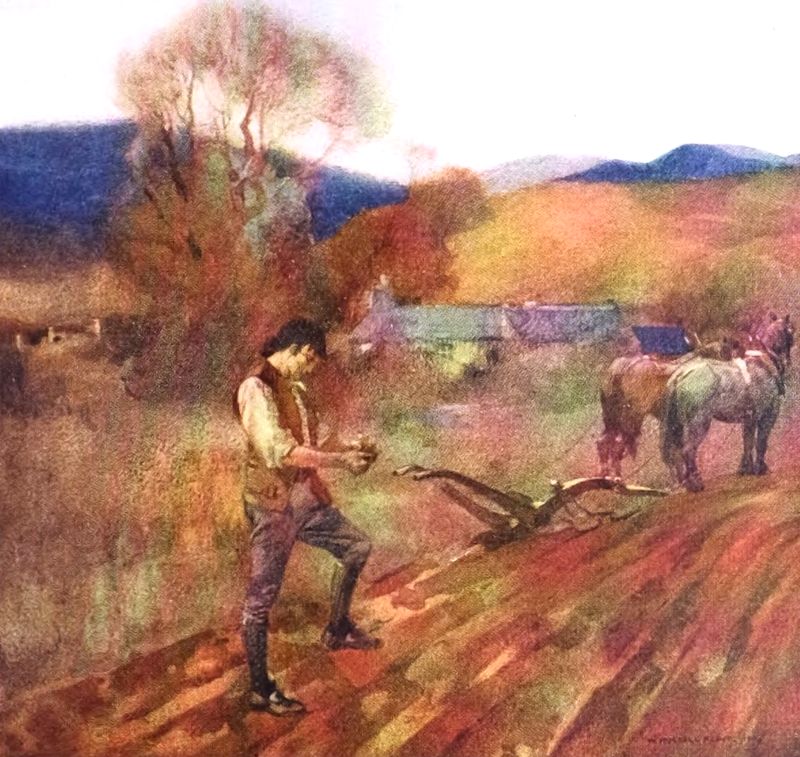
By the valiance of those two thoughts animating, even when only implicitly presented, the whole body of his work—and by the convincing tragic token of a life which, whatever its confusions and faults, was always starkly independent and compassionately kind—Burns has made a contribution distinctly his own to the world’s wealth of ideals, and of the memories that keep them alive. What makes the power of this ideal, and its distinctness as an historical event, is that it was so utterly personal and of the Poet himself: therefore, so inspired and authoritative. The message which he conveys comes to him with the sweep of his genius and the certainty of his imperishable song, and in its delivery he speaks as a chosen son of Nature for and to all mankind. In this sense he speaks as no other poet in the world has spoken. Standing in the new-ploughed earth, or following the occupations of seedtime or harvest, he seems to be at the beginning and at the centre; and has a consciousness of universal man, of the labours and seedtimes and harvests of the ages and the climes, denied to the poets, however great, for whom the world is primarily a scene of cities, and not of earth and sky and man, alone in the fields with the primal curse and solace. In this regard he stands nearer to Millet than any other name in Art or Poetry. Therefore it was fitting[xx] that one who was so much and potently and generously a man should have written, near the close of his life and in a time of repression and alarm, that vindication—A Man’s a Man for a’ That—which (pace Mr. Henley) has been not inaptly called “the Marseillaise of Humanity.” Fitting also that he should have written, again near the close of his life, that song of human friendship and recollected childhood—Auld Lang Syne—which seems destined to become the common possession of the nations, as it is already the one thing in our literature which draws the hearts of all English-speaking people throughout the world, and not seldom their tears.
And of course the ideal has its other aspect: “I bring not peace, but a sword.” With the judgment which saw those two truths clear, he was empowered to put upon its trial the existing system, in as far as it denied them. Being very sure of the essentials, he could look upon the good and evil in current practice with the nihilistic audacity of the great saints or the great sinners, of those who have nothing further to gain or nothing further to lose. Hence the unsurpassed energy of his satire, an energy only possible to a mind working with consummate detachment, a mind that sat very loose to all the dead-horse ideas on which the creatures of convention get carried safely through life. But of this particular splendour and peril of his powers the less need here be said because few of the poems in the present selection have been taken from among those which illustrate it. Enough to know that the spirit of Burns remains in the world, as both a glory and a defence; and that many usurping polities will crumble, and many moral incrustations dissolve, when required to meet the challenge of those two[xxi] conceptions of the sovereignty of the man whose soul is free and the supremacy of kindness. Nor can we doubt that as time goes on, and the idea of his life emerges more clearly out of the chaos in which we see it now, he will be recognised as not only an apparitional personality and a great lyric poet, but as a largely symbolic being also, expressing and embodying the powers in the world which for ever save and for ever beneficently destroy: one of whom it will seem but sense to say—
A Poet, he was brought to birth
By Nature’s self or Mother Earth,
And had for his prophetic sire
The Force that sets the Sun on fire.
Meanwhile, something may be said of the present selection, if only to explain it. The title Songs and Lyrics has been chosen in preference to Songs and Poems, that the reader, having been warned, might have no cause for feeling aggrieved at the absence of a number of pieces which are constants in other collections, however variously made up. The term “lyric” has, by one notable example of its use and by subsequent custom, become the accepted general name for poems of many kinds having for their common characters only the quality of expressing feeling or reflection (or the quality, in the case of an anecdote or incident, of producing feeling or reflection) and comparative brevity. It includes readily O Were I on Parnassus Hill and the Lament for Glencairn; that astonishing rapture of words and humour and gusto the Address to a Haggis, and that wise and tender yet withal scathing Address to the Unco Guid. But it cannot be made to cover such an exact description of local custom as Halloween; such a satirical and controversial description of local[xxii] events as The Holy Fair and others of its kind; nor even Death and Doctor Hornbook, effective though it is and instinct with the poet’s humorous malice. These things are splendid as literature, are indeed unequalled of their kind; but their quality is mainly intellectual rather than poetical in the more absolute sense, and the interest which they appeal to (and appeal powerfully) is not mainly our interest in poetry. In any case they are in all the collections, and I have considered that by their omission on this occasion it would be possible to render a service to Burns, and to lovers of poetry, which has not yet been rendered. A selection, I have thought, might be made in which the Poet himself, and not the social scenery of which he was a curious observer, nor the alien matters with which he took up, should be the pervading presence in the book, making it continuously lyrical, personal, and human. This, it was obvious, would mean some uncustomary omissions. But experiment has proved that it means also a sudden enlargement of the range of choice among things truly and beautifully poetical. The poetic wealth of Burns seems, indeed, not diminished but enriched by the surrender of that part which issues rather from the general energy of his genius than from those faculties of the soul in which he is distinctively a poet. Certainly there is no dearth, either of value or variety, the range of Burns over the different forms and occasions of poetry being, upon the whole, unique. Shakespeare implicitly contains everything, yet he has contributed to but a few of the forms; while the moderns (like Wordsworth) who have attempted to exemplify the different varieties of poetical composition are lyrically or morally monotonous. Cælum non animum mutant.
[xxiii]
But Burns is as vivid and variable as Nature, and at full power in a wide variety of domains and achievements. Within the domain of Song alone (his peculiar and unquestioned kingdom) his variety is almost as astonishing as his wealth. All the moods of love especially are his: the wistful subjection of soul in Mary Morison, the lover’s complaint against fortune and the world in Poortith Cauld, or against the harder fate of a mistress’s disdain in Maun I still on Menie doat (these two with exquisite touches of humour on the way!); the grief of parting in Ae Fond Kiss, with its unutterable regret, and in Go, Bring to Me with the tumult of the future sounding in it; or again, love’s sense of its own nobility and security rising even above that grief in My Love is Like a Red Red Rose (the greatest love song, which is really a song, in literature), or the glossing preoccupation of the enamoured heart, to which every natural beauty is but an illustration and reminder, in Of a’ the Airts (than which there is nothing in the world of song more single, perfect and sincere), or the unanswerable argument of maidens’ reasons when they love in Tam Glen and The Gallant Weaver, or the comedy of courtship in Duncan Gray and Last May a Braw Wooer, and whatever of joyous and equivocal there might be in the idyll of Duncan Davison, so realistic and so reticent. These are but samples of a stock to which only a long catalogue would do representative justice. The reader will at once think of The Rigs of Barley so triumphant and The Lea Rig so trusting, and of Bonnie Doon, with the sadness which has ensued from such trust—how often!—and of the echoing Fareweel to Ballochmyle with its atmosphere so large and lonely. But beyond these there is another order of love-song; of the love that has stood[xxiv] the test of life and has increased in kindness as it has emerged from passion. Here we think of John Anderson, my Jo, a song for which every good man must bow his head to the memory of Burns. And near to it will be found in these pages a lyric with the same consecration—The Cardin’ o’t—not less perfect though less known. It summarises the human epic as lowly and kind folk know it, and is like “the still sad music of humanity,” telling of its affections, its toils, and the little wrongs that mean so much. And beyond these, again, there is another order of love song, in which the destinies enacted or the sorrows endured seem outside the limits of the world. Of this disembodied and metaphysical quality—rare in all literature outside of Shakespeare—are Open the Door to Me, Oh, in which we feel the presence of Nature and Time only as spectators of a human woe; and Ay Waukin’, with its haunting repetition, its immeasurable sense of want and waiting, and of the endless desolation that there may be for the soul within one summer day. But of the songs of Burns it is impossible to speak adequately, and I have spoken only of the love songs. There are others. Those devoted to convivial joy touch a point of glory in letters quite equalling that ever reached by the true devotee in life. Willie Brewed a Peck o’ Maut tells of the escape of three mortal men, for the space of one night, from the dominion of Fate and from the common ignoble respect for the solar system; while in Rattlin’ Roarin’ Willie there are heroic reverberations, and the last verse shows us Willie seated on high—“at yon board en’”—in a mist of glory as though the guid companie were the gods themselves, and he in Asgard! As for the graver national theme, Burns’s love of Scotland was so implicit and pervading,[xxv] that he rarely wrote upon it—apart from incidental allusions—even as a man, among all the things that he does for his wife and thinks for her, may rarely think of saying that he loves her. But when he wrote it was Scots Wha Hae; and that Jacobite lyric, It was a’ for our Rightfu’ King, in which the romantic and adventurous spirit of old Scotland, and its proscribed loyalties and lost causes early and late, quintessentialise into the immortal formula of heroic defeat:
Now a’ is done that men can do
And a’ is done in vain.
Of the Lyrics (other than songs) there is no room to speak at length, but the preceding argument renders this less necessary. They all converge to illustrate Burns’s kindness and his love of all who were kind, his manly independence and his respect for that character in others. His kindness, indeed, passes beyond his own species to embrace all life, from the Daisy to the Devil, and even as a farmer he has no animosity against the Field Mouse. The Devil, indeed, he would not publicly encourage, though he would like him to escape the extreme penalty; but the Daisy and the Mouse he brings for good within the sympathies and almost within the circuit of human nature. They are fellow-travellers with him on the strange road of life and stand equally within the menace of calamity. We see the same humane, dissolving, imaginative aptitude in The Farmer’s Salutation and the Death of Poor Mailie, pieces in which there is, however, a richness of humanity, involving many qualities besides sympathy, hardly to be described. The knowledge, the moral and social inwardness of the former, and in the latter the finely balanced[xxvi] play of humour, never for an instant excessive where excess would have been easy and spoilt all, have hardly been equalled even by himself. The impulse which made him compassionate towards his fellow-creatures ranged him against those who habitually, and on peculiarly insufficient warrant, judged them harshly. Hence the Address to the Unco Guid, which would not have remained unwritten even had he never come personally within the range and shot of their malice. Hence also, in part, Scotch Drink, that plenary libation of soul in honour of those cordials, especially the supreme national one, which are as a divine fuel nourishing the glow of happiness when friend meets friend. The epistles to David Sillar and Lapraik and Simpson (to which I have affixed titles for this occasion)[1] admit us directly[xxvii] into the presence of Burns in his familiar intercourse as the “social, friendly, honest man” beyond measure abundant. These were written while he was still an unprinted local poet, a man of mark among his neighbours, but marked also for misfortune and disgrace, and the future prospectless enough. But though he is cheering[xxviii] others on, and dauntless himself, we can divine that it is fast becoming the dauntlessness of desperation, the indifference of pride. What Nature has given him renders him more keenly conscious of what his lot in life denies, and the gifts and the lack between them are working together to sink this splendid misplaced being, half Apollo and half Pan, among the waste of humanity in whom the light of purpose has gone out. Then came the Edinburgh triumph, and it saved him at least from that. It opened new vistas, and promised a large future. The vistas closed and the promise was not kept; but in the course of being disappointed—in the course of encountering the successive misfortunes of the ten years remaining to him, who was then only twenty-seven—he added to his achievement nearly one-half of the whole. He wrote not only Tam o’ Shanter and the thrice-noble Lament for Glencairn, but also the great bulk of his song work. And the result? Surely it is this: that all who read these pages to the end, to where the Muse of Scottish Song leaves him dreaming in the spence, must feel that the light in which she “fled away” has not itself fled, but remains for ever in his book, and he in the midst of it with the lyric crown still fresh from her hands.
William Macdonald.
FOOTNOTE:
[1] Namely, The Riches of the Poor, An Offer of Friendship, An Exhortation to Davie, Poets for ever! and The Bards of Ayr. A book of selections being in its nature an anthology, in which all the contents are there upon their individual merits as poetry, it seems right that each should have a title that carries some reference to its subject-matter. I have ventured upon this innovation in one or two other cases, with results which, I hope, will commend themselves to the judicious.
And here a word may be said about the arrangement of the contents, which is not chronological, yet anything but haphazard. The intention has rather been to make it lyrical and vital. I conceive that a collection like this, which is virtually an anthology gathered from the domain of a single poet, should as nearly as possible be itself a poem. That is, it should be so composed, so put together, that the reader may pass from number to number in the sequence as easily and naturally as he would pass from verse to verse of a single poem: even more easily and naturally, perhaps, from a continually renewed sense of refreshment, of slightly changed animation. But this effect is not to be achieved without taking pains. An editor who aims at it must be keenly and even anxiously observant of many values—of values constituted by metrical quality, subject matter, moral mood and so forth—in all the varieties of each and in their interactions. He must try to maintain continuity (the continuity of unflagging animation, interest and enjoyment in the act of reading) through variety and relief, and even through the occasional sudden contrast which may express either a natural reaction and subsidence of mood, or an impetus of the poetic soul in fresh directions. Finally, while disregarding the mere time-order of composition (since the poem which best speaks the truth for a man’s forty-sixth year may well have been written at twenty-one) he must yet try to suggest something of the tone of the poet’s different life-periods, and these in their right order. If the attempt is at all successful, the resulting arrangement should not only do justice to each individual poem by a sympathetic setting, but should compass a general effect of unity and of personality. How far the series from There was a Lad to Auld Lang Syne realises this ideal it is not for me to say. Other things besides the ideal had claims to be considered, such as the proposed scope of the book and the need to distribute the illustrations reasonably through the volume. But I may say that from point to point it has only been after many re-readings and searching comparisons that I have finally decided whether this or this or this poem would most happily and economically follow that one; regard being also had to others that were yet to come. Felicity in the metrical transition was, it will be seen, the value predominantly considered in the earlier pages, while towards the close (I speak of the Songs and Lyrics section) there has been more conscious grouping of poems reinforcing one another in the expression or suggestion of a mood or colour-tone of the mind. I say predominantly; for both principles of arrangement, as well as those of relief and contrast, have been used throughout. Thus Lassie wi’ the Lint-White Locks, The Posie, My Lady’s Gown, and The Daisy (pp. 41-4) have an element in common—a certain refinement and gentleness of feeling—which brings them within the same moral key, diverse as they are. They breathe of flowers, independently of speaking of them. But naturally the principle of grouping has been more particularly used to suggest what I have called the colour-tone of the poet’s mind at certain stages of his life, especially the later ones. And I permit myself to hope that the more the reader knows (understandingly) of Burns, the more will he find of what is essential and quintessential to any true account of the poet’s later days suggested or recalled by the successive groupings with which our first and main section draws to a close.
[Note.—The following pages have been set up from the text of the Oxford Edition, for kind permission to use which thanks are due, and are heartily tendered, to Mr. Henry Frowde of the Oxford University Press].
[Pg 1]
Songs and Lyrics
THERE WAS A LAD
There was a lad was born in Kyle,
But what’n a day o’ what’n a style
I doubt it’s hardly worth the while
To be sae nice wi’ Robin.
Robin was a rovin’ boy,
Rantin’ rovin’, rantin’ rovin’;
Robin was a rovin’ boy,
Rantin’ rovin’ Robin.
Our monarch’s hindmost year but ane
Was five-and-twenty days begun,
’Twas then a blast o’ Janwar win’
Blew hansel in on Robin.
The gossip keekit in his loof,
Quo’ scho, Wha lives will see the proof,
This waly boy will be nae coof,
I think we’ll ca’ him Robin.
He’ll hae misfortunes great and sma’,
But aye a heart aboon them a’;
He’ll be a credit till us a’,
We’ll a’ be proud o’ Robin.
[2]
But sure as three times three mak nine,
I see by ilka score and line,
This chap will dearly like our kin’,
So leeze me on thee, Robin.
Robin was a rovin’ boy,
Rantin’ rovin’, rantin’ rovin’;
Robin was a rovin’ boy,
Rantin’ rovin’ Robin.
MARY MORISON
O Mary, at thy window be,
It is the wish’d, the trysted hour!
Those smiles and glances let me see,
That make the miser’s treasure poor:
How blythely wad I bide the stoure,
A weary slave frae sun to sun,
Could I the rich reward secure,
The lovely Mary Morison.
Yestreen, when to the trembling string
The dance gaed thro’ the lighted ha’,
To thee my fancy took its wing,
I sat, but neither heard nor saw:
Tho’ this was fair, and that was braw,
And yon the toast of a’ the town,
I sigh’d, and said amang them a’,
‘Ye are na Mary Morison.’
O Mary, canst thou wreck his peace,
Wha for thy sake wad gladly die?
Or canst thou break that heart of his,
Whase only faut is loving thee?
[3]
If love for love thou wilt na gie,
At least be pity to me shown!
A thought ungentle canna be
The thought o’ Mary Morison.
THE BIRKS OF ABERFELDY
Now simmer blinks on flowery braes,
And o’er the crystal streamlet plays,
Come let us spend the lightsome days
In the Birks of Aberfeldy.
Bonnie lassie, will ye go,
Will ye go, will ye go,
Bonnie lassie, will ye go
To the Birks of Aberfeldy?
While o’er their heads the hazels hing,
The little birdies blythely sing,
Or lightly flit on wanton wing
In the Birks of Aberfeldy.
The braes ascend like lofty wa’s
The foaming stream deep-roaring fa’s,
O’erhung wi’ fragrant spreading shaws—
The Birks of Aberfeldy.
The hoary cliffs are crown’d wi’ flowers,
White o’er the linns the burnie pours,
And rising, weets wi’ misty showers
The Birks of Aberfeldy.
[4]
Let fortune’s gifts at random flee,
They ne’er shall draw a wish frae me,
Supremely blest wi’ love and thee,
In the Birks of Aberfeldy.
Bonnie lassie, will ye go,
Will ye go, will ye go,
Bonnie lassie, will ye go
To the Birks of Aberfeldy?
TO A MOUSE, ON TURNING HER UP IN HER NEST WITH THE PLOUGH, NOVEMBER, 1785
Wee, sleekit, cow’rin’, tim’rous beastie,
O what a panic’s in thy breastie!
Thou need na start awa sae hasty,
Wi’ bickering brattle!
I wad be laith to rin an’ chase thee
Wi’ murd’ring pattle!
I’m truly sorry man’s dominion
Has broken Nature’s social union,
An’ justifies that ill opinion
Which makes thee startle
At me, thy poor earth-born companion,
An’ fellow-mortal!
I doubt na, whiles, but thou may thieve;
What then? poor beastie, thou maun live!
A daimen-icker in a thrave
’S a sma’ request:
I’ll get a blessin’ wi’ the lave,
And never miss’t!
[5]
Thy wee bit housie, too, in ruin!
Its silly wa’s the win’s are strewin’!
An’ naething, now, to big a new ane,
O’ foggage green!
An’ bleak December’s winds ensuin’,
Baith snell an’ keen!
Thou saw the fields laid bare and waste,
An’ weary winter comin’ fast,
An’ cozie here, beneath the blast,
Thou thought to dwell,
Till crash! the cruel coulter past
Out-thro’ thy cell.
That wee bit heap o’ leaves an’ stibble
Has cost thee mony a weary nibble!
Now thou’s turn’d out, for a’ thy trouble,
But house or hald,
To thole the winter’s sleety dribble,
An’ cranreuch cauld!
But, Mousie, thou art no thy lane,
In proving foresight may be vain:
The best laid schemes o’ mice an’ men
Gang aft a-gley,
An’ lea’e us nought but grief an’ pain
For promis’d joy.
Still thou art blest compar’d wi’ me!
The present only toucheth thee:
But oh! I backward cast my e’e
On prospects drear!
An’ forward tho’ I canna see,
I guess an’ fear!
[6]
GO FETCH TO ME A PINT O’ WINE
Go fetch to me a pint o’ wine,
An’ fill it in a silver tassie;
That I may drink, before I go,
A service to my bonnie lassie.
The boat rocks at the pier o’ Leith,
Fu’ loud the wind blaws frae the ferry,
The ship rides by the Berwick-law,
And I maun leave my bonnie Mary.
The trumpets sound, the banners fly,
The glittering spears are rankèd ready;
The shouts o’ war are heard afar,
The battle closes thick and bloody;
But it’s no the roar o’ sea or shore
Wad mak me langer wish to tarry;
Nor shout o’ war that’s heard afar,
It’s leaving thee, my bonnie Mary.
MY LOVE IS LIKE A RED RED ROSE
My love is like a red red rose
That’s newly sprung in June:
My love is like the melodie
That’s sweetly play’d in tune.
So fair art thou, my bonnie lass,
So deep in love am I:
And I will love thee still, my dear,
Till a’ the seas gang dry.
[7]
Till a’ the seas gang dry, my dear,
And the rocks melt wi’ the sun:
And I will love thee still, my dear,
While the sands o’ life shall run.
And fare thee weel, my only love,
And fare thee weel awhile!
And I will come again, my love,
Tho’ it were ten thousand mile.
BLYTHE AND MERRY
By Ochtertyre there grows the aik,
On Yarrow banks the birken shaw;
But Phemie was a bonnier lass
Than braes o’ Yarrow ever saw.
Blythe, blythe and merry was she,
Blythe was she but and ben:
Blythe by the banks of Earn,
And blythe in Glenturit glen.
Her looks were like a flower in May,
Her smile was like a simmer morn;
She trippèd by the banks of Earn
As light’s a bird upon a thorn.
Her bonnie face it was as meek
As ony lamb’s upon a lea;
The evening sun was ne’er sae sweet
As was the blink o’ Phemie’s e’e.
The Highland hills I’ve wander’d wide,
And o’er the Lowlands I hae been;
But Phemie was the blythest lass
That ever trod the dewy green.
She trippèd by the banks of Earn
As light’s a bird upon a thorn.
[8]
HIGHLAND MARY
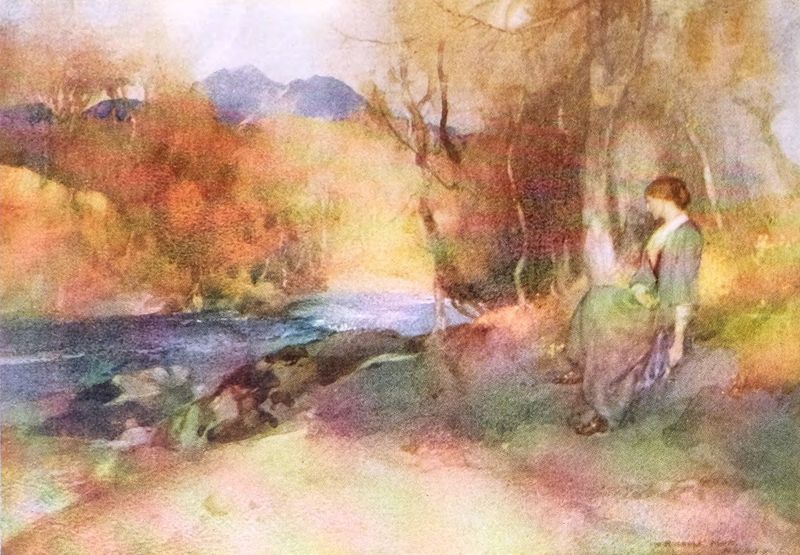
Ye banks, and braes, and streams around
The castle o’ Montgomery,
Green be your woods, and fair your flowers,
Your waters never drumlie!
There simmer first unfauld her robes,
And there the langest tarry;
For there I took the last fareweel
O’ my sweet Highland Mary.
How sweetly bloom’d the gay green birk,
How rich the hawthorn’s blossom,
As underneath their fragrant shade
I clasp’d her to my bosom!
The golden hours on angel wings
Flew o’er me and my dearie;
For dear to me as light and life
Was my sweet Highland Mary.
Wi’ mony a vow, and lock’d embrace,
Our parting was fu’ tender;
And, pledging aft to meet again,
We tore oursels asunder;
But oh! fell death’s untimely frost,
That nipt my flower sae early!
Now green’s the sod, and cauld’s the clay,
That wraps my Highland Mary!
O pale, pale now, those rosy lips,
I aft have kiss’d sae fondly!
And closed for aye the sparkling glance,
That dwelt on me sae kindly!
[9]
And mould’ring now in silent dust,
That heart that lo’ed me dearly!
But still within my bosom’s core
Shall live my Highland Mary.
AFTON WATER
Flow gently, sweet Afton, among thy green braes,
Flow gently, I’ll sing thee a song in thy praise;
My Mary’s asleep by thy murmuring stream,
Flow gently, sweet Afton, disturb not her dream.
Thou stock-dove whose echo resounds thro’ the glen,
When from the hills where springs the brawling Coil,
[189]
Or stately Lugar’s mossy fountains boil,
Or where the Greenock winds his moorland course,
Or haunted Garpal draws his feeble source,
Arous’d by blust’ring winds an’ spotting thowes,
In mony a torrent down the snaw-broo rowes;
While crashing ice, borne on the roaring spate,
Sweeps dams, an’ mills, an’ brigs, a’ to the gate;
And from Glenbuck, down to the Ratton-key,
Auld Ayr is just one lengthen’d, tumbling sea;
Then down ye’ll hurl, deil nor ye never rise!
And dash the gumlie jaups up to the pouring skies!
A lesson sadly teaching, to your cost,
That architecture’s noble art is lost!’
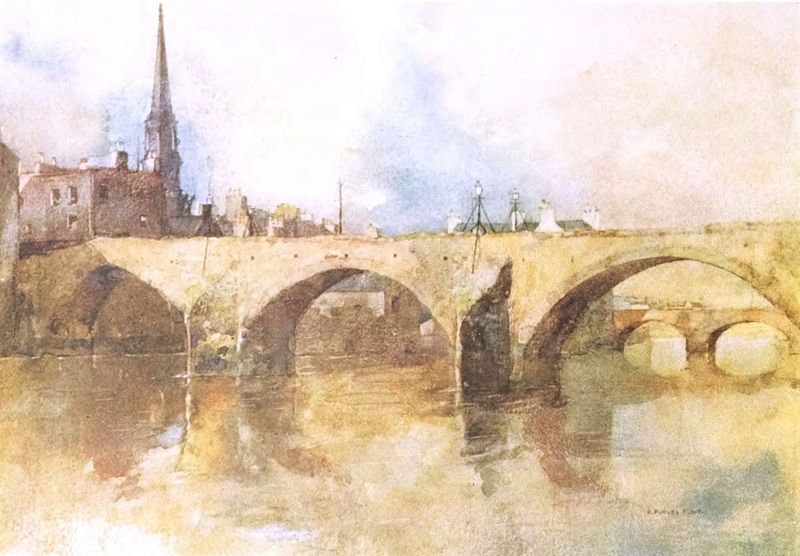
NEW BRIG
‘Fine architecture, trowth, I needs must say’t o’t,
The Lord be thankit that we’ve tint the gate o’t!
Gaunt, ghastly, ghaist-alluring edifices,
Hanging with threat’ning jut, like precipices;
O’er-arching, mouldy, gloom-inspiring coves,
Supporting roofs, fantastic, stony groves;
Windows and doors in nameless sculptures drest,
With order, symmetry, or taste unblest;
Forms like some bedlam Statuary’s dream,
The craz’d creations of misguided whim;
Forms might be worshipp’d on the bended knee,
And still the second dread command be free,
Their likeness is not found on earth, in air, or sea!
Mansions that would disgrace the building taste
Of any mason reptile, bird, or beast;
Fit only for a doited monkish race,
Or frosty maids forsworn the dear embrace,
Or cuifs of later times wha held the notion
[190]
That sullen gloom was sterling, true devotion;
Fancies that our guid Brugh denies protection,
And soon may they expire, unblest with resurrection!’
AULD BRIG
‘O ye, my dear-remember’d, ancient yealings,
Were ye but here to share my wounded feelings!
Ye worthy Proveses, an’ mony a Bailie,
Wha in the paths o’ righteousness did toil aye;
Ye dainty Deacons, an’ ye douce Conveeners,
To whom our moderns are but causey-cleaners!
Ye godly Councils wha hae blest this town;
Ye godly Brethren o’ the sacred gown,
Wha meekly gie your hurdies to the smiters;
And (what would now be strange) ye godly Writers:
A’ ye douce folk I’ve borne aboon the broo,
Were ye but here, what would ye say or do!
How would your spirits groan in deep vexation,
To see each melancholy alteration;
And agonizing, curse the time and place
When ye begat the base degen’rate race!
Nae langer rev’rend men, their country’s glory,
In plain braid Scots hold forth a plain braid story;
Nae langer thrifty citizens, an’ douce,
Meet owre a pint, or in the Council-house;
But staumrel, corky-headed, graceless Gentry,
The herryment and ruin of the country;
Men, three-parts made by tailors and by barbers,
Wha waste your weel-hain’d gear on damn’d New Brigs and harbours!’
NEW BRIG
‘Now haud you there! for faith ye’ve said enough,
And muckle mair than ye can mak to through:
[191]
As for your Priesthood, I shall say but little,
Corbies and Clergy are a shot right kittle;
But, under favour o’ your langer beard,
Abuse o’ Magistrates might weel be spar’d;
To liken them to your auld-warld squad,
I must needs say, comparisons are odd.
In Ayr, wag-wits nae mair can have a handle
To mouth “a Citizen,” a term o’ scandal;
Nae mair the Council waddles down the street,
In all the pomp of ignorant conceit;
Men wha grew wise priggin’ owre hops and raisins,
Or gather’d lib’ral views in Bonds and Seisins:
If haply Knowledge, on a random tramp,
Had shor’d them wi’ a glimmer of his lamp,
And would to Common-sense for once betray’d them,
Plain dull Stupidity stept kindly in to aid them.’
What farther clishmaclaver might been said,
What bloody wars, if Sprites had blood to shed,
No man can tell; but, all before their sight,
A fairy train appear’d in order bright;
Adown the glittering stream they featly danc’d;
Bright to the moon their various dresses glanc’d:
They footed o’er the wat’ry glass so neat,
The infant ice scarce bent beneath their feet:
While arts of Minstrelsy among them rung,
And soul-ennobling Bards heroic ditties sung.
O had M’Lauchlan, thairm-inspiring sage,
Been there to hear this heavenly band engage,
When thro’ his dear strathspeys they bore with Highland rage,
Or when they struck old Scotia’s melting airs,
The lover’s raptured joys or bleeding cares,
[192]
How would his Highland lug been nobler fir’d,
And ev’n his matchless hand with finer touch inspired!
No guess could tell what instrument appear’d,
But all the soul of Music’s self was heard;
Harmonious concert rung in every part,
While simple melody pour’d moving on the heart.
The Genius of the Stream in front appears,
A venerable Chief, advanced in years;
His hoary head with water-lilies crown’d,
His manly leg with garter-tangle bound.
Next came the loveliest pair in all the ring,
Sweet Female Beauty hand in hand with Spring;
Then, crown’d with flow’ry hay, came Rural Joy,
And Summer, with his fervid-beaming eye;
All-cheering Plenty, with her flowing horn,
Led yellow Autumn wreath’d with nodding corn;
Then Winter’s time-bleach’d locks did hoary show,
By Hospitality with cloudless brow:
Next followed Courage with his martial stride,
From where the Feal wild-woody coverts hide;
Benevolence, with mild benignant air,
A female form, came from the towers of Stair;
Learning and Worth in equal measures trode
From simple Catrine, their long-loved abode:
Last, white-robed Peace, crown’d with a hazel wreath,
To rustic Agriculture did bequeath
The broken iron instruments of death:
At sight of whom our Sprites forgat their kindling wrath.
Your ruin’d formless bulk o’ stane and lime.
[193]
TAM O’ SHANTER
When chapman billies leave the street,
And drouthy neibors neibors meet,
As market-days are wearing late,
An’ folk begin to tak the gate;
While we sit bousing at the nappy,
An’ getting fou and unco happy,
We think na on the lang Scots miles,
The mosses, waters, slaps, and styles,
That lie between us and our hame,
Where sits our sulky sullen dame,
Gathering her brows like gathering storm,
Nursing her wrath to keep it warm.
This truth fand honest Tam o’ Shanter,
As he frae Ayr ae night did canter—
(Auld Ayr, wham ne’er a town surpasses
For honest men and bonnie lasses).
O Tam! hadst thou but been sae wise
As ta’en thy ain wife Kate’s advice!
She tauld thee weel thou was a skellum,
A bletherin’, blusterin’, drunken blellum;
That frae November till October,
Ae market-day thou was na sober;
That ilka melder wi’ the miller
Thou sat as lang as thou had siller;
That every naig was ca’d a shoe on,
The smith and thee gat roarin’ fou on;
That at the Lord’s house, even on Sunday,
Thou drank wi’ Kirkton Jean till Monday.
She prophesied that, late or soon,
Thou would be found deep drown’d in Doon;
[194]
Or catch’d wi’ warlocks in the mirk
By Alloway’s auld haunted kirk.
Ah, gentle dames! it gars me greet
To think how mony counsels sweet,
How mony lengthen’d sage advices,
The husband frae the wife despises!
But to our tale: Ae market night,
Tam had got planted unco right,
Fast by an ingle, bleezing finely,
Wi’ reaming swats, that drank divinely;
And at his elbow, Souter Johnny,
His ancient, trusty, drouthy crony;
Tam lo’ed him like a very brither;
They had been fou for weeks thegither.
The night drave on wi’ sangs and clatter,
And aye the ale was growing better:
The landlady and Tam grew gracious,
Wi’ favours secret, sweet, and precious;
The souter tauld his queerest stories;
The landlord’s laugh was ready chorus:
The storm without might rair and rustle,
Tam did na mind the storm a whistle.
Care, mad to see a man sae happy,
E’en drown’d himsel amang the nappy.
As bees flee hame wi’ lades o’ treasure,
The minutes wing’d their way wi’ pleasure;
Kings may be blest, but Tam was glorious,
O’er a’ the ills o’ life victorious!
But pleasures are like poppies spread—
You seize the flow’r, it’s bloom is shed;
Or like the snow falls in the river—
A moment white, then melts for ever;
Or like the borealis race,
[195]
That flit ere you can point their place;
Or like the rainbow’s lovely form
Evanishing amid the storm.
Nae man can tether time nor tide;
The hour approaches Tam maun ride;
That hour, o’ night’s black arch the key-stane,
That dreary hour, he mounts his beast in;
And sic a night he taks the road in
As ne’er poor sinner was abroad in.
The wind blew as ’twad blawn its last;
The rattling show’rs rose on the blast;
The speedy gleams the darkness swallow’d;
Loud, deep, and lang, the thunder bellow’d:
That night, a child might understand,
The Deil had business on his hand.
Weel mounted on his gray mare, Meg,
A better never lifted leg,
Tam skelpit on thro’ dub and mire,
Despising wind, and rain, and fire;
Whiles holding fast his gude blue bonnet;
Whiles crooning o’er some auld Scots sonnet;
Whiles glow’ring round wi’ prudent cares,
Lest bogles catch him unawares.
Kirk-Alloway was drawing nigh,
Whare ghaists and houlets nightly cry.
By this time he was cross the ford,
Where in the snaw the chapman smoor’d;
And past the birks and meikle stane,
Where drunken Charlie brak’s neck-bane;
And thro’ the whins, and by the cairn,
Where hunters fand the murder’d bairn;
And near the thorn, aboon the well,
Where Mungo’s mither hang’d hersel.
[196]
Before him Doon pours all his floods;
The doubling storm roars thro’ the woods;
The lightnings flash from pole to pole;
Near and more near the thunders roll:
When, glimmering thro’ the groaning trees,
Kirk-Alloway seem’d in a bleeze;
Thro’ ilka bore the beams were glancing;
And loud resounded mirth and dancing.
Inspiring bold John Barleycorn!
What dangers thou canst make us scorn!
Wi’ tippenny, we fear nae evil;
Wi’ usquebae, we’ll face the devil!
The swats sae ream’d in Tammie’s noddle,
Fair play, he car’d na deils a boddle!
But Maggie stood right sair astonish’d,
Till, by the heel and hand admonish’d,
She ventur’d forward on the light;
And, vow! Tam saw an unco sight!
Warlocks and witches in a dance!
Nae cotillon brent new frae France,
But hornpipes, jigs, strathspeys, and reels,
Put life and mettle in their heels.
A winnock-bunker in the east,
There sat auld Nick, in shape o’ beast—
A touzie tyke, black, grim, and large!
To gie them music was his charge:
He screw’d the pipes and gart them skirl,
Till roof and rafters a’ did dirl.
Coffins stood round like open presses,
That shaw’d the dead in their last dresses;
And by some devilish cantraip sleight
Each in its cauld hand held a light,
By which heroic Tam was able
[197]
To note upon the haly table
A murderer’s banes in gibbet-airns;
Twa span-lang, wee, unchristen’d bairns;
A thief new-cutted frae the rape—
Wi’ his last gasp his gab did gape;
Five tomahawks, wi’ blude red rusted;
Five scymitars, wi’ murder crusted;
A garter, which a babe had strangled;
A knife, a father’s throat had mangled,
Whom his ain son o’ life bereft—
The gray hairs yet stack to the heft;
Wi’ mair of horrible and awfu’,
Which even to name wad be unlawfu’.
As Tammie glowr’d, amaz’d, and curious,
The mirth and fun grew fast and furious:
The piper loud and louder blew;
The dancers quick and quicker flew;
They reel’d, they set, they cross’d, they cleekit,
Till ilka carlin swat and reekit,
And coost her duddies to the wark,
And linkit at it in her sark!
Now Tam, O Tam! had thae been queans,
A’ plump and strapping in their teens;
Their sarks, instead o’ creeshie flannen,
Been snaw-white seventeen hunder linen!
Thir breeks o’ mine, my only pair,
That ance were plush, o’ gude blue hair,
I wad hae gi’en them off my hurdies,
For ae blink o’ the bonnie burdies!
But wither’d beldams, auld and droll,
Rigwoodie hags wad spean a foal,
Louping and flinging on a crummock,
I wonder didna turn thy stomach.
[198]
But Tam kent what was what fu’ brawlie:
There was ae winsome wench and walie
That night enlisted in the core,
Lang after kent on Carrick shore!
(For mony a beast to dead she shot,
And perish’d mony a bonnie boat,
And shook baith meikle corn and bear,
And kept the country-side in fear.)
Her cutty sark, o’ Paisley harn,
That while a lassie she had worn,
In longitude tho’ sorely scanty,
It was her best, and she was vauntie.
Ah! little kent thy reverend grannie
That sark she coft for her wee Nannie
Wi’ twa pund Scots (’twas a’ her riches)
Wad ever grac’d a dance of witches!
But here my muse her wing maun cour;
Sic flights are far beyond her pow’r—
To sing how Nannie lap and flang,
(A souple jad she was, and strang);
And how Tam stood, like ane bewitch’d,
And thought his very een enrich’d;
Even Satan glowr’d, and fidg’d fu’ fain,
And hotch’d and blew wi’ might and main:
Till first ae caper, syne anither,
Tam tint his reason a’ thegither,
And roars out ‘Weel done, Cutty-sark!’
And in an instant all was dark!
And scarcely had he Maggie rallied,
When out the hellish legion sallied.
As bees bizz out wi’ angry fyke
When plundering herds assail their byke,
As open pussie’s mortal foes
[199]
When pop! she starts before their nose,
As eager runs the market-crowd,
When ‘Catch the thief!’ resounds aloud.
So Maggie runs; the witches follow,
Wi’ mony an eldritch skriech and hollow.
Ah, Tam! ah, Tam! thou’ll get thy fairin’!
In hell they’ll roast thee like a herrin’!
In vain thy Kate awaits thy comin’!
Kate soon will be a woefu’ woman!
Now do thy speedy utmost, Meg,
And win the key-stane o’ the brig:
There at them thou thy tail may toss,
A running stream they dare na cross!
But ere the key-stane she could make,
The fient a tail she had to shake:
For Nannie, far before the rest,
Hard upon noble Maggie prest,
And flew at Tam wi’ furious ettle;
But little wist she Maggie’s mettle!
Ae spring brought off her master hale,
But left behind her ain gray tail:
The carlin claught her by the rump,
And left poor Maggie scarce a stump.
Now, wha this tale o’ truth shall read,
Each man and mother’s son, take heed;
Whene’er to drink you are inclin’d,
Or cutty-sarks rin in your mind,
Think! ye may buy the joys o’er dear;
Remember Tom o’ Shanter’s mare.
[200]
THE VISION
DUAN FIRST
The sun had closed the winter day,
The curlers quat their roarin’ play,
An’ hunger’d maukin taen her way
To kail-yards green,
While faithless snaws ilk step betray
Where she has been.
The thresher’s weary flingin’-tree
The lee-lang day had tirèd me:
And when the day had clos’d his e’e,
Far i’ the west,
Ben i’ the spence, right pensivelie,
I gaed to rest.
There lanely by the ingle-cheek
I sat and eyed the spewing reek,
That fill’d, wi’ hoast-provoking smeek
The auld clay biggin’;
An’ heard the restless rattons squeak
About the riggin’.
All in this mottie misty clime,
I backward mused on wasted time,
How I had spent my youthfu’ prime,
An’ done nae-thing,
But stringin’ blethers up in rhyme,
For fools to sing.
[201]
Had I to guid advice but harkit,
I might, by this, hae led a market,
Or strutted in a bank, and clarkit
My cash-account:
While here, half-mad, half-fed, half-sarkit,
Is a’ th’ amount.
I started, mutt’ring ‘blockhead! coof!’
And heaved on high my waukit loof,
To swear by a’ yon starry roof,
Or some rash aith,
That I, henceforth, would be rhyme-proof
Till my last breath—
When click! the string the snick did draw;
An’ jee! the door gaed to the wa’;
And by my ingle-lowe I saw,
Now bleezin’ bright,
A tight outlandish hizzie, braw,
Come full in sight.
Ye need na doubt I held my whisht;
The infant aith, half-form’d, was crusht;
I glowr’d as eerie’s I’d been dusht
In some wild glen;
When sweet, like modest worth, she blusht,
An’ steppèd ben.
Green, slender, leaf-clad holly-boughs
Were twisted, gracefu’, round her brows;
I took her for some Scottish Muse
By that same token;
And come to stop these reckless vows,
Would soon been broken.
[202]
A hare-brain’d, sentimental trace,
Was strongly markèd in her face;
A wildly-witty rustic grace
Shone full upon her;
Her eye, ev’n turn’d on empty space,
Beam’d keen with honour.
Down flow’d her robe, a tartan sheen,
Till half a leg was scrimply seen;
An’ such a leg! my bonnie Jean
Could only peer it;
Sae straught, sae taper, tight, and clean,
Nane else came near it.
Her mantle large, of greenish hue,
My gazing wonder chiefly drew;
Deep lights and shades, bold-mingling, threw
A lustre grand;
And seem’d to my astonish’d view
A well-known land.
Here rivers in the sea were lost;
There mountains to the skies were tost:
Here tumbling billows mark’d the coast
With surging foam;
There, distant shone Art’s lofty boast,
The lordly dome.
Here Doon pour’d down his far-fetch’d floods;
There well-fed Irwine stately thuds;
Auld hermit Ayr staw thro’ his woods,
On to the shore;
And many a lesser torrent scuds,
With seeming roar.
[203]
Low in a sandy valley spread,
An ancient borough rear’d her head;
Still, as in Scottish story read,
She boasts a race
To ev’ry nobler virtue bred,
And polish’d grace.
By stately tower or palace fair,
Or ruins pendent in the air,
Bold stems of heroes, here and there,
I could discern;
Some seem’d to muse, some seem’d to dare,
With feature stern.
My heart did glowing transport feel,
To see a race heroic wheel,
And brandish round the deep-dyed steel
In sturdy blows;
While back-recoiling seem’d to reel
Their Suthron foes.
His Country’s Saviour, mark him well!
Bold Richardton’s heroic swell;
The Chief—on Sark who glorious fell,
In high command;
And he whom ruthless fates expel
His native land.
There, where a sceptred Pictish shade
Stalk’d round his ashes lowly laid,
I mark’d a martial race, pourtray’d
In colours strong;
Bold, soldier-featured, undismay’d
They strode along.
[204]
DUAN SECOND
With musing-deep astonish’d stare,
I view’d the heavenly-seeming Fair;
A whisp’ring throb did witness bear
Of kindred sweet,
When with an elder Sister’s air
She did me greet.
‘All hail! my own inspired bard!
In me thy native Muse regard!
Nor longer mourn thy fate is hard,
Thus poorly low;
I come to give thee such reward
As we bestow.
‘Know, the great Genius of this land
Has many a light aërial band,
Who, all beneath his high command,
Harmoniously,
As arts or arms they understand,
Their labours ply.
‘They Scotia’s race among them share:
Some fire the soldier on to dare;
Some rouse the patriot up to bare
Corruption’s heart:
Some teach the bard, a darling care,
The tuneful art.
‘Of these am I—Coila my name;
And this district as mine I claim,
Where once the Campbells, chiefs of fame,
Held ruling pow’r:
I mark’d thy embryo-tuneful flame,
Thy natal hour.
[205]
‘With future hope I oft would gaze,
Fond, on thy little early ways,
Thy rudely-caroll’d, chiming phrase,
In uncouth rhymes,—
Fired at the simple artless lays
Of other times.
‘I saw thee seek the sounding shore,
Delighted with the dashing roar;
Or when the North his fleecy store
Drove thro’ the sky,
I saw grim Nature’s visage hoar
Struck thy young eye.
‘Or when the deep green-mantled Earth
Warm-cherish’d ev’ry flow’ret’s birth,
And joy and music pouring forth
In ev’ry grove,
I saw thee eye the gen’ral mirth
With boundless love.
‘When ripen’d fields and azure skies
Call’d forth the reapers’ rustling noise,
I saw thee leave their ev’ning joys,
And lonely stalk,
To vent thy bosom’s swelling rise
In pensive walk.
‘When youthful love, warm-blushing strong,
Keen-shivering shot thy nerves along,
Those accents, grateful to thy tongue,
Th’ adorèd Name,
I taught thee how to pour in song,
To soothe thy flame.
[206]
‘I saw thy pulse’s maddening play
Wild send thee pleasure’s devious way,
Misled by fancy’s meteor ray,
By passion driven;
But yet the light that led astray
Was light from Heaven.
‘I taught thy manners-painting strains,
The loves, the ways of simple swains,
Till now, o’er all my wide domains
Thy fame extends;
And some, the pride of Coila’s plains,
Become thy friends.
‘Thou canst not learn, nor can I show,
To paint with Thomson’s landscape-glow;
Or wake the bosom-melting throe
With Shenstone’s art;
Or pour with Gray the moving flow
Warm on the heart.
‘Yet all beneath th’ unrivall’d rose
The lowly daisy sweetly blows;
Tho’ large the forest’s monarch throws
His army shade,
Yet green the juicy hawthorn grows
Adown the glade.
‘Then never murmur nor repine;
Strive in thy humble sphere to shine;
And trust me, not Potosi’s mine,
Nor king’s regard,
Can give a bliss o’ermatching thine,
A rustic Bard.
[207]
‘To give my counsels all in one,
Thy tuneful flame still careful fan;
Preserve the dignity of Man,
With Soul erect;
And trust the Universal Plan
Will all protect.
‘And wear thou this’: She solemn said,
And bound the holly round my head:
The polish’d leaves and berries red
Did rustling play;
And, like a passing thought, she fled
In light away.
[208] [209]
Glossary
Abeigh, aloof, at bay.
Aboon, above.
Acquent, acquainted.
Ae, one; only.
Aff-loof, offhand.
A-gley, askew.
Aiblins, perhaps, possibly.
Airt, region, direction; to direct.
Airted, directed.
Aizle, ash (of fuel); a cinder.
Ajee, ajar.
An, if.
Asklent, askance.
Ava, at all; of all.
Awnie, bearded (barley).
Ayont, beyond.
Babie-clouts, baby-clothes.
Bairntime, a mother’s whole brood or issue.
Bade, endured, could stand.
Bannock, a soft flat cake.
Barley-bree, barley-brew = ale or whisky.
Baudrons, the cat.
Bawsent, white streaked.
Beets, adds fuel to, incites.
Bell, flower, blossom; sin’ lint was i’ the bell, since flax was in blossom.
Belyve, by and by, presently.
Ben, the spence or parlour; in, into, the inner room.
Beuk, a book.
Bicker, a wooden cup; a draught.
Bickering, hurrying.
Biel, bield, a shelter.
Bien, comfortable.
Big, to build.
Biggin, a building.
Bill, a bull.
Billie, brother; comrade.
Bings, heaps.
Birk, a birch (tree).
Birkie, chap, fellow (carries a suggestion of strut, conceit or cockiness).
Birken-shaw, a wood of birches.
Bizz, to buzz.
Blate, bashful, shy.
Blaud, a slapping lot.
Blellum, a gassy fool.
Blethers, nonsense.
Blink, to glance brightly; a glance; a moment.
Blinkers, spies.
Bluntie, stupid, like a fool.
Bocked, vomited.
Boddle, a small coin, about = ½d.
Bogle, a ghost.
Boortrees, elder-bushes.
Bore, a hole or gap.
Boot, more than they bargained for.
Bouk, a bulk, body.
Braing’t, pulled with a jerk.
Brak’s, broke his.
Branks, a wooden curb, a bridle.
Brats, clothes; aprons.
Brattle, a spurt, sprint, scamper.
Braw, handsome; gaily dressed.
Braxies, sheep that have died of braxy.
Briestit, sprang forward.
Brechan, a horse-collar.
Brent, smooth, upright.
Brent-new, brand-new.
Brock, a badger.
Brogue, a trick.
Broo, brew, liquid, water.
Broozes, wedding-races home from church.
Brugh, a borough.
Brulzie, a brawl or brangle.[210]
Brunstane, brimstone.
Bughtin, gathering sheep into the fold or bught.
Buirdly, burly, stalwart.
Bum, to hum.
Bum-clock, the beetle.
Burdies (dim of burd), damsels.
Bure, did bear.
Burn, a stream.
Burnewin, the blacksmith.
Bur-thistle, the spear-thistle.
But, without.
But an’ ben, the kitchen and parlour.
By, a great deal (“I care na by”).
Byke, a hive; a crowd.
Byre, a cowshed.
Ca’, call; drive (cattle, nails, etc.); push.
Cadger, a hawker.
Caff, chaff.
Caird, a tinker.
Cairn, a (memorial) heap of stones.
Caller, fresh.
Cannie, quiet, gentle, kind (also adv.).
Cantie, merry, jolly.
Cantraip, cantrip, magic, witching.
Carl, an old man.
Carl-hemp, male-hemp.
Carlin, a middle-aged or old woman.
Cast out, quarrel.
Caups, wooden cups.
Chanter, the playing pipe of the bag-pipes.
Chaup, a stroke, a blow.
Chiel, chap, young fellow (eulogistic term).
Chimla, chimney.
Chitter, to shiver.
Claivers, clavers, talk, about anything and nothing.
Clash, gossip, tittle-tattle; to talk so.
Claught, clutched.
Claut, a handful, a quantity.
Cleed, to clothe.
Cleekit, linked (their arms in dancing).
Clink, money.
Clishmaclaver, palaver.
Cloot, a hoof.
Clud, a cloud.
Coble, a small boat.
Coft, bought.
Cogs, various wooden vessels for food and drink are so called.
Coggie, dim. of cog.
Coila, Kyle, a division of Ayrshire.
Coof, cuif, a dolt, ninny; a mean-spirited fellow.
Coost, did cast.
Cootie, leg-plumed; a small pail.
Corbies, crows.
Couthie, kindly, comfortable.
Cour, to cower.
Crack, a story; a chat.
Crackin, conversing.
Craig (dim. craigie), the throat.
Craiks, landrails.
Crambo-clink, rhyme.
Crambo-jingle, rhyming.
Cranreuch, hoar frost.
Crap, a crop.
Creel, an osier basket.
Creepie-chair, stool of repentance.
Creeshie, greasy.
Crood, to coo.
Crouse, confident, bold.
Crowdie, oatmeal and water or milk (= uncooked porridge).
Crummock, a hooked stick.
Cushat, the wood-pigeon.
Cutty, short.
Daffin, funning, skylarking.
Daimen-icker, an ear or two of corn.
Darg, work.
Daw, to dawn.
Dawtit, petted, made much of.
Dead, death.
Deave, deafen.
Diddle, to jog to and fro.
Dight, to winnow or sift; to wipe.
Din, dun coloured.
Dink, dainty, trim.
Ding, to overthrow, beat.
Dirl, to vibrate, thrill.
Dizzen, a dozen.
Doited, muddled; bewildered.
Donsie, restive; wayward.
Doo, a pigeon.
Dooked, ducked.
Dool, sorrow.[211]
Douce, sedate, serious; seemly.
Dour, stubborn.
Dow, can; downa, cannot.
Dowff, dull.
Dowie, low-spirited, dull, jaded.
Downa bide, cannot stand (them).
Doylt, stupified.
Draigl’t, draggled.
Dreigh, tedious, slow, tiresome.
Droop-rump’lt, short-rumped.
Droukit, soaked.
Drouthy, thirsty.
Drucken, drunken.
Drumlie, muddy.
Drumossie Moor, Culloden Field.
Dub, a puddle.
Duds, duddies, clothes.
Duddie, ragged.
Dundee, a Scotch psalm tune.
Dunts, knocks.
Dusht, touched.
Earn, an eagle.
Eerie, apprehensive, frightened, “queer.”
Eild, old age, eld.
Elbuck, elbow.
Eldritch, unearthly, fearsome.
Elgin, a Scotch psalm tune.
Erse, Gaelic.
Ettle, intention.
Eydent, diligent.
Fa’, to fall; lot; to have (by lot); to claim.
Faikit, let off, excused.
Fain, fond, glad; fain o’ ither, fond of each other.
Fairin, a gift from the Fair: ironically = a thrashing.
Fan’, fand, found.
Fash, to mind, trouble oneself.
Fasten-een, Fasten-even (evening before Lent).
Faught, a fight.
Fauldin’-slap, gate of the fold.
Fawsont, seemly, well-doing.
Fecht, a fight.
Feckless, feeble, fit for nothing.
Fell, sharp, tasty.
Fen’, fend, a shift or provision; to provide for, look after.
Ferlie, to wonder.
Fetch’t, stopped suddenly.
Fey, fated to death.
Fidge, to fidget.
Fidgin-fain, fidgeting with fainness.
Fiel, well.
Fient, fiend. The fient a, devil a....
Fiere, comrade.
Fissle, to bustle, be all alive.
Fittie-lan’, the hindmost near horse in ploughing.
Fleech’d, beseeched, wheedled.
Flee, a fly.
Fleg, a fright.
Fley’d, frightened, scared.
Flichterin’, fluttering.
Flingin-tree, a flail.
Fliskit, fretted and capered.
Foor, fared, went.
Forbye, besides.
Forfairn, worn out.
Forfoughten, exhausted by the conflict.
Forjesket, “jaded with fatigue,” R.B.
Fou, full; drunk.
Foughten, troubled, wearied.
Fyke, fidget.
Fyle, to dirty.
Gae, gave.
Gae, gaed, go, went.
Gairs, slashes (of a stuffed gown).
Gar (pf. gar’d, gart) make, cause to.
Gate, gait, the road; the way; a’ to the gate, away, out of the way; tak the gate, start for home.
Gaucie, gawcie, ample, flowing.
Gaun, going.
Geck, to toss the head.
Get, the begettings, offspring.
Genty, trim, elegant.
Geordie, the yellow lettered, a guinea.
Gin, if; when.
Girn, to twist the face, in chagrin or malice.
Gizz, a wig.
Glaikit, silly, thoughtless.
Glaum’d, clutched.
Gleib, a portion (of land).[212]
Glowrin, staring.
Glunch, a scowl.
Gowan, the daisy.
Gowk, a fool; a guy.
Graith, the implements of an occupation.
Grat, wept.
Gree, a prize; bure the gree = won the victory.
Greet, to weep.
Groanin’ maut, the gossips’ ale at a lying-in.
Gruntle, the face, phiz.
Grunzie, the phiz (rather, mouth and nose).
Grushie, sturdy-growing.
Guid-father, father-in-law.
Guid-willie, hearty, with good-will.
Gumlie, muddy.
Gusty, tasty.
Hae, have.
Haet (= have it), component term in phrases; deil-haet, fient-haet = devil a bit, devil a one.
Haffets, the temples.
Hafflins, half-like, partly.
Haggis, “A special Scotch pudding made of sheep’s entrails, onions, and oatmeal, boiled in a sheep’s stomach. The pièce de résistance at Burns’ Club Dinners, and an esteemed antidote to whisky.” Thus Henley and Henderson, with obvious envy.
Hain, to use sparingly; be out of use.
Hairst, har’st, harvest.
Haith, faith!
Haivers, nonsense; idle chat.
Hal’, hald, a holding.
Hallen, a partition wall; a porch.
Halloween, All Saints’ Eve (Oct. 31).
Hammers, blockheads.
Hangie, hangman (nickname for Old Nick).
Hansel, the first gift or getting, supposed to bring luck to the receiver or occasion.
Hap, any warm wrap or covering.
Happer, the hopper of a mill.
Harn, coarse cloth.
Hash, an oaf, dunderhead.
Haslock, the finest of the wool.
Haud, to hold.
Haughs, low-lying rich lands.
Hauns, hands.
Havins, manners, conduct.
Hawkie, the cow.
Hech, dear me! (expression of surprise and grief).
Heft, a haft, handle.
Heigh, high.
Hein-shinned, crooked shinned.
Herriment, plundering, devastation.
Heugh, a hollow or pit.
Hilch, to hobble, halt.
Hiltie-skiltie, helter-skelter.
Hirples, limps.
Histie, bare.
Hizzie, a wench, young woman.
Hoast, a cough.
Hog-shouther, shouldering, jostling.
Hoolie! beware!
Houlet, an owl.
Howdie, midwife.
Howe, a hollow.
Howket, they dug; dug up, unearthed.
Hoyte, “to amble crazily,” R.B.
Hughoc = little Hugh.
Hunkers, the hams.
Hurdies, the buttocks.
Hushion, a footless stocking, worn on the arm.
Icker, an ear of corn.
Ilka, each, every.
Indentin’, indenturing, devoting.
Ingine, genius.
I’se, I will or shall.
Ither, other, another, each other.
Jad, a jade.
Jauk, to trifle, dally.
Jaups, splashes.
Jimp, small, slender.
Jimps, stays.
Jink, to dodge, to turn quickly this way and that.
Jinker, a spanker; a coquette.
Jirkinet, bodice.
Jirt, a jerk.[213]
Jo, sweetheart.
Jouk, to duck down, cower.
Jundie, to justle.
Kain, farm produce paid as rent.
Kebars, rafters.
Kebbuck, a cheese.
Keek, peep.
Kelpies, water-demons.
Kennin, a little, a thought (astray, etc.).
Kep, to catch (a ball, etc.).
Ket, a fleece.
Kiaugh, cark, anxiety.
Kilbaigie, an esteemed whisky.
Kimmer, wench, gossip, lass (married or single).
Kirn, a churn.
Kirns, harvest-homes.
Kirsen, to christen.
Kist, a chest.
Kitchen, a relish, treat or extra; to impart a relish to.
Kittle, risky, difficult.
Knaggie, knobbly.
Knap, to break (stones for road-metal).
Knowe, a knoll.
Kyles, skittles.
Kytes, bellies.
Laigh, low.
Laik, lack.
Lairing, sinking in moss or mud.
Laithfu’, lothe, bashful.
Lallan, Lowland.
Lane, lone, alone (is used with possessive pronoun: “thou art no thy lane” = not alone).
Lap, leapt.
Lave, the remainder; the rest of them.
Lawin, the reckoning.
Lea (also lay and ley), untilled or meadow-land.
Lea-rig, strip of grass-land.
Lear, lore, learning.
Lee-lang, livelong.
Leeze me on, a blessing on.
Licket, licked, thrashed.
Lift, the sky; a load, share.
Limmer, a jade.
Lin (also Linn), a waterfall.
Link, to go dancingly, trippingly on.
Linkit at it, went at it.
Linties (or Lintwhites), linnets.
Loan, a lane.
Loof, palm of the hand; the hand.
Loot, let (past tense).
Lough, a loch, lake.
Loup (also lowp), to leap.
Lowe, a flame.
Lug, ear.
Lugget, eared; lugget caup, the two-eared cup.
Luggie, a cog with an upright handle.
Luntin, smoking.
Lyart, faded, blanched.
Mae, more.
Mailin, a farm.
Mark, an old Scots coin (1s. 1½d. stg.).
Martyrs, a Scotch psalm tune.
Maukin, a hare.
Maun, must.
Maut, malt.
Mavis, the thrush.
Melder, a milling, or quantity of corn sent to be ground.
Mell, to meddle.
Mense, good manners, discretion.
Messan, a mongrel.
Midden, a dungheap.
Midden-creels, dungheap baskets.
Mind, to remind; to remember.
Minnie, mother.
Mirk, dark.
Moop, to nibble; to herd with.
Mottie, dusty.
Mou’, the mouth.
Moudiewort, a mole.
Muslin-kail, meatless broth.
Mutchkin, a liquid measure = 1 pint English.
Naigie, dim. of naig, a nag.
Nappy, ale, liquor.
Near-hand, nearly.
Neuk, corner.
New-ca’d, newly driven.
Nieve, fist.[214]
Niffer, exchange.
Nit, a nut.
Nowte, cattle.
Ourie, shivering, drooping.
Out-owre, out-over, away across.
Owsen, oxen.
Pack and thick, confidental.
Paidle, to wade.
Painch, the paunch.
Paitrick, a partridge.
Parishen, the people of a parish.
Pat, did put.
Pattle, a plough-spade.
Paughty, pompous, haughty.
Paukie (or pawkie), sly.
Pechan, the stomach.
Pechin’, cramming.
Pint (Scots), two English quarts.
Plack, a small coin, about ⅓d.
Plaiden, of coarse woollen cloth.
Poind, distrain.
Poortith, poverty.
Poussie, the hare.
Pow, the poll, head.
Pownie, a pony.
Prief, proof.
Priggin’, haggling.
Proveses, provosts.
Pyke, to pick.
Pyles, grains, particles.
Quat, quitted.
Quean, a young woman, lass.
Ragweed, the ragwort.
Rair, to roar.
Raize, to excite, to anger.
Ramfeezl’d, fagged out.
Ram-stam, headlong, reckless.
Rant, to rollick, royster.
Rants, jollifications; rows.
Rape, a rope.
Raploch, coarse cloth.
Rash, a rush.
Rash-buss, a clump of rushes.
Ratton, a rat.
Raw, a row (of pins).
Rax, to stretch; to reach; Rax thy leather, stretch or exercise thyself.
Reave, to rob.
Red-wat-shod, red-wet-shod.
Reek, smoke; to smoke.
Reekit, smoked, smoky.
Remead, remedy.
Rig, a ridge.
Riggin, the roof, roof-tree.
Reestit, scorched; rested = refused to go.
Rigwoodie hags, gallows hags (rigging for the woodie).
Rip, (or ripp,) a handful of corn from the sheaf.
Rive, to strain, rend, tear.
Rock, a distaff.
Rockin, a social meeting for song and chat and story, to which the women brought their rock or distaff.
Roose, to praise, flatter.
Rowe, to roll.
Rowte, to low, bellow.
Rowth, abundance.
Rung, a cudgel.
Sair, sore; to serve.
Sarkit, shirted.
Saugh, the willow; saugh woodies, willow-wands.
Sawmont, salmon.
Scaith, hurt.
Scar (or Scaur), a jutting cliff, or bank of earth.
Scaur, to scare; (adj.) readily scared.
Scaud, scald.
Scho, she.
Sconner, to loathe.
Screed, a rent, tear.
Scrievin’, careering; tearing along.
Seizins, freehold properties.
Sets you, becomes you.
Seventeen-hunder linen, fine linen, woven in a reed of 1700 divisions.
Shachl’t, large and shapeless.
Shavie, a trick.
Shaw, a wood.
Sheuch, a ditch, watercourse.
Shiel, a shed or hut.
Shill, shrill, shrilly.
Sic, such.
Siller, silver; money; wealth.
Sinsyne, since then.[215]
Skeigh, skittish, coy.
Skellum, a scullion, a worthless fellow.
Skelp, to spank (in all the Eng. senses).
Skinkin’, watery.
Skirl, to shrill out, to scream.
Sklent, to slant, look aside; to cheat.
Skriegh, a scream.
Shyrin’, flaring.
Skyte, a glancing quick stroke.
Slap, a gap in a fence or wall, a gate.
Sleeest, slyest.
Slypet, slipped down.
Smoor’d, smothered.
Smytrie, a smattering, a clump.
Snapper, to stumble along.
Snash, abuse, insolence.
Snaw-broo, melted snow.
Sned, to crop, lop, prune; Sned besoms, make birch-brooms.
Snell, bitter, biting.
Sneeshin-mill, the snuff-box.
Snick (or sneck), the door latchet.
Snool, to snub; to bear snubbing, cringe.
Snoove, to go slowly and steadily on.
Snowkit, pried with the nose.
Sonsie, plump and pleasant.
Sough, a sighing sound.
Soupe (or Sowpe), a “sup” of anything.
Souter, a cobbler.
Sowth, the low humming or whistling of one trying over a tune. Cp. “soothe.”
Sowther, solder.
Spairge, sprinkle.
Spate, the flooding of a river or stream.
Spavie, the spavin.
Spean, to wean.
Speel, to climb.
Speer, spier, to inquire.
Splore, a jollification.
Spotting, ? making spates.
Sprattle, to scramble.
Spring, a quick dancing air on the pipes.
Spritty, full of roots of sprits, or rushes.
Spunkies, Will-o’-the-wisps.
Stacher, to stagger.
Stang, to sting.
Stank, a pool.
Starns, stars.
Staumrel, doltish, half-witted.
Staw, stole.
Staw, to disgust, turn the stomach.
Stechin, cramming.
Steek, to close, fasten.
Steeks, stitches, links (of a purse).
Steer, to stir, molest.
Steeve, firm, compact.
Sten, a leap, bound.
Stents, assessments, dues.
Stey, steep.
Stilt, to limp, halt.
Stimpart, a dry measure = about ½ peck.
Stirk, a young bullock or heifer (over a year old).
Stocks, heads (of cabbage, etc.)
Stoiter, to stagger.
Stookit raw, row of stooks, or shocks of corn.
Stoor, harsh, deep-sounding.
Stoure, dust (of toil, etc.)
Stown, (could) have stolen.
Stowlins, by stealth.
Streekit, stretched.
Stroan’d, spouted.
Studdie, an anvil.
Sturt, trouble.
Sucker, sugar.
Swank, limber, agile.
Swarf, to swoon.
Swat, sweated.
Swats, new ale.
Swither, hesitation.
Syne, then; since.
Tapetless, headless = silly.
Tapsalteerie, topsyturvy.
Tassie, a cup.
Tawie, quiet to handle.
Tawted, matted.
Teat (pron. tait), a little, a small quantity.
Temper-pin, the wooden pin that regulates (tempers), the motion of the spinning-wheel.
Tent, care, heed; to care for, attend to.
Tentie, careful.
Thack, thatch.
Thae, those.
Thairm, fiddlestrings; intestines.
Theekit, thatched.
Thegither, together.[216]
Thieveless, dry, unfriendly.
Thir, these.
Thirl, to thrill.
Thole, to endure, suffer.
Thowe, a thaw.
Thowless, lazy, good-for-nothing.
Thrang, busy; a throng.
Thrave, 24 sheaves (= 2 shocks) of corn.
Thraw, to cross, contradict; to twist; Thraw saugh woodies, make (and peddle) baskets.
Thrissle, the thistle.
Throu’ther, throwther, pell-mell, mixed up.
Till, to; till’t, to it.
Timmer, timber; the woods.
Tine, lose; be lost.
Tint, lost.
Tinkler, a tinker.
Tirlin’, rattling on the door-pin (= knocking for admittance.)
Tittie, sister.
Tocher, dowry; tocher-band, marriage-contract.
Tod, a fox.
Toun (often spelt town), a farm-house and the buildings a-near; a hamlet.
Towmond, a twelvemonth.
Toyte, totter.
Trig, smart, neat.
Tyke, a vagrant dog.
Unco, great; very; strange.
Uncos, news; strangers.
Vauntie, proud, in high spirits.
Virl, the ring of metal round the point of a staff or umbrella.
Wabster, a weaver.
Wad, would; wager.
Wae, sorrowful.
Waft, a side excursion.
Wair, to spend, bestow.
Wale, to choose; a choice.
Walie (adj.), choice; goodly; large.
Wame, the belly.
Wanchancie, risky.
Wanrestfu’, restless.
Wark-lume, a tool.
Warstle, to wrestle, struggle.
Waught, a draught, or hearty drink.
Wauken, to awaken.
Waukin’, watching.
Waukit, hardened with work.
Waukrife, wakeful.
Waur, worse.
Weans (= wee anes), children.
Weasan, the weasand.
We’se, we will, or shall.
Whaizle, to wheeze.
Whiddin, scudding; whids, gambols.
Whigmaleeries, fantastical notions.
Whins, furze bushes.
Whirligigums, flourishes.
Whitter, a hearty draught.
Whyles, sometimes.
Widdle, the wriggle and struggle.
Wimple, to meander.
Winnock-bunker, a window-seat.
Wintie, a staggering motion.
Woodie, the gallows; a wand.
Wordy, worthy.
Writers, lawyers.
Wud, wild, mad.
Wyte, blame.
Yell, dry, milkless.
Ye’se, you shall or will.
Yestreen, last night.
Yett, gate.
Yokin, a yoking; a spell of work; a set to.
Yont, beyond.
Yowe, a ewe.
Yowie (dim. of yowe), a pet ewe.
Yule, Christmas (old style, however, and therefore January 5).
[N.B.—The reader will do well to bear in mind that where Burns uses, seemingly, a mixed dialect, the bias of feeling is towards the vernacular; so that many words that are spelt as English must be pronounced as Scotch in order to get the sense or rhyme or both. See (e.g.) toun above.]
[217]
Index of First Lines
[The first lines of Choruses, as well as of the opening verses, are given in this Index.]