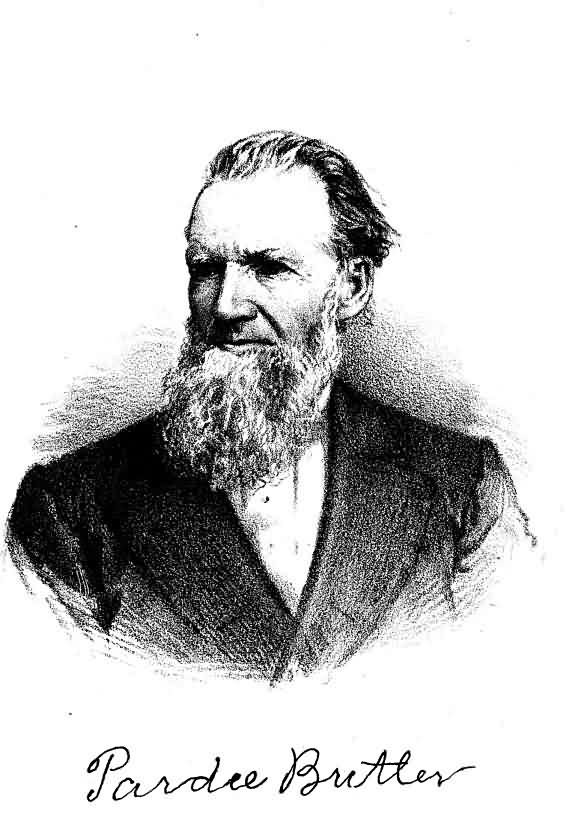
PERSONAL RECOLLECTIONS
OF
PARDEE BUTLER
WITH REMINISCENCES,
BY HIS DAUGHTER,
MRS. ROSETTA B. HASTINGS
AND ADDITIONAL CHAPTERS
ELD. JOHN BOGGS AND ELD. J. B. MCCLEERY.
STANDARD PUBLISHING COMPANY
1889
Contents
List of Illustrations
The Flag Placed on Pardee Butler's Raft.
PREFACE.
I have not attempted to write a complete biography of my father, but merely to supplement his "Recollections" with a few of my own reminiscences. He was a man who said little in his family about his early years, or about any of the occurrences of his eventful life. Nor did he ever keep any journal, or any account of his meetings, or of the number that he baptized. He seldom reported his meetings to the newspapers. I think it was only during the few years that he was employed by missionary societies, that he ever made reports of what he accomplished. He had even destroyed the most of his old letters. And so, for nearly all information outside of my own recollections, I have been indebted to the kindness of relatives and friends.
The later chapters have been written by men who knew my father intimately, and men whose reputations are such as to give weight to their testimony.
To all of these friends I now offer my thanks for their kind assistance.
And to the public I offer this book, not for its literary merit, but as the tribute of a daughter to a loved father, whose earnest devotion to duty was worthy of imitation.
MRS. ROSETTA B. HASTINGS.
Farmington, Kansas, April 23,1889.
INTRODUCTION
In this country inherited fortunes, or ancestral honors, have little effect on a man's reputation; but inherited disposition and early surroundings have much effect on his character.
My father's ancestors were from New England. His father, Phineas Butler, came from Saybrook, Connecticut, where the Congregational Churches framed the Saybrook platform. His mother's people, the Pardees, came from Norfork, Connecticut. The Pardees were said to have been descendants of the French Huguenots. Ebenezer Pardee emigrated to Marcellus, now known as Skaneateles, Onondaga Co., New York. There he died in 1811, leaving his wife Ann Pardee, (known for many years as grandmother Pardee) a widow, with nine sons and two daughters. The eldest daughter, Sarah Pardee, was there married in 1813, to Phineas Butler; and there my father, who was the second of seven children, was born, March 9, 1816.
In the autumn of 1818, Phineas Butler, of whom I shall hereafter speak as grandfather Butler, went to Wadsworth, Medina Co., Ohio. There a settlement had been begun three years before in the heavy timber, and there were only a few small clearings here and there in the woods.
My grandmother came on with her brother the following spring. She had three small children, but they made the journey in a sled, in bad weather, cutting their own roads, and camping in the woods at night. Grandmother Pardee came on later. She was a woman of great energy, and brought up her sons so well that they all became leading men in the communities in which they lived. Grandmother Butler was also a capable, fearless woman, and so calm and firm that it was said no vexation was ever known to ruffle her temper.
Their cabins were built of logs, with hewed puncheon floors and doors; and on the roof, in the place of nailed shingles, were split shakes, fastened on with poles and wooden pins. But grandfather had brought a few nails (made by a blacksmith) from New York, and used them in his house. When a neighbor died they hewed out puncheons to make a coffin, and finding only eighteen nails in the neighborhood, grandfather, by torchlight, pulled fourteen more out of his house to finish the coffin.
Their lives were full of hardship and privation. Grandfather was a famous hunter, and his well aimed rifle sometimes furnished game that kept the neighborhood from starvation. He was dependent on bartering furs at some distant trading post, for his supplies of salt, needles, ammunition and other necessary articles that could not be made at home.
Often, after a hard day's work, he hunted half of the night to obtain coonskins and other furs. Father said that one night grandfather and Orin Loomis were out hunting coons with the dogs, having taken their axes to chop down coon trees, but no guns, when they found a bear, on a small island, in the middle of a swamp. But I find his bear story so well told in the "Wadsworth Memorial" that I will quote from that:
"In the fall of 1823, as Butler and Loomis were returning after midnight from one of their hunts, and had arrived within a mile or two of home it was noticed that the dogs were missing. Presently a noise was heard, far back in the rear.
"'Hark! What was that?' said Loomis. They listened awhile, and agreed it was dogs, sure.
"'Orr, let's go back,' said Butler.
"'No, it is too late,' answered Loomis.
"'But,' said Butler, 'I'll warrant the dogs are after a bear; don't you hear old Beaver? It sounds to me like the bark of old Beaver when he is after a bear.'
"Butler was bound to go back, and so they started. The scene of the disturbance was finally reached, after traveling two or three miles. The dogs had found a bear; but it was in the middle of Long Swamp, and the alders were so thick that there was scarcely room for man, dog or bear to get through. This did not deter Phin. Butler, however. They got near enough to find that the bear was stationed on a spot a little drier than the main swamp, surrounded by alder bushes, and that she was determined not to leave it. The dogs would bay up close, when the old bear would run out after them. They would retreat, and then she would run back to her nest again.
"'We can't kill her to-night,' said Loomis, 'we will have to go home and come down again in the morning.'
"'No,' replied Butler, 'I am afraid she will get away. We can kill her to-night, I guess. You can go and hiss on the dogs on one side, and I will come up on the other; and when she runs out after them, I'll cut her back-bone off with the ax.'
"They concluded to try this plan, and came very near succeeding. As the old bear rushed past, Butler put the whole bit of the ax into her back, but failed to cut the back-bone by an inch or two. Enraged and desperate, she sprang upon the dogs, who, emboldened by the presence of their masters, came too close. With one of her enormous paws she came down on old Beaver, making a large wound in his side, which nearly killed him. He was hardly able to crawl out of the swamp.
"The fight was then abandoned until morning, as without Beaver to lead the dogs it was useless to proceed. It was difficult to get the old dog home, but he finally got well. Early in the morning the hunters were on the ground. This time they had their guns with them, but found the old bear was gone. On examining her nest of the night before, her unusual ferocity was explained. She had a litter of cubs, which, however, she had succeeded in removing, and must have carried them off in her mouth. In a short time the dogs had tracked her out. She was found a half mile lower down the swamp, where she had a new nest. Butler's rifle soon dispatched her; but her cubs, four in number, and not more than three or four weeks old, were taken alive, and kept for pets."
Father said that he could remember when they brought the bears home, growling, snarling—the crossest little things he ever saw.
Strange as it may seem, my father did not inherit grandfather's love for hunting. I never saw him shoot a gun, and he has never owned one within my recollection.
Orin Loomis was often heard to say that Phin. Butler was the most courageous man he ever knew. He was quick-tempered, but warm-hearted, and full of fun, and as honest and sincere as he was bold and fearless. One time he was traveling, and stopped at a tavern. The strangers present were discussing the statement that every man has his price, and each man was telling what was the least price for which he would tell a lie. Finally one man said that he would tell a lie for five dollars. Grandfather's impetuous nature could stand it no longer, and he burst out scornfully: "Tell a lie! Tell a lie for five dollars! Sell your manhood! Sell your soul for five dollars! You must rate yourself very cheap!" And then, they said, he fairly preached them a sermon on the nobility of perfect truthfulness, and the littleness and meanness of lying and deceitfulness.
My grandmother was also very conscientious, which was illustrated by the fact that on her death-bed, after giving some good advice to her daughters, she charged them to carry home a cup of coffee that she had borrowed.
An old Wadsworth friend, writing to us since father's death, says of him: "From a boy Pardee was remarkable for his uprightness, and bold and strict honesty, and it was a maxim among the boys to say, 'As honest as Pard, Butler.' He and his father before him were specimens of puritanical honesty and courage, and had they lived in the days of Cromwell and in England, would doubtless have been in Cromwell's army."
Scarcely was the settlement begun when a school was taught in one room of a log dwelling-house. When but three years old, father was a pupil in the first school that was taught in the new school-house, by Miss Lodema Sackett, and continued to attend school a part of every year. Books were scarce, but he was fond of reading, and read, over and over, all that he could obtain.
The Western Reserve was settled mainly by New Englanders, who were intelligent and God-fearing men; and religious meetings were held from the first; printed sermons being read aloud when there was no preacher. A Sunday-school was organized in Wadsworth in 1820.
The most influential man in the neighborhood was Judge Brown, an uncle of "John Brown of Ossawatomie." He was noted for the purity of his life, the dignity of his demeanor, and the firmness with which he defended his views. He was a bitter opponent of slavery, and, what was strange in those days, a strong temperance man. Before leaving Connecticut he had heard Lyman Beecher deliver his famous temperance sermons, and he came to Wadsworth with his soul ablaze with temperance zeal. The community was strongly influenced by him, and father said that he was much indebted to Judge Brown for his temperance and anti-slavery principles.
Even in those early days Wadsworth contained a public library, a lyceum where the young men discussed the questions of the day, and an academy. Father took part in the lyceum debates, though he was said to be slow of speech; and attended the Wadsworth Academy from its beginning, in 1830. One of its most successful teachers was a shrewd Scotchman named John McGregor. Father and several young men from a distance, who boarded at grandfather's and attended this school, spent their evenings studying their lessons, or reading and discussing some good book. Dick's scientific works were among the books thus read.
There were many Lutherans, Dutch Reformers, and Mennonites near Wadsworth, and there was a perfect ferment of religious discussion.
During father's boyhood, Alexander Campbell and Walter Scott had been preaching the union of Christians on the Bible alone, and there was great enthusiasm.
Eld. Newcomb, an honored Baptist preacher, together with my grandfather, and Samuel Green—the father of Almon B. Green and Philander Green—had been reading the writings of A. Campbell for several years. Almon B. Green had been made skeptical by the unintelligible orthodox preaching. But one day, after reading the first four books of the New Testament, he exclaimed, "No uninspired man ever wrote that book." He read on until he came to Acts ii. 38, which he took to Eld. Newcomb, asking him its meaning. "It means what it says," was his reply. In a few days Almon was baptized by Eld. Newcomb, simply on his confession of faith in Christ, without telling any experience, as usually required by the Baptists. Soon afterwards four families, the New-combs, Greens, Butlers and Bonnels, all Baptists, united to form a church on the apostolic pattern. Then William Hayden came with his fiery eloquence and wondrous songs; the people were stirred up, opposition aroused, the various creeds were discussed with renewed energy, and the church grew and multiplied.
But father and his uncle Aaron, who was eight years older than himself, had been made skeptical by orthodox mysticism and the disputes of so many wrangling churches.
In September, 1833, A. Campbell came to Wadsworth to attend a great yearly meeting held in William Eyle's barn. The following account of an incident that occurred at that time, I quote from "History of the Disciples on the Western Reserve."
"An incident occurred at this time which displays Mr Campbell's character for discernment and candor. Aaron Pardee, a gentleman residing in the vicinity, an unbeliever in the gospel, attracted by Campbell's abilities as a reasoner, and won by his fairness in argument, resolved to obtain an interview and propose freely his difficulties. Mr. Campbell received him with such frankness that he opened his case at once, saying, 'I discover, Mr. Campbell, you are well prepared in the argument and defenses of the Christian religion. I confess to you frankly there are some difficulties in my mind which prevent my believing the Bible, particularly the Old Testament.'
"Mr. Campbell replied, 'I acknowledge freely, Mr. Pardee, there are difficulties in the Bible—difficulties not easy to explain, and some, perhaps, which in our present state of information can not be cleared up. But, my dear sir, when I consider the overwhelming testimony in its favor, so ample, complete and satisfactory, I can not resist the conviction of its divine origin. The field of prophetic inspiration is so varied and full, and the internal evidence so conclusive, that, with all the difficulties, the preponderance of evidence is overwhelming in its favor.' This reply, so fair and manly, and so different from the pulpit denunciations of 'skeptics,' 'infidels,' etc., to which he had been accustomed, quite disarmed him, and led him to hear the truth and its evidence in a much more rational state of mind. Within a year he became fully satisfied of the truthfulness of the Holy Scriptures, and apprehending clearly their testimony to the claims of Jesus of Nazareth as the anointed Son of God, he was prepared to yield to him the obedience of his life."
My father was present with his uncle Aaron at that interview with Mr. Campbell, and he too was led by it to listen favorably to Mr. Campbell's clear and powerful presentation of divine truth. He followed Mr. Campbell to other meetings, and listened, read, and investigated until he, too, became convinced of the truth of the Bible.
His uncle Aaron, who is still living, said in a recent letter: "I remember going to meeting with Pardee sometime about a year before I was immersed, when he put some questions to me on the subject of religion, which were very difficult to answer."
In June, 1835, at a meeting held in Mr. Clark's new barn, my father and his uncle, Aaron Pardee, confessed their Saviour, and were baptized by Elder Newcomb in a stream on Elder Newcomb's farm. A brother and sister of A. B. Green, and a sister of Holland Brown, were baptized at the same time. Holland Brown had been baptized the previous week. He walked down to the water with father, and remembers hearing him exclaim, on the way to the water, "Lord, I believe! Help thou mine unbelief." He also remembers hearing Elder Newcomb remark, "Now we can take everything; we have Bro. Butler and Bro. Pardee to fight the infidels, and the Browns to fight the Universalists." Holland Brown's brother, Leonard, and his wife—he had married my father's eldest sister, Ann Butler—had been baptized not far from that time.
Holland Brown relates the following incident, which occurred some time afterward:
"Bro. Butler was away from home, and driving a horse, which, though of fine appearance, was badly wind-broken. At times the horse appeared perfectly sound, and at one of those times Bro. Butler was offered a handsome sum for him.
"No," said Bro. Butler, "I can not take that sum for the horse, he is badly wind-broken."
"Why didn't you take it? the man was a jockey, anyhow;" asked some one in my hearing.
"'Because,' was the ringing answer, 'I think less of the price of a horse than of my own soul.'"
About that time father began teaching school in neighboring districts, which he followed for several years. But all of his spare time was spent in studying the Bible, church history, the writings of A. Campbell, and other religious books. It was at that time that he began committing the New Testament to memory.
Grandfather Butler and Samuel Green were the leaders of the new organization, as they had been of the Baptist Church, in Eld. Newcomb's absence—for he was away evangelizing much of the time. They called on the young people to take part in their social meetings on the Lord's day, at first only asking them to read a passage of Scripture, afterward to talk and pray, and, as they gained confidence in themselves, they were asked to lead the meetings. Thus there grew, in that church, one after the other, within a few years, eight preachers: A. B. Green, Wm. Moody, Holland Brown, Leonard Brown, Philander Green, B. F. Perky, Pardee Butler and L. L. Carpenter.
A. B. Green had been preaching a year or more before father was baptized, but I do not know which of the others began first, nor do I know the exact time when father began to preach, but it was about 1837 or 1838. He was not ordained at Wadsworth, for the church at that time doubted whether there was any Scriptural authority for ordination. He was ordained some six or seven years afterward, in 1844, at Sullivan.
In such times of religious excitement it was not necessary for a man to have a college education, to become an acceptable preacher. But father saw the advantages of a good education, and resolved to attend A. Campbell's school, then known as Buffalo Academy, but which was soon changed to Bethany College. But the means to acquire an education must be obtained by his own exertions.
About the year 1839 grandfather sold his place in Wadsworth, and moved to the Sandusky Plains, a level, marshy prairie, in northwestern Ohio. Part of the Plains belonged to the Wyandotte Indian Reservation, and was opened to settlement, a few years afterward, by the removal of the Indians to Wyandotte, Kansas.
Father and grandfather made sheep-raising their business while there. Father herded sheep in summer and taught school in winter. And, while herding sheep, he finished committing the New Testament to memory. He could repeat it from beginning to end, and even in his later years he remembered it so well that he could repeat whole chapters at once. I never saw the time that any one could repeat a verse in the New Testament to him, but that he could tell the book, and nearly always the chapter in which it was found.
He and his father's family put their membership into the church at Letimberville, some miles distant; and there he occasionally preached.
He sometimes went back to Wadsworth, and on the way back and forth stopped and preached for the little church at Sullivan, Ashland Co. There he made the acquaintance of Sibjl S. Carleton, the daughter of Joseph Carleton, one of the leading members of the church. They were married August 17, 1843; and he never had cause to regret his choice, for she proved to him a helpmeet indeed.
While living there, at the solicitation of his neighbors, he held a debate with a Universalist preacher, to the satisfaction of his friends and the discomfiture of his opponent.
Many parts of the Plains were covered with water, and were musical with frogs in the spring, but in hot weather they dried up, leaving here and there a stagnant pond. I have heard father tell how one of his neighbors tried to break a field by beginning on the outside, and plowing farther in as the land dried up. But the snakes and frogs grew thicker and thicker, as he neared the center. At length the grass seemed almost alive with snakes, and his big ox-team became wild with fright, and ran away, and he could not get them back there again.
Of course, such a country was unhealthful, and father's family was much troubled with sickness. His parents both died; my mother was nearly worn out with the ague; and he not only suffered from poor general health, but from a sore throat, and had to quit preaching. He moved to Sullivan, but without any permanent benefit to his health. He did not at that time attribute his sore throat entirely to the climate, but thought it a chronic derangement that would utterly unfit him for a preacher. Many years afterward he wrote of that disappointment as follows: "For five years I saw myself sitting idly by the wayside, hopeless and discouraged. I felt somewhat like a traveler, parched with thirst, on a wide and weary desert, who sees the mirage of green trees and springs of cool water that has mocked his vision, slowly fade away out of his sight. So seemed to perish my castles in the air. At that time making proclamation of the ancient gospel was too vigorous a work, and too full of hardship and exposure to be undertaken by any except those possessing stalwart good health. If I had been predestinated to the life I have actually lived, and if it were necessary that I should be chastened to bear with patience all its disabilities, then, I suppose, this discipline I actually got might be considered good and useful. If I have been able to bear provocation with patience, and to labor cheerfully without wages, and at every personal sacrifice, this lesson was learned when I saw all my hope dashed in pieces."
In the spring of 1850 father sold his property and decided to go to Iowa. Shortly before the time of starting, my little sister and baby brother took the scarlet fever and, ere long, they were both laid in the old graveyard. Heart-broken as my parents were, they did not give up the long, lonely journey. Father bought a farm in Iowa, and built a log house on it, intending to become a farmer. He and mother united with the nearest church, at Long Grove, sixteen miles distant. Father did not tell them at first that he had been a preacher, but they questioned him and learned the facts. As his health improved he occasionally preached for them.
Eld. N. A. McConnell gives the following account of his preaching in Iowa:
"I first met him at his temporary home in Posten's Grove, in the fall of 1850. During that winter he taught a school in Dewitt, Clinton Co., and preached occasionally at Long Grove. The next spring he attended a co-operation meeting at Walnut Grove, Jones Co., at which he was employed to labor with me in what was called District No. 2. His district included the counties of Scott, Clinton, Jackson, Jones, Cedar, Johnson, a part of Muscatine, Linn and Benton, and west to the Missouri river. He preached at LeClaire, Long Grove, Allen's Grove, Simpson's, Big Rock, Green's School-house, Walnut Grove, Marion, Dry Creek, Pleasant Grove, Burlison's, Maquoketa and Posten's Grove, as well as at numerous school-houses scattered over a large district of the country. He did excellent work in preaching the word. He was not a revivalist, nor was his co-laborer, yet there were a goodly number added to the Lord during the year. I think not less than one hundred. The next year, 1852, the annual meeting of the co-operation was held at Dewitt, Clinton Co. At that meeting the district was divided into East and West No. 2. Your father was assigned to the eastern division and I took the western. His field included Davenport, Long Grove and Allen's Grove, in Scott Co.; Maquoketa and Burlison's in Jackson Co., and Dewitt in Clinton Co. He labored also in Cedar Co., and did a grand work, not so much in the numbers added as in the sowing the good seed of the Kingdom, and recommending our plea to the more intelligent and better informed of the various communities where he labored. You will remember that he held in mind nearly the entire New Testament, so that he could quote it most accurately. I think he had also the clearest and most minute details of the Old Testament history, of any man I ever knew. Nor was his reading and recollection limited to Bible details; for he was very familiar With other history, both sacred and profane.
"I call to mind two sermons that he delivered. One was based on the language of Christ addressed to the Woman of Samaria, at Jacob's well—John iv.: 'Ye worship ye know not what. We know what we worship; for salvation is of the Jews.' In this sermon he detailed the history of Israel to the revolt under Jereboam, the history of Jereboam and his successors until the overthrow of the ten tribes, and the formation of the mongrel nation called Samaritans. In this he showed that God's promise—Ex. xx., 'In all places where I record my name, I will meet with you and bless you,' was fully realized by the people of God, and that a disregard of the law in harmony with this promise was followed by most disastrous results. And that the same is true under the Gospel—where his name is recorded, and only there, he now meets and blesses his people.
"The second sermon was on the subject of Justification by faith.' This was doubtless one of the very best efforts of his life. I will not trouble you with the details of this grand effort, since it was published in full in the Evangelist in 1852. The sermon was published, not by his request, but by the unanimous voice of the State Meeting held in Davenport that year.
"I am sorry that I can not give more of the details of his grand work in Iowa."
The winter of 1851-2 was very cold, but father did not stop for bad weather. I remember that when he started to his appointment one cold morning mother cried for fear he would freeze to death. The mail-carrier did freeze to death that day, but father kept from freezing by walking. The next summer was very rainy, and mother was always anxious when there were high waters, for there were no bridges, and father always swam his horse across streams, although he could not swim a stroke.
Then he preached for several years in Illinois, and was gone for months at a time.
In July, 1854, my little sister—for by that time I had another brother and sister—after a brief illness, closed her eyes in death. Fortunately father was at home, to mingle his tears with mother's, over the little coffin.
The next spring father sold his Iowa farm.
Before leaving there an incident occurred that I distinctly remember. The Iowa Legislature had passed some kind of temperance law, and the people were to vote on it at the spring election. Our country lyceum formed itself into a mock court, and tried King Alcohol for various crimes and misdemeanors. Father was appointed prosecuting attorney, and he went at it in earnest, as he always did at anything he undertook. He sent for every man in the vicinity who ever drank, or who had good opportunities to observe the effect of drink on others, to appear as a witness against King Alcohol. The trial lasted three evenings, with Increasing crowds. Father's adroitness in drawing facts from witnesses—often against their will—kept the Audience laughing and applauding. I remember hearing people say that he had mistaken his calling; that he ought to have been a lawyer. On the last evening, When he addressed the jury, he became eloquent. He pictured the terrible effects of intemperance, the ruined homes, the weeping wives, the ragged children. He denounced King Alcohol as guilty of every known crime—of stealing the bread from the mouths of children, of robbing helpless women of everything they valued most, of brutally shedding the blood of thousands, and of filling the whole earth with violence, until the cries of widows and orphans reached to high heaven. When he finished, the house rang with applause. The attorney for the defense tried to reply, but the boys said Mr. Butler had spoiled his speech. The jury brought in a verdict of guilty. The election came off soon afterwards, and people said that it was strongly influenced, in that township, by father's speech.
The next May, mother, my little brother, and I, went to my uncle Gorham's, near Canton, Illinois; while father went to Kansas to buy land, intending, however, to live several years at Mt. Sterling, Illinois, before moving to Kansas.
MRS. ROSETTA B. HASTINGS.
PERSONAL RECOLLECTIONS
CHAPTER I.
I came to Kansas in the spring of 1855, having been preaching in that part of Illinois known as the Military Tract, during the three preceding years; but my residence was in Cedar County, Iowa, one hundred and fifty miles from my field of labor, and twenty-six miles to the northwest of the city of Davenport. I had been employed for one year in Iowa as a co-laborer with Bro. N. A. McConnell; but the church at Davenport, which was the strongest and richest church in the Cooperation, determined to sustain a settled pastor, and this left the churches too poor to support two preachers, and I was left to find another field of labor.
When I first came to Cedar County I came simply as a farmer; and there were but nine families in the township in which we settled. But when the country came to be settled up the result was not favorable to the expectation that we should have prosperous churches in that region. Those who have watched the progress of the temperance reform in Iowa have noticed that, while the prohibitory law is enforced almost throughout the State, there are yet exceptions in the cities of Davenport and Muscatine and the adjacent counties. Here the law is set at defiance. This is owing to the presence of a German, lager-beer-drinking, law-defying population, Godless and Christless, and that turn the Lord's day into a holiday. This tendency had begun to be apparent before I left Iowa.
When it became manifest that I could not any longer find a field of labor in Southeastern Iowa, I was recommended to the churches in the counties of Schuyler and Brown, in the Military Tract, Illinois.
My first introduction among them was dramatic, if, indeed, we could give to an incident almost frivolous and laughable, the dignity of a dramatic incident; and yet the matter had a serious side to it. I had been commended by Bro. Bates, editor of the Iowa Christian Evangelist, to the church at Rushville, where I held a meeting of days. The meetings grew in interest, there were some important additions, and the church was greatly revived. Twelve miles from Rushville was the town of Ripley, a small village, where the people were engaged in the business of manufacturing pottery ware. Here two Second Adventist preachers, a Mr. Chapman and his wife, were holding forth. This Mr. Chapman was a devout, pious, and earnest man, and a good exhorter, and had an unfaltering faith that the Lord was immediately to appear. But his wife was the smartest one in the family. She was fluent and voluble. She had an unabashed forehead and a bitter and defiant tongue. It was her hobby to declaim against the popular idea of the existence of the human spirit apart from the body. With her this was equivalent to a witch riding on a broomstick or going to heaven on a moonbeam. Spirit is breath—so she dogmatically affirmed—and when a man breathes out his last breath his spirit leaves his body. But it was her especial delight to declaim against the Pagan notion of the immortality of the soul, and to affirm that the Bible says nothing of the immortality of the soul. A Bro. McPherson undertook to contest the matter with her, but, not finding the scripture he was looking for, she exclaimed with bitter and vixenish speech, "Ah! You can't find it! You can't find it! It isn't there! I told you so!" And thus this couple were fast demoralizing the church, Billy Greenwell, the richest man in the church, being wholly carried away with this fanaticism. John Brown lived half way between Ripley and Rushville, but was a member of the church at Rushville. Bro. Brown was a man of good sense, excellent character, and had been a member of the Legislature. He attended our meeting at Rushville, and, in the intervals of the meeting, was full of questions concerning this heresy that had been sprung on them at Ripley.
Our meeting at Rushville came to a close. It had been a good meeting; the church had been revived, and there had been important additions. I took dinner with Bro. Brown, and in the afternoon we rode toward Ripley. On crossing the ferry at Crooked Creek, "Old Rob Burton," the ferryman, a tall, stalwart Kentuckian, looking down on me, asked, "Are you the man that's goin' to preach at Ripley to-night?"
"Yes."
"Wall, don't you know thar's a woman thar that's goin' to skin you?"
"Well, I don't know. We shall see how it will be?"
At Rushville I had done my best, and now, being withdrawn from the excitement of the meeting, felt exhausted; and determined not to touch any debatable question that night. The house was crowded with eager and expectant listeners. My fame had gone before me, and the "woman preacher" was present, ready for a fight. But, alas! My sermon was a bucket of cold water poured on the heads of my brethren. At any other time it would have been accepted as a good and edifying exhortation; but now, how untimely! The meeting was dismissed and the buzzing was as if a hive of bees had just been ready to swarm. The woman's disciples were jubilant; and, above the din and hurly-burly, I heard a thin, squeaking voice say, "Give that woman a Bible, and she would say more in five minutes than that man has said in his whole dis-c-o-u-rse." This was Billy Greenwell.
Brother Brown said nothing that night; but the next morning he said to me:
"Bro. B., the people were disappointed with you last night."
"Why, Bro. B., was it not a good sermon?"
"Yes; but it was not what the people expected."
"Bro. B., did the people expect me, uninvited, to pitch into a quarrel with which I have nothing whatever to do?"
"Oh, is that it? Well, wait a little and you shall have an invitation."
Bro. Brown went out, and soon returned with a request that I should discuss the question that Mr. Chapman and his wife had been debating. I sat down and wrote out a statement of the subjects on which I proposed to speak in all the evenings of the coming week. The first commanded universal attention: "Does the spirit die when the body dies?" They had never thought of that. They had been thunderstruck when this woman told them that the Bible says nothing about the immortality of the soul, but beyond this they had never gone. There was probably more Bible reading that day in Ripley than any day before or since.
At night the house was jammed, and "the woman" was there, Bible in hand. I began: "The Bible speaks of a man as composed of body, soul and spirit. The body is that material tabernacle in which a man dwells, and which Paul hoped to put off that he might be clothed with a house not made with hands, eternal in the heavens. The soul is that animal life we have in common with all living and material things. Thus Jesus is said to have poured out his soul unto death. But what of the spirit? God is spirit, and God can not die. The angels are spirits, and the angels can not die; Jesus says so. Man has a spirit, and can man's spirit die? But spirit sometimes means breath. Yes, and heaven sometimes means the firmament above our heads, where the birds fly. But does it never mean more than this? Paradise sometimes means the happy garden where Adam and Eve dwelt; but does it never mean more than that? So, granting that spirit sometimes means breath, may it not also mean more than that?
"When Jesus said, 'Into thy hands I commend my spirit,' did he mean, 'Into thy hands I commend my breath'? So, when the disciples saw Jesus walking on the water and cried out, 'It is a spirit,' did Jesus say to them, 'This is an old wives' fable; there is no such thing as a spirit'? Did he not rather say to them,—'It is I; be not afraid.' So, also, when he appeared to them in a room, the doors being shut, and they cried out, 'It is a spirit,' he said to them, 'Handle me and see; for a spirit hath not flesh and bones, as ye see me have.' In all this Jesus encouraged the disciples to hold the idea which was then popular among the Jews, that the spirit may exist apart from the body, and after the body is dead."
I thus discoursed to them for one hour in development of the Bible teachings concerning human spirits; and in my turn ridiculed the persons that had ridiculed the ideas that had evidently been held by Jesus and the apostles.
Mrs. Chapman had always invited objections; but she was sure to make an endless talk over them. I said, "We will not have an endless confabulation to-night; but I will quote one passage of Scripture, and on that I will rest my case. Any other person may then quote one passage of Scripture and on that rest the case. I have preached one sermon; the other party has preached twenty. So far we will count ourselves even, and it only remains that I should quote my Scripture, and let the other party quote the one Scripture on the opposite side, and then we will be dismissed." I gave the views of the Pharisees and of the Sadducees as detailed by Josephus, and then quoted Luke in the Acts of Apostles: "The Sadducees say there is no resurrection, neither angel nor spirit; but the Pharisees confess both." And Paul says, "Men and brethren, I am a Pharisee, the son of a Pharisee." So I also say, I am a Pharisee, the son of a Pharisee, and hold to the existence of human and angelic spirits.
When I announced that I should call for objections, I saw Mrs. Chapman take up her Bible in a flutter and nervously turn over its leaves. When I sat down all eyes were turned on her, and there was a death-like stillness in the house. Then she rose up, and in a moment was out of the house. She left the town the next morning and never came back. Then it was "Old Bob Burton's" turn to speak. He said to Billy Green, "Your chest is locked, and the key is lost in the bottom of the sea."
The brethren were gratified that the power of this "soul-sleeping" delusion was broken. Billy Green never recovered from his infatuation. He afterwards built a house that, in the number of rooms it contained, was wholly beyond his necessities. But he thought that when the Lord should come, and he should own all the land that joined him, and should have children to his heart's desire, then he would need all the room.
CHAPTER II.
From Ripley I went to Mt. Sterling, the county-seat of Brown County. This church had fallen into decay for want of the care of a competent evangelist. Here I remained some weeks; and the church was very much revived, and there was a large ingathering. This was originally the home of Bro. Archie Glenn, now conspicuous in building up the University at Wichita. From the first Bro. Glenn, though modest and unobtrusive, was known as a solid and helpful member of the church. He always had the confidence of the people of Brown County, and was by them elected to various public offices, at last becoming Lieutenant-Governor of the State. But his business not prospering to suit him, he removed to Wichita, which was at that time a straggling village of uncertain fortunes, situated on a river of doubtful reputation, and located in a country concerning which the public were debating whether it should be called "The Great American Desert," or a decent place, where civilized men could live and thrive.
But Bro. Glenn did not lose faith in the Lord nor in his country. He went to his new home to be a live man. Wichita has decided to be a city, and not a straggling village of doubtful and cow-boy reputation; the Arkansas River has agreed to behave itself and to co-operate with human hands in giving fertility to its valley, and the geographers have unanimously agreed to strike the "Great American Desert" from the map of the United States. Sister Shields has grown up since these old days to be a woman, then a widow, and now a true yoke-fellow with her father in these great undertakings.
Bro. Lewis Brockman was pointed out to me, when first I came to Mt. Sterling, as a disaffected member; but, on a better acquaintance, it became apparent that his disaffection was that the church members had made a solemn vow to keep the ordinances of the Lord's house, and did not do it. When better order was obtained, he was once more in harmony with the church; came to Atchison County, Kansas, and died, a pattern of fidelity to his conscience and to every known duty.
During the period of three years in which I remained preaching in the Military Tract, I visited almost all its churches. The number of disciples was large. They had a large amount of wealth at their disposal, and were not averse to using it to promote the advancement of the cause. But the children of this world are, in their generation, wiser than the children of light, and there is a certain practical wisdom that has been abundantly learned by other religious communities that has only come to our churches through a sore and bitter experience; and it was through the fire of this experience they were passing at the time of which we write. "Billy Brown" had been a notable evangelist among them. Indeed, he had been the father in the gospel of the churches in Brown and Schuyler Counties. He was popularly described as having a head "as big as a half bushel," surmounted by a great shock of hair. He was an iconoclast, and devoted his life to the business of image-breaking, and, of course, the breaking in pieces of the idols of the people created a great tumult. There was this difference, and only this difference, between the work of Billy Brown and Sam Jones; Sam Jones declaims against sins already condemned by the popular conscience, but Billy Brown assailed convictions enshrined in the innermost sanctuary of the hearts of the people. He did so because these popular superstitions stood in the way of the acceptance by the people of the apostolic gospel. Of course, the work of such a man carried with it an inconceivable excitement. At Mt. Sterling a man in the audience made some objection.
"What is your name?" said Billy Brown.
"My name, sir, is Trotter."
"Well, come forward, and I will knock your trotters out from under you."
But Billy himself sometimes found his match. At Ripley he had been preaching after his accustomed style, and riding away from the place of meeting—it was in the spring of the year when the mud was deep—he saw an old man painfully and with difficulty making his way through the mud. Knowing that he was a preacher from his white cravat, his broad-brimmed hat and single-breasted coat, he said to him:
"Well, old Daddy, how did you like the preaching?"
"Haven't heard any," stiffly replied the old gentleman.
But when the tumult and excitement of this conflict had passed away, and his converts were brought face to face with the grave duties of a religious life, and with the serious work of keeping the ordinances of the Lord's house, they did not know how; they had been born in a whirlwind and could only live in a tempest. Notwithstanding, they loved the Lord's cause, and they trembled for themselves and their children, if they should not be found faithful.
If these churches are not able at the present time to exhibit a growth adequate to their opportunities, it must be remembered, on their behalf, that they have sent to the West an incredibly large number of disciples to serve as the nuclei for other churches throughout that mighty empire that within the past thirty years has grown up between the Missouri River and the Pacific Ocean.
The days I spent in these churches are the golden days of my life. There has been no field in which my labor as an evangelist has yielded a richer harvest; none in which there have been bestowed on me more flattering or more kindly attentions. It was the bright and joyous sunshine of a spring morning, before the bursting of the storm.
Though each year increased my attachment to the people, and apparently added their good-will to myself, there had been coming to the front a difficulty that could not any longer be thrust aside or disregarded. I was one hundred and fifty miles away from home, and from my wife and children. On holding a council of war to consider our future tactics, in which Mrs. Butler, was commander-in-chief, and myself, second in command, she said to me, "Pardee, I am willing to go wherever you say, only when we go there we must go to stay. We must not put our house on wheels. We must not leave our children without settled employment, exposed to all the hazards of a city life, or a life without a permanent habitation."
Under such circumstances the settling on a home in reference to which it could be said, "Here we are to stay," was not an easy matter. The people of the Military Tract were, almost all of them, Kentuckians. There were evidently impending storms in the political horizon. I could not bend my sails to suit every favoring gale; and if, in the future, there should come a time that my conscience should lie in one direction, and my popularity and pecuniary interest in the other, I did not like to invite such a temptation. At any rate, I did not like to place myself in such a position that to bring down on my head popular odium would be to invite pecuniary ruin. These counties in the Military Tract were old settled counties, and land was high; and I was not rich. At this time the Kansas-Nebraska bill had been adopted by Congress, and Kansas had been opened for settlement. It was certain that Eastern Kansas, in the matter of fertility of soil, and all the elements of agricultural wealth, would be a desirable location.
"But there might be a political and social conflict." Yes, and there might be a political and social conflict in Illinois; or, for the matter of that, it might cover the West as with a blanket. It was certain that Eastern Kansas would be early settled from Missouri; and in no State was there a larger percentage of the people known as Disciples. I would, therefore, be among my brethren; and, if I had kept the peace for three years with Kentuckians in Illinois, could I not do the same thing with Missourians in Kansas? In any case, there was a fair prospect of gaining in Kansas a position of pecuniary independence; and any man can see that such a position was worth all the world to Alexander Campbell, when he was constrained by his conscience to bring down on his own head the utmost wrath of his Baptist brethren.
I started in the spring of 1855 to ride on horseback through Missouri; but was soon made to feel that there were more things in this world than were known in my philosophy. I had determined to remain over Sunday in Linnville, Linn County, Missouri, the county-seat of the county, as here was a congregation of Disciples; and called on a merchant of the place, who had been mentioned as one of the leading members. He remarked that he had become acquainted with me through the Christian Evangelist, published by Bro. Bates, in Iowa; but, on learning my destination, seemed strangely oblivious that anything more should be due from him to me. And so, having waited patiently about for a goodly time, I mounted my horse and rode on till dark; then seeing a light, and having called at the house, I found an old man who kindly received and lodged me. In the morning it appeared that his house was surrounded by negro cabins. Having inquired my destination, he began to talk to me concerning the subject that seemed to be in every man's heart. I replied, submitting to him such views as were held by a majority of Northern men. To my surprise he flared up in anger, and said:
"If you talk that way when you get to Kansas you will never come back again; they will hang you."
The thing was so absurd I only laughed in the old man's face, and said to him:
"Well, you can not teach an old dog new tricks. I have spoken my mind so long that I shall continue to do it if they do hang me," and so bade him good-bye.
It was Sunday morning, and it was eighteen miles to Chillicothe. Arriving at the hotel, the people were getting ready for meeting. On questioning them where they were going, the landlord replied:
"To the Christian Church. Will you not go along with us?"
On asking my name he said:
"O yes; I have seen your name in the Christian Evangelist. You have been preaching in Illinois. I will introduce you to our preacher, and we will make an appointment for you this afternoon."
This landlord was a brother to that Congressman Graves that shot Cilley, a member of Congress from Maine, in a duel with rifles, at Washington. The people described "mine host" as one of "fighting stock "; and spoke of him as being as thoughtful of the comfort, health and welfare of his slaves as of his own children. To me he seemed simply a genial, jovial, friendly and traditional "Boniface," chiefly intent on furnishing comfortable fare and an enjoyable place for his guest.
By the members of the Christian Church I was kindly received, and was invited to take dinner with the preacher. After dinner two brethren came in, to whom I had been introduced at the meeting-house. After some desultory talk, they asked me:
"Are you an abolitionist?"
I was both angry and confounded. I had never in my life made myself conspicuous in this controversy that was going on between North and South, and why should I be insulted with such a question. I did not answer yes or no, but proceeded to give my views on the subject in general. They listened and remarked that they did not see anything offensive in such views; then made this apology for their seeming rudeness: An old man, a preacher, whom they called Father Clark, had come from Pennsylvania to Chillicothe to live with a married daughter, and had said something concerning slavery offensive to the people, and they had called a meeting of the citizens, and he had been driven out of town and ordered never to return. They had, furthermore, resolved that no abolitionist should thereafter be allowed to preach in the city. These brethren explained that, as I would be called on and interrogated by a committee, they thought it would be better that this should be done by friends, than that I should be questioned by strangers.
"Are You an Abolitionist?"
I was angry with myself for having consented to preach a sermon after being met with such a question. But by mine host, Bro. Graves, I was treated with the most frank and manly courtesy, albeit that he was brother to the man that shot a brother congressman in a duel with rifles. He seemed to feel like the town clerk at Ephesus: "What man is there that knoweth not that the city of the Ephesians is a worshiper of the great goddess Diana, and of the image that fell down from Jupiter? Seeing then that these things can not be spoken against, ye ought to be quiet and do nothing rashly."
The Hannibal & St. Joseph Railroad was just being located through the city, yet the town was a dead town, though it was surrounded by a fertile and prosperous country. Bro. Graves seemed awake to all its advantages, and pressed me to remain, pointing out the rapid advance that must take place in the value of its property. But I kept thinking of the question: "Are you an abolitionist?" and bade him farewell.
At nightfall I found myself beyond Gallatin, on the road to St. Joseph. As there were no hotels I called at a private house and was hospitably received. This man, on whom I had called, had come from the State of Pennsylvania, and had grown to a prosperous farmer. There seemed to be no books or newspapers about the house; but he was shrewd and sagacious to a proverb, and was eager to hear from the land of his fathers, and of what was the cause of all this din and clamor and excitement of the people about him. What was the meaning of the Kansas-Nebraska bill? What were the intentions of the Black Republicans? What was the New York Tribune doing, that it should raise such a tumult? And what were the purposes of the Emigrant Aid Society that it should be such an offense to the people in Missouri?
On my own part, I also had much to learn from this man, so shrewd and well-informed, and yet so ignorant. What did it mean that citizens of Missouri should go over in force and vote in the Territory of Kansas? We had heard something of this in Illinois, but supposed it was something done by that turbulent and somewhat lawless element that gathers along the borders of civilization; but now it was apparent that this movement was under control of leading citizens of Missouri, and had been participated in by conscientious men, members of the various churches of Missouri, who would in no wise knowingly do anything wrong. What did it mean?
The reader will not be surprised that we should sit up to a late hour of the night, nor that we should renew the subject again in the morning. When I had got ready to leave this man, who had so hospitably entertained me, he explained that he had business on the road on which I was traveling, and that he would accompany me a number of miles.
This emigrant from Pennsylvania, now a citizen of Missouri, who carried his library in his brain and read his books when he conversed with men, and kept his own counsel and lived in peace with his neighbors, was now about to say farewell. With some hesitation he said: "Mr. Butler, I thank you for all you have told me. I feel just as you do; but I must advise you to be careful how you talk to other men as you have talked to me. There are many in this country that would shoot such a man as you are. Good-bye."
CHAPTER III.
It is said, "There are two sides to every question." In my association with men in the free States I had learned one side of this question; now I was learning the other side, and began to be able to put in intelligible shape to myself those reasonings by which these men justified their action. They reasoned thus: "War is a state of violence and always involves a trenching upon what we call natural rights; and its decisions depend not so much on who is right or wrong, as on who wields the longest sword and commands the heaviest battalions. And if in carrying on a war some evil comes to innocent parties, this is only one of its necessary consequences, and is justified by the final result; provided always that the war, as a whole, is right and just. And in such a strained and unnatural condition of affairs men can not be governed by the same scrupulous regard for others' rights by which they are governed in time of peace. But the North and South are already practically in a state of war. This comes of the mistakes made at the formation of our government. Thomas Jefferson and the fathers of the Revolution were mistaken in holding slavery wrong. It is a rightful and natural relation, as between an inferior and superior race. The black race is far better off here in America, in slavery, than they would be in Africa, in freedom and in paganism; and if there is something of hardship in their lot, it is only because there is hardship in the lot of every human being."
These men also said: "Consequent on these erroneous views held by Thomas Jefferson and others, the settlement made as between the North and South has been wrong, from the beginning, It was wrong to close the Northwest Territory, embracing Indiana, Illinois, Michigan, and Wisconsin, against slavery. So also it was wrong to close Kansas against this institution by what was called the Missouri Compromise Line, agreed upon on the admission of Missouri into the Union."
So these men reasoned, and they said: "Now we propose to go and take by the strong hand those rights of which we have been wrongfully deprived since the beginning of the American Government. A little severity now—a resolute seizing on our rights now, in this golden opportunity—will be worth more than the shedding of rivers of blood by and by. Therefore the primary and rudimental legislation of this infant Territory will be worth everything to us in the final settlement of this question. It is certain that the law is against us; but the law itself is wrong, and has been wrong from the beginning. The right that belongs to us is the material and inalienable right of revolution."
We have no right to assume that a majority of the people of Missouri held the sentiments we have here indicated: probably they did not. But the dissent was generally unspoken. The men of this stamp commonly adopted the policy of the man with whom I had just parted. But there was dissent in some cases, bitter and vehement, followed sometimes by bloodshed.
Before I had gone to Iowa, and while I yet lived in Ohio, I had visited Kentucky. An Ohio colony had gone down into Kentucky and located in the counties of Wayne and Pulaski, on the Cumberland River. A brother of mine had gone with them, and I had made him a visit. I thought then, and think now, that there is no region on which the sun shines, more desirable to live in than the region of the Cumberland Mountains. At Crab Orchard I found a man that was born in the State of New York. He had been a soldier at Hull's surrender, at Detroit, in the war of 1812, with Great Britain. From Detroit he had made his way into Kentucky, had married a rich wife with many slaves, and had become a vehement partisan for slavery. But because he was born in the same State with myself, and because I could tell him much about that people that were once his people, he was glad to have me stop with him. Being old and choleric, he would go off into a fierce passion against the abolitionists. He would say: "These men are thieves! Our niggers are our property, and they steal our property. They might as well steal our horses." After awhile he would begin to talk about his children. He would say: "These niggers are ruining my children! My girls are good for nothing! They can not help themselves! They are so helpless they can not even pick up a needle. And my boys! These niggers are ruining my boys! My boys won't work!" And then he would go on to tell the nameless vices the young men of the city were drawn into through their intimacy with the blacks. I thought, but did not say, "My dear sir, if slavery is working such a ruin on your own children, would not the abolitionists be doing you a kindness if they would steal every nigger you have got?"
But there was a still graver aspect that this question was beginning to assume: A woman that is a slave has neither the motive nor the power to protect her own virtue; and the land was threatened to be filled with a nation of mulattoes. But this mixed race would possess all the pride, ambition and talent of the superior race; at the same time they would feel all that undying hatred that a subject people feel toward the men by whom they are subjugated. We would then be sleeping on a volcano, such as may at any hour engulf the empire of Russia.
All this I pondered in my heart as I slowly made my way toward St. Joseph, on the Missouri River, which flows along the western border of Kansas. And now this question was coming to the front and forcing a settlement, and in Kansas would be the first real conflict. In Congress they had only paltried with, it; now the people were to try their hand. And what should I do? Had I any right as a Christian and as an American citizen, when providentially called to this work, to withdraw myself from aiding in its settlement? And should I turn my horse in the opposite direction, go back to my Bro. Graves at Chillicothe, and say to him: "You are a man of undoubted courage, but I am a paltroon and a coward, and I am going to hunt a hole and hide myself, where I will be out of danger when this battle is fought between freedom and slavery."
I did not turn back, but revolving all these matters in my mind, reached the city of St. Joseph. Here I had been commended by a friend to a merchant in the city, a member of the Christian Church. He received me kindly and treated me courteously, but his partner in business did not seem to be of that mind. He was all out of sorts, and gruffly said, "Kansas is a humbug. It will not be settled in thirty years."
In revolutions men live fast. I had been ten days on my journey, and the man that now crossed the Missouri River at St. Joseph was not just the man that ten days before crossed the Mississippi at Quincy. He was a wiser and a sadder man.
On the Kansas side the first company I met was a two-horse wagon load of men that had been exploring the Territory and were returning. They seemed thoroughly disgusted, and said: "The wind blows so hard in Kansas, it would blow a chicken up against the side of a barn and hold it there for twenty-four hours."
"Kansas will not be settled in thirty years." So said my not very amiable friend in St. Joseph. It is now somewhat more than thirty years, and Kansas has more than a million of inhabitants. But the State has a higher boast to make than that it has so increased in wealth and population. It has been the first State in the Union—indeed, it has been the first government in the world—to incorporate prohibition into its fundamental law; and this is the best possible criticism by which to mark its comparative progress in a Christian civilization.
CHAPTER IV.
After crossing the Missouri River I visited some of the principal settlements in the Territory, such as Atchison, Leaven worth, Lawrence and Topeka. Lawrence, Topeka and Manhattan were settlements made by men from free States, and with an eye single to making Kansas a free State. There was no town located on the Missouri River, and no settlement made in the counties bordering on the Missouri River, that were properly free State settlements. I thought this was a mistake. These counties had by far the largest population, and as these counties would go, the Territory would go; and I thought that no considerations of personal danger ought to hinder, that these counties should have respectable settlements of avowed Free State men among them.
What is now the city of Atchison was then a small village that was being built among—the cottonwood trees on the banks of the Missouri River, about twenty miles below St. Joseph, and the same distance above Fort Leavenworth. It had been named after the notable David R. Atchison, who had been a Senator from Missouri, and acting Vice-President of the United States. D. R. Atchison and Gen. B. F. Stringfellow had at this time won a national notoriety in this struggle now going on in Kansas; and both were leading members in the Atchison town company. Dr. Stringfellow was deputed to act as editor-in-chief of the Squatter Sovereign, a paper at that time started in Atchison; but the editor was Robert S. Kelly. Bob Kelly, as he was popularly called, was a born leader among such a population as at that time filled Western Missouri. The towns along the Missouri River were the outfitting points for that immense overland freighting business, that was at that time carried on across the western plains, to Santa Fe in Mexico and to Salt Lake, Oregon and California; and here congregated a multitude of that wild, lawless, law-defying and law-breaking mob of men, that accompanied these expeditions, and were the habitues of these western plains, or were among the gold seekers of California.
Bob Kelly was left an orphan at an early age, and was from his youth surrounded with such a population. In person he was handsome as an Apollo, broad-shouldered and muscular, with fair complexion and blue eyes, and was the natural chief of the dangerous men that were drawn to him by his personal magnetism. Moreover, he possessed so much native eloquence, and such an ability to make passionate appeals, as made him a fit person to fire the hearts of these men to deeds of violence,
I obtained a claim to 160 acres of land, twelve miles from Atchison, and on the banks of the Stranger Creek. This claim I would be at liberty to buy, at government price, if I should continue to live on it until it should come into market. My nearest neighbor was Caleb May, a Disciple, and a squatter, from the other side of the river. Bro. May was in his way as much a character as Bob Kelly. He gloried, like John Randolph, of Roanoke, in being descended from. Pocahontas, and that he therefore had Indian blood in his veins. Born and reared on the frontier, tall, muscular, and raw-boned, an utter stranger to fear, a dead shot with pistol or rifle, cool and self-possessed in danger, he had become known far and near as a desperate and dangerous man when meddled with. But he had been converted, and had become a member of the Christian Church, and according to the light that was in him he did his best to conform his life to the maxims of the New Testament, and conscientiously sought to confine all exhibition of "physical force" to such occasions as those in which he might be compelled to defend himself. Then it was not likely to be a healthy business for his antagonist.
After securing my claim, and commencing to build a cabin, I began to look around me. Fully three-fourths of the squatters of this whole region were from the border counties of Missouri. But in Western Missouri the percentage of Disciples was perhaps larger than in any other portion of the United States, consequently I had brethren on every side of me. These men certainly were not refined and educated men, as the phrase goes, still they had the qualities that our Lord found in the fisherman of Galilee.
One thought was in every man's heart, and on every man's tongue. The name Squatter Sovereign, that had been given to the Atchison newspaper, indicated the trend of public opinion. They had been flattered with the idea that if they would come to Kansas they should be "Squatter Sovereigns," that the domestic institutions of the infant Territory should be determined not by the nation, nor by Congress, but by themselves. And yet, when the election day came, every election precinct in the Territory, except one, was taken possession of by bodies of men from Missouri, and the elections had been carried, not by bona side citizens, but by an outside invasion. With pain and shame, and bitter resentment, my neighbors told me how they had driven their wagons to the place of voting, on the prairie, and hitched their horses to their wagons, and were quietly going about their business, when with a great whoop and hurrah, which frightened their horses and made them break loose from their wagons, a company of men came in sight, and with swagger and bluster, took possession of the polls, and proceeded to do the voting. Meantime whisky flowed like water, and the men, far gone in liquor, turned the place into a bedlam. In utter humiliation and disgust many of the squatters went home. Caleb May did not get into the neighborhood till afternoon. Before he got to the place of voting, he met Joseph Potter, and on hearing what was done he threw his hat on the ground, and in a towering rage protested he would no longer vote with a party that would treat the people of the Territory in such a way as that. This was done in March, but so far as any public expression of sentiment was concerned, the people seemed dumb. No public meeting was called in the way of protest till the next September, and that meeting was held at Big Springs, sixty miles from Atchison.
But if there was no public protest, there was plenty of it in private. The men from the State of Missouri grew sick at heart. It was a deep, unspoken, bitter and shame-faced feeling, for it was their old neighbors that had done this.
I often asked myself, Can it be hoped that an election can be held that shall fairly express the real sentiment of the people, if they allow themselves to be held down under such a reign of terror?
The prevalent sentiment of the squatters from Missouri was, "We will make Kansas a free white State; we will admit no negroes into it." These men regarded the negro as an enemy to themselves. They said: "We were born to the lowly lot of toil, and the negro has made labor a disgrace. Neither ourselves nor our children have had opportunity for education, and the negro is the cause of it. Moreover, an aristocracy at the South has assumed control of public affairs, and the negro is the cause of that. Now we propose to make Kansas a free white State, and shut out the negro, who has been the cause of all our calamities."
There was, however, a class of men among them that had pity for the negro. I will repeat one story, as it was told me by Bro. Silas Kirkham. Bro. Kirkham belongs to that family of Kirkhams so well known to our brethren in Southeastern Iowa. Bro. Kirkham was raised in a slave State. He said: "When I was a boy I had never thought of slavery as being wrong. There was a black boy in the settlement named Jim. Jim was so good-natured, faithful and well-behaved that we all liked him. Jim married a black girl and they had twins—boys—bright, likely little fellows, and Jim's wife and twin babies were all the treasure he had in the world."
Bro. Kirkham said: "One day I found Jim in the woods, where he had been sent to split rails. He was sitting down with his face buried in his hands, apparently asleep. I thought I would crawl slyly up to him, and spring suddenly on him, and frighten him. I did so, but Jim was not asleep at all, but lifted up his head with such a look of unutterable woe that I was frightened myself, and said: 'Why, Jim, what is the matter?' Jim cried out: 'O, my boys! my boys! Massa sold my boys!'"
Bro. Kirkham said: "I have vowed everlasting enmity to an institution that will legalize such treatment of a human being."
But while these ominous mutterings were heard in so many of the Kansas squatter cabins, little did the high and mighty Atchison Town Company, or the editorial staff of the Squatter Sovereign, or the puissant Territorial Legislature, reck that so soon they must take up the sad refrain of Cardinal Woolsey:
Farewell, a long farewell, to all my greatness!
This is the state of man: To-day he puts forth
The tender leaves of hope, to-morrow blossoms,
And bears his blushing honors thick upon him;
The third day comes a frost, a killing frost,
And—when he thinks, good easy man, full surely
His greatness is a-ripening—nips his root;
And then he falls, as I do.
The following extract, from an editorial that appeared at this time in the Squatter Sovereign, will show what a rose-colored view these gentlemen took of the situation:
SLAVERY IN KANSAS.
We receive letters, by nearly every mail, asking our opinion as regards the security of slave property in Kansas Territory. We can truly say that no Territory in Uncle Sam's dominion can be found where the slave' can be made more secure, or his work command a higher price. Our slave population is gradually increasing by the arrival of emigrants and settlers from the slave States, who, having an eye to making a fortune, have wisely concluded to secure a farm in Kansas, and stock it well with valuable slaves. Situated as Missouri is, being surrounded by free States, we would advise the removal of negroes from the frontier counties to Kansas, where they will be comparatively safe. Abolitionists too well know the character of the Kansas squatter to attempt to carry out the nefarious schemes of the underground railroad companies.
CHAPTER V.
Immediately on obtaining my claim, brethren had sought me out and made my acquaintance, and soon it appeared that there were enough Disciples in the settlement to constitute a church. But the times were stormy, and we delayed making any movement in that direction. It had now come to be the month of June. There had been refreshing showers. The singing birds had come, and the bright sunshine. The prairie had put on its royal robes, the forest its richest garments, and the people had become impatient with their long isolation from religious meetings. The Lord's day was almost ceasing to be the Lord's day to them, and they demanded a sermon. We, therefore, came together in the timbered bottoms of Caleb May's claim, on the banks of the Stranger Creek. The gathering was primitive and peculiar, like the gathering at a Western camp-meeting—footmen, and men and women on horseback, and whole families in two-horse lumber wagons. Some were dressed in Kentucky-jeans, and some in broadcloth; there were smooth-shaven men and bearded men; there were hats and bonnets of every form and fashion; all were dressed in such ways as best suited their convenience or necessities. In this crowd were those that, as the years should go by, were destined to grow in wealth, in understanding, in popularity and high position, and they should be known as the first in the land.
The singing was not in the highest style of the musical art, but it was hearty and sincere.
Looking up at the thick branches of the spreading elms above our heads I said:
MY FRIENDS AND FELLOW CITIZENS:—I have never seen trees clothed with leaves of so rich a green as the trees above our heads, I have never seen prairies robed in richer verdure than the prairies around us.
Since the year of 1832, it has been known that what is called the "Platte Purchase," in Missouri, is the garden spot of the West; and now it is apparent that we have here on the west side of the Missouri River what is the exact counterpart of the Platte Purchase on the east side. It is the same in genial suns, refreshing rains, and unequalled fertility of soil. It is, moreover, true that, owing to the peculiar circumstances under which this Territory will be settled we shall have a population inferior to no population on the face of the earth.
After the deluge was past, God promised enlargement to the sons of Japheth. "God shall enlarge Japheth, and he shall dwell in the tents of Shem;" and more than 3,000 years the sons of Japheth have been fulfilling their destiny. They came originally from the mountain regions around Mount Ararat, and moving westward, they have filled all Europe; and these tribes coming from the east have created the modern European nations. The last and westernmost settlement was made on the island of Great Britain, and here they were stopped from further progress by the Atlantic Ocean; and here, after many generations of war, they coalesced and mingled their blood together, and thus became the British nation; and thus out of the commingling of the blood of the most enterprising races that came out of the loins of Japheth has grown that nation, that in all lands has vindicated its right to be known as the foremost nation of the world.
Christopher Columbus discovered America, and now new causes began to operate that called for the planting of new colonies here in America. Martin Luther asserted the right of a man to stand immediately in the presence of the Lord, to be answerable directly to the Lord, and to confess his sins to the Lord alone, and from the Lord to receive pardon, without the intervention of any pope, priest, or ghostly mediator. This was counted by the Catholic Church a horrible blasphemy, and the Diet of Worms was called, and Luther was commanded to appear before it and recant. Presiding over this Diet was Charles V., Emperor of Germany; here were Electors, Princes and crowned heads, popish priests, bishops and cardinals, together with the principal nobility of Catholic Europe—these all came together to compel the recantation of Friar Martin Luther. But Luther said; "Unless I be convinced by Scripture and reason, I neither can nor dare retract anything for my conscience is a captive to God's Word, and it is neither safe nor right to go against conscience," and a great multitude of men in Germany, France, Switzerland, and Great Britain stood beside Luther and protested that they were amenable to the Lord alone, and that they could do nothing against conscience. But these Protestant governments stopped midway between popery and Protestantism; for each of these nations, while renouncing the Pope of Rome, assumed that it was the business of the king to instruct the people what to believe; and so instead of having one pope they had many popes, consequently many Protestant sects; and these took the place of that one apostolic church originally established by the apostles. Notwithstanding, there were some, in all lands that remained steadfast to the principle enunciated by Martin Luther: "Unless I be convinced by Scripture and reason, I neither can nor dare retract"; and so it came to pass that there were Protestant persecutions as well as Catholic persecutions; and so also it came to pass that men became wearied with this intolerance, and determined to seek beyond the Atlantic Ocean a place where they could worship God according to the dictates of their own consciences, with none to molest them or make them afraid. It was for such cause that the Puritans settled in New England, the Quakers in New Jersey and Pennsylvania, the Scotch and Irish Presbyterians in North Carolina; and it was for this cause that the French Huguenots, driven out of France by the French king, came to South Carolina. The most notable cause that induced the planting of the thirteen original colonies here in North America was religious persecution in the Old World. And as the oak grows out of the acorn, so out of these colonies has grown this nation of which we are so proud.
Great Britain became more Lutheran than Germany, the native land of Luther, and God lifted the British nation up to become the chiefest nation of the world; the United States of North America became more Lutheran than Great Britain, and the eyes of the world are fixed on us in admiration and astonishment. God blessed the house of Obededom, and all that he had, because the ark of God was in it.
But there are spots on the sun, and there are exceeding blemishes in our Protestantism, notwithstanding the fact that the glory of the American people has grown out of it. The image that Nebuchadnezzar saw in his dream had feet and toes, part of iron and part of potter's clay, partly strong and partly broken. So it is with our Protestant sectarianism, and because of it we are partly strong and partly broken. Compare the Protestant United States with Catholic Mexico, or compare Protestant Great Britain with Catholic Spain, and compared with these nations we have the strength of iron, but judged by our sectarianism we have the weakness of miry clay.
My friends and fellow citizens, I have the honor to represent to you a people that have said we will go back to that order of things originally established by Jesus and the apostles—we will make no vow of loyalty to any but Jesus, and we will have no bond of union save the testimonies and commandments of the Lord as given to us by the Lord himself and the holy apostles. Out of this we hope may grow such a union of God's people as Jesus prayed for when he prayed that all Christians might be one. We are striving for such an order of things that Protestants may present a united front against the world, the flesh and the devil, and against all disloyalty to Jesus.
To this appeal men often make reply: "We can not break loose from our religious surroundings, dear to us through life-long and most tender associations." But, my friends, this objection can have no weight with this audience, assembled here on this glorious Lord's day, and on this our first religious meeting. Here we have already broken loose from these associations. These ties, how dear so ever to us, we have already sundered. The people with whom we once met, and with whom we once took sweet counsel, the churches in which we once worshiped, shall know us no more forever. Here we are free to act, and to correct the mistakes that have been unwittingly made by the churches with which we have formerly been connected, just as our American fathers were free to frame a better government than the government of the nations out of which they came.
May I not appeal to you, my friends, and say you owe it to yourselves, you owe it to Christians in every land, you owe it to your Lord, you owe it to the future State of Kansas, to so act as to free the Christian profession from the trammels that have hindered its progress and glory ever since the days when our divisions began. If Protestantism seas done so much in spite of all its divisions, what will it not do if these hindrances are taken out of the way?
Kansas is certainly predestinated to be a great State. The fertility of its soil, the healthfulness of its atmosphere, and the fact that its population is to be made up from the bravest, most daring and most enterprising men in the nation, all look in this direction; you ought, then, my friends, to see to it that as far as your influence may go its religion shall be nothing less than primitive and apostolic Christianity.
In ascertaining what is primitive and apostolic Christianity, we shall pay supreme respect to the time when the old or Jewish dispensation came to an end, and when the new or Christian dispensation began. The first, or Jewish dispensation, Jesus took out of the way, nailing it to the cross. The second, or Christian dispensation, began after Jesus arose from the dead and ascended up on high, far above the thrones, dominions, principalities and powers of the world of light, and became the Head over all things to the church. This was the proposition with which Peter closed his sermon on the day of Pentecost: "Therefore let all the house of Israel know assuredly, that God hath made that same Jesus, whom ye have crucified, both Lord and Christ." To this agree the words of Jesus after his resurrection, as recorded in the close of Matthew's gospel: "All authority is given to me in heaven and in earth. Go ye, therefore, and disciple all nations, baptizing them into the name of the Father, and of the Son, and of the Holy Spirit."
Luke records some things which Matthew does not record: "Thus it is written, and thus it behooved the Messiah to suffer, and to rise from the dead the third day: and that repentance and remission of sins might be preached in his name among all nations, beginning at Jerusalem; and ye are witnesses of these things." But Mark records some things that neither Matthew nor Luke have recorded: "Go ye into all the, world and preach the gospel to every creature. He that believeth and is baptized shall be saved; but he that believeth not shall be damned." In carrying out this commission, thus recorded by these three evangelists, if we find an ignorant pagan that knows nothing of Jesus we shall say to him, as Paul said to the Philippian jailer, ignorant pagan that he was: "Believe on the Lord Jesus Christ and thou shalt be saved and thy house."
But if we find men who already believe, as did the three thousand who were pierced in the heart on the day of Pentecost, we shall say to them, as Peter did: "Repent and be baptized every one of you in the name of Jesus Christ for remission of sins, and you shall receive the gift of the Holy Spirit." If, however, we find a man that not only believes, but is a penitent believer, such as Saul of Tarsus was when Ananias found him, we shall say, as Ananias said: "And now why tarriest thou? Arise and be baptized, and wash away thy sins, calling on the name of the Lord."
In all this there is nothing human, nothing schismatical. All can accept it who are willing to accept the Word of the Lord. In the baptism we administer, we will give no cause for schism: it shall be a burial, and this, so far as the action of baptism is concerned, will meet the conscience of the Greek Church, the Roman Catholic Church, and of all Protestant churches.
Do not, my friends, attempt to turn aside this appeal which I now make to you with a laugh or a sneer. This is the Lord's word, and the word of the Lord is not to be put aside with a sneer. Do not scoff at this as a water of salvation. You certainly will not scoff at the word of the Lord.
And now, my friends, will you not demean yourselves worthy of the high place that God has given you? Adam and Eve carried in their hands the weal or woe of the unnumbered millions of their children that should come after them. Abraham, because of his great faith and because of his high integrity, sent down a blessing upon his fleshly seed for fifty generations; and for the same cause was constituted the spiritual father of a spiritual seed as numerous as the stars of heaven or as the sand upon the seashore. A few Galileean fishermen have filled the world with the glory of the Lord. Luther drove back the darkness of the dark ages and has filled the world with the light of God's Word. And now, my friends, you are laying the foundations of many generations, and will you not take heed how these foundations are laid? Can you repent if you take God at his word and do as did the apostles and the primitive Christians?
CHAPTER VI.
That sermon was preached almost thirty-three years ago. It was an extemporaneous discourse, and no notes were preserved. Nevertheless, there were circumstances attending its delivery, that have indelibly impressed its leading points on the memory of the writer.
S. J. H. Snyder was a Lutheran from Pennsylvania, and at that time was a resident of Atchison county. He had traveled to see the world, and was a writer of books. He heard the sermon, and was greatly taken with it. He wrote out a report of it, and handed his report to me for criticism and correction. He intended to send it for publication to a paper in Pennsylvania. I said to him that his report left out the most essential and vital part of the sermon, and proposed myself to write out an abstract of it for his use. This I did, but my friend Mr. Snyder concluded: "This is a hard saying, who can hear it?" He was not willing to be counted unsound in the faith by his brethren in Pennsylvania, and forwarded the original manuscript.
There were also in the audience two young gentlemen, recently come from the New England States to seek their fortune. They were just of that age to think that what they did not know, or at least what the people of New England did not know, was not worth knowing. Such a meeting in the open air; such an audience, in which the dress of every man and woman was got up according to their own notions, and that, too, without consulting Mrs. Grundy; such a preacher! and such a sermon! Certainly these all were new to them, and did not command their highest admiration. These young gentlemen kept up a sort of running commentary between themselves, on what they saw going on, until, becoming tired of their misbehavior, I turned and said to them in effect: "Young gentlemen, you profess to be men of good breeding, and it is understood that well-bred people will behave themselves in meeting." They were very angry, and one of them wrote me a saucy letter about it. But finding little sympathy in the settlement, they went to Atchison, and there they found abundant sympathy and open ears to hear. A man who was a preacher, and a pronounced free State man, had come from Illinois and had settled on the Stranger Creek; and who could tell the mischief he might do to his brethren who were squatters from Missouri? When these same New England gentlemen were in their turn stripped of all they were worth by the "Border Ruffians" it changed their feelings toward their free State brethren "mightily."
And now that feeling of dissatisfaction that had been all along festering in the hearts of the people, began to come to the surface. An inside view would have revealed a perpetual murmur of discontent. The Territorial Legislature was now in session, and doing its work, and copies of the laws they had enacted were coming into circulation. No legislature in America had ever been elected as they had been, and we have already learned what a thrill of horror and pain this caused in the hearts of the squatters. It would have been a dictate of the most obvious common sense that a body of men whose claim to be a Territorial Legislature rested on such a basis should proceed with the utmost moderation. But they were intoxicated with success. It is an old and a wise saw, that whom the gods wish to destroy they first deprive of their reason, and these men were smitten with judicial blindness. No slave State had ever enacted such savage and bloody laws—laws of such barbarous and inhuman severity, for the protection of slave property. And now the people were reading copies of these laws, and nothing could long suppress the evidences of discontent. The following editorial is also copied from the Squatter Sovereign:
WATCH THE ABOLITIONISTS.
Circumstances have transpired within a few weeks past, in this neighborhood, which place beyond a doubt the existence of an organized band of Abolitionists in our midst. We counsel our friends who have slave property to keep a sharp lookout, lest their valuable slaves may be induced to commit acts which might, jeopardize their lives.
Mr. Grafton Thomasson lost a valuable negro a week ago, and we have not the least doubt that she was persuaded by one of this lawless gang to destroy herself rather than remain in slavery. In fact, one of this gang was heard to remark that she did perfectly right in drowning herself, and just what he would have done, or what every negro who is held in bondage should do. We ask, Shall a man expressing such sentiments be permitted to reside in our midst? Be permitted to run at large among our slaves, sowing the seeds of discord and discontent, jeopardizing our lives and property?
In another instance we hear of a servant being tampered with, and induced to believe that she was illegally held in bondage; since which time she has been unruly, and shows evidence of discontent. Such is the effect produced by permitting the convicts and criminals of the Eastern cities shipped out here by the aid societies to reside in our midst.
The depredations of this fanatical sect do not stop here. Their crimes are more numerous and their acts more bold. It is well known that on Independence and Walnut Creeks, within a few miles of this place, a great number of free slaves and Abolitionists are settled whose thieving propensities are well known. We honestly believe that an organized band of these outlaws exists, whose objects are pecuniary gain and spite, to rob us of our property, drive off our cattle and horses, incite our slaves to rebellion, and, when opportunity afford them facilities for escaping, to aid them.
Within a short time about one hundred and fifty head of cattle have been stolen from this neighborhood, driven off, and sold. Eight or nine horses and several mules have been taken out of the emigrants' camp, driven to parts unknown, and the money is now jingling in the pockets of the Abolitionists. Occurrences of this kind were never before known in this neighborhood, and prior to the shipment of the filth and scum of the Eastern cities our property was secure and our slaves were contented and happy.
The enormity of these offenses, and the great loss of property, should open the eyes of our citizens to their true situation. We can not feel safe while the air of Kansas is polluted with the breath of a single Free-soiler. We are not safe, and self-preservation requires the total extermination of this set. Let us act immediately, and with such decision as will convince these desperadoes that it is our fixed determination to keep their feet from polluting the soil of Kansas.
We published in a former chapter the letter of recommendation this same Robert S. Kelley had written, certifying to the good behavior of the people of the county, and the facts of the case were not altered now; save and only this, that a black woman, the slave of Grafton Thomasson, had drowned herself. This said Thomasson was a drinking man, and when in drink was desperate and dangerous. What passed between this man, when intoxicated, and this slave woman the public have never been informed. An altercation grew out of this between Thomasson and J. W. B. Kelly, Esq., a young lawyer from Cincinnati, in which Thomasson, a great big bully, flogged Kelly, who was a small man, of slender build, and weak in body. A public meeting was called, in which resolutions were adopted praising this big bully for flogging this weak and helpless man; and then this Kelly was ordered to leave, and was not seen in Kansas afterwards. Beyond this, if there was any of this high-handed stealing and robbery we never heard anything of it afterwards.
During the month of July, an event occurred destined to have lasting influence on the Christian cause in Northeastern Kansas. A church was organized at Mt. Pleasant. It is now known as the Round Prairie Church. This church, after passing through varied fortunes, has finally issued in being one of the best and most active churches in Kansas. The last act in his public ministry was the organizing of this church by Elder Duke Young, father of Judge William Young. Duke Young was one of the pioneer preachers of Western Missouri. When in his manhood's prime he was abundant in labors, and though he was without any scholastic attainments he had a keen mother wit, good sense, and good natural gifts as a public speaker; and, working in poverty, exposure, hardship, misrepresentation, and implacable opposition, he was one of the men that laid the foundations of the cause in Western Missouri. Becoming old, he came with his son, William Young, to Kansas, and after organizing the church at Mt. Pleasant, he failed in health, and ceased his work in the ministry.
Connected with this church was Numeris Humber. Bro. Humber and his wife were among the excellent of the earth. Sister Humber was a matronly woman, comely in person, greatly beloved, and a queen of song. When D. S. Burnett afterwards held a protracted meeting at this place, it was the songs of Sister Humber and Stephen Sales, as much as the preaching of D. S. Burnett, that made the meeting a wonderful success, and one long to be remembered. Bro. Humber and Bro. Young were slave-holders. Bro. Humber was also an emancipationist in his views of slave-holding, and often said that if a position could be secured suitable for emancipated slaves he would gladly set his slaves free. When at last they were made free by the results of the war, and went to Leavenworth to live, it was always a burden on Bro. Humber's heart to watch over them, and try and save them from the temptations that were laid for their feet in that wicked city.
It will be readily seen that no scandal would be created in Atchison by organizing a church at Mt. Pleasant with such men to take the lead in it.
CHAPTER VII.
It was now the middle of August. My cabin was completed, and I was ready to go back and bring Mrs. Butler and the children to Kansas. Bro. Elliott accompanied me to Atchison, where I intended to take a steamboat to St. Louis, thence going up the Illinois River to Fulton county, Illinois, where Mrs. Butler had been stopping with her sister.
The things that had been happening in the Territory had been so strange and unheard of, and the threats of the Squatter Sovereign had been so savage and barbarous, that I wanted to carry back to my friends in Illinois some evidence of what was going on. I went, therefore, with Bro. Elliott to the Squatter Sovereign printing office to purchase extra copies of that paper. I was waited on by Robert S. Kelley. After paying for my papers I said to him: "I should have become a subscriber to your paper some time ago only there is one thing I do not like about it." Mr. Kelley did not know me, and asked: "What is it?"
I replied: "I do not like the spirit of violence that characterizes it."
He said: "I consider all Free-soilers rogues, and they are to be treated as such."
I looked him for a moment steadily in the face, and then said to him: "Well, sir, I am a Free-soiler; and I intend to vote for Kansas to be a free State."
He fiercely replied: "You will not be allowed to vote."
When Bro. Elliott and myself had left the house, and were in the open air, he clutched me nervously by the arm and said: "Bro. Butler! Bro. Butler! You must not do such things; they will kill you!"
I replied: "If they do I can not help it."
Bro. E. was now to go home. But before going he besought me with earnest entreaty not to bring down on my own head the vengeance of these men. I thanked him for his regard for me, and we bade each other good-by.
Bro. E. had come to feel that my life was precious to the Christian brethren in Atchison county. Except myself they had no preacher, and they needed a preacher.
The steamboat bound for St. Louis that day had been detained, and would not arrive until the next day. I must, therefore, stay over night in Atchison. I conversed freely with the people that afternoon, and said to them: "Under the Kansas-Nebraska bill, we that are free State men have as good a right to come to Kansas as you have; and we have as good a right to speak our sentiments as you have."
A public meeting was called that night to consider my case, but I did not know it. The steamboat was expected about noon the next day. I had been sitting writing letters at the head of the stairs, in the chamber of the boarding-house where I had slept, and heard some one call my name, and rose up to go down stairs; but was met by six men, bristling with revolvers and bowie-knives, who came up stairs and into my room. The leader was Robert S. Kelley. They presented me a string of resolutions, denouncing free State men in unmeasured terms, and demanded that I should sign them. I felt my heart flutter, and knew if I should undertake to speak my voice would tremble, and determined to gain time. Sitting down I pretended to read the resolutions—they were familiar to me, having been already printed in the Squatter Sovereign—and finally I began to read them aloud. But these men were impatient, and said: "We just want to know will you sign these resolutions?" I had taken my seat by a window, and looking out and down into the street, had seen a great crowd assembled, and determined to get among them. Whatever should be done-would better be done in the presence of witnesses. I said not a word, but going to the head of the stairs, where was my writing-stand and pen and ink, I laid the paper down and quickly walked down stairs and into the street. Here they caught me by the wrists, from behind, and demanded, "Will you sign?" I answered, "No," with emphasis. I had got my voice by that time. They dragged me down to the Missouri River, cursing me, and telling me they were going to drown me. But when we had got to the river they seemed to have got to the end of their programme, and there we stood. Then some little boys, anxious to see the fun go on, told me to get on a large cotton-wood stump close by and defend myself. I told the little fellows I did not know what I was accused of yet. This broke the silence, and the men that had me in charge asked:
"Did the Emigrant Aid Society send you here?"
"No; I have no connection with the Emigrant Aid Society."
"Well, what did you come for?"
"I came because I had a mind to come. What did you come for?"
"Did you come to make Kansas a free State?"
"No, not primarily; but I shall vote to make Kansas a free State."
"Are you a correspondent of the New York Tribune?"
"No; I have not written a line to the Tribune since I came to Kansas."
By this time a great crowd had gathered around, and each man took his turn in cross-questioning me, while I replied, as best I could, to this storm of questions, accusations and invectives. We went over the whole ground. We debated every issue that had been debated in Congress. They alleged the joint ownership the South had with the North in the common Territories of the nation; that slaves are property, and that they had a natural and inalienable right to take their property into any part of the national Territory, and there to protect it by the strong right arm of power, while I urged the terms of the Kansas-Nebraska bill, and that under it free State men have a right to come into the Territory, and by their votes to make it a free State, if their votes will make it so.
At length an old man came near to me, and dropping his voice to a half-whisper, said in a confidential tone: "N-e-ow, Mr. Butler, I want to advise you as a friend, and for your own good, when you get away, just keep away."
I knew this man was a Yankee, for I am a Yankee myself. His name was Ira Norris. He had been given an office in Platte county, Mo., and must needs be a partisan for the peculiar institution. I gave my friend Norris to understand that I would try to attend to my own business.
Others sought to persuade me to promise to leave the country and not come back. Then when no good result seemed to come from our talk, I said to them: "Gentlemen, there is no use in keeping up this debate any longer; if I live anywhere, I shall live in Kansas. Now do your duty as you understand it, and I will do mine as I understand it. I ask no favors of you."
Then the leaders of this business went away by themselves and held a consultation. Of course I did not know what passed among them, but Dr. Stringfellow afterwards made the following statement to a gentleman who was getting up a history of Kansas:
A vote was taken upon the mode of punishment which ought to be accorded to him, and to this day it is probably known but to few persons that a decided verdict of death by hanging was rendered; and furthermore, that Mr. Kelley, the teller, by making false returns to the excited mob, saved Mr. Butler's life. Mr. Kelley is now a resident of Montana, and volunteered this information several years ago, while stopping at St. Joe with the former senior editor of the Squatter Sovereign, Dr. J. H. Stringfellow. At the time the pro-slavery party decided to send Mr. Butler down the Missouri River on a raft, Dr. Stringfellow was absent as a member of the Territorial Legislature.
The crowd had now to be pacified and won over to an arrangement that should give me a chance for my life. A Mr. Peebles, a dentist from Lexington, Mo., who was working at the business of dentistry in Atchison, and himself a slave-holder, was put forward to do this work. He said: "My friends, we must not hang this man; he is not an Abolitionist, he is what they call a Free-soiler. The Abolitionists steal our niggers, but the Free-soilers do not do this. They intend to make Kansas a free State by legal methods. But in the outcome of the business, there is not the value of a picayune of difference between a Free-soiler and an Abolitionist; for if the Free-soilers succeed in making Kansas a free State, and thus surround Missouri with a cordon of free States, our slaves in Missouri will not be worth a dime apiece. Still we must not hang this man; and I propose that we make a raft and send him down the river as an example."
And so to him they all agreed. Then the question came up, What kind of a raft shall it be? 1 Some said, "One log"; but the crowd decided it should be two logs fastened together. When the raft was completed I was ordered to take my place on it, after they had painted the letter R. on my forehead with black paint. This letter stood for Rogue. I had in my pocket a purse of gold, which I proffered to a merchant of the place, an upright business man, with the request that he would send it to my wife; but he declined to take it. He afterwards explained to me that he himself was afraid of the mob. They took a skiff and towed the raft out into the middle of the Missouri River. As we swung away from the bank, I rose up and said: "Gentlemen, if I am drowned I forgive you; but I have this to say to you: If you are not ashamed of your part in this transaction, I am not ashamed of mine. Good-by."
Floating down the river, alone and helpless, I had opportunity to look about me. I had noticed that they had put up a flag on my raft, but had paid no attention to it; now I looked at it and it charged me with stealing negroes; and it was thought by many to be no sin to shoot a "nigger thief." Down that flag must come; and then I remembered that they had said they would follow me down the river and shoot me if I did pull it down. The picture on the flag was that of a white man riding at full gallop, on horseback, with a negro behind him. The flag bore this inscription: "GREELEY TO THE RESCUE: I HAVE A NIGGER. THE REV. MR. BUTLER, AGENT FOR THE UNDERGROUND RAILROAD."
This flag I pulled down, cut off the flag with my pen-knife, and made a paddle of the flag staff, which was a small sapling which they had cut out of the brush, and was forked at the upper end. Between these forks they had carefully sewed this flag with twine, and this part of the canvas I left and made it serve as the blade of my paddle; and so in due time I paddled to the Kansas shore. The river was rapid, and there were in the river heaps of drift-wood, called "rack-heaps," dangerous places into which the water rushed with great violence; but from these I was mercifully saved, and though I could not swim, I landed a few miles below Atchison without harm or accident, and made my way to Port William, a small town about twelve miles down the river.
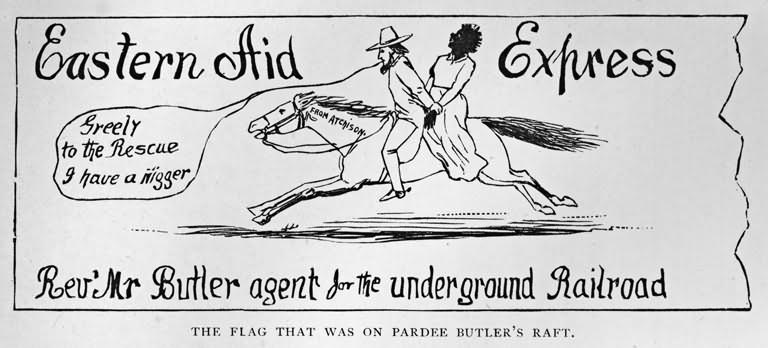
CHAPTER VIII.
At Port William I had already become acquainted with a Bro. Hartman. He had leased a saw-mill, and was running it, and I had bought lumber of him. Having reached Port William, I went to Bro. H. and said, "I want to obtain lodging of you to-night; but as I do not want to betray any man into trouble, I must first tell you what has befallen me." I then told him my mishap at Atchison, and said: "Now if you do not want to lodge such a man, please say so, and I will go somewhere else." He replied: "You shall lodge with me if it cost me every cent I am worth." He then went on to say that he had leased that mill of men who were very bitter, and very ultra in their views, and that they might be angry with him, and turn him out of the mill. But at last he said: "There is Bro. Oliphant living in the bluffs; he is under no such embarrassment," and Bro. Hartman took me there. The next day was the Lord's day, and Oliver Steele was to preach the first sermon in that little village on that day. Oliver Steele was a notable citizen of Platte county, Missouri. His name appears in the early days of the Millennial Harbinger as a citizen of Madison county, Kentucky. Bro. Steele complains of the Reformers of Kentucky, that they are too much wedded to Old Baptist usages to be true to the primitive and apostolic order of things. Then Bro. Steele came to Platte county, Missouri, and had become one of its most wealthy and influential citizens. He was an eminent example of a courtly and courteous "Old Virginia gentleman," and was loved by the rich and loved by the poor, he was loved by white folks and black; loved by the mothers and their babies; and the people patronized his preaching, not because he was a great preacher, for he certainly was not, but because they loved the man. He was an old Henry Clay Whig, and like that great Kentucky statesman was an Emancipationist. Bro. S. was to come over the river and preach the first sermon in this new town, and it was a great event to the people. On returning to Port William in the morning Bro. Hartman said that I must take dinner with him, and he would introduce me to Bro. Steele. It was not until twenty-five years afterwards, and only after Sister Hartman had died, that Bro. Hartman told me what so much altered his feelings. She was a sweet Christian woman, and when Bro. H. went to her she said to him: "Husband, don't you know that in the last great day the Lord will say, 'I was a stranger and ye took me in'; and don't you remember how the good Samaritan showed mercy to the man that fell among thieves? Now we believe that this man is an innocent man; and what will the Lord say to us if we turn him out of doors?"
At dinner, at the house of Bro. Hartman, was also Dr. Oliphant, father of the Bro. Oliphant with whom I had lodged. He was a brusque, blunt-spoken, honest, anti-slavery Northern Methodist preacher. He said bluntly at the table: "Well, Mr. Butler, they treated you rather roughly at At-Atchison, did they not?" I said, "Yes—" attempted to say more, broke down and left the table, and went out of the house. My heart was not as hard here, among sympathizing friends, as it had been the day before, when I had to face a raging mob. When I returned no mother could be more tender seeking out the hurt of her boy bruised in a rough encounter with his fellows, than was Oliver Steele. He would hear the whole story, sighed over these "evil days," and listened with approval to the vindication I made of the purposes of the free State men. How many men that, through a sense of bitter wrong, are in danger to become desperate, could be won to a better temper the world has never fully tried.
The news of what had been done at Atchison flew like wild-fire through the country. This proved the last feather that broke the camel's back. It became apparent that the country was full of men that were ready to fight. As for my friend Caleb May, he went into Atchison and said: "I am a free State man: now raft me!" As no one seemed inclined to undertake that job, he faithfully promised them that if there was any more of that business done he would go over into Missouri and raise a company of men and clean out the town.
Meantime my friends at Port William provided means to send me down to Weston, there to take the steamboat Polar Star, bound for St. Louis. "Boycotting" was a word unknown to the English language at that time; and yet I was "boycotted" on board the steamboat. I heard nothing—not a word; and yet I could feel it. I had hoped to be a total stranger, but it was evident I was not, and the most comfort I could find was to keep my state-room, and employ my time writ ing out the appeal I intended to make to the people, through the Missouri Democrat, published in St. Louis. At length my work was done, and yet we were only half way to St. Louis. The reader will believe that my reflections were not cheerful. What would become of myself? What would become of my wife and children? What would become of Kansas, or of the United States?
At Jefferson City a man had come aboard of the boat who seemed almost as much alone as myself. Still the captain and officers of the boat paid him marked attention. One thing I noticed, he abounded in newspapers, and I wanted something to read that should save me from my own reflections. I ventured to ask him for the loan of some of his papers; then when I returned them he went to his trunk and took out a book of travels and gave it to me, saying: "Take that, please. It will amuse you." At length we could see the smoke of the city of St. Louis, and I gave back to this stranger the book he had loaned me. He said: "No, thank you." I was startled, and said with some surprise: "I do not know why you should do this to a stranger." He laughed and said: "You are not so much a stranger as you think. Your name is Butler, is it not?"
"Yes."
"And they mobbed you at Atchison?"
"Yes."
"Well, please call on me at the office of the Missouri Democrat."
"And what is your name?"
"They call me B. Gratz Brown".
And so Providence had prepared the way for making my appeal to the people. B. Gratz Brown had the preceding winter, at Jefferson City, either given or accepted a challenge to fight a duel; but the public authorities had interfered, and some business connected with this matter had called him to Jefferson City. But whence had he his knowledge of the mobbing at Atchison? The Squatter Sovereign had been issued immediately after they had put me on the raft, and had contained the following editorial:
On Thursday last [it was Friday], one Pardee Butler arrived in town with a view of starting for the East, probably with the purpose of getting a fresh supply of Free-soilers from the penitentiaries and pestholes in the Northern States. Finding it inconvenient to depart before the morning, he took lodgings at the hotel and proceeded to visit numerous portions of our town, everywhere avowing himself a Free-soiler, and preaching Abolition heresies. He declared the recent action of our citizens in regard to J. W. B. Kelley the infamous proceedings of a mob, at the same time stating that many persons in Atchison who were Free-soilers at heart had been intimidated thereby, and prevented from avowing their true sentiments; but that he (Butler) would express his views in defiance of the whole community.
On the ensuing morning our townsmen assembled en masse, and, deeming the presence of such a person highly prejudicial to the safety of our slave population, appointed a committee to wait on Mr. Butler and request his signature to the resolutions passed at the late pro-slavery meeting. After perusing the resolutions, Mr. B. positively declined signing them, and was instantly arrested by the committee.
After various plans for his disposal had been considered, it was finally decided to place him on a raft composed of two logs firmly lashed together, that his baggage and a loaf of bread be given him, and having attached a flag to his primitive bark, Mr. Butler was set adrift in the great Missouri, with the letter "R" legibly painted on his forehead.
He was escorted some distance down the river by several of our citizens, who, seeing him pass several rock-heaps in quite a skillful manner, bade him adieu and returned to Atchison.
Such treatment may be expected by all scoundrels visiting our town for the purpose of interfering with our time-honored institutions, and the same punishment we will be happy to award to all Free-soilers and Abolitionists.
The Missouri Democrat was what was known as the "Tom Ben ton" paper of Missouri, and was not ostensibly a Free-soil paper, yet it vehemently inveighed against the ruffianism with which free State men had been treated. Of course there was sympathy in the office of the Missouri Democrat, that made some amends for the rough treatment I had got at the hands of citizens of Missouri.
Having completed my business in St. Louis I turned my face toward my old field of labor in the "Military Tract," via the Illinois River. The reader will believe that my reflections were full of anxieties. What would the brethren say of me? Were my prospects blighted from this time forward?
CHAPTER IX.
The brethren in Illinois were at the first amazed at what they heard, and did not know what to think or say. Before they could make up their minds, the following editorial appeared in the Schuyler County Democrat, published at Rushville:
ELDER PARDEE BUTLER,
The gentleman who was placed on a raft in the Missouri River, with a proper uniform for a Northern fanatic, is in Rushville. We saw handbills posted around town stating that he would hold a meeting in the Christian Church. We are informed he will deliver a series of lectures, in which, of course, he will give vent to his indignation toward the people of Kansas, Judge Douglas and the Administration. We thought Schuyler county was the last place which a Northern fanatic would visit for sympathy. We hope that those that go to hear his lectures, which differ with him in their sentiments, will not interrupt him or give him any pretext by which he could denounce our citizens.
To the above notice of myself I made the following reply:
[For the Prairie Telegraph.]
MESSRS. EDITORS: Sirs—I find the above notice of myself in the last issue of the Schuyler Democrat.
While in Kansas I diligently worked six days of the week, and on Lord's day spoke to my neighbors, not in reference to affairs in Kansas, but in reference to our common interest in a better and heavenly country. I do not know that I indicated my political proclivities, in any word or allusion, on any such occasion, But I did, in private conversations with my neighbors, avow my intention to vote for Kansas to be a free State, and gave my reasons for so doing. This was my only offence.
What must you think of yourself, sir, in this notice you take of this transaction? And you pretend to be a conservator of public morals! If there is in town a clergyman that will consent to teach you a few lessons upon the items of justice and gentlemanly behavior, I suggest it may be to your advantage to put yourself under his tuition. You may perhaps learn that it is neither just nor gentlemanly gratuitously to insult a man, because you have surmised that he will show some resentment at the ruffianism of a Kansas mob, with which you seem to sympathize.
Since I came into Illinois I have steadily declined to make any statement of this affair in any public address. Still it is perhaps due to the world to know some additional facts. How the mob deliberated among themselves . . .
I have never yet made war on Judge Douglas. It is true that the Missouri Compromise, being a time-honored covenant of peace between North and South, I would much rather it had been suffered to remain; but now I am rather indignant at the clear and palpable violation of the principles of the Kansas-Nebraska bill, in the attempt made by border ruffians to drive out peaceable citizens from the free States. I am still more indignant that a Northern editor can be found to wink at such flagrant and unquestionable wrong. Judge Douglas may well exclaim, "Save me from my friends!"
Perhaps, upon reflection, you may be convinced of three things: First, that I am not a fanatic, and have not deserved the treatment I have received; second, that your friends may be trusted not to create any disturbance at my meetings; and, third, that instead of seeking to stir up against me the prejudices of ignorant partisans, you may safely devote yourselves to the more honorable employment of seeking to restore in our unhappy country the supremacy of law. Very faithfully,
PARDEE BUTLER.
RUSHVILLE, Sept. 11, 1855.
The final result was much more favorable than could have been expected, and the brethren gave me an invitation to remain with them through the winter.
I tarried six weeks in Illinois, and then returned to Kansas with Mrs. Butler and our two children, of whom the eldest is now Mrs. Rosetta B. Hastings. Milo Carleton had already reached the Territory, direct from the Western Reserve, Ohio. He was Mrs. Butler's brother, and it was determined that the two families should spend the winter together, while I should return to Illinois.
We will now pause in our personal narrative and tell what had been going on the preceding summer in other parts of the Territory. A delegate convention had been called by the free State men to meet during the preceding September at a place called Big Springs, on the Santa Fe trail, midway between Lawrence and Topeka. Here the free State men agreed on a plan, to which they steadily adhered through all the sickening horrors that gave to "bleeding" Kansas a world-wide and thankless notoriety. They resolved that they would not in any way, shape or manner, recognize the legality of this so-called Territorial Legislature, nor the machinery it should call into being for the government of the Territory. They would bring no suits in its courts; they would attend no elections called by its authority; they would pay no attention to its county organizations; and yet, as far as in them lay, they would do no act that might make them liable to the penalty of its laws. In short, they would be like the Quaker, who, when drafted into the army, replies: "Thee-must not expect me to fight with carnal weapons;" and when amerced in a fine for non-compliance with the laws, makes the reply, "Thee must not expect me to pay money for such carnal uses, but thee can take my property." Nevertheless, there was superadded to these peaceful resolutions an un-Quaker-like intimation that under certain contingencies they would fight.
Beyond the Wakarusa, and about eight miles from Lawrence, was a placed called Hickory point. Here were some timber claims, and here resided Jacob Branson, a peaceful and harmless free State man. Beside him lay a vacant timber claim, and he invited a young man named Dow to take it, Dow boarded with Branson. When the Missourians came into Kansas the preceding March, many of them staked out a claim which they pretended to hold. One William White, of Westport, Mo., pretended, in his way, to hold this claim. There was not a particle of legality in his proceeding. Notwithstanding, certain pro-slavery men, among whom were Coleman, Hargis and Buckley, determined to drive off Branson and Dow. They sent threatening letters to Branson, and cut timber on Dow's claim; and this made bad blood. One day an altercation took place between Dow and the above-named pro-slavery men at a blacksmith shop, and Coleman followed Dow and shot him. Dow was unarmed, and held up his hands and cried, "Don't shoot," but Coleman lodged a load of buckshot in his breast, and he fell dead, and his body lay in the road till sundown. Then Branson came and took up the body and buried it. This murder created a prodigious sensation; and a public meeting was called, at which there was violent and threatening talk by the free State men. The three above-named pro-slavery men were all present when the murder was committed. They fled, and their dwellings were burned. Coleman went to Westport and gave himself up to "Sheriff Jones." This introduces us to the man that was able to achieve an infamous pre-eminence among that band of conspirators that put in motion a train of causes that issued in the death of half a million of American citizens, and which covered the land with mourning from Maine to Florida, and from the Atlantic to the Pacific Ocean. This Jones is described by the free State men as a bully and a braggart, as only brave when he was not in danger, and as one of the most noisy and obstreperous of the pro-slavery leaders. Though living in Westport, Mo., he was made sheriff of Douglas county, fifty miles from his place of residence. Buckley swore out a peace warrant against Branson—he swore that his life was in danger. Sheriff Jones took with him these three men, who were parties in the murder of Dow, and arrested Branson, dragging him out of his bed at night. He had also associated with himself eleven other men. The news spread like wild-fire among the free State men. This Jones was supposed to be capable of any atrocity, however horrible, and a company of sixteen men was gathered up for the rescue of Branson. Of this company Sam Wood, of Lawrence, was the leader. They met Jones and his company at Blanton's Bridge, on the Wakarusa River, where Jones was crossing to go to Lecompte, and called a halt. Jones demanded: "What's up?"
Sam Wood replied: "That's what we want to know."
Wood asked: "Is Jacob Branson in this crowd?"
Branson replied: "Yes, I am here and a prisoner."
Wood replied: "Well, come out here among your friends."
Jones threatened with oaths and imprecations to shoot. The rescuing party leveled their guns and said: "Well, we can shoot, too." Nobody was hurt, no gun was fired, and Jacob Branson, coming out from among his captors, walked away.
It will be seen that this was a clear and palpable violation of the plan of procedure which the free State men had agreed upon among themselves, and this act made Kansas for three years a dark and bloody ground, and concentrated on this Territory the eyes of the whole nation. Of the rescuing party only three were citizens of Lawrence. Sam Wood was in his element. He was a man overflowing with patriotism, yet succeeded in doing more harm to his friends than to his enemies. He possessed unmistakable talent; he was a clown and a born actor, and as a public speaker was sure to bring down the house; he was a pronounced free State man; yet in this act he made himself the marplot of his party.
CHAPTER X.
Sheriff Jones went away, vowing that he would have revenge, and sent the following dispatch to Gov. Shannon:
DOUGLAS CO., K. T., NOV. 27, 1855.
SIR:—Last night I, with a posse of ten men, arrested one Jacob Branson, by virtue of a peace warrant regularly issued, who, on our return, was rescued by a party of forty men who rushed upon us suddenly from behind a house by the roadside, all armed to the teeth with Sharpe's rifles.
You may consider an open rebellion as already having commenced, and I call upon you for THREE THOUSAND MEN to carry out the laws. Mr. Hargis, the bearer of this letter, will give you more particularly the circumstances. Most respectfully,
SAMUEL J. JONES,
Sheriff Douglas County.
To His EXCELLENCY, WILSON SHANNON, GOVERNOR KANSAS TERRITORY.
On receipt of the above dispatch, Gov. Shannon wrote to Major-General William P. Richardson, reciting the story told him by Sheriff Jones, together with additional stories (equally false), told him by Hargis, and closed his letter with the following order:
You are therefore hereby commanded to collect together as large a force as you can in your division, and repair, without delay, to Lecompton, and report to S. J. Jones, Sheriff of Douglas County, together with the number of your forces, and render him all the aid and assistance in your power in the execution of any legal process in his hands. The forces under your command are to be used for the sole purpose of aiding the Sheriff in executing the law, and for no other purpose.
I have the honor to be
Your obedient servant,
WILSON SHANNON.
Gov. Shannon knew, as well as he knew his name was Wilson Shannon, that this meant another invasion of Kansas Territory. There was no organized militia in Kansas. Gen. Richardson did not live in Kansas; he lived in Missouri, and it meant Missouri militia and not Kansas militia. Moreover, the Governor knew, or at least ought to have known, what an unreliable man this Sheriff Jones was. Jones was Postmaster at Westport, and Shannon was living at Shawnee Mission, in the neighborhood of Westport. And yet, without one moment's inquiry, he placed the issues of life and death of this infant Territory in the hands of this lying scoundrel.
There was a rallying of the clans of the blue lodges of Missouri. The following appeal, sent by Brig. Gen. Eastin, editor of the Leavenworth Herald, and commander of the second brigade, Kansas militia, must serve as a sample of the dispatches that were scattered broadcast through the border Missouri counties:
"TO ARMS! TO ARMS!"
It is expected that every lover of law and order will rally at Leavenworth on Saturday, December 1, 1855, prepared to march at once to the scene of rebellion to put down the outlaws of Douglas county, who are committing depredations upon persons and property, burning down houses and declaring open hostility to the laws, and have forcibly rescued a prisoner from the Sheriff. Come one, come all! The outlaws are armed to the teeth, and number 1,000 men. Everyman should bring his rifle and ammunition, and it would be well to bring two or three days' provisions. Every man to his post and do his duty. MANY CITIZENS.
In answer to the above appeal 1,500 men, mostly from Missouri, encamped around Lawrence, under such notabilities as Maj. Gens. Strickler and Richardson, Brig. Gen. Eastin, Col. Atchison, Col. Peter T. Abell, Robert S. Kelley, Stringfellow and Sheriff Jones. They had broken into the United States Arsenal at Liberty, Clay County, Mo., and stolen guns, cutlasses and such munitions of war as they required.
But when this was known the free State men turned out from all the settlements of Kansas with equal alacrity, to defend Lawrence. They came singly, and in squads and in companies. They came by night and by day. Sam Wood, Tappin and Smith, the rescuers of Branson, and who were residents of Lawrence, left the city, and there were none there against whom Sheriff Jones had any writs to execute. Dr. Robinson was appointed Commander-in-Chief for the defense of the city, and James H. Lane was appointed second in command. But Lane was the principal figure in the enterprise. He alone had military experience, and he alone had the daring, the genius and the personal magnetism of a real leader.
The free State men, for the last year, had been passing through the furnace-fires of a vigorous discipline, and they would have fought as the Tennessee and Kentucky backwoodsmen of Andrew Jackson fought behind their cotton bales at the battle of New Orleans. They had seen their rights wrested out of their hands by a mob of ruffians, and now they were proposing to settle the matter in that court of last resort that is the final and ultimate appeal of the nations. Except Gen. Lane, they had small knowledge of military tactics, but they knew how to look along the barrel of a rifle; moreover, they would fight behind breastworks, and this to raw troops would have been an immense advantage.
It is probable that the first intimation that Gov. Shannon got of the real state of affairs at Lawrence was conveyed to him in the following letter, written by Brig. Gen. Eastin:
GOVERNOR SHANNON:—Information has been received direct from Lawrence, which I consider reliable, that the outlaws are well fortified with cannon and Sharpe' rifles, and number at least 1,000 men. It will, therefore, be difficult to dispossess them.
The militia in this portion of the State are entirely unorganized, and mostly without arms. I suggest the propriety of calling upon the military of Fort Leavenworth. If you have the power to call out the government troops, I think it would be best to do so at once. It might overawe these outlaws and prevent bloodshed.
S. J. EASTIN,
Brig. Gen. Northern Brigade, K. M.
Gen. Eastin is mistaken in putting their number at 1,000, but whether many or few they certainly would have fought a hard battle. They were picked men from all the Kansas settlements. Our old friend, Caleb May, was there, as grim and as self-possessed as Andrew Jackson. So also Old John Brown was there with his four sons, though they did not arrive until Gov. Shannon had made overtures for peace.
The Governor telegraphed to Washington to obtain authority to call out Col. Sumner with the United States troops at Fort Leavenworth. He also wrote to Col. Sumner to hold himself ready to march at a moment's notice. And now this simple-minded Gov. Shannon, Ex-Governor of Ohio, who had come to Kansas to waste in a few short months the ripe honors he had been so carefully hoarding up for a life-time, bethought himself that it was time for him to go and look with his own eyes after this rebellion he had so foolishly and recklessly stirred up.
We have already remarked that Gen. James H. Lane was the most conspicuous figure in the defense of Lawrence. It is proper to pause and consider the character of this man, who shone for a time like a brilliant meteor, and then had his light quenched in the blackness of darkness.
He had now been eight months in Kansas. He came out of the Mexican war with a good reputation as a brilliant and dashing officer, and a man of approved courage. As a politician he had been highly favored by the people of Indiana. He was in the convention that nominated President Pierce. He was in Congress at the time of the passage of the Kansas-Nebraska bill, and aided in its enactment. He was the friend of Stephen A. Douglas. Yet he came to Kansas a man of broken fortunes. He was bankrupt in reputation, bankrupt in property, and bankrupt in morals, and he came away from unhappy family relations. Notwithstanding, he brought with him boundless ambition, and a consciousness in his own heart that he possessed genius that might lift him up to the highest pinnacle of honor. His first effort was to reorganize that political party that was in control of the Government at Washington, and that he had so faithfully served in Indiana. As respects slavery, he probably would have said with Mr. Douglas that he did not care whether it was voted up or voted down. But his effort fell stillborn and dead. Dr. John H. Stringfellow was an old Whig, and so also were many of the Pro-slavery leaders, and they would not hear to it that there should be any parties known save the Pro-slavery and Free State parties. The Free State men were equally averse to making any division in their own ranks. Mr. Lane was to choose, and he did choose with a vengeance.
Bad men usually pay this compliment to a righteous life, that they seek to conceal their wicked deeds and wear the outside seeming of virtue. But this strange man never pretended to be anything else than just what he was. He displayed such audacious boldness as gave an air of respectability even to his wickedness.
His public speaking did not belong to any school of oratory known among men; yet, if to sway the people as a tempest bends to its will a field of waving grain, be oratory, then was Mr. Lane, in the highest sense of the word, an orator. He spoke once in Chicago when the people were most excited over the Kansas troubles. A great crowd came to hear, and he swayed them to his will, as only such men as Henry Ward Beecher and Patrick Henry have been able to do. But this gospel was the gospel of hate. Implacable, unforgiving hate was his only gospel.
At last this man, at once both great and wicked, having attained the highest honors the people had to bestow, died by his own hand. The people believed that he had gone wrong and betrayed them, and they withdrew from him their favor. Mr. Lane loved popularity more than he loved heaven, and he shot himself through the brain.
The writer, unwilling alone to take the responsibility of expressing such a judgment as the above, appealed to a gentlemen whose high position in public life and kindly and conservative temper eminently qualify him to speak, and this is what he says:
No one can question the fact that Mr. Lane's career in Kansas exerted a great influence in shaping the affairs and controlling the destiny of the young State. During his life I was alternately swayed by feelings of admiration and distrust. I recognized fully the marvelous energy and equally marvelous influence of the man, but I distrusted his sincerity and lacked confidence in his integrity. When I met him, or listened to one of his impassioned speeches, ne swept me away with the contagion of his seeming enthusiasm, but when I went out from the influence of his personal magnetism I felt that something was lacking in the man to justify a well-grounded confidence.
This man that had in him such a commingling of good and evil was now the leading spirit in the defense of Lawrence. 2
CHAPTER XI
When Sheriff Jones saw that the control of this business was being taken out of the hands of himself and his fellow-conspirators he wrote the following letter to Gov. Shannon:
CAMP AT WAKARUSA, Dec. 6, 1855. To His EXCELLENCY, GOV. SHANNON:
Sir: In reply to yours of yesterday I have to inform you that the volunteer forces now at this place and Lecompton are getting weary of inaction. They will not, I presume, remain but a short time longer, unless a demand for the prisoner is made. I think I shall have sufficient force to protect me by to-morrow morning. The force at Lawrence is not half so strong as reported. If I am to wait for Government troops, more than two-thirds of the men that are here will go away very much dissatisfied. They are leaving hourly as it is.
It is reported that the people of Lawrence have run off those offenders from town, and, indeed, it is said they are now all out of the way. I have writs for sixteen persons who were with the party that rescued my prisoner. S. N. Wood, P. R. Brooks and Samuel Tappan are of Lawrence, the balance from the country around. Warrants will be put into my hands to-day for the arrest of G. W. Brown, and probably others in Lecompton. They say that they are willing to obey the laws, but no confidence can be placed in any statements they may make. Most respectfully yours,
SAMUEL J. JONES,
Sheriff of Douglas County.
From the above, three facts are apparent:
1. Sheriff Jones is not willing that the militia shall go home, and Col. Sumner and the United States troops take their places.
2. He has writs against the sixteen rescuers of Branson. But of these he has ascertained that thirteen live in the country, and he does not need to go to Lawrence to find them. The three that belong in Lawrence are gone to parts unknown, and he does not need to go to Lawrence to find them. At this writing Sheriff Jones has not a single writ against any person in Lawrence.
3. If he has such a warrant the Lawrence people profess themselves willing that he should serve it, but he does not believe them. "No confidence can be placed in any statements that they may make."
So far as Sheriff Jones is concerned, it is now manifest that this was a devilish conspiracy against the people of Lawrence, to cut their throats and burn up the town. How far the men that were with him were conscious partners in his guilt, or how far they were ignorant dupes of a man that had murder in his heart, does not appear.
The people of Lawrence now thought it was time for them to open communication with Gov. Shannon, and Messrs. G. P. Lowery and C. W. Babcock, after running the gauntlet of the patrols, robbers and guerillas that infested the road to Shawnee Mission, succeeded in putting in the hands of the Governor the following letter:
To His EXCELLENCY, WILSON SHANNON, GOVERNOR KANSAS TERRITORY:
Sir: As citizens of Kansas Territory, we desire to call your attention to the fact that a large force of armed men from a foreign State have assembled in the vicinity of Lawrence, are now committing depredations upon our citizens, stopping them, opening and appropriating their loadings, arresting, detaining and threatening travelers upon the public road, and that they claim to do this by your authority. We desire to know if they do appear by your authority, and if you will secure the peace and quiet of the community by ordering their instant removal, or compel us to resort to some other means or a higher authority.
SIGNED BY COMMITTEE.
The Governor began to think it was time for him to go to the camp of Sheriff Jones' army on the Wakarusa; and when he came he was frightened at his own work, and became just as eager to get out of the scrape as he had been forward to get into it. He wrote to Col. Sumner, frantically begging him to come to the rescue; but he had got no orders, and would not move without orders. Sheriff Jones and the rank and file of his camp were furious that they were held back from pitching into the Lawrence people; but the officers had become cognizant of the bloody job they would have on hands, and were willing to be let off. And so the Governor patched up a peace, and sent his militia home again, with their curses diverted from the Lawrence Abolitionists to Gov. Shannon. Cowardly, weak-minded and infirm in purpose as this unhappy man was, he was not wholly a fool; and we may justly believe that he had in his heart a foreboding of that awful day of reckoning that would surely come, when inquisition would be made for the blood of these citizens, and the Governor himself would be called to answer, "Why were these men slain?"
And now that peace—angelic peace—sat brooding over Lawrence with her dove-like pinions, they made a love-feast and invited the Governor to partake of it; and what with the ravishing music, and the blandishment of flattering tongues, and the intoxication of fair women's eyes and sweet voices, the Governor was made to forget, for the time being, that he was the property, body, soul, and spirit, of the "Law and Order" party; and his soft and plastic nature was beguiled into signing a document constituting the army of defense of Lawrence a part of the Territorial Militia, and giving them authority, under his own hand and seal, to fight with teeth and toe-nails against the outside barbarians that he himself had invoked to cut their throats. When, however, he had come to himself, and had to front the frowns and ungrammatical curses of the "Border Ruffians," he was fain to lay the blame on the sparkling wine of the feast, and the more sparkling eyes and sparkling wit of beautiful women.
These felicitations of the people of Lawrence with Governor Shannon did, however, have a somber and awful background. While this had been going on a boy had been murdered in the vicinity of Lawrence. Some young men rode out to see about it, and one of them was shot and killed. But a still more ghastly crime threw its baleful shadow over the people. It was perpetrated two days before the Governor concluded his treaty of peace.
Thomas W. Barber and Robert F. Barber were farmers, living about seven miles from Lawrence; and on December 6th started with a Mr. Pierson to go home to their families. These were two brothers and a brother-in-law. They were intercepted on their way by J. N. Burns, of Weston, Mo., and Major George W. Clarke, United States Agent for the Pottawatomie Indians. These two men shot Thomas W. Barber. It is hard to find an explanation of their act, unless it were that they came to Lawrence to shoot down Abolitionists as they would have shot wolves on the prairie. They had no provocation. They rode apart from their companions to intercept the Barbers, and called on them to halt. Thomas W. Barber was unarmed, and gave mild and truthful answers to their questions. After the shooting the brothers started to ride away, when the murdered man said, "That fellow hit me;" began to sway in his saddle, was supported for a little time by his brother, then fell to the ground dead. His horse also had been shot, and died the same night. Familiar as Kansas had become with cruel and devilish deeds, there were circumstances connected with this act that made it exceptionally a blood-curdling horror. Thomas W. Barber was a somewhat notable farmer, and had married a young wife, that loved her husband with a love so passionate that she was sometimes rallied about it by her sister-in-law. It had been with misgivings and forebodings she had consented for Barber to go to Lawrence. The news of her husband's death had been kept from her; they dared not tell her. A young man was sent to bring her into the city, whither her husband's body had been already carried, and he blurted out, "Thomas Barber is killed!" and she shrieked, "O, my husband! my husband! Have they killed my husband?" It has been said that so frantic were her struggles, that it was with main force they had to hold her in the carriage which conveyed her into the city. Much has been written of the pathetic and voiceless woe of this wretched and sorrow-stricken woman, but we will spare the reader the recital.
This question, however, we did often ask ourselves: "What had we done that we should be made to suffer thus?"
But now there was peace, and Sheriff Jones, breathing out curses against the Governor who had balked him of his anticipated revenge, disbanded his army and went back to his post-office at Westport. It was past the middle of December, but some lingered on their way, robbing and stealing. The cold grew intense. A driving snow came down from the North. It was one of the coldest winters Kansas had ever known, and there fell one of the deepest snows. And now, winding through the deep snow, benumbed with cold, and all unprovided with clothing suitable for such inclement weather, the rear guard of the ring-streaked, speckled and spotted regiment of Kansas and Missouri Militia passed out of the Territory.
Thirteen leaders of the "Law and Order" party had met with Lane and Robinson, acting on behalf of the people of Lawrence, and had agreed to the terms of the treaty. But Sheriff Jones is reported to have said: "Had not Shannon been a fool I would have wiped out Lawrence." It is reported that Stringfellow said that "Shannon had sold himself and disgraced himself and the whole Pro-slavery party." Atchison accepted the terms, saying to his followers: "Boys, we can not fight now. The position that Lawrence has taken is such that it would not do to make an attack on them. But boys, we will fight some time!"
The peace was to be broken at the earliest opportunity.
CHAPTER XII.
The winter of 1855-6 that I spent in Illinois was uneventful. My success was not such as to discourage an evangelist that desires to be useful, neither was it such as to fill him with vanity. The weather was intensely cold, and the snow was deep.
It is said that before the coming of an earthquake, the sea gives forth deep moanings, as if it felt the approaching convulsion; so at that time there seemed premonitions in the hearts of the people that the whole nation, North, South, East and West, would be swept by a political cyclone that should leave behind it the desolation that is sometimes, in the West India Islands, left in the track of a tropical hurricane. We had heard of the murder of Dow, the rescue of Branson, and the invasion of Lawrence, and these certainly did not give promise that Kansas would be a favorable field for evangelical work, at least for a time. The writer had not hitherto spent much of his time in Adams county; he now spent a considerable part of the winter there, and visited the churches of Quincy, Chambersburg, Camp Point, and many others. The brethren at Quincy were making that experiment of monthly preaching that has been found so hazardous, especially to city churches. They have since changed the plan with wonderfully good results. It was at the church at Chambersburg that Bro. Cottingham who has now won a national reputation, achieved some of his earliest successes.
The majority of the leading members of these churches had been men and women of full age when they left Kentucky. Some had tarried a little time in Indiana. The memory of some went back to the time when the Mississippi Valley was almost an unbroken wilderness, with here and there a scattered settlement, made up of a frontier and uneducated people. What are now its great cities were then insignificant hamlets, and its means of commerce were rude flat boats on its rivers, and pack-horses, or clumsy, heavy lumber wagons on its rough and often impassable roads. There were few schools, fewer churches and still fewer educated men. The country was perambulated by itinerant preachers. These were guided by visions and revelations. Signs, omens and impressions directed them to their field of labor and controlled their lives. Ecstatic joy, vivid impressions, voices in the air, or seeing the Lord in the tree-tops, were their evidences of pardon.
Once every year the people came together to a great camp-meeting. There was intense excitement and enthusiasm, and many got religion; and this was followed by spiritual lethargy, coldness and apostasy. It was a short, hot summer, followed by a long, cold winter of moral and spiritual death.
Among the Old Baptists there was preaching once a month. This was all. There were no prayer-meetings, no meeting together every first day of the week to break break and read the Holy Scriptures. Christian morality was at a low ebb, and Christian liberality down to zero.
At length there came a change. The fountains of the great deep were broken up, and men broke loose from the dominion of these old and man-made systems. John Smith took the lead, and was followed by old Jacob Creath, Samuel Rogers, John Rogers, John Allen Gano, P. S. Fall, and many others. Alex. Campbell once said:
If any man can read the Acts of Apostles through three times, chapter by chapter, pondering each chapter as he reads, and then can remain an advocate of these old systems of conversion, may the Lord have mercy on him!
But the old Baptists fiercely resisted the Reformers, and cast them out as heathen men and publicans. And now the Bible was a new revelation to the men that came into this movement. The veil was taken off their eyes, and they could read the Scriptures as they had never read them before. They could now see that the Bible was a simple and intelligible volume, written to be understood by the common people, and they were only amazed at their former blindness. But they were made to know what persecution means. All the denominations combined against them, and they were compelled to read the Scriptures to defend themselves; and thus pressed by their enemies on every hand, they were made to feel how near they were to each other, and how much they loved each other, and it became an easy thing to meet together every first day of the week to sing, to pray, to exhort, and to commemorate the death of their risen Lord. But many of them were poor, and had growing families, and they had heard that there was a large and good land in the Military Tract in Illinois, and with many a tearful adieu, and bidding farewell to the they loved so well, like Abraham going out into the land that God had given him, into this land flowing with milk and honey they came—and prospered.
And here the writer of these "Personal Recollections" found them, growing strong, and rich, and influential, and more prosperous than any other religious body in Adams county. It is now after the lapse of thirty years, to be mentioned to their honor—and to the honor of the churches of the State—that they have made commendable progress in the direction of a Christian liberality, and of moral, intellectual, and religious growth; still they are not yet up to the mark.
For the purpose of the moral, intellectual and religious education of his people, the Lord has given us one day in seven, and in one year he has given us fifty such days. This in seven years is one whole year, and in seventy-five years it is ten years, leaving out five years as the period of babyhood; and this as fitting men for the highest style of religious life, and of American citizenship is, if well employed, the best school on the face of the earth. Needs it to be said, that to do this work well, the teachers in this school of the prophets have need to be well qualified? There are certain Scriptures bearing on this point we will do well to ponder:
Meditate on these things; give thyself wholly to them, that thy profitting may appear unto all.
No man that warreth entangleth himself with the affairs of this life, that he may please him who hath called him to be a soldier. The Lord give thee understanding in all things.
We have no churches in this nation to whom these admonitions apply with greater weight of impressive authority than to the churches of Illinois. Where much is given, there much is required, and to no State in the Union has more been given in the way of worldly wealth than to the Disciples of that commonwealth. There is not such another body of rich land in this great nation, perhaps not in the world. Water is an element essential to the highest productiveness, even of fertile soil, and the vapors rising on the Gulf of Mexico have not a hillock three hundred feet high to obstruct their flow up the Mississippi eastward and northward, until they reach the State of Illinois. And the men that do business in the cities of this prosperous State, or till its fertile and alluvial soil, that was lifted up, not many geologic ages ago, from beneath the bottom of the sea, are so rich they do not know how rich they are. But it is a peril to be rich. Jesus, Paul and Solomon unite in saying so, and it is especially a peril when wealth comes suddenly. When a man starts poor, and has felt the sting of contempt because of his poverty, and then finds himself rich and prosperous and flattered, and tempted to indulge in every luxury, then this man is in great peril; and there is no security against this danger like using the wealth that God has given him for the glory of God and the good of men.
But there were brethren thirty years ago that needed no admonition as touching the disposition they should make of their world goods. I could give a goodly number of examples, but the reader will pardon me if, because of the narrow limits of these "Recollections," I confine myself to one.
Peter B. Garrett, of Camp Point, Adams county, had set himself, with honest purpose, to bring his Kentucky brethren up to the level of the demands of primitive and apostolic Christianity. Every man has his hobby, and Bro. G. had his hobby. When the writer first visited Camp Point, he was demanded of to know if it was not a fixed part of the apostolic order that each disciple should, on the first day of the week, lay by him in store, of money or goods, as the Lord had prospered him, putting it into the Lord's treasury? I could not quite affirm this, but Bro. G. stuck to his hobby.
Bro. Garrett knew the value of a full treasury, and was ready to do his part towards settling a preacher in the church, and paying him. But he could not bring his brethren up to the level of his own aspirations.
Bro. G. came from Kentucky a poor man, but he got hold of a considerable body of good land, when it was cheap, and cultivated it skillfully. Then the Quincy, Galesburg and Chicago Railroad was build in front of his farm, and the town of Camp Point grew up adjoining his premises. He also built a flouring mill, and this added to his gains; and thus he grew rich and influential, but he never thought of himself only as plain Peter Garrett. The writer in fifty years has known many excellent Christian families, but he has never known one family that, with saint and sinner, among persons outside and inside of the church, have had a more honorable fame than this Christian family. His wife was a motherly woman. She did not assume to know much, but what she did know she knew well, and translated her little store of knowledge into an abundance of good deeds. She knew how to guide the house, take good care of her children, live in peace with her neighbors, love the church and attend its meetings, fear God and entertain strangers; and so this house, like the house of the Vicar of Wakefield, became a resort for
"All the vagrant train,"
whether of tramps or preachers. His children, from the time they were able to toddle, were taught to do something useful. His little boys were made to bring in wood, and run on errands, and his girls to wash the dishes; and thus this house became a hive of industry, and it came to pass that in process of time, when our beloved Bro. Garrison, of the Christian-Evangelist, went out to seek a woman to take care of his house, he very properly sought this favor at the hands of Peter Garrett's daughter. It is a good thing to follow a good example, and our devoted Bro. Smart, hitherto of the Witness, now co-editor of the Evangelist, went and did likewise. 3
Bro. Garret loaned the writer a light spring wagon for the purpose of bringing his family back from Kansas, and thus equipped, he started a second time on the journey he had made one year before.
One thought filled his heart: Will this tumult pass away, and will the American people go forward and fulfill that glorious destiny to which God in his providence has called them?
CHAPTER XIII.
The news of the coming of the South Carolinians had not reached Illinois when I started for Kansas, but when I had reached Western Missouri the country was alive with excitement. Maj. Jefferson Buford had arrived with 350 soldiers, and a part of them were quartered in Atchison. Some persons whose acquaintance I had made, and who were my friends, besought me not to go on.
The last night I stayed in Missouri was at De Kalb. A gentleman who had come from St. Joseph stayed over night at the hotel where I put up. He was tall of stature, with a flowing beard sprinkled with gray, and was of a remarkably dignified and impressive presence. We conversed during the evening on general topics, but no allusion was made to the one exciting topic, on which almost all seemed ready to talk instanter.
The next morning he overtook me. He was on horseback, and mentioned that he was going to Atchison, and for some distance rode beside my buggy, continuing the conversation. Then, as he could travel faster than myself, he rode on.
The reader will recognize this gentleman again in Atchison. An account of my adventures 4 on the other side of the river will be found in a letter addressed by myself to the Herald of Freedom:
[For the Herald of Freedom.]
STRANGER CREEK, Ocena P. O., May 6, 1856.
MR. EDITOR—Dear Sir: The bar of public opinion seems to be the only tribunal to which the free State men of Kansas can appeal for redress. I must, therefore, ask your indulgence while I make a statement of facts.
One year ago I came to Kansas and bought a claim on Stranger Creek, Atchison county. On the 17th of August, the Border Ruffians of the town of Atchison sent me down the Missouri River on a raft. We parted under a mutual pledge: I pledged myself that if my life was spared I would come back to Atchison, and they pledged themselves that if I did come back they would hang me. Faithful to my promise, in November last I returned to Kansas, and visited Atchison in open day, announced myself on hand, and returned without molestation. Kansas being sparsely settled, without churches or meeting-houses, it was determined that Mrs. Butler should live on our claim with her brother and her brother's wife, while I should return to Illinois, and resume my labors as a preacher.
April 30th I returned to Kansas, crossing the Missouri River into Atchison. I spoke with no one in the town, save with two merchants of the place, with whom I have had business transactions since my first arrival in the Territory. Having remained only a few moments, I went to my buggy to resume my journey, when I was assaulted by Robert S. Kelley, co-editor of the Squatter Sovereign, and others, was dragged into a saloon, and there surrounded by a company of South Carolinians, who are reported to have been sent out by a Southern Emigrant Aid Society. In this last mob I recognized only two that were citizens of Atchison or engaged in the former mob. It is not reported that these emigrants from the Palmetto State seek out a claim, and make for themselves a home, neither do they enter into any legitimate business. They very expressively describe themselves as having come out to see Kansas through. They yelled, "Kill him! Kill him! Hang the Abolitionist." One of their number bristled up to me and said, "Have you got a revolver?" I answered, "No." He handed me a pistol and said, "There, take that, and stand off ten steps; and I will blow you through in an instant." I replied, "I have no use for your weapon." I afterwards heard them congratulating themselves in reference to this, that they had acted in an honorable manner with me. The fellow was furious; but his companions dissuaded him from shooting me, saying they were going to hang me.
They pinioned my arms behind my back, obtained a rope, but were interrupted by the entrance of a stranger—a gentleman from Missouri, since ascertained to be Judge Tutt, a lawyer from St. Joseph. He said: "My friends, hear me. I am an old man, and it is right you should hear me. I was born in Virginia, and have lived many years in Missouri. I am a slaveholder, and desire Kansas to be made a slave State, if it can be done by honorable means. But you will destroy the cause you are seeking to build up. You have taken this man, who was peaceably passing through your streets and along the public highway, and doing no person any harm. We profess to be 'Law and Order' men, and ought to be the last to commit violence. If this man has broken the law, let him be judged according to law; but for the sake of Missouri, for the sake of Kansas, for the sake of the pro-slavery cause, do not act in this way." They dragged me into another building, and appointed a moderator, and got up a kind of lynch law trial. Kelley told his story. I rose to my feet, and calmly and in respectful language began to tell mine; but I was jerked to my seat and so roughly handled that I was compelled to desist. My friend from Missouri again earnestly besought them to set me at liberty. Kelley turned short on him and said: "Do you belong to Kansas?" Judge Tutt replied: "No; but I expect to live here in Atchison next fall, and in this matter the interests of Kansas and Missouri are identical." Chester Lamb, a lawyer in Atchison, and Samuel Dickson, a merchant of the place, both pro slavery men, also united with Judge Tutt in pleading that I might be set at liberty. While these gentlemen were speaking, I heard my keepers mutter, "If you don't hush up, we will tar and feather you." But when Kelley saw how matters stood, he came forward and said he "did not take Butler to have him hung, but only tarred and feathered," Yet in the saloon he had sad to the mob: "You shall do as you please." He dared not take the responsibility of taking my life, but when these unfortunate men, whose one-idea-ism on the subject of slavery and Southern rights has become insanity—when these irresponsible South Carolinians, sent out to be bull dogs and blood hounds for Atchison and Stringfellow—when they could be used as tools to take my life, he was ready to do it.
Our gunpowder moderator cut the matter short by saying, "It is moved that Butler be tarred and feathered and receive thirty-nine lashes." A majority said "Aye," though a number of voices said "No." The moderator said, "The affirmative has it; Butler has to be tarred and feathered and whipped." I began to speculate how that sort of thing would work as far north as the latitude of Kansas. There was a good deal of whispering about the house. I saw dark, threatening and ominous looks in the crowd. The moderator again came forward, and, in an altered voice, said: "It is moved that the last part of the sentence be rescinded." It was rescinded, and I was given into the hands of my South Carolina overseers to be tarred and feathered. They muttered and growled at this issue of the matter. They said, "If we had known it would come out in this way, we would have let shoot Butler at the first. He would have done it quicker than a flash." One little, sharp-visaged, dark-featured South Carolinian, who seemed to be the leader of the gang, was particularly displeased. With bitter curses he said, "I am not come all the way from South Carolina, spending so much money to do things up in such milk-and-water style as this."
They stripped me naked to my waist, covered my body with tar, and for the want of feathers applied cotton. Having appointed a committee of seven to certainly hang me the next time I should come into Atchison, they tossed my clothes into my buggy, put me therein, accompanied me to the outskirts of the town, and sent me naked out upon the prairie. It was a cold, bleak day. I adjusted my attire about me as best I could, and hastened to rejoin my wife and little ones on the banks of the Stranger Creek. It was a sorrowful meeting after so long a parting, still we were very thankful that, under the favor of a good Providence, it had fared no worse with us all.
Many will ask now, as they have asked already, what is the true and proper cause of all these troubles I have had in Atchison? I have told the world already; I can only repeat my own words. I have said, The head and front of my offending hath this extent, no more: I had spoken among my neighbors favorably to making Kansas a free State, and said in the office of the Squatter Sovereign, "I am a Free-soiler, and intend to vote for Kansas to be a free State."
Still it will be regarded as incredible that a man should receive such treatment for uttering such words as I report myself to have uttered. The matter is plain enough when the facts are understood.
Prior to August 17, 1855, there was no Free-soil party organized in Atchison county—perhaps not in the whole Territory of Kansas. Free-soilers did not know their own strength, and were disposed to be prudent; some were timid. Here in Atchison county we determined that if the Border Ruffians were resolved to drive matters to a bloody issue, the responsibility of doing so should rest wholly with themselves. There are many Free-soilers in this county—brave men—who have no conscientious scruples to hinder them from arming themselves, and preparing to repel force with force. The Border Ruffians sought by a system of terrorism so to intimidate the Free-soilers as to prevent them from organizing a Free-soil party, or even discussing the subject of freedom and slavery in Kansas. They carried this to such an extent of outrageous violence that it came to be currently reported that it was as much as a man's life was worth to say in the town of Atchison, "I am a Free-soiler." We deprecated violence, and wished a peaceful discussion of the subject. It was therefore most fitting that a man whose profession forbade him to go armed should put to the test of actual experiment whether an American citizen of blameless life could be permitted to enjoy the right of free speech—the privilege of expressing views favorable to making Kansas a free State—such views being uttered without anything of angry, abusive or insulting language. It was for this purpose the above words were spoken, and which have been the cause of all my troubles in Atchison.
If there is any class of men who stand behind the curtain and pull the wires, we would respectfully represent to them that it will do no good to urge these understrappers on to these deeds of violence and ruffianism. We are not a class of men to utter childish complaints at any wrongs we may suffer, but we know our rights and intend to have them.
Subscribing myself the friend of all good and civil men, whether North or South, I am very truly, PARDEE BUTLER.
CHAPTER XIV.
We have already told how Sheriff Jones failed to wipe out Lawrence; how Gov. Shannon patched up a peace, and how that, in no good temper, the "Law and Order" party returned to the border. But immediately the Free State party gave evidence that its spirit had not been broken. A convention had been called to meet at Topeka, in November, 1855, to frame a free State Constitution, and this was ratified at an election called December 15 following, 1,731 votes being cast in its favor, the election having been held only one week after the treaty of peace had been made. Then in less than two weeks a second convention was called to meet at Lawrence, at which a full board of State officers was nominated, the election having been set to be held on the 15th of January.
At Leavenworth, the attempt to hold the election resulted in such mobs and tumult that it was forbidden to be held by a faint-hearted Free State mayor, and was consequently adjourned to Easton. The Free State printing press of Mark Delahay was, during these troubles, destroyed. At Easton, a mob undertook to break up the election, but was driven off, and in the affray one of the attacking party named Cook was mortally wounded. Then the Kansas Pioneer, published at Kickapoo, made an inflammatory appeal to the "Law and Order" party to rally and avenge Cook's death, and in an answer to this appeal the "Kickapoo Rangers" and Captain Dunn's company, from Leavenworth, in all about fifty men, turned out to go to Easton on this errand. A number of gentlemen had gone from Leavenworth to Easton to attend the election, and had stayed over night, among whom were Captain R. P. Brown, a resident of Salt Creek Valley, near Leavenworth. Captain B. was a man well esteemed in his neighborhood, and was a member-elect of the Legislature. Captain Dunn and his company met these men returning to Leavenworth, and took them prisoners, carrying them back to Easton. Here they got up a sort of Lynch-law trial for Captain Brown, but the rabble composing Dunn's company, having maddened themselves with drink, broke into the room where the trial was going on, seized Captain Brown, who was unarmed and helpless, and tortured him with barbarity that has been supposed to be only possible among savages, and then threw the wounded and dying man into an open lumber wagon, in which they hauled him home to his wife, over the rough, frozen roads, in one of the coldest nights of that bitter cold January; stopping meantime at the drinking-houses by the way, they consumed seven hours in making the journey. His wife became insane at the sight of her butchered and dying husband, thrown into the door by these brutal wretches, and was, in that condition, taken to her brother in Michigan. All this was testified to, with every minutia of detail, before the Investigating Committee.
The border papers were aflame with appeals to the "Law and Order" party to go over into Kansas and wipe out the pestiferous Free State men, who set at naught the Territorial Legislature. The following sample of these appeals we extract from a speech made by David R. Atchison, at Platte City:
They held an election on the 15th of last month, and they intend to put the machinery of a State in motion on the 4th of March, "I say, prepare yourselves; go over there. And if they attempt to drive you out, then drive them out. Fifty of you with your shot-guns are worth two hundred and fifty of them with their Sharpe's rifles."
Meanwhile a great cry of wrongs and outrages against the Free State men had filled the whole North, and Congress could not choose, but had to pay attention to it. Ex-Governor Reeder came forward and contested the seat of Mr. Whitfield as Territorial delegate to Congress, alleging that Mr. W. owed his election to the votes of men not residents of the Territory. As a result, a Committee of Investigation was appointed to go to Kansas to take testimony, this committee being composed of Sherman of Ohio, Howard, of Michigan, and Oliver, of Missouri. These took an immense number of depositions, which were published in a volume of more than 1,200 octavo pages, and of which 20,000 were ordered to be printed. This investigating committee made a majority report signed by Howard and Sherman, in which they summed up their conclusions under eight heads. Of these we shall copy four:
MAJORITY REPORT.
1. That each election held in the Territory under the organic or Territorial law has been carried by organized invasion from the State of Missouri, by which the people of the Territory have been prevented from exercising the rights secured to them by the organic law.
2. That the alleged Territorial Legislature was an illegally constituted body, and had no power to pass valid laws, and their enactments are therefore null and void.
3. That Andrew H. Reeder received a greater number of votes of resident citizens than John W. Whitfield for delegate.
4. That in the present condition of the Territory a fair election can not be held without a new census, a stringent and well-guarded election law, the selection of impartial judges, and the presence of United States troops at every election.
(Signed)
WM. A. HOWARD,
JOHN SHERMAN.
Mr. Oliver made a minority report, summing up his conclusions under seven heads. From this we shall copy three:
MINORITY REPORT.
1. That the Territorial Legislature was a legally constituted body, and had power to pass valid laws, and their enactments were therefore valid.
2. That the election under which the sitting delegate, John W. Whitfield, holds his seat was held in pursuance of valid law, and should be regarded as a valid election.
3. That the election under which the contesting delegate, Andrew H. Reeder, claims his seat, was not held under any law, and should be wholly disregarded by the House. (Signed) M. OLIVER.
As a result, Congress permanently unseated Mr. Whitfield, and ordered a new election, thus affirming the conclusions of Howard and Sherman. This committee began its work in April and ended in June.
The "Law and Order" party did not, however, wait for the conclusion of these proceedings at Washington. Col. Buford, as we have told in a former chapter, arrived early in the spring with his company of South Carolinians, and Gen. David R. Atchison had gathered, along the borders, several hundred men to make a second raid on Lawrence. These all marched to Lecompton, where they held themselves in readiness to act, as soon as a pretext could be found invoking their help.
And now the inevitable Samuel J. Jones, Sheriff of Douglas County, again put in an appearance. This time it was to arrest Sam Wood for the rescue of Branson. Jones arrested Wood on the streets of Lawrence. A crowd gathered around, and in the jostling and pushing Jones and Wood were separated, and Wood walked away. No threats were made, and no violence used. The next day was Sunday, and Jones again appeared, but Sam Wood was missing. He had stayed that night at the house of the writer, in Atchison County, being then on his way to the free States. Jones, however, had writs for the arrest of those who had been the occasion of Wood's escape, and the Sheriff called on some of the church-going people to act as his posse in making his arrests. But these were of "the most straitest sect" of the Puritans, and it was contrary to their consciences to do any manner of carnal work on the Sabbath day, and in their estimation this was exceedingly carnal work, and they kept their faces set as if they would go to the synagogue. Samuel F. Tappan was one of the Branson rescuers, and Jones seized Tappan by the collar, and Tappan struck Jones in the face. This was enough; Jones had been resisted, and he went to the Governor and demanded a posse of United States soldiers to aid him in making his arrest. Thus reinforced with a detachment of United States troops, our valorous Sheriff Jones went a third time and arrested without resistance six respectable citizens of Lawrence, on a charge of contempt of court, because they had declined to break the Sabbath in aiding him to make arrests on the Lord's day. In due course of law, it should have been his duty to take his prisoners before a magistrate, and allowed them to give bail to appear at a given time to answer for this alleged contempt. But Jones elected to keep his prisoners without bail, and to act as his own jailer, and so he encamped in a tent on the prairie, using these United States soldiers as his guard. This was a manifest bait to the people of Lawrence to attempt a rescue, but they did not walk into the trap, and so these prisoners slept on the prairie, and their wives slept at home bereaved of their husbands. Somebody shot Jones. It is presumed that somebody thought he ought to be shot, but it was as great a calamity to Lawrence as was the rescue of Branson. The people of Lawrence removed Jones to the Free State hotel, showed every sympathy they could show, and offered a reward of $500 for the apprehension of the assassin. Notwithstanding, all Western Missouri was immediately aflame with appeals to the people to come to the rescue, and avenge the death of the murdered Jones. But the papers making these appeals did not publish the proceedings of the indignation meeting held at Lawrence, nor did they tell that a reward had been offered for the apprehension of the assassin, nor did they tell that Jones' wound was so slight that he was able to be removed the next day to Franklin.
Meanwhile a conspiracy was hatched at Lecompton, in which Chief Justice Lecompte was the chief conspirator, to arrest the leading Free State men on a charge of treason, and keep them prisoners without bail, and thus smother out the Free State movement. James F. Legati was one of the United States grand jurors, and violated his oath of secrecy and made a night journey to give warning to the men that were to be made victims to this conspiracy. Gov. Charles Robinson fled down the Missouri River, but was detained at Lexington, was brought back under charge of treason, and placed in confinement at Lecompton; others fled the Territory, and Lawrence was left to fight its battles with its old leaders gone. According to the purpose of this conspiracy a large number of Free State men were indicted for high treason; and the Free State hotel and the two printing presses were returned by the Grand Jury as nuisances, and as such were by Judge Lecompte ordered to be destroyed. Immediately following Legati's nocturnal visit, Ex-Governor Reeder received a summons at the hands of Deputy Marshal Fain to appear at Lecompton as a witness. Mr. Reeder declined to obey the summons. The next day a writ was served on him to appear on a charge of "contempt of court" for not having appeared as a witness. Mr. Reeder refused to submit to the arrest for two reasons—first, that his life would be in danger; second, he plead his privilege of exemption from arrest because he was a member-elect of Congress. Then United States Marshal Donaldson issued the following
PROCLAMATION.
WHEREAS, Certain judicial arrests have been directed to me by the First District Court of the United States, etc., to be executed within the county of Douglas, and
WHEREAS, The attempt to execute them by the United States Deputy Marshal was evidently resisted by a large number of people of Lawrence, and as there is every reason to believe that any attempt to execute these writs will be resisted by a large body of armed men; now, therefore, the law-abiding citizens of the Territory are commanded to be and appear at Lecompton as soon as practicable, and in numbers sufficient to execute the law.
Given under my hand this 11th day of May, 1856.
J. B. DONALDSON,
U. S. Marshal of the Territory of Kansas.
On receipt of this proclamation the citizens of Lawrence called a public meeting and adopted the following preamble and resolution:
WHEREAS, By a proclamation to the people of Kansas Territory, by T B. Donaldson, it is alleged that certain judicial writs of arrest have been directed to him by the First District Court of the United States, etc. to be executed within the county of Douglas, and that an attempt to execute them was evidently resisted by a large number of the citizens of Lawrence, and that there is every reason to believe that an attempt to execute said writs will be resisted by a large body of armed men; therefore,
Resolved, By this public meeting of the citizens of Lawrence, that the allegations and charges against us, contained in the aforesaid proclamation, are wholly untrue in fact and in the conclusion which is drawn from them. The aforesaid Marshal was resisted in no manner whatever, nor by any person whatever, in the execution of said writs, except by him whose arrest the Deputy Marshal was seeking to make. And that we now, as we have done heretofore, declare our willingness and determination, without resistance, to acquiesce in the service upon us of any judicial writs against us by the United States Deputy Marshal, and will furnish him with a posse for that purpose, if so requested; but that we are ready to resist, if need be, unto death, the ravages and desolation of an invading mob.
CHAPTER XV.
Before Marshal Donaldson had issued the proclamation copied in our last chapter, the citizens of Lawrence had forwarded to Gov. Shannon the following:
WHEREAS, We have most reliable information of the organization of guerrilla bands, who threaten the destruction of our town and its citizens; therefore
Resolved, That Messrs. Topliff, Hutchingson and Roberts constitute a committee to inform His Excellency of these facts, and to call upon him, in the name of the people of Lawrence, for protection against such bands by the United States troops at his disposal.
To this the Governor made the following reply:
EXECUTIVE OFFICE, May 12, 1856.
GENTLEMEN: Your note of the 11th inst. is received, and in reply I have to state that there is no force around or approaching Lawrence, except the largely constituted posse of the United States Marshal and Sheriff of Douglas county, each of whom, I am informed, has a number of writs in his hands for execution against persons in Lawrence. I shall in no way interfere with these officers in the discharge of their official duties.
If the citizens of Lawrence submit themselves to the Territorial laws, and aid and assist the Marshal and the Sheriff in the execution of processes in their hands, as all good citizens are bound to do when called upon, they will entitle themselves to the protection of the law. But so long as they keep up a military or armed organization to resist the Territorial laws and the officers charged with their execution, I shall not interpose to save them from the legitimate consequences of their illegal acts.
The following is a list of the notabilities that were in command of the army that was to serve as the posse of Marshal Donaldson, David R. Atchison in command of the Platte county riflemen of Missouri; Capt. Dunn, of the Kickapoo Rangers; Gen. B. F. String fellow, Robert S. Kelley and Peter T. Abell having charge of the recruits from Atchison; Col. Wilkes, of South Carolina; Col. Titus, of Florida; Col. Boone, of Westport, Mo., and Col. Buford, of South Carolina. More than three-fourths of this army was composed of non-residents of Kansas.
A third time the citizens of Lawrence called a public meeting, and this time they appeal to Marshal Donaldson. They say, "We beg leave to ask respectfully, what are the demands against us?" They repeat their oft-repeated assurance that they will submit to arrests, and demand protection against the gathering mob from the men representing the authority of the General Government. Marshal Donaldson only replied with jeers and insults. The people of Lawrence were indeed in evil case.
The beleagured citizens saw themselves shut in by armed bands, engaged in murder, robbery, and plunder; and this time they appealed to the Investigating Committee, now gone to Leavenworth; but that committee had no power to help them. Col. Sumner could not help them, unless the Governor should speak the word; and Shannon was dumb.
Lane had gone East; Robinson was a prisoner; Ex-Gov. Reeder had fled, disguised as a common laborer; and others were in hiding; and perforce the management of affairs had to be given into the hands of new men. A Committee of Public Safety was chosen, and this committee determined on a policy of abject submission and non-resistance. A committee of volunteers from Topeka offered their assistance, but were told: "We do not want you." Pusillanimous as Gov. Shannon was, he found he had a man to deal with more pusillanimous than himself, in the person of S. C. Pomeroy, chairman of the Committee of Public Safety. Citizens of Lawrence left in unspeakable disgust. The people of the Territory looked on in amazement. The boys jeeringly called the Committee of Public Safety "The Committee of the Public Safety Valve."
The writer had given his testimony before the Investigating Committee while they were yet in Lawrence. A number of South Carolinians had been present while this testimony was being given, and they had protested in a towering rage, "We will shoot Butler on sight." It was evident the town had to be given up to the tender mercies of this mob of ruffians. There was nothing to be gained by remaining, and the writer, sick at heart, went back to Atchison county; but he afterwards returned to see the blackened ruins of the desolated town.
On May 21st the monster posse, led on by Marshal Donaldson and Deputy Marshal Fain, gathered around the doomed city. The town was quiet—unusually so. Deputy Marshal Fain went into the city and arrested G. W. Deitzler, G. W. Smith and Gains Jenkins, on the charge of treason. The Marshal went to the Free State hotel, that they were soon to batter down, and got his dinner, and went away without paying for it. And now the opportune moment had arrived for the final denouement. Sheriff Jones—the mourned and lost and murdered and much-lamented Sheriff Jones—whose tragic death had fired the hearts of all the Missouri border, now put in an appearance and showed himself a mighty lively corpse, and led his posse into the town. The flag of the lone star of South Carolina, blood-red, and on which was inscribed the motto, "Southern Rights," floated beside the Stars and Stripes. The monster posse, with loaded cannon, marched into the city and in front of the Free State hotel, and the "Committee of the Public Safety Valve" was called for. Mr. Pomeroy came forward and shook hands with Sheriff Jones—should not gentlemen shake hands when they meet? Sheriff Jones demanded the arms of the people, otherwise he would bombard the town. Mr. Pomeroy went and dug up the cannon that had been buried, and surrendered it to Jones. But further than this he could not go: the people had their arms, and intended to keep them. Then they tried to batter down the Free State hotel with cannon. Failing in this, they tried to blow it up with powder; and, failing in that, they burned it down. They also destroyed the two printing presses, burning the buildings, and then sacked the town.
Sheriff Jones was beside himself with joy. In frantic excitement he said, "I have done it! I have done it! This is the happiest moment of my life! I determined to make the fanatics bow before me in the dust and kiss the Territorial laws, and I have done it! The writs have been executed. Boys, you are dismissed." It will be doing Senator David R. Atchison, Ex-Vice-President of the United States, a kindness to conclude simply that he was drunk, otherwise he displayed utter savagery and barbarism. He inculcated gallantry to ladies, but said: "If you find any woman with arms in her hands, tread her under foot as you would a snake." The Caucassian white woman of Lawrence had no more rights of self-protection than the slaves of a South Carolina rice plantation—they were wholly and absolutely at the mercy of their masters!
We have no comments to make on the work of this drunken rabble; but there is one man that must be held to a terrible responsibility before the judgment-seat of posterity. Gov. Wilson Shannon was not drunk: and it is to be presumed he had read that Constitution of the United States which he had so often sworn to support. He knew, therefore, that this document stipulates:
1. "That the right of the people to keep and bear arms shall not be infringed;" yet he showed a fixed purpose to deprive the Lawrence people of their arms.
2. The Governor knew that the Constitution guarantees "freedom of speech and of the press" to the American people; yet the burning of these printing presses was an attack on the freedom of the press.
3. The Constitution guarantees that "in all criminal prosecutions the accused shall enjoy the right to a speedy and public trial." Property of large value was destroyed because its owners were charged with high crimes and misdemeanors; yet the owners of this property had never been given a trial.
4. Gov. Shannon alleged that it was treasonable for the people of Kansas Territory to frame a State Constitution without an enabling act from Congress; yet California had done this very thing, and under that Constitution had been admitted as a State.
5. He treated the Free State men as traitors, because they would not admit the legality of the Lecompton Territorial Legislature. But the majority of the Investigating Committee held the same view with the Lawrence people, and Congress affirmed the same judgment in permanently unseating Mr. Whitfield as Territorial delegate to Congress.
Would that men could remember that there is a hereafter; that to-morrow forever sits in judgment on to-day. There are three men most conspicuous in the sacking of Lawrence. Let us look at them in the electric light of the awful to-morrow. Since the Kansas struggle had begun David R. Atchison had made himself the most conspicuous figure. He was the representative of the John C. Calhoun school of Southern politics, and from the hour of the destruction of Lawrence he was to disappear from public view, as absolutely as that Free State hotel which was burned by his orders; yet he did not die—he was simply buried alive out of the public sight. He was done with the nation, and the nation was done with him. He went back and lived on his plantation in Western Missouri, where he was forgotten. It is said he loved his slaves so well, and petted them so much, that they became masters on the plantation, and not himself. He lived to see Kansas a free State, with almost a million of inhabitants, and fairly taking the lead of Missouri in the elements of education, enterprise, and the highest civilization.
We have seen the crawling servility with which Gov. Shannon served the "Law and Order" party; yet in less than three months he was to see his office as Governor go up in smoke, as these burning buildings had gone up in smoke. Mr. S. became frantic when he saw the carnival of bloodshed and murder, of riot and robbery, that had been brought about by his means. Dr. Gihon, the incoming Gov. Geary's private secretary, reported that Mr. Shannon fled the Territory in fear of his life. When the troubles were over he came to Kansas and sought the pity and forgiveness of that city he had turned over to the tender mercies of a mob of ruffians. It need not be said that he could have done no better, for his successor, Gov. Geary, had only to speak a word and this tumult of disorder was instantly hushed.
As the years went by the people could not believe that a man that displayed so many good and amiable qualities could have been a party to such outrages as characterized his administration. He died in Lawrence very much respected.
Sheriff Samuel J. Jones strutted his brief hour on this stage in which the play had been both a bloodcurdling tragedy and a comedy; and now he was to step down and out. In the last act he had said, "I have done it!" And he had done it! He and his fellow conspirators, whether of high or low degree, had set in operation a train of causes that should issue in abolishing throughout the United States that institution of slavery they had so frantically sought to establish in Kansas.
Joseph said to his brethren, "You meant it for evil, but the Lord meant it for good." Sheriff Jones and his fellow conspirators were in the Lord's hands, but they did not know it.
CHAPTER XVI.
When the news came of the sacking of Lawrence, the great mass of the squatters had not yet lost faith in the nation, nor had they lost hope that justice would be done, tardy though it might be; but the utmost limits of human endurance were fast being reached. There were, however, many that had already gone beyond this point, and they returned an answer that made the hearts of the people stand still with horror. It was the answer of a wild beast that had been hunted to its lair, and that turns with savage ferocity on its pursuers. It was an answer framed not in words, but in deeds. It said, "We have come to an end. We have been robbed of the rights guaranteed to us by the Kansas-Nebraska bill. We have been robbed of the rights of American citizens. We have been given the alternative of abject and degrading submission or of extermination. And now we make our answer. We will return blow for blow, wound for wound, stripe for stripe, and burning for burning. Murder shall be paid back with murder, robbery with robbery; and every act of aggression shall be paid back with swift and terrible retaliation." It must be remembered that at that time news traveled slow, and that it was slow work to take men from their ordinary farm life and organize them into bands of soldiers, and it was some days before "Old John Brown, of Osawatomie," appeared on the scene of conflict with a company of men. Of this company his son, John Brown, Jr., was captain. But the "old man" had come too late. He was terribly excited, and denounced as a set of cowards the "Committee of the Public Safety Valve" that had dug up the hidden cannon and had surrendered it to Sheriff Jones. Captain Brown and his company determined to return. Old John Brown selected a squad of six men to go on a secret expedition. Of these, four were his own sons, and one was his son-in-law. His son, Captain Brown, was unwilling that his father should go, and when the old man would not be persuaded, he cautioned him, "Father, don't do anything rash." "Old John Brown" took old man Doyle and two sons and two other men in the dead hour of night and put them to death. The facts of this awful deed have never been made public—there has never been a judicial investigation. It is said that Doyle and his sons were desperate characters, and were in the act of driving off Free State men; but nothing is certainly known.
And now it appeared that the whole country south of the Kaw River was full of armed Free State guerrilla bands. They rose up out of the earth as if they had been specters—their blows were swift, terrible and remorseless. They visited and robbed the houses of Pro-slavery men, as the houses of the Free State men had been visited and robbed. They stole the Pro-slavery men's horses, stopped them on the public highways, and repeated in every detail and in every act of violence the cruel atrocities that had been so long perpetrated on themselves. They showed no partiality—if they stole the horses of Pro-slavery men, they also stole Gov. Shannon's horses, and the Governor posted over the country with a squad of soldiers to find them. The town of Franklin, six miles from Lawrence, that had been a rendezvous for the "Law and Order" robbers, and out of which they issued to visit Free State settlers' houses, rob Free State men on the public highway and make raids on Lawrence, was cleaned out. H. Clay Pate, leader of a "Law and Order" company of militia, went to hunt John Brown and put him to death as he would go to hunt a wild beast. An African lion hunter, when questioned, "Is it not fine sport to hunt lions?" replied, "Yes, it is fine sport to hunt lions, but if the lion hunts you it is not so fine." H. Clay Pate went to hunt the lion, and found the lion was hunting him. John Brown attacked Pate with an inferior force, dispersed his command, and took him prisoner, together with twenty-eight of his men, and kept them in an inaccessible fastness which he made his hiding place. A number of Pro-slavery men fled from the Territory, telling everywhere a blood-curdling story of hard and cruel treatment. The people of the State of Missouri were filled with rage and horror, and its presses groaned with frantic appeals to the people to rise in their might and avenge the blood of their murdered brethren. Hitherto they had witnessed with perfect composure the savage butchery of the Free State men, and the outrage of Free State families; but now the case was bravely altered. It was their ox that was being gored.
Gov. Shannon passed as usual from the extreme of insolence to the extreme of helpless imbecility, and called on Col. Sumner to come forward and put a stop to this riot of confusion, blood-shedding and violence. The Governor really wanted Col. S. to disarm only the Free State guerrillas; but Mr. S. made a more liberal interpretation of his orders, and proceeded to disarm all armed bands in the Territory. He visited Old John Brown's hiding place, told him he must consider himself under arrest, and intimated to Deputy Marshal Fain that he was at liberty to arrest these men, who were under charge of murder. But the Marshal replied that he had no arrests to make. Marshal Fain had no stomach for the business of lion hunting. It is said that Col. S. gave Marshal Fain a piece of his mind that was more explicit than polite.
Col. Sumner ordered John Brown to give up his prisoners, and disband his men. John Brown expostulated with him, that it was not right to require him to do this, while the country was full of armed bands of Pro-slavery militia and guerrillas. Col. S. agreed to disband and disarm all companies of persons armed, and then John Brown agreed to comply with his requests. Gen. Whitfield was in the vicinity, and at the request of Col. S. agreed to remove his men from the Territory; but while doing this they continued the business of riot, robbery and murder.
Thus wearily passed the month of June of 1856, on the south bank of the Kaw River. The coming Fourth of July was looked forward to with intense interest by both parties, and on the north side of the Kaw River, as well as on its south side. The Fourth of July was the day on which the Legislature, elected under the Free State Constitution, was to meet at Topeka; and on that day, and at that place, a mass convention of all the Free State men in Kansas had also been called to meet and agree on their future policy. Col. Sumner had at least done this good service, that the highways were clear, and traveling was safe; but not knowing what might happen, the men generally carried their muskets hidden in their wagons. The writer of these "Recollections" went to Topeka with the Free State men of Atchison county. At this convention it appeared that there was the greatest possible divergence of judgment as to the best policy for the Free State party to pursue. There was nothing of the noise and bluster that characterizes a drunken mob; they were sober and quiet men; nevertheless, they evidently labored under an intense and burning excitement. Some were for war, bloody, relentless and unforgiving war; others advised a more pacific policy. If the reader can imagine the savage determination with which the old Scotch Covenanters turned at bay when hunted into their mountain fastnesses by their bloody persecutors, then he will have some idea of the spirit that animated a great part of that assembly. Two companies of soldiers, handsomely equipped, armed and drilled, one from Topeka and one from Lawrence, were drawn up in front of the Topeka House, where the Free State Legislature was to meet. It is probable that this crowd of men assembled at this convention could have laid their hands on five hundred muskets hidden away in their wagons, in ten minutes.
Meanwhile Col. Sumner had quietly drawn up his company of dragoons just outside of the crowd. In front of the dragoons were two loaded cannon, and by them grimly stood soldiers with burning fuse. While the members of the convention were discussing among themselves their proper policy, United States Marshal Donaldson came forward, accompanied by Judge El-more, and taking possession of the stand from which the speakers were addressing the people, Judge El-more read a proclamation from the President and from acting Gov. Woodson, commanding the Legislature to disperse.
To this Col. Sumner had appended the following note: "The proclamation of the President and the orders under it require me to sustain the Executive of the Territory in executing the laws and preserving the peace. I therefore hereby announce that I shall maintain the proclamation at all hazards."
This act of Marshal Donaldson was fiercely denounced as an impertinent intermedding with other men's business. The general drift of the reasoning was as follows: "Our act in framing a constitution and in electing a legislature is not treasonable nor revolutionary. There is no law against it: consequently we are breaking no law. It is, moreover, something that has to be done at some time by the majority of the citizens of this Territory, and we hope to be able to convince Congress and the President that we are that majority. If we had undertaken to set in operation a government in contravention to the one now recognized by the President, then might there have been some apology for this interference; but we have done nothing of the kind."
The writer will say to the reader that Gov. Walker, an ex-Senator from Mississippi, and the ablest Governor Kansas ever had, admitted afterwards that this reasoning of the Kansas squatters was perfectly correct. But however this might be, here was a patent fact. Here was Col. Sumner with his United States dragoons, and he was a man to obey orders; and what were we going to do about it? Should we fight, or should we not fight? The writer submitted the following resolution:
Resolved, That this Convention expresses its determination not to resist the United States troops.
The resolution was carried, and a committee was sent to Col. Sumner to inform him of its adoption. His answer was one to draw the hearts of the people to himself: "I knew," said he, "that you were loyal to the old flag."
Our readers will be incredulous that such a resolution should be needed, or that there should be any division of sentiment as touching its adoption. It is for this reason we call this incident up. It is that the reader may understand how strained was the state of feeling of many of the Free State men. They had spent the past months fighting, and they, in their own minds, associated the United States troops with the oppressors of Kansas Free State men.
When Mr. Sumner went into the Legislative hall to disperse the Legislature, he spoke as tenderly as a woman. He said: "Gentlemen, this is the most painful act of my life But I must obey orders, and you must disperse." When he wheeled his dragoons to march away the boys cheered Col. Sumner. They cheered the old flag and the United States soldiers, but they gave such groans for the Lecompton Legislature as, it was said, frightened the dragoons' horses.
There was now no further cause that the writer should tarry longer, and he immediately mounted his horse and rode towards home, with a heart heavy with the thought of all the distempers that had come on unhappy Kansas.
CHAPTER XVII.
We have already told how the campaign was opened, in the spring of 1856, in Atchison county, in a letter which we at that time addressed to the editor of the Herald of Freedom. This paper was printed at Lawrence, on the printing press destroyed by the "Law and Order" mob. The weekly issue in which this letter was published was passing through the press on the day the town was sacked, one side having been printed, the other side being yet blank. Then the Border Ruffians came into the town, broke up the press and threw it into the river, and tumbled the half printed weekly issue into the street. The above-named article was on the printed side, and was read by the whole crowd, and they were terribly angry. If the writer had been in town he certainly would not have escaped alive, if this mob could have found him. As it was, their curses would not be edifying reading in a Christian newspaper. Lecompton could not give its friends food or lodging. It had been located in an out-of-the-way and inaccessible place; its proprietors were Sheriff Jones, Judge Lecompton, and men of that ilk, and business men avoided the place as if it had been smitten with a pestilence. The people of the surrounding country were generally Free State men, and the South Carolinians could not choose, but were forced to return to Atchison. They had been angry and impatient when their friends in Atchison had constrained them to do things up in such "milk and water" style, and in Lawrence they had been held back in the same manner, and they returned in a savage temper. Should a cowardly Yankee be allowed to defy them, and scoff at them, and call them "bull-dogs and blood-hounds," with impunity? and now, with this man they had to have a settlement.
We have already seen how the contending factions spread murder and violence south of the Kaw River; but from May till September Leavenworth county became a "dark and bloody ground." Immediately after the Fourth of July, Col. Sumner had been, because of his too great leniency to Free State men, superseded in command at Fort Leavenworth by Persifer F. Smith, a man whose heart was hard as a rock of adamant toward the Free State people, and under his eyes Leavenworth city and county were given up to blood and robbery.
In Atchison county, from the beginning of these border troubles to the end of them, not one man's life was taken, and yet David R. Atchison, Gen. B. F. Stringfellow, and his law partner, Peter T. Abell, were the leading members of the Atchison town company. Robert S. Kelley and Dr. John H. Stringfellow also maintained unchanged their bloody purposes. We find in the Squatter Sovereign, under date of June 10th, the following editorial, and this displays its uniform temper:
The Abolitionist: shoot down our men, without provocation, wherever they meet them; let us retaliate in the same manner. A free fight is all we desire. If murder and assassination is the programme of the day, we are in favor of filling the bill. Let not the knives of the Pro-slavery men be sheathed while there is one Abolitionist in the Territory. As they have shown no quarters to our men, they deserve none from us. Let our motto be written in blood on our flags, "Death to all Yankees and traitors in Kansas."
Why, then, were not these bloody counsels made good by deeds? Our circumstances were peculiar. It will be seen above that it was only the Yankees and Abolitionists in whose bodies the knives of the "Law and Order" party were to be sheathed; and the Yankees in the country were only a handful of men, and were therefore powerless; but between them and these bloody-minded chieftains was interposed a barrier that proved insurmountable. The great mass of the squatters were just from the other side of the river. Sometimes a son had left a father, and crossed the river to get a claim; or a brother had left his brother, or a girl had married a young man in the neighborhood, and as the young folks were poor, they had left the old folks and had gone to seek their fortune in the new Territory. Of course the old folks would still have a care for the young couple. They were in easy reach of each other, and would still visit back and forth. Now who does not see that to touch any one of these was to touch all? It was like touching a nest of hornets. The reader will observe that these people had no quarrel with the people of the South: they were bone of their bone and flesh of their flesh. Neither had they any special quarrel with Southern institutions; only this, that they would rather live in a free State. They did feel that way, and they could not help it. But in one thing they had been sorely wounded. In the invasion of Kansas, and in the carrying the elections by violence, their personal rights had been invaded, and they did resent that. And now here were some Yankee neighbors whom they knew to be kindly and peaceable people, and whose help they needed in building up their churches; and yet these were to be murdered or driven out of the Territory for nothing! and it touched their Southern blood. It was neither just nor right, and they would not allow it; and in such an issue there would be a common bond of sympathy on both sides of the river. Moreover, such men as Oliver Steele, Judge Tutt and the Irvings and Harts and Christophers had grave misgivings what would be the final issue of this system of murder and violence that had been adopted to make Kansas a slave State.
And so it was that the leaders in this conspiracy, right here in this city and county of Atchison, which was their headquarters, found themselves strangely embarrassed and handicapped. Their will was good enough, but how to carry out their purpose?—that was the pinch. A private assassination was a thing that looked easy enough at the first sight, but it might turn out that they had undertaken an ugly job for themselves.
A meeting of the Disciples was held at the house of Archibald Elliott in the month of June. It was called quietly, and no noise made about it. There was a large attendance, and it was evident that if we could hold regular meetings great good would be done. But the neighborhood was soon filled with alarming rumors. It was said that a company of South Carolinians were seen to go into a grove of bushes, about nightfall, where the writer would be expected to pass, and that they were seen to emerge from the same place the next morning. One event, however, adjourned our meetings without date. There was a man living in the western part of the county named Barnett, who was a man of considerable attainment, and had been a member of the Christian Church. But he was given to drink. His wife, however, who was an excellent Christian woman, remained steadfast to the church, and Barnett, as he saw his hold on the church and his hope of heaven slipping away from him, clung the more loyally to his wife, as though her Christian excellencies would save them both. At her request he invited me to preach a sermon at his house, and I consented. But when the South Carolinians in Atchison heard of it, they sent an insulting message to Barnett that they would come and shoot me. Barnett's Southern blood was all on fire. Who were these men that had come to Atchison county to ride rough-shod over him in his own house? He sent a message equally defiant back to them, that if they did come he and his neighbors would shoot them. But there was one man in the county that needed to have no nervousness as touching his reputation for personal bravery. That man was Caleb May; and he interposed and said: "Let us wait patiently for more peaceful times. The Son of man did not come to destroy men's lives, but to save them." But this adjourned without date our meetings.
One incident must illustrate the strained and peculiar condition of affairs in Atchison county. Archimedes Speck lived on the Stranger Creek, several miles below the residence of the writer. He was a man of magnificent physical development, and was a pronounced Free State man. His wife's people originally came from North Carolina, and she was proud of her Southern blood; and the husband and wife did not come to Kansas to be run over by anybody. Yet they were eminently peaceable people, if let alone. These gentlemen in Atchison had determined to disarm the Free State people living in the country; and Mr. Speck, being a Free State man, open and avowed, they called on him, but he was not at home. They therefore asked his wife: "Has your husband a rifle, musket, or fire-arms of any kind?" She brought out an old Queen Anne's musket, as rusty and worn as if it had been in service ever since the Revolutionary war. But while they were inspecting the rusty old thing, whether it was worth carrying away, she took from a closet a bran span new double-barrel fowling-piece, and, putting her finger on the trigger, she said, "Now, sir, if you do not lay down that musket and leave the house, I will shoot you." If this gentleman had suddenly roused up a female tiger, he would not have been more terror-stricken than when he found himself facing this woman, blazing with scorn and irrepressible resentment, and he concluded he did not want the rusty old musket, and did not ask to examine the other one.
Mr. S. had threatened to flog one of his Pro-slavery neighbors who had insulted him, as he alleged, and the man went to Atchison and made oath that he was in fear of his life, and the Sheriff was sent out with a warrant to arrest Mr. Speck. But at this time Leavenworth county was full of murder and bloodshed; guerrilla parties, both Free State and Pro-slavery, were fighting in many parts of the Territory, and Lane had returned, and was leading the Free State men in this warfare, and had threatened with many oaths to wipe out Atchison, and there were rumors that he was already near at hand. And so, to provide against all contingencies, the Sheriff was accompanied by a posse of forty armed men, who took with them a cannon which had been loaned to Atchison by the people of Missouri.
Mrs. Speck received the Sheriff graciously, explained to him that her husband was absent, but would soon return, but to all questions as touching his present whereabouts, she shook her head mysteriously and refused to explain. The thing looked suspicious. Was it possible that Lane was even now in the neighborhood? and the Sheriff went back to his posse to hold a council of war. He had stationed them on a high bluff on the north bank of the Stranger Creek, and, looking across the wide timbered bottom to the opposite bluff, they could dimly see a large number of objects approaching through the brush-wood. What could it be? Was it Lane coming to attack him? And now two horsemen emerged from the brush and rode on a full gallop down the bluff.
"It is Lane! It is Lane!" they cried. "Let us ride back to Atchison and get ready to defend the town," and on a gallop they skedaddled back to Atchison.
Mr. Speck had been with some of his neighbors to bring home a herd of cattle. An old cow had broken from the herd, intending to get back to her former grazing ground, and Mr. Speck and his neighbors had ridden full gallop to head her off. On reaching home, and learning of the visit of the Sheriff, he went at once to Atchison to give bonds to keep the peace; and to make all things square, he took with him the rusty old musket and proffered it to the gentleman that had been so solicitous to get it. Mr. Speck assured him that Mrs. S. was now willing he should have it, and would not shoot him if he took it.
These gentlemen had been making money out of pocket. They had been frightened out of their wits by a spunky woman; and forty armed men, with a loaded cannon, had been stampeded and made to run pell-mell into Atchison by a herd of cattle and two or three men on horseback, riding at full gallop after an old cow.
These men had undertaken to do a wicked thing, and had been made ridiculous in doing so; and this contributed largely to that revolution in the public opinion of the county, which had been going on for eighteen months, and which at the last compelled a radical change in the policy of these "Border Ruffian" leaders. But this again gave the chiefs of this conspiracy abundant experience that it pays to do right, and that a good Providence had brought them prosperity and honor by defeating their original counsels and turning them into foolishness.
But first we must tell of the carnival of riot, ruin, and robbing that had been going on in other parts of the Territory.
CHAPTER XVIII.
The Squatter Sovereign, in its issue of July 1st, made the following announcement:
The steamer, Star of the West, having on board seventy-eight Chicago Abolitionists, was overhauled at Lexington, Mo., and the company disarmed. A large number of rifles and pistols were taken at Lexington, and a guard sent upon the boat, to prevent them from landing in the Territory. After leaving Lexington, it was ascertained that they had not given up all arms, but still held possession of a great number of bowie knives and pistols, which were probably secreted while the search was going on at Lexington. At Leavenworth City, Captain Clarkson, with twenty-five men, went on board of the boat and demanded the surrender of all the arms in the possession of the Abolitionists. Like whipped dogs they sneaked up to Clarkson and laid down their weapons to him.
The men thus robbed of their arms give the following version of the matter: They say that at Lexington they were taken by surprise; that their arms were not accessible to them, and that there was nothing to do but to yield. But that a pledge was made to them, that if they would give up their arms, they should be allowed to proceed peaceably to Kansas. They furthermore state that at Kansas City Col. Buford came aboard the boat, accompanied by a company of soldiers; that David R. Atchison and Gen. B. F. Stringfellow came on board, and that after the boat had left the landing these gentlemen informed them that they would in no wise be allowed to enter the Territory; that after the boat had stopped at Weston, they should be taken back to Alton; but that if they would not accept this arrangement, "they should be hung, every mother's son of them."
At various times the Squatter Sovereign and Leavenworth Herald report similar outrages. The latter paper reports, July 5th, the sending back seventy-five emigrants that had come upon the steamer Sultan. In reference to this occurrence, the Squatter Sovereign makes the following remark:
We do not fully approve of sending these criminals back to the East, to be reshipped to Kansas—if not through Missouri, through Iowa and Nebraska. We think they should meet a traitor's death; and the world could not censure us if we, in self-protection, have to resort to such ultra measures. We are of the opinion that if the citizens of Leavenworth city, or Weston, would hang one or two boatloads of Abolitionists, it would do more towards establishing peace in Kansas than all the speeches that have been delivered in Congress during the present session. Let the experiment be tried.
The Missouri River was thus blockaded against the incoming of emigrants from the free States, and this created intense excitement throughout the North. The result was, that the immigration to Kansas, instead of being diminished, was largely increased; but it changed its direction, and Iowa City became the entrep