POEMS
OF
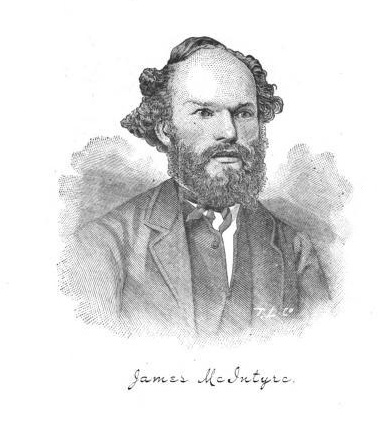
JAMES McINTYRE.
Land of rich cheese, milk and cream."
INGERSOLL:
PUBLISHED AT THE OFFICE OF THE CHRONICLE.
1889.
Registered, according to Act of Parliament,
in the year 1884, by
JAMES McINTYRE,
In the Office of the Minister of Agriculture.
TO THE PUBLIC.
 e received so many kind assurances from friends in this
neighborhood and from gentlemen at a distance who
had taken an interest in our first little work, that they
induce us to issue this more comprehensive volume
containing about one hundred new pieces. We have written a number
of dairy odes recently; these and our patriotic songs composed during
the past year we trust will make the work more interesting. We publish
a few short pieces from many letters and poems we received from
friends. We hope the public will peruse the poems in a friendly
spirit, as a kind feeling towards all of the nationalities forming this
young and vigorous Dominion has prompted us to publish these selections
from our poetic works.
e received so many kind assurances from friends in this
neighborhood and from gentlemen at a distance who
had taken an interest in our first little work, that they
induce us to issue this more comprehensive volume
containing about one hundred new pieces. We have written a number
of dairy odes recently; these and our patriotic songs composed during
the past year we trust will make the work more interesting. We publish
a few short pieces from many letters and poems we received from
friends. We hope the public will peruse the poems in a friendly
spirit, as a kind feeling towards all of the nationalities forming this
young and vigorous Dominion has prompted us to publish these selections
from our poetic works.
SHORT EXTRACTS FROM POEMS AND LETTERS RECEIVED BY THE AUTHOR.
The following lines were received from Mr. William Murray of Hamilton:
With Tennysonian themes to blend,
It is an independent style
Begotten on Canadian soil."
From one of Toronto's well known citizens, S. H. Janes, Esq., formerly of Oxford:
I wish to express to you my great pleasure in looking over your musings on the Banks of Canadian Thames. It seemed to transport my memory across the chasm of twenty-five years and to call up the scenes, associations and joys of boyhood's happy hour. Literary work of this kind must add greatly to your pleasure and happiness as it certainly does to that of your friends.
The Editor of the Toronto Globe, after reviewing a number of other books pronounced our little volume to be the gem of the table.
Col. Denison, Toronto's police magistrate, "found many most interesting pieces on Canadian subjects in the volume."
Joaquin Miller, the American poet, hailed me as "my dear poet of the Canadian pasture fields," and he said I did wisely in singing of useful themes.
N. C. Thompson of Rockford, Ill., wrote us a large number of verses. We select the following:
I like the best, I think it rare,
An equal love of Burns I share,
And read him oft,
O could I write like him 'twould bear
My soul aloft."
Dr. Scadding, the Antiquarian, thought my poem on Father Rannie, the cheese pioneer, "had the ring of a fine old ballad about it."
From a poem by the Rev. John Dunbar, of Toronto, we give this extract:
I only got your poems scanned,
Marking the treatment of your pieces
While wonder and surprise increases,
Assured your book its way will win,
So neat without, so nice within,
Reserving as a promised pleasure
The thorough reading at my leisure,
Permit me now to each unknown
To thank you for the kindness shown.
The Hon. Oliver Mowat was pleased with the patriotic spirit displayed in the poems.
From George McIntyre of Conestoga:
I gazed upon the pretty treasure,
And as it gives me such great pleasure,
My thanks I send
To him who in his hours of leisure
Those verses penned.
A. G. Murray, a prominent clansman of Chicago, sent us the following:—I received your volume and I think a great deal of it. It is one of our family treasures and the reading of it brings before us the genial form of friend McIntyre, who pictures things so vividly, reminding us of days gone by.
From Rev. Robert Cameron of Denver, Colorado:
Your book of rhymes has come,
Take thanks from all around our fire,
For all have said well done;
How many long and toilsome years
Have passed since first we met,
I was a lad twixt hopes and fears,
And you'r a poet yet.
CANADA BEFORE THE CONFEDERATION OF THE PROVINCES.
Divided by river and by bay,
Many a separate division,
Among them there was no cohesion.
Could be formed by federation,
And soon they led public opinion
To favor forming this Dominion.
With sources in the Rocky Mountains,
It was all a great mystery,
Hunting for furs its history.
Yet soon there will be mighty flow,
Millions to North-West will hurry
In last decade of century.
In great fertile prairie land,
For there the choicest wheat it grows
Near where the Saskatchewan flows.
There is found great grazing ranch,
Favoured districts therein abound
Where cattle graze all the year round.
By the Rocky Mountains vast,
Through canon blows no storm terrific,
But balmy breezes from Pacific.
CANADA'S FUTURE.
Has not yet acquired its strength,
On the arts of peace reliant,
Throughout its vast breadth and length.
Nor for the products of its vines,
Though other lands have fairer flowers,
Yet it to nobler gifts inclines.
And few lands can with it compete,
They often try but all in vain
To produce such splendid wheat.
That ere long we will behold
Many a rich glittering mine
Of copper, silver and of gold.
It is our verdant pasture land,
Where cows produce a flood of cream,
Doth make cheese of the finest brand.
When we reflect on this wondrous land,
With vast rivers and mighty lakes,
All nature here's on scale so grand.
Where rail cars run at speed terrific,
Thousands of miles from the Atlantic,
Till in the West you reach Pacific.[Pg 9]
To the far north frozen ocean,
Where it now seems lone and dreary,
All will yet be life and motion.
Doth sail on many a distant sea,
For world's commerce to compete
Her sails in all climes flowing free.
BIRTH OF CANADA AS A NATION, JULY FIRST, 1867.
Who is surrounded by the water
Of many a lake and broad sea,
Land of beaver and of maple tree.
For from the far Atlantic isles
In pomp have come their delegates,
All seeking to unite their fates.
And now throughout the land is seen,
High festival and stately dance,
Triumphant nuptials to advance.
And distant Vancouver rally,
To form this Empire gigantic
From Pacific to Atlantic.
WELCOME TO THE PRINCE OF WALES.
Lines written when the Prince of Wales was about embarking for Canada, May, 1860.
To where doth grow the maple tree,
May he be blest with pleasant gales,
The coming man, the Prince of Wales.
Where nature doth reward for toil
The farmer splitting his fence rails,
He welcome bids the Prince of Wales.
And the yeoman merry singing,
The song resounds o'er hills and dales,
Our future king the Prince of Wales.
We'll weave a wreath of maple leaf,
For o'er broad Canada prevails
Kind feelings to the Prince of Wales.
May he have many pleasant drives,
And on our lakes have merry sails,
Great king of princes, Prince of Wales.
CANADA'S RESOURCES.
Against the might of England's throne,
And shall this land with its vast bounds
Shrink with fear ere the trumpet sounds.
Proudly this heritage maintain,
With fertile acres by the billions,
Future homes for two hundred millions.
Brave men who ne'er will feel alarm,
And they have both the nerve and skill
To work land with a right good will.
Renowned mines of many ores,
While her furnaces and forges
Iron in useful shape disgorges.
Lumber, her cities for to build,
But her wealth is not in these alone,
She has great quarries too of stone.
And skilful webs come from each loom,
One of great nations under sun,
A mightier race it yet will run.
No other people can keep pace,
Here they have room for to expand
Into a nation mighty grand.[Pg 12]
And care in legislative halls,
A mighty future she will gain,
And highest rank she will obtain.
That she hath patriots brave and bold,
To guide her helm shall be extolled,
As loving country more than gold.
NORTH-WEST REBELLION, 1885.
The world's respect it doth command;
How quick her sons at war's alarms
Sprang to her rescue with their arms.
The shamrock and the thistle grows,
United garland they combine
Around the maple tree to twine.
From the far East Atlantic coast,
Our Canada so proud and free,
Four thousand miles from sea to sea.
But their deadly fires our boys did quench,
And victory it soon was won
By our General Middleton.
For Canada's temple of fame,
A kind and a brave hearted man
In hour of danger led the van.[Pg 13]
And Winnipeg doth its glories tell,
London boasts of her volunteers,
For she prides in her Fusiliers.
And triumph their quick march did crown,
For the relief of Battleford,
And scattering of the Indian horde.
Each left his home and all its charms;
Though many they were tender reared,
No frost nor snow nor foe they feared.
So many now do fill a grave,
And others they are maimed for life,
While engaged in glorious strife.
Rose, thistle and the shamrock,
Who all in unity agree,
'Neath the shade of the maple tree.
Under their great Poundmaker chief,
And Toronto troops gained fame
And Otter glory to his name.
And the brave crew of the Northcote,
And of our scouts who captured Riel,
Who in vain for mercy did appeal.
Who do not love the maple leaf,
For they spring from a noble tree,
Shades this land of the brave and free.
BIG BEAR THE INDIAN CHIEF.
The following impromptu was given at a banquet to one of the captives of Fort Pit after he had related his experience.
The death of those fell at Frog Lake,
And trials of captives of Fort Pit
When savages did capture it.
Made savage hordes their power to feel,
And they rescued women fair
From the paws of the Big Bear.
But steaks of tough and lean dog meat,
In daily danger of their lives
From bullets and from scalping knives.
The cry is heard, the troops advance,
To the white captives sounds so sweet,
But savages they quick retreat.
That close to him fell bursting shell,
This shot it was not fired in vain,
For several savages were slain.
So that white captives might be saved,
Who suffered hunger, cold and damp,
'Mong savage hordes in bush and swamp.
He must atone for broken laws,
Far away from his native lair,
In prison strong they put Big Bear.
[A] Mr. Stanley Simpson.
REMINISCENCES
On the laying of the corner stone of the Brock monument at Queenston Heights, and the final interment of the General who had fallen at the battle of Queenston, Oct. 13th, 1812. The remains of his Aide, Col. McDonald, were also deposited under the new tower.
When it was known a vile outlaw
Had at midnight's awful hour,
With ruffian hand blown up the tower.
Who bravely fell on Queenston's rock,
But graceful column soon shall rise,
Its beauteous shaft will kiss the skies.
You may behold a pleasing sight,
The grim old veterans of the war,
Militiamen with many a scar.
Grouped to pay their last ovation,
Round the remains of General Brock,
Who led them oft in battle's shock.
Feebly they move along the valley,
Not as they rushed in days of yore
When torrent like they onward bore.
O'er Niagara's rugged banks,
So indignant was their grief
On losing of their warrior chief.[Pg 16]
Adorned with implements of war,
The sad procession slow ascends,
As round the hill its way it wends.
While grand old flags around it float,
And now may peace be never broken
'Mong lands where Saxon tongue is spoken.
More glorious than horrid war,"
England doth Longfellow revere,
And America loves Shakespeare.
The oration on the above interesting occasion was delivered by the late Hon. William H. Merritt, projector of the Welland Canal. He served at the battle when a young man. We witnessed the interesting ceremony and shall never forget it.
PATRIOTIC ODE
Written at the time of the last excitement on the Niagara Frontier.
United in one mighty band;
No traitors in our land we find,
All one in heart, all one in mind;
Resolute in their opinion,
None shall conquer our Dominion;
For every man with dauntless mien
Will rally round our flag and Queen.
PROVINCE OF ONTARIO.
Pure happiness each one partakes,
Who is sound in body and in mind,
And to industry is inclined.
And them with Uncle Sam divide,
Other lakes seem inferior
In size to great Superior.
In Huron's wide expanded tide,
But it onward flows forever,
Through St. Clair lake and river.
Into Erie's lake so grand,
Then behold its wondrous charms,
When embraced in Niagara's arms.
On pure bosom of Ontario,
Round it our towns and cities cluster,
O'er it Toronto sheds her lustre.
The thought that 'tis our favorite lake;
Several states approach Lake Erie,
Each one claiming it for dearie.
Alone for Lake Ontario,
Our love for it is so unbounded,
We have almost it surrounded.[Pg 18]
They are famed for grapes and peaches,
'Mong choicest fruits you ramble on
From Niagara to Hamilton.
A land of lakes and rocks and mines,
And beneath dark pine tree shade,
How happy is the youth and maid.
And fish for trout in sparkling pool,
For pike or salmon you can spear,
And in the season hunt the deer.
Where both fish and game abound,
And verdant pastures here are seen,
Where cattle graze 'mong sweetest green.
And in the south we have the vines,
Where each year adds into the charms,
Surrounds the homesteads on the farms.
With hardy sons to guide the plow,
In south we have the fruitful soil,
Where nature's bounties on us smile.
Ontario hath thousand islands,
And there is a great array
Of charming isles on Georgian Bay.[Pg 19]
The lovely isles near Huron's shore,
Superior makes a grand display,
All round her shores to Thunder Bay.
For rocks and meadows and clear lakes,
And sportsmen for it proudly claim
That 'tis a land for fish and game.
From great spruce forests of Algoma,
And from the poplar, birch and pine,
There too is wealth in many a mine.
Will be found in Ontario West,
Stretching towards the interior,
Three hundred miles west of Superior.
At the Detroit river's mouth,
There the sun doth cheerful smile
On the grape vineyards of Pelee Isle.
On the shores of Nipissing,
And some do locate claims away
To distant north around James' Bay.
CANADIAN RIVERS AND LAKES.
As bonnie Doon or banks of Ayr,
Like modest worth meandering slow
The quiet waters gently flow,
Rose, thistle, shamrock, all combine,
Around the maple leaf to twine,
Whose outstretched arms so gigantic
Clasp Pacific and Atlantic,
Embracing lakes like burnished gold,
With joy a Shakespeare might behold,
For either Poet Burns or Moore[B]
Such scenery they would adore.
[B] Tom Moore paddled his own canoe along the Canadian shore of Lake Erie and was enraptured with the view. He landed and remained over night at a farm house. His Canadian Boat Song is immortal.
NIAGARA DRY.
While there did float great thick ice cakes,
That then a gale did quickly bring
Them all down from the upper lakes.
Across the entrance to river,
It was a scene of icebergs dreary,
Those who saw will remember ever.
And left Niagara almost dry,
This a lady did discover
As above the Falls she cast her eye.[Pg 21]
Since Israelites crossed the Red Sea,
When they had resolved forever
From Pharaoh's bondage to flee.
Proudly carrying British flag,
Erecting it in river's centre
In crevice of a rocky crag.
How she captured Niagara,
But it was seen by Bishop Fuller,
Who did at sight of flag hurrah.
Before another dry can tread,
In bottom of Niagara,
For she doth jealous guard her bed.
And wind it kept the waters back,
So that a child could almost wade
Across the brink of cataract.
UNITED BY STEEL RAILS.
Rebelled against the Eastern laws,
Canadian courage it did test,
All were united in the cause.
Such distance, several thousand miles,
Will they in their dark hour of need
Ask Uncle Sam with pleasant smiles[Pg 22]
To pass o'er their north railroad,
Perhaps subject to doubts and fears,
Where British soldiers never trod.
When it was found that in our land,
Almost finished was railway,
And trains do wait for word command,
To those far North distant lands,
But dispelled were all their fears
When they rode over those steel bands,
Before detached and all apart,
Shoulder to shoulder now each one
Feels patriot feelings in his heart,
The value of this great railway,
Its benefits each now doth prize,
Highway to Japan and Australia.
Which did build this great railway,
The vast Northwest to colonize,
And bear its products far away.
In the ports of the Chinese,
Short route to Oriental world
Gives Canada her cheap fine teas.
LORNE AND LOUISE.
Lines written on the arrival of Governor Lorne and the Princess Louise in Canada.
That she has landed safe, Louise,
Victoria's beloved daughter,
Who boldly has crossed the water,
For royal Princess doth adorn
The title of the Lord of Lorne,
For this union it doth join
Campbell with Royal Stewart line;
Lorne will be Duke of broad Argyle,
And the Lord of many an Isle.
When he inherits broad domain
May he strive tenants hearts to gain.
To us it seems a brighter morn
Hath dawned on us with Governor Lorne,
And when they visited this place
True happiness beamed on each face,
The first white child who here was born
Presented was to Governor Lorne,
From Forest 'ere it was reclaimed,
Our fine town after him was named.
CANADIAN SPORTS AND GAMES AND PLAYS.
But in Canada is often seen
By far more jolly times than these
At logging raising, paring bees,
For here the youth is not afraid
To trip it with a pretty maid,
For this at night is his reward
For working at the bee so hard,
And oft times till the break of day
At forfeits they will merry play,
For he doth win e'en though he miss,
If from sweet lass he gets a kiss,
But in its place doth justly prize
His tea and cakes and pumpkin pies.
But makes fresh pleasures spring and bloom,
For when the youth longs for a bride
He gives his girl a grand sleigh ride,
Which to them both doth pleasures bring
While merry sleigh bells cheery ring,
And with the fair maid of his choice
He graceful skates with her on ice,
Charming mode of locomotion
Gliding o'er a polished ocean,
Such joys they soon do love evolve,
And they on union do resolve,
He is happy with his chosen,
For warm love gets never frozen.
How swift they down the hill can glide,
And they bravely dare the frost king[Pg 25]
So they may enjoy the coasting,
Each striving for to lead the van
In the swift shooting toboggan.
The polished blocks to skilful curl,
And curlers all do proudly claim
Their's is a manly healthy game,
And in Canadians you trace
A generous, hardy and brave race.
Is scenes on ice at carnival,
Before the gale in an ice boat
It swiftly o'er the ice doth float,
The sensation is you fly
Like lightning shooting through the sky.
The baseball and do play lacrosse,
And tradition doth for it claim
That 'tis an ancient Indian game,
And if a foe invade we can,
Drive them back with clubs Canadian.
NIAGARA'S CHARMS AND DEATH OF WEBB.
Struggling fiercely to be free,
But drawn downwards in its course
By gravitation's wondrous force,
O'er those perpendicular walls,
Hurled 'mong mighty rocks it falls,
Causing the earth to throb and shake
Like to the tremor of earthquake.
Reverberates like peals of thunder,
Enshrined with mist and beauteous glow
Of varied tints of the rainbow,
Most glorious sight the human eye
Hath ever seen beneath the sky,
Along these banks none ever trod
But did feel grateful to his God,
For lavishing with bounteous hand
Glories majestic and so grand.
Transformed into a beauteous green,
Plunged by whirlpools dread commotion
It becomes a seething ocean,
Where furies join in surging dance
From centre to circumference,
This is the favorite abode
Of Neptune, mightiest sea God,
He hath decreed none shall survive
Who will into this vortex dive.[Pg 27]
Like seabird he did love to lave
His breast upon the mightiest wave,
Alas, found here a watery grave;
Torrent onward rushes frantic
On its course to the Atlantic,
But on its way doth gently flow
Through blue lake Ontario,
Rejoicing on its way it smiles,
Kissing the shores of Thousand Isles,
Mingling with St. Lawrance motion,
It soon is blended with the ocean.
DEPARTED STATESMEN.
With a glance at Sir John A. Macdonald and Blake, the two living leaders, 1884.
Thou wert a man with lofty brow;
D'Arcy McGee, so brilliant and free,
From green isle you came o'er the sea.
So high you stood without a peer;
John Sandfield for long you did build
Power under economy's shield.
Confederation you did crown;
You now are all free from the strife
The wrangle and jangle of political life.
You will there see John A. and Blake,
But Sir John the greatest power doth wield,
Our Canadian Beaconsfield.
THE OLD SNAKE FENCE.
When a few acres he did clear,
He found 'an ample recompense
For splitting rails and making fence.
And zigzag style did not awake,
He thought it was a thing of beauty,
Yet in its day it did its duty.
'Twas easy made, axe, wedge and maul,
Were all the tools the pioneer
Required the old rail fence to rear.
Of fence that did not need a post,
To build it now is waste of timber,
And fertile lands it doth cumber.
Will long endure and ward off brutes,
For the crops they ample shield
And do protect each separate field.
Where weeds do grow and bush expand,
And thistle down doth blow from thence,
So folks build wire and the board fence.
CANADIAN VOYAGEURS ON THE NILE.
With gratitude did kindly smile,
On the Canadian voyageurs
Who skilfully did ply their oars.
On boatsmen led by Denison,
Neither the rapids nor the falls
Along the Nile these braves appals.
On each native stream and lake,
Thoughts of their homes in visions throng,
While singing Canadian boat song.
The glorious land of maple tree,
From their memories they never
Forgot the land of lake and river.
They dream about their own St. Lawrence,
And Manitoba's streams and lakes,
Pleasant reflections oft awakes.
Ascending of old Father Nile,
Whose waters fertilize the soil,
And is the home of crocodile.
In Red River expedition,
How these voyageurs could steer,
Or with the axe a roadway clear.
From the banks of the St. Lawrence,
At call to arms quick advance,
With rifle, bayonet and lance.
LAND CLEARING.
In Canada was with a friend,
And when the snow had passed away
Quite early in the month of May.
And told me to get stumps ablazing,
Around each stump I heaped a pile
Of roots and junks of wood so vile.
So it a crop of wheat would rear,
And there was one high withered pine
Which was full of turpentine.
Blaze quick did start and it did scorch
The fences, and the woods were nigh,
For the old tree it blazed on high.
Near there that day and found employ
In saving of the house and barn,
Thus early fire fiend did me warn.
Carried the sparks 'mong leaves of trees,
I did work hard but for recompense
All was saved but a few rails of fence.
From winter slumbers nests of snakes,
And listens to the music grand
Of bull frogs, our Canadian band.
LINES READ AT A MAPLE SUGAR SOCIAL, APRIL, 1888.
In the big woods we did enjoy,
Large maple bush we then did tap
And to camp carried maple sap.
Then in big kettles sugared off,
Though often it did try our mettle
To keep up fire beneath each kettle.
To cut the wood to kettles boil,
To-night it is a pleasant joke,
No trouble from the fire and smoke.
By having on it a neckyoke,
And on each side a heavy pail
Suspended from the yoke by bail.
And stumbled o'er the logs in bush,
But no doubt the maple's sweeter
Than any other thing in meter.
Which maple sugar doth surpass,
And may it be each young man's fate
For to secure a charming mate.
And seek their mates in early spring,
When found each pair do feel they're blest,
When they have finished their warm nest.
Webster was rocked in a sap trough;
When boiling sap it is quite handy
To pour some in snow to make candy.
CANADIAN ROMANCE.
A labourer, John Roe by name,
His little wealth had made him bold,
Twenty sovereigns in gold;
He was industrious and wise
And e'en small sums did not despise,
He added to his wealth each year
For independence he loved dear,
He knew a laborer he would be
Forever in the old country,
His forefathers had tilled the ground
And never one had saved a pound.
On beds of down they did not lie
And frugally their goods did buy,
Their one luxury around their door
A few choice flowers their garden bore,
But never hoped to own the soil
But serve as hinds to sweat and toil,
To work and toil for him had charm
He hoped some day to own a farm,
So he hired with Reuben Tripp
The wealthiest man in the township.
Tripp's only child, his daughter Jane,
He sought her love and not in vain,
As Jacob served for Rachel dear
So John he served year after year,
Till rich enough to buy bush farm
For to chop down with his strong arm.
The truest nobleman of all
He lives not in ancestral hall,
But sheltereth family from harm
By logs rolled up by his strong arm,
In this young glorious land so free
Where each may rear his own roof tree,[Pg 33]
And the chief glory of old days
Broad fire place where big logs did blaze,
As much as four strong men could handle,
They served alike for heat and candle;
He his young oxen did adorn
With fine gay ribbons on each horn,
And to his home with joy and pride
He did bring sweet blooming bride,
Such happiness is seldom seen,
Happier far than king or queen;
She helped him in the fields to reap,
And spun the wool from off the sheep,
All they required they had for both,
Of her own weaving of good cloth,
And she was a good tailoress,
Did make his coat and her own dress;
The golden butter that she made
Was of the very finest grade,
Each grace and virtue she possess'd,
Where'er she was, that spot was blessed,
And though they did not have stove then,
Neither did they own an oven;
She filled large pot with well knead dough
And baked fine bread 'mong embers glow;
He each winter the forest trees
Did quickly hew them down with ease,
For he to work had a desire
And the skill did soon acquire,
But round great giants hewed a ring
Then storms would soon them prostrate bring,
For many a time the furious breeze
Would quick o'erthrow the girdled trees,
And sometimes they would kill the cows
When they did feed on grass or browse,[Pg 34]
But after reckoning damage all
A benefit was each windfall;
Though good fortune now he sees
Might have been got from Walnut trees;
But trees were foes in his hurry,
All were slain, both oak and cherry,
And to this day he doth incline
To mourn o'er slaughter of the pine,
And reflects how he did o'erwhelm
Many a maple, beech and elm;
And each summer day did toil
With his steers drawing logs in pile;
These giants of the forest dead,
Fire did reduce to an ash bed,
And soon potatoes, wheat and corn,
They did the rugged stumps adorn,
And Jane did help him with the hoe,
And well she did keep her row:
No organs then they had to play,
But she could work and sing all day;
In spring he did live maples tap
To draw from them the luscious sap,
He gathered it in big log trough,
Then boiled it down and sugared off,
Enough the household for to cheer,
With all its sweets for the whole year,
And no such thing those times were seen
As the swift raising stump machine,
And where main road was low and damp
With logs he built a road through swamp,
But a smooth ride could not enjoy
While it was naught but corduroy,
Each year added earth and gravel,
Now smoothly o'er they can travel,[Pg 35]
For it doth make an excellent road
For John and Jane to go abroad,
And it is now a great highway
Where hundreds travel every day.
There were no roads in early days
But bridle path, their guide the blaze,
And mills and marts so far away,
They never could return same day;
Log school house served as church for all,
Of various creeds, and for town hall.
These scenes to youth do now seem strange
So wondrous quick hath been the change,
O'er paths where oxen only trod,
Cows quickly speed o'er the railroad,
And every way both up and down
There has sprung up a thriving town.
No more he fights with forest trees,
But both enjoy their wealth and ease,
Long since the old folks both are gone
And left the whole to Jane and John;
The log house now has passed away
With all its chinks filled in with clay,
And in its place fine house of stone
With lawn where choice shrubs are grown.
With sons and daughters they are blest,
The young men say they'll move Northwest;
This gives their mother some alarm,
She wants them still on the home farm,
But father will not have them tarry
They can plow so quick on prairie,
And they find coal makes a good fire,
And build their fences of barbed wire
They would not be forever gone
As they could talk by telephone.
We have been congratulated by many on the truthfulness of the Romance of Canada. They declare it is not a romance but a true picture of rise and progress of worthy people in Canada.
LAMENT OF THE MAPLE TREE.
A VISION.
"We had a dream which was not all a dream."—Byron.
It was late long afternoon,
A very sultry summer's eve,
Such times the senses oft deceive,
The place was 'neath a maple tree,
Soon from all cares and troubles free,
By a gentle, kindly slumber,
No more our sorrows we could number,
But we heard a plaintive wail
Such as we find in fairy tale,
It was the genius of the tree
Who in sad guise appeared to me,
And then she sadly did give vent
Unto this awful grave lament:
Though I am gay in month of June,
All decked in green, yet very soon,
Alas my beauty will be faded
And my charms be all degraded,
For is my time of glory brief,
So often flattered is my leaf.
In Canada so broad and free
All poets sing of the maple tree,
High I stand in their opinion,
Emblem of the New Dominion,
The reason I do them upbraid
Some never slept beneath my shade,
And yet they take the liberty
To chant about the maple tree,
They dare to poetise my leaf,
This is the source of all my grief,
I think their praises all so rude
And as but base ingratitude,[Pg 37]
So often hackneyed is my name
That every fall I burn with shame,
Like maiden's cheek which blushes red
When vain rash youth asks her to wed,
Then do these foolish ones descry
In me fresh beauty and they sigh,
And then renew their songs of praise.
But unto me how sad their lays,
For then I know my days are brief,
'Tis hectic flush upon my leaf;
True poets then should mournful sing
When the destroyer's on the wing,
For then I know my leaves of gold
Will all soon mingle with the mould,
No one does ever think to praise
The fell destroyer when he slays,
None rejoice in the flushed cheek
When the poor girl is low and weak,
Perhaps they'll say and it is true
In spring my glories I'll renew,
But 'tis poor comfort after all
To lose my offspring every fall,
Small consolation to mother
To tell her that soon another
Will replace her fond darling boy
Who has been source of all her joy,
But you know all about my wood
You know that it is strong and good,
And I have full many a curl
And pleasing eye and charming nurl,
Some love me as fond nature grained
And some prefer my beauty stained,
But my dear friend I hope that you
My varied shades love pure and true,[Pg 38]
For of the woods you know the staple
Stoutest and best is good maple,
The youth my sugar eat with glee,
And old maids love me in their tea,
In me do various uses meet
In summer shade, in winter heat,
For I do make a glorious blaze
All worthy of the poet's lays,
But to their praises I'll be deaf
If more they harp about my leaf.
They call me gay when I am sober
To me 'tis gloomy month October,
But saints on earth when they die
Hope for true bliss beyond the sky,
So winter does bring no alarms
Though it strip bare my trunk and arms,
For now I know that time will bring
More glorious foliage in the spring,
Then all nature will rejoice
Triumphing with glorious voice,
And birds will in my branches sing
Hosannas to the lovely spring.
The nurls and birds' eyes and curls were highly prized in furniture thirty years ago, when we used the smooth plain.
LIFE IN THE WOODS.
(Life of the early settlers.)
Whose fathers overcome the foemen,
The enemy they boldly slew
Was mighty forests they did hew,
And where they burned heaps of slain
Their sons now reap the golden grain,
But in the region of Northwest
With prairie farms they are blest.
Though this to them it may seem good
Yet many blessings come from wood,
It shelters you from the fierce storm
And in the winter keeps you warm,
For one who hath his forest trees
He builds his house and barn with ease,
And how quick he gets from thence
Timber for bridge and for his fence.
THE JOYS OF PRAIRIE FARMERS 1884.
About the joys the woods do bring,
But we in regions of Northwest
Do think prairie farms the best,
For those poor men who swing the axe
On their strength 'tis a heavy tax,
For several years they naught can grow
While from the first we plow and sow,
And while we plow we don't get thumps
By running it against the stumps,
And where wild Buffalo now doth feed
There very soon they'll sow the seed,
Where Indian wigwams now do stand
Will be the site of cities grand,
And where the deer and wolf doth roam
Millions will build each happy home,
So quick as if by magic wand
They will arise o'er the whole land,
But this one fact we won't deny
Ontario she can supply,
For so skilfully she doth invent
Each agricultural implement.
CANADA OUR HOME, 1883.
The following response to Canada our home was given at a banquet of the Caledonian Society, Ingersoll:
In responding to the sentiment Canada our home perhaps it would be appropriate to point out the prominent and distinguishing characteristics between the land of our nativity and the land of our adoption. In this Canada of ours we have no bonny blooming heath, no banks and braes covered o'er with daisies and gowans, no fragrant hedges showering down white spray in the May time, no whin and broom prodigal in their gaiety of yellow flowers, no hills nor glens where fairies gambol in pleasant and harmless sport, no grand ruins of ancient cathedrals and castles, no feathered songsters like the mavis and blackbird.
To heavenly song of the skylark.
But Canada is a young giant in its infancy with the noblest chain of lakes in the world on its frontier, and the most magnificent river the St. Lawrence. This land also possesses the largest fertile wilderness on the globe, but it is one which will ere many years have passed away, blossom like a garden, and where naught but grass and flowers now grow in wild luxuriance. Soon the husbandman will plow and sow and reap a rich reward in yellow golden grain. Domestic cattle quiet will graze where now the Buffalos roam and in spots now covered o'er with Indian wigwams, where white men never trod cities will[Pg 42] occupy their sites with busy trade and millions flock from eastern lands to take possession of the great Northwest. Then Winnipeg perchance may be the capital of the Dominion. In the day foretold when this indeed shall be the "Greater Britain" with Ontario's towns for workshops for this vast prairie land.
Worthy of the muse of a Burns or a Moore,
A Shakespeare and a Milton, the great and the wise,
Will sing of the glories of our northern skies,
Of its lakes and rivers and its mountains grand,
Of its fertile plains and great prairie land,
A fit theme for song this empire gigantic,
Whose arms stretch from Pacific to Atlantic.
LINES ON VIOLETS.
'Mid Canadian winter, lo!
To our joy and surprise
We saw some violets in full bloom,
Gazing at us with loving eyes,
Thanking us for opening their tomb,
Yet still they seemed so cozy and nice
Enshrined in the crystal ice,
While all else were drooping dead
Gaily they held up their head.
CANADIAN CHARMS.
For we have bounteous crops of grain,
And you behold on every field
Of grass and roots abundant yield,
But after all the greatest charm
Is the snug home upon the farm,
And stone walls now keep cattle warm.
DONALD ROSS.
Lived young Donald Ross,
Among the heathery hills
And the mountain rills,
In a snug little cot
Content with his lot
He never knew sorrow
With his wife and wee Flora.
O'er the land of the north,
To burn many a home
So the wild deer might roam,
With grief he then did toss
Every night Donald Ross,
And sad seemed the morrow
For his wife and sma' Flora.
But nobles do not heed
The sorrows of the poor
Drove on a barren moor,
Where he wove a wreath
Of the blooming heath,
For to crown with glory
The brow of little Flory.[Pg 44]
To his mountain dell,
Where his fathers appears
Had lived a thousand years,
With their few goats and sheep
Which feed on hills so steep,
O it was a sad story
For bonnie little Flory.
In Canada bought land,
To him a glorious charm
To view his own broad farm,
His horses and his cows,
Cultivators and plows,
And now his daughter Flora
She is the flower of Zorra.
PATRIOT FIGHTING FOR HIS HOME.
An infant giant now awakes,
He has long time been in a dream,
But now is roused by engine's scream.
Traversing of each great railroad,
For it is a glorious theme
The peaceful conquest made by steam.
Ever desecrate his soil,
He firm will meet him bold and brave
And give him soil Canadian grave.
FIGHTING FOR CONQUEST.
But some nations fight to plunder,
For conquest o'er the world to roam,
To tear peaceful lands asunder.
To some aspiring commander,
Who wishes to acquire great fame
As a modern Alexander.
And many thousands strew the plain,
Covered with gore in the carnage,
Where brave and noble men are slain.
Now who can soothe the ills of life,
To them they never shall return,
No one can now cheer the poor wife.
Think of father and of mother,
Of sweetheart, sister and of brother,
Who oft will shed the fruitless tear.
CANADIAN AUTHORS.
MRS. MOODY.
In giving a glance at various Canadian authors perhaps it would be well to commence with that early writer Mrs. Moody. She was a sister of the celebrated Agnes Strickland, author of "The Queens of England."
Its great champion Mrs. Moody,
Showed she had both pluck and push
In her work roughing in the bush.
At time McKenzie did rebel,
Outbreak her husband strove to quell,
Her own grand struggles she doth tell.
Pioneer renowned in story,
But her tale it is more cheering
When she wrote about the clearing.
Though eighty-seven she doth not fail,
She now is writing of wild flowers
Grown in Canada's woody bowers.
[C] Mrs. Traill lives near Peterboro. Mrs. Moody died in Toronto. I sent her a copy of my poems in 1885, and she thanked me for the same through a friend as she was in feeble health at the time.
T. D. MCGEE.
Having been kindly invited as a member of the Mechanics' Institute some 25 years ago by the late Jeremiah O'Neill, Esq., to meet that gentleman in company with a number of our townsmen, when Mr. McGee was rising from the table the chair being new stuck to him, and it being near a general election he very wittily remarked that he hoped the people of Montreal would be as anxious to retain him in his seat as the people here are. We wrote the following lines at the time, the last verse was added afterwards.
All compliment thee,
The hope of the land
On your lecture so grand.
Oh give us the sport
Of an hour of your chat,
Then we'll laugh and grow fat.
Could 'ere cease to smile,
When near to thee
So brilliant and free.
Long in Canadian soil,
May you take deep root
And bear much noble fruit.
Alas he is slain,
By a crankish hand
The flower of the land.
GEORGE MENZIES' POEMS, 1883.
About one third of a century ago there flourished in Canada three Scottish editors, all of whom were poets, McQueen of the Huron Signal, Goderich, who wrote a grand song on "Our Broad Lake," and McGeorge of the Streetsville Review. The following lines are on George Menzies who was a Woodstock editor.
On a small book we almost trod,
Its leaves were scattered o'er the ground,
We picked them up and when we found
Us with a very strong desire
To read the little volume through,
For most of it to us was new.
And Canadian scenes together,
He did adore Niagara's roar
Where mighty flood o'er fall doth pour.
And he had his full share of grief,
Which to his life did gloom impart,
But he bore up with his brave heart.
Lines sent to Thomas Conant of Oshawa, a writer of Canadian sketches
You truthful paint Canadian charms,
And you are the great exponent
Of beauties of her woods and farms.
Of the blue jay and the plover,
And of great white Canadian owl,
All proves of nature you're a lover.
ROBERT FLEMING GOURLEY.
Robert F. Gourley was a graduate of St. Andrew's University, Scotland. He was the first to agitate for popular rights in Canada. He was banished from the country and while crossing the Niagara River he asked for a brush to wipe Canadian dust from his feet. He became a champion of popular rights in England and he whipped Lord Brougham in the lobby of the House of Commons, for which breach of privilege he was sentenced by the House. Mr. Gourley owned several farms in Oxford, Ontario, and sought to represent South Oxford in 1858, but Dr. Connor, an uncle of Hon. E. Blake, won the seat; Mr. Blake was his uncle's secretary through the contest when he was a youth.
In his old age his health was poorly;
He was a relic of the past,
In his dotage sinking fast;
Yet he was erect and tall
Like noble ruined castle wall.
In early times they did him impeach
For demanding right of speech,
Now Oxford he wished to represent
In Canadian parliament,
But him the riding did not honor,
But elected Doctor Connor.
Lines sent to Alexander McLaughlan, Amaranth Station, with a copy of my poems:
In memory of the olden times,
Great chief of our poetic clan,
Admired by all, McLaughlan.
PROLOGUE TO SOUTH ONTARIO SKETCHES.
The district lying South of Georgian Bay and Lake Simcoe, including Toronto.
For in them we proudly glory,
Her lakes and rivers and her streams,
Worthy of renown in story;
And in these leaves we hope is strewn
Some wheat among the chaff,
And maple boughs by rude axe hewn,
Where one may find a rustic staff;
To help him o'er the rugged lines
If he to weariness inclines.
Some see no beauties near to home,
But do admire the distant far,
They always love abroad to roam,
View glory in but far off star;
But let it never be forgot
That distant hills when closer seen
Are after all a barren spot
Not like your own hills clad in green;
You'll find they are but idle dreams
To seek for happiness afar.
At home there's lovely lakes and streams,
Remain content now where you are;
At us we hope you will not rage
Because we sing of local charms
In each varied town and village
As well as round our local farms,
But our address it must be brief,
So now we bid you all adieu,
But of our book pray read each leaf
Until the whole you have gone through;
Each one doth know it is not wise,
Though our songs may not be vocal,
Chants of our home for to despise,
But prize them 'cause they are local.
HOLLAND RIVER AND ITS TRIBUTARIES.
Meanderings of a stream rises twenty miles north of Toronto and sweeps around the whole of Southern Ontario.
Through the lowland meadows running,
To us it is a pleasing theme,
Tracing it from first beginning.
Moving onwards in its motion,
And not content till it reaches home,
Two thousand miles to distant ocean.
A few miles north of Ontario,
But it doth take a wondrous crook,
It northward many miles doth flow.
Doth debar its southern course,
So a long journey it don't grudge,
But slowly on its way doth force.
Into the pure clear lake Simcoe,
It still flows north for to get south,
As onward still its course doth go.
Hundreds of miles it doth flow west,
Blended in the Georgian Bay,
For a moment it doth not rest.[Pg 52]
Erie and Niagara river,
Even at the Falls it don't despair,
But it cheerful flows forever.
It hath flowed back near its first start,
To waters of Ontario,
Where ridge at first kept it apart.
Both the Don and the Humber,
Embracing city of Toronto,
Hath attractions without number.
First of Don and then of Humber,
Improved rivers like to the Clyde,
With wharves for coal, wood, iron and lumber.
ST. CATHARINES.
Lines read at the Welland House, St. Catharines, at a banquet given to the members in attendance at the Oddfellows' Grand Lodge.
And for the beauty of her daughters,
For some do worship at the shrines
Of the fair St. Catharines.
From the genius of a Merritt,
You still would be a village dreary
But for this canal from lake Erie.
Full many a ship and steamboat,
Brings world's commerce to your doors
And many gifts on you it pours.
It gives you dry docks and ship yards,
To drive your mills great water power
It doth give you as a dower.
Through new canal vast stream it flows,
The lock gates at the hill at Thorold
Can not be equaled in the world.
BRANTFORD.
In these sketches of towns in Southern Ontario we are not vain enough to suppose that because we have produced some lines thereon that said rhymes are poetry. If we furnish an occasional poetic gleam like a dewdrop sparkling in the sun, it is all we dare hope for.
And after Indian Chief is named,
And here the sparkling Grand River
It doth flow a joy forever.
Of horrors of Wyoming's vale,
The tale one's mind doth ever haunt,
The cruelties of monster Brant.
And Campbell to him did lament,
And all the tale he did recant
About cruel butcheries of Brant.
When Brantford thinks of her namesake,
She evermore with pride will chant
The bold heroic name of Brant.
Tecumseh on the banks of Thames,
And the Grand River it doth vaunt
O'er the historic name of Brant.
In building him a monument,
And Indians will proudly stalk
Past memorial of great Mohawk.
LINES ON THOROLD.
McCready, the great Irish tragedian, said that the view from Thorold was the finest in America.
And the grand view from off its hills,
A view so charming and extended,
Nature's beauties sweetly blended.
To view Ontario's broad lake,
And husbandmen have their reward in
Fruits of this Provincial garden.
Gardens where choice fruits do grow,
The landscape all within your reach
Doth both produce the grape and peach.
The finest view was from Thorold,
You see St. Catharines thriving town
And steamers sailing up and down.
All along Toronto Bay,
And you clearly see the haze
Where Niagara doth amaze.
Or view Beamsville's fruitful field,
Then this thought you can advance,
This is Canada's sunny France.
Though it has lost us old renown,
And you have a splendid view
Of boats on old canal and new.
[D] Niagara once the capital of Upper Canada and an important fortress at the mouth of the Niagara River.
ST. THOMAS, 1884.
At time of Oddfellows Grand Lodge meeting.
O'er rough stage road to the Grand Lodge,
But now they town of metal seek
And find it on the Kettle Creek.
As it was built by the steel rails,
And here the wide expanded bridges
Do connect the distant ridges.
There's lots of railroads to St. Thomas,
You pluckily did boldly venture,
Now you are great railroad centre.
From its great railway workshops,
And higher yet it still will rise,
This seat of so much enterprise.
He seeks Alma girl graduate,
And he loves her Alma mater
For the sake of her charming daughter.
GALT AND DUNLOP.
John Galt was the manager of the Canada Company's lands, and he was a Scottish Novelist. Dunlop was at one time an eminent British Journalist, but he finally settled near Goderich. The town of Galt is named after John Galt.
They located and planned the city
Of Guelph, and they cut the first tree down,
The stump was the centre of the town.
And they projected on this same plan
The towns of Stratford and Goderich,
The last it stands near broad Huron's beach,
'Neath which doth flow the clear Maitland,
Of glorious view you may partake,
Gazing on Huron's mighty lake.
TILSONBURG.
This place was called in honor Tilson;
Bright gleaming like to a beaming star,
Is clear waters of the Otter.
Which extends for miles beyond,
A fortune on town it will shower,
This prodigious water power.
Like lovely little lakes round here,
And few small towns have fine roadway
Lined with brick blocks like your broadway.
PORT STANLEY.
For to gaze on stormy Erie,
But here in summer time this port
It is a fashionable resort,
For then it is always cheery
For to gaze upon Lake Erie.
All independent of the gale,
Or here the youth can ply the oar
And view the fast receding shore,
And be happy with his dearie
On the bosom of Lake Erie.
On the borders of Lake Erie,
With quadrille parties at Stanley
And games and sports all so manly,
Or bathe in waves with friends near thee,
You fear no storms of Lake Erie.
PORT BURWELL.
The following lines were given at a concert when Port Burwell was a busy port and there had been a race on the ice the day before.
To pay a visit to your busy port,
They must be clad in fur well,
For it blows cold at Burwell;
But when you wish to trot your horse
You make Lake Erie your race course,
And we believe at every heat
All other horses you do beat.
SKETCHES ON THE BANKS OF THE CANADIAN THAMES.
Till by himsel' he learned to wander
Adown some trotting burn's meander."
The valley of the Thames, we presume, includes Stratford on the north and Woodstock and Ingersoll on the south. The Avon, on whose banks Stratford is located, joins the Thames near St. Marys. The middle branch flows through Embro and Thamesford. The south and middle branches unite and flow through Dorchester and Westminster and blend with the northern branch at London, where it deviates to Elgin in the south.
ENGLISH NAMES ON CANADIAN THAMES.
To adorn Canadian Thames,
And charms to them she has lent
In Oxford, Middlesex and Kent,
She Essex kisseth in her mouth,
And Scottish names, one north, one south,
And London now it justly claims
'Tis capital of vale of Thames,
And her strong castellated tower
Doth on the river frowning lower,
And Chatham is the river's port,
There slaves for freedom did resort,
And they did industrious toil,
And now many own the soil,
Stratford now shall be our theme,
On Avon tributary stream,
And its clear waters it doth launch
Into the Thames northern branch,
Near that substantial stone town
St. Mary's with mills of renown,[Pg 60]
Westward it winds past each town,
Growing broader as it flows down,
Onward it glides never weary,
Meandering so soft and cheery.
The sunbeam on the waters glance,
Skipping about in silvery dance,
From morn till eve the cattle feed
'Neath lofty elms along the mead.
And on its banks in warrior pride
The brave Tecumseh fought and died,
And it has now historic claims
The famous battle of the Thames.
Now soon the waters meet and pair
With the wavelets of St. Clair,
As maids when wed do lose their names,
No longer it is called the Thames.
Rejoicing on its way it smiles,
Kissing the shores of Thousand Isles,
Mingling with St. Lawrance motion,
It soon is blended with the ocean.
LONDON FLOOD, JULY 11th, 1883.
O'erflowing were the swamps and drains,
For each day had its heavy shower,
Torrents fell for many an hour;
At London where two branches join
It seem'd two furies did combine,
For to spread far both death and woe,
With their wild, raging overflow;[Pg 61]
E'en houses did on waters float,
As though each had been built for boat,
And where was wealth and joy and bloom,
Soon naught but inmates of the tomb;
Flood o'erflowed both vale and ridges,
And swept railroads, dams and bridges,
A mother climbed in tree to save
Her infant from a watery grave,
But on the house you saw its blood
Where it was crushed 'gainst tree by flood;
Where cottages 'mong gardens stood
'Tis covered o'er with vile drift wood,
O'er flowers and bushes you may travel
For they are buried under gravel,
Or you may walk o'er barren sand,
The crops washed out and fertile land;
Two funerals we at once did see
Of one family who lost three;
No longer river's deep and wide
But gently flows to distant tide.
DISASTER TO STEAMER VICTORIA AT LONDON.
Which was the scene of a sad theme,
A fragile steamer there did play,
O'ercrowded on a Queen's Birthday,
While all on board was bright and gay,
But soon 'neath the cold waters lay,
Naught but forms of lifeless clay,
Which made, alas! sad month of May.
LINES ON WOODSTOCK.
Where the Queen in jealous malice
Slew romance's fairest flower,
Fair Rosamond in secret bower;
Our Woodstock pleasing county town,
This brings it both wealth and renown,
To your strong castle some are sent
To give them leisure to repent.
A charming vista you do view
Gazing on each street and avenue,
Mansions and lawn embowered 'mong trees
Where wealthy owners live at ease,
And through the air there sweetly floats
Harmonious Woodstock organ notes,
And men employment secure
In factory for furniture;
Old Oxford is a seat of knowledge,
Woodstock has a fine new college,
And farm implement work shops,
So farmers easy reap their crops;
The old court house is a disgrace,
Grand structure soon will take its place.
INGERSOLL.
Ex-Mayor Thomas Brown may be considered the father of the town, he projected the first roads and bridges.
Here they do drive numerous mills,
Enabling millers to compete
To pay high price for oats and wheat.
Here streams do drive many a wheel
For to grind both flour and oatmeal,
And town will extend its boundaries
With its enterprising foundries.
For fine pianos town is famed
And highest rank for them is claimed,
And brighter days for it yet dawns
With its grand mansions and fine lawns,
And it has now the title grand
The capital of dairyland.
EMBRO.
When cruel order did go forth,
For to destroy many a home,
So that the wild deer free might roam;
The men of Sutherland and Ross,
The broad Atlantic they did cross,
Each seeking for a fertile farm,
These rolling lands for them had charm;
They ne'er desired again to roam,
Each happy in his woodland home,
Where middle branch of Thames doth flow
They built the village of Embro,
And it the hill tops now doth crown
Like its grand namesake Edina Town,
And good flour mills you here do find
And oats also they here do grind.
BEACHVILLE.
We now will sing a short refrain,
For here the Thames doth pleasant flow,
And charm to landscape doth bestow;
Though river here it is not deep,
Yet banks slope graceful up the steep,
And from the summit of the hills
You look down on the famed lime kilns,
And 'tis full worthy poet's rhyme
The whiteness of your pure white lime,
Your glory never shall be gone
While you have quarries of this stone,
In influence you yet will wax
With mills for flour and also flax.
STRATFORD.
Commemorates great bard of earth,
Stratford and Avon both are here,
And they enshrine the name Shakespeare.
Is named from dramas of great bard,
Here you may roam o'er Romeo,
Or glance on Juliet bestow.
Many a train doth here enter,
And railroad shops do men employ,
And gives them work and wealth and joy.
LINES ON THAMESFORD.
O'er pebble bed and it doth glow
And sparkle like silver in the sun,
As it through pasture lands doth run.
To drive flour mills in Thamesford,
Besides the power of the stream,
Saw mills and flax are drove by steam.
To see fine brick church on each hill,
And that substantial one of stone
Owned by congregation of St. John.
THE VALE OF THAMES.
The cattle graze 'mong sweetest green,
Or there contented with their fate
The gentle cows do ruminate.
In re-chewing hidden treasure,
The cow is a kindly creature,
Kind and pleasant in each feature.
And her the dog should not alarm,
But let all safe guard her from harm,
The gentlest creature on the farm.
DAIRY AND CHEESE ODES.
As cheese making first began in this county and it has already become the chief industry of many counties, it is no insignificant theme. About the middle of this century Canada was a great importer of cheese, and now cheese is the principal article of export from the Province of Ontario, and this Province will soon export no less than ten millions of dollars worth of cheese per annum. Mr. Ranney was doing a thriving business in the dairy line, manufacturing cheese after the century was half gone on the dairy plan from the products of his own cows, and one decade later Mr. Farrington introduced the factory system. Both of these gentlemen have departed this life but Canada is enjoying the fruits of their labors, and about eight hundred cheese factories are in operation in this Province of Ontario.
RANNEY, 1856, DAIRY SYSTEM.
Which he in winter fed on browse,
And now he hath got mighty herds
Numerous as flock of birds,
May he long live our hearts to cheer
This great and useful pioneer.
FARRINGTON, 1866, FACTORY SYSTEM.
Since Farrington went to Norwich,
And the system first there began
Of making cheese on factory plan;
He came from Herkimer county,
To Canada he was a bounty;
Norwich village moved but slow,
Till railways made it quickly grow,
And industries here now take root,
The township's famous for its fruit.
[Pg 68]
Among the earliest champions of the Factory System of making cheese were Messrs. Chadwick, Casswell and Ballantyne. The North Oxford Company were awarded the highest honor at the Centennial Exhibition. Messrs. J. L. Grant & Co. have a fine large cold storage warehouse on the G.T.R., and the C.P.R. have erected one on their line, which is leased by Mr. Riley. Ingersoll being the great dairy centre of Ontario it was deemed requisite to have those facilities for preserving the cheese in the hot season. The following is a list of the most prominent cheese factories in this district and the salesmen thereof:
- Dereham and West Oxford—W. Nancekivell.
- Harris Street—T. R. Mayberry.
- W. Oxford—G. Galloway.
- N. Oxford—D. J. Dundass.
- Maple Leaf—Thomas Caddy.
- W. Zorra—John Blair.
- Burnside—H. George.
- Gore—H. C. Hopkins.
- Salford—Foster & Gregg.
- Mt. Elgin—W. Tripp.
- Brownsville—Hopkins & Fulton.
- Prouse's—T. Prouse.
- Kintore—G. Alderson.
- Harrietsville—R. Facey.
- East Nissouri—W. J. Walker.
- Cold Springs—H. Matheson.
- Dorchester—L. D. Monk.
- Lawson—N. Wilford.
- Wilkinson—J. H. Wilkinson.
- Dereham and Norwich Union—W. Fewster.
- Verschoyle—James Hunter.
- Avon and Firby—W. Kirkly.
- Thamesford—F. Patterson.
- Lyons—James Mitchell.
- Lakeside—T. Marshall.
- Belmont—John Evans.
- Cherry Hill—H. Webster.
FATHER RANNEY, THE CHEESE PIONEER.
This is our earliest cheese ode. The Ingersoll factory has been removed to Thamesford.
In Canada to try the fates,
He settled down in Dereham,
Then no dairyman lived near him;
He was the first there to squeeze
His cows' milk into good cheese,
And at each Provincial show
His famed cheese was all the go.
May he wealth and honour gain aye.
Both for quality and size,
But many of his neighbors
Now profit by his labors,
And the ladies dress in silk
From the proceeds of the milk,
But those who buy their butter,
How dear it is, they mutter.
May he his health retain aye.
They have both cheese and their wheat,
Though now their greatest care is
For to watch o'er their dairies,
They carefully fill their mows
With provender for their cows,
And they thus enrich the soil
With much profit for their toil.[Pg 70]
Long life to Father Ranney.
Is carried out at length,
In the most compact array
At every cheese factory,
You'll see without going far as
There is one kept by Harris,
The factory of Ingersoll,
Just out at the first toll.
The Father of cheesemen Ranney.
To see one kept by Galloway,
And out in the Norwiches
Dairymen are making riches,
And honor has been won
By Harvey Farrington,
The same path is trodden
By folks about Culloden.
The great dairyman Ranney.
Very good cheese from Lawson,
All around Mt. Elgin
Dairymen have well done,
And out in East Nissouri
They make some scores a day,
From Jarvis and Elliott
Some good cheese are bought.[Pg 71]
Indebted to Father Ranney.
This song of curds and rich cream,
You can buy your hoops and screws,
And all supplies for dairy use,
Milk cans and vats, all things like these,
In Ingersoll great mart for cheese,
Here buyers all do congregate
And pay for cheese the highest rate.
To honor Father Ranney.
ODE ON THE MAMMOTH CHEESE.
Weight over seven thousand pounds.
Lying quietly at your ease,
Gently fanned by evening breeze,
Thy fair form no flies dare seize.
To the great Provincial show,
To be admired by many a beau
In the city of Toronto.
Or as the leaves upon the trees,
It did require to make thee please,
And stand unrivalled, queen of cheese.[Pg 72]
We have heard that Mr. Harris
Intends to send you off as far as
The great world's show at Paris.
For some of them might rudely squeeze
And bite your cheek, then songs or glees
We could not sing, oh! queen of cheese.
You'd cast a shade even at noon,
Folks would think it was the moon
About to fall and crush them soon.
LINES READ AT A DAIRYMEN'S SUPPER.
For to expect high price for grain,
Wheat is grown on Egyptian soil
On the banks of mighty Nile.
In India fine wheat doth grow,
And price of labor is so cheap
That it they can successful reap.
The cows for land they fertilize,
And let us all with songs and glees
Invoke success into the cheese.
HINTS TO CHEESE MAKERS.
Must study color, taste and size,
And keep their dishes clean and sweet,
And all things round their factories neat,
For dairymen insist that these
Are all important points in cheese.
Devoted to the cure of pork,
For dairymen find it doth pay
To fatten pigs upon the whey,
For there is money raising grease
As well as in the making cheese.
ENSILAGE.
A few fields with sweet southern corn,
It is luscious, thick and tall,
The beauty of the fields in fall.
For those in dairying engage,
It makes the milk in streams to flow,
Where dairymen have a good silo.
O'er the fields of blooming clover,
Of it she is a fond lover,
And it makes milk pails run over.
FERTILE LANDS AND MAMMOTH CHEESE.
Small fertile spot doth grow fine wheat,
There you may find the choicest fruits,
And great, round, smooth and solid roots.
You cannot make a mammoth cheese,
Which will weigh eight thousand pounds,
But where large fertile farms abounds.
With fertile district of the Thame,
Here dairy system's understood,
And they are made both large and good.
LINES READ AT A DAIRYMAIDS' SOCIAL, 1887.
Where the young lady waiters were dressed as dairymaids.
The fame of our town Ingersoll,
The capital of dairyland,
To-night it seems like fairy land,
The youth and beauty here arrayed,
So sweet and neat each dairymaid.
Sweet and smooth flows milk and cream,
For song or glee what is fitter
In this land of cheese and butter,
But no young man should be afraid
To court a pretty dairymaid.
But find a charmer here at home,
Find some one now your heart to cheer,
Thus celebrate the jubilee year,
Remember long this ladies' aid
And each bewitching dairymaid.
Lines Read at a Parsonage Opening at the Village where Ranney had once flourished, 1883.
But Salford's parent of the cheese,
Ranney, industrious and wise,
Here started this great enterprise.
While Farrington was factoryman,
Both of these men it well did please
To hear of progress making cheese.
For harvest all it has been good,
And all the grain was sown this spring
An abundant yield will bring.
The yield of barley, oats and hay,
Such pasture it is seldom seen,
E'en now it is so fresh and green.
While it insures you large milk cheques,
And certes you've much cause to praise,
For hogs and cattle that you raise.
OXFORD CHEESE ODE.
That Canada was land of cream,
They ne'er imagined it could flow
In this cold land of ice and snow,
Where everything did solid freeze,
They ne'er hoped or looked for cheese.
Were nearly robbed of all their charms,
O'er cropped the weary land grew poor
And nearly barren as a moor,
But now their owners live at ease
Rejoicing in their crop of cheese.
Are well rewarded for their toil,
The land enriched by goodly cows
Yields plenty now to fill their mows,
Both wheat and barley, oats and peas,
But still their greatest boast is cheese.
With good provender for your cows,
And in the winter keep them warm,
Protect them safe all time from harm,
For cows do dearly love their ease,
Which doth insure best grade of cheese.
To sing of milk and curds and cream,
Were it collected it could float
On its bosom, small steam boat,
Cows numerous as swarm of bees
Are milked in Oxford to make cheese.[Pg 77]
One cheese weighed eight thousand pounds,
Had it been hung in air at noon
Folks would have thought it was the moon,
It sailed with triumph o'er the seas,
'Twas hailed with welcome, queen of cheese.
WINDMILLS AND STONE STABLES.
For want of water and from cold,
Now of good water they have fill
For it is pumped by the windmill.
They suffered cold in their board shed,
But good stone walls now them enfold,
And they are warm and safe from cold.
And repay with their full udder,
If bran slops you on cow bestow
Of milk it will increase the flow.
But let them daily lick the salt,
And never let the dogs them chase,
But let them walk at their quiet pace.
DAIRY ODES.
Her own household she ably sways,
And her daughters now milk the cows,
And her sons they now guide the plows.
Doth give to rural life a charm,
Let occupation none upbraid,
But honor plowman and milkmaid.
And wove a garland round the plow,
The source from which all wealth doth spring
And happiness to all doth bring.
Of cheese made early in the spring,
When cows give milk from spring fodder
You cannot make a good cheddar.
Of cheese that is made in April,
Therefore we think for that reason
You should make later in the season.
Until about the first of May.
Then cows do feed on grassy field
And rich milk they abundant yield.
With the Northwest in raising wheat,
For cheaper there they it can grow
So price in future may be low.[Pg 79]
Rejoice that you have got the cream,
In this land of milk and honey,
Where dairy farmers do make money.
So cheese with first class can compete,
And daily polish up milk pans,
Take pains with vats and with milk cans.
To allow no stagnant water,
But water from pure well or stream
The cow must drink to give pure cream.
With breeds from the shire of Ayr,
They thrive on our Canadian feed
And are for milking splendid breed.
Yet spring milk also makes bad butter,
Then there doth arise the query
How utilize it in the dairy:
Though it is not so rich and good,
Let us be thankful for this stream
Of milk and also curds and cream.
Should be to make the vale of Thames,
Where milk doth so abundant flow,
Dairyland of Ontario.
CHEESE CURD FOR BAIT.
The following adventure was participated in by Mr. J. Podmore and Mr. W. D. Grant at Matheson's Cold Spring Cheese Factory in Zorra, 1888.
Combine business with pleasure,
And when they wish to go abroad
They take their gun and fishing rod.
They baited hook with a piece of curd,
And let the rod hang from the boat,
While curd and hook on pond did float.
To try their luck with the shot gun,
And quick they raised from their cover,
Then brought low eight brace of plover.
But loss of rod they have to mourn,
They see it rushing through the water,
And wonder what can be the matter.
It did not for a moment daunt,
Though rod it now is far beyond,
He plunged into deep, cold spring pond.[Pg 81]
A beauteous seven pound trout,
Which had grown from the seed
From spawn of California breed.
On the sweet curd wished to feed;
But, alas, for it's sad fate,
It swallowed hook along with bait.
CANADIAN SKETCHES.
THANKSGIVING ODE, NOVEMBER 15TH, 1888.
The season's pasture it seemed lost,
And the wondrous yield of corn
Of its green beauty it was shorn.
But gentle rains came in October,
Which were absorbed by grateful soil;
With green once more the pastures smile.
Enjoying of the pastures green,
And flow of milk again they yield
From the sweet feed of grassy field.
Warmer far than in September;
The apple, which is queen of fruits,
Was a good crop and so is roots.
And it gratitude to each heart brings,
When we reflect on bounteous season,
For grateful feelings all have reason.
AGRICULTURAL IMPLEMENTS.
When the machine displaced the flail,
There's little work now with the hoes.
Since cultivators weed the rows.
When the scythe took place of sickle,
Labor still it did sink lower,
By introduction of mower.
When they added on the reaper,
Another machine to it they join,
Mower, reaper, binder, all combine.
Both the barley and the hay,
And the farmers do get richer
With the loader and the pitcher.
No more broad cast the grain it grows,
They sow and rake by the machine,
Hand labor is 'mong the things have been.
Cut men down in the fierce war riot,
Round farmers' chariot fall the slain,
But 'tis the sheaves of golden grain.
WHEN TO SELL GRAIN AND FARM PRODUCE.
Even if the price it should be small,
For if you keep it till the spring
Sometimes a less price it doth bring.
You cannot raise the price of wheat,
Then at once you should embark it
On its way to world's market.
For grain doth shrink in weight and size,
If you sell wheat you can get gold,
Retain it, damp may make it mould.
The rats of it will fondly eat,
Sell it and money then invest,
And you can get good interest.
It shrinks and frosts make it to freeze,
Then careful man you have to hire
At great expense to keep up fire.
The business soon it will improve,
And then mankind will you bless
For alleviating their distress.
Plump and young, not old, fat and big,
Young and tender now's the vogue
Either in cattle or in hog.
FOUR ACRE FARM.
Of maiden lady named Ruth,
She owned a small four acre farm,
Which possessed some rural charm.
But none e're fell in love with Ruth,
Though you must not infer from thence
That she possessed not grace nor sense.
But beauty quickly fades away,
Good vegetables and fine roots
She growed and choicest kind of fruits.
She kept, and a fine breeding sow,
Her butter high price did command,
Cow fed on best of pasture land.
From small flock of sheep she sheared fleece,
And thus she passed year after year,
Her cares they kept her in good cheer.
And for them she grew lots of food,
In winter time it was her rule
To knit and spin up her own wool.
Doth pass without jar or strife,
'Tis seldom she e're feels alarm,
But quietly tills her little farm.
She does require to drive her horse,
This little pony looks quite smart
Drawing old maid in little cart.
HARVEST HOME FESTIVAL.
To seek the shade of the green wood,
For it doth banish all our care
When we gaze on scene so fair.
So merrily in early spring,
And lovingly they here do pair
Their mutual joys together share.
Inspiring all with happy mood,
Tables had choice fruits of season,
And we too had feast of reason.
Through evergreen triumphal arch,
On top the Union Jack it floats,
On each side sheaves of wheat and oats.
They do this rural arch adorn,
We are reminded now 'tis fall,
And boys enjoy game of baseball.
At the mighty bonfire's blaze,
The tree leaves shone like silver bright,
The lanterns too were pleasing sight.
CORNER STONE LAYING.
The following lines were read at the festival after the stone had been laid by Grand Master Col. Moffat, of a church on the Culloden road, with Masonic honors.
Which will not be forgotten soon,
For when your little church on hill
You overflowingly did fill,
You then resolved there should arise
Church worthy of your enterprise,
You've laid foundation broad and deep,
And showers of blessings may you reap.
Have come to lay the corner stone,
At the call of our Grand Master
Who was invited by your pastor,
With silver trowel all so fair
He laid foundation on the square,
May you be blessed with Christian love,
And we all meet in Lodge above.
LINES ON METHODIST UNION, SEPTEMBER, 1883.
Four churches joined in harmony,
There difference was but trivial,
But strove each other to outrival.
In friendship now they do unite,
And Satan only they do fight,
And they'll plant churches in North West,
Where they can serve the Lord the best.
CREDIT VALLEY TRIP.
The Credit Valley Railway Company having placed a car at the service of the council we were kindly invited to accompany them to Toronto.
We love to travel o'er new road,
Where scenery to us is new
And landscape pleasing to the view,
When invited for to rally
And take a trip on Credit Valley,
We resolved for to afford
A day with Council and School Board,
For to view the rural charms
Of hills and dales and fertile farms,
With joy we saw the sunbeams gleam
On Grand River beauteous stream,
And those perpendicular walls
Of rock, like old baronial halls,
We saw the great lake ebb and flow,
And queen city of Ontario,
While some enjoyed the genial smile
Of Hanlon on his lake girt isle,
Returning home each one exclaims
"Happiest spot is banks of Thames."
EAGLE AND SALMON.
To this tale he lends his name,
A pair of eagles built their nest
On a lofty pine tree's crest.
A brood of young year after year,
One day he saw one leave its nest,
When for food it was in quest.
And then on water cast its eye,
When it quickly did discover
A great salmon in the river.
And its talons it buries deep,
In salmon of enormous size
He trys to rise in air with prize.
He could not carry thirty pound,
And had bit more than he could chew
For in the air no more he flew.
At the spot where he went under,
Resolved to know what was the matter
He poled his boat o'er the water.
That the eagle it was drowned,
And its wings in part outspread,
But alas it was quite dead.
But attached to him was monster trout,
Eagle could not extract his claws,
And this the death of both did cause.
CAPTAIN'S ADVENTURE.
In a port of Hudson Bay,
I started off for the trading post,
But on the way back I then got lost.
Trudging along on my snow shoes,
Over the wastes of drifting snow,
While the wind it did fiercely blow.
For it was a fearful blizzard,
I was growing faint and weary,
Not the slightest hopes to cheer me.
My yells were beyond crews' hearing,
But at last to my loud halloo
There came a mournful ho, ho.
And that I was forever lost,
I heard horrid creature flutter,
As it those strange sounds did utter.
Was from a noble large white owl,
And a happy apparition,
So runs the Indian tradition.
And leads him out of wilderness,
This strange bird I soon follow,
And it still kept up its halloo.[Pg 91]
I thought the ship was now near me,
As I walked o'er the banks of snow
I kept up a feeble halloo.
From my own crew I got respond,
With joy I was received by crew,
So happy all at my rescue.
Did then inhabit that strange fowl,
But O to me 'twas wondrous fair,
For it thus saved me from despair.
At the strange sounds made by the owl,
The sailors all they took delight
To feed this bird so pure and white.
Early one morn we found it dead,
And my breast it heaved with sighs,
And the tears poured from mine eyes.
I oft gaze on its kindly face,
And grateful memories it brings,
When I behold its glorious wings.
On it I worked with my whole heart,
To preserve each grace and feature
Full of charms to me is creature.
INDIAN ROMANCE.
Where Indian relics may be found,
This hill it hath a history,
Though enveloped in mystery.
For to read an Indian story,
This hill was ancient camping ground,
In creek near by did trout abound.
Of the river's broader stream,
They came in their birch bark canoes
Into this place of rendezvous.
Great Indian host was here arrayed,
Here they rallied from near and far,
In eighteen hundred and twelve war.
And bade farewell to morning star,
He wedded her one year before,
And her he fondly did adore.
Her dress had beads worked o'er so neat,
And her toilet to complete,
Grand moccasins upon her feet.
Longside of Brock on Queenstown height,
With glory they do return crowned,
Into the hill so smooth and round.
And it led to his own slaughter,
His death alas did blast and mar,
And dimmed the light of morning star.
CANADIAN HUNTER.
Old Daniel Boone oft tales are told,
Of wild beasts he had no fear,
But dangers loved that pioneer.
Yet perhaps there is not any
For skill and boldness can compare
With our own Daniel Hebner.
And supple as a willow thong,
He never fled from savage bear,
Though bruin on hind legs would rear.
He was a second Daniel Boone,
His rifle oft brought down the deer,
Which to his table brought good cheer.
Was to kill the savage game,
To track the wild cat to its lair
And see its eyes so fiercely glare.
Sweet as from bear near to Putnam,
For he waged his fiercest war
In big swamp of Dorchester.
Warm 'mong his bear and coon skin hides,
He lets the younger men now snare
The beaver, muskrat and otter.
FIGHT WITH A BEAR IN THE NORTHWEST.
Resolved to have half day of sport,
From Jasper House, in the far north,
For game they joyous issued forth,
The factor of the Hudson Bay
Granted them a few hours play,
And it was in cold winter time
When thick on lake was glassy rime,
But beneath, o'er all their route,
They saw below big speckled trout,
With hatchet ice they did clear,
And the beauteous trout did spear.
Resolved for to seal his fate,
A pistol shot made bruin roar,
And from him trickled drops of gore,
They round him skate and fresh blood drew,
When they at him the hatchet threw;
He first chased one and then the other,
For men on skates did him bother,
But the bold Scottish lad McBeth
Alas he nearly met his death,
When he so boldly did press near
To probe with the sharp fish spear.
So they secured a trusty rifle,
Returning he had fled to wood,
But they traced him with his blood,
They saw the elder bushes sway
While he did force through them his way,
They skated swiftly o'er the ice
And were near brushwood in a trice,
Full soon the savage beast is slain
With rifle bullet in his brain,
And now these hunters do take pride
In skin as large as Buffalo hide.
ORIGIN OF THE TOBOGGAN.
And when I make this confession,
Of what I saw with mine own eyes,
It may cause you some surprise.
That this is not a made up yarn,
It happened in the interior,
Far north of Lake Superior.
I heard on trees peculiar raps,
It made me then attentive hark,
And then I heard pulling off the bark.
The distance was three miles away,
And it caused me but slight alarm,
When they around bark placed each arm.
I being a distant beholder
Knew not what end they had in view,
But I must own my wonder grew.
With good fur robe each one was blessed,
In single file they marched up hill
With strangest thoughts my mind did fill.
With tough bark to make toboggan,
And quick as lightning down they slide,
It seemed to me a dangerous ride.[Pg 96]
And it seem'd mixed with blood of bears,
And my two dogs Bull and Daisy,
At sight and scent of it went crazy.
Or was I gross deceived by bruin,
It was a long and glassy slide,
Reached far up the mountain side.
Of sliding down on their bare skin,
Until their hide was getting worn,
And their flesh was somewhat torn.
Which is a blessing to young man,
And the fair maiden by his side,
For both enjoy the pleasant ride.
BEAR AND FALLS.
On the famed Niagara river,
This thought to mind it now recalls
Event three miles above the falls.
A bear which weighed eight hundred pounds,
Hunters they do him discover
As he was swimming down the river.
This grand fat bear of mighty size,
Three men they jump'd into canoe,
A skilful and determined crew.
But kindly feelings he doth show,
Quick he scrambled o'er the boat side
For to enjoy a good boat ride.
They hit him on head with paddles,
But all in vain, so two of crew
A short time bade the bear adieu.
But current down the river bore
Man, bear and boat, the sound appals
Of roaring mighty water falls.[Pg 98]
In hopes to safely reach the shore,
But this made bear to grin and growl
And wear on brow a horrid scowl.
Finds that in boat he must keep still,
Or else be hugged to death by bear,
While sound of falls becomes more near.
Row quick 'longside in a canoe,
And fire in bruin leaden balls,
Thus saving friend from bear and falls.
BROKEN RAFT ADVENTURE.
On broken raft was borne away,
Right out on the open sea
Where the storm did blow so free,
No shelter from the wind or wave
He thought the gulf would be his grave,
He had no food life to sustain,
He laid him down there to remain,
What happened he did know no more,
But old man on Prince Edward's shore
Saw raft drifting near his shed
And thought the poor man was quite dead,
He called for help and soon they bore
His lifeless body to the shore,
But old man he did them desire
To place the body near the fire,
And wrap it up in blankets warm,
Which did act like to a charm,
And soon the breath it did return,
With gratitude his heart did burn,
To think he was again restored
Unto his friends whom he adored.
FIGHT OF A BUFFALO WITH WOLVES.
With massive neck and mighty mane,
While from his herd he slowly strays,
He on green herbage calm doth graze,
And when at last he lifts his eyes
A savage wolf he soon espies,
But scarcely deigns to turn his head
For it inspires him with no dread,
He knows the wolf is treacherous foe
But feels he soon could lay him low,
A moment more and there's a pair
Whose savage eyes do on him glare,
But with contempt them both he scorns
Unworthy of his powerful horns;
Their numbers soon do multiply
But the whole pack he doth defy,
He could bound quickly o'er the plain
And his own herd could soon regain;
His foes they now are full a score
With lolling tongues pant for his gore,
He hears their teeth all loudly gnash
So eager his big bones to crash,
On every side they him infest,
The north, the south, the east, the west
Fierce rage doth now gleam from his eye,
Resolved to conquer or to die,
'Round him they yelp and howl and growl,[Pg 101]
He glares on them with angry scowl,
They circle closer him around,
He roars and springs with mighty bound,
And of his powers gives ample proof,
Felling them with horn and hoof,
Though some lay dead upon the plain,
Yet their attack was not in vain,
For they have tasted of his blood,
Resolved it soon shall pour a flood,
He feels that they have torn his hide
And streams gush from each limb and side,
He rushes on them in despair
And tosses them full high in air,
But others rush on him and pull
Down to the earth that glorious bull;
On the flesh of this noble beast
Their bloody jaws they soon do feast,
Full worthy of a better fate
Far from his herd and his dear mate,
Who now do look for him in vain
His bones do whiten now the plain.
BEAR HUNT.
Bill Brown and Tom Dawes his mate,
For many months they were wishing
The sport of hunting and of fishing.
When tired of fishing they would hunt,
At river's mouth they caught fine trout,
In woods close by they saw bear's snout.
Fat and slick her darling cubs,
Kind thoughts in their breasts they smother
And cruelly they shoot the mother.
A bloody wound, but with her paws,
Erect in air an awful sight,
She was prepared for her young to fight.
With club he tried to knock her down,
But she gave him an awful hug,
With paws she at him fierce did tug.
Who rescued him from her great paws,
With club he knocked her on the crown
And thus he saved the life of Brown.[Pg 103]
And quickly broke two ribs for Brown,
His clothes were all torn with her claws,
She smeared with blood both Brown and Dawes.
By stabbing her with hunting knife,
And now around this hunter bold
His bear skin coat keeps out the cold.
COON HUNTING.
Love to go a hunting coon,
But this our tale it is no yarn,
While chopping down tree Henry Karn
Found therein a hollow chamber
Full of coons who there did clamber,
It made them a home superior,
Warm and snug in the interior.
Who long had found it a safe haven,
But it is sad to read their fate,
For out of them he slaughtered eight.
But trouble to him now occurs
What shall he do with those fine furs,
Shall he grand overcoat display
Or make them into robe for sleigh.
SAILOR'S YARN.
For days we could not catch a breeze,
But were held fast as if in vice
Surrounded by the bergs of ice,
We could not move the ship or boat
But on low, flat iceberg we did float;
Of provisions we took good store
With big oars we rowed the berg to shore,
And pride and joy each one feels
When we had caught ten thousand seals,
And our brave boys each one they dare
To boldly capture great white bear;
On floating berg we built with boards
A storehouse for to hold our hordes,
We had a stove and stock of coal,
So we enjoyed this voyage droll,
In centre of berg we dug a hole
And erected a strong pole,
The frost and ice soon held it fast
And well it served us for a mast,
On which we stretched out our sails
And scud along before the gales,
Until we came to an island
And on its sides it seemed highland,
And Britain being queen of seas,
For her this island we did seize,
To give her new coaling station
For to benefit the nation,
So when we had sailed landward
We erected British standard
On the highest mountain top,
Which graceful down to sea did slope,
We cast our anchor in its side
So to explore it far and wide,[Pg 105]
But what was our astonishment
Without the least admonishment,
Our island soon away did float
As if it was a mighty boat.
Can you believe this wondrous tale?
It proved to be a monster whale,
And o'er the ocean quick it flew
With our great iceberg and our crew,
Until it came to Newfoundland,
Where all did safe on the ground land;
Poor whale was stranded on the beach
And his sea home no more could reach,
Our crew in great wealth each on shares,
By selling whale and seals and bears,
We hired steam tug to reach our ship,
Now free from ice we had quick trip,
And she being loaded down with seal,
And we all shared in common weal,
For joy each of us had reason,
Making two trips in one season.
HUNTERS AND TRAPPERS.
Their names John Grant and Tom McKay,
Their skill and courage naught could daunt,
The boldest one perhaps was Grant.
When all was snow and frost and rime,
It paid best then to pull trigger,
For then furs were better thicker.
And quick the blood gushed from his foot,
The horrid scene, now who can paint,
For loss of blood soon makes him faint.
The rush of blood he tried to stay,
And when its flow did somewhat slack
He carried him upon his back.
A track of blood is o'er the snow,
But long and weary is the way
And soon exhausted is McKay.
For to rescue his dear friend Grant,
He stood him up against a tree
While the blood yet flowed quite free.
And blood from snow they eager lap,
Then tracked poor Grant, for on the snow
The blood in heavy drops did flow.[Pg 107]
Doth hurry back without delay,
And what a sight then met their gaze
Filled them with horror and amaze.
Mangled by wolves was their friend Grant,
But round him several wolves were slain
With bullet holes right through their brain.
And some he slew with hunting knife,
And he is still quite surrounded,
While fierce brutes are badly wounded.
And then they gather Grant's remains,
They cut two saplings both same size,
With twigs they lace them acrosswise.
A good soft and pliable bed,
Now to his home remains they bear,
Where his poor wife is in despair.
WILD GOOSE SHOT AT MIDNIGHT, NOV., 1888.
Where the waters now are frozen,
Towards the south they issue forth
A flock of wild geese of four dozen.
They swooped down to take a dive,
But sport with shot gun at them aims
And one at least did not survive.
And that it was both fat and big,
A hungry man did on it dine,
Satisfied with just one leg.
But they awoke him from his slumber,
The air with cackle they did fill,
And thus they lost one of their number.
ADVENTURES WITH BEARS.
I knew not it contained a bear,
I never thought there would be any,
But alas, I found many;
The bush was thick and mat and tangle,
It made it a perfect jungle,
But one mile square of good dry land
Was enough for me to take in hand;
Swamp I could reach but when frozen,
Then I saw bears by the dozen,
Thick as monkies in Africa,
And many a strange trick I saw,
Gamboling with the greatest ease,
High up the trunks of the big trees,
While some were swinging from branches
And hanging on them with their haunches;
But quietly I then tilled my farm,
The bears at first done me no harm,
Till one night I was roused by dogs,
And found a bear was at my hogs,
He threw a pig across each shoulder
And there I was a sad beholder,
But to the house I quickly run
For to procure my loaded gun,
And as he could not run but slow,
So heavy laden through the snow,
I him full soon did overtake,
And his courage quick I did shake,
For by the leg my good bold dog
He bravely caught the thievish rogue,
And this move made him soon fork o'er
To me at once the largest porker,
For moment squeeze it did pig stun,
But up he rose and quick he run,[Pg 110]
The bear now scared his only hope,
To let at once the other pig drop,
I shot the bear right through the eyes
And secured a valued prize,
There's nothing I love so to eat
In winter time as the bear's meat,
So a victory I soon won
And sold for high price grease and skin;
The bears on honey love to thrive,
One morn was wrecked my best beehive,
That day I was to sell the honey
For to raise some ready money,
But bear my views he did despise
And proudly carried off the prize;
That night I set a good spring gun,
With rails I built for him a run,
Open all way to hive of bees,
He tried again a hive to seize,
But all his efforts were in vain,
He sprung the gun and he was slain,
O'er the fact I felt quite funny
It well repaid me for my honey;
One bear was playing on me joke,
Carrying off all my young stock,
I set my trap, built round it fence,
Resolved he ne'er would get from thence,
But at the first he did me hoax,
For he was cunning as a fox,
He dug under and stole my bait,
But I next sunk trap and sealed his fate,
My good iron trap again it caught
A great bear but it came to naught,
Breakfast he had at my expense
And he then showed wondrous sense,[Pg 111]
Trap he picked up with greatest ease
And dashed it to pieces on the trees,
But blacksmith soon did it repair
For I was bound to have that bear,
I attached to trap a heavy clog,
It was like lifting a small log,
I drove in it some sharp iron spikes
Which would cut deep each time he strikes,
He tried again to steal my bait
And break my trap at the old rate,
But he soon dashed out his own brains,
His carcass it brought me great gains;
A neighbour man who would not work
I thought that he did steal my pork,
But at last I found long black hairs,
Then I knew it was the bears,
I put through barrels rods of iron
So they a bear neck would environ,
And rods together they would snap,
I found him choked quite dead in trap,
Since then my strife with bears did cease,
Now many years I've lived in peace.
QUEEN'S JUBILEE ODE, 1887.
To her who rules o'er land and sea,
For loyal thoughts do hearts inspire,
To make more glorious empire.
Her brow with golden circlet bound,
She was a girl, graceful, fair,
And has felt joy and anxious care.
She enjoyed as Albert's wife,
But Albert died, the wise and good,
And she was left in widowhood.
On land and sea became supreme,
And all now have strong reliance
In fresh victories of science.
And uses it for message boy,
And when he wants a brilliant light,
Electric orbs do shine most bright.
Truth and justice ever blending,
May strife and discord ever cease,
And jubilee inaugurate peace.
WARS IN QUEEN VICTORIA'S REIGN.
Of wars in Queen Victoria's reign.
The Russian bear did ages lurk,
All ready for to spring on Turk,
For Russian statesmen did divine
That they should conquer Constantine,
But like a greyhound after hare
The Lion did drive back the Bear,
And made it feel the British rule
At gates of strong Sebastopol.
Then insolent was Persia,
Till Lion had to dictate law,
And while engaged in scenes like these
He was attacked by the Chinese,
And for this outrage all so wanton
He then resolved to seize on Canton.
But soon there came a dismal cry
Of slaughter'd Britons from Delhi,
The Bengal Tiger sick with gore
Did tremble at the Lion's roar,
But Britain got a serious shock
By losing of brave Havelock,
But Campbell 'mid a numerous foe
Full quick these armed hosts did o'erthrow,
In Abyssinian dungeons vile
Lay captives of Great Britain's isle,
But soon the tyrant Theodore
Lay sadly weltering in his gore.
The savage tribes of Ashantee
From British troops did quickly flee,
In Afghan and Zulu wars
Many did find their deadly scars;
In the land of the Pharaohs
The Christians suffered cruel woes,[Pg 114]
Till in Alexandria Bay
The British iron clads did display,
The mighty power they did wield,
While their steel sides from harm did shield,
And British army on the land
Marched bravely o'er the burning sand,
And Arabi found 'twas useless labor,
His strong trench of Tel-el-Kebir,
Egyptians did not wish to feel
In their breasts cold British steel,
Their great power was soon laid low
And Wolseley entered Grand Cairo.
Egyptians now no more revile
The Christians on the banks of Nile.
We have sung three heroes' names.
Havelock from the land of Thames,
And Campbell from the banks of Clyde,
And Wolseley from Liffy's side,
When rose, thistle, shamrock unite
They do prove victors in the fight,
Now Britain once more does command
Respect alike on sea and land,
But now may wars forever cease
And mankind ever live in peace.
CRIMEAN WAR.
At the announcement that Britain was to declare war Kossuth the Hungarian Patriot declared in an address in England that the British Lion was a sea dog but helpless on land.
Round many lips a sneer of serious doubt did lurk,
They said he was at home on sea, but when on land
He would be as a ship wrecked upon the strand,
Or like some huge ungainly crocodile
Upon the marshy banks of sluggish Nile,
Who could move gaily on the deep
But on dry land could scarcely creep,
But up the Alma heights he rushed like greyhound after hare,
And in a moment by the throat he seized the Russian bear,
Which begged so hard for mercy his life he did it spare,
And closely now it is confined within its native lair,
For its strong fortress of Sebastpol
Was forced to submit to Great Britain's rule.
INDIAN MUTINY.
Were from their bleeding mother's bosom torn,
And with the bayonet dashed upon the street
There left to lie for native dogs to eat.
Both the high and the low Hindoo,
Now they respect the Christian laws
For fear of British Lion's paws.
BEAR AND WHALE.
A fable of the British and Russian dispute of 1885.
For lack of freedom of the press,
But oft' times they are full able
To enlighten with a fable.
Of a bear and monster whale,
The bear he went to the sea shore
The mighty ocean to explore.
Who beat the ocean with his tail,
With foaming words he told the bear
That he would strip his hide and hair.
Encroaching on his sea shore,
The bear replied I will not quail
At frothing words of any whale.
Whale rejoined you are land lubber,
Thus bandying epithets so vile,
Of bear grease and of whale oil.
Were thrown into great commotion,
The hawks and eagles of the air,
Lions and tigers gathered there.
But he was afraid of water,
The great whale feared that he might strand
If he ventured on the dry land.
Went back again to his own lair,
And British whale content to be
Greatest monarch of the sea.
GORDON AND BURNABY, 1885.
Gordon alone he could them quell,
With justice they his name revere,
The man who bullets did not fear.
That spear or lance could never harm,
He went alone this wondrous man
To fight false prophet of Soudan.
And traitors they have oped the gate,
To meet the foe he doth advance,
But fatal wound receives from lance.
In Burnaby's Asiatic ride,
Russian mysteries to discover,
He crossed many a plain and river.
To relieve Gordon in Soudan,
With his strong arm every blow
Laid at his feet some Arab foe.
He was transfixed by Arab spear,
And thus brave men their lives have lost,
Of war let nations never boast.
Then they have glorious recompense,
But arts of peace they should be prized
By nations truly Christianized.
ENGLISH POETS.
Tercentenary ode on Shakespeare read by the author at the anniversary concert, 1864.
Since that most famous April day,
When the sweet, gentle Will was born,
Whose name the age will e're adorn.
Does not leave on history's page,
A name so bright he stands like Saul,
A head and shoulders over all.
Who shows the workings of the mind,
And in review in nature's glass,
Portrays the thoughts of every class.
At the drolleries of Falstaff,
And few that could not shed a tear
At sorrows of poor old King Lear.
Stabbed by the dagger of McBeth,
Or gentle Desdemona pure,
Slain by the misled jealous Moor.
Who o'ercame his country's foemen,
His high deeds are all in vain,
For by his countrymen he's slain.[Pg 119]
Is that of Harry, Prince of Wales,
Who in combat fought so fiercely
With the brave and gallant Percy.
The tempest or midsummer's dream,
And Hamlet's philosophic blaze
Of shattered reason's flickering rays.
They commemorate Shakespeare's birth,
And there is met on Avon's banks
Men of all nations and all ranks.
The gentle maids and comely dames
Do meet and each does bring her scroll
Of laurel leaves from Ingersoll.
MILTON.
Melodious, grand, is great Milton,
He did in lofty measures tell
How Satan, great archangel, fell,
When from heaven downward hurled;
And how he ruined this our world,
So full of guile he did deceive
Our simple hearted parent Eve.
He shows how pardon is obtained
And paradise may be regained.
COLERIDGE, SOUTHEY AND WORDSWORTH.
Coleridge, Southey and Wordsworth,
And these three are widely famed,
And the "Lake Poets" they were named.
With joy they did pursue their themes,
'Mong England's lakes and hills and streams,
From there with gladness they could view
The distant Scottish mountains blue.
SHELLY.
Of the strange and gifted Shelly,
Kind hearted man but ill-fated,
So youthful, drowned and cremated.
BYRON.
Under a gentle head of steam,
Save one who needed fierce fire on,
The brilliant, pasionate Byron.
His child Harold's pilgrimage,
Forever will the world engage;
He fought with glory to release
From Turkish yoke the isles of Greece,
Its glories oft by him were sung,
This wondrous bard, alas, died young.
TENNYSON.
His youthful muse had daring wing,
He then despised Baronhood,
And sang 'twas noble to be good.
None sang like him of knights of old,
He England's glory did uphold;
In wondrous song he hath arrayed
Glorious charge of light brigade,
And he hath the people's benison,
Greatest of living poets Tennyson.
DRYDEN AND POPE.
Both did take a mighty scope,
The first he virgil did translate,
The second showed us Troys fate.
On English themes they oft did sing
And high their muses flight did wing.
POETS AND PHILOSOPHERS.
Bacon, Hogg, Lamb and Shakespeare.
With mighty thoughts his works abound,
Reflections did his mind engage
Were in advance of his own age.
High honors all do him award,
Great fame and glory he did reap
While tending to his flock of sheep.
His works all show a happy mood;
About these names there is no waste,
Pleasing to fancy and to taste.
The fact that Bacon wrote Shakespeare,
But a gent lives in New York
Asks what effect will it have on pork.
A higher estimate of Bacon,
But it is folly for to rear
His fame on ruins of Shakespeare.
With Greek they did not cram his head,
But he well knew by translations
The history of the ancient nations.[Pg 123]
With people in all walks of life,
His plays they are to nature true
Because he wrote of what he knew.
He does cry out in his despair,
While he did lead a wandering life
And left alone his loving wife.
IRISH POETS.
Were oft obscured beneath the soil,
As miner digging in a mine
Finds rubbish 'mong the gold so fine,
So Moore placed dross in the waste basket
And enshrined jewels in casket,
Where all may view each charming gem
In Ireland's grand old diadem.
In wondrous oriental tales,
So full of gems his Lala Rookh,
Hindoos and Brahmins read his book,
And dark eyed Persian girls admire
The beauty of his magic lyre,
Glowing like pearls of great price
Those distant gleams of paradise.[Pg 124]
Renowned in ancient Irish story,
And shows the wide expanded walls
Which once encircled Tara's Halls,
When joyous harp did there resound
And Ireland's greatest king was crowned,
All wars and tumults then did cease,
Ireland did prosper great in peace.
And of Ireland's charming daughters,
Great minstrel from his harp both flows,
Ireland's triumphs and her woes,
Canada doth his fame prolong
While she doth sing his great boat song,
And his own countrymen adore
The genial, witty, bright Tom Moore.
OLIVER GOLDSMITH.
Now again reduced to tillage,
Once happiest village of the plain,
The place you look for it in vain,
There but one man he doth make rich,
While hundreds struggle in the ditch,
His honest vicar of Wakefield,
Forever he will pleasure yield.
SCOTTISH POETS.
The following ode was read by the author at the Centennial Anniversary of Burns in the year 1859.
For humble life none now despise,
Since Burns was born in lowly cot
Whose muses wing soars to the skies.
And raised her name in classic story
A deathless fame he did bequeath,
His country's pride, his country's glory.
Of Bonnie Doon and Banks of Ayr,
Of death and Hornbook and such tales
As Tam O'Shanter and his mare.
More precious is than finest gold,
He reckoned not on noble birth,
But noble deeds alone extolled.
Or in the harvest field at toil
Another youth, sweet bard, like thou,
Could draw the tear or raise the smile.
For there were no teetotalers then,
That Willie brewed a peck of malt
And Robin preed like other men.
But who for this would loudly blame,
For Scotia's maids his heart did cheer
And love is a true heavenly flame.
Poor honest Robin to extol,
Though oft we differ let us stand
United now in Ingersoll.
BURNS AND SCOTT IN EDINBURGH.
'Mong Edina's famous gentry,
A discussion did there arise
Among those solons learned and wise,
About some lines by a new poet.
The author's name none did know it,
Poem was of Canadian snow
And how o'er it the blood did flow,
For it had then been swept by war
Where armies met in deadly jar.
Of tender years now Scotland's joy,
He there did quickly quote each line
And author's name he did define,
Burns glanced at him with loving eyes,
Youth ever more that look did prize,
The happiest moment in his lot
Ever revered by Walter Scott.
Thus Scotlands greatest poets met,
And they did part with sad regret.
LINES ON SOUTH OF SCOTLAND.
Heroic Wallace and the Bruce,
And even time will never blot
The record of her Burns and Scott,
And Tanahill renowned bard,
And that sweet songster Ettrick Shepherd.
REPLY TO THE TOAST OF SCOTTISH POETS.
Daisies we'll wreath around his brow,
Musing on thee what visions throng,
Of floods you poured of Scottish song.
Scott he did write romancing rhymes
Of chivalry of ancient times;
For tender feeling none can cope
With Campbell the sweet Bard of hope.
Eye with sympathetic tear in
Will shed it for Exile of Erin,
And Tannahill while at his loom
Wove flowers of song will ever bloom.
Hogg, Ettrick Shepherd, did gain fame
By singing when the kye comes hame,
With good time coming Bard McKay
Still merrily doth cheer the way.
JAMES HOGG.
Was happy with his good sheep dog,
Meditating o'er his sweet lays
While his fleecy flocks did graze.
After he reached to man's estate,
While his flocks were busy feeding
His favourite authors he was reading.
Of witches both in prose and verse,
And he in fairy tales did glory
Traditions of each shepherd's story.
Of the deeds of bold Prince Charley,
And how the charming bonnie Flora
Soothed the Prince when in his sorrow.
As his gathering of McGregor,
The lover's heart is all aflame
To meet lassie when the kye comes hame.
And sang them unto countless throngs,
Great Kennedy has passed away
Now mournful is our Scottish lay.
HIGHLAND SKETCHES.
Did oft o'er run the Scottish plains.
So daring were those mauraders
And skilful too were invaders.
But oft he was in great alarm,
When Highlanders o'er plain would sweep
And drive to hills his steers and sheep.
The lowlands to them did belong,
Each highland chief he ruled like king
And Bards they did his praises sing,
Marching to battle with his clan,
And when the foe attacked their chief
The clansmen rushed to his relief.
In Killicrankie's famous pass,
The highlanders with joy and glee
Rushed on them led by bold Dundee.
But they strove to ford the Garry,
Soon many on the field lay dead,
In river floated many a head.
Of battlefield they soon were Lord,
And historians will rank the
Chief highland victory of Killicrankie.[Pg 130]
Victorious at Preston Pans,
Under Prince Charlie full of hope,
They drove the troops were led by Cope.
While Highland blood the heather dyes,
For months he wandered 'mong the hills
Young Flora strove to soothe his ills.
For sake of thirty thousand pounds,
But Highlanders the gold despise,
And honor only each doth prize.
From France a vessel hove in sight,
And safely bore the gallant Prince
To the sunny shores of France.
Be filled with hardy Highland men,
Who love bagpipes and bonnets blue
And give to Britain soldiers true.
THE SHIRES ON THE MORAY FRITH.
Are the shires round frith of Moray,
Here lies the valley of Strathspey,
Famed for its music, lively, gay,
Elgin cathedral's 'prentice aisle
Is glory of that ruined pile.
What modern chisel now could trace
Fine sculpture of that ancient place,
And Forres famed for Sweno's stane
In honor of that kingly Dane,
'Graved with warriors runes and rhymes,
Long prior to historic times,
For a thousand years its been forgot
Who was victor Dane or Scot,
It is the country of McBeth
Where good King Duncan met his death,
And barren heath that place of fear
Stood witches cauldron of Shakespeare,
Nairn's Cawdor castle strong remains
Full worthy of the ancient Thanes,
And nestled 'neath the hills and bens
Queen of the moors, the lochs and glens,
Full proudly stands in vale of bliss
Chief Highland town of Inverness,
Near here the famous falls of Foyers
Where Burns and others tuned their lyres,
And the fatal field of dark Culloden
Where doughty clans were once down trodden,
Here men yet wear the tartan plaid
Ready to join the Highland Brigade,
And when the Frith you look across
The eye beholds Sutherland and Ross,
Where Duke has harnessed mighty team,[Pg 132]
Plows hills and rocks and moors by steam,
Perhaps it may in part atone
For cruel clearings days bygone,
And Cromarty, whose wondrous mason,
First learned his geologic lesson,
Friends may rear a stately pillar,
The old red sand stone of Hugh Miller,
Ben Wyvis towers like monarch crowned,
Conspicuous o'er the hills around,
With crest 'ere white with driven snow,
Strathpeffer's water cure below.
LINES READ AT A SCOTTISH ANNIVERSARY AT EMBRO.
From Moray Frith to Frith of Clyde,
McDonald from his sea girt isle,
And Campbell from his broad Argyle.
From those counties of the north,
Some oft have trod Dunrobins halls
And gazed upon its stately walls.
Is Murray, McKenzie and McKay,
And there doth around us stand
The Munroe, Ross and Sutherland.
In all of the professions learned,
Your bonnie lasses sung in song,
And youths are famed for muscle strong.
LINES READ AT ST. ANDREW'S ANNIVERSARY, 1868.
With kindly feelings we do greet thee,
In honor of the land of heather,
Around this board to-night we gather.
Have garlands of blooming hedges,
Land of the whin and of the broom
And where the bonnie blue bells bloom.
To heavenly song of the skylark,
Which soars triumphant in the skies
Above the gaze of human eyes.
Where they tell oft their fairy tales,
Land where the folks do love the kirk
And on the Sabbath cease from work.
Of blue bonnets and of tartan hose,
The land where all good wives do bake
The thrifty, wholesome, oaten cake.
Of our own dear native land,
And o'er the sea we'll some day sail
To get a bowl of good green kail.
DICK AND EDWARD.
Armed with his hammer and his pick,
Dame nature's secrets did reveal,
Which she for ages did conceal.
In the person of an Edward,[F]
Who now does rank among the first
In the world as naturalist.
[E] Dick was both a geologist and botanist and was of great service to Hugh Millar.
[F] Edward is a shoemaker by trade, remarkable for his knowledge of the lower grades of animated nature.
CASTLE GORDON.
Round Castle Gordon on the Spey,
There is no Clan can gird the sword on,
Can compare with the Clan Gordon,
In India, China and Soudan,
They manfully have led the van.
PRINCE CHARLIE'S GRANDSONS.
Oft' times these handsome gentlemen appeared in the garb of old Gaul.
Had visited of Aberdeen,
'Ere she in castle did abide
'Mong glorious hills on the Dee side,
Or visited each Highland glen,
Or won the hearts of Highland men,
Here oft' was seen in celtic dress
Two Stewarts brave in Inverness,
Well worthy of the poet's lyre.
They claimed Prince Charlie as grandsire,
And that they also did combine
Stuart with Royal Polish line,
Their names Sobieskie, Stuart,
They won many a Highland heart,
But Royal order did go forth
To build Balmoral Castle North,
Then wondrous change was quickly seen,
All hearts were captured by the Queen.
The Royal Stuarts are owners of large estates on the banks of the Findhorn and their great rivals were near by the Royal Comyns. The Lion Hunter Gordon Comyn was of this stock. Professor J. S. Blockie has written a fine poem on the wars of the rival houses.
child of the mountain."
ST. ANDREW.
Read at Anniversary.
We meet to honor St. Andrew,
He was of the Jewish nation,
A fisherman by occupation;
No warlike knight with lance and sword
But humbly following his Lord;
And Scotia she justly claims
Her soil contains his last remains,
In early times the Pilgrims drew
Into the shrine of St. Andrew,
For miracles it gained renown,
And thence sprang up St. Andrew's town;
Now clansmen twine round maple leaf,
When rallying at the call of chief,
And time will come when we'll be one,
And proud of name Canadian,
But Scotia must not be forgot
For sake of Chalmers, Burns and Scott,
But here upon Canadian soil
A man may own where he doth toil,
For here each may enjoy the charm
Of owning fine prairie farm.
Entwining of the thistle around the maple tree, Scotia's sons have indented their names deep in Canadian history. The names of McDonald, McKenzie, Cameron and Mowat stand conspicuous, and Brown second to none. For wealth, enterprise and benevolence those Montreal Scotsmen stand high, Sir Donald A. Smith, Sir George Stephens and Duncan McIntyre.
RIVER CLYDE.
In their river both deep and wide,
In early times the youth and maid
Did o'er its shallow waters wade.
And dug it deep with the steam dredge,
And now proudly on its bosom floats
The mighty ships and great steamboats.
For they themselves have made the Clyde,
Great and navigable river,
Where huge fleets will float forever.
Which oft' has stood the battle's shock,
The river it doth boldly guard,
So industry may reap reward.
Is yet required so down the stream
Strong batteries are erected,
So commerce may be safe protected.
To see upon his bosom ride
The commerce of his youngest bride,
The fair and lovely charming Clyde.
[G] Mr. James Sinclair of this town has written a fine piece remonstrating against the removal of the sword of Wallace from its old place of safety, Dunbarton Castle.
ELF SHOT.
Who did believe each fairy tale,
Which his grannie oft' to him told,
And of witches and of warlocks bold,
And he himself would often pour
For hours reading wizard lore.
One night his mother to the town
In a hurry sent him down,
So o'er his pony he did stride,
And to the town did fearful ride,
He thought that demons they would rush
On him from every rock and bush,
And as he rode through the quarry
It did great increase his flurry,
He felt that fiends with fiercest hate
Would surely there seal fast his fate.
He parcel pressed close to his breast,
The pony now he mounts once more
For to pass quarry as before,
But, alas, at that fatal spot
He heard a gun, he was elf shot,
He felt that from his breast a flood
Was pouring down of his heart's blood,
But he clung fast to pony's back,
Though loss of blood his frame did rack,
But in spite of his alarms
He resolved to die in mother's arms,
And when he reached his own door
He said that he was drenched in gore,
From bullet hole all in his breast.
His father opened up his vest,
And he did sadly fear the worst
But found yeast bottle had but burst.
HALLOWE'EN.
When maids and youths kept Hallowe'en,
It is a tale of old world lore
What happened in the days of yore,
When fairies danced upon the green
So merrily on Hallowe'en,
And witches did play many a trick
Assisted by their auld friend Nick,
And lovers meet around the fire
Near to the one their hearts desire,
For to burn nuts for to discover
The truthfulness of their lover.
They first did give each nut a name,
This was Sandy, that was Jane.
If they did blaze side by side,
She knew her husband, he his bride,
But if one up the chimney flew,
One knew the other was not true.
And one sure test did never fail,
Blindfold to find good stock of kale,
To pull the first comes to the hand
With heavy roots of earth and sand,
For the very weight of mould
Does denote weight of lovers gold.
In tubs children love to splatter,
Ducking for apples in the water,
For such were the delights of yore,
Which soon will cease for evermore;
At Balmoral Castle Britain's Queen
Oft' celebrated Hallowe'en,
But Highland landlords now do clear
Land of men to make room for deer,
But here upon Canadian soil
A man may own where he doth toil.
AMERICAN POETS.
Sweet and luscious is Longfellow,
Melodious songs he oft did pour
And high was his Excelsior.
He shows in his Psalm of Life
The folly of our selfish strife,
With Hiawatha we bewail
His suffering in great Indian tale.
Indian nation was forlorn
Till great spirit planted corn;
His story of Evangeline
It is a tale of love divine.
POE.
His bells do so harmonious flow,
Wondrous mystery of his raven
On our minds is 'ere engraven,
His wierd, wonderful romances
Imagination oft entrances.
LOWELL.
On the charming themes of Lowell.
BRYANT.
Boldly place the poet Bryant.
WHITTIER.
Of the sweet, charming notes of Whittier.
SAXE.
The humor of the witty Saxe,
He puts us in a cheerful mood,
Mirthful as our own Tom Hood.
WILL CARLETON.
Clothes farming songs Will Carleton,
But they have a manly ring
And we his praises hearty sing.
MILLAR.
For bold deeds he doth prepare us,
And now he lives by the golden gate,
Honored in California's state,
To poet 'tis position grand,
Commissioner of Forest land.
HOLMES.
The learned and pleasing genial Holmes.
WALT WHITMAN.
Wildly wayward Walt Whitman,
He done grand work in civil war,
For he did dress many a scar,
And kindly wet the hot parched mouth
Of Northern soldiers wounded South.
LOFTY ACTORS WITHDRAW.
Withdraw from changing play on history's page,
The act of war and peace of old and new contending
For it is long 'ere there's harmonious blending.
Hath perished in the fight between the new and old,
The victor and the vanquished Lincoln and Lee,
The former he four million slaves set free.
The first he on the Lord placed strong reliance,
And in the justice of his cause he bade the North
As grand emancipators they should issue forth.
His mighty deeds of valour they 'ere more will chant,
And now doth pass from stage this last named actor,
In crushing Southern slavery potent factor.
UNITED STATES.
Within its mighty borders grand,
They are a world unto themselves,
In South the Negro plows and delves.
Grapes and rice too may be gotten,
The west for corn, cattle and swine,
On which millions o'er the world dine.
Equaled only by Nevada,
And o'er the world you can't behold
Aught like California's mines of gold.
Of grapes and oranges and peaches,
And Florida the land of flowers
Is famous for its orange bowers.
Wondrous mines of coal and iron,
Great marvel of these modern days,
All you require yourselves could raise.
With their own half of continent,
Though Uncle Sam is most wealthy,
Canada's content and healthy.
Sprung alike from British nation,
May peaceful odes alone be sung
'Tween people of one race and tongue.
Then none will dare to do her wrong,
Either as a youthful nation
Or in Imperial Federation.
CALEDONIA SPRINGS, NEW YORK.
And there doth form a pond around,
'Tis fed from no apparent rills,
And it near by drives several mills.
Where fish are propogate by Green,
Fish hatcheries here had their birth,
And now they're spread o'er all the earth.
Rush around their circular route,
Of various breeds, age and size,
Speckled o'er with various dyes.
On specimens all petrified,
Here church is built of those rare stone,
Fish, reptiles, birds, in days bygone.
As it is far from sea and lake,
Even the hill tops do abound
With proofs here flowed the sea profound.
On an ancient burial ground,
Those who once did tread the heather
Now rest quietly here together.
LOCAL SKETCHES.
Spectators sit to view the war,
'Mong bold contestants on the plain
Where each doth strive the prize to gain.
And see great hammer thrown afar,
See running, jumping, highland fling,
At concert hear the skylark sing.
Like echoes from the distant hills,
And the bold sound of the pibroch,
Which does resound o'er highland loch.
Will gather on the banks of Thames,
And though we have a tug of war
'Twill leave no wound or deadly scar.
GREAT FIRE IN INGERSOLL, MAY, 1872.
Just as the sun shed its last ray,
The bell it rang, citizens to warn,
For lo! a fire appears in barn.
The joining buildings all were wood,
This barn a relic of the past,
There farmers' horses were made fast.
And we have had our Chicago,
But soon a nobler town will rise,
For our town is all enterprise.
MASONIC LINES READ AT A BANQUET, 1884.
The prominent names in Masonry are Kings Solomon and Hiram and St. John.
They figurative work on stone,
King Hiram he is the old sire
And he was famous King of Tyre.
Is the good, kind, true St. John,
Cathedrals did craftsmen raise,
Fills all our minds now with amaze.
To trace such leaf, and bud, and flower,
But though our structures now are rude
Let us all make the mortar good.
To have the work both plumb and square,
And it must have no crack nor flaw,
So masters will lay down the law.
To give the needy ones relief,
And with truth and brotherly love
We sublime structure raise above.
By that great builder Solomon,
And craftsmen o'er the world do sing
The praises of that mighty King.
ODDFELLOWSHIP LINES READ AT CONCERT, 1883.
Now scattered over many lands,
Now some o'er the wide world do rove,
And some have joined Grand Lodge above,
But ever since Father Adams' fall
We are dependent creatures all,
Though man is weak yet he may join
With others strength for to combine.
Five Oddfellows in one hand,
And yet they all united stand,
Each finger hath a different length,
Each finger varies in its strength,
Each one is weak, but a firm fist,
You can scarcely break or twist,
'Tis same with members of a lodge,
United them you cannot budge.
Friendship, love and truth maintain,
And aid our brothers in distress,
The widows and the orphans bless,
Then let each lodge strive all it can,
Both Oxford and Samaritan
To aid distressed brother man,
Extending influence for good,
And universal brotherhood.
ADVICE TO A LITTLE GIRL.
The following lines were written at the request of a little girl, who said she would recite them at a Sunday School entertainment. Prof. J. S. Blackie of Edinburgh, in a letter acknowledging the receipt of my book, said he considered this piece worthy of being committed to memory in the public schools. Sir Daniel Wilson of Toronto University also approves of them as containing good sentiments and should be impressed on the minds of the young.
And they'll call you a dowdy if you are plain,
But do what is right, let that be the test,
Then proudly hold up your head with the best.
For people will talk.
And this course pursue with all of your might,
And if you're a child going to school,
Or full grown up take this for your rule.
For people will talk.
And they'll think more of you if you are brave,
For no one will ever think you are rude
If you are determined for to be good.
For people will talk.
Rude boys sometimes will not let her pass,
But if they see she is not afraid
They soon will respect the brave little maid.
For people will talk.[Pg 149]
Then if to womanhood they ever grow,
Their hose they can knit and make their own dress,
And pathway of life for others they bless.
For people will talk.
Everything should be so clean and so sweet,
This line for ourselves out we will chalk
And we are determined in it to walk.
For people will talk.
IN MEMORIAM.
Lines on the death of my only son, who died on the 5th of July, 1876, on the anniversary of his mother's death.
In the self-same day and hour
Of her death or heavenly birth,
Gazed again upon the earth,
And saw her gentle, loving boy,
Once source of fond maternal joy,
In anguish on a couch of pain.
She knew that earthly hopes were vain,
And beckoned him to realms above
To share with her the heavenly love.
PROVIDENTIAL ESCAPE.
Providential escape of Ruby and Neil McLeod, children of Angus McLeod of this town. Little Neil McKay McLeod, a child of three years of age, was carried under a covered raceway, upwards of one hundred yards, the whole distance being either covered o'er with roadway, buildings or ice.
Of little children fell in race,
The youngest of these little dears,
The boy's age is but three years.
These precious pearls of great price,
The elder Ruby, the daughter,
Was rescued from the ice cold water.
Had sure befallen little Neil,
Consternation all did fill,
And they cried shut down the mill.
What had the poor child befel,
The covered race, so long and dark,
Of hopes there scarcely seemed a spark.
Wedged 'mong the timbers and the ice,
Or was there for him ample room
For to float down the narrow flume.
Or borne along on crest of wave,
Think of the mother's agony wild,
Gazing through dark tunnel for her child.[Pg 151]
Through crowd there ran a joyous thrill,
When he was quickly borne along,
The little hero of our song.
And he is black all over face,
Though he then seemed as if in death,
Yet quickly they restored his breath.
Her sweet dear child to her restored,
And her boundless gratitude
Unto the author of all good.
[H] Mrs. Mary McKay McLeod, the author of some fine poems on Scottish and Canadian subjects.
Moral and Reflective.
BRAIN ENGRAVINGS.
How it impressions doth retain,
Inscribed on it are autographs,
And there is also photographs.
It is deep graven in this book,
A great variety here belongs,
Snatches of sermons and of songs.
Both mighty thoughts and foolish dreams,
Here love and hope so bright and fair,
There hate and doubt and dark despair.
Where youthful lovers first did kiss,
Here are memories of childhood
And of old ages thoughtful mood.
Both of suffering and delight,
You see the parting with old friend,
And where new hearts with yours do blend.
For our comfort it is given,
Indented deep in mind of wise
Are glories of the heavenly prize.
SURVIVAL OF THE FITTEST.
Be he who gentle treats the throng,
And would not cruel treat another,
But to each be as to a brother.
And be possessed of strength and grit,
Then strong as proof of holy writ,
For to survive he is most fit.
The fittest only is the best,
These have a right for to survive,
And well they do deserve to thrive.
It will bring no revolution,
But revolve in Christian sphere,
Where scripture truths are prized and dear.
And presses on in his career,
Undaunted struggling for the right,
Though all mankind 'gainst him unite.
Where he has found true honour's fount,
Yet those below he don't despise,
But strives to aid them for to rise.
MOTTO.
To their possessor will bring good luck.
THINGS SHOULD BE JUDGED BY MERIT.
And it was much admired by all,
Painted by a true artist's hand,
The subject it was truly grand.
Valued at ten thousand pounds,
Beauteous lady none 'ere passed her,
She was the work of an old master.
And saw 'twas work of modern days,
Then quick it was pronounced a daub,
And artist but a money grab.
Will lend to struggling helping hand,
Then let no man of dues be shorn,
If he a subject doth adorn.
LINES ON A FOUNTAIN.
Which nature hath brewed alone in the mountain;
In the wild woods and in the rocky dell,
Where man hath not been but the deer loves to dwell;
And away across the sea in far distant lands,
In Asia's gloomy jungles and Africa's drifting sands;
Where to the thirsty traveller a charming spot of green
Is by far the rarest gem his eyes have ever seen;
And when he has quenched his thirst at the cooling spring,
With many grateful songs he makes the air to ring;
For many nights he dreams of this scene of bliss,
And when he thinks of Heaven it is of such as this.
THE GATES AJAR.
Happy with wife and daughter Alice,
More precious far to him than gold,
His little darling six years old.
His career too soon it ends,
The casket friends enshrined with flowers,
While soul had fled to heavenly bowers.
Admired by all was gates ajar,
The widow led her little girl
To where death his dart did hurl.
But child exclaimed he's won the crown,
And he will watch for me afar,
And keep for me the gates ajar.
He will point out the heavenly mount,
Here neither sun nor moon doth shine,
Lighted with radiance all divine.
Anxious at the pearly gate,
For I would fear to view alone
The glories of the heavenly throne.
Safe into the heavenly palace,
And glories to me will unfold
As we tread the streets of gold.
CHILD MADE HAPPY.
There lay poor Mary Crosby small,
She had no friends her heart to cheer,
So time with her passed sad and drear.
Month after month she passed in pain,
She had no relative nor friend
Who aid or comfort could her lend.
And deplored the poor child's fate,
She tried to make doll of her finger,
And sang to it poor little singer.
The weary days she spent in cot,
For the poor child she could not walk,
And it soon exhausted her to talk.
And with it she all day did play,
The giver often she did bless,
And thought sometimes she was princess.
She fancied she was beauteous bride,
And was possessed of great riches,
Or thought herself a wealthy Duchess.
Imagining that she was fair.
But poor child feels that she must die,
She asks the surgeon to come nigh.
She asked him for to take her hand,
Thanked him for ribbon green and blue,
Then evermore bade him adieu.
POETRY.
As stars beautify the Heaven,
Or, as the sunbeams when they gleam,
Sparkling so bright upon the stream,
And the poetry of motion
Is ship sailing o'er the ocean;
Or, when the bird doth graceful fly,
Seeming to float upon the sky,
For poetry is the pure cream,
And essence of the common theme.
When on broad plain to view a hill,
On barren heath how it doth cheer,
To see in distance herd of deer,
And poetry breathes in each flower,
Nourished by the gentle shower,
In song of birds upon the trees,
And humming of busy bees,
'Tis solace for the ills of life,
A soothing of the jars and strife,
For poets feel 'tis a duty
To sing of both worth and beauty.
POWER OF LOVE.
Whose shuttle weaves each tangled thread,
And works flowers of exquisite bloom,
Shedding their perfume where we tread.
HER LOVER'S STEP.
She knows his step as well's his talk;
He is the favorite of her choice,
So his step's familiar as his voice.
And it is now her husband's tread;
His homeward step it cheers her life,
For she is a kind faithful wife.
His steps at last do cease forever;
And she doth soon hear the tread
Of men who do bear out the dead.
Though she knows sorrow is but vain;
For him she never can recall,
And no more hear his footsteps fall.
And visit her in their old home;
But time approaches, she must die,
Her husband's footsteps she hears nigh.
I hear the echo in my heart;
Now happiness dispels the gloom,
Radiant with joy my face doth bloom.
She joyous cried he's come at last;
And soon she breathes out her last breath,
He guides her through the vale of death.
THE USEFUL WEED.
For the Lord He first sowed the seed,
Perhaps it bears most precious fruit,
And useful leaves and potent root.
Countless millions it yet may feed,
Or future ages it may prize,
Finding in it beauteous dyes.
Will make the heated pulse beat calm,
And the future men of science,
May place on it strong reliance.
In advancing skill and art,
And no person now doth know
How useful are the weeds that grow.
They may yet be used for clothing,
Producing silken glossy coat,
Or paper fine for the bank note.
And do not grow the cumbrous weed,
Either in garden or in field,
Where plants with profit now do yield.
GOLDEN EGG.
A goose did lay an egg of gold,
She did produce one every day,
So regular this goose did lay.
Wanted her to lay them faster,
And he at last the goose did kill,
Gold grist no more came to his mill.
In California's mines of gold,
There they keep both hens and chickens,
'Mong the gravel scratching pickings.
Is too heavy for their dinner,
For it they cannot well digest,
As it lies solid in their breast.
In their craw the shining gold,
Made up of particles so fine,
The purest gold in all the mine.
When he has sweet fowl for dinner,
And he doth find within its craw,
A little golden bonanza.
Is worthy of the poet's pen,
For she doth well deserve the praise
Bestowed on her for her fine lays.
LITTLE DORA.
You do cause my heart to sorrow,
Tell me now you little misses
What you do with all your kisses.
From each aunt and little cousin,
Said she I do intend dear pa
To give them all to you and ma.
But I will give you back each kiss,
And both of you will feel you're blest
When I pay you interest.
And put my principle to test,
And you can dividend partake,
For my bank will never break.
LINES ON THE DEATH OF A FARMER'S WIFE.
She was kind mother and good wife,
And managed her household with care,
She and her husband happy pair.
By the large family she has raised,
She laid up treasures in the skies,
And now enjoys the Heavenly prize.
And ardent all the day did toil,
For work it to her had a charm,
And busy was each hand and arm.
FIGHTING FOR HOME.
O'er a tiny sparkling spring,
Beheld a sleek and beauteous mink,
Was enjoying a bath and drink.
The mink was more at home on water,
And it is strange this curious quarrel
All occurred in a sunk barrel.
There the hawk it came to sorrow,
But it strove often for to sink,
In vain it strove to drown the mink,
All the attacks were made by hawk,
The bird was drenched, it could not fly,
And ne'er again it soared on high.
LINES WRITTEN IN A MENTAL ALBUM.
Where each one expressed some sentiment.
If not the lineaments of face,
There at least you will find
Photographs of the mind.
Some do lecture some do pun,
Here the maiden and the youth,
Each proclaim some precious truth.
Written by maturer ages,
Where they show that time is brief,
That soon comes sere and yellow leaf.
EVERY ROSE HATH ITS THORN.
She loved a youth, his name was Thorn,
But he was shy for to disclose
How he loved dear the sweet May Rose.
If this fair flower would it adorn,
Said he all other names above
Your charming name alone I love.
Unless that it is joined to Thorn,
It very soon doth droop and die,
And she heaved a gentle sigh.
No more from me you shall be torn,
For you will banish all my woes,
And near my heart I'll wear the rose.
All clinging to the parent Thorn,
In grace and beauty each one grows,
Full worthy of the sweet May Rose.
In the sweet month of leafy June,
But May doth bloom each month in year
A fragrant Rose forever dear.
DANGER OF FIRE ARMS.
Would be to prohibit the revolver,
Weapon of coward and of bully,
Who slaughter friends in their folly.
With loaded arms ever toy,
Showing off their manly vigor,
Pointing to friend and pulling trigger.
And then exclaim in mournful strain,
When friends with grief they are goaded,
I did not know that it was loaded.
And they kill more friends than foes,
Hunting now o'er fertile fields,
'Tis seldom that it profit yields.
BIRD SENT BY PROVIDENCE.
His sad fate for to deplore,
For landlord's heart would not relent,
And seized his furniture for rent.
And soon he sees a canary,
Into his cage it did alight
And poured forth notes sweet and bright.
And sadly longed for its return,
Without it she found no delight,
So she did landlord's bill requite.
By the Lord to pay up his rent,
And he now stout maintains from thence
That there is a kind Providence.
HELP IN NEED.
Soon man upon the roadside lay,
With his leg all badly broken,
Of sympathy some gave token.
But with his money would not part,
Another said, while heaving sighs,
It brings the tears into mine eyes.
His heart with kindness it o'er ran,
The poorest man among the three,
A pound he did contribute free.
But this poor man he did bring healing,
The giver only Lord doth prize,
Who helps afflicted for to rise.
O FOR A LODGE.
A man cried out in his distress,
For he was tired and sick of life,
And weary of this worldly strife,
And longed for to be far away
From the continuous daily fray.
His own dearest, loving wife,
Those sentiments did not admire,
For fiercely they did rouse her ire,
Said she, I'll never let you budge
To go and join another lodge,
Your lodges take six nights each week,
And still another lodge you seek,
Continuous abroad you'll roam,
And never enter your own home.
A BIRD'S NEST.
With pride he saw two birds did build,
A broad capacious warm nest,
So full of young with speckled breast,
They soon ran merry 'mong the grass,
But of the youth they were so shy,
They made strong efforts for to fly.
To let them blaze away at quail,
But though they longed for a fat pot,
At them they never got a shot.
For they have flown to broader field,
Long may they spread their wings and tail,
And may no foe them 'ere assail.
LINES ON THE FINDING OF A YOUNG MAN'S BODY IN TORONTO BAY.
His identity was discovered by finding the maker's name on the suit he wore and by sending a strip of the cloth to the maker in Montreal.
In bottom of Toronto Bay,
But at last the waters bore,
And raised him up near to the shore.
No one knew his home or nation,
But his form and dress were genteel,
And sorrow many they did feel.
And was well rewarded for his pains,
So skilful he did him embalm,
Restored the features sweet and calm.
The man who did restore the face,
And saved for him his son's remains,
And thus he fame and honor gains.
LINES ON A LAWN PARTY.
Where it was announced ten days previous that the cereus would bloom, August, 1888.
To see the rare night blooming cereus,
And as if 'twas divine anointed,
It came in bloom at the time appointed,
And gorgeous too their oleander,
None 'ere saw shrub blossom grander.
LINES ADDRESSED TO AN OLD BACHELOR.
But winter draws us round the ingle,
Why do you remain thus single,
When love would make two hearts tingle,
Pray, tell me why my dearest wingle,
With the fair you do not mingle,
Better with love 'neath cot of shingle,
Than all your yellow gold to jingle.
And soon a little girl and boy,
They would your leisure hours employ,
At Christmas you could buy each toy,
And fill their little hearts with joy,
For their amusements never cloy,
Business cares do men annoy,
Child's happiness knows no alloy.
LINES READ AT A LADIES' AID.
We our way to the table wend,
On it we all do make a raid,
And this we call a ladies' aid.
Improvement on the old soiree,
On such a time as this I find
Food for body and for mind.
To attend this pleasant social,
And we hope none will lament
The time and money they have spent.
FEMALE REVENGE.
"Revenge is sweet, especially to women."—Byron.
That you are a charming fairy,
And that to town he'd give you drive,
But just as sure as you're alive,
He does intend to have the bliss,
Of stealing from your lips a kiss.
His efforts they will all be vain,
I hate him, and I him defy,
And anger flashed from her eye,
The monster's wiles I will defeat,
Peck of strong onions I will eat.
LINES ON A TYPEWRITER.
Having received a letter from a gentleman glorying in his typewriter we replied as follows:
And its virtues you rehearse,
But we prefer the old inditer,
For to write either prose or verse.
But never never do abuse
The ancient and glorious quill
From the wing of a fine old goose.
ALL MEN ARE BROTHERS.
All were brothers in days of old,
But these with facts they do not chime
For all mankind do love the dime,
And worship the mighty dollar,
And admire the golden collar,
The rich man's washed with whitest lime,
The poor man's cover'd o'er with slime,
But we should try to love each other
And treat each man as our brother.
THE GOOD MAN.
He to the poor was kind and good,
And he oft' times did find them food,
Also supplies of coal and wood,
He never spake a word was rude,
And cheer'd those did o'er sorrows brood,
He passed away not understood,
Because no poet in his lays
Had penned a sonnet in his praise,
'Tis sad, but such is world's ways.
Humorous.
LAY OF THE SPRING.
From early morn till close of day,
More useful themes engage our pen,
We sing the lay of our good hen.
And it is full and large and big,
Abroad she doth never travel,
Happy she when scratching gravel.
Every morn when e'er she lays,
Proud she is when she finds pickings
For to feed her brood of chickens.
When she found white nest egg of clay,
She knew some one did trick play her,
For she was no brick layer.
Leading his hens along the walks,
Proudly each feather in his tail
Makes rival roosters for to quail.[Pg 171]
And cheerful it doth hail the spring,
Bringing the sunshine and showers,
Green grass and buds and leafy bowers.
When bushes shoot out blooming spray,
'Ere spring we're tired of winter's white,
Spring's varied colours do delight.
HIGH IN MASONRY.
How high I have gone as a mason,
Said worker on true square cut stone
Unto some knights of good St. John.
The highest Masonic degrees,
Tell us how high then you have gone
They said to worker on cut stone.
To top of Washington monument,
I solemnly to you declare
And will swear to fact upon the square.
While the mercury did freeze,
And none of you will have desire
In masonry for to go higher.
Tales.
TRAMP AND FISH.
And he stole a big bunch of fish,
But he full soon did come to grief,
He was quick captured as a thief.
So judge he would pronounce his fate,
Judge asked him how he came by fish,
The thief said for them he did wish,
I own, my Lord, I did them hook,
Said constable, he speaks what's true,
And you must give the devil his due.
He owns fish if he did them hook,
He has not broken any clause
I know of in our fishery laws.
He has hooked them out of season,
Your duty you have thus mistook,
For man had right the fish to hook.
Him you had no right to seize on,
And when the poor man did fish hook,
He had a right the same to cook.
SEAL FISHING AND HUNTING.
There you will find the finest seal,
They do pursue them o'er each bay
From early dawn till close of day.
Engaged in hunting of the seal,
And ladies love for to display
Their seal furs from this famous bay.
Their flesh is good as finest veal,
And the seal it is a squatter,
Lives on either land or water.
When they capture the young seal,
They do seem so happy ever,
Sailing o'er each bay and river.
And o'er the waters merry go,
Full quick to right or left they wheel,
Guided by reins the docile seal.
These youths use no oar nor paddle,
But swift o'er water rushes keel,
For 'tis propelled by the fast seal.
How can you own the whole sea's seal,
And at the same time claim our cod,
If from the shore a mile abroad.
SNAKE AND ITS YOUNG.
You might almost call it squatter,
It loves to dive in pond or lake,
At home on either land or water.
To see small snakes bask in the sun,
Enjoying themselves on a big log,
Near into where the water run.
Her numerous brood on the log,
She thought to them was danger hatching,
When she beheld myself and dog.
All her offspring to awake,
She ope'd her mouth and at a bound,
Down her throat did rush each snake.
To see those small snakes disappear,
I really thought that she would burst,
For the sake of her offspring dear.
To view the young ones leave their prison,
Will you believe this tale of snakes,
If I did count right just four dozen.
WHALE AND ITS FOES.
On sea there seemed a floating battery,
And stream of blood did dye the water,
Sailors wondered what was the matter.
With its bayonet make a quick rush,
Into which proved to be large whale,
And thrasher too did it assail.
But thrasher eager for the strife,
Knew whale must rise for to get breath,
Then it would thrash the whale to death.
And in distress it spouts and blows,
In anger sweeps its mighty tail,
Defensive weapon of the whale.
And fell on monster of the deep,
The sword fish then it did advance,
And assaulted it with its lance.
And quick there floated a dead whale,
The thrasher now victorious winner,
From off the whale expected dinner.
Whale bone and blubber monster size,
Others fought but they only reap,
The spoils of mammoth of the deep.
TIGER AND ELEPHANT.
And lion rules by the Niger,
Hunter heard shrill cry of peacocks,
In Indian jungles go in flocks.
To crush a bird with beauteous wing,
But the tiger missed his aim,
And he hung his head with shame.
Of elephants rush through the bush,
The tiger cat-like crouched on ground,
And elephants rushed in with bound.
To crush its bones did tiger want,
But mother saw fierce forest ranger,
And she gave a cry of danger.
Resolved the tiger should be crushed,
But tiger strove to run away,
Willing to relinquish prey.
On elephant's back he strove to light,
But elephant struck him with his foot,
And then with tusks he did him root.
To beasts who nobly fight for young,
And grateful feelings were now stirred,
Towards the leader of the herd.
STRANGE LIFE PRESERVER.
In minute he seem'd as a speck,
Tossing on each briny wave,
They feared the sea would be his grave.
They could not see where he did float,
He now was a long ways astern,
His whereabouts they could not learn.
He was seized by great Albatross,
Who had been looking round in quest
Of something whereon it could rest.[I]
And its great webb feet on him clings,
And it tore him with its sharp beak,
For it was longing for some steak.
And found with ease he then could float,
So sailor's life was saved by loss
Of the life of the Albatross.
For he had fallen into a swoon,
Him they would not have come across
Had they not seen the Albatross.
For fierce rage of bird he braved,
Though in a faint he still did cling,
One arm round neck and one round wing.[Pg 178]
That fine large bird the Albatross,
Sailors row comrade back to ship,
Where he relates his wondrous trip.
Will fall on crew kill Albatross,
This was slain in self defence,
And so no harm it came from thence.
[I] According to E. A. Poe the Albatross sleeps in air.
[J] See Coleridge's Ancient Mariner for the calamity befell a crew for wantonly killing this bird.
VIRTUES OF A DIAMOND RING.
In simple strains we now will sing,
Brave warrior of ancient France,
Where danger was he did advance.
And on the battle field did fall,
They dug for him a shallow grave
And slightly cover'd warrior brave.
Loathed with his master thus to part,
So he moved soil from where he lay
And found a lump of lifeless clay.[Pg 179]
That could not be his master fair,
That famed brave youth of noble birth,
Now all stained o'er with blood and earth.
The moon reflects on brilliant ray,
From diamond ring on dead man's finger
The servant now doth fondly linger.
And hopes to life he may him bring,
In finger he discovers heat
And hopes his heart it still may beat.
For long he bathes his breast and head,
And slowly master did restore
To fight more brave than he had before.
Of warrior saved by a ring,
Full oft again to fight for king,
His praise his countrymen they sing.
CHILD SAVED BY DOG.
He always looks if track is clear,
For he hath a keen eagle eye,
Danger afar he doth espy.
Of others woes he shares a part;
One day he gazed far down the line,
And a large dog he could define.
In mouth it seemed to lift a pack,
But it oftentimes did fail
For to raise it o'er the rail.
And he loud made his whistle scream,
So that the dog would take alarm
And thus preserve his life from harm.
Fear to him it was a stranger,
His mistress child he wished to save,
And all the danger he would brave.
He raised it safe beyond the rail,
Into a snug and hollow spot,
A place seem'd formed for a child's cot.
For his own safety took no heed,
But at approaching train did bark,
To make them to his troubles hark.[Pg 181]
To see the dog still on the rail,
A moment more the beast is slain,
Cut in two by the cruel train.
For to investigate the theme,
That caused the dog to die at post,
Finds to save child its life it lost.
Saving life of little beauty,
A little darling three year old,
More precious than her weight in gold.
But soon she in quiet slumber lay,
And all the efforts of old Towser,
Were not able to arouse her.
Rushed down to train to find her child,
There she found it sweetly sleeping,
While some for faithful dog were weeping.
For he himself knew not of fear,
But his heart was filled with pain,
Because the noble dog was slain.
LEACH THE ENGINEER.
From scalds he oft doth suffer pain,
And they are more noble scars,
Than hirelings gain in foreign wars.
Train wrecked in Columbia River,
And fatal scalded was Frank Leach,
In mid the river far from beach.
Though his flesh in ribbons hung,
He saw a man who could not swim,
And he resolved to rescue him.
He saved the man from being drowned,
For him upon his back he bore,
And boldly swam with him to shore.
And grave it deep on fame's scroll,
For this great truth we wish to teach,
High 'mong our heroes ranks Frank Leach.
His strength and skill he both did give,
His poor fellow man to save,
From laying in a watery grave.
Were those who hired to fight for gold,
But the true heroes we revere
Doth fight for home and country dear.
JACKAL AND CHILD.
The scavenger is the Jackal,
For it doth love each night to feast,
On the carrion of some beast.
But to this beast 'tis sweet and fair,
Carcass to it is source of wealth,
Jackals promote the public health.
A strange adventure child befell,
An English Colonel and his wife,
They thought still distant was the strife.
While they to distant village roam;
And thus saved their lives from slaughter,
But rebels carried off their daughter.
They knew her to be kind and true,
It almost drove her crazy wild,
To see them dragging off the child.
And in his breast fierce rage doth burn,
He knows the child is doomed to die,
But he the rebels will defy.
And asks for blessings from the Lord,
He puts his pistols in their case,
And carries with him trusty brace.[Pg 184]
Left child to drown in rising tide,
But Jackal went there for water,
And spied the Colonel's daughter.
So quick he carried off the prize,
Though love for child he does not feel,
He only wants her for a meal.
Carrying her in his broad mouth,
The Colonel had a strong desire
On this savage beast for to fire.
The ball might strike his little dear,
He saw that brute was now weary
Running with his little dearie.
And full soon then he gained the race,
The coward beast then dropped the child
And fled away in terror wild.
When he finds babe is still asleep,
And on it neither scar nor trace
Can disfigure its fair face.
With joy and pride surveys its charms,
We fear that kisses did it smother
When he handed it to mother.
LITTLE HERO.
There is many a wild bravado,
Who oft indulge in lawless vice,
And there are pearls of great price.
There is the genuine silver ore,
But it needs skill of the refiner
To find pure gems in the miner.
Among the mountains far away,
The eldest of these travellers bold,
Jack Smith he was but six years old.
That both at last they lost their road,
But their good dog the trusty Rover,
By scent and search doth them discover.
Dark night comes on and heavy rain;
And savage wolves around them howl,
But they fear Rover's bark and growl.
For sounds and they hear Rover's bark,
Joyous that boys were alive,
And that though feeble they survive.
And for more precious pearls explore,
And when the children they discover,
'Tis unbounded then their pleasure.[Pg 186]
Had stripped his coat to keep the cold
From little brother three years old,
A worthy deed should be extolled.
And weak with hunger and fatigue,
Each clung upon a miner's back,
On their way home down mountain track.
GRAY HAIRS.
With the witty Douglass Jerrold,
Because that he had been so bold,
To hint that she was growing old.
She used an essence turned it gray,
O, yes, said he, tincture of time
Affects the hair in this our clime.
GOOD SHOT.
Of those had faced the cannon's mouth,
Where each could show a glorious scar
He had received in the war.
Said he, I am free to wager
I fired the best shot in the war,
And fame of it was heard afar.
And near our battery it fell,
It gave us momentary alarm,
But it caused us little harm.
And I resolved shell to return
To the same spot from whence it came,
I put in fuse was sure to flame.
Seeking for vengeance on the North,
And this swift messenger from South
It entered their great cannon's mouth.
Which left desolate many homes,
But North had justice on her side.
In truth and virtue was her pride.
That the poor slave he should be freed,
And even the South doth prosper more
With freedom than she did before.
LOST SON FOUND.
Near to its port was shipwrecked found,
For it had struck a sunken rock,
And was slowly sinking from the shock.
Which o'er tempestuous sea did float,
They rescued all the crew, save one,
And were content with what they done.
Who on the shore was forced to tarry,
And knew not of the disaster,
So crew had worked without a master.
And that a man was left on deck,
He quickly hurried the boat's crew
For to again attempt his rescue.
Reminded him of his lost brother,
Perhaps drowned in foreign sea,
She cried, son, stay and comfort me.
And thrill of joy o'er city ran,
When it was found 'twas Harry's brother,
Had returned to comfort mother.
Who strive their fellow men to save,
The mother's griefs it did assuage,
And happy now is her old age.
SHOE BLACK.
While boy in gutter brushed his boot,
But at this time, how sad, alas,
An unruly horse did o'er him pass.
They said he was but a shoeblack,
Kind hearted man the poor child bore,
To a soft cot in back of store.
A skilful nurse the lad to guard,
She often listened for his breath,
As he was passing the vale of death.
And he looked round in great surprise,
Feebly he asked, heaving a sigh,
Where in the world now am I.
And said, dear boy, you're in good place,
She asked his name, he said it was Tom,
And that for long he had no home.
He had not once reposed in bed,
And while suffering child did rack,
He eagerly asked will mother come back.
But, to your dear mother you can go,
In his last sleep he had a dream,
Shining up boots it was his theme.
I see you and little brother,
Christ, I know, has me forgiven,
For they are beckoning me to Heaven.
DUCK AND OYSTER.
And by its fishing it did thrive;
So one day it longed to suck
An oyster and for one did dive.
The duck, its gizzard for to fill,
Resolved that he would pop in
Between the shells his sharp bill.
But oyster closed on it its shell,
And duck it got no oyster meat,
But worse than that the duck befell.
It held the duck's head under water,
And towed small oysters like a barge,
Each one clung to it like squatter.
And it floated towards the beach,
And to its bill clung big oyster,
Sticking to it like a horse leach.
Watching fat duck floating to him,
And the wondrous big oyster,
How fine it would be to stew them.
And at the same time lost its life,
But on it dined a hungry sinner,
Who did reap all the spoils of strife.[Pg 191]
It towed small oysters not a few,
For it sailed like to a boat,
With fat duck pie and oyster stew.
For it reckoned without its host,
It strove for conquest and did fail,
Fighting for spoil it battle lost.
When it attacked the big oyster,
It had to fight a numerous foe,
Of these shell fish a whole cluster.
They were full of springy down,
And they made a glorious pillow,
Where fellow he could rest his crown.
But from sea and land he did reap
The wealth that others caused to grow,
And thus he treasures up did heap.
BABY DARLING.
For his distant home he did repine,
In a far off Eastern state,
Where did live his own dear mate.
His little darling baby boy,
One night to drive his cares away
To concert hall his footsteps stray.
He heard a little boy squall,
The sweetest music he e'er heard,
Sweeter far than singing bird.
To his distant eastern home,
Near to the mine there were no trace
Of baby dear or woman's face.
Did make exquisite music flow,
The miner he did loudly bawl
Stop fiddle and let baby squall.
Reminding me of my own dear,
For sooner I would him behold,
Than if I found a mine of gold.
So far away from child and wife,
But few more months I will stay here
Then join my wife and baby dear.
RIDING AN AVALANCHE.
O'er snow you walk where'er you choose,
But on long shoes Norwegian
They are like narrow toboggan.
By the aid of a stout long pole,
With it you balance or propel
But we show now what once befell.
Wished to locate a mining claim,
On a high steep mountain crest
In Colorado of the West.
Their good mine for to pre-empt,
So up the mountain they do climb,
Covered o'er with snow and rime.
High and higher still they go,
One was two hundred yards ahead,
Till snow gives way where he doth tread.
He seizes on a stout tree branch,
But all in vain he rushes fast,
His snow shoes in the avalanche.
Like lightning down the hill he ran,
Or rather o'er the ice did glide
Down the long steep and glassy slide.[Pg 194]
Tearing up trees both root and branch,
The man on Avalanche doth yell
To his friend you are doing well.
Swifter than a toboggan,
Go on, go on, you'll win the race,
For we are slack'ning in our pace.
The Avalanche doth touch his heels,
Shall he be buried in the mass,
Or will the vast pile o'er him pass.
It passed o'er him with mighty shock,
Though it did cause him great alarm,
Yet still he was all safe from harm.
And his friend on it he rides,
Until it safely him doth launch
On outer edge of his own ranch.
They both might have been crushed to mulch,
The one he seemed to run a race,
While one on Avalanche did chase.
One rode, one run in Colorado,
For it was desperate the strife
Each had for to secure his life.
Is not for the collegian,
But for such youths as do take pride
In reading of a wondrous slide.
FINAL ADDRESS TO OUR PATRONS.
To those who have so cheerfully subscribed for our poetic works at this early stage, and whose names have been obtained in this town, we feel ourselves deeply indebted, and it affords us great pleasure to record their names:—Dr. McKay, M.P.P.; Thomas Seldon, mayor; Joseph Gibson, postmaster; Dr. Williams, reeve; Walter Mills, Wm. Ewart, Thomas Brown, George Brown, Dr. Dickson, G. Alderson, William Watterworth, Dr. Canfield, James Smith, Peter Stuart, A. Grant, W. Partlo, Noxon Bros., Samuel, Stephen, T. H. and W. R. Noxon, C. E. Chadwick, J. A. Richardson, C. Simpson, James Brady, Peter Kennedy, M. T. Buchanan, W. A. Sudworth, C. Kennedy, H. Brooke, A. Pearson, John R. Warnock, Evans Piano Company, James Kirby, Dr. Carroll, Stephen King, D. Kerr & Co, W. Underwood, M. Walsh, J. S. Smith, W. McBain, James McKay, John Boles, J. E. Boles, J. C. Norsworthy, James Stevens, Angus McLeod, G. A. Turner, David White, James Sinclair, A. Murdoch, W. Woolson, William Dundass, James Badden, W. H. Jones, A. N. Christopher, G. A. Rose, L. Thompson, James Chambers, J. W. Marsden, Dr. Kester, A. D. Hoagg, W. C. Bell, F. Richardson, H. Richardson, John Morrow, O. E. Robinson, J. F. Morrey, W. Thompson, W. Gibson, G. H. Sharp, W. Hook, D. Secord, N. H. Bartley, W. Beckes, H. D. McCarty, John Ross, J. T. Malone, James H. Noe, L. Noe, G. Bloor, C. Bloor, T. H. Barraclough, T. F. Fawkes, J. Stephenson, J. H. Berry, Paul Berry, Hault Manufacturing Co., Dr. Walker, H. E. Robinson; T. H. Torren, W. Briden, John Birss, David Garlick, William Noxon, W. A. Knox, C. R. Patience, E. H. Hugill, J. A. Young, D. I. Sutherland, D. M. Sutherland,[Pg 196] W. Thompson, R. McNiven, E. Livens, E. M. Walker, H. R. Cotton, D. W. Augustine, R. Gemmell, C. W. Waldron, J. W. Browett, R. H. Young, G. F. Clark, G. F. Mason, G. R. Thompson, W. A. Sinclair, W. Moore, James Kay, E. Caldwell, W. Davidson, G. McBurney, John Husband, R. A. Skinner.
Our dairy friends whose names appear on page 68 responded almost unanimous and the cheese buyers Messrs. Riley, Cook and Simister, manifested a similar spirit. To Podmore and Wilson of Grant & Co. we are also indebted. Several ex-wardens of the county are on our list, and James Sutherland, M.P., B. Hopkins, Gordon Cook, T. R. Mayberry, G. Walker, R. Wilson, J. C. Harris, W. Nancekivell, G. Chambers, R. Mayberry, Andrew Mitchell and J. H. Rowse, are among our country friends, and those prominent cheesemakers Ireland and Wooliever.
But as the printers are awaiting this sheet we must now close this list.
We bid you for short time adieu.
Those who may wish to procure a copy of this book will receive one neatly bound in cloth, with postage prepaid thereon, by remitting us One Dollar.
Index.
| Page. | |
| Kind words From Friends | 4 |
| Canada Before Confederation | 7 |
| Canada's Future | 8 |
| Birth of Canada as a Nation | 9 |
| Welcome to the Prince of Wales | 10 |
| Canada's Resources | 11 |
| North-West Rebellion | 12 |
| Big Bear the Indian Chief | 14 |
| Laying Corner Stone of Brock's Tower | 15 |
| Patriotic Ode | 16 |
| Province of Ontario | 17 |
| Canadian Rivers and Lakes | 20 |
| United by Steel Rails | 21 |
| Lorne and Louise | 23 |
| Canadian Sports and Games | 24 |
| Niagara Charms and Death of Webb | 26 |
| Departed Canadian Statesmen | 27 |
| The Old Snake Fence | 28 |
| Canadian Voyageurs on the Nile | 29 |
| Land Clearing | 30 |
| Maple Sugar Making | 31 |
| Canadian Romance | 32 |
| Lament of the Maple Tree | 36 |
| Life in the Woods | 39 |
| Prairie Farming | 40 |
| Canada Our Home | 41 |
| Donald Ross | 43 |
| Patriot Fighting for his Home | 44 |
| Fighting for Conquest | 45 |
| CANADIAN AUTHORS. | |
| Mrs. Moody | 46 |
| T. D. McGee | 47 |
| George Menzies | 48 |
| Thomas Conant | 48 |
| R. F. Gourley | 49 |
| A. McLaughlan | 49 |
| ONTARIO SKETCHES. | |
| South Ontario Sketches | 50 |
| Holland River and its Tributaries | 51 |
| St. Catharines | 53 |
| Brantford | 54 |
| Thorold | 55 |
| St. Thomas | 56 |
| Galt and Dunlop | 57 |
| Tilsonburg | 57 |
| Port Stanley | 58 |
| Port Burwell | 58 |
| The Banks of Canadian Thames | 59 |
| The River Thames | 60 |
| London Flood | 60 |
| Loss of Steamer Victoria | 61 |
| Woodstock | 62 |
| Ingersoll | 63 |
| Embro | 63 |
| Beachville | 64 |
| Stratford | 64 |
| Thamesford | 65 |
| DAIRY SKETCHES. | |
| Dairy Sketches | 66 |
| Cheese Pioneers | 67 |
| Cheese Factories and Salesmen | 68 |
| Father Ranney | 69 |
| Mammoth Cheese | 71 |
| Lines Read at a Dairyman's Supper | 72 |
| Hints to Cheese Makers | 73 |
| Fertile Lands and Great Cheese | 74 |
| Dairymaid's Social | 74 |
| Salford Home of the Cheese | 75 |
| Oxford Cheese Ode | 76 |
| Windmills and Stone Stables | 77 |
| Dairy Ode | 78 |
| Cheese Curd for Bait | 80 |
| CANADIAN SKETCHES. | |
| Thanksgiving Ode | 82 |
| Agricultural Implements | 83 |
| When to Sell Grain | 84 |
| Four Acre Farm | 85 |
| Harvest Home Festival | 86 |
| Corner Stone Laying | 87 |
| Credit Valley Trip | 88 |
| Eagle and Salmon | 89 |
| Captain's Adventure | 90 |
| Indian Romance | 92 |
| Canadian Hunter | 93 |
| Fight With a Bear | 94 |
| Origin of the Toboggan | 95 |
| Bear and Falls | 97 |
| Broken Raft Adventure | 99 |
| Buffalo and Wolves | 100 |
| Bear Hunt | 102 |
| Coon Hunting | 103 |
| Sailor's Yarn | 105 |
| Hunters and Trappers | 106 |
| Wild Goose Shot | 108[Pg 198] |
| Adventures With Bears | 109 |
| BRITISH ODES. | |
| Queen's Jubilee | 112 |
| Wars in Victoria's Reign | 113 |
| Crimean War | 115 |
| Indian Mutiny | 115 |
| Bear and Whale | 116 |
| Gordon and Burnaby | 117 |
| ENGLISH POETS. | |
| Shakespeare | 118 |
| Milton | 119 |
| Coleridge, Southey & Wordsworth | 120 |
| Shelly | 120 |
| Byron | 120 |
| Tennyson | 121 |
| Dryden and Pope | 121 |
| POETS AND PHILOSOPHERS. | |
| Bacon, Hogg, Lamb & Shakespeare | 122 |
| IRISH POETS. | |
| Moor | 123 |
| Oliver Goldsmith | 124 |
| SCOTTISH POETS. | |
| Burns | 125 |
| Burns and Scott | 126 |
| South of Scotland | 126 |
| Scottish Poets | 127 |
| James Hogg | 128 |
| Highland Sketches | 129 |
| Shires on the Moray Frith | 131 |
| Lines Read at Embro | 132 |
| St. Andrew's Celebration | 133 |
| Dick and Edward | 134 |
| Castle Gordon | 134 |
| Prince Charlie's Grandsons | 135 |
| St. Andrew | 136 |
| River Clyde | 137 |
| Elf Shot | 138 |
| Hallowe'en | 139 |
| AMERICAN POETS. | |
| Longfellow, Poe, Lowell | 140 |
| Bryant, Whittier, Saxe | 141 |
| Carleton, Millar, Holmes, Whitman | 142 |
| Lofty Actors Withdraw | 142 |
| United States | 143 |
| Caledonia Springs | 144 |
| LOCAL SKETCHES. | |
| Victoria Park and Games | 145 |
| Ingersoll Fire | 145 |
| Masonic Lines | 146 |
| Oddfellowship | 147 |
| Advice to a Little Girl | 148 |
| In Memoriam | 149 |
| Providential Escape | 150 |
| MORAL AND REFLECTIVE. | |
| Brain Engravings | 152 |
| Survival of the Fittest | 153 |
| Judge by Merit | 154 |
| Gates Ajar | 155 |
| Child Made Happy | 156 |
| Poetry | 157 |
| Power of Love | 157 |
| Her Lover's Step | 158 |
| The Useful Weed | 159 |
| Golden Egg | 160 |
| Little Dora | 161 |
| Lines on the Death of a Good Woman | 161 |
| Fighting for Home | 162 |
| Mental Album | 162 |
| Every Rose Hath Its Thorn | 163 |
| Danger of Fire Arms | 164 |
| Kind Providence | 164 |
| Help in Need | 165 |
| O For a Lodge | 165 |
| Bird's Nest | 166 |
| Remains Found in Toronto Bay | 166 |
| A Lawn Party | 167 |
| Address to a Bachelor | 167 |
| Lines Read at a Ladies' Aid | 168 |
| Female Revenge | 168 |
| A Typewriter | 169 |
| TALES, HUMOROUS AND SERIOUS. | |
| Lay of the Spring | 170 |
| High in Masonry | 171 |
| Tramp and Fish | 172 |
| Seal Hunting | 173 |
| Snake and Her Young | 174 |
| Whale and its Foes | 175 |
| Tiger and Elephant | 176 |
| Strange Life Preserver | 177 |
| Virtues of a Diamond Ring | 178 |
| Child Saved by Dog | 180 |
| Leach the Engineer | 182 |
| Jackal and Child | 183 |
| Little Hero | 185 |
| Gray Hairs | 186 |
| Good Shot | 187 |
| Lost Son Found | 188 |
| Shoeblack's Sad Fate | 189 |
| Duck and Oyster | 190 |
| Baby Darling | 192 |
| Riding an Avalanche | 193 |
| Final Address to Our Patrons | 195 |
Transcriber's Notes
No changes were made, unless noted.
Page 6
(And you'r a poet yet.) A short version for you're.
Page 27 and 60
(Mingling with St. Lawrance motion,). Spelling as shown. St. Lawrence
in other poems.
Page 38
(when we used the smooth plain.). Possible typo for plane.
Page 47
(D Arcy McGee,). May be D'Arcy.
Page 81
(Which had grown from the seed). Changed whih to which.
Page 85
(But none e're fell in love with Ruth,). Perhaps e'er rather than e're.
('Tis seldom she e're feels alarm,). Same.
Page 89
(Wilmot of fish culutre fame,). Possible typo for culture.
Page 120
(The brilliant pasionate Byron.). Possible typo for passionate.
Page 140
(His wierd wonderful romances). May be weird.
Page 144
(Where fish are propogate by Green,). Possibly propagate.
Page 169
(glorying in his typewriter). Changed typewiter to typewriter.