![[Image
not available: Photo of James E. McGirt.]](images/frontispiece_lg.jpg)
James E. McGirt.
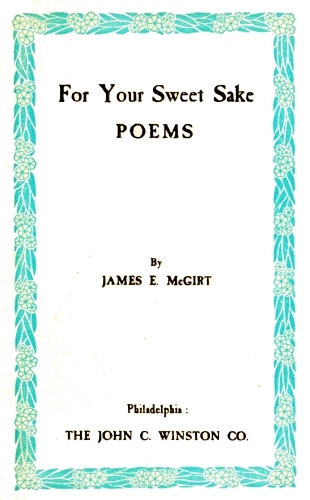

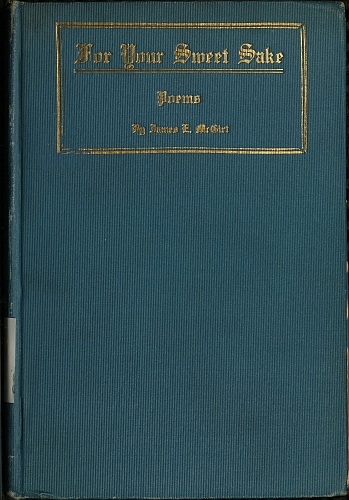
For Your Sweet Sake
POEMS
By
JAMES E. McGIRT
Philadelphia:
THE JOHN C. WINSTON CO.
Copyright 1906, by
JAMES E. McGIRT.
CONTENTS.
BORN LIKE THE PINES.
———
The harp and song in m’ breast,
Though far and near,
There’s none to hear,
I’ll sing as th’ winds request.
Is not for th’ harp or me;
I’m only to know,
From the winds that blow,
What th’ theme of m’ song shall be.
The harp and th’ song in m’ breast,
As th’ winds sweep by,
I’ll laugh or cry,
In th’ winds I cannot rest.
A MYSTERY.
———
Or what the brooklets say;
At eve I sit and listen long,
I cannot learn their lay.
But as I linger by the sea,
And that sweet song comes unto me,
It seems, my love, it sings of thee.
Amid the wheat and rye,
The lillies bloom as white as snow,
I cannot tell you why.
But all the flowers of the spring,
The bees that hum, the birds that sing,
A thought of you they seem to bring.
Moves through the heav’ns at night;
I cannot tell you why the stars,
Adorn the vault with light.
But what sublimity I see,
Upon the mount, the hill, the lea,
It brings, my love, a thought of thee.
That caused my heart to glow,
And why my spirit longs and cries,
I vow, I do not know.
But when you first came in my sight,
My slumbering soul awoke in light,
And since the day I’ve known no night.
THE SPIRIT OF THE OAK.
———
With head uplifted to the sky,
Though hail and storm beat in my face,
Through weal or woe I hold my place,
With head uplifted to the sky,
The spirit of the oak am I.
They hear the storm, desert in fear,
The strenuous eagle strives to stay,
But, ah! at last his heart gives way,
He stretches forth his feathered form,
And sails to heaven above the storm.
I stand undaunted till the end,
With head uplifted to the sky—
The spirit of the oak am I.
My feathered friends return once more,
And find me standing calm and free;
They chirp aloud and sing with glee,
With outstretched arm I bid them rest,
I hold no malice in my breast,
But welcome every passer-by—
The spirit of the oak am I.
“HOME SICK.”
———
Gazin’ at de snow,
Up here in de Norf land,
No friends dat I know.
Peaceful, happy Georgia,
Tired of de rip an’ tare,
Sick ob ways o’ city.
’Bout de joy I’s seen,
Speak ob possum huntin’—
Don’ no what yo’ mean.
Not allow’d to play,
People in de nex’ room,
Too much noise, da’ say.
Dat ’ould be no use,
Sent me one las’ summer,
Sole’ it like a goose.
Lie close to my ear,
I’ll jus’ pic’ yo’ easy,
So dem fools can’ hear.
Letter he’r fo’ me,
No, I jus’ can’ b’leve it,
Han’ me; let me see.
Ticket too hav’ com’,
Com’ on little banjo,
Com’, I’m goin’ hom’.
DES FO’ DAY.
———
’N’ de thing fo’ wh’t yer tries,
Ez yo’ reach yer han’ ter t’ke it,
Des mov’s off bufore yer eyes,
’N’ yer thro’ er side yer shovel,
Like yer ain’t goin’ wohk no mo’,
’N’ yer wonder whur’s ole Gabr’l,
What’s de re’son he don’t blo’;
Den yer wan’ ter wohk de harder,
Fo’ ise allus he’rd um say,
De darkes’ hour,
Des fo’ day.
When de stake keeps movin’ ’way,
’N’ ter hav’ er mind fo’ wohkin,
When yer think der ain’t no pay,
But puhaps when clouds er blackes’,
’N’ der worl’ seems at its wu’s,
Dat it all com’s on er pu’pus,
Maby it fo’ warnin’ us,
Den yer wan’ ter wohk de harder,
Fo’ ize allus he’rd um say,
De darkes’ hour,
Des fo’ day.
MY SOUL’S AT REST.
———
Tired and ro’sted from de sun.
Tho’ I wo’k f’om mo’nin’ early,
Seems m’ tas’ ez never don’;
Th’n its wh’n I sit er scowlin’,
Dinah smoothes m’ brow ’n’ sa’,
Ephr’m yo’s bro’t nothin’ wit’ you’,
Chil’ you’ can’t t’ke nothin’ wa’;
An’ she re’ch’s me m’ banjo,
An’ I lay it cross my bres’,
Fo’ my trouble’s all forgotten
An’ my soul’s at res’.
I ’gin frettin’ ’bout de grain,
Fo’ my little gard’n parchin’
An’ my crop ez needin’ rain;
Th’n its wh’n I sit a scowlin’,
Dinah smoothes m’ brow ’n’ say’,
Ephr’m you’s bro’t nothin’ wit’ you’,
Chile, yo’ can’t t’ke not’in wa’;
An’ she re’ch’s me m’ banjo,
An’ I lay it cross m’ breast,
Fo’ my trouble’s all forgotten,
An’ my soul’s at rest.
I will la me down an’ sleep,
Dinah, honey, don’t yo’ worry,{8}
Tell de people not to weep.
Th’n its w’en I lay a sleepin’,
Smooth my bro’ as ol’ an’ sa’,
Ephr’m, honey, I will meet yo’,
’Round de throne o’ God som’ da’;
T’ke my banjo f’om de ceilin’,
La’ it sofly ’cross my bres’,
Fo’ my troubles will be over,
An’ my soul at rest.
INSPIRATION.
———
Chil’ my feet gits blistered so’
Dat I hav’ a notion fallin’
’Pears I jus’ can’ run no mo’;
Th’n I ’gin to think o’ Lizah,
Wit’ a smil’ upon her face
Stan’in’ at de gate er waitin’,
Jus’ to see me win de race,
An’ I start out wit’ new courage,
Fo’ to win de race or die.
Well I feel jus’ like a feather,
Man, I fairly fly.
An’ I thro’ my burden down,
Somethin’ sa’s ders no use tryin’,
Seems I jus’ don’ wan’ no crown;
Th’n I ’gin to think o’ Lizah,
An’ I wondah wh’t she’d say,
Ef she’d come along an’ fin’ me,
In de gutter by de way.
An’ I gather up my burden,
An’ I start wit’ all my might,
Fo’ my limbs at once grow stronger,
An’ my load gits light.
Matters not de cos’ o’ Fate,
All I wan’ to kno’ ez Lizah,{10}
Waitin’ fo’ me at de gate;
Tho’ns and thistles lose dey terro’,
Hill an’ mountains melt er way;
Tho’ de worl’ seem dark an’ drary,
At de tho’t ’twill turn to day.
Fo’ w’en I think o’ Anner Lizah,
All de worl’ gits clear an’ bright.
An’ my limbs dey grow much stronger,
An’ my load gits light.
THE CENTURY’S PRAYER.
———
To this Thy humble servant’s prayer;
May war and strife and discord cease,
This Century, Lord God, give us peace.
The thoughts of strife, the curse of war,
Henceforth, dear Lord, may we abhor,
One blessing more, our store increase,
This is our prayer, Lord, give us peace.
As Thou dost rule the Courts above;
May man to man as brothers feel,
Lay down their arms and quit the field;
Change from our brows the angry looks,
Turn swords and spears to pruning hooks,
One blessing more our store increase,
This is our prayer, Lord, give us peace.
The milk-white flag wave o’er the world;
Let not a slave be heard to cry,
“The lion and lamb together lie;”
May nations meet in one accord,
Around one peaceful festive board.
One blessing more our store increase,
This is our prayer, Lord, give us peace.
ANNA, WON’T YOU MARRY ME?
———
Listen to the robins, dear;
The honeysuckles are in bloom,
The fragrance fills the air.
A dove is cooing soft and low,
Telling how he loves his mate;
For you the flowers seem to grow,
For you they seem to bloom and wait.
Two by two the sparrows build,
High up in the orchard tree—
Anna, Anna, Anna, won’t you marry me?
The aching of my heart;
It seems, my love, I’m bound to go,
If we have to live apart.
My heart says Anna all the time,
Love, I’ll die for thee—
Anna, Anna, Anna, won’t you marry me?
When out in the orchard, dear;
The stars can witness what you said,
The moon was sailing clear.
You promised, love, that you’d be mine,
Promised in the early spring.
And now the bees are ’round the vine,
Everywhere the song-birds sing,{13}
In every flower I see your name,
Everywhere it seems to say,
Anna, Anna, this is our wedding day.
The aching of my heart;
It seems, my love, I’m bound to go,
If we have to live apart;
My heart says Anna all the time—
Anna, Anna, Anna, won’t you marry me?
SPRING.
———
Early in de spring,
And hear de bees a hummin’
An’ hear de robbins sing;
Th’re com’ o’er me a feelin’
So queer I know not why.
I jus’ sit down an’ listen,
It seem I ’most could cry;
The win’ has lost its biting,
Aroun’ de vine de bees,
The air is full o’ fragrance,
From blossom of the trees.
I stroll out in de garden,
An’ take a look about,
I see de ground’ a crackin’,
The seed has ’gun to sprout.
Beneath de vine a blossom,
All dried and curled it lies,
A striped little melon,
Is hangin’ ’fore my eyes.
Its den I ’gin a hummin’
And join de birds and sing,
My heart is full o’ rapture,
And grandeur of the spring.
A WARRIOR’S JUDGMENT.
———
Bruised and bleeding from the fight,
Not for power, neither honor,
But in battling for the right.
Gashed and wounded was his face,
Stood he waiting for the Master
To assign his resting place.
Saw the form which He had made,
Once like His, now so distorted;
Gazed into his face and said:
That I gave you for awhile—
Given you so pure and holy,
You return it so defiled?”
“In yonder world where I have been,
Daily I’ve encountered battle
With the daring monster, Sin.{16}
He strove to keep me from the goal;
Though he scored me yet I conquered;
Master, he’s not scarred the soul.”
Thought of His own hand and side,
Beckoned to the brightest heaven
That the gate be opened wide.
The soul came flashing from his breast,
Pointing to the fairest heaven,
“Enter thou in peaceful rest!”
UNCLE IS’REL.
———
Jus’ caus’ I do som’ tricks,
An’ caus’ I got dis lucky black cat bone,
Can gather roots to make tea wit’,
Not ’les’ dey talk ’o th’t,
Dey’s scared o’ me an’ say I tote load stone.
No matter how I work,
Dey say de load stone don’ it jus’ de same.
Like wh’n I took Lucindy,
’Way from de ’fessor Jones,
Dey up an’ said I got hur wit’ some skeame.
Let one o’ th’m git sick,
Fo’ it old Is’rel got to bear de blame,
Jes caus’ I got th’s goofer,
An’ a rabbit foot or two;
Th’y say I do mos’ ever’thing th’y dream.
It gits me all up-sot,
Wh’n worrin’ over wh’t th’y say,
I wan’ ’o t’ke my goofer,
As’ ever’thing I got,
An’ let de people see me thro’ ’m ’way.{18}
An’ put ’m in a pile,
I ’gin to think about de needy day,
I think wh’t they’d do fo’ me;
An’ git mad wit’ myself,
Fo’ worrin’ over wh’t de people say.
’Bout wh’t migh’ com’ o’ me,
Can’ help the tears from comin’ in my eye,
One tim’ de world’ was ’gains’ me,
An’ frien’s had turn’ their backs,
My rabbit foot an’ goofer stood righ’ by.
An’ jus’ don’ bother me,
I’m goin’ ’o keep the things th’t bro’t me thro’;
Yo’ talk o’ mother’s teachin’,
But wh’t they don’ fo’ me,
Is much as any mother’d ever do.
Th’t run ’fore master’s door,
An’ ever mornin’ he would hav’ to cross
The load stone in my pocket,
I don’ jus’ lik’ I pleas’;
Mos’ every body tho’t I was de boss.{19}
Yo’ see him ’menc’ to smile,
To git wit’ me it always made him proud;
I made de women lo’ me,
An’ long as I was th’re,
Nobody ever hurt one o’ de crowd.
I goofer up my hands,
An’ put a rabbit down in my sho’,
No man on earth can beat me,
A winnin’ o’ de love;
Fo’ wh’n I meet de girls th’s way I do.
An’ grab’m by de han’,
Be rubbin’ load stone on ’em all de tim’;
No use in tryin’ to s’un me,
I’m goin’ to win your love,
Fo’ ef I want you, I can make yo’ min’.
IF LOVING WERE WOOING.
———
Ah! wouldn’t it be fine?
If loving were wooing,
Alice, thou would’st be mine;
Neither wealth nor honor,
Nor gem from the sea,
Can cause such a yearning
As I have for thee.
When your cheeks I see?
Those gems ’neath your lashes
Are diamonds to me;
Your forehead’s a sapphire,
Beaming ’neath a curl;
Your lips seem a rosebud,
Hiding two rows of pearl.
WINTER.
———
Leaves are getting brown,
Hickory nuts and acorns
Falling to the ground.
Persimmons getting ripe,
Opossum ’gin to fatten
And quails begin to pipe.
Hunter’s got his gun,
Erastus with old Traylor—
Opossum’d better run.
Chickens got their sway;
Let’m be, they’re fattening,
For Thanksgiving Day.
THE SIEGE OF MANILA.
———
Near the close of a summer’s day,
When the sun was flooding with gold the west,
Our fleet was ordered to stop and rest,
After the regular meal was served,
And the code of evening was observed,
Each retired to his usual place,
And gazed into the dome of space.
With awe they watched the steady blaze,
As down on us they seemed to gaze.
I never shall forget the night,
The silvery stars were shining bright,
A full-orbed moon hung in the west,
As if to see the great contest.
The wind was of a peaceful gale.
It was a pleasant night to sail.
The ocean waves were rolling ’long,
A pealing forth a mournful song,
But soon from the sea a mist arose,
That caused the starry book to close.
When sable night had reigned her last,
The rosy morn was coming fast.
Within the glimmer of the day,
We sailed to take Manila Bay.
Soon the fort revealed in sight,
From out the windows gleamed a light.
And then when we saw the deadly gun,
A glistening in the rising sun,{23}
It seemed that fire came in our blood.
Like tigers by our guns we stood,
It seemed our souls would burst with ire,
While waiting the command to fire.
In perfect silence, not a breath,
An instant could have brought us death.
The mist that from the ocean rose,
Had hid us from our Spanish foes.
And when the enemy sent no sound,
A whisper ’mong us passed around.
“Fortune’s with us,” our Captain cried,
“We’ve entered in and are not spied.”
By the fort we ’gan to start,
A distance though we sailed a port.
One by one our ships stole by,
As wolves before a shepherd’s eye.
All of our fleet had safely passed,
Except McCullough, which fortune blessed,
Within its furnace cured a rick,
And sparks went flying from its stack.
The sparks that from the ship did fly,
Met all at once the fort men’s eye.
Through glasses they began to peep,
Their glasses raised the cause to greet.
To their surprise they spied our fleet.
A cry of terror, a dash, a run,
The shells came blazing from each gun,
Before an instant hardly passed,
Around us shells were falling fast.
Their mines in vain they did explode,
But we were safe in our abode.
Our captain gave command to fire,{24}
Which seemed to be our soul’s desire.
Before the words he could repeat,
The shells went blazing from our fleet,
Our hearts were burned with hatred ire,
We filled the air with shell and fire.
While the battle was raging high,
And glowing shells were falling nigh,
Dewey back through memory gazed,
Saw the Maine, became enraged.
And with his dazzling sword in hand,
He whirled it high and gave command,
With fury blazing from his eye,
With thundering voice was heard to cry,
“Remember the Maine! Speed! Haste!
Be careful, boys, no shells to waste.”
Remembered we our blood did run,
And sent shells flying from our gun.
Our boats, like burning Vesuvius seemed,
From out our guns shells poured and streamed.
Directed by an immortal eye,
For not a strayward shell did fly.
But each of the shells from the guns that went,
Performed the mission on which ’twas sent.
Our captain took his glass in hand,
And o’er the battle quickly scanned.
“Stop the guns,” he quickly cried,
“Fortune now is on our side;
The Spanish fleet is in a blaze,
And sinking fast before my gaze.”
When this command to us was given,{25}
Three hearty cheers went up to heaven,
And when the sun sent down her sheen,
Not a Spanish boat was to be seen.
The valiant fleet of tyrant Spain,
Beneath the mighty deep was slain.
SIGNS O’ RAIN.
———
An’ yoah body’s full o’ pain,
Yo’ can res’ right shure an’ sertin’,
Dat we’s goin’ ’o hav’ som’ rain.
Tho’ I wish it I mus’ fea’,
But not ’caus’ I lov’ de hurtin’,
But I kno’ I’ll get som’ rest.
Wh’n de groun’ is white wi’h snow,
In de summer I go fishin’,
Wh’n de groun’s too wet to plow.
Lik’ da’s struck a raccoon trail,
Sho’ sine o’ fallin’ weather,
Chile, I’s neber seen it fail.
An’ see if ther’s a cloud in sight,
Goshie, wh’t a clap o’ thunder,
Clouds ’re hangin’ black as night.{27}
Pitter patter on de roof,
Fold his arms and looked at Hannah,
Now yo’ see I’s tol’ de truth.
Jake, I hear you wishin’ rain,
Yes sur, dad, de garden parchin’
Don’t yo’ think ’twill help de grain?
NO USE IN SIGNS.
———
An’ lettin’ black cats turn you back,
You jus’ go on about your business,
And let de cungers hav’ your track.
As far as luck to you’s concerned,
You han’ may itch don’t spit into it,
You won’t git nothin’ but what you earn.
Your foot may itch, you’ll go nowhere,
An’ you can let de worms crall o’er you,
An’ den no new dress get to wear.
You need not try to figure rich,
Jus’ go and get a spaid or shovel,
And go runnin’ to de ditch.
Don’t think of all de grief you’ve had.
An’ ’caus your eyes is trimblin’ little,
Dat ain’t no sign you goin’ git mad.{29}
Is kinder long—you ain’t go’in rule,
Because my hair grows on my forehead,
You need not take me for a fool.
De hawks may catch me before night,
But if da do you need not worry,
Jus’ say: “I bet they had to fight.”
LULLABY, GO TO SLEEP.
———
When I was young and gay,
A rolling ’round the floor in Tennessee;
From th’ cotton field so white,
My ma would come at night,
And fondly hold me in her arms and say:
Little birdie in your nest;
Humming bees have left the vine,
Go to sleep and take your rest.
At night, when all was still,
I’d wake to find her standing over me,
A smile upon her face,
A creepin ’round the place,
She’d tuck the cover over me, and sing:
Little birdie in your nest;
Humming bees have left the vine,
Go to sleep and take your rest.{31}
Since we assembled last,
That dear old soul has gone away to dwell.
If this whole world was mine,
The wealth I would decline,
If I could only hear my mother sing:
Little birdie in your nest;
Humming bees have left the vine,
Go to sleep and take your rest.
GOD BLESS OUR COUNTRY.
———
And those who rule, who e’er they be;
Protect the flag, and let it wave
Over all free men, not the slave.
May we, dear Lord, sustain its name;
Forbid that it shall trail in shame;
To those who from oppression flee
May this, our land, a refuge be.
Forbid that we should man oppress;
May we accept fraternal love
And live as we must live above.
TRUE LOVE.
———
Too great to compare,
Truer than the stars,
That shoot from their sphere;
Think how the sun sets
And withdraws its light;
Think how I love thee
Alone in the night.
Think of its rising,
How it varies in time;
Oh! there is no varying
In this heart of mine.
True as a rock, then—
How could I this say
When softest of waters
Can wear stone away?
Even time must change
To eternity.
Oh! there is no changing
In my love for thee.
True as eternity!
No, it’s not begun;
All must start even
When a race is to run.
When old eternity
Becomes mossy and gray,
Then, dear, I’ll love thee
The same as to-day.{34}
Fear not that pale death
Will drift us apart;
Ah! death cannot sever
The love in my heart.
When we reach heaven
We shall find our own;
I’m told we will know there
As we are known.
WEEP NOT.
———
He who tries can find a way;
Labor, and to God petition,
Strive, and you will rise some day.
Push ahead and never stop;
Though the field seems filled already,
There is room still at the top.
Start to climb it from the ground;
If great your strength it makes it sadder
To have to climb it round by round.
MEMORY OF W. W. BROWN.
———
The noble leader of our race;
With task complete his spirit fled,
To heaven, its final resting place,
And there in peace it shall remain,
Securely wrapped from care and pain;
His body ’neath sweet roses sleeps,
An angel o’er him vigil keeps.
Too soon it seems we had to part;
To see him hid beneath the clay,
Sharp sorrow fills the aching heart,
It seems I see him on the stand,
Fain I could hear him give command;
And with his outstretched, loving arm,
Imploring people to reform.
Behold the great reformer’s hand;
Ten thousand marching to and fro,
To seek, to help, to lend a hand,
Thy life has not been spent in vain,
Thy deeds are monuments of fame;
Thy name from earth will ne’er depart,
’Tis graved with kindness on the heart.
WHEN DE SUN SHINES HOT.
———
Whin de fruit hab filled de orchard, an’ de burries bend de vine;
Der’s enuf ter keep us libin’ in de little gyarden spot,
An’ der aint no use’n workin’ w’en de sun shines hot.
It was put in der er purpus dat de workin’ men mout know,
Dat dis diggin’ an er grabben, wusn’t men’t in our lot,
An’ der ain’t no use’n workin’ we’n de sun shines hot.
Does yer se de vines er wavin’, biddin’ me ter kum an’ fill?
Whar’s m’ hook and line—say, Hannah, give me all de bait yer got,
Fur der ain’t no use’n workin’ w’en de sun shines hot.{39}
Hannah she c’mmence er grinnin’ little Rastus ’gin to shout;
Soon de hoecake is er bakin’, fish er fryin’, table sot.
No, der ain’t no use’n workin’ w’en de sun shines hot.
EXPERIENCE.
———
That many a time my weary feet would bleed;
They said at last I’d find my way was barred;
I would not heed.
This path, they said, Fate thorns and thistles strew;
But I was young, Ambition led the way;
I thought I knew.
And I was bound and scourged by cruel Fate;
Alas, I cried, pray let me start again;
It was too late.
SUCCESS.
———
That shines in dazzling splendor to the eye,
The waters leap, the surging billows roar,
And he who seeks the prize must leap and try.
With anxious eyes they yearn to reach the goal.
I see them leap, and, ah! I see them sink—
As gazing on dread horror fills my soul!
’Tis better far to try the lashing deep.
I much prefer beneath the surge to lie,
Than death to find me on this bank asleep.
DEFEATED.
———
Feeble and hoary, sick of the strife,
But yet in my bosom a spirit says, “rise,”
A voice calling onward out of the skies.
I hear the voice calling, and strive to obey.
And make my last effort the battle to gain;
Ah! death is upon me, I struggle in vain.
I SHALL SUCCEED.
———
And heaps up thorns and thistles in my way.
I bear the yoke and tread them with a smile,
For I am sure it is but for awhile.
Although to-day it seems so massive strong;
Although it seems my labors are in vain,
I’ll strive and wait, it matters not how long.
So soft it strikes at first it seems but play;
But drip on drip a tiny dent will come—
We turn at length and find it washed away.
To hasty men it all may seem but play.
The hand of man though soft as drops is able,
To wear at length the hardest stone away.
THE ROSY DAWN.
———
See, love, what robes of splendor dawns the sea!
So is my soul hallowed with joy and love,
Gleaming from thee.
There I behold thy beauty from afar;
And, like the rosy dawn, it fills my soul;
I stand in awe.
And soon this world shall be in solemn night.
So will my soul if thou shouldst, like the sun,
Withdraw your light.
A SONG OF LOVE.
———
Which all can feel yet no one can define;
It comes like hallowed glory from above,
We feel the joy and call the blessing love.
We cannot see, still how we mark their way;
Just so it is when love meets you and me—
We bend and sway.
He only feels, though known by all the rest;
For when love comes the gall is changed to sweet,
It brought the valiant Hector to its feet.
She leads the world quite gently with her sway,
No need of lash—just simply smile or frown—
We will obey.{46}
Greater the pain greater he loves her still;
Through thorns and thistles ’till his feet are sore,
She bids him stop; he cries to follow more.
Before she comes to build on it her nest,
So love will nestle when she finds us true,
Deep in our breast.
So love will bruise her victim with her feet;
It shoves the baby eagle from its nest;
Before it falls her wings go ’neath its breast.
THANKSGIVING PRAYER.
———
To view the path o’er which I’ve made my way,
Although a path of thorns my eye may greet,
Although I feel the sting still in my feet;
Although the harvest fail my barn to fill,
With grateful heart I bow and thank Thee still.
How meek, how poor is more than I deserve.
Unto Thy will I bow and murmur not.
I’ll not complain and call Thee, Father, stern.
Because Thy sacred plans I’ve failed to learn;
The cause of all this grief I cannot tell,
And yet, like Job of old, I’ll not rebel.
LOVE.
———
To feel their joy far years in vain I sought;
At last love came, a cooing little dove;
The joy it brought!
I’ve felt a song I would all men could hear,
Though vainly I have sought for word and rhyme
To make it clear.
To mortal man the door is sealed, though near.
Some day the door will open, you’ll discover
Love’s song and hear.
RIGHT WILL WIN.
———
That violent wrong will ever hold the day;
A noble cause aside the kings may toast,
If it be right, Oh! no, ’tis never lost.
Know ye, the stone the builders first refused,
Was left alone, but at the top was used.
God stopped and called the leper from the cross;
He can not use the haughty and the proud;
From out the stagnant pool He makes to grow
The fragrant water lilies, white as snow.
VICTORIA THE QUEEN.
———
I bring this wreath—a token from my race;
True, thou art gone, no more on earth to meet;
I come to spread these lilies at thy feet.
Of all the wreaths brought from the floral shrine,
This wreath alone portrays the life of thine.
These many years thou wert before our sight,
So calm and kind, so pure, serenely bright,
Like glowing sunlight, seated on thy throne,
Giving us rays, withholding them from none.
One soul, one God, has been thy sacred theme;
The high, the low—their cries were heard the same.
Rest on, grand soul, in perfect peace above,
For thou wert love, and love must rest with love;
Even though we weep, though sorrow fills our breast,
We do not wish to call thee from thy rest,
A star, though quenched, thy light is shining still;
Thy voice, though hushed, thy subjects know thy will.
LIFE AND LOVE.
———
Succeed we may to ride the waves of Fate,
Yet still within our paths there surely lies,
The chasm death, the voidless ultimate.
Succeed we may the blessing to attain,
Yet rest assured the hallowed joy it brings,
E’en though sublime, somehow is tinged with pain.
A SLOTHFUL YOUTH.
———
The passers hailed and told me it was day;
“But, ah!” said I, “my days are great in number.”
And soundly slept, regardless of their say.
I fain would go, but darkness hides my way.
I’d turn to God that He would look upon me;
I’ve now forgot the prayer I used to pray.
I yearn to tell, but ah! it is too late.
That he who sleeps at day and fails the warning,
Shall wake at night, the dreadful ultimate.
A QUEST.
———
Some future day, known as the harvest time!
Am I to reap from all the grain I sow,
My ill-wrought deed am I to claim as mine?
And spread out thorns and thistles ’long the way,
Will it return and find me as its mark?
Am I to tread the thorns some future day?
Let not an evil seed by me be sown,
Or cause to sprout within a brother’s land
What I should hate to see within my own.
SIGNS OF DEATH.
———
An’ dogs a howlin’ out der mournful soun’,
I tell you now you better get you ready,
Dey’s goin’ to plant som’body in de groun’.
But some of des morn’ you’ll wake up in su’prize,
An’ if dem dogs com’ howlin’ where I’m sleepin’,
I tell you now dis darkey’s goin’ ’o rize.
Down on my knees a prayer I’ll make,
You can laugh an’ say dat darkey’s skeery,
I’m like a rabbit can’ trus’ no mistake.
But when de howl my path I’m goin’ ’o sweep
An’ I ain’t goin’ to bed no mo dat evenin’,
Fo’ death will never com’ an’ fin’ me sleep.
An’ saying der’s nothing in de signs;
But if da com’ a roun’ me with der learnin’
I’m jus’ er goin’ ’o tell ’em dey’re lyin’.{56}
Fo’ dey is jus’ a tryin’ to show off smart,
Der ain’t nobody, don’t care how dey’s learned,
Dat’s got de signs all wiped out o’ der heart.
It only smears dem over wid a stain,
An’ caus’ you’re learned, you is not an angel,
Dem same old trates er lurkin’ still within.
Yit whin a chicken coop I’m passin’ by,
Der com’ to me again dem same old feelin’s
I’m going ’o hav’ dat chicken ’cep he fly.
A SAILOR’S DEPARTURE.
———
No ring of gold to you can I impart;
Going, yet why should going grieve you?
You have my heart.
My one great thought shall ever be of thee;
Tell me, I pray thee, tell me whether
You’ll think of me?
With head bowed low I plod life’s weary way,
But with your love each day is brighter,
To toil is play.
The lamp of love for you will ever burn;
Farewell, pray let your soul be merry,
Soon I’ll return.{58}
That happy day I pray God that we meet—
My life, my all, I’ll cast with pleasure
Down at your feet.
The ship moved off, she left alone to dwell;
The signal as they sounded pealing
Their last farewell.
A TEST OF LOVE.
———
Clothed every evening in a silvery sheen;
The rippling brook and birds make music clear,
Wild flowers bloom in plenty all the year,
And mistletoe’s the largest tree that’s found,
It’s roots embedded firmly in the ground.
In vales of mistle, ’long the Aztec shore,
Stand board-roofed huts, numbering but a score;
The largest one is Haggar’s—well in years;
No happier man in all the place appears.
His daughter, Alice, simple, pure and good,
And loved by all in that fair neighborhood.
Of all the youths that came to woo her love
No voice but Ed’s could cause her heart to move.
Ed Lassiters, son of a magistrate,
Was loved by all, and no one could he hate;
In peace and love he served the village long,
And no one e’er complained he’d done them wrong;
And Ed, his son, a steady, sober youth,
Was famed throughout the village for his truth.
Alice loved Ed; when children it was seen
That Ed loved her and held her as his queen.{60}
Together they were always seen at play.
What e’er she willed it pleased Ed to obey;
“My doll, a house,” was all she had to speak,
For sticks and bark at once Ed went to seek;
To bake mud cakes more water she’ demand;
Ed quickly brought and placed it at her hand.
In all their play they were not seen to pout;
Always in love there was no falling out.
Each day to school they hand in hand would go,
Her books and slate Ed carried to and fro;
Each Sunday morn the chapel bell would chime,
And Ed with Alice marched away on time;
To church at night Alice alone he’d bring,
And from one book both in the choir would sing.
The childish love that bound them when at play
To greater love soon yielded up its sway.
Were children once, but ah, no children now;
Ed was a farmer, master of the plow;
Alice, a maid, how skilful at the loom,
And all affairs pertaining to the home;
Once close they lived, but now three miles apart;
But miles cannot divide true heart from heart.{61}
The village lads loved well the maiden dear,
But knew their love and would not interfere;
So hand in hand through life they always went,
So lovingly, so happy, so content.
But, ah, if he had known the pain to come,
He would have had her safely in his home.
To Avia came a family seeking health;
A noble family; great, too, was their wealth;
A man and wife, a son, the darling joy;
John his name, and handsome was the boy.
He saw the maid, and love came at the sight;
To win her love he sought with all his might.
Soon she loved John and soon he loved the maid,
So swift is love when gold can give it aid.
And since that day the youth came from the north
Ed’s cloak of love had keenly felt a moth.
E’er on his face there dwelt a heavy frown;
Each day he passed his head was hanging down.
And all the village wondered as he passed
What made the change, what made him so downcast.
Each Sunday morn he strolled alone to church;{62}
We sympathized—we knew it grieved him much;
As when the ivy from the oak we tear.
It seemeth lonely, ah! it seemeth bare.
So ’twas with Ed when they were seen apart,
He seemed e’er sad, so withered was his heart.
He loved her still, and each time he would call
He plead in vain that she would love him all.
Each night Ed called each night both lovers met;
They’d try in vain each other to outset.
When on her face Ed read her heart’s desire
He’d ask his hat, reluctantly retire.
Poor Ed, from youth could see her any time,
Now once a week his visits were confined.
Each youth desired the maid to be his bride;
She loved them both, and how could she decide.
Three months had passed—the choice she had not made;
With bashful face she sought her mother’s aid.
She hinted out the burden of her heart;
Her loving mother knew the other part.
“Oh, Ed and John,” she said, with trembling voice,{63}
“I love them both and cannot make a choice;
Three months in vain the choice I’ve tried to make;
It’s left with you mother, which one to take.”
The mother thought awhile and slowly said:
“I cannot choose the man for you to wed,
For much is in the saying of the bard:
’Make your own bed and keep it if it’s hard;’
So make your choice; if he’s not what he seems
On no one else can you well place the blame.
Since I’m your ma, advice ’tis mine to give:
With whom you choose through life pray try to live,
For they who wed and quit without a cause
Have broken o’er our Holy Father’s laws.
Unless you can for him lay down your life
Never, my child, consent to be his wife,
For married life is greater than a dream,
And all have found it greater than it seemed.
To know the one whose love is pure and best,
I think it right to bring him to a test.
How can you judge from the word the greater love?
Does rain tell all that it has seen above?
What steed an empty wagon cannot pull?
Ah, place him to a wagon that is full.
The many words! but, ah, the simple few,{64}
Can have a great effect if spoken true.
The sweetest words make not the greatest youth,
Ah, he is great who sayest but the truth.
The world to-day is so enrapt with sin,
That it is right with women and with men,
Before they be exalted in our sight,
We must have great assurance they are right.
So Ed and John seem good, I love them well;
The one for you to choose I cannot tell.
The way to find the one to suit you best,
Put life at stake and give them both a test,
For he who takes a maiden for his wife
Should count it joy to give for her his life.”
She knew that neither Ed nor John could swim;
To try the deep would be a test for them.
She thought how each of them enjoyed to row.
She said: “Some day, while rowing, drop your oar,
And tell him bring the oar you’ll be his bride;
First let the oar ’neath the boat be tied;
Engage them now, go quick and tie the oar.”
One came at three, the other came at four.
I feign to tell them what the mother said;
So great the plot when by a woman made.{65}
She set the time, and John and Ed complied;
The evening came and John was by her side.
With John she goes, as though she loved him best,
Out in the boat that she his love might test.
From youth she knew the art to dive and swim;
’Twas all a secret, ’t was not known to him.
They reached the deep where angry billows roar;
She for a purpose dropped her only oar.
Out from the boat the oar the waves did toss;
The maid screamed out in anguish, “We are lost!”
The oar was fairly whirling by a wave;
The frightened maid knelt praying God to save.
The coward youth sat trembling pale as death;
His face had changed, it seemed he had no breath.
The maid knelt still, pretending loud to weep.
But through her fingers at the youth she’d peep.
She saw the youth still fainting in dismay;
She would have laughed, but thought she would betray.
She raised her head, the oar again she spied;{66}
Beneath the boat the oar with cord was tied.
She really cried, for lo! her face was red,
“John, bring the oar, I’ll be your wife,” she said.
But John sat still, for he could not obey;
“I cannot swim,” was all she heard him say.
She bade him think, she bade him count the cost;
“Without the oar won’t both our lives be lost?
If you sit here is death not sure?” she said.
John knew it was, and cowardly dropped his head.
With trembling voice she cried, imploring still:
“Go, bring the oar; if you won’t, John, I will.
What will you do?” She paused to give him time.
He would not go; she leaped into the brine;
She sank and rose, and loudly came a sound:
“Pray come and help! quick! love, for soon I drown!”
John saw his love the third time disappear;
She cried in vain, for John refused to steer.
Again she rose and quickly seized the oar,
Towards the boat the oar she swiftly bore.
Soon in the boat, dripping, she took her seat,
As John sat cowardly gazing at her feet;{67}
Then to the shore she quickly made her way;
She reached the shore, to him was heard to say:
“The oar wasn’t lost; by this thread it was tied;
My life to you I’m thinking to confide.”
And this she said: “I did it just to prove
Whether or not you’re worthy of my love.”
She told him all, and said: “John can’t you see
That you are false and do not care for me.”
And John stood crying, begging not to tell;
She vowed she’d not, and said to him farewell.
He went his way and she sat on the beach—
I’ll tell you why before the end is reached—
’Twas nearly four, and Ed, her other beau,
Had promised then to meet her for a row.
The hour had come, the village clock was heard;
Ah! Ed was there; he always kept his word.
Up from the beach she rose, her friend to greet;
She had not heard the tramping of his feet.
Soon in the boat they both sat face to face;
She took the oar as though out for a race;
Then with the oar she gave the sea a sweep,
And soon the boat was sailing on the deep;
“Here comes a ship; look, Ed, I see the top.”
He turned his head, the oar she did let drop.{68}
“Dear Ed,” she cried, “pray take me to my home;
I dropped the oar and death is sure our doom.”
He gazed at her and saw her faint away.
“Don’t cry, my dear,” she softly heard him say;
He raised her head, consoling words he speaks,
Brushed back her hair and kissed her rosy cheeks;
Pretended she unconscious of a kiss;
Yet still her soul was thrilled with holy bliss.
He raised her gently in a fond embrace,
And gently wipes her tear-stained, blushing face,
The tears upon her rosy cheek repose
Appeared like sparkling dewdrops on a rose.
As men in hurrying pressed for want of time,
Can find a moment still to sip the wine,
So hurried Ed, for fear the oar he’d miss,
Yet still found time, yea, thrice, her lips to kiss;
Just as a man is moved by sparkling drinks
Performs an act before of danger thinks.
The kiss affected Ed as strongest wine;
He could not swim, yet did not fear the brine;
He did not stop for once to count the cost,{69}
Nor thought he once that either would be lost.
He said, unless his queen should reach the shore,
Out of his arm he would have made an oar;
Then from the boat he leaped, and could not swim;
An angry wave came quick and covered him.
Strangled he rose, though struggling for his life,
He cried aloud: “O, God, pray, save my wife!”
He did not drown, for she well knew the art,
And leaped and bore him speechless to her heart.
Hold of the cord the oar she quickly drew;
Yet, brought the oar she said he never knew;
He really thought he saved his lover’s life.
He woke and cried aloud: “You are my wife.”
For when he sank he was a senseless elf;
To-day he thinks he brought the oar himself.
And when she saw how artless was his love
The love within her heart was felt to move;
Where there is love much love it doth inspire,
Thus blazed her love and set his soul on fire.{70}
It seemed as love her heart would ’sunder rent,
Unless by hasty means could give it vent;
For when love’s heart is free from doubt and fear
It sayeth much that love would feign to hear.
Thus went the time until the glowing west
Was telling that the sun had gone to rest.
They reached the shore, though he was soaking wet,
Before they left, the wedding day was set.
Three weeks passed on, the blessed eve drew near,
The wedding bells were chiming loud and clear.
That night they vowed to love and serve through life;
There never lived a happier man and wife.
In Mistle still to-day there can be seen
A thatch-roofed house, twined round with ivy green;
Upon the lawn a boy and girl at play—
This is the home where Ed and Alice stay.
A BALM FOR WEARY MINDS.
———
What fragrant nectar its breezes bring;
How the babbling brook and the birds we hear,
Lull the heart from worry, the soul from fear;
What magnet power its measures hold
To keep the soul from growing old!
What joy upon the turf to lie
And watch the fleeting butterfly,
To hear the bee as it buzzes by;
The humming bees as they go and come,
Sipping honey from the bloom.
Wake, fainting heart, around thee look,
Stroll through the woods, sit by the brook,
And hear it clatter, laugh and sing,
A flood of hope to you ’twill bring.
Look, see the orchard a mass of snow,
Sending the fragrance by the winds that blow;
Drink deep of its joys, on its fragrance fill,
That thy soul may stand cold winter’s chill.
Look at the daisies, see them bend,
Giving their fragrance to each wind;
The lilies in their lovely array
Think of the words the sowers say:
Toil not, spin not, yet how they grow,{72}
So fragrant and spotless and whiter than snow.
List to the thrush up in the trees,
The song of the cuckoo, the hum of the bees;
The tame and wild flowers, drink deep their sweet scent,
Surely thy sad heart will then be content.
On springtime’s fair bosom rest thy aching head,
Who cannot feel springtime surely is dead.
TELL ME, DEEP OCEAN.
———
Why not this surging cease,
Why shouldst thou sing this mournful sound,
And why not hold thy peace?
Tell me, oh mighty deep;
What some poor sailor bade thee bring,
Just as he sank to sleep?
Pray, make it known, oh wave;
I had a lover, brave and strong,
Who met a sailor’s grave.
Were they not told to thee?
If so, I pray thee make them known,
Pray tell, were they of me?
SHOULD I SPY LOVE.
———
With outstretched arm beckoning unto me;
Though I bereft complete of spar and sail,
’Twould not prevail.
IF LOVE COULD SEE.
———
And read the truth which they impart;
Much doubt and fears it would relieve,
No love would e’er have ought to grieve.
TEMPTATION.
———
Tryin’ to do what’s right
Devil, jus’ to temp’ me,
Keeps ol’ sin in sight.
Jam up ’gin the fence;
Leave the hen-coops open
Like they got no sense.
Don mov’ off to town;
Peaches an’ the apples
Rot’nin’ on the groun.’
By the ’simmon tree,
Saw a grea’ big ’possum,
Fat as he cou’d be.
Fo’ to temp’ a man;
’Fusin’ water-melons
More th’n I can stan’.
T’night whin I com’ ’long,
They shan’t teach no oth’r
Christ’an to go ’rong.
Get the kittle hot.
Goin’ bring back a chicken
If I don’t git shot.
I find in Mr. McGirt’s verses a meaning and accent which belong only to the true poet.
(Mrs.) REBECCA HARDING DAVIS.
Mr. McGirt’s poetry is spontaneous, natural and true.
(Mrs.) MARGARET E. SANGSTER.
My Dear Mr. McGirt: Your verses indicate talent. I see no reason why you should not have a great deal of success.
Sincerely Yours,
(Mrs.) ELLA WHEELER WILCOX.
Mr. James E. McGirt:
Dear Sir:—You show in these verses a talent for putting thoughts into literary form ... very rare. I have found the sentiment of the poems always pure and orthodox—often sweet and touching; there is a simplicity about them which wins the reader’s attention....
I remain sincerely yours,
JULIAN HAWTHORNE.
You show a great deal of talent in your poems. I find them very interesting and sweet.
THOMAS NELSON PAGE.
Mr. James E. McGirt, Philadelphia,
My Dear Sir:—I have given some spare hours to the reading of your poems, which you were kind enough to furnish me in volume and manuscript. It is always gratifying to me to find one of your race aim to advance or excel in literary efforts. I was specially pleased with the merits of your poems, which should certainly command a large circle of readers, not only among your own people, but among all lovers of genuine poetic effort.
Yours truly,
(Col.) A. K. McCLURE.