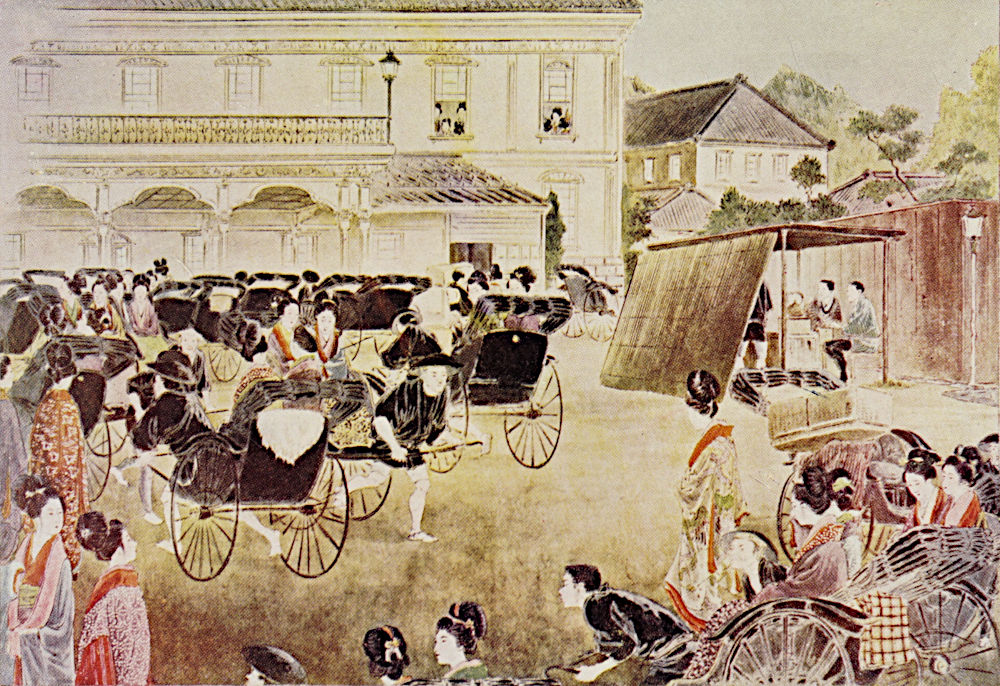
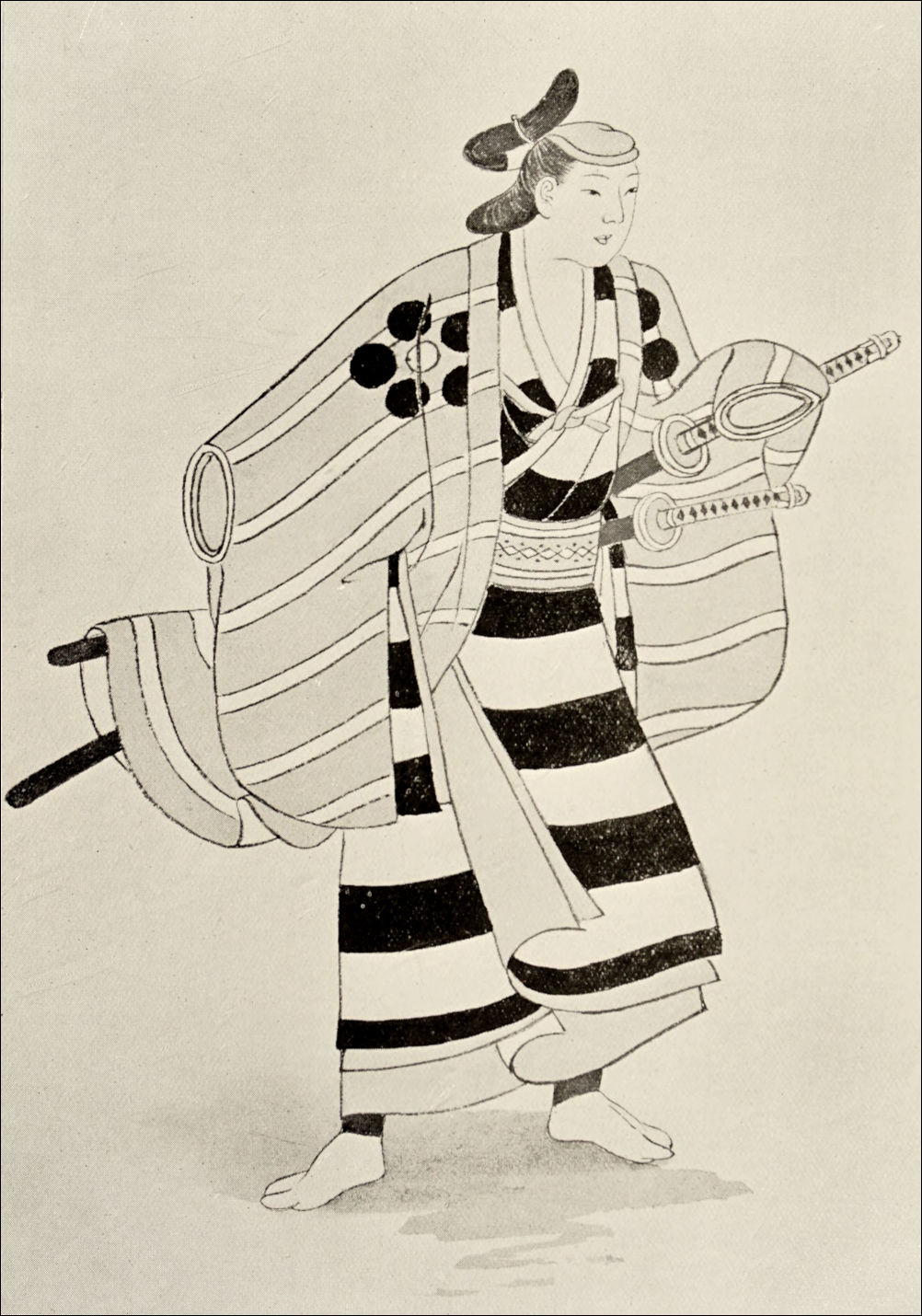
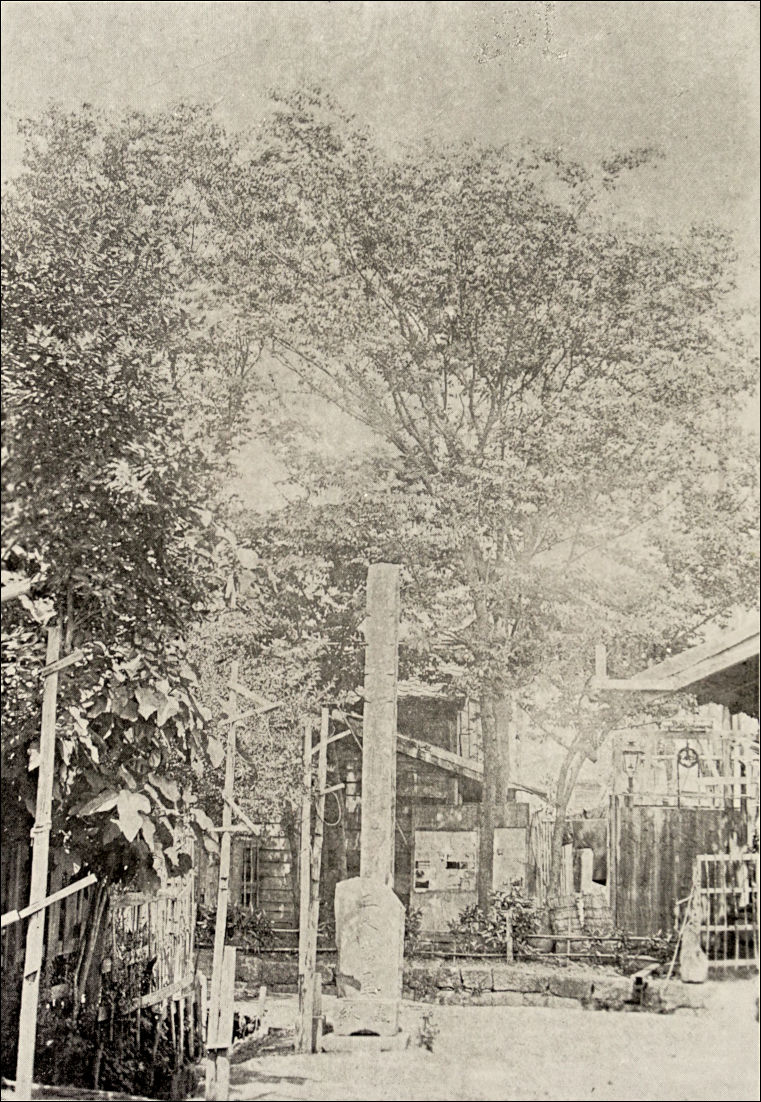
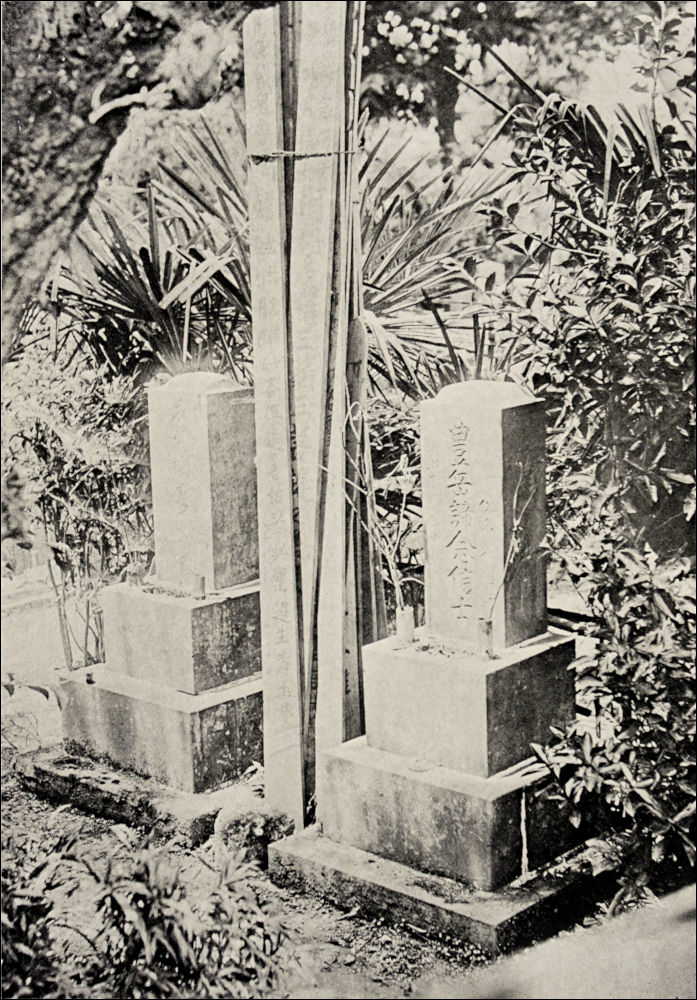
Larger versions of most illustrations may be seen by right-clicking them
and selecting an option to view them separately, or by double-tapping and/or
stretching them. See below for additional transcriber notes.
THE NIGHTLESS CITY
ä¸å¤å
OR THE âHISTORY OF THE YOSHIWARA YŪKWAKUâ
By J. E. DE BECKER
Twenty Years a Resident of Japan
âVirtuous men have said, both in poetry and classic works, that houses
of debauch, for women of pleasure and for street-walkers, are the
worm-eaten spots of cities and towns. But these are necessary evils,
and if they be forcibly abolished, men of unrighteous principles will
become like ravelled thread.â
73rd section of the âLegacy of Ieyasu,â (the first Tokugawa ShÅgun.)
With Numerous Illustrations
Third Edition Revised
Yokohama
Shanghai Bremen
MAX NÃSSLER & Co.
London
PROBSTHAIN & Co.
14 Bury Street, W.C.
Copyright,
BY THE AUTHOR.
All rights reserved.
PRINTED BY THE BOX OF CURIOS PRINTING AND PUBLISHING CO., YOKOHAMA. JAPAN.
Click on image to view larger sized
Map of the Yoshiwara in 1846.
PREFACE TO THE FIRST EDITION.
So long as the human race shall last, so long as human appetites demand
illegitimate gratification, so long as human blood shall course hot in
the veins, so long as men have passions, so long as women are frail,
so long as illicit pleasure has attraction for bewildered wallowing
humanity, and so long as lustââthe headstrong beastââstalks through
the earth, venery and dissipation will undoubtedly continue to claim
thousands of unhappy victims.
âVice, like disease, floats in the atmosphere,â and not-withstanding
the strenuous efforts which have been made in all countries and ages to
eradicate prostitution, it still exists rampant and invincible.
History demonstrates the sad truth that all human efforts have beenâand
probably will ever beâunequal to the task of stamping out the social
evil from our midst, and we are therefore forced to recognize that
the most we can hope to achieve in the direction of ameliorating its
consequences is to regulate and control its worst features.
Many and earnest have been the vain attempts of European reformers
to grapple with the evil, but their efforts have invariably ended in
disappointment. The Church has thundered and anathematised, the secular
authorities have enacted severe and even cruel laws, but the courtesan
still survives and will doubtless survive and flourish until the waters
of Time have engulfed the World.
Japan has not stood still among the nations in her endeavour to solve
the problem of prostitution, and the present system of legal control
is to all intents and purposes a development of that inaugurated
well-nigh three centuries ago.
[xii]
While admitting the existence of objectionable features in the
Yoshiwara, it is evident that a system which has stood the test of
three hundred years must possess some good points to account for its
long lease of life, and it is also manifest that in the course of three
centuries a great many curious customsâsome good, some badâmust have
crystallized around the institution.
Being no partizan or special pleader, I have simply confined myself
to what I believe to be assured facts, and hope that the contents of
the volume will be of interest and service to persons who are anxious
to impartially investigate the customs of one of the most remarkable
institutions in this country. I have compiled this book with the
object of providing foreign students of sociology, medical men, and
philanthropists, with some reliable data regarding the practical
working of the system in the leading prostitute quarter of the Japanese
Metropolis, and I leave my readers to form their own opinions as to
the pros and cons of the success or otherwise achieved by the plan of
strict segregation adopted in this country.
To Japanese who may think that the Yoshiwara is a disgrace to Japan I
would remark that this Empire has by no means a monopoly of vice;
and to foreigners who declaim against the âimmorality of Japaneseâ I
would say franklyââRead the âHistory of Prostitutionâ by Dr. W. W.
Sanger of New York, also the âMaiden Tribute of Modern Babylonâ which
appeared in the Pall Mall Gazette fourteen years ago. You cannot afford
to criticize this country too closely, for you certainly dare not lay
the flattering unction to your souls that you, as a race, have any
monopoly of virtue.â
The Author.
TÅkyÅ, 1899.
PREFACE TO THE THIRD EDITION.
Subsequent to the anonymous publication of the first edition of âThe
Nightless Cityâ in 1899, the author was severely remonstrated with by
certain unctuous persons for writing a work which lays bare a phase of
Japanese social phenomena before which all writers (with the notable
exception of Mr. Henry Norman) have studiously drawn a veil. To this
class of persons he neither owes, nor offers an apology; but, in order
to obviate any misunderstanding of his motives, it may be well to
explain the raison dâêtre of the book.
The voluminous data on which is based the science of Medical
Jurisprudence, the records of all Courts, and the experience and common
knowledge of mankind, prove the universal existence of the âsocial
evilâ to be, a present and undeniable fact.
History shows that from the earliest ages society was never free from
the devastating influences of a vice which arises from an apparently
inextinguishable natural impulse inherent alike in human beings and in
the lower creation. Wrap ourselves up as we may in a mantle of prudery,
refuse as we may to recognize the evil, it is still there, and like the
poor, it will probably âbe with us always.â
We can no more hope, to eradicate or suppress it than to control an
earthquake or harness the winds and waves! Its existence being thus
palpable, is it not far wiser to frankly recognize and investigate
the phenomenon with a view to control, by judicious regulations, the
current of the vice and direct it into channels where it may be,
at least to a certain extent, grappled with and arrested, than to
foolishly close our eyes and[xiv] refuse to discuss the subject on the
cowardly plea that we may possibly disturb the âconventionalitiesâ by
publicly and fully investigating the evils of prostitution?
The author utterly denies the proposition that there can be any
impropriety in enquiring into the facts of a matter which virtually
affects, either directly or indirectly, the whole community; on
the other hand he affirms that much good may be done by collecting
facts and statistics which may prove of value to the legislator, the
philanthropist, and the clergy. Without adequate data, how can we ever
hope to devise measures of a preventative or ameliorative nature, and
how can such data be obtained if we are all to be deterred from
necessary investigations by the mawkish sensibility of Mrs. Grundy?
Legislators of all nations, at different times, have apparently
endeavoured to crush out or control prostitution, and by various
high-handed methods sought to single out and distinguish, for the
alleged protection of the public, women known to be guilty of leading
a professedly abandoned life. Moses, the great Jewish law-giver,
hurled cruel and oppressive edicts against improper unions among the
children of Israel. Greece made the Disteriads wear a distinguishing
costume, and, branding these women with infamy, made regulations by
which they were subjected to the control of the municipal police, and
were forbidden to offend the public by open indecency. Rome required
the registration of its prostitutes, who, under the directions of
the Ãdile were forced to wear special garments and to dye their
hair a certain colour. Mediæval Europe tried (among other gentle (!)
measures) sumptuary laws, banishment, scourging, branding, the stake,
the gibbet, the block, outlawry; while the spiritual powers launched
against prostitution all the terrors of religious anathema, threatening
physical torment and strict excommunication in this world, and in the
world to come everlasting damnation!
[xv]
Modern Europe, while outwardly wearing a spotless garment of
professed self-righteousness, and turning up its goggling eyeballs in
sanctimonious horror at the bare suggestion of anything being amiss
with its morality, knows well enough that its various Governments
are secretly struggling with the problem through their police, and
that the latter have found no satisfactory solution of the matter
notwithstanding many serious essays.
Thousands of miles away from Europe, and practically cut off from all
intercourse with the rest of the world at large, the Japanese, found
themselves confronted with the same problem and, after various attempts
at control, they endeavoured to solve the question in a manner far
more practical than that of the Europeans. They were astute enough to
see that human passions could not be changed by human legislation,
and instead of attempting impossibilities they started in to limit
and control what they knew they had not the power to prevent; so,
with the object of rendering the evil as inoffensive as possible, the
authorities decided upon setting aside certain areas within which
prostitutes were allowed to pursue their calling subject to various
stringent laws. These quarters were fenced in and moated, their great
gateways carefully guarded, and so successful did the system prove in
many respects that it has been maintained (with certain modifications)
up to the present day.
Human nature is fixed and immutable, is, always was, and ever will
be the same; and while race environment and education may affect its
outward form, the animal man is essentially the same throughout the
entire globe. This being so, it is evident that the experience of one
nation or country may often be of considerable value to other peoples
if accepted and applied mutatis mutandis to the circumstances and
needs of the latter; thus it is always well to investigate the results
of institutions foreign to our own in a candid and[xvi] receptive frame
of mind before concluding that we possess a monopoly of wisdom in our
own home lands. Moreover, human nature is so constituted that when a
separate community is established in such a manner as to be practically
unaffected by pressure from the outside, its units are sure to
co-operate, however unconsciously, in moulding new customs and habits
and even superstitions, which gradually crystallize into time-honoured
precedents by immemorial usage. The Yoshiwara, during its three
centuries of existence, proved no exception to the rule, and in the
course of years its inhabitants became slaves to numberless precedents,
with the result that some extraordinary customs were developed and
even yet linger on in a modified form. A serious consideration of
these facts induced the author to believe that it would be of value
to students of sociology throughout Europe and America to be provided
with all available data, as to the ins and outs and the working of
this unique and purely native Japanese system of controlâa system of
which the Westerners have had no experience whatsoever. The result of
his labours was âThe Nightless Cityâ this new edition of which he now
publishes together with an appendix which brings the work up to date so
far as is possible.
The authorâs best thanks are due to Prof. Dr. TÅichirÅ Nakahama,
Director of the âKai-Sei-ByÅ-inâ and Member of the Central Board of
Health, who kindly furnished certain medical statistics and data.
He also desires to express a deep debt of gratitude to Mr. E. Beart
for lightening his task by assisting in seeing the book through the
press, and has pleasure in acknowledging the strenuous endeavours of
the Box of Curios Printing & Publishing Company in producing in Japan,
notwithstanding certain drawbacks and disadvantages, a handsome volume
worthy of the great printing houses of London or New York.
The Author.
Kamakura, December, 1905.
Present Plan of the Yoshiwara.
Procession of Courtesans.
It was not until after the City of Yedo had become the seat of the
Tokugawa government that regular houses of ill-fame were established,
and up to the period of KeichÅ (1596â1614) there were no fixed
places set apart for brothels and assignation houses. Under these
circumstances, the brothels of Yedo were to be found scattered all over
the city in groups of twos or threes, but among the many localities in
which such stews were situated were three spots where the houses were
to be found in larger numbers plying their shameful trade side by side.
(1.)âIn KÅjimachi, hat-chÅ-me, there were fourteen or fifteen houses:
these had been removed from Roku-jÅ in KyÅto.
(2.)âIn Kamakura-gashi (Kanda district) the numbers of houses was the
same as in KÅjimachi: these had been removed from Miroku-machi of FuchÅ«
(now Shidzuoka?) in Suruga province.
(3.)âIn Uchi-Yanagi-machi, near Åhashi (Åhashi is now the Tokiwa-bashi
gate, and Yanagi-machi is now DÅsangashi-dÅri) there were twenty
houses. This group was inhabited by Yedo women exclusively. It is
stated by some writers that the name of this street âYanagi-machiâ
(Willow Street) was derived from the fact that at the entrance of the
street stood two gigantic weeping-willows.[2] Prior to this date, in
the period of TenshÅ (1573â1591), a person named Hara SaburÅzaemon
had established a brothel quarter at Made-no-Koji, Yanagi-no-baba, in
KyÅto, but although it is true that the name of Yanagi-machi was given
to this place, the Yanagi-machi of Yedo did not derive its title from
the one in the Western city.
In the 10th year of KeichÅ (1605) Yanagi-machi was selected by the
Government in connection with the construction of the castle of Yedo,
and consequently all the brothels were removed to a place in front of
the Moto-Seigwanji (temple).
As Yedo prospered and her population increased, various enterprising
individuals gradually arrived from Shumoku-machi in Fushimi,
Kitsuji-machi in Nara, and other places near KyÅto, and established
themselves in the brothel-keeping business.
But as Yedo still grew more and more prosperous and thriving, and her
marts busier, various municipal improvements were projected, numerous
new roads were opened, and bridges constructed, and, as gradually the
work of organizing the urban districts progressed, many houses had to
be pulled down; consequently large numbers of persons were forced to
remove their residences. Under these circumstances, the brothel-keepers
considered the moment to be an opportune one for the presentation to
the powers that were of a petition requesting the Government to allow
of the collection, into one special locality, of the Yedo demi-monde.
They therefore petitioned the authorities to establish a regular
Keisei-machi,2[3] but their petition was unsuccessful and matters
remained in statu quo.
In the 17th year of KeichÅ (1612) a certain ShÅji Jinyemon (a native
of Odawara in Sagami province) conceived the idea of collecting all
the brothels and assignation houses of Yedo into one special quarter
of the city, and after many consultations with his confrères (for
this gentle âreformerâ was in the âprofessionâ himself) he made a
representation to the Government to the effect that:â
âIn KyÅto and in Suruga, and also in all other thickly populated
and busy places (to the number of more than twenty) there have been
established, in accordance with ancient custom and precedent, regular
licensed Keisei-machi, whereas in Yedo, which is growing busier
and more populous day by day, there is no fixed YÅ«jo-machi.3 In
consequence of this state of affairs houses of ill-fame abound in
every part of the city, being scattered hither and thither in all
directions. This, for numerous reasons, is detrimental to public
morality and welfare, etc., etc.â
The petitioner further enumerated the advantages which would be gained
by the system he advocated, and he submitted a memorandum of reasons
and arguments divided into three headings, the substance of the same
being:â
â(1.) As matters stand at present, when a person visits a brothel
he may hire, and disport himself with, YÅ«jo (filles de joie) to
his heartâs content, give himself up to pleasure and licentiousness
to the extent of being unable to discriminate as to his position and
means and the neglect of his occupation or business. He may frequent
a brothel for days on end, giving himself up to lust and revel, but
so long as his money holds out the keeper of the house will continue
to entertain him as a guest. As a natural consequence, this leads to
the neglect of duty towards masters, defalcations, theft, etc., and
even then the keepers of the brothels will allow the guilty guests to
remain in their houses as long as their money lasts. If[4] brothels
were all collected into one place a check would be put to these
evils, as, by means of investigation and enquiry, a longer stay than
twenty-four hours could be prohibited and such prohibition enforced.
â(2.) Although it is forbidden by law to kidnap children, yet, even
in this city, the practice of kidnapping female children and enticing
girls away from their homes under false pretences is being resorted
to by certain vicious and unprincipled rascals. It is a positive
fact that some evil-minded persons make it a regular profession to
take in the daughters of poor people under the pretext of adopting
them as their own children, but when the girls grow-up they are sent
out to service as concubiness or prostitutes, and in this manner the
individuals who have adopted them reap a golden harvest. Perhaps
it is this class of abandoned rascals that even dare to kidnap
other peopleâs children? It is said to be a fact that there are
brothel-keepers who engage women knowing perfectly well that they
are the adopted children of the parties who wish to sell the girls
into prostitution. If the prostitute houses be all collected into one
place, strict enquiries will be made as to the matter of kidnapping
and as to the engagement of adopted children, and should any cases
occur in which such reprehensible acts are attempted, information will
be immediately given to the authorities.
â(3.) Although the condition of the country is peaceful, yet it is not
long since the subjugation of Mino4 province was accomplished, and
consequently it may be that there are many rÅnin5 prowling about
seeking for an opportunity to work mischief. These ruffians have, of
course, no fixed place of abode and simply drift hither and thither,
so it is impossible to ascertain their whereabouts in the absence
of properly instituted enquiries even although they may be staying
in houses of ill-fame for a considerable number of days. If the
authorities grant this petition, and permit the concentration of the
existing brothels in one regular place, the brothel-keepers will pay
special attention to this matter and will cause searching enquiries
to be made about persons who may be found loafing in the prostitute
quarters: should they discover any suspicious characters they will not
fail to report the same to the authorities forthwith.
[5]
âIt will be deemed a great favour if the august authorities will grant
this petition in the fulness of their magnanimous mercy.â
In the following spring (1613) ShÅji Jinyemon was summoned to the
Magistrateâs Court and examined on various points by Honda Lord of
Sado, after which he was informed that the result of the petition would
be made known at a later date. He was then dismissed.
In the spring of the 3rd year of Genna (1617) Jinyemon was again
summoned to the Court and, in the presence of several other judicial
officials, Honda Lord of Sado notified him that the petition was
granted. He was also informed that two square chÅ of land would be
devoted to the purpose of founding a prostitute quarter, and that the
site had been selected at Fukiya-machi. In return for this privilege,
Jinyemon promised that no prostitutes should be allowed in the city
of Yedo and neighbourhood except in the licensed quarter, and further
covenanted that in case of any of the women being found elsewhere the
matter should be communicated to the authorities, as in duty bound,
either by himself or by the other brothel-keepers. At the same time,
ShÅji Jinyemon was appointed Keisei-machi Nanushi (director of
the prostitute quarter) and was instructed by the BugyÅ (Governor
possessed of administrative, military, and judicial functions) to
observe the following regulations:â
â(1.) The profession of brothel-keeping shall not be carried on in
any place other than the regular prostitute quarter, and in future
no request for the attendance of a courtesan at a place outside the
limits of the enclosure shall be complied with.
â(2.) No guest shall remain in a brothel for more than twenty-four
hours.
[6]
â(3.) Prostitutes are forbidden to wear clothes with gold and silver
embroidery on them; they are to wear ordinary dyed stuffs.
â(4.) Brothels are not to be built of imposing appearance, and the
inhabitants of prostitute quarters shall discharge the same duties (as
firemen, etc.,) as ordinary residents in other parts of Yedo city.
â(5.) Proper enquiries shall be instituted into the person of any
visitor to a brothel, no matter whether he be gentleman or commoner,
and in case any suspicious individual appears information shall be
given to the BugyÅ-sho (office of the city Governor).
âThe above instructions are to be strictly observed.
â(Date ___________) The BugyÅ.â
On the low land of Fukiya-chÅ, which was thus granted by the
authorities, now stand Idzumi-chÅ, Takasago-cho, Sumiyoshi-chÅ, and
Naniwa-chÅ, and the ko-hori (or small ditch) at Hettsui-gashi which
was once the outer moat of the prostitute quarters. The present
Å-mon-dÅri (Great Gate Street) was formerly the street leading to the
Å-mon (Great Gate). At the time about which I am writing the place was
one vast swamp overrun with weeds and rushes, so ShÅji Jinyemon set
about clearing the Fukiya-machi, reclaiming and filling in the ground,
and building an enclosure thereon. Owing to the number of rushes which
had grown thereabout the place was re-named Yoshiwara (èå = Rush-moor)
but this was afterwards changed to Yoshi-wara (åå = Moor of Good luck)
in order to give the locality an auspicious name.
The work of filling in and levelling the ground, and the construction
of houses, was commenced in the 3rd year of Genna (1617) and by
November of the following year âbusinessâ commenced. The work of laying
out the streets and completing the quarters was not however finished
until the 9th[7] day of the 10th month of the 3rd year of Kwan-ei (28th
November 1626).
The following were the names of the wards of the Yoshiwara:â
Yedo-chÅ, It-chÅ-me: This was the pioneer prostitute quarter
established in the city after the Tokugawa government had made Yedo
the seat of their administration; and in the hope and expectation of
sharing in the prosperity of the city itself the felicitous name of
Yedo-chÅ (Yedo ward) was chosen as appropriate for the new ward. All
the houses at Yanagi-chÅ removed to this Yedo-chÅ, and among them was
the âNishida-yaâ (House of the Western Ricefield) which was kept by
ShÅji Jinyemon himself.
Yedo-chÅ, Ni-chÅ-me: To this ward (Second ward of Yedo-chÅ) were
transferred all the houses formerly kept at Moto-Kamakura-gashi.
KyÅmachi, It-chÅ-me: To this ward were transferred the houses at
KÅjimachi. The majority of these establishments having had their origin
in Roku-jÅ, KyÅto, the ward was named KyÅ-machi, thus using the first
character 京 (KyÅ) of KyÅto and preserving the old association with the
capital.
KyÅmachi, Ni-chÅ-me: The brothelkeepers of Hisagomachi in Åsaka,
Kitsuji in Nara, and other localities, having heard of the opening of
the Yoshiwara, many of them immigrated to this place. The buildings
in this ward were completed two years later than those in the other
streets, and accordingly this ward was commonly called Shim-machi (æ°çº
New Street).
Sumi-chÅ: The brothels at Sumi-chÅ, KyÅbashi, having been removed to
this ward, the name of the original place was copied when âchristeningâ
the new street.
[8]
After many vicissitudes, the brothel-keepers believed that they had
now found an abiding place, and that no further changes would be made,
but they were doomed to disappointment. On the 19th day of the 10th
month of the 2nd year of Meireki (4th December 1656) Ishigaya ShÅgen,
the BugyÅ, summoned the elders (toshi-yoridomo) of the Yoshiwara and
informed them that the existing site of the prostitute quarter being
required by the authorities for building purposes, the houses must
be removed elsewhere. Ishigaya added that, in lieu of the Yoshiwara,
the authorities were prepared to grant either a plot of land in the
vicinity of the Nihon-dsutsumi (Dike of Japan) behind the Asakusa
temple, or one in the neighbourhood of HonjÅ.
The representatives of the Yoshiwara people were filled with
consternation at the action of the government, and they submitted a
petition of grievances to the effect that the brothels had been in
existence for 44 years and that the keepers would be put to great
inconvenience and caused serious loss if they were suddenly forced
to remove to a remote district. After reciting the above facts, and
pointing out the injury which would be done to âvested interests,â the
petition wound up with a prayer that the authorities would be pleased
to permit the brothels to continue to ply their profession in the same
place as hitherto. This petition, however, was rejected, and after
mature deliberation the elders now applied for a grant of land at the
Nihon-dsutsumi: they also petitioned that a sum of money might be given
them from the public funds to assist their removal.
In response to the last petition, the authorities provided a suitable
site near Nilion-dsutsumi, and in consideration of the[9] removal of
the houses to such a distant and out-of-the-way locality, Ishigaya
ShÅgen, and Kamio, Lord of Bizen, agreed to the following conditions in
connection with the new Yoshiwara:â
â(1.) Hitherto the ground to be occupied has been limited to 2 square
chÅ: in the new place these limits will be increased by 50 per
cent., and extended to 3 chÅ by 2 chÅ (3x2).
â(2.) Whereas hitherto the profession has been allowed to be carried
on in the day-time only, in consideration of the quarter being moved
to such a distant place, it is in future permitted both day and night
alike.
â(3.) More than 200 Furo-ya (風åå± = Bath-houses)6 now existing in
the city shall be abolished.
â(4.) In consideration of the Yoshiwara being removed to a distant
place, its people shall hereafter be exempted from the duties of
acting as guards against fire on the occasion of the festivals at
SannÅ and at Kanda, or as firemen in time of conflagrations, etc.
â(5.) The sum of 10,500 ryÅ will be granted to assist the expenses
of removal, at the rate of 14 ryÅ per small room.â7
It is very curious to note that Japan was not the only country where
shady âbath-housesâ were to be found. In a German book by Wilhelm
Rudeck, entitled âGeschichte der Oeffentlichen Sittlichkeit In
Deutschland,â it is stated that âbath-honsesâ were plentiful. Early
in the morning a horn announced that everything was ready, and men,
women and[10] maids undressed at home and went nearly naked to the
bath-houses, where the attendants were mostly girls who had a very
liberal idea of their duties. The tubs in many cases were large enough
for two, and a board was laid across, upon which food and drink was
served to the bathers, who were not compelled to produce a marriage
certificate. In the castles of the knights, the ladies often attended
on the male guests in the bath and vice versa, and in bathing
resorts, such at Wiesbaden, for instance, Frau Venus seems to have
reigned supreme. A very free illustration, reproduced from an old
volume, shows a row of tubs with a long board laid across them, upon
which food and drink is served, and there are other illustrations,
reproduced from old cuts, of some more than merely suggestive scenes,
which we must presume were nothing out of the common in bath-houses.
On the 27th day of the 11th month of the same year (January 11th, 1657)
the elders and monthly managers (æè¡å¸ = tsuki-gyÅ-ji) of the Yoshiwara
repaired to the Treasury office at Asakusa and received the sum granted
by the authorities to defray the expenses of removal: at the same time
they applied to the officials to be allowed to remain in the Yoshiwara
during the next three or four months, promising to complete the removal
by the following April.
The request being a reasonable one, it was granted, and the removal was
postponed until the fourth month, but on the 2nd March 1657 (Meireki
3 nen, ShÅgwatsu, 18 nichi) Hi-no-to-tori (cycle of the Water Fowl)
that disastrous fire known as the âFurisode kwajiâ (fire of the
long-sleeved garment) broke out in the Hom-myÅji (temple) at Maru-yama
in HongÅ and raged through the city of Yedo during three days and
three[11] nights burning everything before it.8 The fire swept away
a large portion of the city and gutted the Yoshiwara completely, so
there was no further excuse left for not moving forthwith. The head-man
of the Yoshiwara was again summoned to the BugyÅâs office and ordered
to take advantage of the fire to carry out the removal without further
delay.
In May 1657 Ishigaya ShÅgen, Kamio Lord of Bizen, and Sone Genzaemon
proceeded to Nihon-dsutsumi to inspect the site of the new quarter,
and while the houses were being built and prepared temporary shanties
called âKoya-gakeâ (å°å±æ = a temporarily built shed or house) were
erected in the neighbourhood of Sanya and Imado, and in these (and also
in private houses which were hired for the purpose) the loathsome
trade was carried on as usual.
In September 1657, the new brothels were completed and the âprofessionâ
crowded into the âShin-Yoshiwara.â
The âShin-Yoshiwaraâ (new Yoshiwara) was so named in contra-distinction
to âMoto-Yoshiwaraâ (former Yoshiwara). It is situated at a place
formerly known as Senzoku-mura and is only a few chÅ distant from the
Asakusa-ji (temple).
There is a hill (or rather slope) leading down from the Nihon-dsutsumi
on the way to the Shin-Yoshiwara which is called âEmon-zakaâ or
âDress(ing) Hill,â because it is supposed that visitors to the gay
quarter began to adjust their garments and smarten themselves up in
passing along this road. Another account states that the name was taken
from the Emon-zaka of KyÅto.
[12]
The road leading from Emon-zaka to the Yoshiwara is known as
Gojikken-machi. Tradition says that there was a servant named Koheiji
in the employ of ShÅji Jinyemon (the founder of the quarter) and that
he advised his master to construct the road in three curved lines as
this was considered more tasteful than one constructed in a plain line.
Another tradition says that the road was constructed in that way in
accordance with the commands of Kamio Lord of Bizen, but, at any rate,
it is certain that the plan of the road was conceived by some person
gifted with a (from a Japanese point of view) poetical imagination. On
either side of the curved section of roadway twenty-five tea-houses
(cha-ya) were built, making a total of fifty houses (go-jik-ken),
hence the popular name âGo-jik-ken-michiâ (fifty house street) or
âGo-jik-ken-machiâ (fifty house town). At the end of the road stood a
gateway which formed the entrance of the Yoshiwara, and the vicinity of
this gateway was known as the Åmon-guchi (entrance to the great gate).
The gate itself was called the Å-mon (great gateway). Having passed
through the Å-mon, the visitor would find himself within the precincts
of the âShin-Yoshiwara.â
The Shin-Yoshiwara was about half as large again as the old place
(Moto-Yoshiwara), measuring about 3 chÅ (1074 feet) from North
to South, and 2 chÅ (716 feet) from East to West, and therefore
embracing nearly 18 acres of land. The enclosure was surrounded by
a kind of moat, and the streets within were laid out something in
the shape of the Chinese character ç° (ta = a ricefield). As will
be seen from the plan of the Shin-Yoshiwara annexed, Nakano-chÅ
goes through the centre while Yedo-chÅ (It-chÅ-me and Ni-chÅ-me),
Sumi-chÅ, and KyÅ-machi (It-chÅ-me and Ni-chÅ-me) branch out to right
and[13] left on either side. As was the case with the Moto-Yoshiwara,
another street was added for the convenience of âAge-ya,â and called
âAgeya-machi.â9 This street was situated opposite Sumi-chÅ, to the
right of the Naka-no-chÅ when facing SuidÅ-jiri.
In the 8th year of Kwambun (1668) a raid was made on the âjigokuâ
(unlicensed prostitutes) and the captives were transported to the
Yoshiwara, but as they numbered 512 souls it was difficult to find
accommodation for them and apparently there was not enough room in the
quarter to erect new brothels. Under these circumstances, a little
plot of ground was requisitioned at the back of each brothel in
Yedo-chÅ Ni-chÅme, and some seventy-five small houses were built there
for the reception of the new immigrants to this earthly paradise. As
the majority of the these fresh arrivals were natives of Fushimi and
Sakai, the streets where their houses stood were called Fushimi-chÅ and
Sakai-machi. Sakai-machi was destroyed by fire during the era of Meiwa
(1764â1771) and has ceased to exist, but Fushimi-chÅ is to be seen to
this day.
At first the five streets of the Shin-Yoshiwara consisted wholly of
brothels, Ageya-machi of âage-yaâ and Naka-no-chÅ of tradesmenâs
stores, but as time rolled away the âage-yaâ ceased to exist and in
their place sprang up âcha-yaâ (tea-houses). Gradually, also, the
shopkeepers in Naka-no-chÅ removed elsewhere and their stores were
turned into tea-houses. Subsequently tea-houses began to increase in
number at Ageya-machi, and nowadays there are even many brothels to be
seen in this street.
[14]
The following extract from the âTsuikÅ Yoshiwara Taizenâ (追èååå¤§å ¨ an old
descriptive book on these matters) may be of interest to my readers:â
âThe corner between Maka-no-chÅ and Yedo-chÅ It-chÅ-me and
Ni-chÅ-me is called âMachi-ai no tsuji, or âWaiting laneâ because
the women used to sit down here before their houses waiting for
guests. * * * * * The corner of Yedo-chÅ Ni-chÅ-me was called the
Ao-mono Ichiba (Vegetable Market) and that of Sumi-chÅ the âSakana
Ichibaâ (Fish Market) because during the day-time green-grocers
and fishmongers were in the habit of assembling in those places.
In the summer evenings dealers in fire-flies (hotaru-uri) would
also be found hanging around these streets. As to the origin of the
Suido-jiri (âEnd of the Aqueductâ) it is said that formerly there
were no wells in the Yoshiwara and that all the water used there had
to be carried from the wells at Jariba and Tambo, but in the eras
of Genroku (1688â1703) and HÅyei (1704â1710) the famous Yedo
merchant princeâKinokuni-ya Bunzayemonâcaused a well to be sunk in
the compound of Owari-ya SeijūrŠin Ageya-machi for the first
time, with the result that a plentiful supply of water was provided.
* * * * * As the pipes in which this water was conducted to the various
portions of the Yoshiwara terminated at the end of Naka-no-chÅ,
the name âSuidÅ-jiriâ (see above) was given to that spot.â The
âJisekigÅkÅâ äºè¹åè (another book) says:ââThe name of SuidÅ-jiri did
not originate in the Moto-Yoshiwara, but in the Shin-Yoshiwara. In
the plans of the old Yoshiwara, however, it would seem that a place
with a similar name did actually exist, and so it is mentioned here
for the sake of reference. The street, along the creek at KyÅ-machi
It-chÅ-me is called JÅnen-gashi which name is said to have been
derived from the name of a son of the Headman, ShÅji Jinyemon, who
formerly had his residence there.â
âThe âKiyÅ« ShÅranâ å¬éç¬è¦½ (another book) says:âDuring the era of
Kwanbun (1661â1672) the âsan-chaâ (a class of low and cheap
prostitutes about whom an explanation is given elsewhere) came into
existence, and at the same period, on the application of Genyemon,
headman of KyÅ-machi, new houses were built at Sakai-machi,
Fushimi-chÅ, and Minami-chÅ. The first street was so named because
it was situated on the border (sakai) of Sumi-chÅ Ni-chÅ-me,
the second on account of the forefathers of the elders of the
street10 (Yamada-ya YamazaburÅ,[15]Yamaguchi-ya Shichiroemon,
Adzuma-ya Jihei, and Okada-ya Kichizaemon) having come over to the
Yoshiwara from Kotobuki-chÅ, Bungo-bashi, etc., in Fushimi,
at the time of the founding of the Yoshiwara. The street along
the creek at KyÅ-machi It-chÅ-me is called the Nishi-gashi in
remembrance of a younger brother of ShÅji Jinyemon, (founder of the
Yoshiwara) named Tachibana-ya Sainen, having lived there.11
The street along the creek at KyÅ-machi Ni-chÅ-me, known as
RashÅmon-gashiâor more commonly as âWaru-gashiâ (the wicked
creek-side)âwas so-called owing to the fact that there was a small
brothel thereânamed âIbaraki-yaââthe inmates of which used to
accost passers-by and clutch tenaciously at their sleeves, somewhat
after the fashion of the warrior Watanabe no Tsuna who seized
the arm of an ogre and cut it off in the course of his well-known
adventures at the RashÅ-mon, near KyÅto.12 The Tenjin-gashi.
was situated at SuidÅ-jiri, and here there were some 25 low brothels
established. This creek-side was called âTenjin-gashiâ after
Sugawara-no-Michizane, a great scholar who had been deified and
whose festival fell on the 25th of each month.â13
This well-known willow-tree stands at the entrance of Go-jik-ken-machi,
on the left, below the Nihon-dsutsumi. It has been so called because
many a visitor to the Yoshiwara has looked regretfully back as he
passed the willow tree, feeling reluctant to leave the pleasures of the
quarter and to be separated from his fair, even though frail, inamorata.
ç客ä¹ã´è A Familiar Guest. Period of KiÅwa (1801 to 1803). (After the Picture by Kitagawa Utamaro.)
[17]
Yoshiwara Jinja. (Yoshiwara Shrine.)
This is situated on the right hand side of the Go-jik-ken-michi.
Formerly there was on this site a shrine called Yoshitoku Inari, but
of late years the Enomoto Inari (at the corner of Yedo-chÅ Ni-chÅ-me)
the Kai-un Inari (at the corner of KyÅ-machi, It-chÅ-me) the Kurosuke
Inari (at the corner of KyÅ-machi Ni-chÅ-me) and the Akashi Inari (at
the corner of Yedo-chÅ Ni-chÅ-meâFushimi-chÅ) were all amalgamated
into one. The name of âYoshiwara Jinjaâ was given to the new shrine
and it has been made the guardian shrine of the âenclosure.â Every
twelve days, on the day of the horse, the festival of this shrine is
celebrated, crowds of people visit the neighbourhood including sundry
itinerant dealers known as âennichi akindoâ (festival dealers) and
the fête has become one of the popular features of the Yoshiwara.
According to the Shimpen Yedo-shi,â (æ°ç·¨æ±æ¶å¿) the Kurosuke Inari was in
the old Yoshiwara, having been founded in the 4th year of WadÅ? (711?).
Later on, a person named Chiba Kurosuke removed it to a space on the
border of a paddy-field, and since the establishment of the Yoshiwara,
in the era of KeichÅ (1596â1614), this Inari became the guardian deity
of the prostitute quarter. Again, according to the âKwagai Manrokuâ
(è±è¡æ¼«é) the shrine of the Kurosuke Inari was situated beneath KyÅ-machi
Ni-chÅ-me since its removal from the old to the new Yoshiwara, and
about the era of Tenna (1681â1683) it began to be called âKurosukeâ
Inari because a man called Kurosuke lived in front of the building.
As to the origin of the âByakko-sekiâ (white fox stone) of
the Akashi-Inariâwhich was the presiding deity of Yedo-chÅ[18]
Ni-chÅ-meâits shrine formerly stood on the estates of a certain Mr.
Nishimura, but at the request of the local inhabitants to consecrate it
shrine of the guardian deity it was removed to the present site. While
the shrine was in course of construction a curiously shaped object was
unearthed, and on closer examination it was found to be a beautiful
blackish coloured stone resembling the figure of a byakko (white
fox) gambolling in the fields. The people, thinking this a good omen,
consecrated the image under the name of Akashi Inari (æç³ = aka-ishi
âthe bright stone,â or even, by forced rendering, âthe bright and
revealed stoneâ) and prayed to it as a god which would bring prosperity
and good-luck to the town and protect the quarter from disastrous fires.
The âAisome-zakura.â (Cherry-tree of first meeting.) AND
The âKoma-tsunagi-matsu.â (Colt teathering pine-tree.)
The above trees stand close to the Yoshiwara shrine.
The âRyo-jin no Ido.â (Travellerâs Well.)
This well is situated about the centre of the Go-jik-ken-michi, on the
right hand side.
Government Edict-board and Regulations at the Åmon.
Up to the time of the Restorationâsome 30 odd years agoâthe following
official regulations were posted up before the Å-mon (great gateway) of
the Yoshiwara:â
The âÅ-monâ or Entrance Gateway of the Yoshiwara.
[19]
âPersons other than doctors are forbidden to enter riding in Kago
(palanquin) or norimono (sedan chair).
âLong weapons are forbidden.â15 [This meant spears or long swords,
and also other warlike weapons which formed part of the ordinary
paraphernalia of a DaimyÅâs (nobleâs) train.]â
The Present Åmon.
On the present Å-mon (great gateway) are inscribed the following
characters from the pen of Mr. Fukuchi GenichirÅ (a well-known
playwright) better known under his nom de plume of âÅchi Kojiâ:â
âShum-mu masa ni komayaka nari, mangai no Å-un. ShÅ«-shin saki ni tsÅ«zu
ryÅkÅ no tÅ-yei,â or freely translated into English:â
âA dream of Spring-tide when the streets are full of the cherry
blossoms. Tidings of the autumn when the streets are lined on either
side with lighted lanterns.â
This poem is a eulogy composed of four sentences each containing
four Chinese characters, the style being an imitation of that of the
blank verses which were in vogue in the Tsin dynasty. The depth of
meaning conveyed by these sixteen ideographs is almost incredible to
the uninitiated, and to explain the full sense of the composition in
English is well-nigh impossible. The words which are rendered âA
dream of Springtide when the streets are full of the cherry blossomsâ
refer to the custom of planting cherry-trees right down the centre of
the Naka-no-chÅ from the main gateway (Å-mon) to SuidÅ-jiri.
The cherry trees are in full bloom about the first week in the third
month (according to the old calendarânow April) and when one then
glances down[20] the avenue at night, after the place is lighted up
with thousands of brilliantly coloured lanterns and flashing electric
lamps, the whole quarter appears as if smothered in flowers. The
commingling blossoms, seemingly transmuted into dense masses of soft
and fleecy cloud, braid the trees in a wealth of vernal beauty, and
the gay dresses both of the unfortunate women, and those of the
passers-by, ever kaleidoscopic in effect and vividly oriental in
colour, all go to make up a scene at once strange, fascinating, and
well-nigh dream-like in character. The women in the Yoshiwara are
likened in a certain poem to âcherries of the night which blossom
luxuriantly,â and their power of fascination is expressed by another
poem which says âCherry blossoms of the night at length become those
of the morning and again those of the nightâ: and yet another poem
runsââNaka-no-chÅ, where the night-cherries (courtesans) blossom
luxuriantly.â There is a double entendre in the sentence, for the
words not only refer to the intermingling cherry blossoms in the
Naka-no-chÅ but imply that joy and pleasure is to be found in âA
dream of spring, in a town inhabited by beautiful and voluptuous
women to whom their lovers cleave as the commingling blossoms of the
cherries blend together.â The poem also implies an indirect allusion
to an episode in the life of one of the Chinese Emperors, who was
distinguished for his Solomon-like proclivities in his admiration
for the fair sex, and the harem of ravishingly beautiful damsels he
kept at Fuzan.16 The words âTidings of the autumn when the streets
are lined on either side with lighted lanternsâ refer to the custom
of hanging out tÅrÅ (lanterns) in front of every tea-house in the
Naka-no-chÅ during one month from the 1st day to the last day of the
7th month (old calendar.) These tÅrÅ were first hung out as an
offering to the soul of one Tamagiku, a popular courtesan in olden
days. When one enters the great gate at the time of this festival
it is a very pretty sight to see the rows of lanterns after they
are lighted up. Some of these lanterns bear pictures by celebrated
painters and are therefore quite works of art, and the effect of the
display is heightened at times by artificial flowers being placed
between them. It is said that the approach of Autumn is heralded by
the cry of the wild geese, but that it is also foretold by the display
of lanterns in the Naka-no-chÅ during the festival of the dead. The
sight of these lanterns moreover remind the sightseers of the words of
an old poem which runsââAlas! it is the night when the dead Tamagiku
comes to visit the tÅrÅ.â
[21]
Of the Reason Why Going to the Yoshiwara was Called âChÅ ye yuku.â
In the âYoshiwara Å-kagami,â (åå大é âGreat Mirror of the Yoshiwaraâ) it
is mentioned that the origin of the common expression in former days
of âChÅ ye yukuâ (going to ChÅ)âmeaning âgoing to the Yoshiwaraââwas
as follows: Formerly the streets of the Yoshiwara were laid out in
the shape of a cross, but afterwards one of the entrances was closed,
changing the cross into a shape like that of the Chinese character
âChÅâ (ä¸), hence the saying. In later times this expression was
changed, and nowadays people speak of going to the Yoshiwara as ânaka
ye yukuâ (to go inside).
Classes of Brothels.
In ancient times the houses were classified according to the position
and standing of their inmates. As we mention elsewhere, the courtesans
were formerly classed as TayÅ«, KÅshi-joro, Tsubone, Sancha-joro,
Umecha-joro (also read âBaicha-joroâ) and Kirimise-joro, and in a
similar manner brothels were also divided as TayÅ«-mise, KÅshi-mise,
Tsubone-mise, Sancha-mise, Umecha-mise (or âBaicha-miseâ) Kiri-mise,
etc. Afterwards, the name of the TayÅ«-mise and KÅshi-mise was changed
to âYobidashi,â and the âUmecha-miseâ having disappeared the so-called
âZashiki-mochiâ and âHeya-mochiâ came into existence. After the era
of Kwansei (1789â1800) the following classes of brothels sprang into
existence:â1st class:âÅmagaki; 2nd class:âHam-magaki; 3rd class:âDai-chÅ
ko-mise; 4th class:âKogÅshi; 5th class:âKirimise, etc. Courtesans
classed as Yobidashi, Hirusan, and Tsuke-mawashi belonged to the
Åmagaki, while[22] the Zashiki-mochi and Heya-mochi were attached to
the Dai-chÅ ko-mise.
The style of architecture employed in the erection of the
âTsubone-miseâ is elaborately described in the âDÅbÅ Goyen,â (æ´æ¿èªå)
and the fact that the general features of the âSancha-miseâ were
similar to those of the Furo-ya in the city is also mentioned in
the same book. After the era of Kwansei (1789â1800) the classes of
brothels, it appears, were determined according to the height of the
bars of the cages. The highest magaki (籬) are said to have reached
to the ceiling while the lowest were about 2 feet high. The wood used
in the lattice window of an Å-magaki (a first-class house with bars
running up to the ceiling) was about 8 inches in width and was painted
red. The houses themselves were generally as large as 13 ken by 22
ken (78 x 132 ft). The lattice bars of the lower class houses, on the
contrary, were 3 inches in width and therefore these houses were called
Ko-gÅshi (small lattices). The lowest class houses had bars which ran
horizontally instead of vertically. These distinctions were maintained
up to the time of the general liberation of prostitutes in the 5th year
of Meiji (1872) but since that time the brothels have been classified
as either Å-mise, ChÅ«-mise, or Ko-mise (Large, medium, and small
âshops.â)
At present there is no uniform style of architecture, but as the better
class of houses are naturally visited by a superior class of guests,
the leading establishments are fine buildings, and are noted as much
for the luxurious character of their furniture and appointments as
for the beauty of the women who inhabit them. The best houses do not
exhibit the women in cages.
Street Scene in the âNaka-no-chÅ,â Yoshiwara.
[23]
The following are the names of the 126 existing brothels of the
Yoshiwara (1899).
The business of hikite-jaya is to act as a guide to the various
brothels, and to negotiate introductions between guests and courtesans.
There are seven of these introducing houses within the enclosure
(kuruwa) fifty in Naka-naga-ya, SuidÅ-jiri, and outside of the Å-mon
(great gate).
Entertainment given by a YÅ«jo who has been Redeemed from a Brothel.
Guests in a Tea-house Diverting themselves with Dancing Girls.
A Guest being conducted to a Brothel by the Servants of a Hikite-jaya.
Besides these there are many houses in Yedo-chÅ, Sumi-chÅ, KyÅ-machi
(It-chÅ-me and Ni-chÅ-me) Ageya-machi, etc. The first-mentioned seven
houses are first-class, those in Naka-naga-ya second-class, while
those at SuidÅ-jiri and GÅ-jik-ken are very inferior indeed. The
reception of guests, and arranging affairs for them, is attended to by
servant maids, three or four of whom are generally employed in each
hikite-jaya. As,[29] of course, the reputation of the house depends
on these servant maids, their employers generally treat them very
considerately, well knowing that if the girls attend to their duties
satisfactorily the number of guests will continue to increase.
The fifty tea-houses outside the Å-mon (great gate) were in former
times called âKitte-jayaâ (ticket tea-houses) or âKitte-miseâ
(ticket shops); they were also colloquially termed in Yedo
slangââYoshiwara no go-jÅ«-mai kitteâ (the fifty âticketsâ of the
Yoshiwara) because they had the monopoly of issuing tickets or passes
for the Yoshiwara. In a book called the âHyÅkwa Manrokuâ (èè¯æ¼«é) it is
recorded that in the 3rd year of Keian (1650) one of the tea-houses
named âKikuyaâ (sign of the Chrysanthemum Flowers) issued ticketsâor
rather passesâfor the passage of women through the great gate. On one
of these old passes was written:â
[33]
I certify that these six ladies belong to the household of a gentleman
who patronizes my establishment.
The expenses of planting flowers in the streets in Spring, setting up
street lanterns (tÅrÅ) in Autumn, and maintaining street dancing
(niwaka) are defrayed by the tea-houses.
It is one of the many curious customs of the Yoshiwara that the
expression âfukidasuâ (to blow out) is disliked, as also is the
blowing out of the ground cherry (hozuki).20
It is mentioned in the âYoshiwara Taizenâ (ååå¤§å ¨) that there were
tea-houses, standing on each side of the Go-jikken-michi outside the
great gate, which were known as âAmigasa-jayaâ because they lent
to samurai, nobles, and people who wished to conceal their identity,
âamigasaâ which covered the entire head, face and all.21 These
hats were usually made of rush, and being very deep looked something
like inverted baskets. The twenty tea-houses are still to be seen in
Go-jikken-machi, but the rush hats formerly supplied are conspicuous
by their absence. In passing, it may be noted that it was a custom for
these houses to lie built without second-stories facing the street.
âThe âYoshiwara Kagamiâ ååé says:âIn ancient times there were
amigasa-jaya outside the great gate and visitors used to enter the
Yoshiwara wearing the deep rush hats supplied by those houses. Each
hat cost 100 mon (10 sen), but if the purchaser returned it on the
way home the keeper of the amigasa-jaya, would exchange it for 54
mon (about 6-1â2 sen).
âThese hats are no longer used, but the old name still clings to the
tea-houses.â
The âKujaku Nagaya.â
In the âYedo Sunagoâ (æ±æ¸ç å) we find this passage:â
âThe Kujaku-nagaya (a nagaya is a long building in which are
several separate residences. The old nagaya were used as a species
of barracks for the retainers of the feudal lords.[43]Kujaku =
peacock) are situated at the rear of the street at the end of the
paddy-fields, and are so called because from this place the brilliant
spectacle of the lighted Yoshiwara can be seen to great advantage. The
spot has therefore been compared to the body of a peacock, and the
dazzling splendour of the Yoshiwara to the magnificent tail of that
vain bird.
âIn the âBokusui ShÅkarokuâ (墨水æ¶å¤é) it is written:ââA row of houses
on the eminence along that part of the Nihon-dzutsumi which leads
to Tamachi, is called the âPeacock nagaya.â The origin of this
picturesque name is that about the era of Kwanbun (1661â1672) there
lived in the extremity of the nagaya a lovely girl whose wonderous
beauty was noised about the neighbourhood, and, owing to the dingy
block of houses having such an enchanting damsel residing in the
end building, some admirers of the fair nymph, by a quaint conceit,
compared the block of houses to the body and the dainty maiden to the
gorgeous tail of a peacock.â
The âKembansho.â (Office which manages the affairs of geisha and other professionals.)
These people had to obtain licenses from the headmen of their
respective districts, but as no fixed taxes were imposed upon them,
all their earnings, including tips (shūgi) and fees (gyokudai),
went into their pockets intact. Under these circumstances, many persons
began to consider the advisability of taxing the geinin (artists
and artistes) and appropriating such taxes towards defraying the
common public expenses of the Yoshiwara. At this time the morals of
the geinin were at a very low ebb, and their conduct so lax that
great trouble was experienced in the quarter. Female geisha began to
compete with the regular courtesans and openly offered themselves as
prostitutes, while the male professionals contracted intimacies[44]
with the women in the brothels and carried on liaisons with the latter.
All these abuses clearly showed the absolute necessity of putting the
geinin under proper control and of framing regulations for putting
a check to their unrestrained intrigues, amours, and general gross
misconduct. In the 8th year of Anyei (1779) a certain person named
ShÅroku (who was the keeper of a brothel known as âDaikoku-yaâ)
agitated the question, and after consultation with his confrères
established a Kemban-sho (registry office for geisha of both
sexes). Abandoning his profession of brothel-keeping, ShÅroku became
the director (tori-shimari-yaku) of this institution, and under his
supervision a system was inaugurated by which all geinin, including
men, women, and children, jÅruri-singers, samisen-players,
etc., were brought under authoritative control. The business of the
Kemban-sho was transacted by two bantÅ (head-clerks) and some
ten assistant clerks (te-dai), the latter acting in the capacity
of a modern hako-ya (attendant who carries a geishaâs musical
instruments) and attending to female geisha when the latter went out to
fill an engagement.
The male geisha, it appears, were all bound to do duty at the
Kemban-sho in turn.
Classes of Prostitutes.
The custom of dividing courtesans into higher and lower classes
had already sprung into existence while the Yoshiwara was situated
at Yanagi-machi (close by the present Tokiwa-bashi). They were
then classified as TayÅ« and Hashi-jÅro.22 During the period
of the Yoshiwara three classes were added,[45] viz:âKÅshi-jÅro,
Tsubone-jÅro, and Kirimise-jÅro. After the opening of the new
(Shin) Yoshiwara, Hashi-jÅro and Tsubone-jÅro ceased to exist,
while at the same period (Genroku = 1688â1703) Sancha-jÅro and
Umecha-jÅro came into existence. After the era of Kwansei (1789â1800)
the classes in existence were:âYobi-dashi, ChÅ«san, Tsuke-mawashi,
Zashiki-mochi, Heya-mochi, and Kirimise-jÅro. Particulars of
these changes are mentioned in various old books and can also be
gathered from the lists of courtesans published in those times. As to
the origin of the names TayÅ«, KÅshi, Tsubone, etc., these terms
appear to have been derived from a similar classification in vogue in
KyÅto, and if my readers are curious to trace these derivations they
will do well to refer to a book called the DÅbÅ-Goyen (æ´æ¿èªå) for
further information.
Types of Modern Courtesans.
The Tayū was a courtesan of the highest class, excelling her
unfortunate sisters both in respect to her beauty and accomplishments,
and, as previously mentioned, this appellation had come into existence
while the kuruwa was yet in Yanagi-chÅ. In the 20th year of Kwan-ei
(1642) there were 18 tayÅ«, in the era of Manji (1658â1660) 19, and
in the 2nd year of KyÅhÅ (1718) 14, but between the 21st year of KyÅhÅ
(1736) and the 1st year of En-kyŠ(1744) the number of tayū decreased
to 5. In the 4th year of Kwan-en (1751) we only find one tayū in the
whole Yoshiwara, and by the end of the HÅreki era (1751â1763) the class
had entirely disappeared. The age-dai-kin (fee) of a tayū was at
first fixed at 37 momme (about Yen 6.14), but by the era of TeikyÅ
(1684â1687) it had been doubled. In the era of KwampÅ it appears to
have been 97 momme of silver (about Yen 16.00). At that period the
class of courtesans styled Hashi-jÅro was a very low one, and[46] no
reliable record is extant from which we can obtain particulars of their
fees.
The KÅshi-jÅro were similar to those known as Tenjin in KyÅto.
These women had their rooms within the Å-gÅshi (great lattice
doors or bars) and the DÅbÅ-Goyen (æ´æ¿èªå) states that these women
had the prefix of KÅshi placed before the word jÅro (courtesan)
to distinguish them from Tsubone-jÅro. KÅshi-jÅro were next in
position to the Tayū, and their fee was at first 25 momme (Yen
4.15), but in the era of KwampÅ (1741â1743) it rose to 60 momme
of silver (about Yen 10.00). It is mentioned in the Naniwa SeirÅshi
(浪è±éæ¨èª) published in the 10th year of HÅreki (1760) that the term
Tenjin was in use not only in KyÅto but in Shim-machi, Åsaka city.
Next to the KÅshi-jÅro came the Tsubone-jÅro,23 and their fee
was originally 20 momme silver (about Yen 3.32), but, after the
appearance of the Sancha-jÅro, competition reduced it to 15 momme
(about Yen 2.49).
An Ancient âShirabyÅshi.â
A âYobidashiâ of the Yoshiwara.
In the front of the houses where Tsubone-jÅro resided, wooden lattice
work screens, cut in a âfigure of eightâ all over pattern, of six
feet in height were erected, presenting a most curious spectacle.
This class of courtesans were in their turn ousted from popularity
by the Umecha-jÅro about the era of Genroku (1688â1703). It is
true that after the era of Temmei (1781â1788) a class of prostitutes
bearing a similar[47] name came into existence, but these latter-day
Tsubone-jÅro were the lowest of low women and are not to be
confounded with their predecessors.
Kirimise-jÅro were the predecessors of the present Ko-mise-jÅro
(âsmall-shop-courtesansâ) to be found by the creek. These women lived
in naga-ya (barrack-like tenement houses) and offered their services
for the modest sum of 100 mon (10 sen): in consequence of this
latter fact they were described as hyaku-zÅ (or freely renderedââ100
mon womenâ).
At the beginning of Kwambun (1661â1672) a still lower class of harlot,
called Kendon, arose, and later on another lower grade of strumpets
came into existence under the euphonious name of TeppÅ (a gun). The
TeppÅ charged 2 shu (about Yen 1.25) for a day and night, but after
10 oâclock at night even this sum was reduced, on strictly business
principles, to 400 mon (40 sen).
Sancha-jÅro was the name of a class of women which sprang up when
a raid was made on the jigoku (âHell womenâ) of Yedo and the
furo-ya (bath-house) women were brought into the Yoshiwara in the
5th year of Kwambun (1665). The derivation of the word Sancha is
very curious, and its explanation lies in a phonetically evolved pun.
Sancha was the old time word for powdered tea, nowadays known as
matcha or hikicha. In ancient times ordinary leaf tea was infused
by placing it in a bag, and shaking this bag about in boiling water
until the liquor was extracted. In the Japanese the verb âto shakeâ
is furū, but this word is also used (especially by courtesans)
to meanââto repelâ or âmanifest dislike toâ a guest. Ground tea
(Sancha)âon the contraryâwas not placed in a bag, but put right
into the water, and[48] therefore it required no shaking. The negative
form of the word furū is furazu, and furazu has the sense not
only of ânot to shakeâ but ânot to repel.â In the DÅbÅ-Goyen it is
stated that many of the better class courtesans were proud as peacocks,
and in the zenith of their prosperity they would at times display
marked antipathy to some of their guests, going so far as to repel
(furū) the visitor altogether. The newly arrived courtesans who
had been brought into the Yoshiwara from all parts of Yedo City were
quite tractable and docile and did not attempt to rebuff (furazu)
would-be guests and hence the name Sancha-jÅro (âGround-tea
harlotsâ). The fee of the Sancha-jÅro was at first 1 Bu (gold)
(about Yen 2.50). This class of women became very popular in course
of time, and by the era of An-yei (1772â1780) and Temmei (1781â1788)
this popularity had become so marked that the number and value of
TayÅ« and KÅshi began to decrease. By the end of HÅreki (1763) the
last-named classes disappeared, and as soon as they ceased to exist the
Sancha-jÅro succeeded in monopolizing the whole field. About that
time, however, there arose a superior class called the Yobi-dashi,
and these again were divided into two grades, distinguished in the
Yoshiwara Saiken (list of prostitutes) of the period by the marks
and respectively. Those marked corresponded in all
respects to the tayū. Their age-dai for 24 hours was 1 ryŠ1
bu (about Yen 12.50) while those bearing the sign were similar to
the KÅshi-jÅro, their age-dai for a day and a night being 1 ryÅ
(about 10.00 Yen).
Type of Modern Courtesan in âStateâ Costume.
The Sancha were divided into Chūsan (or Hirusan) and
Tsuke-mawashi, their charges being 3 bu (about Yen 7.50) and 2 bu
(silver) (about Yen 5.00) respectively. Both the Yobi-dashi[49] and
Chūsan walked about the Naka-no-chŠon hachimonji geta (clogs)
whereas the other women, with the exception of the Tsuke-mawashi,
appeared in the hari-mise (or cage-like enclosure where the
courtesans sat on exhibition). About the era of Genroku (1688â1703) a
class of women named Baicha-jÅro came into existence and entered into
competition with the San-cha, but failed to maintain their footing.
The fee of these Bai-cha was originally 10 momme (silver) (about
Yen 1.66) but it was raised to 15 momme (about Yen 2.50) afterwards.
By the era of KwampÅ (1741â1743) the Baicha had well-nigh disappeared.
The Zashiki-mochi and Heya-mochi who existed up to the time of the
Restoration are said to have been the remnants of the Baicha-jÅro.
Since the Restoration (I-shin) the different classes of prostitutes
have not been distinguished by any special names, but their age-dai
varies according to the position of the brothels to which they belong.
At present (1899) the fees charged run from 20 sen to 1 Yen 20
sen, and the women are divided into nine classes. The fees of the
women in Å-mise (large brothels) and naka-mise (medium brothels)
are Yen 1.20 and 90 sen respectively. These large and medium-sized
establishments must be visited through the agency of hikite-jaya,
and the latter receive a commission of 10 per cent, on the business
introduced by them.
â³ Yobidashi. (Fee from 1 RyÅ 1 Bu to 1 RyÅ 3 Bu: about Yen
12.50 to Yen 17.50). The gorgeousness of her wearing apparel almost
defies description. Her dress consists of a long robe of richly
embroidered silk brocade. Her head is ornamented by a dazzling glory
of hair-pins (made of the finest tortoise-shell) which glitter around
her head like the lambent aureole of a saint, while her ravishing
beauty is such that the mere sight of her face will steal away oneâs
very soul. * * * * * From this description, the neatness of her
apartments, the tasteful arrangement of her furniture, and the dainty
elegance of her personal effects may well be imagined. Every oiran
of the Yobidashi class goes out walking in the Naka-no-chÅ as soon
as it is dusk. She is attended by two kamuro (young female pages),
two grown up female attendants (shinzÅ), a man bearing a box-lantern
(hakojÅchin), a footman holding an open long-handled umbrella, and
an old woman (yarite) who acts as her chaperone.
â³ Zashiki-mochi. (Fee 1 Bu about Yen 2.50). These women belong
to the ham-magaki brothels. Their âbusiness hoursâ in the day-time
are from 12 oâclock at noon to 4 oâclock in the afternoon; and in
the evening from sunset until 12 oâclock (midnight). * * * * * Their
garments are made chiefly of velvet, crêpe, satin, figured satin, or
habutaye, and their girdles (obi) of gold brocade, velvet, damask,
etc. A couple of rooms of eight mats each are generally placed at the
disposal of each courtesan.
Their futon (a kind of soft mattress) are of velvet or damask
(heavily wadded to a thickness of about nine inches) covered on the
surface with a specially woven crêpe, and each woman possesses two
such futon. The coverlets used at night are of black velvet lined
with red crêpe.
â³ Heyamochi. (Fee 2 shu: about Yen 1.25).
Although these belong to the smaller establishments, there are many
fine looking women among them. * * * * * Velvets, crêpes, and other
silken fabrics are employed in making their garments and bedding.
â³ Tsubone-jÅro. (Fee 100 monâabout 10 senâor 200 monâabout 20
sen for a day and night).
These are an exceedingly low class of women and their houses are
frequented by the riff-raff and scum of the neighbourhood exclusively.
Type of Dress worn by a Courtesan.
[51]
In this neighbourhood there is some strange slang employed. A
samuraiâfor exampleâis called âYama San;â a priest âGen San;â a
merchant âChÅnin San;â a young man âMusuko San;â and other queer
nicknames are given to the various classes of people who visit the
locality. These women used to lie in wait for passers-by, and pulling
in any likely patron they could find would slam to the door. A few
minutes afterwards the door would reopen and the guest depart, and
this process would be repeated ad infinitum.
In a humorous work by Ikku called the âSato Kanoko Shina Sadameâ
(é鹿ååå®) the tayÅ«, kÅshi, sancha, zashiki-mochi and
heya-mochi are wittily compared to flowers, as follows:âTayÅ« being
scarce nowadays may be compared to the cherry-blossom, for as no other
flowers can equal the cherry in point of colour and fragrance, in
like manner the beauty and loveliness of the tayū surpasses that
of all courtesans. KÅshi-jÅro, being mild and gentle, are like the
single-petaled cherry-flower booming luxuriantly, for they impose
no sense of restraint on anyone. The prosperity of the Sancha and
Zashiki-mochi may be likened to the red plum blossom (kÅbai)
because its colour is so deep (by means of a double entendre this
means that the amours of these women are very numerous).
The heya-mochi are like the white plum-blossom, pale in colour but
very odoriferous. (!!!).
The following is a chronological table of the various changes of class
and nomenclature of the joro:â
[52]
Kamuro. (Young Female Pages.)
It is mentioned in the âYoshiwara Daizenâ (ååå¤§å ¨) that Kaburo
(or Kamuro) was the name of young females in the Imperial Court
who had the greater part of their head shaven and only a long
kind of scalp-lock left hanging. The little girls who attended to
the courtesans in ancient times were dressed in imitation of the
child attendants formerly attached to the Court, and were styled
Kiri-Kamuro. Their portraits are often seen in pictures of the Tosa
and Hishikawa ukiyÅ-e (realistic pictures) schools. The clothes
of the Kamuro were cha-jÅro named Miyakoji, belonging to the
Naka-Åmiya in chiefly made of white bleached linen, on which was dyed a
pinetree pattern (waka-matsu no some-moyÅ), or of dyed calico.
The TayÅ« and KÅshi-jÅro were entitled to two and three Kamuro
attending upon them respectively while the Sancha-jÅro had only one;
this system of limiting the number of the Kamuro of a courtesan was
instituted to distinguish the class to which she belonged. The wearing
of a kind of clothes, made of material called Ågiya-zome, by the
Kamuro was considered fashionable. In the era of HÅyei (1704â1710)
a San-Sim-machi, was attended by two Kamuro when she walked through
the quarter, and this excited a good deal of comment, the elders of the
place claiming that it was contrary to established custom. The matter,
however, was settled when Miyakoji explained that one of the little
maids who had accompanied her was the servant of a sister courtesan.
This precedent once established, it became a custom for Sancha-jÅro
to sometimes walk out attended by two Kamuro under the pretext that
one of these girls was not her own servant. It is said[53] that this
Miyakoji was a very popular woman, and that in the house of Naka
Åmiya, to which she belonged, her memory was preserved for several
generations by means of calling her successors by a similar name.
Since then Wakashu-Kamuro and BÅzu-Kamuro came into fashion, and
of later years it became the custom for Kamuro to wear the same kind
of beautiful clothes as the courtesan on whom she was in attendance.
Even at the present day it is the custom for the Kamuro to wear
cotton clothes, dyed with a pine-tree pattern, during the first week in
January, a period which is known by the Japanese as matsu no uchi.
The term Kamuro has only been employed in the Yoshiwara, and
in the Okabasho (which includes the prostitute quarters at
Shinagawa, Shinjuku, Senju, etc.) young servant maids were either
called mame-don or ko-shoku. Even in the Yoshiwara there was a
rule limiting the number of kamuro to attend to a courtesan of a
particular grade.
There was another class of prostitutes in the Yoshiwara called yakko
which originally, it seems, was generally recruited from the ranks of
samurai women. Every now and again a female of gentle birth would
be guilty of a lapse from virtue, and, in order that the stern code
of samurai honour might be vindicated, she would be sent to the
public stews for a term of three, or even five, years as an exemplary
punishment for her immoral behaviour. In later times all public women
who were sold into the Yoshiwara from other quarters were similarly
termed yakko.
The duties of a yarite consist in watching everything which happens
in a brothel, and includes the management of the courtesans and the
due espionage of both the inmates of the house and their guests.
Nowadays these women are called âobasanâ (âauntie!â) The yariteâs
room is generally situated in front of the stairs so as to be more
convenient as a position from which the general affairs of the house
can be observed. No person can fill this important post satisfactorily
unless she be thoroughly well versed in the ins and outs of every
matter pertaining to the Yoshiwara, and unless she possesses a fund
of actual practical experience on which she can draw in an emergency.
The yarite, therefore, are for the most part picked from the old
veterans who have themselves served their time as courtesans. In
the Å-mise (first class house) the yarite are ensconced in their
rooms, employing shinzÅ who play the role of aide-de-camps, while in
the komise (small houses) they are accustomed to receive visitors
themselves and recommend suitable courtesans. The komise yarite
is indeed kept very busy, for she has not only to receive guests,
arrange meetings, etc., but she has to watch the reception[60] given to
visitors by her girls, form an opinion of the visitors themselves, and
attend to a hundred and one other things also. The komise yarite may
be described as âcute,â and there are mighty few things that escape the
notice of these lynx-eyed old beauties! The yarite originated in the
furo-ya (a sort of brothel) and their original title was âkwashaâ
(ç«è» = a fire wheel). In the âKiyÅ« ShÅranâ (å¬éç¬è¦½) is a note to the
effect that the meaning of kwasha was âto graspâ (tsukamu) which in
former times was used in the sense of âbuyingâ prostitutes: it also had
the meaning of âmaking oneself familiarly selfish; and as the yarite
made rules which her women were bound to obey, she often showed herself
heartlessly selfish towards the courtesans, and hence the name of
kwasha. The regular wages received by yarite were insignificant,
but their real sources of income were tips received from guests and
(by previous arrangement with their employer) commissions on the sums
spent by guests. They invariably wore maki-obi (a girdle simply wound
round the waist without being crossed at right angles at the back).
In ancient times they wore a hood or cap over the mae-gami (a coil
of hair above the forehead) and wore maki-obi of black satin. They
received wages twice a year, viz:âabout the middle of August (chÅ«gen
= 15th day of the 7th month; the last day of the Feast of Lanterns)
2 Bu (Yen 5.00), and the end of December (seibo) 3 Bu (Yen
7.50).
Besides, they charged a commission on the food and other things brought
to the guests.
(In those days the rate of commission allowed to the yarite was 200
mon (20 sen) on every Bu spent on food by guests, and she levied
200 mom (20 sen) per guest on the tea-house[61] concerned). Even to
this day the âobasanâ receives a certain percentage of commission,
so she is fairly well off if she is employed in a popular and largely
frequented house. In smaller house the visitors give the âauntieâ a
tip of 20 sen or 30 sen, and those who omit to propitiate the
lady in this manner find that things are not made pleasant for them.
In certain houses, however, a notice is posted to the effect that no
gratuities are expected by the servants, that the proprietor is anxious
not to burden guests with extra expenses such as tips, etc., and that
patrons will be treated with all possible consideration irrespective
of such presents. Sometimes a âcomplaint-boxâ is provided and hung
up, and beside it is a notice, written in bold characters, setting
forth the laudable intentions of the proprietor and requesting guests
to make immediate complaint if they have been improperly treated, or
if they detect any objectionable practices being carried on in the
establishment. Practically, however, the prevailing customs of the
Yoshiwara are so ingrained and hard to fight against that there is
scarcely any visitor who has courage enough to lodge a complaint.
In ancient times it was the obnoxious custom for the yarite to
administer corporal punishment to prostitutes who were accused of
neglect of duty, and, taking advantage of their power, they often
subjected the miserable object of their displeasure to very cruel and
inhuman treatment. Happily, such practices have almost ceased since the
principle has been recognized of according courtesans a reasonably full
measure of liberty; but even in these enlightened days sinister stories
are told regarding the harsh treatment of women in some of the lower
class houses. No doubt the obasan, greatly abuse[62] their power at
times, and this arises from giving them too much liberty and discretion
in dealing with the inmates of brothels: they find themselves in a
position to domineer over a number of other women (all of whom are
practically dependent on the good-will of these female overseers) and,
unless they happen to be exceptional persons, they are naturally apt to
give way to their tempers and to show unfair partiality towards their
subordinates, treating some kindly enough and others most cruelly. What
with tips, squeezes, and lending money to the girls at usurious rates
of interest, the obasan enjoy a fairly lucrative position.
The âKutsuwa.â
In the âYoshiwara-Daizenâ (ååå¤§å ¨) it is stated that the custom of
calling the proprietor of a brothel âkutsuwaâ came into vogue when
the prostitute quarter was situated at Yanagi-chÅ. The place was laid
out in the form of a Japanese bridle-bit (kutsuwa = a bit: shaped
like a cross moline within a circle) and the houses were built in that
shape, so it became the fashion for visitors to call the brothels
kutsuwa.
It is stated in the âRuishÅ«-SanyÅâ (é¡èçºè¦) that brothels were named
kutsuwa (which in Chinese characters reads äº¡å « and means âforget
eightâ) because persons frequenting them were apt to forget the eight
virtues, viz:âfilial piety, brotherly kindness, loyalty, faithfulness,
politeness, righteousness, integrity, and the sense of shame. In
the Genna (1615â1623) and Meireki (1655â1657) eras the kutsuwa
were called kimi-ga-tete (sovereign and parent: or âPrince of the
Courtesansâ) owing to the fact that at the time of the opening of time
Yoshiwara the daimyÅ and other notables used to call[63] the founder
of the quarterâShÅji Jinyemonâby that name. One never hears this term
nowadays.
According to the rules of each house accounts are kept either by the
mise-no-hito (âshop menâ), nakadon (inside men), or yarite. In
every houses the proceeds arising from the sale of waste paper (kami
kuzu) form part of the income of meshi-taki (the kitchen servants).
Tips are naturally desired by all the servants of brothels, but the
yarite, shinzÅ, and nakadon are the most frequent recipients of
them, as their duties bring them into direct contract with guests. The
Åi-mawashi (overseers) and meshi-taki (kitchen maids) have no share
in tips other than those given under the name of sÅ-bana by visitors.
The powers wielded by the bantÅ (head clerk) of first-class houses
are similar to those exercised by the masters themselves, and the
respect in which they are held by the other servants almost equals that
which is accorded to the employer himself.[66] For instance, a bantÅ
generally comes down to his âoffice,â so to speak, every evening about
6 oâclock and remains until midnight (nakabike). On his arrival at,
and departure from, the brothel, he is attended by the naka-bataraki
(parlor-maids?) and other servants, all of whom treat him with the most
profound respect. Any commission (i.e.âkasuri or âsqueezesâ) gathered
in prior to the departure of the bantÅ (this is before 12 oâclock
p.m.) goes to him, but after that hour the âprofitsâ are divided among
his subordinates. The monthly revenue of a bantÅ of one of the best
houses from this source is, generally speaking, not less than 50 or 60
Yen, and even in a medium or lower-class house it ranges from 12 or
13 Yen upwards to 20 or 30 Yen.
The wakai-mono are technically known as gyū and the origin of this
term is explained in the âDÅbÅ Goyen-hoâ (æ´æ¿èªåè£) as follows:â
In the era of ShÅ-Å (1652â1654) there was a brothel-keeper in
Fukiya-chÅ named Idzumiburo no Yohei. In this house was a man called
Kyūsuke who had been long employed in the establishment and was
consequently experienced in the reception of guests. The man, who was
an inveterate smoker, made a peculiar pipe out of a thick piece of
purplish coloured bamboo tube to which was attached a mouth-piece and
bowl, and he was so fond of this contrivance that he carried it round
with him everywhere, sticking it in his girdle when not in use. He was
hump-backed and short in stature, and when he went about smoking his
long pipe the good folk of the place said he looked like the Chinese
character kyÅ« (å). The name was gradually transferred from KyÅ«-suke,
an individual, to the whole class of attendants. First people spoke of
going[67] to âKyÅ«âsâ (å) place, and this nick-name afterwards became
almost a general term for men-servants in brothels. The present word
âgyÅ«â is a corruption of âkyÅ«.â
Sometimes the hÅkan were called âkamiâ owing to the fact that among
the regular attendants of Kinokuni-ya Bunzaemon was a man named Kamiyui
ChÅshichi, a hairdresser by profession, who excelled in dancing the
gaki-mai (hungry devilsâ dance) to the accompaniment of tunes which
he whistled, and who was a great favourite with the Yoshiwara women.
This individual, being a barber, was called âkamiâ (contraction of
kami-yui = a hair-dresser) which of course was written é«® (âhairâ) but
after a time the word was corrupted into kami (ç¥ = a god) and perhaps
this was why the name of massha (æ«ç¤¾ a âsmall shrineâ) was applied
to the attendants of wealthy men and now is used colloquially to mean
a âjesterâ or âbuffoon.â The hÅkan of the Yoshiwara is considered
as[72] below the female geisha in rank. In former times they lived
outside the kuruwa and seldom made buffoonery their sole profession,
but in the era of Meiwa (1764â1771) and Anyei (1772â1780) they
gradually moved into the enclosure, licenses being granted to them by
ShÅji Jinyemon in which they were described as âotoko-geishaâ (male
geisha). By the 7th year of An-yei (1778) their number had reached
twenty and they were recognized as a regular class of professionals.
Since the establishment of the kemban-sho in the 8th year of the
same era (1779) the geisha of both sexes were brought under its
management, but so far as the hÅkan were concerned the Government
only knew and registered them as dote-ninsoku (embankment coolies) or
suibo-kata (coolies provided to guard against flood) so the social
status of these men may well be imagined. [At Fukagawa they were
officially known as amma (shampooers), at Shinagawa as tsuye-barai
(tipstaffs), at NaitÅ Shinjuku as kera-bori (insect-diggers)].
Geisha, HÅkan, and Guest.âPeriod 1800.
Since the Bunkwa and Bunsei (1804â1839) eras the singers of
KatÅ-bushi and ItchÅ«-bushi songs came to attend guests as hÅkan.
When called by notables or samurai they wore hakama, and, while
entertaining the guests with various amusements, acted with civility,
but in the presence of traders they discarded the hakama. Generally
speaking these men were well versed in deportment and various
accomplishments, and, as they were fit to move in the best society,
they were often engaged by poetasters, dilettantes, lovers of art
and letters, and wealthy people, more as friends and companions than
as the mere mercenaries they are at present. Indeed they were such
highly educated and accomplished men in so many respects that persons
of higher social standing were in[73] no wise ashamed to have them
for intimate acquaintances. At present the hÅkan are looked down
upon as belonging to a mean profession because they practice it as
their sole means of earning a livelihood, whereas, in former times,
it was individual taste rather than necessity which attracted persons
to engage in this vocation. In order to make both ends meet, the
latter-day hÅkan grovel before and toady to their guests, and thus
they have forfeited all title to the respect of the public. The story
of the visit made to the Yoshiwara by HÅichi may be read in the light
of revelations by one who was thoroughly familiar with the quarter.
In the Bunkwa (1804â1817) and Bunsei (1818â1829) eras the hair of the
hÅkan was dressed in a style known as âmame-hondaâ (è±æ¬ç°) and in the
era of TempÅ (1830â1843) in the âko-ichoâ (å°éæ) style.
âMame-Hondaâ style of dressing hair.
Gradually the hÅkan have deteriorated, but the men themselves are
not solely to blame, for had their guests been respectable people, and
punctilious sticklers for etiquette, these entertainers would have been
compelled to maintain a high standard as regarded accomplishments and
to have conducted themselves in a decorous manner. The trouble first
arose through permitting laxity in the manner of dress and allowing
the men to appear without hakama in the presence of guests: as soon
as an inch was granted an ell was claimed, and so matters[74] drifted
on until the hÅkan had sunk down to the very low social status they
occupy nowadays. In an Oriental country, at any rate, if you permit
any impropriety or breach of etiquette in silence the result will
always be far-reaching and disastrous! In the pre-Restoration days,
the fee (gyokudai) of a hÅkan was 1 ryÅ (about 10 Yen) for 4
hours (from 6 to 10 p.m.) and out of this 500 mon (50 sen) was
deducted by the kemban (see that heading) as commission. In order to
evade necessity of paying a commission to the kemban, hÅkan were
in the habit of promenading the quarter in the hope of catching sight
of guests whom they might happen to know, and of thus being engaged
without the intervention of the registry office. This was known as
âoka-dzuriâ (岡é£ã = land-fishing), and although the practice was known
to the kemban that office simply winked at it. The present price
of the hÅkanâs services is 10 sen per joss-stick, and generally
he receives a gratuity of from 50 sen to 1 Yen (from these
payments certain small squeezes are levied by the kemban and the
tea-house). There are now two classes of hÅkan, one called jimae
and the other kakae: members of the former (jimae) carry on their
profession independently, while those of the latter (kakae) live in
the houses of their masters and in return for board, and the loan of
professional clothes, divide their earnings with their padrones. In
fact the system is identical with the women geisha system. Among
themselves they use many slangy expressions such as âO Chaya Sanâ
(instead of âhikite-jayaâ). âNesanâ (instead of geisha: this
word is only used in reference to the older women, the rest being
designated by their own proper names), doing to a party by engagement
is called âo zashikiâ (instead of kyaku no seki ye deru); a
brothel[75] keeperâs private room âGo nai-shoâ (instead of rÅ-shu
no kyo-shitsu); courtesans âoiranâ (instead of shÅgi); etc.; etc.
In the Yoshiwara the public women are supposed to occupy the first
position as leaders of society, so they are never spoken of as jÅro
or shÅgi by any professional men and women, but called by the more
flowery and euphemistic name of oiran.26 Any song in which the
words âYoshiwara jÅro-shÅ« (or shÅgi)â occurs is sung; altered to
âYoshiwara oiran,â thus softening the expression and making the sound
more agreeable and less offensive to the courtesans themselves. They
also call a courtesanâs room âoiran no o zashikiâ (the august room
of the oiran instead of âshÅgi no zashiki (courtesanâs room)).
ShinzÅ, teaâhouse maids, etc., are spoken of by their respective
names, and generally speaking, the same is the case with female
geisha.
The fees payable to a geisha are calculated at the kemban-sho by
the number of hours her samisen box is away from the office. The
fee is 12-1â2 sen per hour (it was 2 shuâYen 1.25âin the olden
days) and the tip given (tentŠor shūgi) generally 1 Yen: for
younger geisha (o shaku) the fee is 10 sen per hour and the tip
about 20 sen. At present there is a class of cheap geisha who
charge the rate of a younger geisha (o shaku nami no gyoku-dai =
a fee the same as that of an o shaku). A small percentage of the
geishaâs earnings is taken as commission by the tea-houses arranging
the engagement. Some features of the old style of geisha are still
retained among the singing-girls of the Yoshiwara. For instance, they
wear a large maru-obi (a broad sash made out of a single piece
of stuff folded lengthways once and sewn together at the edges,
loosely[79] tied and hanging down quite low) and a dress so long that
it touches, and almost trails upon, the ground. The ancient styles
of the coiffure are fast disappearing, their place being usurped by
the IchÅgaeshi (or inverted maidenhair-leaf which requires no false
hair, but consists of two tresses parted at the crown, made into rings,
and gathered in at the top) and even the sokuhatsu (European style)
style. Formerly the shimada was en regle and any other style
was considered as impolite vis-a-vis guests. [Nowadays the ordinary
geisha in the cities violate ancient customs in a hundred and one
ways]. They also considered it stylish and âthe thingâ to go about
barefooted and never, even in the coldest weather, wore socks, whereas
of late years the geisha all wear tabi.
IchÅgaeshi style of coiffure.
It is stated that geisha first came into existence at KyÅto and
Åsaka in the 1st year of HÅreki (1751), but they were vastly different
to those of the present day. Up to the eras of ShÅtoku (1711â1715)
and KyÅhÅ (1716â1735) nearly all the courtesans were skilled in the
arts of singing, dancing, music, etc., and as they were equal to the
task of enlivening parties with their performances there was no room
nor necessity for geisha. Besides the fact that the courtesans
were accomplished, it was the custom for the wives and daughters of
brothel-keepers to play the samisen and dance for the amusement
of guests: these were called tori-mochi (entertainers). Again,
those shinzÅ who were versed in amusing arts such as dancing and
music, were invited by guests to assist at parties, although no fixed
arrangement was made with them. These things ceased at the end of the
HÅreki era (1751â1763).
COURTESAN DANCING FOR THE ENTERTAINMENT OF GUESTS.âKWAMBUN ERA (1661â1671).
[81]
Formerly there was a class of female professionals called odori-ko
(dancers), who not only gave exhibitions of dancing but even offered
themselves as substitutes for the ordinary courtesans in order to eke
out their means of subsistence.
In the 4th year of HÅreki (1754) regular geiko (kind of geisha)
sprang into existence for the time, and the term geisha developed
later on about the 11th year (1761). In the latter year, we read
that in the âDaikoku-rÅâ (brothel), was a geiko named Toyotake
Yasohachi, in the âÅgiyaâ (brothel) a geisha named Kasen, in
âTama-yaâ (brothel) two geisha called Ran and Toki respectively,
while another geisha known as Mondo was engaged in the âIseyaâ
(brothel), etc. The geisha were experts in gidayū (musical drama),
naga-uta (lyric poetry or song), and bungo-bushi (a style of
song which originated in Bungo), etc., and, as their name implies,
they were accomplished women. The proper sphere of the geisha, on
the other hand, was to entertain parties by playing popular airs and
singing popular âcatchyâ songs. When the geisha first came into
existenceâabout the 10th or 11th year of HÅreki (1760â1761) they were
employed by the brothels and lent to guests of the houses, but, as
their popularity and number increased, they came to be engaged by
tea-houses and individuals, or to start independently, and so gradually
formed a separate and distinct profession. The liberty of action which
they had acquired since they had set up independently soon degenerated
into license, and it often happened that geisha not only sold their
accomplishments but their charms as well: this led to the establishment
of the kemban-sho by Daikoku-ya Shūmin in the 8th year of Anyei
(1779) and the placing of geisha under proper control. Prior to the
establishment of this kemban-sho[82] the geisha were at liberty
to go out of the great gate with guests, but subsequently this was
strictly forbidden except to two geisha each day. Only on New Yearâs
day and the 13th day of the 7th month (Bon no jū-san-nichi) were
they free to pass out of the Yoshiwara irrespective of number, but
even on those days their hours of liberty expired at 4 oâclock in the
afternoon. We find it recorded that the rules were so stringently
enforced that comparatively few geisha actually ventured outside the
gateway even on the special days above mentioned. The kemban-sho
further made strict sumptuary regulations prohibiting geisha from
wearing unnecessarily fine clothes, believing that if these women
were dressed too magnificently it might lead to their making easy
conquests of the guests they met. The dress was limited to clothes of
plain non-figured stuffs dyed with their crests, and collars of some
white material (shiro-eri muji no mon-tsuki) while their coiffures
had to be made in the âshimadaâ style ornamented with one kÅgai
(hair-pin), one comb, and one smaller hair-pin only. This style of
dress is adopted even in these times on certain days called mom-bi
(crest days). In order to make assurance doubly sure, geisha were
generally recruited from among comparatively plain women so as not to
set up a counter-attraction to the oiran or out-shine the latter,
and in a party of guests they were not allowed to sit close beside
the latter except in cases of sheer necessity. When a geisha was
suspected of too much intimacy with a guest an enquiry was held by
the kemban-sho people, and if they considered the suspicion to be
well-grounded they would suspend the fair sinner from the exercise of
her profession for the space of from one to three days and admonish
her as to her future conduct.[83] Nowadays, geisha have perfect
freedom of action in the matter of going out of the Yoshiwara, the only
stipulation being that they are required to notify the kemban-sho of
their purpose. Formerly, geisha licenses were issued by the nanushi
but are now given by the kemban. In the kemban hung a number of
wooden tickets bearing the names of geisha registered there, and as
soon as a woman was engaged her ticket was taken down and hung up again
with its face to the wall: this enabled the kemban people to tell
instantly whether a certain geisha was âinâ or âout.â Three geisha
made one âsetâ (kumi) and not less than three could be engaged: this
was a precaution against allowing one girl to make herself unduly
familiar with a guest, but now the âsetâ has been reduced to two
geisha only. The hours of engagement were limited from noon to 10
p.m., and during that time 7 joss-sticks (senkÅ shichi hon) were
supposed to have been consumed: the fee was fixed at 1 ryÅ 3 bu
(Yen 17.50) and was divided between the kemban and the geisha,
the latter receiving 2 bu 2 shu (Yen 6.25). The geisha also
received a gratuity of from 2 shu to 1 bu (Yen 1.25 to Yen
2.50). In the Yoshiwara there were no hakoya (samisen-box carriers)
the clerks of the kemban acting in that capacity: at night time these
clerks carried lighted lanterns on which were painted the sign of the
kemban.
In closing this chapter it may be of some interest to readers to note
that the Sakura-gawa school of hÅkan is the most influential in the
Yoshiwara, and consequently many persons have concluded that this style
is indigenous to the quarter: such, however, is not the case, for it
originated in Fukagawa. Of late, several classes of amusements and many
new songs, said to be in the Sakura-gawa style, have been introduced,
but they do not seem to be particularly noteworthy.
The Europeanization of the Yoshiwara and the Introduction of Loochooan
Courtesans.
The origin of the addition of rÅ (æ¨ = a two-storied or âhighâ
house) to the names of brothels is traced back to the Go-mei-rÅ
(äºææ¨) which was another name for the âÅgiyaâ of the Shin Yoshiwara
about the era of Temmei (1781â1786). In the pre-Restoration days no
houses were allowed which exceeded two stories in height, but since
the beginning of the Meiji (the present) era changes have been
introduced into the architecture of brothels and several magnificent
and commodious houses have been built in a hybrid European style. The
TÅkyÅ-kaikwa-hanjÅ-shi (æ±äº¬éåç¹æèª) states:â
âAt the time of the Restoration, high and commodious buildings, such as
had never been seen even in the mansions of nobles, were constructed in
the European fashion, etc., etc.â Illustrations of the Kimpei-rÅ and
the Go-sei-rÅ in the European style are given.
The adoption of foreign costume by prostitutes was first introduced by
the Yamada-rÅ of Ageya-machi in 1886, and later on this example was
followed by the Shin-Inaben-rÅ and several other houses, but before
long the new fashion fell into disfavour and was abandoned. When the
âforeign crazeâ was at its height, the Yamada-rÅ provided foreign
bedsteads for the women, and served up food in foreign dishes; but
they never got so far as knives and forks, and although the plates
were of a Western pattern one was expected to eat the viands with the
cedarwood chopsticks provided!!! The Yamada-rÅ seems to be great on
new sensations, for in 1889 that house engaged two or three Loochooan
women as courtesans. This novel departure filled the house for a time,
but before long the novelty wore off and the lovely Loochooans ceased
to be an attraction.
Zegen. (Procurers.)
There may be various causes which compel many an unfortunate girl
to plunge into the âsea of trouble and bitternessâ (ku-gai), and
out of each the enterprising novelist and feuilleton writer has
over and over again constructed a peg on which to hang his story,
but, when all is said and done, the cause of causes is poverty.
Nowadays, the police regulations are so stringent that it is virtually
impossible for persons to traffic in human flesh and blood and sell
their fellow-creatures,[86] but in former times there were rascally
scoundrels known as âzegenâ who made a regular business of procuring,
selling, and buying women. These infamous pimps not only extorted
outrageous fees for their services but treated their victims in a most
cruel brutal manner, and they even had the temerity to kidnap young
innocent girls for the purpose of selling them to brothels. Even the
officials of the Bakufu (Tokugawa Government) were startled out of
their perfunctory method of doing things when they realized the danger
these pestilent fellows were to the community, and in the 5th month of
the 4th year of Kwansei (1792) the following notification was issued
by the government prohibiting procurers from exercising their nefarious
calling:â
âAmong those people living in this City who make it their business to
find positions for men and women desiring to obtain employment are
parties known as zegen or naka-tsugi. The plan of action adopted
by these individuals is to engage women for a specified number of
years at certain fixed wages, although at the time there is in fact
no opening offering. In the written memorandums of agreement entered
into, it is provided that even should the women thus hired be employed
in such disgraceful or low positions as meshimori (lower class
prostitutes kept in inns under the guise of servants) menial servants,
or in any other capacities whatsoever, they shall have no grounds
for raising objections or complaints of any kind on that account.
Under these circumstances it is not usual for zegen to keep women
on their hands for long, and if no suitable situation be found within
a short time they sell and transfer the girls to other zegen for a
certain sum of money. The zegen also prolong the period of service
contracted for with the result that the parents do not know when to
expect their daughters back. In this manner the whereabouts of many
women are lost, and their parents or relatives are compelled to apply
to the authorities to search for and discover them and cause their
restitution. It is also reported that sometimes zegen extort money
from parties seeking relatives, and from the proprietors of brothels,
and thus[87] matters are arranged and compromised privately without
referring them to the authorities. These practices are tantamount to
traffic in human beings and are highly reprehensible, therefore the
profession of zegen or naka-tsugi is hereby prohibited. This law
is to be strictly observed.â
In the official rules relative to deeds of engagement of courtesans
issued in the 7th year of Kwansei (1797)âthat is four years after the
issue of the above notificationâoccurred the following clauses:â
â2.âThe profession of zegen and naka-tsugi having been prohibited
in the 4th month of the 4th year of Kwansei (the year of the âOxâ) on
the application of interested parties the authorities rendered the
following decision:â
âWhereas heretofore there have been numerous instances of zegen
and naka-tsugi having signed and sealed documents as sureties for
courtesans under the pretence that they were relatives of the women,
it is hereby decreed that, on and after the 5th month of the present
year, when the period of service has expired (as mentioned in the
separate bonds of guarantee handed to their masters) the ex-courtesans
shall not be given over to their sureties but to their own actual
blood relations, and it is further ordered that the proprietors of
brothels are to assist the time-expired women in the matter of placing
them in the charge of such actual blood relations as aforesaid.
âShould any zegen residing within the precincts of the Yoshiwara
receive applications direct from women seeking[88] employment as
courtesans, such zegen shall conduct the applicants to a brothel
for the purpose of introducing them to an employer. When engagements
are finally concluded the zegen shall not (as formerly) seal the
agreements inasmuch that he is only permitted to act as a mere
introducer between the parties.
â3.âShould the number of middlemen in the Yoshiwara be limited, the
profession would become a monopoly, and to prevent the selling and
buying of the goodwill of the trade, as well as to prevent any
dishonest practices, an agreement was lodged by each middleman with
the nanushi. The latter has been in the habit of reminding the
middlemen of the contents of this contract once in every month, and
obtaining their signatures each time in proof of his having done so.
Of late, persons plying a similar profession have appeared in the
vicinity of the Yoshiwara, but have remained outside the enclosure.
This is contrary to the notification and makes it difficult to
exercise proper control over them, therefore they shall be compelled
to move into the Yoshiwara under pain of having the exercise of their
profession suspended. Henceforth all persons desirous of carrying on
the business of a middleman shall only be allowed to do so inside the
gates of the quarter.â
This ______________ (name) residing at ________________ daughter
of ______________ you ______________, owner of ____________ brothel,
agree to take into your employ for ___________ years at the
price of ________________ ryÅ.
_______________ ryÅ you retain as âmizu-kinâ__________ ryÅ, the
balance, I have received.
I guarantee that the girl will not cause you trouble while in your
employ.
She is of the _________________ sect, her ancestral temple being the
_____________ in _________ street.
Parents name ___________________
Guarantor ______________________
Landlord _______________________
_____________________ Name of âteishu.â
_____________________________ âjÅroya.â
It must be understood that many of these documents were âfakesâ as
regards the signatures of the parent and of the landlord of the
parentsâ house. So long as some persons were found to act as the
necessary parties, the papers were signed and stamped, and in exchange
for such an instrument the mi-no-shiro-kin (price of the body) was
paid over in hard cash on strictly business principles. The âparcel
of goodsâ having been taken delivery of by the brothel keeper, the
zegen appropriated 10 per cent as his commission, but besides that
they generally managed to obtain further sums of money on various
pretexts, including hone-ori-kin (money for labour performed)
ifuku no son-ryÅ (hire of clothes), makanai-ryÅ (expenses for[91]
food and lodging), etc., etc. [In passing, it may be noted that in
zegen circles a girl who had been kidnapped was known by the name of
âInariâ (really the Goddess of Rice, but in popular superstition the
fox-deity) which is perhaps the reason why people often call courtesans
âkitsuneâ (foxes)].
As already mentioned, the Kwansei (1789â1800) notification prohibiting
the improper selling of women by zegen had very little practical
effect, but on the 2nd October, 1872 (2nd day of the 10th month of
the 5th year of Meiji) the Japanese Government earned the everlasting
gratitude of right-thinking persons by issuing Decree No. 295 which
ordered the unconditional liberation of all prostitutes throughout
the length and breadth of the Empire. This Decree reads, according to
the official translation, as follows:â
âWhereas transactions involving the sale of persons and their entire
subjection to the will of their masters for life or for a period are
contrary to the principles of humanity, and in consequence have been
prohibited from olden times; and whereas the actual condition of
persons heretofore hired for a term of years as servants, or in any
other capacity, virtually amounts to servitude, therefore all such
transactions are henceforth strictly prohibited.
âIt shall be admissible for any persons to bind themselves as
apprentices for the purpose of acquiring practical training
in agriculture, trade, or art. Nevertheless the term of such
apprenticeship shall in no case exceed seven years, after the
expiration of which, such term may be prolonged with the consent of
both parties.
âThe release of all prostitutes, singing girls, and other persons bound
to serve for any term of years, is hereby ordered, and it is further
directed that no suits relating to debts incurred by, or on account of
such persons, shall be entertained.â
[92]
NOTIFICATION ISSUED IN OCT., 1872, (5th YEAR OF MEIJI) BY THE JUDICIAL
DEPARTMENT.
No. 22.
(PUBLISHED BROADCAST.)
âWhereas on the second day of this month the Council of State issued a
decree No. 295, persons are hereby notified relative to the same and
are to bear in mind the following articles:â
Although the sale of persons has been forbidden from olden days yet
persons are hired for periods under various names, but in reality this
âhiringâ constitutes a âsaleâ and it is considered that the capital
of persons hiring prostitutes, singing girls, &c., is equivalent
to stolen money, therefore should any person complain about the
foregoing, upon investigation the whole of the money in dispute shall
be confiscated by the Government.
As stated above, prostitutes and singing girls having lost the rights
of human beings, they may likened to cattle (gyū-ba ni kotonarazu =
they do not differ from oxen and horses.) There is no sense for human
beings to endeavour to exact repayment from cattle!
Therefore no payment shall be demanded from prostitutes or singing
girls for any moneys lent or debts due and in arrear hitherto, but it
is provided that as regards transactions subsequent to the 2nd day of
the present month, such prohibition ceases.
Persons who for money considerations cause girls to become prostitutes
and singing girls under the pretext that such girls are their adopted
daughters, are actually trafficking in human bodies, and will
hereafter be severely dealt with.â
[Since then, detailed regulations have been established relating
to the profession of prostitutes and are still in operation]. The
losses sustained by the brothel-keepers at the time of this wholesale
liberation of women are said to have been simply enormous. The
âTÅkyÅ-Kwaika HanjÅ-shiâ (æ±äº¬éåç¹æèª) has the following under the
caption of âLiberation of Courtesansâ:ââIn the winter of 1872, all
the prostitutes and geisha who had been engaged in the brothels and
inns throughout the country were unconditionally set free. * * * * *
Thousands[93] of wretched women (whose lives might be compared to
those of birds cooped up in cages) having been suddenly liberated,
the confusion caused by the crowds of delighted parents and daughters
who thronged the prostitute quarters beggars description. * * * * *
Notwithstanding the general rejoicing, owing to being in debt, or
to other circumstances, a large number of these unfortunates were
compelled to apply for new licenses and to continue their calling in
the brothels which were now re-named kashi-zashiki (è²¸åº§æ· = a house
with rooms to let).â From the above remarks the actual condition of
affairs at the time may well be imagined.
The old fashioned style of zegen (procurer) have now disappeared,
and most of the women desirous of becoming courtesans are hired
through yatoinin-kuchi-ire-jo (Registry offices for persons seeking
situations). By law these registry offices are forbidden to negotiate
such transactions, but it is well known that this prohibition cannot be
enforced in practice. The brothel-keeper, or his substitute, attends to
the engaging of women, and is always on the look out for âbargains.â In
the same manner that vultures swoop down to feast on the dead bodies of
soldiers after a sanguinary battle, so these rascally fellows turn the
misfortunes of others to their own profit by visiting localities which
have been overtaken by terrible natural calamity. Earthquakes, fires,
floods, and bad crops are the natural allies, of the brothel-keepers,
as is proved by actual statistics. For instance, out of the present
3,000 inmates of the Yoshiwara fully 40 per cent. are natives of Gifu
and Aichi Prefectures, and we know quite well that these localities
have suffered severely from earthquakes, floods, and bad seasons of
late years. It is said that when a particular[94] district is visited
by some serious misfortune the various brothel-keepers proceed to the
spot in order to see what game they can bag at cheap rates.
With regard to the sumptuary regulations relative to restrictions on
the dress of prostitutes, among the five items of the notification
given to ShÅji Jinyemon by Honda Lord of Sado in the 3rd year of
Genna (1617) it was provided that âprostitutes are forbidden to wear
clothes with gold and silver embroidery on them; they are to wear
ordinary dyed stuffs.â This policy of enforcing simplicity of dress
was adopted by the authorities at the time when the establishment of
the old (Moto) Yoshiwara was permitted, and the courtesans therefore
used to wear either plain kenchū (pongee?) or striped clothes: their
obi (sashes) were broader than those of ordinary women, but never
exceeded 4 sun (if this is cloth measure it will equal 6 inches
English) whereas in those times the usual obi did not exceed 2 sun
(say 3 inches English) in width. The sleeves also were much shorter
at that time, but later on they[96] were gradually made longer as the
sumptuary laws fell into desuetude. Since the founding of the Shin
Yoshiwara luxurious habits of dress gradually spread in the quarter,
and bye and bye extravagance was carried to its utmost point. In the
Kwambun and EmpÅ eras (1661â1680) the tayÅ« usually wore rinzu
(figured satin) or habutaye (a superior kind of pongee) dresses.
In the âDÅbÅ Go-enâ (æ´æ¿èªå) we read about the narrative of an old
gentleman named Muramatsu ShÅ-a who said that in the era of Kwambun
(1661â1672) a certain person met the TayÅ« Takao of Mi-ura-ya DÅ-anâs
house in KyÅmachi and saw one of her new costumes: the lining was of
pale blue silk, the face of the dress black habutae, and the whole
garment so made as to be suitable for a manâs wear. In the âSaikaku
Ichida i-Otokoâ (西鶴ä¸ä»£ç·), published in the 2nd year of Tenna (1682)
it is mentioned that the clothes of some women were made of shiro
rinzu (white figured satin) for underwear, over which were worn two
dresses, the under one of scarlet kanoko (material dyed with minute
white spots) and the upper one of pale-blue Hachijo-silk. These
clothes were used when the wearers attended to parties of guests, the
taste of the period demanding stuffs costly as regarded price but
plain and simple in appearance as compared with the brilliant gold
and silver embroideries and the velvets used in later days. In the
TeikyÅ (1684â1687) and Genroku (1688â1703) periods it had become a
general custom to use plain purple materials (murasaki-mu-ji) for
the shikake (cloak). In the HÅyei era (1704â1710)âfifty years after
the opening of the Shin Yoshiwaraâmagnificent embroidered clothes came
into fashion, and in the era of Gembun (1736â1740), some thirty-years
later, a courtesan named Shigasaki introduced the custom of wearing[97]
a broad obi (sash) she herself having worn one 33â³ (kujira 2
shaku 2 sun) in width (sic). This sash was worn and tied in a
style known as âKaruta-musubi,â and the woman who first set the
fashion was known as âObi Shigasakiâ or âObi-goku-mon.â (The first
means simply âSashâ Shigasaki: the second âSash-exposing-a-criminalâs
head.â The latter has a joking reference to the ancient custom of
exposing the severed head of an executed criminal to public gaze: the
sash was supposed to be so broad that only the head was visible above
it.) Since then, a luxurious and extravagant tendency in the dress
of courtesans manifested itself so strongly that in the 7th year of
Kwansei (1795) the authorities again considered it necessary to impose
restrictions on this rage for idle show: it was therefore announced
that dresses should be of plain stuffs (according to ancient custom)
and that date-mon (ä¼éç´ ornamental crests) should not exceed 6 sun
(if ordinary measure = 7.1586 inches: if âkujiraââcloth measureâabout
9 inches) in diameter. The tide of luxury, however, could no more be
stemmed by a mere notification than could the waters of the ocean be
dammed by a manâs hand, and in the eras of An-ei and Bunsei (1772â1829)
the zenith of barbaric splendour was attained. Costumes of crêpe,
velvet, figured satin, plain satin, habutae, etc., were freely used,
while obi (sashes) were made of velvet, gold-brocade, silk-brocade,
damask, etc. As to colours and patterns, these were chosen according to
the taste of the individual courtesan and were by no means uniform. In
a book called âNishiki-no-Uraâ (é¦ãè£ âBehind the Brocadesâ) published
in the 3rd year of Kwansei (1791) a very elaborate description of an
elegant costume of the time is given. The upper garment consisted of
white nanako dyed with purple[98] clouds among which peeped out
some tasteful pattern: every here and there were flowers embroidered
in silk and finished by handpainting representing in vivid colours
the four seasons, while the crest consisted of a wistaria flower sewn
upon the dress with purple silk-thread. The underwear consisted of a
figured satin garment bordered with plain brown HachijÅ silk and
embroidered with the same pattern in coloured silk, and of a lower
girdle of claret-coloured figured satin lined with bright scarlet silk
crêpe. As an instance of the beauty and costliness of the night-gown of
a certain young miss, the âKeisei-kai Shi-ju-hat-teâ (âForty-eight
methods of buying courtesansâ) mentions:ââThe garment was of scarlet
crêpe, trimmed with purple figured satin and edged with gold and silver
threads so as to give the effect of waves breaking upon the sea-shore,
while her night-sash was of kabe-chÅro (wrinkled silk.â) In the eras
of Bunkwa and Bunsei (1804â1829) the costumes were simply gorgeous.
The pattern of the shikake or cloak generally represented a cloud
with lightning and a golden dragon, or rocks with peonies, and a tiger
chasing a butterfly; the embroidery being silver and gold. That the
dresses of the âjÅroâ of these later periods were gorgeous, the
paintings of Utamaro, Eizan, Kunisada, and others, clearly show. It
appears that in those times there was a fixed rule in every brothel
appointing the make, stuff, colour, and pattern of the dresses to be
worn by the respective grades of women, and that this rule was strictly
adhered to. No courtesan, therefore, was permitted to wear a dress
unsuitable to her particular rank in the brothel, even though she could
afford it, but nowadays the girls are at liberty to wear any clothes
they choose and can pay for, especially if they are popular and[99]
beautiful women. There are various arrangements made as to defraying
the expenses of dress in different brothels, and the clothes of modern
shÅgi are divided into awase (worn in May, June and October),
hitoemono (worn in July, August and September), wata-ire worn
(November to April,) etc., according to the season, in the same way as
with ordinary persons.
âA certain old gentleman, who was ten years older than my father,
traversing an assertion by the latter that the hair of courtesans was
hardened by too much oil, said that such was not the case in former
years when the girls rubbed a little thin oil on their heads: he also
said that the hair[103] remained in its natural state and did not
show any greasiness of appearance. The old pictures substantiate this
assertion.â
Types of Courtesansâ Coiffures.
Moreover, in those days of comparative simplicity, the women used to
dress their own hair. The âHyÅkwa Mampitsuâ (èè±æ¼«ç) remarks:â
âIn ancient times it was considered a disgrace for courtesans not to
dress their hair themselves, but of course it must be recollected
that there were no professional female hairdressers at that period;
they were of later origin. * * * In an old document, said to be a
certificate of a yūjo belonging to the house of Idzumi Kankichi of
Edo-chÅ, the following sentence occurs:âThis woman having been taught
by her parents how to dress her hair, and how to write, no concern
need be felt on these points. There is a considerable difference
between this certificate and one of the present day.â
According to the âKumono-Itomakiâ (èè糸å·) written by KyÅzan, a
well-known writer, the professional female hair dresser came into
existence at the end of An-ei (1772â1780) and therefore it was
undoubtedly later than that period before the courtesans used to have
their hair dressed by regular experts.
Referring to the style of hair dressing, the same authority says:â
For further information on the styles of hair-dressing, the reader is
recommended to refer to the Reki-sei-oniia-sÅkÅ[104] (æ·ä¸å¥³è£è). The
woodcuts inserted in this section illustrate the principal styles of
coiffures which have been adopted in the Yoshiwara from time to time.
Types of Kamuro Coiffures.
Rooms of the YÅ«jo.
There is but little difference between the modern apartments
(kyo-shitsu) of the yūjo and those of ancient times. The room
in which a yÅ«jo receives her guests is called the âzashiki,â
and generally contains about eight mats (hachi-jÅ-jiki), while
the adjoining room (tsugi no ma) is a smaller private apartment
containing perhaps three or four mats.[105] Some women have a third
room placed at their disposal in addition, but this consideration is
mostly granted to the âo shokuâ exclusively.
A Rainy Day in the Yoshiwaraâwithin and without.
Courtesan making her Toilette.Courtesan Composing Letters to their Guests.
Tsumi-yagu no koto. (The piling up and exhibition of bedding.)
In the âUme-no-haruâ (by Kiyomoto) are the words:â
A pile of as many as twenty of the rich floral brocade futon and
bedding which share the couch of Benten San.28
Arranging âTsumi-yaguâ (Exhibition of Bed-clothes) in the KiÅwa period (1801 to 1803). (After the Picture by Kitagawa Utamaro.)
This passage refers to a custom known as âtsumi-yaguâ which forms
one of the leading features of the gay quarter: there are several
songs and stanzas of poetry extant in which the splendid spectacle of
a pile of magnificent brocade night-clothes and bedding is rapturously
dilated upon in amorous[109] language. Vanity is an inherent attribute
of the fair sex, and among the class of women to whom the yūjo
belong âthe rage for competition, show and styleâ has no limits,
consequently they all vie with each other in the attempt to outshine
their sisters in the matter of obtaining, and placing on exhibition,
piles of gorgeous bedding. It is a matter of professional pride for
the girls to make as lavish a display as possible, and in former days,
when the go-sekku were approaching the yūjo would persuade one of
her most intimate guests to undertake the financing of this expensive
function, and so well did they play their cards that they often
succeeded in inducing their infatuated admirers to disburse several
hundred dollars to gratify a passing whim. Nowadays, the holidays known
as the go-sekku are not strictly observed, therefore exhibitions
of tsumi-yagu are made either at the time of cherry-viewing in the
spring, the lantern festival in the autumn, during the first week of
the New Year (matsu-no-uchi) or at the time of the tori-no-machi
(see description under that heading) when the Yoshiwara is most
frequented by crowds of sight-seers. Generally speaking, this display
of bedding is confined to the Å-mise (best houses) or chÅ«-mise
(medium houses), but occasionally the women in smaller houses endeavour
to proclaim, by means of tsumi-yagu, that all the world does not
belong to their prouder sisters in the better-class establishments. As
I have previously mentioned, in ancient times gold and embroideries
were used in making up this exhibition of bedding, but now damask and
crêpe are mostly employed. The present cost (in 1899) of a set of
tsumi-yagu is from 100 to 200 yen: by using yūzen crêpe the price
may be kept as low as 100 yen, but damask will amount to 200 yen, and
if a person is extravagantly inclined there are no[110] limits to the
cost. As the tsumi-yagu set would be charged at an exorbitant figure
if purchased from an ordinary gofuku-ten (drapery store) they are
usually ordered from one of the regular contractors in the Yoshiwara.
There is generally a tremendous amount of bargaining done before the
price of the tsumi-yagu is finally settled, and it is said that when
the negotiations are made by the brothel-keeper, that astute gentleman
invariably dovetails into the figure charged a commission of about 20%
(twenty per cent.) as an honorarium presented to himself for âvaluable
servicesâ rendered. A set of tsumi-yagu consists of three futon and
a large coverlet or quilt: if it be summer a mosquito net is added,
and if it be winter a lighter coverlet. As a rule the colours chosen
are very loud indeed: the older women prefer pale-blue for the lining,
but the younger girls usually have the coverlets lined with red. The
futon are made like a mirror in a frame, the centre panels being of
the same colour as the linings of the coverlets: the collars of the
latter are made of velvet. On the coverlet is worked in gold thread the
crest of the guest who has presented the set as well that of the yūjo
who has received it. A small (light) coverlet (ko-yagu) is generally
wadded with the best wata (cotton wool), but in large coverlets
(Å-yagu) and futon an inferior quality of wadding is used. When
the set is quite completed, it is placed on a stand and exhibited
just inside the entrance of the brothel, facing the door-way, so that
everybody who passes is bound to see the show: and in order to further
attract attention, the tsumi-yagu is labelled with a paper on which
is written in bold letters the name of the lucky yūjo who owns it. On
the day of this ceremony it is usual for the guest concerned to give a
âsÅ-banaâ (a present made to all the[111]inmates of a house) of
5 yen, and a further sum of 5 yen as âsoba-daiâ (cost of buckwheat
macaroni) to be partaken of by all the yūjo in the establishment.
As it is not considered to be conducive to the good reputation of a
woman to continue this exhibition of tsumi-yagu for too great a
length of time, there arises the necessity for another ceremony called
âshiki-zomeâ (commencing the use of the yagu). On this occasion the
lady in question plays the part of hostess, and she is bound by custom
to entertain the guest who has presented her with the set by giving
him a feast and engaging at least a couple of geisha to enliven the
proceedings. When a guest undertakes to provide a set of tsumi-yagu
for his innamorata he must be prepared to spend on tips, and for
various sundries, at least 50 yen over and above the cost of the
bedding, and if he makes a hikite-jaya a party to the arrangement
this will cost him another 10% (per cent.) commission. An exhibition of
tsumi-yagu being considered something to be proud of, women who have
no guests rich enough to render them the necessary pecuniary assistance
occasionally go so far as to even borrow funds from the brothel-keepers
and order a set of bedding for themselves, thus securing a fine
advertisement and enhancing their reputation. It however sometimes
happens that the girls find themselves unable to refund money thus
borrowed, and are therefore compelled to dispose of the bedding they
once so earnestly coveted: these circumstances have tended to place a
number of second-hand sets of tsumi-yagu on the market, and it is a
said that certain women who are vain enough to love empty show, but
too poor to afford it, borrow these relics of extravagance on hire and
exhibit them to the public gaze! But here let us be merciful and draw a
veil over the doings of[112] these unfortunate women, for it would be
boorish and unmanly to further expose the weakness of frail humanity.
[As to the origin of this custom, it appears that a kÅshi-jÅro of the
Miura-ya (kept by MagosaburÅ) named Utanami, first introduced it in the
era of KwampÅ (1741â1743)].
âSÅbana.â (All round âtips.â)
A âsÅbanaâ is a tip by a guest to all the servants of a brothel, and
is shared in by the yarite, shinzÅ, men-servants, and bath-room
attendants. It is usually given on a mombi (crest day: New yearâs
day, the go-sekku tori-no-machi festival, etc.) and varies in
amount according to the class of house: the sums given are regularly
classified and divided into amounts of 2-1â2, 3, 4, and 5 Yen, etc.,
as the case may be. When sÅbana is given, the names of the donor
and his lady friend are posted in a prominent place in the house: the
larger the number of such posters, the greater is the honour to the
woman in question. This custom appears to have been in vogue since
ancient times, for the amounts fixed during the Kwansei era (1789â1800)
were 3 ryÅ for a first-class house, 2 ryÅ for a second-class house,
1 ryÅ 2 bu for a third-class house, 2 bu for a lower grade
establishment. When a sÅbana is given, all the servants of the house
come up to the room and kneeling down outside thank the guest for his
present and clap their hands in unison.
âShokwaiâ AND âMi-tateâ (First meeting) AND (Selection of women.)
YÅ«jo arranging various matters with the âyarite.â
âI-tsudzuke no koto.â (Spending several consecutive days in a brothel.)
The âZensei-Kuruwa-Kagamiâ (å ¨çå»é) says:ââThe act of remaining in a
brothel for several days, owing to stress of weather or other cause, is
known as i-tsu-dzuke.â
âO cha wo hikuâ to iÅ« koto. (âTea powdering.â)
It is remarked in the âDÅbÅ Go-yenâ (æ´æ¿èªå) that the term o-cha
wo hiku, as applied to women of ill-fame who have no guests, is
of ancient origin and should be considered as one of the peculiar
idiomatic expressions of the Yoshiwara dialect: everywhere in
prostitute quarters some special dialect is exclusively used, and
this is more especially true of the Yoshiwara of TÅkyÅ. In the era of
KeichÅ (1596â1614) the servants of the various tea-houses at Uji (near
KyÅto) were[119] practically unlicensed courtesans, and were in the
habit of carrying on illicit intercourse with guests who patronized
their establishments. These women employed their leisure time in
pulverizing tea (o-cha wo hiku) for the tea-drinking ceremony, and in
course of time this expression âo-cha wo hikuâ came to be applied (as
a slang phrase) to a courtesan who had no guests in consequence of her
unpopularity. By and bye this phrase was brought up to TÅkyÅ by natives
of Uji and KyÅto and became one of the idiomatic expressions of the
Yoshiwara. It is now used throughout the entire Empire.
å± çä¹ã´è Guest Detained by âLove and Stress of Weather.â KiÅwa
period (1801 to 1803). (After the Picture by Kitagawa Utamaro.)
Shiki-zome no soba-burumai no koto. (Presentation of buck-wheat macaroni to celebrate the first use of
night-clothes.)
In different brothels different devices are adopted for the purpose of
determining who shall be considered the âleading ladyâ of the house
(o shoku). Some take the number of guests as a standard, others
the number of najimi-kyaku (that is âregular guestsâ) while others
adopt the rather disgusting method of fixing the order of precedence
according to the total amount of money spent by the guests of the
respective women. In first-class establishments no such methods as the
above are employed, and the rank of the women is determined by the
number and value of their own night-clothes and those given by them to
the servants of their own and other houses. The idea may be attributed
to the great esteem in which night-clothes are held by both men and
women in the Yoshiwara.
Courtesans on their âRoundsâ visiting Various Guests at Night.
Courtesan entering a Guestâs Room.
[121]
âShashin-mitate-chÅ.â (Photograph albums for facilitating the selection
of women.)
Until about 1882 (15th or 16th year of Meiji) the photographs of
all the inmates of houses were displayed in frames in front of the
respective brothels, but now this plan has been abandoned, and albums
containing portraits of the women belonging to first and second-class
houses are provided in the hikite-jaya for the convenience of
guests. These books are called âShashin Mitate-chÅâ (albums of
photographs to facilitate the selection of women), and it is believed
that the following specimens of prefaces will be interesting:â
Photograph-album of the O-hiko-rÅ:â
[122]
âThe old saying âif you wish to see flowers go to Yoshinoâ seems
somewhat stupid considering that one can find any flower which he
desires to see if he goes to the Yoshiwara. Nowadays, however, customs
of ancient times are changing, and the flowers no longer parade the
Naka-no-chÅ. The flowers which are shown to the public are limited
to those which blossom on the small fences, while the oiran (who
may be likened to the queen of all flowers) are concealed from the
public view in the privacy of their own chambers, and may be compared
to beautiful blossoms hidden from sight by a dense mist. However, the
practice of promenading in the Naka-no-chÅ is too old a custom to be
revived in these times, and so we have hit upon the plan of grouping a
bevy of belles into the space of a small photograph-album, and leave
our honourable guests to select the flowers their fancy may dictate,
etc., etc.â
âThis preface winds up with a poetical appealâquite untranslatable
owing to puns on wordsâthat the patronage of guests âmay not be as
short as the dream of a spring night,â but as steady and constant as
the bedding used in this house is thick and beautiful. [In Japanese
the word âthickââatsuiâhas a double meaning: it means âthickâ as an
antonym of âthin,â and also âplentiful, liberal, and bountiful.â It
also has the sense of âexcessively friendlyâ or âintimate,â and is
sometimes used to express the idea of âin love with.â]
Guests making their toilettes preparatory to leaving the house.
[123]
ShÅgi no nedan ai-jirushi. (The signs and cyphers showing the fees of courtesans.)
According to the âKyokutei-Zakkiâ (æ²äº«éè¨) written by the well-known
novelist Bakin, the tayū were all represented by the mark ⧠in the
saiken30 (guide-books) during the KyÅhÅ era (1716â1735). * * * * At
that time the price was 60 momme (10 Yen). A class of courtesans
called kyŠno tayū came into existence at the time, but dropped
out of fashion without receiving much attention from the public. The
various classes of women were represented by the following marks from
the era of KyÅhÅ (1716â1735) to the HÅreki era (1751â1763):â
⧠TayÅ«: â KÅshi-jÅro: Ni-nin Kaburo: Yobi-dashi:
Tsuki-dashi: Zashiki-mochi: KÅkin: Bunkin: â ChÅ«-ya:
ã Ni-shu: â³ Uchi-komi: Yama-sancha: Umecha: ã Go-sun Tsubone: ⬤
Nami-Tsubone and Ha-age-ya: ⬠Chaya. By the 6th year of Gembun (1741)
the fees of courtesans were stated in Saiken for the first time as
follows:â
San-gyÅ chÅmen no tsuke-kata. (The system of book-keeping employed by
brothels, tea-houses, and courtesans.)
In former days there were no fixed rules as to the system of making
entries in books kept by brothels and tea-houses, and, in consequence,
considerable inconvenience was experienced by the authorities when
they found it necessary to examine the accounts. In February, 1884,
the âController of the Three Professionsâ fixed a uniform system of
entries to be made in the account-books of brothels and tea-houses,
instructing the proprietors of such establishment to adhere to the same
in future. The system thus inaugurated in 1884 is still in force, and
the following is a description of the ledgers, etc., used.
On the cover of a brothel ledgerâright in the very centreâare written
the words âKashizashiki MotochÅ,â on the right âMeiji nan nen nan
gatsu nan nichi yori, nan nen nan gatsu nan nichi madeâ (From the
_______ day of _______, to the _______ day of _______, 189__); and on
the left the name of the house and its proprietor. The book is to[125]
consist of upwards of 200 sheets of Nishi-no-uchi or Åban-shi
(paper), and the following particulars are to be printed in it:â
1.â
Name of the brothel.
2.â
That the book is to be preserved for at least four years.
3.â
That taxes are to be paid daily in accordance with the regulations.
4.â
That in this book are to be entered in detail the names of every
guest, names of the shÅgi engaged, names of geisha called, names of
the hikite-jaya concerned, the fees of shÅgi and geisha, amounts
spend by guests, advances made, etc. [These items may be expressed
by signs (in cypher) but their total must be written in ordinary
characters.]
5.â
That in the first page of this book the signs (cyphers) to be used
in a brothel in describing various items shall be shown, and that in
case of alteration of such cyphers due notice shall be given to the
managerâs office.
6.â
That besides this ledger the use of two memorandum books (one for
the proprieter of the house and one for the shÅgi herself) shall be
allowed, but that such memorandum books shall be stamped with the stamp
of the manager and be kept at least for one year.
7.â
That the payment of taxes shall be made in accordance with this
ledger, and that daily accounts shall be made up in the following form.
(The monthly accounts shall be made up in the same manner.)
There is another small book (te-bikae) kept by each shÅgi which
is commonly known as the âgyoku-chÅâ and in which the number
of her engagements is noted. As to the mode of entering up this
gyoku-chÅ, there appears to be no[128] fixed rule, but according to
the regulations each shÅgi must make up an account of her earnings
every ten days and get the entry certified by the stamp of the
brothel-keeper. This book must be kept as long as she remains in the
business.
Mr. Norman, in his âThe Real Japan,â observes with regard to the
book-keeping methods of the Yoshiwara:ââIt goes without saying that no
Solomon could devise theoretical safeguards which would practically
protect a girl under such circumstances from unscrupulous greed. For
instance, every person in Japan has a private seal corresponding to
a signature with us, with which all documents, even down to private
letters, are attested, and to counterfeit or reproduce such a seal is
forgery. Now the keeper of every kashi-zashihi is compelled by law
to keep a big ledger in which all money transactions between himself
and the shÅgi are entered, and the shÅgi is compelled to keep a
similar smaller book in which the keeper makes identical entries, each
of which must be attested by her private seal. This book is regularly
inspected by the police with a view to prevent extortion, and it is
expressly forbidden by law for the keeper to take away the girlâs seal.
On one occasion I visited the largest and best kashi-zashiki in the
Yoshiwara in company with my official interpreter. The keeper was a
sharp-looking woman of fifty, who had 45 shÅgi in her house, which
she had just built at a cost of 45,000 dollars. We were taking tea
ceremoniously in her private apartments, and after a while I inquired
if I might put a special question to her. âCertainly,â she replied.
âAny question?â âCertainly.â âThen,â I said to the old lady through my
official interpreter, âwill you be so kind as to show me some of the
seals belonging to your ladies, that you[129] have at this moment in your
possession.â She winced visibly and turned several colours, but after
a minute got up without a word, trotted off and returned immediately
with the private seal of a certain Miss Man, and I took an impression
of it in my note-book, to her evident great alarm. This meant, of
course, that she was in the habit of entering the accounts in all the
books, attesting them herself with the seals of all her yūjo, and
thus the police would be shown an immaculate record, while the shÅgi
themselves would never even see the books, or know with how much they
were debited and credited from week to week.â
By the way, a hypothetical specimen of the entries made in a book kept
by courtesans is given in the âShare-bonâ (æ´è½æ¬) written by Jippensha
Ikkuâthe ancient Mark Twain of Japan.
HOW A VISITORâS BOOK SHOULD BE KEPT.
1st
â¢
(first)
Dearly beloved one. Oh! how I love you! comeâdo come! Hamanoya.
2nd
â¦â¢
Vexing and horribly irritating. Kichisama.
3rd
â¢
As he does not know my real mind it is very irritating. Ryūsama.
4th
â¢
(second)
Oh! you sickeningly ugly brute! Your face is like that
of Heisaku the Octapus! Sumiya.
5th
â¢
(first)
The fellow looks just like Hachibei of Tamachi. (i.e.
âan ass.â) Iseya
6th
â¦â¢
(first)
I love you! Come quickly! Sumiya.
7th
â¢
(first)
Yes you are handsome: if you want to come then come.
Minatoya.
8th
â¦â¢
Ah! what joy and gladness! Minatoya (and) Yasu Sama.
[130]
YÅ«jo no hiki-fuda. (Brothel advertisements.)
Up to the 20th year of Meiji, both brothels and hikite-jaya were
in the habit of freely distributing hand-bills for the purpose of
attracting guests, but since then all classes of advertisements, having
for their object the enticing of visitors to prostitute quarters, have
been strictly prohibited by the authorities. Under these circumstances,
it may prove interesting to reproduce some specimens of the old
hand-bills issued by enterprising brothel-keepers in past times, and
accordingly they are printed below.
[Note.âThe first of these two hand-bills is dated the 5th month of
the 1st year of Kayei (1818), the second the 5th month of the 1st year
of Ansei (May 1854) and the third the 8th year of Meiji (1875). The
last-named, unlike the others, was neither âantiqueâ nor ârefinedâ and
was printed on foreign paper with regular foreign-style type, showing
that the resources of civilization are pressed into every kind of
service in this go-ahead country!]
Specimen No. 1.
å: (Manji)
å¼æãªã: (No introducer required.)
ç¾é: (Terms âspot cash.â)
é女大å®è³£: (Filles de joie for sale at very cheap prices.)
Tips and gratuities to âlady friendsâ and geisha may be given
according to the discretion of guests.
[132]
Positively no guest sent through a tea-house will be received or
entertained.
(Date)
(Signed) MANJI-YA MOKICHI,
Sumi-chÅ,
Shin Yoshiwara.
Should any woman be found unsatisfactory another may be substituted.
Specimen No. 2.
Verbal Message.
I am exceedingly glad to know that my patrons are all in good health.
I am also thankful that, owing to the long period of continued
tranquillity and peace we are enjoying, I have been enabled to pursue
my occupation undisturbed for many years. Wishing to introduce some
novelty for the amusement of my guests, I have devised a new style
of dance which is performed by my yūjo to the accompaniment of
popular songs. This dance is something like that anciently performed
by shira-byÅshi (a kind of singing girl of the Hetaira type) and
I am confident that it will prove a source of pleasure to my august
patrons. Persons coming to my establishment, either through the medium
of tea-houses or direct, will be treated with all possible courtesy
and attention, and as regards the question of expenses the aim of my
house will be to make my prices as moderate as may be compatible with
doing everything conducive to the entertainment of guests. I hope
that this new departure may be made known to the public at large; the
members of which are respectfully solicited to visit my house in an
unceasing stream (in numbers).
In force from the 10th day of the 5th month (cycle of the Tiger).
Daikoku-ya. BunshirÅ.
Yedo-chÅ It-chÅ-me,
Shin Yoshiwara.
Specimen No. 3.
Notice.
At the time of the establishment of the SangyÅ-kwaisha (office of
the âthree professionsâ) I was obliged, by reason of unavoidable
circumstances, to transact the business of the office, and in
consequence trouble arose between the brothel-keepers and owners
of tea-houses. For a time it appeared as if the trouble had blown
over, but apparently such is not the case, as I now learn that the
tea-houses have combined and agreed not to send a single guest to my
house. Far from being affected by their compact, my business is as
brisk as ever, because, I depend on my patrons themselves and not
on the tea-houses. Nor is this all, for when the three and twenty
fair ladies (oiran) who belong to my house heard about the selfish
decision of the tea-house keepers, they justly gave vent to their
indignation at this attempt to interfere with their profession. They
proposed that in future they and I should combine to increase the
popularity of our house, and with this end in view I have been urged
by the oiran to do all in my power to ensure the satisfaction of
guests, while they on their part have promised to cooperate with
me in order to convince the tea-house folk of the fact that the
Yoshiwara would prosper without any hikite-jaya at all. What is
meant by the resolution of the fair damsels it is for visitors to my
house to explain. Accordingly I have decided on the following plan of
action:âFirstly, to endeavour to curtail the expenses of guests to the
lowest possible figure, and secondly, to see that every care is taken
to ensure their pleasant entertainment. As to the females in waiting,
their number will be further increased, and they will appear clad like
the graceful nakai (waitresses) of KyÅto and Åsaka. Care will also
be exercised in the cuisine of my house, and certain dishes will be
served without extra charge. These alterations will take effect on and
after September 1st next, and it will then remain with you to test the
truth of this announcement. I[134] trust that these facts will become
known far and wide, and hope to be favoured with your continued visits
and patronage.
September, 1875.
Kimpei Daikoku.
(Kashi-zashiki keeper)
Yedo-chÅ It-chÅ-me,
Shin-Yoshiwara.
Ageya no sashi-gami. (Summons to the âAgeya.â)
In ancient times a guest was unable to visit a brothel direct, but had
to negotiate for the services of courtesans through the âAge-ya.â The
âAge-yaâ then issued a written request or âsummonsâ (sashi-gami)
to the brothel, nominating the woman desired. The bearer of these
sashi-gami accompanied the courtesans both going and coming between
brothels and âAge-ya,â and as soon as guests had finished their
âspreeâ and left, the yÅ«jo were sent back to their respective houses.
In the âKwagai Manrokuâ (è±è¡æ¼«é) a specimen copy of the summons is
given: the size is about 11â³ x 5â³ (actually 9 sun 6 bu x 4 sun 3
bu) and wording as follows:â
Specimen of âSashigami.â
To ShÅzaburÅ Esq.
As we have a guest to-day, we desire to engage the services of a
courtesan belonging to your house named Tsumasaki during the day-time.
I guarantee that my guest is not one of those persons who are âwantedâ
by the authorities, but a respectable party, and should anyone be
found to allege anything to the contrary I am prepared to offer an
explanation of the matter at any time or place. The above is written
for future reference.
5th day of the 5th month.
(Signed.)
Kyūyemon.
(Proprietor.)
(Countersigned.)
ChÅbei.
(Monthly Manager.)
[135]
The above was issued in the âyear of the dogââthe second year
of Tenna (1682)âand at that time ShÅzaemon was the keeper of the
âKadomanji-yaâ in Sumi-chÅ. Again, in the same book, (Kwagai Manroku)
are given the following rules, relating to age-ya, which were in
force in the Tenna era:â
1.âYÅ«jo shall not be detained after the departure of a guest.
2.âA man-servant shall be provided by the ageya for the purpose
of escorting yūjo to and from the tea-house: such servant to be
barefooted (su-ashi.)
3.âShould a courtesan be unwilling to attend any particular guest,
the yarite (female manager of a brothel) shall endeavour to prevail
upon her to reconsider her decision, and, if the negotiation be
successful, a summons shall be sent to her and the fee paid at the
time of settling accounts. [In practice, the yarite had the option
of deciding whether or not the guest should be accepted.]
4.âWhen a yÅ«jo who had a previous engagement has been induced to
attend to a later guest, the latter shall pay shurai-gin (an extra
fee) to the tea-house which first engaged her. In case, however, of a
substitute yūjo being chosen, no shurai-gin shall be paid, and if
the original guest who had made special arrangements beforehand fails
to appear, no room-rent (zashiki-dai) shall be charged.
Thus, when one wished to engage a courtesan in those times, he had
to make a special arrangement in advance, fixing the date so as to
avoid inconvenience, this agreement was termed a ken-yaku (å ¼ç´
= a previous convenant). The act of inducing a woman to cancel a
previous engagement in favour of a later guest was called âmoraiâ
(è²°ã² = something received, (a gift)), and when this was insisted
upon, the successful bidder had to pay, besides the regular fee, an
extra sum as compensation to the age-ya which was party to such
previous engagement. This extra fee was the âshurai-ginâ referred
to in the above rules. The origin of the âage-yaâ dates back to
the[136] Moto-Yoshiwara, and by the eras of Tenna (1681â1683) and
TeikyÅ (1684â1687) these establishments had reached the zenith of
their popularity. Since the sancha-jÅro appeared, the age-ya
gradually declined until the 10th year of HÅreki, when they completely
disappeared, leaving hikita-jaya in their place.
âKuruwa-kotobaâ or Yoshiwara Dialect.
It appears that owing to the Yoshiwara being a rendezvous of
people from various parts of the country, there were a great many
provincialisms spoken. This caused considerable inconvenience to
persons visiting the quarter, and therefore, for the purpose of
making the language used as uniform as possible, a kind of dialect
known as the âsato-kotobaâ (éè¨è language of the prostitute quarter)
was coined, and all the prostitute were taught to speak it. The
âHoku-jo-ryo Kigenâ (å女éèµ·å) says:â
âWhen a woman speaks the Yoshiwara dialect it successfully conceals her
awkward pronunciation, no matter from what distant part of the country
she may have come, and stamps her as a regular denizen of the quarter.
For this reason, study of sato-kotoba has been greatly encouraged.â
It also appears that in former times the various brothels had their own
special dialects, but these, not being specially interesting, all the
dialectical differences are omitted here.
A few examples of sundry sentences and expressions may be cited to give
an idea of the language:â
Yoshiwara Dialect.
Modern Japanese.
English.
Nushi wa mada chaya ni iinsuka?
Anata wa mada chaya ni i-nasaru ka?
Are you still in the tea-house?
Kore wo o mi nanshi.
Kore wo goran nasai.
Please look at this.
Oide nasen ka e?
Oide nasaimasen ka?
Wonât you go? (or) Wonât you come?[138]
MÅ chitto shite mÄrinshÅ.
MÅ chitto shite mairimashÅ.
I will go (or âcomeâ) a little later on.
Uso-uso shimÄ yo.
SawaijÄ ikenai.
Donât be excited.
Sonnara o tano-mÅ-shinsu.
Sonnara o tanomi mÅ-shimasu.
Well then I will leave the matter in your hands.
Sore wa tareshi mo sÅ de ozansu.
Sore wa dare demo sÅ de gozaimasu.
That is the case with everybody.
SÅ ossÄsu ga.
SÅ osshaimasu ga....
You say so but....
Kurashinsu zo e.
Uchimasu yo!
Iâll strike you!
O busharezansu na.
Baka ni suruna.
Donât try and make a fool of me.
Hagurakasu.
Age-ashi wo toru.
To catch a person tripping.
Sonna koto wa shirinsen.
Sonna koto wa shirimasen.
I donât know anything about it.
Yabo.
Fu-anai no hito.
A stranger who is unacquainted with a place.
Sui.
Tsūjin.
An adept: a person posted up on all points; one who âKnows the ropes.â
A saying in vogue about the Bunkwa era (1804â1817) was:âYou can
distinguish the Ågi-ya by âwatakushiâ the Tama-ya by âshitsukataâ
the ChÅjiya by âzansuâ and the Matsuba-ya by âosu.â This was
said because of the peculiar[140] dialects, spoken in the respective
houses, changed into zansu, zaisu, ossu, osu, ariisu, etc.
The sato-kotoba has now entirely disappeared, but as many of the
women come from the Western provinces, in the neighbourhood of KyÅto,
it is common in the Yoshiwara to hear such words as âanata itsu
kiyaharimasuâ (when will you come?), âsÅ dakkaâ (is that so?),
âahÅrashiiâ (nonsense!), etc.
ShÅgi no okonau juho. (Magic charms practised by the Yoshiwara courtesans.)
The Yoshiwara inhabitants are all peculiarly superstitious people and
great believers in omens, consequently they carefully avoid anything
which may be construed as fore-shadowing ill-luck. The word cha
(tea) is supposed to be unlucky because it occurs in the phrase o
cha wo hiku (literally âto pulverize tea,â but idiomatically it is
applied to women of ill-fame who are unpopular and means âto be out of
employmentâ) therefore it is carefully eschewed not only by courtesans
but by geisha also.32 The courtesans call âteaâ âagaribanaâ
(âgoing-up-flowerâ: meaning a guest who is going up the stairs) or
âyamabukiâ (âyellow roseâ) or Uji (the name of a place) because the
liquor of the infused tea is the colour of the yamubuki flower, and
because Uji (near KyÅto) is a noted tea-district. Geisha speak of tea
as âo-de-banaâ (âaugust-going-out-flowerâ) because this expression
conveys the sense of their âgoing outâ and gathering presents (hana)
from guests. Sitting on the staircase is looked upon with aversion, as
this is supposed to decrease the number of[141] guests. When a cat, or
a domestic fowl, passes through a room it is immediately caught and
brought back to the direction from whence it came, because the local
folk believe that the toleration of such an event will tend to make
guests go away without stopping at the house. There are a great many
silly superstitions of a similar nature in the Yoshiwara, and charms
of all kinds are extensively practised. Every evening the bantÅ of
each brothel says a prayer before the âEngi-danaâ (the shelf of good
luck: this was formerly furnished with emblems of phallic worship), a
bundle of wooden clog-checks (to which a long rope is attached) is held
up and struck several times against the floor of the house, and then an
imitation of a ratâs squeak is made while the bantÅ strikes a pillar
of the house with his hand. This process is said to be a charm for
attracting many guests. It would require a thick volume to contain a
description of all these charms, therefore only a few of the principal
ones as mentioned in the âShÅbai Åraiâ (å¡è³£å¾ä¾), written by Jippensha
Ikku, are given here.
Charm for attracting a person for whom one is waiting:âIt is a most
efficacious method to stick an eel-skewer in the wall and pray for the
advent of the party whose presence is desired.
Ditto (another method):âFold a piece of paper so as to represent a
frog, write the name of your guest on its back, stick a pin through it
and put the frog where no one can see it: the person desired is sure
to turn up. After his arrival, however, the pin should be removed and
the paper frog thrown into the river.
Ditto (another method):âCut a sheet of white paper to a size of
2 inches square, fold it in two, place it in a white envelope and
address it to the desired guest. This charm is much in vogue in the
brothels of KyÅmachi though it has not yet spread to Yedo-chÅ. In
MasurÅ this charm has been especially successful.
How to ascertain whether an expected guest will come or
not:âDraw out a thread from the end of a towel. If this feat be
successfully[142] performed the guest is sure to come, but if the
thread breaks he will not turn up.
At present nobody seems to be acquainted with the charms mentioned
above, they have fallen into disuse nowadays.
Below will be found a description of charms now in vogue. These are
most important occult secrets and should not be lightly revealed to the
vulgar!
To attract a person. Write the first letter of the name of the
person, together with the date of his birth, on a piece of paper.
Paste this under a staircase on the third step from the bottom, but
do it secretly so that nobody will detect it. If a person misses his
footing and falls from this stairway the charm will certainly be
effective.
Ditto. When there is any particular guest whom a courtesan wishes
to call, a letter supposed to be addressed to him should be prepared,
and on the cover should be written the wordsââKogaruru kimi ye.â (To
my beloved prince) and âGo zonji yoriâ (Fromâyou know who). This
missive must be dropped at a cross-way, and if it be picked up by
somebody the charm will work.
Ditto. Take a sheet of hanshi paper and cut it in the style of
a noren (curtain hung before a shop) and on each leaf write the
Chinese character ç (kitsune = âfoxâ). Stick this on the inside
of a cupboard or drawer so that nobody will know about it, and then
offer up a prayer for the speedy advent of the person for whom you are
waiting. When he arrives you must secretly remove the paper and throw
it away.
Ditto. There is a game called en-musubi (marrying) which is
played by making a couple of koyori (soft Japanese paper twisted
into a string) and holding them in the middle while a person ties
both ends together. The koyori are now stretched by pulling, and if
they become entangled in the process the marriage is supposed to be
assured. If you tie the paper[143] strings which have been used for
this purpose to a tobacco pipe-stem, or to the mouth of a teapot, this
will certainly cause the appearance of the party whose presence you
desire.
Ditto. Seven paper-strings (koyori) are bundled together and held
by the centre, while four of them are fastened at one end in pairs;
the remaining three are also fastened, two with one string. Of the
last two strings, one represents the girlâs lover, and is to be marked
as such. When all these strings are pulled, sometimes none of them
get tangled, but now and then one of the three strings tied together
may entangle itself with the others in a curious fashion. Taking this
as the âboundaryâ the length of the remaining two strings should be
compared, presuming the one that is marked to be the man and the
other to be the woman. If the male string is longer it means that the
manâs love is deeper, and vice versa. When the paper strings have
entangled themselves in an auspicious manner, such strings should be
fastened to the end of the womanâs koshi-maki (kind of waist-cloth)
and they will prove to be an irresistible charm for attracting men.
When the person longed for finally arrives, this koyori must be
secretly removed and thrown away so as not to be detected by anyone.
Should this once be forgotten, and the woman go to bed with her lover
while the strings are still attached to her waistcloth, the charm will
lose its efficacy in future.
Ditto. The woman must concentrate her mind and think of the abode
of her lover (if the street, number, etc. is not clearly known a
hypothesis will suffice), the route to be taken in going there, and
the distance. She must then imagine herself departing from her own
house, and on her way to that of the lover, counting her steps as
she goes. Then she will shortly suppose that she has reached her
destination, that she has met with the man she was seeking, and that
she is urging him to visit her in the evening without fail. After
obtaining his consent she must mentally commence her return journey,
going through the same process as she did on her outward journey.
Of course all this labour of love is mentally performed, so that it
may be done even in the presence of another guest without arousing
the slightest suspicion in the minds of outsiders. This practice of
telepathy is said to be startlingly effective in its results.
Ditto. Take a sheet of hanshi paper and from it cut out seven
human figures, all joined together. Then fill in the eyes, noses,
and mouths, but do not complete these in each figure:[144] let some
be without a nose or mouth, or minus one eye, etc. On the abdomen of
the central figure should be written three times the first letter of
the manâs name, and on the remaining six figures it should be written
five times. The central letter on the central figure should be pierced
with a needle in an upward direction, and all the figures should then
be solemnly promised that if the desired party turns up, their organs
shall be completed and that they shall be thrown into a stream and
allowed to float away. The figures should then be pasted in a place
where they will not be detected. In the event of the person whose
presence is desired actually appearing, the organs of the figures
should be completed, and then the paper men should be thrown either
into the moat or the W.C.
Ditto. In the small hours of the morning, enter a room which faces
the street and which is not usually occupied by anybody. Shut up the
paper shutters (shÅji) and place your sandals in the room with the
bottoms upwards. Then pass through the room out into the verandah,
place your hands in the bosom of your dress and shutting your eyes
repeat an old well-known poem three times in succession. If you then
listen very carefully you will hear a human voice which, speaking in
an undertone, will tell you whether âheâ will come or not. This is a
very doubtful charm!
Ditto. Write on a sheet of hanshi paper the well-known poem:â
âKonu hito wo Matsuo no ura no yÅ«-nagi ni yakuya moshiwo no mi wo
kogashi-tsutsuâ [this has been translated by Mr. F.V. Dickins (with a
slight verbal alteration) as follows:â
On Matsuoâs shore, our meeting place,
At dusky hour of night, I wait
My longed-for loved one to embrace;
Ah, why lingerâst thou so late!
My ardent passion, than the fire
That heats the salt-pans, rages higher.
or âWaiting for he who comes not with a passion fervent as the heat
which bakes salt,â] and at the end of the papersââTare sama itsu
made ni kuru yÅ ni tonomi-age-mairase-sÅrÅâ (I beg that Mr. _______
will come by ________ (date) ________) as well as the name of the God
or Buddha which you usually worship. Stick this paper on the wall
upside down.
Charm for attracting guests when âtradeâ is dull. Either burn a
large moxa on the bottom of the wooden pillow you generally use,
or tie two pillows securely together with an obi (sash) and fling
them into an unlighted room. The charm is said to be extraordinarily
effective.
[145]
Charm for attracting an unfaithful man. When you desire to see an
unfaithful man for the purpose of upbraiding him for his insincerity,
first write everything you wish to tell him and pour out all your
wrath upon him in the letter. Then procure a frog, stick a needle in
its back, and putting your letter before the reptile tell it to take
the missive to the addressee, promising that if it be successful in
conveying the letter into the manâs sleeve-pocket the needle shall be
extracted. The frog will assuredly deliver the letter into the manâs
sleeve-pocket, come back, and immediately die. The faithless one,
finding the letter in his sleeve, will certainly visit you to seek an
explanation of the mystery.
Charm to send away a guest. Take a ko-yori (a paper string or
âspillâ) and with it form the shape of a dog. Place this on the
wardrobe or mirror-stand in a room next to the one in which the guest
is, making the paper animal face him. Ask the doggie in a whisper to
quickly answer you whether the guest will go away or stop. It is said
that this charm is so extraordinarily efficacious that a guest who is
thinking of taking his departure goes away forthwith, while one who
wishes to stay immediately expresses his intention of renewing the
engagement and prolonging his visit.
Ditto. If the end of the underfold of your waistcloth or âpetticoatâ
(koshi-maki) be tied in a knot the guest will leave immediately.
Ditto. Wrap up a small quantity of luke-warm ashes in a piece of
paper and place the packet under the night-clothes (bedding) of the
guest near his feet. He will immediately go away.
Ditto. Stand a broom on end in the room next to your guestâs room,
and laying out a pair of sandals before it, say in a whisperââThere
now, do please go away quickly.â The guest will leave at once.
How to know whether âheâ is coming or not. This charm is a somewhat
indelicate and disgusting one, but it runs as follows:âIn the small
hours of the morning enter the W.C., carrying a piece of red paper
and a box of matches. Light the paper by means of a match and glance
down into the W.C. pan, and you will see the face of the person
you are thinking about appear mysteriously. If the face is smiling
your relations are at an end, and you must resign yourself to the
situation; but if, on the other hand, it betrays signs of anger,
the man will visit you ere long. When the charm has worked, put out
the light and throw the remains of the[146] paper down the W.C. If
you accidentally drop the burning paper on the face of your ghostly
visitant a scar is said to be left on the face of the real man.
To ascertain about the health a of man. Very early in the morning
enter an unoccupied room which contains eight mats. Take a broom
with you, dress it up with clothes as if it were a person, then tie
an obi round its supposed waist, and cover the head with a towel
after the fashion of hÅkamuri. Now place a letter addressed to your
friend in the bosom of the figure, instructing the dummy to deliver
the missive to the addressee, obtain a reply from him, and place same
in a certain specified drawer. Then stand the dressed-up broom in a
corner of the room against the wall, and without looking back quit
the chamber. Sometimes the broom topples over by itself without there
being a puff of wind to cause the fall. If it falls down the charm
will work, a reply be found in the drawer mentioned, and you will
receive news of the person about whom you wish to know. (This is an
exceedingly doubtful charm.)
How to read a manâs mind. While your guest is asleep, crawl secretly
out of bed very early in the morning, and getting a single sandal from
the W.C. get into bed again without awakening the man. If the guest
is sound asleep, rub his chest very gently with this sandal and at
the same time ask him his read mind towards you. He will, under these
conditions, answer, as if in a dream, any question you may put to him,
and thus unbosom all his secrets. When the charm is completed, you
must return the sandal to its original place, and coming back go to
bed again.
To call in money. If you have asked a guest for money and failed
to obtain it, dress a broom up with clothes like a human figure,
and standing it upside down complain to it of the non-fulfilment of
promises just as if it were a human being: then knock the figure down,
telling it to bring the money without fail on the following day.
This will cause the man to dream of your indignation at his breach
of promise and he will visit you forthwith, bringing with him the
necessary money.
To arrest the menstrual flow. Before retiring at night, float
some tÅshin (pith wick of a lamp) or ashes on water and drink the
mixture. This is said to be wonderfully effective in arresting the
courses.
[147]
Some Queer Japanese Superstitions.
If the ears are ticklish it is a sign of a lucky event about to
happen. In the morning the right ear and in the evening the left ear
tickles.
He who puts parings of human nails, or hair from a human head into
the fire, will go mad.
To dislodge a bone which has stuck in the throat, stroke the throat
thrice with any ivory instrument and repeat the formulaââU no nodo, u
no nodoâ (Cormorantâs throat, cormorantâs throat).
To cure a corn on the foot. Previous to mentioning anything about it
to another person rub it thrice with the natural oil which exudes from
the side of the nose.
How to tell the sex of a child yet unborn. After obtaining a charm
(for ensuring safe delivery) from the temple of Kwannon (Goddess of
Mercy) at Asakusa, if the paper within the packet is red the child will
be a girl, and, if green, a boy. It is also said that if on the morning
of the first day of the month of parturition a male visitor arrives the
child will be a boy, but, if a female visitor, a girl.
When the combined ages of a married couple can be divided by three
without leaving a remainder, a girl will be born, but if there is a
remainder a boy will be born.
If the yet unborn child shall have been conceived in one year and its
birth be due in the following year, the ages of the parents should be
added together, one year added to the number resulting, and then the
total should be divided by three.
If a pregnant woman asks her first-born child (whether boy or girl is a
matter of indifference) âMame ka adzuki ka?â (Ordinary bean or Adzuki
bean?) and the child answers âOrdinary beanâ a girl will be born, but
if the answer is âAdzuki bean,â then a boy will be born.[148]
If you wear a basket on your head by way of a hat you will become
dwarfed in stature, and if you tread in horse-dung you will become tall.
Dust in the eyes may be removed by closing the eyes and licking the
upper lip for a short time, or by spitting thrice and repeating the
formula âGomi, nara dero; suna nara tokero!â (If dirt go out; if sand
melt!)
When you meet a person suffering from opthalmia, and he stares at
you, if you do not stare back you will catch the disease.
When you meet a funeral procession you should conceal your thumbs
or else your parents will die.
Should a woman wash her hair on the âday of the Horseâ (Uma no
hi) she will go mad.
A person who is not sensitive to tickling is the child of an
illicit lover.
If one allows the nail of his little finger to grow, he will not be
forgetful.
If one removes the skin excretions (aka) from his navel (heso)
he will catch cold.
Method of curing toothache:â
Place a piece of white paper on the floor, put both your feet upon it
close together, and draw the outline of the feet. You have now a shape
on the paper approximating to a human face. In this draw eyes, nose,
and then draw a representation of a set of teeth in the mouth. Then
paint the representation of the aching tooth quite black, and the two
next teeth slightly black, fold up the paper in eight folds, drive a
nail through the same and then throwing the paper into a river let it
drift away down stream.
If one allows wax to collect in the glands of the ears his memory
will be improved.
To cure ringworn (tamushi). Draw on the affected part the
character é´« (shigi = snipe) or else å (minami = south) and then
thoroughly smudge out the writing with black ink. (It is said that
when the character é´« (shigi = snipe) is used the idea[149] is that
the snipe will eat up the tamushiâringworm. This arises from a play
upon the words used. Tamushi, if divided, becomes ta mushi, and
phonetically may mean ç° (ta = a ricefield) + è« (mushi = an insect).
It is well-known that snipe (shigi) devour the insects (mushi) in
the rice-fields (ta) and thus the superstition.)
If you dream of eating anything you will catch cold the following
day.
When a woman has trouble in suckling her child owing to the flow of
milk being scanty, she should draw a picture of a namadzu (cat-fish)
on a piece of paper, and stick this paper on a KÅshin-dÅ (shrine of the
KÅshin). This is a sovereign remedy and will certainly ensure a full
flow of the lacteal fluid.
If a woman washes her hair when she has the monthlies, she will die
of a burning fever.
To cure the hiccoughs, fill a tea-cup with hot water or tea, and on
the top of the cup place a pair of chopsticks cross-fashion. Then drink
a mouthful from each of the four divisions thus formed, and after each
mouthful be sure not to forget to mention the name of some bridge. You
must however be careful that the word bridge (hashi) appearing in
the name is not changed in the combination by reason of euphony. For
instance Same-ga-hashi (Sharkâs bridge) Naka-no-hashi (Middle bridge)
O-hashi (Great bridge) Ichi-no-hashi (First bridge) will do, whereas
Nippon-bashi (Japan bridge) KyÅ-bashi (Capital bridge) will not do
because the word hashi (bridge) undergoes a phonetic change in the
combination.
In order to hasten menstruation thread a needle with red thread
and stick it into the wall of the W.C. In order to[150] prolong the
courses, step over three adzuki beans or over the bank-like paths
dividing the fields. To swallow an adzuki bean is also efficacious.
If one places a mushroom on his navel, and keeps it there, he will
not become sea-sick.
In case of many persons having had illicit intercourse with a
woman, and it is not certain who is the father of the child, if the
placenta be placed on a lacquered tray and examined it is said that the
fatherâs crest (armorial bearings) will appear.
If one goes to sleep early on the night of the KÅshin, a boil
will form on his buttocks.
If you shake your legs you will become poor.
If you break wind your tongue will turn yellow for a little while.
If you cut your nails at night you will be bewitched by a fox.
A woman who has curly hair is lecherous.
Talk about your own death and you will live to a good old age.
If your front teeth are wide apart you will soon be separated from
your parents.
If you tell falsehoods your tongue will be plucked out by Emma
(the King of Hell).
If a person bleeds at the nose or eyes when climbing a high
mountain he is a wicked man.
To cure ring-worm rub the effected part with ame (a kind of
syrup made from malt), stick this ame on the branch of an e-no-ki
(celtis sinensis) and go straight away without looking back.
To cure a stye (mono-morai). If it has grown on the lower eyelid,
you must receive some nigiri-meshi (boiled rice rolled up into a
ball-like shape) from a person in an inferior station in life and eat
the same: the nigiri-meshi must be received from outside of the
window, the giver being inside the room. If the stye be on the upper
lid, the nigiri-meshi must be obtained from a person who is your
social superior.
Or, stroke the affected spot with a miso (bean-sauce) strainer and
reflect half the bottom of the strainer in a well: when a cure is
effected reflect the whole strainer in the well.
Or, rub a comb until it becomes warm by reason of the friction, and
then touch the stye with the same.
If you kindle a fire in front of the entrance of your house
(Kado-guchi) on the occasion of the ShÅryÅ-matsuri (the
festival[151] celebrated in commemoration of dead relatives on the 7th
day of the 7th monthâold calendar) and tread on the ashes, your legs
will become strong. If your light your pipe by this fire you will not
suffer from coughs.
He who shaves off the hair from his legs will not be able to run
swiftly when he runs away.
If a small boil or pimple forms within your nostrils, a child will
be born in the house of some relative.
If you glare fiercely at your parents, you will become squint-eyed
(yabu-nirami to naru).
Strike a person on the chest and you will not survive three years.
If you have te-midzu (water for washing the hands) thrown over
you, you will die within three years.
If you hang up over a midzu-game (water-jar) a straw snake
(mugiwara no ja) such as is purchased by Fuji-mÅde (pilgrims to
Fujiyama) on the first day of the sixth month (old calendar), the
inmates of your house will not suffer from fever. If you preserve the
tongue of this straw snake it will be efficacious as a febrifuge if
boiled in water and the resulting liquor swallowed by a feverish person.
If a child has been bruised, and is in pain, if he repeats the
formulaââChichin pui-pui, go yÅ no on takaraâ (This cannot be
translated into English) the pain will disappear.
If a pregnant woman happens to touch her own skin while beholding
a conflagration, the child to which she gives birth will be found to
have maculæ (aza) on the corresponding part of its body. If however
she happens to be carrying a mirror in the bosom of her dress the child
will escape being thus marked.
Should two pregnant woman live together in the same house, one of
them will either die together with her child, or have a miscarriage.
If a child plays with fire he will urinate the bed.[152]
If one spits into the W.C. he will go blind.
If you press down a personâs shoulder, your own stature will become
short.
If you throw te-midzu (see No. 44) over a person you will have a
child born without hands.
If the soles of your feet become ticklish you will become poor.
If you urinate on an earth-worm your penis will swell up and become
inflamed, but if you subsequently wash any earthworm with water the
swelling will subside and the inflammation disappear.
If you go to sleep with your hand on your breast you will be
disturbed by dreams.
If when you have âthe hiccoughsâ you repeat thrice, without taking
breath, the formulaââEbisu sama no omori-mono nusunde Kuiyasen ka!
(Havenât you been stealing and eating the things offered up to Ebisu
Sama?33) you will be cured.
When many circular and wave-like lines or wrinkles (udzu no
makitaru shiwa-suji) appear on the finger-tips, one becomes skilful at
doing everything.
If the great toe of a personâs foot is shorter than the next toe,
then he will be more prosperous than his parents.
Persons whose eyebrows are close together are short-lived.
If you stick a piece of paper, on which is written âChinsei
HachirÅ Tametomo KÅ on yadoâ (The sojourning place of Chinsei HachirÅ,
Lord Tametomo), on the door of the house, small-pox will not enter.
If you dress a small-pox patient in red garments the attack will
be but slight. The imp of small-pox is pleased with the sight of red
garments and deals gently with the wearers.
If you write âHisamatsu rusuâ (âHisamatsu is not at homeâ) on a
piece of paper, and stick it on the door of the house, you will not
catch âo some kazeâ (influenza). [The origin of this saying is that
in the good old times there lived two lovers, the man being named
Hisamatsu, and the woman O Some. Ergo, when Hisamatsu is not at home,
O Some does not enter the house, whereas if he were in she would enter
to meet him.]
If previous to going to bed you repeat the following three times,
you will awake the next morning at any hour you choose:â[153]
Hono-bono to
Akashi no ura no
Asa-gari ni
Shima-kakure-yuku
Fune wo shiso omou34
Gazing upon the beautiful scenery of the coast of Akashi, and faintly seeing
the fishing boats going out to fish in the grey light of the dawn, I feel a
sense of regret when the white sails of the tiny crafts disappear from sight
behind the islands in the distance.
[This poem was composed by Hitomaro, one of the Sanjū-rok-ka-sen or
thirty-six famous poets of Japan.]
When a white spot forms on the finger-nails, oneâs stock of clothes
will increase.
If you are guilty of unfilial conduct you will get a sasakure
(hang-nail.)
If a stye has formed on your eyelid, go to the house of another
person and ask for food. Eat the food given you and the stye will
disappear.
If a child he conceived on the night of the KÅshin, he will turn
out a robber. [âKÅshin is a deification of that day of the month which
corresponds to the 57th term of the Chinese sexagesimal circle.â
Murrayâs Hand-Book for Japan.]
When you are suffering from kusa (a kind of cutaneous eruption),
draw the character 馬 (uma = horse) upon the affected spot and it will
then heal up.
To protect a child from whooping-cough (hyaku-nichi-zeki), Take a
piece of white cotton (shiro-momen) one shaku (15 inches) square,
and wrapping therein one gÅ (1.2706 gills) of salt, tie the whole up
with red silk thread and then hang the package up to the ceiling of the
doma (the small unfloored court at the entrance of Japanese houses.)[154]
To protect a child from natsu-boshi (a kind of prickly heat).
Place one of the first fruits of the egg-plant (hatsunari no nasu) in
a tea-bag and suspend from the ceiling.
If a woman sweeps and cleans out the W.C. her labour will be easy
in child-birth.
When a person finds that his children die and that he cannot rear
them, it is a good plan to abandon the next child born, watch until
some person picks it up, and then reclaim it. This will ensure the
childâs subsequent health and it will grow up safely. It is also a good
plan to use the character æ¨ (suteru = to throw away) when composing
the childâs name, or else to call him âAguri.â If one constructs a
tÅba out of the wood of a keyaki (Zelkowa acuminata) tree, using
it upside down so that the grain points downwards, and erects it by
the grave of the last child who died, children born subsequently will
grow up safely. [As tÅba, or sotÅba, is a long, narrow, and thin
wooden table on which is inscribed Sanskrit characters quoted from the
Buddhist sacred books, this term is derived from the Sanskrit word
âstupaâ = âa mound.â]
If an infant not yet weaned has two lines on the back of the thigh
between the buttocks and the knee, the next child born will be a girl.
If only one line be visible the next child will be a boy.
An old saying runsââDonât cut your nails on the day of the Hare
(U), Swine (I), Serpent (Mi), or Goat (Hitsuji), or the tears on your
sleeves will never dry up,â (Japanese use their long flowing sleeves
in wiping their tears away) and in consequence of this maxim, people
do not like to cut their nails on those days: they also dislike to cut
their nails at night (yo-dzume), or when about to go out (de-dzume).
If on the day of the Dog (inu no hi) a pregnant women makes an
iwata-obi (the bandage worn by pregnant women after the 5th month
until confinement), her delivery will be painless.
If you stumble and fall down in a graveyard you will die within
three years, and if you are wounded the scar will not heal up.
If you fall down at San-nen-saka (three years hill) in
San-nen-machi (three years town) in KÅjimachi district, you will not
live three years.
To cure toothache. Wrap a piece of paper round the top of one of
the piles of the sluice near Same-ga-hashi in Yotsuya district, and
then tie it on with midzu-hiki (a line paper cord used for tying up
presents.)[155]
If you wash your face with too hot water wrinkles will appear very
soon. It you hang up a wet towel on a rack without smoothing it out,
your face will soon become wrinkled.
If you do not put out fire with your foot you will never have a
calamity or loss by fire.
If you bury pen and ink (fude-sumi) with the placenta (ena) the
child will become a skilful penman, and if a fan be buried also, the
child will rise in the world.
If you allow your nails to grow too long you will catch cold.
The child always dislikes (has an aversion towards) the particular
insect that first passed over the place where the placenta (ena) was
buried. (If the first insect to crawl across was a caterpillar, the
child will always feel a creeping horror when he sees one in after
years).
If you sit down on a seat which has just been vacated by a person,
you will fall out and quarrel with him unless you tap the seat thrice
before sitting down.
If a man and woman visit the shrine of Benten Sama (in Enoshima)
together, their connection will be severed.
Fan the palms of your hands and your whole body will become cool.
If after giving birth to a child the stomach is aching obstinately,
burn an old tea-bag and eat the ashes. This will cure the pain.
If you dream of being cut down (wounded) by a person, it is a sign
that you are going to make money.
To prevent the spread of infection in case of fever, wrap up some
horse-dung in a piece of paper and place the package under the mattress
on which the patient is lying.
If the palms of the hands itch you will receive money; if the backs
of the hands itch you will disburse money. When the sole of the foot
itches, go straight home and scratch it and you will certainly escape
the impending evil.
If you have contracted hayari-me (epidemic opthalmia), you
can cure the disease by the following method. Get a tsukegi
(old-fashioned sulphur match), write on it âYamme Å-yasu-uriâ
(Diseased eyes for sale cheap), and throw it away, together with 10
Mon sen (1 sen present coinage), at a place where cross-roads meet.[156]
If you suffer from earache (kara-mimi) you can cure yourself by
applying water to the ear from the oldest grave you can find.
To care ague (okori). Write down the patientâs name and age on a
piece of paper and throw the same into the river from Jinnoi-bashi at
Fuku-tomi-chÅ in Asakusa district.
Yoshiwara âPot-pourri.â
The following items are given in the âYoshiwara Å-kaga-miâ (åå大é =
The Great Mirror of the Yoshiwara) under the heading of âSho-yaku
Hyaku-monogatariâ (諸è¯ç¾ãã®èª One Hundred Miscellaneous Tales).
Things which are long: The Nihon-dzutsumi; a dispute between
lovers; the magaki song at night; the night to a guest who has been
jilted by a yūjo.
Things that are short: Night of a loversâ meeting; the first letter
from a yūjo to a strange guest.
Things one would like to see: The Diary of a yūjo; sincerity in a
prostitute; a square egg; the false letters of a jÅro, and the end
of a heartless courtesan.
Things one would like to hear: The name of a yÅ«joâs secret lover;
the whispers of a courtesan.
Things that are funny: Apologies of a guest who has offended a
yūjo; a guest who bestows too much attention on a kamuro (young
female page).
Things that are enjoyable: A long sojourn of an intimate guest at a
brothel; secret lover; love-quarrels between sweethearts.
Pleasant things. Spiritedness of a courtesan; a sprightly joro.
Quiet things. The possession of a courtesanâs room at the first
meeting; a tayÅ« who has come down to be a kÅshi-jÅro.
A clever thing. A demand for gratuities by means of broad hints.
Clumsy things. Squandering too much money in a tea-house; going into
a sancha restaurant in the rain; demand by an unpopular courtesan to
be engaged on a holiday.
[157]
Things for which one is sorry. A fire on the night of a loversâ
meeting; for a courtesan to unknowingly receive counterfeit money from
a guest as a present.
Comfortable things. A snowfall on the night when one stays in a
brothel; a hood that is put on the head from behind.
Offensive things. The night-sweat of a jÅro; warming the bowl of a
tobacco pipe by a woman before the guest is well acquainted with her;
the coarse skin of a guest; the relative one meets on his way to the
Yoshiwara; a guest who doesnât clean his teeth.
Things which are soiled. The nostrils of a guest; the tobacco-box of
a slovenly courtesan.
Laughable things. A party of jÅro all of whom have their collars
covered with paper to prevent soiling their clothes; sudden showers
of rain which drench sightseers in the Yoshiwara; demand for a
night-garment by an unpopular jÅro.
An unsightly object. The day-time slumber of a jÅro with her mouth
wide open.
Annoying things. Frequent visits of other jÅro to the room where
their comradeâs guest is staying; whispering in the ear of a guest by
a courtesan at their first meeting.
Cruel things. Expiry of the term of engagement of an unpopular
jÅro; corporal punishment of a kamuro by her ane-jÅro.
Detestable things. The physiognomy of a yarite; talk about rude
things by a prostitute; the indiscretion of a gyū.
A hopeful thing. A woman who redeems herself.
Foolish things. Respectable samurai who visit the Yoshiwara;
elderly visitors to the Yoshiwara; a drunkard who cannot control
himself.
Contemptible things. A guest who keeps away from a brothel when
accounts have to be settled; one candle for a company of three
persons; a jÅro who slavishly obeys a yarite; a lantern which is
used for two rooms conjointly.
Things for which one waits impatiently. An agreement to wait until
the expiry of the term of a jÅroâs engagement; bed-time on the
occasion of a first meeting.
Apparently reliable things. The address of a jÅroâs parents as
told to her guest; the infant name of a jÅro.
Unreliable things. The tears of a jÅro when she inflicts a curtain
lecture on her guest.
By the way, there is, in the âShÅbai Åraiâ (å¡è³£å¾ä¾) by Ikku, an item
which shows a bill of fare in a dai-ya a hundred years ago. It is as
follows:ââThe bill of fare of the âKi-no-ji-yaâ consisted of:â
Conch flavoured with the young leaves of the
sanshÅ plant.
Suimono.
Soup.
Musubi-gisu.
Sayori fish tied in a knot.
Hamaguri.
Clams and vegetables.
SenyÅ.
A kind of soup.
Umani.
Any food cooked in a mixture of soy, mirin, sugar, and the
shavings of dried bonito.
Taimen.
Food made of vermicelli mixed with the minced flesh of the
tai cooked.
Ankake.
A kind of soup, containing tÅfu or arrowroot.
etc., all of which foods are suitable for those persons who stop in
brothels for several consecutive days.
Famous Things of the Yoshiwara ALSO Peddlers, Hawkers, and Beggars.
Takemura no sembei.
Rice and flour cracknels of Takemura.
Sanya-tÅfu.
Bean-curd of Sanya.
Kobu-maki.
Rolled seaweed.
Shiso-maki.
Rolled shiso leaf.
Tsuke-na.
Pickled greens.
Ni-mame.
Boiled beans.
Nameshi.
Green rice.
Maku-no-uchi.
Boiled rice balls.
Dengaku.
TÅfu baked and covered with sweetened miso.
Mugi-meshi.
Boiled wheat.
Aoyagi-sushi.
Sushi of Aoyagi.
Kanro-bai.
âKanroâ plum.
Hakuro.
âHakuroâ sweet-cake.[161]
O-kagura.
âO-kaguraâ buckwheat.
Kabasho-dango.
Rice dumplings of Kabasho.
Shinowara-dango.
Rice dumplings of Shinowara.
These things were very popular (even outside the Yoshiwara) from
the An-ei (1772â1780) to Bunsei (1818â1829) eras, and the âDote no
kin-tsubaâ (a cake made in the shape of the guard on a sword-hilt),
was well known even after the Restoration. There is still one store
which deals in this time-honoured cake, and it is as popular as ever.
Above all, the cooking of Kaneko is well known, and greatly esteemed,
not only in the Yoshiwara but even outside the quarter as well. The
construction and decoration of every room has been carried out in
exquisite taste, and the furniture of the house is at once rare and
costly: moreover, there is a fine bath-room in the restaurant, and, as
everything is thus arranged comfortably for guests, many visitors to
the Yoshiwara patronize the âKaneko,â and go there accompanied by the
yūjo they have chosen as their companions.
The Examination of Licensed Women at the Hospital for Venereal
Complaints.
In September 1867, a hospital for the treatment of venereal diseases
of prostitutes was established in Yokohama for the first time in
the history of Japan, and subsequently similar institutions were
established at KÅbe and Nagasaki. This measure was adopted by
the Bakufu Government owing to the representations made by an
EnglishmanâDr. Newton, R. N.âwho, in spite of much opposition from
prejudice and ignorance, succeeded in converting the authorities to
his views after a long struggle. At first the physical examination
of prostitutes was limited to the three ports of Yokohama, KÅbe, and
Nagasaki, but in September 1871 the measure was applied to the women
at Senju. The vital importance and value of such inspection not being
understood by the public at large, the courtesans regarded the system
with strong aversion, and they accordingly began to remove away from
Senju to other quarters which were as yet free from the objectionable
measure. This anti-inspection movement so seriously interfered with
their business that the brothel-keepers were eventually forced to apply
to the authorities to suspend the system, with the result that it was
abolished in April 1872. In June 1873, however, the TÅkyÅ Municipal
authorities again established physical examination offices, one being
opened in each of the following six places:âYoshiwara, Nedzu, Senju,
Shinjiku, Shinagawa, and Itabashi. Examinations were made several times
a month, and women who were found suffering from venereal diseases
were sent to the hospital at Atagoshita for treatment. This was the
first instance of a Lock hospital in[164] TÅkyÅ, but since then similar
institutions have sprung into existence in different parts of the
country.
In October 1888, physical examination places were established in the
Yoshiwara and five other yūkwaku by the authorities, but in July 1889
these were abolished, and the brothel-keepers were ordered to fit up
a hospital at their own expense: since that time the Lock hospital in
every prostitute quarter has been maintained by the parties locally
interested.
In the âRegulations of the Lock hospital of the Shin-Yoshiwara,â which
obtained official sanction in June 1889, we find the following:â
âThis hospital shall be known as the âKubai-inâ (Hospital for
stamping out syphilis) and shall be established on the ground allotted
for the purpose of providing against fire.
This hospital shall be devoted mainly to the treatment of prostitutes
who are suffering from venereal diseases, and shall be conducted on
the system pursued in the former Police Lock hospital.
There shall be a separate ward in the hospital in which prostitutes
who are suffering from diseases other than syphilis may be treated.
The hospital shall have one chief physician and five assistant
physicians, one chief pharmaceutist and two assistant pharmaceutists,
four officials to attend to miscellaneous duties, two clerks, and ten
female nurses.
The director and sub-director of the brothels shall supervise the
monetary affairs of the hospital, and the appointment and dismissal of
the chief surgeon and the members of the staff of the hospital shall
be subject to the approval of the Metropolitan Police Board.
As to the mode of maintenance, and financial arrangements, etc., of
the hospital, these matters are provided for in a separate set of
regulations.â
[The rules relative to various details such as govern admissions,
wards, etc., are omitted.]
The above extract will furnish some idea of the working[165] of a
Lock hospital, and as to the question of maintenance the following
particulars may be interesting.
Buildings, furniture, and surgical instruments
15,000
(This was defrayed from the reserve fund of the brothels).
Working expenses per month
969
This is met as follows:â
By levying a contribution of 1 sen per diem on each prostitute and
reckoning the number of women as 2150.
645
By charges made to patients of 9 sen each with an average of 120
patients per diem.
324
Generally speaking, the hospital is maintained in this manner, but
when there is a deficit in its revenue this is made good by an
appropriation from the reserve fund of the brothels (kashi-zashiki no
tsumi-tatekin.)
As the number of prostitutes in the Yoshiwara is about three thousand
women their physical examination cannot be effected in a single day;
the quarter therefore is divided into districts to facilitate the
process of inspection.
The regular examination days, and the inspection districts, are as
follows:â
Monday:
KyÅ-machi It-chÅ-me;
Tuesday:
KyÅ-machi Ni-chÅ-me, and Sumi-chÅ;
Wednesday:
Ageya-chÅ, and YedÅ-chÅ It-chÅ-me;
Thursday:
Yedo-chÅ Ni-chÅ-me.
Of course special examinations are made when necessity arises.
According to the latest investigations, the result of examinations
showed the average rate of infected persons to be over 6 per cent. The
annexed figures for 1897 may prove interesting, but it must be borne in
mind that they can only be considered as comparatively reliable. The
results of examinations of course depend very much upon the strictness
of[166] the doctors in attendance, consequently every prostitute
quarter varies in its stated percentage of infected cases. In 1898 the
percentage of disease rose to as high as 5.58 average as against 4.73
average in 1897. This difference has been caused by the more thorough
inspection instituted by the present surgeon in chargeâMr. Doi.35
Results of Medical Inspection.
Results of Medical Inspection. 1897.
Month.
Number of inspections.
Number of infected cases.
Proportion per 100.
Number of guests entertained.
January
9,515
340
3.573
135,356
February
9,383
372
3.965
98,981
March
11,137
381
3.421
107,842
April
9,879
476
4.816
130,524
May
9,956
425
4.278
109,769
June
11,062
466
4.212
99,398
July
10,066
597
5.930
106,527
August
10,656
618
5.799
99,441
September
10,648
611
5.738
100,870
October
9,651
506
5.242
115,961
November
10,792
613
5.679
119,403
December
11,065
456
4.121
101,596
Total
123,810
5861
4.733
1,335,668
There were about 2900 to 3000 women in the Shin-Yoshiwara, and
therefore each yūjo must have entertained, on the average, between
415 to 460 guests during the year.
[167]
Mu-sen YÅ«-kyÅ. (Going on a âSpreeâ without having any money to pay for it.)
Ebisu (The God of Wealth).
Mu-sen yÅ«-kyÅ, or going on a gay frolic without being possessed of
the necessary means, is locally known in the Yoshiwara as âEbisu-kÅâ
or HÅritsu (âLawâ). The former term has been brought into use because
the majority of those who intentionally go âon the spreeâ without money
attire themselves in the garb of wealthy people and so resemble the
God of Wealth (Ebisu), who is much en evidence at the festival of
âEbisukÅâ (in honor of the God of Wealth), although in reality they
havenât a âred centâ (bita-ichi-mon) with which to bless themselves
when the time for squaring up accounts comes. The latter term has
been coined owing to the fact that a large number of law (hÅritsu)
students have been guilty of swindling, but they generally contrive to
evade their liabilities by means of ingenious arguments and managing
to force their victims into committing technically illegal acts of
which they take mean advantage and which they use as a weapon against
creditors. As a matter of fact, the brothel-keepers sometimes find it
impossible to appeal to the police, and are often forced to âgrin and
bearâ their losses in silence owing to the âcutenessâ and sophistry of
the âhÅritsu.â It is not uncommon for men belonging to the shokunin
(artisan) class to enter a brothel under the influence of liquor
without consulting the state of their purses, and consequently[168]
to find themselves confronted next morning with a long bill which
they cannot settle. These fellows are taken in hand by professional
âfixersâ (shimatsuya = one who âfixes upâ and settles matters)
called âuma-yaâ (horse-houses) who undertake to collect the bill on
commission. The âfixers,â or âuma-ya,â send a messenger, known as an
âumaâ (horse), home with such defaulting guest, and this âumaâ will
dog the footsteps of the debtor until the latter pays his bill. Cases
have however been known where the guest conducted a âhorseâ (uma) to
a certain house, which he pretended was his own, entered on the pretext
of obtaining some money, and walking through quietly, slid out of the
back-door and escaped. But even when a guest temporarily escapes in
this way, he is generally detected, and then, if he canât pay, the
âumaâ levy a squeeze of 50 sen per day on their victims.
(Daruma.)
The âEbisu-kÅâ plan of having a âgood timeâ gratuitously is made a
kind of profession of by some rascals, and it is said that in TÅkyÅ
there are several societies or bands (kumi or gumi) of expert
swindlers in this line. Thus there are the Hongo-gumi, Kanda-gumi,
Shitaya-gumi, Shiba-gumi, Fukagawa-gumi, etc., each kumi taking its
name from the district to which it belongs. There is also a special
kumi called âDaruma-gumi,â because its members have the figure
of Daruma tatooed on their forearms, and carry on their fraudulent
operations in a delightfully free and easy manner. The figure of
Daruma is supposed to represent the celebrated prince[169] and priest
of Southern IndiaâDahma. This holy patriarch sat for nine years in
profound abstraction till his legs fell off, therefore he is described
in Japanese as âo ashi no naiâ (âbeing without any august legsâ) but
this, by a pun on the words, can be understood as âbeing without any
august cash.â Considering that the members of this âDaruma-gumiâ
never pay for anything, the âtrade-markâ they have adopted is certainly
very appropriate! Among the members of these beautiful societies, the
act of evading payment of bills is known as âKipparaiâ (Kipparau
= to cut right through an obstruction) or âNakaseruâ (âto cause to
weepâ).
[170]
Yoshiwara-gayoi no Jinrikisha. (The jinrikisha traffic of the Yoshiwara.)
The use of tsuji-kago (palanquin) by the general public was permitted
from the Genroku era (1688â1703), but the number of these conveyances
in Yedo was limited to one hundred only! People, therefore, were in the
habit of visiting the Yoshiwara on horseback. [The name of a street
in the YoshiwaraâUma-michi (Horse-street)âtestifies to the fact that
horses used to pass to and from the quarter.] Later on the palanquin
traffic increased, but with the appearance of the Meiji (present)
period, kago dropped out of fashion.
Jinrikisha (âKurumaâ) with puller and pusher (atÅshi).
When two kuruma-ya are employedâone as an atÅshi (pusher) or
tsunappiki (extra puller in front)âthree times the single fare is
usually demanded because one of the men must return without a vehicle,
and cannot therefore pick up a fare on his way back. The atÅshi or
tsunappiki has to waste his time in going home, whereas the man who
has his jinrikisha[172] with him can generally earn something by
picking up a fare on his return journey.
When a jinrikisha-man has brought a guest to a brothel or tea-house
he is usually given a tip of from 20 to 30 sen, which is paid by the
house and afterwards charged to the guest. There is also a body of
jinrikisha-coolies known as âmÅrÅ-shafuâ (âshadyâ jinrikisha-men)
who are invariably very bad characters. Sometimes these rascals have an
arrangement with certain of the lower-class brothels (bori-ya=greedy
and covetous houses) to inveigle country-folk into their dens and thus
make improper gains. Among the mÅrÅ-shafu there have been desperate
scoundrels who even dared to go the length of taking fares to lonely
places and there robbing them of valuables and money after the fashion
of highwaymen, but, owing to the stringent police system, as well as
the control exercised by the jinrikisha-menâs guild, these evils have
been greatly diminished. As regards the slang used by the Yoshiwara
jinrikisha coolies, there seems to be but little difference between
it and that employed by outside jinrikisha-men.
Jinrikisha (âKurumaâ) with puller and âtsunappiki.â
[173]
Their method of counting is as follows:â
Yoshiwara Slang.
Ordinary Japanese.
Meaning.
Oji
Is-sen
â1 sen.
Jiba
Ni sen
â2ââ
Yami
San sen
â3ââ
Dari
Shi sen
â4ââ
Genko
Go sen
â5ââ
Ronji
Roku sen
â6ââ
Seinan
Shichi sen
â7ââ
Bando
Has-sen
â8ââ
Kiwa
Ku sen
â9ââ
Dote
Jis-sen
10ââ
Furikan
Ni-jis-sen
20ââ
Yari
Ni-jū-go-sen
25ââ
Furi or âHansukeâ
Go-jis-sen
50ââ
Å-yari or Ensuke
Ichi yen or Ichi mai
â1 yen.
Other slang words abound, but we have not space enough to give more
than a few examples:â
Yaka. Being in a hurry (Isogu koto.)
Yanagi. Not being in a hurry (Isoganai-koto.)
Kaidashi. This word is used to express the idea of a jinrikisha-man
taking a fare to a certain place at a very cheap rate with the object
of securing a better fare on his return journey.
Aibako. (Ni-nin-nori no kuruma) A jinrikisha to seat two fares.
[174]
Monde-yuku. The act of changing half-way when two jinrikisha are
being pulled in company and one contains two people and the other only
one person.
Terashi. (RÅsoka) A candle.
There is a funny story told relative to the introduction of
jinrikishas, and the consequent falling into desuetude of palanquins.
A certain guest asked his âlady friendâ in a brothel if she could
tell him what sign was most used on the lanterns of jinrikisha-men:
she promptly replied âYamagata ni ka no ji ga Å gozaimasuâ (âMostly
the shape of a mountain É with the katakana syllable âkaââã«ââ).
She was thinking of the signs used to denote the different classes of
prostitutes (vide page 123) and mistook the characters 人å (jinriki)
for the sign and the syllable ã«. It appears that in those early days
the names of districts or guilds were not painted on the lanterns, but
merely the two characters 人å (jinriki), and hence the comical error!
The âKinsei KisekikÅâ (æ°ä¸å¥è·¡è) says that in the olden days young
bloods who frequented the Yoshiwara used to travel to and fro on
horse-back. It was also a fashion of the period to consider everything
white to be tasteful. Thus the craze went so far that people fancied
white horses, white sword-hilts, white leather hakama (loose
pantaloons), white sleeves, and white everything else. In a book called
the âKo-uta SÅ-makuriâ (å°å總ã¾ãã)âpublished in the second year of the
Kwambun (1661â1372) eraâthe following scale of charges for horse-hire
is given:â
The âSanya-uma.â
Guests going to the Yoshiwara (From an old print.)
[176]
From Nihon-bashi to the gate of the Yoshiwara. Ordinary charge.
200 mon (20 sen)
Ditto, with a caparisoned white horse, and two footmen singing the
âKomuro-bushiâ song.
348 mon (34 sen 8 rin)
From Iida-machi to the gate of the Yoshiwara. Ordinary charge.
200 mon (20 sen)
Ditto, with a caparisoned white horse, and two footmen singing the
âKomuro-bushiâ song.
348 mon (34 sen 8 rin)
From the Asakusa gate to the gate of the Yoshiwara. Ordinary charge.
132 mon (13 sen 2 rin)
Ditto, with a caparisoned white horse, and two footmen singing the
âKomuro-bushiâ song.
248 mon (24 sen 8 rin)
The above proves the taste of the period for white horses, and besides
this there was a song in vogue in the Meireki era (1655â1657) which
described the graceful appearance of a man of rank visiting the
Yoshiwara on the back of a white steed.
ByÅ-chÅ« oyobi In-shoku no koto. (Of the sickness of prostitutes and of their meals.)
In a courtesanâs apartment is to be found every cooking utensil
necessary in the preparation of a meal, and therefore many of the girls
take their meal in their own room, merely getting boiled rice up from
the kitchen and preparing other articles themselves.
[177]
In some houses however, all the inmates have dinner together in the
kitchen, and so there is an old sayingââYÅ«jo wo nabe-kama nashi no
shotai-mochiâ (âYÅ«jo are like house-holders who are possessed of
neither pots nor pans.â) In the Kajita-rÅ the yÅ«jo used to make their
servants boil rice for them in their own rooms over charcoal fires.
In the âYoshiwara Åkagamiâ (åå大é)âreferred to in the preceding
chapterâit says that âthe parting and return home in the morning is
called âKÅchÅâ (å¾æ), but in ordinary Japanese the parting of two
lovers in the morning is idiomatically termed âKinu-ginu no wakare.â
Hiru-jimai Yo-jimai no koto. (The day and night engagements of courtesans.)
The âYoshiwara Åkagamiâ (åå大é) also says that there were formerly
two kinds of shimai (ä»è here the word[178] means âengagementâ)
viz:âHiru-jimai (day engagement) and Yo-jimai (night
engagement.)36
Raku-seki no koto. (The removal of names from the register of the Yoshiwara.)
The âYoshiwara Åkagamiâ (åå大é) says:â
There are three kinds of rakuseki. One is to leave the Yoshiwara
at the expiry of the term of engagement (nenki aki); the second
is to be redeemed by a guest before the term of service has expired
(mi-uke); the third is to be redeemed by parents (also mi-uke).
When a woman is discharged by her master, owing to the expiry of her
term of engagement, she receives back from him her contract (shÅmon)
of service and goes away after bidding farewell to her friends and
acquaintances. At the same time a check or pass (tegata), couched in
the following terms, is given to the woman to serve as a token of her
right to pass out of the great gate:â
Courtesan ____(name)____ belonging to the house of ____(name)____.
Her term of engagement having expired, she is to be handed over to
her relatives outside the quarter, therefore please allow her to pass
through the great gate without fail. (Date)
(Signed) Headman,
To Shirobei, Esq.
Great gate.
But although a woman may be fortunate enough to escape the bitterness
of this living death, and succeed in reaching the outside world again,
yet she has violated the virtue of chastity, wasted the flower of her
youth in vicious living, and as she is unaccustomed to attend to the
proper duties of women her future prospects are anything but cheerful
and reassuring.
Generally, the term of engagement is supposed to expire when a
prostitute reaches the age of 25 years, but as a matter of fact the
girls generally remain until they have reached the age of 27.
[179]
As for the mi-uke (redemption by a guest), it is a vastly different
thing to the nenki-aki (expiry of term of engagement) as it not
only relieves a woman from years of disgusting and painful servitude,
but it may enable her to attain to a life of comparative ease and
luxury. Under these circumstances, mi-uke is earnestly desired by
many a prostitute, and although in vulgar novels certain girls are
made to decline the offer of mi-uke by some rich guest, because
they have lovers to whom they have pledged themselves to marry on the
expiration of their term of engagement, such occurrences in real life
are extremely rare. Far from dissuading a guest from purchasing her
freedom, the average yūjo will positively importune him to take her
out if he manifests his intention of doing so. When a guest wishes to
redeem a woman for whom he has taken a fancy, and whose affection he
desires to obtain, he mentions the matter to the brothel-keeper, who
in turn communicates with the girlâs parents, and as, of course, the
latter can raise no reasonable objection, the mi-uke is forthwith
arranged. The redemption-money (mi-no-shiro-kin), and all the debts
of the girl, are paid by the guest, and her contract of service
(mi-uri shÅmon = âdocument-of-the-sale-of-the-bodyâ) is returned. In
the proceedings that follow, the brothel-keeper plays the part of a
parent to the girl. To her friends sekihan (red rice: rice boiled
with red beans) and other food is distributed, while presents of
seki-han and katsubushi (smoked bonito) are made to the tea-houses
of the Naka-no-chÅ to celebrate the occasion. Farewell tips are also
given to geisha (singing girls), hÅ an (jesters), and wakai-mono
(men-servants), with whom the guest is acquainted, and a splendid
banquet is held in the room where he has so often disported himself.
On this occasion, the girl who has been redeemed, and her erstwhile
fellow yÅ«jo, assemble, and geisha and hÅkan are invited to
enliven the dinner. After the feast is over, the couple are escorted
by a troop of men and women as far as the Å-mon (great gateway),
where palanquins (kago) are waiting for them, and amidst a chorus of
good-wishes and âsayonaraâ (good-bye!) enter these conveyances and
ride away.
Further, there are two kinds of yÅ«jo, known as âzegen-tsukiâ and
âzegen-nashi,â or those who were sold by parents direct, and those
who are sold through the medium of procurers (zegen). Those who are
sold direct by parents (zegen-nashi) are easier and less expensive
to redeem, whereas the zegen-tsuki (sold through procurers) are not
so, as the zegen often purposely try to increase the debts of such
women, or to secretly prolong their term of engagement, thus throwing
obstacles in the way of their redemption by a guest.
[180]
Gwaishutsu oyobi tÅbÅ. (Exit and flight from the Yoshiwara.)
The Yoshiwara Å-kagami (åå大é) says that the going abroad of
prostitutes was prohibited at the founding of the Yoshiwara, and only
tayÅ« were occasionally allowed to attend the HyÅ-jÅ-sho (Supreme
Court) to wait on officials.
In the case of a âjÅroâ being summoned before the âmachibugyÅâ she
was accompanied by two wakaimono, the master of the brothel, five
wardsmen (âgo-nin-gumiâ) a representative of the ânanushiâ and her
âyarite.â The latter made a small present to the attendants of the
âbugyÅâ that they might spread a mat for the âjÅroâ to sit on,
and the âjÅroâ remained silent while the âyariteâ answered the
questions of the judge.
Courtesan ____(name)____ employed by ____(name)____, who is under my
management, being sick, is sent out of the great gateway (Å-mon) to
visit Doctor ____(name)____ accompanied by her master. She is to be
allowed to pass the gate without fail.
(Signed)__________
(Nanushi)
To Shirobei Esq.,
Great Gateway.
A woman thus allowed out of the Yoshiwara would perhaps have looked out
of her kago (palanquin) as she was borne along through the streets,
and wondered at the novelty of her surroundings. Then she might have
become impatient, owing to her anxiety after her parentâs health,
and urged the kago-ya (bearers) to hurry forward. Arriving at her
parentsâ house she would perhaps have found her father, seriously ill,
lying in squalid wretchedness, and have been met by her poor old mother
who, taking her daughterâs hand in her own, might have been overcome
with deep emotion and wept bitterly. Then came long consultations about
the future, and the day of grace began to draw to a close, for it was
a rule that courtesans out on leave had to return to the Yoshiwara
before 5.30 p.m. By and by the sad and solemn tones of the temple bell
at Asakusa would give her warning that her time had expired, and urged
on by the yarite (an old brothel hag), whom she had perforce brought
with her, she rose and bade farewell to her weeping parents, and
re-entering her kago was carried back to her life of gilded misery
well-nigh blinded by an agony of helpless tears.
[182]
Although the rules relating to the passage of the Å-mon (great
gateway) were as above, there were some prostitutes who attempted to
run away from the Yoshiwara, owing to an irresistible desire to see
their lovers, or being heavily in debt. When such an event happened,
the brothel-keeper concerned sent out men on all sides to trace the
absconding woman, or applied to the police office (mem-ban-sho)
for her capture, and as detectives were immediately set to work to
ascertain her whereabouts, nearly all runaway women were caught and
ignominiously brought back to their masters. When an absconder was
brought back, she was censured for her ill-considered step by the
master, yarite, and bantÅ, and all the expenses incurred in
connection with her detection and capture were added to her debt: this
had the effect of prolonging the term of her servitude in the brothel.
Sometimes private punishment was meted out to her by the master if
he thought she deserved it. When an elopement was attempted twice or
thrice in succession, the woman in question was generally re-sold to
one of the prostitute quarters outside the Yoshiwara through the agency
of a zegen (procurer): this practice was called âKuragaeâ (change
of saddles). It is said to have been the custom that when the keeper
of a brothel outside the Yoshiwara was in treaty for the purchase of a
âkuragaeâ prostitute, he sent his bantÅ to the house to which she
belonged as an ordinary guest. The bantÅ spent the night with her,
and the mi-no-shiro-kin (price-of-the-body) was settled according to
his report.
[183]
YÅ«jo byÅ-shi oyobi jÅ-shi no koto.37 (Of the death and double-suicide of courtesans.)
The Yoshiwara Å-kagami, (åå大é) says that as the life of a courtesan
is generally spoken of as âthe painful worldâ (Ku-gaiè¦ç) its
really painful nature may be well imagined. Not only does a woman
who has fallen into this unhappy position become a mere plaything to
gratify the lusts of immoral men, but her freedom is so curtailed by
circumstances that she cannot even sleep and eat independently, and
therefore often has her constitution ruined owing to her irregular
mode of eating and drinking. Others fall sick by reason of excessive
anxiety over monetary affairs, and others fall a prey to loathsome and,
perchance, virtually incurable diseases.
When a first-class prostitute (jÅtÅ no yÅ«jo) was sick, if the master
of the brothel had been to much expense in procuring her, he would
spare no pains to cure her illness, and if the matter was serious the
woman would be removed to the masterâs villa, (which was situated,
perhaps, in the vicinity of Imado or Sanya), for treatment. Such an
invalid would be closely attended by a kamuro (female page), and
sometimes the master himself went to some temple to pray for her
recovery. If, however, the yūjo happened to belong to a lower class,
and was not particularly popular, the attitude of the brothel-keeper
would be entirely different, and the treatment of the girl would
be simply entrusted to some quack doctor, the poor creature being
meanwhile thrust into an out-of-the-way gloomy room where she would
pine away unseen by the other inmates of the house. When her condition
was considered very precarious, the master, in order to avoid the
trouble and expense[184] involved at death, used to summon her parents
and hand the sick woman over to them together with her shÅmon
(document of engagement). When a yūjo died in a brothel the matter
was reported by the monthly manager (tsuki-gyÅji) of the Yoshiwara to
the nanushi, and the latter summoned her parents or surety to take
delivery of her corpse. In the event of the home of her parents being
far away, the remains of the yūjo were interred by the brothel-keeper
in the DÅtetsu (general burial place) on the bank in the presence
of her surety. This place was also known as the ânage-komiâ (the
âthrowing-in-placeâ). There is an old poem illustrating the sad future
which is in store for some unfortunate shÅgi: it runs:â
âShe is hurried to the grave in a pauperâs coffin, with but one
solitary little maid to mourn her.â
Alas! this description was only too true in many cases.
Besides natural death, there were many yūjo who committed suicide,
together with their sweethearts, owing to various reasons, among which
the most powerful were either their inability to live together in
conjugal felicity with each other, or their pecuniary embarrassments.
Such double suicides had been known as shinjÅ« (å¿ä¸ âthe inside of
the heart or mindâ), but about the era of KyÅhÅ (1716â1735) Judge
Åoka Echizen-no-Kami, (who is regarded as the Japanese Solomon), gave
it out as his opinion that the word shinjÅ« (å¿ä¸) if read reversed
would make chÅ«shin (ä¸å¿ = loyalty) and that it was absurd to call the
double suicide of a man and woman, owing to love affairs, âloyaltyâ.
He therefore ordained that this kind of suicide should be called
âaitai-jiniâ (ç¸å°æ» = âdeath by mutual consentâ) and that word was
accordingly adopted.
[185]
The late Mr. Koidzumi Yakumo (Lafcadio Hearn) in his âGlimpses of
Unfamiliar Japanâ (Vol. 1.) gives an extremely interesting example of
shinjÅ«, as follows:â
âThere lived in ancient times a hatamoto called Fuji-eda Geki,
a vassal of the ShÅgun. He had an income of five thousand koku of
rice,âa great income in those days. But he fell in love with an inmate
of the Yoshiwara named Ayaginu, and wished to marry her. When his
master bade the vassal choose between his fortune and his passion, the
lovers fled secretly to a farmerâs house, and there committed suicide
together.
âThe sad occurrence was commemorated in a popular song which ran:â
Kimi to neyaru ka, go-sen-goku toru ka? Nan no go-sen-goku kimi to
neyo? Once more to rest beside her, or keep live thousand koku? What
care I for koku? Let me be with her!â
According to the TÅto Ko-fun-shi (æ±é½å¤å¢³å¿ = Record of ancient tombs
in the Eastern Capital), the JÅkan-ji (æµé寺) temple of Minowa, Shitaya
district, was the burial ground of the yūjo of the Yoshiwara. When
the secret prostitutes of the City of Yedo were transported into the
Yoshiwara, they were called baijo (賣女 = âsold womenâ). Originally
the bodies of these women, and other secret prostitutes, were interred
in the burial ground of this temple only, but later on it became the
custom to bury their remains elsewhere, as also those of regular
yÅ«jo. The book goes on to say:â
âIn these burial places are to be found many graves of yÅ«jo who
committed suicide with their paramours. On the tombstones are to be
found engraved the descriptions of the swords with which they killed
themselves, as well as their names and ages. There is something so
weird and uncanny about these horribly pitiless records on the grey
lichen-covered monuments that the blood of a sightseer runs cold
and he becomes so nervous that he leaves the gloomy spot with the
intention of never visiting it again.â38
[186]
Shin-Yoshiwara no Bodaiji. (The Cemetery of the Shin-Yoshiwara.)
The JÅkan-ji temple at Minowa, and the DÅtetsu on39 the bank (the
Nihon-dzutsumi), were formerly the fixed burial places of the Yoshiwara
yūjo who died during their terms of service and who had no person
to take charge of their remains. Since the Restoration, however, the
regulations of the prostitute quarters having been altered, the burial
of a yūjo in these cemeteries is a rare occurrence.
The grave of the famous Taka-o of the Mi-ura-ya, and that of Usugumo,
are both in the DÅtetsu cemetery. The grave of Usugumo is known as
neko-dzuka (the-mound-of-the cat). October the 20th, 1893, having
fallen on the 233rd anniversary of the death of Taka-o, a grand
religious service was held in this temple and was attended by large
crowds of people belonging to the Yoshiwara.
On the grave of Taka-o is written:â
Samu kaze ni Moroko mo kutsuru Momiji kana!
Alas! poor maple leaves which are crushed and scattered by the cold winds.
Karitaku no Koto. (The temporary prostitute quarter.)
The kari-taku means the establishment of a temporary place for
carrying on business when the Yoshiwara is completely[187] destroyed
by fire. When such a disaster occurs, the brothel-keepers apply to
the authorities for a permit to establish a kari-taku, and their
application is said to be granted forthwith, even in case of only
partial destruction of the quarter by fire.
The Yoshiwara has been enjoying comparative immunity from fire for
quite a long period, but as late as 1862 (May 29th) more than half of
the brothels in the quarter were burnt to the ground, and a kari-taku
was established in the neighbourhood of Fukagawa. During the time that
the business is carried on in a temporary quarter, rules and usages are
not adhered to very strictly by the brothels, and sometimes, under the
pretext of aiming at simplicity, even tea-houses are allowed to carry
on the profession of brothel-keeping. Under these circumstances, more
money flows into the pockets of the brothel-keeper than in ordinary
times, and the trade usually becomes brisker than previously, owing
to a larger number of guests being attracted by the novelty of the
altered conditions. When therefore the Yoshiwara is not prosperous,
and trade is dull, the brothel-keepers not unnaturally wish for the
establishment of a kari-taku. In the 2nd year of Kei-Å (1866), while
the kari-taku was established at Monzen-chÅ, Fukagawa, an application
was forwarded to the authorities by a certain brothel keeper, offering
the payment of 10,000 ryÅ per annum if they would give permission to
leave the âtemporary quarterâ there permanently: the application was
rejected. The âkari-takuâ practice originated in the third year of
the Meireki era (1657) when the brothels of Fukiya-chÅ were swept out
of existence by the memorable conflagration of that year, and pending
removal to the Yoshiwara, temporary brothels were[188] established at
Imado, Sanya, and Yama-no-shiku by means of renting ordinary houses.
After that time, whenever the Yoshiwara was destroyed by a fire,
a temporary quarter was established for from two hundred to three
hundred days, either at RyÅgoku, Nakadzu, Takanawa, Fukagawa,
Asakusa, Namiki, Hanakawado, etc. The temporary brothels
established in the second year of KÅkwa (1845) were scattered here and
there in twenty different streets, viz:âYamakawa-chÅ, Ta-machi,
it-chÅ-me, Ta-machi, ni-chÅ-me, Sanya-machi, Asakusa-machi,
Shin Torikoye-machi, it-chÅme, Shin Torikoye-machi,
ni-chÅ-me, Shin Torikoye-machi, san-chÅ-me, in front of the
Hachiman On-yado: (in HonjÅ district); Rokushaku-yashiki,
Kaneyashiki, Nagaoka-chÅ, jit-chÅ-me; Hachirobei-yashiki;
Matsui-chÅ, it-chÅ-me, and Irie-chÅ; (in Fukagawa district);
Eitai-ji-Monzen-chÅ, Naka-chÅ, Higashi Naka-chÅ, Yamamoto-chÅ,
Matsumura-chÅ, Tsukuda-chÅ, Tokiwa-chÅ, ni-chÅ-me. In
Hanakawado-machi and ShÅden-chÅ (Asakusa), Tamaya SanzaburÅ, and
twenty-one other well-known brothels, were carrying on their business
under special charter (tokkyo) received from the authorities.
The official instructions issued at the time of the establishment of
temporary brothels were not uniform by any means, as they were drawn up
to suit special circumstances, but an idea of such notifications may be
gained by perusing the following transcript of one issued in the 6th
year of Kwansei (1794):â
Owing to the destruction by fire of the Yoshiwara, the carrying on of
the profession in temporary houses is hereby allowed, provided that
the Keepers strictly conform to the following conditions:â
(1).
The clothes worn by the yūjo shall not be such as to be
strikingly attractive.[189]
(2).
No yūjo or kamuro is to be allowed outside the houses, and
this applies even to being outside the houses to which they may
actually belong.
Even inside the houses, they shall not be permitted to appear in the
front second-storey or in the windows in such a manner as to attract
passers-by.
(3).
So long as the business is carried on outside of the regular
quarter, everything shall be done in a quiet and unobtrusive manner,
and no such displays as are allowed in the Yoshiwara shall be
attempted nor permitted.
The following description of a Kari-taku is given in the âYedo
HonjÅ-kiâ (æ±æ¸ç¹æè¨ Records of the prosperity of Yedo):â
âA temporary brothel has, as a rule, very limited accommodation, its
capacity being only about one-tenth of that of the proper permanent
building in the Yoshiwara, while the influx of guests is ten times
larger than usual. Under such circumstances the beds of several
guests are packed into one room, and simply divided off by means of
screens: this kind of sleeping accommodation is called wari-doko (a
divided bed). The beds are so arranged that sometimes oneâs feet are
in juxtaposition with another personâs head and vice versa. Inside
the screens may be heard the voice of a yūjo chattering to her guest
and flattering him with complimentary speeches such as:ââEver since
our first meeting my love for you has become an ardent passion, and my
whole soul yearns for your presence. There may be days when the raven
will cease its cawing, but never a night when I fail to dream of you,
my prince!â * * *
âWithin the fortification of screens to the left you can faintly
hear a guest whispering to his yūjo that if she loves him he is
willing to redeem her and take her away. * * * In front, the guest
would appear to be a student, as he is reciting some Chinese poems
from the TÅshisen. By and by his yÅ«jo begins to wonder what he is
talking about, and asks him: âWhat magical words are you uttering,
and what is that chÅmen (account-book) you carry with you?â âAlas!
what an ignorant woman you are!â the guest retorts, âthese are famous
Chinese poems which you would do well to remember.â * * * At the back
is a guest who has been deserted by his yūjo and who, finding it
impossible to remain passive, is having frequent recourse to yawning
and stretching. * * * Somewhere in the room is a gentleman who has
been[190] carousing too freely, and although he is so top-heavy that
he cannot stand up, he objects to lying down and going to sleep. He is
apparently so beautifully boosy that when he struggles hard to arise
from his couch his legs give way under him and he sinks back huddled
up in a heap. Disappointed, but not discouraged, at his inability to
get up, the groggy veteran begins to express his maudlin sentiments
in a loud grumbling voice, venting his indignation one moment and
laughing at imaginary objects the next. Shortly afterwards he will
endeavour to relieve the monotony of existence by starting to sing
Kiyari (firemenâs songs) in a shrill falsetto tone with all the
force his lungs are capable of, but every now and then breaking down
and finishing off with an inarticulate mutter or drunken gurgle.
âAll of a sudden the lovely noise ceases, as his companion yÅ«jo,
fearing that his continued bawling may disturb other guests, tries to
gag the singing inebriate, persuades him to lie down quietly and go to
sleep, covers him over with the bed clothes, and thus extinguishes him
for the balance of the night. * * * Now, one guest, who has been sound
asleep under the influence of liquor, suddenly wakes up and starts
off to obey the calls of nature, but in the semi-darkness he comes
into contact with the wall of screens surrounding him. Then he gropes
around in order to find an outlet, but failing, owing to his muddled
condition, to discover his geographical position, he commences to
angrily demand the reason of his supposed imprisonment and to threaten
that if he be not instantly released he will smash everything in the
house. No reply being forthcoming, the pot-valiant young man kicks out
savagely at the screens around him, knocking them down on the top of
those sleeping beauties within and rudely dispersing their pleasant
dreams; and then, giving way to a paroxysm of maniacal rage, he makes
a furious attack on the remaining screens, throwing them round and
down in every direction, thus disclosing some very interesting sights
in various parts of the room. This proves too much for the nerves of
the other guests, and a general stampede ensues, the whole position
being accentuated by the hysterical cries of yūjo and shouts of
âfire,â etc.â
From this description it is evident that ordinary houses temporarily
transformed into brothels must have been interesting places to visit,
especially when crowded with guests, and that many comical and amusing
scenes must have been[191] enacted within their walls. It is just
because the kari-taku presented so many novel and funny features that
persons were tempted to go crowding into them.
DÅchÅ« no koto oyobi tsuki-dashi no koto. (The procession of yÅ«jo and the first appearance of ârecruitsâ in the
Yoshiwara.)
The procession, or promenade, of yūjo has been considered as, par
excellence, the most splendid spectacle and important ceremony of
the Yoshiwara. Once in the earlier years of Meiji, and once again
in 1887, when the cherry-blossoms were in full bloom, this wonderful
procession took place, but since then no attempt has been made to
revive the time-honoured custom. Even on the two occasions referred to,
the affair was not carried out in strict accordance with the ancient
style, but in a far simpler fashion.
The best account of this procession of yūjo ever written is given in
Mr. Henry Normanâs âThe Real Japan,â and it is therefore quoted here.
âThe most extraordinary spectacle of the Yoshiwara takes place for a
few afternoons at five oâclock three times a year, when the flowers in
the long street gardens are changed. First in spring comes the pink
glory of the cherry-blossoms; then in summer the purple of the iris;
then in autumn the hundred colours of the chrysanthemum, the national
flower of Japan. When the new flowers are planted the yūjo pay them
a state visit. From each of the principal houses half a dozen of the
most beautiful are chosen and arrayed in gorgeous clothes, their
hair dressed monumentally, combs three feet long stuck in from side
to side, and then they are mounted upon black lacquered geta or
pattens a foot high. When they are ready to start a score of servants
accompany them; two or three precede them to put the crowd away; one
holds the hand of each yūjo upon either side, and solemnly and very
slowly, a step a minute, the wonderful procession moves[192] round the
garden. Other processions issue from the houses and meet and pass, and
by and by the whole main street of the Yoshiwara is packed with an
open-mouthed crowd, over whose heads the faces of the processionists
can be seen here and there.
âThe walking upon the tall heavy geta is itself an accomplishment
and girls are specially trained to it. One foot is put out a little
way and planted firmly, then the other geta is lifted by the toes
tightly grasping the strap which passes between the first and second
toes, and swung round in front of the other and across it. The first
is then lifted and placed on the other side of the secondâexactly
in fact like a skater doing the outside edge. The Japanese call it
hachimonji ni arukuââfigure of eight walking.â It is difficult to
give in words an adequate notion of the extraordinary effect of this
procession. The costly and gorgeous clothes of the yūjo, silks of
marvellous richness, and brocades blazing with scarlet and gold; the
exaggerated bow of her obi tied in front (the courtesan is compelled
by law to distinguish herself in this way),40 the pyramidal
coiffure, the face as white as snow, the eyelashes black, the lips
vermillion and even the toe-nails stained pink; the men-servants
respectfully holding the tips of her fingers on each side and giving
as much heed to every step as an acolyte might give to an aged Pope,
her several women servants walking solemnly behind: a footman pushing
back the crowd and another removing every twig or dead leaf from her
path; her slow and painful hachimonji; her stony gaze straight
before her, half contemptuous and half timid; the dense and silent
crowd; the religious aspect of the vicious ceremony,âall these go
to make a spectacle apart from anything one has ever seenâan event
outside all oneâs standard of comparisonâa reminiscence of phallic
ceremonialâa persistence of Priapus.â
In the âYoshiwara Taizenâ (ååå¤§å ¨ The Complete Book of the Yoshiwara)
reference is made to the effect that
âThe term dÅchÅ« (éä¸ a journey; travelling) meant the going out of
a prostitute to an age-ya, or to promenade in the Naka-no-chÅ. It
was used in the sense of travelling to a distant part of the country
because, for instance, when a yūjo of Yedo-chŠstarted out to go to
KyÅ-machi she was supposed to be going on a journey.
âIt requires some considerable training to enable a yÅ«jo to make a
dÅchÅ« as it is a most difficult thing to lift the lower portion[193]
of her clothes in such a manner as to move with graceful dignity.
âThough there are no age-ya to be found at present, the custom is
still preserved, and the appearance of yūjo in the Naka-no-chŠis
called the dÅchÅ«.â
In the days when there were age-ya in the Yoshiwara it was the custom
for a tayū to go out to the age-ya to which she was called to meet
her guest, and on these occasions she was escorted by her shinzÅ,
yarite, kamuro, and wakaimono. With reference to this subject,
the DÅbÅ Go-en (æ´æ¿èªå) says that
âIn the Moto Yoshiwara (prior to its removal to the present site),
yūjo used to be carried to age-ya on the backs of servants when
it rained. These men-servants (called roku-shaku), by placing their
hands behind their backs made a seat, by means of their palms, on
which the tayÅ« satâor rather kneltâcarefully wrapping her underwear
around her feet and leaving her outside dress hanging loosely down.
The tayÅ«âs hands were not employed in holding any part of her
bearerâs body, but engaged in adjusting her garments, etc. From
behind, a servant covered her with a long-handled oil-paper umbrella,
and in this position the tayÅ« is said to have looked very stylish.â
Since the removal of the old brothel quarter to the present Yoshiwara,
it is said that tayū sometimes went out to age-ya riding in
palanquins, as this was considered to be a convenient mode of transit.
In the âDÅbÅ Go-en I-hon KÅ-iâ (æ´æ¿èªåç°æ¬èç°) it is stated that
âUp to the era of KeichÅ the ladies of noble families were usually
borne on the backs of men-servants in rainy weather, palanquins being
but every seldom used. These ladies wore a kind of veil-like hood
(katsugi) on their heads, and on the backs of the bearers were
fastened wooden rests on which the women could sit. The custom of
prostitutes being carried on the backs of men-servants appears to have
arisen through a desire to ape the higher classes.â
Courtesans being carried to age-yaâvide pages 192â193.
[195]
âSince their removal to the Shin Yoshiwara, palanquins were often
used, but later on were dispensed with, and yūjo preferred to walk
to their destination even in rainy weather. * * * As stated above,
better-class yūjo went out in palanquins when the weather was rainy,
or the roads dirty, but shin-zÅ used to walk, wearing sandals called
âtsume-kakushiâ (nail hiders): these tsume-kakushi were more
particularly in use in the Mi-ura-ya of KyÅ-machi.â
The reason that the promenading of yūjo became one of the most
splendid spectacles of the Yoshiwara in later days was because
(though the women ceased to pass to and from the age-ya after the
disappearance of the latter) they used to be in the habit of showing
themselves gorgeously apparelled in the Naka-no-chÅ and holding an
exhibition of themselves in the tea-houses there. The custom of the
dÅchÅ« is therefore a relic of a prevailing fashion of those times.
As already stated, a yūjo who went out walking in rainy weather was
covered by a long-handled umbrella held over her head from behind. This
umbrella was usually employed by persons of gentle birth, but its use
by yūjo was permitted on the supposition that the latter were Court
ladies.41
To see the procession of a yūjo at night passing through the
brilliantly lighted streets surrounded by her shinzÅ, kamuro,
yarite and wakaimono, proceeded by a great lantern emblazoned with
her crest, and followed by a crowd of tea-house and funa-yadÅ people
each carrying a lighted chÅchin, was a very imposing sight indeed,
and one which probably was unique of its kind and without a parallel in
any other country.
In the Bunkwa (1804â1817) and Bunsen (1818â1829) eras the shikake
(loose robes) worn when promenading were either black or green in
colour and were, as a rule, richly embroidered[197] in gold and silver
thread and silk thread of various hues. The patterns most in vogue
were unriū (dragons and clouds), hiriū (flying dragons), gan-ka
no botan (peony flowers below a rocky cliff), mÅshi kyÅ-hon (raging
lion), etc.; and the general effect of these gorgeous embroideries,
glittering with gold and blazing with all the colours of the rainbow
worked in harmonious blendings, was indeed striking and unique. Under
the shikake were worn three white rinzu (figured satin) kosode
(one over the other) each bearing five large crests dyed upon them.
Their manner of walking was known as uchi-hachi-mon-ji, because
each step was taken with the toes pointed inwards (uchi) like the
Chinese character (monji) eight (hachiå «). There are but very few
persons who now understand this Style of walking. Later on, the custom
of wearing geta (clogs) was introduced by the yÅ«jo FuyÅ, (already
mentioned) who was vainly fond of finery, as she initiated the practice
of wearing three-legged geta, with straw sandals attached to them.
There were certain fixed ceremonial dresses which were worn according
to the season, and special costumes for the New Yearâs holidays and the
1st day of the 8th month. It is stated in the Kita-zato Bun-ken-roku
(åéèè¦é) that on the 3rd day of the 1st month of the 11th year of Bunkwa
(February, 1814) among the yūjo who were out walking in their brand
new geta and magnificent gala dresses, astonishing the spectators
with the dazzling splendour of their gay apparel, was a woman named
Ariwara (belonging to the house of Tsuru-ya IchisaburÅ of KyÅ-machi
It-chÅme) who became the centre of attraction owing to the novelty
of her costume. She wore robes made in imitation of those worn by
certain military officers of[198] the Imperial Court (Å-uchi bu-kan).
From the waist upwards the material was of a pale blue tint and on
it were embroidered three corded lines in silver thread. On the left
shoulder was embroidered a bundle of kiri-fu no ya (arrows winged
with the spotted feathers of a falcon) worked in gold, silver, and
coloured threads. This upper garment represented the naoshi (a kind
of robe worn by nobles). The lower portion was dyed a deep purple and
embroidered with yatsu-busa no fuji (eight-petalled wistaria flowers)
in silver: this apparently was intended for sashi-nuki (a kind of
silk trousers worn by warriors.)
Her obi (girdle) was of crimson worked with elaborate embroideries in
gold, silver, and coloured threads. Her hair was done in the karawa
(osa-fune) style. The whole âget upâ was that of a Court warrior, and
it is said that the idea of dressing herself in this manner occurred
to Ariwara owing to her family name being similar to that of the noted
warrior and poet of ancient dayâAriwara Narihira Ason. This instance
of the extravagant nature of a yÅ«joâs dress in those days is merely
given to illustrate the quaint costumes adopted, and the lavish manner
in which the women spent their money in their endeavours to show
themselves off in novel and costly habiliments. It is curious that
notwithstanding the magnificence of their costume the yūjo ceased to
wear tabi (socks) in the Kwansei (1789â1800) and Bunkwa (1804â1817)
eras, although they had worn them prior to the Tenna era (1681â1683).
In ancient times the tabi were of leather, stained purple.
The tsuki-dashi proper lasted for a week, and during that time the
debutante, accompanied by her ane-jÅro, used to promenade the streets
of the Yoshiwara by way of introduction, in the same manner as if
she were performing a regular dÅchÅ«. Every day, both the debutante
and the ane-jÅro appeared in different costumes. The hair of the
ane-jÅro was done either in the HyÅgo, osa-fune, sage-gami, or
shimada styles, but the coiffure of the debutante was invariably made
in the shimada style. [Since the advent of the Meiji era this custom
has disappeared, but according to the narrative of a person who once
saw such a ceremony, the debutante wore yellow clothes, and the clothes
of her retinue of yarite, kamuro, and wakaimono, were all of a
similar hue].
During the week of introduction, the new-comer was engaged by her
fellow yūjo in turn, and to the latter presents were made by way of
reciprocity.
With them walked a wakaimono (man-servant), lighting the way
with a big lantern (dai-hari) on which was emblazoned the crest
of the yūjo. The yūjo herself walked slowly along escorted by
two furi-shin (furi-sode shinzÅ), two kamuro, one ban-shin
(ban-tÅ-shinzÅ) and six wakaimono. They never returned the same
way they went out: it was a rule that when a procession walked on the
right side of the street on its way out, it should return on the left
side. While the procession moved, the proprietors of tea-houses came
out to the front of their establishments, saluted the passing beauty,
and urged her to sit down and rest there; but she would merely smile
graciously and walk on, placidly smoking her handsome pipe the while.
YÅ«jo were formerly well-trained in their special manner of walking in
procession, and though they wore very high clogs, accidents but rarely
happened. To stumble was considered a sad disgrace,[201] and if a
yūjo accidentally tripped up in front of a tea-house custom demanded
that she should enter the establishment and entertain all the inmates
at her expense. The sight of a lovely and bewitching yūjo clad in
rich silk brocades glittering with gold and polychromatic tints; of her
wonderful pyramidal coiffure ornamented with numerous tortoise-shell
and coral hair-pins so closely thrust together as to suggest a halo
of light encircling her head; and her stately graceful movements as
she swept slowly and majestically through the Naka-no-chÅ, must indeed
have appeared magnificent and awe-inspiring to the uninitiated. Indeed
we are told by ancient writers that the spectacle fairly entranced
the country-folk and ârobbed them of their very soulsâ, and from such
remarks we may gather that these processions of yūjo were by no means
conducive to the elevation of the moral tone of the crowds of persons
who flocked to see the Yoshiwara with gaping mouths and upturned eyes.
In view of the approaching âmixed residenceâ of foreigners in the
interior, it is said that the authorities are contemplating the
advisability of interdicting the present custom of exposing yūjo in
âcagesâ to public view; and that Susaki will be the first prostitute
quarter to discontinue this somewhat scandalous practice. Even as it
is, the exhibition of yūjo in cages is not openly recognized except
in the Yoshiwara and a few other yūkwaku, so the probability is
that is will be discontinued ere long, even without the interference
of the[202] local governments. While many have no sympathy with the
âhai-shÅ-ronâ42 movement which found a good many supporters in
Japan a few years ago, it is their profound conviction that the
prostitute quarters should not be made a show-place, that display for
the purpose of the attracting attention should be discouraged, and
that reverence for humanity and common chivalry should forbid even the
semblance of anything approaching the public exhibition of unfortunate
women, however low they may have fallen. At the present time, the
majority of the Japanese public do not seem to see anything shocking or
strange in the sight of hundreds of gaudily attired courtesans sitting
in rows exposed to public view as living âsamples,â and this tends to
bridge over the sharp line of demarcation which should exist between
the demi-monde and honest women. This again leads to a good deal
of freedom and license of speech, and permits the doings of yūjo,
and the libertines who support them, to be unblushingly chronicled in
newspapers and indelicately alluded to in novels. Then again, at the
time of the festival of the âTori-no machiâ the various yÅ«kwaku
are crowded by a vast multitude of sight-seers including thousands of
young persons of both sexes: this means that very young and perfectly
innocent boys and girls are so accustomed to the strange scene, that
they see no indelicacy in it, and so they grow up knowing far more
about these matters than is good for them. To Europeans and Americans
it is a strange sight to see family parties, including modest young
girls, wending their way through the crowded streets on the night of
the Tori-no-machi, buying various knick-knacks and gazing at the
painted beauties in their gorgeous dresses[203] of glossy brocade and
glittering gold. It is certainly opposed to foreign ideas to take oneâs
young daughter sight-seeing in a prostitute quarter!
Modern Courtesans exposed âon viewâ in their cages.
The chief objection to the public exhibition of handsomely dressed
women is that it tempts youths who might otherwise remain chaste, and
attracts them to the brothel-quarters. It is true that it is a boyâs
nature to wish to see all unusual spectacles and pageants, and so long
as they exist he will certainly make it a point of going and feasting
his eyes upon them. If the authorities decide to prohibit the present
system of âshowmanismâ it will mean that men will be obliged to enter
the houses in cold blood for a definite purpose, and not be exposed to
the temptation of being drawn in by the sight of a pretty face exposed
as âon sale.â The authorities would also be well advised to absolutely
forbid any kind of public fête or festival from being held within the
precincts of yūkwaku, to have the gates strictly guarded as of yore,
and to refuse admittance to either women or boys unconnected with the
brothels. This would be a blow to the âbusinessâ for a time, but it
would result in a healthier moral tone among the rising generation, and
do good in the direction of diminishing, if not preventing, the serious
and far-reaching troubles and entanglements which occasionally involve
young men in great distress and lead them on to commit actual crimes to
gratify either their own salacious desires or the whims of the âscarlet
womenâ with whom they are infatuated.
While the quarter was still situated at the Moto Yoshiwara the
âprofessionâ was carried on in the day-time exclusively, but when,
on the 9th day of the 10th month of the 2nd year of Meireki (24th
November, 1656), Ishitani[204] ShÅgen (the Machi-BugyÅ) gave
permission for the removal of the brothels to the present sites, the
carrying on of business at night was also sanctioned.
This proving far more convenient for visitors who were not willing
to be seen by others entering the quarter, the number of day-guests
gradually dropped off, and at length nearly everybody came to visit
the Yoshiwara after dark exclusively. In this manner, the brothels
obtained the privilege of carrying on their âtradeâ both in the day
and at night, and the fees of courtesans (age-dai) were divided
into ânightâ and âdayâ fees. Each one of these fees was known as
a kata-shimai (half engagement). When the âdayâ hours were over, a
large lantern (andÅ) was hung out in front of every brothel, and thus
a distinction was made between âday and nightâ. The DÅbÅ GÅ-en
I-hon-kÅi (æ´æ¿èªåç°æ¬èç°) says that:â
The reason why the profession of brothels was prohibited at night
during the era of Tenna (1681â1683) was because that period was
immediately subsequent to great internecine strife. Later on, in the
case of the Yoshiwara only, this restriction was removed, and since
that period the occupation has everywhere been carried on at night. In
the Yoshiwara for instance (as in other quarters), âday workâ became
merely nominal owing to the simple reason that there were but very few
guests in the broad daylight.
The âYoshiwara Taizenâ (ååå¤§å ¨) remarks:â
The âdayâ was from noon until 3 P.M. and the ânightâ from 5 to 10 to
oâclock P.M. Apparently finding that 10 oâclock P.M. was too early
to close up the âshopsâ, some genius hit on the pleasant fiction of
causing the watchmen to strike their hyÅshigi (wooden clappers)
announcing the hour as 10 when in reality the temple bell was striking
midnight. This originated the terms âreal 10 oâclockâ and ânominal 10
oâclockâ.
At night-fall (about twilight) a small bell (suzu) was rung before
the shrine (kami-dana) at the entrance of the house,[205] and at the
same time the yÅ«jo appeared in the mise (cages) and the âshinzÅâ
of the house struck up an air called âsugagakiâ on the samisen.
This performance seems to have been a relic of the times when harlots
were skilled in singing and dancing.
It is stated in the Yoshiwara Taizen (ååå¤§å ¨) that while the
Moto-Yoshiwara was in existence some short songs were sung to the
accompaniment of the playing of the sugagaki. The following are
examples:â
âWillow treeâforked willow treeâon the road-side!
Prithee tell me whither thou wilt incline thy drooping branches
when swayed by the breeze?
I trow âtwill be towards the gentleman you love!â
âWho is he that breaketh off a branch of yon willow tree on a
calm Spring day?
He is a gallant who rideth on a white horse.â
The singing of these songs was continued even after the removal of the
Yoshiwara, but was dropped after the era of Kwansei (1789â1800). It
also appears that the songs varied according to the house, but that
gradually matters became simplified until the songs ceased and the
samisen was merely tinkled by the private geisha of each brothel,
as a pure formality. Even the playing of samisen ceased prior to the
advent of the Meiji era (1869â).
In the âNishiki-no-Uraâ (é¦ã®è£) written by KyÅden, published in 1791, a
âFurishinâ is made to say:â
âWho was in charge of the samisen last night? The koshimoto
(a little maid) is complaining that she canât find the bachi
(plectrum).â
This was because it was the duty of the shinzÅ to play the sugagaki
every evening, and each one of them took charge of the samisen
alternately. Up to the An-ei period (1772â1780) shinzÅ sung some
naga-uta or Bungo-bushi and played the koto[206] or samisen,
and, when the shinzÅ happened to be a favorite, people came out in
front of the neighbouring houses to hear her sing. This custom was of a
comparatively later origin and was observed by some houses.
Now-a-days, just prior to the appearance of yÅ«jo in their âcagesâ,
the gyū strike a bundle of wooden clog-checks (gesoku-fuda) against
the floor, and, while slapping the pillar of the entrance door with
the palm of their open hand, imitate the squeaking of a rat. The
hour this charm is performed corresponds to that at which sugagaki
was played in former days. Sugagaki seems to have been evolved and
developed from the tunes of koto music, because one authority states
that âsugagakiâ means the playing of certain koto airs without any
accompanying song. In ancient times a blind musician made a departure
in the direction of playing koto music on the samisen, and this was
handed down in the Yoshiwara as âsugagakiâ.
During the Genroku era (1688â1703) âNi-agari suyagakiâ âYedo
sugagakiâ and âSanya-sugagakiâ came into vogue owing to their
suiting the tastes of fashionable persons.
There is a kiyomoto song entitled âHokushÅ«â in which reference is
made to the sugagaki, and the prosperity of the Yoshiwara at that
time vividly described.
A Street Scene in the Yoshiwara a hundred years ago. Copied from a drawing by Kitagawa Utamaro.
Some people allege that the ballads were the result of literary efforts
on the part of Kibun himself, but this seems rather apocryphal inasmuch
that the name of Kibun is mentioned in them, and he would hardly
compose songs about himself!
However, we may be well content to leave various antiquarians to
quarrel over musty documents and ancient books, and content ourselves
with knowing that the ballads did eventuate in some way or other, and
that somebody did compose them. The following extracts are made from
the âDai-jin-mai KÅ-shÅâ (大ç¡èèè) and will give an idea of the songs,
but it must be borne in mind that the translation is very free owing to
the crudeness and vague character of the original text and the virtual
impossibility of reducing the words into intelligible English.
The treasures of the Shin-Yoshiwara are hidden by the back of a
palanquin. Passing through Shim-machi, Ageya-chÅ, Uki-hashi, Komura,
and Yatsuhashi, one comes out into the Shitaya streets, sees the small
cherry temple of TÅyeizan (Uyeno park)[208] and the Toraren temple of
Kinryū-zan (Asakusa temple). The thing which is praised and admired
here is the long flowing haori of KÅhei-bÅ. Then you know Confucius
said, ha! ha! whosoever worships us, ha! ha! will certainly be dragged
to the wicked place, ho! ho! (Chorus:ââHo-ho-hon, ho-ho-hon-non,
ho-hon-yo ho-hon-yo no notamawaku wa, soto senya soto senya ariya chin
na.)
Ha ha! ho ho! It is a felicitous omen of this tranquil reign that the
waves of the four seas are undisturbed ha! ha! ho! ho! Look at the
Daijin-mai (dance).
(Next âDaijinâ): The origin of the kuruwa (prostitute quarters)
is that Yuge no DÅkyÅ, by Imperial command, founded a kuruwa. On
account of guests flocking in (kuruä¾) and their hearts being
softened (waå) it has been named âkuruwa.â Ha-a! ho-ho! Look at
the Daijin-mai (dance).
(Next âDaijinâ): The five streets of the Yoshiwara have been named
because Yedo-chÅ has âenâ (affinity) with Yedo city: Fushimi-chÅ has
affinity with fushin (fushin suru = to build); all difficulties
having been overcome Sumi-chÅ was built, Shimmachi opened, and the
bustling KyÅ-machi established.
(Next Daijin): The title of tayū originated when the first Emperor
of Shin was out a hunting and encountered a heavy rainstorm. His
Majesty then sought shelter under a small pine-tree, when the branches
of that tree miraculously extended and the leaves spread out and
locked together so closely that the Emperor was completely protected
from the elements. For such virtues the pine and the bamboo are
felicitous. Ha-a! ho-ho! Look at the Daijin-mia (dance).
(Next Daijin): As to the beginning of guests, though the people
may know nothing about Corea or China, everywhere in Japan they know
the name of Kinokuni-ya Bunzaemon (Kinokuni Bunza). The Donsu Daijin
(âDamaskâ millionaire) rivals him and redeems KichÅ of Miuraya. Five
rolls of red damask together with the cost of cotton-wool lining he
sends to Ogiya Hanshi. He also presents a dagger valued at 25 ry which
is still preserved as a treasure by Hanshi. Ha-a! ho-ho! Look at the
Daijin-mai (dance).
(Next Daijin): As the next daijin we must mention Master Naramo.
He redeemed Ura-zato who was well-known at Shimmachi as the leading
belle of the Kagaya. He placed her in a mansion specially built for
her reception at Kuroe-chÅ, Fukagawa, and the name of the mansion
was âMokusan Gotenâ. The hÅkan (jesters) in attendance on her were
ItchÅ, Mimbu, and KakuchÅ, while her female servants were O Man, O
Kin, and O YÅ. KoshirÅ,[209] Zenroku, Kichibei, and SeigorÅ attend her
in various capacities. But oh! what a change of taste, however, that
this daijin should again redeem Arashi Kiyoji! Ha-a! ho-ho! Look at
the Daijin-mai (dance).
(Next Daijin): The day-break on a Spring morning as sung by
SeishÅnagon (noted poetress) is interesting. Being attracted by the
tinkling notes of sugagaki, crowds flock into the Yoshiwara dressed
in their holiday clothes, to visit the girls for the first time in
the New Year: so the kuruwa becomes lively, and men walk about
stretching their necks like herons.
The tayÅ« and kÅshi prosper and the sancha and baicha also
become popular, their voices echoing like the twittering of singing
birds. The great houses of Yamaguchi and Miura are famed for their
wealth and prosperity, and indeed they are the famous things of
SumichÅ. Ha-a! ho-ho! Look at the Daijin-mai (dance.)
(Next Daijin): Yamamoto no HÅjun is a well-known resident of
Shimmachi, Kago-guke (the feat of passing though a hollow cylinder
of basket-work) of Tsunokuni is the famous thing of Sumi-chÅ, the Tosa
smoked bonito sold by Temmaya is that of Ni-chÅ-me, and Hishidaya
Matayemon is said to be a descendant of ShÅji Jimbei. Look at the
Daijin-mai (dance.)
(Next Daijin): The beginning of Sin-goza must be attributed to Iseya
JÅ«bei. He redeemed a well-known yÅ«joâKatsuyamaâbelonging to Åmatsu-ya
of Ni-chÅme. Yukata-mono (people belonging to respectable samurai
families) is the commencement of Shin-goza. Ha-a! ho-ho! Look at the
Daijin-mai (dance.)
(Next Daijin): As to the beginning of yubi-kiri (finger-cutting)
it first took place between the leading yūjo of Tsuta-ya, named
Fujishiro, and Totsuno Yohei, and then the practice gradually spread
until it took place between Hana-Murasaki of Åbishiya and Takayasu
HikotarÅ. Ha-a! ho-ho! Look at the Daijin-mai (dance).
(Next Daijin). [Here the text is so obscure that nothing can be made
of it.]
As to the tunes played when the Dai-jin-mai was danced, these have
been explained by Mr. Åtsuki JÅden and by the widow of the late noted
painter Naga-aki Anshun. (This lady was formerly a geisha in the
Yoshiwara called O-Hata, and is well versed in music as well as the
ancient customs of the[210] Yoshiwara: she lives at 42 ShÅden-chÅ,
YokochÅ, Asakusa, TÅkyÅ). These songs are said to have usually been
sung and danced by the hÅkan before guests during the New Year
holidays.
Daikoku-mai no koto. (Daikoku-mai dancing.)
The custom of performing this Daikoku-mai dance has now completely
disappeared in the Yoshiwara.
According to the reply given by Shichizaemon, manager of the dancing,
and also a subordinate chief of beggars (hi-nin kogashira) to an
enquiry made of him by the nanushi of the Yoshiwara in the 12th
month of the 13th year of TempÅ (January 1843,) there was, during
the Genroku era (1688â1704), a subordinate chief of beggars, named
ManjirÅ, living at the creek-side of Nihon-bashi, and this ManjirÅ
was very proficient in the art of singing popular songs. One day he
picked up a mask (representing the god Daikoku) floating in the creek,
wore it, and danced comic dances in the Yoshiwara to the strains of
the samisen played by his friend ShichizÅ. This was the origin of
the Daikoku-mai. ShichizÅ (or Shichizaemon), who furnished this
information, was a lineal descendant of the samisen-player ShichizÅ.
The âDÅbÅ-Goenâ says that in the first month of each year Daikoku-mai
dancers came into the Yoshiwara, performed various antics, and
entertained people with their buffoonery and comic imitations of things
and persons.
They used to frequent the Yoshiwara from the 2nd day of the first month
of the year until the first âhorse dayâ (hatsu-uma) in the second
month. After that the âDaikoku-kaguraâ[211] players frequented the
Yoshiwara. The Daikoku-mai dancers, however, visited the Yoshiwara on
all principal holidays, especially on the bean-throwing day (mame-maki
no hi) in the twelfth month and the last day (Å-misoka) of the
year. These players were great favourites with many of the yūjo, and
considerable money was given to them by the latter. It is said that a
good many secret love passages took place between the yūjo and these
dancers. In the whole of the Yoshiwara only Kado Tsutaya at Yedo-chÅ,
Ni-chÅ-me, made it a rule of the house not to grant admission to the
Daikoku-mai dancers. Prior to this, puppet dancers (ningyÅ-tsukai)
also frequented the Yoshiwara, but since the appearance of the
Daikoku-mai dancers their visits ceased.
INTRODUCTORY SONGS OF THE âDAIKOKU-MAI.â
âIn the morning of New Yearâs day, facing the lucky direction of the
compass, Daikoku-ten smiles as benignly as the fukujusÅ (Adonis
amuraisis.)
On the head of the jÅro are hair-pins with the figures of storks
which live a thousand years, and others having the flowers of the plum
and cherry carved upon them. The spectacle of the fairy-like kamuro
promenading may well be compared to the flowers which are blooming
in advance of the season. Who are the happy guests who come to this
paradise at the beginning of the year? Look a the Daijin-mai dance!
Look at the Daijin-mai dance.â
From these fragmentary accounts it would seem that the Daikoku-mai
was a kind of dance which degenerated until it was performed by
beggars, wearing the Daikoku hood like the manzai, in front of every
house. For a long time the Yoshiwara was free from their incursions,
but the custom was resuscitated during the Kei-Å era (1865â1867)
though in an altered form as far as their personal appearance was
concerned. The latter day dancers of the Daikoku-mai were attired,
like the Dai-kagura men in black clothes with crests upon them,
and white hakata-obi: the skirts of their kimono were lifted
up (shiri-hashi-ori nite) and fastened by tucking the ends into
their obi. They even powdered their faces, imitated the voices of
well-known actors, and did other similar things. Though all these men
were of the eta class there were many handsome fellows among them
and these were great favourites with the Yoshiwara women. A story is
told of the daughter of a tea-house keeper at Tamachi called Minoya
who eloped with one of these eta class dancers. At that time eta
(leather dressers)[214] were greatly despised in Japan, and under
serious legal disabilities which prevented them from having any
intercourse with other people, so the matter was at length brought
before a Court of Justice and eventually this led to their being
expelled from the Yoshiwara altogether.
There are now very few peopleâeven in the Yoshiwaraâwho know much about
these latter day daikoku-mai dancers.
Dote-bushi no koto oyobi Hayari-uta. [Dote-bushi (songs) and popular songs.]
Nowadays, a visitor to the Yoshiwara usually hurries there in a
jinrikisha, drawn by a couple of agile and sprightly young fellows
who rush along like the wind, brandishing their lanterns and giving
vent to unearthly yells as they run. In former days, in contrast to the
present time, a visitor rode slowly to the quarter on the back of a
white horse caparisoned in white and red, the animal being led by two
mago (grooms) who sang komuro-bushi in turn as they walked. The
charges from Nihon-bashi to the Åmon (gate-way) were 348 mon (34
sen 8 rin) including the fee for singing!
There were in the Genroku (1688â1704) and TeikyÅ (1684â1687)
eras many popular songs such as the nage-bushi, tsuyi-bushi,
magaki-bushi, kaga-bushi of Uji KagajÅ, tanzen, numeri-utu,
rÅsai, etc. In the beginning of Kwambun (1661â1673) a song called
the âDote-bushiâ (embankment song) came into vogue, its name being
derived from the fact that it was generally sung while people walked on
the embankment. The words were about as follows:â
[215]
âThough it is such an out-of-the-way place, yet when I think of the
place of your abode it is dearer to me than a gallery of precious
jewels. Pray do not laugh at me in not paying heed to what others may
think or say. Rumours may spread.â
The âDÅbÅ Goyenâ (æ´æ¿èªå) says that the above mentioned dote-bushi
was composed by an old man named Odaka Josuisai who lived at the foot
of Matsuchi-yama. This old gentleman was also accredited with having
written many other popular dote-bushi songs which were sung by men
belonging to the associations (kumi) of otoko-date, such as the
RoppÅ-gumi, Sekirei-gumi, Yoshiya-gumi, KanabÅ-gumi, DaishÅ-jingi-gumi,
TÅken-gumi, etc. It is said that three of these songs remained popular
up to the 2nd year of Bunkwa (1805), and that two of them ran as
follows:â
âYesterday was a jolly day, but somehow or other to-day seems gloomy.
Shall we send for Wadadsumi (sea deity) or Shusubiin (?). There
is something much better than these. What is it? We have left behind
the fruit of an egg-plant painted with beni. Where? It was drawn
somewhere at the funa-yado. Set your wits to work BekuzÅ: have you
no good ideas about the matter? I have none, absolutely none. I have
no concern at all in the matter. The path of love, after all, is a
weary one. Last night when in the Yoshiwara I learned a popular song,
but I cannot remember either the beginning, middle, nor end of it.
Thinking I might forget it, I got it written down, but even the paper
on which it was written I left at the entrance of my house. It is just
the same with justice and reason. It is by no means amusing.â
There are only a few people who know whether the notes of these songs
still remain in the miscellaneous songs of to-day. The air of the
âYoshiwara Suzumeâ seems to have been derived from the dote-bushi,
owing to the composition of Hara Budayū who from his infancy used to
recite these songs and attained great proficiency in singing them as
he grew[216] up. The preservation of the dote-bushi note to this
dayâafter the lapse of two centuriesâmust be attributed to him.
In a light song in vogue in the Yoshiwara about the era of Kwambun
(1661â1673), which was also popular even outside the quarter, it is
said:â
âThe shaven-pated taiko-mochi (jester) KÅhei, wearing a long haori
(over garment), goes strutting round the place.â
In a song sung by hÅkan about the same period are the wordsââIt
being very lonely we looked out at the brothels. In another direction
the tinkling of samisen and the sound of merry voices is heard. Who
are these ladies wearing broad satin or damask obi? Let us ask their
names. Who are they? They are Taka-o, Usugumo, Shibazaki, Tsushima,
Yatsuhashi, Karasaki, and Yoshino. After having seen these beauties,
our wives looked like the ghosts of Suzuki-chÅ. Having fed and clothed
them, and left them at leisure, the beauty of these courtesans excels
the celebrated cherry-blossoms of Yoshino. Well, well, I met with
a remarkably lovely damsel. I rushed upon her with my javelin and
we wrestled together right valiantly, then I pretended to be in my
cups, and went round annoying everybody in the same manner as the
plant-louse injures and vexes the azalea.
Do you support your parents? I am a night watchman; if you have
compassion upon me pray speak to me. If possible give me your help.
The simpleton who has been jilted by the girl he fancies screens his
face with a haori. Is there any girl who will become his partner? No
doubt but that some Kendon (low class strumpet) will be found for
him; taiko-mochi will negotiate for him.â
The fact that during the era of Kwambun (1661â1673) visitors to the
Yoshiwara rode there on the backs of white horses, having the leaders
of the animals sing the komuro-bushi, is well-known to the general
public. The komuro-bushi songs were generally sung by the horse
coolies on the TÅkaidÅ when they were carrying the baggage of daimyÅ
passing to and from Yedo. Originally the songs appear to have begun
in Mikawa province, and since the emigration of the people of[217]
that province to the East, when the Tokugawa family moved to Yedo,
they resided in Mikawa-shima, Toshima-gÅri, Musashi Province, and
the songs gradually spread among their descendants. The most popular
one is: âHow pretty are the beautifully dyed reins of the horses
which go up and down carrying baggage! It is the habit of the mago
(horse-leaders) to accompany the sound of the horse-bells by singing
in aloud voiceââWhen one passes through Yoshida, somebody dressed in a
long-sleeved garment of kanoko beckons him from the second story.ââ
The notes of these songs are still remembered by some persons. Singers
of komuro-bushi in the old days may be compared to the people who go
round the brothels nowadays singing ribald songs, hÅkai-bushi, and
hayari-uta.
仲ã®çºå¹´ç¤¼ã®å Courtesans about to visit their friends on New Yearâs
Day. Period of KiÅwa (1801 to 1803). (After the Picture by Kitagawa Utamaro.)
On the 2nd day of the 1st month the bath-house keepers again made the
same announcement as they had the previous day. With the first cawing
of the crow (ake-garasu no koe to tomo ni) the dealers of shell-fish
thronged the quarter and cried their wares for sale in loud voices.
Everyone who bought the hamaguri (clams) purchased them only from the
men who were entering the quarter, and not from those who were going
out and back, as it was not considered lucky to buy from departing
vendors. The fishmongers, however, were smart enough to head off their
patrons, and entering the gate they walked up the street shouting away
until they arrived at the end of the thoroughfare. Then they quietly
sneaked back to the gate and started afresh. This practice was repeated
several times until the artful fellows had contrived to secure all the
business in sight, and the simple buyers were happy in the belief that
they had bought hamaguri from fishermen who had only just arrived in
the Yoshiwara.
The wife of a brothel-keeper always made a point of coming out, dressed
in ceremonial clothes, to congratulate every guest on the New Year, and
at this season the food served to patrons was better and more varied
than usual. On this day, wives of the tea-house-keepers returned the
congratulatory visits of the yūjo, going from room to room for that
purpose.
From the 2nd day, until the end of the 1st month, as well as on the
first horse-day (hatsu-uma) of February, and on the 8th day of the
same month, the Daikoku-mai dancers came to every brothel and the
yūjo vied with each other in giving them tips.
Only Tsuta-ya of Yedo-chÅ formed an exception to this rule, as it was
the habit of that house not to grant admittance to the dancers.
On the 7th day the nanakusa-no-iwai (ceremony when a soup compounded
of seven kinds of greens is eaten on the 7th day of the first month)
was performed, and on the 11th day came the ceremony of opening
store-houses for the first time in the year (kurabiraki). On the 14th
followed the toshikoshi,44 while on the 15th, 18th, and 20th there
were some further ceremonies observed. The date of celebrating the
EbisukÅ45 was not uniform, and each brothel had its own methods. In
ancient times it was a universal custom to observe this ceremony twice
a year, vizâin January and October. In the era of Bunsei (1818â1829)
the ceremony in the 1st month became greatly[221] curtailed, and
finally the EbisukÅ was only observed in the 10th month.
The yūjo did not all appear in the cages until the 20th of the 1st
month, so the night aspect of the Yoshiwara did not resume its normal
appearance until this date. The saruhiki and dai-kagura46 began
to pour into the Yoshiwara from the 1st day of the 2nd month: on the
night of the first âhorse dayâ the front of every brothel in the first
and seconds wards of Yedo-chÅ and of KyÅ-machi was illuminated by
a large lantern on which was written the names of the yūjo in the
house. Votive offerings of red rice, fried bean-curd, and fruit were
made to the family shrines of the god Inari.
In April the cherry-blossoms had already fallen, green leaves had
appeared on the trees, and everything foretold the rapid approach of
Summer. Towards the end of this month fire-fly dealers (hotaru-uri)
began to perambulate the Naka-no-chÅ, exhibiting their luminous wares
as if in mockery of those who scorched their bodies in the fire of lust
and dissipation!
On the 5th day of the 5th month the yūjo changed their winter clothes
for those of summer, and used to present new summer dresses to shinzÅ
and kamuro, but it seems that the cost of these latter was defrayed
by guests of the house out of compliment to the yūjo with whom they
were acquainted. There is a comic song which runs:ââThose guests
who ran away during the last days of the old year, and returned in
the Spring, have again fed on account of the utsuri-gae (change of
garments).â It is rather laughable that the yÅ«jo themselves would
tease guest by reciting these lines. On this day, as on New Yearâs
Day, the yūjo visited the tea-houses of Naka-no-chŠto wish them
the compliments of the season. Later on, it became a custom to plant
iris blossoms in the quarter, after this day, as a means of attracting
visitors. After the beginning of the doyŠseason in June, yūjo
made[223] presents of fans to their familiar guests, and to tea-houses,
as a token that they solicited continued patronage at the hands of
their friends.
On the 7th day of the 7th month the festival of the weaver was
celebrated in the quarter by yūjo tying branches of bamboo (with
white fans, on which poems were written, fixed to them) before their
doors. Even the inmates of smaller brothels observed this time-honoured
custom. In some houses the keepers, acting on the advice of guests,
took advantage of the opportunity to make a display of rare curios and
furniture, and consequently the Yoshiwara was thronged with visitors.
On the 10th day the festival of the Asakusa Kwannon took place.
This day was called the âshi-man-roku-sen-nichi (46,000 days) the
idea being that he who visited the temple on that day performed as
meritorious an action as if he made a pilgrimage there on 46,000
occasions, and consequently it follows that one visit to the Asakusa
Kwannon on the 10th day of the 7th month ensured the pilgrim a
life-long blessing from Buddha.
This festival attracted crowds of people to the Yoshiwara and
âtradeâ boomed up on account of the large number of visitors
seeking âblessingsâ! From the dawn of the 12th day until 9 oâclock
on the following day the stalls of dealers in articles necessary
for celebrating the festival of the dead were erected between the
Å-mon and SuidÅ-jiri. This festival was called the âKusa-ichiâ
(Grass-market). Toilet articles and toys were also sold on this
occasion. On the night of the 13th day no guests were received, and
the yūjo roamed about the quarter, as they choose, in groups of
threes[224] or fives. In their rooms the i-hai (a wooden tablet
bearing the posthumous name of dead persons) of their parents were
placed on their wardrobes and before these improvised altars yūjo
offered tearful prayers from aching hearts. A Japanese stanza says:â
Ushi uma no tsunagare-nagara nagare-keri, chiisai toki wo hanasu
keisei.
âCourtesans separated from their parents in early childhood and
drifting over the sea of life tethered together like dumb driven
cattle.â
On the 15th day the yūjo paid another complimentary visit to the
tea-houses, in the same way as they were wont to do on Newâ Yearâs Day.
From the last day of the 6th month, and during the 7th month, while
the âFeast of Lanternsâ continued, the hikite-ja-ya (tea-houses)
of the Naka-no-chÅ hung lanterns, generally square in shape, inside
and outside their houses, but on the 13th and 14th this practice
was suspended and after the 15th new lanterns were substituted. The
lighting of bon-dÅrÅ (memorial lanterns) during the bon (feast in
memory of the dead) is a universal custom in Japan, and originally
lanterns of various shapes were used in the Yoshiwara. But since the
lighting of a special kind of lantern in the 7th month of the 13th year
of the KyÅhÅ era (1728) in memory of the third anniversary of the death
of Tamagiku of the Manji-ya, the pattern has become more uniform and
the custom more general in the quarter.
On the 1st day of the 8th month (hassaku) the yūjo went in
procession through the Yoshiwara wearing shiro-muku no kosude (wadded
clothes of white silk). In ancient times yūjo wore lined clothes
(awase) of dyed stuffs on the tango no sekku[225] (the festival
of the sweet flag celebrated on the 5th day of the 5th month) and
similar clothes of white silk on the 1st day of the 8th month. One
year, in the beginning of the Kwambun era (1661â1672), it happened
to be extraordinarily cold and a yūjo named Yūgiri (evening mist)
belonging to the SÅgyoku wore wadded clothes on the 1st of August, thus
making a departure from the established usage. Her costume attracted
universal attention, and she looked more beautiful and happier in it
than the other women, who appeared chilly and uncomfortable in their
lighter garments. Two years later, on the 1st day of the 8th month,
all the yūjo turned out in wadded clothes in spite of the fact
that the season was unusually warm, and henceforth this costume was
generally adopted. Another version attributes its origin to the fact
that during the Genroku period (1688â1703) a yÅ«jo named Takahashi,
of the Tomoeya, went to an ageya in response to the invitation of
an intimate guest, despite her illness, attired in her night-garment
of white wadded silk. This version of the origin of the custom is of
doubtful authority. During the same period a yūjo belonging to the
MyÅgo-ya, named ÅshÅ«, used to promenade wearing clothes of white silk
on which were depicted human skulls and susuki (eularia japonica:
âreed-grassâ) painted in India ink, greatly surprising spectators with
her extraordinary taste. On the 14th, 15th, and 16th, the ceremony of
âviewing the moonâ (tsuki-mi) was observed. On those nights sambo
(wooden stands) were stood out and loaded with dumplings, chestnuts,
beans in pods, sweet potatoes, persimmons, lespedeza blossoms (hagi),
eularia grass (sususki), aster blossoms (shion) etc., as offerings
to the moon. They also set out vessels filled with sacred wine, and
burnt altar-lamps in her honour.
å «æä¹å Gathering of Courtesans at the âHassakuâ (1st day of the 8th month). (After the Picture by Kitagawa Utamaro.)
[226]
In the rooms of the yūjo were set out artificial representations of
the seven kinds of autumn flowers to represent an autumnal field, or a
sudare of glass was hung in front of the shelf by way of ornament.
At first liliputian (boy) actors, and puppet showmen, etc., were
called into brothels to give entertainments on these nights, but later
on this custom disappeared. During the greater part of the eighth
month, commencing on the 1st day, the festival of Kurosuke Inari was
celebrated, and the Yoshiwara then presented a very lively spectacle
in consequence of the exhibition of cars, filled with dancers and
musicians (neri mono), which were drawn about the streets. Up to the
Bunkwa era (1804â1817) bamboo branches were set up on either side of
the Å-mon (great gateway) and shime-nawa50 were hung upon them.
Throughout this month yūjo who were proficient in singing and dancing
took part in niwaka51 dancing for the amusement of the general
public whenever the weather was fine.
On the 12th, 13th, and 14th, moon-viewing parties were held as in
the previous month, and those guests who had been[227] present at a
party on the eighth month were under obligation to again take part
in this second observance, as the yūjo evinced much aversion to
kata-mi-dzuki (a partial moon-viewing). The second âmoon-viewingâ
was known as (nochi no tsuki-mi). In the 9th year of Bunkwa (1812)
chrysanthemums were planted in the Naka-no-chÅ for the first time: this
was repeated several times in succeeding years but, probably owing to
the show not being sufficiently interesting to draw any large number of
fresh guests, it was eventually abandoned as too expensive a practice.
On and after the first âwild boarâ day of the 10th month the big
braziers (Å-hibachi) were brought out in every brothel, and summer
clothing was changed to that of winter. The festival of EbisukÅ fell
on the 20th day, and banquets were giving throughout the quarter: the
yūjo had a holiday on this occasion, but some of the most popular
of them were accustomed to invite certain familiar guests as they
were proud enough to consider it rather a disgrace to allow such an
interruption of the exercise of their profession.
On the 8th day of the 12th month âkotohajimeâ, or New Yearâs
preparations, began, and on the 13th was the regular susu-harai or
general house-cleaning, but, as a matter of fact, the susu-harai was
generally finished earlier than that date. The 17th and 18th days of
the 12th month being âmarket daysâ (ichi) of the Asakusa Kwannon,
a larger number of persons than usual visited the Yoshiwara, and
the brothel keepers sent men to the market to purchase paper images
of Daruma which they placed on the main pillars of their houses for
good-luck. After the 20th, the making of mochi (rice-cake) commenced
at each house, and firemen from Minowa, Kanasugi, Sanya, Imado, and
vicinity, came to render assistance in pounding the mochi of those
brothels which usually patronized them. In return for this assistance,
the yūjo were in the habit of giving these firemen new hanten,
momohiki and tenugui as presents of the season. This custom is said
to have been originated by ChÅzan of ChÅji-ya during the HÅreki era
(1751â1763). The following verses of a song while pounding mochi may
be of interest:â
âI can hear your voice but cannot see you. You are really like a
cricket that chirps in the field.â
âIf you live in Owari while your wife lives in Mino, you will
naturally long for the latter province even though there be no
rain.â53
âEven a ship which is slowly sailing on the sea quickens its speed if
beckoned by a courtesan.â
é¤ ã¤ãã®å Preparing âMochiâ (Rice Flour Cake) for the New Year in the
Yoshiwara. Period of KiÅwa (1801 to 1803). (After the Picture by Kitagawa Utamaro.)
From the 20th day of the 12th month the night exhibition of yūjo
ceased for the year in the best houses, and even[229] the other
brothels followed this example after the 20th day.
From about the 22nd day of the 12th month, until the 7th day of the 1st
month, a hole was dug in the open space within the brothel entrance,
and in this a fire was kindled by shinzÅ and kamuro. This hole
was called niwa-gama (garden furnace), and the custom of lighting a
fire in such a position was observed until the era of Bunkwa, when it
gradually fell into desuetude.
The above were the principal events in the life of yūjo in former
days, but besides these there were days called maru-bi and mom-bi:
on these days guests were obliged to pay the agedai for both day
and night, although their stay might be limited to only one of those
two general divisions of time. The marubi included the first seven
days of the first month, also the 14th, 15th, and 25th daysâin all 10
days. The mom-bi (crest-days) consisted of the five sekku days
(as mentioned in an earlier part of this book) and they were so named
because there were five crests dyed on ceremonial clothes. Some people
pronounced this word mono-bi.
By the era of KyÅhÅ (1716â1735) the number of the mom-bi had greatly
increased and reached ten every month, but then they gradually
decreased and there are only three or four observed at present.
Naka-no-chÅ no Hana-ue. (Flower-planting in the Naka-no-chÅ.)
Every year, on and after the 3rd day of the 3rd month (old style),
notice of the opening of the flower season (hana-biraki no fuda)
is posted at the Å-mon (great gateway), and in the middle of
Naka-no-chÅ fences of green bamboo are constructed[230] within which
are planted blooming cherry-trees. The commingling cherry-blossoms,
blending together into one dense mass of soft fleecy rolling cloud
which braids the trees with visible poetry and transforms the avenue
into a veritable fairy bower of pink and white florescence, the
dazzling glory of the electric lights, and the flashing brilliance
of thousands of crested lanterns, makes up a sight which baffles
description and must be seen to be appreciated. The garish splendour
and blazing radiance of the Yoshiwara at this time is such as to have
earned for it the appropriate name of FuyajÅ (ä¸å¤å = âNightless
castleâ).54 Besides the actual flowers, artificial is added to
natural beauty, and curtains with a cherry pattern dyed upon them are
hung up in the second story of the tea-houses. There they gently wave
in the soft spring zephyr, beckoning the passer-by alluringly and
enticing him to exploit the secrets of dreamland which they veil so
cunningly and suggestively. Of late years plum-trees are planted in
the second month, iris in the 5th month, and chrysanthemums in the 9th
month (old calendar), and on one occasion the figures of well-known
actors made of chrysanthemum flowersâthe work of the noted Yasumoto
Kamehachiâwere also shown. But of all the flowers planted none can
equal those of Naka-no-chÅ âYo-zakuraâ (ânight-cherriesâ) which
have become famous throughout the length and breadth of Japan, and
whose praises have been sung in song and told in story generation after
generation by enthusiastic poets and writers during more than fifteen
decades.55 The origin of flower-planting was that in the[231] second
year of KwampÅ (1742) cherry-flowers in pots were exhibited in front
of the tea-houses, and this having been noised about the city of Yedo,
multitudes of persons visited the Yoshiwara nightly in consequence. The
Yoshiwara people were not slow at taking the hint, and the following
year several hundred cherry-trees were planted at Naka-no-chÅ.
仲ã®çºè±çä¹å Courtesans and Guests viewing the Cherry-blossoms in the Naka-no-chÅ.
Period of KiÅwa (1801 to 1803). (After the Picture by Kitagawa Utamaro.)
Later, in the 2nd year of En-kyÅ (1745), cherry-trees were planted
between the Åmon and Suido-jiri, bamboo fences being built around
and bright lanterns being lit under them to enhance the effect. This
departure attracted a large number of persons to the quarter.
In those times the expense of the enterprise was fixed at 150 ryÅ
every year, 40 per cent being paid by the Kembansho, 40 per cent
by the miscellaneous traders in the Yoshiwara, and 20 per cent by
the tea-houses. The subscriptions were made in the shape of daily or
monthly deposits by those interested, and it appears that this practice
is still in vogue.
In front of the tea-houses on either side of the street curtains dyed
with fantastic designs were hung, and in the front rooms red carpets
were placed, these practices being observed even at the present day.
The prosperity of the Yoshiwara was at its zenith at this period, and
the quarter was counted as one of the places in Yedo which was âworth a
thousand ryÅ per day.â
TÅrÅ no koto. (Lanterns.)
At present, in the month of August every year, a large lantern, on
which is a painting from the brush of some well-known artist, is
exhibited in the centre of the Yoshiwara at Naka-no-chÅ for the
purpose of attracting people. Besides this show-piece, revolving and
other lanterns of various shapes and designs are hung in front of
the tea-houses and lit up nightly. Under these circumstances many
personsânot excepting womenâflock into the Yoshiwara to witness the
brilliant spectacle, and many a prodigal is induced to squander money
there by reason of the lanterns which apparently only serve to dazzle
his eyes and obscure his reason instead of enlightening him and guiding
his footsteps. The general style of lantern is vertically long but
narrow in breadth, it being made of silk stretched on black-lacquered
frames. It is supported by a pair of cedar poles covered with an
ichimatsu shÅji by way of a roof. Each house is provided with a pair
of these lanterns, one facing the street and the other the interior
of the building, so that one can be seen from either side: this
arrangement has nullified the old saying âtÅrÅ wa ura kara miro,
niwaka wa mae kara miroâ â(look at the lanterns from behind and the
niwaka dance from the frontâ). One writer observes that as late as the
20th year of Meiji (1887) the lanterns placed in front of tea-houses
faced the streets, and were therefore only seen to[233] advantage by
pedestrians, while actual guests who went up into the second story
of a tea-house had to content themselves with looking at the rear of
these lanterns. The present day fashion would seem to be of very modern
origin indeed. After the 10th year of Meiji (1877) the tea-houses in
the Naka-no-chÅ hit upon the novel idea of putting up white cloths at
the entrance and making displays by means of magic-lanterns, but as
this made the Yoshiwara practically a dark world it occasioned great
inconvenience to the guests. From time to time the tea-house-keepers
have shown themselves very ingenious in getting up new schemes to
attract visitors, and on one occasion they displayed an artificial moon
on a screen so contrived as to show the movement of clouds flitting
across its face: all these displays are reckoned as making up one of
the notable events which take place in the Yoshiwara yearly.
Illuminated lanterns in the Naka-no-chÅ
Illuminating Tea-houses with Lanterns in the KiÅwa period (1801 to 1803). (After the Picture by Kitagawa Utamaro.)
According to the old custom, every year, from the last day of the
sixth month to the last day of the seventh month, bon-dÅrÅ (lanterns
erected at the festival of the dead) were shown by all the tea-houses
in the Naka-no-chÅ, but they were not exhibited in front of the small
brothels in side streets as at present. The exhibition was suspended
on the 13th and 14th days, and after the 15th day new lanterns called
ni no kaeri-dÅrÅ were substituted. The lighting of lanterns in the
7th month of the year, during the festival of the dead, was a universal
custom in Japan from olden times, and therefore lanterns of various
shapes and sizes were used in the Yoshiwara also. The âYoshiwara
Taizenâ (ååå¤§å ¨) says that one summer a popular yÅ«jo named Tamagiku
was taken suddenly ill, and that after lingering for a little while she
passed away at the beginning of the 7th month.
[234]
In order to console her spirit, and as a sacrifice to the manes of the
dead, the tea-houses who had been friendly with her hung up before
their doors lanterns which were called âkiriko-dÅrÅâ (a lantern of
a cubical form with its corners squared). This illumination attracted
considerable attention and drew many guests, so âbusinessâ flourished
exceedingly that season, and accordingly in the following year (1716)
the practice was followed by all the tea-houses. About that time an
expert in fancy hand-work, named Ha-ryū, made a prettily contrived
fantastic lantern which he gave to a certain tea-house, and this
drew a large number of interested and admiring spectators. In this
connection a story is told to the effect that on the 4th day of the
7th month of the 1st year of Gembun (10th August, 1736) a teacher of
the samisen, named Kayei, who lived in Ageya-chÅ, held a service in
his house in memory of Tamagiku and at the same time a new tune named
midzu-chÅshi (水調å) was played. In the room were hung a number of
lanterns bearing the kaimyÅ (posthumous name) of Tamagiku, and every
guest was presented with one on his return home. As it was considered
as unlucky to have lanterns inside the houses bearing the Buddhistic
name of a dead person they were hung up outside the tea-houses.
[It is said that on the lower part of these lanterns lines of a
green colour were traced.] A request to be allowed to exhibit these
lanterns was preferred by the tea-houses to the monthly managers of
the Yoshiwara, but as the latter refused their consent the tea-house
keepers carried out the idea without obtaining permission. DÅjo of
Yedo-chÅ, and Tamaya DÅkaku, who were then monthly managers, were
greatly enraged at the independent action of the tea-house-keepers,
and struck down the lanterns[235] of Sumiyoshi-ya and three or four
other establishments. The matter was however settled up quite amicably
by the tea-house-keepers apologizing, and the authorities granting
permission, so after the next year the lantern show commenced and has
been continued down to this very day, though the religious aspect of
the observance has been completely lost sight of. In former days it
seems that besides the lantern show, acting by boys, circus-feats,
juggling, etc., took place, but they ceased later. In some years the
lanterns displayed have been very fine artistic creations, bearing
pictures painted by well-known painters; and anyone who saw the
Yoshiwara between the middle of July and the middle of August 1886 will
never forget the historical drawings of HÅnen and Eitaku then exhibited
on the lanterns.
Night scene in the Yoshiwara during the âFeast of Lanternsâ
âNiwakaâ Dancing.
The performance of âNiwakaâ dancing is considered to be one of the
most interesting features in the life of the Yoshiwara. It consists of
a kind of dramatic representation given by the professional buffoons
(hÅkan) and singing girls (geisha) of the quarter, and it takes
place about August or September each year. When this comic dance takes
place the performers visit all the tea-houses giving an exhibition of
their buffoonery, and it is said that this entertainment is given in
return for the patronage all the members of the troupe usually receive
from chaya (tea-houses) and kashi-zashiki (brothels). During the
continuance of the âNiwakaâ dancing wooden railings are put up on
both sides of the Naka-no-chÅ for the purpose of demarkation, and
in front of the tea-houses lanterns shaped like asagao (âmorning
gloryâ), bearing the respective house names, are hung up and lit.
On[236] either side of the Å-mon are placed a pair of very large
lanterns (takahari-chÅchin) on which are written the letters å ¨çé
(Zensei-asobi = Magnificent Entertainment). To carry out this dance
involves considerable trouble and much preparation, and the very first
step which has to be taken is to obtain the permission of the police
authorities. After official sanction has been granted preparations are
commenced, and the hÅkan and geisha all repair to the managerâs
office where they draw lots as to whether they shall take part in the
first fifteen daysâ performances or the second fifteen daysâ dances.
Those older geisha who undertake the âlionâ dancing and âkiyariâ
songs draw special lots for that purpose, but unless a geisha is a
masculine looking woman she will not be admitted into this company, and
admittance is earnestly desired by many of the professional singers who
compete strenuously for the honour. The performance of âlionâ dancing
and âkiyariâ singing is limited to the first half month, and the
geisha who are picked out for this coveted company are experts in their
line: those who are new to the quarter give way to their predecessors
in order of precedence. When their order has been fixed, by means of
lots, a dozen women are formed into a troupe, and for ten days the
âhiyariâ is practiced from morning till evening. For many years a man
named âKichiâ (who was also known in the Yoshiwara by the nick-name
ofChigeinei no Kichi San) acted as a teacher of the âKiyariâ
songs, but at present one of his pupils, named ChÅ is undertaking the
task of tuition. The mode of training is for the first half dozen
geisha to start a song and the remaining half dozen to follow them
under the direction of the teacher.
ä»åå¥ä¹å The âNiwaka-odoriâ (Dance) in the KiÅwa period (1801 to 1803). (After the Picture by Kitagawa Utamaro.)
[237]
The dancers of dramatic representations also place themselves under a
teacher and train continuously for ten days. It is agreed between the
performers that during the training period they will not respond to the
invitation of any guest, and no one has ever been found to infringe
this rule. It is also a customâif we may be allowed to mention a mere
gastronomic detailâfor the performers to eat unagi no domburi-meshi
(boiled rice and pieces of roasted eels served up in a deep bowl) at
tiffin every day during of the period of rehearsal.
On the first day of the âniwakaâ dancing the kwaisho (office)
sends out people with a drum (shitaku-daiko), which is beaten as
they perambulate the Naka-no-chÅ, to announce the performance. If the
weather be rainy, or the roads muddy and slushy, no performance takes
place; when this is decided no drum is beaten and no lantern is hung
before the Å-mon (great gateway). The âlionâ party (shishi-ren) and
the niwaka no ya-tai (a kind of car, fixed up as a stage, on which
the âniwakaâ dance is performed) are started out from a certain fixed
point at 7 oâclock in the evening, and go up and down the Naka-no-chÅ
every night: if the car and the party go up the left side of the street
this evening they will come down the opposite side to-morrow evening,
and the show ends at 11 oâclock each night, when its members are
recalled to the office. A âniwakaâ stage-car consists of a wheeled
stage about 18 feet square and proportionately high, and it is so
made as to be separated into two sections, each of which is fitted
with its own wheels. The stage is fitted up like a regular theatre,
provided with scenery painted on silk and paper, and lighted by means
of lanterns.
This stage-car is brought to a standstill just between two tea-houses
in order that the performance may be equally well seen by both from
their upper floors: the idea of placing the stage in such a position
was originated by dancing-master Hanayanagi, whose great experience
taught him that this scheme was the best for everybody concerned. Next
come the geisha who play the samisen, riding in a car fitted with
benches made to accommodate them.
To the left and right of the benches uprights are placed and covered
with lattice-work shÅji, curtains of white and red[239] colours are
stretched across the top, and the whole car is lighted by means of
three lanterns.
Then follows a soko-nuke ya-tai (a bottomless car), which is a kind
of square paper-box, without cover or bottom, in front of which is
hung a yoko-naga no andÅ (a horizontal lantern) on which is written
the names of players, singers, dancers, and the name of the owner of
the car. Inside this car are placed the hayashi-kata (orchestra).
The coolies who drag these cars from place to place are usually
hired (through a contractor) in the vicinity of Matsuba-chÅ, Asakusa
district, and are paid daily by the owner of the cars. The costumes of
the geisha who play the samisen are of grey crêpe (dyed with their
crests) trimmed at the bottom of the skirt with scarlet crêpe, white
collars, black satin obi, and white socks. Their coiffure is in the
Shimada style, and it is kept in place by a hair-pin decorated with
the design of susuki grass.
The older geisha attire themselves even more strikingly than the
younger girls, and make use of loud coloursâsuch as blue and scarletâin
their costumes, thus attracting considerable attention by the
incongruity displayed. The male players and singers wear blue cotton
clothes dyed with their respective crests. The geisha who take part
in the âkiyariâ dress their hair after the manner of the top-knot
style of men, intentionally spreading out their forelocks, and the
whole get-up is like that of a teko-mai dancer. They wear three or
even five jiban (loose shirts) a hara-gake (a cloth shield for the
abdomen) and an upper garment called a Yoshiwara-gaku. The right arm
and shoulder is thrust out of the jiban, on which latter an elaborate
design is usually dyed.
[240]
The girls all compete among each other in the matter of dress, and
the result is that some exquisite patterns are adopted. They wear
fine leggings, blue cotton tabi (socks) and straw sandals, while
across their breasts, depending from the right shoulder, dangle silver
chains to which are attached little kake-mamori (hanging charms): in
their hands they hold fans (with black lacquered frames) on which are
painted peony flowers, and besides these they carry teppÅ-chÅchin
(cylindrical lanterns) on which some of the girls boldly and
unblushingly inscribe the names of their paramours. This custom was
started in 1894 and led to a good deal of amusement, as their friends
solemnly imposed upon both the girls and their sweethearts a mock
fine of ten sen as a punishment for publicly advertising such love
affairs! Thus equipped, they sing the kiyari to the sound of the drum
as they move on. A drummer, a wooden-block striker, a drum-carrier,
and another person who carries the âlionâs headâ mask, accompany the
party. When one kiyari song is finished the leader lifts his fan as
a signal for the hyÅshigi to be struck, and the company moves on
to the next house after shouting a farewell âo yaka-mashÅ«â (âweâve
troubled you greatlyâ). The beginning and finish of the female, as well
as the male niwaka, is announced by the striking of hyÅshigi. In
former times what was called the âamefuri niwakaâ (niwaka after
rain) was in vogue. After the rain had cleared, men went about the
tea-houses performing impromptu farces which often elicited applause
by the ready wit displayed, but this practice has now ceased. About 10
oâclock an announcement is made by the kwaisho people that a recess
will be taken, and forthwith all the members of the company stop to
drink tea which is provided[241] by the house in front of which they
may happen to be: on this occasion they also eat such food as may have
been sent as presents by intimate friends among the yūjo or their
guests. During the period of these performances the company is open to
engagement only in the day-time, and after 11 oâclock at night, as at
the latter hour the public entertainment is finished. When the company
receives a notice of engagement from a tea-house, the paper on which
such notice is written is fastened on to the hair-pin of the leading
geisha after being numbered, and after 11 oâclock the whole troupe go
around to the tea-houses by whom they were invited in the order of the
arrival of such notices. Needless to say, the company is elated in
proportion to the number of these notice-papers. In ancient days the
entertainments were often kept up through the night owing to the large
number of engagements made.
Niwaka-odori procession passing by a tea-house.
On the first night of the niwaka the companyâs engagements are
generally arranged in advance, for the reason that it is considered
a disgrace to have no such appointments on the opening day. When
the company obtains tips and gratuities from guests in tea-houses,
etc., all such monies are divided among the persons taking part in
the entertainment, not forgetting even the coolies. The engagement
fees of the niwaka company are charged at the rate of 12-1â2 sen
per geisha per joss-stick (ip-pon) for each guest, and a tip
of 20 sen each is also expected. Of course these rates are for
first-class geisha only, and the fees of other inferior artistes
are proportionately lower.
Strictly speaking, the company should go through its performances for
the benefit of each contributing guest separately, but as a matter
of fact the more convenient method of performing[242] before several
guests collectively is adopted. The niwaka entails considerable
expense on the geisha taking part, and the means of defraying it are
too often raised by yielding to the immoral desires of guests who are
positively repulsive to them in every respect.
During the performance of the niwaka, every tea-house engages firemen
to attend to miscellaneous duties, and the kwaisho people wearing
hakama (bifurcated petticoat), and carrying lanterns, constantly
go round through the streets to see if everything is in order. The
âwakai-monoâ (âyoung-menâ) of the Naka-no-chÅ are also out on
duty with lanterns (called daihari), and iron staffs to prevent
overcrowding by the spectators. The dai-hari carried by these men are
placed in front of the tea-house by which the company has been engaged
while the dancing is being performed: these great lanterns are intended
as signals.
All the expenses connected with the niwaka are defrayed by the
brothels, tea-houses, etc.
Originally niwaka meant an impromptu farce, but about the era of
Tenna (1681â1683) the character was changed though the meaning remains
practically the same. The âKiyÅ« ShÅran (å¬éç¬è¦½) says that the niwaka
seems to be an imitation of the Gion festival of KyÅto, and the
festival cars (nerimono) of Shimabara and Sumiyoshi. It originated
in the festival of the Kurosuke Inari which took place in the 8th
month of the 19th year of KyÅhÅ (August 1734) on the occasion of that
deity obtaining the title of shÅ-ichi-i (first rank.) Owing to
this fact, until recently, whenever a niwaka dance took place, a
bamboo tree, bearing leaves, was set up on either side of the Å-mon
(gateway) and a straw rope was hung across[243] in order to sanctify
the place within: this practice has now ceased. From the 1st of this
month the festival of the Kurosuke Inari at SuidÅ-jiri took place,
festival cars were drawn about the streets, and the Yoshiwara was much
crowded by sight-seers. The custom of erecting bamboos at the Å-mon
(above referred to) appears to have been in vogue until the Bunkwa
era (1804â1817). Again, from the 1st day of the 8th month the yÅ«jo
who were proficient in singing and dancing performed niwaka dances
for the entertainment of the public every fine day for thirty days.
The origin of this dance is stated to have been the visit of young
yūjo to the Mazaki Tenjin in the 4th year of Meiwa (1767) but anyway,
judging from the style of the present niwaka, the dancing in the
Meiwa era appears to have been the origin of this dance.
âÅtsuye shosagoto hayashi kata, Å-deki, Å-deki!â (Dramatic
representation of the Å-tsuye musicians, splendid, splendid!). A
drawing of a car-stage and of an elevated shÅji was depicted, and
around this wistaria flowers were hung: inside were the musicians.
The geisha O Ishi, O Kume, O Yuki, and O Nami, who wore clothes
with long sleeves, and hÅkamuri (handkerchief covering the head
and cheeks) played the samisen. YÅ«jo Taneko (of Shinkana-ya) and
Masuno (of Å-Ebisuya) also in long-sleeved clothes and lacquered
hats danced bearing wistaria flowers in their hands. Next there were
lantern bearers of KyÅmachi It-chÅme which were acted by more than
ten kamuro. The five leading yūjo were dressed in five-fold robes
and red hakama, wore yÅraku (crowns) upon their heads and held
hishaku (sceptres) made of hinoki wood: in their hands. As the
women walked along they were kept carefully covered by means of a
special umbrella held over their heads from behind.
In the programmes of niwaka dances given in the KyÅwa era,
(1801â1803) as well as in the pictures of the Bunkwa era[244]
(1854â1859) are to be seen men playing a farce before the railings of
a brothel. At that period no stage car was used, but the pantomimic
dance was performed in the open, the players being made visible by
means of candles placed on stands in front of the persons taking part
in the performance. The players appear to have been gifted with a
considerable fund of ready wit and humour, as nearly every word and
gesture excited roars of laughter from the lookers-on. The latter day
niwaka seems to have been derived from the dancing of yūjo. The
famous âlion-dancingâ and kiyari songs which form the chief feature
of the niwaka, were originated during the Ansei era (1854â1859) by
a geisha named O Ichi, who was very popular in her day by reason of
her being an expert in these matters. It is stated that in the year
1898 the niwaka scheme was abandoned owing perhaps to the fact that
the result to the Yoshiwara was not commensurate with the large outlay
involved in getting up the entertainments, but on making a careful
investigation we find that the police authorities declined to sanction
the dance even for half the usual time. The proprietor of one of the
largest establishments states that he and his confrères are greatly
concerned about this attempt to abolish such an old custom, and that
a supreme effort will be made to obtain the sanction of the police to
produce the niwaka as usual. His argument was that such an exhibition
is not inimical to the morals of the public, and that persons who visit
the Yoshiwara go there with the express purpose of amusing themselves
with such spectacles!
[245]
Tori-no-machi. (The fête of Åtori no Kami.)
On the days of the fowl, in the month of November every year, the
festival of Åtori-no-kami is celebrated at the various places in
TÅkyÅ where the âEagleâ shrines are located. On these occasions great
crowds of people visit the Yoshiwara, as the most popular âmarketâ is
held in Ryūsenji-machi, Asakusa Tambo, close to the quarter.
Crowds Visiting the âTori-no-machi.â
These are the red-letter days for brothels and their inmates, and, as
a rule, nearly all the yūjo are engaged by previous arrangement with
their guests. It is considered rather a disgrace to yūjo to remain
long on exhibition in their cages on such holidays. Popular women give
ocular demonstration of their popularity by the means of tsumi-yagu
and geisha usually obtain promises of engagement from some guests
beforehand.
The three gates besides the Å-mon, which are kept shut except on the
Tori-no-machi days and in case of fire or other emergency, are thrown
open from early morning for the admission of the general public.
The traders erect their stalls at the back of the Examination House
(kensa-ba) as far as SuidÅ-jiri, and yÅ«jo appear in the cages even
in the day-time. At night the bustle and confusion of the Yoshiwara
becomes intensified.
Yoshiwara Nana-fushigi. (The Seven Mysteries of the Yoshiwara.)
Contrary to the âSeven mysteriesâ of Echigo, Suwa, HonjÅ, etc., all of
which consist of weird ghost stories or really inexplicable mysteries,
the ânana-fushigiâ of the Yoshiwara are most innocent and amusing in
their nature: they are as follows:â
1.â
Though the gateway, or great entrance door, is called the Å-mon
(great gate) there is no genkwan (entrance porch) within.
2.â
Though the moat around is called a creek (kashi) there are no
boats visible.
3.â
Though one of the wards is called Sumi-chÅ (corner âwardâ or
âstreetâ) it has no corner.
4.â
Though the introducing houses are called âcha-yaâ (tea-houses) yet
they sell no tea.
5.â
Though the servants in the brothels are called âshinzÅâ (young
woman) most of them are old women.
6.â
Among the wakaimono (literally âyoung men,â but here meaning
âmen-servantsâ) are many bald-headed individuals.[247]
7.â
Although the old women in the brothels, are called yarite (é£ãæ =
âgiversâ) they really give nothing but take all they can get.
Such are the âSeven mysteriesâ of the Yoshiwara, but the greatest
mystery appears to be the fact that they should have been accepted as
mysteries at all.
Yoshiwara no Kyo-ka. (Comic Poetry.)
Among the many witty and epigrammatic stanzas which have been composed
by well-known literary men, the following have been selected as
interesting and characteristic:â
âThe sight of snowy evening at the Å-mon is so beautiful that no man is
fool enough to leave the Yoshiwara satiated.â (Yomo Akara).
âOn a calm Spring evening, when the women of the quarter enter their
cages, it seems as if flowers were being scattered in the Yoshiwara by
the bell announcing night fall. (Yomo Akara).
âThough visitors may change, the mikaeri yanagi (looking-back willow
tree) is ever green, and flowers perennially scarlet.â (Kyokutei
Bakin).
âEven without asking the question it is known that the miyako-dori
(âoyster-catcherâ) lives in the Sumida river: the person I long for
lives in the Yoshiwara.â (SantÅ KyÅzan).
âIf the wind could be kept out by shutting the Å-mon (great gateway)
the expenditure of a thousand ryÅ would not be begrudged for the sake
of the flowers.â (Magao).
âWhen one is intoxicated the same thing is repeatedââthe flowers are
blooming in the Yoshiwara: in the Yoshiwara the flowers are bloomingâ.â
(Shoku Sanjin).
âAll the guests being tethered to the blossom-laden cherry-trees are
led into the Yoshiwara as horses are put into harness together.â (Moto
no Mokuami).
âIt is the season of flowers and Yoshino will find itself outrivalled
by the âoiranâ blossoms of the Yoshiwara.â (Tegara Okamochi).
Yoshiwara Kwai-rok-ki. (Chronology of fire disasters in the Yoshiwara.)
In the 12th month of the 7th year of Kwan-ei (January 1631) fire broke
out at HatchÅbori and burnt out NegichÅ, Hasegawa-chÅ, and Tomizawa-chÅ.
On the 14th day of the 12th month of the second year of ShÅhÅ (30th
January, 1646), after a lapse of 16 years, fire broke out at Owari-chÅ,
and the Yoshiwara was burnt. The progress of the flames was checked
at Hasegawa-chÅ, at Åmon-dori. This fire was known as the âSakueymon
kwaji.â
In the 9th month of the 3rd year of Sho-Å (October 1654), after the
lapse of 19 years, fire broke out at Kirigashi and the Moto Yoshiwara
was burnt.
On the 18th day of the 1st month of the 3rd year of Meireki (2nd March,
1857), after the lapse of 13 years (something seems to be wrong in this
calculation?) fire broke out in the HommyÅ-ji temple, Maruyama, Hongo,
and the greater portion of Yedo, including the Moto Yoshiwara, was
burnt.
The following are the disasters which have occurred since the removal
of the Yoshiwara to the present site:â
A Fire in the Yoshiwara.
[249]
On the 7th day of the 12th month of the 4th year of EmpÅ (10th
January, 1677), after an interval of twenty years, fire broke out in a
bath-house, kept by a man named Ichibei, at KyÅ-machi-gashi, and the
Yoshiwara was burnt.
On the 27th day of the 11th month of the 5th year of EmpÅ (21st
December, 1677) fire broke out in the house of Hanaya Ichibei, Yedo-chÅ
ni-chÅ-me, and part of the street where the fire originated was
burnt. Rain was falling heavily at the time.
In the 4th month of the 5th year of Meiwa (May 1768) fire broke out in
the brothel at Yedo-chÅ kept by Yotsumeya ZentarÅ, and the Yoshiwara
was burnt down after an interval of ninety-two years.
On the 23rd day of the 4th month of the 8th year of Meiwa, (5th June,
1771) fire broke out in the house of Umeya Ihei and the Yoshiwara was
burnt after an interval of four years.
On the 29th day of the 2nd month of the 9th year of Meiwa (1st April,
1772) fire broke out in the Daitan-ji temple, Gyonin-zaka, Meguro, and
the Yoshiwara was burnt after an interval of two years.
On the 30th day of the 9th month of the 1st year of Temmei (15th
November, 1781) fire broke out in the houses of Aburaya Yasubei,
Fushimi-chÅ, and Yedo-chÅ ni-chÅ-me of the Yoshiwara was burnt after
an interval of ten years. One account says that this fire originated
in the Kadaya, Fushimi-chÅ, and that eleven houses in Yedo-chÅ
ni-chÅ-me, ten houses Naka-no-chÅ, and ten houses at Fushimi-chÅ were
burnt.
On the 16th day of the 4th month of the 4th year of Temmei (3rd June,
1784) fire broke out in the house of Maruebi-ya, and the Yoshiwara was
burnt after an interval of four years.
[250]
On the 9th day of the 11th month of the 7th year of Temmei (18th
December, 1787) fire broke out in the tea-house kept by Gorobei,
SumichÅ, and the Yoshiwara was burnt after an interval of four years.
On the 2nd day of the 4th month of the 6th year of Kwansei (1st May,
1794) fire broke out either in the brothel known as âChoji-yaâ or in
the house of Juzo (they stood close together) and the Yoshiwara was
burnt after an interval of eight years. Tamachi (in Asakusa) was also
burnt by this fire, sparks carried by the wind having ignited the
residences there.
On the 23rd day of the 2nd month of the 12th year of Kwansei (18th
March, 1800) fire broke out in the house of a farmer named Tsunasa
Jinyemon, of Ryūsenji-mura, Shitaya district, and the Yoshiwara was
burnt after an interval of seven years.
On the 21st day of the 11th month of the 9th year of Bunkwa (24th
December, 1812) fire broke out in the compound of sheds belonging to
Zenshichi (chief of beggars), and the Yoshiwara was burnt after an
interval of thirteen years. This fire spread as far as Yama-no-shiku,
and Tamachi (ni-chÅ-me), Asakusa.
On the 26th day of the 1st month of the 6th year of TempÅ (23rd
February, 1835) fire broke out in the brothel kept by[251] Matsugoro,
SumichÅ, and the Yoshiwara was burnt after an interval of twelve years.
On the 19th day of the 10th month of the 8th year of TempÅ (16th
November 1837) fire broke out in the house of Gentaro (who was the
father and guardian of the proprietress of a small brothel at Yedo-chÅ
ni-chÅ-me) and the Yoshiwara was burnt after an interval of three
years. The office of nanushi Nizayemon, at Yedo-chÅ it-chÅ-me, and
the small houses in the back alleys, were not destroyed.
On the 5th day of the 12th month of the 2nd year of KÅkwa (2nd January,
1846) fire broke out in a brothel kept by Kawatsuya Tetsugoro, at
KyÅ-machi ni-chÅ-me, and the Yoshiwara was burnt after an interval
of nine years. The office of Nanushi Sahei at Yedo-chÅ, ni-chÅ-me,
that of nanushi Niyemon at Yedo-chÅ it-chÅ-me, and that of
nanushi Rokuroyemon at KyÅ-machi it-chÅ-me, however, were not
destroyed.
On the 2nd day of the 10th month of the 2nd year of Ansei (11th
November, 1855) a destructive earthquake occurred, and all the houses
in the Yoshiwara were demolished by shaking or burning after an
interval of eleven years. Numerous lives were lost.
On the 29th day of the 9th month of the 1st year of Manen (12th
November, 1860) fire broke out in the house of Kinoji-ya TetsujirÅ
(at the kashi in Yedo-chÅ ni-chÅ-me) and the Yoshiwara was burnt
after an interval of six years. The house of nanushi Jinshiro, at
KyÅ-machi, it-chÅ-me, was saved.
On the 26th day of the 1st month of the 1st year of Genji (5th
March, 1864), after an interval of three years, fire broke out in
the store-house of a brothel (Åguchi-ya Bunzayemon) of Yedo-chÅ
it-chÅ-me, and all the houses in that street were burnt. The brothels
on the creek-side of Ageya-chÅ were saved, and also some houses in
KyÅmachi it-chÅ-me. On the 23rd day of the 9th month of the same year
(23rd October, 1864) fire broke out in a tobacconistâs shop in Yedo-chÅ
it-chÅ-me, and six houses were destroyed.
On the 11th day of the 11th month of the 2nd year of Kei-Å (17th
December, 1866) after a lapse of three years, fire broke out in a small
brothel named Å-Masu-ya (in Yedo-chÅ it-chÅ-me) and a portion of the
Yoshiwara was burnt.
On the 28th day of the 5th month of the 4th year of Meiji (28th May,
1871) fire broke out in a paper-dealerâs store, named Sanya Matsugoro,
(in Kita Fushimi-chÅ) and the greater part of the Yoshiwara was burnt.
The houses along the creek at Yedo-chÅ it-chÅ-me, Ageya-chÅ, and
KyÅmachi it-chÅ-me were saved, as was also the âKado-ebi.â
On the 11th day of the 11th month of the 6th year of Meiji (11th
November, 1873) fire broke out in the house occupied by Kobayashi-ya
Rui, No. 25 KyÅ-machi ni-chÅ-me, and this street, and Yedo-chÅ
ni-chÅ-me, were completely demolished. In the vicinity of the Å-mon
two tea-houses (the âÅmori-yaâ and âYagata-yaâ) only were saved. Some
houses in Tamachi ni-chÅ-me, Yama-no-shiku, and ShÅden YokochÅ, were
burnt in consequence of being set on fire by flying sparks.
[253]
On the 12th day of the 12th month of the 8th year of Meiji, at noon
(12th December, 1875) fire broke out in the kitchen of the house
of Nakamura ChÅbei (Sano Tsuchi-ya) No. 25, Yedo-chÅ, it-chÅ-me,
and in consequence Yedo-chÅ, it-chÅ-me and ni-chÅ-me, SumichÅ,
Ageya-machi, and KyÅ-machi it-chÅ-me and ni-chÅ-me were burnt.
Besides these the fire destroyed some houses in other parts of the
Yoshiwara.
On the 2nd day of the 1st month of the 11th year of Meiji (2nd January,
1878) after an interval of four years, fire broke out in the house of
Nakamura ChÅbei (Iseroku) Yedo-chÅ it-chÅ-me, but it was extinguished
after consuming the building in which it originated. The cause of fire
was kerosene oil.
On the 23rd day of the 1st month of the 24th year of Meiji (23rd
January, 1891), after an interval of seventeen years, fire broke out
in the house of Kobayashi KyÅ«tarÅ (âKobayashi-rÅâ) No. 19, KyÅmachi
ni-chÅ-me, and at Sumi-chÅ; forty-six houses were completely, and
five partially, burnt. At KyÅmachi ni-chÅ-me thirteen houses were
completely, and two partially, burnt. At Yedo-chÅ ni-chÅ-me two
houses were completely, and nine partially, destroyed.
On the 4th day of the 4th month of the 26th year of Meiji (13th
April, 1893) at 7.30 p.m. fire broke out in the third story of Irita
YoshitarÅ (âBaiman-rÅâ) No. 31, Ageya-chÅ, and some forty-five houses
were completely, and nine partially, burnt at Ageya-chÅ, Yedo-chÅ
it-chÅ-me, and KyÅmachi it-chÅ-me.
The latest destructive conflagration in the Yoshiwara occurred at 4.30
a.m. on March 15th, 1896. It was started at the rear of the tea-houses
Shin Kirihan and Kanetama-ya (which were situated on the border
of Yedo-chÅ ni-chÅ-me[254] and Sumi-chÅ) and quickly spread to
Yedo-chÅ ni-chÅ-me, Naka-no-chÅ, Sumi-chÅ, and even to the outside
of the Å-mon. Altogether 139 houses were destroyed. In this fire a
yÅ«jo named Koiginu, 24 years of age, belonging to the âKawachi-rÅâ
(Sumi-chÅ) was burnt to death, her way of escape having been cut off by
smoke.
A man-servant of the âTanaka-rÅâ was also asphyxiated to death on this
occasion.
Mei-gi ryaku-den. (Brief sketches of the lives of famous courtesans.)
Taka-o.
The first Taka-o flourished in the period of the former (moto)
Yoshiwara, and was called MyÅshin Taka-o. She was also known as
Ko-mochi Taka-o (child-bearing Taka-o) as she used to promenade
attended by a wet-nurse who carried the child of which she had been
delivered.
The third Taka-o was âSaijÅ Taka-oâ who was redeemed by one SaijÅ
Kichiyemon (a retainer of Kii Chūnagon) and taken by him to his native
province (Kii). Another account says that she was redeemed by SaijÅ
Kichibei, a gold-lacquer painter at the ShÅgunâs Court.
The fourth Taka-o was called âAsano Taka-o.â It is said that she was
redeemed either by Asano Iki-no-Kami or Asano Inaba-no-Kami, both of
whom were daimyÅ. According to the list of daimyÅ published in the
4th year of Meireki (1658), Asano Iki-no-Kami seems to have been the
grandson of the well-known Asano Nagamasa.
[262]
The fifth Taka-o was called âMidzutani Taka-o.â She was redeemed by
Midzutani Rokubei, a banker to the Prince of Mito. Later she eloped
with a servant of Mizutaniâan old man 68 years of age. Then she married
HandayÅ« RyÅ-un, and next became the concubine of Makino Suruga no Kami
(a daimyÅ), but she again eloped with one of the latterâs attendants
named KÅno Heima. Next we see her as the wife of a hair-dresser at
Fukagawa, then the wife of an actor named Sodeoka Masanosuke, and then
that of an oil dealer at Mikawa-chÅ. The career of this much-married
woman was brought to a close by her sudden death in the street in front
of the Dai-on-ji temple.
The sixth Taka-o was called âDa-zome Taka-o,â and was redeemed by a
dyer named Jirobei. She is said to have been a very beautiful woman
who surpassed all her predecessors except the fifth, (whose immoral
behaviour we have just noticed) to have been a skilful writer (one of
the necessary accomplishments of a lady) and to have been of a quiet
and gentle disposition. With her lady-like accomplishments and graceful
manner she was fitted by nature to become the wife of a gentleman of
position, and yet she married Jirobei although the latter was not
only in humble circumstances but noted for being a rare specimen of
ugliness. The strange union, however, proved a great success as the
pair lived on most happy and affectionate terms. The history of their
marriage was briefly as follows. Jirobei, who was a dyer working in his
masterâs shop, one day went out to the Yoshiwara with his comrades to
see the promenading of yūjo. On this occasion he first saw his future
wife, and, being greatly struck by her beauty and graceful demeanour,
he thought if[263] he could only approach her the one wish of his
whole life would be gratified. At that time, however, the engagement
of so superior a yūjo by a common artizan who made a hand-to-mouth
living was, of course, out of the question and Jirobei felt desperate.
The matter preyed on his mind to such an extent that when he returned
to his masterâs house he looked so melancholy and depressed that
his appearance attracted the attention of his employer. Unable to
conceal his secret, he unbosomed himself to his master, and the latter
encouraged him to work diligently and save money enough to engage the
yūjo, as it was, after all, only a matter of money. For more than a
year Jirobei worked very hard both by day and night, and by dint of
great economy managed to save enough cash to pay the age-dai of a
yÅ«jo of Taka-oâs class. The very moment that he had sufficient money
he hurried off to the Yoshiwara, as he feared that should he wait too
long the object of his love might be redeemed by somebody and thus be
lost to him for ever. Entering the quarter dressed in his workmanâs
attire, and looking dirty and uncouth with his unkempt hair and stubbly
beard, he experienced considerable trouble in approaching Taka-o, but
finally he succeeded in meeting her and disclosed everything without
reserve. Her womanâs heart was greatly moved by this proof of loving
sincerity, and she finally promised to marry him when her term of
engagement expired. This promise she afterwards faithfully redeemed,
and Jirobei then opened a dyerâs shop on his own account in the city,
and became very prosperous in after years. It seems that Jirobei was
not a success as a dyer as he was unskilful in the technique of his
trade, but his business prospered on account[264] of the many people
who patronized his establishment in order to catch a glimpse of the
famous and romantic beauty.
It is not on record as to who redeemed the seventh Taka-o. Some persons
mistake the seventh for âSakakibara Takao.â In the Mi-ura record the
sixth is erroneously mentioned as the âSakakibara Takao.â The eight and
ninth appear to have had successful careers in the Yoshiwara, but they
were apparently not redeemed by people of note as no record exists on
this point.
The tenth Taka-o seems to have appeared in the Yoshiwara either in the
13th or 14th year of KyÅhÅ (1728 or 1729).
The eleventh Taka-o was redeemed by Sakakibara-Shikibu-Tayū, daimyŠof
Takata, Echigo province, who enjoyed an income of 150,000 koku of
rice per annum. With the retirement of this lord she accompanied him to
his clan headquarters (Takata): after his death she became a nun and
died at the age of thirty and odd years.
Hana-Ågi.
The Yedo-Kwagai-Enkahushi says that the brothel-keeper named Ågi-ya
Uyemon was a pupil of KatÅ Chiin, well versed in the composition of
Japanese poems, and favourably known by his literary name of Bokuka
(墨河 = âInky Riverâ). Among the inmates of this gentle poetasterâs house
was a yÅ«jo named Hana-Ågi who was very popular at that time. About
the 6th year of Kwansei (1794) she escaped from the Yoshiwara and lived
with a man with whom she had contracted intimate relations, but she was
soon detected and brought back to her masterâs house. She then refused,
on the plea of illness, to act as a yūjo any more and no persuasion
had any effect upon her.
[265]
Finally the master of the house composed a poem to the effect that:â
âNotwithstanding the careful attention given to the plum-tree by its
care-taker in order that its flowers may not be injured the wind
increases in violence.â
and showed it to her. Hana-Ågi, bursting into tears, and touched by the
kindness of her master, instantly composed another poem which read:â
âThe plum-blossoms that tightly closed themselves in order not to be
shaken by a merciless wind may be found in bloom next Spring.â
From this time she changed her mind and her popularity returned.
The Kinsei Shogwadan says that Hana-Ågi, a yÅ«jo of the Ågi-ya,
Yoshiwara, not only had poetical tastes and was well versed in the
art of penmanship but was a most filial and dutiful daughter towards
her aged mother. Though her literary accomplishments were well-known
and recognized, her filial piety was not so widely known, and the
author of the Kinsei Shogwadan says âfilial piety ought to be prized
above all other things. It is a rare quality among women who sell
their bodies for prostitution.â In the case of Hana-Ågi, her filial
piety having been noised abroad until her fame reached even to far
away lands, a Chinese scholar, named Hikosei, who visited Nagasaki on
board a trading-ship, happening to hear about her sent her a letter of
eulogy written in the style of a Chinese poem. The composition, which
was characterized by beautiful and imaginative thought, may be freely
translated as follows:â
âYou, who are the leading courtesan of a superior house of pleasure,
are richly gifted by Heaven with a hundred various graceful
accomplishment most excellent in woman. I, being a[266] stranger
and sojourner from a far-off land, must sail away without beholding
your charms, but I shall long for you while tossed upon the bosom
of the boundless sea. There is in Yedo a famous courtesan, named
Hana-Ågi, who not only is of unsurpassed beauty, but is well versed in
literature. This lady has an aged mother at home whom she adores, and
to whom she blindly devotes herself as a filial child is bound to do.
I have sojourned in Nagasaki for a decade and have known many women at
once beautiful and possessed of poetic tastes, but never have I heard
of a courtesan accomplished in literature and likewise distinguished
for her filial piety.
âHaving heard your storyâHana-ÅgiâI wish to personally visit you, but
this being impossible I compose a poem and send it to you.â
(Signed)âShokei Hi-ko-sei.
It appears that Hana-ogi was a pupil of TÅkÅ Genrin (a poet), and often
composed both Chinese and Japanese poems. Three of her compositions run
as follows:â
1.â
The name of Hana-Ågi (âFloral Fanâ) does not suit the person who
bears it, and is comparable to the case of a rough woodman who has an
uncommon and ludicrously fine name.
2.â
Though the autumnal moon is shining, the countenance of him upon
whom I gazed for the last time in the days of Spring vanishes not from
my mental vision.
3.â
The moon shines so brightly and magnificently upon the trembling
surface of the river that the shadow of a man who is handling ropes in
a boat may be clearly discerned.
It is said that this noted courtesan wrote the Chinese character é³´ç´
(meikin âtinkling harpâ) and after framing the paper presented it to
the Ishi-yama-dera (temple) where it was hung in the Genji-no-na
(room).56
[267]
Tamakoto.
In one of the poems of the famous BashÅ it is said:â
âThe pine-tree of Karasaki is more obscure than the flowers.â
This poem is considered to be written in praise of the virtue of the
evergreen solitary pine-tree which is inferior to the flowers on a
cloudy night. Tamakoto may be favourably compared to this pine-tree
of Karasaki (which is a universally recognized symbol of virtue),
as she is described to us as âa model of sincere, charitable, and
charming womanhood, whose graceful manner and delightful conversational
power lifted her high above the other women of her class.â Owing to
these unique and sterling qualities she became the most popular of
all the courtesans of the Yoshiwara. The custom of depositing a leaf
of a ânakiâ tree in the back of the handle of the mirrors used by
ladies in making their toilettes, was inaugurated by Tamakoto. It was
afterwards followed by many ladies of high rank. In feudal days the
sword was called âthe living soul of the samurai,â and a ladyâs
mirror was also considered as equally precious and important to her.
The depositing of a leaf of the ânakiâ tree in the mirror handle
appears to have had a religious significance, as the naki tree is
said to have been the sacred tree of the shrine of Idzu Dai-Gongen,
in Hakone, Idzu province. It was believed that the Hakone Gongen was
the deity who supervised the carrying out of promises made between the
sexes, and therefore the naki leaf placed within the mirror handle
was equivalent to a pledge to the gods that the owner of the mirror
would be faithful to men and never utter a falsehood. While she was yet
in the prime of life Tamakoto fell sick and returned to her parentsâ
home,[268] where, in spite of everything done to restore her to health,
she departed this life and âset out on her journey to the unknown
worldâ in the 25th year of her age. During her life this accomplished
woman composed a lyric song entitled âThe Sorrowful Butterflyâ which
was afterwards set to music by Ranshu and sung in loving memory of the
gentle authoress.
Katsuyama.
In the employ of Yamamoto Sukeyemon, of KyÅ-machi ni-chÅ-me, was a
yÅ«jo named Katsuyama who, though a sancha-jorÅ, was a gentle and
kindhearted woman, accomplished in the art of composing Japanese
poems and very æsthetic in her nature. Once, on the occasion of the
celebration of Hina-matsuri in the third month of a certain year,
a well-known poet of that ageâRansetsuâhappened to be in Katsuyamaâs
room and witnessed her preparations for the festival, and he wrote the
following stanza:â
âIt is pitiable to see a barren woman celebrating the Hina festival.â
This is in allusion to the fact that the doll-festival (Hina-matsuri)
was originally inaugurated for the purpose of celebrating the birth of
children and of manifesting a desire to have a succession of lineal
descendants to perpetuate the family name. Hina means young birds
newly hatched from the eggs, and in feudal times child-bearing was
considered of such great importance that barrenness was a sad disgrace
and formed a legitimate ground for divorcing a wife. A courtesan, in
consequence of her unnatural life, and the physical strain to which she
was subjected, was supposed to be incapable[269] of conceiving, and
hence Ransetsuâs lament that a woman of Katsuyamaâs goodness and
beauty should be condemned to celebrate a festival which amounted to a
mere mockery of her unfortunate position.
âSweet little birdie, there may be those who envy your position living
in a cage decorated with gold and silver and being petted by people,
but I, my birdie know that the thoughts which fill your mind are quite
opposite to those others attribute to you. I have lived for many
years in the Yoshiwara like a bird in a cage and can sympathize with
your situation. I too have lived in a golden cage and am arrayed in
gorgeous robes, but I know that a person deprived of freedom is like
Åshokun57 for whom jewels and flowers had no attraction and who
felt as if living in Kikaigoshima (Devilsâ Island). Judging by my own
feelings I can imagine the sorrow of you, birdie, for be you ever so
well treated and carefully tended you will flutter against the bars of
your cage and long to fly away and be at liberty under the blue sky of
Heaven just as I long to return to my dear native place.â
So saying, Katsuyama took the beautiful bird from its cage and allowed
it to fly away. If this had happened in the time of KenkÅ HÅshi (the
priestly author of the celebrated Tsurezure-Gusa) he would assuredly
have praised her kindly deed in the same manner as he did a similar act
of KyÅyÅ« in his well-known book of jottings.
Segawa.
The second Segawa of the Matsuba-ya of Yedo-chÅ ni-chÅ-me (Yoshiwara)
was redeemed by the master of E-ichi-ya (an establishment in the
vicinity of RyÅgoku-bashi), and the third Segawa by a blind musician
named Toriyama. The second Segawa lived on affectionate terms with her
redeemer, but by and by she fell sick and lay helpless for a long time
in spite of everything which her doctor could do. Some person having
suggested that if she were named after an animal she would recover,
Segawa changed her name to Kisa, (archaic term for âelephantâ) and
tradition says that after this she[271] was gradually restored to
health under the treatment of a certain Doctor Kitayama Gian. While
Segawa was still in the Yoshiwara she sent a letter, written in a
beautiful hand, to her intimate friend Hinadzuru (of the âChÅjiyaâ)
on the occasion of the latter leaving the Yoshiwara in consequence of
having been redeemed by a guest. The letter was a model of Japanese
feminine writing, and ran as follows:â
âIt is with feelings of the utmost satisfaction and delight that I
hear you are to-day going to quit the âhouse of fireâ (Kwatakuç«å® )
of this Yoshiwara for ever, and that you are going away to live in a
cool and more congenial city. I cannot find words adequate to the task
of expressing my envy of the promising future which awaits you at your
new residence. Moreover, according to the principles of divination,
your nature has affinity with wood while that of your husband has
affinity with earth. This is an excellent combination of the active
and passive principles of nature, for the earth nourishes and protects
the wood (tree) as long as it lives. This is indeed a good omen and
augurs well for your future prosperity and happiness, and I therefore
again congratulate you on the felicitous and promising union you have
made.â
Usugumo. (Faint Clouds.)
In the Genroku period (1688â1703) Usugumo was one of the most
popular of the Yoshiwara courtesans and ranked next to Taka-o in
this respect. She was an exceedingly beautiful woman, graceful and
slender as a willow-tree, and moreover she was versed in all those
polite accomplishments the acquirement of which is necessary to a
Japanese lady. On the 15th day of the 8th month of a certain year
she was holding a âmoon-viewingâ party with her guest in the second
story of an âage-yaâ and was busily composing or reading Japanese
and Chinese poems while enjoying the ravishing splendour of the full
harvest moon which hung like a glittering silver[272] mirror in the
cloudless autumnal sky. Presently thin clouds appeared on the horizon,
and gradually spreading themselves over the heavens screened the moon
from view. In the adjoining room a KÅshi-joro named Matsuyama (âPine
Mountainâ) was also holding a moon-viewing party with her guest,
and this woman, not being on good terms with Usugumo [âThin (or
âFaintâ) Cloudsâ] maliciously remarked:â
âThe thin clouds are insolently hiding the beauteous moon from public
gaze.â
Hearing this but ill-veiled sneer directed at herself by means of a
clever play upon the words âusu-gumoâ [faint (or thin) clouds]
Usugumo, unable to control her temper, replied with cruel directness:â
âThose thin clouds which now obscure the moon may appear to be blots
on the sky above us, but after all they are but transient and will
soon drift away. The pine-crowned mountain (Matsuyama) yonder on the
contrary looms up dark and forbidding in the landscape and permanently
obstructs the best view of the orb of night.â
Discomforted by this spontaneous and fitting answer, Matsuyama coloured
up and immediately retired from the party. Usugumo was well-known for
her ready wit and cleverness in repartee, and the above incident proves
that her reputation was well deserved.
Usugumo possessed a beautifully furred cat which she was accustomed
to take with her whenever she went out promenading, the animal being
carried by one of her attendant kamuro. Strange to say, whenever
Usugumo went to the lavatory her pet followed her without fail, and
this fact having become well known among the inmates of the house
it gave rise to an idle whisper to the effect that the cat was in
love[273] with its owner! The proprietor of the âMiura-yaâ (to which
establishment Usugumo belonged), hearing of this story, one day caused
the cat to be fastened to a pillar and awaited the result. On seeing
Usugumo going into the lavatory, however, the cat became desperate, and
biting through the rope with which it had been fastened attempted to
rush after its mistress, leaping clean over a pile of kitchen utensils
which stood in the way. As it flew along, one of the cooks gave the
animal a blow on the neck with a sharp kitchen knife, completely
severing poor pussyâs head from her body. Usugumo, who had been in the
lavatory, being frightened by the noise and commotion came hurriedly
out and was much distressed to find her eat dead, but she noticed that
although the body remained the head of the unfortunate animal had
disappeared. On an examination of the lavatory being instituted, the
missing head of the cat was discovered with its teeth tightly closed in
a death grip on the throat of a great snake which was writhing in the
throat of impending dissolution! Then the mystery of the catâs constant
attendance on its mistress was fully explained, as the people saw that
the unhappy animal, knowing of the snakeâs existence, had followed
Usugumo for the purpose of protecting her from injury, and had died
in her defence. When the story of the catâs faithfulness became known
everyone bewailed pussyâs sad fate, and in order to atone for the cruel
treatment to which it had been subjected the animal was buried in the
family cemetery of the house. Kikakuâs poem to the effect that:â
âThe cat of KyÅmachi was wont to play between it and Ageya-machiâ
seems to refer to Usugumoâs pet.
[274]
In former days the grave of this loyal creature was pointed out at
Ageya-chÅ, but nowadays the site of the monument has been forgotten
owing to the frequent occurrence of fires in the Yoshiwara.
Åsumi.
Though Åsumi was comparatively lower in rank than Shiragiku of the
âYamagata-yaâ and KaryÅ« of the âHyÅgo-yaâ, she was a very popular
courtesan and more sought after than they. One day she was suddenly
taken ill, and her malady increasing in severity she could get no
rest even at night. When, worn out with fatigue she finally succeeded
in dropping into a fitful slumber, she shrieked and groaned in an
agony of terror, while the cold sweat poured in a profuse stream from
her quivering frame. Her symptoms were so dreadful that the other
inmates of the brothel felt their blood run cold as they gazed on
her drawn and terror-stricken countenance and heard her awful cries
of fear, but they did their best to alleviate her sufferings and
attended her assiduously. Curious to relate, the women who nursed the
unhappy sufferer found an immense toad at the side of her couch, and
although they flung the loathsome creature away several times it would
immediately return and squatting down by the bed would sit gloating
over the patientâa portentous and revolting watcher!
At length, notwithstanding the efforts of her attendant physician
Åsumi wasted to a skeleton and finally died of the dread disease which
had seized upon her, but to the last she uttered the most ghastly and
blood-curdling cries and in her[275] delirium expressed a sense of the
most awful terror pursuing her to the grave.
It is stated that a certain priest had been in the habit of frequently
visiting Åsumi, and having fallen in love with her tried his best to
win the fair courtesan for himself, but failed owing to her having
a paramour. The latter had squandered his parentâs money in riotous
living and had been driven out of his home on that account. Åsumi, in
order to assist her sweetheart in distress, pretended to be deeply
in love with the priest referred to, and by this means inveigled the
recreant âServant of Buddhaâ into supplying her with considerable sums
of money, all of which she promptly gave to her secret lover. One dark
night, the deluded priest was foully murdered on the banks of the
Nihon-Zutsumi, and it is said that his troubled spirit sometimes passed
into the body of a frog which sat haunting the bedside of Åsumi, and
at other times took possession of the body of kamuro and in a hollow
sepulchral voice expressed his resentment to the heartless woman who
had allured him to death and perdition.
Ko-murasaki (Little Purple.) (The second of the name.)
The name of this courtesan is known throughout the length and breadth
of Japan, and the fame of the fair girl has been spread even to Western
lands by means of a story entitled âThe Loves of the Gompachi and
Komurasakiâ given in Mitfordâs âTales of Old Japanâ.
She is regarded as a specimen of feminine faithfulness as exhibited
by women of her class. She was proficient in the[276] art of literary
composition, wrote a beautiful hand, and was well versed in all those
other graceful accomplishments which were considered necessary to
ladies in this country. It is said that she was the authoress of a
popular song called the âYae-umeâ (The double-blossomed Plum) which
ran as follows:â
âI am like the azalea which blossoms in the meadows, pluck my flowers
ere they fall and are scattered.
âI am like the firefly in the field which lights up the bank like a
pine-torch. However impatiently I may long for you and pine to meet
you I am like a bird imprisoned in its cage and cannot fly away, and
my inexpressible sorrow makes me brood in melancholy.â
The touching story of the loves of Ko-Murasaki and Shirai Gompachi is
as follows:â
âIt was a case of mutual love at first sight, and from that time
the handsome young man went daily to the Yoshiwara to visit
Ko-Murasaki. As was usual with a frequenter of the quarter, Gompachi,
being a rÅnin and without any fixed employment, had no means of
continuing his dissipation and at last when his stock of money ran
out he commenced to resort to robbery and murder for the purpose of
replenishing his purse.
[277]
âBlinded and infatuated by his love for Ko-Murasaki, he continued
his wicked course of life and kept on slaying and robbing, but at
length he killed a silk-dealer on the banks of Kumagaya and robbed the
unfortunate man of three hundred ryÅ and this act subsequently led
to his arrest and execution as a common felon at Suzugamori (âBell
Groveâ) near Åmori which was the execution ground in the days of
the Tokugawa Government. When Gompachi was dead, Bandzui-in ChÅbei
obtained the remains from the authorities and interred them in the
burial ground of the Boron-ji Temple at Meguro. Ko-Murasaki, on the
other hand, was redeemed by a certain wealthy man after her loverâs
death, but on the very night of her redemption she escaped from her
benefactorâs house and after spending the night somewhere she repaired
the next morning to the temple where Gompachi lay buried.
âFirst she thanked the priest in charge for his kind consideration
and care for the soul of the departed, made an offering of a bundle
of costly incense-sticks and ten ryÅ to the temple, and placed five
ryÅ in the hands of the priest asking him to expend the money in
erecting a stone monument over Gompachiâs grave. After this she went
out into the burial ground and offered prayers over the tomb of her
loved one, and committed suicide by means of a dagger she had brought
with her for the purpose. When the chief priest of the templeâZuisen
OshÅâheard what had happened he reported the sad event to Bandzui-in
ChÅbei, and the latter soon came to the spot bringing with him the
parents of the unfortunate girl.
âUnhappy in their lives, in death at least they were not divided,
for the body of Ko-Murasaki was buried in the same grave as that of
Gompachi.
âBeside the tomb was planted an orange-tree with two branches as a
symbol that the two sleepers had entered into their eternal rest in
perfect and mutual accord, and over the grave they erected a stone
monument on which were engraved the respective crests of the coupleâa
sasarindÅ58 in the case of Gompachi and a circle containing two (äº)
characters in the case of Ko-Murasaki. The names of the dead pair were
also inscribed on the tombstone, and the words âTomb of the Hiyokuâ
added. The monument remains to this day, and by it stands another
bearing the following legend:â
âIn the old days of Genroku, she pined for the beauty of her lover,
who was as fair to look upon as the flowers; and now[278] beneath the
moss of this old tombstone all has perished of her save her name.
Amid the changes of a fitful world, this tomb is decaying under the
dew and rain; gradually crumbling beneath its own dust, its outline
alone remains. Stranger! bestow an alms to preserve this stone, and
we, sparing neither pain nor labour, will second you with all our
hearts. Erecting it again, let us preserve it from decay for future
generations, and let us write the following verse upon it:ââThese two
birds, beautiful as the cherry-blossoms, perished before their time,
like flowers broken down by the wind before they have borne seed.â
While Gompachi was in prison the following letter was sent to him by
Ko-Murasaki:â
âI am looking upon the rare flower which you sent to me only the
other day, as if I were gazing upon your countenance. I am extremely
distressed to learn that you find yourself placed in such an
unpleasant position, and am inconsolable at the thought that your
unhappy plight has been caused by myself. I hear it stated that there
is a god even in the leaf of a flower and so I solemnly appeal to this
deity to witness my unaltered faithfulness and constancy towards you,
come what may.â
The above document is still in existence and is known as the
âHana-kishÅâ (âthe Floral Vowâ). It is often quoted to show how
Ko-Murasaki loved her sweetheart and how faithful and true she was
towards him in the day of adversity.
Even to-day people think kindly of the sorrows and constancy of the
beautiful courtesan and keep her memory green in song and story, and
still pious folks burn incense and lay flowers before her grave and
say a prayer for the souls of the ill-fated couple. A popular song
expresses the feelings of the Japanese people towards Ko-Murasaki when
it says:â
âWho shall say that courtesans are insincere? Let him visit Meguro.
Let him see the Hiyoku-zuka which bears silent but eloquent testimony
to a courtesanâs fidelity!â
Kaoru (Fragrance.)
Kaoru was an exceptionally beautiful woman and was the leading
courtesan of the âTomoye-ya.â A certain enthusiast has left a
record of the impression made upon him by this belle[279] in the
wordsââEveryone who gazed upon her lovely countenance and noted her
charming and graceful mien was intoxicated with the joy of her presence
and remembered the story of the historical Chinese beauties Rifujin
(æ夫人) and Seishi (西æ½).â Once, one of her familiar guests brought her a
water-vessel containing four or five much prized gold fish of a species
known as RanchÅ.
Kaoru and the other inmates of the house were greatly delighted with
the beautiful gold-fish, and surrounding the vessel looked eagerly into
it, quite forgetting in their excitement that they were neglecting
their visitor. By and by the guest became weary of waiting, and to
beguile his tedium he edged his way into the group of on-lookers to see
what was going on. He perceived a maid-servant, under the directions of
Kaoru, taking the gold fish out of the vessel one by one and placing
them on the cover of the latter. This proceeding aroused his curiosity
and he enquired the reason, saying:â
âWhy do you take the fishes out of their element? None of them are
dead!â Kaoru blandly repliedââThe fish seem quite tired, so I am giving
them a rest by making them lie down on this cover.â
Kokonoye was the name of a well-known courtesan who was possessed
of considerable literary ability. Her story is a sad and withal
interesting one as it reveals the vein of illogical reasoning
traversing the unnecessarily severe and inhumane judgments of the
Japanese judicial authorities in ancient times. It appears that
Kokonoye had been in the employment of a certain respectable citizen of
TÅkyÅ as wet-nurse for his infant son. By and by the child grew older,
and one day while playing, he got drawn into a quarrel with one of his
comrades. Words soon led to blows, and the boy inflicted an injury on
his little playmate which caused the death of the latter. The dead
boyâs parents, indignant at the deed, complained to the authorities
and the case came on for hearing before Åka Echizen no Kami who was
renowned as a great jurist in the olden days. The Solomon-like Judge
decided that both the little prisoner and Kokonoye were alike guilty.
He said that the boy had actually committed homicide, and that the
nurse had been an accessory to the crime inasmuch that she had failed
to exercise proper control over her charge. The boy was therefore
sentenced (due consideration being had for his tender years) to be
sent to a monastery and trained as a priest, while the unfortunate
nurse was condemned to a life of shame in the âSea of bitter miseryâ
(the âYoshiwaraâ) for a term of five years. Kokonoye was accordingly
sent to the Yoshiwara and was there engaged as a courtesan in the
âNishida-yaâ at Yedo-chÅ, It-chÅ-me. Another account says that this
woman originally belonged to the family of a KyÅto citizen, but that
owing to her lewd conduct she was[282] sent to the Yedo Court for
trial and there sentenced to perpetual service as a courtesan in the
Yoshiwara. That she was a woman of literary and poetical tastes some of
her compositions testify; especially one poem in which she feelingly
refers to her native place, her banishment, the three great duties
of women, and the five obstacles against women attaining the joy of
Nirvana. Years rolled by, and, on account of her age, Kokonoye was no
longer able to retain the popularity which she had originally enjoyed.
Accordingly in the KyÅhÅ era (1716â1735) the nanushi and elders of
Yedo-chÅ proceeded to the Court and prayed for the commutation of
Kokonoyeâs sentence on the ground of her age, but the petition was
rejected. On hearing this the poor woman was overcome with the most
bitter grief, and composed a poem which may be translated thus:ââAlas!
I am doomed to live in a place far from my parentsâ home, and to
ladle up for ever the water of the never-ceasing stream of the Sumida
river.â On reading this sad poem the nanushiâs pity was intensified
a thousand-fold, and with moist eyes he brought the lines to officials
of the BugyÅ-sho and again begged the writerâs liberty. Greatly moved
by this expression of hopeless misery, the authorities were graciously
pleased to show their clemency to the unfortunate courtesan, and
readily granted the nanushiâs second petition.
Kinokuni-ya Bunzaemon.
In the EmpÅ era (1673â1680) there lived, in the vicinity of Nakahashi,
Yedo, a man named Bunzaemon. This individual was a person of very
humble extraction, but aided by his native shrewdness he managed to
amass an enormous fortune[283] in a comparatively short time, and
the extravagance of his expenditure furnishes the theme for many a
strange story to be found in Japanese novels. The true narrative of
Bunzaemonâs life has probably never been written, as every version
appears apocryphal and more or less tainted with a strong vein of
fiction, but perhaps it will be interesting to peruse the following
story which is no doubt as true as any other told about the whimsical
parvenu. One year Bunzaemon purchased, at a very insignificant
figure, a large quantity of vegetable marrows, fruit of the egg-plant,
etc., which had been used as votive offerings at the festival of
the dead (shÅ-kyÅ-matsuri) in the seventh month. These various
vegetables he pickled in a mixture of salt and rice bran and held in
stock until such time as he could dispose of them. In the same year
a most destructive fire broke out in the city, and as this caused a
considerable rise in the market prices of commodities, Bunzaemon was
able to unload his large stock of pickles at an enormous profit. With
the money thus realized he immediately started out to Kiso in Shinano
Province in order to buy lumber. For the purpose of making the simple
country folk think him a rich and generous person he purposely and
ostentatiously showed great liberality in giving the children in the
neighbourhood gold coins as playthings. This plan succeeded admirably,
and before he left the district he found himself the owner of a large
tract of valuable forest land on which stood an immense quantity of
timber. Later on the timber merchants of Yedo poured into Kiso to
replenish their stocks which had been exhausted on account of an
extraordinary demand caused by a great fire. To their astonishment
and disgust they found that every available forest had already been
secured by the astute Bunzaemon,[284] and under these circumstances
they were compelled to relinquish their quest and return to Yedo, where
they purchased the necessary lumber from him at a considerable advance
over cost. Not only did he make an enormous profit over the lumber
speculation, but he made a fortune in contracting for the erection of
mansions for daimyÅ who had been burnt out in the fire. Up to this
time he had been residing in an obscure corner of the city with his
aged mother, but now he blossomed out as a merchant prince and started
a large firm at Ko-ami-chÅ, employing an army of clerks and servants.
The firm-name adopted was âKinokuni-ya,â and thenceforth the proprietor
of the concern was known as âKinokuni-ya Bunzaemon.â He then purchased
a comfortable house for himself and his mother at Isshiki-chÅ,
Fukagawa. Having once amassed a substantial capital, Bunzaemonâs
prosperity increased with the rapidity of the glorious rays of the
rising sun. One larger contract after another fell into his hands, and
among other orders he secured were those for rebuilding the Gokoku-ji
temple (at Ko-ishi-kawa), the family mausoleums of the Tokugawa
Shoguns, etc. After the completion of the latter contract Bunzaemon
entertained in princely style all the Shogunate officials connected
with the work. Excursion boats were engaged, and the officials went out
on the Sumida-gawa (river) accompanied by many popular professional
entertainers, including Hanabusa ItchÅ, Nakamura Kichibei, and ShinkÅ.
After enjoying their picnic, the party proceeded to the Yoshiwara,
each man wearing a reed hat (ami-gasa) in accordance with the
prevalent fashion. Bunzaemon was very fond of a style of song called
the Handayu-bushi and took lessons in the same from the actorâYedo
Handayu. The latter had a great[285] weakness for gambling and at
one time lost everything he had, including his marionettes and their
clothes, so he was unable to continue his performances and he got into
every low water. Hearing of Handayuâs misfortunes, Bunzaemon gave him
two thousand ryÅ in exchange for a written promise never to indulge
himself in gambling again, so the actor was able to redeem his puppets
and effects and resume his business. At the beginning of the same year,
Bunzaemon, in accordance with his usual practice, visited the Yoshiwara
followed by a large number of professional entertainers, and made
minute enquiries as to how much it would cost to engage the whole place
to the extent of closing the great gate and refusing admittance to
outsiders. The reply was that 2,300 ryÅ (Yen 23,000) would work the
oracle, and Bunzaemon immediately concluded the bargain, had the gates
closed, and held high revel with the whole population of the quarter at
his heels.
In the 11th year of Genroku (1698) he secured the contract to construct
the temples at Ueno, and large sums of money flowed into the great
merchantâs coffers. On this occasion again Bunzaemon invited the
Government officials concerned to go out with him on the river Sumida,
and he engaged a number of minor poets and actors to bear them company
and enliven the proceedings. The party set out from the Kanda-gawa and
landed on the other side of the Sumida-gawa to pay a visit to the Inari
Shrine at Mimeguri, the day being enlivened by a display of fire-works,
etc. It happened that year that there had been a great drought in the
land and not-withstanding the prayers offered for rain not a drop
fell. When Bunzaemon and his companions visited the shrine (called
âMimeguri-no-Yashiroâ) one of the farmers noticed[286] that Kikaku (a
famous poet) was among the company, and addressing the latter begged
that he would compose a poem so touching that it would move Heaven to
send rain upon the earth and thus gladden the hearts of all living
things. The farmer pointed out that there was a precedent for this
course as Ono no Komachi (a celebrated poetess in past times) had been
successful in persuading the gods to grant a similar boon by means of
a poem. Kikaku modestly disclaimed being able to control the elements,
but he went into the shrine, prayed, and then wrote down:â
YÅ«dachi ya Ta wo mimeguri no Kami naraba.
âOh send a shower of rain, if thou art
indeed the God who supervises the harvest,
for thou knowest the sad state of the fields.
This poem he offered up to the shrine, and tradition states that Heaven
was so pleased with the production that rain commenced to fall very
shortly afterwards and the whole earth was gladdened by the refreshing
showers and cool breezes. Kikaku having performed this pious and
laudable act, the whole party went to the Yoshiwara and for the second
time the gates of that gay quarter were closed by virtue of Bunzaemonâs
money. Once, three rich men from Åsaka and KyÅto visited Bunzaemon
in order to make his acquaintance, and he entertained them most
hospitably, offering them every luxury and pleasure that his enormous
wealth could command. In the course of conversation one of the visitors
expressed his belief that any man could procure the love and favour of
a courtesan if he only possessed money: this statement rather offended
Bunzaemon but he dissembled his real feelings and later on promised the
three visitors to take them to the Yoshiwara on the following evening.
Meanwhile, Bunzaemon sent[287] four of his people to Åtsuya SanshirÅ in
the Yoshiwara and made arrangements with him to engage every courtesan
and tea-house in the place and to buy up everything that a visitor to
the quarter would require: in short, the closing of the great gateway
(Å-mon) was carried out in a more general and thorough way than ever
before. The following day the three wealthy men from the West arrived
at Imado-bashi in boats, accompanied by Bunzaemon and a gay company,
and were received by the tea-house people, geisha, hÅkan, etc., all of
whom wore clothes given to them by Bunzaemon and bearing his crest.
Bunzaemon now led his guests through Naka-no-chÅ and the other streets
of the Yoshiwara, both sides of which were lined with courtesans,
shinzÅ, kamuro, and other inmates of the quarter who had turned
out in large numbers to welcome him. He then entered the âÅtsu-yaâ
tea-house and from there proceeded to an age-ya called âOwari-yaâ
where he held a great banquet. The three rich men from the West now
wished to send for courtesans to attend them, but to their great
astonishment they were informed that as everything in the Yoshiwara
had been bought up by Bunzaemon there were neither any women to be had
nor eatables to be procured. The visitors protested most indignantly
at this treatment and spoke about their wealth and possessions, but
the words fell on deaf ears, and finally the crestfallen trio had to
trudge away on foot owing to the fact that Bunzaemon had taken care to
engage all the available boats and palanquins beforehand. It appears
that these three men were very much incensed in consequence of the
trick Bunzaemon had played them, and that they consulted together with
a view to âgetting evenâ with him. It seems, however, that they were
not successful in[288] hitting upon a suitable plan and that they
eventually slunk away home âwith their tails between their legs.â
Although Bunzaemon caused the great gateway to be closed on three
occasions, this is not all he did. There are many interesting stories
told about the extraordinary life which this extraordinary man led
and the various pranks he played. For instance it is stated that he
would at times fling showers of golden coins about to be scrambled for
by the persons present, and there is a curious story told about his
extravagance in competing with another rich man, named Naramo, when the
two attempted to vie with each other in prodigality and luxury. There
is also a tradition which mentions the magnificent banquet given by
Bunzaemon in the Naka-no-chÅ on the occasion of a snow-viewing party.
Notification No. 40. Issued by the Metropolitan Police Board, TÅkyÅ,
7th July, 1896 (Meiji 29 nen 7 gwatsu 7 ka.)
Notification No. 12 containing regulations relative to the control
of brothels (kashi-zashi), introducing tea-houses (hikite-jaya)
and courtesans (shÅgi) issued by the Metropolitan Police Board
in March 1889 (Meiji 22 nen 3 gwatsu) is hereby amended and
revised as follows: The new regulations are also to be enforced in
Nishitama-gÅri, Minamitama-gÅri and Kitatama-gÅri, and should
the provisions of this notification conflict with those of previous
notifications the latter shall become null and void from the day that
the present regulations are put into force.
[289]
REGULATIONS.
For the Control of Brothels, Introducing Tea-houses, and Courtesans.
Chapter I. Brothels and Introducing Tea-houses.
Art. 1.âThe business of brothel-keeping, or the keeping of
hikite-jaya shall only be carried on in places approved by the
Metropolitan Police Board, and no new establishments will be permitted
outside of the yūkwaku (a place set apart for prostitute houses).
Art. 2.âPersons desirous of opening a brothel (kashi-zashiki)
or hikite-jaya shall send in a petition to that effect to the
Metropolitan Police Board through the Police Station having
jurisdiction, and obtain a license: the same formality shall be
observed should it be desired to change the seat of the business. The
petition shall contain the following particulars:â
(a).
Place of registration, position or rank, place of residence,
surname and personal name, age.
(b).
Name of the kashi-zashiki or hikite-jaya.
(c).
Seat of the business.
(d).
Drawing (plan?) of the building in which the business is to be
carried on. (Arrangement and size of rooms, and the width, number, and
position of staircases must be stated).
Art. 3.âWhen it is proposed to erect buildings to be used as
kashi-zashiki or hikite-jaya, and the height is to exceed three
stories, a petition, to which plans and detailed specification of the
construction are annexed, shall be[290] submitted to the Metropolitan
Police Board through the Police Station having jurisdiction, and
permission obtained to carry out the work. In the case of buildings not
exceeding two stories, only drawings need be annexed to the information
to be given to the Police Board in the manner herein provided. When
rebuilding or repairing, the same formalities shall be observed.
Every house (containing room space up to 30 tsubo) used as a
kashi-zashiki or hikite-jaya must have at least two staircases of
four feet in width, and another staircase shall be added for every
additional 30 tsubo.
Art. 4âAfter the permission mentioned in Art. 3 is obtained, and the
buildings have been completed, the Police Station having jurisdiction
shall be notified and the premises inspected, and the said buildings
shall not be used until the Police authorities have sanctioned same.
Art. 5.âShould the keeper of a kashi-zashiki or hikite-jaya be
found infringing these regulations and thereby endangering public
safety, committing offences again public morals and good order, or
lending his (or her) name to others, the license shall be withdrawn or
the business suspended.
Art. 6.âShould the keeper of a kashi-zashiki or hikite-jaya,
without reasonable cause, not commence business within three months of
the date of receiving a license, or cease to carry on the same for a
period of upwards of one year, said license shall become null and void.
Art. 7.âTwo or more kashi-zashiki or hikite-jaya are not permitted
to carry on their business in partnership.
Art. 8.âWhen a change occurs in the place of registration, position,
rank, residence, or name of the keeper of a kashi-zashiki or
hikite-jaya, when the name of an establishment is altered, when
a change of guardianship[291] takes place, or when business is
relinquished, suspended, or commenced, the Metropolitan Police Board
shall be notified through the Police Station having jurisdiction within
three days of the date on which such change occurs.
Art. 9.âWhen a license is applied for through a guardian, or when a
change of guardianship takes place, a certificate relative to the
guardianâs status must be annexed, such certificate being signed and
sealed by the head man of a town, village, or district.
Art. 10âKeepers of kashi-zashiki and hikite-jaya shall display
before their establishments a signboard as follows, on which shall be
clearly inscribed their names and the names of their houses, and at
night they shall exhibit a lantern bearing a distinguishing sign.
3 ft. x 8-1â2â in.
Name of the house.
Brothel
(or Hikite-jaya)
Keeperâs name.
Art. 11.âKeepers of kashi-zashiki and hikite-jaya shall prepare
two books marked respectively âAâ and âB.â In âAâ shall be entered the
receipts of the house, and in âBâ shall be minutely recorded the name,
residence, profession, age, appearance, and style of clothes worn by
each guest. Each and every time new books are opened they shall be
inspected and sealed by the Police Station having jurisdiction, and
after being used up they shall be preserved during a period of five
years. Should said books be damaged, destroyed or lost, the Police
Station having jurisdiction shall be notified within three days and the
cause stated.
Art. 14.âWhen keepers of kashi-zashiki or hikite-jaya afford
lodging to females, this fact is to be notified to the Police Station
having jurisdiction within twenty-four hours.
Art. 15.âKeepers of kashi-zashiki and hikite-jaya shall observe the
following provisions:â
(a).
Refreshments not actually ordered shall not be served or forced
upon guests, neither shall they be urged to eat and drink against their
will.
(b).
Passers-by shall not be urged to enter and divert themselves;
keepers of houses shall not make arrangements with jinrikisha-men
with the object of enticing customers, and persons shall not be
persuaded to visit establishments by means of public advertisements,
etc.
(c).
Pupils of schools wearing the badges of their respective
schools, and boys under sixteen years of age, shall not be permitted to
enter and divert themselves.
(d).
When a person wishes to see a guest, his (or her) request shall
not be denied, and it is forbidden to conceal the presence of such
guest so enquired for.[293]
(e).
In case of taking in pledge any articles belonging to a guest as
guarantee for payment of his account, the guest shall be conducted to
the Police Station having jurisdiction and the sanction of the Police
authorities obtained.
Art. 16.âWhen special orders are given by Police Stations relative
to the control of their business, keepers of kashi-zashiki and
hikite-jaya shall observe the same.
Art. 18.âWhen it is proposed to plant flowering trees, to hold
exhibitions of dancing or buffoonery, to hang up lanterns (tÅrÅ),
or to do anything else in the streets, a petition shall be lodged to
that effect with the Police Station having jurisdiction, giving full
particulars and permission be obtained. It is however provided that no
such displays will be permitted outside the boundaries of yūkwaku.
Art. 19.âKeepers of kashi-zashiki shall not allow bedizened and
bedecked courtesans to be seen by passers-by in the streets outside
yūkwaku.
Art. 20.âIn dealing with courtesans, keepers of kashi-zashiki shall
treat the girls fairly, do all in their power to reform them, advise
them to return to a virtuous course of life, and shall not cause them
to squander money recklessly.
Art. 21.âKeepers of kashi-zashiki shall cause the courtesans in
their houses not to infringe the regulations relative to physical
examination, and when the women are ill shall at once cause them to
receive medical advice and treatment.
[294]
Art. 22.âKeepers of kashi-zashiki shall hang up in a place where it
can be easily seen by the courtesans a copy of the regulations with
hira-gana written against the (Chinese) characters.60
Art. 23.âIn the event of a courtesan infringing these regulations,
information shall be given to the Police Station having jurisdiction,
but the keeper of the kashi-zashiki shall not attempt to enforce an
observance of the same by private arbitrary measures.
Art. 24.âWhen courtesans wish to enter another brothel, to give up the
life of prostitution, to rest for a time from the exercise of their
profession, or to visit some place outside the quarter, the keepers of
kashi-zashiki shall not raise objections except on reasonable and
valid ground.
Art. 25.âWhenever a courtesan absconds or returns, information is to be
immediately given by the kashi-zashiki keeper to the Police Station
having jurisdiction.
Art. 26.âKeepers of hikite-jaya are forbidden to allow guests,
courtesans, or singing girls to lodge in their establishments.
Art. 27.âKeepers of kashi-zashiki, hikite-jaya, and courtesans
shall form guilds within each of their respective districts, shall
draw up rules and regulations, and obtain the sanction of the
Metropolitan Police Board to the same through the Police Station having
jurisdiction. The same formalities shall be observed when it becomes
necessary to amend or change these rules.
Art. 28.âGuilds shall elect a Director and Sub-Director and obtain
the approval of the Metropolitan Police Board of the persons elected
through the Police Station having jurisdiction. Should the parties
elected be considered as unsuitable for the position, the authorities
may order another election or special election.
[295]
Art. 29.âOnly males of not less than full twenty-five years of age, and
who have been carrying on the business of kashi-zashiki keeping or of
keeping hikite-jaya for a period of not less than two years in the
district, shall be eligible for election as Director or Sub-Director.
Art. 30.âThe term of office of Directors is full two years, but after
the expiration of that period they may be re-elected.
Art. 31.âWhen amendments or alterations of the regulations relative
to kashi-zashiki, hikite-jaya, or courtesans are made, or when
(Police) instructions are received, the Directors shall duly notify the
members of their respective guilds.
Art. 32.âDirectors shall affix their seals to petitions and
notifications made by kashi-zashiki keepers, keepers of
hikite-jaya, and courtesans.
Art. 33.âIn addition to those duties determined in these regulations,
matters which require the attention of Directors are specially provided
for elsewhere.
Chapter II. Courtesans.
Art. 34.âThe profession of a courtesan shall only be permitted in
kashi-zashiki.
Art. 35.âA woman who wishes to become a courtesan must send in
a written petition for a license to the Police Station having
jurisdiction. The petition must give the following particulars, and no
woman under 16 years of age will be licensed.
(1).
Document of consent signed and sealed by applicantâs father or
mother, or by her nearest relative if she is an orphan. The paper must
state period of service contracted for and the amount of cash loan
received.[296]
(2).
Certificate of registration from City, Town, or Village Office
(name, age, birth-place, residence) and certificate of an impression of
the legal seal of father, mother, or relation.
(3).
Previous record of applicant.
(4).
Agreement with the kashi-zashiki keeper in whose establishment
she resides.
(5).
Reasons for wishing to become a courtesan.
(6).
Her assumed name (nom de guerre) and her fees.
(7).
Term of applicantâs engagement.
(8).
Certificate of health given by medical inspector.
Art. 36.âCourtesans must reside in kashi-zashiki. When a courtesan
wishes to change her house she shall petition the Police Station having
jurisdiction to the effect and obtain permission. The petition shall
be jointly signed by the keepers of both the kashi-zashiki. In this
event documents mentioned in paragraphs 4, 6, and 7 of Art. 35 must be
annexed, and should the house to which she proposes going be situated
within the jurisdiction of another Police Station the petition shall be
forwarded through the Police Station of the former jurisdiction.
Art. 37.âShould any change occur in the registration, position, name,
professional name, or fees of a courtesan, or should she abandon the
life, cease for a time, or commence, practising her profession, the
Police Station having jurisdiction shall be notified within three days.
Art. 39.âWhen courtesans received special instructions from a Police
Station relative to the control of their profession they shall observe
the same.
[297]
Art. 40.âCourtesans shall undergo physical examination in accordance
with special regulations.
Art. 41.âCourtesans may not leave their kashi-zashiki except for the
purpose of visiting the graves of their fathers or mothers, for nursing
their grandfathers, fathers, mothers, uncles, aunts, brothers, or
except when there is an occasion of rejoicing or mourning in connection
with such relatives. They may, however, leave their houses so long as
they remain within the boundaries of the yūkwaku.
When they go out of the yūkwaku they must obtain the sanction of
the Director through the keeper of their kashi-zashiki, must wear
ordinary female clothes, and must be accompanied by a person from their
houses.
Art. 42.âWhen under the circumstances mentioned in Art. 41 it is
necessary to lodge in some place outside the yūkwaku, or when it
is necessary to receive medical treatment outside the yūkwaku for
diseases other than those contemplated in Art. 2 of the regulations
relative to the physical examination of prostitutes, the Police Station
having jurisdiction shall be duly notified and permission obtained.
Such document of notification must be signed by the courtesan and the
keeper of her kashi-zashiki, and in case of sickness a doctorâs
certificate shall be annexed.
Art. 45.âEach and every time changes such as are provided for in Art.
44 occur (with the exception of punishments inflicted by the Police
authorities) the owner of the book is to enter particulars of the same
and get the Police Station having jurisdiction over the kashi-zashiki
or hikite-jaya to stamp the entry with the âInspection stamp.â
Art. 48.âWhen a person infringes the provisions of these regulations,
or is considered to have committed improper acts in connection with his
duties, the âInspection stampâ in his pass-book may be cancelled.
Art. 50.âPersons who have infringed Arts 2 to 4; 7 and 8; 10 to 16;
18 to 26; 31; 36 to 43; 45 to 47; and 49 shall[299] be punished by
detention of not less than one day and not exceeding ten days, or by
a fine of not less than five sen and not exceeding one yen ninety
five sen.
In addition to the foregoing, there are a great many detailed
regulations governing the social evil, among which may be mentioned:â
Police Department Notification No. 22 re the physical examination
of prostitutes. (Issued March 1894.)
Police Department Instruction No. 18-a prescribing method of
physical examination of prostitutes. This is an instruction to the
examining surgeons and to it is annexed specimen forms of reports to be
made. (Issued April 1894.)
Police Department Instruction No. 38-a. Instructions for the
practical enforcement of the regulations re Introducing tea-houses
(hikite-jaya), brothel (kashi-zashiki), and prostitutes (shÅgi).
Gives forms of reports, books to be kept, etc. (Issued November 1896).
Police Department Instruction No. 42-a addressed to all Police
Stations having jurisdiction over brothel quarters. This Instruction
demands:
1.
That information re suspicious characters must be given to the
police. When visitors resemble the circulated descriptions of persons
âwantedâ by the police and advertised for with a picture.
2.
Information must be given re persons who possess money or
valuables manifestly unsuitable to their station in life, and re
persons who are spending money recklessly.
3.
Information must be given re persons possessed of swords,
firearms, or other lethal weapons, and whose conduct is suspicious.[300]
4.
Information must be given about persons who remain in brothels for
upwards of three days consecutively.
5.
Information must be given when guests entrust or give to courtesans
money or effects. (Issued December 1896).
Police Department Instruction No. 43-a, addressed to all Police
Stations having jurisdiction over brothel quarters. Contains seven
articles re the position of the Department vis-Ã -vis the
Kashi-zashiki, Hikite-jaya, and ShÅgi Guilds. (Issued December
1896).
There are also a great many detailed provisions intended to protect the
women, among which may be mentioned one reading:â
âShould the keeper of a brothel endeavour to cause undue expenditure of
money, or without valid reason try to interfere with the women desiring
to reform, it is forbidden by law; and he can neither by law or under
agreement, ill-treat the women cruelly or unfairly, therefore should
anything like this occur, the women shall complain to the policeman on
the beat or to the Police Station.â
The laws are fair to a certain extent if carried out in the spirit in
which they have been framed, but it is needless to say that the inmates
of the Japanese brothels are entirely subjected to the will of their
keepers, and although as a rule the girls are not inhumanely treated,
they are to all intents slaves, just as much as if they were chained
to the galleys. It is not law, but custom which keeps them there,
and there is many and many an innocent victim driven to these devilish
institutions by customs which exalt profligate fathers and beastly
brothers into authoritative beings for whom every[301] sacrifice should
be madeâeven that of chastity. To say a woman has sacrificed herself
for the sake of her relations covers everything among the lower and
more ignorant masses, and the only thing which would be effectual
with these model fathers, mothers, and brothers, would be a thorough
horse-whipping each and every time a case crops up; or better still,
the cat-oâ-nine-tails laid on by an expert until they howl for mercy.
The efforts of the Japanese Government to abolish the evil of this
servitude have been vigorous, but customâthat law of foolsâhas been
too powerful, and the regulations are infringed indirectly in many
ways, chiefly however owing to the frantic opposition to reform raised
by those numerous parasitic hangers-on who attach themselves to the
prostitute quarters, and, while leading a lazy and mischievous life,
manage to suck sustenance from the earnings of defenceless women. The
position of the Government is clearly demonstrated by the text of the
laws and notifications, but no Government can eradicate an evil if not
backed up by the people, and at present the number of persons who have
intelligently considered the question is very small indeed.
The Penal Code, promulgated July 1880, Art. 425, provides three to ten
daysâ imprisonment, or a fine of 1 yen to 1 yen 95 sen, as a punishment
for secret prostitution, or lending premises to persons for the purpose
of assisting such secret prostitution.
To enable the reader to judge of the severity of the treatment which
the Government in olden times meted out by way of punishment, annexed
is a proclamation made by Åoka Echizen-no-Kami, the famous Governor of
TÅkyÅ, dated KyÅhÅ, 7th year, 8th month, 16th day. (26th Sept., 1722).
[302]
âWhereas secret prostitution has been prohibited in the Wards of this
City, and whereas it appears that the practice has been carried on
in an audacious manner, it is hereby ordered that henceforth secret
prostitutes shall be treated as follows:â
â1st.âThe person harbouring secret prostitutes will be ordered to yield
up to the Government his ground lot, furniture, house, and godown, and
the woman offending shall herself have her furniture seized, and for
the space of 100 days shall be manacled with irons, and committed into
the custody of the responsible parties in her Ward, an officer being
detailed off to visit the house every other day to inspect the seal on
her manacles.
â2nd.âThe owner of grounds and houses in which secret prostitution
takes place, shall be held in the same penalties even although he is
not living on the premises, but only represented by a care-taker. The
care-taker shall have all his furniture seized, and shall be manacled
for a period of 100 days, during which period he will be committed into
the custody of the responsible parties in his Ward, and every other day
the bonds shall be examined and the seal inspected.
âThree days after this date the appointed officials and Yoshiwara
authorities will proceed to search for persons carrying on illicit
prostitution, and if those persons are apprehended they will be dealt
with as stated above.
âPersons harbouring offenders may be punished with banishment or death,
and moreover the members of the Ward who are responsible for the
parties may be likewise punished in accordance with the foregoing. Now
therefore take notice, and let this be published throughout the City.â
[303]
Again in 1875, the Police Department issued a notification, dated the
27th January, and numbered 23, as follows:â
âPersons practising secret prostitution and the keepers of secret
houses used for that purpose, shall be punished as follows:â
Principal or Accessory
First Offence
Fine not exceeding 10 yen or 2-1â2 monthsâ imprisonment.
Second Offence
Fine not exceeding 20 yen or 5 monthsâ imprisonment.
Keeper of the House
First Offence
Fine not exceeding 15 yen or 3 monthsâ imprisonment.
Second Offence
Fine not exceeding 50 yen or 6 monthsâ imprisonment.
Forms of Contracts between Brothels and Courtesans.
The following is the text of a form of contract used at Susaki. It is
practically the same as that used in the Yoshiwara:â
å ¥é¢ä¼æ¥çãç²ã¡é常ãç«æéã²åã±åãéäº¡å ¶ä»ç¨¼æ¥ãä¸èª 實ãã«ã«ç²ã¡æ»¿æãç¯åç¨æ®éä¹åããã廢æ¥ãå³æ¥å£¹æçæ¿å¯è´åäº
The following is the text (translated) of an actual agreement which was
cancelled by mutual consent:â
Memorandum of Agreement.
2 Sen Revenue stamp.
2 Sen Revenue stamp.
Yen 90. Bearing interest at the rate, of 1% (one per cent) per
month.
With respect to the above, owing to unavoidable circumstances, I agree,
with the consent of my relatives, to practise the profession of a
courtesan in your establishment. In this connection I have borrowed
from you the sum of money herein-above-written, the due receipt of
which I hereby acknowledge. In consideration of the premises, and with
the intention of repaying the loan to you from my earnings, I hereby
agree to the following clauses of this contract:â
1.â
My fee for each guest is fixed at 25 sen. Out of each fee 12
sen will appertain to myself, 3 sen being kept for my personal
pocket-money while 9-1â2 sen will be applied to the reduction of the
principal and interest of my debt. You will please deduct the (latter)
amount from the total of my daily earnings when the accounts are made
up.
2.â
Should I contract temporary loans during the period of my service,
the monies shall be promptly returned out of my earnings for the
current[306] month, and such temporary loans shall be separate and
apart from, and have nothing to do with, the capital loan contracted
under this agreement.
3.â
As my living expenses during detention in the hospital are a charge
payable by myself, you will please deduct the same from my earnings
during the current month. These expenses shall have no connection with
the capital loan contracted under this agreement.
4.â
Should I at any time be unable to repay out of my earnings temporary
advances, or living expenses while in the hospital, during the current
month in which such charges are contracted, you will please add the
amount to the capital loan to be accounted for as per Article 1.
5.â
My professional possessions are hereby pledged for the amount of my
debt, therefore I will neither carry them out elsewhere, pledge them,
nor sell them to other parties.
6.â
The term of service contracted for is from the 20th December, 1895,
to the 9th October, 1900, and during that period I will not fail to
practise my calling in your house; but should I abandon the profession,
or move to another establishment during the term, it is agreed that I
am to repay forthwith the whole amount of loan and interest due thereon.
7.â
Should I fall ill and become unable to attend to business, I shall
leave the matter in the hands of the doctor and abide by his diagnosis,
and I promise not to rest from work or abandon my profession on account
of arbitrary personal caprice.[307]
8.â
When this agreement expires, should there be a balance of money
owing to you by reason of extraordinary advances made by you in
connection with my entering the hospital, resting from business, etc.;
or in connection with my flight (abscondence) or other faithless
(disloyal) conduct, I am to repay to you the whole amount of such
balance on the same day that I give up the profession.
9.â
When I give up business on the expiration of this agreement, or
should I fall sick, be disabled, or die, my guarantor will receive me
and will positively not cause you any trouble or annoyance.
10.â
Under the circumstanceâs mentioned in Art. 9, should the amount
of debt not be duly repaid, the articles held in pledge by you shall
be sold, in the presence of my guarantor, and the proceeds shall be
applied to the clearing off of the debt.
11.â
Should I commit a breach of agreement in violation of Articles
6, 7, or 8, or should I abscond and not return within 30 days, the
articles pledged shall be sold, and the proceeds applied to the
clearing off of the debt. Should a balance still be left, it is
specially agreed that all the persons whose names appear as joint
signatories to this contract shall be liable for the repayment of
the amount involved. Should any of the persons liable be unable to
discharge the debt, the remaining persons shall be responsible for
repayment.
Agreement entered into is as above.
[308]
20th December, 1895.
Borrower _______________ (signature)
Guarantor ______________ (signature)
(Address) ______________
To
Mr. Nishimura Etsusuke
Brothel-keeper.
I have witnessed the above agreement.
(signed) Sunaga YonezÅ
Vice-Superintendent of the brothels, tea-houses, and courtesans of
Susaki.
No. 453.
The following is a specimen of an average contract from an actual
document and will serve to illustrate the matter. This contract is one
used by the Kanagawa brothel called âJimpurÅâ (commonly known as âNo.
9.â)
Memorandum of Agreement. Relative to a Loan of Money.
YenâFour hundred.
Provided that interest on the above shall be in accordance with the
Government Regulations.
With respect to the above I hereby acknowledge that as I have no means
of livelihood, and practice the profession of a courtesan by official
sanction, I have borrowed from you the above-written sum of money, and
in consideration thereof I hereby agree to the following clauses of
this contract:
[309]
1.â
I will strictly comply with the regulations relative to courtesans.
2.â
I will commence business on the ____________ year ____________
month ____________ day of Meiji, and continue until the ____________
year ____________ month ____________ day of Meiji, and on the completion
of this term of three years will forthwith return my license to the
Government. It is understood that should I enter the Lock hospital
during the term, the number of days shall be clearly noted in writing,
and I shall apply for official sanction to continue longer in the
business for a corresponding period of days. Should I not have repaid
the loan when the time comes to return my license, I will enter into an
agreement to repay the same entirely.
3.â
I will gradually repay the loan from my earnings as a courtesan,
and while the same is not all repaid, I will work faithfully and
diligently. I will never rest from work without good reason, neither
will I do anything calculated to interfere with or hurt your business.
4.â
I will pay the prostitute tax provided by the regulations from my
own earnings.
5.â
I will divide the amount of my earnings into two portions, one of
which I will give up to you as room-hire and other sundry expenses.
From the remaining half I will repay the loan to you at the rate of 15
per cent of my receipts, and the balance (35 per cent) will be taken by
me as my own. It is understood that having agreed to halve the money as
above, even should the amount of my earnings be insufficient to pay the
expenses of my board, I shall not pay out any other money.[310]
6.â
The account of repayments of the loan shall be balanced twice a
month, for which purpose the landlord and the courtesan shall both keep
books of the account wherein shall be set down entries to agree the
one with the other, and at the end of each month such entries shall be
stamped by both parties in each otherâs presence. With regard to the
clothes which I use in the profession, and also my other effects as per
separate list attached herewith, I hereby pledge and mortgage the same
to you as security for the hereinbefore-mentioned debt.
7.â
Should the owner of the prostitute house consider that the coming
of any particular guest will be unprofitable, even although he (she)
should send such guest away with a refusal I shall certainly not
complain, but comply with his (her) wishes.
8.â
Should I abscond during the term of engagement, fall sick, or desire
to discontinue the business and change my residence owing to certain
circumstances, but be unable to repay the above-written debt, I will
not remove or cease practising the business until my guarantor has paid
the entire amount.
9.â
Any special debts which may be contracted by private arrangement
between the parties shall have no connection with the present
agreement. It is nevertheless understood that should I be unable to
pay the fees and expenses while in the Lock hospital, any money I may
borrow from you under that head will be added to the amount of the
present loan.[311]
10.â
In respect to the monthly balancing of account as per above-written
(Art. 6), in order that there may be no objection or dispute, the books
of both parties shall be submitted to the Director of the âThree
Professions,â who shall be requested to seal the same officially after
inspection.
In Witness whereof we the undersigned have hereunto set our seals
together with those of the guarantors, in order that there may be no
breach of the foregoing agreement hereafter.
Meiji _________ year _________ month _________ day.
Borrower ____________________________ L.S.
Guarantor (father) __________________ L.S.
Address ______________________
Guarantor (mother) __________________ L.S.
Address ______________________
To the Mistress of the Brothel.
I hereby seal the foregoing instrument in witness that its contents are
in order.
According to a report of an investigation of venereal diseases, drawn
up by Dr. Takai Hayao in 1892, and published[312] in No. 4 of the
âMedical Monthly Reportâ (é«åæå ±) for that year, the percentage of
infection in the six prostitute quarters of TÅkyÅ was, during 1891, as
follows:â
At the same time, it must not be forgotten that segregation of
prostitutes in regularly appointed quarters may cause a difference in
the percentage of disease, as this system gives a greater control over
the licensed women.
[313]
According to the records of the Yokohama General Hospital (from 1868)
the ratio of syphilitic cases treated diminished considerably after the
present system of inspection and control was inaugurated in Yokohama.
European medical practitioners states that it is a decided mistake to
consider the form of syphilis in Japan as a peculiarly virulent or
severe type. Among Japanese it is exceptionally mild, the more severe
and deeper lesions being somewhat rare. It may be more severe in the
comparatively pure-blooded European, but even with foreigners it is as
amenable to treatment as in Europe or America.
Many Japanese doctors affirm that since the introduction of inspection
and enforced hospitalization the more severe types of syphilis have
become less common. Prior to the Meiji (present) era it was quite
an ordinary thing to see noses eaten away by syphilis, whereas such a
sight is comparatively rare nowadays.
Although there are a great many conflicting opinions on the subject,
the concensus of opinion among Japanese medical men is that public
prostitution is an unfortunate but necessary evil. They say that the
present system is a safety-valve for society and that repressive
measures would increase the number of cases of rape, seduction,
adultery, unnatural vice, and illicit prostitution;63 and that to
abandon medical inspection would certainly tend to increase the ratio
and virulence of venereal diseases.
One of the greatest evils of the system is that of permitting the
custom called âmawashiâ by which a woman accepts several[314] guests
and goes round from one to the other in turn all night. It is stated
that the women wash themselves after each connection for the purpose of
preventing the spread of disease, but unless the cleansing is done very
thoroughly there can be no doubt but that infection is communicated to
guests by this disgusting practice of accommodating several men at the
same time. It appears that great trouble is experienced by the women
when washing themselves in summer: the skin is apt to become inflamed
and excoriated by excessive washing, and although iodoform would be an
excellent antiseptic if applied, the smell of iodoform is offensive to
guests, and this precludes its use.
The doctors, recognizing the one-sided feature of dealing with women
alone, recommend that men entering houses of prostitution should be
examined by a matron, so that all who are diseased can be eliminated,
but they admit that this examination would not be infallible and that
certain diseases would pass undetected: the brothel-keepers say that
such a system would drive away guests and tend to encourage secret
prostitution, and besides that the cost of medical attendance would be
greatly increased.
Result of Medical Inspection in the Shin-Yoshiwara. 1898.
Month.
Number of inspections.
Number of infected cases.
Proportion per 100.
Number of guests entertained.
January
10,590
574
5.42
135,100
February
10,052
585
5.82
98,922
March
12,224
697
5.70
104,415
April
10,466
633
6.05
121,497
May
11,568
733
6.33
100,616
June
11,803
684
5.83
101,005
July
10,542
600
5.69
108,973
August
12,268
671
5.47
92,101
September
11,153
539
4.83
90,523
October
10,869
540
4.96
91,486
November
11,817
649
5.49
111,784
December
11,250
597
5.30
81,463
Total
134,602
7,506
5.58
1,237,885
Result of Medical Inspection in the Shin-Yoshiwara. January to April
1899.
Month.
Number of inspections.
Number of infected cases.
Proportion per 100.
Number of guests entertained.
January
11,545
732
6.34
133,410
February
10,300
665
6.46
89,127
March
11,648
740
6.35
115,534
April
10,412
699
6.71
131,593
Total
43,905
2,836
6.47
469,664
[316]
Statistics re Social Evil in Japan in 1898.
The following figures are stated to be the result of official
investigation, and they are given for reference. Readers will please
understand that it is virtually impossible to verify the details, and
therefore the correctness of the information cannot be guaranteed:â
Number of singing girls (adults)
24,261
Number of singing girls (children)
3,537
Number of women carrying on the profession of courtesans and singing-girls combined
As the writer has absolutely no axe to grind, and only desires to offer
materials for further investigation of the subject, he has thought it
well to annex some correspondence which appeared in the âJapan Timesâ
in March 1899.
Correspondence. A SOCIAL QUESTION. To the Editor of the âJapan Times.â
Dear Mr. Editor,âWill you kindly give the following âfactsâ a place
in your paper. How long is the Government[317] of this land going to
sanction a condition of things that permits of such cruel enslavement
of her women?âfor, Mr. Editor, however the law may âread,â morally,
these girls have no liberty; and so long as legalized prostitutes are
possible, so long will such sacrifices be forced upon the women of
Japan.
If it be true that a nation is judged by the esteem in which her women
are held,âis it not time for ambitious Japan to remove this blot upon
her name?
In western Japan lives a widow and her three childrenâtwo daughters
and a son. The eldest daughter when twelve years of age was adopted
by another family. Three years later the adopted father died, when
the adopted mother desired to be relieved of the child, but had no
intention of giving her up without remuneration. She therefore wrote
the true mother offering to return the girl on the payment of yen
150, and in the event of the mother not paying this price stating
that she would sell the child for three years to a brothel. The
price demanded was more than the poor mother could meet, for she was
struggling to supply the needs of herself and other children; and this
child of fifteen years was sold for âsevenâ instead of âthreeâ years,
the purchase money going into the hands of the foster mother.
Seven years rolled round, and the true mother expected to receive
her child, but through the intrigue of the brothel manager and
foster-motherâthe latter was receiving a monthly percentage of the
girlâs earningsâit had been so managed that the helpless girl must
earn still yen 300 before her slavery would end. The letters from
this victim of manâs passion and greed told only of repugnance of the
life to which she was bound, and were full of entreaties to be freed.
Finally a letter came saying death was preferable to the life she was
leading. In despair the mother journeyed to the city where her child
was in bondage, and succeeded in getting possession of her. Ten years
of enforced slavery to which âdeathâ is preferable has[318] been this
girlâs portion. Happy in her freedom, she is now earning her living in
an honest and respectable way, but on this innocent woman, who is but
twenty-five years of age, will rest the blot of a soiled life. Where
are the patriots? Surely the time has come for such to lift their
voices and say these things shall not be.
Yours,
White Ribbon.
Editorial Note, March 3rd, 1899.
The question of licensed prostitution, like every other problem under
the sun, has two sides to it, and no judgment can be pronounced upon
it until all the pros and cons have been duly considered and weighed.
We do not profess to have studied the subject sufficiently thoroughly
and dispassionately to record any authoritative opinion about it. But
so far as we can see, the community at large certainly fares better
from moral and sanitary points of view under a system which localizes
social vices and exercises strict control over them, than under the
alternative systemâor rather absence of systemâunder which the evil is
suffered to stalk about and stare at respectable men and women at every
turn in the open streets, as is the case in many Christian cities in
Europe and America. It is quite possible that the system of efficient
control is not free from individual cases of hardship, cruelty, and
injustice, such as that cited by âWhite Ribbonâ in a letter published
elsewhere. But the question is whether such cases of hardship upon
innocent girls will be removed when the present system of licenced
prostitution shall have been done away with. Supposing that there
were no licenced houses of ill fame, would not the same greedy and
cruel adopted mother in the present case have found some other means
of making money at the sacrifice of the unfortunate girlâs virtue?
Would the girlâs[319] lot be any the better in such event? Until a
times arrives when these questions can be answered in the decided
affirmative, it seems to be mere waste of useful energy on the part
of social reformers to cry out against the system of administrative
control of vice. They had better devote their attention to the
elevation of the general moral tone of society.
Dear Sir,âThe case of the girl sold by her mother-in-law into a life
of prostitution, reported by âWhite Ribbonâ in to-dayâs issue of your
paper, is certainly not an exceptional one in this country. That the
majority of the girls filling the houses of prostitution in this
country are there not of their own free will, but are practically held
as slaves, is the current opinion among Japanese. That the government
does not recognize such âsalesâ is of course understood. The first
and most important step for social reformers undoubtedly is, as you
suggest, the elevation of the general moral tone of society. This is
the purpose of the âWhite Ribbonâ movement and of much other moral
and religious work. I am also ready to grant that, at least for the
present, it may be an open question whether the legal control of the
social evil is not perhaps the wiser course to pursue. But the question
remains; what is the Government of Japan doing towards the elevation
of the moral tone of society, making such cases as reported by your
correspondent at least hideous in the eyes of the people, and rare in
occurrence? Does not the manner in which the Government regulates
this vice tend rather towards encouraging than towards discouraging
such practice? Henry Norman in his âThe Real Japanâ has given us a
pretty clear insight into the procedure by which girls receive the
Governmentâs permission to lead the profession of courtesan. As Henry
Norman says, âthe whole system is based upon the theory of a civil
contractâ and if the poor girl, hating the life into[320] which she
has been forced, tries to escape it by flight, is it not true that
the keeper of the house of prostitution ârecovers possession of her
by a civil action for debt against her parents and suretyâ? Would not
much be gained if the Government should cease authorizing the entrance
of any girl upon a life of prostitution? If the police were to keep
strict account of the number of prostitutes in the houses of ill fame,
the medical examination could be continued compulsorily as now; and
in this lies, as far as I understand, the great advantage claimed by
the advocates of licensing the evil. But if a girl has been allured
or has been sold into a life of shame, she could then escape from it
without fear of being forced back by a civil suit against her parents
or against those who had to do with leading her into it. If any keeper
of a house of ill fame advances money in order to have additions to his
stock of prostitutes, let him do it entirely at his risk, knowing that
there is no legal redress if he loses his money through the flight of
the girl.
Dear Sir, I write in no carping or fault-finding spirit. While I wish
with all my heart that this whole awful evil could be wiped from
the face of the earth and all men might treat every woman as their
own mother or sister, I recognize that this cannot be gained at one
jump. Social reformers as well as temperance reformers ought to avoid
impracticable extremes. But while we are working for the elevation
of the general moral tone of the people, is it not possible for the
Government to do more towards the discouraging of the evil than it is
doing? Can the Government do nothing towards making it easier for a
girl, longing for freedom and purity, to secure it? Can the Government
not do something to allow a girl to hide herself from the gaze of
voluptuous men rather than be driven by a wretch of a brothel-keeper to
sit for hours exposed to the gaze and the foul talk of vile men, for
the mere purpose of swelling the[321] brothel-keeperâs income? Is the
Government doing all it can do, all it ought to do, towards making it
easier for any girl to keep out of a life of shame if she wishes to,
and at the same time make it harder for the keepers of these houses of
hell to capture and to retain these poor girls? With regard to these
two points the authorization of a girl by the Bureau of Prostitution,
and the permission for publicly exposing the inmates of a house of
prostitution to public gaze, Japan certainly is far behind other
civilized nations, and it is these two points that appear most hideous
to foreigners. Can not the newspapers of the country, who so powerfully
influence public opinion, do more than they are doing at present
towards changing the existing state of things?
Thanking you for your kindness in granting me your valuable space, and
inclosing my card, I remain,
Yours respectfully,
Adjutor.
March 8th, 1899.
Dear Sir,âIn commenting on a contributed article entitled âA Social
Questionâ in a recent issue, the editor states that he has not
studied the subjectâlicensed prostitutionâsufficiently thoroughly and
dispassionately to record any authoritative opinion about it, but that
fact did not deter him from allowing his remarks to convey the idea
that he considers the present system the best that can be had under the
circumstances.
The writer has made a study of the social evil question and hence
begs space for the following comments:
The statement that the community fares better under license than
under the alternative systemâprohibition,âcannot be supported by
facts. On the contrary in Gumma and Wakayama provinces, which prohibit
prostitution, venereal diseases are no more prevalent than in places
under licenseâin fact the greatest percentage of venereal cases are to
be found in provinces and cities which license the evil. This ought
to[322] settle the sanitary side of the question, and the fact that
under prohibition hundreds and thousands of powerless girls are freed
from the most damning form of moral slavery ought to settle the moral
side of the same.
The editor speaks of âefficient control,â conveying the idea that
the evil is actually being controlled and localized by license, but
such is far from being the case. Take the editorâs own city, TÅkyÅ,
for instance. There were in 1897, 6,393 licensed prostitutes and over
2,000 geisha plying their trade according to law, but at the same
time there were between 3,000 and 5,000 women who plied their trade
secretly, that were not controlled, except the 304 who were arrested
for fornication.
The fact, that licence or no licence, the evil will exist to some
extent however, certainly does not justify the State in making its
existence easy and secure, for surely the proper idea of license is to
confine, lessen, and prohibit outside of certain specified places, but
a careful investigation will prove that the evil is not confined and
that instead of being lessened is actually augmented.
Because some women will sell their bodies and inhuman parents will sell
their daughters for immoral purposes does not justify the State in
becoming a partner to the transaction and making from 30 to 35 yen
per year on each girl as at present. Neither can the writer understand
how the general public is benefited by laws which compel helpless girls
to abide by the terms of contracts made by others going so far as to
fine and imprison those who attempt to escape from the brothels.
A case like the one cited, and there are thousands of such in Japan
to-day, could not occur in either Gumma or Wakayama Ken, neither
could anything very near it occur.
Trying to elevate the moral tone of society while leaving this question
as it is means a great loss of effort, as every one who has much
experience in reform work must know.
[323]
The State must withdraw its support and sanction and take the
only logical and safe position a State can take, that of absolute
prohibition of everything essentially evil, then we can have a much
better chance at elevating the moral tone of society.
As to the evil stalking about the streets in many European and American
cities, etc., the editor draws on his imagination or that of some one
elseâs if he means to convey the idea that such is carried on to any
great extent. Hoping that the time is near at hand when the welfare
of helpless, innocent girls will receive consideration as well as the
safety and convenience of lustful men,
I am, yours for
Reform.
March 10th, 1809.
Japan Times Editorial, 14th March, 1899.
We feel considerable reluctance to take up the question of licensed
prostitution, it is too delicate in its nature and complicated in
its bearings to be a proper subject for journalistic discussions
which are unavoidably brief and incomplete and which, in the case of
questions like this, are particularly liable to become the source of
misunderstandings and misleading inferences. However, having already
ventured some remarks in connection with a recent communication on
this subject, we cannot very well refuse to take cognizance of some of
the points raised by the two other correspondents whose letters are
published in another column.
âAdjutorâ says:ââThat the majority of the girls filling the houses of
prostitution in this country are there not of their own free will,
but are practically held as slaves, is the current opinion among
Japanese.â We may ask our correspondent if[324] the majority of the
unfortunate girls of the same class in other countries are not nearly
in the same predicament as their sisters in this country with regard
to the exercise of free will in the choice of their profession, the
only difference being in the nature of motives that influence their
decision. If misery, starvation and vicious habits constitute the
principal influences that drive women to the immoral calling in other
countries, the determining motive is here, in many cases, a mistaken
idea of filial piety. In either case, the choice is equally free or
otherwise, according to the way in which one likes to understand the
meaning of the expression âfreedom of will.â This certainly has little
to do with the question of licensed prostitution. So long as some girls
are willing to enter upon a life of shame in obedience to mistaken
ideas of filial duty, and so long as society remains as it is, the
abolition of licensed prostitution will not prevent the occurrence of
cases like that of the girl mentioned by âWhite Ribbon.â
âAdjutor,â however, is not positively opposed to the system of licensed
prostitution, on the contrary, he is âready to grant that, at least
for the present, it may be an open question whether the legal control
of the social evil is not perhaps the wiser course to pursue.â But
he is opposed to the manner in which the system is carried out and
maintained, and complains that the Government is not doing enough to
discourage the evil. He suggests that much improvement can be effected
if all legal sanction be removed from contracts which at present bind
the prostitutes to their employers, so that the latter, in the event
of the escape of their employees, may not be able to enforce the
contract. There is something in this suggestion, but we doubt very much
whether its adoption will not practically tend to make the lot of the
unfortunate girls harder than it now is. Supposing that the keeper of a
house of ill-fame had no legal means of proceeding against any girl who
may escape from his establishment, he will certainly take every[325]
precaution to prevent such desertion. And what does this mean? It
inevitably means a complete curtailment of the liberty of his employees
who will then be no better than galley slaves. Our correspondent
may say: Why, the police can interfere in such cases. They can,
to a certain extent, but it is not to be expected that, however
assiduous and rigorous their exertions may be, their interference will
effectually prevent the unscrupulous and ingenious brothel-keepers
from exercising their oppressive control over the movements of the
prostitutes under them. The result will simply be an immense increase
in the hardships of the lot of those unfortunate creatures.
As to the charge that the Government is not doing enough to discourage
the social evil, all that we need say is that the police authorities,
before whom all girls about to enter upon a life of prostitution are
required to appear before official authorization is issued, are under
strict instructions to see that no unfair means have been employed to
force the girls against their will. And there have been a number of
cases where the discovery of the use of such unfair means has led to
the withdrawal of official authorization. We may, however grant that
the system as it is now carried out admits of reforms and improvement.
One of these is, as âAdjutorâ points out, the abolition of the exposure
of the inmates of the houses of ill-fame to public gaze. We hope this
desirable change will be speedily carried out by the police authorities.
The other correspondent, âReform,â who declares that he âhas made a
study of the social evil question,â denies that âthe community fares
better under license than under the alternative system.â He says that
âin Gumma and Wakayama provinces (sic), which prohibit prostitution,
venereal diseases are no more prevalent than in places under license,â
and that âin fact the greatest percentage of venereal cases are to
be found in provinces and cities which license the evil.â[326] This
is a bold statement, a statement which certainly is not in accord
with the opinion of those scientific experts who have made a special
study of the matter. Unfortunately statistics are wanting, but it is a
well known fact that the sanitary authorities at the Home Office are
agreed in the verdict that venereal diseases are far more prevalent in
places where no public prostitution exists than localities where it is
licensed.
âReformâ takes exception to our expression âefficient control,â and
cites some figures about the existence of unlicensed prostitutes
in TÅkyÅ. We need hardly say that the expression was used in a
relative sense, no right-minded person will expect that the evil can
be controlled in an absolutely efficient manner. Neither will such
person deny that the relative freedom of the streets of TÅkyÅ from the
presence of those objectionable beings who swarm in cities claiming to
be more civilized and enlightened, is attributable to the system of
localization followed here. We do not of course expect that âReformâ
will recognize this fact unless he makes a short visit to his native
land and sees how the evil stalks about in the open streets in some
of the cities there. Such a trip will be of immense benefit to many
another social reformer.
Note on âJigokuâ or Illicit Prostitutes.
The Jigoku: These women are the legitimate representatives of the
ancient Yo-taka (night-walker). The origin of the word âYo-takaâ
is given in an accepted Japanese encyclopÅdia as follows: In the
eighteenth century, there was, in Yoshida Street, TÅkyÅ City, a house
called the âYotaka-yaâ (the sign of the âNight-hawkâ) where women
repaired to be painted and decked out when the ravages of disease had
made them unpresentable. Thus women who were full of disease were
painted and made up to look like young girls, and old hags had their
eyebrows blackened with charcoal and their hair[327] fashionably
dressed in order to add to their attractions. Many of these prostitutes
had their noses eaten away by syphilis, so they had the damage repaired
by coloured candle drippings. Among them were deaf, dumb, lame, persons
suffering from amaurosis and other maladies owing to syphilis which
preventing them from practising in a regular brothel. These whitened
their dirty complexions with powder, and the syphilitic sores and
wounds in their faces were filled up and concealed by cosmetics, while
the handkerchiefs which they bound round their heads did the rest, and
guarded against too close an inspection.
These women in their dirty, greasy cotton garments, haunted the public
streets, and might be seen by the sickly light of the waning moon,
flitting about like the spirits of the damned, hunting for victims.
They were in the habit of carrying with them a piece of matting or
a rug, the use of which was only too self-evident and requires no
explanation. They would accost passers-by with the utmost effrontery,
and the price of their favours was a few cash per night! During the
period 1711 to 1735, the nuisance grew so bad that a large number
of these women were compelled to become regular prostitutes, being
forcibly handed over to the Yoshiwara by the Government. From 1711 to
1746, the number of women who had been forced by the Government to
enter the Yoshiwara as regular courtesans, served their time there, and
been released was, according to a return made the 27th March, 1746,
just 246 women.
APPENDIX.
THE GOVERNMENT OF THE NIGHTLESS CITY.
Since the first edition of the âNightless Cityâ was published in June
1899, many changes tending to ameliorate the condition of prostitutes
have been made in the Japanese laws, and the writer believes it may
be of more than a passing interest to foreign readers to be presented
with a brief digest of the minute regulations at present governing the
Yoshiwara in TÅkyÅ.
One word of warning is, however, essential as a preliminary to what
follows. Taken as a whole, the rules are apparently well drafted and
seemingly just, but let not the reader be deceived by their plausible
provisions!
It must be remembered that, in a place inhabited by those whose
business is the unholy trade in human flesh and human honour, there
cannot be, broadly speaking, much room for benevolent sentiments and
deeds of mercy! Be assured that in the so-called âNightless City,â
populated as it is by heartless bestial men and abandoned shameless
women, and frequented by bully, habitual criminal, and the scum of
creation, no laws or regulations, however wise or humane, can be made
completely effective! Notwithstanding all that has been, and is being
done, the Yoshiwara is a very inferno of black despair, for it is
the common resort of the most wicked and depraved of the male part
of the community who hold high carnival within its precincts. Once
entrapped in this grave of modesty and virtueâthis home of concentrated
debauchery and sexual perversionâa woman becomes a virtual slave to the
brothel-keepers,[332] many of whom set the law at defiance within the
four walls of their unhallowed dens, and, aided by toadying satellites,
terrorize and oppress the unfortunate females doomed to spend years
of misery with none but shameless libertines and strumpets for their
associates! Someone may askââIf these women have legal rights, why
donât they appeal to the police or to the Courts?â The question is
easily answered. Some few do, and out of these a certain number obtain
relief; but the majority suffer in silence owing to the very force of
circumstances and environment. Most areânaturallyâquite uneducated,
do not know their rights, and are moreover possessed with a vague
indefinable sense of terror which prevents them from making a struggle
for independence. Others again, from a false sense of duty towards
relatives and friends (who have made themselves liable for debts
contracted with the brothel-keepers), refrain from making complaints
or raising trouble; and above all, the ancient customs of the quarter
die hard and hold the victims in their relentless clutches. The police,
from their familiarity with this class of women, are more or less harsh
and unsympathetic, and, to crown all, even the Supreme Court of the
Empireâto the unspeakable disgrace, of the judgesâhas decided that
debts incurred by prostitutes, although based upon a clearly immoral
consideration, are binding upon the women and their guarantors! With
the above preface, we will proceed to describe the present system
of control in force in the Yoshiwara, which is the largest and most
important of the brothel-quarters in the TÅkyÅ Urban Prefecture, and
therefore a typical institution.
The general status of persons engaged in the practice of prostitution
is defined in detail by Notification No. 44[333] âRegulations for the
Control of Prostitutesâ issued by the Home Office on the 2nd October,
1900, under the signature of the late Marquis Saigo Tsugumichi, then
Minister of State for Home Affairs. This Notification applies to the
whole Empire, but various supplementary rules ancillary thereto provide
for the control of prostitute quarters in the different prefectures.
The regulations prescribe (inter alia) that no female under eighteen
years of age can either become a licensed prostitute or pursue her
calling until her name has been actually inscribed on a âRegister of
Prostitutesâ (ShÅgi MeibÅ) to be kept in the Police Station having
jurisdiction within the locality, and that all women thus registered
are subject to the control of the Police authorities.
In order to safeguard inexperienced applicants as far as possible,
females desirous to prostitute themselves are required to appear
personally at the Police Station, where they are closely interrogated
and warned against taking the fatal step. They are then required to
file a document giving full details as to the following matters, viz:â
(1)
The reason and necessity for becoming a prostitute.
(2)
The date of birth.
(3)
As to whether the consent of her nearest ascendant relative, or the
head of her family, has been obtained.
(4)
As to whether (in the case of a minor) the consent of her real
father, or failing him the consent of either her (a) real mother,
(b) real grandfather, or (c) real grandmother (in the preferential
order given) has been obtained.
(5)
The place where she proposes to engage in prostitution.
(6)
Residence subsequent to registration.[334]
(7)
Present means of livelihood; and if supported by some other person,
the facts.
(8)
As to whether she has previously practised prostitution or not,
and, if so, the date of commencement and relinquishment; the place,
her former residence, and the reason for her having discontinued the
business.
(9)
Special name to be adopted by the prostitute while in the brothel.
(10)
The proposed term of service.
(11)
Any supplementary details specially demanded by the Authorities in
the various Prefectures.
To further guard against fraud and forgery, the above application must,
in every case, be accompanied by:â
(1)
A copy of personal registration (koseki-tÅhon) certified to by
the Registrar.
(2)
Documents of consent (shÅdaku-sho) signed and sealed by the
proper parties.
(3)
Certificates of the seals of the consenting parties (shÅdaku-sha
no inkan shÅmei-sho) duly verified by the heads of cities (shi),
districts (ku), towns (chÅ) or villages (son).
The Police may, in the exercise of their free discretion, refuse to
enroll any applicant, but, when the application is granted, the woman
is bound to submit to a preliminary medical examination at the hands
of the physician on duty in accordance with the rules in force in the
various administrative districts.
Women who have been prohibited from carrying on business as
prostitutes, or giving up the life, have their name obliterated from
the Police Registers. In the case of voluntary[335] retirement, the
applicant is, as a general rule, required to attend personally and
prefer her request either in writing or orally, but the Police have
discretion to dispense with personal attendance if they deem such
attendance to be unnecessary under certain circumstances. No person can
object to the cancellation of a registration, and any person proved
guilty of causing entries to be made in the registers against the will
of a woman is punishable with fine or imprisonment.
Once enrolled on the register of prostitutes, the womanâs freedom of
action is naturally much circumscribed, as she is neither allowed
to exercise her calling except in a licensed brothel, nor to reside
outside the district assigned to houses of ill-fame by the various
Prefectural Governments. Moreover, she cannot leave the appointed
precincts for any purpose other than that of attending at a Police
Station, unless, indeed, she has received permission from the police,
or is acting in accordance with some law or regulation, or in
conformity with some official order. When, however, the local laws
allow her freedom within certain fixed limits, the above restrictions
are varied mutatis mutandis.
To prevent coercion and unwarranted interference with the private
concerns of women inhabiting brothels, Article 12 of the Notification
provides that it is unlawful for any person to prevent them from
enjoying the rights of free communication and interviews with friends,
freely receiving and perusing letters and papers, owning and possessing
articles, making purchases, and other rights of personal liberty.
Persons infringing these provisions are liable to major imprisonment
for a term not exceeding 25 days, or a fine of not exceeding Yen 25
(say U. S. $12.50 or £2 10/- sterling).
[336]
All women whose names are inscribed on the Police Registers are obliged
to submit to periodical physical inspection, and if found suffering
from any contagious disease, or any sickness incapacitating them, they
are suspended, under pain of fine or imprisonment, from continuing
their business pending treatment and the obtaining of a certificate of
complete recovery.
As previously stated, the Police Authorities have discretion in the
matter of granting or withholding licenses. Prefectural Governors may
either suspend or prohibit the trade of prostitution, and the various
Prefectural Governments are empowered to issue further detailed
regulations within the scope of the Notification.
Women who were actually engaged in public prostitution when the new
regulations came into effect in 1900, were registered without being
required to make any of the formal applications hereinbefore mentioned.
There are several penal clauses in the Notification, imposing fines or
major imprisonment on persons infringing the various regulations.
Brothels (kashi-zashiki), introducing-tea-houses (hikite-jaya)
and prostitutes (shÅgi) are further governed in the TÅkyÅ Urban
Prefecture by Notification No. 37 issued on the 6th September, 1900, by
the TÅkyÅ Metropolitan Police Board, under the signature of Mr. Åura
Kanetake, Commissary of Police. This Notification, which superseded
Notification No. 40 issued in July 1896, provides (inter alia) that
brothel-keeping, the keeping of introducing-tea-houses, and public
prostitution can only be carried on within the limits of certain
quarters (yūkwaku) determined by the Metropolitan Police[337] Board;
but an exception to this rule is made in favour of persons who up
to the time of the promulgation of the Notification had carried on
business outside such quarters, and of the successors (sÅzoku-nin) of
such persons.
Persons desirous of engaging in the businesses of brothel-keeping or
âtea-house-keepingâ are required to submit plans and all details of the
buildings to the Police, and to obtain a license. The same applies when
any change is made in the buildings. As a precaution against accidents,
staircases of a certain width have to be provided, and for every 1080
(30 tsubos) feet increase in the superficial area an extra staircase is
required. The legal maximum width of these staircases is four feet, and
the minimum three feet.
No building can be used until officially inspected, approved, and
licensed, and no buildings of three-stories and upwards, calculated to
attract the public gaze, can be erected outside the brothel-quarters.
Buildings at present existing are to be made to conform to these
requirements upon the occasion of extensive repairing or rebuilding.
Brothel-keepers are only allowed to attend to their own particular
business, and are absolutely forbidden, under pain of having their
licenses cancelled or suspended, to further engage in the businesses of
restaurant-keepers or geisha (singing girl) keepers. The carrying on
of such secondary businesses was stopped on the 1st October, 1900.
Licenses will be cancelled if business is not commenced within three
months, or if suspended for twelve months, and all changes of personal
status, change of domicile, etc., etc., are to be reported to the
Police within three days.
[338]
Dancing, singing, music, etc., is forbidden after midnight in brothels
and tea-houses outside the actual brothel districts; and such
establishments are forbidden to display attractive sign-boards, bright
lamps and lanterns, etc., which produce a showy appearance in the road.
Keepers of brothels and tea-houses are bound to provide guest registers
(yÅ«kyaku-jin-meibÅ) and to enter therein a minute description of all
guests. These registers have to be stamped by the Police, and if lost
or damaged the Police must be notified within three days.
In order to check the movements of employees, brothel-keepers and
tea-house-keepers are prohibited from engaging employees who possess
no âEmployeeâs Bookâ (âyatoinin-meibÅâ), and when engaging or
discharging persons, the Police have to be notified, within three days,
of the status, domiciles, names, and ages, etc., of such parties.
To prevent secret prostitution in brothels, brothel-keepers are bound
to report to the Police, within twenty-four hours, the presence of any
woman lodging in their houses.
For the protection of the public, brothel-keepers and âintroducing
tea-housesâ are strictly enjoined; (1) not to force guests to consume
food and drink not voluntarily ordered; (2) not to send out touts
(kyaku-hiki) or to induce people to dissipate either by means of
advertisements or other means; (3) not to harbour persons under age or
students and pupils wearing the insignia of schools or colleges; (4)
not to conceal the presence of guests or deny persons interviews with
guests; (5) not to accept clothes or other articles from guests in lieu
of cash payment, or in pledge, except the guest has accompanied[339]
the keeper to the Police Station, and consented to such transaction in
the presence of a Police Officer.
In order to prevent brothel or tea-house keepers from evading
responsibility, they are required to obey all instructions given by the
Police in connection with the control of their businesses; and they are
moreover held personally responsible for the laches and torts of their
servants, or members of their household, in regard to business matters.
For the purpose of maintaining public order in the streets of the
brothel quarters, the planting of flowering trees and shrubs, organized
decorations, and spectacular shows are forbidden unless the sanction
of the Police has first been obtained. Outside the quarters the Police
absolutely prohibit any public displays connected with the brothels or
tea-houses; and in the case of outside brothels the regulations require
the rooms to be so screened as to be practically invisible from the
public road. Such houses are also forbidden to expose their bedding65
to public view.
To protect women from harsh treatment, brothel-keepers are strictly
prohibited from treating inmates in a cruel manner, and forbidden to
compel them to incur needless expenditure. In case of sickness, the
brothel-keepers are bound to provide medicine and medical attendance;
and in order that the girls may be made aware of their rights under the
law, it is provided that a copy of the regulations shall be posted up
in each brothel in a conspicuous place where it can be easily seen and
read by all whom it may concern. While the law is thus solicitous for
the welfare of the women, they are by no[340] means allowed too much
license, for the regulations provide that any infringement thereof by
the prostitutes shall be notified to the Police by the brothel-keepers
obtaining knowledge of such infringement.
For the purpose of localizing prostitution as far as possible,
introducing tea-houses are forbidden to allow either guests, public
women, or geisha (singing and dancing girls) to lodge or sleep
therein.
To simplify the work of the Police and to ensure a more efficient
control over these haunts of vice, the regulations provide for an
elaborate system of what might be termed âlocal self-government,â in
which all classes concerned participate in a greater or lesser degree.
Article 26 of Notification No. 37 of the Metropolitan Police Board
says:ââBrothel-keepers, introducing tea-house keepers, and prostitutes,
belonging to each and every brothel-district, shall form a Guild
(Kumi-ai) and frame a constitution66 therefor. Notice thereof shall
be given to the Metropolitan Police Board through the Police Station
having jurisdiction, and permission obtained in respect thereto. When
the constitution is revised or altered, the same rule applies.â
The Guilds are required to elect a director (tori-shimari) and
a vice-director (fuku-tori-shimari), but the Police possess the
power of vetoing such appointments, may cancel their approval of
appointments, or may order fresh election. Directors of Guilds attend
to the collective interests of the members, and are bound to notify the
members of all changes[341] in the laws and regulations, and of the
purport of any special instructions issued by the authorities.
Articles 30 to 39 (inclusive) of Notification No. 37 deal in detail
with the status of prostitutes, and provide (inter alia) that in case
of an alteration of the term of service the same must be registered in
the Police Station; that no woman may live or practice outside licenced
houses; that if she changes her house such change must be notified to
the Police under the joint signatures of herself and the keeper of the
brothel in which she is presently staying; that changes of residence
must be registered at the Police Station; that when a woman removes to
a brothel situated in another jurisdiction, the change must be notified
through the Police having jurisdiction over her former residence; that
all changes of names, status, pseudonyms, fees charged (age-dai),
suspensions and resumptions of business must be notified to the Police
within three days. The regulations further provide that prostitutes may
only hire as servants such persons as are possessed of âEmployeeâs
Books,â and that when employees are engaged or discharged the facts
are to be notified to the Police within three days; that they shall
submit to certain physical inspections prescribed as necessary to
prevent the communication of venereal disease; that they shall not
leave the brothel-quarters without official permission, and that they
shall respect all special orders of the Police. The women are also
forbidden to appear outside the quarters dressed in a loud or showy
manner, or to loiter about in the public road or a place visible from a
public road.
Articles 40 to 46 (inclusive) of Notification No. 37 provide for
a complete system of control over employees of brothels,[342]
tea-houses, and prostitutes. Such persons are required to carry with
them pass-books wherein are set down particulars of their service
record, and details of any punishments they may have undergone. All the
movements of employees are thus known to the Police, who inspect and
seal the books from time to time, and who have power to confiscate the
books and thus prevent the subsequent employment of persons offending
against the regulations. If a book be damaged or lost, application for
a new book must be made within three days, and, should the bearer of a
book entirely quit his employment, an application for cancellation of
the same must also be made within three days.
In case the proprietor of a brothel or introducing tea-house is a minor
of less than twelve years, or an incompetent person (kinji-san-sha)
his legal representative (hÅtei dairi-nin) may be held
responsible for his acts. In the case of a quasi-incompetent person
(jun-kinji-san-sha), his curator (hosa-nin) may be held responsible.
In case of an infringement of the regulations by a juridical person
(corporation) the managing member (gyÅmu-tantÅ-nin) may be punished
by a police fine.
Details of âEmployeesâ Books.
These are made of strong Japanese âMinoâ paper, folded in four, and
contain at least six such sheets. The cover is made of stout paper and
the whole is bound together with an extra sheet at the back which is
pasted securely to both covers (fukuro-toji). Remarks which should
properly be entered by the Police cannot be entered by the holder.[343]
Roughly speaking, the books are divided into two portions; (a)
entries re employer, employment, discharge, and date; (b) re
changes in personal registration, domicile, or name; also re actions
of the authorities.
The form of the books is as follows:â
(Front)
Date ______________
EMPLOYEEâS BOOK.
Name ___________________
Of No ______________ (name of
village, town, district, county,
prefecture, or urban
Lodging at c/o _______________
No _______________ (name of
village, town, district, county,
prefecture, or urban prefecture).
(Back)
Caution to employee carrying
this book.
1.âChanges in registration of
citizenship, domicile, or
name, the date, and details
of such changes must be
personally entered.
2.âWhen employed or discharged,
the date, house-name, and
name of the employer, as
well as all facts
concerning such engagement
and discharge, must be
personally entered.
3.âThis book must be
constantly carried with you.
Date _______________
No ___________
Seal of the Police Station having jurisdiction.
[344]
Specimen entries in an Employeeâs book.
Changes in registration of
citizenship, personal status,
domicile, and name.
Employer and date of being
engaged and discharged.
Removed on the _____ day of
the ___ month of the ____ year,
to No. ____ (name of village,
prefecture.)
Employed on the (___date___)
engaged and discharged.
by (____name____) of the (name
of brothel or tea-house) of
No. ___(ward) Shin-Yoshiwara.
Removed on the ______ day of
(same as above.)
Discharged on the (___date___)
by the aforesaid (____name____)
upon the expiration of the term
of service.
Matter of Disposition.
Punished by the imposition of
a police-fine of (amount) on
account of (offence).
Date _________
_____________ Police-Station.
The Medical Inspection of Prostitutes.
Notification No. 39 of the Metropolitan Police Board, issued on the
10th October, 1900, under the signature of Åura Kanetake, Commissary of
Police, which superseded Notification No. 22 of March, 1894, provides
for the medical inspection of public women as follows:
All prostitutes are to undergo both regular and special inspections.
Regular inspection is to take place once a week, and the days appointed
in TÅkyÅ are:â
[345]
District.
Inspection Days.
Shin-Yoshiwara
Monday, Tuesday, Wednesday and Thursday.
Susaki
Friday and Saturday.
Shinagawa
Monday.
NatiÅ Shinjuku
Wednesday.
Senju-machi and Minami Senju-machi
Thursday.
Itabashi-machi
Saturday.
HachiÅji-machi
Friday.
Fuchū-machi
Tuesday.
ChÅfu-machi
Tuesday.
Special Inspection takes Place:â
(1)
When a woman becomes a prostitute.
(2)
When a woman has been resting outside the brothel to which she is
attached, and is going to resume her calling after the lapse of seven
days.
(3)
When a patient is about to be discharged from a hospital.
(4)
When a patient who has been sick has recovered her health and is
about to resume her calling.
(5)
When a woman discovers that she is infected.[346]
(6)
When a special inspection is considered necessary or expedient by
the physicians.
The special inspection days in TÅkyÅ are:â
District.
Inspection Days.
Shin-Yoshiwara
Every day except Sunday.
Susaki
Every day except Sunday.
Shinagawa-machi
Monday, Wednesday, Friday and
Saturday.
NatiÅ Shinjuku
Monday, Tuesday, Wednesday and
Friday.
Senju-machi and Minami Senju-machi
Tuesday, Thursday, Friday
and Saturday.
Itabashi-machi
Monday, Tuesday, Thursday and
Saturday.
HachiÅji-machi
Monday, Thursday, Friday and
Saturday.
Fuchū-machi
Monday, Tuesday, Thursday and
Saturday.
ChÅfu-machi
Monday, Tuesday, Thursday and
Saturday.
Upon being inscribed upon the Registers of Prostitutes, new-comers
are to be examined, on one of the special inspection days, by the
surgeons of the Inspection Office (Kensa-jo). Special provisions are
made to meet all cases needing inspection, and the regulations require
all infected women to enter the Lock Hospital for proper treatment
under penalty of a fine of not exceeding Yen 1.95 (U.S. $0.97-1â2, or
a little under 4/-s sterling.) Patients intending to leave the hospital
must[347] procure a certificate (shindan-sho) from the President of
the hospital. As a regular thing, examinations are to be conducted
between the hours of 10 a.m. and 3 p.m., and at the close of each such
examination the woman is to procure a sealed certificate of inspection
(juken-shÅsho) from the surgeon.
Outside the Yoshiwara Lock Hospital on âInspection Day.â
Hospital Regulations.
Various regulations exist, but those of the great Yoshiwara Lock
Hospital are typical of the others. They were revised in March 1900,
and provide substantially as follows:â
Object of the Hospital.âThe hospital is established for the purpose
of treating prostitutes who are suffering from venereal diseases,
consumption, and other contagious maladies contracted or developed in
the Yoshiwara brothel-quarters.
Staff.âThe permanent staff consists of about fifty people, including
several surgeons, a secretary, four pharmacists, nurses, clerks,
servants, etc., and is presided over by a chief doctor. The hospital
arrangements are subject to Police supervision.
Medical Staff.âThe patients must be visited at least twice a day, and
on each occasion details of their condition and treatment entered in a
report sheet (byÅshÅ nis-shi) for the information of the President.
In case of serious illness or slow recovery the matter must be reported
to the President, and should the symptoms denote immediate danger, the
brothel-keeper of the womanâs house must be notified forthwith. Upon
recovery, the report sheet has to be signed by the attendant physician,
after which the President himself has to examine the patient. It is
the duty of the doctors to[348] prescribe the diet of patients, to
instruct and supervise the nurse to see that all necessary instruments
are provided and kept in proper condition; and each of the doctors are
bound to take night-duty alternately. To prevent scandal and collusion,
the doctors are prohibited from entering the wards unless accompanied
by a nurse, and, as a precaution against incurring unnecessary risks in
treatment, surgical operations can only be performed with the approval
of the President. When not otherwise engaged, the hospital doctors may
employ their leisure time in making medical investigations, and may,
subject to the permission of the President, publish the results of
their labours in this direction.
Records, Accounts, Statistics and Reports.âProper records must be
kept of the work and accounts of the hospital, the admissions and
discharges, and a monthly and yearly report prepared containing
detailed statistics. Monthly reports must be prepared by the 5th of the
following month, and the annual report by the 10th of January of the
following year. The chief pharmacist is also bound to prepare a daily
report of all drugs dispensed and to submit same to the President.
Sundry.âDetailed rules are laid down for keeping the bedding and
premises in a clean and sanitary condition, for disinfection, etc.; and
for the control of the nurses.
Salaries.âThat the staff of the hospital is very much underpaid will be
recognized upon perusal of the following scale of monthly salaries:[349]
Yen.
U.S. $
£ Sterling.
President
80
to
150
40
to
75
8
to
15
Vice-President
50
â
80
25
â
40
5
â
â8
Physicians
25
â
50
12-1â2
â
25
2.10/-
â
â5
Secretary
20
â
30
10
â
15
2
â
â3
Chief Pharmacist
25
â
50
12-1â2
â
25
2.10/-
â
â5
Pharmacist
10
â
25
â5
â
12-1â2
1
â
â2.10/-
Clerks
10
â
25
â5
â
12-1â2
1
â
â2.10/-
Chief Nurse
10
â
20
â5
â
10
1
â
â2
Nurses
3
â
10
â1-1â2
â
5
0.6/-
â
â1
Servants
4
â
10
â2
â
5
0.8/-
â
â1
P.S.âIf absent for upwards of two weeks, no salary is paid for the
current month, and if absent for upwards of one month they may be
discharged from the service. The rules do not, however, apply in cases
of sickness.
Financial.âFunds for the support of the hospital are raised by way of
forced contributions from the brothel-keepers of the Yoshiwara, and the
basis of the annual expenditure is a written estimate prepared prior
to the 20th March every year by the President of the institution and
the Director of the Brothel-keepers Guild, and approved by the Police
authorities. In case of a deficiency occurring, steps may be taken to
make good the same by the President and Director acting in concert.
Alteration of Hospital Regulations.âWhen necessary, the regulations
may be altered by the President of the hospital and the Director and
Vice-Director of the Guild[350] acting in concert, provided that the
consent of the Police authorities has been obtained to the proposed
changes.
Sick-Rooms and Sanitary Precautions.âThe regulations require that
separate wards67 be provided for various classes of patients, and
that contagious cases be properly segregated; also that the premises
be kept swept and clean, and all infected matter be destroyed by fire.
Bedding and towels are not to be used promiscuously, sheets are to be
disinfected by means of hot steam, spittoons containing a 5% solution
of carbolic acid are to be provided, table utensils are to be washed in
hot water containing corrosive sublimate (1 in a 1000), infected waste
paper must be burnt, and even waste paper which is not infected must
not be sold until properly disinfected. Patients who have obtained
permission from the physicians are bound to take a bath every morning
before the periodical examination.
Visitors.âAre not allowed in the wards or rooms unless the patient
is unable to move and special permission has been obtained from
the physician in attendance. Visitors may, however, under certain
conditions, see patients between 9 a.m. and 3 p.m. in a room
(Åsetsu-jo) set apart for that purpose.
Rules for Patients.âWhile under treatment, patients are required to
be civil and respectful in their language and demeanour towards the
members of the hospital staff, to wear the regular cotton dresses
worn by all inmates, and to observe[351] the regulations governing
the institution. No patient is allowed to leave the hospital while
under treatment. Patients are required to do their hair up in a simple
style, to refrain from entering other wards or rooms except for
proper reasons, to refrain from wearing the thick-soled high sandals
(takazÅri) ordinarily worn in brothels, to carefully place all
waste-paper in the receptacles provided, to refrain from creating noise
or disorder, singing, quarreling, and scribbling nonsense on the walls
or furniture. They are also prohibited from lending or borrowing money,
gambling, etc.; and (except with the permission of the physicians) from
taking food and drugs brought in from outside. In case of wishing to
make purchases outside the hospital, permission must be obtained from
the physicians through the nurses.
Exercise.âExercise may be taken daily in the hospital gardens within
prescribed hours.
Complaints.âComplaints against the nurses or other persons must be made
direct to the physicians in attendance.
As to the actual working of the Yoshiwara Hospital, some caustic
remarks, contained in a book entitled YÅ«kiwaku no Rimen (éå»ã®è£é¢
âBehind the scenes in the brothel-quartersâ) published in TÅkyÅ in
1903, are appended. In the course of an exceedingly severe arraignment,
the author says substantially as follows:â
âThe filthy state of the Yoshiwara Hospital, and its utter lack of
proper appointments, is so notorious that it is hardly necessary
for us to dwell upon this particular phase of the subject; but we
propose to enquire into some of the details of the institution.
When we try to picture to ourselves what a hospital is, or should
be like, we naturally imagine a fine lofty building[352] surrounded
by beautiful green trees, grateful shrubs and flowering plants,
containing well-ventilated wards kept scrupulously neat and clean
and furnished with beds covered with snowy-white counterpanes free
from even a suspicion of stain or dirt; but the Yoshiwara Hospital
is indeed far from being like that. We are tempted to compare it to
a prison, but, as a matter of fact, a prison like the Sugamo Gaol is
far more clean and complete, so from the point of general dirtiness
and disorder the comparison would be quite inappropriate! The sick
rooms have an area of from about 144 to 180 square feet, and as many
as twelve or thirteen people are sometimes collected together in such
stuffy chambers. The inmates often sleep two in a bed, and women
belonging to different brothels, who are indeed entire strangers to
each other, share the same couch. As to their treatment, they are
medically examined twice a day, they have to pay for their own food,
and although attendance and medicine is supposed to be supplied by the
brothel-keepers, the patients have to get the money from their masters
in the form of a loan and repay it in due course. Even in these
expensive times, when living is far dearer than formerly, it appears
that the cost of the regular hospital food is only estimated at from
7 to 8 sen (3-1â2 to 4 cents U.S. money or say 2d in sterling), so
that for the women to be supplied with appetizing or nourishing food
is simply impossible. The food they actually get three times a day is
far worse than good prison fare, and consists of:â
(1)
In morning: boiled barley and rice mixed (baku-han).
(2)
At noon: boiled barley and rice mixed (baku-han), some
vegetables or a small fish.[353]
(3)
In the evening: boiled barley and rice mixed (baku-han) and some
indigestible malodorous pickled vegetables (kÅ-no-mono).
âPeriodical examination of all prostitutes takes place once a week,
the different streets each having special days. For instance if
Edo-chÅ It-chÅ-me has its inspection on Friday, the inspection of
Ageya-machi will be on a Wednesday. When the inspection time arrives,
the name of each prostitute is called by turn, and one by one each
undergoes a local examination. If a woman is visibly infected, the
doctor orders her into hospital, but prior to her entering the
establishment she is permitted to temporarily return to her brothel,
where she makes up a bundle of such little things as she needs and,
accompanied by a servant of the house, proceeds to the hospital
and applies for admission. In the hospital several nurses are in
attendance, but while the name ânurseâ sounds fine enough in itself,
the women who bear this title are terrible females, something like
the old brothel hags (yarite) themselves, and are ready to do
anything for a consideration. For this reason, the prostitutes need
some pocket-money when entering the hospital, and if they only are
provided with this they have very little trouble in getting their
whims gratified in every respect. After a prostitute has been in the
hospital three or four days, if she happens to be a popular woman, the
brothel-keeper, and others who lose by her absence, do their best,
by judicious presents, to get her discharged as soon as possible,
so she is not put to any great inconvenience. On the other hand, if
the woman is an unknown new comer, or unpopular, she is treated in
a manner painful to witness, only getting what may be given to her
out of sheer pity by one of the senior prostitutes of the brothel to
which[354] she belongs. The moment they hear the signal for dinner,
these wretched girls rush into the dining hall, and scrambling for
food devour it in the same greedy wolfish manner as we can imagine
the hungry spirits doing in the Buddhist hell! As to the condition
of the inmates of the hospital, most of them spend their time in
reading obscene novels and stories, but this does not last long, and
they begin to discuss their guests and the men they know, to talk
about their lovers, to sing, and to make abusive remarks about their
masters and the servants in their respective brothels. Or they dance
and skip about, play cards, write begging letters, and generally raise
a pandemonium as if the institution was a low-class boarding-house.
Such being the conditions of this horrible place, with the exception
perhaps of a few disappointed women, or women who get on badly with
the brothel-keeper, the prostitutes regard with dread the ordeal of
entering the hospital. The majority of the public place considerable
faith in the efficacy of the medical examination, but they are
woefully mistaken in thinking that immunity from disease is secured
by such inspection, because many of the doctors of the prostitute
quarters are miserable quacks, apparently regardless of their conduct,
and so venal that they receive bribes from the brothel-keepers to
deliberately pass unchallenged women who are plainly affected with
venereal diseasesâan act as dangerous as letting loose wild tigers
to prey upon the public! Not only that, but some of the youngster
assistant doctors who, though of course licensed, are still in the
course of perfecting their medical knowledge by practical training,
often intentionally overlook serious cases which, unless treated in
the hospital, are incurable and likely to spread infection. This is
done partly out of sympathy and partly[355] for the sake of winning
popularity with some of these ill-famed wenches who know so well
exactly how to bewitch the impressionable young men with their
sidelong looks and amorous glances. No doubt it is very wrong, but
then what a potent influence for good or bad there is in the eye of a
young and pretty woman! Moreover, many of the girls are in collusion
with their masters for the purpose of hoodwinking the examiners. These
girls employ some of the low quacks who haunt the quarters to make
preliminary inspections, and if they are found infected and likely
to be ordered into hospital on the examination day, they get âfixed
upâ for the official inspection by having the inflamed parts treated
with medicinal applications which temporarily, but effectually,
conceal all visible symptoms of disease. For those reasons, it is
by no means safe to put oneâs trust in the medical inspection. But
these are not the only tricks of the trade. It sometimes happens that
the quacks discover cases which it is impossible to conceal from the
examiners by any known method of âfixing,â and when this happens, the
brothel-keepers often request the mercenary charlatans to prepare
false certificates stating that a change of air is necessary. Armed
with these certificates, keepers pretend that the patient has gone
into the country, whereas she is carefully hidden in the house and
secretly treated by the quacks. The consequence of this is that
many women who are actually in attendance on guests, and apparently
healthy, are a frightful menace to society and dangerous as the sharp
points of poisoned needles concealed in a bag, whose awful pricks
spread death and desolation in the paths of those with whom they
come into contact. As to the sanitary conditions of the quarters,
the laws of hygiene are utterly defied, for[356] notwithstanding the
exterior splendour of the palaces of vice in the Yoshiwara, filthiness
is the order of the day, and in unseen corners, and dirty yards and
alleys, lie heaps of festering garbage containing the germs of every
imaginable form of virulent disease. While some attempt is made to
detect venereal maladies by means of periodical inspections, internal
diseases are practically left uncared for, therefore the callous
and selfish brothel-keepers, taking advantage of this fact, are apt
to force girls (who are really ill and ought to be inmates of a
hospital ward) to wait on guests, and allow women suffering from such
sicknesses as consumption and syphilitic eye diseases to continue
their calling. Partly owing to the heartlessness of the masters, and
partly owing to their carelessness in matters of sanitation, many
instances have occurred where women have not only communicated to
their guests the most loathsome diseases, but actually died from
illness while sleeping beside their patrons. Decency forbids a too
close description of all the horrors of these brothels, but one or two
more instances of the terrible inattention to sanitary precautions
may be pardoned. In some of the smaller houses the keepers are too
mean to provide daily baths, so it often happens that the women appear
before their guests innocent of the use of soap and water. In these
houses the girls are treated like veritable dogs and cats, and remain
year in and year out in cramped unclean chambers, known as kwambeya,
furnished with dirty ragged bedding which is so filthy that it gives
off a strong sweaty effluvium! In these dens, owing to the absence
of hot water, the inmates are supposed to wash in cold water, but
in the winter-time the low temperature causes them to dread their
ablutions, and so the risk of infection to themselves and[357] guests
is materially increased. On the other hand, when they do cleanse
themselves as expected, the frequent application of cold water results
in bringing on various forms of uterine affections and dooming the
unfortunate wretches to life-long misery. In the alleys where the
restaurants (daiya) stand, lie piles of mouldy fish-bones, rejected
articles of food in a high state of putrefaction, and even heaps of
excrement, all vieing with each other in the exhalation of offensive
and poisonous odours, and advertising far and wide the âsanitaryâ
ideas of the charming residents of this sink of corruption. Thus are
the laws of hygiene observed in the great Yoshiwara of TÅkyÅ!â
Whether the authorâs scathing denunciations of the medical staff of
the Yoshiwara are justified or otherwise is not known, but, collating
the results of enquiries instituted, the writer is of the opinion that
the allegations are somewhat sensational, although of course scandals
may occasionally arise, and it must be remembered that the miserable
salaries paid are not likely to tempt high-class practitioners to
remain in the service for any great length of time. That a host of
shady quacks haunt the quarters and assist the brothel-keepers to
enable the women to hoodwink the regular examiners is, the writer is
informed on reliable authority, a sober fact, and it is probable that
in some cases the official doctors have to bear the opprobium of sins
committed by these unscrupulous outside charlatans.
As to the gross inattention to sanitary methods charged against the
denizens of this immense social sewer, it is probably impossible to
exaggerate the mephitic abominations of the disgusting place, or to
overestimate the danger of infection[358] run by its thoughtless
frequenters in consequence of the virulent disease-germs which are
incubated in and infest every hole and corner of the unclean stews,
vitiating the atmosphere and spreading the seeds of sickness and death
far and near.
The monthly report sheets of the hospital contain blanks analysing the
various forms of disease as follows:â
INFECTIOUS DISEASES.
Syphilis:
1
Primary sclerosis and ulcers.
2
Painless buboes.
3
Disease of the lymphatic glands.
4
Skin diseases.
5
Diseases of the mucous membranes.
6
Opthalmia.
7
Diseases of the bones and periosts.
8
Diseases of the joints.
9
Diseases of the muscles.
10
Diseases of the viscera and brain.
11
Soft chancres.
12
Acute buboes.
13
GonorrhÅa.
14
Itch.
15
Tuberculosis.
16
Unenumerated.
NON-INFECTIOUS DISEASES.
17
Diseases of the digestive organs.
18
Diseases of the respiratory organs.
19
Diseases of the circulatory organs.
20
Diseases of the urinary organs.
21
Diseases of the generative organs.[359]
22
Diseases of the nerves and sensitive organs.
23
Diseases affecting the general development and nutrition of the body.
24
Diseases of the skin and muscles.
25
Diseases of the bones and joints.
26
Surgical diseases.
27
Unenumerated.
Medical Statistics.
The medical statistics of the Yoshiwara for seven years (1898 to 1904
inclusive) are as follows:â
Year.
Number of inspections.
Number of infected cases.
Infected per 100.
Number of guests entertained.
1898
134,602
7,506
5.58
1,237,885
1899
108,268
5,333
4.95
1,367,639
1900
108,109
5,117
4.76
1,428,136
1901
108,572
4,864
4.48
1,157,492
1902
107,260
4,635
4.33
1,065,674
1903
106,121
5,006
4.74
1,167,969
1904
119,148
8,592
7.22
1,285,424
The figures show that during seven years the average ratio of infection
was 5.18 per 100, but whether these show the true facts of the case is
hard to determine. However, they have the merit of being âofficialâ
even if somewhat erroneous.
Taking into consideration the above results, it appears that the
figures for the whole Empire given in the âAnnual Report of the
Central Sanitary Bureau of the Home Departmentâ (published in 1905)
must be misleading, as they[360] show the ratio in 1901 to range from
only 0.43 in KÅchi Prefecture to 6.20 in Kagoshima Prefecture. In HyÅgo
Prefecture, Iwate Prefecture and Aomori Prefecture the ratio is stated
to be 9.69, 13.75 and 14.52, respectively, and the average for the
whole country works out as only 2.75 for all the forty-six prefectures
enumerated. It is hard to reconcile these differences except on the
assumption that the severity of the examination varies according to the
localities.
The following table shows the alleged results of examination of
prostitutes throughout Japan for ten years, the average ratio being
3.31 per 100.
EXAMINATION OF PROSTITUTES FOR SYPHILIS, IN EACH OF THE LAST TEN YEARS.
Years.
Places of examination at the end of each year.
Each dayâs average of the total number of prostitutes.
1892
484
30,687
1893
487
31,253
1894
476
34,023
1895
471
37,518
1896
472
39,079
1897
498
43,570
1898
495
48,780
1899
518
49,553
1900
536
52,305
1901
530
40,855
Average.
Average.
Total.
496.7
40762.3
Years.
Affected.
Unaffected.
Total.
Number of affected per 100 examined.
True.
False.
True cases per 100 affected.
1892
8,364
43,237
16.21
1,379,598
1,431,199
3.61
1893
9,339
40,858
18.60
1,408,813
1,459,010
3.44
1894
6,327
52,963
10.67
1,553,422
1,612,712
3.68
1895
5,937
50,056
10.60
1,644,110
1,700,103
3.29
1896
7,231
65,049
10.00
1,707,565
1,779,845
4.06
1897
8,856
61,004
12.68
1,960,407
2,030,267
3.44
1898
11,692
56,816
12.07
2,190,325
2,258,833
3.03
1899
8,650
52,508
14.14
2,171,964
2,233,122
2.74
1900
11,493
59,406
16.21
2,249,276
2,320,175
3.06
1901
9,117
50,493
13.29
2,427,909
2,496,518
2.75
Average.
Average.
Average.
Average.
Average.
Average.
Total.
8700.5
54139.0
13.45%
1869338.9
1932178.4
3.31%
[361]
Digest of the Regulations of the Yoshiwara Guild.
General.âIn December 1901, in accordance with Article 26 of the
Metropolitan Police Board Notification No 37, issued in 1900, the
brothel-keepers, introducing-tea-house-keepers, and prostitutes of the
Yoshiwara established a Guild, and in February 1904 the rules of this
Guild were revised.
Object.âThe object of the association is to secure and maintain
intimate relations between its members, to protect the common interests
of the âtrade,â and to preserve ancient picturesque customs of the
quarter.
Director.âThe Guild, which has its office at No. 462 Ni-chÅ-me,
Senzoku-machi, Asakusa district, TÅkyÅ City, is governed by a Director
(tori-shimari) and a Vice-Director (fukutori-shimari) both of whom
are elected, by means of an open ballot, by the members, all of whom
enjoy the âfranchise.â
When the number of votes is equal the individual who is senior in birth
is deemed to be elected, and when the dates of birth are identical the
vote is decided by lot. The term of office is two years, and in case of
a vacancy occurring a by-election is held. The Director has a staff of
clerks and other employees under his control.
Undertaking by Members.âPersons joining the Guild are required to
subscribe to the articles of association and to give a written promise
to observe the same. Moreover the new member has to provide a guarantor
who will actually make performance of his duties should he himself fail
to do so. Guarantors must be persons in the same line of âbusiness,â
and the brothel-keepers have to guarantee the prostitutes belonging to
their respective houses.
Contracts to be Submitted to Director.âAll financial arrangements
relative to contracts entered into between the[362] brothel-keepers
and prostitutes have to be reported to the Director under the joint
signatures of the parties.
Pass-Books.âThe brothel-keepers and the women are required to prepare
and keep pass-books in the following form, and to send in the same
(duly entered up) for the approval of the Director before the 10th of
every month:â
Entries in this book are to be made for one year from the
_______________ 19__ to the _______________ 19__.
Name of prostitute _______________
Date __________________________
Total
Yen
Fee for one entertainment out of which
Yen
(1) Portion of the Keeper
ââ
(2) Portion of the woman
ââ
Agreement relative to the income of the woman of ____________
out of the fee for one entertainment as shown in the above
division, has been duly notified to the Police Station.
As to the pocket-money ____________ for each entertainment fee,
it will be paid at the time of accounting.
Number of entertainments ____________
Yen
Sen
Entertainment fees
Actual amount to be paid to the woman
To be applied to the interest on loan for (name of month)
Pocket money of the woman
Applied to repayment of debit balance in books
Balance is as follows:â
Loan
Advance in current a/c on the books
Total
[363]Changes in Membership, Etc.âAll changes in regard to membership and
movements of employees are notified to the members generally through
the Director, and the members are bound not to engage discharged
employees except with the consent of the former employers.
Precautions Against Fire.âTo guard against fire, periodical
examinations are made by an expert (appointed by the Director) of the
kerosene oil used in lighting, and the use of oil of under 70° (C) is
forbidden.
Power to Expel.âPersons infringing the rules of the Guild may be
expelled by a resolution of a general meeting.
Revision of Articles.âThe articles of association of the Guild may be
revised by a general meeting called by the Director at the request of
thirty members.
Brothel-Keepers Consultation Committee.âTo protect their mutual benefit
the brothel-keepers appoint a consultation committee (kyÅgi-in) the
members of which are elected in the same manner as the Directors. This
committee may request the Director to call a meeting at any time.
Reports of Income.âEvery day each brothel keeper is obliged to report
his gross income, and number of guests entertained, to the Director.
Charges.âAn entertainments tariff, legibly written, must be
conspicuously displayed in every guest-chamber. This table must also
include the prices of various refreshments provided. Persons who
accompany guests, but who do not engage a woman, are charged half the
amount of the highest fee charged for a woman.
Exhibition of Women.âWomen may not be publicly exhibited in the âcagesâ
after 1 oâclock a.m. from November[364] to April, or after 2 oâclock
a.m. from May to October; and in case of pregnancy are forbidden to
practice their calling for three months before and after parturition.
Medical Expenses.âBrothel-keepers are required to pay daily to the
accountant of the Guild for transmission to the hospital the charges
incurred in consequence of any of their women undergoing medical
treatment.
Brothels who may use Tea-Houses.âBrothels employing women whose fee
is Yen 1.50 (U.S. $.75 or 3/- sterling) may do their business through
tea-houses, but they are obliged to pay a commission to the latter.
Insurance of Accounts.âAs an insurance against loss the brothel-keepers
pay to a separately organized office, called the âUke-harai-joâ
one per cent of the amount of money received from tea-houses, and in
return for this premium the âUke-harai-joâ guarantees the tea-house
accounts. All monies due to the brothels by tea-houses are paid to the
âUke-harai-joâ and not direct, and should any tea-house fail to meet
its liabilities all business with such defaulting establishment is
discontinued until settlement is made. In case of the tea-house people
having committed any improper act, the brothel-keepers may boycott the
tea-house and refuse to do business with its proprietors.
Expenses to be Defrayed by Brothel-Keepers.âBrothel-keepers have
to bear the following expenses: (1) of the Yoshiwara Hospital; (2)
of the office for the inspection of venereal diseases; (3) of the
Directorâs office; (4) of emergencies; (5) of displays and shows; (6)
of meetings; (7) of salaries of Director and employees; (8) reserve
fund. These expenses are estimated and passed by the Consulting
Committee in May[365] and November each year, and notified to the
brothel-keepers through the Director. In January and July of every year
the Director prepares and submits accounts for the previous term. A
supplementary budget may be passed by the Consulting Committee, but if
the expenditure is for an object not contemplated in the eight items
mentioned above, the sanction of a general meeting of brothel-keepers
must be obtained.
Accounts for Medicines.âAccounts for medicine must be settled at
the latest by the 25th of each following month, but these drugs are
supplied to members at half-price as compared with the prices charged
by ordinary physicians to the general public.
Tea-house-keepers.âIntroducing-tea-house-keepers appoint by ballot
a Consulting Committee, two accountants and several nemban (âyear
guards.â) General meetings of tea-house-keepers are convened by the
Director in accordance with resolutions of the Consulting Committee.
Members of the tea-house fraternity deposit Yen 50 as a guarantee
that they will pay accounts due to the brothels with whom they deal.
The members must join the Uke-harai-jo or âclearing houseâ of the
Guild, and all monies are paid to the brothels through its medium, and
not direct. A commission of 10 (ten)% is charged to brothel-keepers
on the gross sums of money paid to the latter by the tea-houses, but
this is subject to alteration by agreement between the Committee and
the brothel-keepers. Monthly statements of accounts relative to the
number of guests, money received for refreshments and geisha fees,
etc., must be sent to the Director by the 3rd of each following month.
When tea-houses fail to meet their liabilities in respect to brothel
accounts, the âclearing-houseâ (uke-harai-jo)[366] makes good the
amount, and the defaulter is either suspended or expelled.
Duties of Prostitutes.âProstitutes belonging to the Guild are required
to âtake care of their health, be economical, and use their leisure
time in study, sewing, etc., to the end that they may be prepared to
resume their normal position in society.â They are expected to dress
like ordinary women when outside the brothel-quarter, to maintain good
relations with their comrades, to treat their guests fairly and show
proper respect towards them, and not to refuse acceptance of guests
unless for âvalid reasons.â
The Validity of Debts.
At present, debts contracted by prostitutes are held to be valid and
legally recoverable, although contracts binding women to serve in
brothels in consideration of a loan would probably be held illegal.
The leading case on the question is Åkuma Kin (and two others) v.
Watanabe Mase decided in the First Civil Division of the Supreme
Court of Japan (Case âOâ 398 of 1901) on the 6th February, 1902. The
principles enunciated are thus stated in the digests:ââProstitution
being a publicly recognized business, it is not in the least contrary
to public order or good morals for a prostitute to enter into an
agreement with her creditors to devote the profits arising from her
own business to the satisfaction of her debt towards them.â It is
the writerâs strong opinion that the Judges have committed a very
serious blunder in interpreting the law as stated above, as they
appear to have overlooked the distinct intention of the legislature.
Prostitution, even in Japan, is[367] not intended to be authorized as
a legitimate business, and, while it is tolerated by the law, this
toleration is the outcome of a desire to control and regulate the
evil for considerations of public policy. Public and personal safety
require a constant inspection, and Japanese experience has shown
that such inspection can be best enforced when the brothels are all
gathered together in one central locality, but to dignify the infamous
and ruinous calling by placing it upon a level with other permitted
callings is tantamount to protecting the business itself by affording
the security of the law to persons engaged in earning money by means
of leading and encouraging a notoriously profligate course of life.
There can be no doubt but that the Japanese system is excellent so far
as it goes, but for the courts to virtually hold that the mere fact
that brothel-keepers and prostitutes are tolerated and taxed entitles
them to be ranked as ordinary worthy citizens, and their disgusting
transactions protected by the Imperial laws, suggests a somewhat loose
idea of morality in the Judges, and a wrong perception of the proper
status of a class of persons whose professed business is to foster vice
and pander to the libidinous desires of the multitude. Eradicate the
evil we cannot, regulate it we can and ought, but surely the law goes
far enough when it imposes certain obligations upon the unholy trade
without going to the length of upholding claims based upon what isâno
matter how plausibly you argue itâan immoral consideration!
YarÅ. âPeccatum illud horribile, inter Christianos non nominandum.â
The subject is so horribly repulsive and distasteful that the writer
would have preferred to close his eyes to the existence of this awful
phase of human depravity and pass it[368] by in silence, but friends,
in whose judgment he places entire confidence, have pointed out that
the very nature of this work demands at least a passing allusion to one
terrible form of venery which prevailed in Japan in the later Middle
Ages.
In the early part of the Yedo period (commenced 1587,) traces of
the surviving customs of the preceding civil wars lingered on, and
as unnatural practices (which had grown up in armed camps) had been
introduced into the metropolis, and were rife in the city, there were,
of course depraved persons who provided accommodation to gratify the
infamous tastes of the times. Among the play-actors were a number of
vicious and wholly abandoned characters who did not hesitate to pander
to their patrons and submit to outrageous physical indignities for hire.
Warned by experience, and in order to prevent the recurrence of the
vicious practice, the authorities caused all actors to[369] shave the
hair above their foreheads, and the cognomen of âwakashuâ (âladâ)
was officially changed into that of yarÅ (âa low fellowâ). To
circumvent the law and nullify its operation, actors who took the part
of women wore towels arranged so as to conceal their shaven pates,
and, hitting upon a further expedient, wore hats made of floss silk
or purple crêpe. The prepossessing appearance of these men so greatly
outrivalled the beauty of real women that, far from the regulations
effecting any reform, the habit of enjoying unnatural pleasure spread
through the city. Following the trend of prevailing tastes, games
known as âyaro-karutaâ (cards with figures of yarÅ upon them), and
yarÅ-sugoroku (yarÅ backgammon) were invented and hawked around for
sale, while some enterprising people manufactured pictures of yarÅ
for sale and others published a hyÅban-ki (Notes and criticism) about
them. To such an extreme did the craze run that some insensate fanatics
even went so far as to present votive tablets to shrines and temples
bearing representations of these disgusting yarÅ!
The resorts of this vile fraternity were in Yedo (TÅkyÅ), Negimachi;
in KyÅto, Miyagawa-machi; and in Åsaka, DÅtonbori. The houses in
which yarÅ were kept were colloquially known as âKodomo-yaâ
(childrenâs houses). These establishments hired and offered to their
patrons the services of attractive boys much in the same manner as
the regular brothels dealt in women. The youths were taught various
accomplishments, and after they had become proficient as actors they
were placed on the stage. Those who performed in plays were styled
butai-ko (stage children), those who only waited at entertainments
were called kagema, and those who travelled about the country were
known as tobi-ko (jumping or âflyingâ children).
[370]
It was chiefly members of the military class and priests who came to
houses of assignation (age-ya) and engaged these young men, but their
services were also requisitioned by not a few women. At first the lads
only appeared at banquets as pages in waiting on the guests, danced for
the amusement of the company, and were engaged by enthusiastic patrons
in the ordinary way, but eventually their exclusive business led them
to become as familiar with their guests as ordinary female prostitutes.
They aped the style of females, blackened their teeth with ohaguro
(like the women of those times), and gave themselves languid effeminate
airs in imitation of the fair sex. Originally they dressed in a
distinctive costume, and their get-up was known as wakashu-sugata
(young man style), but gradually their mode of dress underwent a
change, and in the Meiwa and An-ei periods (1704 to 1780) they attired
themselves in graceful garments dyed in rich designs, adopted long
flowing sleeves such as were worn by females, wore wide girdles around
their waists, and did their hair up woman-fashion.
In the Genroku period (1688 to 1703) the common practice of the vice
had declined, but the custom of hiring yarÅ was as popular as that
of hiring courtesans, and in the Meiwa and An-ei periods (1704 to
1780) it had reached its zenith. At that time there were as many as
ten places in Yedo where yarÅ could be hiredânamely in Yoshi-chÅ,
Kobiki-chÅ, HatehÅ-bori in Kanda, in the grounds of the Shrine of
Yushima Tenjin (!), in front of the Shimmei Shrine (!) in Shiba near
the Hirakawa Tenjin Shrine (!) in KÅjimachi, near the Hachiman Shrine
(!) at Ichi-ga-ya, etc. The number of yarÅ carrying on their infamous
calling in the city was two hundred and thirty at this period.
[371]
Before long, nature either began to assert itself or the laws against
the vice passed in Kwansei period (1789 to 1800) were severely applied,
for in the TempÅ period (1830 to 1843) only four places remained
where yarÅ could be found.68 Of these Yushima was patronized
most extensively, but only twenty-two lads were kept there. In the
13th year of TempÅ (1842), in the time of Ieyoshi, the 12th Tokugawa
Shogun, the vice was utterly rooted out in consequence of searching
reforms instituted by Midzuno Tadakuni, Lord of Ichizen, and from
that year unnatural sexuality ceased almost entirely in Yedo. In the
Kwan-ei period (1624 to 1643) a number of so-called âincense-dealersâ
(KÅgu-uri) appeared in Yedo who offered unnatural services to their
customers, and by the era of Genroku (1688 to 1703) the business was
firmly established and the practice prevailed far and wide. Beautifully
dressed, handsome, and effeminate looking young men wandered through
the city carrying about with them various kinds of incense in
kiri-wood boxes wrapped in light-blue silk cloths, and, under the
guise of selling incense, wormed their way into the mansions of the
nobility and gentry, but in course of time the custom was abolished. In
those days it was quite general for lewd and abandoned women to hire
actors and indulge in immoral pleasure. Such women, when they attended
a play, would call actors to the tea-houses and there enjoy themselves
with the players in the same way that male libertines were wont to call
courtesans.
The above description of yarÅ is condensed from the
Nikon-Fuzoku-Shi (æ¥æ¬é¢¨ä¿å²), but the writer desires to add that the
literature of the Genroku period, as typified in several[372] ancient
volumes in his possession, clearly reveal the fact that the vice was
practised quite openly, and apparently without any sense of shame,
in the 17th century. Curious readers are referred to the Danshoku
Å-kagami (published in 1687) and the Danshoku Ki-no-me-dzuke
(published in 1703) as specimens of this precious literature.69
The Grave of a Courtesan.
[373]
Golgatha.
The following sad description of the last hours, death, and burial of
an inmate of the Yoshiwara is gleaned from the âYÅ«kwaku no Rimenâ
(éå»ã®è£é¢) published in 1903:â
âEven in the case of a courtesan who for a time has been famous as the
star of her brothel, and who has become so skilful that she has robbed
many men of their very souls, what will her ultimate fate probably be
when suddenly attacked by a serious disease? I believe that there is no
fate more piteous than that of a courtesan whose body has been sold to
this prostitute quarter from a distant province, and who finds herself,
sad and lonely, without a single acquaintance or relative, and with
none to whom she can look for aid!
âNow that she is sick and has given up her business for one or two
months, the myriads of guests, who formerly came crowding to see her in
a never-ending stream while she was yet elegantly attired and beautiful
to behold with her comely face and perfectly pencilled eyebrows, do
not send her even a[374] single letter. The servants who called her
âOiran, Oiranâ70 when she was in the zenith of her pride and
popularity, and who served her obsequiously in consideration of the
many gifts she lavished upon them, gradually become unaccommodating
and churlish. But that is by no means all, for they even speak ill of
her and backbite her. Then she falls into low spirits, and alone by
herself she writhes in solitary agony. Her debit account for medicine
increases. There is no one to soothe or comfort her, and indeed it is
impossible to imagine how great is her misery as she dozes uneasily
upon her pillow, in this unhappy place, among things hard to bear and
painful to hear.
âIn this manner her sickness increases in severity, and finally,
falling into a state which offers no hope of recovery, she can only
await the awful approach of death. Our imaginations fails to picture
the unhappy state of the wretched courtesan who is about to draw her
last breath, lying on a cold hard thin mattress in a miserable and
lonely little room beneath the back staircase of the brothel, without
a soul in the world to help the absolutely forsaken creature. When
death is about to enter through the torn paper-covered windows of her
room, there is no light in the chamber, and all is dark as pitch. In
the upper portion of the house singing girls are probably playing
merrily upon their samisen (banjo), while dancing-girls are dancing
and frisking to the music. The sounds of boisterous laughter, music,
and cheerful voices pierce the ears of the sick woman and grate upon
her nerves, and she, lying in misery at the very point of death, with
none[375] to attend or nurse her, totters on the brink of the grave
writhing and struggling in pain and anguish, and when she breathes her
last she is mocked in the hour of her mortal agony by the babel of
voices telling of licentious joy and happiness and voluptuous pleasure.
Her limbs grow cold and rigid, her eyes, which have lost the light of
life, become dull and glazed, and, remaining wide open, stare horribly
into the darkness. Just at this moment some courtesan who has come down
the stairs for a sitz-bath, or a brothel hag (yarite) coming along
the passage, noticing that the faint noise of breathing has ceased,
and wondering if anything has happened, may open the door and look
in and exclaimââAh! all is over.â That is about all the expression
of astonishment which will be ejaculated, and although perchance two
or three of her courtesan friends may shed a few tears of sympathy
and pity, this ends the matter. The brothel keeper immediately states
that there is no one to take delivery of the corpse, and, without even
waiting for the dawn, the mortal remains are hurriedly born away to the
crematorium and disappear forever in the smoke of the furnace. Ah! what
a fearful and cruel thing this is to contemplate!
âAnd to where are the calcined bones carried, and where are they
interred?
âIf there be any person who desires to know where the white bones of
the miserable courtesan are going, and who wishes to follow the unhappy
woman to the end of her terrible fate, I beg that he will go out of
the great gateway of the Yoshiwaraâwhere the flower has withered and
fallenâpast the Go-jikken-dÅri road, up the Emon-zaka hill, and grope
his way along to the left of the dike at Dote-HatchÅ.
[376]
âBefore the eyes of the traveller spreads out on both sides of the
dike a vista of beautiful fields and gardens. On the right, so far as
the eye can see, separated by vast stretches of irrigated rice-fields,
rise to varying heights the rows of the roofs of the brothels of
Kotsugappara and Senju. Passing by this cluster of habitations, there
are clumps of green trees and bamboo groves. Further on, if the weather
be clear and fair, the white sails of craft on the upper part of the
stream of the Sumida river can be faintly discerned, and, of course,
the purple mountain of Tsukuba-yama can be seen among the clouds.
Glancing around to the left of the dike, there will be noticed towns
composed of tenant houses lately erected on ground reclaimed from the
fields. Between the trees may be seen here and there the high roofs of
various temples. The sight of the forest which crowns the high ridge
of land reaching from Ueno to Higurashi and on to DÅkwan-yama creates
a pleasing sensation in the mind. As one goes on among this beautiful
scenery, he at length nears the gate of the slaughter-houses, and his
nostrils are assailed by the scent of blood borne on the breeze. Going
on a little further beyond the dike, a road commences which forms an
old fashioned avenue with rows of trees on both sides. Having arrived
at this point, if one turns round and glances back he will be able
to see, between the trees, just the numerous roofs of the Yoshiwara
prostitute-quarter stretching out all over. The lofty buildings of
the quarter, such as the clock-tower of the âEbi-ya,â âHikota,â and
the âShinagawaâ rise up in such conspicuous majesty that one imagines
that he is looking at some great castle-town. Quickening oneâs steps,
and going on one or two chÅ more, the dike disappears, and you see
the railway embankment crossing[377] diagonally in front. Beneath
this railroad line stands a temple, and this temple is indeed the
place where the unfortunate courtesan is doomed to have her bones
decay and rot! By the left side of the bank oozes a little dirty
ditch-like stream, spanned by a small old-fashioned stone bridge. This
stream skirts the temple grounds, and, washing the luxuriant growth
of wild bamboo grass which overgrows into boundaries, disappears at
the back of the railway track. Pleased with the extreme quietness and
privacy of the place, you cross the little bridge and come to a black
gateway which you recognize as that of the JÅ-Kan-ji temple. Ah! the
Jo-Kan-ji at Minowa! Men of the world with their loves and hates,
even if they have not already explored the actual place itself, have
probably become acquainted with its name through the various books they
have read.
Tombs of Courtesan and Guest who Committed Suicide together on the 1st October, 1880.
âHaving entered the gate, you will see a little hut where flowers
are sold. Proceeding to the rear of the not very large hondÅ (main
temple) by the left side of the building, you will come to a place
thickly studded with numberless graves, tombstones and sotoba
(stûpa). Near the thicket-like hedge, and here and there between
the tombstones, stand clumps of gnarled and ancient e-no-ki trees
whose branches quiver sadly and mournfully as the wind soughs through
them with a plaintive sobbing sound like the burthen of a requiem.
Glancing at the well-nigh undecipherable inscription carved on the
first tombstone that meets the eye, we can trace a posthumous name such
as æ³çé¢è±å®¹ç«¥å¥³ä¹å¢ (RyÅ«-sho-in KwayÅ-dÅjÅ no haka,) or the words â»â»æ¨ä»£ã ã®å¢
(the family grave of the _______ brothel). Or we may even see stones
on which two names are carved together, one name being that of a man
and[378] one that of a woman. None of these stones are more than two or
three feet in heightâthey are all small and dirtyâand for a very long
period of time no incense has been burned or flowers offered before
them.
âGoing on into the heart of this lonesome place one at length arrives
behind the main temple. Here the whole surface of the earth is damp
and humid, and a dismal grave-like smell of mouldy earth pervades the
locality. Probably the sunshine has never penetrated to this spot for
centuries. The dead leaves of the e-no-ki trees have been allowed
to lie as they have fallen year after year, so they have piled up,
crumbled, mouldered, and rotted on the dark ground, and from the
purulent mildewed soil have sprung into being myriads of weird uncanny
poisonous toadstools and foul fungi fearful and horrid in shape and
strangely ghastly in colour. Ah!, what a desolate uncanny appearance
the place has; persons visiting it soon experience a deep sense of
commiseration and sympathy, and feel as if they had entered a chilly
underground vault. In this gloomy dismal place lie the bones of the
courtesan who only up to yesterday resembled a beautiful butterfly or
lovely blossom when seen in all the glory of her gorgeous apparel, with
her glossy black hair ornamented with gold and her snowy-white body
clad in rich brocade robes now exchanged for the cerements of death.
âAnd look! at the rear of two great e-no-ki trees rises a high stone
wall. Upon it stands a stone column bearing the six Chinese characters
æ°ååç¡ç·£å¢ (Shin Yoshiwara Mu-en-dzuka) âThe tomb of those of the Shin
Yoshiwara who are without kith or kin.â Around it is a rank growth
of various weeds and grasses, and near by still stands undecayed a
huge[379]stûpa which was erected as an offering to the spirits of
the dead at the time of the great earthquake of the 2nd year of the
Ansei period (1855).
The âMu-en-dzukaâ in the âJÅ-kan-jiâ temple at Minowa.
âAs a matter of fact such things really do occur, but the courtesan
who is thus buried in the Mu-en-dzuka must be counted as the most
truly unfortunate, because most of the women are given burial in the
family burying places of the brothel-keepers, while the bodies of those
who cannot obtain even this latter consideration, who are from a far
country and without a friend to take delivery of their remains, are
carried stealthily out of the back entrance of the brothels in the grey
light of the dawn, and here transformed into a heap of grisly bones. In
any case the end of these brothel women is very sad and lamentable, and
looked at from this point of view there is indeed nothing so miserable
or so awful as the brothel quarter.â
[380]
Five Curious Legal Documents actually used in the Yoshiwara in
1902.
(No. 1.)
Agreement.
Whereas I _______________, being unable to maintain myself,
have consented to _______________âs practising prostitution
in your establishment for the purpose of aiding in my support, it is
hereby agreed as follows:â
Art. 1.âI acknowledge and confirm the fact that I have consented to
_______________âs practising prostitution in your house for a
period of _______________.
Art. 2.âI hereby acknowledge the receipt of the sum of Yen
_______________ which you have advanced to me at the rate of
_______________ per annum as regards interest.
Art. 3.âThe principal and interest mentioned in the proceeding Article
shall be repaid out of _______________âs income derived by her in her
practice of prostitution. Provided that her entertainment fee per head
shall be fixed at ____, whereof _______________ is to be given to her
as pocket-money, and the balance of _______________ is to be applied
to the repayment of principal and interest.
With regard to the âentertainment feeâ mentioned in the proceeding
paragraph, it is agreed that you may, at your convenience, either
increase or decrease the rate, and that even in such case the money is
to be applied according to the same proportion as that mentioned in the
said preceding paragraph.
The portion of her earnings hereinbefore mentioned as yours is to be
applied for the expenses of maintaining the[381] Yoshiwara Hospital and
other fixed expenses; but the cost of board while in the hospital is to
be paid by herself.
If at any future time further advances are made by you, or if you
kindly disburse for us the cost of medicine and the expenses of board
in the hospital, such monies shall be repaid in the following order and
manner:â
(1)âCost of medicine.
(2)âBoard in hospital.
(3)âInterest on all loans.
(4)âPrincipal of further loans.
(5)âPrincipal of original loan.
Art. 4.âIt is further agreed that she will, of course, lodge in your
house and practice the business faithfully during the term of the
agreement, that she will strictly observe the regulations relating
to the business, and any other Articles or customs which should be
respected for the regulation of the brothel-quarters; and further
that, no matter what be the circumstances, she will neither relinquish
or suspend the business nor change her lodging place until both the
principal and interest of the liability towards yourself are finally
cleared off. Provided, however, that in case you should, at your
convenience, alienate your brothel-keeping business, or require us to
change the lodging-place, your directions will be respected and no
objection to the change will be raised against your wishes, except for
proper and valid reasons.
Art. 5.âMy portion of the profit being determined according to the rate
specified in paragraph 1 of Article 3 hereof, I shall not be interested
or concerned in respect to any other income derived in connection with
your brothel-keeping business.
Art. 6.âWith regard to any personal property belonging to _____________
it is agreed that the same is pledged as[382] security for the loan
mentioned in Article 2 hereof, irrespective as to whether it is now
actually in existence or may be acquired at any future time in the
course of practising the business; and the said property shall be
neither taken out, delivered to others, pledged, sold, nor otherwise
alienated.
Art. 7.âIn case _______________ falls ill before the loan from
you is cleared off and consequently cannot practice the business, she
shall undergo a medical examination by a physician at the Yoshiwara
Hospital; and if his diagnosis shows that there is no prospect of
her being able to resume her calling, it is agreed that the pledged
articles belonging to the said _______________ shall be sold by you
in the presence of one of the guarantors, and that the proceeds of the
sale shall be applied to the repayment of the principal and interest
of the loan. In case any deficiency arises, the liability in respect
thereto will be undertaken and fulfilled jointly and severally by the
guarantors and the principal, the said guarantors assuming joint and
several liability among themselves.
Art. 8.âShould the principal party abscond, conceal her whereabouts,
etc., the guarantors will forthwith enquire after her and bring her
back to resume her business; and as to the time which has elapsed
during the period of her desertion, application will be made forthwith
to the Police Station for the purpose of having the term of agreement
mentioned in her license extended by the number of days during which
she was absent, and of procuring renewal of the said license. If
her whereabouts cannot be ascertained, or if she dies, the pledged
articles belonging to her are to be sold by you in the presence of one
of her guarantors and the proceeds to be applied to the repayment of
the principal, and interest of the loan. Any[383] deficiency will be
made good by the guarantors and the principal all being jointly and
severally responsible, and the guarantors undertaking the liability
jointly and severally among themselves. In case of the death of the
principal, the guarantors will take delivery of her corpse.
Art. 9.âShould there be any portion of the loan standing unpaid at the
time of the maturity of the term of the agreement, you are at liberty
to sell the pledged articles belonging to the said _______________ and
to apply the proceeds towards the repayment of such unpaid portion of
the loan. Any deficiency arising will be made good by the guarantors
themselves, and you will be protected against any loss or annoyance.
Art. 10.âIt is specially agreed that in case any of these Articles
should be infringed, or should any other dispute arise between the
parties, the case shall be considered as within the jurisdiction of
either the TÅkyÅ Local or District Court.
The above Articles of Agreement being duly accepted by the parties, we
hereby undertake not to infringe the provisions thereof; and in order
to avoid future misunderstanding and trouble, we have drawn up this
document and signed and sealed the same hereunder.
Dated _______________
(Signatures) _______________
(No. 2.)
Deed of Loan.
The sum of Yen _______________ together with interest at the rate of
_______________ per annum.
We hereby acknowledge that the above sum of money has been borrowed
from you to meet the requirements for ____________âs[384] carrying on of the
business of a prostitute. Repayment of the money will be made according
to the provisions of an agreement dated ________________, and we have
therefore no objection to your treating the matter accordingly.
In order to avoid future misunderstanding and trouble, we have drawn up
this document and signed and sealed it hereunder.
Dated _______________
(Signatures) _______________
(No. 3.)
Power of Attorney.
I, _______________, being about to commence business as a
prostitute at _______________ in the Urban Prefecture of TÅkyÅ, hereby
give and grant unto _______________ the following powers:â
1.âTo manage all matters connected with the application for a license
for practising as a prostitute, and to sign and seal as attorney for me
all necessary papers and documents.
2.âTo contract any further loan or loans from the brothel-keeper,
while I am practising as a prostitute, to the actual amount of Yen
___________, and to sign and seal as my attorney the documents relative
to such loan or loans.
3.âIn case of the alteration of the lodging-place at the convenience
of the brothel-keeper, to borrow money from the new brothel-keeper,
to determine the manner in which the money is to be repaid, to enter
into any other agreement or contract in connection with the practice of
the business of a prostitute, to sign and seal as my attorney various
papers and documents, and to perform any other acts or deeds.
[385]
4.âTo manage all my personal affairs while I am practicing prostitution.
5.âTo appoint a substitute to manage or perform any of the matters
entrusted to you.
I hereby certify that the above matters are duly entrusted to you, and
beg that you will manage everything in accordance with the regulations;
I pledge you my word that I will not raise any objection at any future
time to anything which may have been done by you in the premises; and
it is further specially agreed that this power of attorney will not be
cancelled unless with your consent.
In witness whereof, I have drawn up this power of attorney and signed
and sealed the same hereunder.
Dated _______________
(Signature) _______________
(No. 4.)
Resolution of the Family Council.
Resolved:â
Art 1.âThat permission is given to _______________ to practice as a
prostitute in the Urban Prefecture of TÅkyÅ.
Art. 2.âThat _______________ may borrow the sum of __________ from
_______________, a brothel-keeper, contract any further loans not
exceeding the actual amount of _______________, and enter into an
agreement (as per draft) hereto attached.
Art. 3.âThat in case the brothel-keeper ______________
alienates the brothel-keeping business at his convenience, or causes
______________, change her lodging place, ___________ may borrow from
the new brothel-keeper the sum of Yen _______ or contract any further
loan not exceeding the amount of Yen ______________, he may determine
in the exercise of his discretion the manner in which the repayment of
the loans are[386] to be paid, enter into further various agreements
relating to the practice of the business of a prostitute, and do any
and all other acts and deeds in connection therewith.
Art. 4.âThat for the purpose of performing any acts or deeds in
relation to Articles 2 and 3, ____________________ may appoint any
substitute under him and give to such substitute power to perform all
such acts and deeds.
Date _______________
(Signatures) _______________
(No. 5.)
Letter of Request.
________________ being now prepared to practice as a prostitute,
I am very much obliged to you for your kind consent to my request to
guarantee the agreement. Under these circumstances, I promise that
I will respect and observe the said agreement and not cause you any
trouble whatsoever. When it is necessary to sign and seal papers
filed with the proper authorities in connection with the practice
of prostitution, I beg that you will kindly sign and seal the same,
and that you will, when necessary, sign and seal the documents re
additional loans as attorney for ___________, and kindly guarantee the
repayment of the said loans. I further request that you will look
after her in all matters affecting her interests while engaged in the
business of prostitution. If you act as above, the principal party will
never act contrary to your directions, and ___________ too will raise
no objections.
In witness whereof, I have hereby drawn up this letter of request and
signed and sealed the same hereunder.
1YÅ«kwaku is a segregated town provided with brothels and
assignation houses.
2Keisei-machi:âA courtesan quarter. Keisei means a castle
falling into ruins, the idea being that such women lead to the
destruction and ruin of the State.
4 The decisive battle between Ieyasu and Hideyori, son of the great
Hideyoshi (âTaikÅ Samaâ) was fought at Seki-ga-hara, Mino Province, in
the year 1600.
6 These âbath-housesâ were in reality houses of assignation and
unlicensed brothels. Carrying on their business under this innocent
title they engaged women called âKami-arai-onna,â or (for want of a
better word) âshampooers,â but these females were really âjigokuâ
(âHell womenâ) and were selected for their beauty in order to attract
persons to âtake baths.â The âbath-houseâ women were not only as
beautiful and accomplished as the regular courtesans, but they were
cheaper and would accommodate guests either day or night, whereas, the
regular girls were only permitted to exercise their calling in the day
time. These unlicensed prostitutes were so numerous that they seriously
interfered with the business of the real Yoshiwara, and it was to
the interest of regular brothel-keepers that they should be suppressed.
7 It is interesting to note that even in those times the Government
recognized the principle of granting compensation when the right of
eminent domain was exercised.
9Ageya (æå±) were houses of assignation where, in accordance with
the customs of the time, a visitor could stay and to which he could
invite any prostitute with whom he had, or wished to have, a liaison.
The age-ya made all arrangements for procuring the attendance of
courtesans when required.
10 âNamed after their native place in order to perpetuate the memory
of their ancestors.â
11 The Japanese pronunciation of the character 西 (sai) in the name
âSainenâ is âNishiâ (West); hence the name of Nishi (West) +
gashi (river bank). It is a very common custom in Japan to compose
names in this manner.
12 The story of Watanabe no Tsunaâs adventures has been published
in the KÅbunsha âFairy Tale Seriesâ under the head of âThe Ogreâs
Arm.â
13Tenjin is the name under which Sagawara-no-Michizane is
apotheosized. He was a great minister and scholar, but falling a victim
to calumny was banished and finally died in exile. He is worshipped as
the God of Calligraphy.
14 Trees planted in this manner by the authorities were called
âgoyÅ-boku,â or âgovernment trees.â Lacquer trees are poisonous, and
the sap produces a severe rash on the skin if handled.
15 It should not be forgotten that no samurai (feudal warrior
class) was allowed to enter the brothels wearing his swords. The swords
were taken charge of by attendants at the doors before the samurai
guest went into the house. Mr. A. B. Mitford says in his âTales of Old
JapanâââWhen a Japanese enters a house of ill-fame he is forced to
leave his sword and dirk at the door for two reasonsâfirst, to prevent
brawling; secondly because it is known that some of the women inside so
loathe their existence that they would put an end to it, could they get
hold of a weapon.â
16 Chi Hwan-ti (å§çå¸), builder of âGreat Wall.â
18 Literally a âsign-board lanternâ so called because the lantern
bears the name of the hikite-jaya. It is the custom for the maid to
carry a lighted lantern (even inside the brothel) as far as the door
of the room of the courtesan to whom the visitor is introduced. This
lantern serves as a token to identify the hikite-jaya to which the
maid belongs. On arriving before the door of the room the lantern is
extinguished by shaking it, and not by blowing out the light in the
usual way. A superstition exists against blowing out the light with
oneâs lips:âit is supposed to be unlucky.
20 As these places depend upon the custom of persons entering them,
it is considered as unlucky to speak about blowing anything out. The
hozuki is bitter or acid, and as a pregnant woman is supposed to like
sour or acid things courtesans think that to blow the winter cherry is
most ominous as it may presage pregnancy and injure their profession.
The ordinary geisha (dancing girl) in Japan delights to sit making a
squeaking noise by means of blowing and squeezing between her lower lip
and teeth the dried and salted berry of the winter-cherry, from which
the pulp has been deftly extracted at the stem. This practice seems as
pleasant to the geisha as that of chewing gum does to some foreigners.
21 In ancient Rome, until the lowest age of Roman degradation, no man
of any character entered a houses of ill-fame without hiding his face
with the skirt of his dress.
23Tsubone-jÅro were generally quartered in the second story.
Tsubone,âthe âwomenâs apartmentsâ in the courts of princes and
daimyÅâwas added to jÅro to find an appellation for a daughter of
Ichinomiya, a noble. She set out on a journey, so the story runs, to
Hatake in Tosa, but was driven by stress of weather to Hiroshima, where
poverty presently forced her to become a prostitute.
The country folk of that district possessed no word in their
vocabulary, applicable to a jÅro of such high social status, so they
coined one and handed down to future generations in the Yoshiwara the
name tsubone-jÅro.
âOiran ga itchi yoku saku sakura kana!â which means in ordinary
language âOira no ane-jÅro no ueshi sakura ga ichi-ban yoku sakitariâ
(The cherry-tree planted by my ane-jÅro blossomed more luxuriantly
than the others).
This poem, which the little Kamuro so proudly wrote, is a proof
that the word oira (âI,â or in connection with no or ga âmyâ
or âmineâ) had been corrupted to oiran in the Yoshiwara. It would
therefore appear that the present word oiran, which is universally
used, arose from the fact that the attendants of courtesans anciently
spoke of them as âoiranâ (oira no ane = my elder sister).â
The DÅbÅ-Go-yen-hoæ´æ¿èªåè£ says:â
âOiran means âane-jÅrÅâ (elder-sister, or âsenior,â courtesan) or
âmy elder sisterâ in the vocabulary of the Yoshiwara. The word oiran
is applied to a mild and gentle courtesan.â
Another explanation is that the oiran were so beautiful that even
when an old person (Oi-taru mono) met them he was apt to be excited,
agitated, and half crazy (äº = ran) for the love of their pretty
faces. Thus the word oi+ran (an aged person + excited half crazy
with agitation). The word âoiranâ is written è±é (hana-no sakigake)
and means âthe leader of flowersâ (i.e.âthe most beautiful of all
flowers) because a beautiful woman may be compared to a flower, and
oiran occupy the same position among other courtesans as the cherry
does among other flowers.
The oiran is also compared in a poem by SenryÅ« to the ârenge-sÅâ
(Astragalus lotoides? a small wild flower of a whitish pink colour
closely resembling a lotus blossom in shape) when he says:â
âGather not the blossom of the Renge-sÅ. Better leave the flower
blooming in the meadows.â
This poem conveys a warning to young men not to choose wives from among
the denizens of the Yoshiwara.
The word oiran appears in a famous satirical poem, as follows:â
âOiran no Namida de Kura no Yane ga moriâ
âThe tears of an oiran cause the roof of oneâs house to leak.â
27 Mr. Henry Norman says in the âThe Real Japanâ:ââThere is nearly
always a large written and framed scroll in a conspicuous position,
exhibiting some scrap of appropriate poetry tersely told in the
complicated Chinese characters. One I was shown had the four characters
matsu kiku nao sonsu, literally, âPine chrysanthemum still are,â
i.e., the pine and the chrysanthemum always preserve their
charm, even in winter when other flowers die, and by implication,
âMy charms are everlasting, like the pine and the chrysanthemum.â
38 During the Genroku (1688â1703) and ShÅtoku (1711â1715) eras,
âshinjÅ«â or double suicides of guests and âjÅroâ became so common
that the jÅroya were forced for the sake of self-preservation to expose
the bodies of both the man and the woman on the Nihombashi for three
days. The eta or âoutcastsâ then buried them, and writing their
story, read it about the streets of Yedo. The burial of those who
committed âshinjÅ«â was the burial of dogs. Their hands and legs were
tied together, and the bodies were wrapt up in straw matting and thrown
into a common grave. The people of the jÅroya believed that this would
prevent the ghosts of the dead haunting the house where they died, the
superstition being that animals had no ghosts.
39 Now called the âKo-gwan-zan SaihÅjiâ situated at No. 36,
ShÅden-chÅ, Asakusa district.
40 Formerly this was the case, but now the obi is tied in
front merely out of deference to old custom. The ancient sumptuary
regulations have been abolished long ago.
41 This involves a pun on the words jÅro (女é âa harlotâ) and jÅro
(ä¸è âa lady in waiting attached to the court.â)
42 Movement in favour of the abolition of licensed prostitution.
44Toshi-koshi. The ceremony of scattering parched peas about in
an occupied house to drive out evil spirits, crying aloud the while
âfuku wa uchi, oni wa soto,â (good fortune is within, and devils
outside). This ceremony is also known as âmame-makiâ (bean throwing)
and âoni-yaraiâ (casting out devils.)
45 A fête in honour of the god of trade and industry.
46Saruhiki. One who goes about getting money by leading a monkey
who performs tricks.
Dai-kagura. A kind of dance performed in the streets by boys wearing
wooden lion-head masks. Also called âShishi-mai.â
47Inari. Goddess of rice (written with the two characters ç¨²è· =
ârice bearingâ). Inari is sometimes spoken of as the âfox-deity,â
but the foxes appear to be mere guards to the temples dedicated to the
Goddess. There is more or less confusion as to the sex of Inari as
sometimes âsheâ (sic) is represented as a bearded man!
48Kagura. An old Japanese dance which may yet be seen in the
grounds of certain temples. The performers wear masks and quaint gowns
of real or imitation damask. The kagura mentioned above was probably
a profane invention of a comic nature.
49Third month. It must be remembered that this was April according
to the present calendar.
50Shime-nawa. A rope with tufts of straw or of cut paper at fixed
intervals, hung before shrines in order to sanctify the place within.
It is a relic of the straw-rope which Futodama-no-mikoto stretched
behind the Sun-goddess to prevent her returning to the cave after
Tajikarao-no-mikoto had pulled her out and thus re-illuminated the
universe which had been plunged into darkness.
52ChÅyÅ no sekku. The 9th day of the 9th month (o.s.); a festival
day of the chrysanthemum.
53 This is a pun on the name of Mino province and the Japanese word
for straw rain-coat (mino).
54 Or âNightless City,â the title of this book.
55 This paragraph of course refers to the inmates of the Yoshiwara.
56 The monastery of Ishi-yama was founded in 749 by the monk
RiÅ-ben SÅ«jÅ, at the command of ShÅmu TennÅ. It was destroyed by fire
in 1078 and rebuilt a century later by Yoritomo. The present hon-dÅ
(main hall) was built by Yodo-Gimi, the mother of Hideyori, towards the
end of the 16th century. The little room to the right of the hon-dÅ,
known as Genji-nÅ ma, is said to have been occupied by the famous
authoress Murasaki Shikibu during the composition of her great romance,
the âGenji Monogatari.â Ishiyama-dera is famous for the beauty of
its maple-trees in autumn. (Murrayâs Hand-Book of Japan.)
57 Wife of an ancient Chinese King who was held by the enemy as a
hostage in a foreign country.
58 A family badge in the form of a tuft of five overlapping bamboo
leaves with their apexes spreading downwards, and surmounted by three
little flowers.
63 Illicit prostitution has actually increased in Gumma and
Wakayama since the abolition of licensed brothels.
64 A great many of these women are by no means virtuous. These
statistics are very incomplete, inasmuch as they fail to take into
account the vast number of secret prostitutes in Japan. Even in the
case of courtesans and geisha, it is almost certain that the numbers
are understated.
65 It used to be the custom for lower class houses to air all their
showy bedding on the balconies facing the road.
66 The actual word used is âKi-yakuâ (è¦ç´) âan agreementâ or
âcovenant,â but, in the sense in which it is used here the term
âConstitutionâ seems most appropriate.
68 Yoshi-chÅ, HatchÅ-bori, Shimmei, and Yushima.
69 Copies of these works are rare and the Japanese Government will
not allow them to be reprinted for sale. The language of these books is
not in any way disgusting, and the style is florid and pleasing. It is
the subject only which is âoff colour.â
70 âThe most beautiful of flowers.â Complimentary name for a superior
harlot in the TÅkyÅ Yoshiwara.
Back cover.
Transcriberâs Note
The original scan for this book is available from the Internet Archive.
Obvious errors and omissions in punctuation, hyphenation, and
capitalisation have been fixed. Otherwise word hyphenation has
not been standardized.
Except in the case of most Japanese transliterations, if multiple
spellings are used, the most common is adopted. But note that the table
of contents and chapter titles spellings are adjusted to match.
The use of italicisation has not been standardised.
Numbers with fractions are presented as number-numerator/denominator
rather than using Unicode versions of the fraction without the hyphen.
Missing chapter titles added to text as needed.
If an illustration has a readable Japanese title in the image, that title is
prepended to the caption.
Footnotes have been renumbered and moved to the end of the book.
Illustrations within a paragraph have been move to either before or
after the paragraph. The page number in the âList of Illustrationsâ may
not match the new location.
Blocks of text that had leading double quotes on each line have been
replaced by a single double quote at the start of each paragraph.
The Japanese language legal contract starting on page 303 has been
changed from vertical text read right to left into horizontal text read
left to right
The Japanese publication data located before the footnotes is
translated as:
First edition published Meiji year 32 June 30 (i.e. June 30, 1899)
Second edition printed Meiji year 38 Dec 1 (i.e. Dec. 1, 1905)
Second edition published Meiji year 38 Dec 5 (i.e. Dec. 5, 1905)
Copyright owned by author
Author and publisher: Kobayashi Beika
Printer: Charles J. Branham
Printing House: Box of Curios Printing House
Note:
Kobayashi Beika was De Beckerâs Japanese name. J. E. De Becker is
listed as a Yokohama solicitor on page 884 of the directory referred to
in the next paragraph.
Charles J. Branham is listed in a 1906 directory as the manager of
the printing house. V. Thorn & Son were listed as proprietors.
See:
ââGo-jik-ken-machiâ (fifty house street)â changed to
ââGo-jik-ken-michiâ (fifty house street)â (i.e. äºåéçº changed to
äºåéé)
pg 15
âcut in off inâ changed to âcut it off inâ
pg 17
âprostitude quarterâ changed to âprostitute quarterâ
![[The image of the book's cover is unavailable.]](images/cover.jpg)

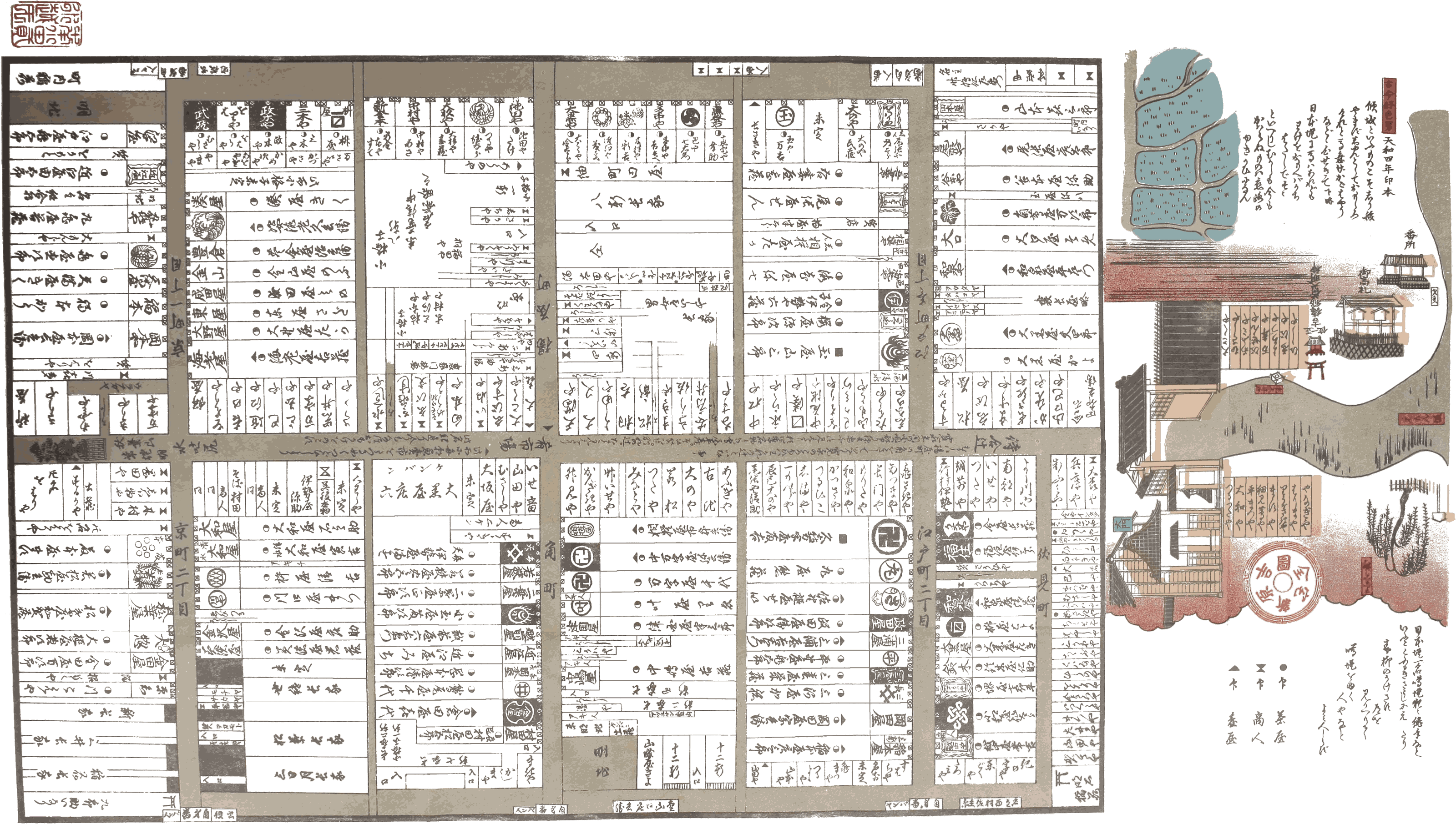

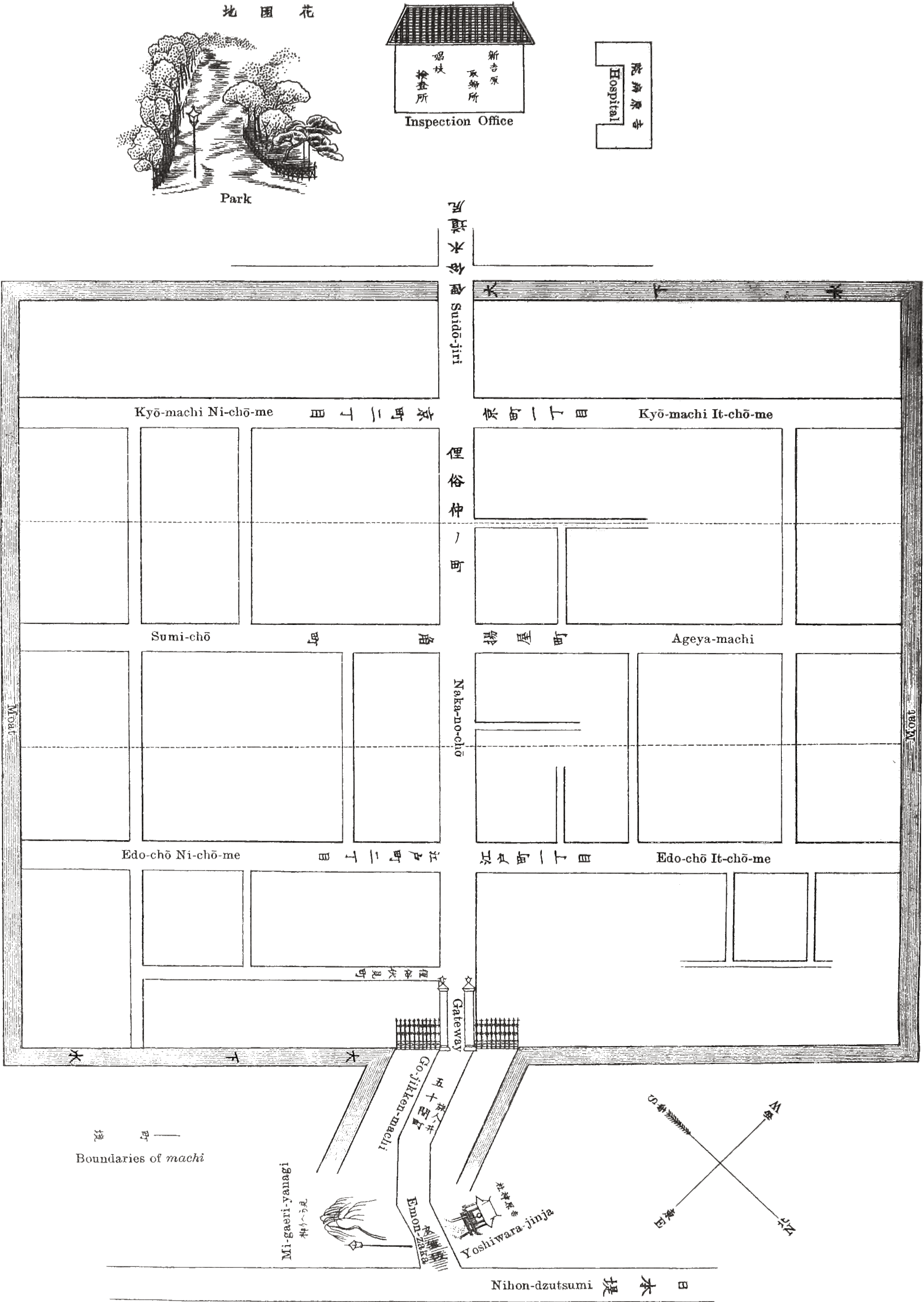
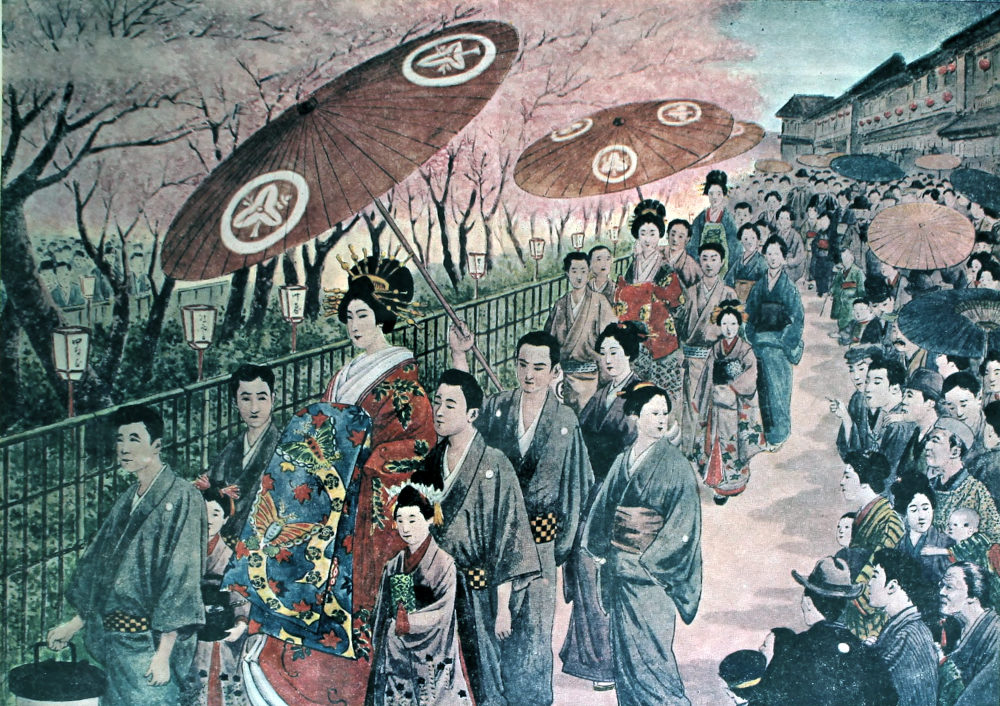

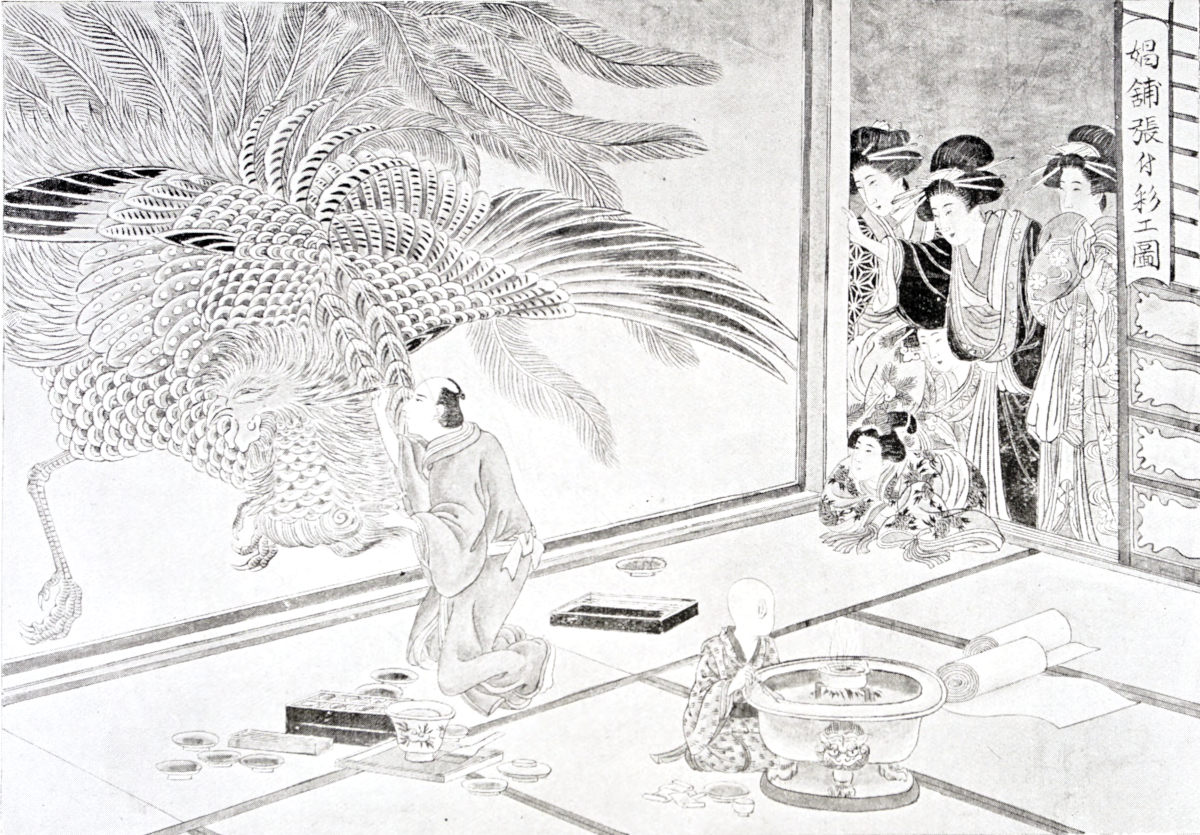
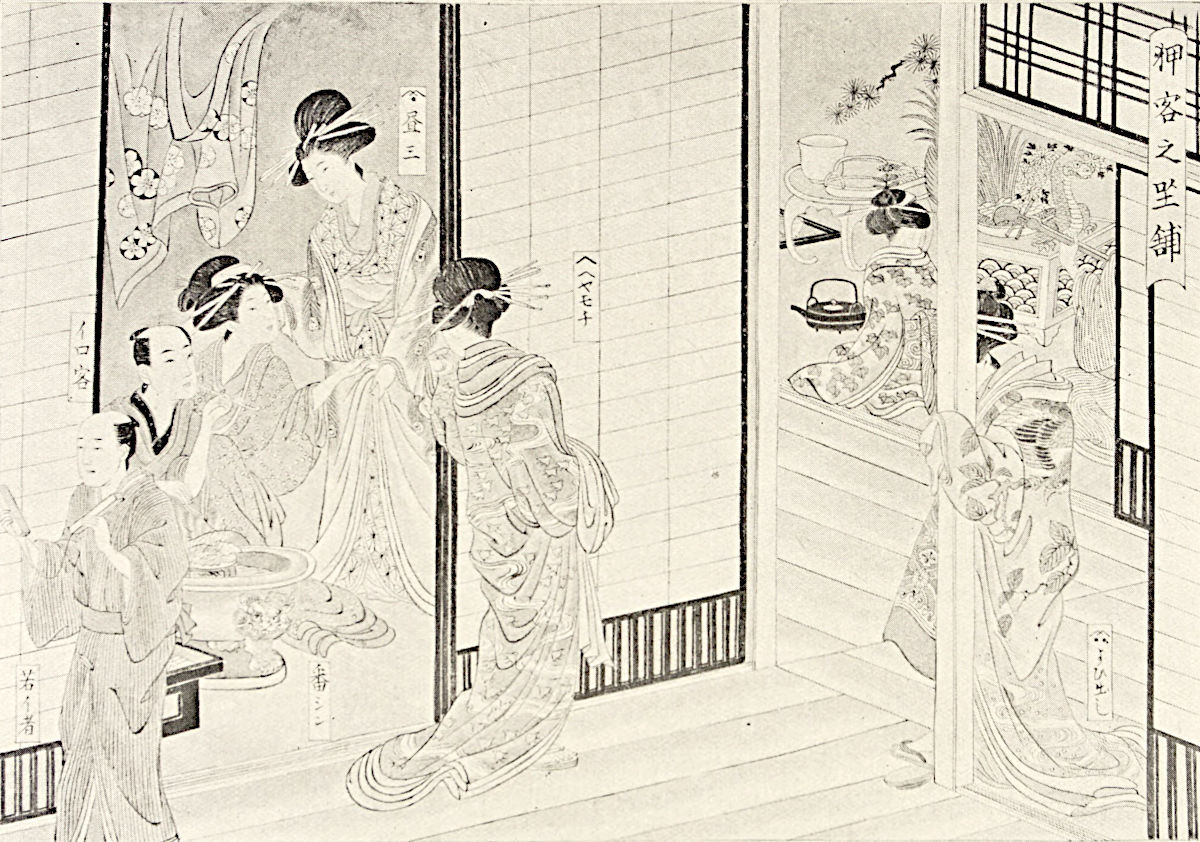
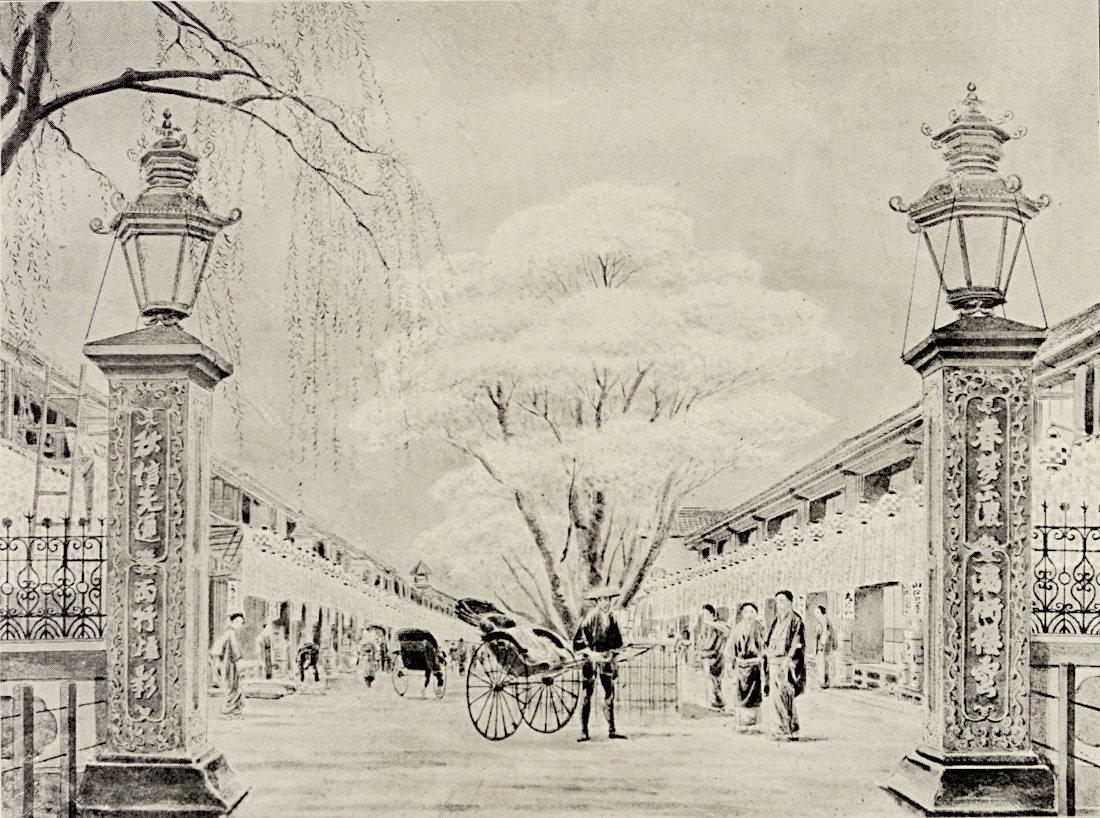
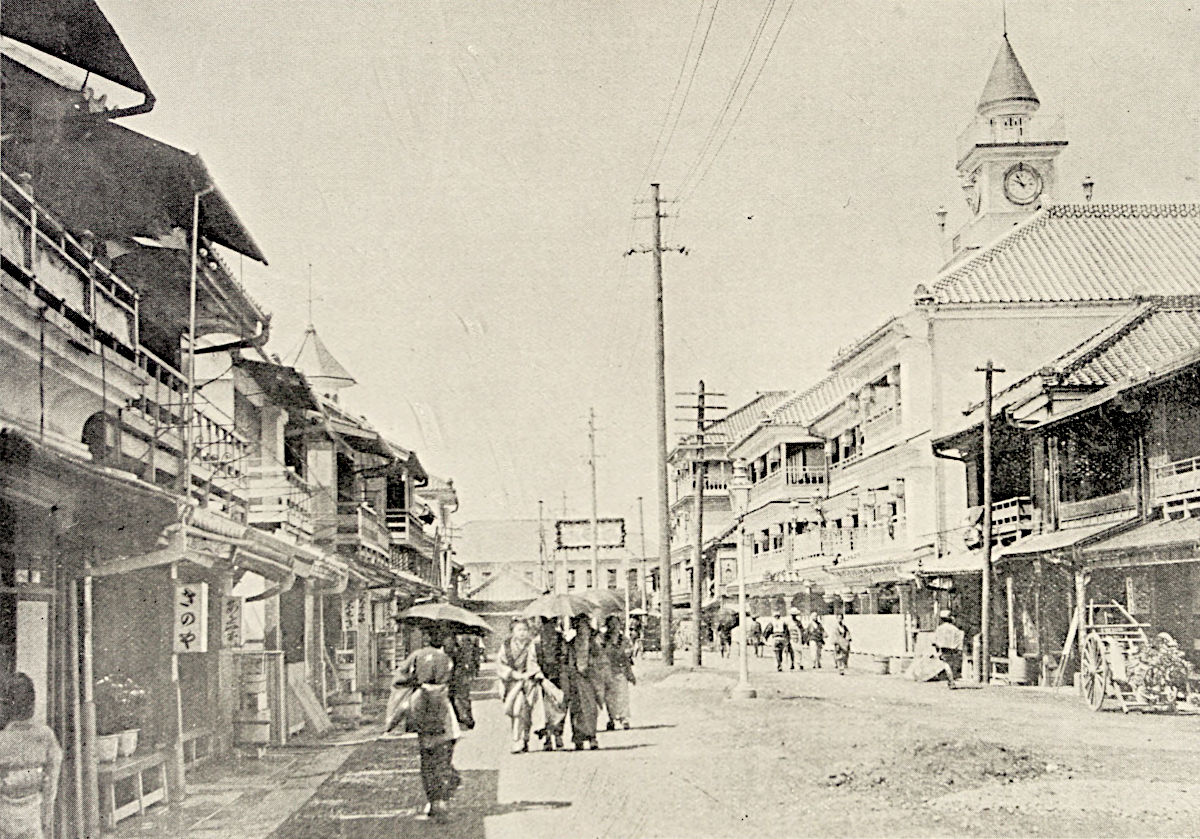
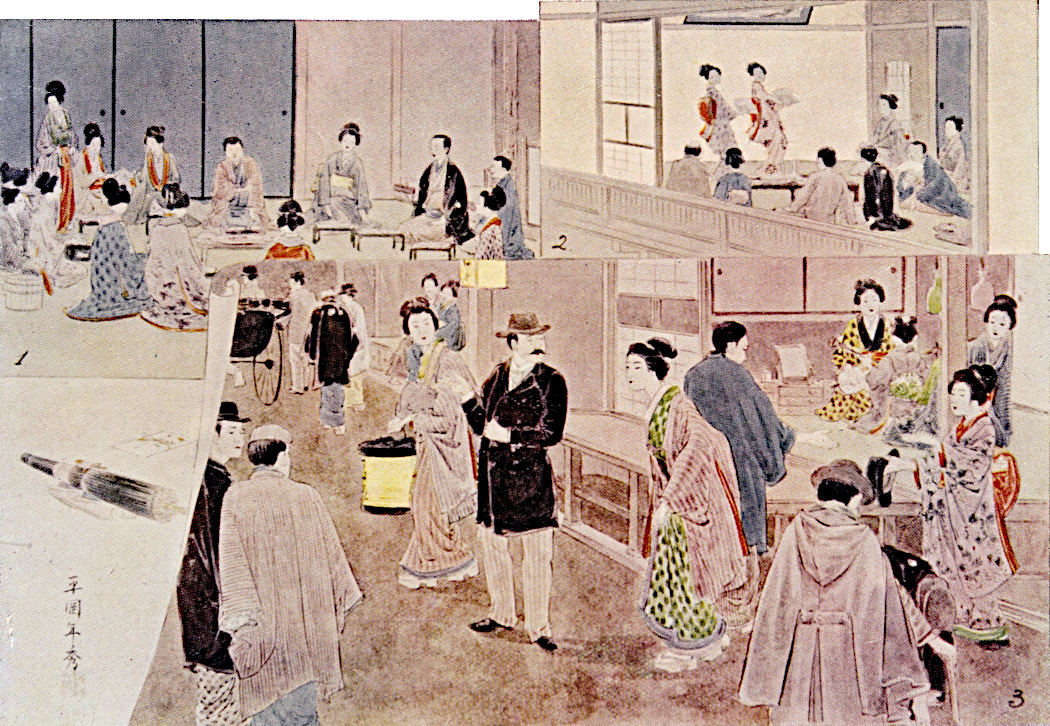
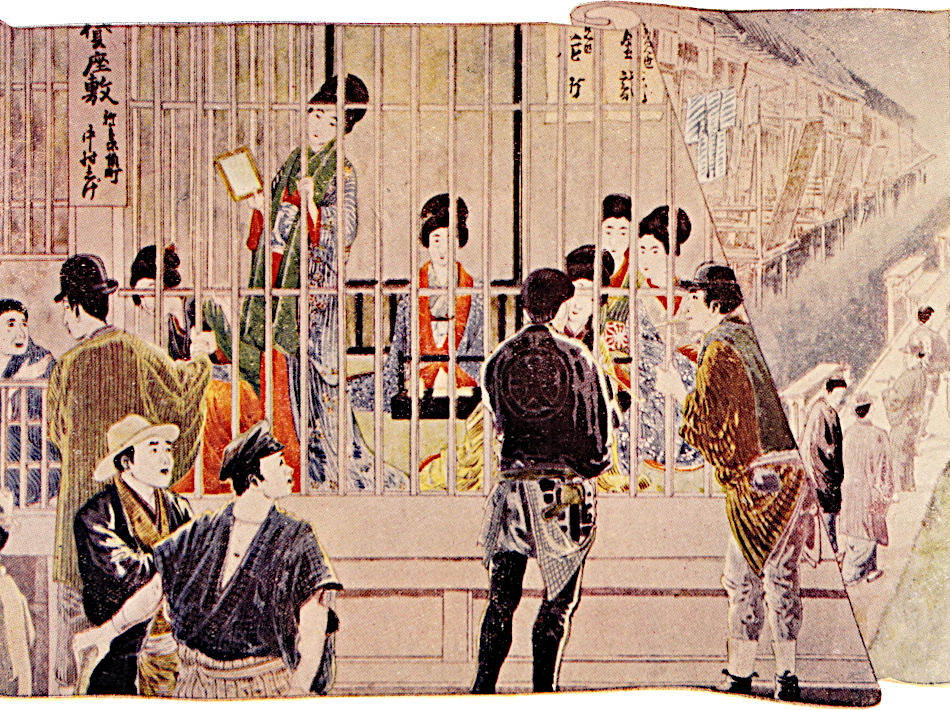
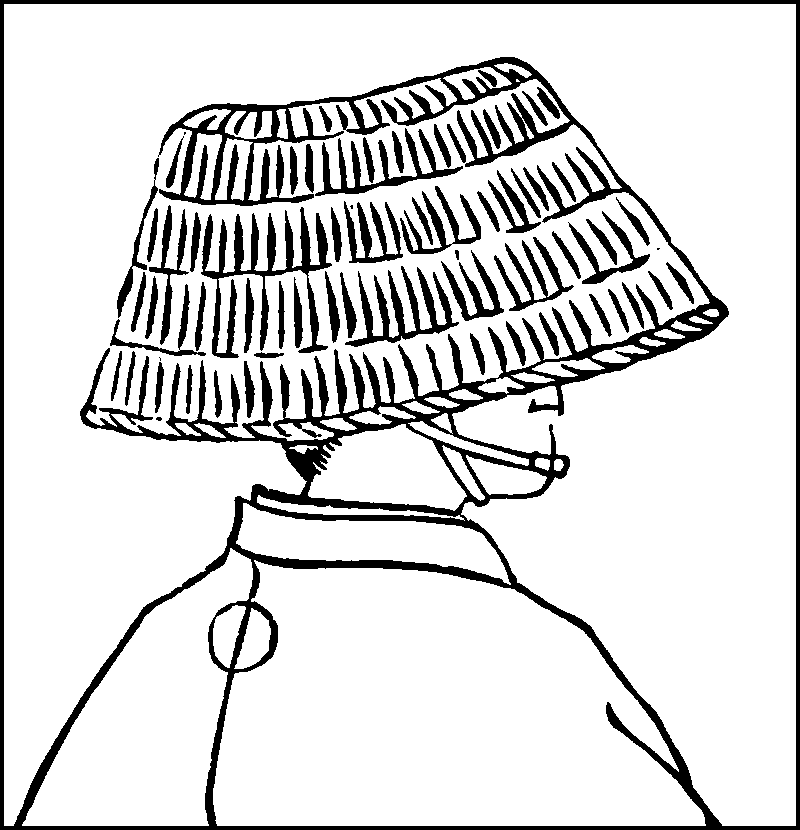
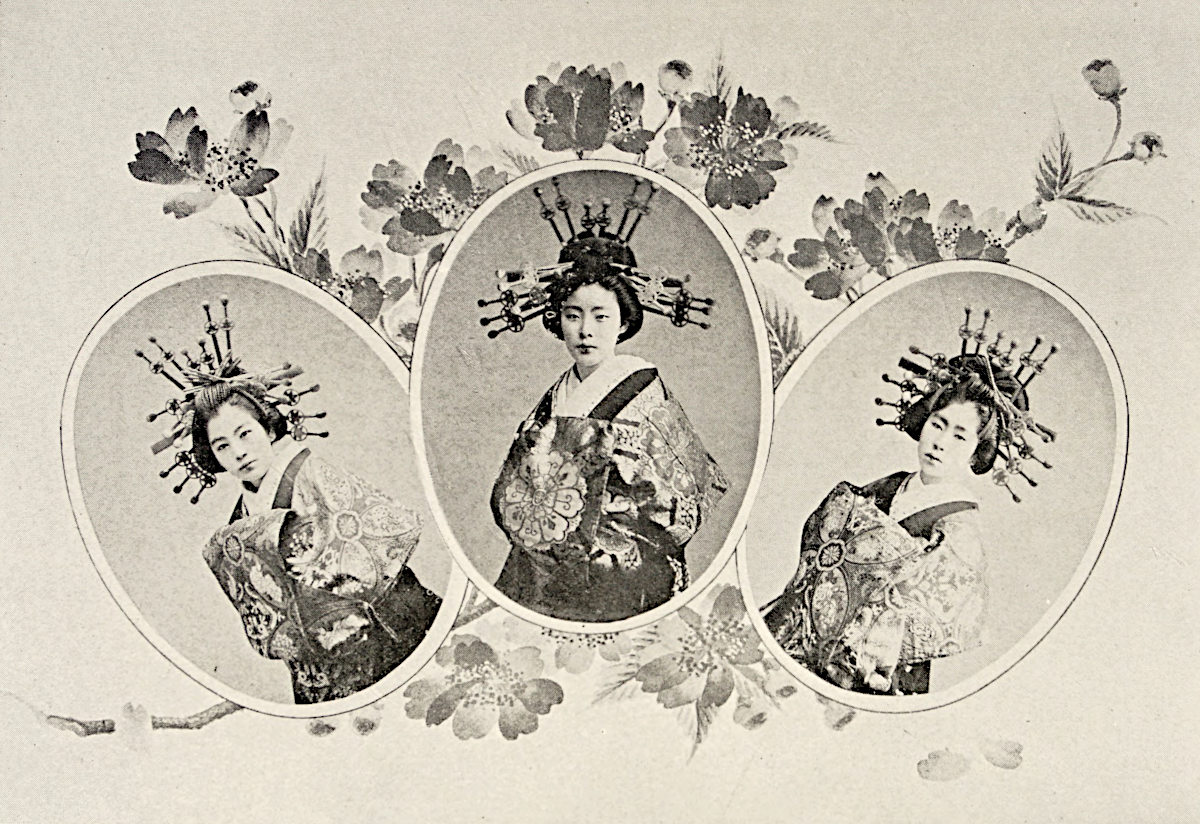
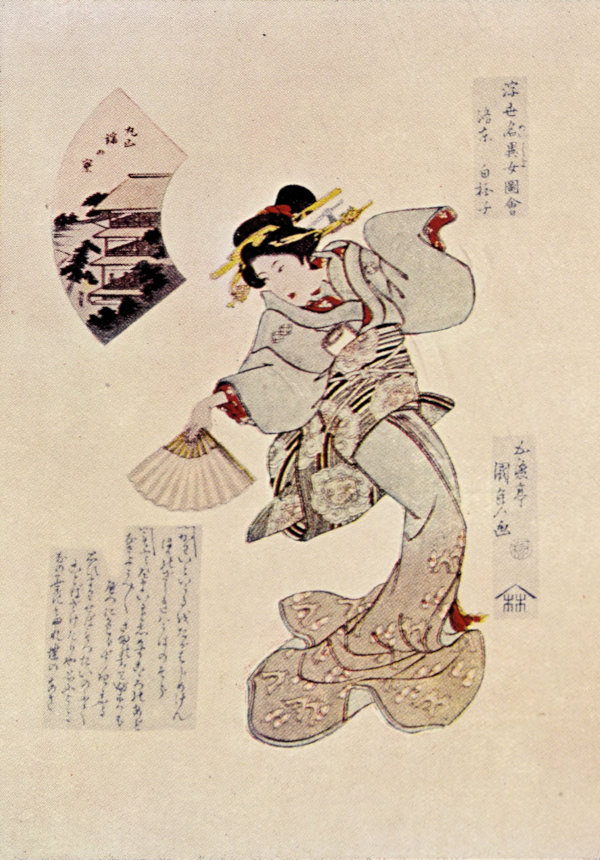
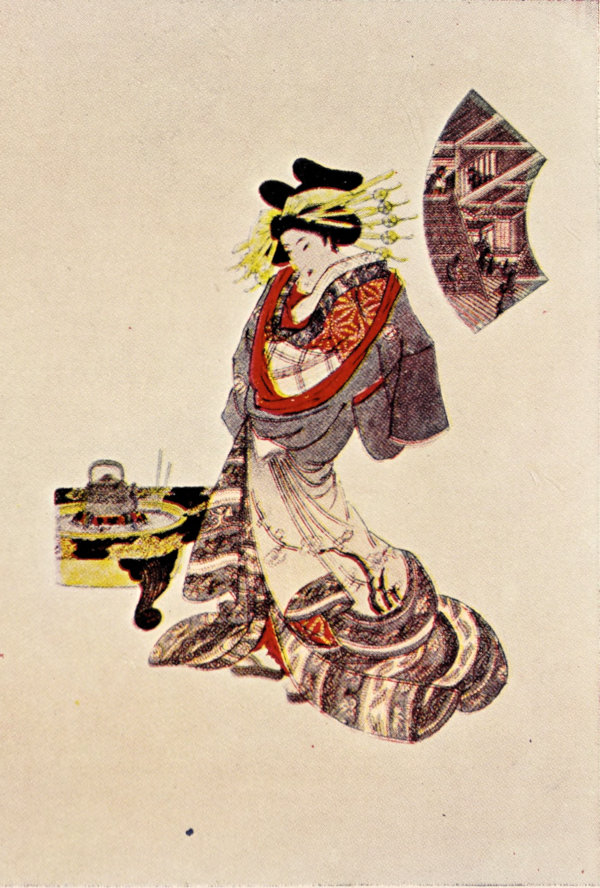
 and
and  respectively. Those marked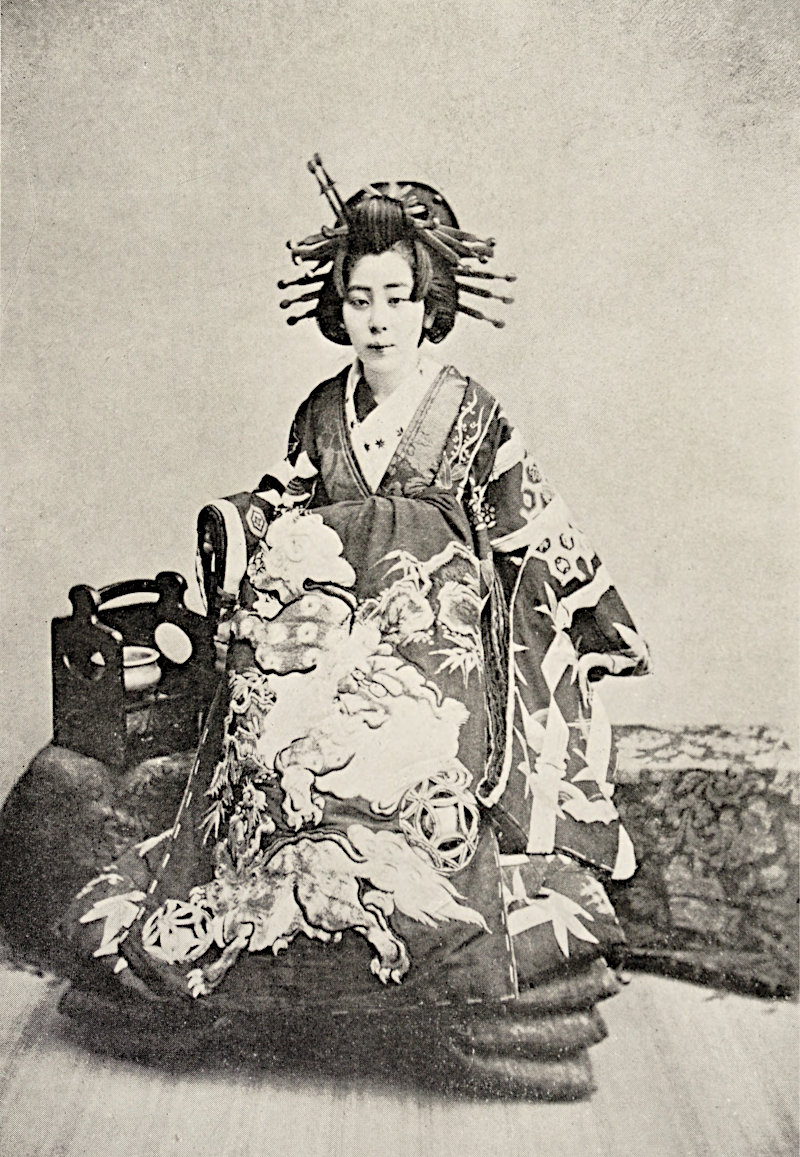
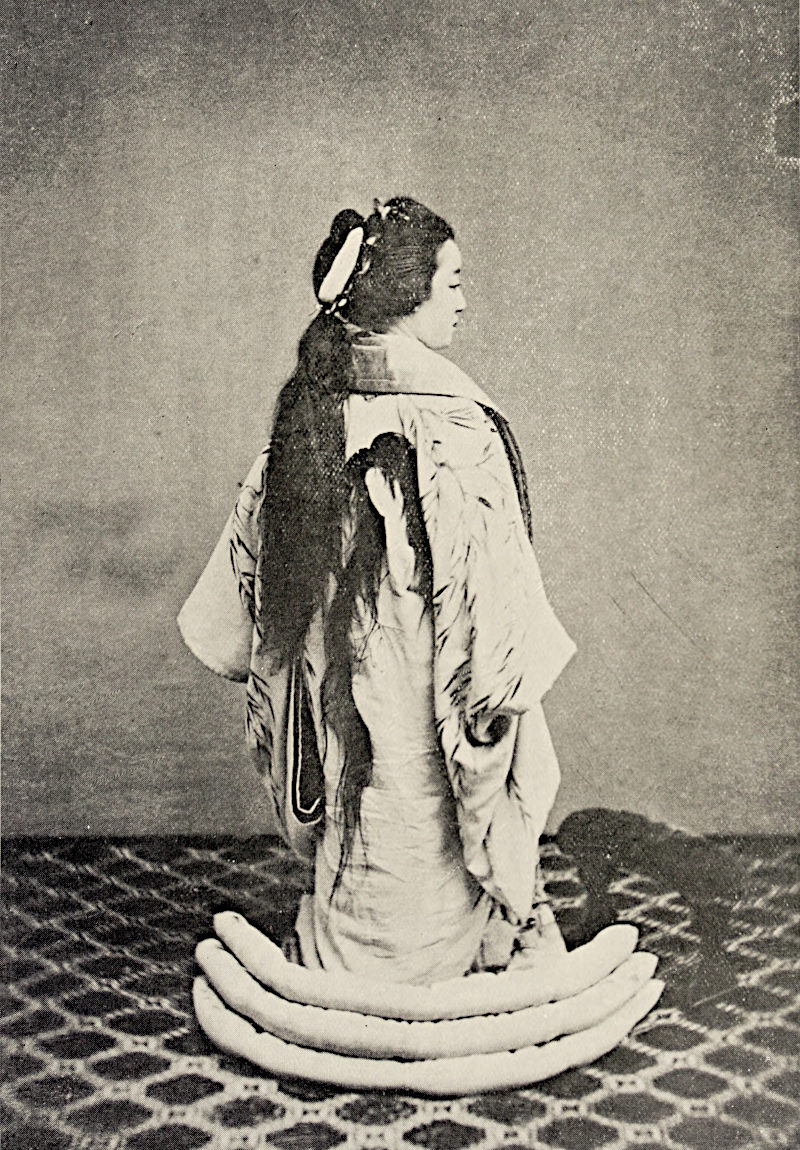
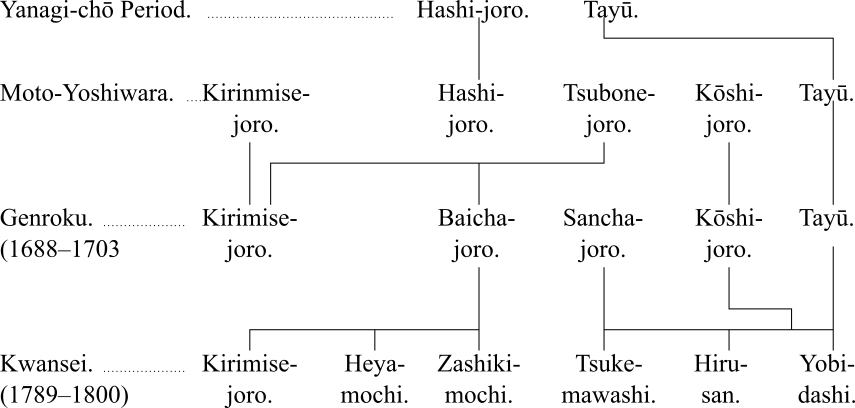
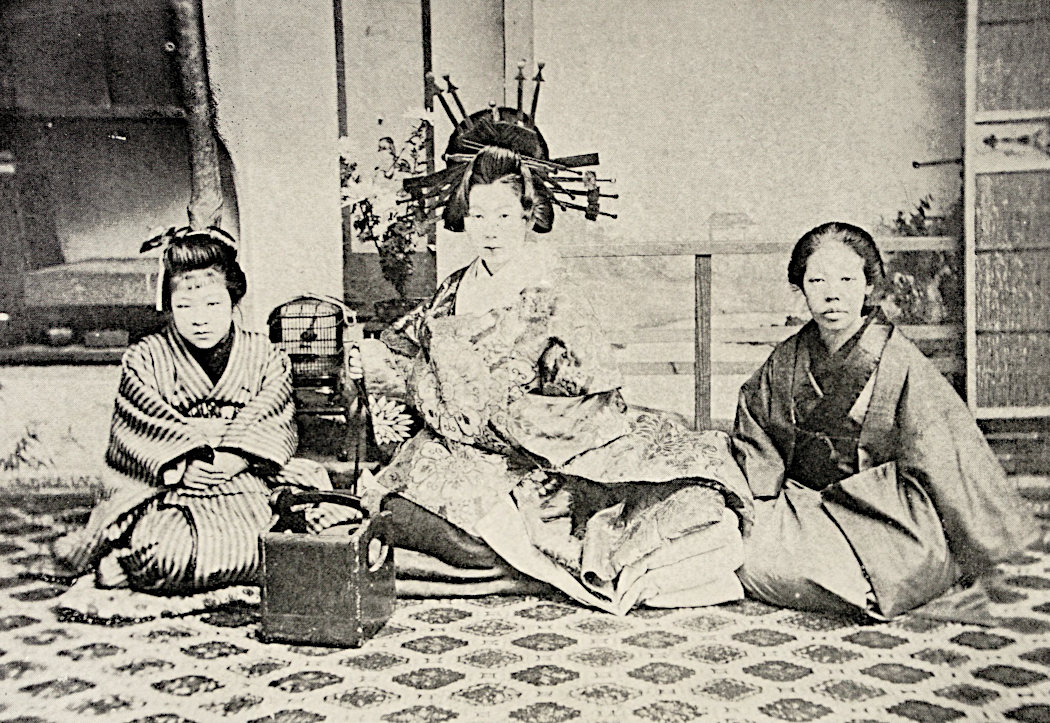
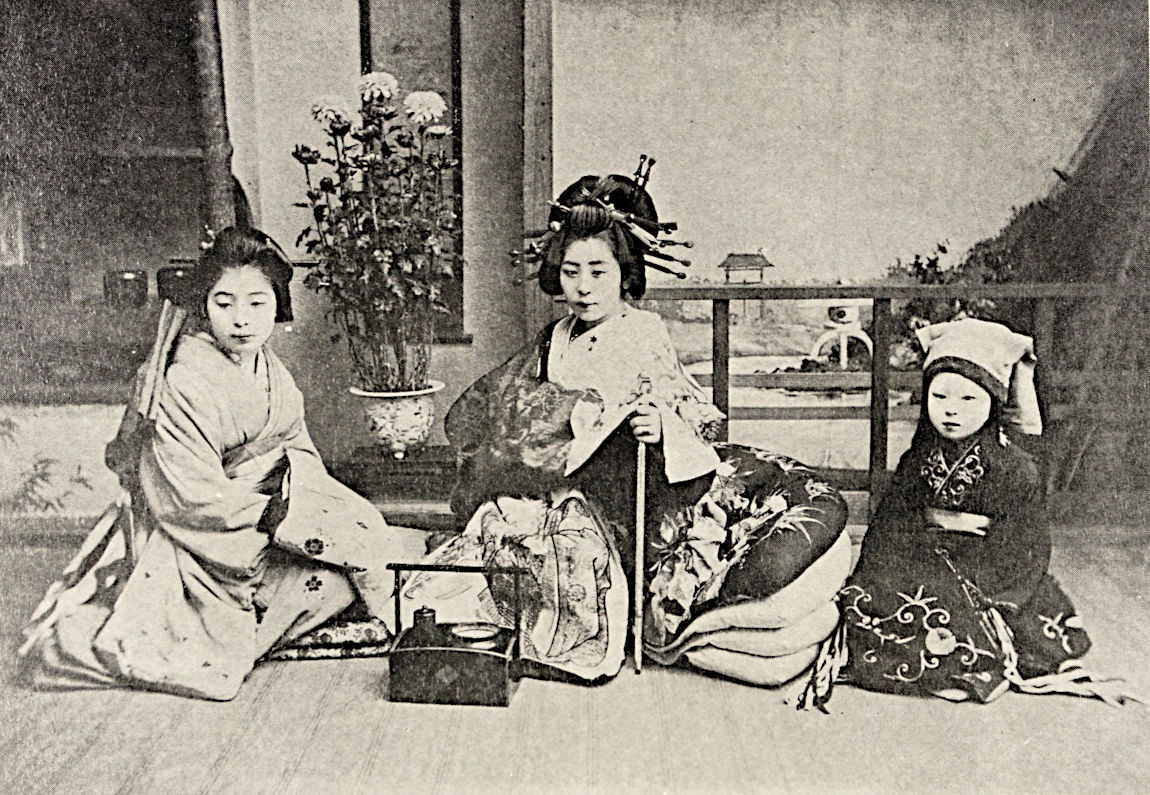
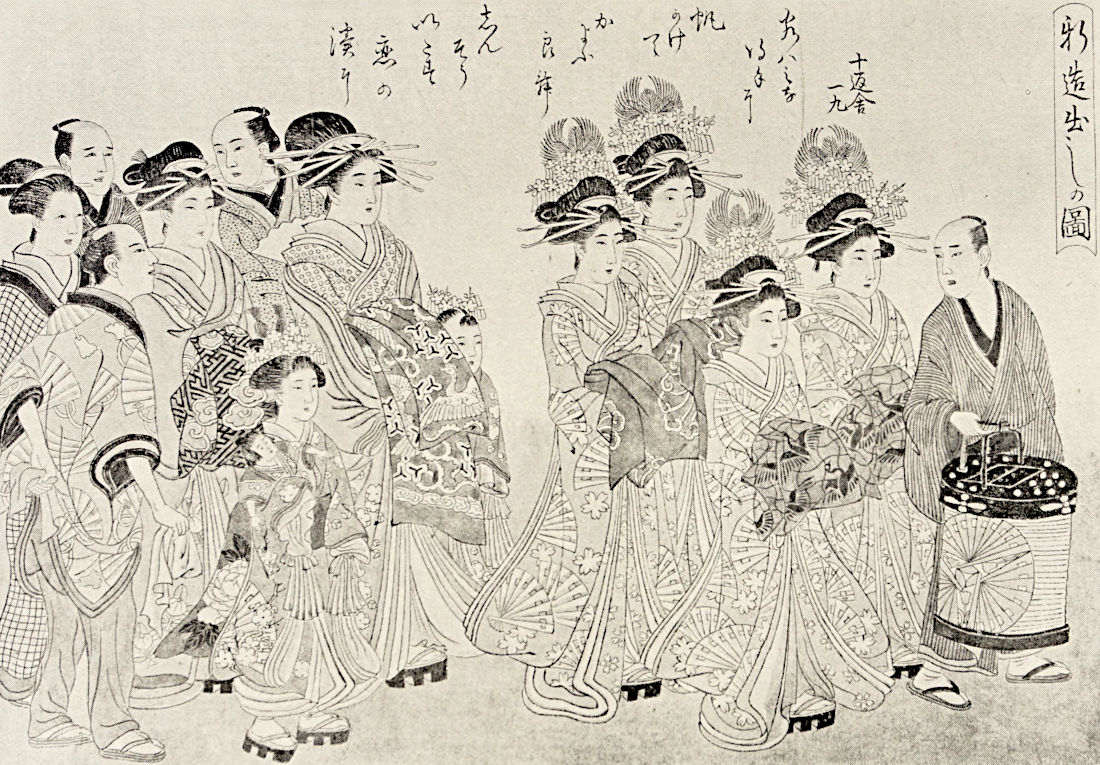
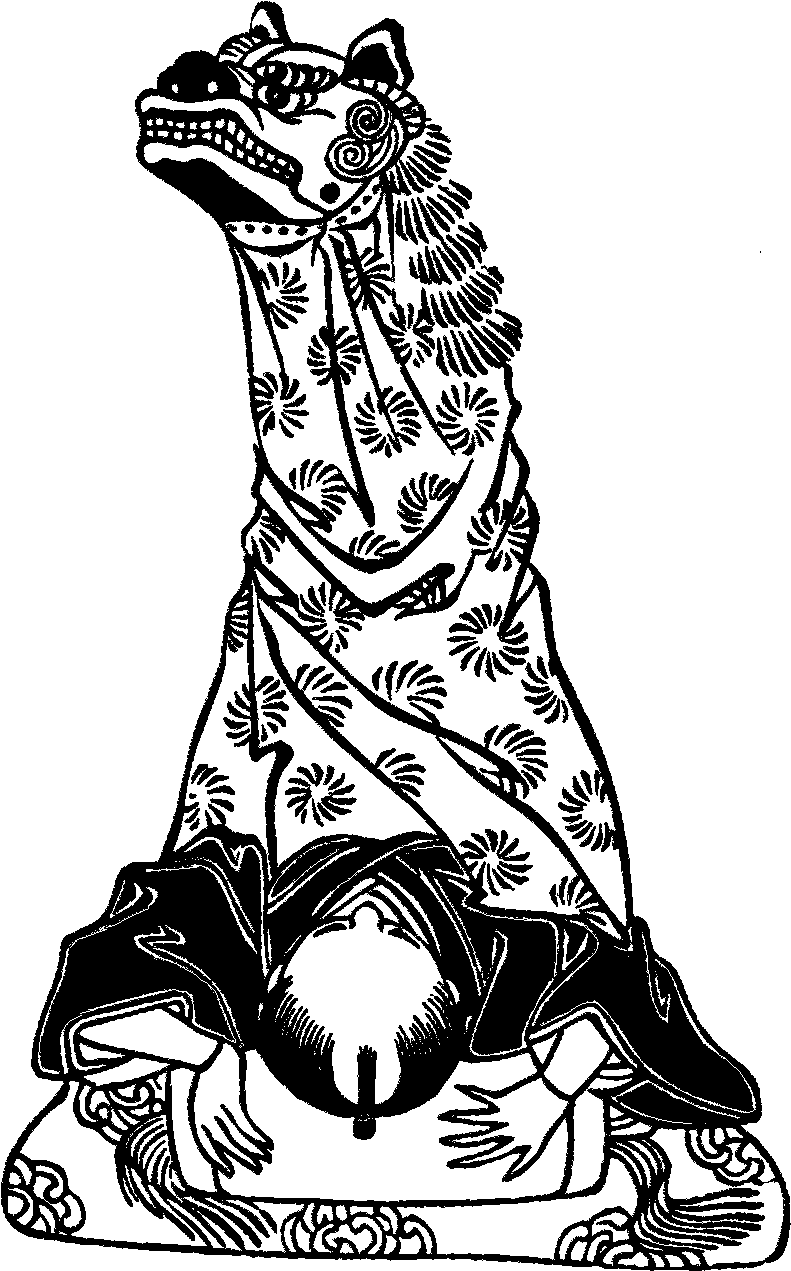
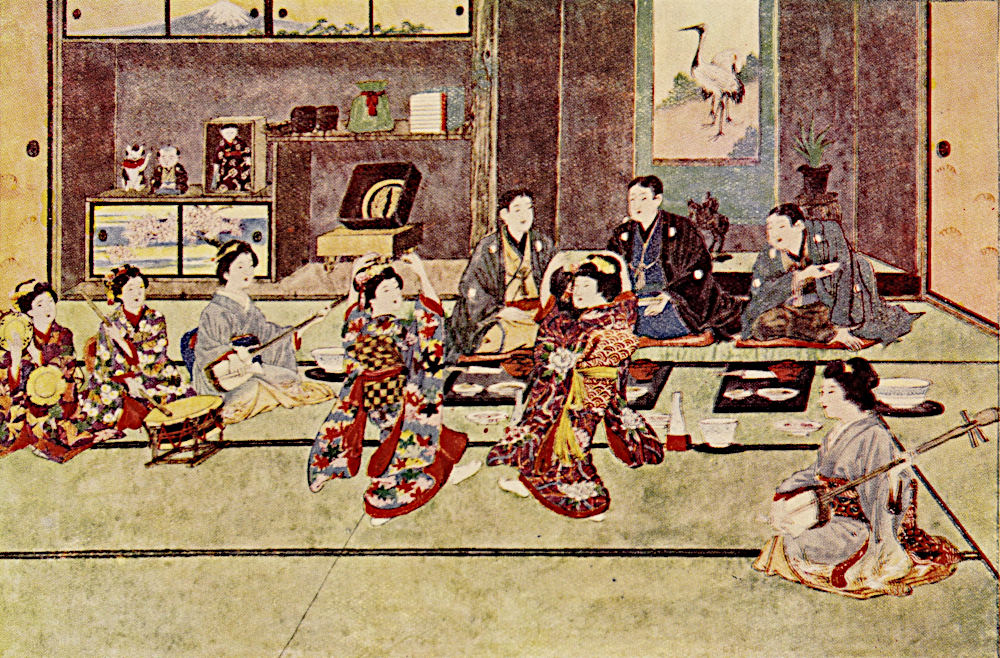

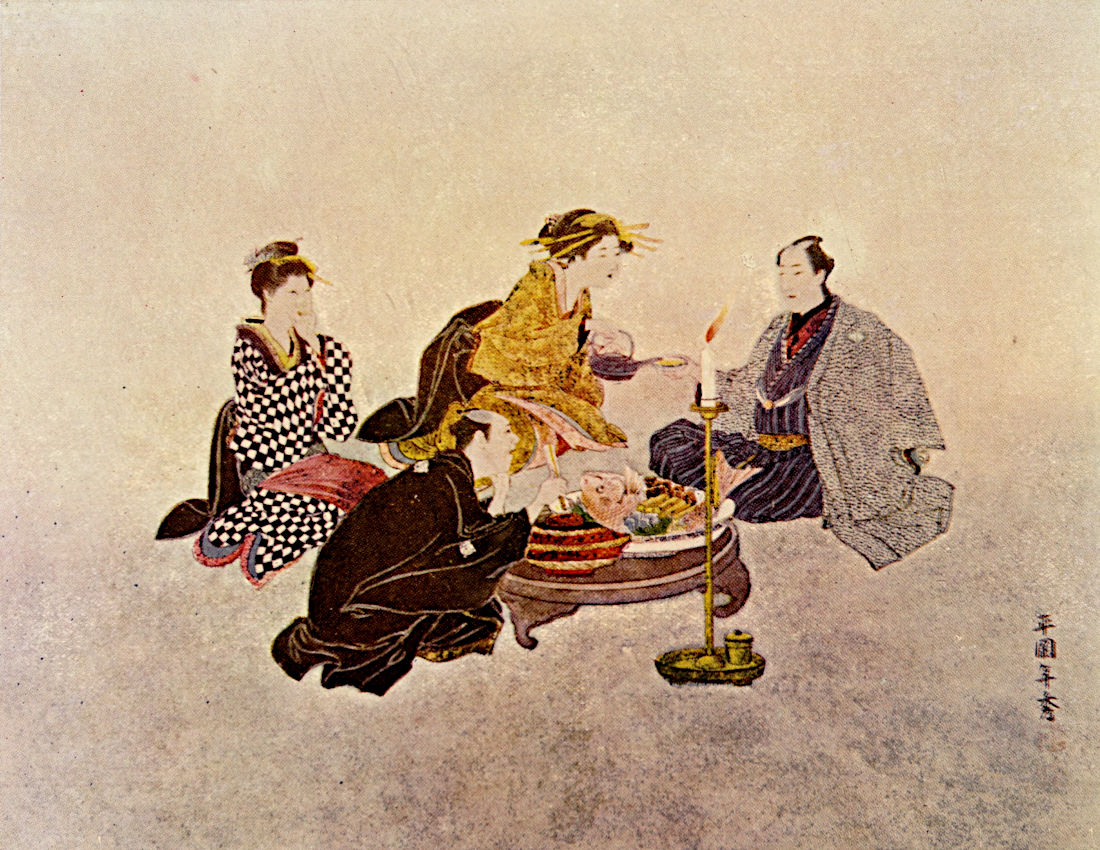
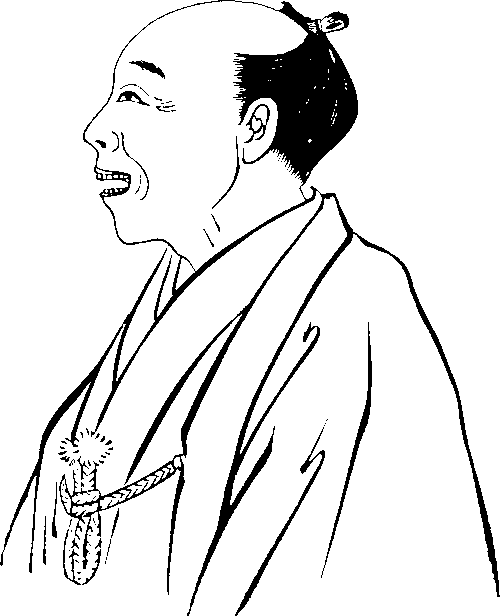
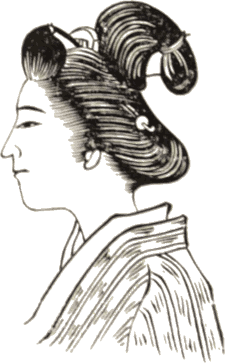
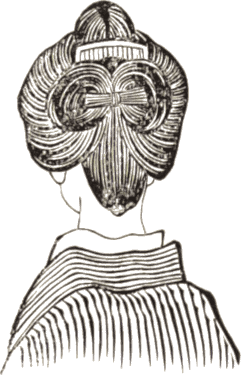
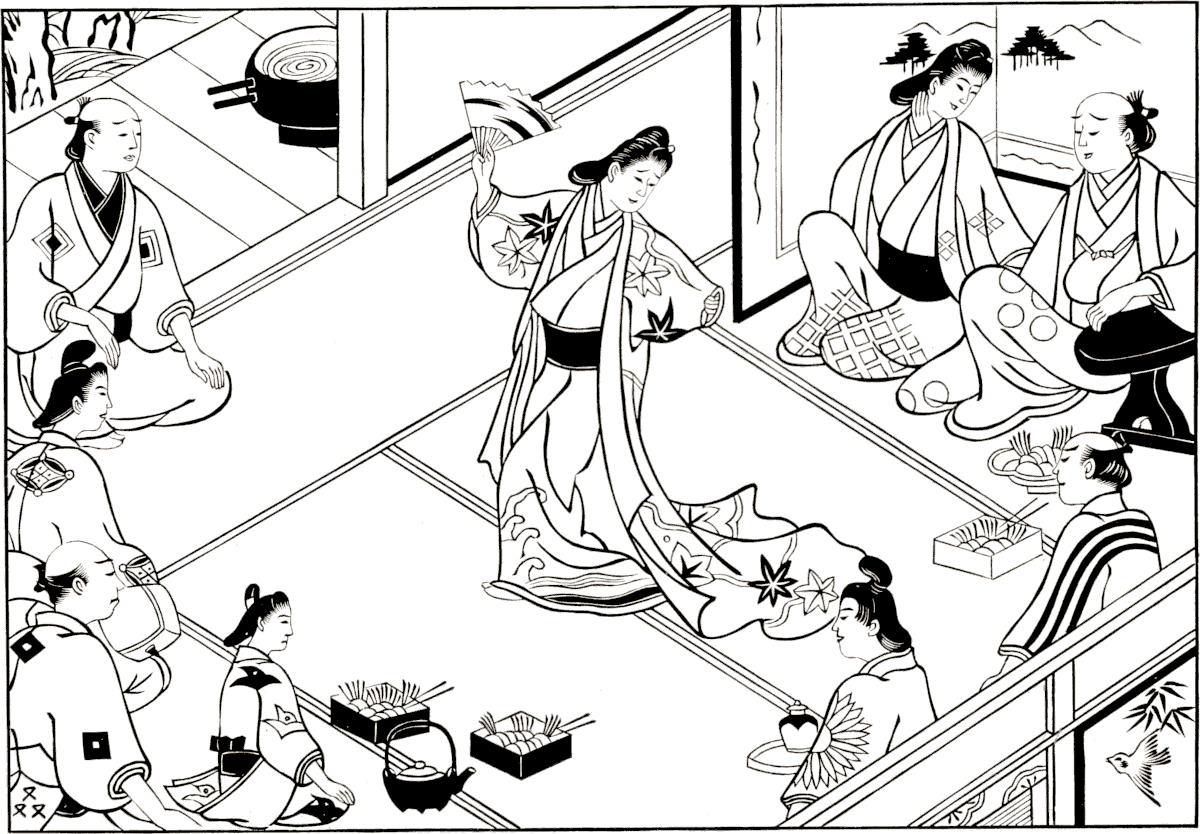

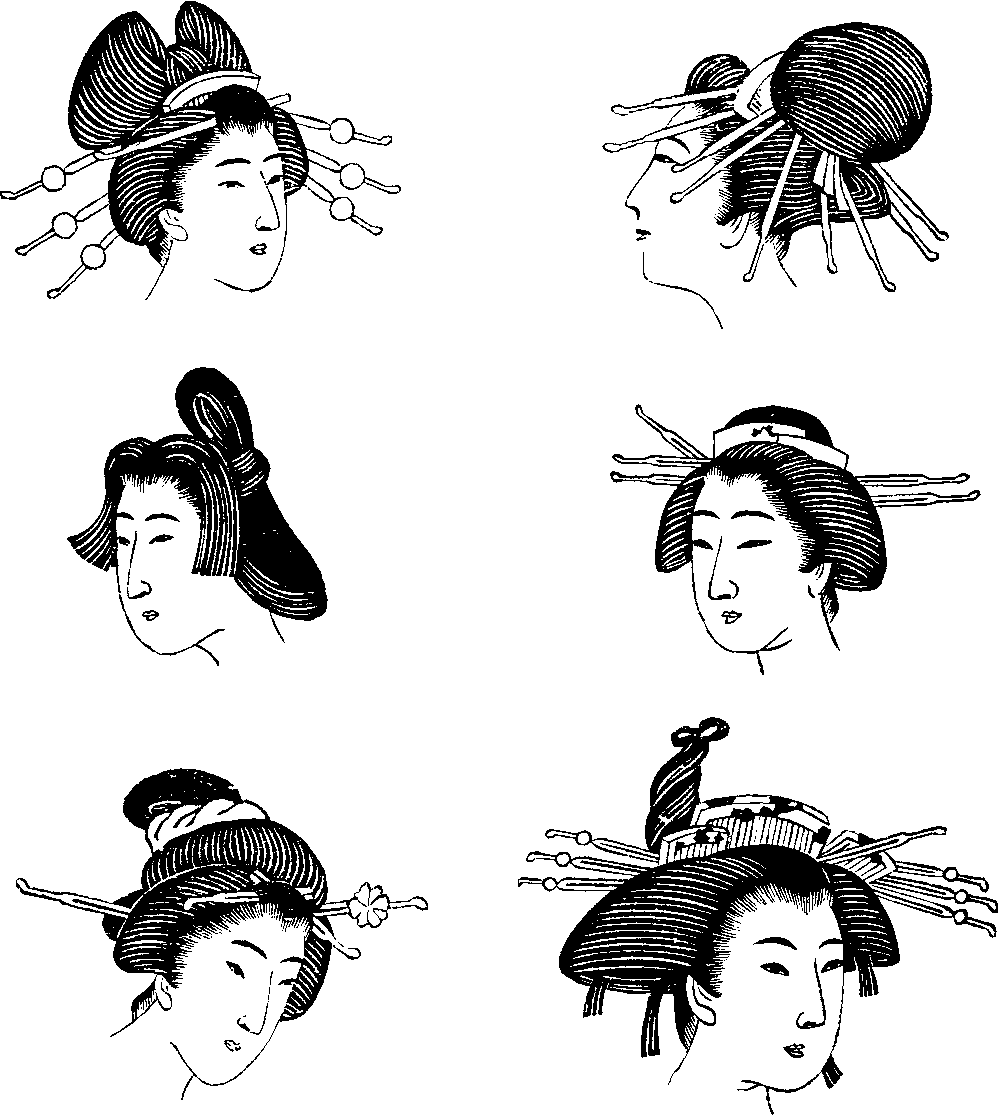
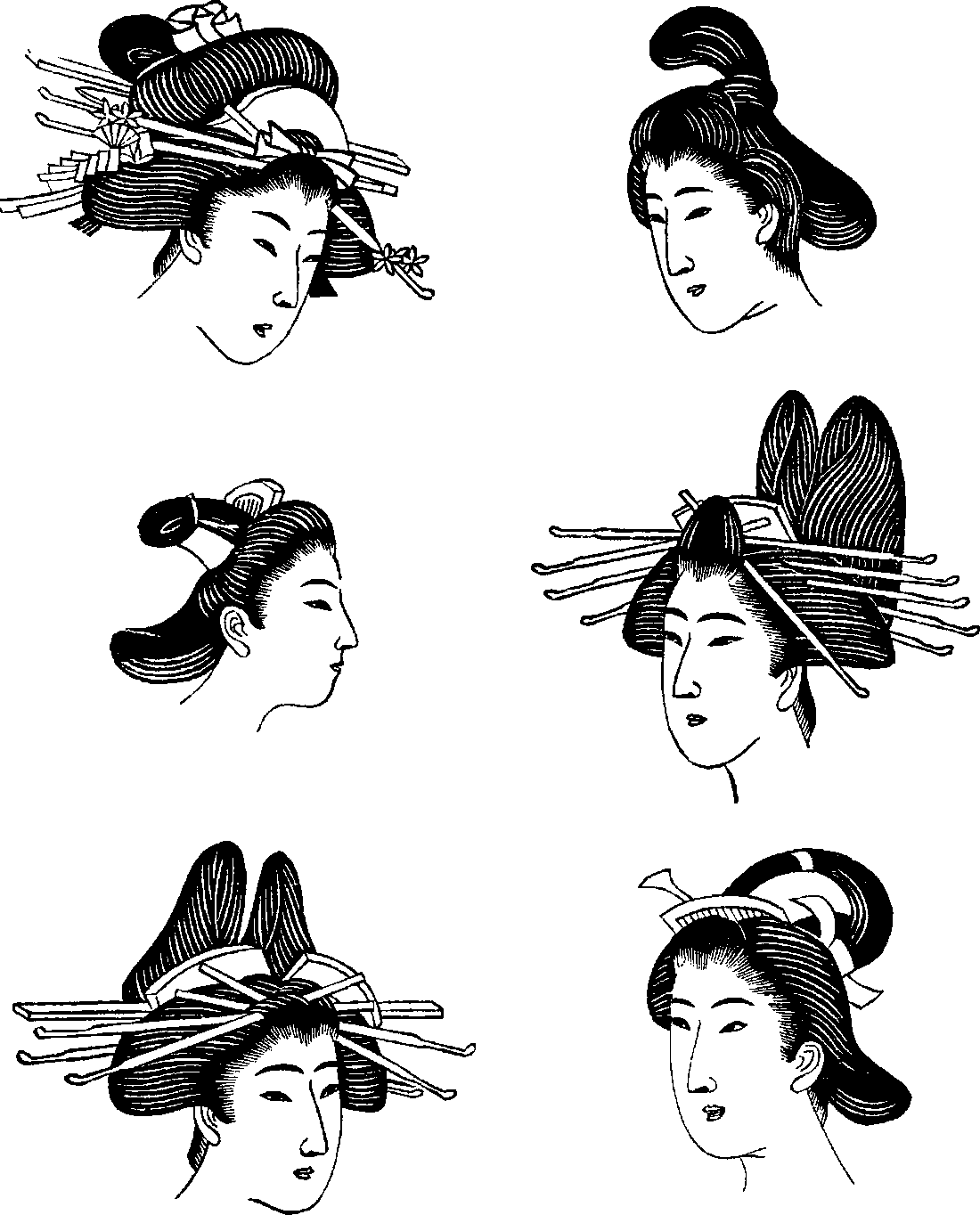
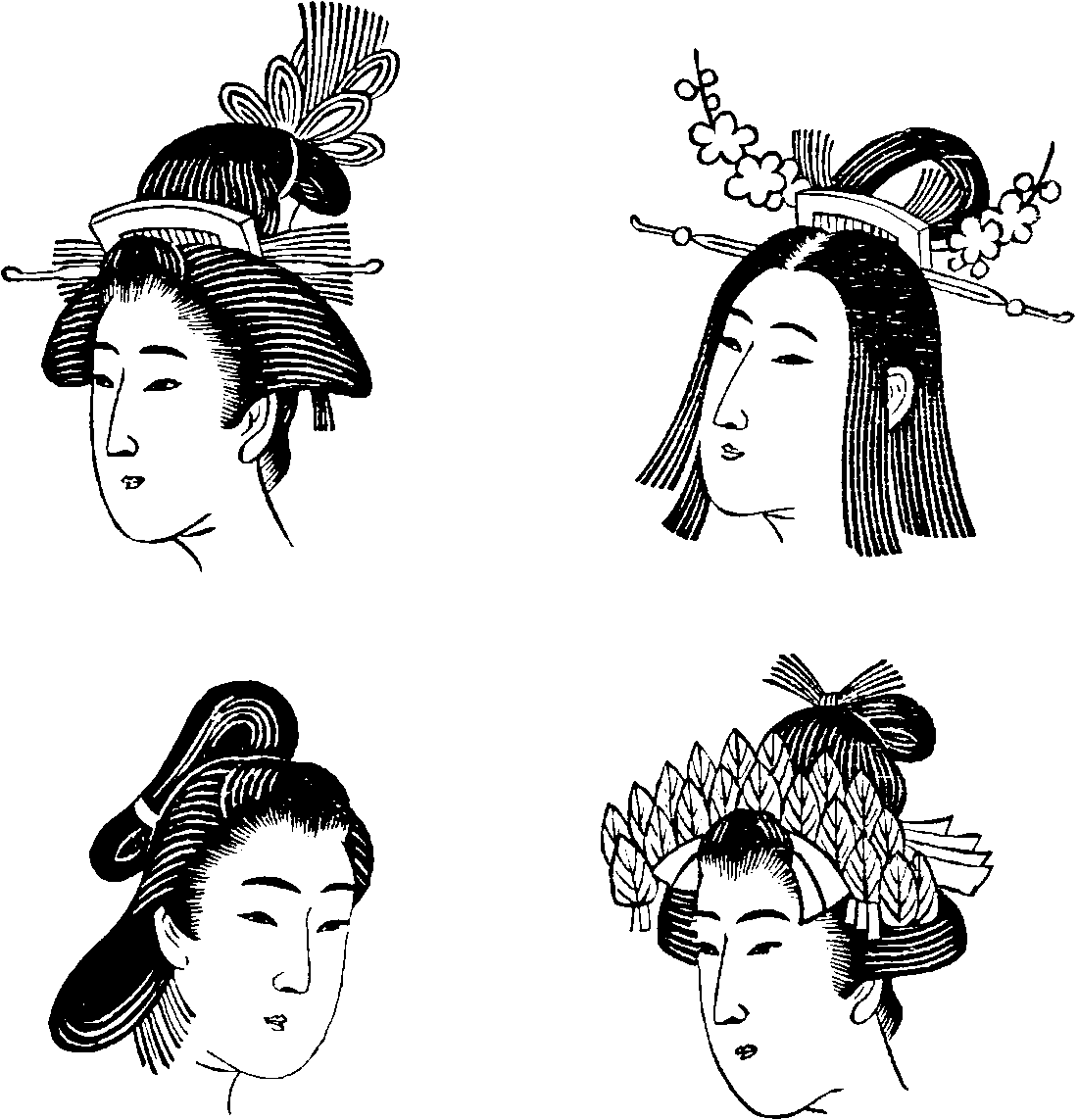
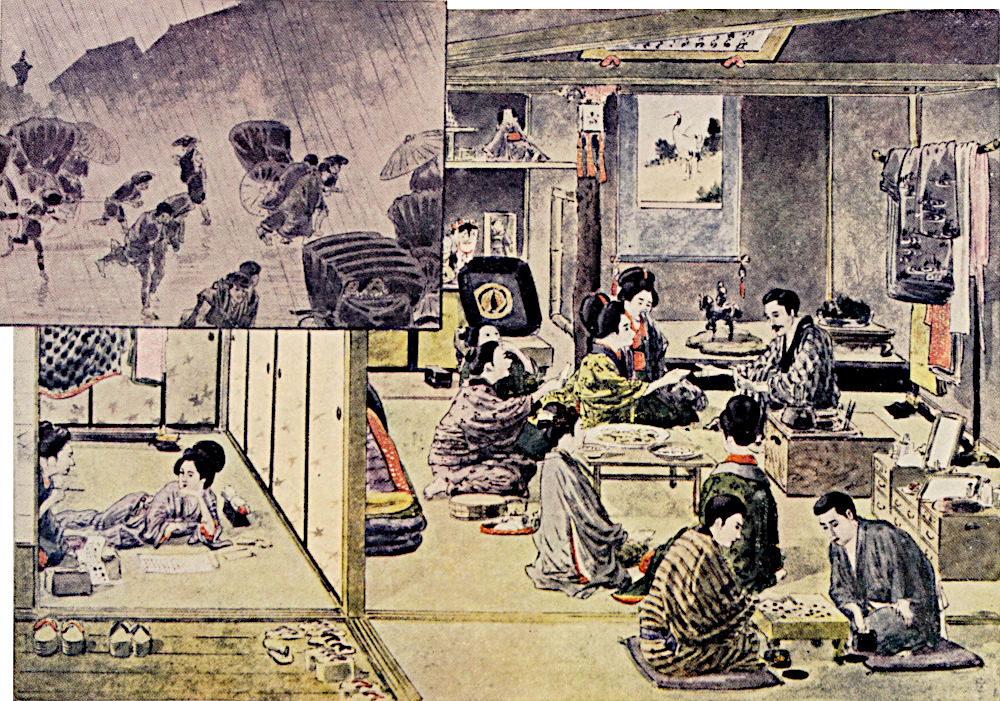
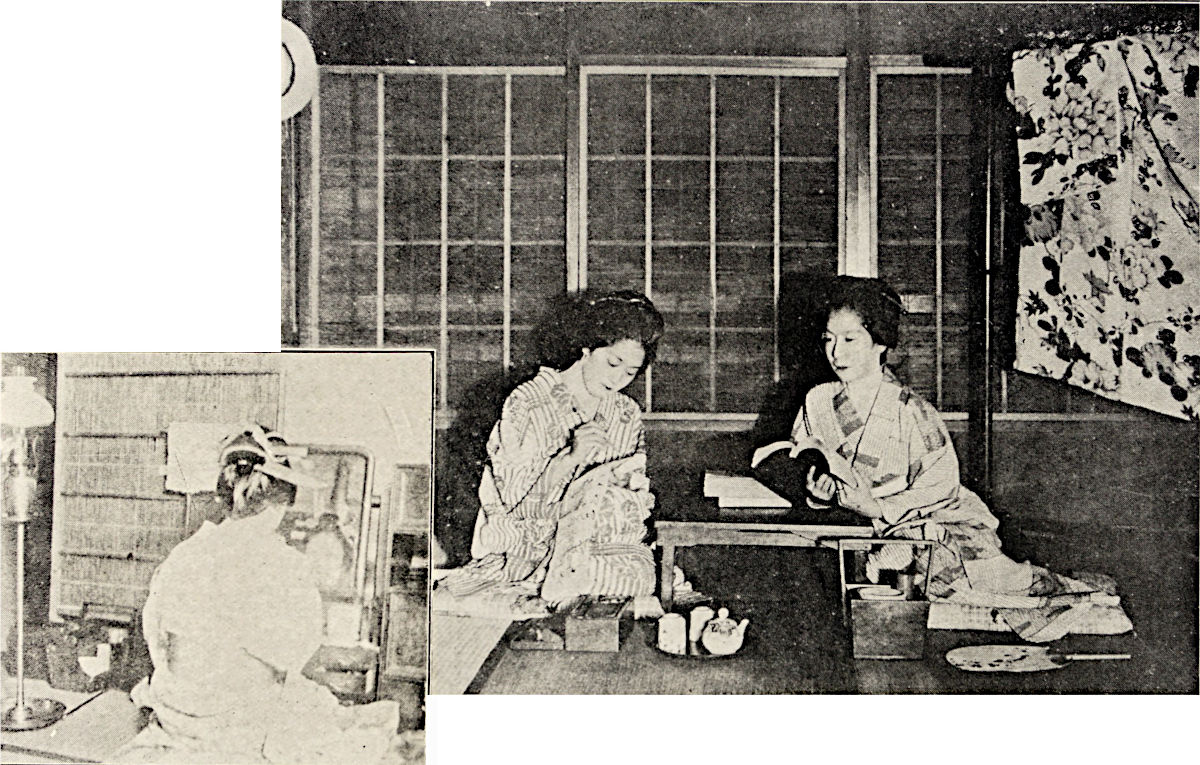
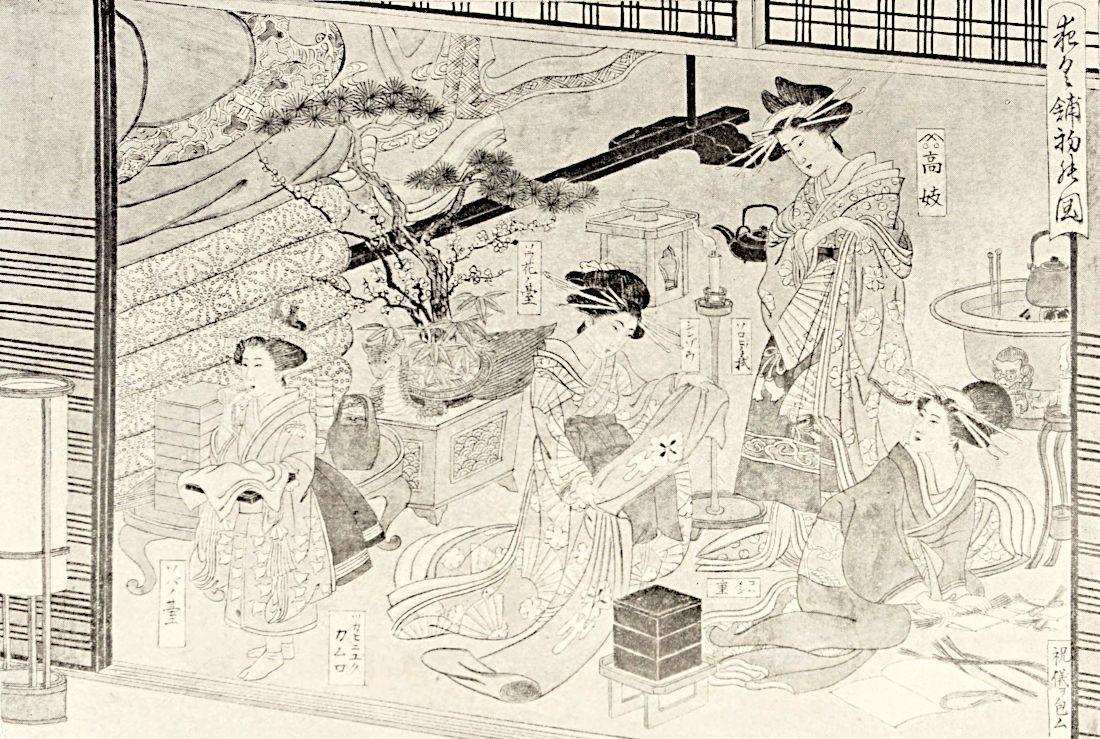
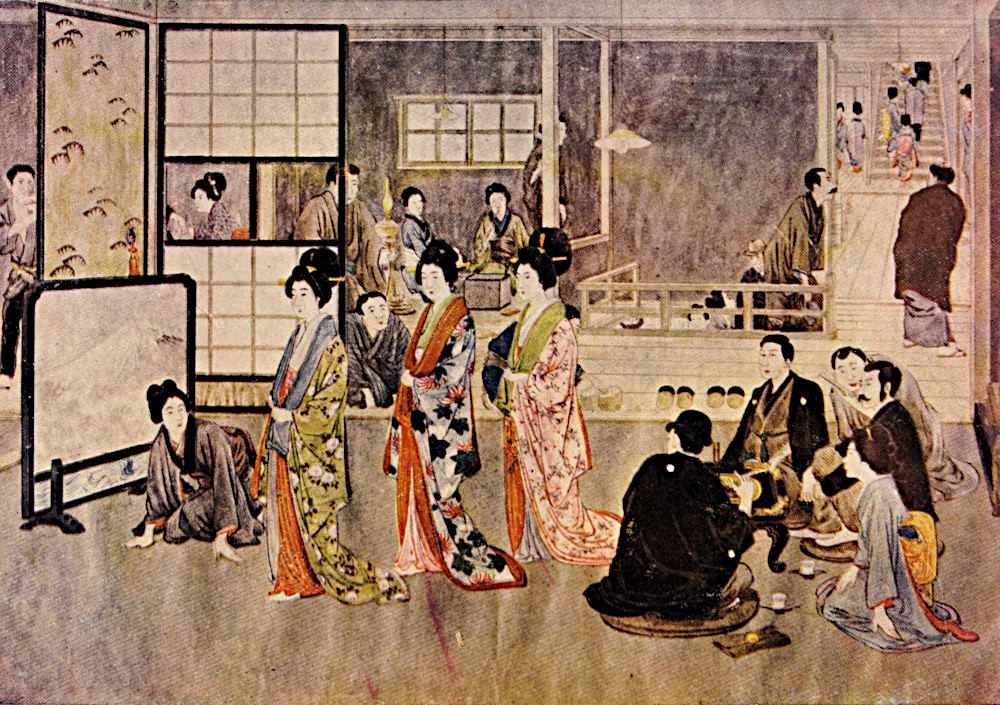
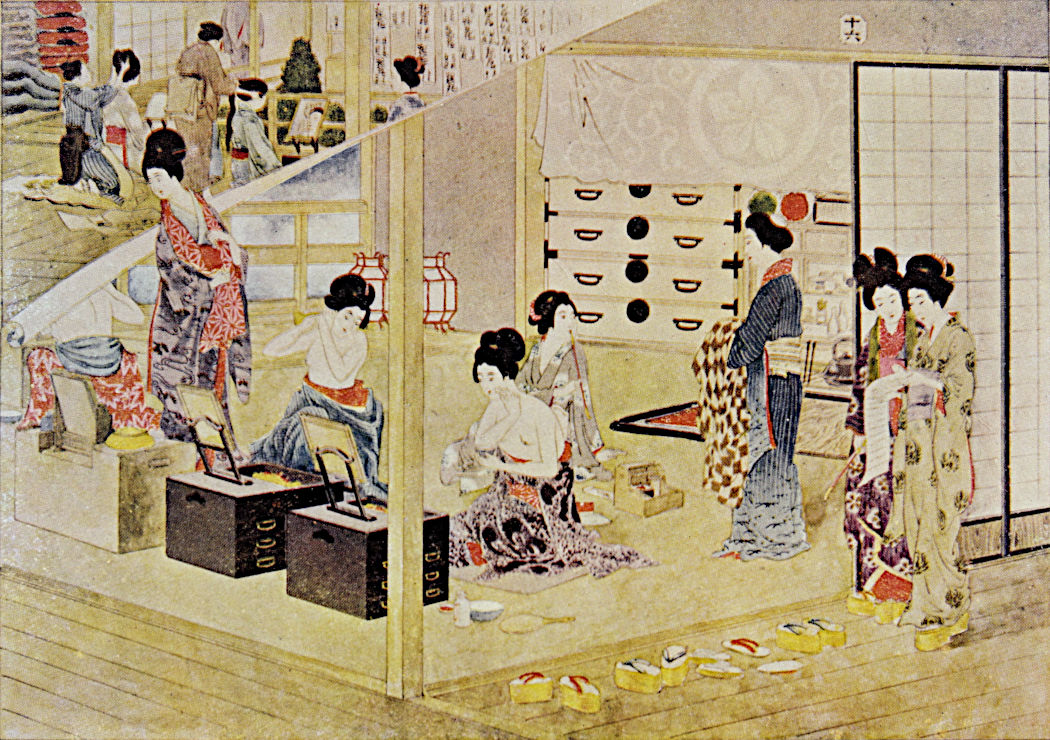
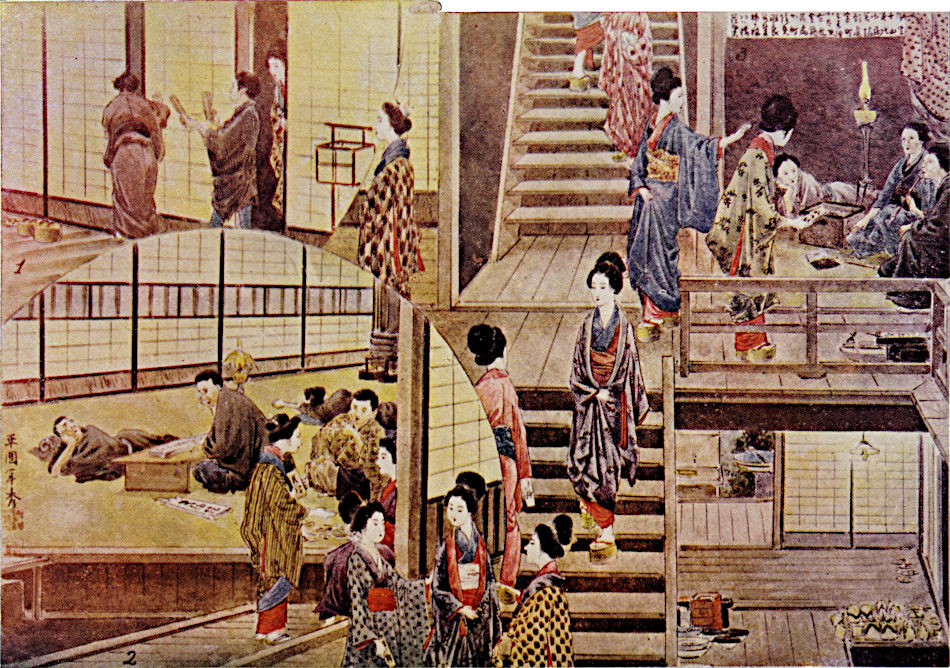
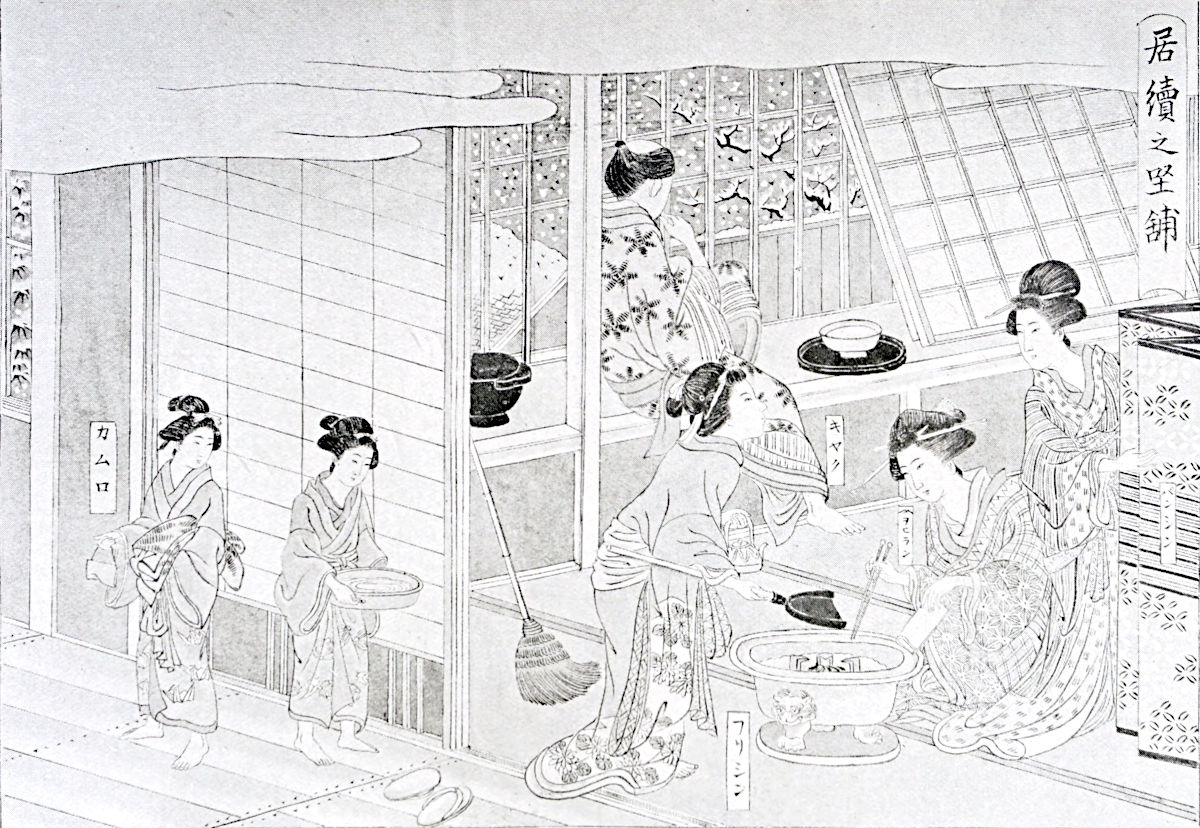
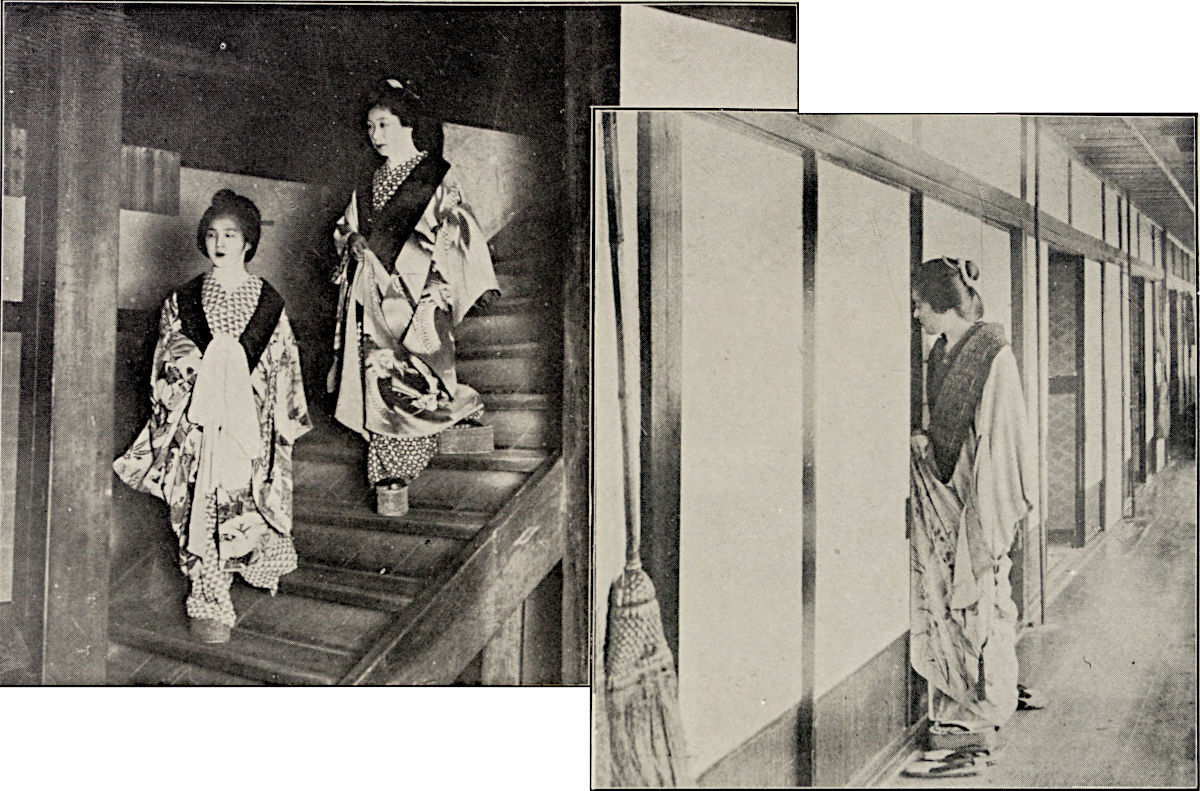
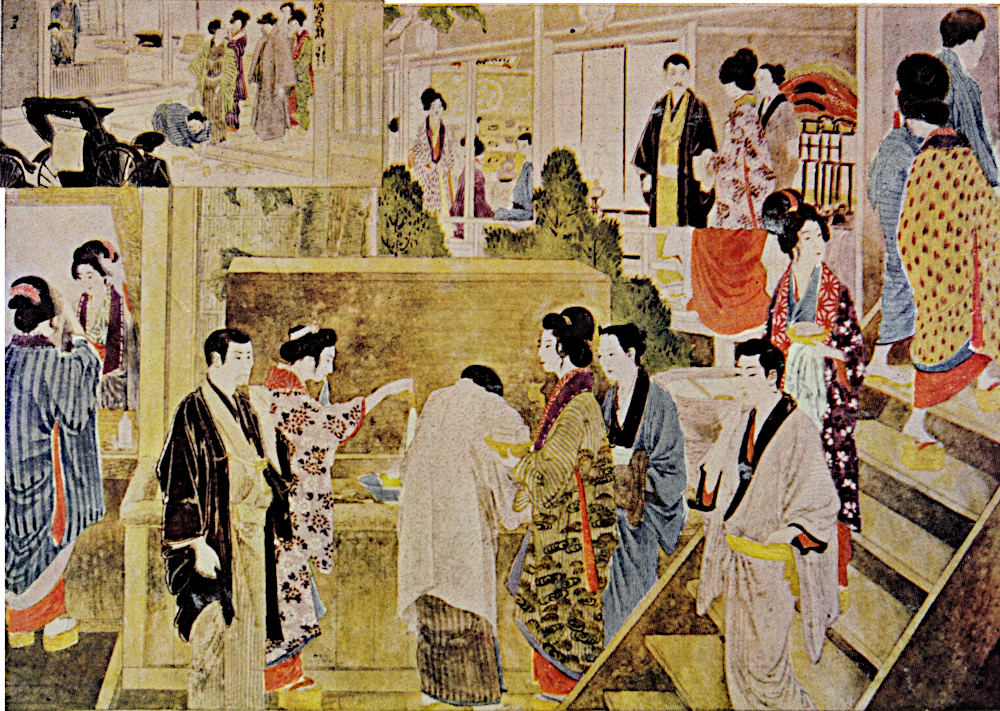
 Ni-nin Kaburo:
  Yobi-dashi:
  Tsuki-dashi:
  Zashiki-mochi:
  KÅkin:
  Bunkin: â ChÅ«-ya:
ã Ni-shu: â³ Uchi-komi: Yama-sancha: Umecha: ã Go-sun Tsubone: ⬤
Nami-Tsubone and Ha-age-ya: ⬠Chaya. By the 6th year of Gembun (1741)
the fees of courtesans were stated in Saiken for the first time as
follows:â
Bunkin: â ChÅ«-ya:
ã Ni-shu: â³ Uchi-komi: Yama-sancha: Umecha: ã Go-sun Tsubone: ⬤
Nami-Tsubone and Ha-age-ya: ⬠Chaya. By the 6th year of Gembun (1741)
the fees of courtesans were stated in Saiken for the first time as
follows:â





 Food.[127]
 Saké, 1 bottle ____ sen.
 Saké, 2 bottles ____ sen.

 .
.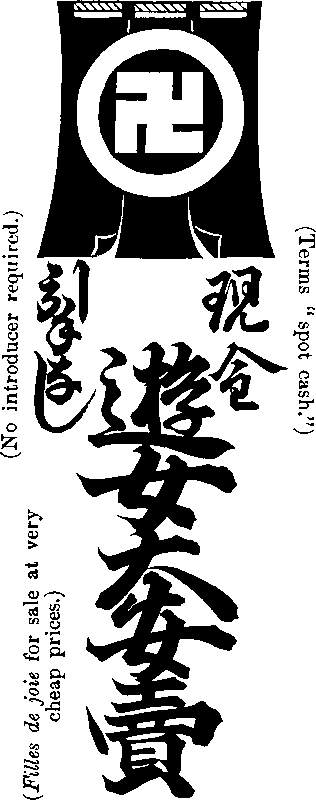

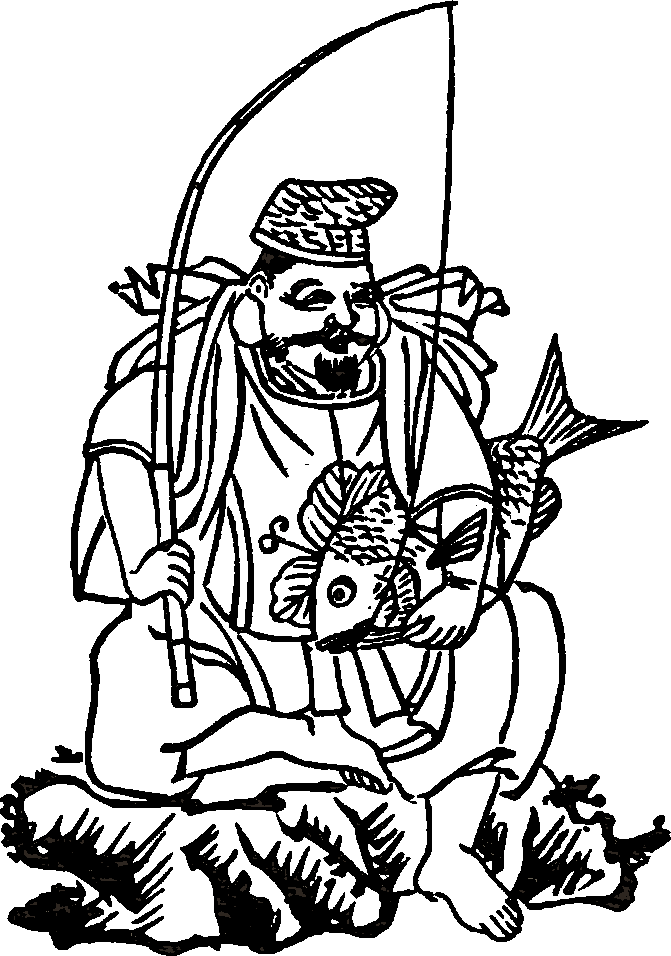

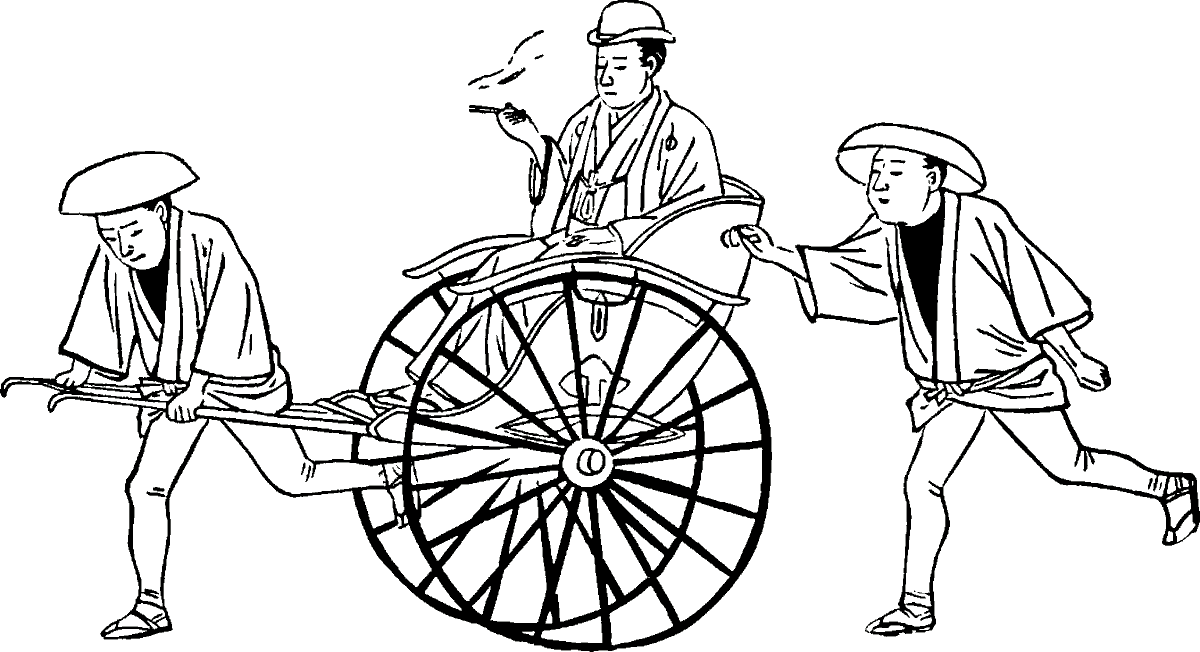
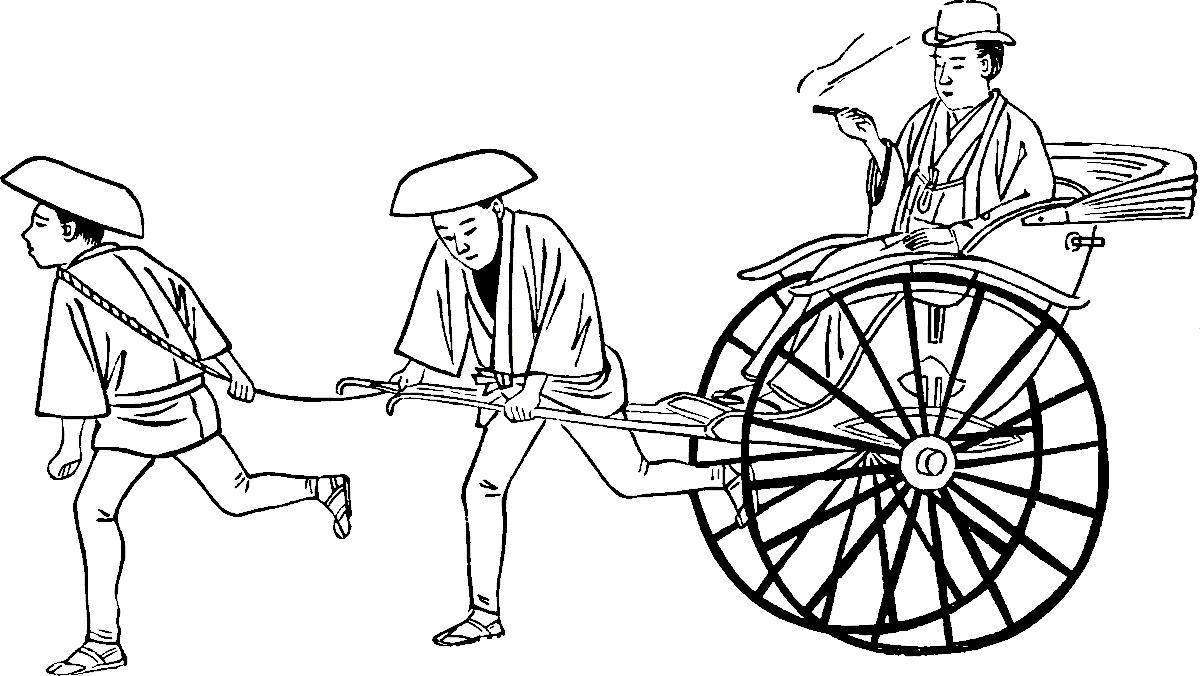
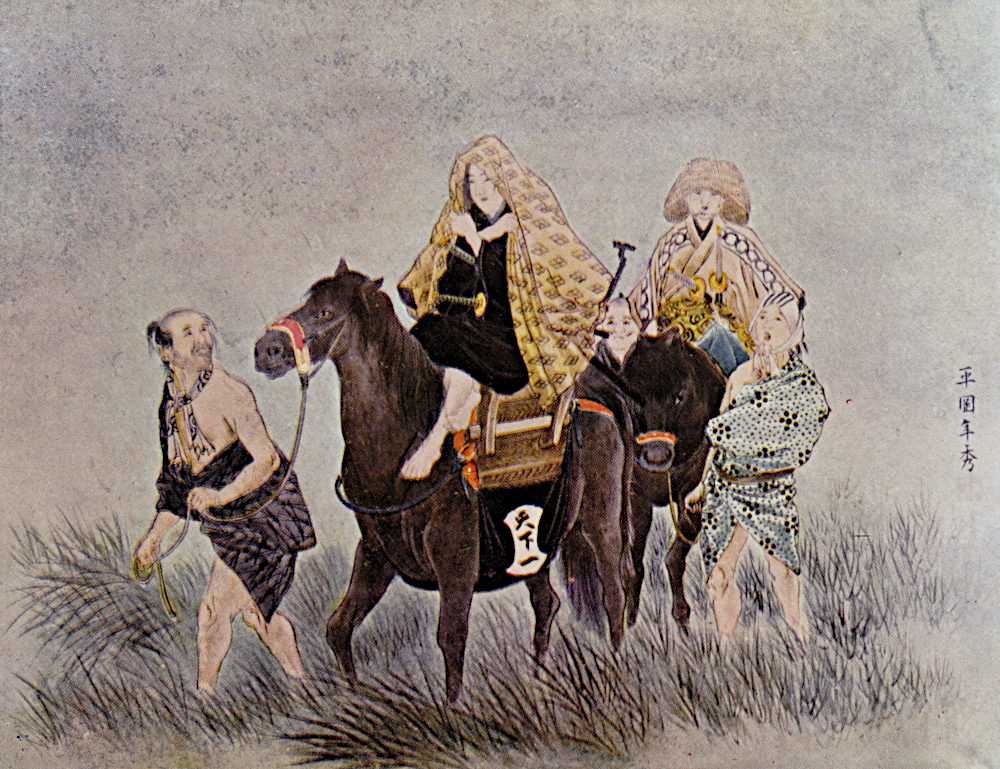
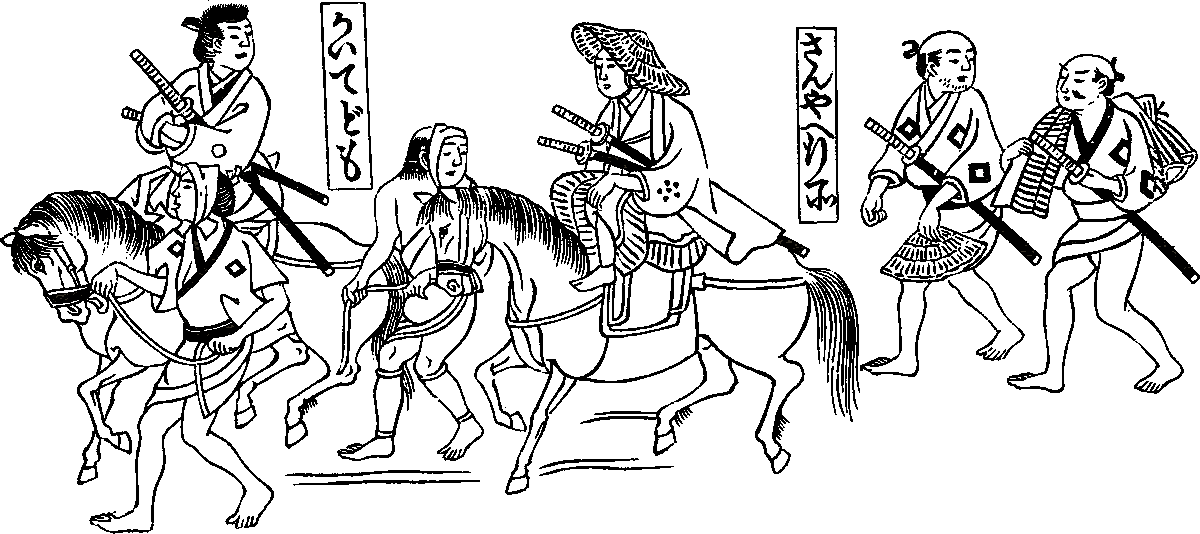
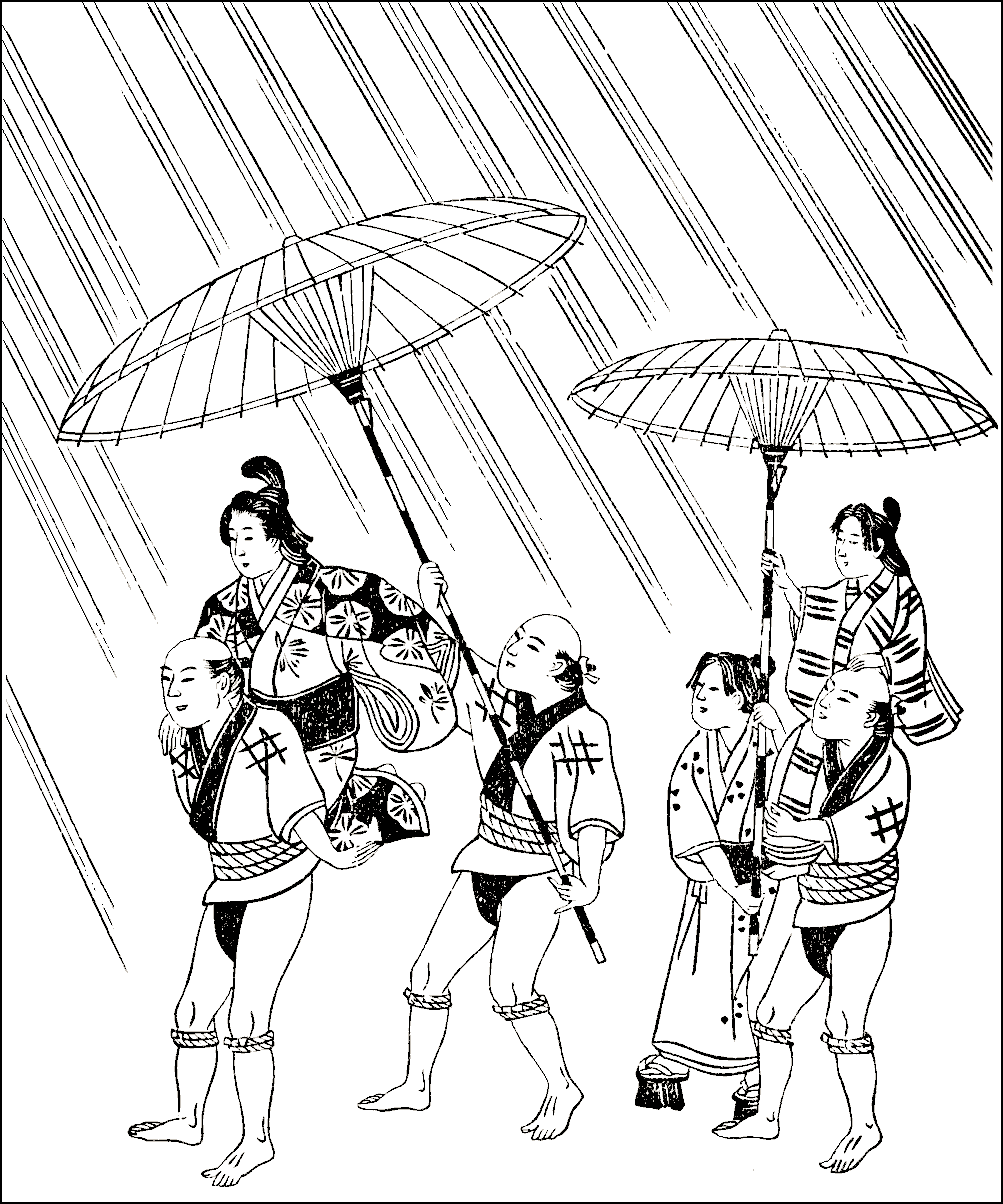
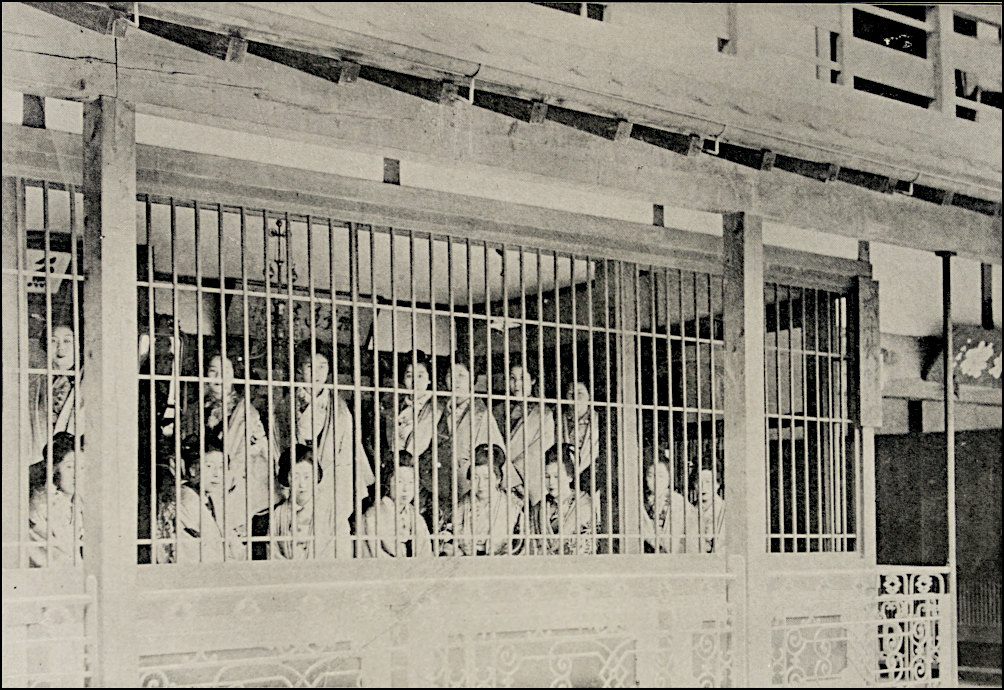
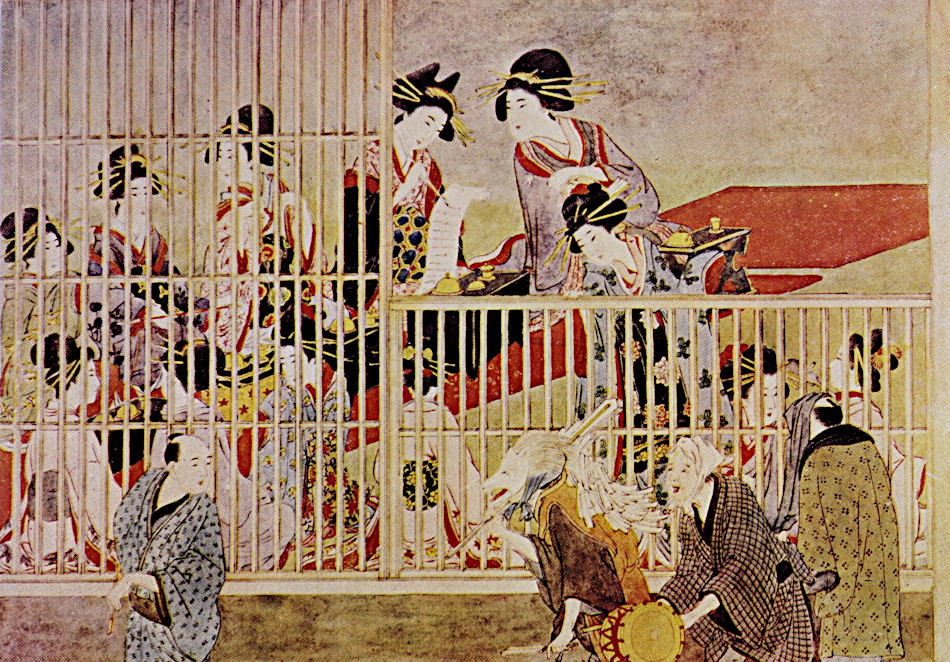
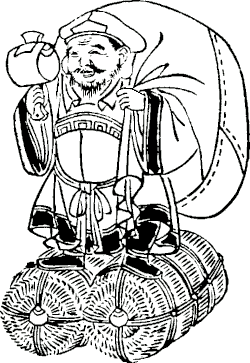
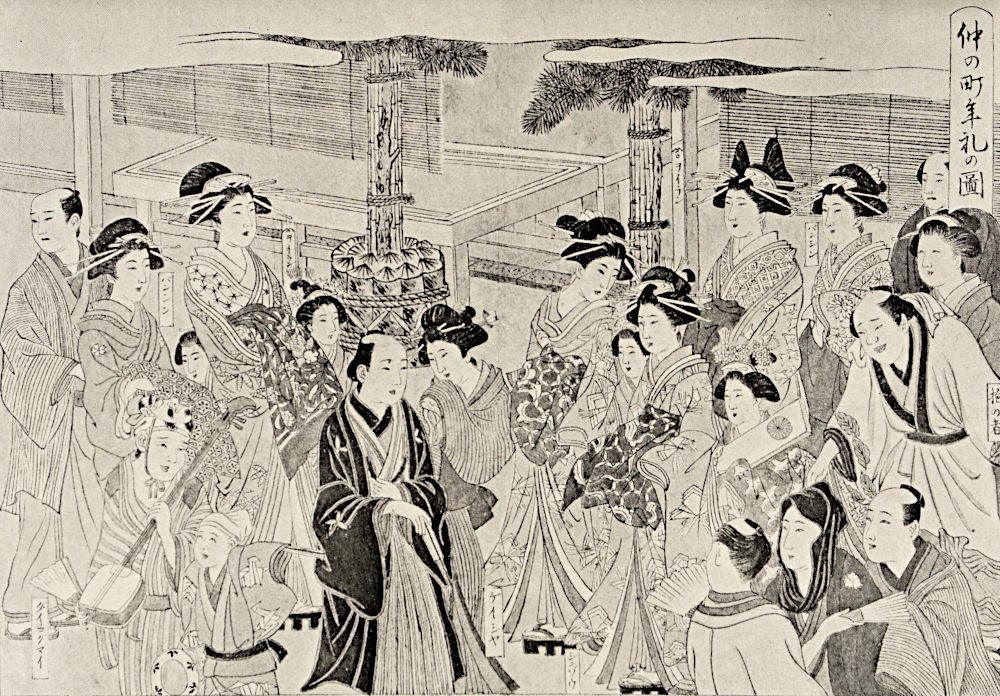
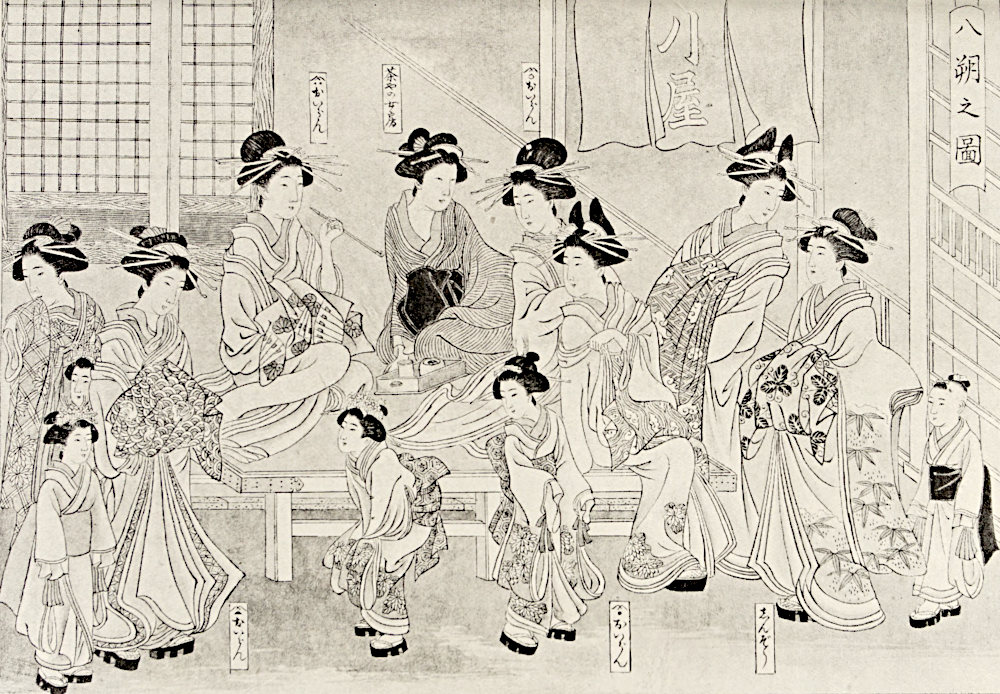
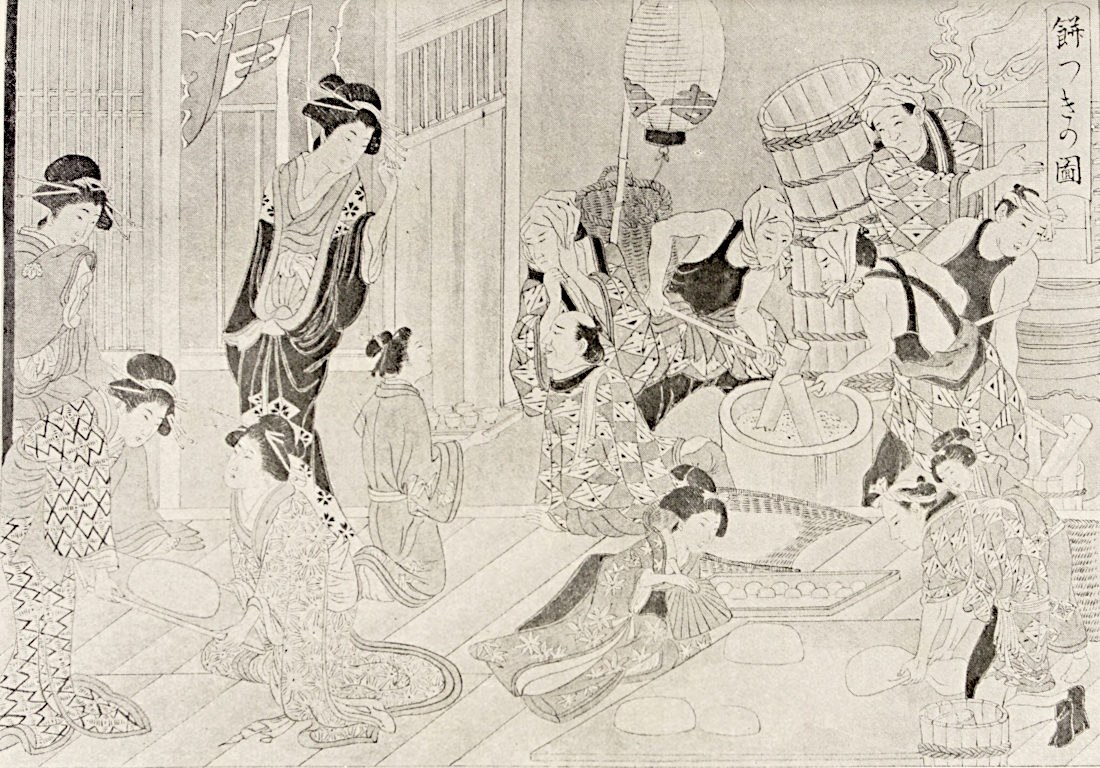
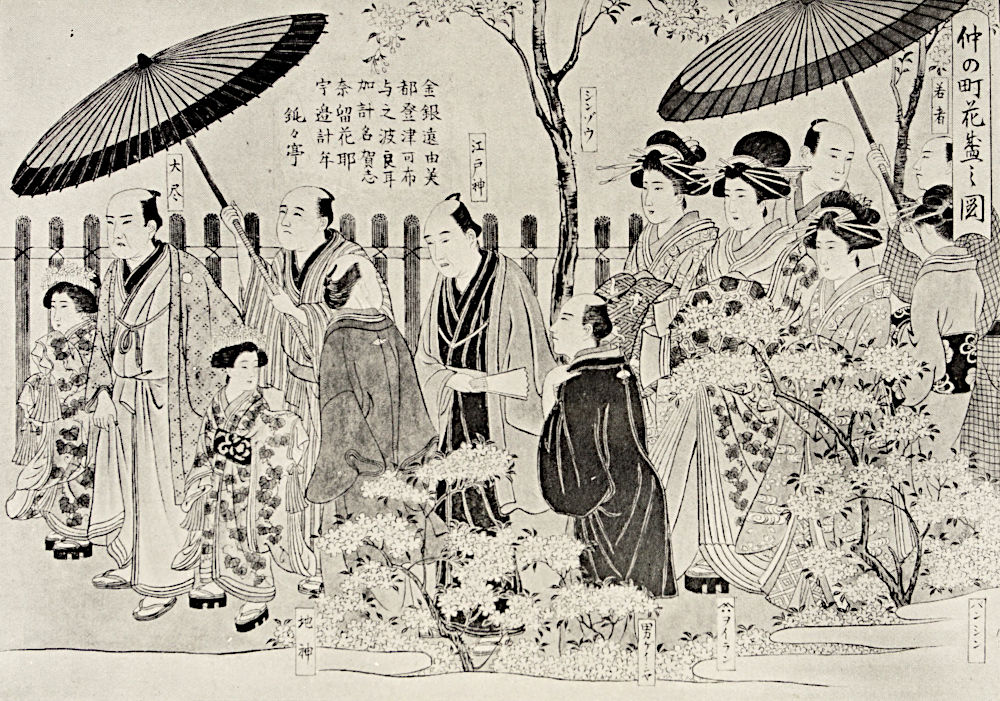
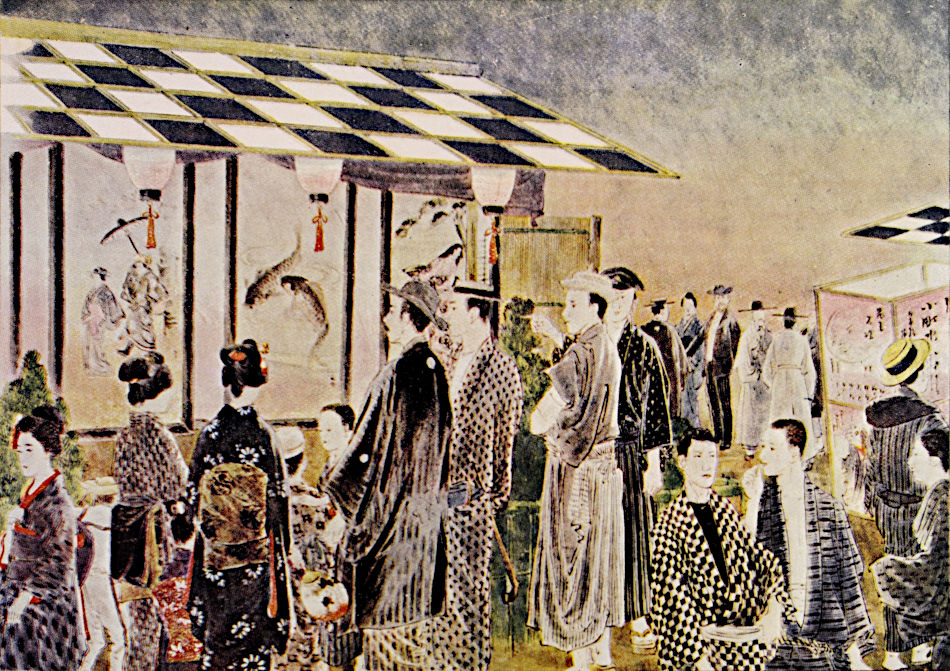
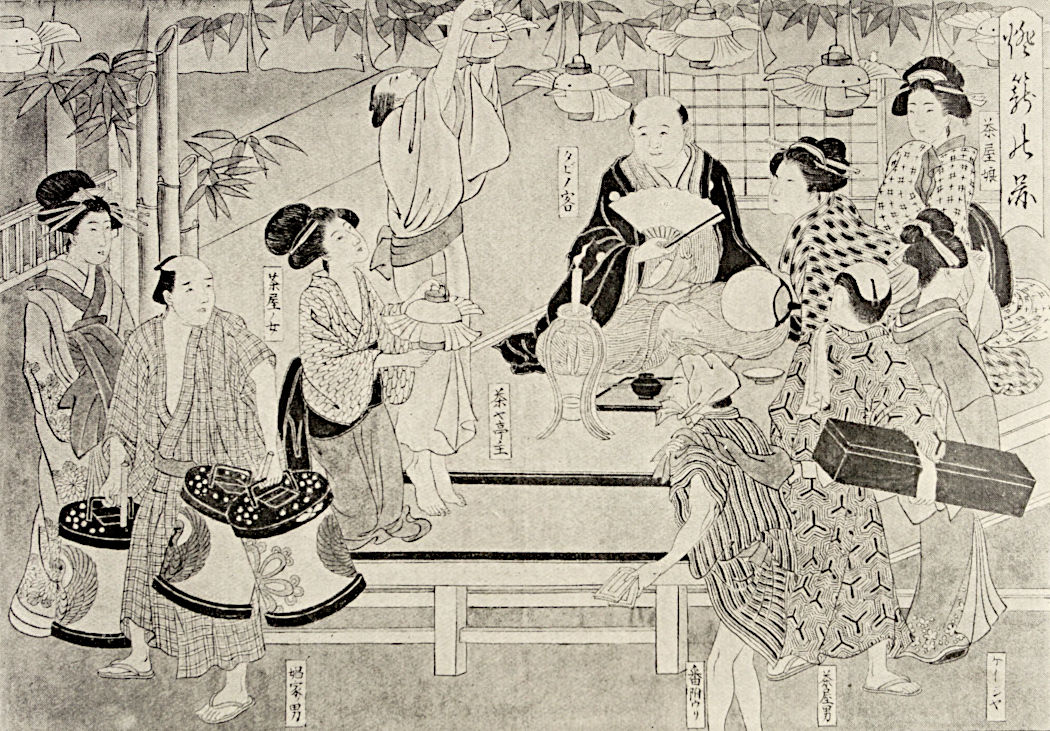
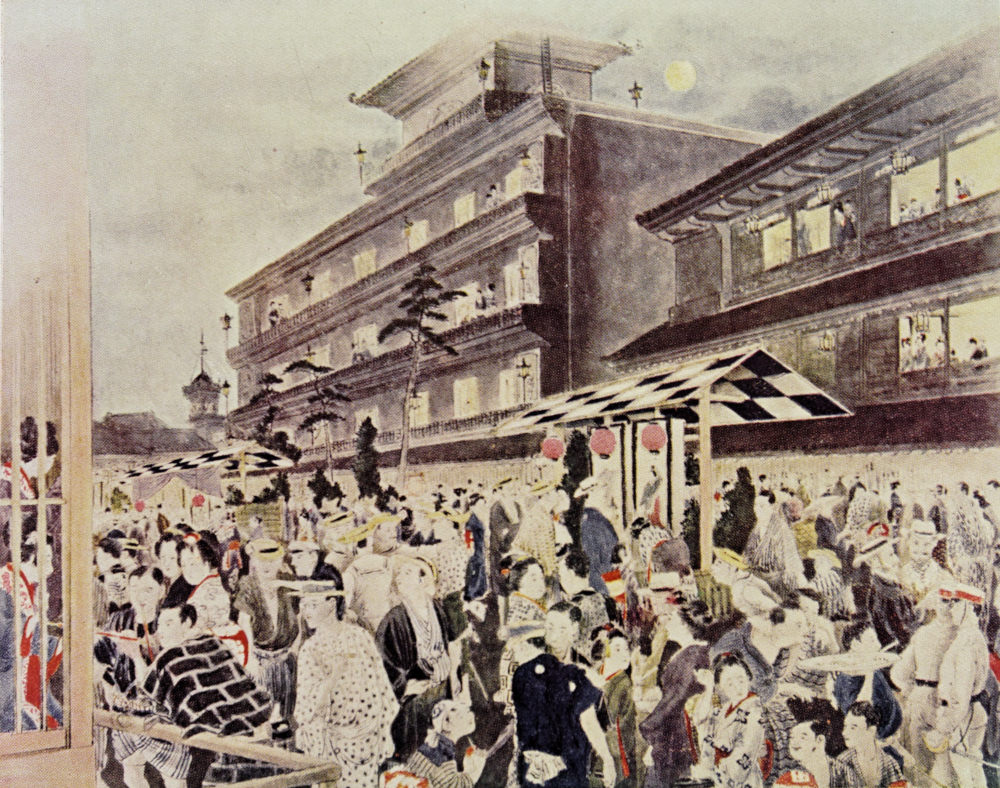
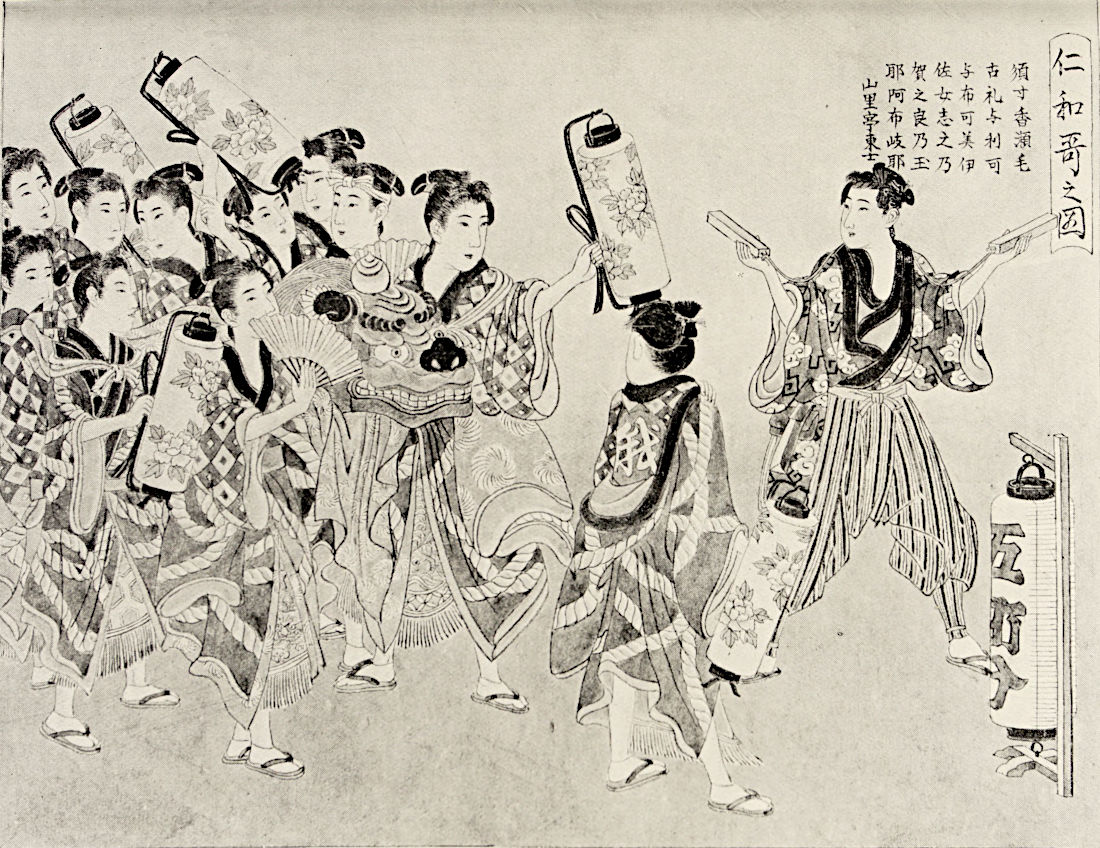
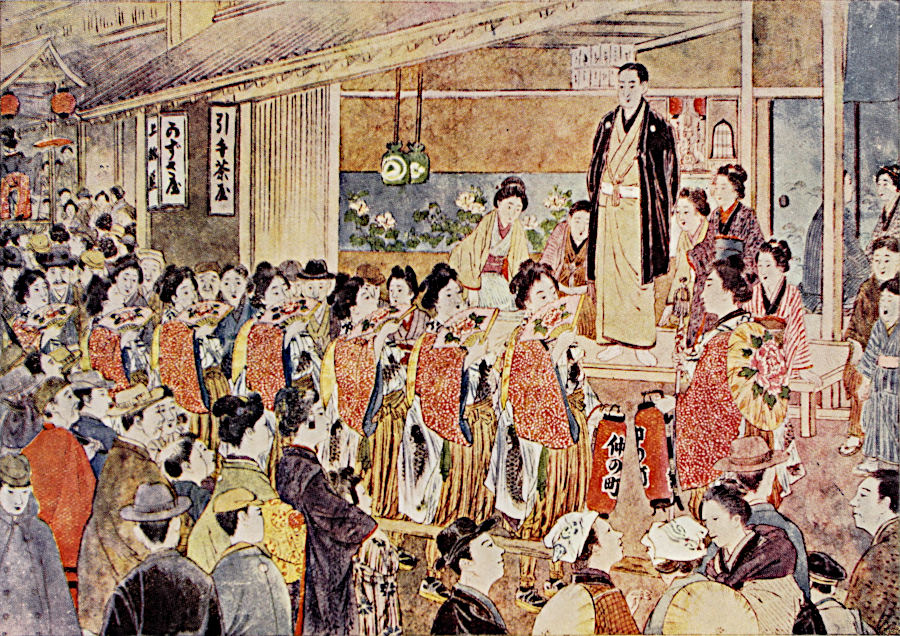
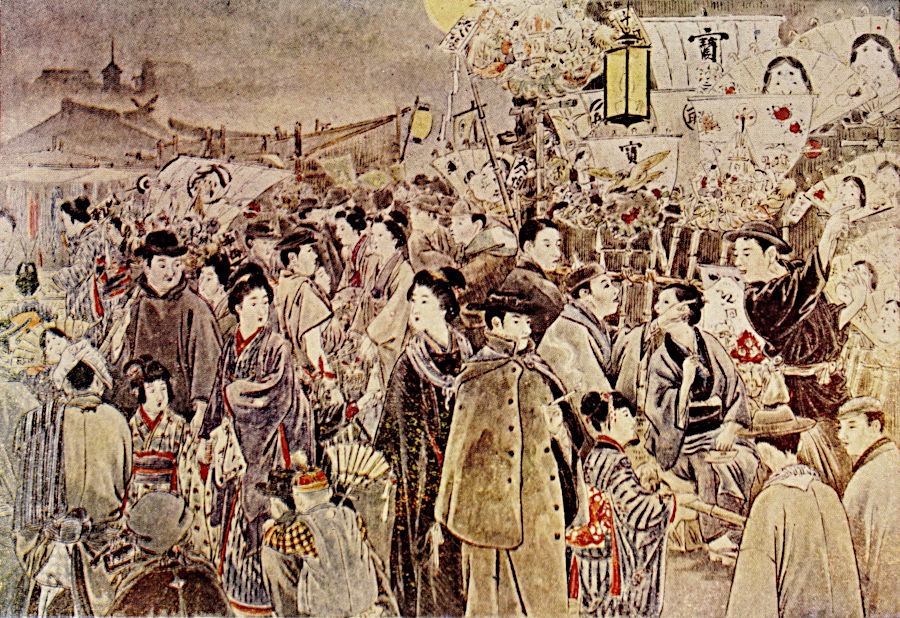
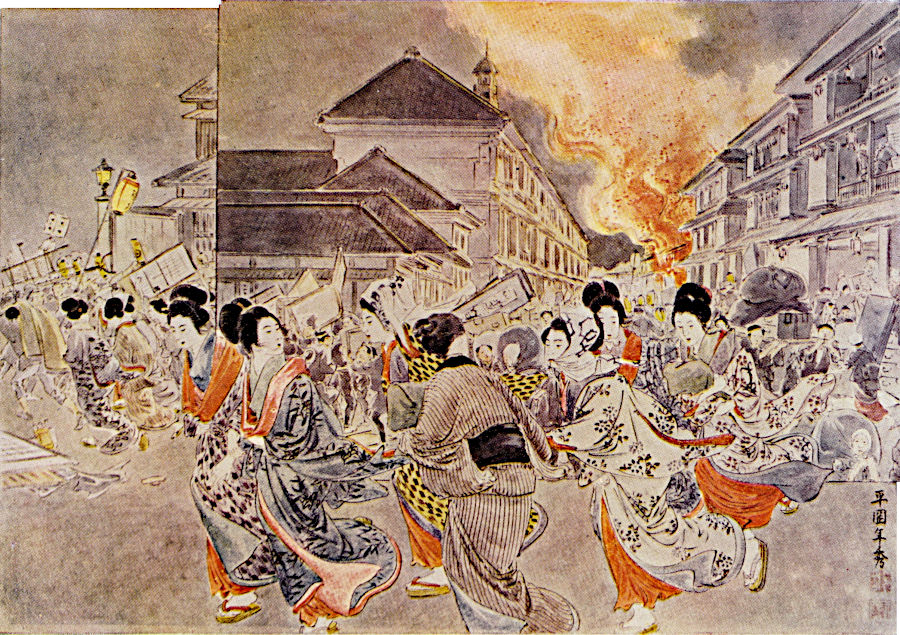

![[SEAL.]](images/seal2.png)