HERBS AND APPLES
HERBS AND APPLES
BY
HELEN HAY WHITNEY
Author of "Songs and Sonnets,"
"Gypsy Verses," Etc.
New York: JOHN LANE COMPANY
London: JOHN LANE, THE BODLEY HEAD
MCMX
Copyright, 1910
By John Lane Company
THE UNIVERSITY PRESS, CAMBRIDGE, U.S.A.
It holds my heart, can you not hear it beat?
So poor a gift to put within your hand—
Apples and Herbs!—but you will understand.
CONTENTS
| PAGE | |
|---|---|
| To Neighbor Life | 1 |
| The Unburied | 2 |
| Up a Little Road | 3 |
| On Cedar Street, New York | 4 |
| Che Sarà Sarà | 5 |
| The Dead Wanton | 6 |
| Leaven | 7 |
| Quaeritur | 8 |
| Love Land | 9 |
| By the Western Gate | 10 |
| For Music | 11 |
| The Little Ghost | 12 |
| Madonna Eve | 13 |
| A Conversation | 14 |
| Be Brave | 15 |
| Forfeiture | 16 |
| The Search | 17 |
| Dust | 18 |
| Nature's Child | 19 |
| Veritatis | 20[Pg viii] |
| The Peacock | 21 |
| Anticipation | 22 |
| The Wayfarer | 23 |
| Renunciation | 24 |
| Arabesque | 25 |
| The Architects | 26 |
| Ambush | 27 |
| The Scales | 28 |
| The Old Tragedy | 29 |
| Taboo | 30 |
| The Rivals | 31 |
| Alone | 32 |
| Beneath the Mask | 33 |
| Thoth | 34 |
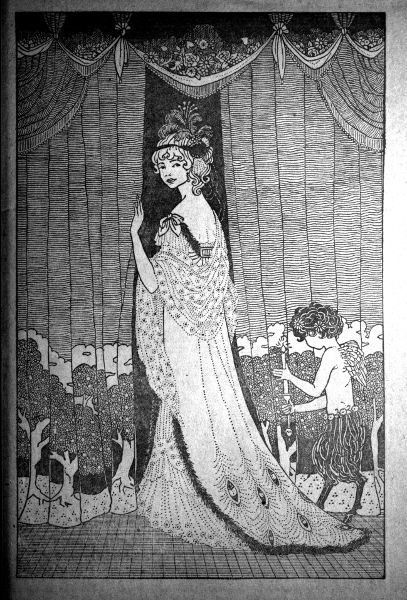
| Little Dancer | 35 |
| Sic Itur ad Astra | 36 |
| The Judges | 37 |
| The Spring Planting | 38 |
| An Impressionist Picture | 39 |
| Such Help for Singing | 40 |
| Tempus Edax Rerum | 41 |
| The Coward | 42 |
| The Lost Romany | 43 |
| Compensation | 44 |
| Untamed | 45 |
| To Pervanche | 46 |
| The Belle | 47[Pg ix] |
| Release | 48 |
| The Thief | 49 |
| I will Write Letters to the Grass | 50 |
| Only This | 51 |
| The Survivor | 52 |
| Megaera | 53 |
| The Song of Mokai | 54 |
| To the Gypsy Man | 55 |
| There is no Danger in Disdain | 56 |
| The Playmate | 57 |
| Afterwards | 58 |
| The Old Maid | 59 |
| Madness? | 60 |
| The Scholar | 61 |
| Wisdom's Secret | 62 |
| Caged | 63 |
| The Wife Speaks | 64 |
| The Altar | 65 |
Acknowledgment is made to Messrs. Harper & Bros., the Century Company, The Metropolitan Magazine, and Collier's Weekly, for courteous permission to reproduce certain of the verses included in this volume.
LIST OF ILLUSTRATIONS
| PAGE | |
|---|---|
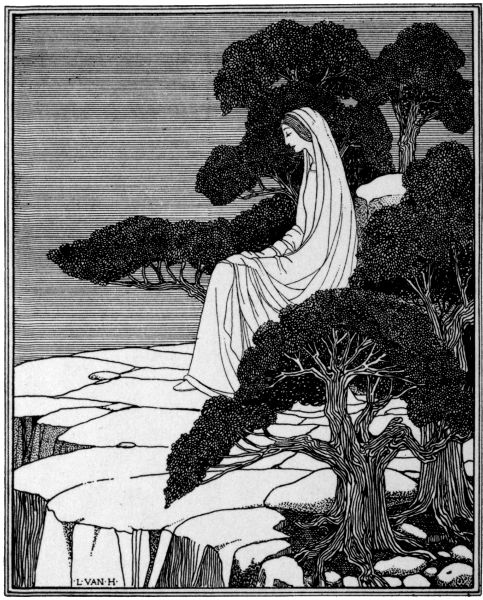
| "To be Alone, to Watch the Dusk and Weep" Frontispiece | 32 |
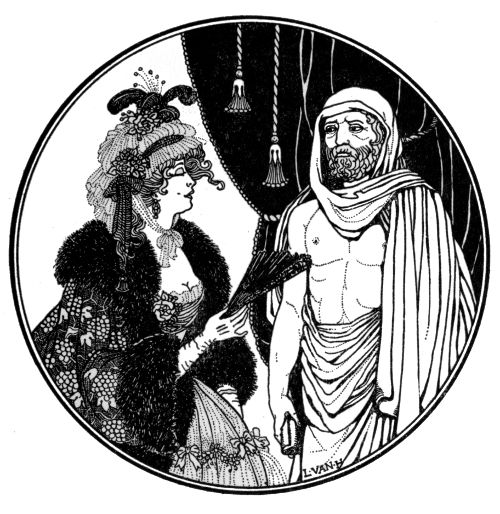
| "Smiling She Flouts Demosthenes" | 6 |
| The Peacock | 21 |
| Little Dancer | 35 |
| The Romany | 43 |
| Pervanche | 46 |
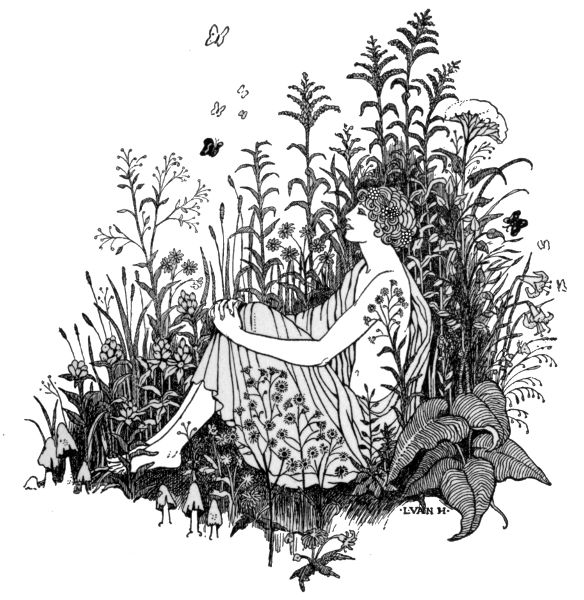
| "And Wrap My Heart Close Shrouded in the Hours" | 50 |
HERBS AND APPLES
TO NEIGHBOR LIFE
Have you any goods to sell?
Let me buy or let me borrow
Joy, to tide me o'er the morrow;
I will give you in exchange
Baskets full of thoughts that range,
Bright utensils of my brain;
Coins of feeling you shall gain.
All I ask in equal measure
Is your store of joy and pleasure.
Neighbor Life, I love you well,
Have you any joy to sell?
THE UNBURIED
Dead and living, hand to hand,
Being Winter, who can tell
Which is sick and which is well?
Standing upright, day by day
Sullenly their hearts decay
Till a wise wind lays them low,
Prostrate, empty, then we know.
Men stand dead upon their feet,
Corpses without epitaph;
God withholds his wind of wrath,
So we greet them, and they smile,
Dead and doomed a weary while,
Only sometimes thro' their eyes
We can see the worm that plies.
UP A LITTLE ROAD
Drenched with dew and tipsy with the madness of the May,
Leafy fingers on my face, I stop not for your charms!
Love is waiting round the turn, to be my Love to-day.
Ah! my pony knows the goal to which his course is laid,
Galloping thro' dawn he knows he bears a little god
Bacchus-mad with happiness who burns to meet his maid.
ON CEDAR STREET, NEW YORK
In the days when earth was new,
Joyous leafy ancestry
Known of twilight and of dew,
Now within this iron wall
Slave of tasks that irk the soul,
To my parents send one call—
That they give me of their dole.
Grimy noise of work-a-day,
Secretly a voice, half drowned,
Whispers thro' the evening's grey,
"Child, we know the path you tread,
Ghost and manes, we are true;
Cedar spirits, long since dead,
Calm and sweet abide with you."
CHE SARÀ SARÀ
Fierce as its central fire,
Man is his own conclusion,
Woman her great desire.
THE DEAD WANTON
She had no wisdom but her face,
Which caught men's fancy like the Spring
Yet held them but a moment's space.
And so the great lean round her feet;
They strive to learn from her fair head
Why far-forgotten life was sweet.
And lapped in languor she agrees
With Kant, and as her soft hair blows,
Smiling, she flouts Demosthenes.
LEAVEN
Busy hucksters on the street,
They will give you what you need,
All the facts your life to feed.
I can give my love but mirth;
Let, oh let this part be mine,
I would be your salt and wine.
QUAERITUR
That love is utterly and wholly mine,
What if I found that faith should not endure
And all my trust in you I should resign;
To your dear heart they find no resting place,
But all misunderstood, far, foreign words,
They die away like strangers at your face.
And when I wonder, give the faith I seek
Perfectly trusting, let me end in you
Heart against heart, and cheek upon your cheek.
LOVE LAND
Where is bright Cathay?
These are lands where we should go
To live and love to-day.
Over all the sun,
Tropic, spicy-laden breeze
To lull when day is done.
With the tides we'd rove;
We be natives of no land
Save the land of love.
BY THE WESTERN GATE
That fronts the falling sun I shade my face
And watch for you. As one who's lost the race
Tries to demand no further gift from Fate
Lest he be hurled more low, so I, who wait
And want you, ask no pity of your grace
On my defeat, I only long to trace
My lost heart; come to me, my need is great.
They stand about my door, their hearts, I know
Are breaking in the poppies that they bring.
I cannot love them for I am not wise;
Ah, come, or else forever let me go,
I grow so tired with waiting in the Spring.
FOR MUSIC
Oh, red, red lips like a crimson rose,
Oh, slender hands with the tips of red,
You are lost in the land of Nobody-knows.
The water flows in a silver stream,
But never returns on its moon-white track,
They are gone, past recall, like a lovely dream.
Where sweetest honey awaits the bee;
Come back, come back for a single hour,
Dear Love, my Summer, come back to me.
THE LITTLE GHOST
Who only lived for play,
Ah, why was she the one condemned
To dark and dreams for aye!
Was as a rose's breath,
And now she treads eternally
The gusty walks of Death.
MADONNA EVE
The sweet faint fragrance that enslaves my sense?
What subtle love trick taught you to be fair
With overt lure and covert reticence?
A hungry emerald like the desiring sea,
But warm upon your heart lie pearls of rest
What man could exorcise such witchery?
A CONVERSATION
Rove the world with me.
Fields and towns and pretty lands
Together we would see.
There be workers everywhere,
You would not be missed.
Come, ah come, and take for yours
The mouth you never kissed!"
So I may not go.
Only those who hate to toil
The true enjoyment know;
But could you love a larrikin
Whose task he'd so resign?"
"Yes!—I'd love a larrikin
If only he were mine."
BE BRAVE
If in the crazy warp and woof you gleam
With the insistence of determined suns,
Shine, being true and modest in your dream.
Draw from her breast your milk, nor weep the high
Duties for lack of which you now despond,
Made for historic planets thro' the sky.
Be you courageous in your light despair;
Sure that you fill a space of unknown need,
Idle and green in the bright coat you wear.
Jester or Gypsy, Body, Brain or Soul,
Filling with perfect cheer your place on earth,
So shall the tapestry of Time be whole.
FORFEITURE
Shall fade at length to mere despondency
What will the answer to this problem be?
They say that nothing dies, that all we stake
Brings some unknown return; what then shall make
An adequate exchange for love, to see
Your hand held out in friendship?—as for me
The episode is ended, for life's sake.
But now it ends for you. I am not brave
To love you seared; I have no happy days
To brood upon at dusk, and so I claim,
As all the wager that good fortune pays,
Complete obliteration of your name.
THE SEARCH
There hangs the chalice of sapphire, the infinite sky,
Why thro' the space of despair should my spirit be hurled
Seeking for truth, when beneath lies this pearl of a world?
Comforting joy may not give us the absolute whole,
But if the seers should be wrong, may the truth not be ours
Thanking dear Life for its light and its beautiful hours?
DUST
That midst your myriad particles for me
Might come one atom out of Ispahan,
One spiced far memory of caravan.
To dissipate monotony, and purge
The spirit of its spleen; one with the man
Who takes the sun blue air of Ispahan.
NATURE'S CHILD
His word was wisdom and his strength was sure;
His courage in the ills he had to bear
Made others strong and able to endure.
I asked no love, no tribute of the sense
For his companionship was recompense.
He smiled on me as he on others smiled,
But one grey day a chill was in the air
And then to prove that I was Nature's child,
He spoke—"I do not love you very much—"
And all my friendship shattered at the touch.
VERITATIS
I pondered. Shall we still strive on? forsooth
There is no better, that is good as Best,
There is no truer that is true as Truth.
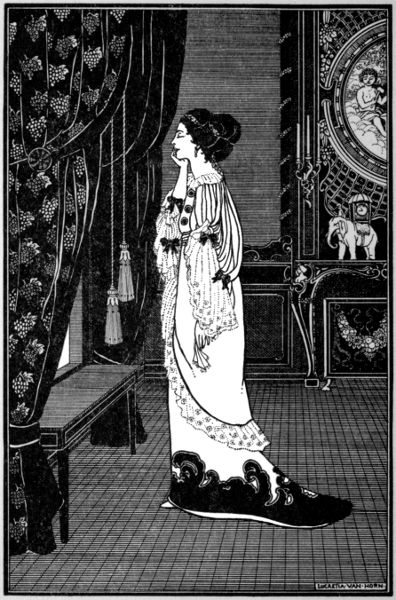
THE PEACOCK
Luring, compelling as the smile of Fate;
Like a poor wastrel, I for her delight
Squandered my soul and gained her idle hate.
Peacock and paroquet!—at last I know
The sorriest songsters make the bravest show.
ANTICIPATION
Our dream is wonderful with flowers, we name
The purlieus of our garden and the aim
Is worth the effort, yet we cannot know
The garden will be just a garden, so
The dream is heaven. This way mothers frame
The child's high dedication to its fame,
Repaid for all reality may show.
The vast anticipation, rugged man
Joys in the struggle, triumphs over throes,
Vanquished a thousand times he still finds zest
In hope and all his pleasure in a plan
To be fulfilled at length in Heaven?—who knows.
THE WAYFARER
The whole way back again,
Stumbling up the stubborn hill
From the luring lane.
Standing all alone,
I could come and sweep the leaves
From your stepping stone.
Laughing at the rain
But O it's far to Happiness,
A short way back again.
RENUNCIATION
O my Beloved, proves my love for you.
And love can set to love no harder task
Than wistful silence, reticence to sue.
With all my being wailing for a sign.
Ah, if men knew what woman's smiling meant
When fierce and hard the heart cries out "He's mine."
Who say "Be happy, dear, and play your part."
What matter how we yearn, you are our sons
Whose every footfall breaks a woman's heart.
ARABESQUE
As lady Lillith's hair,
Mauve and blue as curling smoke
And water-sapphires there.
I built a little dream,
As a goldsmith cunningly
I made it flash and gleam.
I colored it with love,
Scarlet mouth and breast of pearl
And eyes of turtle dove.
I woo'd her for my bride
But ah! I could not build her soul,
So with the dawn she died.
THE ARCHITECTS
Our house to live and love in?—Shall it be
Only significant to you and me,
Or shall it be a palace where may dwell
Those whom our spirits notice? May we tell
An architect to loose his fancy free
To toss up towers in soaring ecstasy
With Doric dignity or temple bell?
Or shall we build it with our hands, alone,
Working together over wood and stone
To learn an art we never knew, and strive,
Patient, to raise with faith and trust and love,
Fashioned so cunningly it must survive,
A secret cottage in a silent grove?
AMBUSH
You can see the clouds drift by,
Waiting in the dusky fern
For your enemy's return.
Never tell you of my face,
I, you left, to plot and plan
For the ending of a man?—
I have met him unafraid,
We have wandered all alone
Underneath a yellow moon.
Is the waking up to life—
Therefore you, who forced my vow,
Take my all of wisdom now.
Love is merry, love is youth,
We be children, he and I.
Where is your sagacity?
THE SCALES
And love is limited,
And if because my heart is glad
Some other heart has bled.
Of recompense, I pray
That my beloved gained the joy
I did not have to-day.
THE OLD TRAGEDY
I only meant to be so dear you could not let me go.
I held you close against my heart, bending down above you,
As mothers brood above their babes, I loved you, loved you so.
You never felt my tenderness full launched on your desire.
You never knew the friendship and sympathy I brought you.
Ah, Mary pity women when their veins are filled with fire.
You thought me but a siren by your crafty arts beguiled.
I hate myself and scorn you for the honor I have done you.
I leave you, bitter woman, and I came to you a child.
TABOO
Your touch, has made me as a god; to-day
I am magnificent, I am a king
To whom my fellow men must cringe and pray.
I may look once upon the sun and you;
Then, thro' the dawn, with wailing and sad drums
I pay the utter price.—Such is taboo!
THE RIVALS
With Duty by my side,
How I strove to see her charms
And take her for my bride!
And suddenly I heard
The laughing call of Beauty's voice
And all my soul was stirred.
And gone was every doubt,
For who could stay at Duty's side
When Beauty calls without?
ALONE
I saw the days like little silver moons
Cool and restrained shine forth; there were no noons
To make me glad with glory, to atone.
I dreamed of solitude. When one has known
Ardent and eager verity, the tunes
Of semi-truths are sweet, as subtle runes
Attest the bud more dear than flower full blown.
For beauty's face that is so veiled, to know
How exquisite the earth breaths come and go,
To feel my life a silent, empty room
Where lovely thoughts might take new shape and bloom,—
This is the dream that is more dear than sleep.
BENEATH THE MASK
I thought that men were brave,
I said that women gained no faith
For all the love they gave.
I wore a heart of trust,
But laughed in all my lovers' eyes
And vowed their vows were dust.
My thoughts have proved no test,
But still beneath my mask, I say
I know my dreams were best.
THOTH
Blind eyes staring, hands on knees,—
This is Thoth, who shall survive
All your fair divinities.
White Diana, Cupid sweet,—
All their beauty, all their pride,
Lie like ashes round his feet.
Ere this orb dissolves in space
Life's last glimpse to man shall be
Thoth, with his impassive face.
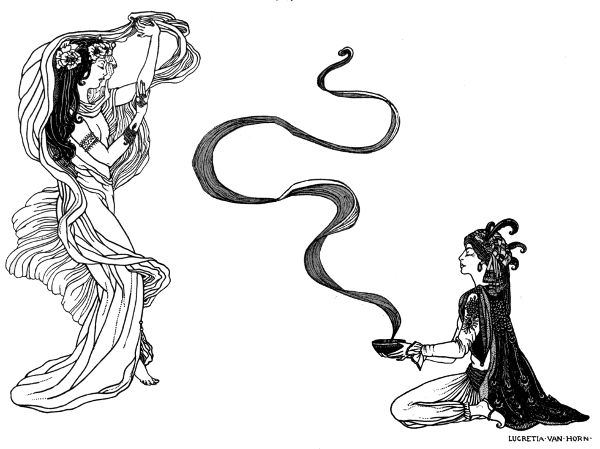
LITTLE DANCER
A candle flame blown by the wind—how soon
Will all this be forgotten! Do you care
The pagan poppies dying in your hair;
Do you despair to think that even as they
Your lovely life will tarnish in a day?
How can we keep you, butterfly!—O must
Such lovely grace resolve itself in dust?
We must believe that some day when you lie
Hid from the lights, beneath the open sky
The trees will bend more perfectly above you,
The flowers dance gayer for they'll know and love you,
And we will mind a little less the cold,
Remembering your grace when we are old.
SIC ITUR AD ASTRA
Salt lipped the wave that is the woe of Earth,
Who could be called a fool? There is no rest
From sorrow in this island of re-birth.
In the penumbra we may all discern
Glowing and gay the promise of a star
For the adventurer with faith to yearn.
THE JUDGES
See if I come to the dusk with stain,
Search me, eyes of the soaring sun,
See what mischief my hands have done.
If there be truth or a scorn of greed,
Give me the peace of your dark, sweet hours,
Let me be still as your moon and flowers.
If there be pander to sordid lusts,
Curse and condemn me to wide-eyed pain,
Judge, and pay me, eyes of the rain.
THE SPRING PLANTING
Seeds of enchantment and seedlings of joy?
Brave little cuttings of laughter and light?
Then shall our Summer be flowery and bright."
"Have we not grass and the weeds and a tree?
Why should we water and weary away
For sake of a flower that lives but a day!"
Tended her apricot, apple and fig.
Then, when one morning he chanced to appear,
Sadly he noticed—"No trespassing here."
AN IMPRESSIONIST PICTURE
She wore was like a golden serpent's skin.
I took her white gloved hand, my voice grew thin
As tho' her hand were tight about my throat.
The air was green with heat, a flaccid note
I did not fail to see, for heat might win
My cause; her weary soul looked from within
And saw the white sails flapping on my boat.
In Isles where morn grows never afternoon,
Where Passion buds forever with the Spring,
Nor wanes with shifting tides of sea and moon,
But—"How are you?" she said, and that was all,
And tho' she smiled, she passed beyond recall.
SUCH HELP FOR SINGING
The little winds a-stir
Touch gently on the lisping leaves
Like dainty dulcimer.
What dreams, what themes they bring—
While gaunt crows cry their gasconade
Down all the ways of Spring.
And round, below, above
The air is thrilling with my joy
Of love, love, love.
TEMPUS EDAX RERUM
The little noise that was your name falls dead.
I can remember how your mouth was red,
In the lost years, but tho' the senses yearn
For some unguessed desire, they never turn
To that vitality, your face!—We sped
So swiftly thro' our burning hour. We said
Drink deep, 't will never end; too late we learn
That lovely passion's face so soon is grey,
That notes too often pressed upon grow dumb,
That after the high climax crowns a day
The dusk seems long and empty. We who come
To taste again Life's feast, why must it be
We meet such ghosts to chill our revelry?
THE COWARD
He was too lame to climb,
And so he sat to wait for Death,
Forgetting to be brave.
From off the trees of Time,
Drop down in mellow chance to him
The while he digged his grave.

THE LOST ROMANY
I knew I could not keep him, so I laughed and let him go.
I do not know the road where his freedom and his bliss is,
So take my sober spinning where no gypsy winds can blow.
I may think no more of perfume and the lingering in the lane;
I will rear me sturdy children, and my soul I will discover,
For I will not love a Romany in all this world again.
COMPENSATION
Wide-eyed upon the sun,
What matter when such memoried light
Would last till life were done.
Divinely wild, and brave,
What matter with such dreams to dream
Within the quiet grave.
UNTAMED
Weary so with your caresses,
As the hooded hawk returning
To its tinkling bells and jesses,
So we flutter to the prison
Of your arms, in meek surrender,
And we grieve when you are angry,
And we smile when you are tender,
But our souls, untamed, are soaring
Where no blandishments can teach them,
Free our hearts, and free our spirits,
Where your hands can never reach them.
TO PERVANCHE
That see you, weary of their innocence)—
If prayers that have been pale with penitence
Grew purple with our passion, all the hours
From sun to sun would be unique with bliss,
Little red mouth that is not mine to kiss!
And so I am magnanimous, I give
My love and you to Time, and you shall live
Bride of his avid passion. I will see
The moon of all this lure and beauty set,
And I will turn from you and quite forget.

THE BELLE
So rare, so fine to see.
Her bonnet was of Tuscan straw,
Her shawl was Turkey red.
She peacocked gay before men's eyes,
This lady of degree,
On slippered tiny feet, and ah!
She wished that she were dead.
She was the toast of town;
But no one knew who called her cold
What cruel wound had she.
The laughing gallant that she loved
Had scorned her high renown,
And now another bore his babe,
And held it on her knee.
RELEASE
One dreads each green renewal of the grain,
Reviving ancient life. If but the brain
Might be made clean of last year's withered lies,
Blown like brown leaves across the April skies
In hateful resurrection, and retain
Only the springs of promise, fine and sane,
And a kind, leading hand to make us wise.
Each year might be accomplished, strong and free
With the sweet prescience of virginity,
Then were we true inheritors of earth,
And the large lonely stars no more should see
The age worn phoenix-lives that make our dearth.
THE THIEF
He robbed me of my happiness before I knew its worth.
He stole into my garden and took it by surprise,
When midnight hid his wicked ways upon the sleeping earth.
Took away my April 'neath his cloak of steaming rain.
Tho' he left his Summer and a choir of birds that sing,
Nothing will content me for I want my Spring again.
I WILL WRITE LETTERS TO THE GRASS
I will sing all my songs to lilac flowers
Gather the spices in the airs that pass,
And wrap my heart close shrouded in the hours.
Thro' the inviolate silences of Spring
Like a marauder, waking that which sleeps
To gather strength for lyric blossoming.
The world shall be resolved into a cry
Faint as a little voice that cries Alas!
And I will laugh alone beneath the sky.
ONLY THIS
We might dispense with documents and creeds,
If but this one great grace to us were given—
The strength to follow where our reason leads.
THE SURVIVOR
Love rarely lasts for a year,
Virtue is sold for the asking,
Bravery fades before fear.
One thing of all is alive,
Joy cannot quench it, or sorrow,
Folly alone shall survive.
Toys for the great and the small,
None shall escape her by learning—
Folly has rattles for all!
MEGAERA
With woe that groweth every day more deep;
To don the green robe of tormented scorn,
And ever curse the hour that love was born!
Furies, my Sisters! have you no surcease
For me to whom no death shall bring release?
The ages hold me high to endless shame;
How, if I suffer so, does no one care
And pity, for the wrath that I must bear?
Gods! let me go, your service wrecks and sears,
The vase must break that holds so many tears.
THE SONG OF MOKAI
He cast a spell on my mate,
They loved, and the moon whirled 'round the sky,
They mocked at my rage and hate.
The sun rose, and I knew!
My soul whined wild little songs to me,
I did what I had to do.
I have fashioned it into a horn;
And I sing my soul's song, shrill and high,
And curse the day he was born.
TO THE GYPSY MAN
Where a woman's love might lie
Warm and sheltered, your prize and song,
As you wander beneath the sky?
I must be free, be free;
I'll carry no love in my gypsy heart
To make a drag for me."
That shelters you from the storm;
Love makes the shoes for your gypsy feet,
Love is your coat so warm.
You cannot escape the load
Of a woman's longing and woman's love
That follows you down the road.
THERE IS NO DANGER IN DISDAIN
No grief in perfidy;
The meek they are who taste of pain
And matchless misery.
Could they but learn the way
To take, and laugh and then deny,
They still might live their day.
THE PLAYMATE
Free as the water and the wind are free;
Eyes of an odalisque and skin of a peach,
O for such a playmate to play with me!—
How we would tumble in the white wild spray;
Then, drowsy children, fall asleep like the flowers,
And wake keen and merry to a new clean day.
AFTERWARDS
World beaten, tossed aside;
Ready for death at a hangman's hand,
Stript of all hope or pride.
Close to your great sweet heart,
Lulled me and told me to be a man,
Taught me your wonderful art.
Proud with your love's true vow;
Glorious with power,—I am more than a man,
What will you do with me now!
THE OLD MAID
I powder and I perfume and I tire
With the long wasting of my one desire.
I choose fair colors, furs, and antique gold
To draw men's eyes and hands, and yet how cold,
How careless are their eyes. I see the fire
Flame from my neighbor, and I can aspire
To only friendship. I have tried the bold,
The luring attitude, the timid mien,
The boyish, wise, or simple, all in vain.
I know the women laugh at me, but oh,
How can I let my dreamed perfection go?
I am a woman, I must have a man
Only to ratify my nature's plan.
MADNESS?
And look as tho' they were not there,
Because I only speak when aught
Occurs to me by way of thought.
I cut my coat to fit my needs.
I laugh at grief and only weep
When noisy life disturbs my sleep.
Was ever wise man so beguiled?—
Mad, am I mad!—then pray that you
May some day hope for madness too!
THE SCHOLAR
What love and laughter taught me to be blind;
How patient did they point the letters out
Latin and Greek to my bewildered mind.
The little 'a' of doubt's first faint distress
Then, letter perfect, I recall the way
Thro' all the alphabet of bitterness.
WISDOM'S SECRET
That life was imminent with idleness,
Their jibes made mad, their lashes aided me
To grasp the accident of bitterness.
For calm inhibits growth!—I called on fire
To sear my comfortable days, and wear
The nights to wastes of torment and desire.
I met with Wisdom laughing in the sun;
She said, "Lie still, for idleness is good,
And grow in peace as I myself have done."
CAGED
They put me in a cage, I did not die.
They tamed me, taught me tricks and bade me sing;
I waited, bore it patiently; one thing
I knew, that some day it might be
The cage would open and I should be free.
I waited endlessly,—at last the day!
Faint with delight I thought to fly away,
Ah, but the mockery of that open door!—
My wings were powerless, I could fly no more.
THE WIFE SPEAKS
O my Beloved, can stir my jealousy;
Not the light loves which you forgot for me,
For my heart's fingers made by life most deft
Have mended all the rents their arrows cleft
And from their old enchantments set you free.
But one is my despair, and only she,
The one who loved you, hopeless and bereft.
As she, unloved who gave with scorn of gain?
So do the angels; at her name I smart
And feel a sordid bargainer who gives
For fair exchange; I cannot heal the pain,
I am defeated by her while she lives.
THE ALTAR
Thro' the slow grey surge of Time,
Some take joy from ruddy war,
Lust of conflict, heat of crime.
Gods may wander newly born,
Every day for each man's needs
Bringing blessings thro' the morn.
Open heart and hand for play,
And a song which none have heard
For my altar of the day.
RECENT POETRY
THE COMPLETE WORKS OF WILLIAM WATSON
UNIFORM EDITION. 3 vols. Cloth. 12 mo. $4.00 net per set. Postage 25 cents. Half Morocco. $12.00 net. Postage 25 cents.
Sold separately as follows
POEMS. 2 vols. $2.50 net. Half Morocco, $7.50 net. Photogravure Portrait. Postage and packing 20 cents.
The lover of poetry cannot fail to rejoice in this handsome edition.—Philadelphia Press.
A glow of inspiration that merits better than that of any living poet the high adjective, Vergilian.—New York Evening Post.
Work which will live, one may venture to say, as long as the language.—Philadelphia Public Ledger.
NEW POEMS. $1.50 net. Half Morocco, $5.00 net. Postage and packing 12 cents.
Contains "On Hearing Samaroff Play," "Vivisection," "Leopold of Belgium," "To Richard Watson Gilder," "To the Invincible Republic," "Sonnets to Miranda," and "The Woman With the Serpent's Tongue."
"To the Invincible Republic" is full of a generous and admiring appreciation. All of these poems are explicit, strong, and interesting.—New York Sun.
Times—William Watson is, above all things, an artist who is proud of his calling and conscientious in every syllable that he writes. To appreciate his work you must take it as a whole, for he is in line with the high priests of poetry, reared, like Ion, in the shadow of the Delphic presences and memories, and weighing every word of his utterance before it is given to the world.
Athenæum—His poetry is a "criticism of life," and, viewed as such, it is magnificent in its lucidity, its elegance, its dignity.... We revere and admire Mr. Watson's pursuit of a splendid ideal; and we are sure that his artistic self-mastery will be rewarded by a secure place in the ranks of our poets.... We may express our belief that Mr. Watson will keep his high and honorable station when many showier but shallower reputations have withered away, and must figure in any representative anthology of English poetry.... "Wordsworth's Grave" is, in our judgment, Mr. Watson's masterpiece ... its music is graver and deeper, its language is purer and clearer, than the frigid droning and fugitive beauties of the "Elegy in a Country Churchyard."
SABLE AND PURPLE. $1.25 net. Postage 10 cents.
Boston Transcript—Still the poet whose inspirational fantasy gives distinction to modern English Literature.
Spectator—A great artist, "Sable and Purple" is of a high excellence.
The Works of Laurence Hope
INDIA'S LOVE LYRICS, including "The Garden of Kama."
12mo. $1.50 net. Postage 10 cents. Half morocco, $4.00 net.
STARS OF THE DESERT: Poems.
12mo. $1.50 net. Postage 10 cents. Half morocco, $4.00 net.
LAST POEMS.
Translations from the "Book of Indian Love." 12mo. $1.50 net. Postage 10 cents. Half morocco, $4.00 net.
COMPLETE WORKS.
Uniform Edition. 3 volumes. In box.
INDIA'S LOVE LYRICS.
STARS OF THE DESERT.
LAST POEMS.
Cloth, $4.50 net. Postage 35 cents. Half morocco, $12.00 net. Postage 50 cents.
SONGS FROM THE GARDEN OF KAMA.
Illustrated from photographs by Mrs. Eardsley Wilmot. Cloth. 4to. $3.00 net. Postage 15 cents.
INDIA'S LOVE LYRICS
By Laurence Hope
The New York Commercial:
Its colors are elemental, silver and gold and red. It is heavy with the breath of citron groves, cool with the tinkling of temple bells, and the air of night, and the cries of wild peacocks and parrots.... In many ways this volume of translation is the most important contribution to poetry that the season has as yet brought forth.
The Baltimore Sun:
There is nothing stale or hackneyed in this book; newness, freshness, and variety are found on every page. These poems are true lyrics, for they give us true glimpses into the hearts of men.
The Chicago Tribune:
A volume of passionate love poems written by a true poet.
The Chicago Inter-Ocean:
They are in several metres, handled always with graceful ease, and often with intensity. The coloring is vivid and the music subtle. The book is redolent with the atmosphere of the Arabian Nights.
The Boston Evening Transcript:
Mr. Hope is a thorough artist to his fingertips, and his choice of words and images is as keen and exact as his ability to adapt Indian literature to the more prosaic mood and tongue of the Anglo-Saxon.
The Athenæum:
Mr. Hope has caught admirably the dominant notes of this Indian love poetry, its delirious absorption in the instant, its out-of-door air, its melancholy.
STARS OF THE DESERT
By Laurence Hope
The Washington Mirror:
The author has so completely infused the charm of the Orient into this volume that one is transported for the time and lost in the poetic beauty of his surroundings, finds no jarring chord nor is disposed to shrink from the frankness of this translation of oriental verse.
It is still a question whether these are direct translations or whether they are written in the Hindu style by Laurence Hope. Perhaps she has done for the Hindu poets what FitzGerald did for Omar.
The Conservator:
He seems to exhale an oriental atmosphere. He sings musically. I can follow the delicate strain by which Hope saves himself from stepping beyond the bounds of a vital reserve.
The New York Star:
The author is imbued with the glowing passion of Eastern romance.
The New York Globe:
The theme, in almost every instance love, is treated with feverish abandon.
KING ALFRED'S JEWEL
THIRD EDITION
By KATRINA TRASK. Author of "Night and Morning," "Mors et Victoria," etc. Cloth, 12mo. $1.25 net. Postage 10 cents. With Colored Frontispiece reproducing the Jewel now at Oxford.
The English speaking world has waited a thousand years for a worthy dramatic impersonation of King Alfred. And here it is.... The play will stand not alone upon the grateful response it wins from the English national heart, but as a work of art.... The author is supremely a poet, the master of metaphor not less than of melody.... It is a play not only to be read but to be acted.... This vivid drama is not cast in the conventional classic mould. It is distinctly and wholly English in spirit and form, and intensely modern—but breathing the air of morning, of springtime, of fresh adventure.—Henry Mills Alden, The New York Times Saturday Review.
King Alfred's noble and vigorous character is limned with great skill, while Elfreda, a graceful and innocent maiden, flits through the play like a woodland fairy.—The Glasgow Evening News, Scotland.
The living Alfred lives in this gracious play, for the author has fashioned his great spirit out of the mist of time.—James Douglas, The Star, London.
ARTHUR SYMONS
POEMS
A Collected Edition of the Poet's work, issued in two volumes, with a Photogravure Portrait as Frontispiece. 8vo. $3.00 net. Postage 24 cents. Half morocco, $10.00 net.
THE FOOL OF THE WORLD AND OTHER POEMS
12mo. $1.50 net. Postage 15 cents. Half morocco, $5.00 net.
Stands at the head of all British poets of his generation.—New York Evening Post.
One of the truest poets that modern England owns.—Bookman.
THE POEMS OF ERNEST DOWSON
Illustrations and a Cover-design by Aubrey Beardsley. An Introductory Memoir by Arthur Symons, and a Portrait. 12mo. $1.50 net. Half morocco, $4.00. Postage 10 cents.
Belongs to the class that Rossetti does, with a touch of Herrick, and something which is Dowson, and Dowson alone.—Dr. Talcott Williams in Book News.
POEMS OF ARTHUR CHRISTOPHER BENSON.
Cloth. 12mo. $1.50 net. Postage 12 cents.
In this volume we have a welcome gathering together of the principal poems issued by Mr. Arthur Christopher Benson during the past sixteen years.... In this new form his poems should make new friends.—London Daily Telegraph.
CARMINA. By Thomas A. Daly.
Cloth. 12mo. $1.00 net. Postage 10 cents.
A collection of poems by this well-known author of Italian, Irish and American verse. The volume contains all of the most popular verses from "Canzoni," in addition to many new ones of equal appeal.
NEW POEMS. By Richard Le Gallienne.
Cloth. 12mo. $1.50.
THE WIND AMONG THE REEDS. Poems
W. B. Yeats. 12mo. $1.25 net. Half morocco, $4.00. Postage 10 cents.
The genuine spirit of Irish antiquity and Irish folk lore—the very spirit of the myth-makers is in him.—Mr. William Archer.
THE RUBAIYAT OF OMAR KHAYYAM
Cloth, 50 cents net; Leather, 75 cents net. Postage 4 cents.
Rendered into English verse by Edward Fitzgerald. With 9 illustrations.
THE ROSARY AND OTHER POEMS
By Robert Cameron Rogers. 12mo. $1.25 net. Half morocco, $4.00. Postage 10 cents.
A Landorian touch of divine simplicity.—The Dial.
THE WORKS OF FRANCIS THOMPSON
POEMS. Square 12mo. $1.75 net. Postage 10 cents.
SISTER SONGS: An Offering to Two Sisters. With Frontispiece by Laurence Housman. Square 12mo. $1.75 net. Postage 10 cents.
NEW POEMS. Cloth. Square 12mo. $1.75 net. Postage 10 cents.
THE HOUND OF HEAVEN. Special Edition. 16mo. 50 cents net. Postage 5 cents. (Also included in "Poems.")
SELECTED POEMS. Cloth, 16mo. $1.50 net. Postage 10 cents.
SAMUEL TAYLOR COLERIDGE
THE POEMS OF. Edited with an Introduction by Ernest Hartley Coleridge, and numerous Illustrations by Gerald Metcalfe. 8vo. $3.50 net. Postage extra. The only complete, definitive, illustrated edition of the poems of the author of "Christabel," "The Ancient Mariner," etc. Several hitherto unpublished poems are included in this edition.
A. E. HOUSMAN
A SHROPSHIRE LAD. New Edition. Cloth, 16mo. $1.00 net. Postage 4 cents. Half morocco, $3.00 net; postage 5 cents.
SAPPHO
Memoir, Text, Selected Renderings, and a Literal Translation by Henry Thornton Wharton. Illustrated in Photogravure. New Edition. $2.00 net. Postage 10 cents.
THE POETRY OF STEPHEN PHILLIPS
PAOLO AND FRANCESCA: A Tragedy in Four Acts. By Stephen Phillips. New Edition with Photogravure Frontispiece after the painting by G. F. Watts, R. A.
12mo Twelfth Edition $1.25 net
New York Times—Nothing finer has come to us from an English pen in the way of a poetic and literary play since the appearance of Taylor's "Philip van Artevelde."
Brooklyn Daily Eagle—It is not too much to say that "Paolo and Francesca" is the most important example of English dramatic poetry that has appeared since Browning died.
Philadelphia Press—"Paolo and Francesca" has beauty, passion, and power.... The poem deserves a wide reading on account of its intrinsic merit and interest.
HEROD: A Tragedy. By Stephen Phillips.
12mo Twenty-First Thousand $1.25 net
Times—Here, then, is a noble work of dramatic imagination dealing greatly with great passions; multicolored and exquisitely musical. Mr. Stephen Phillips is not only a poet, but that still rarer thing, a dramatic poet.
Mr. William Archer (in The World)—The elder Dumas speaking with the voice of Milton.
Athenæum—Not unworthy of the author of "The Duchess of Malfi."
POEMS. By Stephen Phillips. Including "Marpessa" and "Christ in Hades."
12mo Thirteenth Edition $1.25 net
Times—Mr. Phillips is a poet, one of the half dozen men of the younger generation, whose writings contain the indefinable quality which makes for permanence.
Spectator—In his new volume Mr. Stephen Phillips more than sustains the promise made by his "Christ in Hades"; here is real poetic achievement—the veritable gold of song.
Literature—No such remarkable book of verse as this has appeared for several years.
MARPESSA. By Stephen Phillips. With Illustrations by Philip Connard.
Cloth, 50 cents net Leather, 75 cents net
William Dean Howells—Tennyson at his age had not done better.
NEW POEMS. Including "Iole: A Tragedy in One Act"; "Launcelot and Guinevere," "Endymion," and many other hitherto unpublished poems.
12mo. Cloth, $1.25 net. Half mor., $4.00 net. Postage 10 cts.
RECENT POETRY
SELECTED POEMS OF JOHN DAVIDSON
12mo
Leather, $1.50 net Cloth, $1.25 net
The Nation—An uncommonly masculine volume.
Chicago Record-Herald—What every admirer of this virile poet desires, a brief summary of his important work from which an adequate conception of his style and versatility can be obtained.
Athenæum—There is urgent need for a collected edition of Mr. Davidson's poems and plays. The volume and variety of his poetry ought to win for it wider acceptance. It is indeed curious that poetry so splendid as Mr. Davidson's should fail to get fuller recognition. There are many aspects of his genius which ought to make his work popular in the best sense of the word. He has almost invented the modern ballad.... He handles the metre with masterly skill, filling it with imaginative life and power.
Times—There are not more than two or three living writers of English verse out of whose poems so good a selection could be made. The poems in the selection are not only positive—they are visible.
Literary World—We count ourselves among those to whom Mr. Davidson has made himself indispensable.
Daily Mail—Mr. Davidson is our most individual singer. His variety is as surprising as his virility of diction and thought.
St. James's Gazette—This volume may serve as an introduction to a poet of noble and distinctive utterance.
New Age—The book contains much that Mr. Davidson's warmest admirers would best wish to remember him by. There is a subtle charm about these poems which eludes definition, which defies analysis.
T. P.'s Weekly—Mr. Davidson is one of the most individual of living poets; he has a rare lyrical faculty.
Morning Post—Mr. Davidson is as true a poet as we have now among us ... he has included nothing that we do not admire.
Daily Graphic—This delightful volume.
Dundee Advertiser—Its poetry gives out a masterful note.... Mr. Davidson's poem pictures.
Transcriber's Notes
In The Chicago Tribune review for STARS OF THE DESERT by
Laurence Hope, "she" may be a typo for "he."
(Perhaps she has done for the Hindu poets what FitzGerald did)
In the List of Illustrations: "To be Alone, to Watch the Dusk and Weep"
has two links: page 32 links to the poem and Frontispiece
links to the illustration.