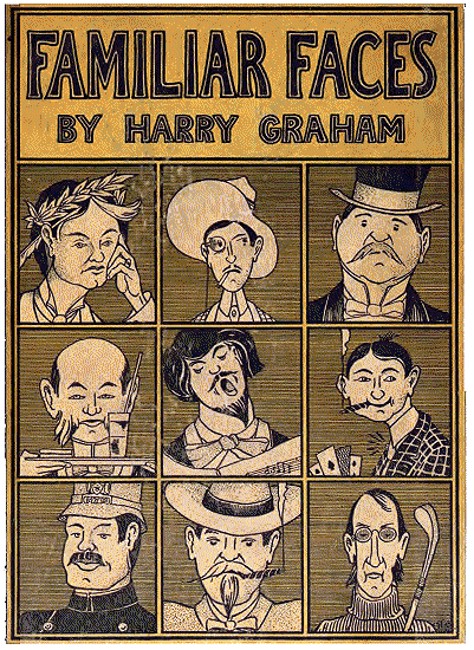
FAMILIAR FACES
By the Same Author
FAMILIAR FACES
BY
HARRY GRAHAM
Author of "Ruthless Rhymes for Heartless Homes," "Misrepresentative
Men," "Misrepresentative Women," etc., etc.
Illustrated by Tom Hall
New York
DUFFIELD & COMPANY
1907
Copyright, 1907, by
DUFFIELD & COMPANY
Published August, 1907
THE PREMIER PRESS, NEW YORK.
CONTENTS
PAGE
The Cry of the Publisher 7
The Cry of the Author 9
The Fumbler 11
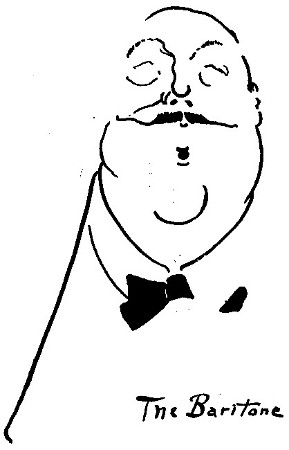
The Baritone 15
The Actor Manager 20
The Gilded Youth 25
The Gourmand 29
The Dentist 36
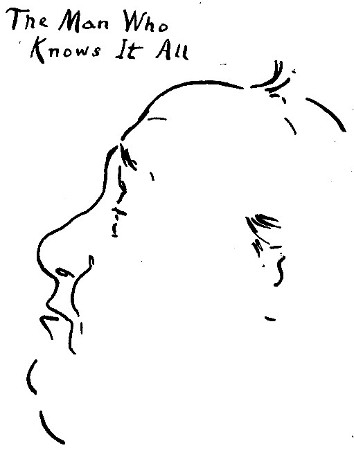
The Man Who Knows 38
The Faddist 44
The Colonel 47
The Waiter 50
The Policeman 54
The Music Hall Comedian 58
The Conversational Reformer 63
King Leopold 67
"Bart's" Club 71
The Reviewer 74
L'Envoi 77
LIST OF ILLUSTRATIONS
| The Man Who Knows it All | Frontispiece | ||
| The Baritone | Facing Page | 16 | |
| The Actor Manager | " | " | 22 |
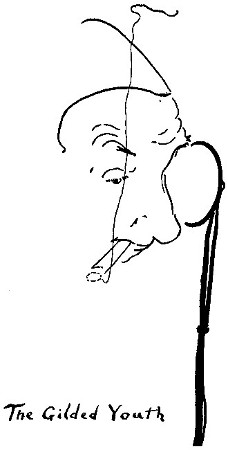
| The Gilded Youth | " | " | 28 |
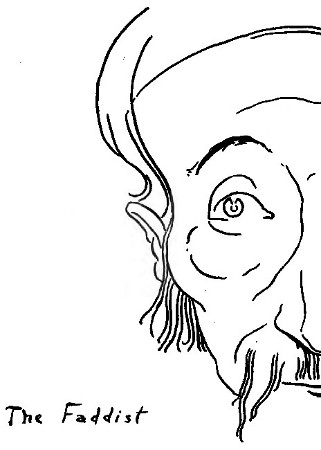
| The Faddist | " | " | 44 |
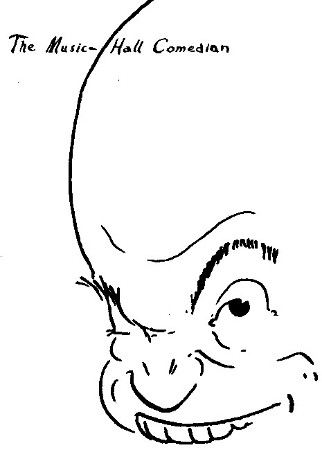
| The Comedian | " | " | 58 |
| King Leopold | " | " | 68 |
| The Reviewer | " | " | 74 |
THE CRY OF THE PUBLISHER
Does its message fail to reach you in your den,
Where the ink that once so sluggishly was crawling
Courses swiftly through your stylographic pen?
'Tis the season when the editor grows active,
When the office-boy looks longingly to you.
Won't you give him something novel and attractive
To review?
If you only can be striking and unique,
The reviewers will concede you half a column
In their literary journals, any week.
And 'twill always be your publisher's ambition
To provide for the demand that you create,
And dispose of a gigantic first edition,
While you wait.
Try to expiate the failures of the past,
And just ask yourself dispassionately whether
You can't give us something better than your last?
If you really—if you truly—are a poet,
As you fancy—pray forgive my being terse—
Don't you think you might occasionally show it
In your verse?
THE CRY OF THE AUTHOR
Of your censure I am frankly growing tired.
With your diatribes eternally before me,
How on earth can I expect to feel inspired?
You are orderly, no doubt, and systematic,
In that office where recumbent you recline;
You would modify your methods in an attic
Such as mine.
(Where the mouth found less employment than the hand);
If your rhymes would lend your humour no assistance,
And your wit assumed a form that never scann'd;
If you sat and waited vainly at your table
While Calliope declined to give her cues,
You would realise how very far from stable
Was the Mews!
With the patient perseverance of a drone,
While some tactless but enthusiastic neighbour
Played a cake walk on a wheezy gramophone,
While your peace was so disturbed by constant clatter,
That at length you grew accustomed—nay, resigned,
To the never-ending victory of Matter
Over Mind.
[Pg 10]
In the shelter of some fashionable club,
I am starving, very likely, in a garret,
Off the street so incorrectly labelled Grub,
Where the vintage smacks distinctly of the ink-butt,
And the atmosphere is redolent of toil,
And there's nothing for the journalist to drink but
Midnight oil!
When one isn't in the true poetic mood,
When one contemplates the prospect of starvation,
And one's little ones are clamouring for food.
When one's tongue remains ingloriously tacit,
One is forced with some reluctance to admit
That, alas! (as Virgil said) Poeta nascit-
-Ur, non fit!
Do not treat him with the harshness he deserves,
For, in fact, altho' you little seem to know it,
You are gradually getting on his nerves.
Kindly dam the foaming torrent of your curses,
While I ask you,—yes, and pause for a reply,—
Are you writing this immortal book of verses,
Or am I?
I
THE FUMBLER
With anæmic lemonade!
Let us toast our fellow-fumbler,
Who was surely born, not made.
None of all our friends is "dearer"
(Costs us more—to be jocose—);
No relation could be nearer,
More intensely "close"!
"Oh, I say, do let me pay!"
Watch him in his pocket fumbling,
In a dilatory way;
Plumbing the unmeasured deeps there,
With some muttered vague excuse,
For the coinage that he keeps there,
But will not produce.
You alone provide the fare;
Not for all a monarch's ransom
Would he pay his modest share.
He may fumble with his collar,
He may turn his pockets out,
He can never find that dollar
Which he spoke about!
[Pg 12]
With a sort of old-world grace,
But, when you accept them, proffers
With surprise, an empty case.
Your cigars, instead, he'll snatch, and,
With the cunning of the fox,
Ask you firmly for a match, and
Pocket half your box!
You'll discover, when you've dined,
That your friend has taken care to
Leave his frugal purse behind.
"We must sup together later,"
He remarks, with right good-will,
"Pass the Heidsieck, please; and, waiter,
Bring my friend the bill!"
He comes running up to you,
And exclaims with agitation,
"Take my ticket, will you, too?"
Though his pow'rs of conversation
In the train require no spur,
To this trifling obligation
He will not refer!
[Pg 13]
Do not think it odd or strange
If he says, "It's very funny,
But I find I've got no change!
Do remind me what I owe you,
When you see me in the street."
Mr. Fumbler, if I know you,
We shall never meet!
In a pocket with thy thumb,
Never by good fortune stumbling
On the necessary sum,
Cease to make polite pretences,
Suited to thy niggard ends,
Of dividing the expenses
With confiding friends!
With the fumbler's well-earned wreath,
Who would'st rob thine aged mother
Of her artificial teeth!
We at length are slowly learning
That some friendships cost too dear.
"Longest worms must have a turning,"
And our turn is near!
[Pg 14]
Thou a lonely way must wend;
Henceforth, when for food thou achest,
Thou must dine without a friend.
Thine excuses thou shalt mumble
Down some public telephone,
And if thou perforce must fumble,
Fumble all alone!
II
THE BARITONE
The baritone's decolleté throat
Produces weird unearthly lays,
Like some dyspeptic goat
Deprived but lately of her young
(But not, alas! of either lung).
The contours of his manly chest,
Since that has fallen far below
His "fancy evening vest."
Here, too, in picturesque relief,
Nestles his crimson handkerchief.
Such doleful melancholy lays,
Of withered summers, ruined springs,
Of happier bygone days,
And kindred topics, more or less
Designed to harass or depress?
[Pg 16]
Is of the old familiar blend:—
A faded flow'r, a maiden, and
A "brave kiss" at the end!
(The kind of kiss that, for a bet,
A man might give a Suffragette.)
(THE BARITONE'S BOUDOIR BALLAD)
With a longing that seemed to say
Is it too late, dear heart, to wait
For the dawn of a brighter day?
Is it too late to laugh at fate?
See how the teardrops start!
Can we not weather the tempest together,
Dear Heart, Dear Heart?
As I gazed at her yielding form,—
Turned with a groan, and then hastened alone
Into the teeth of the Storm!
Long, long ago! Still the winds blow!
Far have we drifted apart!
You live with Mother, and I love—another!
Dear Heart, Dear Heart!
Our hero to a vocal burst,
Until his audience, too, acquires
The most prodigious thirst.
And nobody would ever think
That milk was his peculiar drink!
When each monastic brotherhood
Could brew, within its private walls,
A vintage just as good
As that which restaurants purvey
As "rare old Tawny Port" to-day!
(THE BARITONE'S DRINKING SONG)
With a bottle at either knee,
And he smacks his lips as he slowly sips
At his beaker of Malvoisie.
Sing Ho! Ho! Ho!
Let the red wine flow!
Let the sack flow fast and free!
His heart it grows merry on negus and sherry,
And never a care has he!
Ho! Ho!
(Ora pro nobis!)
Sing Ho! for the Malvoisie!
[Pg 18]
The Friar he sits him down,
With the door tight shut, and an unbroached butt
Where the ale flows clear and brown.
Sing Ha! Sing Hi!
Till the cask runs dry,
His spirits shall never fail!
For no one is dryer than Francis the Friar,
When getting "outside the pail!"
Ho! Ho!
(Benedicimus!)
Sing Ho! for the nutbrown ale!
And he lowers his tonsured head,
As he lifts the lid of the tankard hid
'Neath the straw of his trestle bed.
Sing Ho! Sink Hey!
From the break of day
Till the vesper-bell rings clear,
Of grave he makes merry and hastens to bury
His cares in the butt'ry bier!
Ho! Ho!
(Pax Omnibuscum!)
Sing Ho! for the buttery beer!
[Pg 19]
Some Paradise for stricken souls,
Where amateurs no longer bleat
Their feeble baracoles,
From lungs that are so oddly placed
Where other people keep their waist;
The faculty for being bored
By each anæmic baritone
Who murders "The Lost Chord,"
And singers, as a body, are
Cursed with a permanent catarrh!
III
THE ACTOR MANAGER
Ranked with rogues and vagabonds;
They were jailed as malefactors,
They were ducked in village ponds.
In the stocks the beadle shut them,
While the friends they chanced to meet
Would invariably cut them
In the street.
Ev'ry country-squire would feel
That his fallow-deer supplied them
With the makings of a meal.
They annexed the parson's rabbits,
Poached the pheasants of the peer,
And had other little habits
Just as queer!
[Pg 21]
As a poacher stands confest,
And altho', of course, cleanshaven,
Was as barefaced as the rest.
He, a player by vocation,
Practised, like his buckskin'd pals,
Indiscriminate flirtation
With the gals!
For romance are orthodox;
Nowadays he puts his savings,
Not his ankles, into "stocks."
Nobody to-day is doubting
That a halo round him clings;
One can see his shoulders sprouting
Into wings.
Centre of a rev'rent group;
Note with what an air imperial
He controls his timid troupe.
Deadheads scrape and bow before him,
To his doors the public flocks;
Even duchesses implore him
For a box.
[Pg 22]
(What we should not ever guess)
That he is absurdly jealous
Of subordinates' success.
Minor mimes who score a hit or
Threaten to advance too fast,
Are advised to curb their wit or
Leave the cast!
Managers are free of speech,
And unduly prone to curse all
Those who come within their reach.
With some tiny dams (or damlets)
They exhort each "walking gent—"
Language that potential Hamlets
Much resent.
All who lead successful lives,
Swear repeatedly at waiters,
Curse consistently at wives?
Shall the heads of the Profession,
Histrionic argonauts,
Be denied the frank expression
Of their thoughts?
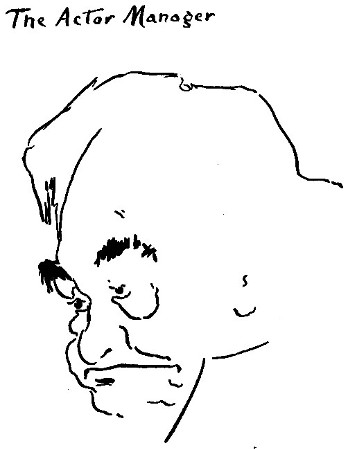
Execrate with righteous rage
Player knaves who would defraud them
Of their centre of the stage?
Do we grudge these godlike creatures
Picture-cards that advertise—
Calcium lights that flood their features
From the flies?
Who produces problem plays,
Is a most important factor
In the world of modern days.
Kings occasionally knight him,
Titled ladies take him up;
Even millionaires invite him
Out to sup.
Clouds of limelight from afar,
(Diffidence is not the failing
Of the true dramatic "star").
What cares he for rank or fashion,
Politics or place or pelf?
He whose one prevailing passion
Is himself?
[Pg 24]
Managers, whose heads are twirled,
Think (to paraphrase the poet)
That the stage is all the world.
Other men discuss the summer,
Or the poor potato crop,
Nothing can prevent the mummer
Talking "shop."
Of his intellectual pow'rs,
He (as usual, introspective)
Talks about himself for hours.
While his friends, who never dream of
Interrupting, stand agog,
He decants a ceaseless stream of
Monologue.
By a long and arduous climb
To the crest, the crown, the summit
Of the Thespian tree—a lime!
There he chatters like a starling,
There, like Jove, he sometimes nods;
But he still remains the "darling
Of the gods!"
IV
THE GILDED YOUTH
Safe screwed within his dexter eye;
His mouth stands open wide, and snares
The too intrusive fly.
Were he to close his jaws, no doubt,
The eyeglass would at once fall out.
His jacket, short, and negligée,
Is slit behind, as tho' he feared
A tail might sprout some day.
One's eye must be inured to shocks
To stand the tartan of his socks.
Betrays its owner's florid taste;
A three-inch collar grips his neck,
A cummerbund his waist;
The trousers that his legs enshroud
Speak for themselves, they are so loud.
[Pg 26]
Are all of a cerulean hue,
And advertise that Norman blood,—
The bluest of the blue,—
Which, as a brief inspection shows,
Seems to have centred in his nose.
Back from a vacant brow he scrapes;
From so compact a head of hair
No filament escapes.
(This surface-polish, friends complain,
Does not descend into the brain.)
Nothing at all, to be exact!
Yet he performs this tedious task
With quite consummate tact.
(No cause for wonder this, in truth,
Since he has practised it from youth.)
And gazes out with torpid eyes;
Then yawns politely through his nose,
Looks at his watch, and sighs;
Regards his boots with dumb regret,
And lights another cigarette.
[Pg 27]
And now, his daily labours done,
Feels far too comatose and frail
To give the dog a run;
Besides, as he reflects with shame,
He can't recall the creature's name!
Where lyric comedy is played;
And, after, to some local Ritz,
Escorts a chorus-maid.
The jeunesse dorée of to-day
Is called the jeunesse stage-doorée!
(That to his fellows fly so fast),
To one who in a waking-dream
Awaits the next repast!
How tiresome and how long they feel,
Those hours dividing meal from meal!
His "occupation gone," poor soul,
Who can but wander in his mind
When he requires a stroll;
A mental sphere, one may surmise,
Too cramped for healthy exercise.
[Pg 28]
That "nothing walks with aimless feet,"
To ask why such a type is spared
To grace the public street,
Would be most curiously misplaced,
And in the very worst of taste.
V
THE GOURMAND
(A Ballad of Reading Grill)
But a simple dinner-coat;
For once his spirits seemed to fail,
And his fund of anecdote.
His brow was drawn and damp and pale,
And a lump stood in his throat.
With looks so dour and blue,
Upon the square of bill-of-fare
We waiters call the "M'noo,"
And at ev'ry dainty mentioned there,
From entrée to ragout.
He viewed the groaning board,
For he wondered if the chef would show
The treasures of his hoard,
When a voice behind him whispered low,
"Sherry or 'ock, my lord?"
[Pg 30]
As, with a frightful oath,
He seized the waiter by the hair
And cursed him for his sloth;
Then, grumbling like some stricken bear,
Angrily answered "Both!"
As tonic, dram or drug;
Some do it standing, in their gloves,
Some seated, from a jug;
The upper class from slim-stemmed glass,
The masses from a mug.
But when the meal was through,
His wild remorse at ev'ry course
Each moment wilder grew.
For he who thinks to mix his drinks
Must mix his symptoms too.
[Pg 31]
And the tougher tournedos,
The oysters dry, and the game so high,
And the soufflé flat and low,
Which the chef had planned with a heavy hand,
And the waiters served so slow?
From caviare to pork;
Some guzzle cheese or new-grown peas,
Like a cormorant or stork;
The poor man's wife employs a knife,
The rich man's mate a fork.
Some wait till they are old;
Some take their fare from earthenware,
And some from polished gold.
The gourmand gnaws in haste because
The plates so soon grow cold.
[Pg 32]
In restaurant or grill;
Some, when their weak insides go wrong,
Try a postprandial pill.
For each man eats his fav'rite meats,
Yet each man is not ill.
Through a night of wild unrest,
With a snow-white bandage round his head,
And a poultice on his breast,
'Neath the nightmare weight of the things he ate
And omitted to digest.
Or whether meals be long;
All that we know of this resort
Proves that there's something wrong,
That the soup is weak and tastes of port,
And the fish is far too strong.
[Pg 33]
The butter full of hair;
Defunct sardines and flaccid "greens"
Are all they give us there.
Such cooking has been known to make
A common person swear.
At eve or afternoon,
Their harassed ears are never freed
From the fiddle and bassoon,
Which sow dyspepsia's subtlest seed,
With a most evil spoon.
Is a pastime rare and grand;
But to eat of fish or fowl or fruits
To a Blue Hungarian Band
Is a thing that suits nor men nor brutes,
As the world should understand.
[Pg 34]
And gags each genial guest;
A grillroom orchestra can baulk
All efforts to digest,
Till the chops will not lie still, but walk
All night upon one's chest.
Six times he sat and scann'd
The list of dishes, badly cooked
By the chef's unskilful hand;
And I never saw a man who looked
So wistfully at the band.
But ordered wine galore,
As though it were some vintage rare
From an old Falernian store;
With open mouth he slaked his drouth,
And loudly called for more.
[Pg 35]
Who simply lives to feed,
Who little cares what food they show
If it be food indeed,
Who, when his appetite is low,
Falls back upon his greed.
(Provided by his wife);
Or cheese or chalk, or peas or pork,
(For such, alas! is life!)
The rich man eats them with a fork,
The poor man with a knife.
VI.
THE DENTIST
With what perils he has to contend,
As he plunges his paws
In the gibbering jaws
Of some trusting but terrified friend,
With the risk that before he is ten minutes older
His arms may be bitten off short at the shoulder!
And he speaks with a delicate twang,
When polite as a prince,
He requests you to "rinse,"
After gently removing a fang.
('Tis to save wear-and-tear to the mouth, one supposes,
That dentists consistently talk through their noses.)
For he lives such a hand-to-mouth life.
When the sex known as "fair"
Comes and sits in his chair,
He will call for his sister or wife,
For a lady-companion or female relation,—
So strong is the instinct of self-preservation!
[Pg 37]
Though his patients are loth to reply.
With his fist in your mouth
He may say North is South,
And you cannot well give him the lie;
For it's hard to converse on such themes as the weather,
With jawbone and tongue fastened firmly together!
You should always avoid talking "shop."
If he drops in to tea,
You must certainly see
That your wife doesn't ask him to "stop!"
He is facile princeps, perhaps, of his calling;
But jokes about princip'ly forceps are galling!
That he isn't a gentleman quite.
Half the gents that we see
Are no gentler than he,
And but few are so sweetly polite;
For of all the strange trades to which men are apprentic'd;
The gentlest, I'm certain, is that of the dentist!
VII
THE MAN WHO KNOWS
In ordinary conversation
As brightly as this human mine
Of universal information,
Or give mankind the benefit
Of such encyclopædic wit.
On any topic one may mention
With so much savoir-faire, or such
Exasperating condescension;
Or take so lively a delight
In setting other people right.
The Man Who Knows has dreamt or done it;
If you propound some novel scheme,
The Man Who Knows has long begun it;
Should you evolve a repartee,
"I made that yesterday," says he.
[Pg 39]
He listens to your newest story,
As tho' your latest legend were
Some chestnut long of beard and hoary.
"When I recount that yarn," he'll say,
"I end it in a diff'rent way."
Your ev'ry statement with another,
If you have lost your voice, perhaps,
He knows a man who's lost his mother;
If you've a cold, 'tis not so bad
As one that once his uncle had.
That happened to a near relation,—
Some fatal motor accident,
Some droll or ticklish situation,—
"In eighteen-eighty-eight," says he,
"The very same occurred to me."
[Pg 40]
A peg on which to air his knowledge;
"Poor So-and-So," he sadly sighs,
"He shared a room with me at college.
I knew his sister at Ostend.
He was my father's dearest friend."
A trifle scandalous or shady,
An anecdote you've heard anent
Some wealthy or distinguished lady,
He stops you with a sudden sign:—
"She is a relative of mine!"
You fancy him impaled securely,
He either smiles with silent tact,
Or else he shakes his head obscurely,
Suggesting that he might disclose
Portentous secrets, if he chose.
[Pg 41]
At once that puts him on his metal;
"Your facts," says he, "are quite absurd!
As for Mount Popocatepetl,—
Of course it's not in Mexico;
I've been there, and I ought to know!"
It isn't half-past seven, nearly!
I make it seven-twenty-eight;
Your watch is out of order, clearly.
Mine cannot possibly be slow;
I set it half an hour ago."
Where tourists are quite inoffensive;
He knows a brand of ancient port,
Comparatively inexpensive;
And he will tell you where to get
The choicest Turkish cigarette.
[Pg 42]
And take the most fastidious guest to;
He knows a mine in Argentine
In which you safely can invest, too;
He knows the shop where you can buy
The most recherché hat or tie.
He has a cousin who can tell you
Of something second-hand but far
Less costly than the trade would sell you;
And if you want a chauffeur, too,
He knows the very man for you.
Except—a rather grave omission—
How weary his relations grow
Of such unceasing erudition,—
How fervently his fellows long
That just for once he should be wrong.
[Pg 43]
That thou shouldst cease such grateful labours—
Suspend thy self-inflicted task
Of lecturing thine erring neighbours;
For in thy knowledge we detect
No faintest sign of Intellect.
VIII
THE FADDIST
At the mention of the "Simple Life" brigade?
Do you shudder at their Jaeger underclothing,
Which is "fearfully and wonderfully made"?
Though in manner they resemble "poor relations,"
Or umbrellas which their owners have forgot,
They contribute to the gaiety of nations,
Do they not?
Who will feed out of a fellow-creature's hand,
If he happens to provide them with a diet
Of a temperance and vegetable brand.
They can easily subsist—a thing to brag of—
In the draughtiest of sanitary huts,
On a "mute inglorious Stilson" and a bag of
Monkey-nuts.
When he leaves his couch (at 6 a. m. perhaps)
He will struggle with some patent "Exerciser,"
Until threatened with a physical collapse.
He wears collars made of cellular materials,
And sandals in the place of leather boots,
And his victuals are composed of either cereals
Or roots.
Undiluted by the essence of the grape;
And he deprecates the universal slaughter
Of dumb animals in any form or shape.
So his breakfast-food (a patent, too, of course), is
Made of oats which he monotonously chews,
Mixed with chaff which any self-respecting horses
Would refuse.
In the liquids that his fellow creatures drink;
Fell bacilli that are stealthily residing
In our carpets, in our kisses, in our ink!
In his eagerness such parasites to smother,
He will keep himself so sterilised and aired,
That one fancies he would disinfect his mother,
If he dared.
Where he feeds, like any other anthropoid,
Upon dishes which must certainly remind him
Of the cocoanuts his ancestors enjoyed.
As he masticates his monkeyfood, you wonder
If his humour is as meagre as his fare,
And you look to see his tail depending under-
-Neath his chair.
[Pg 46]
The exact amount of times they ought to chew,
The advantages of "totally abstaining,"
And the joys of walking barefoot in the dew;
How that slumber must be summoned circumspectly,
In an attitude conducive to repose,
And that breathing should be carried on correctly
Through the nose.
With a sparse and wizened beard, and straggly hair,
Upon which is perched a sort of a sombrero
Such as operatic brigands love to wear.
He may eat the nuts his prehistoric sires ate,
He may flourish upon sawdust mixed with bran,
But he looks more like a Nonconformist pirate
Than a man!
IX
THE COLONEL
At ev'ry "Service" Club reclining!
How brightly through its close-cropped hair!
His polished skull is shining!
His form, inert and comatose,
Suggests a stertorous repose.
What music on our ears is falling?
Through his Æolian nose we hear
The distant East a-calling.
(A good example here is found
Of slumber that is truly "sound.")
Where, camping by the Jimjam River,
He sacrificed his figure and
The best part of his liver,
And, in some fever-stricken hole,
Mislaid his pow'rs of self-control.
[Pg 48]
Its surface change from chrome to hectic;
Examine that pneumatic throat,
That visage apoplectic.
His colour-scheme is of the type
That plums affect when over-ripe.
Awakened by your indiscretion,
Becoming slowly Dunlop-necked—
(To coin a new expression);
Where stud and collar form a juncture,
You contemplate immediate puncture.
Ascends, a Phoenix, from its ashes;
His eyebrows rise and beckon up
His "porterhouse" moustaches;[A]
And you acknowledge, as you flinch,
That he's a Colonel—ev'ry inch!
Across the barrack-square could carry,
Reverberates and megaphones
A rich vocabulary.
(His "rude forefathers," you'll agree,
Were never half so rude as he.)
[Pg 49]
The grievances from which he suffers:—
"The Service gone, sir, to the dogs!"
"The men, sir, all damduffers!"
In so invet'rate a complainer
You recognise the "old champaigner."
Recall their retrospective splendour;
One of the brave Old Guard is he,
That dyes but won't surrender;
With fits of petulance afflicted,
When questioned, crossed, or contradicted.
Combined with chronic indigestion,
The breed is quickly dying out—
(The fact admits no question)—
I'll give you, if advice you're taking,
A recipe for Colonel-making.
Is bluff and anything but "soul-y;"
Transplant him to a torrid zone;
There leave him stewing slowly;
Remove his liver and his hair,
Then serve up hot in an armchair.
[A] Cf. "mutton-chop" whiskers.
X
THE WAITER
My hero does all three, and even more.
Bearing a dozen food-congested plates,
With silent tread (altho' his feet are sore),
He swiftly skates across the parquet floor.
None can afford completely to ignore him,
Because, of course, he "carries all before him!"
He poises plate on plate, and never swerves;
Two in each hand, three more up either arm,—
A feat of balancing which tries the nerves
Of the least timid customer he serves.
So firm his carriage, and his gait so stable,
He is the Blondin of the dinner-table.
(A custom more might copy, I confess),
The waiter hastens, with the least delay,
To don that unbecoming evening-dress
Which etiquette compels him to possess.
('Tis too the conjurer's accustomed habit,
Whence he evolves a goldfish or a rabbit.)
[Pg 51]
The anarchist parades a red cravat;
The eminent physician always wears
A stethoscope concealed within his hat;
A diamond stud proclaims the plutocrat;
The rural dean displays a sable gaiter,
And evening dress distinguishes the waiter.
With long sidewhiskers and an old-world air.
How gently, with what rev'rent hands, he laid
A bottle of some vintage rich and rare
Within a pail of ice beneath your chair,
Like some proud steward in a hall baronial
Performing an important ceremonial.
His manner how distingué and discreet,
As he directed your capricious choice
To what 'twere best and pleasantest to eat,
Or warmly recommended the Lafitte.
A perfect pattern of the genus homo,
More like a bishop than a major-domo.
[Pg 52]
When in some haven "hush'd and safe apart,"
You sought the shelter of a private room,
To entertain the lady of your heart
At a delightful dinner à la carte.
(The consequences would, he knew, be shocking
Were he perchance to enter without knocking.)
The alien product of some Southern sun.
Who speaks an unintelligible tongue
And serves impatient patrons at a run,
Snatching away their plates before they've done.
Brisk as a bee, and restless as the Ocean,
He solves the problem of perpetual motion.
To him your choice you never would resign.
He gauges from the point of view of price
The rival worth of each respective wine;
His tastes, indeed, are frankly Philistine,
And, with a mien indifferent or placid,
He serves your claret cold and corked and acid.
[Pg 53]
Think sometimes of his troubles, I entreat,
Who in a crowded restaurant and hot
Walks to and fro on tired and tender feet,
Watching his hungry fellow-creatures eat!
What form of earthly hardship could be greater
Than that which daily overwhelms the waiter?
XI
THE POLICEMAN
In ev'ry crowded London street;
Longsuff'ring, stoical, serene,
With huge pontoonlike feet,
His boots so stout, so squat, so square,
A motor-car might shelter there.
With hands that half obscure the sun,
Like monstrous, vast Virginian hams.
A trifle underdone;
The while the matron and the maid
Pass safely by beneath their shade.
His tact and patience have no end;
He helps the helpless and the weak,
He is the children's friend;
And nobody can feel alarm
Who clings to his paternal arm.
[Pg 55]
In any tangled thoroughfare,
Or spinster ladies lose their way,—
The constable is there.
With smile avuncular and bland,
He leads them gently by the hand.
A bull's-eye lantern at his belt;
His muffled steps are noiseless quite,
His soles unheard—tho' felt!
And burglars, when a crib they crack,
Are forced to do so from the back.
Is Irish by direct descent.
His bludgeon is intended to
Inflict a nasty dent;
And if you ask him for advice,
He knocks you senseless in a trice.
[Pg 56]
But tho' he twirls his waxed moustache,
The natives heed him not at all.
No more does the apache.
And cabmen, when he lifts his palm,
Drive over him without a qualm.
Is stern, inflexible, austere.
His presence fills his friends with awe,
The foreigner with fear.
Your doom is sealed if he should pass
And find you walking on the grass!
With London's own partic'lar pet;
A martyr he who stands foursquare
To ev'ry Suffragette,
And when that lady kicks his shins
Or bites his ankles, merely grins.
[Pg 57]
As Dr. Watson's famous foil,—
Sherlock, that keen unerring sleuth
Immortalised by Doyle,
And Patti who, where'er she roams,
Asserts "There's no Police like Holmes!"
Provide the vulgar with a jest,
How true the heart that beats below
That whistle at his breast!
How perfect an example he
Of what a constable should be!
XII
THE MUSIC-HALL COMEDIAN
When our labours are suspended,
And we hunger for agreeable society,
The relentless voice of Pleasure
Bids us spend an hour of leisure
In a Music-Hall or Palace of Variety,
Where to furnish relaxation
Ev'ry effort is directed,
Tho' the claims of ventilation
Have been carefully neglected.
(For the smoking is excessive)
In this Temple of conventional hilarity,
But the place is scarcely warmer
Than the average performer
With his stock-in-trade of commonplace vulgarity.
There is nothing wise or witty
In the energy he squanders
On some quite unworthy ditty
Full of dubious "dooblontonders."
Is by nature economic-
-Al of humour, and avoids originality;
Like a drowning man he seizes
Upon prehistoric wheezes,
Which he honours with a loyal partiality,
In accordance with the ruling
Of a senseless superstition
Which demands a form of fooling
That is hallowed by tradition.
With a figure like a barrel,
And a smile of transcendental imbecility,
All the humours he discloses
Of such things as purple noses
Or of matrimonial incompatibility;
While the band (who would remind him
That it never would forsake him)
Keeps a bar or two behind him,
But can never overtake him.
Of that mild intoxication
Which is chronic in some sections of society,
And we learn from his explaining
How extremely entertaining
And amusing is persistent insobriety;
And we realise how funny
Are the wives who nag and bicker,
While the husbands spend their money
Upon alcoholic liquor.
[Pg 60]
The delights of overdrinking,
And describes his nightly orgies, which are numerous;
How he comes home "full of damp," too,
How he overturns the lamp, too,
And does other things if possible more humorous.
And we listen con amore,
While our merriment redoubles,
To the truly tragic story
Of his dull domestic troubles.
A cantankerous old codger,
Asks another person's spouse to come and call for him;
How he tumbles from a casement
In an attic to the basement,
Where the lady very kindly breaks his fall for him;
And our peals of happy laughter,
As he lands on her umbrella,
Grow ungovernable after
She has fractured her patella.
Than "The Macs" and "The O'Gormans,"
Who are artistes of the "knockabout" variety,
Or those ladies in chemises
Who undress upon trapezes
With an almost imperceptible propriety;
'Tis as worthy of encoring
As the "Farmyard Imitator,"
And a little bit less boring
Than the "Lightning Calculator."
[Pg 61]
Like those dreadful "Living Pictures"
Which the prurient wrote columns to the press about;
'Tis no clever exhibition
Like that tedious "Thought Transmission"
Which we all of us disputed more or less about.
But the balderdash and babble
Of our too facetious hero,
Tho' attractive to the rabble,
Send our spirits down to zero.
Growing every moment flatter,
On such subjects as connubial infelicity,
And we find ourselves protesting
Against everlasting jesting
On the tragedies of conjugal duplicity.
And we feel desirous very
Of imposing some restrictions
On the humour that makes merry
Over personal afflictions.
When we see some public idol,
Who is earning a colossal weekly salary,
Having long ignobly pandered
To the questionable standard
Of intelligence that blooms in pit and gallery.
We are easily contented,
And our feelings we could stifle,
If the comic man consented
Just to raise his tone a trifle.
[Pg 62]
As red noses, weak digestions,
Drunkards, lodgers, twins and physical deformities;
Ceased from casting imputations
On his wretched "wife's relations,"
Or from mentioning his "ma-in-law's" enormities;
If he didn't sing so badly,
And if only he were funny,
We would tolerate him gladly,
And get value for our money!
XIII
THE CONVERSATIONAL REFORMER
As Pres: of an immense Repub:
And sought to manufact: a plan
For saving people troub:.
His mode of spelling (termed phonet:)
Affec: my brain like an emet:.
To simplify my mother-tongue,
That so in fame I might resem:
Upt: Sinc:, who wrote "The Jung:,"
And rouse an interest enorm:
In conversational reform.
Completing words that are so comm:
Wherever peop: of cult: and taste
Habitually predom:.
'T would surely tend to simpli: life
Could they but be curtailed a trif:.
[Pg 64]
(Inscribe this mott: upon your badge).
The sense will never suff: a bit,
If left to the imag:,
Since any pers: can see what's meant
By words so simp: as "husb:" or "gent:."
You hand your unc: an empty plate,
Or ask your aunt (that charming spinst:)
To pass you the potat:,
They have too much sagac:, I trust,
To give you sug: or pep: or must:.
You'll find the salfsame princ: hold good,
Nor get, instead of bread and butt:,
Some tapioca pudd:,
Nor vainly bid some boon-compan:
Replen: with Burg: his vacant can.
Why in a haz: your nib: is sunk.
And you explain your fav'rite Hask:
Lies buried in a bunk:,
He cannot very well misund:
That you (poor fooz:) have made a blund:.
[Pg 65]
My scheme at once becomes attrac:
And I (pray pard: a litt: impert:)
A public benefac:
Who saves his fellow-man and neighb:
A large amount of needless lab:.
And not be irritab: or peev:,
You'll find it of tremend: assist:
This habit of abbrev:,
Which grows like some infec. disease,
Like chron: paral: or German meas:.
Will feel his heart grow grate: and warm
As he becomes the loy: discip:
Of my partic: reform,
(Which don't confuse with that, I beg,
Of Brander Math: or And: Carneg:).
As Add. remarked; but if my meth:
Does something to dimin: or less:
The waste of public breath,
My country, overcome with grat:
Should in my hon: erect a stat:.
[Pg 66]
Shall be exhib:, devoid of charge,
With (in the Public Lib: at Bost:)
My full-length port: by Sarge:,
That thous: from Pitts: or Wash: may swarm
To worsh: the Found: of this Reform.
The fav: of your polite consid:.
XIV
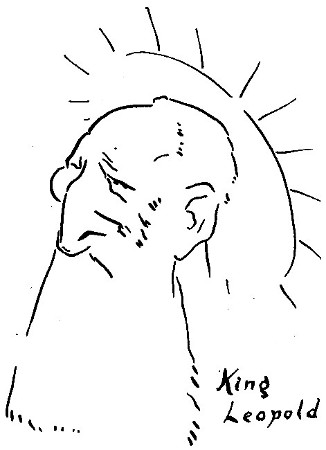
KING LEOPOLD
("In dealing with a race that has been composed of cannibals for thousands of years, it is necessary to use methods that best can shake their idleness and make them realise the sanctity of labour."—King Leopold of Belgium on the Congo scandal.)
Or they label him as "tyrant" and "oppressor";
The majority must wilfully misunderstand his aims
To regard him in the light of a transgressor.
For, to tell the honest truth, he's a benevolent old man
Who attempts to do his "duty to his neighbour"
By endeavouring to formulate a philanthropic plan
Which shall demonstrate the "sanctity of labour."
Whose existence was a constant round of pleasure;
Whose imperfect education had not ever let them know
The pernicious immorality of leisure.
[Pg 68] They were merry little people, in their simple savage way,
Not a thought to moral obligations giving;
Quite unconscious of their duties, wholly ignorant were they
Of the blessedness of working for a living.
Heard their story, and, with admirable kindness,
Deemed it utterly improper, not to say a trifle sad,
That the heathen should continue in his blindness.
"Let us civilise the children of this most productive soil,"
Said their agents, who proceeded to invade them;
"Let us show these foolish savages the dignity of toil—
If we have to use a hatchet to persuade them!"
They implored them not to idle or malinger;
And they showed them there was nothing that encouraged honest work
Like the loss of sev'ral toes or half a finger.
When they fancied that their womenfolk were lonely or depress'd,
They would chain them nice and close to one another,
And they thoughtfully abducted ev'ry baby at the breast,
To facilitate the labours of its mother.
And dividing ev'ry maiden from her lover;
If a workman drooped or sickened they would jab him with a knife,
And then leave him by the roadside to recover.
If he grumbled or grew restive they would amputate a hand,
Just to show him how unsafe it was to blubber,
Till with infinite solicitude they made him understand
The necessity of cultivating "rubber."
While these pioneers are sharp and firm and wary,—
And the Congo is reluctantly compelled to own the truth
Of that motto "Laborare est orare."
Though the Belgians sometimes wonder, on their tenderhearted days,
(When the little children scream as they abduct them),
If the natives CAN supply sufficient rubber to erase
The effect of such endeavours to instruct them
That these practices offend the sister-nations,
That one cannot safely advocate "the sanctity of work,"
By a policy of theft and mutilations,—
Yet wherever on the Congo Belgium's banner is unfurled,
Where the atmosphere is redolent and sunny,
[Pg 70] I am sure the Monarch's methods must be giving to the world
Some ideas upon the "sanctity of money!"
That the Ruler of the Congo has not surely ruled in vain!
XV
"BART'S" CLUB
("In my view, the most absolutely perfect club of all would be a club where absolutely every man could get in, it mattered not what he had done in the past."—Bart Kennedy.)
This institution, just arisen;
We notice here that atmosphere
Of restaurant and prison,
Of green-room, gambling-hell, saloon,
Which makes it an especial boon.
Who noisily inhales his luncheon,
His flattened nose has felt the blows
Of many a p'liceman's truncheon;
The premier cracksman of the City,
Is Chairman of our House Committee!
Discussing Plato with his neighbour,
Returned to-day from Holloway,
And eighteen months' "hard labour";
He's such a gentleman, I think,
—Or would be, if he didn't drink.
[Pg 72]
And all the nimble-fingered gentry;
The buccaneer is harboured here,
The "shark" has instant entry.
Blackmail is practised, too, by all,
Who never heard of a black-ball!
The bankrupt and the unfrocked parson,
All those whose vice is loading dice,
Or bigamy, or arson.
Most of our pilgrims have pursued
The path of penal servitude.
While regicides infest the smoke-room;
(The faux-bonhomme who brings a bomb
Must leave it in the cloak-room).
Ink for the forger we provide,
And strychnine for the suicide.
As "green-goods man" or quack-physician;
We welcome here the pseudo-peer,
Or bogus politician.
Within the shelter of our fold
King Peter greets King Leopold.
[Pg 73]
And no precautions are neglected.
Come, then, with me, and you shall be
Immediately elected,
To what with confidence I dub
An "absolutely perfect" club!
XVI
THE REVIEWER
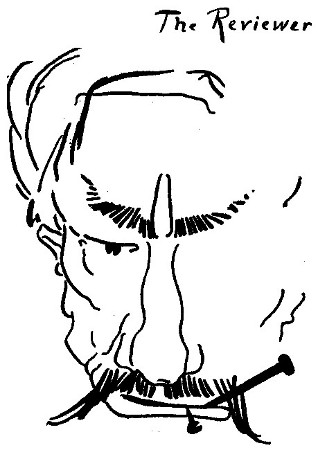
See with what a piercing look
He impales, as with a skewer,
This unlucky little book!
Note his gestures of impatience,
As he contemplates, perplex'd,
The amazing illustrations
Which adorn the text!
Eye converges on the verse,
"Any man who writes such drivel
Must be capable of worse.
Let it be my painful mission,
As a literary man,
To suppress the whole edition,
If a critic can.
Ev'ry drawing less than true;
Such a trite and trivial tome is
Quite unworthy of review.
On this balderdash no vocal
Praises can my tongue bestow;
To the dust-bin of some local
Pulp-mill let it go!
By some cunning artifice,
Shall be presently directed
To diviner ends than this.
There its pages, expurgated
By some alchemy abstruse,
Shall at length be dedicated
To a nobler use!"
Do not spurn it with a groan,
Tho' your labours may be fewer
If you leave my books alone!
'Tis the chief of all your duties—
Duties which you strive to shirk—
To discover hidden beauties
In an author's work.
[Pg 76]
Crowd this casket of a book;
'Tis your privilege exclusive
For these hidden gems to look.
When you have adroitly caught them,
Their delights you can explain
To a public which has sought them
For so long in vain.
Snubs which one might justly call
(Like the artist's cruel pictures)
The "unkindest cuts of Hall"!
Tho' your sneers be fierce and many,
Honest censure I respect,
And will meekly swallow any-
Thing except neglect.
Tho' your pen be dipped in gall,
Criticise me frankly, freely,—
Better thus than not at all!
Up the ladder I have crept un-
Til I reached a middle rung,
Do not let me die "unwept, un-
Honoured and unhung."
L'ENVOI
Beneath the pillows of the blest,
Whence those who seek in vain for sleep
Shall drag thee from thy nest;
That so thy sedative aroma
May lull them to a state of coma.
Within its tiny trundle-bed,
No soothing potion needs to take,
If thou art duly read;
And hosts of harassed monthly nurses
Shall bless thy soporific verses.
Has but at thy contents to glance
To hug thee to his fevered breast
And fall into a trance;
And sleepless patients without number
Shall hail thee harbinger of slumber.
[Pg 78]
Perform thy deadly work by night,
Thou rich man's boon, thou widow's cruse,
Thou orphan-child's delight!
Appease the heirs from all the ages
With balm from thine hypnotic pages!
The mansion of the millionaire,
Thy readers shall combine to sing
Thy praises ev'rywhere,
Till folks in less exalted places
Scream loudly for Familiar Faces!
I shall become extremely wealthy!)