IN THE
YULE-LOG GLOW
CHRISTMAS POEMS FROM
'ROUND THE WORLD
"Sic as folk tell ower at a winter ingle"
Scott
EDITED BY
HARRISON S. MORRIS
IN FOUR BOOKS
Book IV.
PHILADELPHIA
J. B. LIPPINCOTT COMPANY
1900.
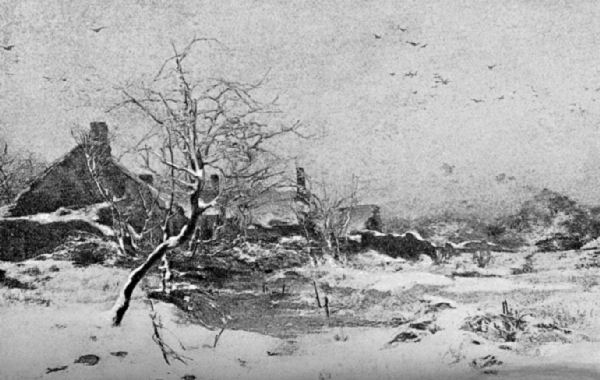 Christmas Weather
Copyright, 1891, by J. B. Lippincott Company.
Printed by J. B. Lippincott Company, Philadelphia.
ILLUSTRATIONS, BOOK IV.
| Christmas Weather | Frontispiece. |
| "What Can I Give Him?" | Page 90 |
| The Season's Reveries | " 174 |
| "Too Happy, Happy Tree" | " 212 |
CONTENTS OF BOOK IV.
| Sung Under The Window. | PAGE |
| Who's There? | 9 |
| God Rest You Merry, Gentlemen | 10 |
| Welcome Yule | 12 |
| Angel Heralds | 14 |
| The Matchless Maiden | 15 |
| Remember, O Thou Man | 16 |
| The Singers in the Snow | 19 |
| A Christmas Chorus | 21 |
| Three Ships | 22 |
| Jacob's Ladder | 24 |
| Saint Stephen, the Clerk | 26 |
| The Carnal and the Crane | 29 |
| The Holy Well | 35 |
| The Holly and the Ivy | 38 |
| The Contest of the Vines | 39 |
| Ane Sang of the Birth of Christ | 41 |
| Christmas Minstrelsy | 43 |
| The Old, Old Story | 47 |
| A Christmas Ballad | 49 |
| A French Noël[A] | 52 |
| Masters, in this Hall | 54 |
| [Pg 4] | |
| The Worship Of The Babe. | |
| To His Saviour, a Child; a Present, by a Child | 59 |
| Honor to the King | 60 |
| New Prince, New Pomp | 62 |
| Of the Epiphany | 64 |
| A Hymn for the Epiphany | 66 |
| A Hymn on the Nativity of My Saviour | 68 |
| At Christmas | 70 |
| New Heaven, New War | 72 |
| For Christmas Day | 73 |
| Sung to the King in the Presence at Whitehall | 75 |
| And They Laid Him in a Manger | 77 |
| The Burning Babe | 79 |
| Christ's Nativity | 81 |
| An Ode on the Birth of Our Saviour | 83 |
| Who Can Forget? | 85 |
| The Child Jesus | 87 |
| Long Ago | 89 |
| Star of Bethlehem | 91 |
| No Room | 92 |
| On Christmas Day | 94 |
| The Heavenly Choir | 96 |
| The Wassail-Bowl. | |
| Wassail | 103 |
| Invitation à Faire Noël | 105 |
| A Thanksgiving | 107 |
| Around the Wassail-Bowl | 108 |
| From Door to Door | 111 |
| Wassailing Carol | 113 |
| [Pg 5]A Carol at the Gates | 116 |
| Wandering Wassailers | 118 |
| Bring Us in Good Ale | 120 |
| About the Board | 122 |
| Before the Feast | 123 |
| A Bill of Christmas Fare | 125 |
| The Mahogany-Tree | 126 |
| A Christmas Ceremony | 129 |
| With Cakes and Ale | 129 |
| The Masque of Christmas | 130 |
| Santa Claus. | |
| A Visit from St. Nicholas | 145 |
| The Hard Times in Elfland[B] | 148 |
| Old Christmas | 156 |
| Mrs. Santa Claus | 158 |
| Santa Claus to Little Ethel | 163 |
| The Season's Reveries. | |
| Guests at Yule | 169 |
| Christmas in India | 171 |
| Christmas Violets | 174 |
| Dickens Returns on Christmas Day | 175 |
| A Grief at Christmas | 176 |
| My Sister's Sleep | 183 |
| Christmas in Edinborough. I. | 186 |
| Christmas in Edinborough. II. | 187 |
| Around the Christmas Lamp | 188 |
| Christmas Eve | 189 |
| Wonderland | 190 |
| [Pg 6]Waiting | 192 |
| Aunt Mary | 193 |
| The Glad New Day | 195 |
| Under the Holly Bough | 196 |
| The Dawn of Christmas | 198 |
| Ballade of Christmas Ghosts | 200 |
| The Village Christmas | 202 |
| Winter | 203 |
| December | 204 |
| Christmas Weather in Scotland | 205 |
| Sir Galahad | 212 |
| A Thought for the Time | 213 |
| Ballade of the Winter Fireside | 214 |
| A Catch by the Hearth | 216 |
| Sally in Our Alley | 217 |
| Little Mother | 218 |
| Occident and Orient | 220 |
| The Blessed Day | 225 |
| Christmas in Cuba[C] | 227 |
| Farewell to Christmas | 229 |
| The New Year | 231 |
| A Happy New Year | 234 |
| New-Year's Gifts | 236 |
| The End of the Play | 238 |
| Finis | 240 |
FOOTNOTES:
[A] By the courtesy of Messrs. Houghton, Mifflin & Co.
[B] By the courtesy of Messrs. Charles Scribners' Sons.
[C] By the courtesy of Messrs. Harper & Bros.
Sung Under The Window.
With a hey, and a ho, and a hey nonino!"
Shakespeare.
WHO'S THERE?
Who ys there that syngith so, nowell, nowell, nowell?
Well come, my lord syre Christmasse,
Welcome to us all, bothe more and lesse,
Come nere, nowell!
A mayd hath born a chylde full yong,
The weche causeth yew for to syng,
Nowell!
In an oxe stalle he ys layde,
Wher'for syng we alle atte abrayde
Nowell!
Make gode chere and be right mery,
And syng with us now joyfully,
Nowell!
GOD REST YOU MERRY, GENTLEMEN.
Let nothing you dismay,
For Jesus Christ our Saviour
Was born upon this day
To save us all from Satan's power
When we were gone astray.
O tidings of comfort and joy,
For Jesus Christ our Saviour was born on Christmas day.
This blessed babe was born,
And laid within a manger
Upon this blessed morn;
The which His mother Mary
Nothing did take in scorn.
O tidings, etc.
A blessed angel came,
And unto certain shepherds
Brought tidings of the same,
How that in Bethlehem was born
The Son of God by name.
O tidings, etc.
Let nothing you affright,
This day is born a Saviour
Of virtue, power, and might;
So frequently to vanquish all
The friends of Satan quite.
O tidings, etc.
Rejoicéd much in mind,
And left their flocks a-feeding
In tempest, storm, and wind,
And went to Bethlehem straightway
This blessed babe to find.
O tidings, etc.
Whereat this infant lay,
They found Him in a manger
Where oxen feed on hay;
His mother Mary kneeling
Unto the Lord did pray.
O tidings, etc.
All you within this place,
And with true love and brotherhood
Each other now embrace;
This holy tide of Christmas
All others doth deface.
O tidings, etc.
WELCOME YULE.
In worship of this holy day.
Welcome born in one morning,
Welcome for whom we shall sing,
Welcome Yule.
Welcome Innocents, every one,
Welcome Thomas Martyr one,
Welcome Yule.
Welcome Twelfth Day, both in fere,[D]
Welcome saintés lef[E] and dear,
Welcome Yule.
Welcome be ye, Queen of Bliss,
Welcome both to more and less,
Welcome Yule.
Welcome all and make good cheer;
Welcome all, another year,
Welcome Yule.
Ritson's Ancient Songs.
ANGEL HERALDS.
He heard an angel sing:
"This night shall be born
Our Heavenly King;
In housen nor in hall,
Nor in the place of Paradise,
But in an ox's stall;
In purple nor in pall,
But all in fair linen,
As we were babies all.
In silver nor in gold,
But in a wooden cradle
That rocks on the mould.
In white wine nor in red,
But with fair spring-water
With which we were christenéd."
THE MATCHLESS MAIDEN.
To His mother's bower,
As dew in April
That falleth on the flower.
There His mother lay,
As dew in April
That falleth on the spray.
Was never none but she;
Well may such a lady
God's mother be.
Wright's Songs and Carols.
REMEMBER, O THOU MAN.
O thou Man, O thou Man;
Remember, O thou Man,
Thy time is spent.
Remember, O thou Man,
How thou earnest to me then,
And I did what I can,
Therefore repent.
O thou Man, O thou Man;
Remember Adam's fall
From Heaven to Hell.
Remember Adam's fall,
How we were condemnéd all
To Hell perpetual,
There for to dwell.
O thou Man, O thou Man;
Remember God's goodness
And promise made.
Remember God's goodness,
How His only Son He sent
Our sins for to redress,
Be not afraid.
O thou Man, O thou Man;
The Angels all did sing
On Sion hill.
The Angels all did sing
Praises to our heavenly king,
And peace to man living,
With right good-will.
O thou Man, O thou Man;
The Shepherds amazed was
To hear the angels sing.
The Shepherds amazed was
How this should come to pass,
That Christ our Messias
Should be our King.
O thou Man, O thou Man;
To Bethlehem did they go
This thing to see.
To Bethlehem did they go
To see whether it was so,
Whether Christ was born or no,
To set us free.
O thou Man, O thou Man;
As the Angels before did say,
So it came to pass.
[Pg 18] As the Angels before did say,
They found Him wrapt in hay
In a manger where He lay,
So poor He was.
O thou Man, O thou Man;
In Bethlehem was He born
For mankind dear.
In Bethlehem was He born
For us that were forlorn,
And therefore took no scorn
Our sins to bear.
O thou Man, O thou Man;
In a manger laid He was
At this time present.
In a manger laid He was
Between an ox and an ass,
And all for our trespass,
Therefore repent.
O thou Man, O thou Man;
Give thanks to God always
With hearts most jolly.
Give thanks to God always
Upon this blessed day,
Let all men sing and say,
Holy, Holy.
Ravenscroft's Melismata, A.D. 1611.
THE SINGERS IN THE SNOW.
And all that are therein,
And to begin this Christmas tide
With mirth now let us sing.
For the Saviour of all people
Upon this time was born,
Who did from death deliver us.
When we were left forlorn.
And sing with cheerful voice,
For we have good occasion now
This time for to rejoice.
For, etc.
And fall no more at strife,
Let every man with cheerfulness
Embrace his loving wife.
For, etc.
Provide some wholesome cheer,
And call your friends together
That live both far and near.
For, etc.
Since that we are come here,
And we do hope before we part
To taste some of your beer.
For, etc.
That seems to be so strong;
And we do wish that Christmas-tide
Was twenty times so long.
For, etc.
For Christ this time was born,
Who did from death deliver us,
When we were left forlorn.
For, etc.
A CHRISTMAS CHORUS.
Every generation;
Prince and peasant, chief and sage,
Every tongue and nation,
Every tongue and nation,
Every rank and station,
Hath to-day salvation.
Alleluia!
Came our Lord and leader;
From the lily came the rose,
From the bush the cedar,
From the bush the cedar,
From the judge the pleader,
From the saint the feeder.
Alleluia!
In a manger lying,
Hallow'd birth by being born,
Vanquished death by dying,
Vanquished death by dying,
Rallied back the flying,
Ended sin and sighing.
Alleluia!
THREE SHIPS.
On Christmas day, on Christmas day;
I saw three ships come sailing in,
On Christmas day in the morning.
On Christmas day, on Christmas day?
And what was in those ships all three,
On Christmas day in the morning?
On Christmas day, on Christmas day;
Our Saviour Christ and His lady,
On Christmas day in the morning.
On Christmas day, on Christmas day?
Pray whither sailed those ships all three,
On Christmas day in the morning?
On Christmas day, on Christmas day,
O they sailed into Bethlehem,
On Christmas day in the morning.
On Christmas day, on Christmas day;
And all the bells on earth shall ring,
On Christmas day in the morning.
On Christmas day, on Christmas day;
And all the angels in heaven shall sing,
On Christmas day in the morning.
On Christmas day, on Christmas day;
And all the souls on earth shall sing,
On Christmas day in the morning.
On Christmas day, on Christmas day;
Then let us all rejoice amain,
On Christmas day in the morning.
JACOB'S LADDER.
At night on a stone for a pillow he lay;
He saw in a vision a ladder so high
That its foot was on earth and its top in the sky.
Hallelujah to Jesus, who died on the tree,
And hath rais'd up a ladder of mercy for me.
Hath stood hundreds of years and is not yet decayed;
Many millions have climbed it and reached Zion's hill,
And thousands, by faith, are climbing it still.
Hallelujah, etc.
For the angels of Jacob are guarding it still;
And remember each step that by faith we pass o'er,
Some prophet or martyr hath trod it before.
Hallelujah, etc.
We shall hear the glad word: Come up hither, ye blest!
Here are regions of light, here are mansions of bliss,
Oh, who would not climb such a ladder as this?
Hallelujah, etc.
SAINT STEPHEN, THE CLERK.
In King Herod's hall,
And servéd him of bread and cloth
As ever king befall.
With boar's head on hand,
He saw a star was fair and bright
Over Bethlehem stand.
And went into the hall:
"I forsake thee, King Herod,
And thy workés all.
And thy workés all;
There is a child in Bethlehem born
Is better than we all."
What is thee befall?
Lacketh thee either meat or drink
In King Herod's hall?"
In King Herod's hall;
There is a child in Bethlehem born
Is better than we all."
Art thou wode,[I] or thou ginnest to breed?[J]
Lacketh thee either gold or fee,
Or any rich weed?"[K]
Ne none rich weed;
There is a child in Bethlehem born
Shall helpen us at our need."
Also sooth i-wis
As this capon crowé shall
That lieth here in my dish."
That word in that hall,
The capon crew Christus natus est
Among the lordés all.
By two and all by one,
[Pg 28] And leadeth Stephen out of this town,
And stoneth him with stone."
And stoned him in the way,
And therefore is his even
On Christés own day.
THE CARNAL AND THE CRANE.
And there as I did reign,[M]
In argument I chanced to hear
A Carnal[N] and a Crane.
If all the world should turn,
Before we had the Father,
But now we have the Son!
From where and from what place?
He said, In a manger,
Between an ox and ass!
Tell me before thou go,
Was not the mother of Jesus
Conceived by the Holy Ghost?
And the cleanest from sin;
She was the handmaid of our Lord,
And mother of our King.
That Christ was rockéd in?
Where are the silken sheets
That Jesus was wrapt in?
That Christ was rockéd in;
The provender the asses left
So sweetly He slept on.
So bright did it appear
Into King Herod's chamber,
And where King Herod were.
And told the king on high,
A princely babe was born that night
No king could e'er destroy.
As thou tellest unto me,
This roasted cock that lies in the dish
Shall crow full fences[O] three.
By the work of God's own hand,
[Pg 31] And then three fences crowéd he
In the dish where he did stand.
See that you ready be,
All children under two years old
Now slain they all shall be.
And Mary that was so pure,
They travelled into Egypt,
As you shall find it sure.
Amongst those fierce wild beasts,
Mary, she being weary,
Must needs sit down to rest.
Come sit thee down by me,
And thou shalt see how these wild beasts
Do come and worship me.
Which Jesu's grace did spring,
And of the wild beasts in the field,
The lion shall be the king.
Of birth and high degree,
[Pg 32] In every sundry nation,
Where'er we come and see.
And Mary, that was unknown,
They travelled by a husbandman,
Just while his seed was sown.
Go fetch thy ox and wain,
And carry home thy corn again
Which thou this day hast sown.
Even before his face;
Long time hast Thou been looked for,
But now Thou art come at last.
Thy name is Jesus called;
Redeemer of mankind Thou art,
Though undeserving all.
Of it thou may'st be sure,
For I must lose my precious blood
For thee and thousands more.
And inquire for me alone,
[Pg 33] Tell them that Jesus passed by,
As thou thy seed did sow.
With his train so furiously,
Inquiring of the husbandman,
Whether Jesus passed by.
And the truth it must be known,
For Jesus passéd by this way
When my seed was sown.
And some laid on my wain,
Ready to fetch and carry
Into my barn again.
Your labor and mine's in vain,
It's full three-quarters of a year
Since he his seed sown.
By the work of God's own hand,
And further he proceeded
Into the Holy Land.
Which for His sake did die;
[Pg 34] Do not forbid those little ones,
And do not them deny.
And the truth now I have shown,
Even the blessed Virgin,
She's now brought forth a Son.
THE HOLY WELL.
And upon one bright holiday,
Sweet Jesus asked of His dear mother,
If He might go to play.
And to play pray get you gone;
And let me hear of no complaint
At night when you come home.
As far as the Holy Well,
And there did see as fine children
As any tongue can tell.
And your bodies Christ save and see:
Little children, shall I play with you,
And you shall play with me?
They were lords' and ladies' sons;
And He, the meanest of them all,
Was but a maiden's child, born in an ox's stall.
And He neither laughed nor smiled,
But the tears came trickling from His eyes
Like water from the skies.
To His mother's dear home went He,
And said, I have been in yonder town,
As far as you can see.
As far as the Holy Well,
There did I meet as fine children
As any tongue can tell.
And their bodies Christ save and see:
Little children, shall I play with you,
And you shall play with me?
They were lords' and ladies' sons;
And I, the meanest of them all,
Was but a maiden's child, born in an ox's stall.
Born in an ox's stall,
Thou art the Christ, the King of heaven,
And the Saviour of them all.
As far as the Holy Well,
And take away those sinful souls,
And dip them deep in hell.
Nay, nay, that may not be;
For there are too many sinful souls
Crying out for the help of me.
THE HOLLY AND THE IVY.
Now both are full well grown;
Of all the trees that spring in wood,
The holly bears the crown.
The holly bears a blossom
As white as a lily flow'r;
And Mary bore sweet Jesus Christ
To be our sweet Saviour.
As red as any blood,
And Mary bore sweet Jesus Christ
To do poor sinners good.
The holly bears a prickle
As sharp as any thorn,
And Mary bore sweet Jesus Christ
On Christmas Day in the morn.
As bitter as any gall,
And Mary bore sweet Jesus Christ
For to redeem us all.
The holly and the ivy
Now are both well grown;
Of all the trees that are in the wood,
The holly bears the crown.
THE CONTEST OF THE VINES.
It shall not be, I wis;
Let holly have the mastery,
As the manner is.
Fair to behold;
Ivy stand without the door,
She is full sore a-cold.
Nay, ivy, nay, etc.
They dancen and they sing;
Ivy and her maidens
They weepen and they wring.
Nay, ivy, nay, etc.
She caught it with the cold;
So mot they all have ae,[Q]
That with ivy hold.
Nay, ivy, nay, etc.
As red as any rose,
The forester and the hunters
Keep them from the does.
Nay, ivy, nay, etc.
As black as any sloe;
There come the owl
And eat him as she go.
Nay, ivy, nay, etc.
A full fair flock,
The nightingale, the popinjay,
The gentle laverock.
Nay, ivy, nay, etc.
It shall not be, I wis;
Let holly have the mastery,
As the manner is.
ANE SANG OF THE BIRTH OF CHRIST.
A SCOTCH CAROL.
The best nowellis that ever befell;
To you this tythinges trew I bring,
And I will of them say and sing:
Of Marie meike and Virgine mylde,
That blessit barne, bining and kynde,
Sall yow rejoyce baith heart and mynd.
Quha lyes in ane cribe of tree,
Quhat babe is that, so gude and faire?
It is Christ, God's sonne and aire.
How art Thow becum so pure,
That on the hay and stray will lye
Amang the asses, oxin, and kye!
Prepare Thy creddill in my spreit,
[Pg 42] And I sall rocke Thee in my hert,
And never mair from Thee depart.
With sangs sweit unto Thy gloir,
The knees of my hert sall I bow,
And sing that right Balululow.
CHRISTMAS MINSTRELSY.
To-night beneath my cottage eaves;
While smitten by a lofty moon,
The encircling laurels thick with leaves,
Gave back a rich and dazzling sheen,
That overpowered their natural green.
Had sunk to rest with folded wings:
Keen was the air, but could not freeze
Nor check the music of the strings;
So stout and hardy were the band
That scraped the chords with strenuous hand.
Respect to every inmate's claim,
The greeting given, the music played
In honor of each household name,
Duly pronounced with lusty call,
And a merry Christmas wished to all.
That took thee from thy native hills;
And it is given thee to rejoice:
Though public care full often tills
[Pg 44] (Heaven only witness of the toil)
A barren and ungrateful soil.
Hadst heard this never-failing rite;
And seen on other faces shine
A true revival of the light
Which nature, and these rustic powers,
In simple childhood, spread through ours!
On these expected annual rounds,
Whether the rich man's sumptuous gate
Call forth the unelaborate sounds,
Or they are offered at the door
That guard the lowliest of the poor.
Snow-muffled winds, and all is dark,
To hear—and sink again in sleep!
Or at an earlier call, to mark,
By blazing fire, the still suspense
Of self-complacent innocence;
Of hearts with gladness brimming o'er,
And some unhidden tears that rise
For names once heard, and heard no more;
[Pg 45] Tears brightened by the serenade
For infant in the cradle laid!
With ambient streams more pure and bright
Than fabled Cytherea's zone
Glittering before the Thunderer's sight,
Is to my heart of hearts endeared,
The ground where we were born and reared!
Where they survive, of wholesome laws:
Remnants of love whose modest sense
Thus into narrow room withdraws;
Hail, usages of pristine mould,
And ye that guard them, Mountains old!
That slights this passion or condemns;
If thee fond fancy ever brought
From the proud margin of the Thames,
And Lambeth's venerable towers,
To humble streams and greener bowers.
Short leisure even in busiest days,
Moments to cast a look behind,
And profit by those kindly rays
[Pg 46] That through the clouds do sometimes steal,
And all the far-off past reveal.
Beats frequent on thy satiate ear,
A pleased attention I may win
To agitations less severe,
That neither overwhelm nor cloy,
But fill the hollow vale with joy!
William Wordsworth.
THE OLD, OLD STORY.
Which, as on this night of glee, in David's town befell.
Joseph came from Nazareth, with Mary that sweet maid;
Weary were they, nigh to death; and for a lodging pray'd.
Sing high, sing high, sing low, sing low,
Sing high, sing low, sing to and fro,
Go tell it out with speed,
Cry out and shout all round about,
That Christ is born indeed.
Soon a Babe from Mary's womb was in the manger laid.
Forth He came as light through glass: He came to save us all,
In the stable ox and ass before their Maker fall.
Sing high, sing low, etc.
Hosts of angels in their sight came down from heaven's high steep.
Tidings! tidings! unto you: to you a Child is born,
Purer than the drops of dew, and brighter than the morn.
Sing high, sing low, etc.
God was in His manger bed, in worship low they bent.
In the morning see ye mind, my masters one and all,
At the altar Him to find who lay within the stall.
Sing high, sing low, etc.
H. R. Bramley.
A CHRISTMAS BALLAD.
The snow in the street and the wind on the door.
Through what green sea and great have ye past?
Minstrels and maids, stand forth on the floor.
The snow in the street and the wind on the door.
We come to bear you goodly wine:
Minstrels and maids, stand forth on the floor.
The snow in the street and the wind on the door.
To tell of great tidings strange and true:
Minstrels and maids, stand forth on the floor.
The snow in the street and the wind on the door.
And Mary and Joseph from over the sea:
Minstrels and maids, stand forth on the floor.
The snow in the street and the wind on the door.
What hope do ye deem there should us betide?
Minstrels and maids, stand forth on the floor.
The snow in the street and the wind on the door.
There lay three shepherds tending their sheep:
Minstrels and maids, stand forth on the floor.
The snow in the street and the wind on the door.
To slay your sorrow and heal your teen?"
Minstrels and maids, stand forth on the floor.
The snow in the street and the wind on the door.
A Babe and a maid without a flaw.
Minstrels and maids, stand forth on the floor.
The snow in the street and the wind, on the door.
His hair was white, and his hood was wide.
Minstrels and maids, stand forth on the floor.
The snow in the street and the wind on the door.
Those twain knelt down to the Little One.
Minstrels and maids, stand forth on the floor.
The snow in the street and the wind on the door.
That slew our sorrow and healed our care."
Minstrels and maids, stand forth on the floor.
The snow in the street and the wind on the door.
Nowell, nowell, nowell, we sing!
Minstrels and maids, stand forth on the floor.
William Morris.
A FRENCH NOËL.
(TRANSLATED FROM GUI BARÔZAI.)
Pass the minstrel throngs;
Hark! they play so sweet,
On their hautboys, Christmas songs!
Let us by the fire
Ever higher
Sing them till the night expire!
Every day the chimes;
Loud the gleemen sing
In the streets their merry rhymes.
Let us by the fire, etc.
Where the Babe was born,
Sang, with many a change,
Christmas carols until morn.
Let us by the fire, etc.
Songs devout and sweet;
While the rafters rang
There they stood with freezing feet.
Let us by the fire, etc.
At this holy tide
For want of something else
Christmas songs at times have tried.
Let us by the fire, etc.
To the sound they beat,
Sing by rivers cold
With uncovered heads and feet.
Let us by the fire, etc.
Stamps his feet and sings;
But he who blows his hands
Not so gay a carol brings.
Let us by the fire, etc.
Henry Wadsworth Longfellow.
MASTERS, IN THIS HALL.
To Bethl'em did they go to see whe'r it were so or no,
Whether Christ were born or no
To set men free."
Hear ye news to-day
Brought over sea,
And ever I you pray.
Nowell! Nowell! Nowell! Nowell!
Sing we clear!
Holpen are all folk on earth,
Born is God's Son so dear.
Through the milk-white snow,
Heard I ewes bleat
While the winds did blow.
Nowell, etc.
Sat among the sheep;
[Pg 55] No man spake more word
Than they had been asleep.
Nowell, etc.
Why this guise sit ye?
Making but dull cheer,
Shepherds though ye be?
Nowell, etc.
Leap, and dance, and sing;
Thus to see you sit
Is a right strange thing."
Nowell, etc.
"To Bethl'em town we go,
To see a Mighty Lord
Lie in manger low."
Nowell, etc.
Shepherds?" then said I.
"Very God," they said,
"Come from Heaven high."
Nowell, etc.
We went two and two,
[Pg 56] And in a sorry place
Heard the oxen low.
Nowell, etc.
A sweet and goodly May,
And a fair old man;
Upon the straw she lay.
Nowell, etc.
On her arm had she;
"Wot ye who is this?"
Said the hinds to me.
Nowell, etc.
Kneeling on their knee:
Wondrous joy had I
This little Babe to see.
Nowell, etc.
Masters, be ye glad!
Christmas is come in,
And no folk should be sad.
Nowell, etc.
William Morris.
The Worship Of The Babe.
On Christmas day in the morning."
Old Carol.
TO HIS SAVIOUR, A CHILD; A PRESENT, BY A CHILD.
Unto thy little Saviour;
And tell Him by that bud now blown,
He is a Rose of Sharon known.
When thou hast said so, stick it there
Upon His bib or stomacher;
And tell Him, for good handsel too,
That thou hast brought a whistle new,
Made of a clean, strait oaten reed
To charm His cries at time of need.
Tell Him for coral thou hast none,
But if thou had'st He should have one;
But poor thou art, and known to be
Even as moneyless as He.
Lastly, if thou can'st win a kiss
From those mellifluous lips of His,
Then never take a second on
To spoil the first impression.
Robert Herrick.
HONOR TO THE KING.
Should of his own accord
Friendly himself invite,
And say, "I'll be your guest to-morrow night,"
How should we stir ourselves, call and command
All hands to work: "Let no man idle stand.
Set me fine Spanish tables in the hall,
See they be fitted all;
Let there be room to eat,
And order taken that there want no meat.
See every sconce and candlestick made bright,
That without tapers they may give a light.
Look to the presence; are the carpets spread,
The dais o'er the head,
The cushions in the chairs,
And all the candles lighted on the stairs?
Perfume the chambers, and in any case
Let each man give attendance in his place."
Thus if the king were coming would we do,
And 'twere good reason too;
For 'tis a duteous thing
To show all honor to an earthly king,
And after all our travail and our cost,
So he be pleased, to think no labor lost.
[Pg 61] But at the coming of the King of Heaven,
All's set at six and seven:
We wallow in our sin,
Christ cannot find a chamber in the inn.
We entertain Him always like a stranger,
And, as at first, still lodge Him in the manger.
Christ Church, Oxford, MS.
NEW PRINCE, NEW POMP.
In freezing winter night,
In homely manger trembling lies;
Alas! a piteous sight.
This little pilgrim bed;
But forced He is with silly beasts
In crib to shroud His head.
First what He is inquire;
An orient pearl is often found
In depth of dirty mire.
Nor beast that by Him feed;
Weigh not His mother's poor attire,
Nor Joseph's simple weed.
This crib His chair of state;
The beasts are parcel of His pomp,
The wooden dish His plate.
His royal liveries wear;
The Prince himself is come from heaven,
This pomp is praiséd there.
Do homage to thy King;
And highly praise this humble pomp
Which He from heaven doth bring.
Robert Southwell.
OF THE EPIPHANY.
Before the sages, to the rising sun,
Here cease thy course, and wonder that the cloud
Of this poor stable can thy Maker shroud:
Ye heavenly bodies glory to be bright,
And are esteemed as ye are rich in light;
But here on earth is taught a different way,
Since under this low roof the Highest lay.
Jerusalem erects her stately towers,
Displays her windows and adorns her bowers;
Yet there thou must not cast a trembling spark,
Let Herod's palace still continue dark;
Each school and synagogue thy force repels,
There pride enthroned in misty error dwells;
The temple, where the priests maintain their quire,
Shall taste no beam of thy celestial fire,
While this weak cottage all thy splendor takes:
A joyful gate of every chink it makes.
Here shines no golden roof, no ivory stair,
No king exalted in a stately chair,
Girt with attendants, or by heralds styled,
But straw and hay enwrap a speechless child.
[Pg 65] Yet Sabæ's lords before this babe unfold
Their treasures, offering incense, myrrh, and gold.
The crib becomes an altar; therefore dies
No ox nor sheep; for in their fodder lies
The Prince of Peace, who, thankful for His bed,
Destroys those rites in which their blood was shed:
The quintessence of earth He takes, and fees,
And precious gums distilled from weeping trees;
Rich metals and sweet odors now declare
The glorious blessings which His laws prepare,
To clear us from the base and loathsome flood
Of sense and make us fit for angel's food,
Who lift to God for us the holy smoke
Of fervent prayers with which we Him invoke,
And try our actions in the searching fire
By which the seraphims our lips inspire:
No muddy dross pure minerals shall infect,
We shall exhale our vapors up direct:
No storm shall cross, nor glittering lights deface
Perpetual sighs which seek a happy place.
Sir John Beaumont.
A HYMN FOR THE EPIPHANY.
SUNG AS BY THE THREE KINGS.
1 King.
Bright Babe! whose awful beauties make
The morn incur a sweet mistake;
2 King.
For whom the officious heavens devise
To disinherit the sun's rise;
3 King.
Delicately to displace
The day, and plant it fairer in Thy face;
1 King.
O Thou born King of loves!
2 King.
Of lights!
3 King.
Of joys!
Chorus.
Look up, sweet Babe, look up and see!
For love of Thee,
Thus far from home
The East is come
To seek herself in Thy sweet eyes.
1 King.
We who strangely went astray,
Lost in a bright
Meridian night;
2 King.
A darkness made of too much day;
3 King.
Beckoned from far
By Thy fair star,
Lo, at last have found our way.
[Pg 67]
Chorus.
To Thee, Thou Day of Night! Thou East of West!
Lo, we at last have found the way
To Thee, the world's great universal East,
The general and indifferent day.
1 King.
All-circling point! all-centring sphere!
The world's one round eternal year:
2 King.
Whose full and all-unwrinkled face
Nor sinks nor swells with time or place;
3 King.
But everywhere and every while
Is one consistent solid smile,
1 King.
Not vexed and tost,
2 King.
'Twixt spring and frost;
3 King.
Nor by alternate shreds of light;
Sordidly shifting hands with shades and night.
Chorus.
O little All, in Thy embrace,
The world lies warm and likes his place;
Nor does his full globe fail to be
Kissed on both his cheeks by Thee;
Time is too narrow for Thy year,
Nor makes the whole world Thy half-sphere.
Richard Crashaw.
A HYMN ON THE NATIVITY OF MY SAVIOUR.
The author both of life and light;
The angels so did sound it.
And like the ravished shepherds said,
Who saw the light, and were afraid,
Yet searched, and true they found it.
That did us all salvation bring,
And freed the soul from danger;
He whom the whole world could not take,
The Word, which heaven and earth did make,
Was now laid in a manger.
The Son's obedience knew no No,
Both wills were in one stature;
And as that wisdom had decreed,
The Word was now made flesh indeed,
And took on Him our nature.
Who made himself the price of sin,
To make us heirs of glory!
To see this babe all innocence;
A martyr born in our defence;
Can man forget the story?
Ben Jonson.
AT CHRISTMAS.
My horse and I both tried, body and mind,
With full cry of affections quite astray,
I took up in the next inn I could find.
My dearest Lord; expecting till the grief
Of pleasures brought me to Him; ready there
To be all passengers' most sweet relief?
Wrapt in night's mantle, stole into a manger;
Since my dark soul and brutish is Thy right,
To man, of all beasts, be not Thou a stranger;
A better lodging than a rock or grave.
My God, no hymn for Thee?
My soul's a shepherd too; a flock it feeds
Of thoughts and words and deeds;
The pasture is Thy word, the stream Thy grace,
Enriching every place.
Outsing the daylight hours.
Then we will chide the sun for letting night
Take up his place and right:
We sing one common Lord; wherefore He should
Himself the candle hold.
Shall stay till we have done;
A willing shiner, that shall shine as gladly
As frost-nipt suns look sadly,
Then we will sing and shine all our own day,
And one another pay.
Till ev'n his beams sing and my music shine.
George Herbert.
NEW HEAVEN, NEW WAR.
Earth hath the heaven of your desires;
Remove your dwelling to your God,
A stall is now His blest abode;
Sith men their homage do deny,
Come, angels, all their fault supply.
Is come to rifle Satan's fold;
All hell doth at His presence quake,
Though He himself for cold do shake;
For in this weak, unarméd wise
The gates of hell He will surprise.
Stick to the tents that He hath pight;
Within His crib is surest ward,
This little Babe will be thy guard;
If thou wilt foil thy foes with joy,
Then flit not from this heavenly Boy.
Robert Southwell.
FOR CHRISTMAS DAY.
In Christé's birth this day rejoice!
From Virgin's womb this day did spring
The precious seed that only savéd man;
This day let man rejoice and sweetly sing,
Since on this day salvation first began.
This day did Christ man's soul from death remove,
With glorious saints to dwell in heaven above.
This day to man came perfect unity,
This day man's grief began for to surcease,
This day did man receive a remedy
For each offence and every deadly sin,
With guilty heart that erst he wandered in.
From Christé's flock let concord hate expel,
Of Christé's flock let love be so embraced
As we in Christ and Christ in us may dwell;
Christ is the author of all unity,
From whence proceedeth all felicity.
O praise His name let every living thing;
Let heart and voice, like bells of silver, ring
The comfort that this day doth bring;
Let lute, let shawm, with sound of sweet delight,
The joy of Christé's birth this day recite.
Francis Kinwelmersh, A.D. 1576.
SUNG TO THE KING IN THE PRESENCE AT WHITEHALL.
Than a carol for to sing
The birth of this our heavenly King?
Awake the voice! awake the string!
Heart, ear, and eye, and everything
Awake! the while the active finger
Runs divisions with the singer.
And give the honor to this day,
That sees December turn'd to May.
The why and wherefore all things here
Seem like the spring-time of the year?
Why does the chilling winter's morn
Smile like a field beset with corn?
Or smell like to a mead new-shorn,
Thus on the sudden? Come and see
The cause why things thus fragrant be:
'Tis He is born whose quickening birth
Gives life and lustre public mirth
To heaven and the under-earth.
Who with His sunshine and His showers
Turns all the patient ground to flowers.
And fit it is we find a room
To welcome Him. The nobler part
Of all the house here is the heart.
This holly and this ivy wreath,
To do Him honor, who's our King,
And Lord of all this revelling.
Robert Herrick.
AND THEY LAID HIM IN A MANGER.
To my God, bed, cradle, throne!
Whilst thy glorious vileness I
View with divine fancy's eye,
Sordid filth seems all the cost,
State, and splendor, crowns do boast.
Humbled beneath poverty;
Swaddled up in homely rags
On a bed of straw and flags!
He whose hands the heavens displayed,
And the world's foundation laid,
From the world's almost exiled,
Of all ornaments despoiled.
Perfumes bathe Him not, new-born,
Persian mantles not adorn;
Nor do the rich roofs look bright
With the jasper's orient light.
Where, O royal Infant, be
Th' ensigns of Thy majesty;
Thy Sire's equalizing state;
And Thy sceptre that rules fate?
Where's Thy angel-guarded throne,
Whence Thy laws Thou didst make known,
[Pg 78] Laws which heaven, earth, hell, obeyed?
These, ah! these aside He laid;
Would the emblem be—of pride
By humility outvied?
Sir Edward Sherburne.
THE BURNING BABE.
Surprised I was with sudden heat which made my heart to glow;
And lifting up a fearful eye to view what fire was near,
A pretty babe all burning bright did in the air appear,
Who, scorchéd with excessive heat, such floods of tears did shed,
As though his floods should quench his flames which with his tears were fed.
Alas! quoth he, but newly born in fiery heats I fry,
Yet none approach to warm their hearts or feel my fire but I.
My faultless breast the furnace is, the fuel wounding thorns:
Love is the fire and sighs the smoke, the ashes shame and scorns:
The fuel justice layeth on, and mercy blows the coals;
The metal in this furnace wrought are men's defiléd souls;
[Pg 80] For which, as now on fire I am, to work them to their good,
So will I melt into a bath to wash them in my blood.
With that he vanish'd out of sight and swiftly shrunk away.
And straight I calléd unto mind that it was Christmas Day.
Robert Southwell.
CHRIST'S NATIVITY.
It is the birthday of thy King.
Awake! awake!
The sun doth shake
Light from his locks, and, all the way
Breathing perfumes, doth spice the day.
Winds whisper, and the busy springs
A concert make!
Awake! awake!
Man is their high-priest, and should rise
To offer up the sacrifice.
Fluttering in woods, or lifted far
Above this inn,
And road of sin!
Then either star or bird should be
Shining or singing still to Thee.
Fit rooms for Thee! or that my heart
Were so clean as
Thy manger was!
[Pg 82] But I am all filth, and obscene;
Yet, if Thou wilt, Thou canst make clean.
This leper haunt and soil Thy door!
Cure him, ease him,
O release him!
And let once more, by mystic birth,
The Lord of life be born in earth.
Henry Vaughan.
AN ODE ON THE BIRTH OF OUR SAVIOUR.
I sing Thy birth, O Jesu!
Thou pretty baby, born here
With sup'rabundant scorn here:
Who, for Thy princely port here,
Hadst for Thy place
Of birth a base
Out-stable for Thy court here.
Of interwoven osiers,
Instead of fragrant posies
Of daffodils and roses,
Thy cradle, kingly stranger,
As gospel tells,
Was nothing else
But here a homely manger.
With sundry precious jewels,
And lily work will dress Thee;
And, as we dispossess Thee
[Pg 84] Of clouts, we'll make a chamber,
Sweet babe, for Thee
Of ivory
And plaster'd round with amber.
But we will entertain Thee
With glories to await here
Upon Thy princely state here;
And, more for love than pity,
From year to year
We'll make Thee here
A free-born of our city.
Robert Herrick.
WHO CAN FORGET?
The time, that all the world in slumber lies,
When, like the stars, the singing angels shot
To earth, and heaven awaked all his eyes
To see another sun at midnight rise
On earth? Was never sight of pareil fame
For God before, man like himself did frame,
But God himself now like a mortal man became.
That with His word the world before did make;
His mother's arms Him bore, He was so weak,
That with one hand the vaults of heaven could shake;
See how small room my infant Lord doth take,
Whom all the world is not enough to hold!
Who of His years or of His age hath told?
Never such age so young, never a child so old.
And yet already He was sought to die;
Yet scarcely born, already banished;
Not able yet to go, and forced to fly:
But scarcely fled away, when by and by
[Pg 86] The tyrant's sword with blood is all defiled,
And Rachel, for her sons, with fury wild,
Cries, "O thou cruel king, and O my sweetest Child!"
Who, straight to entertain the rising sun,
The hasty harvest in his bosom brings;
But now for drought the fields were all undone,
And now with waters all is overrun:
So fast the Cynthian mountains pour'd their snow,
When once they felt the sun so near them glow,
That Nilus Egypt lost, and to a sea did grow.
The cursed oracles were strucken dumb;
To see their Shepherd the poor shepherds press;
To see their King, the kingly sophies[S] come;
And them to guide unto his Master's home,
A star comes dancing up the orient,
That springs for joy over the strawy tent,
Where gold, to make their prince a crown, they all present.
Giles Fletcher.
FOOTNOTE:
[S] Wise men.
THE CHILD JESUS.
A CORNISH CAROL.
That voice o'er Bethlehem's palmy glen!
The lamp far sages hailed on high,
The tones that thrilled the shepherd men:
Glory to God in loftiest heaven!
Thus angels smote the echoing chord;
Glad tidings unto man forgiven,
Peace from the presence of the Lord.
The Wise Men traced their guided way;
There, by strange light and mystic sign,
The God they came to worship lay.
A human Babe in beauty smiled,
Where lowing oxen round Him trod:
A maiden clasped her awful Child,
Pure offspring of the breath of God.
The star the Wise Men saw is dim;
But hope still guides the wanderer's foot,
And faith renews the angel hymn:
[Pg 88] Glory to God in loftiest heaven!
Touch with glad hand the ancient chord;
Good tidings unto man forgiven,
Peace from the presence of the Lord.
Robert Stephen Hawker.
LONG AGO.
Frosty wind made moan,
Earth stood hard as iron,
Water like a stone;
Snow had fallen, snow on snow,
Snow on snow,
In the bleak mid-winter
Long ago.
Nor earth sustain;
Heaven and earth shall flee away
When He comes to reign:
In the bleak mid-winter
A stable-place sufficed
The Lord God Almighty,
Jesus Christ.
Worship night and day,
A breastful of milk
And a mangerful of hay;
Enough for Him whom angels
Fall down before,
The ox and ass and camel
Which adore.
May have gathered there,
Cherubim and seraphim
Thronged the air;
But only His mother,
In her maiden bliss,
Worshipped the Beloved
With a kiss.
Poor as I am?
If I were a shepherd,
I would bring a lamb;
If I were a wise man,
I would do my part:
Yet what I can I give Him,
Give my heart.
Christina G. Rossetti.
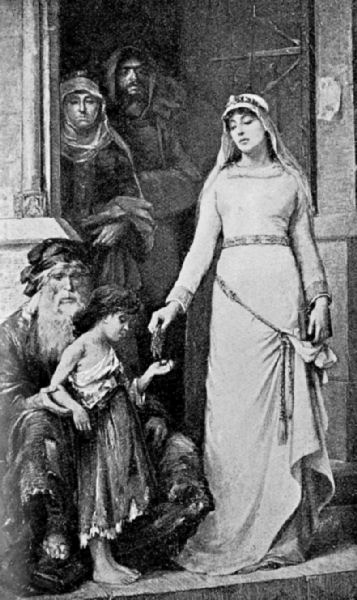 "What Can I Give Him?"
STAR OF BETHLEHEM.
The glitt'ring host bestud the sky,
One star alone of all the train
Can fix the sinner's wandering eye.
Hark! hark! to God the chorus breaks
From ev'ry host, from ev'ry gem;
But one alone the Saviour speaks,—
It is the Star of Bethlehem!
The storm was loud, the night was dark;
The ocean yawned, and rudely blew
The wind that tossed my found'ring bark.
Deep horror then my vitals froze;
Death-struck, I ceased the tide to stem,
When suddenly a star arose,—
It was the Star of Bethlehem!
It bade my dark forebodings cease;
And through the storm and danger's thrall,
It led me to the port of peace.
Now safely moored, my perils o'er,
I'll sing first in night's diadem,
Forever and forever more,—
The Star, the Star of Bethlehem!
Henry Kirke White.
NO ROOM.
Some rest to seek, but was denied.
"There is no room," the blind ones cried.
No voice entreating her to stay;
There was no room for God that day.
Angels are bowed in transport sweet
The mother of their God to greet.
The troubled sea and mighty land
Lie cradled like a grain of sand;
That Christmas night; and even we
Dare shut our hearts and turn the key.
Strikes our deaf souls; we pass Thee by,
Unsheltered 'neath the wintry sky.
Should bar our doors, nor ever see
Our Saviour waiting patiently.
The ashes on my hearth lie black—
Of light and warmth a total lack.
Amid the desolation drear
Of lukewarm love and craven fear?
Than my cold heart's tepidity—
Chilled, wind-tossed, as the winter sea?
No home to offer Thee have I;
Yet in Thy mercy pass not by.
Agnes Repplier.
ON CHRISTMAS DAY.
On which the Saviour of Mankind was born;
But oh! what Numbers to the Theme can rise?
Unless kind Angels aid me from the Skies!
Methinks I see the tunefull Host descend,
And with officious Joy the Scene attend!
Hark, by their Hymns directed on the Road,
The Gladsome Shepherds find the nascent God!
And view the Infant conscious of his Birth,
Smiling bespeak Salvation to the Earth!
For when th' important Æra first drew near
In which the great Messiah should appear;
And to accomplish his redeeming Love;
Beneath our Form should every Woe sustain,
And by triumphant Suffering fix his Reign,
Should for lost Man in Tortures yield his Breath
Dying to save us from eternal Death!
Oh mystick union!—salutary Grace!
Incarnate God our Nature should embrace!
That Deity should stoop to our Disguise!
That man recover'd should regain the Skies!
Dejected Adam! from thy grave ascend,
And view the Serpent's Deadly Malice end,
[Pg 95] Adorning bless th' Almighty's boundless Grace
That gave his son a Ransome for thy Race!
Oh never let my Soul this Day forget,
But pay in gratefull praise the annual Debt.
From a manuscript volume, written by George Washington.
THE HEAVENLY CHOIR.
Spreads o'er th' expanse of heaven?
In waves of light it thrills along,
Th' angelic signal given—
"Glory to God!" from yonder central fire
Flows out the echoing lay beyond the starry quire;
Upon a clear blue river,
Orb after orb, the wondrous sound
Is echoed on forever;
"Glory to God on high, on earth be peace,
And love toward men of love—salvation and release."
To join that festal throng;
Listen and mark what gentle air
First stirred the tide of song;
'Tis not, "the Saviour born in David's home,
To whom for power and health obedient worlds should come:"
With fix'd adoring look
The choir of angels caught the word,
Nor yet their silence broke;
But when they heard the sign, where Christ should be,
In sudden light they shone and heavenly harmony.
And in His manger laid,
The hope and glory of all lands
Is come to the world's aid:
No peaceful home upon His cradle smiled,
Guests rudely went and came where slept the royal Child.
No other thought should be;
Once duly welcomed and adored,
How should I part with Thee?
Bethlehem must lose Thee soon, but Thou wilt grace
The single heart to be Thy pure abiding-place.
Of a pure virgin mind,
In quiet ever, and in shade,
Shepherd and sage may find;
[Pg 98] They who have bow'd untaught to nature's sway,
And they who follow truth along her star-paved way.
Approach Thee, Babe divine,
For they in lowly thoughts are nursed,
Meet for Thy lowly shrine:
Sooner than they should miss where Thou dost dwell,
Angels from heaven will stoop to guide them to Thy cell.
For Thee to be revealed,
By wakeful shepherds Thou art found,
Abiding in the field.
All through the wintry heaven and chill night air,
In music and in light Thou dawnest on their prayer.
What though your wandering sheep,
Reckless of what they see and hear,
Lie lost in wilful sleep?
High heaven in mercy to your sad annoy
Still greets you with glad tidings of immortal joy.
The Saviour left for you;
Think on the Lord most holy, come
To dwell with hearts untrue:
So shall ye tread untired His pastoral ways,
And in the darkness sing your carol of high praise.
John Keble.
The Wassail-Bowl.
Our toast it is white, our ale it is brown,
Our bowl it is made of the mapling tree;
With the wassailing bowl we will drink to thee."
Old Carol.
WASSAIL.
An easy blessing to your bin
And basket, by our entering in.
Your larders, too, so hung with meat,
That though a thousand thousand eat,
Their silvery spheres, there's none may doubt
But more's sent in than was served out.
As that your pans no ebb may know;
But if they do, the more to flow,
Banked all with lilies, and the cream
Of sweetest cowslips filling them.
Nor bee or hive you have be mute,
But sweetly sounding like a lute.
Your stacks, your stocks, your sweetest mows,
All prosper by your virgin vows.
That brings us either ale or beer;
In a dry house all things are near.
Where rust and cobwebs bind the gate;
And all live here with needy fate;
For want of warmth, and stomachs keep
With noise the servants' eyes from sleep.
Our free feet here, but we'll away;
Yet to the Lares this we'll say:
And reckon this for fortune bad,
T' have lost the good ye might have had.
Robert Herrick.
FOOTNOTE:
[T] White bread.
INVITATION À FAIRE NOËL.
(FROM THE FRENCH OF THE TWELFTH CENTURY.)
Hither come from travel wide,
This Christmas-tide.
Hearken, give us bed and cheer,
We are weary, life is dear
This day o' the year!
God send ye joy and peace on earth,
Who broach good cheer for Christé's birth.
Spicéd ale and meat of beast,
Nor laugh the least:
If ye fill not pantries high
With bread, and fish, and mammoth pie,
And sweets, pardie!—
God ordains no peace on earth
To ye who fast at Christé's birth.
Who fill the fire for Christmas cold
And wassail hold,
Shall have of food a double store
And ruddy-blazing ingle roar
Forevermore.
[Pg 106] God sends the peace of heaven and earth
To men who carol Christé's birth.
Mar the tongue of any wight
'Twixt night and night.
Botun, batun—belabor well
Churls who sleep through matin bell
And no soothe tell.
God will forfeit peace on earth
If men fall out at Christé's birth.
English, French, and Gascon fine
And Angevine;
Clinks with neighbor and with guest,
Empties casks with gibe and jest—
The year's for rest!
God sends to men the joy of earth
Who broach good cheer for Christé's birth.
While yet the bubbles boil and wink
At the brink;
Ere ye lift the pot aloft,
Merrily wave it, laughing oft,
With hood well doft.
And if I cry ye, sad, "Wesseyl!"
Woe's him who answers not "Drinchayl!"
Translated by H. S. M.
A THANKSGIVING.
The pulse is Thine,
And all those other bits that be
There placed by Thee;
The worts, the purslane, and the mess
Of water-cress,
Which of Thy kindness Thou hast sent;
And my content
Makes those and my belovéd beet
To be more sweet.
'Tis Thou that crown'st my glittering hearth
With guiltless mirth,
And giv'st me wassail-bowls to drink
Spiced to the brink.
Robert Herrick.
AROUND THE WASSAIL-BOWL.
A wassail of good ale;
Well fare the butler's soul
That setteth this to sale;
Our jolly wassail.
Our wassail we begin,
We are all maidens poor,
We pray now let us in
With our wassail.
With apples and with spice,
Then grant us your good-will
To taste here once or twice
Of our good wassail.
Here dwelling in this house,
They kindly will agree
To take a full carouse
Of our wassail.
All freezing in the cold:
Good master, give command
To enter and be bold,
With our wassail.
With us is entered in,
Our master first of all
We hope will now begin
Of our wassail.
Our spicéd bowl will try;
The Lord prolong your life!
Good fortune we espy
For our wassail.
Our wassail to maintain;
We'll buy no house nor lands
With that which we do gain
With our wassail.
Of choosing king and queen;
Then be it your delight
That something may be seen
In our wassail.
To bear a liberal mind;
God bless our master's heart!
For here we comfort find
With our wassail.
To seek out more good cheer,
Where bounty will be shown
As we have found it here
With our wassail.
Our prayer shall be still,
We hope and ever shall
For this your great good-will
To our wassail.
FROM DOOR TO DOOR.
Among the leaves so green,
Here we come a wand'ring,
So fair to be seen.
Love and joy come to you,
And to you your wassail too,
And God bless you and send you a happy New Year.
Of the rosemary tree,
And so is your beer
Of the best barley.
Love and joy, etc.
That beg from door to door,
But we are neighbors' children
Whom you have seen before.
Love and joy, etc.
As you sit by the fire,
Pray think of us poor children
As wand'ring in the mire.
Love and joy, etc.
Made of ratching leather skin;
We want some of your small change
To line it well within.
Love and joy, etc.
Put on his golden ring;
Let him bring us a glass of beer,
And the better we shall sing.
Love and joy, etc.
And spread it with a cloth;
Bring us out a mouldy cheese,
And some of your Christmas loaf.
Love and joy, etc.
Likewise the mistress too
And all the little children
That round the table go.
Love and joy, etc.
WASSAILING CAROL.
We come to bring you tidings to all mankind so dear:
We come to tell that Jesus was born in Bethl'em town,
And now He's gone to glory and pityingly looks down
On us poor wassailers,
As wassailing we go;
With footsteps sore
From door to door
We trudge through sleet and snow.
The oxen were around Him within that lowly shed;
No servants waited on Him with lords and ladies gay;
But now He's gone to glory and unto Him we pray.
Us poor wassailers, etc.
And good old Joseph watched them both the while they took their rest;
And wicked Herod vainly sought to rob them of their child,
By slaughtering the Innocents in Bethlehem undefiled.
But us poor wassailers, etc.
These tidings of your Jesus, the Saviour, Lord and King;
In poverty He passed His days that riches we might share,
And of your wealth He bids you give and of your portion spare
To us poor wassailers, etc.
Your children like the olive branches round about your table;
Your barns shall burst with plenty and your crops shall be secure,
If you will give your charity to us who are so poor,
Us poor wassailers, etc.
And we must trudge and sing our song at many another gate;
And so we'll wish you once again a merry Christmas time,
And pray God bless you while you give good silver for our rhyme.
Us poor wassailers, etc.
A CAROL AT THE GATES.
Here we come a-singing, so fair to be seen.
God send you happy, God send you happy,
Pray God send you a happy New Year!
I have a little pocket to put a penny in.
God send you happy, etc.
Bring out some of your old ale, likewise your Christmas loaf.
God send you happy, etc.
And all the little children that round the table strew.
God send you happy, etc.
I wish you a merry Christmas, and a good fat pig in the sty.
God send you happy, etc.
WANDERING WASSAILERS.
Our bread it is white, and our ale it is brown;
Our bowl it is made of the maplin tree,
So here, my good fellow, I'll drink it to thee.
Come, fill it up unto the brim;
Come fill it up that we may all see;
With the wassailing bowl I'll drink to thee.
And we hope your soul in heaven shall rest;
But if you do bring us a bowl of your small,
Then down shall go butler, the bowl, and all.
But pull out your knife and cut us a toast;
And cut us a toast, one that we may all see;
With the wassailing bowl I'll drink to thee.
God send our mistress a good Christmas-pie!
A good Christmas-pie as e'er we did see;
With the wassailing bowl I'll drink to thee.
God send our master a good crop of corn,
A good crop of corn as we all may see;
With the wassailing bowl I'll drink to thee.
We hope our master and mistress heart will ne'er fail;
But bring us a bowl of your good strong beer,
And then we shall taste of your happy New Year.
Don't let the jolly wassailers stand on the cold stone,
But open the door and pull out the pin,
That we jolly wassailers may all sail in.
Chappell's Ancient English Melodies.
BRING US IN GOOD ALE.
For our blessed Lady's sake, bring us in good ale.
Nor bring us in no white bread, for therein is no game,
But bring us in good ale.
But bring us in good ale, for that goeth down at once;
And bring us in good ale.
But bring us in good ale, and give us enough of that;
And bring us in good ale.
Nor bring us in no tripes, for they be seldom clean;
But bring us in good ale.
But bring us in good ale, and give us nothing else;
And bring us in good ale.
Nor bring us in no pig's flesh, for that will make us boars;
But bring us in good ale.
Nor bring us in no venison, for that is not for our blood;
But bring us in good ale.
Nor bring us in no duck's flesh, for they slobber in the mere;
But bring us in good ale.
Wright's Songs and Carols.
ABOUT THE BOARD.
For here we shall be tasters
Of curious dishes that are brave and fine,
Where they that do such cheer afford,
I'll lay my knife upon the board,
My master and my dame they do not pine.
And sing down, down, aderry?
For now it is a time of joy and mirth;
'Tis said 'tis merry in the hall
When as beards they do wag all;
God's plenty's here, it doth not show a dearth.
Come fill us of the strongest,
And I will drink a health to honest John;
Come, pray thee, butler, fill the bowl,
And let it round the table troll,
When that is up, I'll tell you more anon.
New Christmas Carols, A.D. 1642.
BEFORE THE FEAST.
Come hearken to my song;
I know you do not hate good cheer
Nor liquor that is strong.
I hope there is none here
But soon will take my part,
Seeing my master and my dame
Say welcome with their heart.
And merry time of year,
Whereas the rich with plenty stored
Doth make the poor good cheer;
Plum-porridge, roast-beef, and minced-pies
Stand smoking on the board,
With other brave varieties
Our master doth afford.
Have neatly played the cooks;
Methinks these dishes eagerly
At my sharp stomach looks,
As though they were afraid
To see me draw my blade;
But I revenged on them will be
Until my stomach's stayed.
Small drink is out of date;
Methinks I shall fare like a prince
And sit in gallant state:
This is no miser's feast,
Although that things be dear;
God grant the founder of this feast
Each Christmas keep good cheer.
Who was born at this time;
For which all Christians should rejoice,
And I do sing in rhyme.
When you have given God thanks,
Unto your dainties fall:
Heaven bless my master and my dame,
Lord bless me and you all.
New Christmas Carols, A.D. 1642.
A BILL OF CHRISTMAS FARE.
And we shall be feasted with jolly good cheer;
Then let us be merry, 'tis Saint Stephen's day,
Let's eat and drink freely, here's nothing to pay.
And 'tis yonder smoking dish doth me inflame;
Anon I'll be with you, though you me outface,
For now I do tell you I have time and place.
My heels are so light they can stand on no ground;
My tongue it doth chatter, and goes pitter patter,
Here's good beer and strong beer, for I will not flatter.
Let's joy at morning, at noon, and at even;
Then leave off your mincing, and fall to mince-pies,
I pray take my counsel, be ruled by the wise.
New Christmas Carols, A.D. 1642.
THE MAHOGANY-TREE.
Winds whistle shrill,
Icy and chill,
Little care we:
Little we fear
Weather without
Sheltered about
The Mahogany-Tree.
Birds of rare plume
Sang, in its bloom;
Night-birds are we:
Here we carouse,
Singing like them,
Perched round the stem
Of the jolly old tree.
Boys, as we sit;
Laughter and wit
Flashing so free,
Life is but short—
When we are gone,
[Pg 127] Let them sing on
Round the old tree.
Happy as this;
Faces we miss,
Pleasant to see,
Kind hearts and true,
Gentle and just,
Peace to your dust,
We sing round the tree.
Lurks at the gate:
Let the dog wait;
Happy we'll be!
Drink, every one;
Pile up the coals,
Fill the red bowls,
Round the old tree!
Friend, art afraid?
Spirits are laid
In the Red Sea.
Mantle it up;
Empty it yet;
Let us forget,
Round the old tree.
Life and its ills,
Duns and their bills,
Bid we to flee.
Come with the dawn,
Blue-devil sprite,
Leave us to-night
Round the old tree.
William Makepeace Thackeray.
A CHRISTMAS CEREMONY.
You many a plum and many a pear;
For more or less fruits they will bring
As you do give them wassailing.
Robert Herrick.
WITH CAKES AND ALE.
Well tiptoed to the tabor string,
And many a buss below the holly,
And flout at sable melancholy—
So, with a rouse, went Christmassing!
No clog to blaze? No wit to wing?
Are catches gone, and dimpled Dolly,
With cakes and ale?
The spicéd meat, the minstreling!
Undo Misrule, and many a volley
Of losel snatches born of folly—
Bring back the cheer, be Christmas-king,
With cakes and ale!
H. S. M.
THE MASQUE OF CHRISTMAS.
(AS IT WAS PRESENTED AT COURT, 1616.)
The Court being seated,
Enter Christmas, with two or three of the guard, attired in round hose, long stockings, a close doublet, a high-crowned hat, with a brooch, a long, thin beard, a truncheon, little ruffs, white shoes, his scarfs and garters tied cross, and his drum beaten before him.
Why, gentlemen, do you know what you do?
ha! would you have kept me out? Christmas,
old Christmas, Christmas of London, and Captain
Christmas? Pray you, let me be brought
before my lord chamberlain, I'll not be answered
else: 'Tis merry in hall, when beards wag all:
I have seen the time you have wish'd for me
for a merry Christmas; and now you have me,
they would not let me in: I must come another
time! a good jest, as if I could come more than
once a year! Why, I am no dangerous person,
and so I told my friends of the guard. I am
old Gregory Christmas still, and though I come
out of Pope's-head alley, as good a Protestant
as any in my parish. The truth is, I have
brought a Masque here, out o' the city, of my
own making, and do present it by a set of my[Pg 131]
sons, that come out of the lanes of London,
good dancing boys all. It was intended, I confess,
for Curriers Hall; but because the weather
has been open, and the Livery were not at
leisure to see it till a frost came, that they cannot
work, I thought it convenient, with some
little alterations, and the groom of the revels'
hand to 't, to fit it for a higher place; which I
have done, and though I say it, another manner
of device than your New-Year's-night. Bones
o' bread, the king! (seeing King James.) Son
Rowland! Son Clem! be ready there in a trice:
quick, boys!
Enter his Sons and Daughters, (ten in number,) led in, in a string, by Cupid, who is attired in a flat cap, and a prentice's coat, with wings at his shoulders.
Misrule, in a velvet cap, with a sprig, a short cloak, great yellow ruff, like a reveller, his torch-bearer bearing a rope, a cheese, and a basket.
Carol, a long tawny coat, with a red cap, and a flute at his girdle, his torch-bearer carrying a song-book open.
Minced-Pie, like a fine cook's wife, drest neat; her man carrying a pie, dish, and spoons.
Gambol, like a tumbler, with a hoop and bells; his torch-bearer armed with a colt-staff, and a binding cloth.
[Pg 132] Post and Pair, with a pair-royal of aces in his hat; his garment all done over with pairs and purs; his squire carrying a box, cards, and counters.
New-Year's-Gift, in a blue coat, serving-man like, with an orange, and a sprig of rosemary gilt on his head, his hat full of brooches, with a collar of ginger-bread, his torch-bearer carrying a march-pane with a bottle of wine on either arm.
Mumming, in a masquing pied suit, with a vizard, his torch-bearer carrying the box, and ringing it.
Wassel, like a neat sempster and songster; her page bearing a brown bowl, drest with ribands, and rosemary before her.
Offering, in a short gown, with a porter's staff in his hand, a wyth born before him, and a bason, by his torch-bearer.
Baby-Cake, drest like a boy, in a fine long coat, biggin-bib, muckender, and a little dagger; his usher bearing a great cake, with a bean and a pease.
They enter singing.
Your majesties all, two there;
Your highness small, with my good lords all,
And ladies, how do you do there?
From little, little, little London;
[Pg 133] Which say the king likes, I have passed the pikes,
If not, old Christmas is undone.
[Noise without.
Chris. Ho, peace! what's the matter there?
Gam. Here's one o' Friday-street would come in.
Chris. By no means, nor out of neither of the Fish-streets, admit not a man; they are not Christmas creatures: fish and fasting days, foh! Sons, said I well? look to it.
Gam. No body out o' Friday-street, nor the two Fish-streets there, do you hear?
Car. Shall John Butter o' Milk-street come in? Ask him.
Gam. Yes, he may slip in for a torch-bearer, so he melt not too fast, that he will last till the masque be done.
Chris. Right, son.
And two, the which are wenches:
In all they be ten, four cocks to a hen,
And will swim to the tune like tenches.
Which some would say are torches
To bring them here, and to lead them there,
And home again to their own porches.
Enter Venus, a deaf tire-woman.
Ven. Now, all the lords bless me! where am I, trow? where is Cupid? "Serve the king!" they may serve the cobbler well enough, some of 'em, for any courtesy they have, I wisse; they have need o' mending: unrude people they are, your courtiers; here was thrust upon thrust indeed: was it ever so hard to get in before, trow?
Chris. How now? what's the matter?
Ven. A place, forsooth, I do want a place: I would have a good place, to see my child act in before the king and queen's majesties, God bless 'em! to-night.
Chris. Why, here is no place for you.
Ven. Right, forsooth, I am Cupid's mother, Cupid's own mother, forsooth; yes, forsooth: I dwell in Pudding-lane: ay, forsooth, he is prentice in Love-lane, with a bugle maker, that makes of your bobs, and bird-bolts for ladies.
Chris. Good lady Venus of Pudding-lane, you must go out for all this.
Ven. Yes, forsooth, I can sit anywhere, so I may see Cupid act: he is a pretty child, though I say it, that perhaps should not, you will say. I had him by my first husband; he was a smith,[Pg 135] forsooth, we dwelt in Do-little-lane then: he came a month before his time, and that may make him somewhat imperfect; but I was a fishmonger's daughter.
Chris. No matter for your pedigree, your house: good Venus, will you depart?
Ven. Ay, forsooth, he'll say his part, I warrant him, as well as e'er a play-boy of 'em all: I could have had money enough for him, an I would have been tempted, and have let him out by the week to the king's players. Master Burbage has been about and about with me, and so has old master Hemings, too, they have need of him; where is he, trow, ha! I would fain see him—pray God they have given him some drink since he came.
Chris. Are you ready, boys? Strike up! nothing will drown this noise but a drum: a'peace, yet! I have not done. Sing,—
Car. Why, here be half of the properties forgotten, father.
Offer. Post and Pair wants his pur-chops and his pur-dogs.
Car. Have you ne'er a son at the groom porter's, to beg or borrow a pair of cards quickly?
[Pg 136] Gam. It shall not need; here's your son Cheater without, has cards in his pocket.
Offer. Ods so! speak to the guards to let him in, under the name of a property.
Gam. And here's New-Year's-Gift has an orange and rosemary, but not a clove to stick in't.
New-Year. Why, let one go to the spicery.
Chris. Fy, fy, fy! it's naught, it's naught, boys.
Ven. Why, I have cloves, if it be cloves you want. I have cloves in my purse: I never go without one in my mouth.
Car. And Mumming has not his vizard, neither.
Chris. No matter! his own face shall serve, for a punishment, and 'tis bad enough; has Wassel her bowl, and Minced-pie her spoons?
Offer. Ay, ay: but Misrule doth not like his suit: he says the players have sent him one too little, on purpose to disgrace him.
Chris. Let him hold his peace, and his disgrace will be the less: what! shall we proclaim where we were furnish'd? Mum! mum! a'peace! be ready, good boys.
With all the appurtenances,
A right Christmas, as of old it was,
To be gathered out of the dances.
The queen, and prince, as it were now
Drawn here by love; who over and above,
Doth draw himself in the geer too.
Here the drum and fife sound, and they march
about once. In the second coming up, Christmas
proceeds in his song:
No more of your martial music;
Even for the sake o' the next new stake,
For there I do mean to use it.
With roll and farthingale hoopéd:
I pray you know, though he want his bow,
By the wings, that this is Cupid.
But that were not so witty:
His cap and coat are enough to note
That he is the love o' the city.
For that was only his-rule:
But now comes in, Tom of Bosoms-inn,
And he presenteth Mis-rule.
Albeit you never ask it:
For there you may see what his ensigns be,
The rope, the cheese, and the basket.
A chirping boy, and a kill-pot:
Kit Cobler it is, I'm a father of his,
And he dwells in a lane called Fill-pot.
Minced-pie; with her do not dally
On pain o' your life: she's an honest cook's wife,
And comes out of Scalding-alley.
And, to make my tale the shorter,
My son Hercules, tane out of Distaff-lane,
But an active man, and a porter.
Doth make and a gingling sally;
And wot you who, 'tis one of my two
Sons, card-makers in Pur-alley.
Mac-pipin my son, but younger,
Brings Mumming in; and the knave will win,
For he is a costermonger.
To tell you what his name is:
With orange on head, and his ginger-bread,
Clem Waspe of Honey-lane 'tis.
And for Twelfth-night more meet too:
She works by the ell, and her name is Nell,
And she dwells in Threadneedle-street too.
That in every great house keepeth,
Is by my son, young Little-worth, done,
And in Penny-rich street he sleepeth.
Of Christmas, merry, merry vein-a,
Is child Rowlan, and a straight young man,
Though he come out of Crooked-lane-a.
But I could find but one more
Child of Christmas, and a Log it was,
When I them all had gone o'er.
That he would make one to prance it;
And I myself would have been the twelfth
O' but Log he was too heavy to dance it.
Or queen and ladies bright:
Cupid invites you to the sights
He shall present to-night.
Ven. 'Tis a good child, speak out; hold up
your head, Love.
Cup. And which Cupid—and which Cupid—
Ven. Do not shake so, Robin; if thou be'st a-cold, I have some warm waters for thee here.
Chris. Come, you put Robin Cupid out with your water's and your fisling; will you be gone?
Ven. Ay, forsooth, he's a child, you must conceive, and must be used tenderly; he was never in such an assembly before, forsooth, but once at the Warmoll Quest, forsooth, where he said grace as prettily as any of the sheriff's hinch-boys, forsooth.
Chris. Will you peace, forsooth?
Cup. And which Cupid—and which Cupid—
Ven. Ay, that's a good boy, speak plain, Robin; how does his majesty like him, I pray? will he give eight-pence a day, think you? Speak out, Robin.
[Pg 141] Chris. Nay, he is out enough. You may take him away, and begin your dance; this it is to have speeches.
Ven. You wrong the child, you do wrong the infant; I 'peal to his majesty.
Here they dance.
Chris. Well done, boys, my fine boys, my bully boys!
THE EPILOGUE.
The commendation of my sons,
For at the Artillery garden they shall
As well forsooth use their guns,
And march as fine as the Muses nine,
Along the streets of London;
And in their brave tires, to give their false fires,
Especially Tom my son.
Now if the lanes and the allies afford
Such an ac-ativity as this;
At Christmas next, if they keep their word,
Can the children of Cheapside miss?
Though, put the case, when they come in place,
They should not dance, but hop:
[Pg 142] Their very gold lace, with their silk, would 'em grace,
Having so many knights o' the shop.
But were I so wise, I might seem to advise
So great a potentate as yourself;
They should, sir, I tell ye, spare't out of their belly,
And this way spend some of their pelf.
Ay, and come to the court, for to make you some sport,
At the least once every year,
As Christmas hath done, with his seventh or eighth son,
And his couple of daughters dear.
And thus it ended.
Ben Jonson.
Santa Claus.
As if it stooped with its own load.
To poise this, equally he bore
A paunch of the same bulk before,
Which still he had a special care
To keep well crammed with thrifty fare."
Butler.
A VISIT FROM ST. NICHOLAS.
Not a creature was stirring, not even a mouse;
The stockings were hung by the chimney with care,
In hopes that St. Nicholas soon would be there.
The children were nestled all snug in their beds,
While visions of sugar-plums danced in their heads;
And mamma in her kerchief and I in my cap
Had just settled our brains for a long winter's nap,
When out on the lawn there arose such a clatter,
I sprang from my bed to see what was the matter.
Away to the window I flew like a flash,
Tore open the shutters and threw up the sash;
The moon on the breast of the new-fallen snow
Gave the lustre of day to the objects below;
When what to my wondering eyes should appear
But a miniature sleigh and eight tiny reindeer,
With a little old driver so lively and quick
I knew in a moment it must be St. Nick.
[Pg 146] More rapid than eagles, his coursers they came,
And he whistled and shouted and called them by name:
"Now, Dasher! now, Dancer! now, Prancer! now, Vixen!
On, Comet! on, Cupid! on, Dunder and Blixen!
To the top of the stoop, to the top of the wall!
Now dash away! dash away! dash away all!"
As dry leaves before the wild hurricane fly,
When they meet with an obstacle, mount to the sky,
So up to the house-top the coursers they flew,
With the sleigh full of toys and St. Nicholas too;
And then in a twinkling I heard on the roof
The prancing and pawing of each little hoof.
As I drew in my head and was turning around,
Down the chimney St. Nicholas came with a bound;
He was dressed all in furs from his head to his foot,
And his clothes were all tarnished with ashes and soot.
A bundle of toys he had flung on his back;
And he looked like a pedler just opening his pack.
His eyes, how they twinkled! his dimples, how merry!
His cheeks were like roses, his nose like a cherry;
[Pg 147] His droll little mouth was drawn up like a bow,
And the beard on his chin was as white as the snow.
The stump of a pipe he held tight in his teeth,
And the smoke, it encircled his head like a wreath.
He had a broad face, and a little round belly
That shook when he laughed, like a bowl full of jelly.
He was chubby and plump, a right jolly old elf,
And I laughed when I saw him, in spite of myself.
A wink of his eye and a twist of his head
Soon gave me to know I had nothing to dread.
He spoke not a word, but went straight to his work,
And filled all the stockings, then turned with a jerk,
And laying his finger aside of his nose,
And giving a nod, up the chimney he rose.
He sprang to his sleigh, to his team gave a whistle,
And away they all flew like the down of a thistle;
But I heard him exclaim, ere he drove out of sight,
"Happy Christmas to all, and to all a good-night!"
Clement C. Moore.
THE HARD TIMES IN ELFLAND.
The Christmas Eve so bitterly!
But Wife, and Harry, the four-year old,
Big Charley, Nimblewits, and I,
More frontward of the mighty fire,
Where wise Newfoundland Fan foreknew
The heaven that Christian dogs desire—
Huge nose on heavy paws reclined,
With never a drowning boy to save,
And warmth of body and peace of mind.
The fire well capp'd the company:
In grave debate or careless chat,
A right good fellow, mingled he:
And talked of things above, below,
With flames more winsome than our wit,
And coals that burned like love aglow.
Smooth down the channel of the night,
We spoke of Time: thereat, one told
A parable of the seasons' flight.
And I, with inward purpose sly,
To shield my purse from Christmas-trees,
And stockings, and wild robbery
My cash in Santa Claus's name,—
In full the hard, hard times surveyed,
Denounced all waste as crime and shame;
Including skates, velocipedes,
Kites, marbles, soldiers, towers infirm,
Bows, arrows, cannon, Indian reeds,
And all th' infernal host of horns
Whereby to strenuous hells of noise
Are turned the blessed Christmas morns;
I rose, forefinger high in air,
When Harry cried, some war to wage,
"Papa is hard times ev'ywhere?
It isn't hard times none at all!"
Now, blessed vision! to my hand
Most pat, a marvel strange did fall.
He cried, leapt up in wild alarm,
Ran to my Comrade, shelter took
Beneath the startled mother's arm,
A foot hang down the fireplace! Then,
With painful scrambling, scratched and raw,
Two hands that seemed like hands of men,
The blazing fire, and forth there came
Before our wide and wondering view
A figure shrinking half with shame,
—But with a mien of dignity
The seedy stranger raised his head:
"My friends, I'm Santa Claus," said he.
The new moon rivall'd, pale and thin;
Where once was cheek, now empty space;
Whate'er stood out, did now stand in.
His arms mere sickles seemed to be:
But most o'erflowed our sorrow's cup
When that we saw—or did not see—
It shook like a bowl of jelly fine:
An earthquake could not shake it now;
He had no belly—not a sign.
I have seen better days," he said:
"But now with shrinkage, loss, and care,
Your Santa Claus scarce owns his head.
For goblins! Never knew the like.
All Elfland's mortgaged! And we fear
That gnomes are just about to strike.
The whole world called me jolly brick;
But listen to a piteous tale,
Young Harry,—Santa Claus is sick!
Comes to my house and talks to me:
'I've got,' says he, 'a little plan
That suits this nineteenth century.
Six reindeer slow from house to house,
Let's build a Grand Trunk Railway through
From here to earth's last terminus.
An Elevated Track, of course,
Then, as we whisk you by, you'll drop
Each package down: just think the force
Our millions: look you, soon we will
Compete for freight—and then we'll take
Dame Fortune's bales of good and ill—
That e'er did business in this world!
Then Death, that ceaseless traveller,
Shall on his rounds by us be whirled.
We'll bring 'em cheap by steam, and fast:
We'll run a branch to heaven! and then
We'll riot, man; for then, at last,
To call each hour, from town to town,
And carry the dead folks' souls up there,
And bring the unborn babies down!'
Nay every penny I could raise.
My wife e'er cried, ''Tis rash, 'tis rash:'
How could I know the stock-thief's ways?
My woes began that wretched day.
The President plied me like a tool,
In lawyer's fees, and rights of way,
Was meshed as in a mighty maze;
The stock ran low, the talk ran high,
Then quickly flamed the final blaze.
The debts were large ... the oft-told tale.
The President rolled in splendor new,
—He bought my silver at the sale.
I've had to give up everything;
My reindeer, even, whom I ... pray,
Excuse me" ... here, o'er-sorrowing,
Then calmed again: "My reindeer fleet,
I gave them up: on foot, my dears,
I now must plod through snow and sleet.
Yes, every luxury is cut off,
—Which, by the way, reminds me how
I caught this dreadful hacking cough:
To make young Kris a coat of state
That very night the storm occurred!
Thus we become the sport of Fate.
Surveying chimney-tops and roofs,
And planning how it could be done
Without any reindeers' bouncing hoofs.
A most superior woman she!
'It never, never can be right
That you, deep sunk in poverty,
And trot about, bent down with toys;
There's Kris a-crying now for bread—
To give to other people's boys!
The Elfs' Insurance Company's gone.
Ah, Claus, those premiums! Now, our lives
Depend on yours: thus griefs go on.
I do believe, if out you went,
You'd go, in spite of all that's passed,
To the children of that President!'
These eyes that night ne'er slept a wink;
My path seemed honeycombed with pits,
Naught could I do but think and think.
Ne'er shall my boys, my boys, I cried,
When Christmas morns their eyes unclose,
Find empty stockings gaping wide!
The wife, the girls, and Kris took fire;
They spun, sewed, cut,—till by and by
We made, at home, my pack entire!"
"Now, hoist me up: there, gently: quick!
Dear boys, don't look for much this year:
Remember, Santa Claus is sick!"
Sidney Lanier.
OLD CHRISTMAS.
He knows a wight of worth,
For he's as good a fellow
As any on the earth;
He comes warm-cloaked and coated,
And buttoned to the chin;
And ere he is a-nigh the door,
We ope to let him in.
It does one good to hear;
For all the little children
He asks each passing year:
His heart is warm and gladsome,
Not like your griping elves,
Who, with their wealth in plenty,
Think only of themselves.
He sings with might and main;
We ne'er forget his visit
Till he comes back again.
With laurel green and holly
We make the house look gay;
We know that it will please him,
It was his ancient way.
What gifts he gives away!
There's not a lord in England
Could equal him to-day!
Good luck unto Old Christmas,
Long life now let us sing;
He is more kind unto the poor
Than any crownéd king.
Mary Howitt.
MRS. SANTA CLAUS.
The stars like flashing beads
That round a brimming punch-bowl break
'Mid spice and almond seeds;
And here and there a silver beam
Made bright some curling cloud
Uprising like the wassail's stream,
Blown off by laughter loud.
And good old Santa Claus
His door was just about to leave,
When something made him pause:
"I haven't kissed my wife," quoth he,
"I haven't said good-by."
So back he went and lovingly
He kissed her cap awry.
The least bit—of a shrew.
What wonder? Only think of it—
She has so much to do.
Imagine all the stocking-legs,
Of every size and shape,
That hang upon their Christmas pegs
With greedy mouths agape.
The northern skies aflame
With quivering light, 'tis only she—
This very quaint old dame—
Striking a match against the Pole
Her whale-oil lamp to light,
That she may see to work, poor soul,
At making toys all night.
Before the sleigh had gone;
"'Tis many a year since we were wed;
I'll follow him anon.
For faithless husbands, one and all,
Ere on their loves they wait,
Their wives' suspicion to forestall
Seem most affectionate."
Into her husband's sleigh
She slipped, and hid behind his pack
Just as he drove away.
"Great Bears!" growled Santa in his beard,
"A goodly freight have I;
Were't fouler weather, I had feared
The glacier path to try."
Across the realms of snow—
[Pg 160] The glittering planets overhead,
The sparkling frost below—
Until the reindeer stopped before
A mansion tall and fair,
Up to whose wide and lofty door
Inclined a marble stair.
They heard no stroke of hoof;
No fall of foot as Santa leapt
From pavement unto roof.
So, down the chimney like a sweep
He crept, and after him
Went Mrs. Claus to have a peep
At chambers warm and dim.
A stocking by the fire
To wear which no one over-young
Could fittingly aspire:
Long, slender, graceful—it was just
The thing to fill the heart
Of Mrs. C. with deep distrust;
And—well—it played its part.
The silken foot and leg
With bonbons, fruit, and toys until
It almost broke its peg.
[Pg 161] "My!" whispered Santa, "here's a crop.
This little boy is wise;
He knows I fill 'em to the top,
No matter what the size."
Like every jealous wife;
She would make bad things out of good,
To feed her inward strife.
Snapped she unto herself: "The minx
Sha'n't have a single thing!
I'll take 'em home again, methinks,
Nor leave a stick or string!"
She followed Santa's wake,
And as he stuffed the stockings tight,
She every one did take,
Stowing them all unseen away,
In order grimly neat,
Within the dark box of the sleigh,
All underneath the seat.
The bells began to peal,
And tiny forms down many a hall
And stairway 'gan to steal,
[Pg 162] In vain each chimney-piece they sought—
Those weeping girls and boys—
For Christmas morn had come and brought
No candy and no toys.
Charles Henry Lüders.
SANTA CLAUS TO LITTLE ETHEL.
(IN ANSWER TO HER LETTER, GIVING HIM A LIST OF HER CHRISTMAS WANTS.)
I fear that the breath'll
Be out of our bodies before we get through;
Day in and day out
We are rushing about,
And you haven't a notion how much there's to do.
When you may remember
I paid you a visit at dear Elsinore,
There's not been a minute
With a resting-place in it,
And my nose has not once been outside of the door.
My bellows a-blowing,
My hammers and tongs and a thousand odd tools,
Never give up the battle,
But click, bang, and rattle
Like ten million children in ten thousand schools.
And yet, my small deary,
I read all the letters as fast as they come;
If I didn't,—good gracious!
The house is not spacious,
And the letters would soon squeeze me out of my home.
And a dolly's soft bed,
With a night-gown and bed-clothes of pretty bright stuffs,
And paints, and a case
Where my books I may place,
And besides all these things, Dolly's collars and cuffs."
But may I be kissed
On the back of my head by a crazy mule's hoof,
If the list I don't fill,
Though it takes all the skill
Of every stout workman beneath my broad roof.
Let me not hear a snarl,
[Pg 165] Or a growl, or a grumble come out of your heads;
To work now, instanter!
Trot, gallop, and canter,
And finish this job ere you go to your beds!"
With a jump and a jerk,
And everything's finished in beautiful style.
Christmas Eve's here again,
And I'm off with my train,
Every reindeer prepared for ten seconds a mile.
With this letter for you,
So softly, for fear I your slumbers might break.
Not a word will I speak,
But I'll kiss your soft cheek,
And be gone in a jiffy, before you awake.
Any part of the lot
That I ordered prepared and all marked with your name,
Let me just add a word,
So if that has occurred,
You will know just exactly how I was to blame.
As I go, year by year,
[Pg 166] Up and down these straight chimneys, while you are in bed,
The bumps and the scratches
That Santa Claus catches
Have rubbed all the hair from the top of his head.
Of my cover of hair,
Is rapidly losing its power, my pet!
Sometimes, after all's fixed,
I get everything mixed,
And you must forgive if I ever forget.
May the coming New Year
Bring all kinds of blessings to you from above;
Make you happier and better:
And so my long letter
Must close, with a great deal of Santa Claus's love.
Francis Wells.
The Season's Reveries.
Till the mouldering fire forgot to blaze,
Shaping among the whimsical coals
Fancies and figures and shining goals!"
Lowell.
GUESTS AT YULE.
Thus sounds each Christmas bell
Across the winter snow.
But what are the little footprints all
That mark the path from the churchyard wall?
They are those of the children waked to-night
From sleep by the Christmas bells and light:
Ring sweetly, chimes! Soft, soft, my rhymes!
Their beds are under the snow.
Carols each Christmas bell.
What are the wraiths of mist
That gather anear the window-pane
Where the winter frost all day has lain?
They are soulless elves, who fain would peer
Within and laugh at our Christmas cheer:
Ring fleetly, chimes! Swift, swift, my rhymes!
They are made of the mocking mist.
Cease, cease, each Christmas bell!
Under the holly bough,
[Pg 170] Where the happy children throng and shout,
What shadow seems to flit about?
Is it the mother, then, who died
Ere the greens were sere last Christmas-tide?
Hush, falling chimes! Cease, cease, my rhymes!
The guests are gathered now.
Edmund Clarence Stedman.
CHRISTMAS IN INDIA.
As the women in the village grind the corn,
And the parrots seek the riverside, each calling to his fellow
That the day, the staring eastern day, is born.
Oh, the white dust on the highway! Oh, the stenches in the by-way!
Oh, the clammy fog that hovers over earth!
And at home they're making merry 'neath the white and scarlet berry—
What part have India's exiles in their mirth?
As the cattle crawl afield beneath the yoke,
And they bear one o'er the field-path who is past all hope or caring,
To the ghat below the curling wreaths of smoke.
Call on Rama, going slowly, as ye bear a brother lowly—
Call on Rama—he may hear, perhaps, your voice!
[Pg 172] With our hymn-books and our psalters we appeal to other altars,
And to-day we bid "good Christian men rejoice!"
As at home the Christmas Day is breaking wan,
They will drink our healths at dinner—those who tell us how they love us,
And forget us till another year be gone!
Oh, the toil that knows no breaking! Oh! the heimweh, ceaseless, aching!
Oh, the black, dividing sea and alien plain!
Youth was cheap—wherefore we sold it. Gold was good—we hoped to hold it,
And to-day we know the fulness of our gain.
As the sun is sinking slowly over home;
And his last ray seems to mock us, shackled in a lifelong tether
That drags us back, howe'er so far we roam.
Hard her service, poor her payment—she in ancient, tattered raiment—
India, she the grim stepmother of our kind.
[Pg 173] If a year of life be lent her, if her temple's shrine we enter,
The door is shut—we may not look behind.
As the conches from the temple scream and bray.
With the fruitless years behind us and the hopeless years before us,
Let us honor, O, my brothers, Christmas Day!
Call a truce, then, to our labors—let us feast with friends and neighbors,
And be merry as the custom of our caste;
For, if "faint and forced the laughter," and if sadness follow after,
We are richer by one mocking Christmas past.
Rudyard Kipling.
CHRISTMAS VIOLETS.
You sent me once across the sea;
From gardens that the winter frets,
In summer lands they came to me.
Still humid from the frozen dew,
To me they spoke of Christmas mirth,
They spoke of England, spoke of you.
The perfume long has passed away;
The sea whose tides are year by year
Is set between us, chill and gray.
The haven of a happy clime;
You do not dread the winter's rage,
Although we missed the summer-time.
Across the gulf of time and pain,
To-night returns the memory
Of love that lived not all in vain.
Andrew Lang.
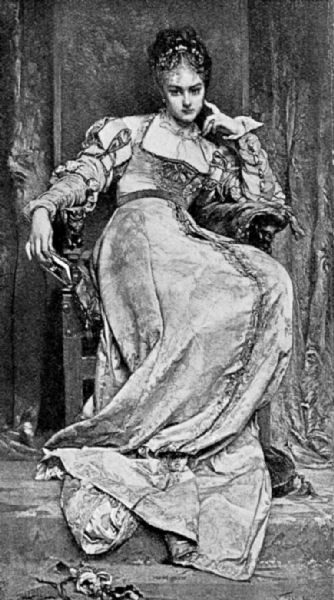 The Season's Reveries
DICKENS RETURNS ON CHRISTMAS DAY.
London seemed shivering in the summer heat;
Strangers took up the tale like friends that meet:
"Dickens is dead!" said they, and hurried by;
Street children stopped their games—they knew not why,
But some new night seemed darkening down the street;
A girl in rags, staying her way-worn feet,
Cried, "Dickens dead? Will Father Christmas die?"
He loves thee still in all thy joys and fears:
Though he whose smiles made bright thine eyes of gray—
Whose brave sweet voice, uttering thy tongueless years,
Made laughters bubble through thy sea of tears—
Is gone, Dickens returns on Christmas Day!
Theodore Watts.
A GRIEF AT CHRISTMAS.
FROM "IN MEMORIAM."
First Year.
The moon is hid; the night is still;
The Christmas bells from hill to hill
Answer each other in the mist.
From far and near, on mead and moor,
Swell out and fail, as if a door
Were shut between me and the sound:
That now dilate, and now decrease,
Peace and good-will, good-will and peace,
Peace and good-will, to all mankind.
I almost wish'd no more to wake,
And that my hold on life would break
Before I heard those bells again:
For they controll'd me when a boy;
They bring me sorrow touched with joy,
The merry merry bells of Yule.
As daily vexes household peace,
And chains regret to his decease,
How dare we keep our Christmas-eve;
To enrich the threshold of our night
With shower'd largess of delight,
In dance and song and game and jest.
Entwine the cold baptismal font,
Make one wreath more for Use and Wont,
That guard the portals of the house;
Gray nurses, loving nothing new;
Why should they miss their yearly due
Before their time? They too will die.
The holly round the Christmas hearth;
A rainy cloud possess'd the earth,
And sadly fell our Christmas-eve.
We gambol'd, making vain pretence
Of gladness, with an awful sense
Of one mute Shadow watching all.
We heard them sweep the winter land;
And in a circle hand-in-hand
Sat silent, looking each at each.
We sung, tho' every eye was dim,
A merry song we sang with him
Last year: impetuously we sang:
Upon us: surely rest is meet.
"They rest," we said, "their sleep is sweet,"
And silence follow'd, and we wept.
Once more we sang: "They do not die
Nor lose their mortal sympathy,
Nor change to us, although they change;
With gather'd power, yet the same
Pierces the keen seraphic flame
From orb to orb, from veil to veil."
Draw forth the cheerful day from night:
O Father, touch the east, and light
The light that shone when Hope was born.
Second Year.
The holly round the Christmas hearth;
The silent snow possessed the earth,
And calmly fell on Christmas-eve:
No wing of wind the region swept,
But over all things brooding slept
The quiet sense of something lost.
Again our ancient games had place,
The mimic picture's breathing grace,
And dance and song and hoodman-blind.
No single tear, no mark of pain:
O sorrow, then can sorrow wane?
O grief, can grief be changed to less?
No—mixt with all this mystic frame,
Her deep relations are the same,
But with long use her tears are dry.
Third Year.
The moon is hid, the night is still;
A single church below the hill
Is pealing, folded in the mist.
That wakens at this hour of rest
A single murmur in the breast,
That these are not the bells I know.
In lands where not a memory strays,
Nor landmark breathes of other days,
But all is new unhallow'd ground.
This laurel, let this holly stand:
We live within the stranger's land,
And strangely falls our Christmas-eve.
And silent under other snows:
There in due time the woodbine blows,
The violet comes, but we are gone.
The genial hour with mask and mime;
For change of place, like growth of time,
Has broke the bond of dying use.
By which our lives are chiefly proved,
A little spare the night I loved,
And hold it solemn to the past.
Nor bowl of wassail mantle warm;
For who would keep an ancient form
Thro' which the spirit breathes no more?
Nor harp be touch'd, nor flute be blown;
No dance, no motion, save alone
What lightens in the lucid east
Long sleeps the summer in the seed;
Run out your measured arcs, and lead
The closing cycle rich in good.
The flying cloud, the frosty light:
The year is dying in the night:
Ring out, wild bells, and let him die.
Ring, happy bells, across the snow;
The year is going, let him go;
Ring out the false, ring in the true.
For those that here we see no more;
Ring out the feud of rich and poor;
Ring in redress of all mankind.
And ancient forms of party strife;
Ring in the nobler modes of life,
With sweeter manners, purer laws.
The faithless coldness of the times;
Ring out, ring out, my mournful rhymes,
But ring the fuller minstrel in:
The civic slander and the spite;
Ring in the love of truth and right,
Ring in the common love of good.
Ring out the narrowing lust of gold;
Ring out the thousand wars of old,
Ring in the thousand years of peace.
The larger heart, the kindlier hand;
Ring out the darkness of the land,
Ring in the Christ that is to be.
Lord Tennyson.
MY SISTER'S SLEEP.
At length the long-ungranted shade
Of weary eyelids overweigh'd
The pain naught else might yet relieve.
Over the bed from chime to chime,
Then raised herself for the first time,
And as she sat her down did pray.
With work to finish. For the glare
Made by her candle, she had care
To work some distance from the bed.
Of winter radiance sheer and thin;
The hollow halo it was in
Was like an icy crystal cup.
Of flame, by vents the fireshine drove
And reddened. In its dim alcove
The mirror shed a clearness round.
And my tired mind felt weak and blank;
Like a sharp, strengthening wine it drank
The stillness and the broken lights.
Heard in each hour, crept off; and then
The ruffled silence spread again,
Like water that a pebble stirs.
Her needles, as she laid them down,
Met lightly, and her silken gown
Settled: no other noise than that.
So as said angels, she did say;
Because we were in Christmas-day,
Though it would still be long till morn.
There was a pushing back of chairs,
As some one had sat unawares
So late, now heard the hour, and rose.
Our mother went where Margaret lay,
Fearing the sounds o'erhead—should they
Have broken her long-watched-for rest!
But suddenly turned back again;
And all her features seemed in pain
With woe, and her eyes gazed and yearned.
And held my breath, and spoke no word;
There was none spoken; but I heard
The silence for a little space.
And both my arms fell, and I said,
"God knows I knew that she was dead,"
And there, all white, my sister slept.
A little after twelve o'clock,
We said, ere the first quarter struck,
"Christ's blessing on the newly born!"
Dante Gabriel Rossetti.
CHRISTMAS IN EDINBOROUGH.
I.
Frost-pearl'd are all the boughs of forests old,
The sheep are huddling close upon the wold,
And over them the stars tremble on high.
Pure joys these winter nights around me lie;
'Tis fine to loiter through the lighted streets
At Christmas-time, and guess from brow and pace
The doom and history of each one we meet,
What kind of heart beats in each dusky case;
Whiles, startled by the beauty of a face
In a shop-light a moment. Or instead,
To dream of silent fields where calm and deep
The sunshine lieth like a golden sleep—
Recalling sweetest looks of summers dead.
Alexander Smith.
CHRISTMAS IN EDINBOROUGH.
II.
But I am sitting in my silent room,
Sitting all silent in congenial gloom
To-night, while half the world the other greets
With smiles and grasping hands and drinks and meats,
I sit and muse on my poetic doom;
Like the dim scent within a budded rose,
A joy is folded in my heart; and when
I think on poets nurtured 'mong the throes
And by the lowly hearths of common men,—
Think of their works, some song, some swelling ode
With gorgeous music growing to a close,
Deep muffled as the dead-march of a god,—
My heart is burning to be one of those.
Alexander Smith.
AROUND THE CHRISTMAS LAMP.
It may rage, but cannot harm us;
For a merrier din shall resound within,
And our Christmas cheer will warm us.
There is gladness to all at its ancient call,
While its ruddy fires are gleaming,
And from far and near, o'er the landscape drear,
The Christmas light is streaming.
Ho! the yule-log we will burn it;
For Christmas is come in ev'ry home,
To summer our hearts will turn it.
There is gladness to all at its ancient call,
While its ruddy fires are gleaming;
And from far and near, o'er the landscape drear,
The Christmas light is streaming.
J. L. Molloy.
CHRISTMAS-EVE.
The loveliest star among the hosts of night,
While the gray tide ebbs with the ebbing light—
I pace along the darkening wintry sea.
Now round the yule-log and the glittering tree
Twinkling with festive tapers, eyes as bright
Sparkle with Christmas joys and young delight
As each one gathers to his family.
Uprooted with life's bleeding hopes and fears,
From that one heart that was my heart's sole home,
Feel the old pang pierce through the severing years,
And as I think upon the years to come,
That fair star trembles through my falling tears.
Mathilde Blind.
WONDERLAND.
In the beautiful Land of Books;
Where the friends of childhood roam
Through most delightful nooks.
In Aladdin's palace built,
Whose walls, to the outer door,
Are ivory and gilt.
Will pass in his deft disguise;
But him I'll know by his air
So grand, and his eagle eyes.
Will weep when her sisters whip her:
And I'll be the Prince—or you—
Who will find her crystal slipper.
With Robin the Bobbin to feast,
Or to frequently call and see
The Beauty and the Beast.
And the Rusty Dusty Miller
Will eat of a Christmas-Pie
With Jack the Giant-Killer.
In the most frequented nooks
Of the land of elves and gnomes,
In the beautiful Land of Books!
Charles Henry Lüders.
WAITING.
At Christmas-tide await the opening door,
Eager to tread the fairy-haunted floor
Around the tree with goodly gifts for all,
Oft in the darkness to each other call,—
Trying to guess their happiness before—
Or knowing elders eagerly implore
To tell what fortune unto them may fall,—
And, with strange fancies or another's thought,
Try to divine before the curtain rise
The wondrous scene; forgetting that the gloom
Must shortly flee from what the ages sought,—
The Father's long-planned gift of Paradise.
C. H. Crandall.
AUNT MARY.
A CORNISH CHRISTMAS CHANT.
Which do you love the best?
O! the one that is green upon Christmas-day,
The bush with the bleeding breast.
Now the holly with her drops of blood for me:
For that is our dear Aunt Mary's tree.
'Tis a plant that loves the poor:
Summer and winter it shines the same
Beside the cottage door.
O! the holly with her drops of blood for me:
For that is our kind Aunt Mary's tree.
They sing in it all day long;
But sweetest of all upon Christmas-eve
Is to hear the robin's song.
'Tis the merriest sound upon earth and sea:
For it comes from our own Aunt Mary's tree.
I love that tree the best;
'Tis a bower for the birds upon Christmas-day,
The bush of the bleeding breast.
O! the holly with her drops of blood for me:
For that is our sweet Aunt Mary's tree.
Robert Stephen Hawker.
THE GLAD NEW DAY.
And darkness flee away,
When on its dim, benighted hills
Has dawned the glad new day?
For now behold the shepherds go,
The wondrous babe to see;
Ah, then methinks that all around
Was one grand jubilee!
Let all the earth be glad;
The Prince of Peace comes down to-day,
In robes of pity clad.
Yea, thus should all mankind rejoice
On this glad day of love;
But yet, alas! how far we are
From those blest heights above!
This day as all men should,
When angels shall with joy attend,
And dwell among the good.
Then will this earth an Eden be,
A Paradise of love;
And all shall know the perfect bliss
Of those bright realms above.
Thomas Moore.
UNDER THE HOLLY BOUGH.
In this fast fading year,
Or wronged a friend or brother,
Come gather humbly here:
Let sinned against and sinning
Forget their strife's beginning,
Be links no longer broken
Beneath the holly bough,
Be sweet forgiveness spoken
Beneath the holly bough.
In this fast fading year,
Sister, or friend, or brother,
Come gather happy here:
And let your hearts grow fonder
As mem'ry glad shall ponder
Old loves and later wooing
Beneath the holly bough,
So sweet in their renewing
Beneath the holly bough.
In this fast fading year,
Estranged from joy and gladness,
Come gather hopeful here:
[Pg 197] No more let useless sorrow
Pursue you night and morrow;
Come join in our embraces
Beneath the holly bough;
Take heart, uncloud your faces
Beneath the holly bough.
Charles Mackay.
THE DAWN OF CHRISTMAS.
The moon looks down the snow,
As if an angel, clad in white,
Carried her lanthorn so
That, going forth the streets of light,
She made an earthward glow.
Like downy coverlet;
And, garnered into whited sheaves,
The graves are harvest-set
Waiting the yeoman. All the panes
Are rich with rimy fret.
Where chilly sparrows cower—
And bells ring down the winter air
From forth the snowy tower;
For, muffled deep in drift, the clock
Hath struck the Christmas hour.
And out the naked copse,
And where the owl sits plump and black
Amid the chestnut tops—
[Pg 199] The branches echo back the bells,
Like dulcet organ stops.
And rustle of the frost,
And winter's inner voice—avow
The holy hour is crossed,
And far, mysterious music sounds,
Sweet like a harping host.
H. S. M.
BALLADE OF CHRISTMAS GHOSTS.
In winter evenings long ago,
What ghosts I raised at your desire,
To make your leaping blood run slow!
How old, how grave, how wise we grow!
What Christmas ghost can make us chill—
Save these that troop in mournful row,
The ghosts we all can raise at will?
On Christmas-eve, old legends know.
As one by one the years retire,
We men fall silent then, I trow—
Such sights has memory to show,
Such voices from the distance thrill.
Ah me! they come with Christmas snow,
The ghosts we all can raise at will.
Your carols on the midnight throw!
Oh, bright across the mist and mire,
Ye ruddy hearths of Christmas glow!
Beat back the shades, beat down the woe,
Renew the strength of mortal will;
[Pg 201] Be welcome, all, to come or go,
The ghosts we all can raise at will.
We part, like guests who've joyed their fill;
Forget them not, nor mourn them so,
The ghosts we all can raise at will!
Andrew Lang.
THE VILLAGE CHRISTMAS.
While well attested, and as well believed,
Heard solemn, goes the goblin story round,
Till superstitious horror creeps o'er all.
Or, frequent in the sounding hall, they wake
The rural gambol. Rustic mirth goes round;
The simple joke that takes the shepherd's heart,
Easily pleased; the long, loud laugh, sincere;
The kiss, snatched hasty from the side-long maid,
On purpose guardless, or pretending sleep;
The leap, the slap, the haul; and, shook to notes
Of native music, the respondent dance,
Thus jocund fleets with them the winter-night.
James Thomson.
WINTER.
Old winter, with a rugged beard as gray
As the long moss upon the apple-tree;
Blue-lipt, an ice-drop at thy sharp blue nose,
Close muffled up, and on thy dreary way
Plodding alone through sleet and drifting snows.
They should have drawn thee by the high-heapt hearth,
Old winter! seated in thy great armed-chair,
Watching the children at their Christmas mirth;
Or circled by them as thy lips declare
Some merry jest, or tale of murder dire,
Or troubled spirit that disturbs the night;
Pausing at times to rouse the smouldering fire,
Or taste the old October brown and bright.
Robert Southey.
DECEMBER.
Yet he, through merry feasting which he made,
And great bonfires, did not the cold remember;
His Saviour's birth his mind so much did glad:
Upon a shaggy-bearded goat he rode,
The same wherewith Dan Jove in tender years,
They say, was nourisht by th' Idæan Mayd;
And in his hand a broad deep bowle he beares,
Of which he freely drinks an health to all his peeres.
Edmund Spenser.
CHRISTMAS WEATHER IN SCOTLAND.
Thickens the air with strange delight, and lays
A fairy carpet on the barren lea.
No sun, yet all around that inward light
Which is in purity,—a soft moonshine,
The silvery dimness of a happy dream.
How beautiful! afar on moorland ways,
Bosomed by mountains, darkened by huge glens,
(Where the lone altar raised by Druid hands
Stands like a mournful phantom,) hidden clouds
Let fall soft beauty, till each green fir branch
Is plumed and tasselled, till each heather stalk
Is delicately fringed. The sycamores,
Through all their mystical entanglement
Of boughs, are draped with silver. All the green
Of sweet leaves playing with the subtle air
In dainty murmuring; the obstinate drone
Of limber bees that in the monk's-hood bells
House diligent; the imperishable glow
Of summer sunshine never more confessed
The harmony of nature, the divine,
Diffusive spirit of the beautiful.
Out in the snowy dimness, half revealed
Like ghosts in glimpsing moonshine, wildly run
[Pg 206] The children in bewildering delight.
There is a living glory in the air,—
A glory in the hushed air, in the soul
A palpitating wonder hushed in awe.
Quickens in the undawned east; and silently—
With definite silence—as the stealing dawn
Dapples the floating clouds, slow fall, slow fall,
With indecisive motion eddying down,
The white-winged flakes,—calm as the sleep of sound,
Dim as a dream. The silver-misted air
Shines with mild radiance, as when through a cloud
Of semilucent vapor shines the moon.
I saw last evening (when the ruddy sun,
Enlarged and strange, sank low and visibly,
Spreading fierce orange o'er the west) a scene
Of winter in his milder mood. Green fields,
Which no kine cropped, lay damp; and naked trees
Threw skeleton shadows. Hedges, thickly grown,
Twined into compact firmness, with no leaves,
Trembled in jewelled fretwork as the sun
To lustre touched the tremulous water-drops.
Alone, nor whistling as his fellows do
In fabling poem and provincial song,
[Pg 207] The ploughboy shouted to his reeking train;
And at the clamor, from a neighboring field
Arose, with whirr of wings, a flock of rooks
More clamorous; and through the frosted air,
Blown wildly here and there without a law,
They flew, low-grumbling out loquacious croaks.
Red sunset brightened all things; streams ran red
Yet coldly; and before the unwholesome east,
Searching the bones and breathing ice, blew down
The hill, with a dry whistle, by the fire
In chamber twilight rested I at home.
O Giver of the seasons and the days!
Creator of all elements, pale mists,
Invisible great winds and exact frost!
How shall I speak the wonder of thy snow?
What though we know its essence and its birth,
Can quick expound, in philosophic wise,
The how, and whence, and manner of its fall;
Yet, oh, the inner beauty and the life—
The life that is in snow! The virgin-soft
And utter purity of the down-flake,
Falling upon its fellow with no sound!
Unblown by vulgar winds, innumerous flakes
Fall gently, with the gentleness of love!
The earth is cherished, for beneath the soft,
Pure uniformity is gently born
[Pg 208] Warmth and rich mildness, fitting the dead roots
For the resuscitation of the spring.
Now while I write, the wonder clothes the vale,
Calmed every wind and loaded every grove;
And looking through the implicated boughs
I see a gleaming radiance. Sparkling snow,
Refined by morning-footed frost so still,
Mantles each bough; and such a windless hush
Breathes through the air, it seems the fairy glen
About some phantom palace, pale abode
Of fabled Sleeping Beauty. Songless birds
Flit restlessly about the breathless wood,
Waiting the sudden breaking of the charm;
And as they quickly spring on nimble wing
From the white twig, a sparkling shower falls
Starlike. It is not whiteness, but a clear
Outshining of all purity, which takes
The winking eyes with such a silvery gleam.
No sunshine, and the sky is all one cloud.
The vale seems lonely, ghostlike; while aloud
The housewife's voice is heard with doubled sound.
I have not words to speak the perfect show;
The ravishment of beauty; the delight
Of silent purity; the sanctity
Of inspiration which o'erflows the world,
Making it breathless with divinity.
The sacred shower; and when the shortened day
Dejected dies in the low streaky west,
The rising moon displays a cold blue night,
And keen as steel the east wind sprinkles ice.
Thicker than bees, about the waxing moon
Gather the punctual stars. Huge whitened hills
Rise glimmering to the blue verge of the night,
Ghostlike, and striped with narrow glens of firs
Black-waving, solemn. O'er the Luggie-stream
Gathers a veiny film of ice, and creeps
With elfin feet around each stone and reed,
Working fine masonry; while o'er the dam,
Dashing, a noise of waters fills the clear
And nitrous air. All the dark, wintry hours
Sharply the winds from the white level moors
Keen whistle. Timorous in his homely bed
The school-boy listens, fearful lest gaunt wolves
Or beasts, whose uncouth forms in ancient books
He has beheld, at creaking shutters pull
Howling. And when at last the languid dawn
In wind redness re-illumines the east
With ineffectual fire, an intense blue
Severely vivid o'er the snowy hills
Gleams chill, while hazy, half-transparent clouds
Slow-range the freezing ether of the west.
Along the woods the keenly vehement blasts
Wail, and disrobe the mantled boughs, and fling
A snow-dust everywhere. Thus wears the day:
[Pg 210] While grandfather over the well-watched fire
Hangs cowering, with a cold drop at his nose.
And to the polished smoothness curlers come
Rudely ambitious. Then for happy hours
The clinking stones are slid from wary hands,
And Barleycorn, best wine for surly airs,
Bites i' th' mouth, and ancient jokes are cracked.
And oh, the journey homeward, when the sun,
Low-rounding to the west, in ruddy glow
Sinks large, and all the amber-skirted clouds,
His flaming retinue, with dark'ning glow
Diverge! The broom is brandished as the sign
Of conquest, and impetuously they boast
Of how this shot was played,—with what a bend
Peculiar—the perfection of all art—
That stone came rolling grandly to the Tee
With victory crowned, and flinging wide the rest
In lordly crash! Within the village inn
They by the roaring chimney sit, and quaff
The beaded Usqueba with sugar dashed.
O, when the precious liquid fires the brain
To joy, and every heart beats fast with mirth
And ancient fellowship, what nervy grasps
Of horny hands o'er tables of rough oak!
[Pg 211] What singing of Lang Syne till tear-drops shine,
And friendships brighten as the evening wanes!
David Gray.
SIR GALAHAD.
Thro' dreaming towns I go,
The cock crows ere the Christmas morn,
The streets are dumb with snow.
The tempest crackles on the leads
And, ringing, springs from brand and mail;
But o'er the dark a glory spreads,
And gilds the driving hail.
Lord Tennyson.
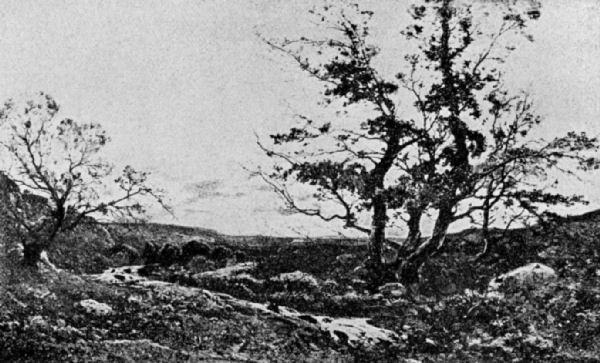 "Too Happy, Happy Tree"
A THOUGHT FOR THE TIME.
Too happy, happy tree,
Thy branches ne'er remember
Their green felicity:
The north cannot undo them
With a sleety whistle through them;
Nor frozen thawings glue them
From budding at the prime.
Too happy, happy brook,
Thy bubblings ne'er remember
Apollo's summer look;
But with a sweet forgetting,
They stay their crystal fretting,
Never, never petting
About the frozen time.
A gentle girl and boy!
But were there ever any
Writhed not at passéd joy?
To know the change and feel it,
When there is none to heal it,
Nor numbéd sense to steal it,
Was never said in rhyme.
John Keats.
BALLADE OF THE WINTER FIRESIDE.
A lamp and a lazy book;
And, deep in a doubled, downy rug
Your feet to the warmest nook.
And wherever the eye may crook,
A print or a tumbled tome—
For the kettle sings on the blackened hook,
And hey! for the sweets of home!
Where sleety drifts be shook?
What though i' the churchyard graves be dug;
And sweethearts be forsook?
A hearth, and a careful cook,
And cares may go or come!
For the kettle sings on the blackened hook,
And hey! for the sweets of home!
A maid that comes to a look;
A boy to carry a rimy log
From over the frozen brook—
And, a fig for the cawing rook,
Or ghosts in the ruddy gloam!
For the kettle sings on the blackened hook,
And hey! for the sweets of home!
Envoi.
To a friend the cup should foam;
For the kettle sings on the blackened hook,
And hey! for the sweets of home!
H. S. M.
A CATCH BY THE HEARTH.
Christmas is here,
The day that we love best
Of days in the year.
The box, and the bay,
Deck out our cottage
For glad Christmas-day.
Draw round the fire,
Sister and brother,
Grandson and sire.
SALLY IN OUR ALLEY.
O then I shall have money;
I'll hoard it up, and box it all,
I'll give it to my honey:
I would it were ten thousand pound,
I'd give it all to Sally;
She is the darling of my heart,
And she lives in our alley.
H. Carey.
LITTLE MOTHER.
A GERMAN FANCY.
The children play by the white bedside,
The world is merry for Christmas-tide,
And what would you do in the falling snow?
Hushed to dream in a child's delight,
For wonders happen on Christmas night:
Little mother, why must you go?
Oh, slender figure and small wet feet,
Where do you haste through the lamp-lit street,
And out and away by the fortress gate?
Yet light enough with the snow to see;
But what would you do with that Christmas-tree
At the tiny mound that is baby's bed?
Oh, how should I not have a thought for thee,
When the children sleep in their dream of glee,
Poor little grave but a twelvemonth old!
You kiss the cross in the drifted snow,
Kneel for a moment, rise and go
And leave your tree by the tiny grave.
And flakes fell white on your Christmas toy,
I think that its angel wept for joy
Because you remembered the one that died.
Rennell Rodd.
OCCIDENT AND ORIENT.
A northern Christmas, such as painters love,
And kinsfolk shaking hands but once a year,
And dames who tell old legends by the fire?
Red sun, blue sky, white snow, and pearléd ice,
Keen ringing air, which sets the blood on fire,
And makes the old man merry with the young
Through the short sunshine, through the longer night?
And heavy with the scent of steaming leaves,
And rose-buds mouldering on the dripping porch;
On twilight, without rise or set of sun,
Till beetles drone along the hollow lane
And round the leafless hawthorns, flitting bats
Hawk the pale moths of winter? Welcome then,
At best, the flying gleam, the flying shower,
The rain-pools glittering on the long white roads,
And shadows sweeping on from down to down
Before the salt Atlantic gale! Yet come
In whatsoever garb, or gay or sad,
[Pg 221] Come fair, come foul, 'twill still be Christmas-day.
To sailors lounging on the lonely deck
Beneath the rushing trade-wind? or, to him
Who by some noisome harbor of the east
Watches swart arms roll down the precious bales,
Spoils of the tropic forests; year by year
Amid the din of heathen voices, groaning,
Himself half heathen? How to those—brave hearts!
Who toil with laden loins and sinking stride
Beside the bitter wells of treeless sands
Toward the peaks which flood the ancient Nile,
To free a tyrant's captives? How to those—
New patriarchs of the new-found under world—
Who stand like Jacob, on the virgin lawns,
And count their flocks' increase? To them that day
Shall dawn in glory, and solstitial blaze
Of full midsummer sun: to them that morn
Gay flowers beneath their feet, gay birds aloft
Shall tell of naught but summer; but to them,
Ere yet, unwarned by carol or by chime,
They spring into the saddle, thrills may come
From that great heart of Christendom which beats
[Pg 222] Round all the worlds; and gracious thoughts of youth;
Of steadfast folk, who worship God at home,
Of wise words, learnt beside their mother's knee;
Of innocent faces, upturned once again
In awe and joy to listen to the tale
Of God made man, and in a manger laid:
May soften, purify, and raise the soul
From selfish cares, and growing lust of gain
And phantoms of this dream, which some call life,
Toward eternal facts; for here or there
Summer or winter, 'twill be Christmas-day.
What 'tis to be a man: to curb and spurn
The tyrant in us: that ignobler self
Which boasts, not loathes, its likeness to the brute,
And owns no good save ease, no ill save pain,
No purpose, save its share in that wild war
In which, through countless ages, living things
Compete in internecine greed—ah, God!
Are we as creeping things, which have no Lord?
That we are brutes, great God, we know too well:
Apes daintier-featured; silly birds who flaunt
Their plumes, unheeding of the fowler's step;
[Pg 223] Spiders who catch with paper, not with webs;
Tigers who slay with cannon and sharp steel,
Instead of teeth and claws; all these we are.
Are we no more than these save in degree?
No more than these; and born but to compete—
To envy and devour, like beast or herb
Mere fools of nature; puppets of strong lusts,
Taking the sword to perish with the sword
Upon the universal battle-field,
Even as the things upon the moor outside?
The pine eats up the heath, the grub the pine,
The finch the grub, the hawk the silly finch;
And man, the mightiest of all beasts of prey,
Eats what he lists;—the strong eat up the weak;
The many eat the few; great nations, small;
And he who cometh in the name of all
Shall, greediest, triumph by the greed of all;
And armed by his own victims, eat up all.
While even out of the eternal heavens
Looks patient down the great magnanimous God
Who, Maker of all worlds, did sacrifice
All to himself. Nay, but himself to one
Who taught mankind on that first Christmas-day
[Pg 224] What 'twas to be a man: to give not take;
To serve not rule; to nourish not devour;
To help, not crush; if need, to die, not live.
To self and sense and all the brute within;
Oh, come to us, amid this war of life,
To hall and hovel, come, to all who toil
In senate, shop, or study; and to those
Who sundered by the wastes of half a world
Ill warned, and sorely tempted, ever face
Nature's brute powers and men unmanned to brutes,
Come to them, blest and blessing, Christmas-day.
Tell them once more the tale of Bethlehem,
The kneeling shepherds and the Babe Divine,
And keep them men indeed, fair Christmas-day.
Charles Kingsley.
THE BLESSED DAY.
Put on thy best array;
Lest if thou longer stay
Thou lose some minutes of so blest a day.
Go run
And bid good-morrow to the sun;
Welcome his safe return
To Capricorn,
And that great morn
Wherein a God was born,
Whose story none can tell
But He whose every word's a miracle.
The Word itself was mute and could not speak.
To dazzle if he durst look on,
Now mantled o'er in Bethlehem's night,
Borrowed a star to show Him light!
He that begirt each zone,
To whom both poles are one,
Who grasped the zodiac in His hand
And made it move or stand,
[Pg 226] Is now by nature man,
By stature but a span;
Eternity is now grown short;
A King is born without a court;
The water thirsts; the fountain's dry;
And life, being born, made apt to die.
Chorus.
With His humility!
Since He's exiled from skies
That we might rise,—
From low estate of men
Let's sing Him up again!
Each man wind up his heart
To bear a part
In that angelic choir and show
His glory high as He was low.
Let's sing towards men good-will and charity,
Peace upon earth, glory to God on high!
Hallelujah! Hallelujah!
Jeremy Taylor.
CHRISTMAS IN CUBA.
The air is faint with flowers,
In the wondrous, dream-like calm
Of tropical morning hours.
Like a mirror lies the bay,
And softly on its breast,
In the glow of coming day,
The vessels sway at rest.
The chiming of Christmas bells,
As the sun rises burning and clear
Over the ocean swells.
And birds with singing sweet
Proclaim the glorious morn
When angels thronged to greet
The Christ-child newly born.
For a frozen land afar,
Under a cold gray sky,
Where glistens the northern star;
Where a winter of rest and sleep
Embraces mountain and plain,
And meadows their secret keep
To tell it in spring again.
And valleys wrapped in snow,
Dearer the ice-bound rills,
And roaring winds that blow,
Than this tropical calm, and perfume
Of jasmine and lily and rose,
These flowers that always bloom,
This nature without repose.
Of a distant fireside,
Where loving hearts unite
To keep this Christmas-tide!
Where the hemlock and the pine
Sweet memories recall,
As their fragrant boughs entwine
Around the panelled wall.
Draw near and dwell with me;
Thy love is everywhere,
On land and on the sea.
I grasp Thy saving hand,
And while to Thee I pray,
Alone, in a foreign land,
I bless this Christmas-day.
Helen S. Conant.
FAREWELL TO CHRISTMAS.
Adieu and adieu,
I needs now must leave thee,
And look for a new;
For till thou returnest,
I linger in pain,
And I care not how quickly
Thou comest again.
I purpose to see
What merry good pastime
This day will show me;
For a king of the wassail
This night we must choose,
Or else the old customs
We carelessly lose.
About shall go round,
Though it cost my good master
Best part of a pound:
The maid in the buttery
Stands ready to fill
Her nappy good liquor
With heart and good-will.
Our master stands by,
And tells me in friendship
One tooth is a-dry.
Then let us accept it
As lovingly, friends;
And so for this Twelfth-day
My carol here ends.
New Christmas Carols, A.D. 1661.
THE NEW YEAR.
Tells us the day himself's not far;
And see where, breaking from the night,
He gilds the western hills with light.
With him old Janus doth appear,
Peeping into the future year,
With such a look, as seems to say,
The prospect is not good that way.
Thus do we rise ill sights to see,
And 'gainst ourselves to prophesy;
When the prophetic fear of things
A more tormenting mischief brings,
More full of soul-tormenting gall,
Than direst mischiefs can befall.
But stay! but stay! methinks my sight,
Better inform'd by clearer light,
Discerns sereneness in that brow,
That all contracted seem'd but now.
His reversed face may show distaste,
And frown upon the ills are past;
But that which this way looks is clear,
And smiles upon the new-born year.
The year lies open to his eye;
And all the moments open are
To the exact discoverer.
Yet more and more he smiles upon
The happy revolution.
Why should we then suspect or fear
The influences of a year,
So smiles upon us the first morn,
And speaks us good as soon as born?
Plague on't! the last was ill enough,
This cannot but make better proof;
Or, at the worst, as we brush'd through
The last, why so we may this too;
And then the next in reason should
Be superexcellently good:
For the worst ills (we daily see)
Have no more perpetuity
Than the best fortunes that do fall;
Which also bring us wherewithal
Longer their being to support
Than those do of the other sort;
And who has one good year in three,
And yet repines at destiny,
Appears ungrateful in the case,
And merits not the good he has.
With lusty brimmers of the best;
[Pg 233] Mirth always should good fortune meet,
And render e'en disaster sweet;
And though the princess turn her back,
Let us but line ourselves with sack,
We better shall by far hold out
Till the next year she face about.
Charles Cotton.
A HAPPY NEW YEAR.
The new year it is enteréd,
Then let us now our sins down-tread
And joyfully all appear.
Let's merry be this holiday,
And let us now both sport and play,
Hang sorrow, let's cast care away:
God send you a happy New Year!
Who for our sins did often weep;
His hands and feet were wounded deep,
And His blessed side with a spear.
His head they crownéd then with thorn,
And at Him they did laugh and scorn,
Who for to save our souls was born:
God send us a happy New Year!
Unto each other they do send;
God grant we may all our lives amend,
And that the truth may appear.
Now like the snake cast off your skin
Of evil thoughts and wicked sin,
And to amend this New Year begin:
God send us a happy New Year!
In friendly manner all agree,
For we are here welcome, all may see,
Unto this jolly good cheer.
I thank my master and my dame,
The which are founders of the same;
To eat, to drink now is no shame:
God send us a merry New Year!
Jack, Tom, Dick, Bessy, Mary, and Joan,
Let's cut the meat up unto the bone,
For welcome you need not fear;
And here for good liquor we shall not lack,
It will whet my brains and strengthen my back;
This jolly good cheer it must go to wrack:
God send us a merry New Year!
I'll drink to each one in this hall;
I hope that so loud I must not bawl,
But unto me lend an ear;
Good fortune to my master send,
And to my dame which is our friend,
Lord bless us all, and so I end:
God send us a happy New Year!
New Christmas Carols, A.D. 1642.
NEW-YEAR'S GIFTS.
Their loves they will present
With many a gift both fine and gay,
Which gives them true content:
And though the gift be great or small,
Yet this is the custom still,
Expressing their loves in ribbons and gloves,
It being their kind good-will.
But thus their love is shown;
Young Richard will buy a bodkin fine
And give it honest Joan.
There's Nancy and Sue with honest Prue,
Young damsels both fair and gay,
Will give to the men choice presents again
For the honor of New-Year's day.
Maids give them fine and neat;
For this the young men will them embrace
With tender kisses sweet:
And give them many pleasant toys
To deck them fine and gay,
As bodkins and rings with other fine things
For the honor of New-Year's day.
To make the old amends,
All those that have it will dress good cheer,
Inviting all their friends
To drink great James's royal health,
As very well subjects may,
With many healths more, which we have store,
For the honor of New-Year's day.
A Cabinet of Choice Jewels, A.D. 1688.
THE END OF THE PLAY.
Slow falling to the prompter's bell;
A moment yet the actor stops
And looks around to say farewell.
It is an irksome word and task;
And, when he's laughed and said his say,
He shows, as he removes the mask,
A face that's anything but gay.
Let's close it with a parting rhyme,
And pledge a hand to all young friends,
As fits the merry Christmas-time.
On life's wide scene you, too, have parts,
That fate erelong shall bid you play;
Good-night! with honest, gentle hearts
A kindly greeting go alway.
Let young and old accept their part,
And bow before the Awful Will,
And bear it with an honest heart.
Who misses or who wins the prize,
Go, lose or conquer as you can;
But if you fail, or if you rise,
Be each, pray God, a gentleman.
(Bear kindly with my humble lays);
The sacred chorus first was sung
Upon the first of Christmas days;
The shepherds heard it overhead,
The joyful angels raised it then;
Glory to heaven on high, it said,
And peace on earth to gentle men.
I lay the weary pen aside,
And wish you health, and love, and mirth,
As fits the solemn Christmas-tide.
As fits the holy Christmas birth,
Be this, good friends, our carol still—
Be peace on earth, be peace on earth,
To men of gentle will.
William Makepeace Thackeray.
FINIS.
And we have feasted weel;
Sae Jock mun to his flail again.
And Jenny to her wheel.
Transcriber's Notes:
A number of the poems contain archaic and varied spelling. This has been left as printed, with the exception of the following few printer errors:
Page 84—plater'd amended to plaster'd—"And plaster'd round with amber."
Page 86—tyran's amended to tyrant's—"The tyrant's sword with blood is all defiled,"
Page 89—wind-winter amended to mid-winter—"In the bleak mid-winter Long ago."
Page 204—Iæan amended to Idæan—"They say, was nourisht by th' Idæan Mayd;"
Page 207—ore clamMorous amended to More clamorous—"More clamorous; and through the frosted air,"
The frontispiece illustrations has been moved to follow the title page. Captions have been added from the List of Illustrations.