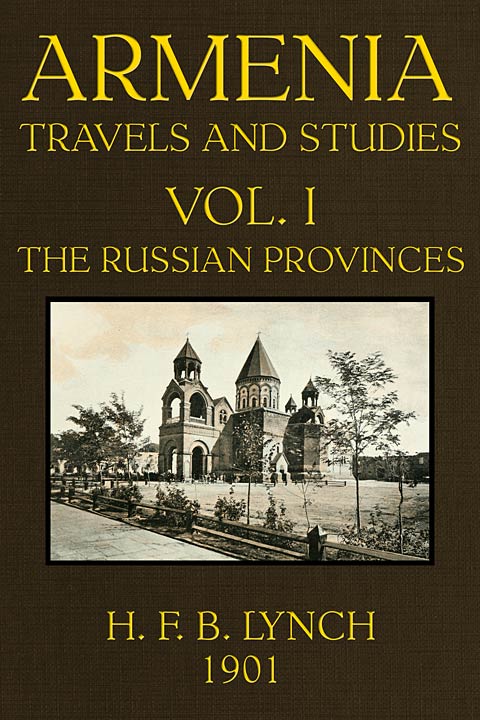
ARMENIA
TRAVELS AND STUDIES
VOL. I
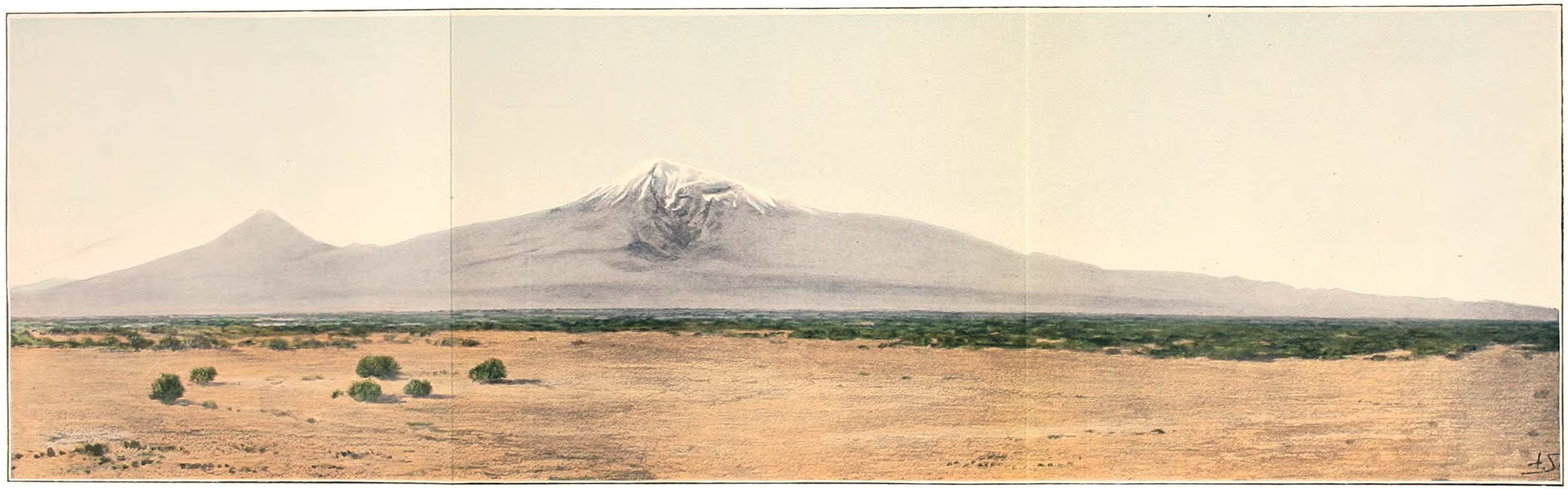
Ararat from Aralykh.
Aralykh, 2750 feet; Ararat, 16,916 feet.
Nature’s vast frame, the web of human things.
Shelley, Alastor.
Who can foretell our future? Spare me the attempt. We are like a harvest reaped by bad husbandmen amidst encircling gloom and cloud.
John Katholikos
Armenian historian of the Xth century Ch. CLXXXVII.
LONDON: 39 PATERNOSTER ROW
NEW YORK AND BOMBAY
1901
[v]
PREFACE
This book contains the account of two separate journeys in Armenia, the first extending from August 1893 to March 1894, and the second from May to September 1898. Before embarking upon them, I was already familiar with the contiguous countries, having spent a considerable portion of the years 1889 and 1890 in Mesopotamia and Persia. The routes shown in my map from Aleppo to Diarbekr and down the Tigris, and from Batum across Georgia and the Caspian to Resht, were taken during the course of these earlier wanderings, and they contribute no part of the ensuing narrative.
What attracted me to Armenia? I had no interests public or private in a country which has long been regarded even by Asiatic travellers as a land of passage along prescribed routes. One inducement was curiosity: what lay beyond those mountains, drawn in a wide half-circle along the margin of the Mesopotamian plains? The sources of the great rivers which carried me southwards, a lake with the dimensions of an inland sea, the mountain of the Ark, the fabled seat of Paradise.
With each step forward in my knowledge of the countries west of India came a corresponding increase of my original emotion. Sentimental were reinforced by purely practical considerations; and I seemed to see that the knot of politics tightening year by year around these [vi]countries was likely to be resolved in Armenia. I became impatient to set foot upon Armenian soil.
When my wish was realised, my first experiences of the country and of the Armenians in the Russian provinces exceeded my expectations—fringed with doubt as these were by disappointment with much I had seen in the East. So I passed over the Russian frontier, struck across to the lake of Van, and spent the winter in Erzerum.
When I came to setting down on the map my routes in Turkish Armenia, the scantiness of existing knowledge was painfully plain. I soon realised that it would be necessary to undertake a second journey for the purpose of acquiring the necessary framework upon which to hang the routes. Meanwhile the events occurred with which we are all familiar—the Armenian massacres, and the comedy of the concert of Europe.
It was with difficulty that I was at length enabled to return to the country. These later travels were almost exclusively occupied with the natural features, our tents spread upon the great mountain masses, whence plain and lake and winding river were unfolded before us like a map.
Primitive methods were rendered necessary for transferring these features to paper. One is not allowed in Turkey the use of elaborate or obvious instruments, and miles of ground had to be crossed in full view of Turkish officials before reaching the field of our work. But I was able to transport to Erzerum a standard mercurial barometer, which was duly set up in that centre and read several times a day during our absence. We carried two aneroids, a boiling-point apparatus, a four-inch prismatic compass, used upon a tripod and carefully tested at Kew; lastly, a rather troublesome but very satisfactory little instrument called a telemeter, and made by Steward. The measurements were checked by cross-readings with the compass, and we found that they could be relied upon. Once we were upon the [vii]mountains our operations were not impeded, and, indeed, were assisted by the authorities.
I was accompanied on this second journey by my friend, Mr. F. Oswald, who had been helping me disentangle the voluminous works of the great Abich upon the geology of the Caucasus and Russian Armenia. The varied talents of Oswald were of the greatest service to the work in hand, while his society was a constant source of pleasure and repose. He is now engaged with the geological results of this journey, and with a well-considered study of the geology of Armenia as a whole. These he hopes to publish before very long.
The illustrations are for the most part reproductions of my photographs, being a selection from a collection which fills several cases. On my first Armenian journey I was accompanied as far as Erzerum by Mr. E. Wesson of the Polytechnic in London, who not only developed the films and plates upon the spot, but rendered the most valuable assistance in the photographic work. He also displayed the qualities of a veteran campaigner before the journey was done. And I was always missing him after his return home and during the second journey, when the work devolved entirely upon myself.
My cousin, Major H. B. Lynch, now serving in South Africa, travelled with us as far as Ararat and took charge of the camp. It is, I think, a legitimate cause for satisfaction that, except for momentary lapses on the part of the cook, not one of the party during either of the two long journeys fell ill or became incapable of hard work. And on both occasions the horses were sold at a small profit when the coast was at length reached.
Why does one write a book? I find it difficult to answer the question, which, indeed, demands a knowledge of human nature greater than any I possess. There are societies and individuals who, I feel sure, would offer a price [viii]if the potential author would agree to keep his material to himself. The sum might probably be augmented by the contributions of weary students; and a revenue could be collected from these various sources far exceeding any royalties received from publishers. Moreover the author would escape the foreboding of condign punishment, which he is made to feel suspended over his head. On the other hand, there is the fascination of feeling possessed by a subject, stronger than yourself and elemental. And there is the joy and the impersonality of the work reacting upon the personality of the writer.
The country and the people which form the theme of the ensuing pages are deserving, the one of enthusiasm and the other of the highest interest. It is very strange that such a fine country should have lain in shadow for so many centuries, and that even the standard works of Greek and Roman writers should display so little knowledge of its features and character. Much has been done to dispel the darkness during the progress of the expired century; and I have been at some pains to collect and co-ordinate the work of my predecessors. In this task I have been assisted by my friend, the Hon. Mrs. Arthur Pelham, to whom the credit of the bibliography accompanying my second volume is due.
In taking leave of the book—and it has been a long connection—the mind rests with pleasure and gratitude upon the help given without stint by fellow-workers in the same or in different fields. To my friend, Mr. R. W. Graves, now Consul-General in Crete, I am indebted for a lengthy spell of hospitality and delightful companionship in distant Erzerum. I have borrowed freely from his intimate knowledge of extensive regions in Turkish Armenia, as well as from that acquired by my friend, Major Maunsell, now our Consul at Van, the principal contemporary authority on Kurdistan. Geheimrath Dr. [ix]G. Radde of Tiflis has rendered me valuable assistance on more than one occasion; and it is also a pleasure to feel conscious in many ways of my obligations to my friend, Mr. L. de Klupffell, formerly of Batum. At home I have received much kindness from Mr. Fortescue of the British Museum library, and from Dr. Mill, who has so long presided over the library of the Royal Geographical Society, and whose recent retirement from that office in order to devote himself to his scientific work is keenly regretted by those whom he encouraged by his assistance and advice. The book has brought me several new friends, among them Mr. F. C. Conybeare of Oxford, the extent of my debt to whom, in various directions, it would be difficult to estimate. Professor Sayce has kindly looked over the sheets dealing with the Vannic empire, and contributed several valuable suggestions. Prof. E. Denison Ross has helped me with the Mussulman inscriptions, besides informing me upon a number of obscure points.
A portion of the narrative of the ascent of Ararat has already appeared in Messrs. Scribner’s Magazine, reprinted in Mountain Climbing, a book published by this firm. Parts of the concluding chapters of each volume, entitled “Statistical and Political,” have seen the light in the shape of a series of articles in the Contemporary Review.
H. F. B. LYNCH.
The map which accompanies my first volume will be on sale separately at Messrs. Stanford’s in Longacre. [xi]
CONTENTS
CHAPTER I
PAGE
CHAPTER II
CHAPTER III
CHAPTER IV
CHAPTER V
CHAPTER VI
CHAPTER VII
Gorelovka and Queen Lukeria 96
CHAPTER VIII
To Alexandropol 118
CHAPTER IX
At Alexandropol 124
CHAPTER X
CHAPTER XI
To Ararat 143
CHAPTER XII
Ascent of Ararat 156
CHAPTER XIII
CHAPTER XIV
Return to Erivan 200
CHAPTER XV
At Erivan 206
CHAPTER XVI
Edgmiatsin and the Armenian Church 228
CHAPTER XVII
CHAPTER XVIII
Ani, and the Armenian Kingdom of the Middle Ages 334
CHAPTER XIX
Kars 393
CHAPTER XX
Across the Spine of Armenia 409
CHAPTER XXI
Geographical 421
CHAPTER XXII
LIST OF PLATES
- Ararat from Aralykh Frontispiece
- Trebizond from above the Head of the Western Ravine To face page 12
- Trebizond: Hagia Sophia 24
- Trebizond: Façade of Hagia Sophia on the South 25
- Plain of the Rion from the Southern Slopes of Caucasus: Kutais in the Foreground 46
- View North from the Zikar Pass Back to page 52
- View South from the Zikar Pass 53
- Safar: St. Saba from the West 62
- Safar: Porch of St. Saba 63
- Akhaltsykh from the Road to Akhalkalaki To face page 65
- Castle of Khertvis 76
- Vardzia, the Troglodyte City 80
- Mount Abul from Akhalkalaki 92
- Summer Pavilion at Gorelovka 109
- Alagöz from the Plain of Alexandropol 122
- Alexandropol from the Armenian Cemetery 125
- Ararat from near Aramzalu 153
- Great Ararat from above Sardar Bulakh 165
- Our Kurd Porters on Ararat 167
- Akhury: The Great Chasm from Aralykh 179
- Akhury: Inside the Great Chasm 194
- Erivan and Ararat from the North 208
- Erivan: Interior of the Kiosque of the Sirdars 216
- Edgmiatsin: The Great Court and the Cathedral 243
- Edgmiatsin: Ceremony of the Consecration of the Katholikos—Anointing with Oil from the Beak of a Golden Dove 254
- Edgmiatsin: Interior of the Cathedral 267
- Edgmiatsin: Exterior of St. Ripsime 269
- Edgmiatsin: Exterior of St. Gaiane 270
- Edgmiatsin: Exterior of Shoghakath 271
- Talin: Mouldings on South Side of Ruinous Church 322
- Walls and Gateway of the City of Ani from Outside, looking East 369 [xiv]
- Ani: The Cathedral from South-East To face page 370
- Ani: Niche in Eastern Wall of Cathedral 371
- Ani: Apse of the Cathedral 372
- Ani: Church of St. Gregory from the West 373
- Ani: North Wall of the Church of St. Gregory 374
- Ani: Detail of the Porch of St. Gregory 375
- Ani: Mosque and Minaret 376
- Ani: Detail of Doorway of Chapel near Citadel 379
- Ani: Chapel of St. Gregory, East Side 380
- Ani: Chapel of St. Gregory, Entrance 381
- Ani: Interior of the Chapel of St. Gregory 382
- Ani: Chapel of the Redeemer 383
- Ani: Doorway of the Castle 384
- Ani: Portal of the Church of the Apostles from the West 385
- Ani: East Front of the Church of the Apostles 386
- Khosha Vank: Pronaos 387
- Khosha Vank: Exterior of Pronaos and Church from South-West 388
- Khosha Vank: Hall of the Synod 389
- Looking down the Valley of Kagyzman 417
- A Rib or Buttress of Aghri Dagh 419
- Pass over Aghri Dagh 420
ILLUSTRATIONS IN THE TEXT
- PAGE
- Entrance to the Black Sea from the Bosphorus 3
- Interior of Hagia Sophia 27
- Banks of the Rion above Kutais 46
- Road in the Forest 50
- Georgians 51
- Portrait of Ivan 59
- Group of Villagers at Khertvis 77
- Archimandrite and Deacon at Vardzia 82
- Head Waters of the Arpa Chai 121
- Byzantine Picture in Greek Church 128
- Wedding Party at Alexandropol 130
- Church of Marmashen from S.W. 131
- Alagöz from the Head Waters of the Abaran 136
- Ararat: Aralykh in the foreground 155
- Our Cavalcade on Ararat 159
- Our Encampment at Sardar Bulakh 163
- Little Ararat from near Sardar Bulakh 164
- Summit of Ararat from the South-East, taken at a height of about 13,000 feet 180 [xv]
- Boulders near Akhury 191
- Ararat from a house-top in Erivan 207
- Alagöz from a house-top in Erivan 208
- Entrance to Gök Jami, Erivan 213
- Court with basin of Gök Jami, Erivan 214
- The Temple, Gök Jami 215
- Pilgrims’ Court, Edgmiatsin 230
- The Katholikos Mekertich Khrimean 237
- The Lake at Edgmiatsin 246
- Ararat from the Lake at Edgmiatsin 247
- Armenian Nun 252
- Interior of the Portal of the Cathedral 266
- Episcopal Staves 268
- Sculptured Stone 271
- Village of Talin, with Mount Bugutu 322
- Mouldings on North Side of Ruinous Church at Talin 323
-
Tartar Khan at Talin 
324 Pristav of Talin - Priest of Talin 325
- Tartar of Akhja Kala 326
- Alagöz from the Plains on the West 327
- Greek Girl of Subotan 331
- Ani: Bas-relief on the Inner Wall of the Gateway 369
- Ani: Sculptured Stone Moulding 373
- Ani: Walled Enclosure and Chapel 376
- Ani: Building on the Citadel 378
- Ani: Pilaster in the Building on the Citadel 379
- Ani: Landscape from the southern extremities of the site 380
- Ani: The Castle 383
- The Monastery of Khosha Vank: east side 386
- Khosha Vank: Chapels in the Ravine of the Arpa Chai 387
- The Citadel of Kars 406
- Molokan Elder at Vladikars 411
- House at Novo-Michaelovka 412
- Aghri Dagh from the Araxes Cañon 414
- Cliffs composing Northern Wall of Araxes Cañon 415
- The Araxes near Kagyzman 416
- Kara Vank on Aghri Dagh 419
- Map of the Armenian Plateau 452
[xvi]
LIST OF MAPS AND PLANS
- Plan of the Ancient Fortifications of Trebizond To face page 13
- Trebizond and Surroundings 30
- Plan of the Monastery and Churches of Edgmiatsin Between pages 244 and 245
- Plan of the Deserted City of Ani To face page 390
- Kars and Surroundings 395
- The Structural Features of Asia Between pages 422 and 423
- Map of Armenia and Adjacent Countries Cover
[1]