JAPANESE COLOUR-PRINTS AND THEIR
DESIGNERS
[pg
3]
In the annals of
art production the colour-prints designed by the master artists of
the Ukiyoé school occupy a unique place. They represent a plebeian
art which was not a spontaneous upgrowth from the soil, but, so to
speak, a down-growth or offshoot from an old and highly developed art
of aristocratic lineage.
This elder art had
its fountain-head in ancient China. That country, during the Tang and
the Sung dynasties (618-905, 960-1280), was the seat of an aesthetic
movement during which painting and other arts reached an
extraordinarily high development. To the works produced during this
great flowering-time of art the Japanese painters of the classical
schools turned for inspiration and enlightenment. These works were
distinguished by singleness of purpose, rhythmic vitality, and
synthetic coherence, and by a clear conception of the essential that
goes far beyond anything elsewhere attained, and which, when fully
apprehended, must inevitably force a revision of Western ideas and
criteria.
The art of ancient
China and of the earlier Japanese schools is an art refined, poetic,
and intensive to the last degree. It is based upon profound
understanding of aesthetic laws. The artists were carefully grounded
in the fundamental principles that govern all art, whether Oriental
or Occidental. The result of this training is apparent in the
homogeneity of their works. In Europe very confused notions have
prevailed as to what should be done and what is permissible in art.
Not even the great artists have always seen clearly; had they done
so, it cannot be doubted that Western achievement would have attained
a much higher level than it has ever reached.
In the Japanese
modifications of the ancient Chinese art its traditions [pg 4] and aesthetic ideals were
sedulously preserved. With only rare exceptions, the artists—and
under this head it is necessary to include potters, lacquerers,
metal-workers, swordsmiths, and others—were drawn from the upper
classes. Many of them were in the service of the daimyo, and did not
sell their productions, but received from their noble patrons regular
stipends in koku of rice. Seldom did any of their works find their
way into the hands of the common people, who had little opportunity,
therefore, to become familiar with them. Gradually, however, as the
number of paintings, statues, and other art objects multiplied and
the temples were filled with votive offerings, the classical art made
its impress upon buildings, wearing apparel, and utensils of all
sorts; its conventions and principles were laid hold of by all
classes and became the heritage of the entire people.
The social fabric
in old Japan was one of sharp distinctions. At the upper end of the
scale were the Emperor; the kuge, or court nobles; the daimyo, or
lords of the two hundred and fifty-one provinces; and the samurai, or
hereditary military men, from whom were recruited the officials,
priests, and scholars. Between these and the lower classes was an
almost immeasurable gulf. Highest among the heimen, or commoners,
were the farmers. Below them were the artisans, and still lower were
the merchants, innkeepers, servants, and the like; while lowest of
all were the eta, or outcasts, a class comprising scavengers,
butchers, leather-workers, and others engaged in what were considered
degrading occupations.
Under the peaceful
regime of the Tokugawa shoguns there was a sociological change that
in the cities almost amounted to a transformation. The most salient
feature was the rise of the tradesmen and artisans to wealth and
power. Many places of amusement sprang up, restaurants and tea-houses
multiplied, jugglers, story-tellers, musicians, and other itinerant
entertainers found audiences in every street, fêtes were frequently
held in the temple compounds, the theatre rose to a position of
prominence, and the yukwaku, or courtesan quarters, with their medley
of attractions, became established institutions.
The art of the
Ukiyoé was a direct outcome of the gay life of this time. The
inception of the school dates back to the closing years of the
[pg 5] sixteenth century,
when a reaction set in against the Chinese classicism of the Ashikaga
period. This manifested itself in the choice of Japanese instead of
Chinese subjects, and in novel treatment in which features of both
the classic Kano and Tosa styles were combined, but which in many
respects broke away from academic traditions. The reputed leader of
the revolt was Iwasa Shoi, better known as Matahei, son of the Daimyo
of Itami; but other distinguished artists, notably Kano Sanraku, also
painted pictures in the new manner, which was not then held to
constitute a distinct school. The subjects being drawn from the life
of the people, these pictures were called Ukiyoé. É is the Japanese
term for a picture or drawing.1 Ukiyo, as
originally written, had a Buddhistic signification and was applied to
the secular as distinguished from the ecclesiastical world. Literally
the word means “the miserable world,”
but as now used it may be more accurately translated as “the passing (or floating) world of every-day
life.”
Perhaps for the
reason that Ukiyoé themes were not considered quite dignified, and
because they did not express poetic ideas, the Ukiyo paintings of
Matahei and his contemporaries and successors, though prized and much
sought after, were seldom signed, and the identification of their
authorship is a matter of extreme difficulty. For more than half a
century works in this manner continued to be produced in considerable
numbers, but the movement did not crystallize into a school until, in
the person of Hishikawa Moronobu, a leader appeared to give it form
and direction. Moronobu was an artist of rare distinction. His
paintings were eagerly sought by the daimyos and the wealthier
samurai. But Moronobu was a man of the people, and it was as a
designer of book illustrations and later of ichimai-yé, or
single-sheet prints, that he gave the impetus to Ukiyoé. For fifty
years or more prior to his time books with engraved illustrations had
been published in Japan, but they were comparatively few and the
illustrations were poor and crudely executed. The twelve drawings
Moronobu made for a book of instruction for women in etiquette and
hygiene, published in 1659, marked a decided advance. This, so far as
we know, [pg 6] was the
first of a long series of books illustrated by him. Their popularity
was deservedly great, and by them his fame became wide-spread. The
illustrations were printed in black from blocks similar to those from
which the text was printed, and were characterized by fine broad
treatment and a rather wiry but strong and expressive outline.
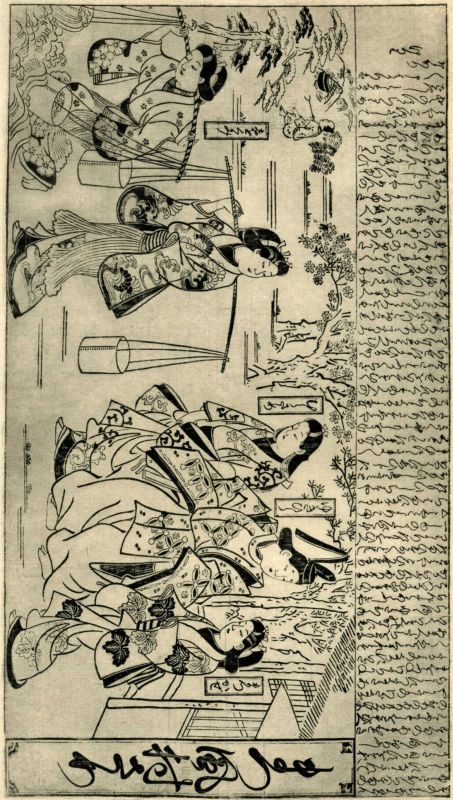
About 1670
Moronobu began to issue large single-sheet prints which could be
affixed to screens or mounted as kakemono. These prints, which were
impressions in black from one block only, are known as
sumi-yé—sumi being the Japanese name for
Chinese—or, as we incorrectly call it, India—ink. They were designed
to be coloured by hand, and apparently a part of the edition was so
coloured before being placed on sale by the publishers. At first this
colouring consisted of a few touches of yellow-green crudely laid on;
later it became more elaborate, and occasionally we meet with prints
that are very beautifully coloured, but in such cases it is
impossible to tell when or by whom the colouring was done. The
probability is that in some instances it was the work of purchasers
of the prints.
Moronobu's pupils,
of whom there were many, devoted themselves almost exclusively to
painting. After his death in 1695, the production of prints fell
chiefly into the hands of Torii Kiyonobu and his son Torii Kiyomasu,
two artists who take rank among the most talented men of the Ukiyoé
school. Moronobu had taken for the subjects of his prints historic
incidents, the manners and customs of the people, and, in particular,
women and their occupations and amusements. To these the Torii
artists, seeing a new and fertile field for the print-designer in the
rise of the theatre as a popular form of entertainment, added
portraits of actors in the costumes of their most admired rôles.
Especially esteemed were Kiyonobu's portraits of the first
DanjuÌ
roÌ
. During the Genroku period (1688-1704) the people
developed a passion for the theatre that amounted to veritable
madness. In the first quarter of the eighteenth century this reached
a height that sorely troubled the Tokugawa rulers. To check it
various expedients—among them the exclusion of women from the
stage—were tried. They only added fuel to the flame. Certain gross
practices were abolished. This helped to purify the theatre, but also
to perpetuate it by removing the seeds [pg 7] of what must inevitably have meant its early
decay. Actors of distinguished ability became popular idols. Their
comings and goings were like royal progresses. Wherever they went,
were it to view the cherry blossoms at Ueno, for a boating party on
the river, or for a visit to the Yoshiwara, they moved in state. Yet
their rank in the social scale was so low that they were looked upon
as little better than eta. The earliest actors were contemptuously
termed kawara-mono (river-bed folk), from
the fact that the first theatrical performances in Japan were upon a
stage erected in the dry bed of the Kamogawa at Kyoto. The stigma
that attached to their origin and to the vulgarity of the early
performances has never been entirely lifted. Many of the Ukiyoé
artists felt it a degradation to make drawings of actors.
Nevertheless the popular demand created a supply, and for more than a
century a large proportion of the enormous output of prints consisted
of theatrical scenes and portraits of the performers.
Many of the prints
produced during the early years of the eighteenth century were large
single figures of actors, geishas, and women of the Yoshiwara. These
were broadly treated, with strong, free brush-strokes based upon the
technique of the Kano masters and quite different from Moronobu's
style, which was more nearly like that of the Tosa painters. Each of
the classical schools, I may explain, had its own peculiar methods,
for which brushes of special shape were required. In their
spontaneity, their freedom, their glorious sweep of line, these
prints are among the finest works of the Ukiyoé school. Among them
are many masterpieces of linear composition. Yet by the people of the
upper classes they were regarded as hopelessly vulgar. Though the
Kano painters used similar sweeping strokes, they laid great stress
upon carefully modulated tone. The notan, or lightness and darkness
of the ink in different parts of the drawing, was an essential
quality. It should not be confused with chiaroscuro, the science of
light and shade. Notan signifies merely difference in lightness and
darkness of tone. In the early prints this did not appear. All the
lines were uniformly black. And the addition of colouring which was
looked upon as coarse and gaudy was a further offence to persons of
refined taste.
[pg 8]
Our vision not
being hampered by the canons of the Kano academy, we can appreciate
the distinguished character of these compositions. Unquestionably the
brush-work of a Sesshu, a Motonobu, or a Tanyu—to name a few only of
the most eminent of the Japanese painters—has a precious quality not
to be found in any printed line.2
Nevertheless the primitive Ukiyoé prints have a freshness and vital
force peculiarly their own. The word “primitive” as applied to these prints calls for a
word of explanation. They are primitive, not in their art, which is
highly developed, but merely as regards its application to
wood-engraving.
The failure of
Japanese connoisseurs to appreciate Ukiyoé art is not, however,
entirely or even principally because of its technique. The art of the
classical schools is deeply imbued with poetic feeling and usually is
dignified in subject. Ukiyoé art, on the contrary, is flippant,
whimsical, comic. Except when it deals with portraits, landscapes, or
birds and flowers—subjects that are not strictly Ukiyoé—it is seldom
that the things depicted are intended to be taken quite seriously. In
nearly every picture there is some joke, open or cleverly hidden,
some amusing fantasy in the shape of a modern analogue or travesty of
popular myth, well-known tale, or historical event. Sly hits at the
vices or follies of the aristocrats are not uncommon. A very large
proportion of the subjects deals with the theatre and the denizens of
the Yoshiwara. To the Japanese of the upper classes Ukiyoé art was a
synonym for the art of the underworld. It is not surprising that they
failed to appreciate its merit. To give Ukiyoé paintings or prints an
honourable place in one's house was a confession of lack of taste.
Were there no other reason, the subjects for the most part rendered
them unfit, if not impossible. The prints were indeed amusing, and
therefore many of them were saved; but they were looked upon much as
we regard the pictures in our comic periodicals. Even when the art in
these is good, it is hard to disassociate it from the humour and to
enjoy it for itself alone. More commonly we fail to appreciate it as
art or even to think of it as such. So it was with the prints. To the
Japanese they [pg 9]
appeared little better than children's toys. In considering this we
should not overlook the important circumstance that when first
printed they were in general less charming than they are to-day. The
wonderful colour that makes them so entrancing has come in large
measure through the mellowing influence of time. Not infrequently
this has wrought transformations that would seem incredible did not
close study show clearly the changes that have taken
place.
Even to-day
inherited prejudice prevents wide-spread appreciation of the prints
in the land of their origin. Our enthusiastic admiration is still
more or less a mystery to our neighbours across the Pacific. Only
now, when most of the fine prints have passed into the hands of
European and American collectors, are the Japanese connoisseurs
beginning to understand how it is that the Western art-lover,
unfettered by any traditional point of view and not disturbed by any
meanings the subject may hold or suggest, is able to perceive the
glorious colour, the superb composition, the masterly treatment and
rare beauty to which they have been blind.
The history of art
is everywhere among civilized peoples a record of the influence of a
succession of ideas, each in turn dominating for a longer or a
shorter period the character of what is produced. When an idea has
sufficient vitality to constitute the germ of a specific type of art,
and artists of creative genius are inspired by it, the votaries
working under the stimulus of a common ideal form what we designate
as a school. “When left to pursue its course
of development unchecked,” each marked type of art, as John
Addington Symonds pointed out in one of his essays, “passes through stages corresponding to the embryonic,
the adolescent, the matured, the decadent, and the exhausted,”
This sequence, he showed, was clearly marked in the evolution of
Italian painting, the Attic and the Elizabethan drama. Any of the
classic schools of Japanese painting, the Kosé, the Yamato, the
Sesshu, or the Kano, would furnish an excellent illustration, though
in studying these movements it would be necessary to follow them back
to their Chinese antecedents. The Ukiyoé school affords a
particularly striking example. In the works of the earlier
artists—Moronobu, Kiyonobu, Kiyomasu, and the KwaigetsudoÌ
group—we
find [pg 10]
superabundant vigour, swift inspiration, and splendid though
sometimes brutal force. The note of prophecy that these works contain
is found also in those of the next generation of artists, foremost
among whom was Okumura Masanobu. The fire of enthusiasm still glows
brightly, but more attention is paid to subtleties of style, to
beauty of detail, and to the development of technical processes.
Hand-coloured prints are superseded by those in which the colour as
well as the black outline is printed. Ukiyoé has become an art of the
printed pictures which in large measure have taken the place of
paintings.
Then, after a
brief interval of eager experiment and rapid changes, comes the
flowering-time, when a group of great artists turn out by the
thousand works in which spiritual intensity is combined with grace,
beauty, refinement of composition, and technical perfection. This is
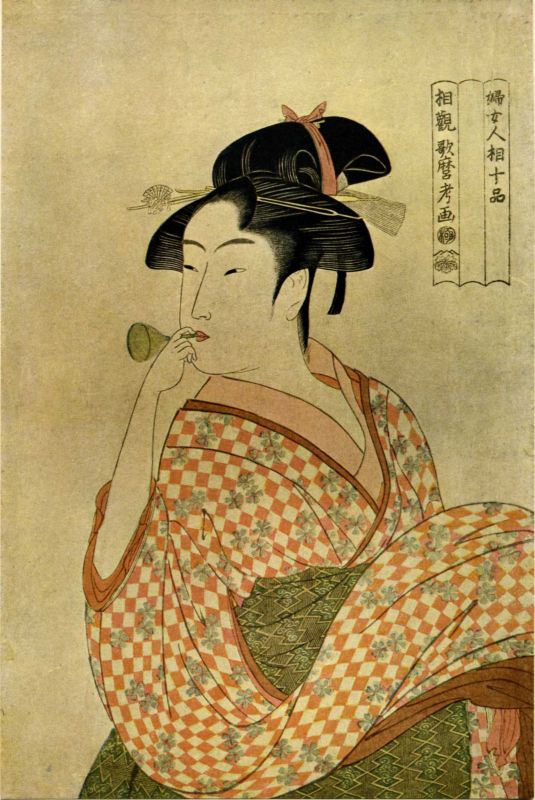
the epoch of Harunobu, ShunshoÌ
, Shigemasa, Koryusai, Kiyonaga, and
ShunchoÌ
.
The decline of the
initial impetus that brought the school into being is plainly
apparent in the works of the next generation. Utamaro was an artist
of the very first rank, whose genius cannot be gainsaid; Eishi and
Toyokuni were only a little less brilliant; but it was their
misfortune to come upon the scene when the cycle of animating ideas
had been exhausted. Too virile to be content merely to echo the
performances of their predecessors, they spent their energy in
inventing variations upon the perfected type. It was the only course
open to them, but it led steadily and swiftly downward, though
neither the artists nor the people who gleefully applauded each
successive innovation were conscious of the decadence.
With the
appearance of still another generation of artists upon the scene, the
degradation of the school was complete. Artistic feeling was obscured
by blatant vulgarity and affectation. There was a steady letting down
to the level of the popular taste, which was steadily lowered in
consequence. The skill of the more able artists was expended in the
production of works interesting chiefly as tours de
force, more remarkable for technical than for artistic
merit; the tendency toward exaggerated drawing became more
pronounced; colouring grew more crude, raw, and over-vivid.
Coincident with this decline in the art of [pg 11] the Popular School was a change for the
worse in the fashions of the time. Loud patterns for brocades and
other fabrics came into vogue; garments became showy and elaborate;
coiffures, more especially those of the demi-monde, were often
startling in their extravagance. As the prints were accurate mirrors
of contemporary life, in these changed fashions may be found a
partial explanation of the inferiority of the works of the later men.
The Ukiyoé RyuÌ
was a school of design which laid its impress upon
all of the arts. The prints were but one of its phases, though the
principal and the most distinguished of them. The rise, culmination,
and disintegration took place all along the line. Toward the middle
of the nineteenth century the Ukiyoé school sank into the dotage of
decrepitude, and then into the sleep from which there is no
awakening. I choose this phrase deliberately. An art that is of the
past can never be revived. We may strive to work in the style of
Harunobu or of Kiyonaga. All we can do is to copy their forms and
imitate their mannerisms. We cannot possibly get our inspiration from
the same source as they; that dried up at the fountain-head long ago.
The best work we can do in their style must necessarily lack creative
force and be without a spark of real vitality.
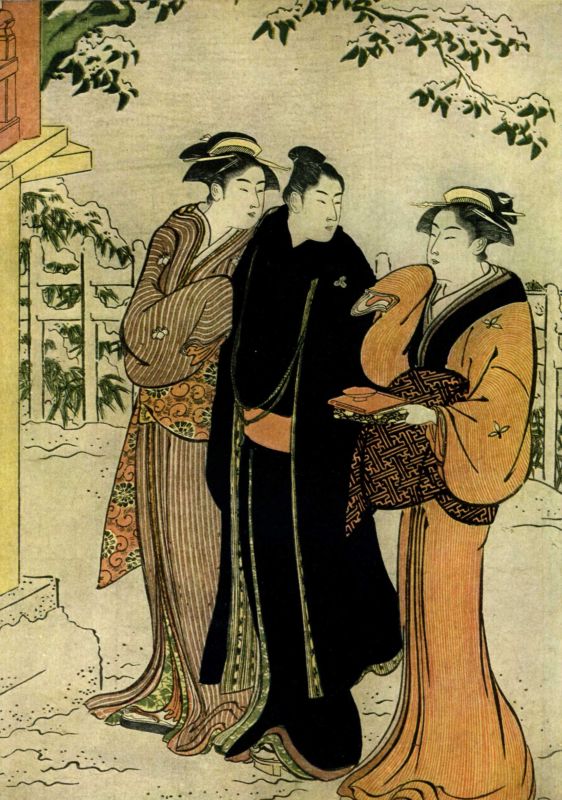
Primarily the
charm of the Ukiyoé colour-prints is due to the fact that the leading
masters of the school were artists of exceptional power. It is also
due to the fact that most of them3 made
print-designing their chief occupation, to which they devoted their
thought, time, and skill, and that with rare exceptions they were
less distinguished as painters.
From about 1670,
when Moronobu began to issue single-sheet prints, until about 1742, a
period of at least seventy years, the prints were in black outline
and were coloured by hand. They were, in fact, cheap paintings. Early
in the eighteenth century the chief pigment used in colouring them
was red lead. The Japanese name for this pigment is tan, and the
prints upon which it appears are designated as tan-yé. About 1710
yellow and citrine were commonly used with the tan. Four or five
years later a new style of hand-colouring, said to have been
[pg 12] devised by Torii
Kiyonobu, came into vogue and greatly modified the style in which the
prints were designed. In place of tan he substituted beni, a very
beautiful but fugitive red extracted from the saffron. This was used
in combination with a greenish yellow (probably gamboge) and
low-toned blues and purples. Finer details were introduced into the
designs, and the colouring in general was more carefully done. In
response to a growing demand for less expensive pieces smaller prints
(hoso-yé) became common. To give brilliance to the pigments a little
thin lacquer (urushi) was mixed with them, and, while wet, parts of
the design were sprinkled with metallic powder, which was probably
applied by blowing it through a small bamboo tube. These prints were
known as urushi-yé, or lacquer prints. A little later the custom grew
up of painting parts of the prints with black lacquer.
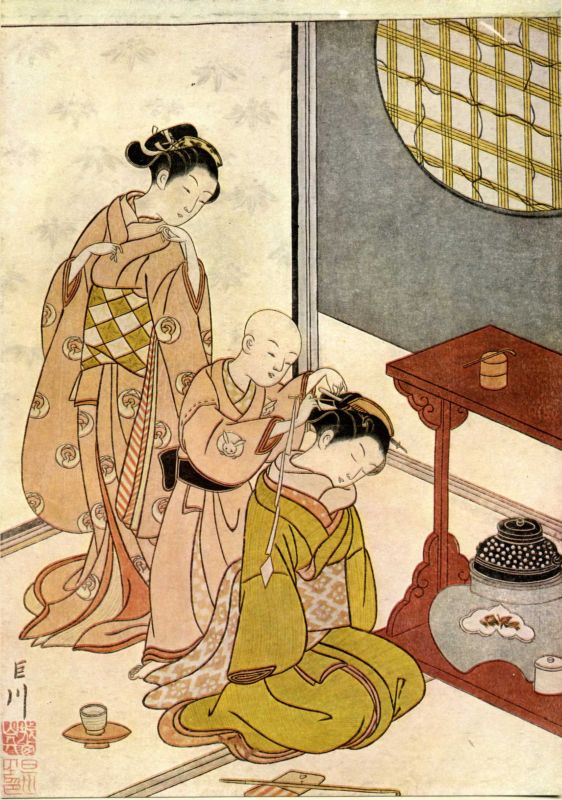
Not until the year
1742 did the practice begin of applying colour by impressions from
flat wood blocks. Why the invention should have been so long delayed,
and why, after it was once made, nearly fourteen years more should
have elapsed before the number of colour-blocks was increased beyond
two, are questions to which no certain answer is yet forthcoming. It
is incredible that during the forty years when innumerable
hand-coloured prints were issued no one should have conceived the
idea of printing the colour as well as the black outline. Without
doubt some practical difficulty connected with the printing stood in
the way. Possibly the thing that awaited discovery was the trick of
mixing rice paste with the colour to keep it from running. Or, as is
more likely, it took a long while to discover a practical method of
securing accurate register in impressions made upon damp paper which
was liable to stretch or shrink during the printing process. Whatever
the problem may have been, the honour of the solution is due to
Okumura Masanobu. Being a publisher as well as an artist, he was no
doubt alive to the economic advantage of a cheaper process and to the
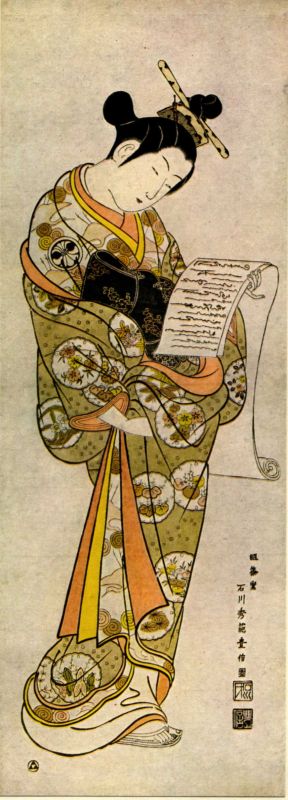
attraction of novelty. Some years earlier he had invented the
hashira-yé, or pillar-print, and had also put forth a series of
prints that show a fair understanding of the laws of linear
perspective to which he gave the name of Ukiyé. Being an artist as
well as a publisher, Masanobu perceived that the change in process
called for a change in the [pg
13] style of the designs. The very first of the new prints,
therefore, were characterized by finer and more exquisite detail than
was suitable for the hand-coloured editions. The colours used were
beni and a soft green; and the name beni-yé, which had been applied
to the hand-coloured prints in which beni was used, was also given to
them. A happier selection of colours could not have been made. By
thinning the red and modifying the hue of the green a wide range of
effects was secured. Almost every possible combination and variation
was tried during the fourteen or fifteen years that the beni-yé were
in vogue. The world is far richer because of this long period before
the number of colour-blocks was increased, since time was afforded to
work out the decorative possibilities resulting from the limitation
to two colours and black and white. This limitation demanded fine
skill and creative resource in the invention of pattern and the
distribution of the colours employed.4 The
results achieved were remarkable. Until one has seen them it is
impossible to realize that so much life and vivacity of colouring
could be given by impressions from two blocks charged with rose and
green.
By many the
beni-yé are regarded as the choicest products of the school. So
charming were they when first printed that they speedily drove the
urushi-yé prints out of the market, with the exception of the tall
hashira-yé, or pillar prints, of which hand-coloured editions
continued to be produced for a year or two, to satisfy those who
still wished paintings rather than prints. Most of the beni-yé that
have survived until our time are very much faded. The beni has quite
generally turned into a soft yellow or disappeared altogether. The
green is more stable, but that also has in many instances become a
warm citrine or russet. Extremely rare are the specimens in which the
original colour has not suffered material modification.
From the testimony
of the prints themselves it appears probable that very soon after
Okumura Masanobu issued the first prints in beni and green, similar
prints were put forth by Nishimura Shigenaga, Ishikawa [pg 14] Toyonobu, Torii Shiro
(otherwise Kiyonobu the second), and all the Yedo print-designers,
among them the veteran Torii Kiyomasu. None of these men seems to
have attempted any marked departure from the type established by
Okumura. About 1755, however, a group of young men appeared upon the
scene, who were fired with zeal for further experiments. The leaders
were Torii Kiyomitsu, Kitao Shigemasa, and Suzuki Harunobu. Kiyomitsu
began by trying novel colour schemes such as two tones of beni
instead of beni and green. Then he tried a third colour-block. After
this new developments followed in rapid succession. The variety and
range of the colour schemes broadened almost from day to day. At
first the wider resources proved an embarrassment, but the mastery
attained in dealing with the simpler means soon enabled the artists
to take advantage of them. Invention was stimulated. In 1764 a
printer named Kinroku discovered a method by which printing in
colours from many blocks became possible. We can only guess at the
nature of the difficulty that was surmounted; but as it is known that
the printing was usually done upon dampened paper, it is evident that
the stretching or shrinking of the sheets, to which I have already
referred, must have proved extremely troublesome, and that every
additional block must have multiplied the liability to defective
register. It is reasonably safe to assume, therefore, that to find
some means of overcoming this was the problem which remained unsolved
for so many years.
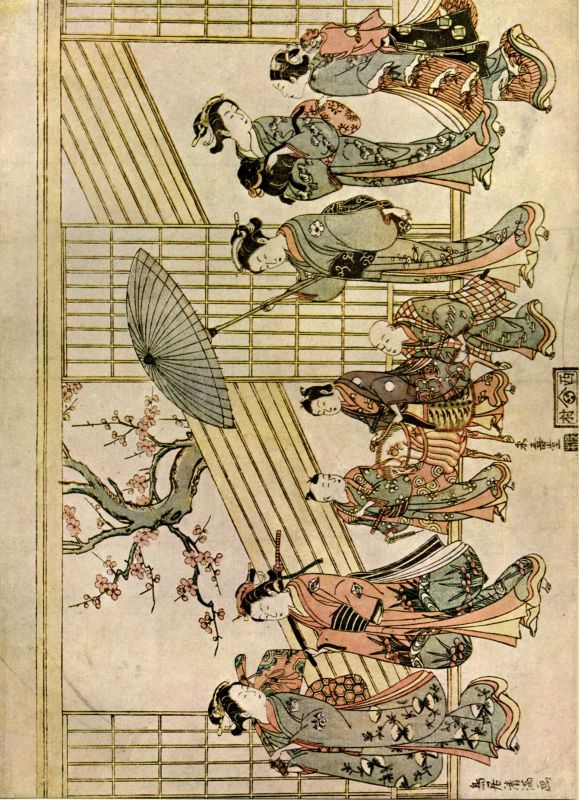
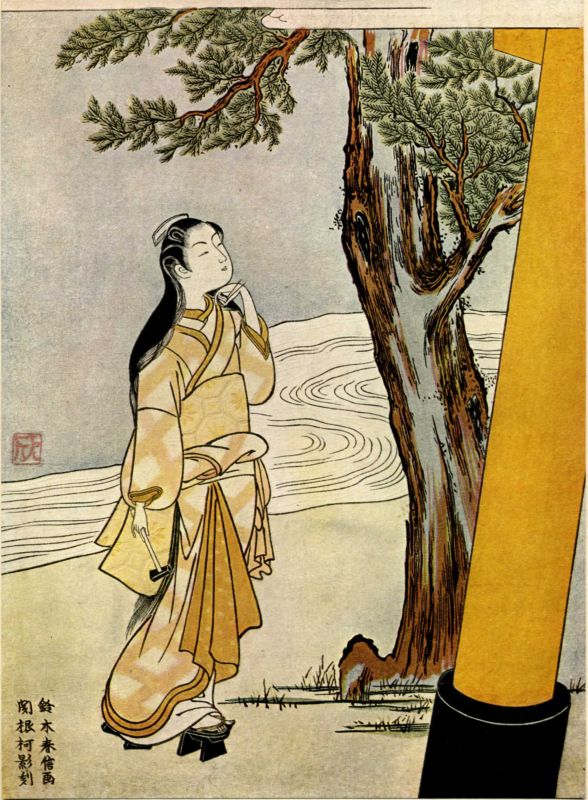
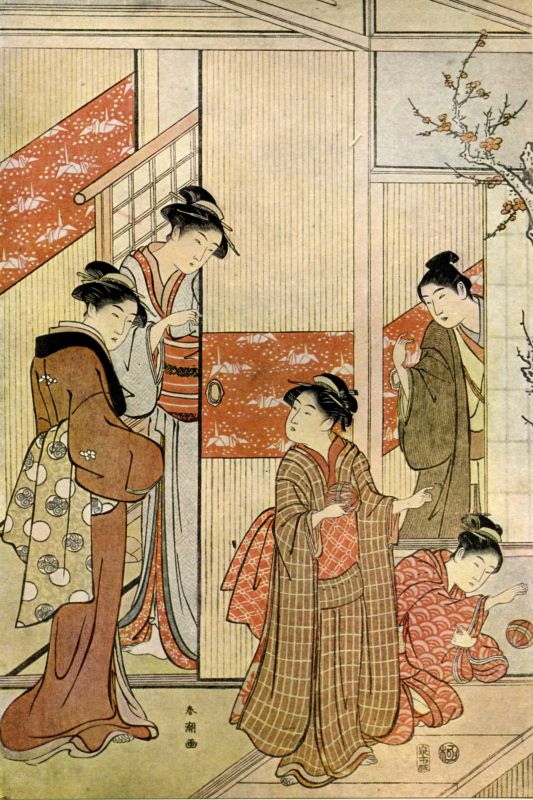
The name of Suzuki
Harunobu is familiar to every admirer of Japanese prints. It is in
large measure to his genius that the development of full-colour
printing is due. He was not only the first artist to make use of the
new process, but he took advantage of it to bring out prints of a
novel type. Very dainty and graceful these were, and in the poetic
allusions or quiet humour with which they were charged, and in the
quality of the brush-strokes with which the drawings were executed,
they made a direct appeal to men of taste. Success was instantaneous.
By the year 1765 Harunobu had come to the front and distanced all
competitors for popular favour. The serenity and compelling charm of
his compositions brought him wide fame. Realizing the possibilities
that now lay before him, he proudly exclaimed, “Why should I degrade [pg 15] myself by the delineation of actors?”
His ambition, he said, was to become “the
true successor of the painters in the department of printing”;
that is to say, to design prints that should be worthy substitutes
for paintings. Instead of restricting himself to a few primary or
secondary hues and the variations resulting from their superposition,
he mixed his colours to get the precise tint desired, and he used as
many colour-blocks as were needed for the effects at which he aimed.
The Yedo-yé, or Yedo pictures, as the prints had been called from the
fact that they were produced only at the eastern capital, were now
denominated nishiki-yé, or brocade pictures, from the number of
colours woven together in them. To the printing itself, the charging
of the blocks with colour, the character and quality of the pigments
and of the paper used, Harunobu gave careful attention, and these
things were greatly improved as a result of his experiments.
Under his
leadership the art now entered upon the period of its greatest
triumphs. In the eager search for novel subjects scarcely anything
was left untouched. History, mythology, and romance, the numberless
fêtes and merrymakings of the people and the daily routine of their
lives, representations of celebrated poets and heroes, scenes from
the drama, portraits of popular actors and courtesans, the revels of
the Yoshiwara, animals and plants, familiar scenes and famous
landscapes, furnished motives for almost endless broadsheets and book
illustrations. No other art was ever more crowded with human
interest.
The forward
movement in print-designing at this epoch was helped on by a number
of highly gifted artists who seem to have worked together to some
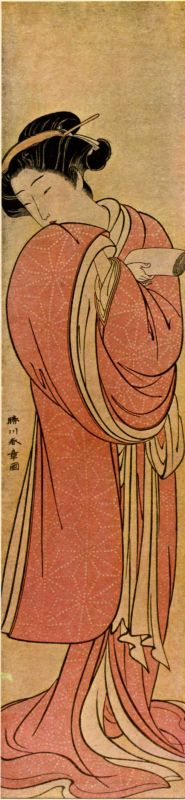
extent. Katsukawa ShunshoÌ
, who took up the theatrical branch of
print-designing that Harunobu scorned, is one of the most
distinguished masters of the Ukiyoé school. He was a designer of
marked power, a colourist of the first rank. His works are not yet
appreciated as they should be, but the finest of them yield pure
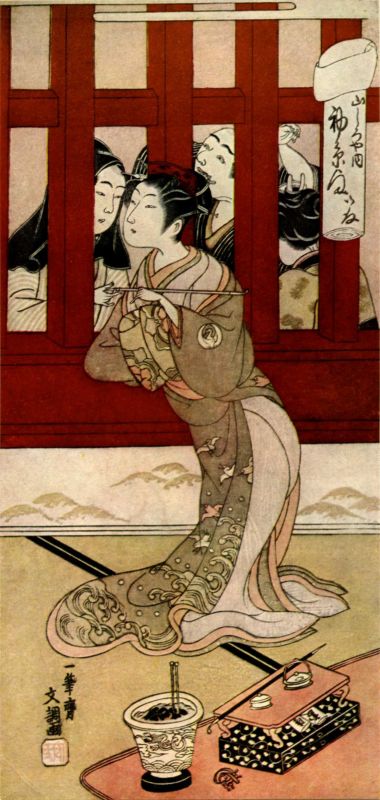
aesthetic delight of most exalted quality. Kitao Shigemasa,
Ippitsusai BunchoÌ
, and Isoda Koryusai also rank among the
first-rate men of this period. In the contest for popular favour
during the ten years following the death of Harunobu, which took
place in the summer of 1770, it has been said that the guerdon rested
upon Koryusai, but that is a mistake, [pg 16] for both ShunshoÌ
and Shigemasa stood higher
in the estimation of qualified judges. All, however, were surpassed a
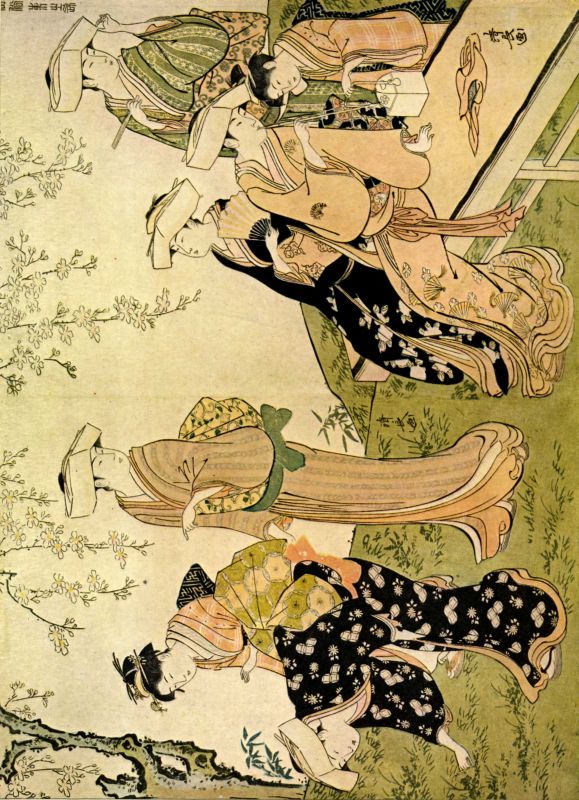
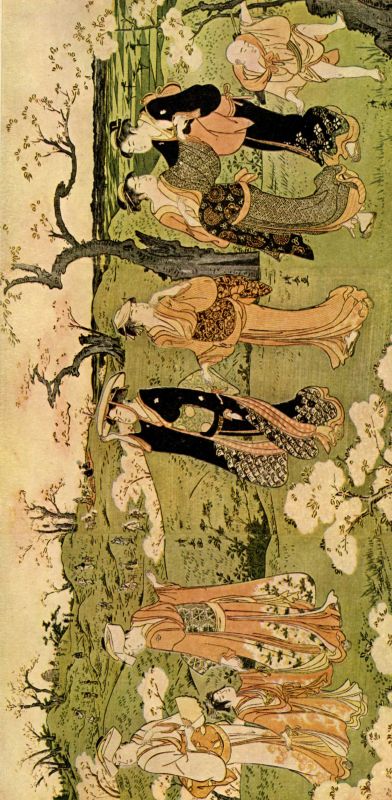
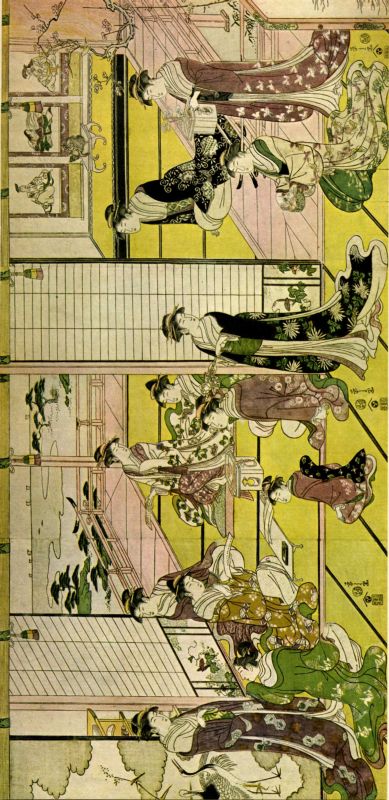
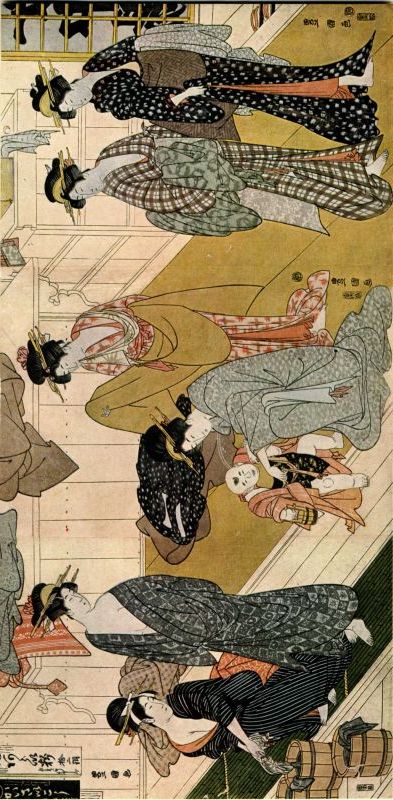
few years later by Kiyonaga, the last great artist of the Torii line
and the culminating figure in the history of the Popular School. He
conquered by the rugged strength and marvellous quality of his
brush-strokes, by the richness of his colouring and the ripe mastery
he displayed over all the resources of his craft. But also he created
a new type of design—that which found expression in the great
diptychs and triptychs that stand as the triumphs of colour-printing.
At the height of his power his influence over his contemporaries was
so great that, without exception, the younger men among them copied
his style as closely as they could.
When Kiyonaga,
about 1793, stopped designing prints, the decadence had already set
in. The decade that followed was a period of rapid deterioration,
with Utamaro as its particular evil genius. Yet many of the most
splendid of the prints were produced in that decade. Where shall we
look for anything finer than Eishi's wonderful series with the
chocolate background, or his triptychs of the Prince Genji series?
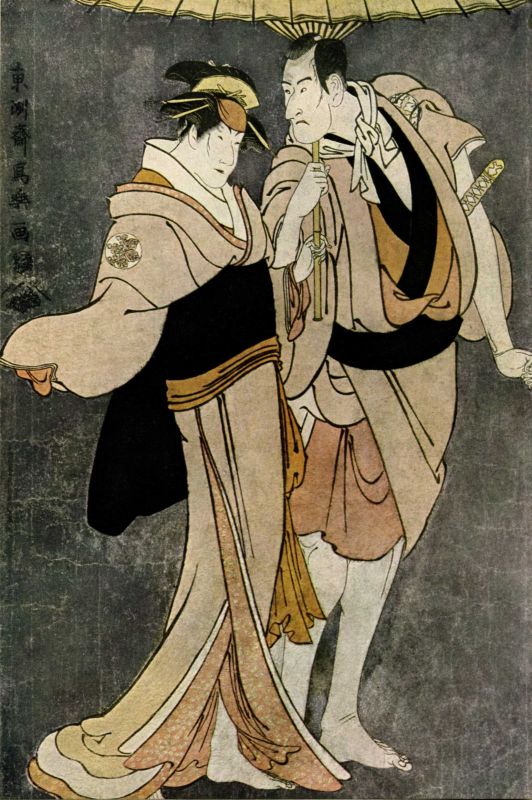
Where shall we find anything to equal the brilliant characterization
of Sharaku's actor portraits? Where else shall we turn for such
marvellously facile rhythmic line, such swift, vital handling as that
which made Utamaro's masterpieces the despair of his many imitators?
Toyokuni also designed many fine prints; but as he was a man of less
force than the others I have named, he fell faster and farther than
they did, and fewer of his works command our admiration.
I have left myself
little time to speak of two eminent artists, both of them
world-renowned, who by their genius made the latter years of the
Ukiyoé school as notable in their way as any in its entire history.
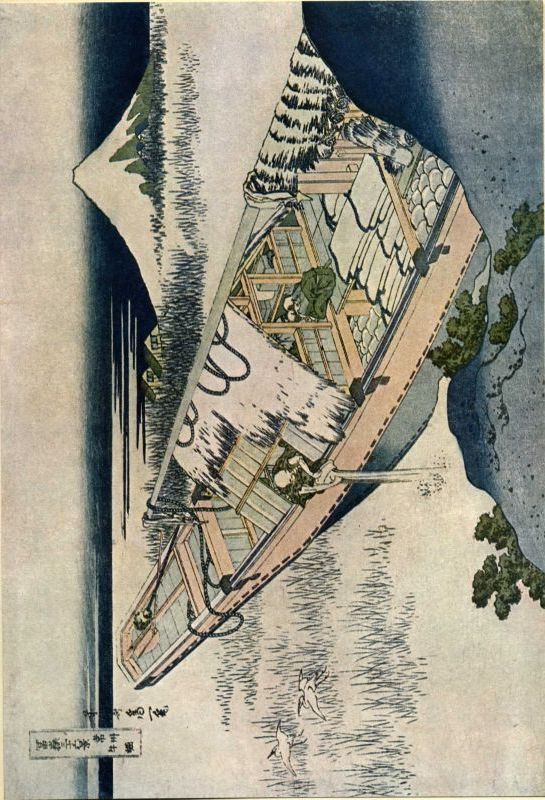
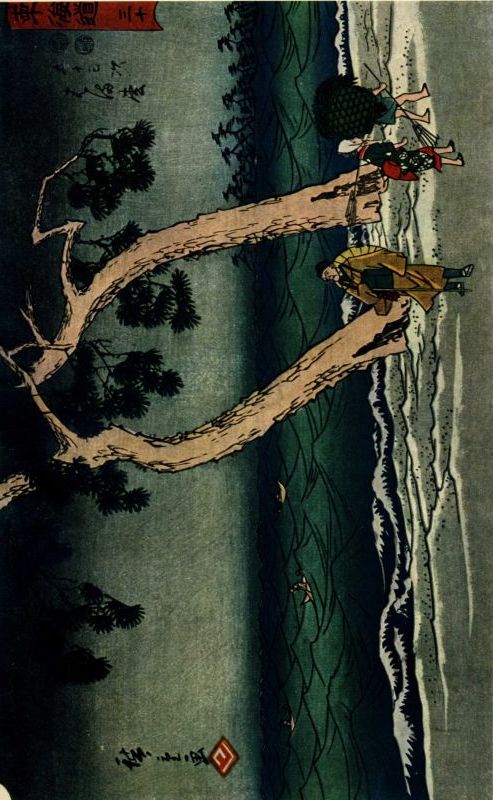
Either Hokusai or Hiroshige might well engage our attention for an
entire evening. Both were extraordinarily prolific; Hokusai was the
more versatile and has the wider reputation. Both are among the
greatest landscape artists the world has ever known. Their numerous
prints of landscapes are a revelation of the possibilities of
originality in composition and variety of interest in this field.
Unless one has studied these prints in fine examples, it is
impossible to realize how great is their [pg 17] merit. This is true of all the prints, but
particularly true of Hiroshige's. Between the best impressions and
the very good ones the difference is really astonishing. But the best
are so extremely rare as to make it probable that because of the
difficulty and the cost of printing, very few of them were issued—the
publishers finding cheaper editions more profitable.
Though classed as
Ukiyoé artists, Hokusai and Hiroshige really represent a separate
movement which undoubtedly would have crystallized into a distinct
school had worthy followers arisen to carry it forward, had the times
been different, and, last but not least, had the genius of the two
masters been less transcendent.
In this sketch of
the history of the art of Ukiyoé colour-printing only the more
salient features have been touched upon. Of the prints themselves it
is not too much to say that the finest of them are the most beautiful
specimens of printing that have been done in any land at any
time.
Yet none but the
most primitive methods—or what from our point of view may seem
such—were employed. The most wonderful among all the prints is but a
“rubbing” or impression taken by hand
from wood blocks. The artist having drawn the design with the point
of a brush in outline upon thin paper, it was handed over to the
engraver, who began his part of the work by pasting the design face
downward upon a flat block of wood, usually cherry, sawn plankwise as
in the case of the blocks used by European wood-engravers in the time
of Dürer. The paper was then scraped at the back until the design
showed through distinctly in every part. Next, the wood was carefully
cut away, leaving the lines in relief, care being taken to preserve
faithfully every feature of the brush-strokes with which the drawing
was executed. A number of impressions were then taken in Chinese ink
from this “key block” and handed to
the artist to fill in with colour. This ingenious plan, which is
manifestly an outgrowth of the early custom of colouring the ink
prints (sumi-yé) by hand, and which perhaps would never have been
thought of had not the colour itself been an afterthought, enabled
the artist to try many experiments in colour arrangement with a
minimum amount of labour. The colour scheme and ornamentation of the
surfaces having been determined, the [pg 18] engraver made as many subsidiary blocks5 as were
required, the parts meant to take the colour being left raised and
the rest cut away. Accurate register was secured by the simplest of
devices. A right-angled mark engraved at the lower right-hand corner
of the original block, and a straight mark in exact line with its
lower arm at the left, were repeated upon each subsequent block, and,
in printing, the sheets were laid down so that their lower and
right-hand edges corresponded with the marks so made. The defective
register which may be observed in many prints was sometimes caused by
unequal shrinking or swelling of the blocks. In consequence of this,
late impressions are often inferior to the early ones, even though
printed with the same care, and from blocks that had worn very
little. The alignment will usually be found to be exact upon one side
of the print, but to get further out of register as the other side is
approached.
The printing was
done on moist paper with Chinese ink and colour applied to the blocks
with flat brushes. A little rice paste was usually mixed with the
pigments to keep them from running and to increase their brightness.
Sometimes dry rice flour was dusted over the blocks after they were
charged. To this method of charging the blocks much of the beauty of
the result may be attributed. The colour could be modified, graded,
or changed at will, the blocks covered entirely or partially. Hard,
mechanical accuracy was avoided. Impressions differed even when the
printer's aim was uniformity. Sometimes, in inking the “key block,” which was usually the last impressed,
some of the lines would fail to receive the pigment, or would be
overcharged. This was especially liable to happen when the blocks
were worn and the edges of the lines became rounded. A little more or
a little less pigment sometimes made a decided difference in the tone
of the print, and, it may be noted, has not infrequently determined
the nature and the extent of the discolouration wrought by
time.
In printing, a
sheet of paper was laid upon the block and the printer rubbed off the
impression, using for the purpose a kind of pad called [pg 19] a baren.
This was applied to the back of the paper and manipulated with a
circular movement of the hand. By varying the dampness of the paper
and the degree of pressure the colour could be forced deep into the
paper, or left upon the outer fibres only, so that the whiteness of
those below the surface would shine through, giving the peculiar
effect of light which is seen at its best in some of the surimono
(prints designed for distribution at New Year's or other particular
occasions) by Hokusai and his contemporaries. Uninked blocks were
used for embossing portions of the designs. The skill of the printer
was a large factor in producing the best results. Even the brilliancy
of the colour resulted largely from his manipulation of the pigments
and various little tricks in their application. The first impressions
were not the best, some forty or fifty having to be pulled before the
block would take the colour properly. Many kinds of paper were used.
For the best of the old prints it was thick, spongy in texture, and
of an almost ivory tone. The finest specimens were printed under the
direct personal supervision of the artists who designed them. Every
detail was looked after with the utmost care. No pains were spared in
mixing the tints, in charging the blocks, in laying on the paper so
as to get the best possible impressions. Experiments were often tried
by varying the colour schemes. Prints of important series, as, for
example, Hokusai's famous “Thirty-six Views
of Fuji,” are met with in widely divergent colourings.
The pigments most
frequently used were comparatively few, and different lots of the
same pigment seem to have been far from uniform in hue. As to this
and some other points upon which we should be glad to have light, no
very certain information exists. We do not know how soon some of the
colours began to fade. Internal evidence indicates that in some
instances the change took place within a comparatively short time, as
in the case of the lovely blue used by Harunobu and ShunshoÌ
chiefly
as a colour for sky and water. It appears to have been a compound
tint formed of blue mixed with some other colour to modify its
intensity. In the change which followed—possibly a chemical one—the
blue disappeared in whole or in part, leaving in its stead a buff hue
having peculiar depth and a soft, velvety texture. To our
[pg 20] eyes the modified
colour is often far more beautiful than the original, but the
variation, it may safely be asserted, was not desired by the
artist.
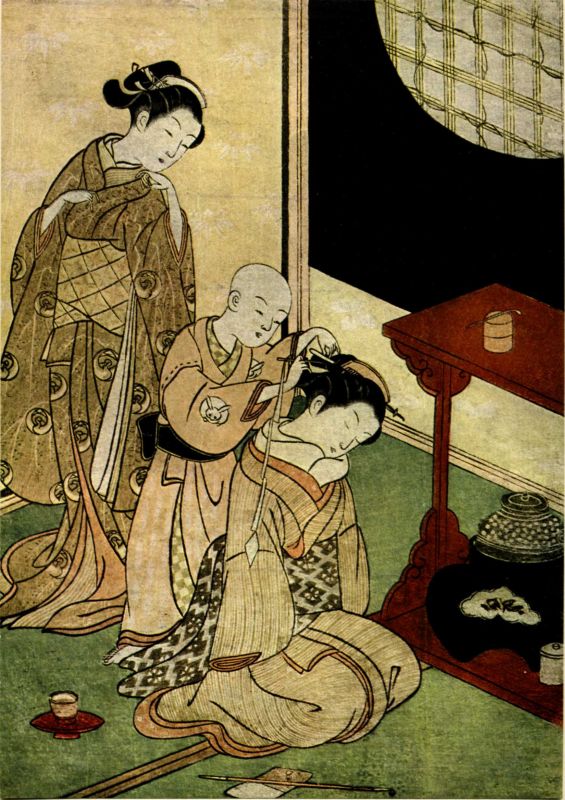
The quality of the
colour wrought by these changes explains why it is not possible
to-day to reproduce the prints successfully. The printing process is
still in use, and, as the plates in such publications as “Kokka” attest, very splendid results are still
yielded by it. But some of the old pigments cannot now be obtained;
and if they could be, we should still have to wait long years for
time to mellow the prints made with them. Indigo can be had, but it
is not the same indigo and its colour is not quite like the old,
which was extracted from blue cloth imported from China. Beni can be
made, but the secret of the blue added to it to produce the divine
violet seen in many of the prints has been lost, as has that of the
precious moss-green used by Utamaro. Many reproductions have been
made during the last twenty-five years, and some of them are
extremely clever; but the printing lacks depth, and when placed
beside the old works they appear dull and lifeless.
Colour-prints were
made for many purposes. To some extent they were used as
advertisements. Incidentally they served as fashion plates. Some were
regularly published and sold in shops. Others were designed expressly
upon orders from patrons, to whom the entire edition—sometimes a very
small one—was delivered. The number struck from any block, or set of
blocks, varied widely. Of the more popular prints many editions were
printed, each one, as might be expected, inferior to those that
preceded it. Not infrequently the Yedo publishers removed from their
out-of-date blocks the marks showing their imprint, and sold them to
publishers in Osaka and Nagoya, by whom poor and cheap editions were
issued. Eiraku-ya of Nagoya, in particular, is said to have bought
many old blocks, some of which were revamped in various ways before
being reprinted.
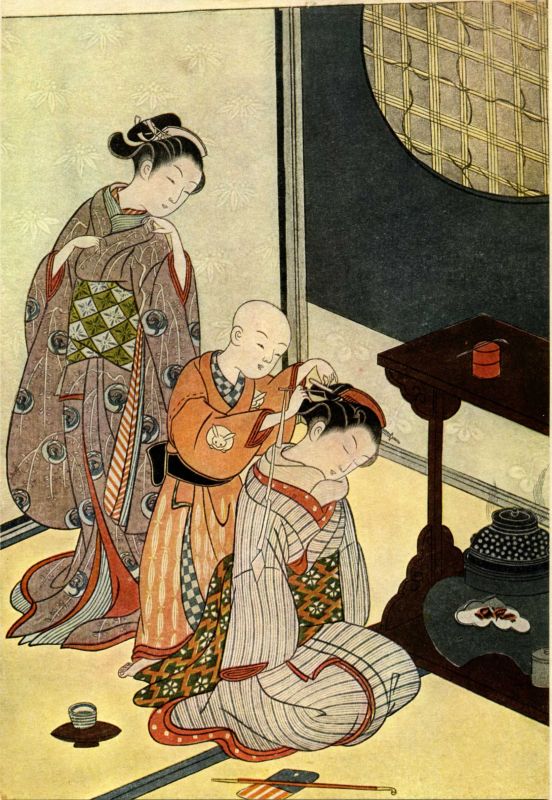
In a number of
instances, when blocks had worn out or had been accidentally
destroyed in the fires by which Yedo was ravaged, the artists were
called upon to make new drawings of the same subjects. Usually, in
such cases, the second design differed very little from the first,
save in such details as the patterns upon the garments of the
[pg 21] figures and the
styles of hair arrangement, which invariably reflected the current
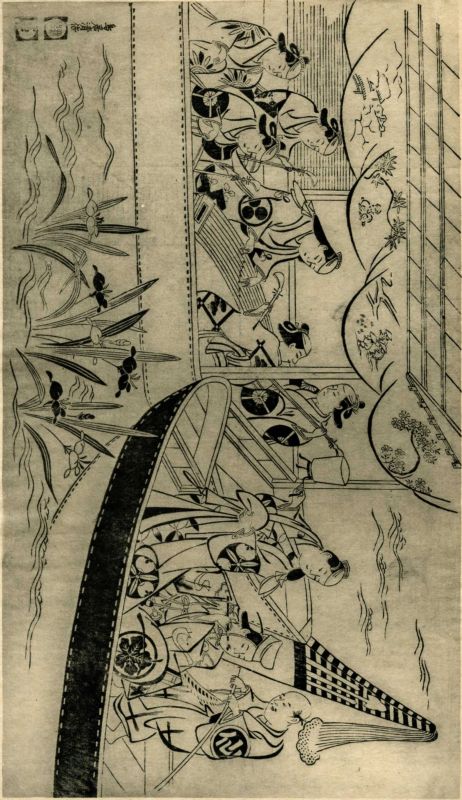
mode. Kiyonaga's “Iris Garden” and his
well-known triptych “Ushiwaka Serenading
Jorurihime” are notable examples of this practice. Two designs
of each of these were issued, the intervals between the appearance of
the first and second being, in each instance, about three or four
years. For the later editions of many of the prints designed by
Harunobu changes were made in the blocks, and the number was
sometimes increased and sometimes decreased. After his death
re-engravings of a number of his prints appear to have been made, as
well as forged works in imitation of his style to which his name was
attached.
Most of the prints
were sold at the time of publication for a few sen. The finer ones
brought relatively higher prices, and such prints as the great
triptychs and still larger compositions by Kiyonaga, Eishi, Toyokuni,
Utamaro, and other leading artists could never have been very cheap.
In general, however, the price was small and they were regarded as
ephemeral things. Many were used to ornament the small screens that
served to protect kitchen fires from the wind, and in this use were
inevitably soiled and browned by smoke. Others, made into kakemono or
mounted upon the sliding partitions of the houses, perished in the
fires by which Japanese cities have been devastated; or, if in houses
that chanced safely to run the gauntlet of fires, typhoons,
cloudbursts, and other mishaps, their colours faded and their
surfaces were rubbed until little more than dim outlines were left.
These lost prints include a very large proportion of those that were
most beautiful, and especially of those having inoffensive
subjects.
Fortunately,
though the upper classes did not consider the prints as works of art,
that did not prevent them from buying them for the entertainment they
afforded. The samurai, though they considered it degrading to take
part in the amusements of the lower classes and affected to despise
the vulgarity of the theatre, sometimes attended the performances in
disguise. And when they returned to their home provinces with their
feudal lords after the six months of every year spent in the capital,
they usually carried with them large quantities of prints. Country
people visiting Yedo rarely returned without taking [pg 22] many of these cheap souvenirs
of the city to distribute among their neighbours. Of course many were
destroyed, but the Japanese have always been accustomed to take care
of their possessions, and so many thousands of prints were neatly
packed away in boxes and placed in the kuras, or fireproof
storehouses. There they were often spoiled by mildew, the dread foe
of the Japanese housewife, and eaten by insects. Those pasted in
albums, as were many of the noted series by Hokusai and Hiroshige,
fared better than the loose ones.
Thus it has come
about that in spite of the enormous number printed, really choice
specimens are very rare. Of many of the most important only two or
three copies in good condition are known. Even at the time of their
issue the number of those in what may be called the “proof” state could not have been large. The best
printing, as has already been pointed out, was not only difficult and
relatively expensive—perhaps prohibitively expensive in many
instances except for a small number of impressions—but when the
blocks had worn so that the edges of the finest lines had lost their
sharpness, it was quite impossible. Collections of prints were rarely
made. Literary men often saved such as were inscribed with odes of
especial merit, or had recondite meanings that appealed to them, and
to their care we are indebted for the preservation of the majority of
those that have survived in perfect or nearly perfect condition.
For those who have
learned the elements of their language the charm of the prints is
very great. I should perhaps say the charm of some of the prints is
very great; for, as we learn what we ought to admire, we learn to
discriminate, at first between the works of the different artists,
then between different works by the same artist, and finally between
different copies of the same work. The truth is that the prints are
only in a remote sense to be spoken of as reproductions. Each
impression is more or less an individual work of art; the difference
in quality between one and another is often astonishingly wide.
In conclusion it
may be well to specify briefly some of the qualities in the prints
that appeal to people of taste. In the first place, there is the
compelling charm of colour. Equally notable are excellence of
composition, grace, beauty, and sweep of line, distinctive character,
[pg 23] daringness of
conception, and perfect balance of both line and mass. Collectively
the prints furnish the clearest exemplification of the basic
principles of design that the world has to offer. Nowhere else can we
find so much accomplished with simple means. Technically, also, they
fulfil every requirement. Considered merely as wood-engravings, they
are of the first order of excellence. Though the drawing is seldom
scientifically accurate, it is, nevertheless, of exquisite refinement
and subtlety. In short, the best prints are creative works of very
high order which amply justify our admiration because of their
intrinsic merit.
[pg
24]