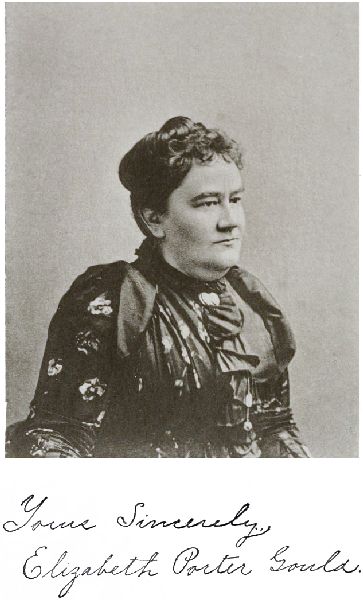
STRAY PEBBLES
FROM THE
Shores of Thought
BY
ELIZABETH PORTER GOULD
BOSTON
Press of T. O. Metcalf & Co.
1892
COPYRIGHT 1892
BY
ELIZABETH PORTER GOULD
CONTENTS.
| Poems of Nature: | |
| PAGE | |
| To Walt Whitman | 11 |
| To Summer Hours | 12 |
| A True Vacation | 13 |
| A Question | 14 |
| To a Butterfly | 16 |
| In a Hammock | 18 |
| O rare, sweet summer day | 20 |
| An Old Man's Reverie | 22 |
| On Jefferson Hill | 26 |
| On Sugar Hill | 28 |
| At "Fairfield's," Wenham | 29 |
| Blossom-time | 31 |
| The Primrose | 33 |
| Joy, all Joy | 35 |
| Among the Pines | 37 |
| Conscious or Unconscious | 39iv |
| Poems of Love: | |
| Love's How and Why | 43 |
| Love's Guerdon | 44 |
| A Birthday Greeting | 45 |
| Three Kisses | 48 |
| If I were only sure | 50 |
| Absence | 52 |
| A Love Song | 53 |
| In Her Garden | 55 |
| Love's Wish | 56 |
| Is there anything purer | 58 |
| Longing | 60 |
| Young Love's Message | 61 |
| A Diary's Secret | 63 |
| A Monologue | 65 |
| A Priceless Gift | 66 |
| The Ocean's Moan | 67 |
| Love's Flower | 70 |
| Renunciation | 71 |
| Love Discrowned | 74 |
| A Widow's Heart Cry | 76 |
| Together | 78 |
| Shadowed Circles | 80v |
| Miscellaneous Poems: | |
| A Song of Success | 85 |
| The Under World | 87 |
| She Knows | 88 |
| At Pittsford, Vermont | 90 |
| Childhood's Days | 92 |
| An Answer | 94 |
| Where, What, Whence | 96 |
| Heroes | 98 |
| A Magdalen's Easter Cry | 100 |
| For the Anniversary of Mrs. Browning's Death | 103 |
| Robert Browning | 105 |
| To Neptune, in behalf of S. C. G. | 107 |
| To the Pansies growing on the grave of A. S. D. | 109 |
| A Broken Heart | 111 |
| My Release | 113 |
| The god of music | 115 |
| To Wilhelm Gericke | 118 |
| For E. T. F. | |
| 1.—After the birth of her son | 119 |
| 2.—Upon the death of her son | 121 |
| To C. H. F. | 123vi |
| An Anniversary Poem | 126 |
| A Comfort | 128 |
| An Anniversary | 129 |
| To Miss Elizabeth P. Peabody | 131 |
| At Life's Setting | 133 |
| Grandma Waiting | 136 |
| Does it Pay | 144 |
| Auxilium ab Alto | 145 |
| Limitations | 147 |
| The Muse of History | 148 |
| An Impromptu to G. H. T. | 151 |
| To Mrs. Partington | 153 |
| Lines for the Seventieth Birthday Anniversary of Walt Whitman | 156 |
| Sonnets: | |
| The Known God | 161 |
| To Phillips Brooks | 163 |
| At the "Porter Manse" | 165 |
| Our Lady of the Manse | 167 |
| To B. P. Shillaber | 169 |
| To Our Mary | 171 |
| A Birthday Remembrance | 173vii |
| Josef Hofmann | 175 |
| After the Denial | 177 |
| Gethsemane | 179 |
| On Lake Memphremagog | 181 |
| Luke 23: 24 | 183 |
| To Members of my Home Club | 185 |
| For my little Nephews and Nieces: | |
| Mamma's Lullaby | 189 |
| Warren's Song | 190 |
| Baby Mildred | 192 |
| Rosamond and Mildred | 194 |
| 'Chilla | 196 |
| Childish Fancies | 197 |
| What little Bertram did | 199 |
| "Dear little Mac" | 202 |
| Willard and Florence on Mt. Wachusett | 207 |
| A little Brazilian | 210 |
| The little doubter | 213 |
| Our Kitty's Trick | 217 |
| A Message | 220 |
POEMS OF NATURE.
TO WALT WHITMAN.
And what do I feel?
An influx of life from the great central power
That generates beauty from seedling to flower.
And what do I hear?
Original harmonies piercing the din
Of measureless tragedy, sorrow, and sin.
And what do I see?
The temple of God in the perfected man
Revealing the wisdom and end of earth's plan.
August, 1891.
TO SUMMER HOURS.
DAY.
While Day her heart reveals.
Such wealth from secret bowers
King Time himself ne'er steals.
O joy, King Time ne'er steals!
NIGHT.
While Night in beauty sleeps.
Hold back e'en softest showers,—
Enough that mortal weeps.
Ah me, that my heart weeps!
A TRUE VACATION.
IN A HAMMOCK.
Under the trees,
(Oh what ease.)
Nature full of joyous greeting;
Dancing, singing, naught secreting,
Ever glorious thoughts repeating—
Pause, O Time,
I'm satisfied!
Now all life
Is glorified!
Porter Manse, Wenham, Mass.
A QUESTION.
Tell me, O breeze,
Bearing the perfume of flowers and trees,
While gaily decked birds
Pour forth their gladness in songs beyond words,
And cloudlets coquette in the fresh summer air
Rejoicing in everything being so fair—
Is life a farce?
When Nature at heart
Is but the great spirit of love and of art
Eternally saying, "I must God impart."
15
Tell me, O soul,
Struggling to act out humanity's whole
'Midst Error and Wrong,
And failure in sight of true victory's song;
With Wisdom and Virtue at times lost to view,
And love for the many lost in love for the few—
Is life a farce?
When humanity's heart
Is but the great spirit of love and of art
Eternally crying, "I must God impart."
TO A BUTTERFLY.
Through the air,
So glad to share
The freedom of new living,
Come, tell me my heart's seeking.
Shall I too know
After earth's throe
Full freedom of my being?
Shall I, as you,
Through law as true,
Know life of fuller meaning?
If here on earth
A second birth
Can so transform a being,
Why may not I
In worlds on high
Be changed beyond earth's dreaming?
IN A HAMMOCK.
The breezes sighing round me,
A network glimpse of bluest sky
To meet the upturned seeing eye,
The greenest lawn beneath me,
Loved flowers and birds to greet me,
A well-kept house of ancient days
To tell of human nature's ways,—
Oh happy, happy hour!
The soft wind to caress me,
The life which does my strength renew
For purer visions of the true?
Alas! no one can tell me.
19 But, hush! let Nature lead me.
Let even wisest questions cease
While I breathe in such life and peace
This happy, happy hour.
Porter Manse, Wenham, Mass.
O RARE, SWEET SUMMER DAY.
To a lingering motion bound,
Like a river in its flowing—
Can there be a softer sound?"
Could'st thou not longer stay?
The soothing, whispering wind's caress
Was bliss to weary brain,
The songs of birds had power to bless
As in fair childhood's reign.
The sky was wondrous clear,
The precious incense of rare flowers
Made sweet the atmosphere;
21 The shimmering haze of mid-day hour
Was balm to restlessness,
While thought of silent hidden power
Was strength for helplessness—
O rare, sweet summer day,
Could'st thou not longer stay?
Porter Manse.
AN OLD MAN'S REVERIE.
And bear her the message my heart dares to sing.
Pause not on the highways where gathers earth's dust,
Nor in the fair heavens, though cloudlets say must.
But blow through the valleys where flowers await
To give of their essence ere yielding to fate;
Or blow on the hill tops where atmospheres lie
Imbued with the health which no money can buy.
23 But fail not, O breezes, on Love's swiftest wing
To bear her the message my heart dares to sing.
As, cradled in hammock, I sang in delight,
On that blest summer day in the years long ago,
When life was all sunshine and youth all aglow.
The sweets of the valleys, the breath of the hills
Were gathered—the best that our loved earth distills—
As, obedient still to my wish, on they flew
To the home of my darling they now so well knew.
Alas for my message, so full of love's art!
If only the breezes had followed their will,
And loitered among the pure cloudlets so still,
They'd have met a fair soul from the earth just set free
In search of their help for its message to me;
The message my darling, with last fleeting breath,
In vain tried to utter, o'ertaken by death.
With messages laden again and again.
As for me, I send none. I wait only their will
To bring me that message my lone heart to fill.
25 They'll find it some day in a light zephyr chase,
For nothing is lost in pure love's boundless space.
ON JEFFERSON HILL.
(BEFORE THE PRESIDENTIAL RANGE.)
The valleys rest in peace;
The lingering clouds melt into twilight haze,
The birds their warbling cease;
The villagers' hour of welcome sleep is near,
The cattle wander home,
While wrapped in summer-scented atmosphere,
Calm evening comes to roam
With gentle pace
Through star-lit space,
27 Till moon-kissed Night holds all in her embrace,
And Morning waits to show her dawn-flushed face.
ON SUGAR HILL.
TO F. B. F.
Of glorious mountain peaks;
The purple tint of sunset hour, and charms
The evening hour bespeaks;
The monarch peak kissed by the rising sun,
While clouds keep guard below;
Grand, restful views, with foliage autumn-won,
And Northern lights rare glow,—
Will e'er recall,
In memory's hall,
The happy days when on fair "Look-Off's" height,
Sweet friendship cast her hues of golden light.
Hotel Look-Off, September, 1891.
AT FAIRFIELDSA, WENHAM.
June, 1890.
Clover red and white,
Ferns and crown-topped grasses
Waving with delight,
Dainty locust-blossoms,
All that glad June yields,
Welcome me with gladness
To dearly-loved "Fairfields."
But where's my happy collie dog,
My Rosa?
The butterflies come near,
30 The hens cease not their cackling,
The horses neigh "I'm here,"
The cows nod "I have missed you,"
The pigs' eyes even shine,
And from the red-house hearth-stone
Comes pet cat Valentine.
But where's my happy collie dog,
My Rosa?
Her handsome, high-bred face,
Her vigorous, playful action
In many a fair field chase.
Not even lively Sancho
Can fill for me her place.
Gone where the good dogs go,
Dost find such fields as "Fairfields,"
More love than we could show?
A "Fairfields" is but another name for "Porter Manse."
BLOSSOM-TIME.
Bearing perfumes rich and rare,
Free from trouble, toil, and care.
Would I were a blossom!
Feeling every velvet breeze,
Free from knowledge that bereaves.
Would I were a robin!
Telling each its happy tale,
Free from worldly noise and sale.
Would I were a violet!
Wafting only purity,
Or like robins, singing free
'Midst the deepening mystery,
Or like violets, caring naught
Only to reflect God's thought."
Porter Manse.
THE PRIMROSE.
After dreaming all day?
Who changes so quickly your sombre green dress
To the yellow one gay,
And makes you the pet of the twilight's caress,
And of poet's sweet lay?
Who does, primrose, pray?
Looked up quickly to say,
"A dear lovely fairy glides down from his throne
In the sun's golden ray,
34 And with a sweet kiss opens wide all our eyes,
Saying, 'Now is your day.'
And lo! when he's gone we are filled with surprise
At our wondrous array,
So fresh and so gay.
Do tell us the name of this fairy, I pray,
Who gives of his beauty, and then hies away
Without thanks, without pay.
Does he linger your way?"
JOY, ALL JOY.
On a summer day,
With no care to weigh,
Or a bitter thought to stay all that sense might yield—
What a joy to have alway!
Birdlings on the wing
Ere they pause to sing
On the top of bush or tree, or on sweet hay-mound—
Restful joy in everything!
36
Cows in pastures near,
Wondering why I'm here,
Chipmunks now and then in sight, bees in clover-flower—
Added joy when these appear!
Running here and there.
Farmer's work to share,
Skipping, shouting loud and clear, full of daring play—
Children's joy! Joy everywhere!
AMONG THE PINES.
Love songs sweet and low,
With a rhythmic flow,
Worthy of the glad sun's glow.
Captured by the sound
Of such pleasure found
In a playful daily round.
Wondering all the while
How the trees can smile
Rooted so to earthly guile.
38
Perfumed from below
By the flowers that show
They, too, murmuring love songs know.
Oh, that I could hear
Love songs once so dear
Death has hushed forever here!
Intervale Woods, North Conway.
CONSCIOUS OR UNCONSCIOUS?
The lightning's vivid chain,
The ocean's strength, the deluge's pour,
The wildest hurricane,
To man who boasts his birth
From conscious force she could not know
Because denied soul-worth.
A knowledge in God's plan?
Must not she His own secret bear
To so touch soul of man?
40
Into the heart of things;
For how could otherwise God here
Reveal His wanderings?
POEMS OF LOVE.
LOVE'S HOW AND WHY.
Oh, who knows
How the blush of the rose
Can its secret disclose?
Oh, who knows?
Ah, who cares
Sound a passion he shares
With the angels? Who dares,
Yes, who dares?
LOVE'S GUERDON.
To love's pure rapturous height.
Thy thoughts are pearls to lead me
To truth beyond earth's sight.
Thy love is life to keep me
Forever in God's light.
A BIRTHDAY GREETING.
Oh, would I had the poet's art
By which I could my wish impart
For thy new year;
But e'en a poet's pen of gold
Would fail my wish to thee unfold
In earthly sphere.
Oh, would I had the painter's skill
Prophetic visions to fulfill
For thy new year;
But e'en a painter's rarest brush
Would but my holy visions crush,
Or fail to cheer.
46
Oh, would I had sweet music's aid
To vitalize the prayers I've made
For thy new year;
Alas! not even music's best
Could put in form my soul's behest
For thee, my dear.
In purest depths of thine own mind
This coming year;
As, guided by the inner light,
There'll come to thee the new-born sight
Of ravished seer.
Eternal beauty o'er thee steal—
God's gift, my dear—
That thou can'st find the blessed art
47 By which to make e'en depths of heart
In form appear.
Will have to dawn for us to say
Our best things, dear.
For, as thou know'st, Truth's deepest well
Must e'er reflect, its depths to tell
Heaven's atmosphere.
THREE KISSES.
That kiss of long ago,
When in the flush of love's first hour
He said he loved me so.
The kiss of wedded bliss,
When soul met soul in rapture sweet—
Oh, pure love's burning kiss!
A kiss for heaven's day,
(O heart abide God's way)—
When in the life beyond earth's change,
49
New life will spring from out the old,
New thoughts will larger truth unfold,
And love have endless sway.
IF I WERE ONLY SURE.
He loves me still,
As in the realms of beauteous space
(Alas! so far from my embrace)
He bides God's will,
I could be more content to bear
The bitter anguish and despair
Which now me fill.
He waits for me
To join him in the heavenly realm
(Oh, how the thought does overwhelm)
When body-free,
51 I could the better bear my fate,
As day by day I learn to wait
In silent agony.
One thing is sure,
That Thou, all love, could ne'er destroy
(Death only is in earth's alloy)
Such love so pure
As that which blessed our union here,
The love which knew no change nor fear—
Such must endure.
ABSENCE.
But happier would they be
Could'st thou be near to bless me
With love's sweet ministry;
Would on my memory lie,
As prayers of sainted mother,
Or childhood's lullaby.
Hotel Look-Off, Sugar Hill, N.H.
A LOVE SONG.
Comes down to share
The heart that with human love trembles;
While all on the earth
Is crowned with new birth
And everything heaven resembles.
Have latent their share
In hearts that with human love tremble,
Since fires of love
Enkindled above
In frail earthen vessels assemble.
Comes down to share
54 The heart that with human love trembles;
While all on the earth
Is crowned with new birth
And everything heaven resembles.
IN HER GARDEN.
Were ever such roses?
Their fragrance would honor
The heavenly halls.
Such wondrous-eyed pansies,
And lovely nasturtiums
That run on the walls.
While all the time singing.
And I? Ask the flowers
To tell what befalls.
LOVE'S WISH.
Then you at Beauty's shrine might freely dine,
A welcome guest
For joy's bequest.
But, dear, if this were so,—
If I were Beauty's child, all undefiled,
To make you blest
In beauty's quest,
The soul's pure hidden shrine wherein e'er shine
The things that test
Love's true behest.
57 Would I were beautiful,
That you might better see the soul in me!
That wish is best,
Is 't not, dearest?
IS THERE ANYTHING PURER?
Breathed forth with true love's gentle art!
Is there anything purer
On land or on sea,
More laden with blessing
For you or for me?
More precious than love's spoken word.
It is fraught with a keen recognition
Of truest soul-need and fruition.
Is there anything purer
On land or on sea,
More laden with comfort
For you or for me?
59
With no ray of hope's blessed gain.
But as lulled by the angels at midnight
Ere reaching the infinite daylight
Is there anything surer,
On land or on sea,
To bring the God-Father
To you or to me?
LONGING.
Though lying on fair Nature's breast,
There breathes the longing heart's desire,
Would he were here!
For all the while there o'er me steals
Like holy chimes in midnight air,
"He'll soon be here."
Make haste to echo her glad words,
"He'll soon be here."
YOUNG LOVE'S MESSAGE.
Dost thou know?—
I'll speak low—
"Oh, I do love him so."
What I say,
Till the day
When as sweet new-mown hay
62 Thou dost fear?—
Oh, love dear,
How I wish thou wert here!
I am sure,
Sweet and pure,
Though the winds do allure;
But dost know?—
Tell him low,
"That I do love him so,
Oh! I do love him so."
A DIARY'S SECRET.
January 1, 1867.
My heart to satisfy,
When in the days of childhood's faith
I knew not doubt or sigh.
And knew his love's sweet cheer,
And felt the anguish and despair
Which come from partings here,
No love can satisfy,
And all my childhood's faith in God
Doth mock me as a lie.
64
I hold one anchor fast:
Perhaps this is the woman's way
To reach God's love at last.
January 1, 1887.
Love's conquest justified.
The woman's hungry heart at last
In God is satisfied.
A MONOLOGUE.
Ah, too late!
Already Death stands o'er me
With hungry eyes that bore me—
O cruel fate,
That after all life's years
Of sacrifice and tears,
'Tis Death, not Love, that wins.
But, stay! This message bear,
Ere yet Death's work begins:
"In other realms earth's losses
Will change from saddening crosses
To love-crowned joy,
Where Death shall have no mission,
But Love his sweet fruition
Without alloy."
A PRICELESS GIFT.
Unknown to worldly ways.
What could he give? Ah, well he knew
He lacked sweet virtue's praise.
Without a doubting thought,
When, lo! through seeming sacrifice
A miracle was wrought;
Revealing woman's power;
For, clothed in purity, he rose
To meet the coming hour.
THE OCEAN'S MOAN.
Was to my ears
The deep sad undertone
Of vanished years,
A bliss unattained,
A strife and a longing,
A life sad and pained,
To the shores vast and free
Of eternity's sea.
Long known to the sea—
Told in moments of silence
A sad heart to free—
To be borne me some day
In the ocean's own way.
Of mystery
Was now that passion-moan
Of secrecy,
My moaning ne'er'll cease
Till she on my breast
Findeth love's perfect peace;
Till she on my breast
Findeth love's perfect rest."
Its heavenly peace,
Its help for all sorrow,
Its heart-pain release,
To a soul waiting long
For love's tender, true song?
Is to my ears
The dearest undertone
Of all the years,
A sweet bliss attained,
A gratified longing,
A life's joys regained,
To the shores vast and free
Of eternity's sea.
Boar's Head, Hampton, N.H.
LOVE'S FLOWER.
Of pure, perennial life,
Blooms ever fresh in power
O'er all earth's wrong and strife.
This flower of wondrous hue,
Nor dare to crush, nor fail to scan.
Such beauty ever new.
And guard its sacred blush;
Then shall its treasures old unfurl
Your yearning soul to hush.
LOVE DISCROWNED.
(In Four Scenes.)
SCENE I.
I shall tell him all:
All the secret ecstasy,
All the peace and joy,
All my heart's sweet fantasy,
Free from self's alloy,—
All—
Of love's sweet hour,
When I shall tell him all,
Shall tell him all!"
SCENE II.
O joy, love's hour is here.
I knew that he was true and pure,
I could not feel love's fear.
Oh, no; I could not, dear."
SCENE III.
Drew back her anguished soul,
Then murmured low, "O bitter hour!
But—God—forgive—the—whole—
Forgive—
Of love's death-hour,
I thought to tell him all,
To tell him all."
SCENE IV.
He held her lifeless hand.
Was this the form he once had loved?
He did not understand.
Once loved? Yes, that was so.
He'd loved since, one or two,
And—well, what was a woman for,
If not for man to woo?
MORAL.
Of those who can but trust!
Alas, for those who see no law
But that of selfish must!
RENUNCIATION.
When once the heart be won?
Oh, is not love infernal
When love can be undone?"
In light of memory dear,
As, sad and heavy-laden,
She longed for knowledge clear.
Gave way to victory's cheer;
For, brave, she chose for His sake
The life which knows no peer;
75
Which gives the Christ's own peace,
But leaves the sad temptation
To ask for life's release.
A WIDOW'S HEART-CRY.
So breathe I when the day's begun,
So breathe I when the day is done.
I pause and listen, till appears
The welcome voice for listening ears;
And makes my longing heart to thrill
With love for those who need me still.
When will I learn to calmly say,
"Thy will is mine," both night and day?
77
Since he who gladly gave me birth
To everything that was of worth
To what? O ye who still invite
To heaven's sure realm and faith's own right,
What life is his, what he's to me.
Alas! ye can't. Then what can be
Or when the morning is begun,
Than, "Not my will, but Thine, be done."
TOGETHER.
In perfect harmony with beauteous sights
Beyond imagination's highest flights
Ere reached by seer,
We shall together walk the golden streets
Sometime, my dear.
So changed from what we were while here below,
When, caged like birds, we longed and suffered so?
Ah, do not fear.
79 Will not the soul, when free, seek like the bird
Its own, my dear?
For you may be among the blessed few
Who'll sooner reach the blissful heights—your due
For pure life here—
But sometime, sure as God is love and truth,
We'll meet, my dear.
Breathed through the softest, sweetest music heard,
Or some vibration rare of soul depths stirred
By memory's tear,
Will, like a flash of light, reveal our souls
Together, dear,
To live the fuller life we've dreamed of here.
SHADOWED CIRCLES.
Do sorrows press?
Beneath the weight of sorrow
Is love's caress.
Is love thine own?
Ah! 'neath love's deep rejoicing
Is sorrow's moan.
Could otherwise
Truth's dazzling light be subject
To mortal eyes?
The endless light,
Beyond the shadowed circle
Of mortal sight?
MISCELLANEOUS POEMS.
A SONG OF SUCCESS.
YOUTH.
I'm so happy and free.
I know not nor care what will tame or destroy,
Life now satisfies me.
Oh, there's naught like dear youth
To reveal the glad truth
That 'tis pure, healthful joy just to know and to be!
MIDDLE AGE.
To alleviate wrong.
86 With a heart full of love both to God and to man,
And an arm free and strong.
Oh, there's naught like mid-life
To make sure without strife
The beauty of progress through action and song.
OLD AGE.
My work is all done.
I have fought the good fight, known the full of each day,
And true victory won.
Oh, there's naught like old age
To declare with the sage,
Life ending on earth is but heaven begun.
THE UNDER-WORLD.
Of ocean's vast domain,
The god of perfect quiet
Holds ever peaceful reign.
Of passions strong and wild,
The still small voice of conscience
Is heard in accents mild.
Of all man's life on earth,
The Christ of sacred story
Renews each day his birth.
SHE KNOWS.
(Written at Mountain Cottage, on Mount Wachusett, where Louisa M. Alcott spent the last summer of her life.)
God's loving self did flow,
But now she knows 'tis so.
She sees with spirit-eye
What sense could not descry.
Becomes a restful cheer
To all who linger here,
89
And troubled with the why
Of all earth's sorrowing cry.
Made beautiful through pain
Eternity to gain.
August, 1888.
AT PITTSFORD, VERMONT.
TO J. A. C.
Ne'er pausing on its way,
Though love its tribute pay,
To days of long ago
When thee I first did know.
What these dear Vermont hills
Are to the little rills;
91
Oh, hills, be now as much
To her who feels Time's touch!
Together now we rest
On Nature's peaceful breast.
CHILDHOOD'S DAYS.
TO M. C.
May wholly cloud from sight
The glimpse which childhood's eye hath caught
Of heaven's celestial light,
Of second childhood's days
To catch another broader glimpse
Of heaven's immortal rays?
Through earth's illusive hour,
Immortal childhood's heavenly days
Of sweet, revealing power;
93
The deeper glimpses yet
Of life eternal, glorious, pure,
Where sun hath never set?
AN ANSWER.
TO B. P. S.
Ah, friend, if you could see
The depths of hidden heart-life
Alas! so known to me,
Flashed out in gleams of light,
Before which all pens falter
And vanish out of sight.
They leave the impress clear,
That only Heaven's pen could write
Such stories acted here.
95
Revealed to all some day,
You'll find my story grand and true,
Worked out in His own way.
WHERE? WHAT? WHENCE?
Oh, where?
Would that the heart which with pity o'erflows,
While deigning love's burdens to share,
Could disclose!
Oh, what?
Would that the Infinite Presence which flows
Through a life on the earth finely cut
Might disclose!
Oh, whence?
97 Ah! let the wind and the breath of the rose
Their secrets of life and of sense
Dare disclose!
Could we then see the better whence spirit arose?
Who knows? Oh, who knows?
HEROES.
Their fighting o'er;
They feel no more the fevered breath
Of battle's war;
They hear at last the voice that saith
"Fight on no more."
Who know no rest!
Whose hearts ne'er feel the full release
From mortal quest,
Nor breathe the air where struggles cease
The soul to test.
99
For such we pray.
Let Nature free them from the strife
Of falsehood's way,
And Love through every struggle rife
Have free, full play.
A MAGDALEN'S EASTER CRY.
Prepared for the faithful and pure,
(Ah me, for the faithful and pure!)
Can I dare hope to find e'en a small resting place
Free from sin and all earthly allure?
On the baubles and gewgaws of time,
(Ah me, on the baubles of time!)
Have a fitting strength left to regain needed health
For the life of a heavenly clime?
101
Bring their perfect eternal reward,
(Ah me, their eternal reward!)
And the pleasures obtained with such fever intense
Can find nowhere a vibrating chord?
No hope riseth up in my soul.
(Ah me, my poor sin-laden soul!)
I have only the dregs of my pleasure to pay,
And such wrong, bitter thoughts of life's whole.
Bearing down on my sad troubled heart?
(Ah me, on my sad troubled heart!)
102 "Christ is risen indeed. He is risen to cheer,
And His strength to the weakest impart."
Can give life, added life, to my soul,
To my sin-laden, weak, starving soul?
Yes, 'tis true. I'll believe, and rejoice now at length
To feel Easter's sweet joy o'er me roll.
FOR THE ANNIVERSARY OF MRS. BROWNING'S DEATH.
June 29, 1861.
Then closed her weary eyes and died.
Attested to by friend and sage.
Illumined with immortal light.
And life, not death, revealed its stores.
The secret of life's mystery;
Needs heaven's light to round God's plan.
We thank thee more and more each year
Beyond earth's transitory hour.
And beautifies earth's troubled reign,
This same sweet message of God's will,
Of perfect beauty, peace, and light.
ROBERT BROWNING.
Then a light, then thy breast.
O thou soul of my soul, I shall clasp thee again,
And with God be the rest!"
Fulfilled December 12, 1889.
Of peace out of pain!
Of a light without darkness,
A clasping again!
Of a full soul reunion
In Love's endless reign!
At this victory won!
For the faith that endured
Till the setting of sun!
106
Through the mighty work done!
For the love that sought God
To guide love here begun!
Sing, O earth, with new joy
For such victory won!
TO NEPTUNE, IN BEHALF OF S. C. G.
Of all the ships that sail,
Watch lovingly the well-known way
Of one we wait to hail.
But why need I tell more?
Thou knowest indeed the well earned fame
She bears from shore to shore.
Is one who's life to me,
O Neptune, bear her in thy hand
E'en yet more tenderly,
108
'Midst winds that only blow
To make the time more swiftly fly
For hearts that hunger so.
Boston, September 4, 1886.
TO THE PANSIES GROWING ON THE GRAVE OF A. S. D.
Your sacred mission here,
For how could otherwise ye grow
So sweet and full of cheer?
As, lingering here in tears,
Fond memory brings the precious weight
Of friendship's golden years.
Of heartsease and of life,
Through which our thought may dare retreat
From pain and death so rife,
110
From earth's alloy set free,
Wherein abide immortal love
And deathless ministry.
Our hearts will wildly yearn
To hear once more the loved one speak,
Once more the form discern.
At Woodlawn Cemetery, May, 1886.
A BROKEN HEART.
I.
On the morrow?
Must I never have the hope
That a life of larger scope
Will before my vision ope?
II.
On the morrow
For the broken hearts that wait,
Bearing secretly their fate.
Yet the opening of the gate
To the blessed heaven's morrow,
When the aching, longing heart
112 Shall be free from pain and sorrow,
Comes before my tired eyes
With a wondrous sweet surprise.
III.
Not for me.
Alas! for my poor broken heart,
With its poisoned arrow's dart.
Without hope, alone, apart.
MY RELEASE.
My soul's lament.
Will it ever cease?
Deep anguish spent.
Shall I now know peace?
Enough for content—
But is that release?
Eternal, inspiring, and free.
Oh, that's my release.
Happy me, happy me!
THE GOD OF MUSIC.
TO E. T. G.
The god of music came,
To echo heavenly cadence
On earth's fair shores of fame.
He met the lords of earth.
But 'twas the old, old story,
They blind were to his worth.
He flew on wings of light,
"To bide their time of nonsense,"
He sang when out of sight.
116
He ever and anon
Sent down to earth his pages
The lords to breathe upon.
From Germany's fair clime,
Of sweetest modulations
E'er heard in realms of time.
To that dear father-land,
To seize—ere earth could capture—
A spirit pure and grand,
Himself with perfect ease,
And weave the music tender,
Of heaven's own harmonies.
117
On him his blessing fell.
And in his soul was woven
The sounds we know so well.
TO WILHELM GERICKE.
(On the completion of his conductorship of the Boston Symphony Orchestra.)
1884–1889.
Of kindred mind
Reveal to us the secrets laid
On them to find;
But music-kings need ministries
To sound their hidden harmonies.
Of these great kings,
And making clear with wondrous art
Their wanderings,
We thank thee, while we tender here
A "bon voyage" to home's loved sphere.
FOR E. T. F.
I.
AFTER THE BIRTH OF HER SON, R. A. F.
May 28, 1887.
That little gurgling coo,
Than rarest song or symphony
Born out of music's mystery
Which once did woo.
That lovely dimpled face,
Than all the choicest works of art,
Inspired by loving hand or heart,
Contained in space.
120
Such deep blue heavenly eyes,
Than all the world's delighted gaze,
Proclaiming with continued praise
My power to rise.
My precious baby dear,
Is more than music, art, or fame,
Or anything that bears the name
Of pleasure here.
A soul-inspiring rest,
Beyond the wealth of fame or art,
To satisfy my woman-heart,
Or make it blest.
My heaven-sent, blessed gift,
121 Thoughts such as Mary pondered o'er
Deep in her heart in days of yore
Come to uplift,
Dear sacred motherhood,
Become creation's mountain height,
Whereon e'er shines the beacon-light
Of womanhood.
Chelsea, Mass.
II.
AFTER THE DEATH OF R. A. F.
February 5, 1888.
That lovely dimpled face,—
122 O God, how can I bear the pain
Of never seeing it again,
My baby's face;
Those deep blue heavenly eyes,
The wondrous glimpses of soul-light
Which filled my heart with strange delight
And sweet surprise;
That little gurgling coo—
O God, how can I bear the pain
Of never hearing it again,
My baby's coo.
Not mine, but Thine, be done.
I can but breathe again this prayer,
As in the days of past despair,
When peace was won.
TO C. H. F.
(Upon receiving a twig of green from the grave of Helen Hunt Jackson, October, 1888.)
Dear thoughtful friend,
I hold this precious bit of green
You kindly send
From Cheyenne's holy, lonely grave,
Where pilgrims tend.
Inspired by her,
Who, child of poetry and ease,
Did not demur
From sacrificing all to be
Wrong's arbiter.
124
Made by the hand
Of those who seek this favored spot
In chosen land,
Where, oft in life, she penned her soul
At Truth's command.
To mark the place;
But must she not be satisfied
To see the space
Thus blessed and open to the heart
Of every race?
America's pride,
No wonder that the mountain height,
Above sin's tide,
Was chosen as the resting place
With death to hide;
125
On earth denied,
Could satisfy the poet's thought,
Unsatisfied,
And symbolize the soul's true rest
When glorified.
AN ANNIVERSARY POEM.
'Tis just a year ago to-day
Thou went so suddenly away,
And left me in my loneliness the weary days to spend?—
Ah, weary days,
Denied thy praise
And all thy many helpful ways!
The present changing life of man
Still working out the wondrous plan
127 Of making even broken lives add to the complete whole?—
Ah, broken lives
That death deprives
Of help like thine that heavenward strives!
Still have that patient yearning love
Which longed to lift my soul above
The sweet though transitory joys of even earth's best fare?—
Ah, earth's best fare
Cannot compare
With thy ideal of me laid bare!
A COMFORT.
TO S. R. H.
Shall I reap in joy?
Shall my human heart be satisfied,
And sorrow and pain be justified?
Shall full fruition free my soul
From limitation's sad control,
And all my faculties of mind
Their perfect rest and freedom find?
Shall reap in joy,"
Sang a poet-heart in the long ago,
'Midst depths of sorrow, pain, and woe;
And what to him was truth and life
Has shone through all the ages' strife,
To be at last our beacon-light
Of comfort in the darkest night.
AN ANNIVERSARY.
Outlined against the sky,
Are dearer far to me this year
Than in the years gone by;
To celebrate the time
When her pet child changed life on earth
For that of heavenly clime.
Wear not their flowers of joy.
Alas! could she but give us back
Our gifted artist boy!
130
That he, like her, should know
Death, and the Resurrection too,
The fullest life to show.
A THANK-OFFERING.
TO MISS ELIZABETH P. PEABODY.
Wherein God's spirit lies,
Thou willing priestess of the art
Of true self-sacrifice,
To realms beyond our praise,
Where childhood's pure eternal light
Shines through the blessed days,
Of thought wrought out in deed,
132 By which love's sweet supremacy
Becomes man's potent need.
Ere it can fully rise
To heights of truth and insight where
True wisdom's glory lies.
AT LIFE'S SETTING.
There—like that.
I want a little petting
At life's setting.
For 'tis harder to be brave
When feeble age comes creeping,
And finds me weeping
(Dear ones gone),
Or brings before my tired eyes
Sweet visions of my youth's fair prize
(There is a pain in sacrifice),
Denied me then and ever.
Left me alone? No, never.
For in God's love I nestled,
While with deep thought I wrestled,
134 Till all my busy life at length
Was spent in giving others strength,
In making others' homes more bright,
In making others' burdens light.
I am hungry
For a human love's sweet petting
At life's setting.
Keep your arms around me,
Kiss my fevered brow,
Whisper that you love me
I can bear it now.
Now my work is done!
I've all my life loved others,
Now I want love, dear one.
135 Just a little petting
At life's setting;
For I'm old, alone, and tired,
And my long life's work is done.
GRANDMA WAITING.
A TRUE EXPERIENCE.
To the home my soul's been building all these years of mystery,
Through ninety years and over now of deep and wondrous change,
Wherein I've known the heights and depths of human feeling's range,
And tried to solve the problems old of human life so strange.
Ah, child, no human life can here be fully understood.
You call me good, and what is more, a 'true and blessed saint.'
(There is illusion sweet indeed in what you child-souls paint
Before you know too much of life and feel its evil taint.)
You even picture beauties of my home across the sea
Which I never dared to hope for e'en on heights of ecstasy.
You see me sitting helpless here, blind now for many years,
Apparently so full of peace, so free from doubts and fears,—
Though never free from Memory's thought which often brings the tears,—
138 And you wonder where's the passion and the energy of youth,
The power that even dared to sway to evil ways forsooth.
Ah, you but see the blessed fruit of what God planted sure,
When in my years of sorrow He was whispering, 'Endure.'
You cannot see the dreadful scars which naught on earth can cure.
You cannot see the passion wild, when, 'neath the coffin lid,
Among the flowers, my children three, my precious all, were hid.
Before the dying form of him who had loved me from a lad,
139 A loving husband, kind and true, as ever woman had.
But still, before my dear one died, more children came to me:
Two lovely boys, who seemed at last a recompense to be.
For sometimes it does seem as if God sends a special gift,
To be a special help and strength, the selfish clouds to lift,
Or—what, perhaps, we need as much—the wheat from chaff to sift.
Through all my lonely, widowed life I lived in their sweet ways,
And found no sacrifice too great in work for future days.
At length they were my crowning joy. I'd come again to know
The blessings of a married life—the happiest here below—
140 When, lo! Death seized the oldest one, my boy that I loved so.
This opened fresh the old deep wounds; but still I had much left,
For then I was not, as before, of every child bereft.
So on I went in daily life, determined to be true
To blessings that were left to me. That does one's life renew,—
Remember this, my dear one, when your grandma's gone from you.
So I banished every lingering thought that Death could come again.
But when we are the surest, child, 'tis then he seems to be
141 More vigilant than ever to proclaim his mystery,
As if he envied us an hour of joy's sweet company.
My husband first was stricken down; then came the added blow:
Two grown up sons, all settled with as fine a business show
As ever comes to mortals, were cut down in prime of life,
Having just begun to free me from the circumstances rife,
Which boded of the bitterness of poverty's dread strife.
My soul was then so mystified, so dazed before God's will,
That I could only find my voice in His calm words, 'Be still.'
Oh, could I not been spared this stroke, known one less bitter pain,
142 And been as good for duties here, as fit for heaven's reign?
Was this the way, the only way, eternal life to gain?
To the home my soul's been building all these years of mystery.
I've had my share of sorrow, but I've done the best I could.
God knows I've tried through all to grow more patient, wise, and good;
To get at least this out of life, as every mortal should.
But, though I've had his comfort, and still hear his sweet 'Endure,'
I feel the bitter heartache which no time or sense can cure.
143 My friends have all been laid away, my work long since was o'er,
And now I'm only waiting for Death's landing on the shore.
I hope 'twill be at sunset when he knocks at my soul's door;
For, somehow, it much easier seems to go the unknown way
Attended by the beauty of the sun's last glorious ray.
But as I calmly wait and think, it does seem rather queer
That what you 'blessed angel' call has seemed my chief curse here.
Alas! how much we suffer before God's ways appear."
DOES IT PAY?
All the learning acquired with pain,
All the planning and nervous wild action,
The restlessness following gain,
Does it pay?
To have knowledge without fear and pain,
To be peaceful, far-seeing, sweet tempered,
And calm in the presence of gain,
We must know the pure secret of Nature,
Like her be obedient to law,
And work in the light of the promise
Of blessed results Christ foresaw.
Then each day,
And alway,
Life will pay.
AUXILIUM AB ALTO.
To tell the joys of love.
The poet bold e'en dares behold
The mystery above.
Of wars and victories gained.
The poet sweet e'en dares repeat
The angels' songs unfeigned.
Go on and do thy best."
Though still we feel each doth but seal
A part of life's bequest.
146
Must thou thy wealth so share?
America feign would have the reign
Of one thy gift to bear.
The dangerous shoals of thought,
Which in this age of clown and sage
Her progress gained hath wrought.
The deeper shoals of wrong,
Which in these days of doubt's fond lays
Tempt e'en her favored strong.
And tell in truth God's plan,
While he declares as well as shares
The fullest life of man."
LIMITATIONS.
Would that I could but master myself as visions bold!"
As waves of great temptation before him high did roll.
Oh, would that I could picture the visions I foresee!"
As waves of sad depression rolled on her soul to gain.
THE MUSE OF HISTORY.
And book of valued lore,
Comes down the ages, dark and bright,
Our interest to implore.
Proud of her knowledge gained;
Though mourning oft at having seen
Man's life so dulled and pained.
From searching mystery's cause,
And dealing with the hidden thought
Of nature's subtle laws.
149
At sight of actions fine,
And pales with anguish at the strife
Of evil's dread design.
When, in creation's heat,
She sees evolved a higher phase
Of life's fruition sweet.
When man came forth supreme.
'Twas thus in days of Nemesis,
When Love did dare redeem.
When out from spirit laws,
Shall be brought forth for lasting praise
The ever great First Cause.
150
Who walks the aisles of Time,
And not so thoughtlessly refuse
Her book of lore sublime;
Of spirit-life divine,
Which even through a winding course
Leads in to Wisdom's shrine.
AN IMPROMPTU.
(Written for G. H. T., on the death of W. S. T., March, 1889.)
The tears of boyhood's hour,
And felt the sweet companionship
Of manhood's love and power.
Beyond the mortal sight.
The grave with all its mystery
Asserts Death's power to blight.
In this bright world of ours.
The bravest soul shrinks from its hold
Though loving faith empowers.
152
With comfort as of yore?
"Dear brother, Death is but more Life,
The grave is heaven's door."
TO MRS. PARTINGTON.
July 12, 1886.
It hardly seems a year
Since I these words did hear,—
When three score years and one did crown thee,—
"Not till I am an octagon,
Or, worse still, a centurion,
Shall I be old, with factories gone
All idiomatic and forlorn."
Of what we call society's cheer;
"Ordained beforehand, in advance."
('Twas "foreordained," that does enhance,)
154
But a new "Erie's" dawn to bring,
Of "fluid" thoughts which counteract
The "bigamies" of fate and fact.
Still hints "romantic" pains and fears;
A "Widow Cruise's oil jug" say,
To keep "plumbago" still at bay!
In "Lines of Pleasant Places" rare.
And, by the way, not crutch alone
Finds in that book its value shown.
Are seen thy tenderest, purest lines;
Impromptus born at love's command
To deck occasion's wise demand.
155
No "reprehensible" despair;
But teeming thoughts on Mounds and Press
Poured out in pure unselfishness.
Wherein that "plaguey Ike" does lurk,
And other books with humor rife,
Done in the priming of thy life.
What "Angular Saxon" would say so?
"Congestive thoughts then so inane
They'd decompose the soundest brain."
Not seventy years and two can kill.
'Tis free from all "harmonious" lore,
A "wholesome" not a "ringtail" store.
LINES
SENT TO THE DINNER GIVEN IN HONOR OF WALT WHITMAN'S SEVENTIETH BIRTHDAY, AT CAMDEN, N.J., MAY 31, 1889, AT 5 O'CLOCK P.M.
Comes to my mind as I think of the hour
When our poet and friend will be lovingly drinking
The mystical cup of the seventy years' power.
Nothing could keep me from flying that way.
157 But, though absent in body, there's nothing can hinder
My tasting the joys of that festive birthday;
My soul will glide in to drink deep the cup's wealth.
Who knows but the poet's keen sense of pure friendship
Will feel, 'midst the joy, what I drink to his health?—
Splendor of ended day
Be but the door
Opening the endless way
Life evermore.
B "Song at Sunset."—W. W.
SONNETS.
THE KNOWN GOD.
(Suggested by Arlo Bates' sonnet, "The Unknown God," published in the Boston Courier of August 21, 1887.)
Than what he found when deep in sacred thought,
He stood and marvelled o'er what had been wrought,—
The To the Unknown God of heathen lore,—
Then were he only one on thought's wide shore
To lose his name in others. But, heaven-taught,
162 Undaunted, and in words experienced-fraught,
Declared he God as known forevermore.
Are more than vision deified. They are
Love's balm to permeate true mental strife,
And bring to sin-sick weary souls a star
Of hope born of temptation's struggles rife.
To the Known God. Through Paul we dare thus far.
August, 1887.
TO PHILLIPS BROOKS.
Attuned to law of man as well as God,
We hail thee as a guide, who, having trod
With Christ the spirit-fields, in eager haste
Makes glad return to give us blessed taste
Of fruit there found. Through thee our feet are shod
With gospel-peace, while thy imperial rod
Becomes our need in times of drought or waste.
164 O master-spirit of the priests of earth?
By daily doing penance without fear,
Or resting satisfied in deeds of worth?
O no! 'Tis when we breathe love's atmosphere,
And live like thee the life of heavenly birth.
Boston, 1890.
AT THE "PORTER MANSE."
[That part of the Porter Manse containing the room referred to was built early in the last half of the seventeenth century. It was the house which Wenham (the first distinct township set off—in 1639—from Salem) gave to the second pastor of its church, Rev. Antipas Newman, who married, while living there, Governor Winthrop's daughter. It was bought by John Porter in 1703, and has remained in his family name without alienation to this day.]
I muse alone. The ancient room, low-beamed,
Holds for my ear thoughts voiced by forms that teemed
Two hundred years ago with life and power.
I breathe the essence of sweet joys that flower
166 In light of home; while life that only seemed
On history's page becomes the real, redeemed
From all the chaff that time fails not to shower.
Continuous life of man's activity,
Reveal a wealth beyond that which appears
In modern homes built e'er so lovingly.
Imbued so long with human hopes and fears,
Have they not claim to personality?
OUR LADY OF THE MANSE.
The charming freedom of the Porter Manse,
None were more worthy of inheritance
Than she who now presides as lady there.
Her gracious calm makes hospitality wear
A beauteous crown of peace. Kind tolerance
And wide-embracing sympathy enhance
Her power to please and lighten daily care.
Of home-life secrets, and through tact and grace,
168 Make growing years reflect the joys of youth.
They lose not hope, though sorrow leave a trace
In all their joy. Such cannot fail, forsooth,
Of making home a loved abiding place.
TO B. P. SHILLABER.
July 12, 1888.
And Night comes slowly forth to fill her place,
Preceded by a twilight-hour's loved face
Reflecting glorious rays of sunset light,
'Tis then my thoughts go wandering with delight
Through oft-frequented avenues of space
To those dear souls—the dearest of the race—
Who've dwelt with me on friendship's purest height.
170 From this old mountain-top I come to you,
My large souled trusted friend of many a year,
With birthday greetings of the roseate hue
Left by a perfect Day just lingering here.
Oh, may life's twilight hold a peace as true,
And be as filled with hope of dawn's sweet cheer!
Mount Wachusett, Mass.
TO OUR MARY.
Forgetting self, if only we be served,
How oft thy loving sympathy has nerved
Our fainting hearts to kinder, nobler deed,
Or brought to being thoughts that intercede
For others' progress. We, all undeserved,
Cannot forget that life to ends thus curved
Made time for us to plant our own pet seed.
172 Who, banishing with tears in midnight hour
A fond desire for larger, happier sphere,
Strives faithfully in lowly life to shower
Rich daily blessings. Such may know e'en here
A Christ-like joy unknown to worldly power.
Chelsea, Mass., 1887.
A BIRTHDAY REMEMBRANCE.
TO F. D. L.
September 26.
Another year, which graciously awaits
Thy fair soul's bidding, as it estimates
The wealth the parting year has left untold.
Clothed in chameleon garments, which unfold
The fresh new days thine eye ne'er underrates,
It brings continued hope of life that dates
Man's finest being. Thou its secrets hold!
174 Are not such birthdays restful stepping stones,
To aid the growing soul pick out the way
To life eternal? Not earth's bitterest moans
Or wildest joys can man's true progress stay,
If, in these pauses, he but hear the tones
Of immortality's soothing, deathless lay.
1887.
JOSEF HOFMANN.
(After hearing him play at Boston Music Hall in 1888.)
Expectant Genius dwells, while lingering here
On earth to fit us for the heavenly sphere,
Dost feel awe-struck to know thou hast the keys
To new and wondrous unheard harmonies?
O favored boy, marked out to be the peer
Of those who in all ages God's voice hear,
Hushed are our souls before what thy soul sees!
This precious earthly temple of Art's shrine!
176 May chilling poverty, or sin that dates
Soul loss, ne'er hinder Genius' wise design
To have full sway—as she anticipates—
In working out, in time, her laws divine.
I.
AFTER THE DENIAL.
John 21: 15–18.
The risen Lord, still anxious that his own
Should know love's secret as to him 'twas known,
Thrice asked of Peter, "Lovest thou me more
Than these?" The third time Peter's heart was sore.
Must even love divine have doubt's sad tone?
"Thou knowest, Lord, I love thee," was his moan.
Then, "Feed my sheep," Christ answered as before.
178 Still in these days the risen Lord bends o'er
The shores of time, and longs for human love;
The love that hears his voice, awake, asleep,
And makes response as Peter did of yore.
"Lovest thou me?" O Christ, from heights above,
Thou knowest that we love thee. "Feed my sheep."
II.
GETHSEMANE.
Matthew 26:36–46.
Of Christ, still longing in the bitterest hour
For human sympathy and love to shower
A needed strength beyond words to impart!
Humanity is richer for this art
Of seeing in poor finite man a power—
Before which even ministering angels cower—
To know all truth, e'en dread Gethsemane's smart.
180 Alas! the power to know will bring the pain.
But through the pain of wisdom's true insight
Is Christ's own perfect sympathy made plain.
Possessed of this, we see in tenderest light
His sorrowing heart in failing to obtain
The longed-for love in hour of darkest night.
ON LAKE MEMPHREMAGOG.
In hammock-nook 'midst scenery wild and bold,
The spirit of the waters, as of old,
Broods o'er my soul, its secrets to confide,
It whispers of the anguish, joy, and pride,
The heart of man has on its bosom told;
And hails as conqueror Him who once did hold
Its heart in peace when tempest-tossed and tried.
The power of Him who walked the holy sea
182 Of Galilee. Capacity to fail
Were harder to believe than victory.
May He who conquered wildest Nature's heart
His infinite power and rest to us impart!
August, 1891.
LUKE 23:24.
"Forgive them, for they know not what they do."
His heart, pierced then with anguish through and through,
Cried out "'Tis finished," as he death obeyed.
In bitterest wrong this marvellous soul was weighed
With tenderest love and longing towards those who,
Through ignorance of what they might be too,
Were now the slaves of evil passion's raid.
184 "They know not what they do." O blessed sight
Into the heart of sin's great mystery.
Forgiveness here is shown in sweetest light,
Clothed in her garment of sincerity.
Blest are those souls who reach this precious height;
They know the secret of Christ's victory.
TO THE MEMBERS OF MY HOME CLUB.C
In company with poets grand and good
Who met our human nature's every mood,
What life was ours, beyond our words to praise!
In seeking for the secret of the lays
Which clothed in art pure Nature's daily food,
Or brought to light a Christian brotherhood,
Did we not garner thoughts for future days?
186 'Tis one of wisdom's joys, while lingering here
To plant her seeds of righteousness and peace,
To give a sweet companionship and cheer
To those who seek from her their soul's increase.
This, friends, we've felt in our Club atmosphere.
May its sweet memory linger till life cease!
Chelsea, Mass., 1888.
C For an account of this Home Club, see the Boston Literary World, of July 9, 1887, and June 9, 1888; also, Lend a Hand, for September, 1889.
FOR MY LITTLE NEPHEWS AND NIECES.
A MAMMA'S LULLABY.
Harold, baby boy.
Lullaby, lullaby, lullaby.
Catch the sweetest glimpses of the heavenly bliss,
While the holy angels bless thee with a kiss.
Lullaby, lullaby.
So shall mamma feel a breath
Of celestial power,
To beautify the ministry,
Of baby's waking hour.
Lullaby, lullaby, lullaby,
Harold, baby boy.
Lullaby, lullaby.
WARREN'S SONG.
Sister Rosamond!
I must kiss you,
I must hug you,
I must be your little beau,
To protect you
Or to rescue
From the faults of friend or foe.
I must grow more wise and graceful
Every way,
That I may be true and helpful
For the day
When, as lovely fair young woman,
You will need my stay.
Darling Rosebud,
191 How I love you,
How I love you, sister dear!
Oh, I will be good and pure,
Striving always to endure
What will make me honest, kind,
Generous, manly, strong in mind,
Worthy of my Rosebud.
Darling Rosebud,
Sweetest Rosebud,
How I love you, sister dear!
BABY MILDRED.
I see!
Creeping here and creeping there,
Into mischief everywhere,
Mamma's little pet and care—
I see!
I see!
Never slipping from her place,
Joyous laughter keeping pace
With a motion full of grace—
I see!
193
I know!
Lighting up the passing days
With such happy, winsome ways,
Joy of household life that pays—
I know!
Sleep on!
Waking, heaven will be more near
For the angels' presence here,
Whispering secrets in her ear—
Sleep on! Sleep on!
ROSAMOND AND MILDRED.
I see!
Laughing blue eyes, dimpled face,
Laughing brown eyes, ways of grace,
Chubby hands that interlace—
I see!
I see!
Clinging now to mamma's dress,
Trembling in new happiness,
Then at last a sweet success—
I see!
195
I know!
Cousins; each in her own way
Growing wiser every day,
Full of promise as of play—
I know!
Good-bye!
Each a little picture fair,
Carrying blessing everywhere.
Grateful are we for our share—
Good-bye! Good-bye!
'CHILLA.
Ah, here she comes bounding,
So quickly responding,
Oh, who could but love her!
Her fur like chinchilla—
Her movements all grace—
Such a wise little face—
What kitty is like her?
Oh, who could but love her,
Our dear pretty 'Chilla!
CHILDISH FANCIES.
(A FACT.)
A sweet-faced, blue-eyed boy,
Was one day playing by my side
With this and that pet toy,
As, laying down my book,
I paused a while to watch with joy
His bright, expressive look,—
Some paper in the ground,
Say, would it grow to be a book
Like yours, with leaves all bound?"
198
Whose nurse searched far and wide
For little sister's rubber shoes;
"Where can they be?" she cried.
"We planted them last night,
To see if they would bigger grow
To fit our feet all right."
Of future questions deep,
When evolution's grand idea
Shall o'er their vision sweep.
As at Truth's shrine they bow,
A childlike faith and earnestness
May fill them then as now.
WHAT LITTLE BERTRAM DID.
(A FACT)
Sat on his grandpa's knee,
Enjoying to the full the love
That grandpa gave so free,
He said,—the little teaze,—
"Will grandpa give me just one cent
To buy some candy, please?"
This grandpa could not, sure.
So with a kiss he gave the cent—
Ah, how such things allure!
200
Than off the fair boy ran
To buy his candy, "'lasses kind,"
Or little "candy-man."
A window full of toys,
He spied a ring with big red stone,
O'erlooked by other boys.
He'd buy that ring so fine
For his new sister, Rosamond—
Oh, how his eyes did shine!
The size of such a thing;
His only care was for the price—
Would one cent buy the ring?
201
And never girl or boy
Went tripping homeward through the streets
With greater wealth or joy.
"DEAR LITTLE MAC."D
(A FACT.)
Was called from out his happy home-life here
To that blest sphere
Beyond earth's dearest power to call him back.
Said one who'd loved to watch his eager face,
In happy chase
203 Of many a thought which flitted through his mind.
"Instead of guiding him, he'll be our guide
To where abide
The things we need most to be comforted."
Two of the children paused in midst of play,
To have their say
Concerning this great mystery Death had brought.
204 "He's gone way up to heaven where angels are,
Way up so far
That we can't ever see him till we die."
I saw them put him in the cold dark ground,
And I went round
And threw some flowers in for him to see."
"He's up in heaven. My mamma told me so.
He is, I know.
He isn't in the ground all dark and cold."
While Miriam felt the joy of victory.
205 Then suddenly
The lovely six-year-old this idea caught:
His head, his feet, and every other part,
But just his heart—
And that's gone up to heaven, and angels found."
And as I overheard this earnest talk,—
Which might some shock,—
I wondered if we could more wisdom show.
But Bertram's thought sank deep in sister's mind,
206 And left behind
The wonder how dear Mac to heaven had gone.
She softly said, "It can't be very dark,
Not very dark
For Mac, I know, 'cause God will make it light."
Sent fresh from heaven to be our loving guide,
When sadly tried
By doubt or sorrow's strange, mysterious ways.
D MacLaurin Cooke Gould, died in Maplewood, Mass., November 8, 1887.
WILLARD AND FLORENCE ON MOUNT WACHUSETT.
July, 1888.
Dancing hand in hand
Over hill and valley land,
Filled with summer joy;
To Wachusett's top,
With that graceful skip and hop
Born where fairies hide;
Old Monadnock clear,
While Washacum twin-lakes near
Sparkle in sun-light;
208
Back to cottage home,
Only pausing there to roam
Where laurel finds abode;
Sitting under trees,
Feeling every mountain breeze,
Hearing birds' sweet lay;
By the brook's cascade,
Listening 'neath the sylvan shade
To its rippling tone;
Plucking maiden-hair,
Gathering glistening "sundew" there
For "dear mamma's sake";
209
Berries red and blue;
Spying where the mayflowers grew
Earlier in the year;
Following sunset-cloud,
Singing low and singing loud
While the swift day flies;
With its looked-for mails,
Hearing strangers tell their tales
As they come and go;
Dancing hand in hand
Over hill and valley land,
Filled with summer joy.
A LITTLE BRAZILIAN.
(A FACT.)
While at a family feast,
A little girl of five years old
The merriment increased,
The ice she ne'er had seen,—
"Oh see! what pretty little stones.
What for? Where have they been?"
Pleased with her childish glee.
"'Twill show her as no words could show
What ice is, and must be."
211
All watching eagerly,
When suddenly she let it fall,
And cried, "It's burning me."
She asked a servant near
To hand it in a napkin wrapped—
Then there would be no fear.
Her plaything for the day,
When all at once she cried aloud,
"The stone is running away."
Sure that would keep it hers.
But no! with all her loving watch
The same result occurs.
212
She sat on uncle's knee.
"Who makes those white stones, you or God?"
She asked, inquiringly.
God makes them," answered he.
"But in Brazil a factory-man
Makes them for you and me."
Heaven's blessing on her fall,—
"Why doesn't God get from Brazil
A man to make them all?"
THE LITTLE DOUBTER.
While all this rain comes down?"
Ah, little girl
Of flaxen curl,
Who has not asked before
This question o'er and o'er?
The sun is shining still,"
The mother quickly answered back,
Her child with faith to fill.
In doubt almost a pain,
Then turned again her wistful eyes
To watch the pouring rain.
214
She muttered to herself.
Ah, little girl
Of flaxen curl,
Why doubt e'en mother's word,
Because of feelings stirred?
The sun behind that cloud,"
She still went on, defiantly,
To say in accents loud.
The truth made known by sight,
Behold the cloud did suddenly
Become imbued with light.
The little doubter cried.
215 And, full of joy at victory won,
She danced with childish pride.
Her child's transparent joy,
But dared not quench the glad surprise,
Or victory's power destroy.
"Of hidden things made plain,
When in the depths of life she's tried,
And all fond hopes are slain."
The little daughter fair
Rushed to her arms, all smiling still,
And said, while nestling there,
216
E'en while the rain comes down."
Ah, little girl
Of flaxen curl,
This wisdom is indeed
For future hours of need.
OUR KITTY'S TRICK.E
Would be so glad to see
Our kitty do the little trick
She often does for me.
She to my shoulder leaps,
And looks directly to the shelf,
Where from a box it peeps.
Until I find the place
Where she can take between her teeth
The ball with easy grace.
218
When, dropping first the ball,
She runs behind the open door
That leads into the hall.
The ball to see me throw;
Then after it she scampers well
Some forty feet or so.
Then lifts with wondrous grace
Her velvet paw to take the ball
From out its hiding place.
And purrs while I caress,
Unconscious of the trick she's done,
Since three months old or less.
219
So long as I am still;
But if I move to touch the ball,
Then all her nerves will thrill,
Her place behind the door,
And wait again to see the ball
Roll on the long hall floor.
To join thought, act, and sight?
Must not we think that in you dwells
The germ of mental light,
In kind though not degree,
But which was quickened by His touch
For our supremacy?
E These verses, true in every detail, are only preserved in remembrance of a pet cat of our family for many years.
A MESSAGE.
This message grand and true,
Which at my bidding came to-day
For me to give to you:
While learning how to wait.
Stand strong against the tempest's strife,
Not questioning the fate.
Then shalt thou live above the din
Of petty things below,
Absorbing depths of life within,
The future to o'erflow."
At the foot of Mount Holyoke.
Transcribers' Notes
Punctuation and spelling were made consistent when a predominant preference was found in this book; otherwise they were not changed.
Simple typographical errors were corrected; inconsistent hyphenation was retained.
Footnotes have been moved to the ends of the poems that reference them.
It sometimes was unclear whether or not a new stanza began on a new page.
Page 32: Unbalanced closing quotation mark retained after: God's thought.
Page 78: "In perfect harmony" was printed as "perect".