THE
OLD MINEâS SECRET
THE MACMILLAN COMPANY
NEW YORK · BOSTON · CHICAGO · DALLAS
ATLANTA · SAN FRANCISCO
MACMILLAN & CO., Limited
LONDON · BOMBAY · CALCUTTA
MELBOURNE
THE MACMILLAN CO. OF CANADA, Ltd.
TORONTO
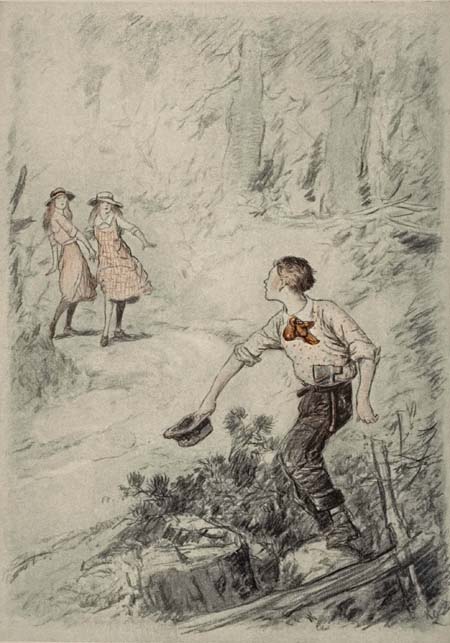
âThere was Dick, waving his hand tauntinglyââpage 18
THE
OLD MINEâS SECRET
BY
EDNA TURPIN
AUTHOR OF âHONEY SWEET,â âPEGGY OF
ROUNDABOUT LANE,â âTREASURE
MOUNTAIN,â ETC.
FRONTISPIECE BY
GEORGE WRIGHT
New York
THE MACMILLAN COMPANY
1921
All rights reserved
PRINTED IN THE UNITED STATES OF AMERICA
Copyright, 1921,
By THE MACMILLAN COMPANY.
Set up and electrotyped. Published September, 1921.
Press of
J. J. Little & Ives Company
New York, U. S. A.
TO
REBECCA BROCKENBROUGH
AND
TERRY LEE ROBERTS
THE OLD MINEâS SECRET
CHAPTER I
âO-O-OH! oh me-e!â Dick made the sigh very sad and pitiful.
His father did not seem to hear it. He tilted his chair farther back, perched his feet on the porch railing, and unfolded his newspaper.
It was a mild April morning, and the Osborne family had drifted out on the porch,âMr. Osborne with his papers and Mrs. Osborne with her sewing; Sweet William was playing jackstraws with himself, Patsy sat on the steps with her back to the others, especially Dick, who, however, was pitying himself too much to notice her.
âI always get blamed for everything I do,â he said mournfully, âbut Davidâââ
ââHouse for War: Vote 373 to 50.ââ Mr. Osborne read the headline. âThat is the answer to the Presidentâs message four days ago. Now the Senateâââ
âFather! If youâll just let me off to-day, Iâll work from school-out till dark every day next week. I certainly will. Father, pleaseâââ
âRichard Randolph Osborne! You are to[2] work your assigned part of the garden to-day, to-day, without further pleas for postponement.â Mr. Osborneâs mild voice and red flabby face stiffened with determination. This was not the first week that Dick had neglected his garden task.
âYes, sir,â Dick answered meekly, wriggling a little. That was all he could doâwriggle a littleâbecause he was made into a sort of merman by having an old Persian shawl wrapped about him, from the waist down. âI think you might let me off,â he persisted in an undertone; âjust this one more time. If mother had patched my trousers last nightâif sheâd let me put on my Sundays nowâI could get that hateful old garden worked this morning. Iâve got something else to do to-day, something awfully important.â
âIâm sorry I forgot, son,â said his mother. âI certainly meant to mend them last night. I was reading, and forgot. I wish you had reminded me.â She took quicker stitches and her thread snarled so that she had to break it and begin again. âI am so sorry,â she repeated in the delicious voice that made her words seem as fresh and sweet as the red roses that fell from the mouth of the fairy-tale maiden.
Mrs. Osborne was a dear, sunny-hearted little woman with dark hair, irregular features, and a[3] vivid, eager face. She loved to read; indeed, she could no more resist a book than a toper could refuse a drink, but she was always so sorry and so ashamed when she neglected home duties that every one except the person who suffered from it forgave her freely.
Patsy, Dickâs twin sister, came now to her motherâs defense. âItâs your fault, Dick,â she said. âItâs all your own fault. If you had locked the bookcase door, it would have reminded her there was something to do. And then she would have thought of the trousers.â
âI forgot,â Dick confessed. That put him clearly in the wrong, and made him the crosser. He turned on his sister, growling: âWhat business is it of yours, miss? You please let my affairs alone and attend to your own. What are you doing, Patsy?â
He tried to wriggle near enough to see, but Patsy made a face at him and ran into the yard. Dick was such a tease! She was not going to tell him that she had decided to be a poet and was composing a wonderful ballad. How surprised he would be when it came out in the Atlantic or St. Nicholas, with her name in big black lettersâPocahontas Virginia Osborne, as it was in the family Bible. Or would she have a pen-name, like âMarion Harlandâ? If she could think of a[4] lovely original nameââ But perhaps she had better finish the poem first.
She perched herself in the swing and chewed her pencil and read over the four lines she had written:
She could not think of anything else to say, so she read that over again; and then again. While inspiration tarried, an interruption came. It took the shape of her small brother William with two of his followersâHop-o-hop, a lame duck that he had adopted when its hen mother pecked it and cast it off, and Scalawag, a sand-colored, bob-tailed stray dog that had adopted him.
âHey, Patsy! I think Iâll give you a kiss,â announced Sweet William, raising his fair, serious face to hers. âI think I might give you two kisses. You are so sweet. Patsy,â he went on coaxingly, âwouldnât you want to lend me a pencil? Just one little minute, to make you a picture of a horse.â
âOh, Sweet William, youâre such a nuisance!â said Patsy. âIâm awfully busy. How can I ever finish this, if you bother me?â
But she gave him pencil and paper, and sat[5] swinging back and forth, looking idly about the spacious yard where the budding oaks made lacelike shadows, on that April morning.
In the center of the yard was a great heap of bricks. That was the remains of Osborneâs Rest, the family mansion that had been burned in a raid during The War, as those southern Virginians called the War of Secession from which they dated everything. Since then, two generations of Osbornes had dwelt in The Roost, a cottage in one corner of the yard. It was now the home of Patsy, her father and mother, her two brothers, Dick and Sweet William, and a motherless cousin, David Spotswood.
The big front gate opened on The Street, the one thoroughfare of The Village. There were a church, a tavern, two shops, a dozen frame and brick dwellings set far back in spacious grounds, and the county Court-house in a square by itself. Behind the Court-house rambled The Back Way which had once expected to become a street, but remained always The Back Way with only a blacksmithâs shop, a basket-makerâs shed, and a few cabins on it.
A century and a half before, three royal-grant estates, Broad Acres and Larkland and Mattoax, cornered at a stone now on Court-house Green. These plantations had long ago been divided into[6] small farms; but in The Village still lived Wilsons and Mayos and Osbornes who counted as outsiders all whose grandfathers were not born in the neighborhood and the kinship.
While we have been looking about, Sweet William lay flat on the ground, holding his tongue between his teeth, to assist his artistic efforts.
âLook at my horse, Patsy!â he crowed, holding up the paper.
âHm-m! I donât call that much like a horse,â observed Patsy.
Sweet Williamâs face clouded, and then brightened. âTell you what!â he said. âItâll be a cow. Iâll kick out one hind leg and put a bucket here. Now! Sheâs spilt all the milk.â
Patsy laughed; and then one knew that she was pretty, seeing the merry crinkles around her twinkling hazel eyes, and the upward curve of her lips that brought out dimples on her freckled pink cheeks.
âI love you when you laugh, Patsy!â exclaimed Sweet William, hugging her knees. âYou may have my picture. And Iâll sit in the swing with you.â
âYou and Scalawag and Hop-o-hop may have the swing,â said Patsy. âIâm going in. Iâll finish my poem to-morrow. I want to find outâI think Dick has a secret.â
[7]She jumped out of the swing, gave Sweet Williamâs ear a âlove pinch,â and strolled back to the porch.
âDick,â she asked in an offhand way, âwhat are you going to do with that candle you got this morning?â
Dickâs gloom relaxed and he winked tantalizingly.
âYou wish you knew,â he said. âButâyouâllâneverâfindâout. Ah, ha-a-a!â
âDonât you tell, Mister Dick!â said Patsy. âI donât want you to tell. Iâd rather find out for myself. And I certainly will find out, sir. You just see if I donât.â
Mr. Osborne still had his nose in his day-old paper; news younger than that seldom, came to The Village. ââArmy plans call for a million men the first year.â That is a gigantic undertaking, Miranda, andââ
âIt certainly is,â she agreed placidly. âMayo, Black Mayo has bought some more pigeons; and Polly says heâll not tell what he paid for them, so she knows itâs some absurd sum that he canât afford.â
âYes.â Her husband agreed absently. âAnd a million men means not only men, but arms, equipment, food. Bless my life! Is that clock strikingâit canât be!âis it ten? And I here[8] instead of at the Court-house.â He got up and stuffed the newspaper and a Congressional Record in his pocket.
âWhat are you going to do, dear?â asked his wife.
âWe want to find out if the Board of Supervisors can appropriate money to send our Confederate veterans to the Reunion in June. There have been so many unusual expenses, bridges washed away and that smallpox quarantine, that funds are low. I hope they can raise the requisite amount.â
âOf course they will. They must,â Mrs. Osborne said quickly and positively. âWhy, the yearly reunionâseeing old comrades, being heroized, recalling the glorious pastâis the one bright spot in their gray old lives.â
âMr. Tavis and Capân Anderson were talking about the Reunion at the post office yesterday,â said Dick. âThey are just crazy about having it in Washington. Capân has never been there. But he was telling how near he and old Jube Early came to it, in â64.â
âWhat an experience it will be, taking peaceful possession in old age of the Capital they campaigned against when they were soldier boys, over fifty years ago!â said Mrs. Osborne. âCertainly[9] they must go. How many are there, Mayo?â
âNine in our district,â answered her husband. âLast year there were sixteen. Three have died, and four are bedridden.â
âAh! so few are left; so many have passed on.â Mrs. Osborne glanced through the open door at a portrait, her father in a colonelâs gray uniform. âOf course they must go, our nine old soldiers.â
âSure!â said Dick. âIf there isnât money enough, we boys can help raise it. Mr. Tavis says heâll pay me to plant corn, afternoons and Saturdays. I wasnât thinking about doing it. But our old Confeds mustnât miss their Reunion.â
âGood boy! thatâs the right spirit,â exclaimed Mrs. Osborne.
She adored the memory of her gallant father and of the Confederate cause to which he had devoted himself. The quiet, uneventful years had brought no new deep, inspiring interests to the little Southern community. Its love and loyalty clung to the past. To the children the Lost Cause was a tradition as heroic and romantic as the legends of Roland and Arthur; but it was a tradition linked to reality by the old gray-clad men who had fought with Lee and Jackson. As Jones and Tavis and Walthall, they were ordinary old[10] men, rather tiresome and absurd; but call them âConfederate veteransâ and they were transformed to heroes whom it was an honor to serve. Dick, shirking the work that meant food for his family, would toil gladly to send them to their Reunion.
âThey must have this, perhaps their lastââ
Mrs. Osborne paused, and her husband said: âWeâll manage it; weâll manage it somehow. If there is a deficit, we may be able to make it up by private subscription. Perhaps Iâll get a case next term of court, and can make a liberal contribution.â He laughed.
Mr. Osborneâcalled Red Mayo to distinguish him from a dark-haired cousin of the same name, called Black Mayoâwas a lawyer more by profession than by practice; there were not enough law crumbs in The Village, he said, to support a sparrow.
He strolled toward the Court-house while Mrs. Osborne took her last hurried stitches. Then she handed the patched trousers to her son, who rolled indoors and put them on. He went into the garden and gloomily eyed the neglected square where peas and potatoes and onions were merely green lines among crowding weeds.
âI certainly canât finish it this morning,â he growled. âThereâs too much to do.â
[11]âIf you work hard, you can finish by sundown,â said his cousin, David Spotswood, who was planting a row of beets on the other side of the garden.
âI canât work after dinner,â said Dick. âIâve got something else to do. I just canât finish it to-day.â
âYouâd better,â said Patsy, who had followed him into the garden. âWhen father says âRichardâ and shuts his mouthâso! he means business. Say, Dick! What were you getting that candle for? What are you going to do? Let us go with you, Anne Lewis and me, and Iâll help you here.â
âYou help!â Dick spoke in his most superior masculine manner. âGirls havenât any business in gardens. They ought to stay in the house and make bed-quilts. Theyâre too afraid of dirty hands and freckled faces.â
Patsy flared up and answered so quickly that her words stepped on one anotherâs heels. âThatâs mean and unfair! You know I hate gloves and bonnets, and I just wear them because mother makes me. But anyway, sir, I think theyâre nicer than great-grandmotherâs shawl for trousers.â
She went back up the boxwood-bordered walk.
[12]âIâll keep my eyes on you, Mr. Richard Randolph Osborne,â she said to herself. âWhere you go to-day, Iâll follow.â
Halfway up the long walk, she came upon Sweet William, sitting on the ground, holding a maple bough over his head.
âWonât you come to our picnic, Patsy?â he said. âMe and Scalawag are having a loverly picnic in the woods down by Tinkling Water.â
âNo, thank you,â said Patsy. âI want to see Anne Lewis about going somewhere after dinner.â
âWhere?â asked Sweet William.
âI donât knowâtill I find out,â laughed Patsy. âBut Anne and I will do that; we certainly will.â
âI wish Anne was staying here,â Sweet William said wistfully.
âSo do I,â agreed Patsy. âEaster holiday is too short to divide with Ruth. Oh! Iâll be so glad when itâs summer and Anne comes to stay a long time.â
âIt isnât ever a long time where Anne is,â said Sweet William. âIâm going with you to see her, Patsy, and Iâll have my picnic another day.â
They went off and left Dick raking and weeding and hoeing very diligently; but, working his[13] best, he had not half finished his task when the dinner bell rang. He surveyed the garden with a scowl.
âItâll take hours and hours to get it done,â he said. âAnd then it would be too late to go where Iâm going. Maybe I can work the potato patch after supper.â
âYou canât,â said David, who had a straightforward way of facing facts.
âOh! maybe I can,â said Dick, who had a picturesque way of evading them. âYou might help me. You might work on it awhile after dinner.â
âThank you! Iâve something else to do. Iâm going to harrow my corn acre. I want to plant it next week,â said David, who was a blue-ribbon member of the Boysâ Corn Club.
At the dinner table the boys were joined by Sweet William, Patsy, and Anne Lewis, a cousin who was spending her Easter holiday in The Village. The two girls watched Dick like hawks, and jumped up from the table as soon as he went out of the dining room. He hurried to the little upstairs room he shared with David that was called the âtumble-up roomâ because the steps were so steep. Presently he came down and showed off the things he was putting in his pocketsâa candle, a box of matches, and a ball of[14] stout twine. He sharpened his hatchet and fastened it to his belt.
âYah! You wish you knew what thatâs for,â he said, with a derisive face at Patsy and then at Anne.
He strutted across the yard toward the front gate, but he was not to march off in undisturbed triumph.
âDick! uh Dick!â called his mother. âRemember youâve your garden work to finish.â
âYesâm.â He scowled, then he said doggedly: âThereâs something else Iâve promised myself to do first.â
Anne and Patsy waited only to see that he turned up, not down, The Street; then they ran around The Back Way and came out just behind him at the church; there The Street turned to a road which led past the mill and on to Redville. Dick walked quickly, and the girls hurried after him; then he walked slowly, and they loitered so as to keep just behind him.
âWhere are you going?â he turned and challenged them.
âOh! we might go to the mill to see Cousin Giles, or to Larkland to look at Cousin Mayoâs new pigeons, or to Happy Acres,â answered Patsy.
[15]Dick strode on, and the girls trotted behind him, making amicable efforts at conversation.
âSteve Tavis has gone fishing with John and Baldie Eppes,â Anne remarked. âHe said we girls might go, too. But Patsy and I thought there might be somethingâsomething more fun to do.â
No answer.
Patsy made an effort. âDick,â she said, âI hope youâll finish your garden work to-day. Fatherâs tired of excuses and heâs made up his mind for punishing. But even if we do get home late, I can help you.â
Silence.
âItâs a mighty nice day,â Patsy went on pleadingly, âtoâto do outdoor things. You say yourself Iâm as good as a boy to have around. I wouldnât be in the way at all; and I could hold the candle for you.â
By this time they were at the mill where the Larkland road and the Happy Acres path turned from the highway. Dick kept to the main road and the girls followed. He stopped and faced them.
âYou said you were going to the mill, or Larkland, or Happy Acres. Trot along!â
âI said we might go there,â Patsy amended.[16] âOr we might goââmost anywhere. Do let us go with you; please, Dick.â
âWhere?â
âOh! wherever you are going. Weâll not tell.â
âYou certainly will not,â he declared; âfor a mighty good reason: you are not going to know anything to tell.â
Patsyâs eyes flashed. âWeâll show you,â she said. âWe are going to follow you, like your shadow. You know good and well I can run as fast as you. Now take your choice, sir; let us go with you, or give up and toddle home and finish your task so as not to get punished.â
âHm!â he jeered. âIf Iâve got something on hand good enough to take punishment for, itâs too good to spoil with girls tagging along.â
He walked briskly up the road. Anne and Patsy followed him for a silent mileâup and down hills scarred with red gulleys, through woods, by brown plowed fields and green grain land. They passed several log cabins; the Spencer place, an old mansion amid tumbled-down out-buildings; Gordan Jonesâs trim new house gay with gables and fresh paint. Then they came to an old farmhouse surrounded by neglected fields.
âWhy, that doorâs open!â Anne remarked with surprise. âIs somebody living at the old Tolliver place?â
[17]âA new man; Mr. Smith. He came here last winter,â explained Patsy.
âSomebody new in the neighborhood!â laughed Anne. âDoesnât that seem queer? What sort of folks are they?â
âUm-mm; unfolksy,â said Patsy. âThereâs just Mr. Smith, and his nephew Albert that goes to our school. Weâve never got acquainted with Albert. Heâs sort of stand-offish; not as if he wanted to be, but as if he were afraid.â
âAfraid of what?â asked Anne.
âOh! I donât know. Nothing. I reckon heâs just shy.â
âWhat sort of man is Mr. Smith?â inquired Anne.
âUgly; and grins. Heâs away from home most of the time. Heâs a salesman or agent of some kind. Dick,â Patsy returned to a more interesting subject, âdo please tell us what you are going to do.â
âWe-ell,â Dick began as if he were about to yield reluctantly; then he interrupted himself eagerly: âOh! look at that squirrel!â
Their eyes followed his pointing finger, and crying, âEasy marks!â he darted into a dense thicket of pines on the other side of the road. The girls followed quickly, but he made good use of his momentâs start and they caught only[18] glimpses of him here and there behind the trees.
âRun, Anne!â Patsy called presently. âTo the left. Here! Letâs head him off!â
They ran around a thick clump of pines to meet himâand he was not there. He did not seem to be anywhere. He had vanished as completely as if the earth had opened and swallowed him.
âWe may as well give up,â Anne sighed at last.
âYes,â Patsy agreed reluctantly. âI reckon heâs miles away by this time.â
Crestfallen and disappointed, they went back to the road and started slowly down the hill.
Then a red-brown head rose out of a heap of pine brush, so cautiously that it did not disturb the woodpecker drumming on a nearby stump. A pair of merry brown eyes watched the girls till they were at a safe distance; then Dick, to the terror and hasty flight of the woodpecker, scrambled out of the brush heap.
âCock-a-doodle-doo-oo-oo!â he called deridingly.
Anne and Patsy started and looked back.
âThere he is!â groaned Patsy.
Yes, there he was, standing in the middle of the road, waving his hand tauntingly.
âShall we chase him again?â asked Anne.
[19]âYes,â said Patsy; and then: âNo, itâs no use. Heâs too far away; before we could get halfway up the hill, heâd be out of sight again.â
âOh, well!â laughed Anne. âWe donât care, Patsy-pet. Letâs go to Happy Acres and see what flowers are in bloom.â
They went back to Larkland mill that had been a mill ever since The Village had been a village; crossed a foot bridge over Tinkling Water; and followed the path to the woodland nook they called Happy Acres. Long ago a house had been there, and persistent garden bulbs and shrubs gave beauty and fragrance to the place. One spring, Anne had adopted it and christened it Happy Acres, and she and her friends had made it a little woodland park that was a joy to all the neighborhood. It was fragrant now with a blossoming plum-tree and gay with the pink and scarlet of flowering almond and japonica.
Anne and Patsy plucked a few sprays to carry home the beauty of it, and started down the path for a little visit to their cousin, Giles Spotswood, the miller.
Patsy, who was in front, stopped suddenly. âWhatâs that?â she whispered.
âIt sounds like men quarreling,â Anne whispered back. âWho on earthââ
âLook there!â
[20]Anne crept to Patsyâs side and peeped through the bushes. There were two men on the roadside. One was their cousin, Black Mayo Osborne.
âWhoâs that man?â asked Anne.
âMr. Smith; the new man at the Tolliver place.â
âUgh! heâs horrid! snarling like a spiteful cur dog!â exclaimed Anne.
The stranger was indeed odd and unpleasant-looking. He had long loose-jointed limbs and such a short body that it seemed as if its only function was to hold his head and limbs together. The two sides of his blond face were quite unlike. The left side was handsome with its straight brow and wide blue eye; but the right eye, half hidden by its drooping lid, slanted outward and down, the tip of the nose turned toward the bulging right nostril, and the mouth drooped at the right corner and ended in a heavy downward line.
âEasy! go easy, my German friend!â Black Mayoâs voice rang out clear and mocking.
âI am not a German; that am I not!â screamed Smith. âI am an American citizen. I can my papers show. I am more American than you. What are your peoples here? Ach! what do they? This morning they did the last cent out of their[21] treasury take, the expenses of old traitors and rebels to payââ
The sentence was not finished. A quick blow from the shoulder stretched him on the ground.
âHey! lie there a minute!â cried Black Mayo, with an impish light twinkling in his dark eyes. âListen! Hereâs a tune youâve got to respect in this part of the world.â He whistled âDixieâ with vim and vigor, over and over again. Then he stepped aside and held out his hand, saying: âAh, well! You didnât know any better. Forget it!â
The man glared up at him, without a word.
âOh! if thatâs the way you feel about itââ Mr. Osborne laughed, shrugged his shoulders, and, still whistling âDixie,â took the road that led to his home at Larkland.
Mr. Smith scrambled to his feet and looked after Black Mayo, from under down-drawn brows, with his thin wide lips writhing like serpents; then he went limping up the road.
The girls turned white amazed faces to each other.
âUgh!â said Patsy. âLetâs go home. Doâdo you reckon heâll hurt Cousin Mayo?â
âOf course not. He canât. How can he?â said Anne. After a pause she added: âHe certainly will if he can.â
CHAPTER II
EXULTING at the way he had diddled the girls, Dick pranced along the Redville road. He did not meet any one, for it was a fair spring day and the country people were busy; but he saw men and boys he knew, plowing and grubbing, hallooing to their teams and to one another.
About two miles from The Village, Dick turned off on the Old Plank Road. Twenty years before, this had been a highway going through The Village, on its long way to Richmond. Then the railroad was built. It wanted to come through The Village, between court-house and church, but the people rose up in arms. They did not want shrieking, grinding trains, to scare horses and bring in outsiders, nor an iron track parting their homes from their graves in the churchyard. So the railroad went by Redville that was six miles from The Village in summer and three or four times as far in the winter season of ruts and red mud.
After the railway was built, however, the road by Redville station became the thoroughfare;[23] the Old Plank Road was seldom traveled except by negroes who lived in clearings in the Big Woods that covered miles of the rocky, infertile ridge land.
Dick was near one of these clearings, a patch of stumpy land around a log cabin, when he heard a voice calling loudly, âWhoa! Gee! Whoa, I say!â
An old negro was coming up the hill, in a cart drawn by bony, long-horned oxen.
âHey, Uncâ Isham!â said Dick. âWhat are you making such a racket for?â
Isham Baskerfield jumped nervously; but when he recognized the speaker, he grinned and said: âHowdy, little marster! howdy! I was jest talkinâ to my oxes. I tuk âem down to de creek to gin âem some water.â
âYou sounded scared,â commented Dick. âAnd you looked scared, too.â
âSkeered? Course I aint skeered. Huccome I be skeered?â Isham replied loudly. Then he mumbled: âI aint nuver liked to go down dis road since dat old manâWhar you gwine, Marse Dick?â he interrupted himself. âDonât you fool âround dat lowermosâ cabin. Datâsââhe breathed the name in a whisperââSolomon Gabeâs house, dat is. Anâ he can shore cunjer folks.â
[24]Dick laughed. âSo thatâs what you are afraid of. Youââ
âShâsh, little marster!â The old negro looked around, as if afraid of being overheard. He stopped his oxcart in front of his cabin. âI got to git my meal bag,â he said. âLily Belle emptied it to make a hoecake for dinner, so I got to go to mill anâ git some corn ground âfore supper time. I donât worry âbout nothinâ long as my meal bag can stanâ up for itself, but when it lays down I got to stir about. What you doinâ, Marse Dick, strayinâ so fur from home?â
âOh! Iâm just strolling âround,â Dick answered vaguely.
âUmph! When I fust see you, I thought you mought be gwine fishinâ; but you aint got no fishinâ pole.â
âNo use to carry a pole in the woods, when youâve got a knife,â said Dick. âWhere is a good place to go?â
âUh! any oâ dem holes in Mine Creek below de ford,â said the old man; âtaint good fishinâ âbove thar.â
âO. K.!â said Dick. âIf I catch more fish than I can carry, Iâll leave you what I canât tote home.â
âYas, suh; yas, suh! I reckon you will,â chuckled the old negro.
Dick went on down the road. But his merry[25] whistle died on his lips as he passed Solomon Gabeâs cabin.
It stood, like a dark, poisonous fungus, under low-branching evergreens in a dank, somber hollow a little away from the road. The squat old log hovel had not even a window; the door stood open, not hospitably, but like the yawning mouth of a pit.
Dick ran on down the road and came presently to Mine Creek, a little stream straggling along a rocky, weed-fringed bed. Near the ford, there was a pile of rotting logs and fallen stones that had once been a cabin. He left the road here, but he did not take Ishamâs advice and go down Mine Creek. Instead, he went up stream, following a vague old path that presently crossed the creek and climbed a little hill. There was a small enclosure fenced in with rotting rails. In and around the enclosure were piles of earth and broken stones of such ancient date that saplings and even trees were growing on them.
Dick paused on the hilltop and looked around cautiously. No one was in sight; and all was still except for the chatter of squirrels and the drumming of woodpeckers. He jumped over the old fence and advanced to the edge of a well-like opening. Again he stopped and looked around. Then he took out of his pocket a ball of string.[26] He tied a stone to one end of it; dropped the stone into the hole; played out his line until it rested on the bottom; and tied a knot in the string at the ground level.
Then he went into the woods and cut down a hickory sapling; he measured it with his line and cut it off at the top; and trimmed the branches, leaving stout prongs at intervals of about eighteen inches. Every now and then, he stopped and looked about, to make sure that he was not observed. After nearly an hourâs work, he finished an improvised ladder which he carried to the hole and slid over the edge. Then with a final sharp lookout, he descended.
He found himself in a pit about ten feet in diameter, heaped knee-deep with twigs and leaves swept there by winds of many winters. At one side there was an opening four feet wide and five or six feet high, the mouth of a tunnel that was roofed with logs supported on the sides by stout rough timbers.
Dick lighted his candle and started down this tunnel. But after a few steps he turned back, set down his candle, and pulled his ladder into the hole.
âNow,â he said. âAnybodyâs welcome to look in here. I reckon theyâll not find little Dick.â
[27]He picked up his candle and went along the tunnel. Now and then it dropped down abruptly, but there were timbers and old ladders that made the way passable. At last the tunnel broadened into a room about thirty feet square and high enough to stand upright in. This room also was roofed with logs and poles propped by stout timbers of white oak. Here and there were heaps of earth and stones and piles of rotting timbers; on the left side there was another tunnel.
Dick hesitated a minute, then he muttered: âI reckon Iâll find it here. But Iâll look around first.â
He followed the lower tunnel. It, too, slanted downward, but it was longer than the upper one and had several short spurs. It ended in a pit a dozen feet deep, that had an old ladder in it. Dick climbed down and looked around, then he went back to the main room and began examining the clay and stone between the supporting timbers.
âIt certainly seems as if they would have left some,â he said earnestly to himself. âI ought to see little bits sparkling somewhere. If they were ever so little, they would show me where to work.â
His tour of investigation brought him at last to a corner where there was a heap of earth and[28] stones. He scrambled on top of the mound,âand, in a twinkling, he landed at the bottom of a hole.
For a minute he was stunned. Then he staggered to his feet, lighted the candle which had been extinguished in his fall, and looked around. He had fallen into a pit ten or twelve feet deepâprobably an opening of the mine that had been abandoned with the failure of a vein that was being followed. The place had been covered with a layer of logs and poles on top of which earth and stones had been thrown. The rotting timbersâhow many years they had been there!âhad given way under his weight.
How was he to get out? The walls of the pit, stone in one place and clay on the other sides, were steep, almost perpendicular.
After considering awhile, he set his candle on a projecting rock, took out his knife, and dug some crannies for finger-holds and toe-holds, to serve as a ladder. But when he put his weight in them and tried to climb up, the clay slipped under his feet and he slid back. He made the holes larger and deeper, but after he mounted two or three steps he slid back again; and again; and again. At last he gave up this plan. Anyway, if he could climb to the top, how could he get out? He had crashed through the middle of[29] the pit, and the broken downward-slanting poles barred the sides.
Must he stay here and wait for help to come? Help? What help? No one knew where he was. Oh! how he regretted now his careful plans to put every one off the trail. Anne and Patsy could only say that they had last seen him on the main road to Redville. And Isham thought he had gone down Mine Creek.
If only he had left the ladder in place, there would be a chance that when they missed him and made search, they would look in the mine. But he had taken that chance away from himself by pulling the ladder into the pit.
He must dig his way out. He must! There was no other way of escape. He selected a place that seemed free from rocks, and began to hack at the wall. He toiled till his arms ached and his hands were sore and blistered. It was a slow and painful task, but he was making progress. He piled up loose rocks and stood on tiptoe, so as to reach higher on the wall. In spite of his weariness and his tormented hands, his spirits rose.
âA tight place like this is lots of funâafter you get out. Wonât Dave and Steve pop their eyes when I tell âem about it?â
He laughed and, with renewed vigor, drove his[30] knife into the hard clay. There was a sharp scratch and a snap. Something fell, click! on a stone. It was his knife blade, broken against a rock that extended shelf-like above him, and formed an impassable barrier. All these hours of work and pain were wasted. He must begin again and dig out in another place; or try to, and perhaps run against rock again. And with this broken knife!
He groaned and looked around.
âO-oh!â he gave a sharp, startled cry. His candle! Only an inch of it was left. Oh! he must get out! How terrible it would be here in the pitch-black, shut-in dark!
He seized a broken bit of timber for a makeshift spade, and gave a hurried stroke. Alas! The old timber snapped in two, bruising and cutting his hands cruelly. He threw aside the useless fragment and then, as if he had lost the power of motion, he stood staring at his bit of candle that shortened with every passing second.
He pulled himself together. He must view every foot, every inch of the pit, so that he could work to purpose in the dark, not just dig, dig, dig, and get nowhere. He scrutinized the wall, noting every angle and projection; then he looked up, and studied the position of every log, every[31] broken pole. For the first time, he observed a log that did not extend across the pit; its end was about two feet from the wall. Ah! perhaps, perhapsâ
He jerked the string out of his pocket, made a slip noose, and threw it at the end of the log; the noose fell short. He threw it again; and again it went aside. The next time, it caught a broken pole, and to get it off he had to poke and push with a piece of timber for two or three minutesâminutes that seemed hours as he glanced fearfully at the flickering candle. He threw the noose again; and at last it went over the log. He tried to pull it along. He wanted to get it near the middle, free of the broken poles, and pull himself up by it, ifâoh! how he prayed it was!âstout enough to bear his weight; but now it was fast on a knot and he could not move it.
He glanced at the candle. It was a mere bit of wick in a gob of grease; every flicker threatened to be its last. He could not wait any longer! he must do something! something! He would pull himself up to the end of the log and try to break through the poles.
As he pulled, the log began to move. Ah! If he could pull the end into the pit, it would be a bridge to climb out on. He jerked with all his might, and it moved, slid, slipped downward;[32] the end caught against a projecting rock about four feet from the top; there it held fast.
The candle flame flared and dropped andâno, it was not out; not yet.
Dick jumped up and caught hold of the log. The movement fanned the failing light; it spurted and went out. No matter now! He had firm hold of the log. He scrambled up on it and managed presently to push and pull himself between the broken poles. At last, at last, thank Heaven! he was out of that awful pit.
He staggered along, feeling his way by the wall, making one ascent after another, until a light glimmered before him and he reached the entrance well. He raised his ladder and climbed out. Then his strength gave way. He dropped down on a pile of leaves at the mine entrance, and lay there, gazing blankly at the blue sky shining beyond the fretwork of budding branches.
Suddenly he began to laugh. He sat up and slapped his knees. âIâll pass it on to them,â he said. âIâll cover up that hole, and Iâll take Dave and Steve thereâafter I find itâand let them tumble in without a light. Then Iâll go off and pretend I donât hear them, andâoh! Iâll let them stay there long enough for them to think, to[33] feelââ His face was suddenly solemn. âI might have stayed there and died. Died!â
He got up and dragged the ladder out, and hid it under the leaves piled against the fence.
âI reckon I ought not to expect to find it right away,â he sighed. âIâve got to keep on looking and looking and looking. And I say I will! But I need some real tools. A knife, specially a broken one, isnât much force for mining.â
He went toward home, but he was in no hurry to complete the journey at the end of which were his unfinished task and his father. Instead of going down The Street, he took The Back Way behind the Court-house, and slipped around the corner of the blacksmith shop.
Mr. Mallett, the blacksmith, with only his corncob pipe for company, was sitting in a chair tilted against the door jamb of the grimy log cabin. He was a vivacious little man with blue eyes and dark hair, and a face that would have been sallow if it had been visible under the grime. All the Village boys liked to loaf at his shop, but Dick had now a special reason for visiting him.
âMr. Mallettââ Dick began.
The smith started. âYou young imp!â he exclaimed. âWhat do you mean by jumping at me, sudden as a jack-in-the-box? I wasnât thinking âbout youâand here you are, close enough to[34] hear my very thoughts. I never see such a boy. Why, whatâs the matter with your face?â
âI fell down. It got scratched,â Dick explained briefly. âMr. Mallett, I was thinking about the Old Sterling Mine, near your great-grandfatherâs shop. Do you reckon it was silver, real silver, he got there?â
âDo I reckon? No, I donât! I know it, sure and certain as Iâm setting here in this chair, smoking my corncob pipe. Aint I heard my father tell time and again what his granddad told him? Why, my father could remember him good. He was a little quick man with blue eyes and black hairâwe all get our favor from him. He never did learn to talk like folks over here; he always mixed his words and gave âem curious-sounding twists. He come from France, one of Lafayetteâs soldiers he was.â
âWhy didnât he go back with Lafayette?â asked Dick. âI should think heâd have been lonesome here, away from his own home and folks.â
âCertainly he was lonesome,â said Mr. Mallett. âMy father said, when he was old and child-like, heâd set in the corner, jabbering French by the hour, with tears dripping down his face.â
âI donât see why he stayed here,â persisted Dick.
âHe just stayed and kept staying,â said the[35] smith. âMaybe that old silver mine had something to do with it. He was always expecting to get out a fortune. He come with the Frenchers to chase Cornwallis, and they stopped here, two or three days, to mend shoes and get victuals.
âThe old Mr. Osborne that owned Larkland in them days see what a good blacksmith my great-grandad was, and told him when the war was over to come back here and he should have a home. So he did, and the squire helped him get some of the old glebe land, and he married Mr. Osborneâs overseerâs daughter. He had a smithy on the Old Plank Road by Mine Creek. I reckon you know the place.â
Dick nodded. He did not say he had been there that very afternoon.
âAnd he found silver on that hill. My grand-daddy used to tell us children about seeing his father getting silver out of the ground and beating it on his anvil with his sledge hammer. And Black Mayo thatâs always finding out something âbout everything, he found them old reecord papers.â
âAnd they proved about the silver mine?â asked Dick.
âCertainly they did,â asserted Mr. Mallett. âWould folks try a man in law court for making money out of silver he didnât have? Great-granddad[36] didnât deny making of it. He just said he wasnât making no false coins. He was hammering out sterling pure silver. Thatâs why they call it the Sterling Mine. And he was making pieces like Spanish six shilling piecesâour folks counted money by shillings in them daysâand was giving them, in place of what they called alloy; he was giving better and purer money than the law. And what could folks say to that? Why, nothing; for it was the truth.â
âAnd so they didnât punish him?â asked Dick.
âPunish him? What for? For doing better than the law of the land? No, sirree!â
âI donât reckon he got out all the silver,â said Dick, more to himself than to Mr. Mallett.
âCourse not! Some was got out in my fatherâs day, by the Mr. Mayo that owned the land before The War.â
âHow did they get it out?â asked Dick.
âDug it out with tools, of course. Aint there the old picks and sledges and things, setting there in that shed, that my father made for them? And Mr. Mayoââ
âAre theyââ
Dick tried to interrupt, but Mr. Mallett went on with what he had to say: âHe aint made much out of it. They say it was what they call âfree silverâ, and great-granddad chanced to[37] strike where it was rich. It petered out, and silver was so scarce and the rock so hard it didnât pay to work the mine. Some folks say that. There was a tale that the manager wasnât trying to make it pay; he wanted to get the mine for himself. He tried to buy it. But he didnât. He died. Anyway, The War came, and âtwasnât worked any more.â
âYes.â Dick accepted the fact that The War ended everything, even the worth of the silver mine. âIt does seem, if it was real silver, we could see it there now,â he said thoughtfully.
âShucks!â Mr. Mallett got up and knocked the ashes out of his pipe. âCourse they took out all in sight. Folks would have to dig for any more they got.â
âAnd the tools; will youââ Dick checked himself. If he asked for the tools now, Mr. Mallett would guess what he was planning to do and somehow all The Village would know before sunset. He must wait and manage to get them, without betraying his purpose.
Mr. Mallett was looking at the westering sun. âFayett ought to be home,â he said. âHe went to Redville, and he was to be back in time to help me with a little work.â
âFayett!â exclaimed Dick. âWhy, I didnât know he came home for Easter.â
[38]âYes,â said Mr. Mallett. âHeâs mighty stirred up âbout this war. What have we got to do with Europeâs war that started with the killing of a little prince in a country Iâd never heard tell of? But Fayettâs got a notion in his headâ Here! Iâve got to fix some rivets. Donât you want to blow the bellows?â
âI wish I had time,â said Dick. âIâve got to go home. IâI havenât finished my garden work.â
âThen I reckon youâll save it for another day,â said the smith. âSunâs âmost down.â
Its long rays lay like a red-gold band across The Street, as Dick started home, wishingâtoo late!âthat he had finished his garden task and postponed his adventuring to another day. Seeing his father on the porch, the truant slipped behind the boxwood at the edge of the walk. But Mr. Osborne called, âDick!â and then more sternly, âRichard!â
It was useless to pretend not to hear.
âSir!â Dick answered meekly.
âHave you completed your garden work?â
âNotânot quite, sir,â said Dick. âI am just going to it now, sir. I can get a lot done before dark. And Iâll get up soon Monday morning, and finish it, sir, indeed I will.â
âMy son,ââ Mr. Osborne spoke in a magisterial voice and took Dick by the arm.
[39]Just then the front gate clicked, and Black Mayo came up the walk.
âWar has been declared,â he said without a word of greeting. âWar! The United States has declared war with Germany.â
Red Mayo dropped Dickâs arm. âHowâd you hear?â
âI met Fayett Mallett coming from Redville. Heâd heard the news, if we can call it news. We knew it was coming.â
âOf course; it was inevitable. We knew that the minute we read the Presidentâs War Message. He held off as long as he could.â
âYes. Now the War Resolution has passed Congress and the President has signed it.â
Dick stood listening a minute, then slipped indoors just as his mother came out.
âWhat are you talking about?â she asked. âWhat is the matter?â
âWar!â said her husband. âThe United States is in the War, Miranda.â
Sweet William was at his motherâs elbow. He spoke in a puzzled little voice. âI thought The War was done. I thought the Confedacy was overrun.â
âThis is another war, son,â laughed Mr. Osborne. âThis is war with Germany.â
CHAPTER III
JUST then Emma came to the door. Emma was the Osbornesâ old servant, brown and plump as one of her own baked apple dumplings, and as much a part of the family as the tall clock in âthe chamber.â
âSupper is ready, Miss Mâranda, anâ you-all come right away, pleaseâm,â she said. âDe muffins is light as a feather. Come on anâ butter âem. If you-all will live on corn bread, pleaseâm eat it hot.â
âPoor Emma!â laughed Mrs. Osborne. âShe cannot reconcile herself to our food program.â
âI tell Emma âbout the Belgians,â complained Sweet William. âBut she says âthem folks is too far off for her to bother âbout; corn bread donât set good on her stomach; and sheâs going to eat what she likes, long as she can get it.â And, mother, she has light bread and hot biscuits for herself every day, andââ
âSh-sh, son boy!â said Mrs. Osborne. âEmma doesnât know any better, and we do. Come, Mayo, and Mayo. Come to the hot corn muffins!â
[41]âI ought to go home,â said Black Mayo. âPollyâll be expecting me.â
âIndeed she will not,â said Mrs. Osborne. âPolly never expects you till she sees you coming in the gate. How is she, and how are your pigeons? I understand they are a part of your family now. Of course youâll stay to supper, Mayo. Patsy, tell Emma to put another plate on the table.â
A visit from their Cousin Mayo, always a delight, was now especially welcome to Dick because it postponed, perhaps prevented, a disagreeable interview with his father. He slipped to his place and quietly devoted himself to the hot muffins, cold ham, and damson preserves.
âWhy, Dick! What have you done to your face?â asked his mother.
âNothing. It got scratched,â he mumbled, glancing at his father.
But Mr. Osborne was not thinking of the garden; he was about to present to his family an amazing piece of news. He prepared for it by an impressive âAhem!â with his eyes fixed on Black Mayo.
âA client came to my office to-day,â he said solemnly.
âReally, Mayo!â exclaimed his wife.
âWhat is a client?â asked Sweet William.
[42]âWho disturbed the hoary dust of your sanctum?â asked Black Mayo.
âWell may you inquire!â said the Village lawyer. âYou are responsible for his coming.â
âI?â There was a look of blank astonishment, followed by a peal of laughter. âYou donât mean to say that scoundrel Smithââ
âYes. He wants to take action against you for assault and battery.â
âWhat is a client?â Sweet William asked again.
âWhat in the world are you talking about?â inquired Mrs. Osborne.
âOh, I reckon I know.â Patsy eagerly aired her knowledge. âThat Smith, the new man at the Tolliver place, quarreled with Cousin Mayo, and Cousin Mayo knocked him down. We saw it, Anne and I.â
âOh, Princess Pocahontas! Are you and Lady Anne taking the witness stand against me?â Black Mayo said in mock reproach. âWell, itâs true.â
Mrs. Osborne gave a little exclamation of horror. âOh, Mayo!â she said, frowning at her husband. âIâve begged you not to let outside people buy land around here. And now Mayoâs had to knock one of them down.â
âBut, Miranda dear, when a man sells his farm[43] and the purchaser comes to get me to look up the titleââ
âYou just ought to tell him we donât want him here,â said Mrs. Osborne. âWhat is the use of being a lawyer if you canât put some law on outsiders to keep them from spoiling The Village?â
The two men laughed.
Then Black Mayo said: âI suppose he told you about it, Mayo. The âI saidsâ and âhe saidsâ?â
âYes; oh, yes!â
âHâm! I hope youâll make him pay you a good fat fee for the case.â
âFee!â Red Mayo stared in amazement. âAssuredly you donât think Iâd accept his dirty money! Case! I informed him he had none.â
âBut I did knock him down.â
âOf course you did. When he repeated what he said, Iâd have knocked him down myself, if he hadnât been in my own office. I told him if The Village heard such talk, heâd be tarred and feathered and drummed out of the community. Then I ordered him out of my office.â
âAnd that is how you treat your rara avis, a client!â said Black Mayo.
âWhat is a client?â repeated Sweet William, whose questions were always answered because he never stopped asking till they were.
âA client, young man, is the golden-egg goose[44] that a lawyer tries to lure into his coop,â Black Mayo explained. âOne fluttered to your father and he shooed it away.â
âI wish I had a goose that laid gold eggs,â said Sweet William. âI wouldnât kill it, like the silly man in that story.â
âPerhaps I can find one and trade it to you for Hop-o-hop,â suggested his cousin.
Sweet William considered and shook his head. âHop-o-hop couldnât get on without me,â he said gravely.
âAh, itâs a family failing,â laughed Black Mayo, as they left the table. âNone of you is willing to pay the price for the goose.â
The evening was so mild that they settled themselves again on the porch. The men resumed their discussion of the war; David pored over a bulletin about corn; Dick snuggled down in a corner with âThe Days of Bruceâ; Anne and Patsy brought out their Red Cross knitting, and whispered and giggled together. Sweet William put a stool beside his motherâs chair and cuddled against her knee, with Scalawag at his feet.
Mrs. Osborne left the discussion of public affairs to the menfolks. She was intent on her own task, the making out of a program for the Village Literary Society. What pleasant meetings they would have, reading about the Plantagenet kings,[45] supplementing Humeâs history with Waverley novels and Shakespeare plays. She smiled and folded her paper.
As the twilight deepened, Dick shut his book and grinned at the girls.
âToo bad not to have your company on my walk to-day, after you promised it, too!â
âOh! we thought of a nicer place to go, where we wouldnât scratch our faces,â said Anne.
âWeâll go with you some day, after you tear down all the barbed wire and briers,â said Patsy.
âI dare you!â Dick defied them.
âYou say that because you know Iâm going away so soon,â said Anne.
âYouâre coming back in June. I dare and double dare you for then,â replied Dick. âIâll be going to this placeâoh! right along.â
âAll right,â said Anne. âWeâll follow you; see if we donât. Weâll not take a dare; will we, Patsy-pet?â
Their bickering was interrupted by the approach of guests. Three men strolled across the yardâGiles Spotswood, the cousin from the mill; Will Blair, another cousin, who kept the Village post office; and old Mr. Tavis, a villager outside the cousinship.
âWe saw Black Mayo here, and we dropped in to talk over the news,â said Mr. Blair. âGiles[46] says Fayett Mallett heard at Redville that the United States has declared war. Thatâs what comes of sinking American ships; eh, Mayo?â
âYes,â answered Black Mayo; âthe German sinking of American ships was the overt act which brought on this war, just as the Stamp Tax brought on the Revolution. But at bottom, in both cases, the real cause is the same: itâs a fight against a despotic government for liberty and human rights.â
âItâs strange the Germans kept up submarine fighting after the United Statesâ protests,â said Mr. Blair; âgetting another powerful enemy.â
âI reckon they count on winning the war with U-boats before the United States gets over there with both feet,â answered Black Mayo. âBut Iâll bet on the British Navy; itâs saved the Allies so far.â
âYou said the Belgians saved them by that ten days of defense that gave the French and British time to come,â said David.
âYou told me the French saved them by driving the Germans back at the battle of the Marne,â said Dick.
âOh! but you said the stubborn retreat of that first little British army was a real victory that made possible the Marne victory,â Patsy reminded him.
[47]âWell, well! a good deal of saving is necessary; and maybe the old United States will jump in and do the final saving.â
âThe French and British are pushing forward now,â said Mr. Blair. âYesterdayâs paper saysâââ
The men discussed the war news in an interested but remote way, just as they had discussed plagues in India, famines in China, the Boer War. Their sympathies were as wide as humanity; but, after all, these things did not touch them, really and personally, as did the death of Joe Spencerâs little daughter or the burning of a negro cabin with a baby in it. No one said âweâ about the war; it was always âthey.â
âWhat do you reckon they will do?â asked Mr. Spotswood. âWill they send an army over, do you think?â
âOh, no!â Red Mayo answered confidently. âThe war will be over before they could send men abroad, even if they had a trained army ready to start. Theyâll lend the Allies money; theyâll give someâlarge amounts, millions, no doubt. And theyâll supply food and munitions; they must hustle around and get ships.â
âThe main job will be to get the food to send,â said Mr. Spotswood. âThereâs an alarming[48] shortage of grain. I never saw it so scarce and high, since Iâve been milling. The first war work is the farmersâ, to raise a bumper crop.â
âThen Iâm in war work, father,â said David. âIâm going to beat the record on my corn acre this year.â
Dick laughed. âA poor war worker! Not even a one-horse farmer, just a one-acre boy!â
âMy one-acre boy multiplied by hundreds of thousands makes the Boysâ Corn Club a big thing,â said Mr. Spotswood. âWhy arenât you in it, Dick?â
âIâve got something better to do,â said Dick, confidently and mysteriously.
âIsnât it strange the Germans donât see they are beaten?â said Mr. Blair.
âMan, man! What are you talking about?â Black Mayo exclaimed. âBeaten? In three years of war, German soil has been trampled by enemy feet only once, those few days in that first August when the French invaded Alsace. I fear thereâs a hard struggle and dark days ahead.â
This speech amazed every one.
âWhy, Cousin Mayo! Canât the United States whip the world?â exclaimed David.
âArenât most of the nations against Germany?â asked Dick.
âOh, yes! A score of nations are united[49] against Germany and her sister autocracies, Austria-Hungary and Turkey and Bulgaria.â
âIs Germany so much the best fighter?â David wanted to know.
âNo! But she has the inside lines, and she was ready for war. For nearly forty years she was preparing for âthe day,â while the rest of the world was busy with works of peace.â
âDidnât the other countries have armies and navies, too?â David persisted.
âNo country ever built up such a perfect war machine as Germany,â said Mr. Osborne. âEvery point was prepared. Optical and dye experts produced an inconspicuous gray-green uniform; engineers constructed the Kiel Canal and a network of railroads leading to Belgium and France; scientists captured nitrogen from the air for explosives and fertilizers, and devised Zeppelins, huge guns, submarines, and poison gas; experts made war plans; officers were drilled to carry them out with soldiers trained by years of service. And the minds of people were preparedâabroad by propaganda, and at home by patriotic-sounding talk about âthe seas must be freeâ and âwe demand our place in the sun.â Even Kunoâââ He paused and then said to himself, âI wonder where Kuno is!â
âKuno?â said Red Mayo, questioningly.
[50]âKuno Kleist, a German friend of mine with whom I tramped through Mexico. He was coming home with me, but he had news that his mother was ill, so he went back to Germany. Such a clever, merry, kind-hearted fellow he was; confident that the eternal jubilee of peace and brotherhood was at hand, âmade in Germany,â by his Socialist brethren.â
Mr. Blair laughed. âNow we are seeing what is really âmade in Germanyâ by your friend Kuno Kleist and the others.â
Black Mayo shook his head. âNot Kuno, not the will and heart of him. They may have his bodyâI hope not, I hope notâas a cog in this terrible military machine, crushing helpless nations and people with its awful policy of frightfulness.â
âThey ought all to be killed, them German scoundrels ought,â wheezed old Mr. Tavis. âThey ought to be treated like they treat the Belgians and them other people Will Blair reads us about in his newspaper.â
âNo and no!â Black Mayo said emphatically; then he went on, looking not at Mr. Tavis, but at David and Dick: âThe worst thing that could happen to the world, to us, would be to be infected by the germ of hate.â
âBut the Germans do such mean things, Cousin Mayo. How can we not hate them?â Patsy[51] looked up with a frown. âFather read in the paper to-day that two more relief ships have been sunk, ships loaded with food for the starving Belgians.â
âAnd I gave all my money to buy it,â said Sweet William, indignantly. âIâm saving my sugar for the poor little Belgians. Do you reckon the Germansâll sink that, too?â
âRelief ships!â said David. âWhy, they sink hospital ships, with wounded soldiers and doctors and nurses; and ships with women and babies. Remember the Lusitania!â
âI think we ought to hate them,â said Anne.
âNo, dear, no,â said Black Mayo. âWe ought to fight fair and hard and without hate, for our own rights and the rights of all people, the Germans, too. Why, the German people had no voice in making this war. It was declared by the kaiser without consulting the Reichstag in which the people are represented.
âRemember, children, most wars are made by governments, against the wishes and interests of the people. War is a disaster, a scourge; war, more than famine, is the seven blasted ears of corn, the seven lean-fleshed kine, destroying the full and the well-favored. All the waste and woe of this World War will be worth while if they make people realize the horror and wickedness of war and put an end to it forever.â
[52]âYou are talking over their heads,â laughed Red Mayo.
âI am not sure of that,â said Black Mayo, looking at Davidâs thoughtful face. âAnd if I am, it is not a bad thing for young folks to have things above them to grow up to.â
âDick, get a chair for Cousin Alice Blair,â said Mrs. Osborne, as a fat, smiling woman waddled up the path. âShe likes the big rocker. Get two chairs, son. Thereâs Miss Fanny coming down The Street, and sheâll stop to find out what we are talking about.â
Sure enough, Miss Fanny Morrison turned in at the gate. She was the Village seamstress, a blunt-featured, blunt-mannered, kind-hearted woman who lived with an invalid sister in a cottage across the street from the Osborne home.
âI saw you-all out here and I just had to come in,â she said. âOh! youâre talking about this war. Is it really true that the United States is in it? Isnât it awful? War is a terrible thing. I certainly am glad I donât live in a country that is in it, I mean, really in it. My mother said that during The War they used toâââ She carried the conversation away from the war that was convulsing the world, to their âThe War,â fought before they were born.
[53]âDid the supervisors appropriate money for our veterans to go to the Reunion, Mayo?â Mrs. Osborne asked presently.
âThe treasuryâs almost empty,â answered her husband. âThey gave what they had. And we started a subscription to make up the deficit.â
âWe can raise part of the money by selling lunches on the Green during court week,â said Mrs. Osborne.
Patsy spoke quickly. âOh, no, mother! You forget I told you the schoolâs going to serve lunches that week for the Red Cross.â
Mrs. Osborne turned a surprised, indignant face to her daughter. âWhy, my dear! Arenât you patriotic enough to give up any other plans for the sake of our dear old Confederate soldiers?â
Patsy hung her head, with a submissive mumble.
Sweet William, now nestling against his motherâs knee, put a caressing hand on her cheek to demand attention.
âMother, is Virginia the United States, too?â he inquired.
âVirginia the United States?â repeated his mother.
âVirginians used to be accused of thinking so,[54] son,â said Mr. Osborne, laughing. âIt is the general opinion that our State is a part of the Union; itâs so on the map.â
âThen if Virginia is in the United States, we are, too; arenât we, father?â
âWe certainly are, son; we are whatever Virginia is,â declared Mr. Osborne.
âThen we are in this war.â Sweet William imparted the information solemnly, as his own special discovery. âVirginiaâs the United States, and we are Virginia; and so we are in the war!â
âIt sounds reasonable, son,â remarked his father, with a dry chuckle, âbut you are the first of us who has thought of it.â
While they were laughing over Sweet Williamâs great discovery, two men, one leading a horse, turned from The Back Way into The Street and came toward the Osborne home.
Black Mayo jumped up.
âThereâs Jack Mallett bringing Rosinante,â he said. âI left her at the shop to be shod, and told him Iâd be back in ten minutes.â
âWe all know the length of your âten minutes,ââ laughed Mrs. Osborne.
âItâs your fault, Miranda, all your fault,â Black Mayo turned on her. âYou asked me to stay to supper; and you know I never know when to go home.â
[55]By this time, Mr. Mallett and his son were at the steps, receiving a cordial greeting. They were a little circle of friends, gentlefolks and seamstress and blacksmith, who had grown up together in The Village.
As children and men and women, in school and shop and church, they played and worked and worshipped together. Each stood on his own merits, and only old negroes spoke slightingly of âpoor white trash.â But the class lines were there, as deep or even deeper than when they were marked by wealth and land and slaves. An Osborne or Wilson or Mayo wasâoh, well! an Osborne or Wilson or Mayo, and not a Tavis or Jones or Hight.
âIâm awfully sorry, Jackâââ began Black Mayo, going to get his horse.
âOh! thatâs all right,â interrupted Mr. Mallett. âI was shutting up the shop and I saw you here, so I thought Iâd bring the mare. She donât like to stand tied.â
âThank you, Jack.â
âCome in, Jack; come in, you and Fayett, and sit awhile,â said Red Mayo, heartily.
âNo, Red; no, Miss Miranda, thank you,â replied Mr. Mallett. âI canât set down. Iâve got to go straight home. I promised my old woman I would.â But he tarried to share his news with[56] them. âYouâve been talking âbout the war, I reckon. Fayett heard to-day at Redville the Congress has voted for it. Andâwhat do you think?âheâs going to give up agricultural school and be a soldier.â
âFayett a soldier!â exclaimed Dick, looking at his neighbor with amazement and a sort of awe.
The elders, too, were exclaiming and questioning, looking at the boy whom they had known all his life as if he had suddenly become a stranger. That a Village boy was going as a soldier did not bring home to them the fact that the World War had become an American war; it merely seemed to carry him away from them, making him a part of that mighty overseas conflict.
âIs Fayett really going?â asked Miss Fanny Morrison.
âWell, he wants to, and my old woman and meâve been talking it over and weâve done both give our consent; so I reckon itâs settled,â was the answer.
âHow could his mother agree?â As Mrs. Osborne asked the question, her hold tightened on the man child drowsing at her knee.
âHe told us he felt he ought to go, and she says she wouldnât stand in the way of anything[57] he thought he ought to do,â Mr. Mallett said quietly. âAnd if his mother can give him up, Iâve got no right to hold him back.â
âBut, Fayett,ââ Mr. Blair turned to the boyââI donât understand your wanting to go. You were always such a peaceable fellow.â
âYes, sir,â said the lad, as if that were a reason for him to fight in this war. âAnd now that the United States is in it, it seems like I must go. Of free will. Not waiting to be sent.â
He spoke as an American, but those listening remembered that he was the great-great-grandson of a Frenchman.
Black Mayo turned to Mr. Mallett. âWell, well, well! Your great-grandfather came here to fight for American liberty, and now your son is going to France to fight for freedom there. Wouldnât that old Mallett of the mine be proud of Fayett? Ah, itâs fine to act so that our ancestors might be proud of us! God bless you, boy!â
He wrung Fayettâs hand, man to man, and then took his bridle rein.
âThank you, Jack,â he said again. âGood night, folks. Itâs ten minutes to eight. Polly is locking the back door this minute, and when I get there sheâll be settled with her knitting. Come to see us, all of you.â
[58]He paused in the yard and said, âMayo, a word with you.â Then he said in an undertone: âItâs best to keep quiet about what happened to-day. Tell Anne and Patsy so. That fellow Smith doesnât understand how we feel about things. If his foolish speech gets abroad, it will injure him. Maybe I was a little too quick on the trigger.â
He swung into the saddle and the roan mare galloped away.
While the other guests were saying good night, Dick slipped to his bedroom, avoiding a private interview with his father.
âHe wonât punish me to-morrow,â he said. âItâs Sunday, Easter Sunday.â
Easter Sunday! And America, that had striven so hard for peace, had been whirled into the red World War.
But it was not of the nation that Mrs. Osborne was thinking as she put Sweet William to bed.
âPoor Mrs. Mallett!â she said to herself. âWhat if it were my boy that is going?â And she kissed her little son so fiercely that he stirred and opened his eyes.
âMother,â he said drowsily, âwill my sugar be enoughâââ
He was asleep before the question was finished.
CHAPTER IV
DICK was up early Monday morning, meekly and diligently hoeing the potato patch. But his father had seen this humility and industry follow too many offenses to overlook Saturdayâs disobedience; so the culprit received a severe lecture ending with the command to spend his Saturday afternoons for a month working in the garden.
A month! A whole month before he could go back to the Old Sterling Mine! All that he could do, in the meantime, to help carry out his plan of working the mine and making a fortune, was to get tools and collect candles.
He rummaged among the old irons in the blacksmithâs shed on several afternoons, under pretense of finding horseshoes.
âWhatâs this old tool; and that one?â he asked with assumed carelessness, pulling out one after another, until he identified and set aside some that the miners had used.
Then he chose an occasion when Mr. Mallett was busy shoeing a fractious mule and said in an offhand way: âMr. Mallett, I want to dig a[60] hole, where I reckon thereâs rock. May I take some of the old tools out of your shed?â
âHelp yourself.â
âAnd I neednât bring them back right away?â
Mr. Mallett did not look up from his task. âKeep âem long as you please. Theyâre there to sell for old iron. Whoa, you brute!â
âThank you!â Dick went away then, but at dusk that evening he slipped back to the shop and got the pick and spade and sledge hammer he had set aside, and sped down the unlighted street and deposited them under the churchyard hedge.
Many an hour, during the days that followed, while he sat with a textbook in his hand, he was in fancy unearthing vast treasures and displaying them to the envy and admiration of his comrades. Slowly, oh! very slowly, the days went by that kept him chained to his tasks at home.
One pleasant afternoon in mid-April, the children drifted out of school, in the usual merry chattering groups. The Village schoolhouse was across The Street from The Roost. It was a quaint, ivy-mantled brick cottage, the old âoffice,â in the corner of the yard at Broad Acres. Broad Acres, once a lordly estate, was now âbroad acresâ in name only. Farm after farm, field after field, had passed from the family ownership[61] until the mansion, with the rambling yard and garden, was all that was left.
The house was a stately red-brick building with wide halls and spacious, high-ceilinged rooms. Mrs. Wilson, who lived there with her daughter Ruth, spent her days teaching A B Câs to babies and preparing Dick and the older boys for the university. People who were able paid her in money or wood or meal or shoes, and she accepted their pupils and fees, but oh! how she struggled to get the children whose parents were too poor to pay for schooling or to realize its value.
âI wish and I wish you werenât going away, Anne, you precious darling Anne!â Patsy wailed for the twentieth time, giving Anne Lewis a frantic embrace.
âItâs a horrid shame!â exclaimed Ruth Wilson.
âBut Iâm coming back in the summer,â Anne said, to comfort them and herself. âOh! and, Patsy, wonât we have a lovely time, going around with Dick!â she said, with a mischievous glance at Patsyâs twin.
âBet you willânot!â declared Dick.
âAnd think what a good time weâll all have at Happy Acres.â
âLetâs go to Happy Acres now,â suggested David Spotswood. âWe boys will catch some[62] fishâmaybe, and you girls can get flowers, and weâll come home by the mill.â
âOh, yes! letâs do that,â exclaimed Anne. âYou can go, canât you, Patsy? Ruth? Alice?â
âI donât see how I can, to stay all afternoon,â Patsy said regretfully. âOur Red Cross box is to go off next week and Iâm not half done my sweater.â
âIâve got to f-finish my scarf,â stammered Ruth.
âI want to knit another pair of socks, if I have time,â said Alice.
The Village was working and denying itself to help stricken France and Belgium. If the contributions were not large in dollars and cents, they were great in the efforts and self-sacrifice of the little country neighborhood. But the offerings came from the hands of good Samaritans, not of patriots. America had accepted the war; it had not yet come home to The Village. Later on, it was toâbut we shall see what we see.
âOh, you girls!â grumbled Stephen Tavis. âYou are doing that Red Cross stuff all the time.â
âAnd you boys are playing while we work,â said Patsy, tossing her head.
âWe are saving flour and sugar for the Belgians. Do you want us to knit and sew?â laughed Dick.
âSome of the boys in Washington are knitting,â[63] Anne said gravely; âand lots of men, real men, like firemen and soldiers. And theyâweâare all making gardens, so there will be more food to send to hungry France and Belgium.â
âFather read from the paper last night something the President said,â said Patsy. ââEvery one who makes or works a garden helps to solve the problem of feeding the nations.ââ
âYes, the President says the fate of the nation and the world rests largely on the farmer,â said David, importantly. âHe wants them to plant food crops; and thatâs what I am doing.â
âOh, your old corn acre! Youâre so biggity about it,â jeered Dick.
âI wouldnât mind a little farm work or gardening; but I certainly draw the line at knitting,â said Steve.
âOh! oh! oh!â Anne jumped up and down, uttering little squeals of excitement. âSteve! David! Dick! Why donât you have a school war garden?â
âA school garden?â questioned Steve.
âYes; like we have in Washington, that all the pupils work in,â said Anne.
âThank you! I get enough gardening at home,â said Dick, sourly. âI donât want to spend all my life hung to one end of a stick with a hoe at the other end.â
âOh! but this is fun, and good war work too.[64] It takes just a few hours a week from each of us. The more there are to help, the less there is for each one to do.â Then Anne went on indignantly: âIt seems to me youâd want to help, you boys, when you think about all those poor people over there, old folks and children and women with babies, homeless and without food. Hundreds and thousands of them stand in line for hours every day to get a little soup and a piece of bread; and if we in America donât provide that bread and soup, theyâll starve.â
âIâll make a garden for them,â said a high, sweet voice, quavering on the verge of tears. âIf I had a hoe and a place to work, Iâd begin right away. I ainât quite as big as Dick, but father says Iâve got mighty good muscle. Just you feel it, Anne,â said Sweet William. âWhereâs a hoe? And whereâs the garden going to be?â
âYes; where could we have a garden?â said Steve. âI donât mind working a little, enough to keep up with Sweet William, if we had a good place.â
There was a pause.
âThere isnât any place. You see we canât have it,â Dick said triumphantly.
âThere is; you can,â Anne declared vehemently. âYou may have my Happy Acres that Cousin Rodney gave me. Iâllâyes, Iâll be willing[65] and glad to dig up the flowers for potatoes and things.â Her voice broke and she winked back her tears.
âO-oh!â
âWhy, Anne!â
âOf course you wouldnât!â
âWhatâs this about digging up flowers?â Mrs. Wilson, coming out of the schoolroom, with her hands full of papers, heard Anneâs last words and the horrified exclamations they excited. âSurely you arenât talking about dear Happy Acres?â
âAnne wants us to have a garden, a sort of war garden,â explained Patsy.
âWe have them in Washington, you know, Cousin Agnes,â Anne said. âWe raise lots of vegetables, and it isnât hard work, with so many to help; and anyway, itâs worth working hard for, to help feed the world when itâs hungry and starving.â
âAnd Steve asked where the garden could be,â Patsy continued her explanation. âAnne says it can be Happy Acres, even if they have to dig up the flowers.â
âThat would be dreadful!â exclaimed Alice Blair.
âItâs dreadfuller for people to be starving,â said Anne.
âShucks! We couldnât work a garden at[66] Happy Acres,â said Dick. âBy the time we walked there after school, it would be time to walk back to do our home work.â
âWe could run,â suggested Sweet William.
Mrs. Wilson laughed with the others; then she said: âPossibly you are right, Dick; and certainly Anne is. Let me think a minute. If you boys are willing to give part of your time to work for the hungry, I will give part of my garden and my help. What do you say?â
âYes, maâam, thank you!â screeched Sweet William.
âIâm Sweet Williamâs partner,â said Steve.
âIâll help,â said Tom Walthall, âif you donât ask me to do too much.â
âSo will I,â said Tom Mallett.
âIâll help when pa can spare me,â promised Joe Spencer.
âI will, if Baldie will,â said John Eppes, who never wished to do anything without his brother Archibald.
âOh! Iâll be in it with the others,â said Archie.
âOf course you will, David?â Anne appealed to the silent boy whose voice she had expected to hear first.
âThereâs my corn acreâââ David began hesitatingly.
[67]âOf course!â laughed Dick.
âThatâs just it,â Anne said eagerly. âYouâve done such splendid work, raising such fine corn and winning prizes. You know so much more than the rest of us about working crops thatâwhy, we need you dreadfully.â
David tried not to look pleased. âIâll do what I can,â he agreed. âBut I just tell you, Iâm not going to neglect my corn acre for anything; that Iâm not.â
âOf course not,â said Mrs. Wilson. âAnd you, Dickâyouâll help, of course?â
âNo; no, Cousin Agnes,â Dick answered positively. âIâm getting enough garden work to last my lifetime. And besides, Iâve got something else to do, if I ever get a chance at it.â
âWhat part of the garden are you going to give us, Cousin Agnes?â asked David.
âLetâs go and look over the ground,â said Mrs. Wilson. âIâve just had it plowed and harrowed, ready for planting.â
She led the way to the big, old-fashioned garden. In front were beds of hardy flowers, and arbors and summerhouses covered with roses and jasmine and honeysuckle. Back of the flowers were vegetable beds and rows of raspberries and gooseberries and fig bushes. And in a far corner, hedged by boxwood and carpeted with[68] blue-starred periwinkle, rose the lichened marble slabs of the family burying-ground.
David, the star member of the county Corn Club, looked admiringly at the fertile vegetable beds. âGee!â he exclaimed. âIâd beat the record if my corn acre was like this; itâs rich as cream.â
âIt has been a garden more than a hundred years,â said Mrs. Wilson. âBroad Acres was the first clearing in the wilderness where The Village is now. Here, boys, I am going to give you this sunny southeast square. Now, letâs see who are our gardeners. Youâll join, wonât you, Albert?â she said kindly to Albert Smith, who stood uncomfortably apart from any of the friendly groups.
âNo. I canât,â he said abruptly. Then he turned his head with a queer little gesture as if he were listening to hear how his speech sounded. He added confusedly: âMy uncle needs me to come home. I came to ask the arithmetic page lesson.â
Mrs. Wilson indicated the page and then, as he slipped away, she turned to the other boys. All except Dick Osborne enrolled as members of The Village War-Garden Club. Meanwhile, the girls were whispering together, and Patsy became their spokeswoman.
[69]âCousin Agnes,â she said, âwe want to war-garden, too.â
âY-yes, mother,â said Ruth. âWeâve been having flower gardens; why c-canât we raise real things, beans and potatoes?â
âYou can; of course you can,â said her mother.
There was a howl from the boys.
âWe donât want girls bothering around,â said Archie. âLet them stay in the house and sew.â
âTheyâve got their Red Cross stuff,â said Steve. âThatâs enough for them.â
âWe girls have Red Cross work in Washington, and we do war gardening, too. And who suggested this garden, Iâd like to know?â Anne asked.
âThatâs all right; suggest,â said Joe. âGirls are good at talking; but we donât want them around in our way when we are working.â
There was a clamor of indignation from the girls.
âBoys! Girls!â Mrs. Wilson said in her schoolroom voice. In the silence that it brought, she went on: âOf course the girls may have a garden, if they wish. Iâll give them the strip of land by the rose garden.â
But the girls scornfully rejected this offer.
âWe donât want a little ribbon like that,â said Patsy. âWe want a real garden or none at all.[70] We donât care if you give us a bigger place than the boys haveâIâm sure we can manage itâbut we donât want an inch less. There are more of us than there are of them; two more, counting Anne, whoâs coming back in June.â
âGive us the square by the one the b-b-boys have,â said Ruth.
âOh, you greedy!â said David. âThat would be taking nearly all of Cousin Agnesâs garden, these two big squares.â
âMake the boys divide their square with us, Cousin Agnes,â suggested Patsy.
âNo! no! no!â the boys objected loudly.
âWhoâs greedy now?â Patsy inquired scornfully.
âG-g-give us that s-southwest square, mother,â urged Ruth. âYou and I donât need such a big garden. Letâs l-l-let the Belgians have it.â
âWell,â Mrs. Wilson agreed. She and Ruth did need the garden; it was their main support; but in this time of world need, they must give not only all they were able, but more and still more. She and Ruth would get on, somehow. âYou girls may have the square next to the boys,â she said.
There were groans and cheers.
âWeâll see which do the best work. To-morrow morning letâs meet here and start the[71] planting. Bring hoes and rakes. I,â she added, âwill supply seeds.â
That meant another sacrifice. She and Ruth would stint themselves to give for seed the peas and beans and potatoes they had stored for food.
On the way home, Dick and some of the others stopped at the post office. It occupied a corner of Mr. Blairâs general merchandise shop and it was, Black Mayo said, the Village club where young and old gathered in the afternoons for mail and gossip.
When Dick went in, there were a dozen villagers and countrymen lounging in the room, Mr. Blair was sorting the mail, and Black Mayo was perched on the counter, reading the news in Mr. Blairâs paper the only daily that came to The Village.
âThe British are holding Vimy Ridge,â he said.
âWhat about Congress and army plans?â asked Red Mayo.
âCongress is still discussing, discussing. Why doesnât it go ahead and put a draft bill in shape? The Presidentâs right; thatâs the way to raise an army.â
âHey, Black Mayo! Hereâs a letter for Polly,â said Mr. Blair. âAnd here are two letters for Mr. Carl Schmidt.â He looked around.
[72]The man who lived at the old Tolliver place came forward. âI guess they are for me,â he said, âfrom somebody that did not know my name; itâs Smith, good American Charley Smith.â
âCarl Schmidt; thatâs a queer-sounding name. What is it?â asked Mr. Jones, a stout, red-faced countryman.
âIt is a German name,â Black Mayo said crisply.
âMy father did from Germany come,â the man who called himself Smith said hastily, darting an angry glance at Black Mayo and then looking around without meeting any oneâs eyes. âHe was sensible, and he did come to America. I was here born. I am an American citizen.â
âIâd hate to be one of them low-down Germans,â said Pete Walthall, taking a chew of tobacco.
âAch! so would I,â Smith proclaimed loudly. âThey are bad people. Awful bad people.â He met defiantly Black Mayoâs quizzical eyes. âI got no use for them German peoples.â
âNobody has,â said Mr. Tavis.
âOh, yes!â Black Mayo declared. âI have. One of my best friends is a German, a fine fellow named Kuno Kleist that I spent months with, in Mexico, helping him collect bugs and butterflies.â
[73]âWhy, Mr. Mayo!â said Pete. âYou mean to say you donât hate Germany?â
âI hate the Germany of Prussianism, power-mad Junkerism, the âblood and ironâ of Frederick the Great and Bismarck and Kaiser William,â said Black Mayo; âbut I love the Germany of Goethe and Schiller and Luther and Beethoven.â
âGermany is one!â Mr. Smithâs voice rang out. âIt is one, I say.â
âSo are we all, all one.â Black Mayo looked around with a sudden winning smile. âRemember that first Christmas when German and British soldiers came out of the trenches to exchange food and to talk together. âYou are of the same religion as we, and to-day is the Day of Peace,â a German said to a Scottish officer. And those men had to be transferred to other parts of the line; they were enemies no longer, but friends; they could not fight one another.
âFacts come out now and then that show the difference in spirit between people and war lords. A German paper recently announced that the people of a certain town had been jailed for improper conduct to prisoners and their names were printed, to make their shame known to coming generations.
âAn American consul investigated the case. He found that a trainload of Canadian prisoners[74] had been sidetracked in the little town, and the citizens had found out they were thirsty and starving; so they brought food and drink. This was the crime for which they were imprisoned and held up to shame!
âOh! the war lords are trying to carry out their policy of frightfulness. But they have studied history to little purpose if they think Edith Cavell and the Lusitania victims and the murdered Belgians and the tortured prisoners are dead.â
âWhat do you mean, Cousin Mayo,â asked Dick.
âAre the Greeks of Thermopylæ dead? Or Roland and King Arthur, who perhaps never lived?â Leaving Dick to make his own explanation, Mr. Osborne turned to Mr. Blair. âWill, give me two pounds of nails, please. I must be going.â
âGoing!â said Mr. Blair, in surprise. It was an unwritten law that when a man came to the post office he was to loaf there until night drove him home.
âIâm busy making a new pigeon cote.â
âSo youâve gone back to the amusement of your boyhood, eh?â said Mr. Blair, as he weighed the nails.
There had always been pigeons at Larkland, Black Mayo Osborneâs home. When the house[75] was built, the master, the first Osborne in Virginia, erected a dovecote and stocked it with birds from the family home in England. There they had been ever since. Sometimes they were carefully bred; sometimes they were neglected; but always they were there, flying, cooing, nesting in the quiet old country place.
As a boy, Black Mayo took great interest in raising and training them. And this spring he had sent to a famous breeder for new stock and had begun again to train carrier pigeons.
He answered Mr. Blair with a smile and a nod, and started out. âHey, Dickon!â he said. âItâs a long time since you came to see the pigeons. Have you lost interest in them?â
âNo; no, sir,â answered Dick, looking embarrassed. âIâIâthat I havenât.â
âRichard isâhâm!âkeeping bounds this month,â Red Mayo said austerely. âHe disoâââ
âI understand.â Black Mayo spared Dick a public explanation. âWell, come when you can. Iâll bring you one of my young birds to-morrow, to turn loose for a trial flight.â
âOh, thank you, Cousin Mayo!â
Mr. Smith sidled to the door and looked after Mr. Osborne, with a malignant scowl.
âHe, the one you call âBlack Mayo,â isâisnât[76] he queer?â he said to Jake Andrews and Mac Hight, who were sitting on the porch.
âWhat do you mean?â asked Jake Andrews.
âHe takes up for the Germans; says they are such good, kind people and he loves them. It sounds to me strange to hear a man call himself now a friend of the German peoples.â
âShucks! Black Mayo ainât said that; is he, Mr. Tavis?â Jake appealed to the old man who now came shuffling out on the porch.
âYes, he did,â said Mr. Tavis. âHe explained at it somehow; but he certainly said he loved them Germans that are tearing the world to pieces over yonder.â
âAnd here, too,â said Jake. âAinât they been blowing up railroad bridges, and factories, and public buildings? Why, theyâve got soldiers guarding the warehouses at South City; near us as that!â
âThatâs what South City gets for being on the railroad where all sorts of folks go traipsing up and down,â said Mr. Tavis. âI stand to what Iâve always said, Iâm glad the railroad donât come a-nigh The Village.â
âItâs good that Mr. Osborne so talks here where you permit him what he pleases to say,â said Mr. Smith. âIn New York State a man for that talk would be arrested and punished.â
[77]âShucks!â said Mr. Tavis. âBlack Mayo didnât mean no harm. He always had a funny way of talking.â
âYou heard him say he loves the Germans; not so?â insisted Mr. Smith.
âWell, yes; he certainly said that,â admitted Mr. Tavis again.
âH-m-m! Thatâs mighty curious talk,â said Jake.
CHAPTER V
THE next morning the young folks gathered at Broad Acres. All the school children were there except Albert Smith and Dick Osborne; and Dick, poor boy, was toiling sullenly and alone in the garden at home.
The young war gardeners became so interested in the task they had set themselves that they returned to it in the afternoon, and there Black Mayo found them when he came to bring Mrs. Wilson some tomato plants.
âWhat is this, Agnes? a Chatterbox Club?â he inquired, setting a basket carefully in a shaded place. âFrom the noise I heard at a distance, I thought crows or blue jays might be holding a caucus in your garden.â
The young folks were duly indignant at the slander, and asserted that their handsâmost of them, anyway, andâwell, most of the timeâwere going as fast as their tongues.
âCome and see what we are doing,â invited Patsy. âHere are our potatoes; we are giving half of our garden to them. Isnât the soil fine, and arenât the rows pretty and even? Cousin[79] Agnes showed us how to lay them off, by a string tied to sticks at the ends of the row.â
âI wish the potatoes would hurry and come up,â said Sweet William, âso I can get the bugs off them.â
âHey, old scout!â said Black Mayo. âAre you in it, too?â
âCourse I am,â was the complacent answer. âI was the first to join. Wasnât I, Cousin Agnes? I reckon Iâve walked ten milesâwell, I know Iâve walked a mileâto-day, carrying buckets of potatoes to the children to plant. Didnât I, Cousin Agnes?â
âYouâve been helping, dear. We couldnât get on without you. Nothing in The Village could get on without our Sweet William,â said Mrs. Wilson, kissing him.
He accepted the caress soberly and then said with a little frown: âI reckon Iâm âmost too big for ladies to kiss.â
âAh, Billy boy, youâll change your mind in a few years,â laughed Black Mayo. âWhatâs that bag-of-bonesy thing at your heels?â
âHeâs my dog; heâs Scalawag,â the youngster explained with dignity.
âA dog, eh? A poor excuse for a dog! Whereâd you get it?â
âI didnât get him. He came and adopted me,â[80] explained Sweet William. âHeâs a mighty good dog. See! Heâs watching me like he wants to help.â
âCousin Mayo, look at the bean rows I am laying off,â called Patsy.
âReally and truly, Cousin Mayo,â said Anne, âdonât you think itâs good for us to have a garden?â
âTruly and really, my dear,â he said, âI think itâs splendid. You are helpingâand how much the willing, diligent children all over the land can help!âin Americaâs work of saving the world from starving. The fighters canât farm, so we must feed the armies; and we have the people of France and Belgium on our hearts and hands; and there are the U-boatsâwe must have food enough to send another shipload for every one they sink. Itâs a big job.â
âWe gardeners will do our part. Iâm going to help when I come back in June,â said Anne.
âSheâs helping while sheâs away, Cousin Mayo,â said Patsy. âShe suggested our having a garden. And her Happy Acres, all except the flower part, is to be put in corn. Our Canning Club is going to can corn and butterbeans and tomatoes together, to make Brunswick stew. Cousin Agnes says we can surely sell all we put up.â
[81]âThe girls think pie of their old Canning Club,â said David, jealously. âWe boys are doing real work in our Corn Club, and we are going to have a real garden; not dawdle around, like a parcel of girls.â
âCome, come!â chided Mr. Osborne. âYou are working for the same cause. You are in friendly camps, not hostile ones. By the way, what are their names?â
âNames? They havenât any,â said Patsy.
âPshaw! They must have names; of course they must. Camp Feed Friend, isnât that a good name for yours, Patsy? And the boysâ plot can be Camp Fight Foe.â
âAll right,â said David; then he laughed. âMaybe the girls will raise enough to feed Friend Humming Bird!â
âHere, my boy!â said Mr. Osborne. âIt isnât a sign of wisdom or experience to be scornful of girls and women. You may do better work than the girls; and then again you may not. Time will prove. Suppose you keep a record of your work and have a competitive exhibition of garden products this autumn. Iâll give a prize, the silver cup I cut my teeth on, to the best gardeners.â
âFine!â said Steve. âThat cup is as good as ours.â
[82]
Patsy reminded him, with a saucy tilt of her chin.
Mr. Osborne laughed. âWell, while I loaf here, my workâs getting no forwarder. I must go home. By the way, Agnes, I have two or three bushels of potatoes for you that Iâll sendâââ
âBut, Mayo, you canât spareâââ
âNeither could you,â he said, looking at the war-garden rows. âGâby! Oh, I was forgetting the pigeon I brought Dick.â He picked up his basket. âPoor hungry bird!â
âHungry? Let me feed it,â said Mrs. Wilson. âHere are a few peas left in my seed box.â
âOh, no! no, thank you,â he answered. âIt is a racing pigeon that Iâm beginning to train. It must start off hungry, so it will fly home to be fed.â
âLet me see it, Cousin Mayo; please let me take it in my hands,â said Anne. She cuddled the dove against her cheek. âWhat a pretty, gentle bird it is! The emblem of peace, isnât it? Oh, what a shame it seems to send it from this quiet, sweet place to those terrible battlefields!â
Mr. Osborne put one caressing hand on the bird and the other on Anneâs head.
âThese Godâs dear creatures bear messages[83] of help and rescue through the battle cloud; they soar above and beyond it, and their wings catch the eternal sunshine. Ah! our doves of war are stillâare more than everâthe birds of peace. For this war isnât just a fight for territory and undisturbed sea ways; it is a war for freedom and human rights, and so for true and lasting peace. Agnes,â he turned to Mrs. Wilson, âhave you given our young folks the Presidentâs message?â
âNot yet,â she answered.
âNot yet!â he repeated reproachfully. âAnd already it is being read in French schools. It is a part of the history of our times, of all time; itâs like the Declaration of Independence, but wider, higher, grander.â
âIâm going to read it to my history class,â said Mrs. Wilson.
âTo every one of these young folks, from primer babies up, and now,â Black Mayo said impetuously. âGet the paper. Letâs sit in the summerhouse here and fancy itâs the Capitol and this is the history-making night of April 2d.
âHere we are, waiting for the President. Heâs coming. The throngs on the streets are cheering him at every step. The floor of the House is crowded,âits own members, senators, Cabinet officers, judges of the Supreme Court,[84] representatives of the Allied nations. The galleries, too, are crowded; people waited at the doors for hours for the precious privilege of a seat.
âThe President rises, solemn and resolute with a great duty. He stands there before the House, before the world for all time. He is America speaking. He gives the message that devotes a hundred million people to war for American rights and world freedom.
âIt is done. He turns to go. And now, ah! now statesmen are not Democrats, not Republicans; they are only patriots. Men who have stood with the President, men who have stood against him, throng shoulder to shoulder to clasp his hand and pledge themselves to support him in this sacred cause. Only the âlittle group of willful menâ stands shamefully apart.
âHere are the words that expressed and inspired the soul of America.â
And then Mayo Osborne read the Presidentâs war message.
ââThe wrongs against which we now array ourselves are no common wrongs; they cut to the very roots of human life....
ââWe are at the beginning of an age in which it will be insisted that the same standards of conduct and of responsibility for wrong done shall[85] be observed among nations and their governments that are observed among the individual citizens of civilized states....
ââThe world must be made safe for democracy. Its peace must be planted upon the tested foundations of political liberty. We have no selfish ends to serve. We desire no conquests, no dominion. We seek no indemnities for ourselves, no material compensation for the sacrifices we shall freely make....
ââThe right is more precious than peace, and we shall fight for the things which we have always carried nearest our heartsâfor democracy, for the right of those who submit to authority to have a voice in their own governments, for the rights and liberties of small nations, for a universal dominion of right by such a concert of free people as shall bring peace and safety to all nations and make the world itself at last free.
ââTo such a task we can dedicate our lives and our fortunes, everything that we are and everything that we have, with the pride of those who know that the day has come when America is privileged to spend her blood and her might for the principles that gave her birth and happiness and the peace which she has treasured.
ââGod helping her, she can do no other.ââ
[86]There was a minute of silence at the end.
With eyes shining through tears, Mrs. Wilson turned to her daughter.
âOh, Ruth, Ruth!â she said. âIf only you were a boy in khaki, and I at your side!â
âOh, mother! I w-w-wish I were!â cried Ruth.
âItâs wonderful!â Black Mayo tapped the paper with a thoughtful finger. âHe Americanizes the war, and does it by putting aside everything for which the âland of dollarsâ is supposed to stand and upholding our old high ideals. No indemnity, no conquests. The Lusitania was an insult to our flag; more than that, it was a dishonor to humanity.â
âHe starts us on a high-going road,â said Mrs. Wilson.
âPlease,â broke in David, âletâs finish planting our corn before dark.â
âRighto, boy!â exclaimed Black Mayo, jumping up. âAnd my plowâs standing still. Geminy! how time flies!â
He hurried away and the war gardeners went back to work.
âWill you look whoâs coming?â Patsy exclaimed presently, glancing toward the gate. âJeff Spencer and Will Eppes!â
Mrs. Wilson hastened to meet the visitors who[87] had been her pupils from A B C days till they went to university and engineering corps.
âWhy, Jeff! I didnât know you were at home!â she said, shaking hands with the boy in front, a pleasant-looking, round-faced fellow, so fat that he resembled a well-stuffed pincushion.
âIâI am not at the University any longer, Miss Agnes,â he said soberly.
âNot at the University!â She looked at him in dismay. He had always been a mischievous chap, and she had had her doubts and fears about his college course, but gradually these had subsided. Now he was in his senior year; and here he was back home. What scrape had he got into?
Jeffâs light-blue eyes were twinkling, and now he laughed till his fair, freckled face reddened to the roots of his sandy hair.
âI always could get a rise out of you, Miss Agnes!â he said. âHere you are wondering what Iâve done to get sent away from the University, just as mother did. And it never occurred to you that Iâve left of my own free will.â A new light came into the bright eyes. âIâve enlisted. And, gee! wonât a uniform be full of me!â
âEnlisted!â she echoed. âBut, Jeff, your motherâshe always said she could never consent toâââ
[88]âOh, sheâs a trump, the ace of trumps! Of course she hates war. The War took so many of her peopleâher father and both her unclesâand all the things. She knows what war is. But when I put it up to her, she said âGo!â Of course Iâd have had to do it anyway. I couldnât look myself in the face in a mirror if I sat safe at home and let others risk their lives to make the world a decent place for me to live in. So Iâve come to say good-by to you whoââhe returned to his waggish toneââput me up to going.â
âI?â She was amazed. âWhy, Jeff, Iâve not seen you even to say âhow-dye-doâ since war was declared.â
âOh, I wasnât thinking about lately. It was the way you taught us history; not Jackâs book that was so dry every time we turned a page it raised dust, but in spite of it you made us know what America stands for, the things for which a man ought to be willing and glad to risk his life. Grandmother saysââhe grinnedââIâm fighting for Confederate principles, the right of self-government. Isnât she a darling, red-hot old Southerner?â
âAnd Iâm going, too, Cousin Agnes,â said William Eppes. âI didnât know it till yesterday; but father knew it.â
[89]âYour father knew it?â she repeated.
âYesâm. Heâd been might quiet lately, and at last he came out with, âthere never had been an American war without an Eppes in it, and here are the two of us, and I can take my choice; but he hoped Iâd stay at home and let him go, being a Spanish-American vet.â I asked him if he knew what a whopper he was telling. Why, heâd have dropped in his tracks if I had showed the white feather and said I wasnât willing to go. But I just hadnât thought of it. It didnât take me two secs to decide. Of course Iâm going.â
âAnd so you boys are joining the army; going to France to fight.â
It seemed but yesterday since they were little fellows in her primer class. And now they were going, with the bodies and hearts of men, to do menâs work in the world. Through the mist in her eyes she had a vision: New pages of the history book opened, heroes walked out, took form and life; lo! they were her own schoolboysâshy Fayett Mallett, mischievous Jeff Spencer, slow William Eppesâand others, others would come. Why, here were the youngsters, even little Sweet William, putting aside play to do their part.
âOh, goody! goody!â Sweet William was saying now, in his high, eager little voice. âWeâve[90] got soldiers, our own soldiers, to send things to. Come on, Jeff; you and Will, look at our gardens.â
And then half a dozen, talking at once, explained about Camp Fight Foe and Camp Feed Friend.
âIâm surely glad to see these gardens,â said Jeff. âI always was a hearty eater, and my âstomach for fightingâ needs to be a full one. Weâre going to claim the best food we see over there, arenât we, Bill? biggest potatoes and sweetest beans, for I know theyâll come from The Village straight to us.â
âWeâll think of you when the weather gets warm, and weâll work hard and not loaf on the job,â said Alice Blair.
âThank you,â said William. âIt seems a shame for you to tan your face and blister your handsâfor us.â
âI like to do itâfor you,â said Alice; and then she blushed.
âI should think youâd be going to Fort Myer, Jeff,â said David.
âWell, I did think about the O. T. C.,â answered Jeff; âbut I felt sorry for those poor officers. It seemed to me they need a few privates under them; so I decided to be in the ranks. And Iâm going to try to get with Northern boys.â
[91]âJeff Spencer! Whyâââ
âSo I can do missionary work,â he explained. âThose Harvard chaps I met on our last gameâbully fellows they were!âthought the old United States began in 1620 on Plymouth Rock. I broke to âem the news about 1607 and Jamestown,âthat before their Mayflower sailed, Virginia was here, with a House of Burgesses standing for freemenâs rights, just as weâre standing to-day. Hurrah for Jamestown and Woodrow Wilson!â
The enthusiasm excited by the Presidentâs message and the volunteers extended to the smallest small boys. For weeks they had been carrying on a war play on their way home from school. Now the game was blocked. The boys who had composed the kaiserâs forces refused to be Germans; they were Americans.
At last, after a whispered consultation with Jeff Spencer, Joe Eppes said with a grin: âOh, wait a minute. Iâll be the Germans one more time; Iâll be them all, kaiser and generals and army.â
He ran home and soon came back, wearing a German helmet made of an old derby hat with a tin oil can fastened on top of it.
He did the goosestep backward down the hill, shouting, âOn! on! on! straight to Paris!â At Tinkling Water, he swaggered on the foot log and[92] tumbled, with a mighty splash, into the water, to the huge delight of the other children who loudly applauded the ignominious end of the German forces.
CHAPTER VI
THE first Saturday afternoon in May found a busy group of ladies and girls in the big parlor at Broad Acres which Mrs. Wilson had given up to Red Cross work.
Saturday was usually sacred to needle and broom and cookstove, in preparation for the quiet, strictly kept Presbyterian Sunday; but to-day was an exception. A Red Cross box was to be sent off next week, and everything else was put aside to get it ready.
Mrs. Wilson was cutting out hospital shirts.
âThis finishes our last piece of cloth,â she said regretfully. âI do wish we had some money.â
There was an awkward silence. Money had to be mentioned sometimes in a shopâasking Mr. Blair the price of shoes and umbrellas, in an apologetic tone. But to wish for it, in public and aloud! No one had ever before heard a Village lady do such a thing.
Miss Fanny Morrison, who had charge of the work, broke the embarrassing silence. âThese shirts ainât ready to pack,â she said with a frown, as she pushed aside a bundle she had just opened.[94] âIâve got to rip âem and do âem over. Every seam is crooked or puckered.â
âIf you would tell whoever did themâââ began Mrs. Blair.
âCourse I canât tell her,â said the seamstress, who was supposed to have a tongue as sharp as her needle. âItâs Mrs. Tavis. Ainât she doing her best, with her dim old eyes and trembly old hands? I canât tell her it would save me time for her to sit and twirl her thumbs, and let me make the shirts instead of unmaking âem and making âem over. Well, weâve got a lot done. And you girls have certainly worked splendid. I thought you-allâAlice and Ruth and Patsy and Mary Spencer and Essie Walthall, the bunch of youâwould just be a lot of trouble. But youâre faithful and painstaking, and you do as good work as anybody.â
âWe like to do it,â said Patsy, whose fingers were flying in the effort to finish a sweater.
âThis will be six pairs of socks Iâve knit,â said Alice Blair; âand I thought Iâd never get done that first pair!â
âYouâve learned how,â said her mother; then she chuckled: âWill says he expects to wake up some night and find me knitting in my sleep!â
âAh, dears!â Mrs. Spencer said in her gentle, quavering old voice. âThis takes me back to[95] The War. We used to gather here, in this very room, to knit socks and make bandages and tear linen sheets and underwear into lint for our poor, dear, wounded soldiers.â
âThose awful days!â said Miss Fanny. âI certainly am thankful we are not really in this war; in it with our men and our homes.â
âI am beginning to feel,â Mrs. Wilson said quietly, âthat we are in it, and that this is our war. There are Fayett and Jeff and William; and the Presidentâs war message; and now the draft.â
âItâs awful to think they may make our boys go to foreign parts to fight,â groaned Mrs. Blair.
âThey donât seem to need much making,â remarked Mrs. Wilson.
âEurope doesnât seem so far off as it used to,â said Mrs. Red Mayo Osborne, who had locked herself out of the bookcase for a whole week. âWhoâd have thought, three years ago, weâd be giving up our Saturday duties to make things to send to France and Belgium?â
âEurope isnât so far off,â Mrs. Wilson replied. âThe Germans gave us two object lessons last year, to prove thatâsending the Deutschland and U-53 to our very harbors. And next thing we know, aircraft will cross the ocean.â
The others laughed at the idea of such a thing.
[96]âWell, there are other nearnesses,â said Mrs. Wilson. âThe ties are tightening among English-speaking people. Didnât it thrill you to read about the Stars and Stripes floating from the highest tower of the Parliament buildings?âthe first time a foreign flag was ever displayed there.â
âI didnât care so much about that.â Miss Fanny tossed up her chin; she prided herself on being an âunreconstructed rebelâ and kept a little Confederate flag draped over a chromo of âLee and his generals.â âBut,â she went on, âit did give me a queer feeling to read about that great service the English had in St. Paulâs, to celebrate Americaâs joining in the war. They sang âO God! our help in ages past,â the very hymn we were singing Sunday morning.â
âWe people of the same tongue and blood, are getting together,â said Mrs. Red Mayo.
âI donât see anything good anywhere outside The Villageâ declared Mrs. Walthall. âWhen my old man comes home and tells the cruel, wicked, dreadful, terrible thingsââMrs. Walthallâs language was broken out with adjectives like smallpoxââWill Blair reads in his paperâyou feel as if the world was upside down and something mean and awful might even happen here!â
[97]This was such a wild flight of fancy that every one laughed.
âWhy, even during The War,â said Mrs. Spencer, âThe War that we were in, bodies of all the men and hearts of all the women and children, even that, my dears, didnât come to The Village, except the one raid from Shermanâs army marching north that awful April.â
âI am glad we are shut up here in this safe, quiet little corner,â said Mrs. Blair; âfor, as Mrs. Walthall says, terrible things are happening. Not only factories and munition plants destroyed in the North, but railroad bridges and trestles right here in Virginia; a bridge near Norfolk, a bridge that trains with troops and supplies and munitions have to cross, was saturated with oil and set afire, by foreigners and negroes.â Her voice dropped.
âThere is our bridgeâââ began Mrs. Walthall.
She was interrupted by a little indignant stir. Mrs. Osborne said crisply, âThat bridge is just as safe as our own doorsteps.â
âThey say,â Mrs. Walthall said, âthat in New York poison has been put in Red Cross bandages and dressings. I declare, I feel like we ought to inspect our things and keep them locked up.â
âNonsense, Anna!â exclaimed Mrs. Red Mayo.[98] âInspect things! And lock them up! Who ever locks up anything in The Village? Why, we never lock our outside doors, and in summer-time they stand wide open every night.â
âStrange and curious and terrible things are happening in other places,â said Mrs. Walthall.
âIn other places,â Mrs. Osborne repeated, dryly and emphatically.
The ladies were so absorbed in work and talk that they did not hear the click of the front gate and the stumbling and stamping of feet coming up the steps.
Susan opened the parlor door. âThereâs some menfolks out here, Miss Agnes,â she said to her mistress. âThey say pleaseâm they want to see the Red Cross ladies.â
âTo see me?â asked Mrs. Wilson.
âTo see the Red Cross ladies; thatâs what they say, Miss Agnes.â
âAsk them to come in,â said Mrs. Wilson.
Miss Fanny modestly hid a hospital shirt she was ripping and began to knit a wristlet. Susan opened the door and ushered in nine old men. They were feeble and broken with years, years not only of age but of poverty and many hardships. They shuffled in, some on wooden legs, some dragging paralyzed feet, some supporting[99] rheumatic limbs with canes and crutches. There were palsied arms and more than one empty sleeve.
The old fellows came in panting and wheezing from the exertion of climbing the steps. At the door they took off their hats, baring bald pates and straggling white locks, and stood in line.
Mrs. Wilson went forward swiftly and greeted them with gracious courtesy, but they did not respond as friends and neighbors.
âWe came on an errand to you Red Cross ladies,â Captain Anderson said formally. âWeââhe straightened his old shouldersââare Confederate veterans.â
At the words the ladies came to their feet, in respect and homage.
âConfederate veterans!â Captain Anderson repeated.
The bent, stiff forms stirred with a memory rather than a reality of soldierly bearing; the bleared, dim old eyes brightened.
Their spokesman went on in his thin, quavering voice: âLadies, fair flowers of Virginia womanhood, we, the little remnant surviving of the gallant defenders of our glorious Lost Cause, greet you. By the noble generosity of The Village, funds have been raised for us to attend the Reunion at Washington.
[100]âIt is a grand and glorious place to hold the Reunion. We are glad and proud thatâthat our old comrades are to meet thereâin the capital they threatened six times by their dauntless and renowned valor, but the streets of which they were never to tread in uniform and under flag until now, after a half century of peace. They are to camp in the very shadow of the Capitol of our glorious and reunited country, and their battle-shattered and death-thinned ranks are to parade before the President and be addressed by himâthe first President since The War born on the sacred soil of old Virginia, and the greatest President since Washington. Three cheers for President Wilson!â
They were given with a will by the thin, cracked old voices.
âAndâandâââ stammered Captain Anderson.
âGettysburg,â said old Mr. Tavis, in a stage whisper.
âYes. Gettysburg; Gettysburg. That comes presently.â He mopped his brow with a bandanna handkerchief. âA-ah! The President to address us. Yes, yes! No more is needed to make it a grand and perfect occasion. But more is to be added. The veterans in gray and their brethren in blue are to make a pilgrimage to[101] Gettysburg, that was the high-water mark of our glorious and unsuccessful war; there is to be erected a monument to our brave comrades, the heroes that fell on that bloody field. I tell you, ladies, we are as glad and proud of it all as if we were going to that Reunion ourselves.â
âBut you are going!â cried Patsy.
âAnd now hereâs war againâwe donât count that little skirmish with Spainâbut now the United States is in a real war, and South and North and East and West are standing shoulder to shoulder together.
âThis isnât like The War we fought, a decent war of man against man on the earth God gave them to fight over. This warâitâs like nothing that ever was before in civilized timesârobbing and burning towns by the hundred, shooting down unarmed people in gangs, killing men with poisonous gases like you would so many rats, sinking ships without giving folks a chance for their lives, dropping bombs from airships on homes and schools and hospitals.
âIt makes our hearts sick for people to suffer such things; and it makes our blood boil for people to do them. So weâve talked it over together, we old Confeds, and weâre all of one mind. We want to help the women and children and the pieces of men left by this hellish fighting. So[102] here is the money, please, maâamââhe held out a purse to Mrs. Wilsonââthat you-all so generously raised to send us to the Reunion. We bring it to you as our contribution to the Red Cross.â
âOh!â cried Patsy, âbut you mustnât miss it, the grandest of all Reunions. You must go.â
He shook his head.
âThis is what Marse Robert would do, if he was here to-day,â he said simply, looking up now in his old age, as to a beacon, to the hero he had adoringly followed in youth.
Mrs. Wilson controlled her voice and spoke: âWe accept your offering; donât we?â She turned to her companions, and every head was bowed. âWe accept it in the noble spirit in which it is given, a spirit worthy of your peerless leader. And we thank you from our hearts, in the name of suffering humanity, to whose service it is consecrated.â
âBut for you to give up the Reunion, the Reunion that youâve looked forward to!â mourned Miss Fanny.
The old men glanced at one another with a sort of shy glee. Then Captain Anderson said: âThat isnât all. We are going to volunteer! Theyâre going to have that draft and raise soldiers. Folks said at first theyâd just need American dollars and food and steel; but theyâre calling[103] for soldiers now. And I tell you theyâll need American valor. As long as war is war, theyâll want men. The young soldiers, the drafted boys, will do their best. But weâwell, we are going to write to the President and tell him we are ready to go, and we seasoned old soldiers will show those youngsters what fighting is!â
While the old heroes were making their offering, Dick Osborne was creeping along the edge of a field near The Village, carrying in his arms something bundled up in a newspaper. He scrambled through the churchyard hedge and crept into the woodshed at the back of the church. Now that its winter uses were over, no one else gave the shed a look or a thought, and Dick had hidden here his mining tools and a bundle with something white in it.
His garden task was off his hands at last, and he had planned to spend to-day at the old mine; but Patsy had watched him keenly all the morning, and this afternoon David and Steve were at work in a cornfield near the road. Usually it would be easy enough to elude them, but not to-day, burdened with the tools he had to carry. And anyway, he had devised a plan to lend interest and excitement to the long, weary way to the mine. In order to carry out his plan and avoid embarrassing questions, he had obtained permission[104] to spend the night with his cousin at the mill.
Safe in the shed, he opened the package he had been carrying so carefully and chuckled as he looked at its contents. It was a cowâs skull!
âUh, itâs a beauty!â he said, gazing admiringly at the bleached and whitened old thing. âAnd when I fix itââ!â
He proceeded to âfix itâ by pasting green tissue paper over the eyeholes and fastening his flashlight inside. Then he stood back and looked at it. Ah, it was as fearful looking as he had hoped it would be! He opened the other package and took out a sheet which he smeared with phosphorus. It was getting dark now; late enough, Dick thought, for him to venture out. He fastened the tools together with an old chain and slung them over his shoulder; then he draped the sheet around him and fastened the skull on his head. He crept out of the shed, slipped around the corner of the church, and looked up and down the road.
The coast was clear, and he took the road to Redville. For a mile he had it to himself. Then he heard wheels and voices behind him. He hesitated a minute, then prudently withdrew to the wayside. It might be people who would accept him as a ghost; or it might not. Ah! It was[105] Mr. Spencer, trotting homeward from The Village, with his son Joe. Dick crouched in the bushes.
âWait a minute, pa,â said Joe. âThereâs something queer in those chinquapin bushes; something white and light looking. Letâs see what it is.â
âShuh! Itâs just Gordan Jonesâs old white cow,â replied Mr. Spencer. âWe havenât time to stop. Weâre late for supper already.â
When they were safely out of sight, Dick came back to the highway and hurried along till he came to the Old Plank Road and the Big Woods. From here on, there were only a few negro cabins, and he felt secure in his ghostly array.
Isham Baskerfieldâs cabin was dark and seemingly deserted, but the door of the next house was open and from within came a bright light and loud voices and laughter. Peter Jim Jones was having a âfrolic.â The guests were overflowing on the porch, and the barking of dogs and the squealing of children mingled with the jovial voices of men and women.
As Dick stalked down the road toward the cabin, a dog began to bark and then subsided into a whine. One of the negroes on the porch looked around and caught a glimpse of the white, tall figure.
[106]âWh-whatâs dat?â he stammered.
âWhatâs what?â
Dick took a few steps forward, clanking and rattling his chains, and stood still in an open space, revealed and concealed by the light of a fading young moon. His white drapery glimmered and gleamed with pale phosphorescent light, and the green eyes in the ghastly old skull glared like a demonâs. He uttered a sepulchral moan.
The negroes rushed pell-mell into the cabin, tumbling over one another.
âA haânt! a haânt! a haânt!â
Dickâs moan broke into a laugh, but that came to an abrupt end. For a dozen dogs ran to investigate the strange appearance which, after all, had a human scent. Dick in his flowing drapery stood for a moment at a disadvantage. But he jerked up the sheet and gave a kick that sent one cur yelping away. And then he laid about him so vigorously with his bundle of tools that the dogs retreated, yelping and howling, while their masters crouched indoors, shaking with terror.
Mightily amused and pleased with himself, Dick went on down the road. He passed the hollow where Solomon Gabeâs cabin stood, and came to Mine Creek. He paused to look at[107] his gruesome image in the still, dark water. Then he turned to follow the path to the mine.
As he turned, he faced a pile of logs, the ruins of the old blacksmithâs hut. It was in shadow except for a ray of moonlight at one side. In that streak of moonshine, there rose, as if the earth had yawned and let forth a demon, a little, dark, bowed figure with a black, evil face. It was horribly contorted, the eyes wide and staring, the lips writhing in terror.
For a minute Dick and the fiendlike figure stood silent, face to face. Then the boy stepped back. His foot caught on a root; he stumbled and, with a wild gesture and an awful clanking of chains, fell flat on the ground.
A screech quivered through the air, so sudden, so wild and terrified that it seemed like a live, tormented thing. The dark form crashed through the bushes and was gone.
Dick recovered himself in a minute. He scrambled to his feet and, clutching his drapery, ran up the hill toward the old mine. He hurriedly rid himself of his ghostly apparel, took out his flashlight, and threw the skull and the tools into the mine hole. Then, with the sheet bundled under his arm, he sped homeward. As he passed Peter Jimâs cabin, he heard fervent prayers[108] and pious groans; the âfrolicâ had been turned into a prayer meeting.
Dick smiled ruefully. âI donât reckon they were much worse scared than I was,â he said to himself. âWhatâwho on earth could that have been?â
CHAPTER VII
AT last and at last, school was out! Patsy, free and merry as a bird, wrote a long letter to Anne Lewis.
She begged Anne to hurry and come to The Village. There were so many things to do! Camp Feed Friend was getting on famously; Anne would see it was better than the boysâ Camp Fight Foe. Happy Acres was a bower of roses; they would take their knitting to the summerhouse every day. Anne rememberedâof course she rememberedâDickâs dare and double dare about their following him and finding out what he was doing? They must certainly do that. He went off every few days, no one knew where. David and Steve had tried to follow him, but Dick led them a chaseâlike an old red fox, Cousin Mayo saidâfor miles and miles, and then back home. It was certainly a secret, and she and Anne must find it out. And Patsy ended as she began; begging Anne to hurry and come to The Village.
It was such an important letter that Patsy took it to the post office herself to put it into Mr. Blairâs[110] own hand, feeling that would make it go more surely and safely than if she dropped it into the letter box. She had to wait awhile, for he was talking to Mr. Spencer who had come in just before her.
âWe missed you at church yesterday, Joe,â said Mr. Blair. âWhatâs the matter? You look seedy.â
âItâs malaria, I reckon,â Mr. Spencer said in a weak, listless voice. âI stayed in bed yesterday, but I donât feel much better to-day.â
âYou ought not to have got up,â said Mr. Blair.
âI have to crawl around and do all the work I can. Cropâs in the grass, Will. Give me two plow points and half a dozen bolts; I must start a plow to-morrow. And I ought to be a dozen hoe hands at the same time.â
âCanât you hire hands?â
Mr. Spencer shook his head. âI never saw labor so scarce and unreliable. I counted on Jeff to help work the crop after I put it in; now heâs in the army, you know.â
âYou need him mighty bad at home.â
âYes, but we must do without him; thereâs where he ought to be. Well, if I canât get hands to chop my cotton this week, Iâll have to plow it up and sow peas or something that I can raise[111] without hoe work. Cotton is like tobacco, a âgentleman cropâ that requires waiting on; it wonât stand grass. My crop must be worked this week, or itâs lost.â
Patsy went home, frowning to herself as she thought how sick and worried Mr. Spencer looked. At the dinner table that day, she told about seeing him and what he had said about his cotton.
âPoor fellow!â said Mrs. Osborne. âI hope he can get hands. It would be a serious thing for him to lose his crop.â
âI wishâââ began Patsy.
âIt would be a severe personal loss,â said Mr. Osborne, âand these things are national calamities, too; cotton is one of the sinews of war.â
âSinews of war? What do you mean, Uncle Mayo?â asked David.
âCotton is one of the great essentials of war,â explained Mr. Osborne. âIts fiber is used for tents and soldiersâ uniforms and airplane wings and automobile tires; its seed supplies food products; and fiber and seed are used in making the high explosives of modern warfareâguncotton, nitroglycerin, cordite. Cotton is one of the great essentials of war.â
âWhat a lot of things itâs good for!â exclaimed Dick.
[112]Patsy spoke again, and this time she did not say âI wish.â Instead, she said: âI know we could help Mr. Spencer, and the war. Mother, father, please let us do it. Iâm sure Ruth and Alice and the other girls will help; and maybe the boys. We can work rows of cotton as well as rows of beans.â
Dick laughed. âHâm! I was just thinking we boys might get together and help Mr. Spencer. But you girls!â
âIf we all help, the twenty of us, itâll not take long to chop over Mr. Spencerâs cotton,â said David. He was more respectful of girlsâ work, since he was seeing their flourishing garden.
âGood!â cried Patsy, clapping her hands.
âMy dear!â exclaimed Mrs. Osborne. âYou donât mean, Patsy,âare you suggesting that you girls work a crop, like common field hands?â
âTheyâre very uncommon nowadays,â laughed Patsy. âThatâs why Mr. Spencerâs cotton is in the grass. Oh, mother dear! heâs so sick and miserable looking! We would love to save his crop, and we can, if youâll let us. You heard what father said. It will be patriotic as well as neighborly; with Jeff in the army, too! Itâll not be a bit harder than gardening. Do say we may, mother.â
Finally it was agreed that the young folks[113] might undertake the task. As Patsy said, if they could work rows of vegetables in a garden, they could work rows of cotton in a field. They would use light hoes, and the soil was sandy and easy to work. But it was a big job to undertake, those acres and acres of cotton!
Patsy and Dick and David went to see all the members of Camps Feed Friend and Fight Foe, to enlist them in the little army of crop savers. They were easily persuaded. It was harder to win over their parents. The Malletts and Walthalls and Joneses were unwilling to let their girls âdo field work like niggers,â but they consented when they learned that Alice Blair and Ruth Wilson and Patsy Osborne were in the party; whatever the Blairs and Wilsons and Osbornes did was right and proper.
On Tuesday morning, the volunteer workers, with hoes on their shoulders, presented themselves to Mr. Spencer.
âWhyâwhy,â he stammered, âitâs awfully kind of you. But I canât let you do it, you girls, you young ladies! If the boys will help chop my cotton, and let me pay themâââ
âCome on, Mr. Spencer, and do your talking while we work,â laughed Patsy. âCome on! You may be our overseer and boss the job.â
Before the morning was half over, however,[114] they deposed him. Why, he wanted them to stop and rest every few minutes; at that rate, it would be cotton-picking time before they finished chopping the crop! So they elected David foreman.
Sweet William, as water boy, trotted back and forth to supply cool drinks; and about the middle of the forenoon, he proudly invited the workers to a surprise luncheon, where each had half a dozen delicious little wild strawberries on a sycamore-leaf plate.
At noon they rested and ate their picnic dinner in the grove at the spring. Evening found them healthily and happily tired, and they went gladly back to work the next day. Thursday brought showers that gave them a rest and made the freshly worked crop grow like magic. By noon on Saturday, they finished hoeing the cotton and, for the time at least, the crop was saved.
On Saturday afternoon, the young workpeople loafed like real farmers; for, according to rural custom, that day was a sort of secular Sabbath on which the men of the community rested from all their labors and gathered sociably in the post office or on Court-house Green.
What wonderful things they had to talk about these days!
Mr. Blair read the account in his daily paper of the Confederate Reunion at Washington and[115] the Presidentâs Arlington speech. The old soldiers chuckled at hearing that foreigners, seeing the Stars and Bars displayed alongside the Alliesâ flags, asked wonderingly, âWhat flag is that? What new nation has entered the war?â They straightened their stooped old shoulders at the description of their ten thousand comrades, in gray suits and broad hats, marching along the Avenue. And they said, with a sigh, that the story was as goodâalmostâas being there.
Then they rehearsed tales of their battles and marches and sieges, and compared old feats with new.
Those brilliant Canadian drives were like Jacksonâs charges. And like one of his messages was Fochâs telegram to Joffre in the battle of the Marne: âThe enemy is attacking my flank; my rear is threatened; I am, therefore, attacking in front.â
The heroic, hopeless, glorious Gallipoli campaignâah! it was the epitome of their War of Secession. As long as the world honors high courage and stanch devotion to a desperate cause, it will remember those men who, like the Franks in the old story of Roland, beat off army after army and died, defeated by their own victories, âtriumphing over disaster and death.â
And the trench warfareââ
[116]âThey learned that from us,â chuckled old Captain Anderson; âand iron ships. Ah! we showed the world a thing or two.â
But never had they dreamed of trenches like theseâstretching in long lines from the Swiss mountains to the Belgian coast, bent in and out by great attacks like the British at Neuve-Chapelle, the Germans at Verdun, and both sides in the bloody battle of the Somme.
And there were strange, new modes of warfareâU-boats hiding underseas, aircraft battling miles above the earth, tanks pushing forward and cutting barbed wire like twine.
There were many things besides fighting to discuss.
America was making vast and speedy preparation for its part in the World War.
Two weeks after war was declared, Congress without a dissenting voice voted the largest war credit in the history of the world. And there was a two-billion-dollar issue of Liberty Bonds. The government must be trying to gather up all the money in the United States, so as to have enough to carry on the war many years, so these country people said, little dreaming of the billions and billions to be raised during the next two years.
There was the draft, too, to discuss. The Selective Conscription Bill had passed. âTheyâ[117] were having men from the ages of twenty-one to thirty registered, and âtheyâ were to pick and choose soldiers from these registered men. It was wonderful how calmly this supreme assertion of the governmentâs power was accepted. There was a little opposition here and thereâin the Virginia mountains, in Kansas and Ohio, in New York Cityâbut all plots were promptly and firmly quelled.
The Draft Act was accepted quietly by The Village. It had its sentimental, passionate devotion to the past; but now that it was being tested, it realized the living, sacred strength of the ties that bound it to the Union.
It heard, with even more horror than of things âover there,â of outrages at homeâthe German plot to get Mexico to declare war against the United States, factories blown up, railroad bridges destroyed, food poisoned; even here in Virginia, things were happening. âTheyâ said loyal citizens everywhere ought to be on the lookout.
âThereâs one safe place in the world; thatâs The Village,â said old Mr. Tavis, who was sitting on the post office porch with Pete Walthall and Jake Andrews and Mr. Smith.
Mr. Smith shook his head and smiled. âSee who comes there,â he said.
[118]âItâs Black Mayo,â Mr. Tavis said in a constrained tone.
Somehow, no one understood how or why, there had grown up a feeling of constraint about Black Mayo whenever Mr. Smith was present.
âHeâs got a basket,â commented Jake Andrews, âand I bet there are pigeons in it. Yes, Mr. Smith, it does look foolish for a grown-up man to be raising birds and carrying them about and playing with them.â
Dick Osborne, who came out of the post office just then, spoke up indignantly. âWhy, Mr. Andrews! Cousin Mayoâs training those pigeons for war; they use them to carry messages.â
âShucks!â Jake laughed deridingly.
âWell, they can fetch and carry, you know,â old Mr. Tavis said mildly. âItâs in the Bible; Noah sent a dove out of the Ark and it came to him in the evening with an olive leaf pluckt off.â
âThatâs all rightâin the Bible,â said Jake. âBut weâre talking âbout our days. My daddy was in The War; I never heard him tell of using pigeons. You were in The War yourself, Mr. Tavis. I ask you, is you ever sent your news by a pigeon?â
Mr. Tavis had to confess that he never did.
âAnd Black Mayo says they can fly a thousand[119] miles. Did you ever see a pigeon fly a thousand miles, Mr. Tavis?â
âI never went a thousand miles myself,â Mr. Tavis answered.
âI never did neither,â said Jake; âand I donât believe no pigeon ever did.â
Black Mayo now came up the porch steps, greeting his neighbors cordially.
âHope your ârheumatizâ is better, Mr. Tavis. Hey, Pete! Jake! How are folks at home? and your crops? Ah, Dick! You are the boy I was looking for. Here is the pigeonâa fine fellow he isâthat I want you to take this afternoon for a three- or four-mile flight.â
âGood! I was just starting,â said Dick. âWhat are you going to do with that other bird, Cousin Mayo?â
âIâm going to send it to Richmond.â
âTo Richmond! What for?â asked Jake Andrews.
âTo be set free there and fly back here, as a part of its training.â
âCousin Mayoâââ began Dick.
But Pete Walthall interrupted. âTo fly back here? You think itâll come all that ways?â He laughed incredulously.
âA hundred miles!â It was Black Mayoâs turn to laugh. âHeâll make it in two or three hours.[120] Why, man, I have had birds fly nine hundred miles, and they have been known to go eighteen hundred, flying over forty miles an hour.â
âWhew!â Jake Andrews whistled his unbelief, and Pete Walthall stared and laughed.
âThat beats the dove in the Ark,â Mr. Tavis said doubtingly.
Dick now got in his question. âCousin Mayo, arenât carrier pigeons useful in war?â
âCertainly and indeed they are,â Mr. Osborne answered. Then, as Mr. Tavis still looked doubtful, he gave an instance. âAt Verdun a company of Allied troops was cut off from the main line, and one man after another, who tried to go back for help, was shot down. At last a basket of pigeons was found beside a dead soldier. The birds were weak, almost starved; but the men, as a desperate last chance, started them off with notes fastened to their legs. Off they flew, through that curtain of fire no man could pass. The message was delivered; forces came to rescue the trapped soldiersâsaved by those birds.â
Pete and Jake shook their heads incredulously.
Mr. Tavis pondered a while, and then said: âWell, they could carry that note just as good as that other dove could carry the olive leaf for Noah. I am going to believe it, Mr. Mayo.â
âOf course,â said Black Mayo. âWhatâs the[121] matter with you folks? Donât you always believe what I say? And why shouldnât you?â
No one answered, and he went on into the post office, looking a little puzzled.
Mr. Smith raised his eyebrows and glanced around with a disagreeable smile. âPe-cu-li-ar amusement; pe-cu-li-ar statements; he himself is pe-cu-li-ar.â The drawled-out word was unfriendly and sinister.
âBlack Mayo is all right; all right,â old Mr. Tavis said emphatically.
But Pete and Jake dropped their eyes. Black Mayo Osborne was a queer fellow. They had known him all their lives. But did they really know him? Why was he playing about with birds, like a schoolboy, while other men were working their corn and cotton and tobacco? They looked askance at him as he came out of the post office and went up The Street toward The Roost.
He found Mrs. Osborne sitting on the porch with her eyes on a book propped on the railing and her hands busily knitting a sweater.
âHowdy, Miranda! Whereâs David?â he asked.
She looked up with a start. âOh! itâs you, Mayo,â she said. âDavid isnât here; heâs at his corn acre, I suppose. But, Mayo, come in a[122] minute. Thereâs something I want to speak to you about. Itâs Dick,â she went on, as her cousin took off his broad-brimmed straw hat and settled himself on the porch step.
âWhat about Dick?â
She hesitated a minute. âThe other young folks are working splendidly in their war garden.â
âYes; that was a good suggestion of Anneâs. The food question is serious,â said Black Mayo. âDid you ever know anything like the way the price of wheat has climbedâand soared? Flour is fifteen dollars a barrel, and it will go to twenty, if the government doesnât get those Food Bills through Congress and take control. I hope it will be a good crop year. The young folks are doing a splendid work in their war gardens.â
âAnd Dick not in it,â said Dickâs mother, frowning. âHe goes off alone somewhere every chance he gets. Weâve never interfered with their little secrets; but this looks so selfish! Weâve thought of compelling him to help, butâââ
âBut youâll not. This gardening is free-will work.â
âYes.â Mrs. Osborne agreed. âAnd weâve always taken the stand that after the children do their regular home work, their spare time is[123] their own. But, if Dick could be persuaded, influencedâââ She looked hopefully at Black Mayo. âYou can do anything with him,â she said. âYour word is law and gospel to all the Village young folks.â
âI refuse to be flattered into coercing Dick,â laughed Black Mayo. âIf you want him spoken to, my dear Miranda, speak to him yourself.â He leaned back against the porch post, stretched out his long legs, and then twisted them comfortably together. âSpeak to your own erring boy!â
âI have done it,â she said. âI tried to shame him just now. I reminded him how David and Patsy and even little Sweet William are working to raise food for the hungry, suffering world. I told him about the Richmond Boy Scouts who are going on farms, to save the potato crop.â
âAnd he refused to be shamed?â
âHe cocked up his head, with that superior, self-satisfied airâoh, big as he is, I want to slap him when he does that!âand said, âItâs a nice little thing David and Patsy and the others are doingâthe best they can, I reckon. But Iâd rather do a big thing; something to get a lot of money, enough to buy a whole Liberty Bond at a whop.â And before I could get my wits together to answer that amazing foolishness, he[124] said heâd finished his tasks, hoed the beans, and brought in stove wood, and couldnât he go. And off he went. What would you do, Mayo?â
âI think Iâd do nothing, Miranda,â her cousin replied. âA boyâs got to have his adventures. And Dickâs a fellow that can stand a lot of letting alone. If heâs on the wrong track, heâs got sense enough to find it out and get on the right one. Donât worry, Miranda. Will you tell David he can get one of my plows any day he wants it? And donât you worry about Dick, Miranda,â he repeated, untwining his long legs and getting up.
As he started down the walk, Mrs. Osborne put aside her work and went out to the kitchen, a one-roomed cabin behind the Roost dwelling-rooms, to speak to Emma.
The old woman was standing at the door, looking worried and grum.
âWhy, Emma, you havenât kindled your fire!â Mrs. Osborne exclaimed.
Emma started. âNawâm. My shoe sole was floppinâ. I had to go to de shop to git it sewed on.â
âDe shopâ was a shed on The Back Way where shoes were cobbled by Lincum Gabe, old Solomon Gabeâs son.
âIâm gwine to start de fire now.â Emmaâs[125] voice was mournful, and as she rattled the stove lids, she shook her head and sighed dolefully.
âIs anything the matter? Are you sick?â Mrs. Osborne asked anxiously.
âNawâm, I ainât sick, Miss Mâranda. I donât reckon I is. I ainât got no outâard pains. Iâm just thinkinâ âbout my boy, anâ wonderinâ whoâll git himâââ She went off into a confused mumble. Suddenly she turned to her mistress and said earnestly: âIf dey take de colored folks back in slavery, Iâll belong to you; wonât I, Miss Mâranda? Like my folks always did to yore folks?â
âWhat nonsense are you talking, Emma?â Mrs. Osborne asked sharply. âNo one could put you back in slavery. No one wants to. We hate and abhor it more than you do. Why, we wouldnât have you back in slavery for anything in the world. What put such a silly notion in your head?â
âI ainât faultinâ you âbout it, Miss Mâranda. Itâs dem folks off yander,â said Emma, vaguely. âDey done started it. Dey done numbered de young bucks anâ deyâre goinâ to nomernate âem to be slaves. Deyâre just waitinâ for de orders. My boy Tom is one of âem.â
Patsy, who had followed her mother, laughed and exclaimed: âWhy Aunt Emma! They numbered[126] all the men, white and colored, from twenty-one to thirty years old, and they are going to select soldiers from them, to go and fight the Germans.â
âEmma, some due has told you a lie, a wicked, silly lie,â said Mrs. Osborne. âThere isnât a word of truth in it. As Patsy says, the white boys are going, too. Why, some of them have goneâFayett Mallett and Jeff Spencer and Will Eppesâboys that you know, and lots of others. They need a great many soldiers, and they are going to select them from that draft list.â
âDey say as how dem white ones was took to be offiseers, anâ boss de colored ones till dey git âem handcuffed anâ back in slavery,â said Emma, lowering her voice and glancing fearfully around as if she were betraying secrets of state.
Mrs. Osborne laughed. âHow silly! Who are âtheyâ that say such foolish things?â
âUh, itâs jest beinâ talked âround,â Emma answered evasively.
âIt sounds like propaganda,â said Mrs. Osborne, wrinkling her brow.
âNawâm, âtainât no sort oâ gander. Itâs just talk datâs goinâ âround. You-all want some seconds batter-cakes, you say, honey?â
And Emma went bustling about her work, deaf to all further questions.
CHAPTER VIII
âCOME on, Sweet William! Sweet William!â sang Patsy, catching her small brother by the hand and dancing down the walk. âLetâs go to Broad Acres for a look around. Alice! uh, Alice!â She called Alice Blair, who was sitting in the swing, with her knitting. âCome and see how our gardens are growing. Weâve been so busy being field hands for Mr. Spencerâs cotton, Iâve not been to our garden for two whole days.â
âI ran by to look at it this morning,â said Alice. âI feel real lonesome if I donât see it every day.â
âSo do I,â agreed Patsy. âI know now how David felt that first year he had corn at Happy Acres, and he used to âgo byâ to see it every time he was sent to the store for the mail or a spool of thread.â
At the garden gate they paused and called Ruth. She came out on the back porch, but stopped at the head of the steps.
âIâve j-just come in,â she said. âI weeded a row of p-peas. Now Iâm helping mother. Iâll see you p-p-presently.â
[128]The others went into the garden, admired the flourishing vegetables, and pulled up a few stray weeds.
âIsnât it beautorious?â exclaimed Patsy. âThings have just been leaping and bounding along these two days.â
âScrumptious!â agreed Alice.
âWe-all boys have got the biggest potatoes,â said Sweet William, wagging his head proudly.
âYou-all boys! Will you look at those beans? What about them, Mr. William Taliaferro Osborne?â demanded Patsy. âAnne Lewis had a lot to say about their Washington gardens. They arenât a bit better than this; they canât be. Just think! Anne is coming next week.â
âGoody, goody, goody!â cried Sweet William, clapping his hands.
As they went chattering back up the walk, Ruth came out to ask them to stay to supper; her mother had a strawberry shortcake.
âIâll go and askâââ âIf mother knewâââ began Patsy and Alice.
âIf I had a piece of strawberry shortcake in my hand,â suggested Sweet William, âI could go home and tell them you were invited. We are going to have batter-cakes for supper; Emma makes good little batter-cakes with lacy brown edges.â
[129]Patsy was properly horrified at her small brotherâs greediness, but Mrs. Wilson laughed and sent him home, munching a generous slice of shortcake.
After supper Mrs. Wilson and the girls went out on the front porch. It was wide and long, set high on brick pillars, with a flight of steps leading down to the long boxwood-bordered walk.
âThere is a loose railing,â said Mrs. Wilson. âI must nail it in place to-morrow.â
âYou are as careful about mending and tending Broad Acres as you are about Ruthâs darning and patching,â laughed Patsy.
âYes,â said Mrs. Wilson. âItâs all in the family. Broad Acres is a dear old part of the family.â
âHow old is it, Cousin Agnes?â
âThe house was built in 1762,â said Mrs. Wilson, with quiet pride. âIt was made strong, to be a fort, in case of Indian attacks. That is why the shutters are so thick, with the little hinged middle pieces for loopholes to fire from.â
âThe Yankees came by here in The War,â said Ruth.
âIn April, â65,â agreed her mother. âThe doors and shutters were closed, with crape hanging from them, in mourning for the dead Confederacy.[130] Shermanâs men marched past, without disturbing the house, thinking there was a corpse in it.â
âThis very bench weâre s-s-sitting on is c-called the Presidentâs bench, because W-W-Washington sat here when he was v-visiting my way-back-grandfather. Tell about that, mother,â said Ruth.
But an interruption came before Mrs. Wilson could begin the story, the more loved because it was old and well known. The front gate clicked. Patsy glanced toward it and, seeing a negro girl standing there, exclaimed in surprise, âWhy, thereâs Lou Ellen!â
âGo to the side gate, Lou Ellen,â Mrs. Wilson said sharply. âWhat do you mean by coming the front way?â
âI ainât cominâ in,â said Lou Ellen, in a pert, high voice, as she lounged on the gate. âI jest come to de store anâ stopped to leave you a message, Miss Agnes. I was cominâ down de mill path anâ a manâI reckon he was Vanâhollered to me anâ said Mr. Black Mayo say for you pleaseâm to go anâ spenâ de night wid Miss Polly. He got to go âway anâ she was feelinâ sort oâ puny, anâ he didnât want to left her at home by herseâf.â
âItâs strange he didnât tell me when he was in[131] The Village to-day,â said Mrs. Wilson. âVan told you, you say?â
âIt sounded like Van,â answered Lou Ellen. âHe was in de woods anâ I didnât see him good.â
She tossed her head and strolled away.
âSheâs a horrid thing!â said Ruth.
âHow could she help it?â asked Alice. âHer mother, Louviny, is as trifling as she can be, and so is her father, Lincum; and his father is that horrid old Solomon Gabe that they call a trick doctor; all the other darkies are afraid of him.â
âDarkies are queer things,â laughed Patsy. And then she told what Emma had said about the draft.
âShe isnât the only one who believes that,â said Alice. âUncâ Isham told father heâd heard tell they are all going to be put back in slavery; he said they always told him if the Democrats got strong in power, they would make the darkies slaves again.â
âI wonder how they get these foolish notions into their heads?â said Mrs. Wilson. âWell, chickens, Ruth and I must be starting to Larkland.â
âLet Ruth spend the night with me, Cousin Agnes,â entreated Patsy.
Mrs. Wilson consented, and the three girls[132] walked with her as far as the mill on her way to Larkland. Sweet William did not see them go, and he was surprised to find the house dark and deserted when he came running back, with Scalawag at his heels, for his sweater. He went, with a little feeling of awe, down the somber boxwood walkâit was now nearly darkâand it was a relief to hear Scalawag, who had run ahead of him, give a sharp bark.
âCats-s! cats-s!â hissed Sweet William urgingly.
Scalawag ran to a rose arbor at the back of the garden, but his furious barking changed to a sudden yelp and whine; he ran back to his master.
âOld tabby cat must have scratched you,â said Sweet William. âSic her! sic her, Scalawag!â
But the dog, bristling and growling, kept at his masterâs heels, as if unwilling to encounter again whatever he had found in that dark, secluded place. Sweet William groped around for his sweater and ran home. Then he had his bath and went to bed. The older children followed soon, as behooved those who must be at Sunday school at half past nine oâclock and know a Psalm and the story of Gideon and be ready to answer seven new questions in the Shorter Catechism.
The next morning, when the Osbornes were[133] at breakfast, Steve came running into the room, with a tragic face.
âOur gardens are ruined!â he cried.
âOh, Steve! What do you mean?â
âRuined?â
âThey canât be!â
âRuined!â he repeated, with doleful emphasis. âI went by there, just after breakfast, taking our cow to pasture. I saw the gate openâââ
âWho left it open?â demanded David.
âAnd Miss Fanny Morrisonâs old cow was there, gorging herself on our corn and peas. Everything is grazed off; trampled down.â
With no more appetites for breakfast, the war gardeners ran to Broad Acres, to see the wreck of their gardens.
âBut who left the gate open?â David demanded sternly.
âWe were the last ones here,â said Patsy; âand I know we shut it.â
âI was here about dark,â Sweet William confessed bravely; âI came for my sweater. But I shut the gate and I fastened it. I had to climb up on the garden fence to put the hook in the hole.â
âYou didnât put it in,â Patsy said severely. âYou let it slip to the side. And our gardens are ruined.â
[134]âItâs my garden, too. And I did fasten the gate,â sobbed Sweet William.
He seemed so clearly the culprit that black looks and little pity were being given him when Mrs. Wilson came up.
She, too, was horrified and distressed, but she said: âIf Sweet William is sure he fastened the gate, I am sure he fastened it. There is something strange about this matter. Mayo did not send for me. He is away, but Polly had told him she would have Chrissy sleep in the house. She was surprisedâbut of course pleasedâto see me; I would have come back home, if it hadnât been so late.â
âCould Lou Ellen have done it?â suggested Patsy. âShe came with that message; and sheâs so pert and horrid.â
They examined the premises carefully. Near the rose arbor, at the back of the garden, they found footprints, the track of a big, bare, flat foot. Dick carefully made a copy of it on a piece of paper, and Mr. Blair and Mr. Red Mayo Osborne went with the gardeners to Lincumâs cabin on the Redville road, and confronted Lou Ellen. She stoutly denied the charge, and when her foot was measured it proved to be much smaller than the print. Evidently, then, she was not the intruder. Who could it be?
[135]That was a doleful Sabbath for the young villagers. They were thinking more about their wrecked garden than their Sunday school lesson; the sermon fell on deaf ears; and in the afternoon they stood mournfully around the scene of their destroyed hopes.
But with the next morning came cheer and good counsel. Black Mayo, having come back on an early train, stopped at the post office and was told about the catastrophe and he went to view the garden.
âIt is pretty bad, but it might be worse,â he said cheerily. âSome of these things will come up from the roots. Some of the rows will have to be plowed up and planted in things that will still have plenty of growing time. The soil is in fine condition. Letâs get to work and make a garden day of it. One of you boys go to Larkland, and get Rosinante and a plow.â
Mr. Tavis came to help them, and so did Mr. Blair, who shut up the post office, saying casually that any one who came for mail could look him up or wait till he got back.
Several hours of diligent, intelligent toil worked wonders. The gardens would be later, of course, but with a long growing season before them that was no serious disadvantage; it would require more work, much more work, but that[136] they were all willing and glad to give. Why, Dick had offered to help this morning, and he had been just as interested and busy as any one else. Perhaps he would join the garden club now. But he did not. When Mr. Osborne went home to dinner, Dick started off with him, to get a pigeon for a trial flight.
Patsy looked after him and set her lips firmly. âJust you wait, young man,â she promised him, âtill next week when Anne Lewis comes. Weâll show you what it means to dare and double dare us.â
For weeks Dick had been going off alone every few days, and coming back late, tired and dirty and with a joyful air of mystery. The others were too busy with gardening and Red Cross and Corn Club work to make any real effort to find out where he went.
But he always watched to make sure that he was not followed, and he never relaxed his precautions at the mine. He pulled his ladder in and out, blurred his footprints, and stirred up the dead leaves so as not to make a path. It would take, he proudly thought, a Sherlock Holmes or a bloodhound to trace his course.
He had examined the main room without seeing any place that it seemed worth while to work in the crude fashion possible to him. The most[137] promising places, he thought, were in the spurs of the lower tunnel, where there was more clay than rock. If he dug a little fartherâa few inches or some feetâperhaps he would find silver that the miners had missed.
He planned to extend each spur a certain distance; at first he said ten feet, but a little work convinced him that was too far, so he decided to go six feetâor fiveâor four. It was too discouraging to compute how long it would take to go even four feet, at his snail-like rate of progress. He could not use alone the drill and sledge hammer he had brought from Mr. Mallettâs shop. So he had to content himself with digging along a ledge, breaking off rough bits of rock and eagerly examining them for silver.
He had inquired furtively about dynamite, but the law made it difficult for him to get itâfortunately; for in his ignorant, inexperienced hands there would probably have been an accident which might even have cost him his life.
On this pleasant June afternoon, Dick went blithely with his Cousin Mayo to Larkland. He nearly always went there on his way to the Old Sterling Mine; it was only half a mile off the road; and the distance to the mine seemed shorter to him when he had a carrier pigeon for company.
[138]Breeding and blood were telling in the Larkland pigeons. Mr. Osborne showed Dick that afternoon a marked copy of The Bird World telling, with big headlines, about the thousand-mile flight of a young pigeon trained by Mr. Mayo Osborne, of Virginia.
âI bet Snapshot will make a record, too,â said Dick, stroking the plumage of a petted young bird.
âDick,â said Mr. Osborne, suddenly, âIâm glad to have your help and interest about these birds; I want you to learn all you can about training them. Your Cousin Polly knows all there is to know about their feeding and care. But when I go awayâââ
âOh! you are going away?â interrupted Dick. âWhen, Cousin Mayo?â
âEarly this fall, I hope; as soon as some business matters can be arranged. Iâve been wanting to be in the army from the first.â
âI said you would go. It wasnât true you wanted to stay at home playing with birds.â
Mr. Osborne looked at Dick and started to ask a question, but it did not seem worth while. So he merely said: âWhen I leave, Iâm going to ask your father to let you stay here at Larkland with your Cousin Polly and help her with the doves, our doves of war.â
[139]âThank you, Cousin Mayo; Iâll do my best,â promised Dick.
Mr. Osborne wrote a note and fastened it to the birdâs legâthat was always part of the ceremony; then he put it into a makeshift cage, an old shoe box with holes punched in it, and gave it to Dick.
âWhere are you going?â asked Mr. Osborne.
âTo the mineâcreek,â said Dick, almost telling his secret. It was hard not to give a forthright answer to his cousinâs direct look.
âWhy donât you boysâdo you?âever go to the Old Sterling Mine?â
âMaybe so. Sometimes,â he mumbled.
Black Mayo did not notice the boyâs conscious air. He was watching his pigeons fluttering and circling about, white against the woodland, dark against the shining sky.
âI used to go there;â he said. âAh! the hours and days I spent, seeking its treasure. It was one of the great adventures of my boyhood.â
âDid you ever find any?âany silver in the mine, I mean,â Dick asked eagerly.
His cousin gave a smiling negative.
âDo you suppose?âperhaps there isnât any.â Dickâs voice dropped in disappointment.
âI believe there is,â said Black Mayo. âSilver was found there by old Mallett, not long after the[140] Revolution. Youâve heard the tale handed down in his family. Some years ago, when I was rummaging through old court records, I found the account of his trial for âfeloniously making, uttering, and passing false and counterfeited Coin in the likeness and similitude of Spanish milled Dollars of the value of six shillings Current money of Virginia.â That was in 1792.â
âBut the mine was worked after that, wasnât it?â asked Dick.
âOh, yes! My grandfather Mayo, your great-grandfather, had it worked, but it never paid. It doesnât seem reasonable that the old blacksmith spaded out all the silver that was there. Thereâs a tale that a valuable vein was struck and lost. You might take a look around to-day, and you and I might go prospecting some time,â he said, now looking keenly at Dick.
The boy reddened to the roots of his hair. âYes, sir,â he said. âItâs time I was gone.â
Mayo Osborne looked after him with a whimsical smile. âStraight to the Old Sterling Mine, Iâll wager my head!â he laughed.
CHAPTER IX
ANNE LEWIS had come, and that was a jubilee for her and her Village cousins. She and Patsy and Alice and Ruth wanted to go to every place at once and to tell in one breath everything that had happened since they had parted in the spring.
There was Happy Acres to be visited, and its budding and blossoming beauty to be welcomed. There was the mill, Larkland mill that was loved almost as dearly as the miller, Mr. Giles Spotswood. There were all the cousins at Larkland, Broad Acres, and The Roost. And there was the dear outside host, Tavises and Morrisons and Walthalls, and the old servants and their families, for whom Anne had gifts and greetings. The girls made a round of visits, with their tongues going like bell clappers.
âAnd havenât you found out yet where Dick is goingânot yet?â Anne asked Patsy, privately. âOh, Iâm so glad! Itâll be so much fun to follow him up!â
âIf we can. Weâll certainly do it, if we can,â said Patsy, with less assurance. âAnne, even Dick has never kept a secret like this.â
[142]âI donât see why you havenât found out, in all these weeks,â said Anne; âthough Iâm glad you havenât, so we can do it together.â
âDick isnât so easy to catch up with,â answered Patsy. âAnd then there are our gardens. The boys wonât stop working for fear weâll get ahead of them, and we wonât stop for fear theyâll get ahead of us. No one has timeâand time it would take!âto follow Dick.â
âYou must win out in the gardening; we must certainly beat those boys,â said Anne. âIâm so glad Iâm here to help.â
They were on their way now to inspect Camp Feed Friend and Camp Fight Foe, that were thriving wonderfully after being replanted and reworked ten days before. Black Mayo said Jackâs famous beanstalk must surely have grown in the deep, fertile soil of Broad Acres garden; no other place could produce such magic results.
Patsy and Anne found most of the war gardeners already at Broad Acres, at work. Black Mayo had lent them Rosinante, and David was plowing while the others were weeding and hoeing the rows of vegetables. Anne and Patsy set to work, side by side.
âDonât you think our garden is the better?â Patsy asked for the dozenth time.
And for the dozenth time, Anneâpartial[143] judge!âanswered emphatically: âI certainly do. Your potatoes are taller than theirs. And your peas are better; Iâve counted the pods on the biggest vines in both gardens. Itâs just splendid what youâve doneâall but Dick.â
âOh!âDick.â Whatever Patsy herself might say about Dick, she could never bear to have others find fault with her twin brother. âHe helps Cousin Agnes in her garden. He would work here sometimesâreal oftenâbut the boys call him âslackerâ because he wonât join them. Heâs working hard over his secret, whatever it is. He comes home so dirty! Andâwell, Anne, I know itâs something big, from the way he acts.â
âWeâll find out what it is,â Anne said confidently.
âI hope so,â sighed Patsy.
âBut now,â said Anne, âthis garden is the most important thing. Oh! itâs awful to think of all those people with nothing to eat except what we send them across these thousands of miles of ocean.â
âWeâve been saving our flour and sugar for a long, long time; looks like they might have enough to eat now,â Sweet William said, frowning. âOh! I did want them all to have enough, and leave me sugar for a birthday cake. Itâs such a so-long time since Iâve seen a real cake!â He[144] sighed. âI donât reckon weâll ever have another one; not till I get old as Miss Fanny Morrison and donât have any birthdays.â
âFather says conditions are terrible along the Hindenburg Line,â said Alice. âCousin Mayo, what is the Hindenburg Line?â she asked her cousin who, having finished some errands in The Village, was waiting to take Rosinante home.
He explained. âThe first of this year, the Germans realized that they could not repel Allied attacks in the position they then held. So in March they drew back and entrenched themselves in northern France in a position as strong as the nature of the country and their science could make it; that is their âimpregnable Hindenburg Line.â The Allies began, with the battle of the Aisne in April, the attacks they will continue till that great Hindenburg Line is smashed.
âWell! The Huns laid waste the country that they left; robbed and burned homes and villages in that rich farming country, and kidnapped men and women and children and set them to work in Germany. And they left behind wrecks of people in wrecks of homes, many of them little fellows like Sweet William here, half starved and crippled and shell-shocked.â
Anne put a comforting arm around Sweet William. âDonât cry, dear,â she said.
[145]He stiffened his lips bravely. âIâIâm not crying,â he announced. âIâI think I caught a cold. Iâve got a frog in my throat. I wish I could find a lot of potato bugs! I want to work hard to help all those poor people.â
He set to work very diligently, but presently David called out: âYou Bill! Youâre wearing out those potato plants, looking for the bugs you caught yesterday. And every row I plow, youâre in my way.â
âI isnât not moved since I got out your way the other time you told me to,â complained Sweet William, stumbling over a furrow.
âWell, get out of the patch and stay out till I finish this plowing, if you please,â said David, who was warm and tired and getting cross.
The little fellow turned away with injured dignity and went into the back yard. He sat on the porch steps for a while, then he began rummaging around. Presently he came back into the garden, with his arms full of little sticks, and busied himself in a corner where the war gardeners had a bed of radishes for work-day refreshment.
âWhat are you doing now?â Anne stopped to ask.
âPlaying this is my garden. Iâm building a fence âround it,â explained Sweet William.
[146]âPhew! What a horrid smell! It smells likeâwhy, I smell kerosene oil,â said Anne, sniffing and frowning.
âI reckon itâs these little sticks,â he said. âTheyâre all smelly.â
âWhere did you get them?â asked Anne.
âFrom under the back-porch steps.â
âThatâs queer!â said Anne. âI wonderâââ
âCome on, Anne, and letâs start our next rows at the same time, so we can raceâand talk,â called Patsy.
Anne went her way and forgot the little sticks that smelled of oil.
Sweet William put them aside presently and had a partyâfilling some oyster shells with make-believe dainties and setting them out on a flat stone.
Mrs. Mallett, who came to consult Mrs. Wilson about some Red Cross work, paused to watch the youngster who was the Village pet.
âYou are having a fine party, ainât you?â she said.
âItâs a birthday party,â he said. âBut Iâm just having ash-cake. I reckon Mr. Hoover wouldnât want me to have fruit cake and pie. Mother says he wants us to save everything we can, so as to feed our armies and our Allies.â
âBless your heart!â she said. âI wish the[147] grown folks âround here would act that way. You know,â she said, turning to Mrs. Wilson, âthose Andrewses and Joneses and Walthalls arenât making a mite of change in the way they eat, for all the government tells them âfood will win the warâ and âif we waste at home, our boys over there will go hungry.ââ
âI know. Food has become sacred; it means life,â said Mrs. Wilson. âIt is dreadful that some of our own people are so slow to realize the situation and their duty. Miranda Osborne and I carried the government pamphlets to the Andrewses and Joneses and Walthalls and talked to them, but they listened as if their minds were shut and locked. They think, as Gordan Jones said, those who raise wheat and corn and hogs have a right to use all the flour and meal and meat they please.â
âA right! Who with a heart and conscience wants the right to use victuals extravagant when other folks are starving? Well, I must go and take this wool to the women that said they would knit.â
âIâll go with you,â said Sweet William, scrambling to his feet. âIâd rather go visiting with you than to stay here and play party by myself.â
Mrs. Mallett gladly accepted his company, and,[148] with Scalawag at his heels, he trotted along with her, to collect knitted garments and dispense wool.
Suddenly Scalawag, usually a well-mannered dog that did not interfere with people on the public road, ran at a negro boy, barking furiously. The boy jerked up a stone, and Scalawag came back to Sweet Williamâs heels, whimpering and growling. As soon as they were at a safe distance, he again barked angrily.
âI never saw him do that way before,â said Sweet William; ânever, but that night in the garden.â
âWho was he barking at then?â asked Mrs. Mallett.
âI donât know,â said Scalawagâs master; and then he told about his trip to Broad Acres the night before the gardens were destroyed and about the dogâs queer behavior.
âHâm!â Mrs. Mallett said thoughtfully. âWho was that boy we passed?â
âKit, Lincum Gabeâs boy,â said Sweet William. âScalawagâs met him a hundred times, I reckon, and never noticed him before.â
âHâm!â Mrs. Mallett repeated. âSweet William, you tell Mr. Black Mayo how this dog acted to-day, and about that night. Some dogs have got a lot of sense, and some are pure fools; theyâre[149] just like folks. Well, hereâs a place weâve got to stop,â she said, frowning at the pea-green gabled and turreted house that was the outward and visible sign of Gordan Jonesâs prosperity.
The door was wide open, and in response to Mrs. Mallettâs knock there was a hearty âCome in!â She and Sweet William walked through the hall and turned into the dining room where Mr. and Mrs. Jones were sitting at the dinner table.
âOâoh!â Sweet William stared at the table. It was strangely unlike what he was used to at home these days. Why, it was loaded with food, vegetables swimming in sauces and gravies, two or three kinds of meat, hot biscuits, cakes, and pies. âO-o-oh!â he said again.
âHowdy, folks!â called Mr. Jones, a stout man in shirt sleeves. âCome in, come in, you-all, and set down to dinner.â
âHowdy, Mrs. Mallett,â said Mrs. Jones, getting up to greet the guests. âAnd howdy, little man. Itâs Mr. Red Mayoâs little boy, ainât it?â
âYes; itâs William, Sweet William Osborne,â said Mrs. Mallett, stiffly. âI just come to bring you the wool you saidâââ
âHere, here!â interrupted Mr. Jonesâs big voice. âEat first and then do your talking. Weâve got plenty victuals for you.â He laughed and surveyed the table with pride. âCome and[150] eat with us, Mrs. Mallett. Come on, little boy, and set right here by me.â
âOh, the little French and Belgians!â exclaimed Sweet William, whose eyes had never moved from the table.
âNo, thank you, Mr. Jones,â said Mrs. Mallett, drawing her lips into a tight line. âNow, Mrs. Jones, this woolâââ
âAw, come along and set and eat,â urged Mr. Jones, hospitably. âI want you to sample this old home-cured ham; and thatâs prime good bacon with the greens.â
The little womanâs face flushed and her eyes snapped. âMr. Jones,â she said, âthem victuals would choke me.â
âWh-what?â He gazed at her with blank astonishment.
âI canât set down to a gorge like that,â she said. âIâd be thinking âbout them hungry mouths over there.â
âStarving Belgians and French,â interjected Sweet William.
Mrs. Mallett hurried on: âYes, them and our other Allies; theyâve got no time to raise wheat and such; their farmers are fighting their war and ours, and the women are working in munition factories and taking the menâs places at home. And there are our boysâmy boyâgoing[151] over there, depending on us at home to send them food. If we are lazy and selfish and donât raise it, or if we are greedy and selfish and use it wasteful and extravagant, whatâs to become of them?â
âWhy, whyââMr. Jones was bewilderedââI raised all thatâs on this table, âcept a little sugar and such, that if I didnât buy somebody else would. I always was a good provider; weâre used to a good table, and nobodyâs got a right to ask me to live stinting,â he said, with rising anger.
âTheyâve got a right to ask me to give my son, my own flesh and blood,â said Mrs. Mallett, with a fire of righteous wrath that paled Mr. Jonesâs flicker of temper. âAnd yet you think they havenât got a right to ask you to give up your hot biscuits and meat three times a day! Sâpose you are used to being a good provider? Ainât I used to going to bed easy in mind about my boy Fayettâand any day I may hear heâs dead.â
âThey oughtnât to have sent him, your boy,â mumbled Mr. Jones. âTheyâve got no business to send our men over there to fight, and maybeâââ
âTheyâve got all the right to send him to fight for his country. But Fayett didnât wait for any draft. He went of his free willâIâm glad and proud of itâto fight for liberty. And if he dies, I want it to be the Germans that kill him. I donât[152] want you, that have known him since he was a curly-headed baby boy, to be the ones to help kill him.â
âWhy, Mrs. Mallett!â Mrs. Jones said in a hurt, amazed voice. âWe wouldnât harm a hair of his head; not for the world, we wouldnât.â
âIâd do anything I could to bring him back safe home,â said Mr. Jones.
âThatâs what you say,â the little woman cried passionately. âBut words donât count. And you are doing your part to starve him. They canât get food over there, unless we send it to them. Itâs being rationed out to folks in France and Italy. The English ships that used to go to South America to get wheat are busy taking over our soldiers and munitions and food, food, food. And thereâs just so-o much and all the world to feedâthe world and my soldier boy. If we use it wasteful, there wonât be any to send. Yes, sir! I say your good dinner would choke me. Iâd feel I was helping to kill my own son. You may not mean it, but itâs true that every time you set down to a meal like this you are helping kill my son, beat our armies, make the Germans win.â
âI donât want your cake, your pie,â sobbed Sweet William. âIâm hungry, but IâI want to be hungry.â
Mrs. Jones pushed back her plate and sobbed[153] with him. âI canât swallow a morsel,â she declared. âI can just see Fayett, like when he was a little boy playing with my Tommyââher own son who was deadââwhen theyâd come in and say, âWeâre hungry; give us a snack!â I ainât never said ânoâ to them.â She buried her tear-wet face in her apron.
Mr. Jones winked hard and cleared his throat loudly. âCome, come, mother,â he said. âDonât you cry. We hadnât thought âbout things like she put âem. I reckon you are right, Mrs. Mallett. Yes, you are! A man that wonât work at home for them thatâs fighting over there for him ainât much of a man. The world to feedâand Fayett! Iâll double the crop of wheat I was going to put in, and Iâllâsay, Mrs. Mallett, if you wonât take a feed with me, wonât you and the little boy set and have a bite?â
âThat I will, thank you,â said Mrs. Mallett, smiling through tears. âI didnât mean to fault you too rough, Mr. Jones. But when I think âbout them things, itâs like I had a pot in me that was boiling over.â
âThatâs all right,â answered Mr. Jones. âYou put it strong to me; and weâll put it strong to other folks. We must see Jake Andrews and Pete Walthall, and make âem know what theyâve got to do. We wonât have men here in our neighborhood[154] that are so low-down and greedy and selfish they wonât do their part. Weâll see to them! Whatâll you have, Mrs. Mallett? some corn bread and greens and a bit of bacon? Folks have got to eat, you know, so they can work. Um, um! Whatâll I do âbout my hounds?â
âCome now, Willie, youâll have a cake and a piece of pie, being as theyâre here and got to be et,â said Mrs. Jones, bustling about to get plates and chairs.
Sweet William gravely and wistfully considered the matter. âWe donât have cakes at home,â he said. âBut these cakes are already madeâwith icing tops and raisins! I reckon it wonât hurt for me to eat oneâmaybe two, to save them. The little Belgians couldnât get this sugar anyway.â He sighed, not altogether sad, and fell to with a will.
CHAPTER X
THE war gardeners went home at noon, but they came back late in the afternoon. When they finished the tasks they had set themselves, Mrs. Wilson suggested that they take eggs and radishes and lettuce, and meal to make ash-cakes, and have a picnic supper at Happy Acres; they might find some berries to add to the feast, and the boys were always hoping to catch fish in Tinkling Water, though they seldom did.
The plan was welcomed with enthusiasm, and they had a merry time and came home in the twilight. Anne, who was to spend the night at Broad Acres, sat on the porch with Mrs. Wilson and Ruth, knitting and talking.
âWasnât it dear of our old soldiers,â said Ruth, âto g-g-give up going to the Reunion, and have just the little service and parade here, and give their money to the Red Cross, to help in the war?â
Anne laughed. âOh, Ruthie! You said âthe warâ about this war,â she said.
âWell, why not?â Having used the word inadvertently, Ruth now defended it. âThere never[156] was such a big war in the world. And we are in it; it is our war; some Village b-boys are there and others are going. It is The War, isnât it, mother?â
âYes,â her mother answered slowly. âThis is The War. The otherâweâve been living in its shine and shadow all these yearsâit is history now; a war. Why, our old soldiers put in acts what none of us before have put in wordsâthat this is The War, our war.â
Presently the girls yawned and their fingers went more and more slowly with their knitting. Mrs. Wilson said an early bed hour would be the fitting end to their strenuous day. So they went upstairs, and Ruth escorted Anne to a spacious guest chamber.
âThis is the room W-Washington stayed in,â said Ruth.
âI love it,â said Anne, looking around. âOh! I love Broad Acres. Donât you?â
Ruth laughed. âLove it? Why, itâs a part of us. The way-back-grandfather that c-c-came from England built it like his home there, and all our people since have lived here. Itâs home.â Her voice lingered and thrilled on the word. Then she threw her arms around Anne and kissed her.
Anne had left her own old home early in her[157] orphaned childhood, and now lived, as an adopted daughter, with friends in Washington. She was happy there and dearly loved; but Ruth, with her intense devotion to home and family, was always distressed when she remembered that Anne âdidnât belong to her own folks.â
âI w-wish you lived with us,â she said, kissing Anne, again and again.
âThen I wouldnât have the fun of coming to see you,â her cousin reminded her, returning the caresses.
âSweet William says having you all the time would be like having Christmas all the year.â
Anne laughed.
âAnne darling,â said Ruth, âI was g-going to stay with you to-night, but mother has a headache and may want a hot-water bottle or something. Youâll not mind my staying with her? Weâll be across the hall, at the other end.â
âOh! Iâm used to staying alone,â said Anne. âMy room at home is across the hall from Aunt Sarahâs.â
Ruth went out and Anne undressed and climbed into the great bed. She lay there, looking out into the soft summer night, listening to a mocking birdâs joyous melody. There was a magnolia tree in blossom near the front window and the night breeze wafted in the delicious odor[158] of the blossoms. How beautiful and peaceful it all was! Could anything be lovelier than those great white magnolia blossoms, shining like moons in the dark foliage? Blossom-moonsâfragrant white moonsâmoonsââ The moons came nearer and nearer. And as they drew nearer, they changed. They were no longer white and fragrant. They were red and hot. Why, they were bombs, bombs that Germans were throwing. They exploded with a great noise and blinding flame and thick, pungent, choking smoke.
âWhizz-bangs, thatâs what they are,â Anne thought, recalling something she had read about bombs that exploded time and time again, like Chinese firecrackers.
She wanted to get away from them, but she could not. She was in the thick of the battle.
Suddenly she sat up in bed and opened her eyes. The room was filled with smoke and there was a glare and a roar around her. Were the Germans here, attacking The Village? Then her senses awoke. The sounds that she heard were not the bursting of bombs, but fire crackling and voices shouting.
She sprang up and ran to the door. Smoke poured in, and through it she saw leaping flames, a great column of fire rising from the stairway between her and her cousinâs room.
[159]âCousin Agnes! Cousin Agnes! Ruth! oh, Ruth!â she called at the top of her voice.
There was no answer. There was only the horrible roar of the mounting flames. She slammed the door to shut out the noise which was more terrifying than the smoke and the flames. She ran to a front window. The yard was full of people, her friends and cousins, who seemed very far away and strange, with their excited, anxious faces lighted by the red glare of the conflagration.
Some one saw her as soon as she opened the shutter and raised a shout of relief. âThere she is! Thereâs Anne!â
âAnne, Anne! Oh, Anne!â
There was an agonized screech from old Emma. The words were lost in the roar of the fire or unheeded in the excitement; but Dick knew afterward that he heard her yell, âThat old devil! heâs burninâ up little Miss Anne!â
For a minute Anne stood dazed and motionless at the window. But now the fire had eaten through the door; the air was stifling with lurid smoke; the roaring, crackling flames came nearer. She was gasping, choking. She climbed on the window sill.
âDonât jump! donât jump! Weâll get you in a minute!â called Dick.
[160]She stood still. It was a fearful distance; she might break her arm, leg, neck; butâshe moved restlesslyâanything would be better than being caught by those awful flames.
âWait, Anne, wait!â called Mrs. Osborne. âWait! They are bringing a ladder.â
A group of men came around the corner of the house, dragging a ladder. They raised it, but in their haste it was pushed too far to one side and caught on the window blind. Anne clutched at a swaying rung.
âStop, Anne! Steady, old girl, steady!â
Dick pushed past Mr. Mallett, went like a cat up the ladder, steadied the upper end of it against the window sill, while Anne climbed down.
Explanations came by degrees, piecemeal, in ejaculations. When Mrs. Wilson and Ruth awakened, the flames had made a wall across the hall which they could not cross. They called and called Anne, but she did not answer.
âOh! thatâs what I heard in my sleep!â exclaimed Anne. âI thought you were the Germans.â
At last they had to shut the door as a temporary barrier to the fire. When it blazed, they climbed on a trellis below one of the windows. There they clung till help came.
Miss Fanny Morrison, who lived in the cottage[161] next door, had awakened at last and she ran out, screaming and beating at doors, and aroused The Village.
As soon as Mrs. Wilson and Ruth and Anne were rescued, people set to work to save the contents of the house. But the upper floor was cut off by the burning of the staircase, and the fire had now made such headway that they succeeded in getting only a few articles from the lower rooms. The rapidly advancing flames drove them back and they stood, in helpless, sorrowful groups, like watchers at a deathbed.
âOh, my home! my home!â sobbed poor Mrs. Wilson.
Mrs. Osborne threw her arms around her. âThank God, you and Anne and Ruth are safe.â
âYes, yes! Thank God for that. But my home, my precious home!â
âGo with Miranda, Agnes; go to The Roost,â urged Red Mayo. âDonât distress yourself staying here. We will put your things in the schoolhouse; thatâs safe, Iâm sure.â
But the poor lady stood and watched, with fascinated horror, the flames racing through the house and thrusting fierce, demonlike tongues out of the windows.
âStand back! out of the way!â shouted Red Mayo and Will Blair. The roof had caught;[162] there was a great burst of flame, burning shingles soared through the air. Fortunately, it was a windless night and the Village houses were far apart, in lawns and groves.
After that great upflare, the fire subsided. When the east wall toppled and crashed down, there was another fierce spurt of flame. Then the fire died down. And at last they all went sadly home.
In the gray morning, an old, bent, black negro man crept out of a shed on The Back Way and looked with a curious mixture of triumph and terror at the smoldering ruin, the blackened walls with the windows like ghastly loopholes. That was all that was left of Broad Acres, which had been for over a hundred years a home and a landmark.
âOf course youâll stay right here with us,â said Mrs. Red Mayo Osborne to Mrs. Wilson, the next morning.
âUndoubtedly!â Mr. Osborne was surprised that his wife considered it necessary to say so.
âYou and Ruth.â âOf course you will.â âOh, yes!â and âSure!â exclaimed Patsy, Sweet William, David, and Dick.
âWhy, dears, you havenât room for us,â said Mrs. Wilson.
âCertainly, there is plenty of room,â said Mrs.[163] Osborne. âI have it all planned. You and Ruth will stay in âthe bedroom,â Patsy will move out of it, into the dressing room that Sweet William will give up. He can sleep on a pallet in âthe chamberâ or go into the âtumble-up roomâ with Dick and David. Of course you will stay here.â
âWhatâs that you are saying?â asked Black Mayo, who came up the walk just then. ââStay here?â You arenât hoping you can have Agnes and Ruth with you?â
âYes, indeed!â said Patsy. âNow, donât you come and try to hog them away. They are going to live with us.â
âIndeed they are not,â declared Black Mayo. âTheyâre going to Larkland. Van is on the way with the wagon, Agnes, to carry your things. Of course you are coming to us. Why, we really need you. Think of all those big empty rooms. And youâll be such company for Polly when Iâm away.â
While he was arguing the matter, the Miss Morrisons came up the walk, followed by Mr. Tavis and Mr. Mallett.
Miss Elmira was an invalid, but she had hobbled across The Street with Miss Fanny to invite Mrs. Wilson and Ruth to come to their cottage.
âIt is so convenient, with just the grove between[164] it and Broadâthe schoolhouse,â said Miss Fanny. âAnd itâs just right for two families; there are two rooms on each side, with the hall between, like a street, and weâll be just as particular about crossing it, we assure you.â
âWe spoke for them first. Stay with us, Cousin Agnes, you and Ruth; please do,â pleaded Sweet William.
âNo; they want a home of their own,â said Mr. Mallett. âMiss Agnes, I ainât got a house to ask you to, not to call it a house; itâs just a hole to put my gang of children in. I come to say we-all are going to build you a house. Weâve been talking it over, Joe Spencer and Benny Hight and a bunch of others; everybody wants to help. Thereâs the sawmill in the Big Woods, and weâll cut trees and haul lumber andâââ
âShucks!â said Mr. Tavis, in his high, wheezy voice. âAinât no sense in building a house, when thereâs one all ready for Miss Agnes and her gal to live in. I built a big house with upstairs and all that, âcause I had the money and I wanted a place like you-alls. My old woman and me are used to living in one or two rooms, and it comes awkward to have so much house âround us. Weâre going to move in the little room next to the kitchen, and, Miss Agnes, youâre to take the rest of the house; youâre used to having room to[165] spread yourself. We certânâly will be thankful to you.â
âDear people! my people! my own family, all of you!â Mrs. Wilson said; it was some minutes before she could speak between sobs. âI canât tell youâI never can sayâhow grateful I amâhow I love you all, forâfor being so dear and good to me.â
âDear Agnes!â Mrs. Osborneâs arms were around her.
Mr. Mallett cleared his throat loudly. âGood to you!â he said. âAinât you taught my children and every Village child, never asking if youâd get pay or not, and beating sense in them that ainât got no sense, andâââ
âAinât I seen you grow up from a baby, age of my girl thatâs dead?â said Mr. Tavis, blowing his nose like a trumpet.
Sweet William wailed aloud.
âSh, sh, son!â His mother soothed him. âWhy are you crying?â
âI donât know,â sobbed Sweet William. âIâI just got to cry.â
âI didnât know I could love you all better than I did!â exclaimed Mrs. Wilson. âOh, you are so good, so dear! But weâve made up our minds, Ruth and I, what we are going to do. We are going to live in the schoolhouse.â
[166]âBut, Agnesâââ began Red Mayo.
âBut, Mayo!â she said. âIt was the Broad Acres âoffice,â just as The Roost here where you live was the âofficeâ of Osborneâs Rest, and itâs almost as large. There are two big rooms and a little one. Oh! there is room and room enough for Ruth and me.â
âBut, Miss Agnesâââ
âOh! Cousin Agnesâââ
âAgnes dearâââ
âBut me no more buts,â she said, laughing through her tears. âIt is best; I know it is best for us to make our home there. Thereâll not be room for the Red Cross workâââ
âWeâll take that,â said Miss Fanny, hastily.
âYou wont! I will,â asserted Mr. Tavis.
It was at last decided that the Red Cross workers were to occupy the Miss Morrisonsâ spare rooms, and Mr. Tavis was comforted with the promise of furnishing a schoolroom in the autumn.
Mrs. Wilson had her way about living in the cottage in Broad Acres yard, but The Village had its way about furnishing the rooms. At first people came pell-mell, haphazard, with their best and filled the cottage to overflowing. Then Polly Osborne, who was the soul of order and common sense, took charge of things. She made a list of[167] house furnishings that had been saved and of those that were needed, and accepted and rejected offerings accordingly. She sent back several center tables and big clocks and three or four dozen parlor chairs, and asked for kitchen utensils and bed linen.
By nightfall, the little home-to-be contained the choicest offerings of The Village. In the bedroom were the Blairsâ best mahogany wardrobe and bureau, and the Black Mayo Osbornesâ four-poster bedstead arrayed with the Red Mayo Osbornesâ lavendered linen sheets. The kitchen stove had been saved and a procession of housewives had piled up utensils and pantry supplies. In the living room Mr. Tavisâs red plush rocking-chair reposed on the Miss Morrisonsâ best rag rug.
Beside the window was a bookcase full of books, clothbound and sheepskin old volumes that had been read and loved, and that had old names in them, like Mrs. Wilsonâs own dear lost volumes which had belonged to the forefathers of The Village. There was a note from Black Mayo, saying of course it did not make any real difference whose house the books were in, because they belonged to any one who wished to read them, but heâd rather theyâd be in her home so his wife would not have them to dust.
[168]Mrs. Wilson laughed and cried as she read the note.
A procession of people came in with food that broke all conservation rulesâbeaten biscuits, batter-yeast bread, fried chicken, baked ham, and countless varieties of jams and jellies and pickles and preserves.
It was bedtime when at last Mrs. Wilson and Ruth were left alone. They undressed and hand in hand, they knelt at their bedside, and then they lay down to rest in the new home, shadowed by the ruins that had been home the night before.
Who would have thought it possible for so sad a day to be so happy?
CHAPTER XI
LIKE most Southern communities, The Village had not the habit of celebrating the Fourth of July. It had its fireworks and jollifications at Christmas, which was the gala season of its year, a whole week of holiday and feasting.
But now that the United States was in the World War, Independence Day acquired a new and deeper meaning. There were flags and addresses in the Court-house, and they sang âThe Star-Spangled Bannerâ after âDixie.â Then there was a picnic dinner, with plenty of fried chicken and a hooverized amount of ice cream and cake.
The pleasant new patriotic enthusiasm about the Fourth was tremendously deepened two days later when Black Mayo came to the war gardens and told the workers about that wonderful American Fourth of July in France.
The American Expeditionary Force had crossed the submarine-infested ocean and had landed, every man safe, at âa seaport of France.â On the Fourth, the splendid, brave, eager fellows[170] in khaki and blue jackets marched along the streets of Paris, hundreds and thousands of them, forerunners of hundreds of thousands who were coming.
Paris went wild with joy. The streets were strewn with flowers; the Stars and Stripes waved a welcome; French bands played âThe Star-Spangled Bannerâ and American bands responded with the âMarseillaise.â
âVive lâAmérique! vive lâAmérique!â
âPershingâs boys are here!â
Ah, what a day it was!
The Americans were sorely needed in 1917.
In the west, British and French and Belgians were bravely holding the entrenched long line from the Alps to the Channel. But alas! for the east. There was a revolution in Russia, beginning with bread riots in Petrograd. Patriots echoed anxiously the prayer of the abdicating Czar: âMay God help Russia!â as she dropped from the ranks of fighting Allies and became the battleground of warring factions.
German submarines continued to take their toll on the seas. And German air raids grew more frequent. Night after night Zeppelins swept down, like huge, evil birds of prey; day after day airplanes darted and dived like swallows. People heard the whir of motors, the explosion[171] of bombs, the rattle of anti-aircraft guns; in a few minutes it was over, all but the counting of the wounded and the dead, chiefly women and children.
The Village listened with interest to all news from overseas as a part of âour war.â Then it turned to the work at home.
In June men registered in obedience to the Draft Act. One day in July the Secretary of War, blindfolded, drew one capsule out of a great jar; it was opened; on a slip of paper in it was a number. Another capsule was drawn out; and another; and another. All day and until long after midnight went on that drawing of capsules containing numbers.
And the numbers, when they came to The Village and to all the country places and little towns and great cities of the whole nation, were no longer mere numbers, but names; and when they went to the homes of the community they were neither numbers nor names, but sons, brothers, sweethearts, friendsâmen who had to go to fight, perhaps to die, for the nation.
The end of the summer found nearly a million men under arms and in training camps scattered over the country. A great brave, efficient army of soldiers was being formed. And everywhere men and women and children were enrolled in[172] the nationâs greater army of service, as patriotic and brave and efficient and as necessary as soldiers.
The Second Liberty Loan was under way, and people who had thought they had not a dollar beyond their needs found they could âbuy a bond to help Uncle Sam win the war.â
There was Red Cross work to doâfeeding the hungry, clothing the naked, caring for the sick and wounded; millions of people were helping with money and service, at home and overseas.
Millions, too, were enrolled in the work of food conservation. During that spring and summer and autumn of 1917, crop reports were watched as anxiously as news from the war front, for even the children knew that âarmies march on their feet and on their stomachs.â
At family worship, night and morning, in that little old-fashioned Presbyterian Village, voices prayed God to bless our homes and soldiers and Allies, and thanked Him for great ideals and wholesome food, for President Wilson and bounteous crops.
The crops were, indeed, bounteous. There were record-breaking yields of corn and oats, and an abundant yield of potatoes. The wheat crop was smaller; we must stint at home, to send supplies to Europe. But the country, going[173] calmly through its sugar famine, was ready for âmeatless Tuesdaysâ and âwheatless Wednesdaysââanything, everything to help win the war.
The members of Camp Fight Foe and Camp Feed Friend went enthusiastically to Broad Acres, one pleasant day in early autumn, to harvest their crop of white potatoes.
Mr. Mallett, who had volunteered to help with his horse and plow, ran a furrow beside each row; potato diggers had never been heard of in The Village. Behind him came the young gardenersâcollecting the tubers turned up by the plow, picking them out of the soft soil, or raking out those that were more deeply embedded. Not one must be overlooked and left behind, for close was the contest between the rival gardeners. The bucket- and basketfuls of potatoes were emptied into a half-bushel measure, over which Mrs. Wilson presided, and then put into bags. The gardeners were jubilant over the results of their labors, and with reason. Mrs. Wilson said that Broad Acres had never yielded a better crop than the one they were harvesting.
âIsnât this a crackerjack?â cried David, holding up a huge tuber.
âHereâs a better one. Itâs just as big as yours, and itâs smooth, instead of being all bumpy,â Patsy said critically.
[174]âO-oh!â wailed Ruth. âJ-just see this lovely one that the plow c-cut in two. It would have been best of all. Isnât it a pity?â
âThese nice little round ones are loverly,â said Sweet William, who was making a collection of the tiny, smallest potatoes. âThe little Belgians can play marbles with them first, and then eat them.â
âAlice, empty your basket in the measure and letâs see if we havenât another bushel,â called Patsy.
âYou girls! Make haste and put your potatoes in a bag, so we can have the measure,â urged Steve. âWeâll fill it in a hurry.â
When the last measureful was emptied, it was found that the boys had a half peck more than the girls.
âYah! yah! Of course we beat you!â cried Steve.
âBy measuring all Sweet Williamâs marbles,â Anne Lewis said scornfully. âOur potatoes are bigger. And anyway you had four more hills on your last row.â
âYes, sirree! And this is the first crop out of our gardens. You wait till we come to the last,â said Patsy, confidently.
âOur gardens will feed a lot of soldiers,â Sweet William said proudly. âTheyâll take care[175] of our Village boys a yearâor a while, anyway. Jeffâs such a big eater! Weâre all working our hardest; and Scalawagâs helping.â
Sweet William never tired of singing Scalawagâs praises, since by his aid the destroyer of the war gardens had been discovered and punished.
Kit, closely questioned by Mr. Black Mayo Osborne, confessed that he had gone into the garden, and had hidden behind the arbor when he heard some one coming; he had kicked Scalawag, to drive him away; andâhe finally ownedâhe had driven in the cow from the adjoining pasture.
He gave no reason except âbecauseâ; and Mr. Osborne shook his head and frowned. There was something back of this, he felt sure. What was it? Were there wanton mischief-makers in The Village? The burning of Broad Acresâwas it an accident, caused by rats and matches, as was generally believed? He wondered, but he got no clews, and other matters were disturbing him. For the present, things went on their usual quiet way in The Village.
When the gardeners started to dig potatoes, Dick shrugged his shoulders and started off whistling, as if he were having a grand good time. But, to tell the truth, he was getting tired of these excursions to the mine. He continued[176] them, at more and more infrequent intervals, chiefly to plague Anne and Patsy.
Time after time they had left gardening and Red Cross work and followed him. Sometimes he had turned across a field, and twisted and doubledâlike an old red fox, to which Black Mayo compared himâand made a successful get-away.
Sometimes, in a teasing humor, he kept just far enough ahead to encourage them to continue the pursuit and led them over miles of rough country and back to The Village; then he would ask, with an exasperating grin, âHavenât we had a lovely walk?â
Anne looked after him to-day and said, as often before, âOh! I wish we could find out Dickâs secret.â
âIf just we could!â Patsy replied; âbutâwell, sometimes I think we might as well give up. We canât keep on forever trotting after him, with the Red Cross and Camp Feed Friend and the Canning Club and Happy Acres and all the other things there are to do.â
âOh, no, Pats-pet! Weâll not give up,â Anne said decidedly. âThereâs some way to manage it. But of course we mustnât take time from the garden; not now, while thereâs so much to do. The main thing is to make our garden beat those[177] bragging boysâ. Oh! Iâm so glad Iâm going to stay here this winter and see it through.â
On account of the housing shortage in Washington, Anneâs adoptive parents had given up their home to war workers, and Anne was to continue her studies this winter with her cousins in The Village; Mrs. Wilson was as good as a university for scholarship.
Dick went by Larkland as usual. His Cousin Mayo was silent and seemed preoccupied as they went to the pigeon cote.
âHereâs a bird for you,â he said, taking one at random.
Dick stood a minute with the caged pigeon in his hand, then said abruptly: âCousin Mayo, you told me that you were going in the army. When?â
âHey?â Black Mayo gave a start.
Dick repeated his question.
His cousin frowned. âI donât know,â he said. âI donât know. There are things here. I donât see how I can get away.â
Couldnât get away! Why, Cousin Mayo had always been footloose; he picked up, on a dayâs notice, and went to Alaska or Mexico or the South Sea Islands, for a month or two, or a year or two. And now to say he couldnât get away! People were saying he stayed at home because[178] he was a coward and a slacker. It was not true. And why were they saying it about Cousin Mayo and not about other men who didnât go to war?
Dick went on toward the mine, feeling mystified and worried. He proceeded cautiously as usual, varying his route and making cut-offs and circuits to avoid possible observation and pursuit. The door of Solomon Gabeâs cabin was open, as it often was, revealing nothing in the gloomy interior. Dick circled behind the hovel, going rather close to keep away from a little swamp. The place was usually as silent as the grave. But now he heard two voicesâSolomon Gabeâs old monotone and another voice that he felt he might have recognized if it had been a little louder. He scurried along the edge of the swamp, and in a minute he was out of sight and hearing.
He paused at Mine Creek as usual to set free his bird. It perched on his shoulder a moment; then it soared up and wheeled and was off.
Dick went on to the mine and stood several minutes on the lookout before he put his ladder into the hole and descended. He always took precautions against stray passers-by, although in all these months he had never seen any one thereabouts.
Down in the mine, he lighted a candle and went[179] to one of the lower spurs and set to work, following the line between a layer of clay and rock. After a while he came to a projecting ledge of rock and, using pick and sledge hammer with difficulty, he broke off a piece. He picked it upâit was very heavyâand looked at it. On the broken surface there were bright specks and streaks. How they shone and sparkled in the candlelight! Silver! Ah, he had found it at last!
He sped to the mine opening to examine his find by daylight, and his eager confidence was confirmed. How beautifully the specks and streaks glinted and glittered! He climbed out and hid his ladder, and went homeward on winged feet. He was too hurried and eager to take his usual roundabout course; but he saw no one as he sped along the Old Plank Road except Mr. Smith, whom he passed on the hill beyond Peter Jimâs cabin.
Dick dropped from a trot to a walk when he came to The Village, and sauntered up The Street to The Roost, where his father was sitting on the porch reading a Congressional Record. With an elaborate assumption of carelessness, Dick held out the shining stone.
âSee what Iâve found, father,â he said. âWhat do you reckon it is?â
Mr. Osborne examined the stone deliberately.
[180]âH-m! It isâââ
A vagrant breeze caught the Congressional Record and tossed it on the floor.
âPick up that paper, son,â said Mr. Osborne, âand smooth out the pages; gently, so as not to tear them. You know I fileâââ
âYes, sir. But my rock, father!â Dick interrupted in uncontrollable impatience.
âIt is quartz,â said his father; âquartz with a little silver in it. These minute particles and streaks are free silver, such as is found occasionally in the quartz in this section. This looks like a poor specimen from the Old Sterling Mine. Where did you get it?â
âOh! I found it,â Dick said vaguely.
âSomewhere along Mine Creek, I presume, my son?â
âYes, sir.â
âWell, donât venture too close to the old mine,â cautioned his father. âOf course you wouldnât think of entering it. The timbers are probably all decayed; there might be a cave-in any time. It is a dangerous place.â
âYes, sir,â Dick answered meekly.
And forthwith he went to Mr. Blairâs store and invested his last dime in two candles. He was very zealous about going to the mine for some time after that, but he only succeeded in[181] chipping off a few bits rather worse than better than the one he had first secured.
The glow of that little success died away, and he felt discouraged and ashamed of himself when his schoolmates held their garden exhibit in the Tavern parlor.
All The Village and the surrounding country gathered there on the evening of that crisp autumn day, the last Saturday in October. The big parlor that had been a gathering place since stagecoach days had a gala air. It was decorated with American flags, and the vegetables were piled in pyramids on tables covered with red, white, and blue tissue paper. Every withered leaf had been cut from the cabbages. Each potato and onion and tomato had been washed as carefully as a babyâs face. The ears of corn had the husks turned back and tied, and were fastened in great bunches on the wall with tri-colored streamers. By the side of each pile of vegetables was a card saying how many bushels or gallons or quarts the garden had yielded. The girls had jars and jars of tomatoes, peas, beans, corn, berriesâcanned, pickled, preserved.
On a neatly lettered card above the door were the Presidentâs words: âEvery bushel of potatoes properly stored, every pound of vegetables properly put by for future use, every jar of fruit[182] preserved, adds that much to our insurance of victory, adds that much to hasten the end of this conflict.â
âI tell you, dears,â quavered Mrs. Spencerâs gentle old voice, as she looked around, âthis exhibition would be a credit to grown-up farmers anywhere. I donât believe,â she added thoughtfully, âthat people worked during Theâthat other war, like they are working now. Of course that was at home, and all our men were in it and our women all felt it as a personal thing. But peopleâwell, they werenât organized. Did you ever know children do anything like this, all this gardening and Red Cross work? Oh, itâs wonderful, wonderful! And theyâve all workedâeven that dear little dove, Sweet William.â
âOh, Sweet William! I always knew youâre a bird,â laughed Anne Lewis, who was standing near. âNow I know the kind. You are a dove; oh, you are a dove of war, like Cousin Mayoâs birds!â
âGood, Anne!â said Black Mayo. âSweet William is a dove of war, and so are all you dear children and all you good and lovely people here and everywhere. Doves of war, harbingers of real peace that can only come from winning this war and securing freedom and human rights.â
âCome, come, Mr. Osborne!â called Mr. Martin,[183] who was in charge of the County Corn Clubs: âMr. Jones and I are waiting for you. We judges must get to work. And weâve got no easy job,â he said, looking around at the exhibits.
The garden produce was arranged in two groups. No one except the contestants knew which was the girlsâ and which was the boysâ. The judges went from one to the otherâlooking, admiring, considering, reconsidering. At last they announced their decision: Both exhibits were highly creditable, but this was the better.
There was a shout of joy from the girls. They had won, they had won! After a little pause, the boysâfor they were generous rivalsâjoined in the applause and congratulations.
Anne Lewis, who had suggested the war gardening, was deputed by the girls to receive the silver cup presented by Black Mayo Osborne, and the blue ribbon; and David received the red ribbon for the boys.
Dick Osborne looked so forlorn that David said: âCheer up, old boy! If you hadnât been busy about something else when we started the garden, youâd have been in it with us.â
âIâm not much forwarder about that than I was in April,â Dick confessed. âIâm going to keep on trying, though. But if thereâs a war garden next year Iâll be in it.â
[184]âThere isnât any âifâ about it,â declared David. âWe are going to keep on gardening, to help win the war. And weâll get that cup back from the girls next year; see if we donât.â
âWeâll seeâyou donât,â said Patsy.
Just then there was a little stir at the door. Mr. Mallett, who had been to Redville on business, came in and said something in an excited undertone to Black Mayo Osborne. Mr. Osborne asked a quick question or two, and then jumped on a table and caught the big flag draped over the mantelpiece and waved it above his head.
âHurrah! hurrah!â he said. âNews, great news!â
âThe Liberty Loan has gone over the top,â guessed Red Mayo.
âOf course, of course! But something else is going over the top. Our American boys! They are facing the Germans in âNo Manâs Land.â To-day, to-day for the first time, our American boys were in the first-line trenches on the French front. Hurrah! hurrah! We are in The War!â
Every voice joined in a cheer that rang and rang again. Mr. Tavis and the other old Confederates raised the ârebel yell,â their old valiant battle cry. The children clapped their hands and shouted: âWe are in it! We are in it! We are in The War!â
[185]Sweet William clapped and cheered with the best. Then he turned to his mother. âWhat does it mean, mother, our men âin the trenchesâ?â he asked. âDoes it mean weâve beat the war?â
âIt means our soldiers are over there, fighting side by side with our Allies against the Germans,â explained his mother. âI donât know whether itâs defeat or victory to-day; but we Americans will stay there till we win The Warâif you and I have to go to help, little sonâto conquer the world for peace and freedom.â
CHAPTER XII
IN his Christmas sermon, the Village minister gave thanks that the British, in this twentieth-century crusade of liberty, had accomplished the purpose of the old Crusades and had wrested Jerusalem, the Holy City, from the Turks who had held it for nearly seven hundred years. And a few Sundays later, he charged each citizen to take, as his New Yearâs resolution for the nation, the âfourteen principles of peaceâ formulated by the first citizen of America and of the world.
Thanksgiving and peace terms! Those were the things people were taking as matters of course, feeling sure, that now America was in the war, the victorious end would come, and that soon. But days began to darken. The spring of 1918 was a tragic, anxious time.
Germany had failed to clear the seas and win the war with submarines. Every few minutes a wooden or steel or concrete ship left the New World, bearing soldiers and food and munitions, and ninety-nine per cent of them came safe to harbor; soon there would be millions of trained and equipped doughboys in Europe. Germanyâs one chance was to strike a decisive blow on the[187] Western Front before those fast-coming Americans were there in full force.
And Germany was ready to strike that blow. The Redsâ shameful peace at Brest-Litovsk enabled her to mass armies in the west. She had there Von Hindenburg and Ludendorff and six million soldiers. And having the inner lines, she could concentrate troops and outnumber the Allies two or three to one in every attack, although they had eight million men.
Late in March, the great German offensive began.
The first drive was on a fifty-mile front. It swept onward with terrible force, capturing vast numbers of prisoners and guns. The monster guns in the St. Gobain Forest dropped shells on a church in the heart of Paris. Late in April, that drive was checked, but the Germans had thrust forward thirty-four miles on their way to the French capital.
Before that first drive was halted, the second drive began in Flanders; its purpose was to reach the Channel ports and to cut off the British Army from the French and Americans. The British held their broken ranks and stood âwith their backs to the wall.â The Germans were again checked, but they had advanced ten long, hard-fought miles.
[188]The Village received with growing dismay the tidings from the battle front. Months ago the older men had offered themselves for war service and formed a company, and now they drilled regularly on Court-house Green. They might as well be ready, in case they were needed, said Red Mayo Osborne.
Black Mayo Osborne did not join the company. Nor did he enter the army as he had said months before he was going to do. He spent a great deal of his time wandering about the countryside, with baskets of pigeons, seemingly unconscious of the sneers at his expenseâthat came most frequently and openly from men who were leaving no stone of political influence unturned, to keep themselves and their sons and brothers out of the army.
One of Black Mayoâs favorite walks was toward the high bridge, eight miles from The Village, where frequent trains bearing soldiers and supplies crawled across the long, high trestle far above the river and the lowlands.
One day as he was sauntering near the bridge, he saw a man and boy who were following a by-path through the woods. Circling through a pine thicket, he came near enough to hear part of their conversation.
The man was not speaking English, but Black[189] Mayo understood what he was saying: âNot train time. You walk the bridge andââthere Black Mayo missed some words.
âNo,â the boy said curtly.
The man insisted.
âThat will I not!â declared the boy, speaking in English. âNothing to hurt, all to help!â
âCoward that you are!â the man cried in his guttural language. âYou, a boy as at play, could do it without suspicion. Must I risk, not only myself, but the Cause?â
Then he discovered Black Mayo, almost at his elbow, apparently intent on the pigeonsâscrawling a line and affixing it to a bird. He released it; it soared, circled, and was gone.
Mr. Smith knew that, at that nearness, Mr. Osborne must have heard his words and understood probably his purpose. With an oath he jerked out a pistol. Albert caught his arm, and before he could free it and take aim, Black Mayo said: âLook out! That pigeon carried my message home: âHigh bridge. Threatened by Smith.ââ
For a minute the two men stood silent, face to face.
Smith thought quickly. To shoot down this unarmed man whom he hatedâonly to be arrested as a murdererââ The game was not worth the candle. He spoke with an angry laugh:[190] âYou did startle me. Ach! I was talking nonsense with my nephew. Go, with your little birds! But ifââhe scowled, and his evil left eye became a mere glinting sparkââif you make harm where there is none, I will shoot you with my last act.â
Black Mayo considered a moment before he answered: âI will go home and receive my own message. But I will put another where it will be found the minute harm comes to me.â
Mr. Smith laughed and put his pistol into his pocket. âGo, save your skin,â he sneered. Then he said to his nephew: âAch! That is the man you adore, a coward who dares not tell on me for fear of himself. It is well. The German victory is a matter now of the days.â
Was that indeed true? Every day brought new Allied losses; guns and men and miles; on the north the English were being forced back; in the south the French were being forced back.
But in that time of dire need, two new factors entered the war. One was Foch as commander-in-chief; the other was the Americans.
Instead of being many, the Allied armies became one; American Pershing, British Haig, French Pétain, Italian Diaz, Belgian Albert, served under Foch, whom all the world knew as a brilliant strategist.
So far the American troops had been in training[191] and held in reserve. But late in May newspapers had two news items. One announced, in glaring headlines, that the Germans had advanced ten miles, crossed two rivers, and taken twenty-five thousand prisoners; the other said, in small type, that the Americans had advanced their lines and taken the village of Cantigny and two hundred prisoners. A big advance and a little one. Ah! but in that day at Cantigny the Americans were tried and not found wanting.
The Germans, already talking of a âhard peace,â pushed forward on their âVictory Driveâ toward Paris. Hundreds of square miles were taken, and thousands of prisoners and guns. They crossed the Marne River and reached Château-Thierry, only forty miles from Paris.
Had Foch and the Americans come too late?
Ah! now they moved, swiftly and successfully, both of them. Foch had let the Germans advance so as to make flank attacks. The Americans, given the post of honor at Château-Thierry, drove back the best of the Germans and carried positions deemed impregnable. Up and down the long battle line from the Alps to the North Sea, went the tidings: âThe Americans have held the Germans. They are as good as our best. A million of them are here, and there are millions ready to come.â
[192]The Germans made their last great offensive, a desperate drive on a sixty-mile front toward Paris. They were checked. They retreated. The Allies took the offensive.
During these stirring days, The Village could not wait the leisurely roundabout course of the mail rider and accept day-old papers as ânews.â Some one rode every day to Redville and brought back the morning Dispatch and then the war news was read aloud in the post office.
There was a deep personal as well as patriotic interest now, for Village volunteers and drafted soldiers were overseas. All the community mourned with the Spencers when Jeffâs name was among the âmissingâ after Château-Thierry. They looked every day for news of him, but hope died as weeks and months passed and none came.
One September Saturday brought an overseas letter for Mrs. Mallett. Dick Osborne ran to deliver it, and then they waited for her to come as usual and share its tidings.
An hour passed and she did not come. Then she walked swiftly down The Street and passed the post office, without turning her head. Her face was pale and she was biting her lips to keep them steady.
âItâs bad news,â they whispered one to another.
âAwful!â groaned Dick, as she went straight[193] to the pastorâs study at the back of the church. No one knocked at that door on sermon-sacred Saturday afternoon unless the need were extreme.
Mr. Harvie met her with grave, kind, questioning eyes. âMy dear Mrs. Mallettâââ he began.
Then she broke down and sobbed as if her heart would break.
âItâs Fayett,â she said as soon as she could speak. âHeâs in hospital.â
âThe Great Physician can heal our dear boy. Let usâââ
âHe says heâs all right; it was a flesh wound; he was starting back to the army. Itâit isnât that!â
âNot that? Then whatâââ
Mrs. Mallett again burst into tears.
âMy dear woman, what is it?â asked Mr. Harvie.
âOh!â she gasped out the awful news. âTheyâve got him; those terrible Catholics. Readâyou read for yourself.â
She handed him the letter and sat there sobbing with her face buried in her apron.
As Mr. Harvie read Fayettâs letter, his face cleared and he set his lips to keep back a smile.
âDonât cry, Mrs. Mallett,â he said gently.[194] âYouâve reason to be glad and proud of your son. And Iâm sure heâs just as good a Presbyterian as when he was here in the Village Sunday school. Heâââ
âBut theyâve give him their cross; he too-ook it!â she sobbed.
âIt was given not as a symbol of religion, but as a token of valor,â he explained. âDonât you see what he says in this sentence or two?âthat he went under fire from his refuge in a trench to the rescue of two wounded men in a disabled tank.â
âHe had to help them out; they couldnât get away,â she said.
âJust so; and he saved them at the risk of his own life. That is why this Croix de Guerre was given. Fayett is a hero.â
âCourse he is. Did they think he was a coward?â she asked indignantly. âBut he ainât any betterân Jack. And Jack, my little Jack, is in this new draft.â
Jackâs eighteenth birthday was just past, and so he came in the second draft that included men between eighteen and forty-five. For the most part, this draft, like the first one, was met frankly and bravely. But if any one had observed carefully, which no one seemed to be doing, he might have found two little Village groups where sentiment[195] seemed to drift away from the current of loyalty.
One was in the shed on The Back Way where Lincum had his cobblerâs bench. His father, Solomon Gabe, was there oftener than formerly; perhaps he was lonely now that his other son, Cæsar, had been drafted for service. The old man sat far at the back of the shed, mumbling to himself or throwing a sharp sentence into his sonâs conversations with other negroes. They talked in lower tones and laughed less than usual; and when they went away, they sometimes let fall curious misstatements and misunderstandings about the war and the draft, like that of Emmaâs, which the white people who heard them laughed at, tried to explain, and then forgot.
But one would have felt more disturbed at the other group that lounged on the Tavern porch on Saturday afternoons, chewing and smoking and whittling. Mr. Charles Smith was generally there, and the most ignorant and least public-spirited of the men about The Village.
âNow what do you fellows thinkââ Jake Andrew was saying fiercely one day. Mr. Smith nudged him, Jake turned, saw Black Mayo Osborne approaching, and concluded in an entirely different tone, âofâof the weather?â
Mr. Osborne laughed. âYou fellows spend a[196] lot of energy discussingâweather and crops,â he said, speaking lightly but glancing keenly about him, âDonât you ever talk about public affairs, this great war we are in?â
There was a little embarrassed silence. Mr. Smithâs suave voice broke it. âWe are poor and hard-worker farmers, Mr. Osborne. About crops and weather we are interested to talk. We have not the gentlemanâs time to amuse with pretty little doves.â
The other men snickered or guffawed. Black Mayo seemed about to speak, then turned on his heel and walked away.
âDoves! Heâll send them to war; but he ainât so ready to give his folks,â said Jake Andrews, who had done a deal of political wirepulling to get off his drafted sons.
âOr himself,â growled Zack Gordan, a young neâer-do-well, who had made the widowed mother who supported him an excuse for evading war service. âWhat business have we got in this war anyway? What harm have them Germans ever done us?â
âNow what?â inquired Mr. Smith. He darted a look of pure venom after Black Mayo. âThat fellow is a queer one. Can one believe he goes, comes, comes, goes about the little birds?â He gave a scornful, incredulous laugh. âAnd you[197] say he had the years of absences? Where?â He made the question big and condemning.
Ever since the April day that Charles Smith had lain in the mud and looked up at Black Mayo Osborneâs mocking face, his heart had been full of hate. For a few weeks after the incident at the bridge, he had been cautious, perhaps a little fearful. But as time passed and Black Mayo kept silence, Mr. Smith grew contemptuously bold and missed no chance for slur and insinuation against the man he hated.
And slur and insinuation were not in vain. The community had always accepted Black Mayoâs roving habits without question, never surprised when he went away, welcoming him warmly when he turned up at home a week or a month or a year later. But nowânot one of them could have said whyâthey were suspicious of those unknown weeks and months and years.
âAnd no one can question him or seek to know his goings, for he is an a-ris-to-crat.â Mr. Smithâs voice was silky.
Jake Andrews uttered an oath. ââRistocrat! Iâm sick and tired of this old âristocrat business. He ainât no moreân any other man, for all his being a Mayo and a Osborne. Iâm a law officer, and soâs my Cousin Bill at Redville. Iâm going to look into things. Seems to meâââ
[198]âEasy, friend!â Mr. Smith chuckled and pulled at his fingers, making his knuckles snap in a way he had when he was pleased. âThose girls come.â
The girls were Anne and Patsy. Mrs. Osborne had asked them to carry a basket of food to Louviny, Lincumâs wife. He had said she had a âmisery in her backâ and was âmightly porely,â so she could not come to help about Mrs. Osborneâs house-cleaning.
Anne and Patsy gave casual glances and greetings to the group on the porch.
âIsnât that Mr. Smith horrid?â said Patsy. âI despise a man like thatâwith a mouth that runs up on one cheek when he grins.â
âAnd I despise a man thatâs so hateful about Cousin Mayoâlaughing about his pigeons and saying things about his not being in the army.â
âCousin Mayo used to speak so often of going; now he never says anything about it. He looks awfully worried.â
âDear Cousin Mayo!â Anne said affectionately. âHeâs in this draft, and he may have to go. I donât want him not to go, but, oh, how weâd miss him! Even when you donât see him, you feel The Village is a happier place to live in because heâs here. Itâs a kind of adventure to meet him on the road.â
[199]âYes,â said Patsy, âhe sets your mind traveling to all sorts of lovely, unexpected places.â
âDonât his doves make you feel excited?â said Anne. âOh, I hope some of his birds were with our boys fighting at St.-Mihiel. There must have been! For Cousin Will read in the paper that they had three thousand carrier pigeons.â
Chattering thus, the girls beguiled their way to Lincumâs cabin, on the edge of the old Tolliver place. They took a short cut across a field, and then as they came close to the cabin they heard loud voices and laughter that was more spiteful than merry. They paused at the old rail fence. There was a tangle of blackberry vines and sassafras bushes between them and the house.
âThatâll be a grand day for us.â
They could not see the speaker, but they recognized her voice. She was Betty Bess, a âtriflingâ negro girl whom Cæsar had been âgoing withâ before he was drafted.
âYouâre right, honey,â agreed Louviny. She was bustling about, with no sign of the âmiseryâ that her husband said was keeping her bedrid. She threw aside the broom and sat down in a splint-bottomed chair. âIâve been like old Bet mule in de treadmillâgo, go, go, anâ nuver git nowhar. But now Iâm gwine in de promised land. Iâm gwine to eat turkey anâ cake. Anâ[200] Iâm gwine to have six silk dresses anâ a rockinâ-cheer. Anâ Monday morninâ Iâm gwine to put on my blue silk dress anâ set my cheer on de porch anâ rockâanâ rockâanâ rock!â
She swayed back and forth as she spoke and her voice was shrill and jubilant.
âAnâ Chewsday morninâ Iâm gwine to put on my purple silk dress, anâ Wednesday my green silk dress, anâ Thursday Iâll dress in red, anâ Friday in yaller, anâ Satâday Iâll put on my pink silk dress. Anâ Sunday,â she concluded triumphantly, âIâm gwine to lay out all six my silk dresses anâ look âem up anâ down anâ take my châice.â
Patsy laughed. âDid you ever hear such foolishness?â she asked.
âWhatâs that? Whoâs out thar?â queried Betty Bess, sharply.
âI reckon you hearn dat old dominecky hen a-squawkinâ,â said Louviny, bringing her chair down with a thump.
Patsy, followed by Anne, came out of the thicket and went to the door.
âHowdy, Aunt Louviny,â said Patsy. âLincum said you were mighty bad off with a misery in your back, and so mother asked us to come to see you. But we ought to have waited till you had on one of your six silk dresses.â
[201]She laughed, but the woman looked confusedâfrightened, Anne would have said, if that had not been too absurd a thought.
âWh-whatâwhat you mean, Miss Patsy?â Louviny stammered. âWhatâwhat is you talkinâ âbout?â
âAbout what I heard you say,â responded Patsy.
âYouâyou ainât hear me say nothinâânothinâ much,â Louviny said defensively.
âOh! yes, I did. I heard you say you were tired working like a mule in a treadmill, and you are going to have six silk dresses and a rocking-chair,â said Patsy, laughing.
Louviny, still confused, looked relieved. âShuh, Miss Patsy! You mustnât mind my foolishness. I was just talkinâ âbout what I would do, if I had all them things.â
âLincum said you were âmighty porely,ââ said Anne. âAnd so we brought you some soup and rolls.â
âBut you donât deserve them,â said Patsy; âfor you arenât sick.â
âLawsy, honey! Iâve been havinâ sech a misery in my back I couldnât lay still, neithermore move,â whined Louviny. âUh, it was turrible, turrible! I got a little easement just now, anâ I crope out oâ bed to clean up de house.â
[202]âHere are the soup and rolls,â Patsy said shortly, and she turned away.
âWasnât it queer the way Louviny was talking?â Anne said presently. âIt sounds soâso impertinent.â
âUm, hâm,â agreed Patsy. âSheâs a trifling thing, and made up that excuse about being sick, to keep from working for mother.â
âSheâs a silly thing!â laughed Anne. âWhereâd she expect to get six silk dresses? Oh, Patsy! Letâs go by Larkland and help Cousin Mayo feed the pigeons.â
This was evidently their day for appearing where they were not expected or wanted. As they went up the walk, they saw, through the open front door, two men in the hallâCousin Mayo and a stranger, a tall, fair, youngish man. They had only a glimpse of him, however, for Cousin Mayo opened the parlor door, ushered him in, and shut the door. Then Mr. Osborne came forward to greet the girls, went with them into the sitting room, and looked about for Cousin Polly. He did not mention the guest shut up in the parlor, and the girlsâfor the first time at Larklandâfelt themselves in the way. They soon started home, wondering who the stranger was.
âOh, I know; Iâm sure I know,â Anne exclaimed.[203] âItâs Kuno Kleist, Cousin Mayoâs German friend. Fair and light-haired; heâs a real German.â
âBut what would he be doing here?â asked Patsy.
Anneâs imagination was equal to the occasion. âYou know heâs a Socialist, and he doesnât like war. Cousin Mayo has brought him here to hide, to keep the kaiser from making him be a soldier, and he doesnât want any one to know heâs here.â
âHe might have told us. Weâd never let any one know,â said Patsy.
âNever!â Anne agreed emphatically.
The girls took the path by Happy Acres. If they had gone by the mill, they would have met Dick, who had chosen this afternoon for one of his visits to the mine that were now rare because of failing interest and because this year he was heart and hand with the others in war gardening. But there was nothing to do in the garden now, and this was too good an outdoors day not to go adventuring. His hopes and spirits rose with the crisp, brilliant weather. He had found some silver; he might find a great deal. He had as good tools as the old blacksmith. How grand it would be to find a big lump of solid silver! He would buy a Liberty Bond and give a lot of[204] money to the Red Cross. How all the other boys would envy him! And the girls would know he was âsome boy!â
He scurried along the Old Plank Road until he reached Mine Creek, where the path turned off to the Old Sterling Mine. Suddenly he stopped stock-still, listening intently. Yes, there were voices; and coming nearer. A dozen steps away was the tumbled-down cabin, the old blacksmith shop. He crept into the rubbish pileâit was little moreâto wait till the people passed by. But they did not pass. They stopped at the creek. Dick, peeping between the logs, could see them plainly; they were two negro men, Solomon Gabe and his son Lincum.
Old Solomon Gabe, with wild, wandering eyes, was rocking back and forth, mumbling to himself.
Lincum had a furtive, excited look. He was trying to fix his fatherâs attention. âI told him you knowed dat old place. Hey?â he said. âYou cân tell him all âbout it, canât you? Hey? He axed me to come wid him last night, but I waânât gwine to project on dis road in de dark, not atter seemâ dat haânt so nigh here; up on dat hillside. Um-mm! It was graveyard white; higherân de trees; wid greât big green eyes!â
For the first time the old man seemed to regard[205] what his son was saying. He chanted over his last words: âGreen eyes; greât green eyes; ghosâ white! Not on de hillside. Right here. I seed it.â
So it was Solomon Gabe Dick had run upon that night he was playing âhaânt!â He had been so startled by the sudden appearance and the old manâs face was so distorted by terror that he had not recognized him. Of course it was Solomon Gabe!
The old negro was still speaking. âI seed it dat fust night I come to meet dat man. Right here. Down it wentâclank-clankinâ like gallows chainsâin de grounâ; right whar yore foot is.â
Lincum moved hastily. âI donât like dis-here place,â he said. âAnâ I donât like dat white man. If de white folks âround here finds outââThar he is!â
A man was coming down the road. It was Mr. Smith.
âCome!â he said quickly. âLetâs get where we are to go. Some one might come and see us.â
âDonât nobody travel dis-here road but we-all colored folks anâ dat venturesome Dick Osborne,â said Lincum. âAnâ donât nobody pester âround de place I tolâ you âbout.â
âWhere is it?â Mr. Smith asked impatiently.
âUp de hill a little piece,â replied Lincum.[206] âDaddy knows all âbout it. But his mindâs mighty roaminâ to-day. Looks like heâs done tricked folks so much heâs gittinâ tricked hiâself.â
âNonsense!â said Mr. Smith, sharply. âHere! Come, old coon! If you want that gallon bucket of money to open, you must do what I say.â
Mumbling to himself, âMoney! money! money!â the old man took the lead and went up the path toward the Old Sterling Mine.
Dick came from his hiding place and crept through the woods. The men were standing by the mine, talking earnestly in low tones.
Had these negroes brought Mr. Smith here to seek its treasure? Gallon buckets of money! That was queer talk. He would go to Larkland and tell Cousin Mayo what he had heard.
CHAPTER XIII
AS Dick went up the hill, he saw on the porch a spot of blue with an expanse of white beside it,âMrs. Osborne in blue gingham, with a dozen hospital shirts that she was basting, ready for machine work.
Suddenly there was a commotion, a frightened fluttering and squawking among the fowls in the side yard. Mother hens were warning their young that a chicken hawk was near. It had alighted in a tall locust tree, ready to pounce on some defenseless creature. Mrs. Osborne rose quickly, but unhurriedly, went into the house, and reappeared in the door with an old shotgun. As the bird poised for its downward dive, she winged it with a quick, sure shot; it dropped in the midst of the young things that were to have been its prey.
âWhew! that was a fine shot, Cousin Polly!â Dick said admiringly. âA hawk on the wing!â
âI am glad to get the rascal,â Mrs. Osborne said quietly. âIt has been raiding my poultry yard, and I was afraid it would get some of Mayoâs pigeons.â
[208]âWhereâs Cousin Mayo?â Dick asked, beginning to feel embarrassed as soon as he got over the thrill of the hawk-shooting.
Mrs. Osborne always made the boys feel clumsy and untidy and ill at ease. She was as different as possible from her dark, rugged, merry husband. Everything about her was neat and prim and small. She had a pretty little mouth, a little thin nose, little round blue eyes; her fair glossy hair was plaited and coiled around her small well-shaped head.
âMayo has gone away,â she answered. âHe may not come back to-night. Will you come in? Is there any message?â
âNo. No, thank you.â
And Dick made his escape.
After all, he was glad Cousin Mayo was not at home and he had not yielded to the impulse to tell the tale which would have involved the telling of his own secret. He would watch the mine himself and find out if Mr. Smith and the two negroes were trying to get its treasure.
At the mill Dick saw the mail hack coming from Redville and ran to get a ride. Jim Walthall, the driver, had news to tell.
âThree of them drafted niggers from Charleburg County run away from Camp Lee; deserted, by jinks!âBill and Martin Toole from the lower[209] end of the county and Cæsar Gabe. They traced them to a freight train, and folks think maybe they come back here. Iâve got printed descriptions of them, to put up at the post office. The sheriffâs on the search for them.â
âOh! I hope heâll find them,â said Dick.
âHe wonât,â declared Jim. âThose fellows wouldnât think of coming back here where everybody knows them; why, theyâd be caught right away. No, theyâve gone to Richmond or New York, a city somewhere.â
When Dick got home Anne and Patsy were sitting in the swing in the yard.
âThereâs Dick! Heâs been âsecretingâ again,â laughed Anne.
âIâve just come from Larkland,â Dick said shortly. âAnd at the mill I metâââ
They stopped swinging, and interrupted him before he could tell his news about the deserter.
âDid you see him?â Patsy asked excitedly.
âIsnât it Kuno Kleist?â demanded Anne.
âI just saw Cousin Polly. Cousin Mayoâs gone away.â
âWith Kuno Kleist, that German friend of his, the one he was in Mexico with. He was at Larkland. We saw him. And now Cousin Mayoâs gone away with him andâââ
Patsy pinched Anneâs arm. Mr. Jake Andrews[210] was coming up the walk, was, in fact, close to them before any one saw him. On being told that Mr. Osborne was not at home, he turned and went away.
âIâm sure he heard me, and Iâm awful sorry,â Anne said. âItâs a secret, Dick, for Cousin Mayo didnâtâââ And then she told the whole story.
âOh, well! What you said didnât make any difference,â said Dick. âJake doesnât know what you were talking about; he wouldnât care if he did.â And then he told them about the deserters.
Anne and Patsy and Dick would have been dismayed if they could have followed Jake Andrews. He left The Village and went straight along the Redville road to the old Tolliver place. He gave a shrill whistle, and a minute later Mr. Smith sauntered out of the back door toward a clump of trees on a hillock. Andrews cut across the field and joined him on the wooded eminence where they were secure from observation.
âItâs like you said, Smittie,â declared Andrews; âthem dog-gone old âristocrats need watching. Black Mayo Osborne knows a German spyââSmith started violentlyââfriends with him, staying in his house. Them gals saw him; that German he was with down in Mexico.â
Mr. Smith had regained his composure. âHeâs there, you say?â
[211]âGone now; that mischeevious Dick Osborne was at Larkland after the gals was there. The manâs gone away, and Black Mayo with him.â
Mr. Smith knit his brows. âTo have known this before! What the devilâââ He looked at Jake Andrews and adjusted his face and words. âYou have acted with the wisdom and patriotism in coming to me. It is service to Government. And there are rewards; much money. But it is of the most importance that you keep cemetery stillness.â He paused and his lips writhed and set themselves in a hard, cruel line. Then he said: âWe shall not be surprised now to hear of the outrages. But what happens, keep you silence except to me.â
The week went by quietly, in spite of Mr. Smithâs prediction. Black Mayo came home, without a word about his guest or his journey, and went here and there more busily than ever with his pigeons for trial flights.
And then things did happen.
The Home Guard at Redville had received orders months before to patrol the high bridge over which troops and supplies were constantly passing on their way to Camp Lee or to Norfolk. Day and night the youths in khaki paced to and fro, with guns on their shoulders. And thenâwhat a thrill of horror it sent through the community!âone[212] of the bridge guards was killed. The shot came from the heart of a black, rainy night that hid the criminal. He went free, ready to strike againâwhere? whom?âat any minute. Was it one of the deserters? Probably not. Their one aim would be to âlay lowâ and avoid arrest; and probably they were far away; the community had been thoroughly searched without finding them.
A few days after the bridge guard was killed, Sweet William came running from the mill in great distress.
âItâs poisoned, mother!â sobbed the little fellow. âThereâs glass in it; the flour we were saving for the Belgians.â
âWhatâs the matter, dear? What is it, Patsy?â exclaimed Mrs. Osborne.
âItâs so, mother,â cried Patsy. âOh, mother! Cousin Giles found glass in a lot of flour. Some one got in and put glass there, to poison it; in our mill, our own mill here at Larkland.â
The finding of glass in flour at Larkland mill was the one subject of conversation in The Village that Saturday night. And on Sundayâa day that in the little Presbyterian town seemed stiller and sweeter than other daysâpeople stood in troubled groups at the church door, discussing the matter. The minister even referred to it in[213] his prayerânot directly, that would have been regarded as irreverentâbut with the veiled allusions considered more acceptable to the Almighty.
Glass in flour at the mill, Larkland mill! The people resented it with a vehemence that would have puzzled outsiders. Larkland mill was not merely a mill. It was one of the oldest, most honored, most loyal members of the community. As the quaint inscription on its wall said, âThis mill was finished building by Hugh Giles Osborne his men, 8 June, in year of our Lord 1764, ye third year of his gracious majesty King George III.â On its oaken beams were marks of the fire set to it by Tarletonâs men because that Hugh Giles Osborneâs sons were fighting side by side with Washington. Nearly a century later, soldiers in blue marching from Georgia had taken toll of its stores. And then Colonel Osborne, coming back in defeat to poverty, had laid aside his Confederate uniform and become a miller, as his son was to-day.
Larkland mill had served the whole community in peace and war, and it was loved with a personal feeling. Had not the children even had a birthday party in its honor at Happy Acres, not so long ago? For it to deal out poison was like a fatherâs giving it to his children.
[214]Not that the mill was to blame. Of course not.
Who could have taken advantage of it and put glass in its flour? No one could even guess. Mr. Spotswood had not seen any suspicious person aroundâonly the usual frequenters of the mill, which included all the men of the community, white and black. The evildoer, a stranger and an outsider of course, must have come in the shielding twilight or the covering night. Nothing easier. The mill was near the highway; the doors stood wide open all day, and shutting them at night was a mere matter of form; there were a dozen easy ways of ingress.
Day after day passed and brought no trace of the criminals. There was a growing feeling of uneasiness throughout the community. Whispers went about, tales circulated among the Village loafers, the source and foundation of which no one could give, but which were repeated, at first doubtingly; but they were told over and over again and gained credence with each repetition until they were believed like gospel truth. These tales were about Black Mayo and his guest.
Dick was in the back room of Mr. Blairâs store one morning, picking over apples to pay for some candles. He was daydreaming about the mine, and at first was only conscious of voices in the front room, without really hearing the conversation.[215] But presently he heard Mrs. Blair ask excitedly, âAgnes, have you heard these shameful tales about Black Mayo?â
Shameful tales about Cousin Mayo! Dick listened now.
âWhat do you mean?â asked Mrs. Wilson.
âPeople are sayingââ Oh, Will! tell her. I am too furious to talk!â
âJake Andrews is accusing Mayo of being disloyal, a suspicious character that ought to be watched, arrested.â
âMayo watched, arrested! Mayo! Jake Andrews accuses him! And, pray, who is Jake Andrews?â
âA common fellow from the upper end of the county, who schemed to keep his sons out of the draft. This Andrews and some other fellows went to Larkland and actually asked Mayo about a guest of his and what his business was. Mayo refused to tell, and when Andrews persisted, why, he settled the matterâââ
ââSettled the matter,â how?â asked Mrs. Wilson.
âKnocked him down, of course. That was all right. The idea of Andrews catechizing him! It was infernally insolent.â
âI wonder he dared do it,â said Mrs. Blair.
âOh! The fellow is a justice of the peace or a[216] deputy sheriff or some sort of little officer,â conceded Mr. Blair. âIt seems that Andrews has been sneaking around, watching Mayo. And heâs found out, he claims, that Mayo has been harboring an enemy alien, a Germanâââ
âI donât believe any one at all has been there,â said Mrs. Blair.
âSo the thing has gone on, butâââ Mr. Blair paused and frowned.
âBut what?â asked Mrs. Wilson.
âWhy doesnât Mayo explain?â he exploded. âI gave him the opportunity, deuce take it! I was so sure he would make it all right that I brought up the subject yesterday when there was a crowd here in the office, waiting for the mail. But instead of saying where he went or who his guest wasâIâm a Dutchman if he didnât walk out of the office without a word!â
âAnd that makes it worse than if you had not given him the chance to explain,â said Mrs. Wilson.
âOf course. But I was so sure of him,â said Mr. Blair. Then he asked impatiently: âWhy doesnât he tell where he goes and why?â
âBecause he doesnât want to,â said Mrs. Blair. âHe thinks people havenât any right to ask, and so he wonât tell.â
âBut he ought to tell,â said Mr. Blair. âOf[217] course itâs all right; we know that. But some peopleââ Dog-gone it!â he said vehemently. âI wish I had knocked Andrews down when he came drawling his âsuspicionsâ to me. I will beat the scoundrel to a pulp if he comes in my store with another question. Of course Mayoâs all right.â
âOf course!â said his wife, more vehemently than absolute certainty required. âIâI wonder whyâwhatâhe wouldnât tell you.â
âWhatever Black Mayo does is right,â Mrs. Wilson said serenely. âHe has some good reason for silence.â
âOf course!â âOf course!â Mr. and Mrs. Blair said, avoiding her eyes and each otherâs.
âI know about it,â Dick thought, with a thrill of pride. âIt is all right. It was Kuno Kleist.â Kuno Kleist! He remembered with dismay Mr. Blairâs words, âA German, an alien enemy heâs concealing.â Why, that was what Kuno Kleist was, and for his Cousin Mayo to hide him was not âall right,â in the eyes of the law, but a crime. âTheyâll never find out from me,â said Dick to himself, gritting his teeth. âIâll be hanged and drawn and quartered, like men in âThe Days of Bruce,â before Iâll tell anything to get Cousin Mayo in trouble.â
âBlack Mayo feelsâoh! we know how he[218] feels,â said Mrs. Wilson. âBut in these times there are things we owe to ourselves, and to others. Mayo ought to tell about his perfectly proper journeys and perfectly proper guest, and I am going to ask him.â
âAgnes!â
âI know. I never thought I would interfere, would ask a question about any oneâs private affairs,â she said. âBut I canât help it. I am going to do it. I must. Black Mayo suspected of treason! Black Mayo that weâve known and loved all our lives! Why, it is as if some one should say my Ruth was a thief.â
Mrs. Wilson was not one to postpone a disagreeable duty. She put on her bonnet and gloves and started at once to Larkland. It was a path familiar to her childish feet. How often she, like her own child, had roamed about this dear, quiet countryâplaying in the mill, roaming about Larkland, fishing in Tinkling Water. Miranda and Giles Spotswood, Anne Mayo, Polly Spencer, Beverley Wilson, and Red and Black Mayo Osborne had been her comrades; Black Mayo, the leader in all their sports, was the chum of Beverley Wilson whom she married the very June that Black Mayo married Polly Spencer. The friendship of early days had lasted and deepened with the years. It was stronger[219] than the tactful habit of never asking personal questions.
She found Polly Osborne on the porch, busy, as usual, with Red Cross sewing. She dropped her work and set a comfortable chair in a pleasant corner of the porch while she called greetings to the approaching visitor. âHow good of you to brave the heat and come to see me!â she said. âHere is a fan. Take off your bonnet. Iâll get you a glass of raspberry vinegar. It is so refreshing on a warm day!â
Mrs. Wilson put a protesting hand on her arm. âDonât, Polly. I canât sit down, not now. Where is Mayo? I want to see himâabout something important.â
âMayo? I reckon heâs in the garden. He has some pigeons there in the old summerhouse. Iâll find him and tell him you want to see him.â
âNo, please, Polly. Let me go there and speak to him. Then I will come back and see you.â
âCertainly; just as you wish,â said Mrs. Osborne. âYou know the wayâall the ways hereâas well as I do.â
Mrs. Wilson went along the flagstones across the yard, through the garden gate, down the boxwood-bordered walk. She turned across the huge old garden to the summerhouse embowered in microfila and Cherokee roses, with their dark[220] foliage starred with creamy blossoms. She heard a merry voice whistling âDixie,â the only tune that Black Mayo had ever mastered. There he was in overalls, hard at work, putting up boxes for nests.
âHow do you do, Mayo?â she said, speaking before he saw her.
He dropped his hammer and caught both of her hands in his.
âI wished you on me,â he said gleefully. âI was thinking so hard about the rainy days when we children used to play here! I found a box with some of our dominoes in that closet when I was clearing it out to make a place to keep feed for my pigeons. Donât you rememberâââ
âI remember everything, Mayo,â she interrupted, with her lovely clear eyes meeting his, âfrom the mud-pie days to the generous sending of your books when mine were burned. And because I do, I have come to ask you some questions. Who was your guest three weeks ago? Where did you go, on what business, when you left home with him?â
He looked her straight in the eyes. âYou ask, Agnesâââ
He hesitated and she took up his words. âI ask, Mayo, about your private affairsââher voice did not falter, but her cheeks flamedââbecause[221] people are saying things about you that Iâweâwant you to disprove.â
âOh!â he said sharply. Then he dropped his voice and his eyes, and answered: âIâI canât do it, Agnes.â
âMayo!â she exclaimed. There was a little silence. Then she said, âOh, Mayo!â in a tone that implored him to answer.
He looked away. âIf you were asking me for yourself, Agnes,â he said, âIâI ought not, but I mightâprobably I shouldâtell you.â
âI do not ask for myself,â she said. âI trust you utterly. If there were one little doubt in the thought of my heart, I could not come to you with this question.â
âA question I must leave unanswered,â he said with a wry smile.
âOh, no, Mayo!â she said. âYou know I donât wish to force your confidence, but it seems to me that when people askâhow dare they ask!âwe have no right to refuse to prove our loyalty.â
âAre they asking Giles Spotswood or Will Blair to prove theirs?â he inquired a little bitterly.
âThey sayâyou can guess what they say, Mayo.â She could not make herself give words to their suspicions.
âOh, yes!â he answered quickly. âI know.[222] Theyâve been questioning me about Kuno Kleist, my friend in Mexico. Being a German, he was probably a Prussian; being a Prussian, he was probably sent by the kaiser to incite the Mexicans against the United States; being a German and a Prussian and the kaiserâs emissary, he probably perverted me. Good reasoning!
âAnd they want to know about my comings and goings. My old absent days rise up and damn me with my dear stay-at-home county people. And Iâve had a guest and Iâve taken a few little trips and I havenât put a bulletin in the post office to say who and where and why. And so they want me to explain. I canât explain.â His voice grew harsh and he laughed mirthlessly. âLet them roll their doubts and suspicions like sweet morsels under their tongues.â Then his voice softened. âIt was like you, Agnes, to come to me in the spirit of our old loyal friendship, and I thank youâââ
She put out her hand to stop him, turning away her head. She could not give him at that minute the sight of her grieved face.
âDonât, Mayo,â she said unsteadily. âNot âthanksâ between us. Youâyou understand why I came. IâI am sorryâââ
She walked slowly back across the fair, fragrant garden, taking time to get control of herself[223] before she went through the gate and along the flagged walk and around the house corner. There was Polly on the porch, still busy with her sewing. Mrs. Wilson compelled herself to sit down and chat a few minutes about gardens and fowls and Red Cross work. Then she said good-by and started home.
Near the mill she met Dick Osborne and he looked at her with eager eyes. Then his face fell. Cousin Mayo had not told her; Dick was sure of that as soon as he saw her face. Why not? It must be a tremendous secret if Cousin Mayo couldnât tell Cousin Agnesâand she asking him to! He remembered uneasily the conversation that Jake Andrews had overheard; he was sorry that fellow had happened to come along just then. He must tell Anne and Patsy to keep their lips glued up. Alas! It was too late now for caution. The secret was out.
CHAPTER XIV
âCOUSIN POLLY dear,â called Anne Lewis, tripping up the Larkland path a few days later, âhereâs the wool you said youâd need to-day. And where is Cousin Mayo? David wants to know if heâll lend us a wagon Saturday, to haul up our potatoes.â
âMayo will let David know about it. He is away from home now,â said Mrs. Osborne, in her quiet voice.
âThose pigeons keep him on the go, donât they?â said Anne.
Mrs. Osborne answered only with a smile. âCome, dear; sit down,â she said. âStay to dinner.â
âNo, thank you, Cousin Polly. We want to can a lot of butterbeans to-day,â said Anne. âIâll just run to the kitchen and say âhowdyâ to Chrissy; I havenât seen her for a long time.â
Anne went to the kitchen, which, according to Village custom, was a cabin back of the dwelling house, and stopped at the door.
âWell, Chrissy, how are you?â she said pleasantly.
[225]The old woman, usually good-humored and talkative, turned a glum face toward her young visitor. âUh! I ainât nothinâ to-day,â she groaned. ââScuse me a minute, Miss Anne. I got to git a dish out de dininâ room.â She went out of the back kitchen door and took the long way around to the house.
âGoodness, Chrissy!â Anne said when she came back. âWhy did you go that roundabout way? Why didnât you come out this door?â
Chrissy looked around, and then said in a cautious undertone, âMiss Anne, dat doorstepâs cunjered.â
âCunjered!â laughed Anne.
âCunjered,â Chrissy repeated solemnly. âSolomon Gabe was here yestiddy. He tolâ Miss Polly he come to bring her shoes dat Lincum patched, but I knows better. He come grumblinâ anâ mumblinâ ârounâ here; anâ he was puttinâ a spell on dat step, datâs what he was doinâ.â
âWhat kind of spell?â asked Anne, still mirthful.
âA spell to hurt me, Miss Anne; to give me a misery, maybe to kill me, if I tromp on it.â
âBut I came in this door and it didnât hurt me,â said Anne.
âNawâm. It canât hurt you, âcause âtwaânât laid in yore name. âTwas put dar for me.â
[226]âWhy do you think Solomon Gabeâhe looks mean enough for anything!âput a spell for you?â
âHeâs mad with me, Miss Anne. IâI canât tell you de why anâ de wherefore. Dey say de birds oâ de air will let âem know if I tell anything. Miss Anne, donât you breath what I done said.â The old woman groaned. âUh, dese is trouble times, trouble times! Who is dem folks cominâ up de walk, Miss Anne? Dey ainât de kind oâ folks dat come visitinâ to Larkland.â
Anne had joined her Cousin Polly in the hall when the three rough, loud-talking menâJake Andrews, Bill Jones, and Joe Hightâcame stamping up the front steps. Mrs. Osborne met them with the cordiality that a Virginia country house has for any guest, even the unexpected and unknown. Wouldnât they come in and let Chrissy bring them some fresh water? She was sorry her husband was not at home.
âWe saw him go away,â said Andrews, shortly. âThey said he was carrying pigeons to Richmond, to fly back home.â
âOh! Yes,â she said in a noncommittal way.
âWas he?â asked Andrews, fixing his beadlike black eyes on her face.
Anne saw her cousin flush; the rude manner of[227] the men was enough to bring an indignant color to her cheeks.
Mrs. Osborne hesitated a minute, then said quietly: âThat is the way pigeons are trained. They are taken away hungry, and they fly back to the place whereâââ
Andrews cut short her explanation. âHow fast do they fly?â
âMy husband had a bird come six hundred miles last week,â she said. âIt made that flight in fifteen hours.â
âHâm! What made you think soâthat it came in that time?â
âOh! my husband knows all his birds. And there is always a note fastened to the leg, telling where it came from and where it is going, so if any one catches it he will turn it loose to finish its flight.â
âAh!â said Andrews. âIf a pigeon was coming from Richmond, it would be here now. Weâll see if any of them have notes fastened to their legs, to prove what you say.â
Mrs. Osborneâs eyes blazed in her white face. âWhat have you to do with my husbandâs birds?â she demanded.
âWhat I please, with him and them,â answered Andrews, throwing back his coat and showing a badge. âIâm an officer of the law, I am. And[228] Iâm dog-tired of the old âristocrats that been running Charleburg County, and ainât no better than other folksâand friends with Germans, in all sorts of meanness. Now, maâam, are you ready to prove what you said about them pigeons?â
There was a brief silence. Mrs. Osborneâs face went from white to red and back again. At last she said quietly: âYou need not wait, gentlemen. No birds will come home to Larkland to-day. There are none to come. My husband did not take them with him.â
âWhere did he go?â demanded Andrews. âAnd whoâs that strange man thatâs been here with him?â
âI refuse to answer your impertinent questions,â she said, looking over his head. âGentlemen, I bid you good day. Come, Anne.â
She marched like a royal procession through the hall, with Anne following her. They went into the sitting room, and Mrs. Osborne, with a red patch on each cheek, sat stiffly erect in a straight-backed chair and talked to Anne, jumping from one subject to anotherâRed Cross work, war gardens, Mr. Tavisâs rheumatism, Miss Fanny Morrisonâs new hatâanything and everything except the one subject she and Anne had in mind.
[229]âWhich of your studies do you like best?â she asked.
âPigeons,â answered Anne. âOh!â she gasped, and hastily said, âMath,â which she hated.
Then, very embarrassed and puzzled and troubled, she went back to The Village. In the midst of her task and the merry chatter of her companions, her thoughts wandered often to that strange scene at Larkland. What did it, what could it mean? There was evidently some secret; so she must not discuss it with any one, not even Patsy. But what? and why?
By the middle of the afternoon, the task they had set themselves was finished. Anne went home with Patsy, and they dropped down on the shady lawn to enjoy their well-earned rest.
âIâm thirsty!â said Anne.
Patsy laughed. âThatâs the first time youâve seemed to know what you were saying to-day!â Then she called Emma, who brought fresh water, and filled and refilled for them the big old âhouseâ dipper, a coconut shell rimmed with silver.
âOh, for some lemonade!â sighed Patsy. âSweet and cold, with ice tinkling in the glass!â
âHush! You make me so thirsty!â said Anne. âWe could get the lemons at Cousin Willâs store, but we ought not to use the sugar. Mr. Hoover[230] says we must save more than weâve been saving.â
âDat Mr. Hoover shore is stingy wid his sugar,â grumbled Emma. âHow come folks let him have it all, anyway?â
âHe wants us to use less so there will be some for our Allies,â explained Anne.
âHâm!â snorted Emma. âIâve always been havinâ all de sugar I could buy anâ pay for. Why canât dem âLies git on like dey always done?â
Anne knew; she had read Mr. Hooverâs appeals. She said: âOur Allies used to get most of their sugar from Germany and Austria, the countries we are at war with. Now they canât get that, so we must divide with them the sugar from Louisiana and Cuba and the Hawaiian Islands.â
âWellum, course what you say is so; but I donât believe a word of it,â said Emma. âAnâ here Miss Mâranda come this morninâ anâ say I canât have no sugar to make a cake for Sweet Williamâs birthday. Um, um, um! If my old man was livinâ, heâd git sweeteninâ for dat cake anâ for you-allâs lemonade, too.â
âHow could he get sugar?â asked Patsy.
âI ainât say sugar,â answered Emma; âI say sweeteninâ. I was talkinâ âbout honey.â
âBut we havenât any honey,â said Anne.
âHeâd git it, Amos would. He was a powerful hand for findinâ bee trees.â
[231]âWhat is a bee tree?â âHow did he find them?â asked Patsy and Anne.
âShuh, Miss Patsy! You-all know what a bee tree is. Itâs a tree whar bees home anâ lay up honey.â
âOh, yes! But how can you find it?â inquired Anne.
âMy old man was a notable bee courser,â said Emma. âDis hereâs de way he done: He put some sirup on a chip anâ he took some flourâââ
âFlour! What for?â interrupted Patsy.
âIâm a-tryinâ to tell you what for,â said Emma. âWellâm, heâd go wid dat chip, like out yander whar de bees is on dem white clover blooms; anâ thar heâd stand. Presenâly de bees come anâ sip de sirup. Whiles a beeâs a-sippinâ, Amos takes anâ dusts it wid de flour, and den he watches to see whichaway it goes. It flies âlong home, anâ den comes back to git more sirup, anâ Amos he takes noticement how long itâs gone; dat gives him a sort oâ noration âbout how fur off de tree is. Well, he follows Mr. Dusty-back fur as he cân see it, anâ waits; anâ follows, anâ waits; takinâ de course twel he comes smang to de bee tree. Anâ lawdy! de honey he got! We used to sell it, anâ give it âway, anâ eat honey anâ honey cakes. Um-mm!â
She smacked her lips reminiscently.
[232]âOh, Patsy!â said Anne, and âOh, Anne!â said Patsy; and then both together, âLetâs do it!â
âLetâs go right away!â said Anne.
Heat and fatigue were forgotten. They ran into the house, and Anne scooped up a handful of flour while Patsy was getting sirup out of a preserve jar. They did not have enough confidence in the amiability of the bees to put the sirup on a chip; instead, they took a long stick, and Patsy held it with some trepidation while Anne stood by with the flour.
âDust that big one; that big fat one!â Patsy whispered excitedly.
The bee buzzed and flirted its wings, and flew away from what must have seemed to it an avalanche of white dust. Anne and Patsy, on tiptoe to follow, watched eagerly to see the direction of its flight. It circled aimlessly about, and then buzzed back to the clover blossoms. The girls selected another fat bee and dusted it liberally; it flew off, buzzed about the clover field, and came back to sip the sirup.
âItâs all nonsense!â Patsy said crossly. âLetâs give up.â
âI donât want to give up,â said Anne. âI reckon Amos did something Emma doesnât know about. I wonderâââ
âWe certainly canât chase all the bees in the[233] field,â said Patsy. âWe might as well be trying to follow Dick. Come on! I want to scold Emma for sending us on a wild-goose chase.â
âWild-bee chase,â corrected Anne, laughing.
Patsy was too warm and tired and cross to laugh. She went to the kitchen door and said sharply: âEmma, what made you tell us that foolishness about following bees to a tree? Weâve tried it, and the bees donât go anywhere; they just buzz around on the clover and come back and eat some more sirup.â
âUmp-mm, Miss Patsy. You just ainât done it right. Maybe you was coursinâ a bumbler or de wrong kind oâ bee.â
âIt was a honey bee. Donât you reckon I know honey bees?â Patsy replied indignantly. âCome out here and Iâll show you the kind it was. There! It was like that.â
âUm-hmm! Dat big fuzzy-end bee; datâs a droner. Youâve got to chase a honey-maker. Tharâs one, Miss Anne; dat little fellow. Dust it wid de flour. Now you follow it.â
Ah! this little creature was no loitering drone. Instead of buzzing about the field, it took a straight, swift course, a âbee line,â to the northeast. Anne and Patsy followed as far as they were sure of its course, and then waitedâwaited what seemed a very, very long time, and then[234] dusted another honey bee. A minute later, the first flour-coated little creature came flying back, to sip and fly away again. Again they followed, in growing excitement and glee. It led them across a field, through a swamp that they waded recklessly, across another field, and into woods where their progress was slow because they could see only a short distance ahead. They made up for it, however, by dusting several bees, and at last they had a line of little messengers going in the same direction.
They followed the swift-flying, busy creatures toâof all lovely, suitable places in the worldâHappy Acres! Happy Acres, their dear garden plot in an old field surrounded by woodland. There was a big oak tree at the edge of that charming, beloved place, to which bees were coming from all directions. The girls forgot caution and ran close to the tree; there was a hole near the ground, and about eight feet up was a larger hole black with bees crawling in and out.
âListen, Patsy!â exclaimed Anne. âItâs humming! the whole tree is humming like a beehive!â
Oh, there was no doubt of its being a bee tree!
They made their discovery a great sensation in The Village. Mr. Mallett, whose father had kept bees and who had a charm against stings, volunteered to get the honey.
[235]The Village turned out that evening to watch the performance.
Mr. Mallett set to work calmly and like a veteran. He stopped the upper hole and started a smoldering fire of dry leaves and tobacco stalks near the lower opening. After the smoke stupefied the bees, he sawed and cut the upper hole, brushed aside the deadened bees by handfuls, and got out the honey stored in the great hollow tree; there were bucketfuls and bucketfuls of it. Anne and Patsy had a happy, important time dividing it among their friends and neighbors.
âTheyâre welcome to the honey,â laughed Anne. âBut, O Patsy! arenât you glad you and I had the glory of finding the bee tree?â
âThat I am! And now hey for lemonadeâcool, and tinkly with ice, and sweet, sweet, sweet!â rejoiced Patsy.
âOh, goody! we canât send this to the Belgians and Frenches,â said Sweet William. âAnne, I wish you and Patsyâd find a bee tree every week. Then I wouldnât mind saving all my sugar. Emma says sheâs going to make me a cake, a real cake. And I am going to eat honey, and eat honey, and eat honey!â He heaved a sigh of blissful content.
While Anne and Patsy were coursing the bees, Dick was on his way to the Old Sterling Mine.[236] He had been there several times lately, looking about jealously to see if Mr. Smith were investigating the mine. He had not seen any one there again, and he had about decided that Mr. Smith was looking over the timber in the Big Woods and had merely stopped to see the old mine as a curiosity.
And so, on this pleasant autumn afternoon, Dick went up the hill from the creek, carefree and whistling merrily. Suddenly his tune changed to a sharp, dismayed exclamation, and he stopped to gaze at the ground; yes, there were footprints; and the tracks ledâhe followed swiftly and anxiouslyâto the mine opening.
âTheyâve been here! Theyâve been back to my mine!â he exclaimed.
Instead of pulling his improvised ladder from its hiding place beside the fence, he went to the mine hole and looked in. An old dead pine branch was hanging on the edge; it might have been tossed there by a gust of wind. Dick pulled it aside. It covered a ladder made of rough timber. Some one had been in the mine; might be there now!
Dick stood very still for several minutes, listening intently and looking sharply around. Then he descended the ladder, with a shivery feeling that some one might tumble a rock or send a shot[237] on him from above or drag him down by the legs or thrust a knife through him from below. Nothing happened. He descended safely, and the tunnel ahead of him was black and silent. He lighted his candle and went to the main room. The odor of stale tobacco smoke hung about the place and there were a few scraps of torn newspaper here and there.
He went on toward the lower tunnel. At a sudden little noise, he jumped and put out his candle and stood on the alert. There was no glimmer in the murky darkness. All was still. The noiseâif he had really heard any noiseâwas probably outside, the fall of a dead bough or the cawing of a crow.
He relighted his candle and went on and set to work, but his spade made a horribly loud noise. He felt as if some one were listening; creeping down the tunnel; slipping behind him. Cold chills ran over him; he peered into the darkness outside his little circle of light; he dropped his spade and crouched behind a projecting rock.
Oh, it was useless to try to work! He put his tools under a pile of old timbers and went back. Just as he was starting up the ladder, he noticed a pile of leaves between the foot of the ladder and the wall. It was not there the last time he[238] was in the mine. He kicked the leaves aside. Under them was an old iron mortar and pestle.
Something in the mortar glittered in the candlelight. Silver; silver, of course! Dick picked up some of the particles to examine. There was a little sharp pain and his finger began to bleed. Why, those particles were glass! And there were bottles and pieces of bottles. What on earth was any one doing here with a mortar and pestle, breaking up glass? It was the strangest, silliest, most absurd thing! Why, whatââ Oh, the glass in the flour at Larkland mill! Had Germans, who put that glass in the flour, been hiding in the mine? Suppose they should come back and find him here!
He hastily pushed the leaves over the mortar and climbed out. It never entered his head then to question how German strangers would know of this deserted place almost forgotten by the community. He sped down the path, through the woods, took the path to Larkland, and hurried to the hayfield where he saw Mr. Osborne at work.
âCousin Mayo!â Dick hardly had breath to speak. âIâve been in the Old Sterling Mine and I foundâââ
âSilver!â his cousin interrupted, in humorous excitement.
[239]âA mortar with broken glass in it. There were the pestle and some bottles.â
âWhat!â exclaimed Black Mayo, the fun leaving his face and voice.
âSome one had put a ladder in the hole. I found the mortar and pestle and bottles at the foot, covered with leaves. They werenât there last week. Then I went down on my ladder.â
âYou may have got on the track of something of far more importance than the silver in or out of that old mine,â Mr. Osborne said, frowning thoughtfully. âHave you seen or heard anything else that might mean mischief, at any time? Think! and think!â
âNo, sir,â said Dick; then he exclaimed: âOh, Cousin Mayo! Iâd forgotten, but it was queer. The night before Broad Acres was burned, when Sweet William was undressing, mother asked him how he got oil on his blouse, and he said he reckoned it was from the little smelly sticks he got under the steps at Broad Acres. And that night, Emmaâshe was standing by meâlet out a screech, âThe devilsâburning little Miss Anne!ââ
âI wish you had told me these things before,â said Mr. Osborne. âNow, keep a still tongue and open eyes.â
âI certainly will,â promised Dick.
CHAPTER XV
THAT night Patsy was awakened by a hand on her arm, an excited voice in her ear.
âPatsy, Patsy!â whispered Anne. âWake up! Iâve something to tell you. Wake up and listen. I canât wait till morning. Oh, Patsy! I know how we are going to find out Dickâs secret!â
âWhat? How?â Patsy was wide awake at once.
âWeâve failed and failed; it did almost seem as if he could outdo us. Oh, he would have held it over our heads the rest of our lives!â
âBut howâââ interrupted Patsy.
âWeâit came to me in a flashâwe are going to course him,â said Anne.
âCourse him?â Patsy made the words an amazed question.
âAs we did the bees,â Anne explained. âWeâll follow him as far as we can see him; and then weâll take up his course from that place next time; and so on, till we get to Redville or the end of the worldâwherever he goes!â
âI donât see how weâll manage it,â said Patsy.
[241]âOh, yes you do! Or you will when I tell you from A, B, C to X, Y, Z,â Anne exclaimed impatiently. âYou see, Pats, weâve got to watch him and follow him.â
âWeâve tried that dozens of times,â was Patsyâs despondent interjection.
âWill you listen to me? I say weâll follow him. He nearly always goes by Larkland, to get a pigeon; then he comes back to the public road and he goes up Jonesâs hill. We know that, for weâve followed him that far. Well! Next time we see him getting ready to go, weâll stroll to the mill and stop, as if we just meant to visit Cousin Giles; then, while Dickâs at Larkland, weâll run along and hide in the pines where he gave us the slip that first time. You remember?â
Patsy emphatically did.
âAnd then weâll follow him. Heâll not be expecting us there, and weâll be careful to keep out of recognizing distance. If he gets away, weâll come back home and not let him know we followed him. And the next time, weâll race ahead and hide at the place where we lost sight of him, and follow him from there.â
âOh! I see!â said Patsy. âWe are to course him just like the bees.â
âOh! you see; at last!â laughed Anne. âMaybe weâll find out the very first time; or we may have[242] to follow him again and again. Oh, itâll be lots and loads of fun!â
The girls were on tiptoe with impatience, and rejoiced mightily when they saw Dick put a candle into his pocket the next Saturday afternoon. They went at once to the mill; presently they saw him take the path to Larkland, and they ran ahead and dived into the pine woods where he had hidden on that well-remembered April day. Half an hour later, Dick came whistling along the road, and they crept from their hiding place and followed at a cautious distance for about three quarters of a mile; then they lost sight of him at a turn of the Old Plank Road. Anne stopped.
âCome on,â said Patsy, keen on pursuit. âThere arenât any paths here; of course he went on down the road.â
âHe may have turned off in the woods,â said Anne. âThe thing to do is to course him, follow him as far as we see him. Oh, itâs such fun!â
âIt certainly is,â agreed Patsy. âWeâve followed him a long way. Why, weâre over two miles from The Village. Itâs out here somewhere in the Big Woods that Solomon Gabe lives.â
âOh! the old âcunjerâ darky the others are so afraid of?â asked Anne.
âYes. And his son Cæsar is one of the deserters[243] theyâre looking for. Oh, Anne! suppose we should walk upâzip, bang!âface to face with a real deserter?â
âNonsense! Everybody says those men went to New York or somewhere; they wouldnât dare come back here, where people know them. Now, Pats-pet, next time Dick starts off, weâll run ahead and come here andâoh, Patsy! that clump of chinquapin bushes will make a splucious hiding place.â
âIf he sees us, we can just be looking for chinquapins. Anne, this was a splendid plan of yours.â
âIt certainly was,â agreed Anne. âOh! I do hope next time weâll get thereâwherever it isâand find out Dickâs secret.â
A few days later, they followed Dick again. He went toward Larkland, and they hid in the chinquapin bushes as they had planned. And there they stayed, weary hour after hour. No one passed except a negro man who went slinking down the road.
âAnne,â whispered Patsy, âthat man looks likeâI believe it isâCæsar!â
âAny darky you saw would look like Cæsar to you, now heâs a deserter,â giggled Anne. âYou donât see anybody that looks like Dick, do you?â
âNo; and donât letâs wait any longer. Weâre[244] so crazy to find out about Dick weâre getting to be real slackers in Red Cross and gardening.â
They âwent byâ Larkland, and there they found Dick, busy stretching wire and driving staples, helping Cousin Mayo wire in a new pigeon cote.
The next Saturday was perfect outdoor weather, with blue skies and crisp air that invited one to the gorgeous October woodlands. Early in the afternoon, Anne, who was spending the day with Alice Blair, came running to The Roost.
âPatsy! Patsy! Whereâs Patsy?â she called.
âI sent her to carry Mrs. Hight some wool,â said Mrs. Osborne. âSheâll be back in an hour or so.â
âOh, dear!â Anne exclaimed. âI canât wait. Tell her Iâve goneâshe knows whereâabout the secret. Tell her to follow to the last place, please, Cousin Miranda. Sheâll understand. I must run.â
Away she sped, to pass the mill while Dick was at Larkland and get to the chosen covert on the Old Plank Road. Near the mill the mail hack passed her, with passengers that excited a sensation when they came to The Village. They were the sheriff and a deputy with two of the negro deserters, Bill and Martin Toole.
[245]âWhere dâyou catch them?â asked Mr. Blair, neglecting his mail bags.
âNot so far from you folks,â answered the sheriff. âLewis Jones saw two men sneaking âround that old sawmill place in the Big Woods; he came and told me, and Tom Robson and me went and nabbed these fellows. Weâve brought them here to jail to-night; to-morrow weâll deliver them to army folks.â
Just then Mrs. Red Mayo Osborne came in, hurried and anxious looking.
âWill,â she called to Mr. Blair, âhave you seen Anne Lewis this afternoon?â
âNot since directly after dinner,â he answered. âShe passed the post office then.â
âYes,â said Mrs. Osborne. âShe came running in and asked for Patsy. Patsy was away, at the Hightsâ, and Anne ran off, saying Patsy would know where she was going. As soon as Patsy came home, she followed, but she came back half an hour ago; she had looked and looked, and seen no sign of Anneâon the Old Plank Road, where she expected to find her.â
âAnne ought not to wander off that way,â said Mr. Blair.
âIndeed not,â agreed Mrs. Osborne.
âIâd send the boys to look for her,â suggested Mr. Blair.
[246]âTheyâve gone,â said Mrs. Osborne. âDavid and Steve and Dick. Itâs Dick that made me so uneasy. When Patsy came back and found him at home, she asked him where Anne was. He said he hadnât seen her. And Patsy said she had followed him, as far as the Old Plank Road, she was sure; and farther. He looked startled, positively frightened. And he asked what color her dress was; and when I said blue, a blue gingham, he said, âOh, Iâm afraid I saw her!â He was off like a shot before I could ask a question. He seemed so upset and excited thatâwell, it frightened me.â
âNonsense, Miranda!â laughed Mr. Blair. âYou let your imagination run away with you. Anne ought not to roam the woods alone, but she is safe, perfectly safe.â
Dick had, as his mother said, gone hurriedly in search of Anne. He did not share Mr. Blairâs feeling of security; he was uneasy, alarmed.
On his way to the Old Sterling Mine that afternoon, he had seen two negroes going up the path from the creek toward the mine. He crept into the bushes and followed a little way, but the undergrowth was so straggling that he could not get near them. One of the negroes was Solomon Gabe, he was sure; the other negro, a stout, youngish figure, had his back toward him and[247] was screened by bushes. Dick caught only a word here and there of their mumbled speechââhide,â âget away,â and oaths and oaths.
He crept back to the road, and then, to avoid Isham Baskerfield whose oxcart was going up the hill, he went down the creek and cut through the woods. He ran to Larkland to tell his Cousin Mayo what he had seen and heard. The house was shut up. Perhaps he would find Cousin Mayo in The Village.
And so Dick ran homeâto be greeted by the news that Anne was off alone somewhere; had followed him, Patsy said, along the Old Plank Road. Then he remembered something that filled him with vague terror; if that were Anne, and she should wander to the Old Sterling Mine, and encounter those menââ He turned and ran to seek her. It was nearly dark when he came to Ishamâs cabin. The old negro was on the porch with his wife, who was talking in a rapid, excited voice.
âHey, Uncâ Isham!â Dick called. âHave you seen Anne?â
The man started and the woman was suddenly silent.
Dick called again; then he sprang over the fence and started toward the cabin.
Lily Belle said something sharply to Isham,[248] who turned and said: âHey? Why, itâs little Marse Dick. Was you calling me?â and hobbled down the path.
âHave you seen Miss Anne Lewis?â
âSee who? What you say, Marse Dick? Laws, Iâm gittinâ deef!â
âAnne, Anne Lewis,â Dick said impatiently. âWhich way did she go?â
âHow I know which way she go? I ainât see her,â mumbled Isham.
âWhat!â Dick said sharply. âI saw you going up the road in your cart, and she was there at the top of the hillâin a blue dress.â
Isham looked terribly confused. Then he said: âWas that her? Was that Miss Anne? My old eyes ainât no good nowadays. I knowed somebody passed me, but I was studyinâ âbout my business, anâ I ainât took no noticement who âtwas.â
âBut I thought she stopped and spoke to you,â said Dick. âIt looked likeââ Didnât she speak to you?â
As Dick became uncertain, Isham grew positive. âWho? Miss Anne? I donât riccermember her speakinâ to me. Naw, Miss Anne ainât spoke to me.â
After all, Dick was not sure it was Anne. He had only seen a far-off figure in blue. He thoughtâhe was not certainâit paused by Ishamâs cart.[249] He had not thought of Anne then, but now the conviction grew that it was she; and he was curiously disturbed by Ishamâs manner, though he was sure the old negro would not hurt Anne.
Perhaps she had gone back, straying in the woods to get chinquapins, and was now safe at home. Oh! surely she was at home. Twilight was deepening. He would go home. He started back, examining the road closely. There in the sand were footprints, slim little tracks, Anneâs footprints!
So it was Anne that Isham had met. Why did he say he had not seen her? And why did he look so confused, frightened?
All the tracks led in one direction. There were no homeward-going footprints. Anne had passed this way, but she had not gone back. Where was she now? Did Isham know?
Dick ran to the cabin. No one was in sight, and door and shutter were closed; butâfor it was now duskâhe caught glimpses of flickering firelight. He was just about to bang on the door when he heard a voice,ânot Ishamâs and not Lily Belleâs. He peeped through a knothole. There was a man sitting at the table. His back was turned. Dick crept to the side of the cabin and looked through a crack. Now Lily Belle was between him and the man. Isham threw a lightwood[250] knot on the fire and the blaze flared up. And Lily Belle moved. The man was Cæsar Gabe, the deserter!
This news ought to go at once to The Village. But Anne! He could not go back without one effort to find her. He ran down the road to the ford. There he stopped. After listening intently and hearing nothing but the usual wood noises, he took out the candle he had brought for his mining, lighted it, and looked about. There, on the soft, damp ground, the footprints were distinct; and they went, not up the road, but along the path toward the mine.
Dick blew out the candle, squared his shoulders, and started up the hill. If Anne had gone to the Old Sterling Mine, if she had encountered the deserterâ
Close to the mine he lighted his candle and saw rough, heavy tracks and again that slim little footprint.
Should he go into the mine to search for her? Or should he hurry back for helpânot because of the danger to himself, but because he only could guide aright the search for Anne; and to tell about the deserter.
As he stood there, trying to decide what was best to do, he heardâhe thought he heardâa faint cry. Anne? Was it Anne? Was she[251] there, in terror, in danger? He forgot his sober second thoughts about going back for help. Anne there in need! He must go to her.
He scrambled down the ladder and stumbled along the tunnel to the main room, not daring to light his candle. There was no glimmer in the darkness before him, and now he heard no sound; perhaps he had never heard anything, had just imagined he had. He lighted his candle and examined the ground, but he could not distinguish footprints, Anneâs or others. Was he wasting precious time here, when he ought to be on the way home to give the alarm?
Anyway, he would go on to the second tunnel.
There, about the height of his head, was something hanging on one of the rough timbers that supported the roofing. It was a piece of blue ribbon, the gay bow that he had seen on Anneâs hair. He sprang forward, in certainty and terror now, going straight to the pit at the end of the tunnel. He stumbled against something and almost fell; it was the ladder that some one had pulled out of the pit. He pushed it to the edge, slid it in, and scrambled down.
As he reached the bottom, his arm was clutched, so suddenly that his hand was jerked upward and his candle was extinguished. For a second he was frozen with terror, awaiting he[252] knew not whatâa pistol at his brow, a knife at his throat.
And then to him, expecting any terrible thing, came a dear, familiar voice. âOh, Dick! Dick!â gasped Anne. âI was so scared! I didnât dare look or move! And when I saw it was youââ Oh! I thought no one would ever come. I thought they were coming back to kill me!â
âThey? Who?â
âI donât know. They threw a hat over my face from behind and blindfolded me. Then they put me here.â
âLetâs get away, quick as we can,â said Dick. âI saw two men here this afternoon. Thatâs why I went back.â
They climbed out of the pit and hurried along the tunnel.
Anne giggled hysterically. âO Dick!â she said. âI did find out your secret. I said I would, and I did. ButâI wish I hadnât!â
He started to answer, and thenâthey were now at the foot of the ladderâhe stopped in terror. He heard voices. The men were returning.
âTheyâve got us,â he said.
âGo on, go on,â gasped Anne. âLetâs get out anyway.â
âWeâd just meet them,â replied Dick.
[253]âOh, come on out!â Anne said desperately. âDonât let them kill us in this awful hole.â
âA hole!â Dick exclaimed. âOh! thereâs one. Come here!â
He caught Anne by the arm and pulled her along the tunnel, into the main room, to the pit into which he had fallen on his first visit to the mine.
âHereâs a hole,â he explained in a rapid whisper; âbehind this pile of dirt. Wait a sec till I move these poles. Now! Grab that pole and slip in. Feel for the log with your feet. There!â
Instead of following Anne, he poised on the crosswise timber.
âHold the candle a minute,â he said. âQuick! And steady!â
He dragged back the poles he had pulled aside.
âPut out the light,â he said. âIâll stay here and watch. If they donât step on the poles, theyâll never find us.â
âOh, Dick! Ifâââ
âHush! Theyâre coming!â
They crouched down in silence, listening fearfully to the footsteps and voices that came nearer and nearer. Three men, the foremost one carrying a lantern, stopped in the main room of the mine. Dick saw them clearly; they were Solomon Gabe, Cæsar, and Isham.
[254]Solomon Gabe was moaning over and over: âUh, my boy! Deyâll git you, deyâll git you! My boy! my boy!â
Cæsar spoke with impatient harshness: âShet up! Is all yore senses wandered off, so you canât see nothinâ but chain gangs anâ gallowses? I tell you, Iâm goinâ to git off. If youâd got any spondulix from dat white man dat said he had gallon tin buckets oâ moneyââ Well, Iâm gwine in dat post office to-night. Iâm bleeged to have money. Den dat daybreak train.â
âWhat you drug me here for?â asked Ishamâs frightened voice. âI got nothinâ to do wid you anâ yore desertinâ. You come to my house anââââ
âYou reckon I was gwine to stay here anâ starve?â snarled Cæsar.
âAnâ makinâ me tell dat lie âbout not seeinâ Miss Anne,â grumbled Isham. âWhen dey finds outâââ
âIf you tell on me Iâll kill you, if itâs my last livinâ act,â Cæsar said fiercely.
âUh, I ainât gwine to tell; I ainât nuver gwine to tell,â promised Isham, hastily. âBut it donât need me. Tharâs Miss Anne. What cân you do toâââ
âKill her,â said Cæsar.
âUh, my boy! my boy! Trouble! trouble!â moaned his father.
[255]âCæsar! Cæsar!â Ishamâs voice was shocked and deprecating.
âKillinâ is saftest,â insisted Cæsar. âIf you-allâs feered, leave it to me.â
âNaw! naw!â protested Isham. âBoy, if you do a killinâââ I know dese here white mens. Deyâre mighty soft anâ easy-goinâ long as you donât make âem mad. But if harm comes to dat gal, deyâll grub thar way down to hell wid thar bare hands to git de man dat done it. Youâll nuver git away. IâIâve heerd bloodhounds run,â he quavered.
Cæsar cowered. âYou want to turn her loose, to start a search anâ git me cotch?â he asked sullenly.
âNaw. Just left her in dat hole awhile,â said Isham. âShe donât know yore name or nomernation. Anâ âfore folks find her, youâll be gone.â
Cæsar thought it over. âWell,â he agreed. âIf she stays thar two-three daysââ Leâs take a look âround to make shore thar ainât no way she cân climb out.â
âThar waânât nothinâ but de ladder, anâ you done took it out,â said Isham.
âLeâs make shore. If she come here to de openinâ, folks mought hear her.â
Cæsar, followed by Isham and Solomon Gabe, went down the tunnel toward the pit.
[256]Anne clutched Dickâs arm. âTheyâll miss me and find us here,â she whispered. âLetâs get out. Letâs run.â
âToo near. Not time enough. Sh-sh!â Dick answered hurriedly.
Even then the negroes were coming back, in great excitement.
âWho put dat ladder thar? Who got her out?â Isham was saying wildly over and over.
âCome on!â Cæsar was urging, between oaths. âWe got to ketch her âfore she gits to de Village. Hitâs her life now; or mine!â
âYas, yas! Anâ Iâll stanâ by you!â Old Solomon Gabe ended with an awful, sobbing shriek.
Anne and Dick, cowering in the hole, felt as if wild, bloodthirsty beasts were on their trail. The fierce voices, the hurrying feet were close at hand. But they passed by. They went toward the ladder. And then voices and footsteps died away in the distance.
CHAPTER XVI
AS the voices died away, Dick sprang up and pushed aside the poles.
âCome on, Anne!â he said. âHere! Take my hand. Now! We must get homeâquick!â
âOh, Dick! What if they come back? What if we meet them?â
âWeâll not meet them,â he answered. âTheyâre going to The Village, looking for you. And heâs planning to rob the post office. He may shoot Cousin Will. We must hurry and let them know at home.â
He took Anneâs hand and they groped through the tunnel and into the mine opening.
âWhy, itâs night!â Anne whispered.
âLate,â said Dick. âIt was dark when I came. The moonâs up.â
They crept up the ladder. Dick put his hand on Anneâs arm and they stood still a minute, straining their eyes and ears into the woodland night. Above the whir and chirp of insects and the murmur of the little stream, they heard a trampling on the hillside; no voices.
[258]âSuppose just Cæsar and Isham have gone on?â whispered Anne, terrified. âSuppose that awful old man is waiting to grab us?â
âOh, no!â Dick tried to soothe her; then he warned her: âDonât talk. Listen. And be on the lookout.â
They went cautiously down the path, starting whenever a twig cracked or a pebble rolled underfoot. Now and then they stopped to listen and peer ahead. Thus they went onâacross the creek, along the path, on the Old Plank Road, up the hill by Ishamâs cabin.
The door was open, and by the brilliant blaze of the lightwood knots on the hearth Anne and Dick saw Lily Belle moving restlessly about. She came to the door and peered out; but she did not see the two figures that slipped past in the darkness and hurried along the Old Plank Road to the highway.
At the path that turned off to the mill and Larkland, Anne caught Dick by the arm. âWait, Dick!â she said.
âWe havenât time to stop,â he said impatiently. âCome on!â
âBut, Dick,â she said, âIâve been thinkingââ Suppose theyâre watching. If we go the straight road home, theyâll be sure to catch us.â
âItâs a chance weâve got to take, to get home to[259] tell them,â he said. âI must. Do you want toâââ
âIf we turn off here and go to Larkland,â said Anne, âwe can tell Cousin Mayo. Heâll know what to do. It isnât much farther this way, and itâs a million times safer.â
âRighto!â agreed Dick, turning into the path. âIâd been wondering if weâd get past them.â
They hurried along the path through the woods and splashed through Tinkling Water, not taking time to grope for the stepping-stones. The mill loomed before them, a huge, dark shadow on the shadows.
Dick and Anne ran along the road to Larkland. Presently they heard horseâs hoofs clattering down the road. There was a pause at the big gate, and a familiar voice said, âSteady, Rosinante, steady!â as the rider bent to open the gate.
âCousin Mayo! Cousin Mayo!â cried Dick and Anne, running toward him.
âHey! Whoâs there?â he called sharply.
âItâs just us,â said Anne; and Dick said, âAnne and me.â
âAnne!âhere at this time of night! Why, everybody in The Village is distracted about you. Get on Rosinante behind me. Iâll take you to The Roost.â
[260]âCousin Mayoâââ
âWhoâs that with you? Dick? Is this one of your fool pranks?â
Mr. Osborneâs indignation for the instant dominated his relief. The search for Anne had been growing hourly in intensity and uneasiness. After walking about for hours, he had come home to get his horse, and was starting off again. And here the girl for whom the community was searching came strolling up the road to Larkland.
âArenât you ashamed of yourself?â he exclaimed.
âWe were afraid to go home,â said Anne. âThey are looking for me.â
âOf course we are looking for you,â Black Mayo said impatiently. âThey are horribly uneasy about you.â
âI mean, Cæsarâs looking for me,â Anne explained in a hurried, scared undertone. âThe deserter!â
âWhat!â
âThey put her in the Old Sterling Mine. I found her,â said Dick.
âWe thought weâd better tell you about it. I ran up on that deserter, and heâs afraid Iâd tell. Theyâre looking for me, andââ Oh! whatâs that?â Anne gave a stifled cry. The noise that she heard was onlyâas she realized on the[261] instantâthe crackling fall of a dead bough, but it left her white and quivering.
âHere, here!â said Black Mayo. âLetâs know what this is all about.â
He sprang from his horse, threw the bridle rein over the gatepost, and led Anne up the walk and into the house.
âWhy, Mayo! I thought you were gone. Anne! Where did you find her, Mayo? And what is the matter?â asked Mrs. Osborne, as they hurried into the room where she was sitting.
There was no direct answer to her questions. Mr. Osborne put Anne in a big chair and knelt down before her, grasping her cold, trembling hands. âTell me what happened. Quick!â he commanded.
âI feel as if they are peeping in,â Anne said with a shuddering glance at the windows.
Mrs. Osborne drew the curtains close, and she and her husband listened with exclamations and quick questions to the girlâs story. As Mr. Osborne listened and questioned he was moving aboutâtaking firearms out of a closet, loading a gun with buckshot, oiling and loading a revolver, getting out boxes of shells and cartridges.
âThey didnât see you,â he said; âthey donât know where you areâor you wouldnât be here. Polly, you and Anne and Dick go into the chimney[262] roomâââ He nodded toward a small room opening out of the sitting room, and called âthe chimney roomâ because it was only the width of the big old chimney. âFasten the shutters; nail down the window and put a blanket over it, so that not a ray of light can get out. Leave the door ajar and a dim light in the sitting room, so you can see both doors. Donât answer any call unless itâs my voice.â
âYour voice? You are goingâââ
âTo The Village. To warn Will and help there. If any one enters the house, keep still till they open the sitting-room door, and then aim straight and shoot to kill, Polly, as you do at the chicken hawks.â
âYes, Mayo; I will.â Her voice was as calm as if she were answering a request to sew on a button. With an unfaltering hand she took the gun she was accustomed to use with deadly execution on birds of prey.
âGod bless you, dear!â Her husband took her in his arms and kissed her still, colorless face again and again. âDick,â he said, âkeep the gun and pistol loaded for your Cousin Polly. Sheâs better than the best man I know, in time of need.â
He turned to go.
âBut, Mayo,â said his wife. âYou must have firearms. Take a gun, the pistol.â
[263]âNo,â he said. âIf that villain traces Anne here, youâll need firearms. Anyway, the pistol would be mighty little use to me; Iâd be an easy markâon horseback, for them sneaking along in the dark. But I count on getting safe to The Village. They arenât after me, you know. And whatâs a manâs life for but to take in his two hands and put where it is needed?â He unclasped her hands that clung to him. âIf all goes well, Iâll be backââ Oh! as soon as I can come.â
He went out unarmed into the hostile night. The tense listeners heard his firm, light tread on the flagged walk, the restive mareâs whinny, and his soothing, âWhoa there! Gently, girl!â Then he galloped down the hill, whistling âDixie.â
Hour after hour passed. Anne tumbled down on the bed, to rest a while, and Dick, too, fell asleep. Mrs. Osborne sat there alone, very still and heedful, with the firearms at her hand.
Once the collie sleeping on the porch gave a quick, short bark, yelping in a dream or at some little meaningless noise. Mrs. Osborneâs face brightened. âMayo!â she breathed, bending to listen. But no horse hoofs rang on the road, no footsteps sounded on the walk; and gradually the light faded from her face, leaving it bleak and sharp.
At last the early-morning farm noises began[264] to be heard. Roosters crowed, a restless calf bawled and was answered by its lowing mother, the collie whined and scratched at the door. The east lightened for dawn. The gray sky became saffron and brightened to orange. Catbirds and thrushes sang, wrens twittered and crows cawed. There was the sweet, melancholy sound of cooing doves. Then came the pause when day seems to âstand tiptoe.â
Mrs. Osborne went into the sitting room. She looked through the front window, down the road; quiet and untraveled, it lay there in the brightening morning light.
âIf nothing had happened,â she said to herself; âif he were safeâââ
She turned from the window, with her lips pressed tightly together.
Now sunrays were creeping through the eastern shutters, and the farm creatures were growing insistent in their calls. Mrs. Osborne wakened Anne and Dick, who were amazed and mortified to find that they had slept so long and left her to watch alone.
âWhy, itâs day, broad day!â exclaimed Anne. âHasnât Cousin Mayo come back?â
âNo.â
âIsnât that queer? I should think heâd be here,â said Dick.
[265]He and Anne ran to look out of the window, but Mrs. Osborne sat silent, with averted face.
âYou look so tired, Cousin Polly!â said Anne. âDo lie down a little while. Weâll watch.â
âNo,â Mrs. Osborne said quietly. âI am not tired. I must go out and feed the stock, and the pigeons.â
âLet me do it,â said Dick.
âWeâll help you,â said Anne.
âNo. You mustnât go outdoors and risk being seen. Iâll be back in a little while.â
Mrs. Osborne made the rounds of the farmyard. Last of all, she carried a bucketful of small grain to the pigeon cote, and scattered it on the ground. The pretty, gentle birds fluttered around her and alighted on her arms and shoulders. She stroked the shining plumage of one of her husbandâs pets. Then her lips quivered and she dropped her face in her hands.
âGod help me!â she said. âIf he were alive, he would have come back to me.â
A few painful tears trickled between her fingers. But soon she regained her self-control and went indoors.
âAnne, Dick,â she said, âif something had not happened, Mayo would have been back. Iâve stayed here all these hours because he said we must. Now Iâm going to look for him.â
[266]âAnd we are going with you,â Anne exclaimed.
Mrs. Osborne considered a minute. âYouâll be just as safe, I reckon,â she said. âCome on.â
Dick ran ahead and opened the door.
âOh, Cousin Polly!â he cried. âThere are peopleâtwo menâcoming up the hill. Itâs father andâââ
âCousin Giles!â said Anne.
She and Dick ran down the path, followed more slowly by Mrs. Osborne. She did not even hope to see her husband again, and it was with calm misery that she met Red Mayo and Giles Spotswood. At least she would have certainty instead of the terrible suspense of these long hours.
Red Mayo Osborne ran forward and threw his arms around his son and Anne, and kissed first one and then the other.
âDick, my boy! Anne, dear little Anne! Thank God, you are safe!â exclaimed Red Mayo. âMayo said you were safe with Polly.â
âWhere is Cousin Mayo?â asked Anne. âWeâve been looking and looking for him to come back.â
Red Mayo glanced away. He answered in a queer, hesitating voice. âHeâhe couldnât come now.â
Polly Osborneâs face was as pale as death and[267] drawn with anguish. Red Mayo, keeping his eyes still averted, did not see it. She spoke in a firm, low voice: âWhat about Mayo?â
âThe fact is,â Mr. Spotswood said, âMayoâhe told me to tell you, PollyâMayoâMayo has been arrested.â
âArrested!â she repeated blankly.
âArrested,â Red Mayo said. âJake Andrews came with a warrant. Arrested asâas a pro-German, or something. Butâhe ran away.â
âWhat!â exclaimed Anne, in amazement.
By degrees they got the story. Mr. Osborne had ridden to The Village, without seeing Cæsar or Solomon Gabe or Isham. He quickly told his tale to the men who were waiting for him to start an organized search for Anne; had she and Dick reached Larkland a few minutes later, the deserter would have found all the Villagers away in search of Anne, and the post office would have been easily rifled. As it was, the Village men hid in the post office and waited till Cæsar came through a window and seized him. Only one of the older negroes, probably Solomon Gabe, came with Cæsar to The Village; he stayed outside the office, and ran away when the fracas began inside. They sent a few shots after him in the darkness, but evidently without effect.
They carried Cæsar to the jail and locked him[268] in a cell, to await the officer who was to take him back to Camp Lee.
And then in the early morning, just as Black Mayo was starting home, Jake Andrews rode up The Street.
âHuh! Youâre the man Iâm looking for,â he said to Black Mayo, without any courtesies of greeting. âI was on my way to your house.â
Black Mayo looked him up and down, without speaking.
âIâve got a warrant for your arrest,â Andrews said, producing a paper.
âMy arrest! On what charge, pray?â
âOh, there are charges enough; having traitors in your house, and being one yourself likely, andâââ
âWho preferred these charges against me?â inquired Mr. Osborne.
âA good citizen, if he ainât none of you-allâs aristocrats. Youâll find out who and what when your trial comes.â
A dozen voices rose in protest.
âThatâs high-handed!â
âCome, come, Jake! Thereâs a mistake somewhere. Why, we all know Mayo Osborne. Heâs all right.â
âI know my duty, and Iâve got my warrant,â Andrews responded doggedly.
[269]Mayo Osborne looked perplexed. âWeâve got to submit to law and officers,â he said, âRed, you and Giles go to Larkland, pleaseâPollyâll be uneasyâand tell her about this arrest businessââ He laughedââand get Anne and Dick.â
âWeâre going to stand by you, you know, Mayo,â said Red Mayo. âWe know it wasnâtâwasnât an intentional crime. It was perfectly natural you should not consider that your old friend was an enemy alien and that you should shelter Kuno Kleistâââ
âKuno Kleist! What do you mean?â demanded Black Mayo.
âHe wasâwasnât he?âthe man who visited you secretly, whoâââ
âThat tall, fair man with a little pointed beard. If he wasnât Kuno Kleist, who was he?â
âI canât tell you. I submit to arrest. But, Mr. Law Officer, will you explain why you are such an early bird, out at daybreak?â
âIâm on my job,â replied Andrews. âA good citizen came to me in the night and said you were fixing to skip the country andâââ
Black Mayo considered this with a frown. Suddenly he gave a startled exclamation. âCharles Smith told you that?â he demanded sharply.
âYes; heâââ
[270]âThat express! Redville at seven-thirty!â exclaimed Black Mayo.
Before any one had the ghost of an idea what he was going to do, he was out of the group, at the horse rack where Rosinante was tied, on her back, and galloped down the road. Andrews with an oath, jumped on his horse and pounded after him.
Without a word, the little group watched the fleeing and the pursuing man till they were out of sight. Then they looked around at one another.
âWhat on earthâs the meaning of it all?â Will Blair asked everybody.
No one tried to answer.
But David Spotswood said: âI know two things: Cousin Mayoâs all right, and Jake Andrews will never catch him.â
Red Mayo laughed. âNever! As Emma would say, he might as well try to plant a rose bush on the tail of a comet. Well, we must go and tell Polly.â And then his face grew sober.
CHAPTER XVII
BLACK MAYO did not spare his good horse, but the train whistled long before he reached Redville, and a desperate spurt of speed only brought him to the station as the train was pulling out. He flung himself off Rosinante and ran down the platformâjust too late to clutch the rear railing of the last coach.
There was no one in sight; the station agent did not meet this early train, and the telegraph office would not be open for another hour.
Mr. Osborne stood a moment, looking after the departing train. Then, frowning, he got on Rosinante and rode slowly homeward. Half a mile from the station he met Jake Andrews, coming on merely because he had started, and much surprised at seeing the fugitive whom he had long ago given up hopes of overtaking.
âAndrews,â Mr. Osborne said crisply, âcome with me to Smithâs place. We must make certainâââ
âCome with you!â Andrews recovered himself enough to sneer. âYouâll come with me, under arrest.â
[272]âNonsense, man!â Black Mayo threw open his coat and displayed a badge that made Andrews stare. âDonât make yourself a bigger laughingstock than youâre bound to be when people find out you let yourself be that scoundrelâs tool.â
âWh-what do you mean, Mr. Mayo?â stammered Andrews.
âCome and find out,â commanded Mr. Osborne.
Down the road they met a party of horsemen; Mr. Tavis, Mr. Blairâoh! the whole Village, astonished at Black Mayoâs arrest, was following after, hoping to have the mystery explained.
But for the moment Black Mayo made no explanation.
âCome!â he said, hurrying on to the old Tolliver place.
Albert Smith came out to meet them. His eyelids were red, and he looked lonesome and miserable, but he met Mr. Osborneâs eyes bravely and frankly answered his questions. His uncle had gone away very early that morning.
âExit Karl Schmidt, alias Charles Smith, German propagandist, bridge destroyer, et cetera!â said Black Mayo, looking around at his companions.
There was a chorus of surprised exclamations.
[273]âWhere has he gone?â thundered Andrews, turning to Albert.
âI do not know, I do not want to know. I have nothing to tell you about my uncle,â the boy answered in a low, firm voice.
âYouâd betterââ
âStop that!â Black Mayo checked Andrewsâ blustering, and put a protecting hand on Albertâs shoulder. âBut what are you to do, my boy?â
Albertâs lip quivered. âMy uncle said I might go to our cousin in New York. But I do not want that. I like it here. I like to study and war-garden and help liberty. I want to be American.â
âWell, you can make plans later,â Mr. Osborne said kindly. âNow get your horse and come home with me and letâs have our breakfast.â
Albert went to the stable, watched suspiciously by Jake Andrews, who began a mumbling which Black Mayo interrupted. âOh, I forgot! Mr. Andrews has a warrant to serve against me. Shall weâââ
Andrews, turning fiery red, jerked out his warrant and tore it in two. âAnd I let that man make a fool of me!â
âYes,â Black Mayo agreed tranquilly.
âBut if you knew all thisâyou had authority, being a Secret Service manâwhy didnât you arrest him?â demanded Andrews.
[274]âBecause there were things we wanted to find out, details of a plot, proof against its leaders. I donât mind telling nowâyouâre an officer of the law and these others are friendsâthe tall, fair man who came to Larkland was Thomas Milner. Youâve heard of him?â
âNot the big Secret Service chap?â exclaimed Andrews.
âYes. I was in Washington, to make a report to him, when Smith sent you fellows to Larkland to nose about.â
âIf Mrs. Osborne had told meâââ Andrews began to mumble.
âShe didnât know; and she wouldnât have told you if she had known.â
âBut why did Smith set us on you?â
âOh! partly revenge for a beating I gave him last year and a fracas we had later, and partly, no doubt, to shield himself from suspicion by turning it on me and my guest. If he had suspected who that guest wasâââ Black Mayo chuckled.
âBut what was Smith doing?â asked Mr. Blair.
âThis little out-of-the-way corner was a good place for him to lie quiet between jobs. He didnât do much right here except some mischief-making among foolish negroes and silly whites.â Jake Andrews reddened, but Mr. Osborne did[275] not look at him. âInstead of being a chewing-gum salesman, as he pretended, Smith had a nice little business of directing bomb throwers. He got plans of all the railroad bridges in this section, with a view to their destruction, so as to hinder troop movements. The high bridge was such a tempting mark that he wanted a whack at it himself, preferably with a troop train on it. I found out that just in time.
âNow, Andrews, youâd better go to Redville; the telegraph office will be open. Mr. Jones comes down on that 8.45 train, and he must wire up and down the road, and see that Smith is arrested.â
âIâll do whatever you say, Mr. Osborne,â Andrews said humbly.
âHere comes Albert. Well, folks, letâs go home. A fine morning for an early ride.â
It was, indeed, a glorious day, early November in Southside Virginia. The sunshine lighted up the bright gold of hickory and the pale gold of down-fluttering locust leaves and the tawny purple of black haw and the rich or flaming reds of oaks and Virginia creeper, all the more splendid against the steadfast green of pines.
âOur woods look like an army with banners,â said Black Mayo. âBanners of victory! Itâs at hand,â he said confidently.
[276]Ever since Château-Thierry, the Allies had been on the offensive. The mittel-Europa dream of Germany faded as Bulgaria and Turkey and Austria-Hungary fell. Only Germany was left now. And all the world, and none better than the kaiser and Von Hindenburg and Ludendorff, knew that she soon must yield. âRetreat! retreat! retreat!â was the one order. Never again, âForward!â
The victory news came two days later. David had ridden to Redville for the daily Dispatch, and he came galloping up The Street, waving a paper that had a big black headline:
âARMISTICE SIGNED!â
The President had gone before Congress and given it the great tidings. âMy fellow countrymen: The armistice was signed this morning. Everything for which America fought has been accomplished. The war thus comes to an end.â
For over four years Europe had been a battlefield for the nations of the world. The conflict was less between nations than between two principles: The right of kings to govern through armies, and the right of people to govern themselves by law and justice. When the fate of the world seemed in doubt, America turned the scale for right and justice.
A day or two after the great armistice news,[277] Black Mayo went with the Village young folks to the Old Sterling Mine; they were all curious to see the scene of Anne and Dickâs perilous adventure.
âI wish Albert had come with us,â said David.
âHe preferred to stay at home,â said Mr. Osborne. âNaturally he feels badly about his uncleâs arrest; the fellowâll probably have a long term in a federal prison.â
âWhatâll become of Albert?â asked Anne.
âOh, heâll get on all right. Heâs a good little American,â replied Mr. Osborne. He did not say that he and his wife were planning to adopt the little fellow who had endeared himself to them both.
âOur boys will be coming back soon,â rejoiced David.
âThose who are left of them,â Anne said soberly.
Alas! there was a gold star for Mrs. Hightâs son William, and Jeff Spencer was still missing. But the other Village boys would have honorable discharges, and Fayett Mallett was bringing back a Croix de Guerre.
âIf only I had been olderâââ David began enviously.
âWell,â Mr. Osborne said, âI wanted to go, too, but if I had and we had lost our bridge and[278] perhaps a trainload of soldiers or suppliesââ Ah, David, we stay-at-homes can look our soldier boys in the face and say, âWe, too, did our part.â Those brave fellows over there would have been helpless if we here hadnât been brave enough to do our duty.â
Anne had been walking quietly along beside Mr. Osborne. Now she said in an undertone, âCousin Mayo, Iâââ Then she stopped.
âWell, Anne?â
âCousin Mayo, IâIâââ Then she blurted out, âI was to blame about their thinkingâabout your arrest.â
âYou to blame? Of course not!â
âThe stranger I saw at Larkland that morningâI thoughtâI said it was Kuno Kleist. And Jake Andrews heard me.â
âIt was Mr. Milner. As I did not present you to him, you ought not to have mentioned him or guessed his name. The lips of an honorable guest are sealed to the secrets of a house.â Mr. Osborne spoke gravely; The Village had its standard of good breeding not to be lowered for its young people; they must rise to it.
âYes, Cousin Mayo,â said Anne. âIâm awful sorry. I was so excited, thinking it was Kuno Kleist.â
âI thought so, too,â said Patsy.
[279]âYou will never see Kuno, my dears,â Mr. Osborne said sadly. âHe is dead.â
âDead!â
âMurdered. His sister wrote to me from Switzerland. He came home once on a furlough, and she asked him if the tales were true about brutalities to conquered people. He said: âI hope those things will not be required of me; I am a human being before I am a German.â
âA month later came the news that he had been shot for refusing to obey orders. She learned the details later from a comrade. An old Frenchman had fired on a drunken German soldier who insulted his daughter, and Kuno was one of a squad ordered to shoot a dozen citizens in retaliationâmen and women and children drawn by lot. Kuno refused. He was put in front of the firing squad and was shot by his own comrades.â
âI am so sorry,â Anne said softly.
âI am so glad,â Black Mayo said, with a tender smile. âDeath was his only gate to freedom from the wicked tyranny of Prussia.â
âOld Prussiaâs beat at last, thanks be!â said Patsy. âWhat will the Allies do to the Germans, Cousin Mayo?â
âSay to them, as Julius Cæsar said to the Germans two thousand years ago: âGo back whence[280] you came, repair the damage you have done, and give hostages to keep the peace for the future!ââ
âPeace!â said Anne. âYour doves are birds of peace now, Cousin Mayo.â
âAnd again they find a deluged world.â
âOh, sound gladder, Cousin Mayo!â cried Dick. âWeâve won the war; andâthanks to Albert and me helping this yearâwe walloped the girls in garden work and took the silver cup. Oh, itâs a fine old world!â He danced a jig on the roadside.
His cousin smiled in sympathy. âI donât want to be a wet blanket, young uns,â he said. âWe did splendid work in war. When I look ahead, I see such stupendous peace tasks thatâwell, it makes me solemn. Oh, well! weâll grope and stumble a little, but we are on an upward path, with old ideals and new vision ahead of usâand thank God for the leader with vision.â
This talk brought them to the top of the long hill that led to Mine Creek.
âThereâs Uncâ Ishamâs cabin, still as a graveyard,â remarked Dick. âI wonder where he and Aunt Lily Belle are?â
âThey ran away because theyâre scared of being punished,â said Steve.
âTheyâd better be scared; mean things!â exclaimed Patsy.
[281]âOh! Uncâ Isham didnât want to hurt me,â said Anne. âHe was just afraid to tell where I was. It was mighty comforting to hear the way he talked.â
âI say it was!â Dick agreed emphatically. âThe old nig was in a tight place, with Cæsar threatening to kill him.â
âAnd thereâs Solomon Gabeâs house,â said David.
The door was open; but the house was a mere shell from which its occupant had gone forever. When his son was captured, the half-crazed old negro had rushed back to his poor little home and, overcome by haste and terror, he had fallen dead on the threshold. There the officers of the law had found him.
âIt was Solomon Gabeâpoor old misguided wretch!âwho set fire to Broad Acres,â said Mr. Osborne.
âWhat! Did he burn Broad Acres?â exclaimed Patsy.
âOh, Cousin Mayo! How do you know?â asked Alice.
âDick heard Emma say that night that âthe old devil was burning little Miss Anne.â At first I couldnât get anything out of her; she insisted it was Satan she meant. But, now that Solomon Gabe is dead, she confesses that he told her the[282] night before not to let Mary Jane sleep at Broad Acres; âthe torch of the Lord was lit for that house.â She kept her daughter at home; and then she was afraid to tell, partly for fear of being blamed herself and still more from fear of Solomon Gabe. Iâm pretty sure he put the glass in the flour at Larkland. He was at the mill that day, I remember.â
âDo you reckon any of the other darkies knew about it?â asked Anne.
âThey probably knew a little and suspected more; like Emma they were afraid to tell.â
âLouviny talked mighty queer one day when Patsy and I were there,â said Anne.
âSmith had made all sorts of promises and threats to her and Lincum,â said Mr. Osborne. âWhen Kit destroyed the war gardens, he was merely acting in the spirit of what he heard at home. Scalawag told us about that; didnât he, Billy boy?â
âYes, sirree!â said Sweet William, waggling his head proudly. âHasnât anybody helped war gardens more than me and Scalawag.â
âLook here, Anne! Hereâs where I found your footprints, turning from the road up to the path,â said Dick.
âI saw somebody through the bushes; I thought it was you, and I followed, down that ladder; and[283] then that manâI didnât know who he wasâpushed me in the pit and pulled out the ladder. Oh, Dick! hereâs where I thought they had us, on the way out. I stepped on a twig, and it snappedâlike a pistol shot it sounded.â Anne shuddered at the memory.
âWhatâwhoâs that?â Dick exclaimed, looking earnestly into the woods at the left.
âNothing; nobody,â David said carelessly. âWell, hereâs your mine hole, with the ladder in it still.â
They all went into the mine and examined it with a great deal of interest, especially the hole in which Anne and Dick had hidden. Black Mayo lingered there after the others were ready to go.
âThis place looks as if it had been intentionally and carefully concealed,â he said; âthe hole was covered with poles and then a layer of dirt over it. I wonder why? Suppose we investigate a little. We have plenty of time.â
âMother says she never expects us back till night when we go off with you,â laughed Patsy.
âRighto!â said Mr. Osborne. âDickon, havenât you some mining tools hereabouts, a spade and pick and shovel?â
âYes, sir.â Dick grinned.
âWell, weâll get ready to use them. Iâll show[284] you mining methods used by the old PhÅnicians and by the Mexicans to-day. Letâs pile these poles and logs against the face of the rock.â
The old timbers were piled as Black Mayo directed. Then he put leaves and twigs under the dry wood.
âItâs your party, Dick,â he said, when all was ready. âYou may stick a match to the kindling, and then weâll flee to the open. We couldnât stand the smoke. Besides weâve work to do out there.â
As the bonfire flared and roared, they went scrambling up the ladder.
âNow,â said Black Mayo, âweâll go to Peter Jimâs cabin and borrow all his buckets and tubs. We must fill them with water and have it ready.â
âReady for what?â inquired Dick.
âIâll show you presently,â said Black Mayo.
The wondering young folks carried out his instructions, and then sat around the old mine from which smoke poured as from a chimney.
All at once Dick again said sharply, âWhatâs that?â He looked down the wooded, rocky slope to the left. âI knew I saw somebody!â he exclaimed, and ran down the hill.
There was a rustle and stir in a clump of chinquapin bushes. The foliage parted and a black face peered out, a manâs frightened, pathetic old[285] face. Suddenly a pair of bony black arms were thrust out wildly from behind, clutched the woolly head, and dragged it back. There was a violent struggle, and screeches and sobs and loud, excited talking.
âOh, Dick, Dick! Come back!â Patsy screamed in terror.
For Dick had vanished in the thicket, the scene of that strange commotion. Mr. Osborne and David and Steve ran to find him and to see what was the matter.
Just then Dick reappeared, followed by an old negro man with a woman tugging at his coat tails. It was Isham and Lily Belle.
âCome on away!â she was wailing. âUh, what you let âem see you for? My old man, my old man! Dey got to kill me, too, when dey kill you.â
âHush that racket. Youâre all right,â said Dick.
Isham went to Anne and put up appealing hands. âI didnât mean you no harm, Miss Anne,â he sobbed. âI wouldnât âaâ teched a hair oâ yore head.â
âI know you wouldnât, Uncâ Isham,â said Anne. âOh, donât cry! Do stop crying! Oh! weâre so glad to see you. Weâve wondered where you were.â
[286]âWe runned away,â said Lily Belle. âWeâwe started to runned awayâanââanââââ
âDen we crope back,â said Isham. âWe done lived here all our lives, anâ we couldnât go traipsinâ âround strange neighborhoods. We ruther you-all would kill us here at home.â
âNobodyâs going to hurt you,â Anne assured them. âWe know you didnât mean any harm. Oh, Uncle Isham! Dick and I were hiding in a hole in the mine, and we heard you telling Cæsar he mustnât hurt me. We are all your friends, and youâre just as safe as we are.â
Lily Belle forgot her fears. âI told you so, old man,â she cried; âI told you to come on out them bushes. Ainât nobody gwine to hurt us. Our white folks is gwine to take keer of us. Um, um! Come on home, old man; anâ ainât we glad to git back!â
By this time the smoke came in lessening swirls from the mine hole. Mr. Osborne and the boys carried the tub into the mine and set it at the edge of the hole, and filled it with water.
âNow for a smotheration!â he said.
He poured bucketful after bucketful of water on the hot rock. It filled the air with choking, blinding steam; and through its hissing came time after time, like pistol shots, the popping of the rock.
[287]As soon as the steam cleared away a little, Black Mayo and the boys set to work with pick and hammer. In a few minutes a large piece of the split rock was broken off. The gray-green mass was full of glittering specks and streaks.
âWell, my boy, you found it!â said Mr. Osborne, turning to Dick.
âFound it?â echoed the boys and girls who were crowding around.
âFound the lost vein of silver. It was true, then, that tale about the rascally mine manager. Evidently he concealed this place, hoping to get possession of the mine and work it. But he died without being able to carry out his plan. And now the mine comes back to its rightful owners.â
âIts rightful owners!â stammered Dick. He had not thought of any right except the right of discovery. âRightful owner!â he repeated in dismay, remembering that this land had been bought by Mr. Smith.
âYes; to your father and me, among other heirs,â said his cousin. âOur grandfather never lost faith in the mine, and when he sold the land he reserved the mineral rights. Your tumbling into this hole was a lucky accident. But for that, the secret of the old mineâs treasure might have remained hidden another half century, and you and I might have died without knowing it.â
[288]âWe surely might.â Dickâs eyes grew grave, then he turned with a shining face to his young cousin. âAh, Anne! thatâs a real treasure hole. Silver isnât theââhe went closer to her and dropped his voiceââthe dearest thing itâs kept hidden and safe. But for itâoh! what would have become of you that awful night?â
TRANSCRIBERâS NOTES:
Obvious typographical errors have been corrected.
Inconsistencies in hyphenation have been standardized.
Archaic or variant spelling has been retained.