SONGS OF LOVE AND EMPIRE
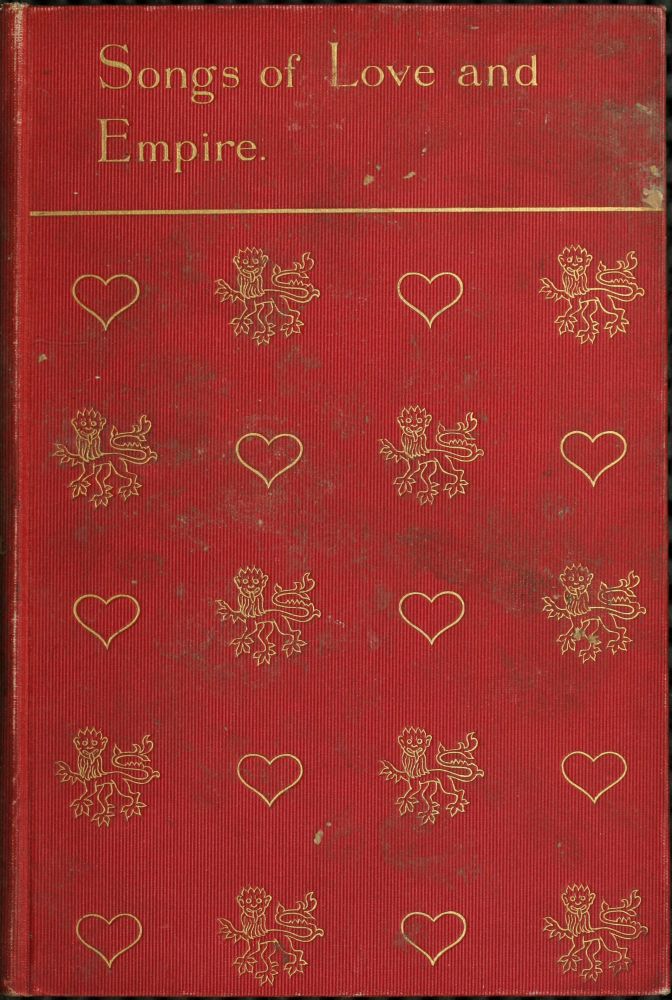
SONGS OF
LOVE AND EMPIRE
By E. NESBIT
AUTHOR OF “LAYS AND LEGENDS,” “A POMANDER OF VERSE,” ETC
WESTMINSTER
ARCHIBALD CONSTABLE & CO
1898
“After Sixty Years” appeared on June 22, 1897, in the Daily News; “To the Queen of England” and many other verses in the Pall Mall Gazette; “A Song of Peace and Honour” and “A Song of Trafalgar” in the Daily Chronicle, and certain other verses in the Athenæum. To the Editors of these papers my thanks are due.
TO HUBERT BLAND
Beause of all that lies its sheaves between;
You taught me first what Love and Empire mean,
And to your hands I bring my harvest home.
CONTENTS
(in order of appearance)
CONTENTS
(alphabetical)
| PAGE | |
| Absolution | 167 |
| Adventurer, The | 58 |
| After Sixty Years | 11 |
| Appeal, The | 93 |
| “At Evening Time there Shall be Light” | 150 |
| At the Sound of the Drum | 67 |
| Ballad of the White Lady, The | 43 |
| Betrayed | 109 |
| By Faith with Thanksgiving | 91 |
| Chains Invisible | 147 |
| Christmas Hymn | 164 |
| Crown of Life, The | 157 |
| Dirge | 125 |
| Discretion | 86 |
| Ebb-tide | 132 |
| Entreaty | 83 |
| Evening Prayer | 162 |
| Evening Song | 129 |
| Faith | 62 |
| Faute de Mieux | 99 |
| February | 139 |
| Forest Pool, The | 84 |
| Ghost Bereft, The | 50 |
| Goose Girl, The | 69 |
| Guardian Angel, The | 74 |
| Haunted | 123 |
| Heart of Grief, The | 115 |
| Heart of Joy, The | 113 |
| Heart of Sadness, The | 111 |
| In Eclipse | 103 |
| In the Enchanted Tower | 60 |
| Last Act, The | 97 |
| “Love Well the Hour” | 107 |
| Magnificat | 159 |
| Maidenhood | 152 |
| Medway Song | 144 |
| Monk, The | 155 |
| New College Gardens, Oxford | 135 |
| Offering, The | 82 |
| On the Downs | 133 |
| Out of Hope | 121 |
| Pedlar, The | 71 |
| Portrait, A | 80 |
| Prelude | 66 |
| Promise of Spring, The | 141 |
| Queen of England, The | 3 |
| Refusal, The | 64 |
| Requiem | 117 |
| “Shepherds all and Maidens Fair” | 77 |
| Song in Autumn | 95 |
| Song of Long Ago | 101 |
| Song of Peace and Honour | 35 |
| Song of Trafalgar | 26 |
| Special Pleading | 105 |
| Spring Song | 88 |
| Teint Neutre | 119 |
| “This Desirable Mansion” | 131 |
| To a Tulip Bulb | 137 |
| Too Late | 90 |
| Trafalgar Day | 24 |
| Vain Spell, The | 55 |
| Waterloo Day | 32 |
I
TO THE QUEEN OF ENGLAND
[June 22, 1897]
The shout of bells fills full the shattered air,
This is the crown of all your golden hours,
More than all other hours august and fair;
This did the years prepare,
A triumph for our Lady and our Queen,
More rich than any king in any land hath seen.
Flowers under foot and banners over head,
And while your people’s voice storms Heaven for you
About your way are voiceless blessings shed,
And over you are spread
Wide wings of love, free love, tamed to your hand,
Love that gold cannot buy, nor Majesty command.
Your triumph—here all English hearts beat high,
Nations far off your royal colours wear,
And swell with unheard voice this loyal cry
That strikes the English sky:
A cloud of unseen witnesses is here
To testify how great is England’s Queen, and dear.
Come visionary faces, vision-led,
And splendid shapes that are not of our day,
The spirits of the mute and mighty dead,
To see how Time has sped
The fortunes of their England, and behold
How much more great she is than in the days of old.
You the inheritor of all the past
Wherein the dead, in noble heraldry,
Blazoned the shield of England, and forecast
The charge it bears at last—
More splendid than the azure and the or
Of the French lilies lost—long lost and sorrowed for.
Who in long ships across the swan’s bathfared,
In whose rude tongue the voice of Freedom spoke,
In whose rough hands the sword was bright and bared—
The men who did and dared,
And to their sons bequeathed the fighting blood
That drives to Victory and will not be withstood.
Mixed with the crowd and all unseen of these,
On their long swords the wild Norse rovers lean
And watch the progress of your pageantries,
And on this young June breeze
Float the bright pennons of the Cressy spears—
Shine shadowy shafts that fell, as snow falls, at Poitiers.
Above the travail of the tournament;
Here gleam old swords, once wet for Liberty;
Old blood-stiff banners, worn with war and rent,
Are with your fresh flowers blent,
And by your crown, where love and fame consort,
Shines the unvanquished cloven crown of Agincourt.
Your world-adventuring ships come home again,
Glide ghostly galleons, manned by men of might
Who plucked the wings and singed the beard of Spain;
The men who, not in vain,
Saved to the children of a world new-trod
The birth-tongue of our land, her freedom, and her God.
Poets who wreathed her greatness with their song,
Wise men who steered her heavy ship of State,
Brave men who steered her battle-ships along,
In spectral concourse throng
To applaud the consummated power and pride
Of that belovèd land for which they lived and died.
Ploughed the long acre wherein Empire grows
Wide as the world, and long as Time is long—
These mark the crescence of the English rose
Whose thorny splendour glows
O’er far-off subject lands, by alien waves,
A crown for England’s brow, a garland for her graves.
Faces long hidden by death’s misty screen,
Faces you still can scarcely see for tears,
Will smile on you to-day and near you lean,
O Mother, Wife, and Queen!
With whispered love too sacred and too dear
For any ear than yours, Mother and Wife, to hear.
Daughter and heir of many mighty kings,
The Queen of England, whose imperial name
From England’s heart and lips tumultuous springs
In prayers and thanksgivings,
Because your greatness and her greatness shine
Merged each in each, as stars their beams that intertwine.
The richest treasures of the poorest lie,
Love, whose clear eyes see many secrets, knows
A nobler name than Queen to call you by,
And breathes it silently;
But, ’mid His listening crowd of angels, One
Shall speak your name and say, “Faithful and good, well done!”
AFTER SIXTY YEARS
Its ecstasy. Let the hid heart in prayer
Lift up your name. God bless you evermore,
Lady, who have the noblest crown to wear
That ever woman wore.
A jewel, in the front of time, shall blaze
This day, of all your days commemorate;
With Time’s white bays your brows are laureate,
And England’s love shall garland all your days.
** * * *
When England’s crown, to Love’s acclaim, was laid
On the soft brightness of a maiden’s hair,
Amid delight, Love trembled, half afraid,
To give that little head such weight to bear,—
Bind on so slight a maid
A kingdom’s purple—bid her hands hold high
The sceptre and the heavy orb of power,
To give to youth and beauty for a dower
Care and a crown, sorrow and sovereignty.
When loyal Love met tender Love half way,
And, in love’s script, wrote on the scroll of fame,
Entwined with all the splendour of that day,
The letters of her name.
Then as fair roses grow ’mid leaves of green,
Love amid loyalty grew strong and close,
To hedge a pleasaunce round our Royal rose,
Our sovereign maiden flower, our child, our Queen.
Their speech found echo in the hundred guns;
From countless towers the answering bells rang out,
And England’s heart spoke clamorous, through her sons,
The exulting land throughout.
Down streets ablaze with light the flags unfurled,
Along dark, lonely hills the joy-fires crept,
And eager swords within their scabbards leapt
To guard our Lady and Queen against the world.
Dust in the dust are laid who held her dear;
But from their grave the bright flower springs anew,
Which for her festival we bring her here,
The long years’ meed and due;
The bud of homage graffed on chivalry.
God took the souls that shrined the jewel of love,
But made their sons inheritors thereof,
In endless gold entail of loyalty.
When in spent perfume passed the flower of youth;
Her feet were set upon the upward road,
Her face was turned towards the star of truth
That in her soul abode.
With youth the maid’s bright brow was garlanded
But richer crowns adorn the dear white hair;
The gathered love of all the years lies there,
In coronal benediction on her head.
The angels of delight and of despair?
Does not she, too, remember and forget
How bitter or how bright the lost days were?
Her eyes have tears made wet;
She has seen joy unveilèd even as we,
Has laid upon cold clay the heart-warm kiss,
She has known Sorrow for the king he is;
She has held little children on her knee.
And call you blessèd, and shall we not, too,
Who are your children in the greater wise,
And love you for our land and her for you?
The blessing sanctifies
Your children as they breathe it at your knees,
And, bringing little gifts from very far,
Where the great nurseries of your Empire are,
Your children’s blessings throng from over seas.
Homage is borne from far-off sun-steeped lands;
From many a domed mysterious Eastern place,
Where Secresy holds Time between her hands,
The children of your race
Reach English hands towards your English throne;
And from the far South turn blue English eyes,
That never saw the blue of English skies,
Yet call you Mother, and your land their own.
In arrogant submission to your sway,
In fur of price your northern hunters go,
And shafts of ardent greeting fly your way
Across the splendid snow;
And isles that with their coral, safe and small,
Rock in the cradle of the tropic seas,
In soft, strange speech join in the litanies
That pride and prayer breathe at your festival.
In wind-ploughed oceans and in sun-kissed bays,
By every busy wharf and chattering quay,
Some cantle of your Empire sails or stays—
Flaunts your supremacy
Against the winds of all the world, and flies
Your flag triumphant between blue and blue,
Blazons to sun and star the name of you,
And spreads your glory between seas and skies.
There is no pasture where our shepherds tend
Their quiet flocks, no red-roofed village street,
But holds for you the love-wish of a friend,
Blent with high homage meet;
No little farm among the cornfields lone,
No little cot upon the uplands bare,
But hears to-day in blessing and in prayer
One name, Victoria, and that name your own.
Pauseless, resistless, moves by night and day,
From hidden mines where day is one with night,
From weary lives whose days and nights are grey
And empty of delight,
From lives that rhyme to sunshine and the spring,
From happiness at flood and hope at ebb,
Rose the magnificent and mingled web
That floats, your banner, at your thanksgiving.
With present glory clothed as with the sun,
Crowned with the future’s hopes, you know at last
What treasure from the years your life has won;
Behold, your hands hold fast
The moon of Empire, and its sway controls
The tides of war and peace, while in those hands
Lies tender homage out of all the lands
Against whose feet your furthest ocean rolls.
Much love, much sorrow, dead desires, lost dreams,
A great life lived out greatly; hidden tears,
And smiles for daily wear; strong plans and schemes,
And mighty hopes and fears;
War in the South and murder in the East,
And England’s heart-throbs echoed by your heart
When loss, and labour, and sorrow were her part,
Or when Fate bade her to some flower-crowned feast.
Green pastoral fields saved by the blood of these,
Duty that bade mere sorrow stand aside,
And love transforming anguish into ease;
Long longing satisfied,
Great secrets wrenched from Nature’s grudging breast,
The fruit of knowledge plucked for all to eat,—
These have you known, Life’s circle is complete,
And, knowing these, you know what is Life’s best:
The English woods and hills, the English home,
The common joys and griefs of Mother and wife,
Joy coming, going—griefs that go and come,
Soul’s peace amid world’s strife;
Hours when the Queen’s cares leave the woman free;
Dear friendships, where the friend forgets the Queen
And stoops to wear a dearer, homelier mien,
And be more loved than mere Queens rise to be.
The centre of our triumph’s blazing star,
And, gazing down your long life’s lustrous line,
Behold how great your life-long glories are,
Yet, in your heart’s veiled shrine,
No splendour of all splendours that have been
Will brim your eyes with tremulous thanksgivings,
But little memories of little things—
The treasures of the woman, not the Queen.
A golden girdle all about the earth,
Because your name is as a trumpet sound
To call toward you men of English birth
From the world’s outmost bound,
Because old kinsmen, long estranged from home,
Come, with old foes, to greet you, friend and kin,
With kindly eyes behold your guests come in,
See from afar the long procession come!
Knew ever such a triumph day as this,
Though captive kings bore chains along his ways,
Though tribute from the furthest isles was his,
With pageant and with praise.
For you—free kings and free republics grace
Your triumph, and across the conquered waves
Come gifts from friends, not tributes wrung from slaves,
And praise kneels, clothed in love, before your face.
Its ecstasy! Let the hid heart in prayer
Lift up your name! God bless you evermore,
Lady, who have the noblest crown to wear
That ever monarch wore.
For, ’mid this day’s triumphal voluntaries,
Your name shines like the splendour of the sun,
Because your name with England’s name is one,
As Hers, thank God! is one with Liberty’s.
TRAFALGAR DAY
Till England’s boughs are bare of leaves!
Soon comes the flower more rare, more dear
Than any laurel this year weaves—
The Aloe of the hundredth year
Since from the smoke of Trafalgar
He passed to where the heroes are,
Nelson, who passed and yet is here,
Whose dust is fire beneath our feet,
Whose memory mans our fleet.
His England’s tears in each green fold,
His England’s joy, his England’s pride,
His England’s glories manifold.
Yet what was Victory since he died?
And what was Death since he lives yet,
Above a Nation’s worship set,
Above her heroes glorified?—
Nelson, who made our flag a star
To lead where Victories are!
A SONG OF TRAFALGAR
War gleams down the long years’ track;
They strain at the leash, the dogs of war,
And who shall hold them back?
“Let loose the pack: we are English bred,
We will meet them full and fair
With the flag of England over our head,
And his hand to keep it there!”
Blew brave to the north and south;
An iron answer we gave the world,
For we spoke by the cannon’s mouth.
But he who taught us the word to say
Grew dumb as his Victory sang,
And England mourned on her triumph day,
And wept while her joy-bells rang.
The swift years crept apace,
The patient, the coral-insect way,
To cover the dear dead face.
O foolish rabble of envious years,
Who wist not the dead must rise,
His name is music still in our ears,
His face a light to our eyes!
Of a deathless love and pride;
These cling more close than the laurels twine,
They are strong as the world is wide:
At the feet of Virtue in Valour clad
Shall glory and love be laid,
While Glory sings to an English lad,
Or Love to an English maid.
On an English roof-tree shine,
Wherever the fire of a youth’s desire
Is laid upon Honour’s shrine,
Wherever brave deeds are treasured and told,
In the tale of the deeds of yore
Like jewels of price in a chain of gold
Are the name and the fame he bore.
Lies white on the ocean foam,
His name is sweet to our English lips
As the names of the flowers at home;
Wherever the heart of an English boy
Grows big with a deed of worth,
Such names as his name have begot the same,
Such hearts will bring it to birth.
Lies drunk by her heavy hoard;
They say her hands have the grasp of the gold
But not the grip of the sword,
That her robe of glory is rent and shred,
And that winds of shame blow through:
Speak for your England, O mighty Dead,
In the deeds you would have her do!
Who fought with the sword of old,
For the sword that is wielded of Englishmen
Is as much as one hand can hold.
Yet the pen and the tongue are safe to use,
And the coward and the wise choose these;
But fools and brave were our English crews
When Nelson swept the seas.
To ponder and pause and plan,
But the way of Nelson was better yet,
For that was the way of a man;
They would teach us smoothness, who once were rough,
They have bidden us palter and pray,
But the way of Nelson was good enough,
For that was the fighting way.
What never honour should brook,
In vain does the tomb of her hero wear
The laurel his brow forsook;
In vain was the speech from the lips of her guns,
If now must her lips refrain;
In vain has she made us, her living sons,
Her dead have made her in vain.
Lay flowers where the dear dust lies,
And wreathe his column with laurel round
To point his fame to the skies;
But the greenest laurel that ever grew
Is the laurel that’s yet to win;
Crowned with his laurels he waits for You
To bring Your laurels in!
WATERLOO DAY
[June 18]
Under her dusty laurels England stirs in her sleep;
Dreams of her days of honour, terrible days that are dead,
Days of the making of story, days when the sword was red,
When by the sword of her children her place in the world was made,
When Honour sounded the trumpet and Valour leapt to obey,
And Heroes bought us the Empire that statesmen would sell to-day.
Has slain in her wars her thousands, but her tens of thousands in peace:
And the cowards grieve for her glory; their glory is in their shame;
They are glad of the moth in her banners, and the rust on her shining name.
A SONG OF PEACE AND HONOUR
[December, 1895]
TO THE QUEEN
Upon whose head the glories of our land
In one immortal diadem are met,
Embodied England, in whose woman-hand
The sceptre of Imperial sway is set,
Receive this song of mine!
For you are England, and her bays grow green
To deck your brow, your goodness lends her grace,
And in our hearts your face is as Her face;
The Mother-Country is the Mother-Queen.
* * * * * *
We, men of England, children of her might,
With all our Mother’s record-roll of glory,
Great with her greatness, noble by her name,
Drank with our mothers’ milk our Mother’s story,
And in our veins the splendour of her fame
Made strong our blood and bright;
And to her absent sons her name has been
Familiar music heard in distant lands,
Heart of our heart and sinews of our hands,
England, our Mother, our Mistress and our Queen!
Through the gold-dust of centuries we hear
Her voice, “O children of a royal line,
Sons of her heart, whom England holdeth dear,
Mine was the Past—make ye the future mine
All glorious to the last!”
And, as we hear her, cowards grow to men,
And men to heroes, and the voice of fear
Is as a whisper in a deaf man’s ear,
And the dead past is quick in us again.
Hers are the golden-laden Argosies,
And lordship of the wild and watery ways,
Her flag is blown across the utmost seas:
Dead nations built her throne, and kingdoms blaze
For jewels in her crown.
Her Empire like a girdle doth enfold
The world; her feet upon her foes are set;
She wears the steel-wrought, blood-bright amulet
Won by her children in the days of old.
Which power and sovereignty and kingship fill
To the vast limit of the circling sun,
England, our Mother, in her heart holds still,
As her most precious jewel, save only one,
The priceless pearl of peace—
Peace plucked from out the very heart of war
Through the long agony of strenuous years,
Made pure by blood and sanctified by tears,
A pearl to lie where England’s treasures are.
O English meadows where the grass grows tall,
O red-roofed village, field and farm and fold
Where the long shadows of the elm-trees fall
On the wide pastures which the sun calls gold
And twilit dew calls gray;—
These are the home, the happy cradle-place
Of every man who has our English tongue,
Sprung from those loins from which our sires have sprung,
Heirs of the glory of our mighty race!
Shall Peace, our pearl, by us be cast aside?
Is it not more to us than all things are?
Nay, Peace is precious as the world is wide,
But England’s honour is more precious far
Than all the heavens and earth.
Were honour outcast from her supreme place
Our pearl of Peace no more a pearl would shine,
But, trampled under-foot of cowards and swine,
Rot in the mire of a deserved disgrace.
We will not cast our pearl of Peace away,
But, holding it, we wait; and if, at last,
The whole world came against us in array,
If all our glory into darkness passed,
Our Empire ceased to be,
Yet should we still have chosen the better part
Though in the dust our kingdoms were cast down,
Though lost were every jewel in our crown
We still should wear our jewel in our heart.
Let Peace be lost, but lost the worthier way;
Not trampled down, but given, for her sake
Who forged of many an iron yesterday
The golden song that gold-tongued fame shall wake
When we are dust, in dust:
For brotherhood and strife and praise and blame
And all the world, even to our very land,
Weighed in the balance, are as a grain of sand
Against the honour of our English name!
II
THE BALLAD OF THE WHITE LADY
Upon his marriage morn,
Her eyes were blue as cornflowers are,
Her hair was gold like corn.
A posy of roses seven,
“You are the fairest May,” said he,
“That ever strayed from Heaven.”
Was lured away to shame,
For seven long years of prayers and tears
No tidings of him came.
A mighty oath she swore,
“For seven long years I have wept and prayed,
Now I will pray no more.
Bring not my lord to me,
I will go down myself to hell
And bring him back,” said she.
She crept to the white lady’s bower,
The taper’s flame was dim,
And there Sir Geoffrey lay asleep,
And the white witch sat by him.
Her gold hair on his face,
And there was silence in the room
As in a burial-place.
And ’broidered bridal gear—
“Whose bridal is this?” the lady said,
“And what knight have ye here?”
He was your lord, I trow,
But I have taken him from your side,
And I am his lady now.
We twain our bridal keep,
So take for your mate another knight
And let my dear lord sleep.”
“What bridal cheer is this?
I would think scorn to have the lips
Who could not have the kiss!
Who could not have the whole;
I would think scorn to steal the body
Who could not take the soul!
This seven weary year,
His soul walks ever at my side
And whispers in my ear.
What, if it waked, would flee,
So let his body join his soul
And both fare forth with me;
“For I have learned a spell more strong
Than yours that laid him low,
And I will speak it for his sake
Because I love him so!”
Her eyes began to shine—
“His soul is thine these seven years?—
To-night it shall be mine!
While seven long years befell,
Rather than let a bridal be
Whose seed should flower in hell.
Nor joined my lips to his,
For fear his soul should spring to flame
And shrivel at my kiss.
While the long hours come and go,
To hold the body without the soul,
Because I love him so.
Has sat by thee,” she said,
“His body and soul to-night shall lie
Upon my golden bed.
That thou hast learned,” said she,
“For I will wake him from his sleep
And take his soul from thee.”
She laid her lips on his;
He stirred, he spake: “These seven long years
I have waited for thy kiss.
And trembled at thy breath,
Thou hast given me life in a cup to drink,
As God will give me death.
Which only lives for thee?
Thou hast put seven wasted years,
O love, ’twixt thee and me.”
THE GHOST BEREFT
And passed down the old dear road again.
Like little children that shrank afraid.
When the poor ghost came to the garden gate;
The weeds stood up where the rose was set.
To think how alone I lie and chill?
With her dear head laid on a new love’s arm?
For another’s love, and not for mine?
She is mine, my own, for evermore!”
Till it reached the square bright window pane.
Roses and love, and a hid delight?
Her heart that is breaking—and not for me?”
Though all the glass was wrinkled with rain.
Twelve tall tapers about the bed.
But not the garland a bride may wear.
But its scent is gone where the lost dream goes.
But the room is empty—she is not here!
Would not have hastened and come to me?
Be hence and away, and I not know?
For I have lost her for evermore!”
To its own appointed place again.
But up in Heaven, where memories cease
Because the blessed have won to peace,
Yet I fain would remember the days gone by.
But I think there was sorrow, long ago;
But I think there is rain on the earth to-night.
Help all poor souls in the wind and rain.”
THE VAIN SPELL
The fields are alight with dew;
“Oh, will you not come to me, Love, to-night?
I have waited the whole night through,
For I knew,
O Heart of my heart, I knew by my heart,
That the night of all nights is this,
When elm shall crack and lead shall part,
When moulds shall sunder and shot bolts start
To let you through to my kiss.”
She had wrapped her round with the spell,
She called the call, she vowed the vow,
And the heart she had pledged knew well
That this was the night, the only night,
When the moulds might be wrenched apart,
When the living and dead, in the dead of the night,
Might clasp once more, in the grave’s despite,
For the price of a living heart.
And the grave clothes were wet with dew;
“Oh, will you not come to me, Love, to-night,
I have waited the whole night through,
For I knew
That I dared not leave my grave for an hour
Since the hour of all hours is near,
When you shall come to the hollow bower,
In a cast of the wind, in a waft of the Power,
To the heart that to-night beats here!”
Ah, God! do the dead forget?
The grave is white and the bed is chill,
But a guest may be coming yet.
But the hour has come and the hour has gone
That never will come again;
Love’s only chance is over and done,
And the quick and the dead are twain, not one,
And the price has been paid in vain.
THE ADVENTURER
The sea a challenge roared between;
I left my throne, my crown, my queen,
And sailed out of the quiet bay.
The curses of the winds I mocked:
The conquered wave my galley rocked,
The wind became my envious slave.
Spices, and shells, and rich attire;
Red rubies, fed with living fire,
To lie where all my longings are.
As slow we sailed into the bay,
And long ago seemed yesterday
And yesterday looked long ago.
Bent was my crown, my courts grown mean,
And on my throne a faded queen
Raised alien eyes, and looked at me.
Upon thy heart, as once my head ...”
She smiled pale scorn: “My heart!” she said,
And turned her weary eyes away.
IN THE ENCHANTED TOWER
Upon the rocks below my tower,
And none will dare the Sea-king’s power
And venture shipwreck for my sake.
Across the darkling sea had cast—
I saw a sail; at last, at last,
It came towards me through the night.
To lead the ship through mist and foam,
The ship that came to take me home,
To that far land I half forget.
And surf-robed rocks curl hid below,
I quenched my lamp—and, weeping low
I saw my ship go safely by!
FAITH
Along the dark and haunted way,
I knew your hidden face was bright—
More bright than any day.
Rose from some weed-grown wayside grave,
I said, “I do not walk alone;
’Tis easy to be brave.”
For all the way was dark and long,
But all the shadows’ menace through
Your silence was my song.
For all the way was long and rough;
I taught my soul to understand
That love was strength enough.
A ghastly, gliding, tomb-white band;
I called aloud for you to hear,
My hand besought your hand.
Where in my dream I dreamed you were—
Night, night, you are not by my side,
You never have been there!
THE REFUSAL
All hung with gold and silver things,
It is more glorious than a king’s,
And crownèd queens might envy me.
Stay rather at the gates and weep
For all the splendour that I keep,
The treasures that you cannot win.
For both the palace still is here—
Its turrets gold, its silver gear
Are yours to wish for—mine to use.
The spell would break, the palace fade,
And we stand, trembling and afraid,
Lost in the dark where chill winds blow.
PRELUDE
Clouds of white wings came flying, flying,
Wheeling and whirling they swept away
Into the heart of the eastern gray;
But one white dove came straight to my breast
Out of the west.
Clouds of white wings went, dewy-early,
Straight from the world of the waning stars;
O beating pinions! O prison bars!
My dove flies free no more with the rest
Into the west.
AT THE SOUND OF THE DRUM
And a scarlet coat instead of the smock you used to wear?
Are you going to drive the foe as you used to drive the plough?
Are you going for a soldier now?
And I’m tired of woman’s chatter, and I’ll hear the drum instead;
I will break the fighting line as you broke your plighted vow,
For I’m going for a soldier now.
To hear the drums a-beating and to hear the bugles blow?
I’ll make you sweeter music, for I’ll swear another vow—
Are you going for a soldier now?
You must get another sweetheart, with another heart to break,
For I’m sick of lies and women and the harrow and the plough,
And I’m going for a soldier now!
THE GOOSE-GIRL
As is my daily use,
I saw her drive across the lea
The gander and the goose.
The gander and the gray, gray goose,
She drove them all together;
Her cheeks were rose, her gold hair loose,
All in the wild gray weather.
Across the common wide,
Turn, turn your pretty back on these
And come and be my bride.
I am a poet from the town,
And, ’mid the ladies there,
There is not one would wear a crown
With half your charming air!”
“I want no poet’s hand;
Go read your fairy-books,” she said,
“For this is fairy-land.
My Prince comes riding o’er the leas;
He fitly comes to woo,
For I’m a Princess, and my geese
Were poets, once, like you!”
THE PEDLAR
And see if you can find him;
He has blue eyes—you’ll know him by,—
He wears a pack behind him.
He’s gone away—ah! many a mile
Because he could not please me,
And, oh! ’twill be a weary while
Ere next he comes to tease me.
Fine ribbons, silks, and laces,
Bargains to rhyme with every mind,
And hues to suit all faces.
He has gold rings and pretty things
That other maids will throng for,
Ah, pigeon! spread your pretty wings,
And fly to him I long for.
For once I sent him packing;
He offered me a bargain then,
But wit and price were lacking.
I have the price he asked of me,
The wit that will not weigh it;
Ah! bid him come again and see
How gladly I will pay it.
THE GUARDIAN ANGEL
And I am safe tucked up in bed,
I know my guardian angel stands
And holds my soul between his hands.
Because I keep my eyes shut tight,
For, if I open them, I know
My pretty angel has to go.
His white wings rustling very near;
I know it is his darling wings,
Not Mother folding up my things!
III
“SHEPHERDS ALL AND MAIDENS FAIR”
So wreathe your crooks with flowers;
The world’s in tune to Love and June,
The days are rich in hours,
In rosy hours, in golden hours—
Love’s crown and fortune fair,
So gather gold for Love to hold,
And flowers for Love to wear!
Of pleasures speed your way;
Too harsh and dry is fierce July,
Too maiden-meek was May;
But Love and June their old sweet tune
Are singing at your ear:
So learn the song and troop along
To meet your shepherds dear!
And gold to spend have I—
When all are gay on this June day
You would not bid me sigh?
You would not scorn a swain forlorn—
Each shepherd far and near
Hastes to his sweet, with flying feet,
As I towards my dear.
But have their shepherds true;
Must you alone despise the one
Who only pipes for you?
You have no ear my pipe to hear
Though all for you it be;
And I no eyes for her who sighs
And only sings for me!
A PORTRAIT
Is her dainty way;
Like the gray of a twilight sky or a starlit lawn
Are her eyes of gray;
Like the clouds in their moving white
Is her breast’s soft stir;
And white as the moon and bright
Is the soul of her.
THE OFFERING
No heart of gold—and yet my dearest treasure?
It has its graces—it can ache and pine,
And beat true time to your sweet voice’s measure;
It bears your name, it lives but for your pleasure:
What will you give me for this heart I bring,
That holds my life, my joy, my everything?
Is that, without return, you will but take it—
Feed it with hope, or starve it to despair,
Keep it to play with, mock it, crush it, break it,
And, if your will lies there, at last forsake it?
Its epitaph shall voice its deathless pride:
“She held me in her hands until I died.”
ENTREATY
Ours is the tremulous, low-spoken vow,
Ours is the spell of meeting hands and eyes.
The first, involuntary, sacred kiss
Still on our lips in benediction lies.
O Love, be wise!
Love at its best is worth no more than this—
Let us part now!
Ere yet the roses wither on my brow,
Ere yet the lilies wither in your breast,
Ere the implacable hour shall flower to bear
The seeds of deathless anguish and unrest.
To part is best.
Between us still the drawn sword flameth fair—
Let us part now!
THE FOREST POOL
Reflected in the forest pool,
Tall foxgloves grow about the place,
Forget-me-nots grow green and cool.
Look deep and see the naiad rise
To meet the sunshine of your eyes.
How gold your hair, your mouth how red;
See the leaves dance about your hair
The wind has left unfilleted.
What naiad of them can compare
With you for good and dear and fair?
The naiad weeps your face to see,
Your beauty is more rare than hers,
And you are more beloved than she.
Fly! fly, before she steals the charms
The pool has trusted to her arms.
DISCRETION
You would not have me love again?
Love’s pleasure does not live a day,
Immortal is Love’s pain,
And I am tired of pain.
The pleasure died, the pain lives here;
I will not look in your sweet eyes,
I will not love you, Dear,
Lest you should grow too dear.
Have I not seen why life was fair,
And known how good a world God made,
How sweet the blossoms were,
How dear the green fields were?
A mist-hung road, a quest in vain,
Until once more Love smiled my way
And fooled me once again,
And taught me grief again.
I only ask to see the sky,
The budding flower, the budding leaf,
And put old dreamings by,
The dreams Love tortures by.
You, if you will, snare with those eyes
Some fool who never loved before,
And teach him to be wise!
For why should you be wise?
SPRING SONG
Earth’s green gown is new,
Lambs begin to bleat,
Doves begin to coo,
Birds begin to woo
In the wood and lane;
Sweet, the tale is true
Spring is here again!
All the winter through;
Now, before your feet,
Blossoms let me strew.
Flowers, as yet, are few;
Will my lady deign
Take this flower or two?
Spring is here again
Give the Spring her due!
All the flowers entreat,
All the song-birds sue.
’Twixt the green and blue
Let Love wake and reign,
Let me worship you—
Spring is here again!
TOO LATE
I clipped his wings, and dressed his cage with flowers,
Made him my little joy for little hours,
And fed him when I had a song to spare.
And then I saw how good life’s good things were,
The kingdoms and the glories and the powers.
Flowers grew in sheaves and stars were shed in showers,
And, when the great things wearied, Love was there.
I found him lying still with folded wings,
No longer fluttering, eager to be fed—
Kingdoms and powers and glories passed away,
And of life’s countless, precious, priceless things
Nothing was left but Love—and Love was dead!
BY FAITH WITH THANKSGIVING
No rose that buds and blooms and dies,
No star that shines and disappears,
No fire whose ashes strew the years:
Love is the god who lights the star,
Makes music of the lark’s desire,
Love tells the rose what perfumes are,
And lights and feeds the deathless fire.
THE APPEAL
“Love has no need of shelter nor of kindness,
For all the flowers take pity on his blindness,
And lead him to his scented rose-soft bed.”
“That I bow not the knee will never grieve him,
For all the summer-palaces receive him.”
But now Love has not where to lay his head.
“His altars are wherever roses blossom.”
And summer made his altar of her bosom,
But now the altar is ungarlanded.
Out in the rain he shivers broken-hearted;
Summer who bore him has with tears departed,
And o’er her grave he weeps uncomforted.
Would weep too, if when dawn stills the wind’s riot,
You found him on your threshold, pale and quiet,
Clasped him at last, and found the child was dead.
AUTUMN SONG
The shafts of sunlight burn
On many a golden-crested tree
And many a russet fern.
The Summer’s robe is dyed anew,
And Autumn’s veil of mist
Is gemmed with little pearls of dew
Where first we met and kissed.”
THE LAST ACT
Or a letter stained with tears,
No crown for the princely hour to wear,
To be mocked of the rebel years.
Not a spoken vow, not a written page
And never a rose or a rhyme
To tell to the wintry ear of age
The tale of the summer time.
FAUTE DE MIEUX
And the fields are crimson with love-lies-bleeding,
When the elms are black deep overhead
And the shade lies cool where the calves are feeding,
When the blackbird whistles the song of June,
When kine knee-deep in the pond are drowsing,
Leave pastoral peace—come up through the noon
To the high chalk downs where the sheep are browsing.
On the scented bed of thyme and clover,
With the air from the sea, blown keen and sweet,
And the wings of the wide sky folded over,
While, far in the blue, the skylark sings,
Renounce desire and renounce endeavour,
Forget life’s little unworthy things
And dream that the dream will last for ever.
With its gifts and its torments, leave it sighing,
And I will bury the pain of mine
In the selfsame grave where its joy is lying.
Let me hold your hand for a quiet hour
In the wild thyme’s scent and the clear blue weather,
Then come what may, we have plucked one flower,
This hour on the downs alone together.
SONG OF LONG AGO
When the hawthorn buds were pearly
And the birds sang, late and early,
All the songs that lovers know,
How we lingered in the lane,
Kissed and parted, kissed again,
Parted, laggard foot and slow!
What a pretty world we knew
Dressed in moonlight, dreams and dew,
Long ago, my first sweet sweetheart,
Long ago!
When the wind was on the river
Where the lights and shadows shiver,
And the streets were all aglow.
In the gaudy gas-lit street
We two parted, sweet, my sweet,
And the crowd went to and fro,
And your veil was wet with tears
For the inevitable years—
Long ago, my last sweet sweetheart,
Long ago!
IN ECLIPSE
Pale fringe of rain upon the hills,
Cold earth, cold sky and biting breeze
That mock the withered daffodils.
And yet so short a while ago,
The sunlight on the quickened land
Laughed at the memory of the snow,
And we went hand in hand.
Pale fringe of tears upon your eyes;
Why did we choose the evil part?
Why did we leave our Paradise?
There were such green and pleasant ways
Where you and I with happy heart
Laughed at the old unhappy days,
And now—we are apart.
Will you forgive me and forget?
Chill is the east, the west is gray,
And all our world with tears is wet.
Ah! love, the world is wide and cold,
The weary skies are wild with rain;
Give me at least your hand to hold
Till the sun shines again.
SPECIAL PLEADING
A sky all fresh and fair,
With daisies underneath your feet
And roses for your hair;
Red roses for your pretty hair,
Green trees to shade your way,
And lavish blossoms everywhere,
Because the time is May.
How soft the turf is spread!
How richly falls the shimmering sheen
About your darling head!
How in the dawn of Paradise
Should you foresee the night?
How, with the sunlight in your eyes,
See aught beyond the light?
The world’s a path all rough and wild,
A sky all black with fears,
Among the ghosts, unhappy child,
You stumble, blind with tears;
The track is faint, and far the fold,
And very far the day:
Unless you have a hand to hold,
How will you find the way?
“LOVE WELL THE HOUR”
If you were lost what should I do?
I dare not let you from my sight,
Lest Death should fall in love with you.
The gods know well how dear you are:
What if they left me desolate
And plucked and set you for their star?
And perfect joy so rare a flower
No man may hope to keep it long,
And I might lose it any hour.
Thus shall the future spare me this:
The thought that there was ever an hour
We might have kissed and did not kiss.
BETRAYED
That still its robe of roses wore;
My feet took the old easy way,
And led me to our door.
Those little feet of yours will come
To meet me at the open door,
The threshold of our home.
I entered, and the silence drew
My steps towards the little nest
That once I shared with you.
Your seam half-sewn, and I could see
The window whence you used to look—
Yes, once you looked—for me.
Our pillow still, and on the floor
Still lay, dropped there when last you dressed,
The scarf and rose you wore.
Yet, when I bade the silence tell
Of you, my bidding was in vain,
I could not break its spell.
Till the last level light grew dim;
Then, in the twilight I could hear;
The silence spoke—of him.
THE HEART OF SADNESS
I am lonelier when the rest are near,
But that my place against your heart has grown
Too dear to dream of when you are not here.
To meet, half-way, your longing thoughts of me,
To turn with these and spread glad wings for home,
For the dear haven where I fain would be.
To show to solitude what love could do,
To fill the waste space of the night and day
With thousand-wingèd dreams that flew to you;
But now through many tears I am grown wise
To know how mighty and how dear love is;
I dare not turn to him my longing eyes,
Nor even in dreams lean out my face to his,
Through dreams to seek you, I should follow too
Through wrong and right, through wisdom and through woe,
Through heaven and hell, until I won to you!
THE HEART OF JOY
Laugh with and play with you,
Weep with and pray with you,
All his life through?
Think, O my heart, if you never had found me,
Crept through the cere-clothes the world has wound round me,
What would you do?
Long for and cry for you,
Weep for and die for you,
You being you.
I only I, am the man you could sigh for,
Live for and suffer for, sorrow and die for,
Twenty lives through.
Traps on each side for us,
Nothing as guide for us,
Yet I and you
Found Life’s great treasure, the last and the first, love;
Life’s little things, Time and Space, do their worst, love!
What, after all, can they do?
THE HEART OF GRIEF
Along the deep-banked lane
To where the field and fold so long have missed you;
You know no more the way
To where, so many a day
Before the world grew gray,
Your lover kissed you.
Of London days and nights
Hold fast a soul not made for pastoral pleasures;
The scent of mignonette
Brings to you no regret,
No withered flowers lie yet
Among your treasures.
Sad and glad seasons through,
Find my grief’s heart in knowing grief will find you;
Some day you too will sigh,
And lay a dead flower by,
And weep to see joy lie
At last behind you.
With London wire be tied?
What though the heart that broke your heart be rotten?
You too at last must miss
The smile, the word, the kiss,
And know how hard it is
To be forgotten.
REQUIEM
Love lies asleep, who never more will wake;
Nor would you wake him, even for my sake
Who for your sake pray he sleep sound at last.
So long his yoke? what pleasant thing had we
That we should weep his deathlong sleep to see,
Or call on Life to waken him once more?
A little pleasure, and enduring grief,
One flower of joy, and pain piled sheaf on sheaf,
Harvests of loss, for every bud of gain.
Divided by his narrow grave we sit,
Welded together by the depths of it,
Watching the years pass, with averted face.
The old unrest frets not these empty years;
With him went smiles a few, and many tears,
And peace is sweeter far than those or these.
We too gave gifts—his gifts were less than ours:
We gave the world, that held so many flowers
For this—the world that only holds his grave.
TEINT NEUTRE
Chill fields stripped naked of their gown of grain,
Small fields of rain-wet grass and close-grown clover,
Wet, wind-blown trees—and, over all, the rain.
So far away the may and roses seem;
Ah! was there ever a garden red with roses?
Ah! were you ever mine save in a dream?
Heard her own praises in his perfect strain;
Low hang the clouds, the sad year’s heart is breaking,
And mine, my heart—and, over all, the rain.
OUT OF HOPE
Where the wet stone reflects the flickering gas,
Some weeping autumn night your wandering feet,
Lost in a lonely world, should chance to pass;
If, passing many doors that welcomed you
When robes of good renown your dear name wore,
Your feet again, as once they used to do,
Paused at my door,—
The old wrong done, the sorrow and the sin?
Or—only knowing that I love you still—
Should I throw wide the door and let you in?
Come—with your sins—my tears shall wash them all,
The heart you broke still waits to be your home.
Yet if you came.... Oh! lost beyond recall
You never more will come.
HAUNTED
Go pattering about it in their play,
I tremble lest the little one should meet
The ghosts that haunt the happy night and day.
They come through night of ease and pleasant day
To whisper of the torment that must be
If I some day should be, alas! as they.
The ghosts draw back the curtain of my bed,
And past them through the dreadful dark I creep,
Clasp close the child, and so am comforted.
Sad voices on the wind come thin and wild,
Ghosts of poor mothers crying in the night—
“Father, have pity—once I had a child!”
A DIRGE
To other gardens; here we have no need of her.
She smiles and beckons, but we take no heed of her,
Who love not Summer, but bare boughs and snow.
To choke the insolent triumph of the year,
With birds that sing as though he still were here,
And flowers that blow as if he still could see.
What ailed the rose to blow? she is not dear to us,
Nor all the summer pageant that draws near to us;
Let it be over soon, let it go by!
With the wild mourning of the wind-tossed boughs
To drown the stillness of the empty house
To which no more the little feet come home.
IV
EVENING SONG
Worn out with sunlit hours,
Droop o’er the garden beds
Their little sleepy heads,
The dewy dusk on quiet wings comes stealing;
And, as the night descends,
The shadows troop like friends
To bring them healing.
Of life too full and bright,
We long for night to fall
To wrap us from it all;
Then death on dewy wings draws near and holds us,
And like a kind friend come
To children far from home,
With love enfolds us.
Fresh to the morning sun,
Their little faces yet
With night’s sweet dewdrops wet,
The flowers awake to the new day’s new graces;
And we, ah! shall we too
Turn to the daydawn new
Our tear-wet faces?
“THIS DESIRABLE MANSION”
Across the sodden, tangled grass,
Weed-covered are the pathways where
No footsteps ever pass;
No whispers wake, no kisses die,
No laughter thrills the dwindling flowers,
Only the night hears sigh on sigh
From ghosts of long-dead hours.
The spider spins on stair and hall,
And round the windows shadows creep,
And loathly creatures crawl.
Cold is the hearth; the door is fast;
No guest the silent threshold sees
Save ghosts out of the happy past,—
And one who is as these.
EBB-TIDE
Long leaning wings across the sea and land.
The waves creep back bequeathing to our sight
The treasure-house of their deserted sand,
And where the nearer waves curl white and low,
Knee-deep in swirling brine the slow-foot shrimpers go.
Marked with broad arrows by their planted feet;
White rippled pools, where late deep waters were
And ever the white waves marshalled in retreat
And the grey wind in sole supremacy
O’er opal and amber cold of darkening sky and sea.
ON THE DOWNS
Drowned in the flood of rain
That drips from roof of byre and shed,
And splashes in the lane:
The leafless lean-flanked lane where last year’s leaves are spread.
Where the rain beats them blind,
Where scarce the rotten hurdles hold
Against the weary wind
That moans with angry tears across the pathless wold.
Show where the lone farms lie,
The twisted trees have lost their brown,
Are black against the sky,
And far below blink lights, gay lights of Brighton town.
And did the thyme smell sweet
Where, between dewy dusk and light,
The warm turf felt our feet,
And bean-flowers scented all the enchanted summer night?
Across the golden haze?
Were the woods ever leafy-dear,
In those forgotten days?
The wet wind shrieks denial: no other voice speaks here.
NEW COLLEGE GARDENS, OXFORD
Across the shadows dark with dew,
Where autumn on the thick sweet grass
Has laid a weary leaf or two,
When the young morning, keenly sweet,
Breathes secrets to the silent air,
Happy is he whose lingering feet
May wander lonely there.
The magic of the quiet hours,
Breathe unheard tales of other times
And other destinies than ours;
The feet that long ago walked here
Still, noiseless, walk beside our feet,
Poor ghosts, who found this garden dear,
And found the morning sweet!
The heart-ache that youth clasps so close,
Pain finely shaped in pleasure’s mould,
A thorn deep hidden in a rose.
Here is the immortal thorny rose
That may in no new garden grow—
Its root is in the hearts of those
Who walked here long ago.
TO A TULIP-BULB
And let the storm and winter do their worst;
Let all the garden lie
Bare to the angry sky,
The shed leaves shiver and die
Above your bed;
Let the white coverlet
Of sunlit snow be set
Over your sleeping head,
While in the earth you sleep
Where dreams are dear and deep,
And heed nor wind nor snow,
Nor how the dark moons go.
In this sad upper world where Winter’s hand
Has bound with chains of ice the weary land.
Then wake
To see the whole world lovely for Spring’s sake;
The garden fresh and fair
With green things everywhere,
And winter’s want and care
Banished and fled;
Primrose and violet
In every border set,
With rain and sunshine fed.
Then bless the fairy song
That cradled you so long,
And bless the fairy kiss
That wakened you to this—
A world where Winter’s dead and Spring doth reign
And lovers whisper in the budding lane.
FEBRUARY
The shivering gray of field and sky;
The mists wrapt round the dying day
The shroud poor days wear as they die:
Poor day, die soon, who lived in vain,
Who could not bring my Love again!
Dead rustling stalks blow chill between;
Only, above the sodden mould,
The wallflower wears his heartless green
As though still reigned the rose-crowned year
And summer and my Love were here.
The empty house, all still and chill;
The desolate and trembling boughs
Scratch at the dripping window sill:
Poor day lies drowned in floods of rain,
And ghosts knock at the window pane.
THE PROMISE OF SPRING
But our heart knows the word;
Caresses that seem
Like love’s lips in a dream;
Yet we know she is here,
The desirèd, the dear,
The love of the year!
In the murmur of boughs,
In the softening of skies,
In the sun on the house,
In the daffodil’s green
(Half an inch, half-unseen
Mid the mournful brown mould
Where the rotten leaf lies)
Her story is told.
O sweet days of blue weather!
The thrushes shall sing,
Fields shall grow green again,
Daisies be seen again,
Hedges grow white;
Then down the lane,
Grown leafy again,
Shall go lovers together—
Lovers who see again
Sunshine and showers,
Perfume and flowers,
Dewy dear hours,
Dream and delight.
Winter’s behind us;
Springtime shall find us,
Taking our hands,
Lead us away from the cold and the snow,
Into the green world where primroses grow.
Winter, hard winter, forgotten, forgiven;
All the old pain paid, to seventy times seven,
All the new glory a-glow.
Love, when Spring calls, will you still turn away?
Winter has wooed you in vain, and shall May?
Love, when Spring calls, will you go?
MEDWAY SONG
(Air: Carnaval de Venise)
Of Thames let Arnold sing,
But we will sing no river more
Save this where crowbars ring.
Let others sing of Henley,
Of fashion and renown,
But we will sing the thirteen locks
That lead to Tonbridge town!
Then sing the Kentish river,
The Kentish fields and flowers,
We waste no dreams on other streams
Who call the Medway ours.
The evening sunshine lies,
The little voles among the reeds
Look out with wondering eyes.
The patient anglers linger
The placid stream beside,
Where still with towering tarry prow
The stately barges glide.
Then sing the Kentish river,
The Kentish fields and flowers,
We waste no dreams on other streams
Who call the Medway ours.
The wild rose blossoms fair,
O’er meadow-sweet and loosestrife bright,
For water nymphs to wear.
And mid the blowing rushes
Pan pipes a joyous song,
And woodland things peep from the shade
As soft we glide along.
Then sing the Kentish river,
The Kentish fields and flowers,
We waste no dreams on other streams
Who call the Medway ours.
Of fashions fine and rare,
But happy men in shabby coats,
And girls with wind-kissed hair.
The world’s a pain forgotten,
And very far away,
The stream that flows, the boat that goes—
These are our world to-day.
Then sing the Kentish river,
The Kentish fields and flowers,
We waste no dreams on other streams
Who call the Medway ours.
CHAINS INVISIBLE
Wide meadows ring my garden round,
In that green copse wild violets blow,
And pale, frail cuckoo flowers are found.
For all you see and all you hear,
The city might be miles away,
And yet you feel the city near
Through all the quiet of the day.
Sweet lilac waves in moonlight pale,
And from the wood beyond the lane
I hear the hidden nightingale.
Though field and wood about me lie,
Hushed soft in dew and deep delight,
Yet can I hear the city’s sigh
Through all the silence of the night.
For me the vine her garland weaves;
The swallow folds her glossy wings
To build beneath my cottage eaves.
But I can feel the giant near,
Can hear his slaves by daylight weep,
And, when at last the night is here,
I hear him moaning in his sleep.
AT EVENING TIME THERE SHALL BE LIGHT
One grey wrapped sky and sea and shore,
It seemed our marsh would never again
Wear the rich robes that once it wore.
The scattered farms looked sad and chill,
Their sheltering trees writhed all awry,
And waves of mist broke on the hill
Where once the great sea thundered by.
This little land that is our own,
He caught the rain up in His hand,
He hid the winds behind His throne,
He soothed the fretful waves to rest,
He called the clouds to come away,
And, by blue pathways, to the west,
They went, like children tired of play.
Its holy vestment of fine gold;
From marge to marge the glory shone
On lichened farm and fence and fold;
In the gold sky that walled the west,
In each transfigured stone and tree,
The glory of God was manifest,
Plain for a little child to see!
MAIDENHOOD
Veiled with her maiden innocence, she goes;
Not all the splendour of the waxing light
She sees, nor all the colour of the rose;
And yet who knows what finer hues she sees,
Hid by our wisdom from our longing eyes?
Who knows what light she sees in skies and seas
Which is withholden from our seas and skies?
And feels not yet the treachery of the thorn,
Her crown of lilies still its perfume sheds
Where Love, the thorny crown, not yet is borne.
Yet in the mystery of her peaceful way
Who knows what fears beset her innocence,
Who, trembling, learns that thorns will wound some day,
And wonders what thorns are, and why, and whence?
V
THE MONK
The long day’s penance done at last,
I see the ghosts of days gone by,
And hear the voices of the past.
From hearths where life has rhymed to love,
I see the kingdoms of the world—
The glory and the power thereof,
And cry, “Ah, vainly have I striven!”
And then a voice calls, soft and low:
“Thou gavest My Earth to win My Heaven;
But Heaven-on-Earth thou mayest not know!”
That I renounced Thy pleasant earth—
The ship, the furrow, and the sword—
The dreams of death, the dreams of birth!
Weak in my hope and in my faith—
O Christ, for whom this cross I bear,
Meet me beside the gate of Death!
(O Christ, who sanctifiest pain!)
Falling asleep upon Thy breast,
And, if Thou wilt, wake never again!
THE CROWN OF LIFE
Are over, not to come again,
And from the menace of the night
Has dawned the day-star of delight:
My baby lies against me pressed—
Thus, Mother of God, are mothers blessed!
His little body soft and warm,
His little feet that cannot stand
Held in the heart of this, my hand.
His little mouth close on my breast—
Thus, Mary’s Son, are mothers blessed.
Are very faint and far away,
Yet you some day will stand upright
And fight God’s foes, in manhood’s might,
You—tiny, worshipped, clasped, caressed—
Thus, Mother of God, are mothers blessed.
This hour divine goes on for me.
All glorious is my little span,
Since I, like God, have made a man,
A little image of God’s best—
Thus, Mary’s Son, are mothers blessed.
Come endless chain of empty years;
They cannot take away the hour
That gives me You—my bird, my flower!
Thank God for this! Leave God the rest!—
Thus, Mother of God, are mothers blessed.
MAGNIFICAT
He lay upon His Mother’s knee,
Who kissed and blessed Him soft and low—
God’s gift to her, as you to me.
The love that rocks this cradling breast
Is such as Mary gave her Son:
She was more honoured, not more blest.
Than your eyes were those eyes of His,
And just such little hands and feet
As yours Our Lady used to kiss.
She held a King upon her knee:
O King of all my world, and more
Than all the world’s desire to me!
For He has given me all things good:
This body which a child has borne,
This breast, made holy for his food.
Beside her Son’s stands up apart:
I sit on heaven’s steps alone
And hold my king against my heart.
She sees your smile, through worlds of blue
Who was a mother, even as I,
And loved her Child, as I love you.
Because she bore the Babe Divine,
And all my soul to hers draws near,
And loves Him for the sake of mine!
EVENING PRAYER
Whose altars struck their roots in flame and blood,
Not to the jealous God, whose merciless might
The infamy of unclean years withstood;
But to the God who lit the evening star,
Who taught the flower to blossom in delight,
Who taught His world what love and worship are
We pray, we two, to-night.
To no enthronèd King too great to care,
To no strange Spirit human needs above
We bring our little, intimate, heart-warm prayer;
But to the God who is a Father too,
The Father who loved and gave His only Son
We pray across the cradle, I and you,
For ours, our little one!
CHRISTMAS HYMN
I have no gift to give my King;
No flowers grow by my weary way;
I have no birthday song to sing.
Who never saw Thy face divine;
Who walk in darkness all my days,
And see no Eastern stars a-shine?
How can I leave Thy praise unsung?
How stay from homage to the King,
And hold a silent, grudging tongue?
And many a humble hymn of praise
For Thy great Miracle of Spring,
The wonder of the waxing days.
Did I not sing Thy pleasant earth?
The moons of love, the years of tears,
The mysteries of death and birth?
While soul and song were mine to yield,
Thy lightning crown, Thy cloud-control,
The dewy clover of Thy field?
Thy streams and woods, Thy sun and shade;
Have I not made me holy feasts
Of all the beauty Thou hast made?
Won never grace Thy face to see?
I heard Thy footstep on the grass,
Thy voice in every wind-blown tree.
Yet, Lord, remember I have been
The lover of Thy world, wherein
I found nought common or unclean.
Thy saints in heaven sing sweet and strong,
Yet take the songs I made of yore
For echoes to Thy birthday song.
ABSOLUTION
Look on the sins that made thy life unclean,
Behold how poor thy vaunted virtues were,
How weak thy faith, thy deeds how small and mean,
How far from thy high dreams thy life hath been,
How poor thy use of all thou hast received,
How little of all God’s glory thou hast seen,
How misconstrued that which thou hast perceived.
The cup of shame drink to the bitter lees;
And when thou art lowerèd to the least on earth,
And in the dust makest common cause with these,
Then shall kind arms enfold thee, bringing peace,
The Earth, thy Mother, shall assuage thy pain,
Her woods and fields, Her quiet streams and seas
Shall touch thy soul, and make thee whole again.
If one vile script thy soul shrinks to erase,
The mighty Mother cannot bring thee in
Unto the happy, holy, healing place;
But thou shalt weep in darkness, out of grace,
And miss the light of beauty undefiled;
For he who would behold Her, face to face,
Must be in spirit as a little child.
NOW BEING PUBLISHED
The New Popular Edition
OF THE
Works of
George Meredith
Crown 8vo, 6s. each.
With Frontispieces by Bernard Partridge, Harrison Miller, and others.
| THE ORDEAL OF RICHARD FEVEREL |
| EVAN HARRINGTON |
| SANDRA BELLONI |
| VITTORIA |
| RHODA FLEMING |
| THE ADVENTURES OF HARRY RICHMOND |
| BEAUCHAMP’S CAREER |
| THE EGOIST |
| DIANA OF THE CROSSWAYS |
| ONE OF OUR CONQUERORS |
| LORD ORMONT AND HIS AMINTA |
| THE AMAZING MARRIAGE |
| THE SHAVING OF SHAGPAT |
| THE TRAGIC COMEDIANS |
| SHORT STORIES |
| SELECTED POEMS |
ARCHIBALD CONSTABLE & CO
2 WHITEHALL GARDENS WESTMINSTER
In the Tideway
By FLORA ANNIE STEEL
(Author of “Miss Stuart’s Legacy,” “On the Face of the
Waters,” etc.)
6s.
“One has grown accustomed to the association of Mrs. Steel’s name with novels which deal exclusively with Indians and Anglo-Indians. Such powerful and remarkable books as ‘The Potter’s Thumb’ and ‘On the Face of the Waters,’ point to a specialism which is becoming one of the salient features of modern fiction; but ‘In the Tideway,’ although dealing entirely with England and Scotland, presents the same keen and unerring grasp of character, the same faculty of conveying local atmosphere and colour, the same talent for creating strong and dramatic situations, and the same originality of thought and expression.... It is too late in the day to speak of Mrs. Steel’s position. This is assured, but this book adds greatly to an established position. It is profoundly impressive.”
“Wonderfully bright and lively both in dialogue and incidents.”—Scotsman.
“Admirably written.”—Glasgow Herald.
“The story is beyond question powerful. The characters are life-like and the dialogue is bright and natural.”—Manchester Guardian.
“As it is, the book is a sheer triumph of skill, one degree perhaps less valuable than a fully conceived presentation of the actual, but none the less admirable within its limits. There is care shown in every character.... But the real art, perhaps, lies less in the sequence of events or the portrayal of character, than in just this subtle suggestion everywhere of the abiding causeless mystery of land and sea.”—Academy.
ARCHIBALD CONSTABLE & CO
2 WHITEHALL GARDENS WESTMINSTER
PRICE SIX SHILLINGS
Dracula
By BRAM STOKER
“One of the most enthralling and unique romances ever written.”—The Christian World.
“The very weirdest of weird tales.”—Punch.
“Its fascination is so great that it is impossible to lay it aside.”—The Lady.
“It holds us enthralled.”—The Literary World.
“The idea is so novel that one gasps, as it were, at its originality. A romance far above the ordinary production.”—St. Paul’s.
“Much loving and happy human nature, much heroism, much faithfulness, much dauntless hope, so that as one phantasmal ghastliness follows another in horrid swift succession the reader is always accompanied by images of devotion and friendliness.”—Liverpool Daily Post.
“A most fascinating narrative.”—Dublin Evening Herald.
“While it will thrill the reader, it will fascinate him too much to put it down till he has finished it.”—Bristol Mercury.
“It is just one of those books which will inevitably be widely read and talked about.”—Lincoln Mercury.
“A preternatural story of singular power. The book is bound to be a success.”—Dublin Freeman’s Journal.
“The characters are limned in a striking manner.”—Manchester Courier.
“A decidedly able as exceptionally interesting and dramatically told story.”—Sheffield Telegraph.
“We strongly recommend all readers of a sensitive nature or weak nerves to abstain from following the diabolic adventures of Count Dracula.”—Sheffield Independent.
“Arrests and holds the attention by virtue of new ideas, treated in an uncommon style. Throughout the book there is not a dull passage.”—Shrewsbury Chronicle.
“Singularly entertaining.”—Birmingham Daily Mail.
“Fascinates the imagination and keeps the reader chained.”—Western Times (Exeter).
“We commend it to the attention of readers who like their literary fare strong, and at the same time healthy.”—Oban Times.
“The most original work of fiction in this almost barren season.”—Black and White.
“We read it with a fascination which was irresistible.”—Birmingham Gazette.
“The spell of the book, while one is reading it, is simply perfect.”—Woman.
“The most blood-curdling novel of the paralysed century.”—Gloucester Journal.
“The sensation of the season.”—Weekly Liverpool Courier.
ARCHIBALD CONSTABLE & CO
2 WHITEHALL GARDENS WESTMINSTER
The Folly of Pen Harrington
By JULIAN STURGIS. 6s.
“Decidedly to be recommended as light and lively reading.”—Manchester Guardian.
“Very pleasant reading indeed.”—Glasgow Herald.
“The tale throughout is fascinating.”—Dundee Advertiser.
“A thoroughly entertaining story.”—Daily Telegraph.
“Bright, piquant and thoroughly entertaining.”—The World.
“A clever and brightly-written novel.”—Black and White.
“Will hold its own with any work of the same class that has appeared during the last half-dozen years.”—The Speaker.
Green Fire: A Story of the Western Islands
By FIONA MACLEOD,
Author of “The Sin Eater,” “Pharais,” “The Mountain Lovers,” etc. Crown 8vo, 6s.
“There are few in whose hands the pure threads have been so skilfully and delicately woven as they have in Fiona Macleod’s.”—Pall Mall Gazette.
The Laughter of Peterkin
A Re-telling of Old Stories of the Celtic Wonderworld.
By FIONA MACLEOD.
Crown 8vo, 6s. Illustrated.
A book for young and old.
Odd Stories
By FRANCES FORBES ROBERTSON.
Crown 8vo, 6s.
The Dark Way of Love
From the French of M. Charles le Goffic.
Translated by E. WINGATE RINDER.
Some Observations of a Foster Parent
By JOHN CHARLES TARVER.
Crown 8vo, 6s.
“If there were more schoolmasters of the class to which Mr. Tarver evidently belongs, schoolmasters would be held in greater honour by those who have suffered at their hands. His ‘Observations of a Foster Parent’ are excellent reading; we hope they will reach the British parent. He may be assured the book is never dull.”—Glasgow Herald.
“A series of readable and discursive essays on Education. The book deserves to be read.”—Manchester Guardian.
“The book is one which all parents should diligently read.”—Daily Mail.
ARCHIBALD CONSTABLE & CO
2 WHITEHALL GARDENS WESTMINSTER
The Amazing Marriage
By GEORGE MEREDITH
Crown 8vo, 6s.
“To say that Mr. Meredith is at his best in ‘The Amazing Marriage’ is to say that he has given us a masterpiece.”—Daily News.
“Mr. Meredith belongs to the great school of writers of whom Aristophanes, Rabelais, Montaigne, Fielding, are some of the most splendid examples. Mr. Meredith’s style is not ... so obscure as it is often represented to be.”—Athenæum.
“Carinthia will take her place ... in the long gallery of those Meredithian women whom all literary Europe delights to honour.”—Daily Chronicle.
“By George Meredith! Those three words have a welcome sound for reviewers.”—Literary World.
“We have said enough to show that Mr. Meredith’s plot is excellently conceived and excellently carried out.”—Standard.
“Most novels are merely dramas with padded stage directions. Mr. Meredith’s, everybody knows, are otherwise. His novels are always human life....”—The Star.
“Wholly delightful.”—Black and White.
“This is a book in which, to use Mr. Meredith’s own expression, you jump to his meaning.”—Westminster Gazette.
“The book is full of wise, deep, and brilliant things.”—Scotsman.
“This latest example of Mr. Meredith’s quality is marked by observation, wit, and variegated fancy enough to deck out a gross of novels of the average sort.”—Morning Post.
ARCHIBALD CONSTABLE & CO
2 WHITEHALL GARDENS WESTMINSTER
London City Churches
BY
A. E. DANIELL
WITH NUMEROUS ILLUSTRATIONS BY
LEONARD MARTIN
With a Map showing the position of each Church
Imperial 16mo, 6s.
The intention of this book is to present to the public a concise account of each of the churches of the City of London. If any reader should be induced to explore for himself these very interesting, but little known buildings, wherein he cannot fail to find ample to reward him for his pains, the object of the writer will have been attained.
This volume is profusely illustrated from drawings specially made by Mr. Leonard Martin, and from photographs which have been prepared expressly for this work.
“The author of this book knows the City churches one and all, and has studied their monuments and archives with the patient reverence of the true antiquary, and, armed with the pen instead of the chisel, he has done his best to give permanent record to their claims on the nation, as well as on the man in the street.”—Leeds Mercury.
“His interesting text is accompanied by numerous illustrations, many of them full-page, and altogether his book is one which has every claim to a warm welcome from those who have a taste for ecclesiastical archæology.”—Glasgow Herald.
“This is an interesting and descriptive account of the various churches still extant in London, and is illustrated by several excellent photographs.... His work will be of value to the antiquarian, and of interest to the casual observer.”—Western Morning News.
“Mr. Daniell’s work will prove very interesting reading, as he has evidently taken great care in obtaining all the facts concerning the City churches, their history and associations.”—London.
“The illustrations to this book are good, and it deserves to be widely read.”—Morning Post.
ARCHIBALD CONSTABLE & CO
2 WHITEHALL GARDENS WESTMINSTER
Crown 8vo, 3s. 6d.
The Shoulder of Shasta
By BRAM STOKER
Author of “Dracula.”
“Will be one of the most popular romances, in one volume, of the season now opening. It is chiefly remarkable for the very marked and superior descriptive power displayed by the author in his rich and inspiring picture of the scenery of the Shasta Mountain.... So entirely unconventional, humorous, and bizarre, as to be quite unique.... The composition is bold and lucid.... He is an accomplished artist, and shows here at his best.... Mr. Bram Stoker will add widely to his reputation by this.”—Irish Times.
“A pure and well-told story.”—Glasgow Herald.
“The story is charmingly written, and deserves to be read for its brilliant open-air passages, and the portrait it contains of Grizzly Dick.”—Daily News.
“Mr. Bram Stoker has given the reading world one of the breeziest and most picturesque tales of life on the Pacific slope that has been penned for many a long day.”—Daily Telegraph.
“Mr. Stoker seems quite at home in picturing the wild beauty of Californian scenery.... ‘The Shoulder of Shasta’ is eminently fresh and readable.”—Globe.
“It is a capital story.”—Bristol Times and Mirror.
“The story is gracefully conceived, and wrought out with considerable skill.... A readable and entertaining work.”—Scotsman.
“ ‘The Shoulder of Shasta’ may fairly be classed among the books to be read and enjoyed.”—Yorkshire Post.
“A pleasant story of life in Western America.... Fresh and unconventional.”—Publishers’ Circular.
“Mr. Bram Stoker’s new book is a peculiarly bright and breezy story of Californian life.... There is nothing laboured in this description, no straining after undue effect.... The language is simple, yet the effect is always satisfying, and the word-picture is complete.”—Liverpool Daily Post.
“The narrative is entertaining throughout, with eloquent descriptions of scenery.”—Academy.
“Mr. Bram Stoker’s story is unflagging, full of vigour, and capital reading from end to end; moreover, it conveys a vivid picture of life and manners in a corner of the world better known to him than to the majority of those who will read his book.”—Standard.
The Fortune of a Spendthrift
AND OTHER ITEMS
By R. ANDOM
Author of “We Three and Troddles,” “The Strange Adventures of Roger
Wilkins,” etc., etc.
AND
FRED HAREWOOD
“Lightly, briskly, and pleasantly written.”—Scotsman.
“The adventures of a spendthrift, which form the principal feature of the book, are related with so much dramatic force that any improbabilities of the plot are forgotten in the reader’s eagerness to learn the dénouement.... Treated with freshness in a pleasant, graphic style, and a lively interest is cleverly sustained.... They are all told with spirit and vivacity, and show no little skill in their descriptive passages.”—Literary World.
“A collection of brightly-written short stories, well adapted for a holiday afternoon.”—Globe.
ARCHIBALD CONSTABLE & CO
2 WHITEHALL GARDENS WESTMINSTER
Dracula
By BRAM STOKER. Price Six Shillings.
“The reader hurries on breathless from the first page to the last, afraid to miss a single word.”—Daily Telegraph.
“Unquestionably a striking example of imaginative power.”—Morning Post.
“The most daring venture into the supernatural I have ever come across.”—Truth.
“One of the best things in the supernatural line that we have been lucky enough to hit upon.”—Pall Mall Gazette.
“A story of very real power.”—The Speaker.
“One of the weirdest romances of late years.”—Lloyd’s Newspaper.
“We have never read any work which so powerfully affected the imagination.”—North British Daily Mail.
“Interesting almost to fascination.”—Gloucester Journal.
“An exciting story from beginning to end.”—The Newsagent.
“Told in a way to hold the reader spell-bound.”—Sunderland Weekly Echo.
“Contains many passages of rare power and beauty.”—Dundee Advertiser.
“Will remain unique amongst the terrors which paralyse our nerves at bedtime.”—Daily Chronicle.
“The story is indeed a strange and fascinating one.”—Northern Whig.
“I soon became horribly enthralled, and could not choose but read on—on—until the lights burned blue and my blood ran cold.”—The Referee.
“No other writer of the day could have produced so marvellous a book.”—The British Weekly.
“The new wild and weird ‘Vampire’ story.”—The Morning.
An Indian Story.
His Majesty’s Greatest Subject
A Novel. By S. S. THORBURN, I.C.S. Crown 8vo, 3s. 6d.
“Mr. Thorburn interests us immensely in his story on his theories, and in the daring romance of his situations.”—Bombay Gazette.
“A very romantic and interesting story.”—Scotsman.
“Mr. Thorburn may be congratulated ... a daring departure from the ways of story writers.”—Glasgow Herald.
Chin-Chin-Wa
By CHARLES HANNAN, F.R.G.S. Crown 8vo, 3s. 6d.
“Chin-Chin-Wa is a cleverly realised study of an Englishman who turns Chinaman.”—Daily Chronicle.
“Delightful and dramatic.”—British Review.
A Sturdy Beggar and Lady Bramber’s
Ghost
Two Stories by CHARLES CHARRINGTON. Crown 8vo, 3s. 6d.
“Two stories full of merit.”—Western Mail.
“An original turn of thought, and a vivacious style.”—The Globe.
The Love of an Obsolete Woman
CHRONICLED BY HERSELF. Cloth extra, 3s. 6d.
“The suppressed fire, the pregnant brevity, the still acute misery, all tell that in these pages a human soul is written down.”—Aberdeen Free Press.
“The story of the main episode in a human life is told in these pages with a convincing simplicity, directness, and power, such as we rarely find.... We cannot think of what we have read as a fiction; it reads like a piece of sincere autobiography, as absolutely frank as that of Samuel Pepys; and though it is constructed with more art—a very delicate art—we have no consciousness of this as we read, only when we lay the volume aside and begin to think about it.... In all it aims at the story is absolutely perfect.”—Birmingham Daily Post.
“We may frankly say that this little volume is quite the strongest that has recently been written on the burning question of the relations of the sexes.”—Manchester Guardian.
ARCHIBALD CONSTABLE & CO
2 WHITEHALL GARDENS WESTMINSTER
Hans van Donder
A Romance of Boer Life.
By CHARLES MONTAGUE, Author of “The Vigil.”
Fcap. 8vo, 2s. 6d.
“Mr. Montague has written another charming romance.”—Scotsman.
“Admirably told. The descriptions of Big Game Shooting are highly
exciting.”—Glasgow Herald.
Torriba By JOHN CAMERON GRANT.
Fcap. 8vo, 2s. 6d.
“Torriba is unquestionably bold in treatment and well written.”—Globe.
Madge o’ the Pool By WILLIAM SHARP.
Fcap. 8vo, 2s. 6d.
“Excellent.”—Athenæum.
A Writer of Fiction A Novel.
By CLIVE HOLLAND,
Author of “My Japanese Wife.” Cloth extra, 2s. 6d.
“Intensely interesting.”—Glasgow Daily Mail.
“A striking story.”—Pall Mall Gazette.
The Love of an Obsolete Woman
CHRONICLED BY HERSELF.
2s. 6d.
“A fascinating book. True to life and highly artistic.”—Publishers’
Circular.
Angela’s Lover BY DOROTHEA GERARD
Paper, 1s. Cloth extra, 2s.
“Charming.”—Scotsman.
A Full Confession BY F. C. PHILLIPS
1s. net.
“In brief—direct and forcible.”—Literary World.
The Parasite BY CONAN DOYLE
1s. net.
ARCHIBALD CONSTABLE & CO
2 WHITEHALL GARDENS WESTMINSTER
“The Game of Polo”
By T. F. DALE
(“Stoneclink” of “The Field”)
Illustrated by Lillian Smythe, Cuthbert Bradley, and Crawford Wood; and a
Photogravure Portrait of Mr. JOHN WATSON.
Demy 8vo. One Guinea net.
“Likely to rank as the standard work on the subject.”—Morning Post.
“What the author does not know about it is not knowledge.”—Pall Mall Gazette.
“Will doubtless be of great use to beginners.”—Illustrated Sporting and Dramatic.
“A charming addition to the library of those who are devoted to the game.”—The Globe.
The Art and Pastime of Cycling
By R. J. MACREDY and A. J. WILSON
New Edition, and in a large measure rewritten. Profusely illustrated.
Cloth, 1s. 6d. Paper Cover, 1s.
“One of the most complete books on Cycling—deals with every phase of the noble Sport.”—Cycle and Camera.
“An eminently useful handbook.”—South Africa.
“Full of information.”—Scotsman.
“A great fund of useful and practical information.”—The Field.
“The Fourth Edition of this book, and better than ever.... No cyclist’s library is complete without it.”—Bicycling News.
With Plumer in Matabeleland
By FRANK W. SYKES
With numerous Illustrations in the text, and 35 Full-page Plates and Two Maps.
Demy 8vo, 15s. net.
“Operations of the Force during the Rebellion of 1896 are described in great detail, and in a very interesting fashion.”—Financial Times.
“Mr. Sykes served as a trooper in the M.R.F., and depicts with much point and piquancy the life of the rank and file of that corps as it presented itself to him throughout the campaign. Still more delightful is the racy vein in which the humours of the situation are recounted. Mr. Sykes’ narrative of ‘Massacres and Escapes’ is a noble record. Many incidents not hitherto mentioned of pluck and heroism are alluded to. His book is one of the best of its class we have yet had the pleasure of reviewing.”—South Africa.
“The chapter on the Religion of the Matabele is well worth reading, so from first page to last is Mr. Sykes’ book.”—Daily News.
“The best illustrated and most generally interesting volume.... Frank, catholic, fearless, and generous. I congratulate him, and also his assistants on a notable volume.”—African Critic.
Imperial Defence
By Sir CHARLES DILKE and SPENSER WILKINSON
New and Revised Edition. 2s. 6d.
“To urge our countrymen to prepare, whilst there is yet time, for a defence that is required alike by interest, honour, and duty, and by the best traditions of the nation’s history.”—Daily Mail.
ARCHIBALD CONSTABLE & CO
2 WHITEHALL GARDENS WESTMINSTER
The Paston Letters,
1422-1509
Edited by JAMES GAIRDNER
OF THE PUBLIC RECORD OFFICE
3 Vols. Fcap. 8vo. With 3 Photogravure Frontispieces,
cloth gilt extra, or paper label uncut, 16s. net.
These letters are the genuine correspondence of a family in Norfolk during the Wars of the Roses. As such, they are altogether unique in character; yet the language is not so antiquated as to present any serious difficulty to the modern reader. The topics of the letters relate partly to the private affairs of the family, and partly to the stirring events of the time: and the correspondence includes State papers, love letters, bailiff’s accounts, sentimental poems, jocular epistles, etc.
“This edition, which was first published some twenty years ago, is the standard edition of these remarkable historical documents, and contains upward of four hundred letters in addition to those published by Frere in 1823. The reprint is in three small and compact volumes, and should be welcome to students of history as giving an important work in a convenient form.”—Scotsman.
“Unquestionably the standard edition of these curious literary relics of an age so long ago that the writers speak of the battles between the contending forces of York and Lancaster as occurrences of the moment.”—Daily News.
“One of the monuments of English historical scholarship that needs no commendation.”—Manchester Guardian.
ARCHIBALD CONSTABLE & CO
2 WHITEHALL GARDENS WESTMINSTER
Boswell’s Life of Johnson
Edited by AUGUSTINE BIRRELL.
With Frontispieces by ALEX ANSTED, a reproduction of
Sir JOSHUA REYNOLDS’ Portrait.
Six Volumes. Foolscap 8vo. Cloth, paper label, or gilt extra, 2s. net per Volume. Also half morocco, 3s. net per Volume. Sold in Sets only.
“Far and away the best Boswell, I should say, for the ordinary book-lover now on the market.”—Illustrated London News.
“ ... We have good reason to be thankful for an edition of a very useful and attractive kind.”—Spectator.
“The volumes, which are light, and so well bound that they open easily anywhere, are exceedingly pleasant to handle and read.”—St. James’s Budget.
“This undertaking of the publishers ought to be certain of success.”—The Bookseller.
“Read him at once if you have hitherto refrained from that exhilarating and most varied entertainment; or, have you read him?—then read him again.”—The Speaker.
“Constable’s edition will long remain the best both for the general reader and the scholar.”—Review of Reviews.
In 48 Volumes
CONSTABLE’S REPRINT
OF
The Waverley Novels
THE FAVOURITE EDITION OF
SIR WALTER SCOTT.
With all the original Plates and Vignettes (Re-engraved). In 48 Vols.
Foolscap 8vo. Cloth, paper label title, 1s. 6d. net per Volume, or £3 12s.
the Set. Also cloth gilt, gilt top, 2s. net per Volume, or
£4 16s. the Set; and half leather gilt, 2s. 6d.
net per Volume, or £6 the Set.
“A delightful reprint. The price is lower than that of many inferior editions.”—Athenæum.
“The excellence of the print, and the convenient size of the volumes, and the association of this edition with Sir Walter Scott himself, should combine with so moderate a price to secure for this reprint a popularity as great as that which the original editions long and fully enjoyed with former generations of readers.”—The Times.
“This is one of the most charming editions of the Waverley Novels that we know, as well as one of the cheapest in the market.”—Glasgow Herald.
“Very attractive reprints.”—The Speaker.
“ ... Messrs. Constable & Co. have done good service to the reading world in reprinting them.”—Daily Chronicle.
“The set presents a magnificent appearance on the bookshelf.”—Black and White.
ARCHIBALD CONSTABLE & CO
2 WHITEHALL GARDENS WESTMINSTER
The Nation’s Awakening
By SPENSER WILKINSON
Crown 8vo, 3s. 6d.
“The essence of true policy for Britain, the policy of common-sense, lies, according to Mr. Wilkinson, in choosing for assertion and for active defence those points in the extensive fringe of our world-wide interests, and those moments of time at which our self-defence will coincide with the self-defence of the world. This idea he works out in a clever and vigorous fashion.”—Glasgow Herald.
“He elaborates his views in four ‘books,’ dealing respectively with the aims of the other Great Powers, the defence of British interests, the organization of the Government, and ‘the idea of the nation,’ ... he deprecates a policy of isolation, and advocates a closer alliance with Germany.”—Scotsman.
“We consider Mr. Wilkinson completely proves his case. We agree ... that Mr. Spenser Wilkinson must make all men think. We welcome the volume, as we have welcomed previous volumes from Mr. Wilkinson’s pen, as of the highest value towards the formation of a national policy, of which we never stood in greater need.”—Athenæum.
“These essays show a wide knowledge of international politics.”—Morning Post.
BY THE SAME AUTHOR
The Volunteers and the National Defence
Crown 8vo, cloth, 2s. 6d.
The Brain of an Army
Crown 8vo, cloth, 2s. 6d.
The Command of the Sea
Crown 8vo, paper, 1s.
The Brain of the Navy
Crown 8vo, paper, 1s.
ARCHIBALD CONSTABLE & CO
2 WHITEHALL GARDENS WESTMINSTER
At all Booksellers and Bookstalls.
NEW AND CHEAPER EDITION,
REVISED AND BROUGHT UP TO DATE,
WITH A NEW CHAPTER ON THE LATE
WAR IN THE EAST.
Problems of the Far East
Japan—Corea—China
BY THE
Rt. Hon. GEORGE N. CURZON, M.P.
With numerous Illustrations and Maps. Extra Crown 8vo, 7s. 6d.
“Certainly the influence of Mr. Curzon’s thoughtful generalizations, based as they are upon wide knowledge, and expressed in clear and picturesque language, cannot fail to assist in solving the problems of the Far East.”—Manchester Courier.
“We dealt so fully with the other contents of Mr. Curzon’s volume at the time of first publication, that it is only necessary to say that the extreme interest and importance of them is enhanced by recent events, and the light of which they are revised.”—Glasgow Herald.
“Any one who desires to know anything of Japan, Corea, and China, will employ time profitably in becoming acquainted with Mr. Curzon’s book. The book is thoughtfully and carefully written, and the writer’s well-known abilities, both as a traveller and a statesman, lend weight to his words, while the fact that it is already in its fourth edition shows that the public realize its value.”—Belfast News Letter.
“All who have read the volume will admit that it is a valuable addition to the literature dealing with the problems of the Far East.”—Morning Post.
“His impressions of travel, confirmed by a study of the best authorities, are interesting and well written.”—Manchester Guardian.
“ ‘Problems of the Far East’ is most informing, and deserves to be widely read.”—Liverpool Mercury.
ARCHIBALD CONSTABLE & CO
2 WHITEHALL GARDENS WESTMINSTER
English Illustration. “The Sixties”: 1855-70.
By Gleeson White. Price £2 2s. net.
With Numerous Illustrations by Sir E. Burne-Jones; Ford Madox Brown; Birket Foster; A. Boyd Houghton; Arthur Hughes; Chas. Keene; Lord Leighton, P.R.A.; G. Du Maurier; Sir J. E. Millais, P.R.A.; J. W. North; E. J. Poynter, R.A.; D. G. Rossetti; Frederick Sandys; J. McNeill Whistler; Frederick Walker, A.R.A.; and others.
“Mr. Gleeson White has done his work well.... It is a book of beauty in one of its aspects, and an instructive and well-written critical treatise in the other.”—Daily News.
“In this very handsome volume Mr. Gleeson White has given us what is practically an exhaustive account of the admirable results obtained by designers and wood-engravers during the eventful years that lie between say 1855 and 1870.... Simply invaluable to all students and collectors....”—Glasgow Herald.
“ ... This sumptuous volume, which Messrs. Constable have printed with their familiar mastery, and to which have been added the glories of hand-made paper and beautiful binding. With characteristic modesty Mr. Gleeson White would claim but the cataloguer’s place, and would write himself down only the guide to those who must follow. Certainly in the first instance the volume is a monument of painstaking research.... But a careful reading conveys the sense that the historians’ and critics’ parts belong not less to Mr. Gleeson White. The book, in short, must be in the hands of all who care for English art. Even those to whom the names on its title-page are nothing but names, will find it a surprising picture book, an album, if you will, to lay upon the table, but an album rich in suggestion and of singular and subtle charm.”—Pall Mall Gazette.
“We recognise the magnitude of the task undertaken by Mr. Gleeson White, as well as the care, patience, and learning that he has bestowed upon its adequate execution. For the printing, binding, arrangement of illustrations, and spacing of pages, we have nothing but praise to offer.”—Manchester Guardian.
“Mr. Gleeson White has written a work worthy of a foremost place among the standard reference books on matters artistic. Messrs. Constable have produced the book in a truly sumptuous manner.”—Publisher’s Circular.
The Household of the Lafayettes. By
Edith Sichel. Illustrated. Demy 8vo. 15s. net.
Songs for Little People. By Norman Gale.
Profusely Illustrated by Helen Stratton. Large Crown 8vo, 6s.
“A delightful book.”—Scotsman.
“We cannot imagine anything more appropriate as a gift-book for children.”—Glasgow Daily Mail.
“This book, in truth, is one of the most tasteful things of its kind.”—Whitehall Review.
“Mr. Norman Gale is to be congratulated.”—Black and White.
“A delightful book in every way.”—Academy.
The Selected Poems of George Meredith.
Crown 8vo. 6s.
New Poems. By Francis Thompson. Fcap.
8vo., 6s. net.
“The first thing to be done, and by far the most important, is to recognise and declare that we are here face to face with a poet of the first order, a man of imagination all compact, a seer and singer of rare genius.”—Daily Chronicle.
“It confers a literary distinction upon the 60th year of the Victorian Era, and it gives the annus mirabilis yet a new title to memory.”—Newcastle Daily Chronicle.
“A true poet.... At any rate here unquestionably is a new poet, a wielder of beautiful words, a lover of beautiful things.’—I. Zangwill, in the Cosmopolitan, Sept., 1895.
“At least one book of poetry has been published this year that we can hand on confidently to other generations. It is not incautious to prophesy that Mr. Francis Thompson’s poems will last.”—Sketch.
“Mr. Thompson’s is the essential poetry of essential Christianity.”—Academy.
ARCHIBALD CONSTABLE & CO
2 WHITEHALL GARDENS WESTMINSTER
CONSTABLE’S
Hand Atlas of India
A New Series of Sixty Maps and Plans
prepared from Ordnance and other Surveys
under the direction of
J. G. BARTHOLOMEW, F.R.G.S.,
F.R.S.E., &c.
In half morocco, or full bound cloth, gilt top, 14s.
This Atlas is the first publication of its kind, and for tourists and travellers generally it will be found particularly useful. There are Twenty-two Plans of the principal towns of our Indian Empire, based on the most recent surveys, and officially revised to date in India.
The Topographical Section Maps are an accurate reduction of the Survey of India, and contain all the places described in Sir W. W. Hunter’s “Gazetteer of India,” according to his spelling.
The Military, Railway, Telegraph, and Mission Station Maps are designed to meet the requirements of the Military and Civil Service, also missionaries and business men who at present have no means of obtaining the information they require in a handy form.
The index contains upwards of ten thousand names, and will be found more complete than any yet attempted on a similar scale.
Further to increase the utility of the work as a reference volume, an abstract of the 1891 Census has been added.
“It is tolerably safe to predict that no sensible traveller will go to India in future without providing himself with ‘Constable’s Hand Atlas of India.’ Nothing half so useful has been done for many years to help both the traveller in India and the student at home. ‘Constable’s Hand Atlas’ is a pleasure to hold and to turn over.”—Athenæum.
ARCHIBALD CONSTABLE & CO
2 WHITEHALL GARDENS WESTMINSTER
Butler & Tanner.]