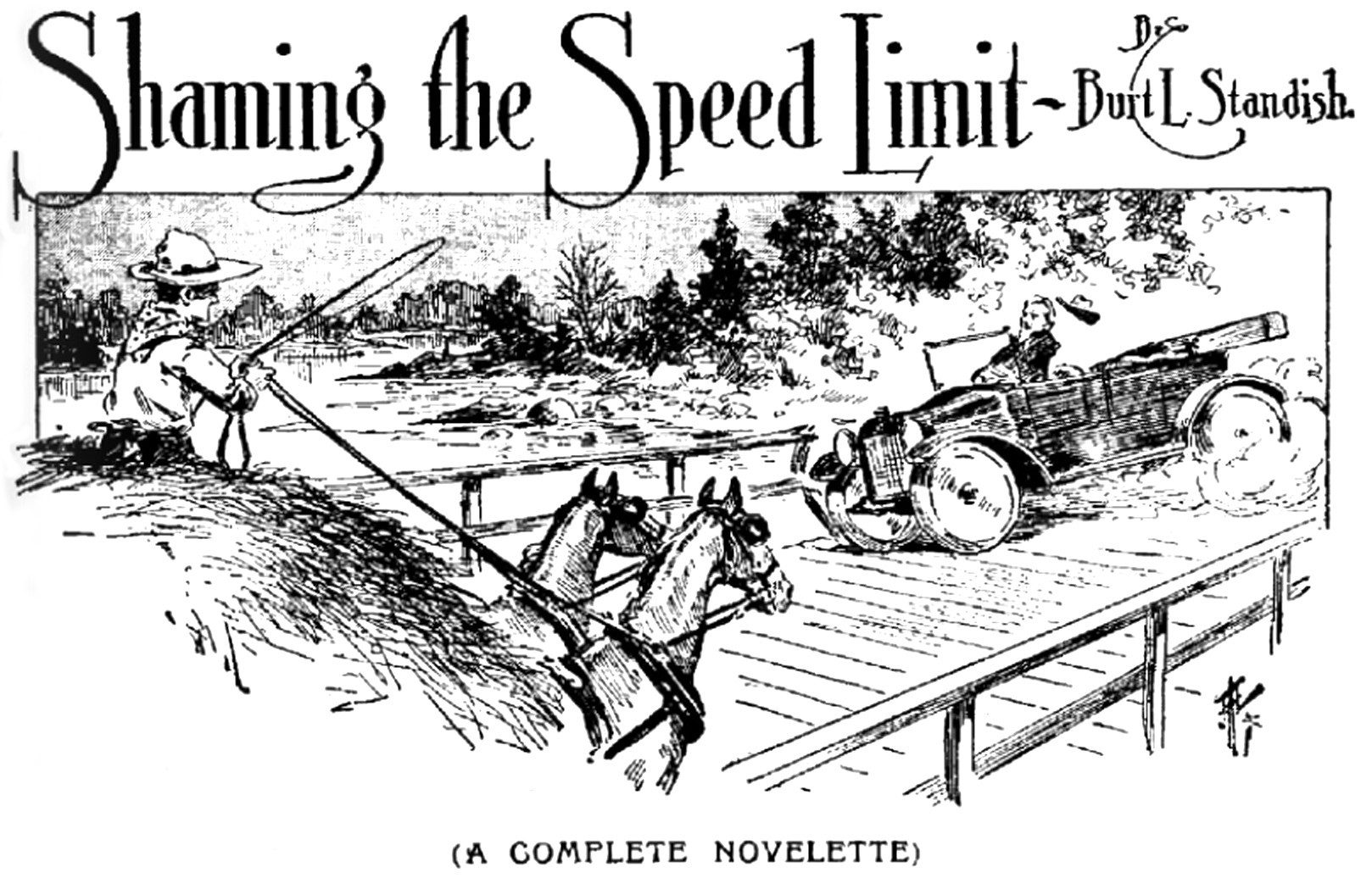
Shaming the Speed Limit
CHAPTER I
A GIRL, A DOG, AND A MAN.
When Miss Elizabeth Wiggin settled herself comfortably in the shade of the spreading oak in Libbyâs pasture, she looked forward eagerly to a pleasant and quiet hour with her book, âWooed, Won, and Wedded.â As may be surmised from the title of the book, Miss Wiggin was romantic. She was likewise just eighteen years of age, and the daughter of Judge Nathan P. Wiggin, of Greenbush, the village that could be seen nestling in the valley something like a mile distant from that hillside oak.
Miss Wiggin lived in Greenbush, but on pleasant afternoons she had a habit of wandering away, accompanied only by an aged shepherd dog, in search of some spot where she could read without fear of interruption. For her grim old father objected to trashy love stories, and her ascetic spinster aunt, who had acted as the judgeâs housekeeper since the death of Mrs. Wiggin, held all such fiction in abhorrence.
Indeed, the animus of Aunt Sally Wiggin against stories depicting the ravages wrought by the little god of the bow and arrow was so extreme that, by consigning such terrible tales to the flames whenever she found them about the house, she conscientiously did her best to prevent them from turning the head of her niece. She even forbade the village news dealer to sell Bessie any more books of that type.
In these days, however, it is no easy matter to deprive any one of the mental pabulum that is desired, and Aunt Sally had set herself a task that she could not accomplish. Lemuel Dodd, Judge Wigginâs hostler and man of all work, red-headed, freckled, and homely as a slump fence, undeterred by the discouraging fact that his persistent efforts to make love to Bessie seemed merely to arouse her amusement, became her secret and faithful ally. Twice a week, at least, he spent twenty-five cents of his wages for a paper-covered novel to be smuggled into her possession, and invariably he chose the ones whose titles seemed to promise that their contents would come up to Elizabethâs requirements.
âThere ainât many single fellers left round this town,â Lemuel told himself, âand mebbe if she reads enough of them yarns sheâll git so desprit sheâll have to grab whatâs handy. And when she gits the notion to grab, Iâm going to take keer that Iâm the handiest thing in reach.â
And so, on this sunny September afternoon, Bessie Wiggin was seeking the shade of the oak in Libbyâs pasture, presumably afar from interruption, and prepared thoroughly to enjoy Lemuelâs latest contribution. Her face was almost hidden by one of Aunt Sallyâs extremely old-fashioned sunbonnets, which she had hastily taken when she slipped out of the house with the book. Shep, the old dog, stretched himself in the short grass at her feet and prepared to go to sleep comfortably.
The view from this spot, at a considerable distance from the brown road that wound, ribbonlike, down into the village, was pleasant to the eye, but the judgeâs daughter lost no time in admiring the scenery. She was soon absorbed in the pages of her novel.
So absorbed did she become that she failed to hear the approaching steps of a somewhat dusty and soiled, but decidedly good-looking, young man in a brown Norfolk suit, knee-length leather leggings, and a motoring cap. He was within a few yards of her when he saw her and stopped.
âI beg your pardon, madam,â he said, looking down upon the obscuring sunbonnet.
She uttered a little startled scream, and looked up, her blue eyes wide, her red lips parted. A glimpse of the pretty and youthful face which the sunbonnet had concealed caused the stranger to catch his breath.
âReginald!â exclaimed Miss Wiggin, beholding before her the living incarnation of the hero of her book just as her fancy had pictured him.
âDaphne!â said the young man, thinking of the mythological wood nymph.
âWoof!â barked the old dog, awaking and springing up as quickly as age and rheumatism would allow.
The stranger backed round to the opposite side of the tree. âKeep that beast away from me, please,â he begged, in evident apprehension.
With a swift sweep of one slender hand, Miss Wiggin thrust back the sunbonnet, which, held by the loosely knotted ribbons, hung suspended on her shoulders, exposing a mass of wavy, golden-brown hair. At the same moment, with remarkable agility and grace, she half rose and half turned. On her knees, her right hand clasping the book, the fingers of her left hand lightly touching the ground, her gaze followed the shrinking young man, who was now fearfully watching the ominously growling dog. Surely this was unexpected and disappointing behavior for Reginald, the brave, who—in her novel—had unhesitatingly faced the most frightful perils for his lady fair.
Made suspicious by the actions of the stranger, Shep advanced, bristling and snapping. As if contemplating instant flight, the young man gave one hasty look around. The nearest fence was some six or eight rods away, and it did not promise to stop a ferocious and angry dog in pursuit of a fleeing fugitive, and there was no other refuge in sight.
âKeep that creature away, wonât you?â again entreated the agitated man, placing the trunk of the tree between himself and the animal. âI detest dogs!â
âOh, Reginald!â sighed Bessie Wiggin in bitter disappointment!
âOh, hang it!â exploded the stranger, with shocking violence. âIf I had a gun——â
Shep charged, barking violently. He meant to stop out of reach of the manâs feet in case he showed a disposition to kick. But, making a great leap, the stranger clutched a stout lower limb of the tree, and swung himself up out of the reach of harm with the most amazing celerity, the dog snapping at his heels as they receded skyward.
Perched astride the limb, with his feet drawn up, the refugee shook his fist at the raging animal, which, inflamed by success, made another great jump into the air and fell back on the ground, his age-enfeebled legs collapsing beneath him.
Still kneeling, the girl burst into a peal of laughter.
CHAPTER II
ROMANCE JUSTIFIED.
âGo to it!â said the exasperated man in the tree. âGet in your laugh while the laughingâs good. If your confounded dog had succeeded in chewing some chunks out of me, I suppose youâd simply have collapsed with merriment.â
âOh, dear!â gasped Miss Wiggin, trying to suppress her mirth. âIf you only realized how ridiculous it is! Old Shep couldnât hurt a sick kitten.â
âHuh!â grunted the stranger skeptically. âPerhaps not, but he certainly showed a strong desire to plant a few teeth in any part of my person that he could reach.â
Miss Wiggin continued to laugh. âIt would have to be a few teeth, as heâs lost almost all that he ever had, and heâs so old that heâs half deaf and getting blind. Thatâs why he didnât warn me that you were coming. If you hadnât shown that you were scared, heâd never have made an offer to touch you.â
âHow was I to know that?â demanded the man on the limb, flushing. âOn such short notice I couldnât tell whether he was a senile and harmless old dog or a young and savage one bent on making a meal off my person.â
âYouâre an awful coward, arenât you?â asked the girl, rising to her feet and regarding him with open contempt.
She was slender, willowy, and graceful. He considered that she was the prettiest girl he had ever seen, and he wondered how, even with the sunbonnet hiding her face, he had made the blunder of mistaking her for a middle-aged woman. He felt his heart thumping queerly. He also felt his face burning beneath her unmasked disdain.
âLet me explain,â he pleaded hastily.
âIt isnât necessary,â she cut him short. âI donât suppose there are any Reginalds to be found outside the pages of fiction.â
âThe Daphnes,â he returned, âare myths.â
She tossed her head. âBesides being a âfraid cat,â she retorted, âyouâre just about the most impolite person I ever met. What were you doing prowling around in this field, anyhow?â
âBeing in haste to secure a conveyance to Albion for two gentlemen whose motor has broken down back yonder on the road, I was making a short cut to town and avoiding the most of the hill. The gentlemen must catch the three-forty train at Albion. It is now,â he stated, balancing himself on the limb and taking out his watch, âseven minutes past two.â
âAnd twenty-three miles to Albion. Your gentlemen will have to hurry.â
âThey may make it if I can get an automobile in town.â
Again she laughed. âAutomobiles arenât popular in Greenbush. Peter Beedy is the only citizen who owns one. Heâs been arrested and fined four times for exceeding the speed limit of eight miles an hour. The last time that happened he was so mad he swore heâd never start the machine again, and he had it towed to his barn and stored away.â
âThanks for the information. Me for Peter Beedy.â He glanced downward. Sitting on his haunches and gazing upward with a wistful eye, Shep was licking his old chops. âIf you will be good enough to call your dog away and keep a firm, restraining hand upon him, Iâll hit the high spots between here and Mr. Beedyâs domicile.â
âAs long as youâre so completely lacking in sand,â said she, âIâll collar Shep and hold him until you get a fair start. But let me warn you that if you succeed in getting Beedyâs auto youâll certainly be pinched and fined if youâre caught driving faster than eight miles an hour anywhere within the town limits.â
âItâs always necessary,â was his retort, âfirst to catch your hare. If Beedyâs bubble has any speed at all, somebody will be handed a laugh. When you give the word, Iâll come down.â
Now it chanced that neither of them had noticed the approach of Libbyâs bull, confined in that same pasture. The bull was ugly, and resentful of intrusion on its domain. And just as the girl placed one hand on the dogâs collar the bull charged, with a snort and a bellow. The man on the limb shouted a warning. The girl screamed and dodged behind the tree. The dog, seeing the charging beast by accident, bounded lamely to meet him. And the bull, with one sweep of his horns, tossed the dog fifteen feet into the air.
The man in the tree was paralyzed with horror. The disastrous attempt of the dog to protect his mistress seemed to check the charging bull for barely a fraction of a second. With glaring eyes, the beast came on, dashing straight at the terrified girl.
âThe fence!â shouted the man. âRun!â
Even as he uttered the words he realized what would happen if she attempted to obey. The infuriated beast would overtake her, toss her with its horns even as the old dog had been tossed, gore her, trample the life out of her delicate body. For the briefest fraction of time, he was sickened by the thought. Then he dropped from the tree directly in the path of the mad creature. As he dropped, he snatched the cap from his head. The instant his toes touched the turf, he sprang to one side. The bull missed him by a foot, and he struck the animal across the eyes with his cap.
It seemed like a feeble thing to do, but he had time for nothing else, and he hoped desperately to turn the attention of the beast from the girl; hoped somehow, by diverting the creatureâs fury to himself, to give her an opportunity to flee to safety beyond the fence.
The girl had circled round the tree, keeping it between herself and the bull. As the man struck the animal, the latter swerved and turned with amazing speed, surprised, perhaps, by the appearance of a second human being on the scene. The stranger waved his arms and shouted challengingly. The animal accepted the challenge promptly and charged at him.
âOh!â gasped Miss Wiggin. âHeâll be—killed!â
But, almost with the agility of a capeador, the young man again leaped aside at precisely the right moment to foil the beast. Again he struck with his cap, but this time it was impaled on one of the bullâs horns and torn from his hand.
Without glancing round at the girl, he cried sharply, commandingly: âRun for the fence! Iâll keep him busy till you are safe.â
Bessie Wiggin ran, just as she was ordered to do, although she did not realize what she was doing until she had almost reached the fence. Too terrified to look back, she actually sailed over the barrier almost as a frightened deer might have done, scarcely touching the top rail, falling safe on the far side amid some bowlders and bushes, where for a moment she lay panting and helpless.
She was aroused by Shep. The faithful old dog had not been killed. Limping and whining, he had followed her in her flight and dragged himself through the fence. Still whining plaintively, he was licking her face.
With a sobbing cry, she seized the fence and pulled herself to her feet. Still baiting the bull, the young man was dodging round and round the tree, the enraged beast making every effort to reach him. He had kept his word; he had held the attention of the animal while she escaped; the handsome stranger she had called a coward had taken this dreadful risk for her.
Realizing the danger he was in, she called to him wildly: âOh, look out—look out! Jump—quick! Run! Do something!â
He certainly was doing something; in fact, he was an extremely busy person just then. Again and again he appeared to avoid the rushes of the bull barely by a hairâs breadth. Each time this happened the girlâs heart seemed ready to burst with terror. It could not last long. The snorting, bellowing beast would get him at last. A slight miscalculation, the slightest slip, and it would all be over.
Bessie Wiggin grasped a stake of the fence, and tried desperately to tear it loose, intending to return to the assistance of the stranger with this weapon. She was the coward, after all! She had run away and left him to be killed!
Then she saw him âput overâ a bit of strategy on the bull. The animal had paused for a moment, and turned slowly upon him, pawing the ground. Instead of placing the tree between himself and danger, the man planted his back against it, his eyes never leaving the beast for an instant.
Waving his hands in gestures of disdain, he taunted the creature. âCome on, old lumberheels! Wake up and show a little pep! Throw into high gear and give us some speed. Donât quit now; the funâs just begun. Wake up! Come on!â
The bull leaped forward like a hurricane. And just as the pale and horrified girl expected to see the man impaled to the tree, he slipped deftly behind it. The head of the bull crashed against the oak, and the animal staggered as if struck by a butcherâs maul.
The stranger laughed. âThat ought to give you a slight headache,â he said.
âRun!â cried the girl. âThis way—quick! Nowâs the time!â
Dazed, the bull was backing off slowly, shaking his head. Evidently the man agreed with Bessie that the moment was propitious, for he turned and raced toward the fence. But the animal had not been injured nearly as much as one might have supposed, and, seeing his mocking foe in flight, he plunged in pursuit.
The stranger was fleet-footed, but the bull was a trifle fleeter. Just as the runner gathered himself to take the fence with one clean leap, the beast overtook him. Through the air sailed the man, propelled by the head and horns of the bull, as well as by the spring of his own legs. Over the fence in a great curve he came, crashing head downward amid the rocks and bushes.
When the young man opened his eyes again, he discovered that his head was resting in the lap of Miss Bessie Wiggin, who, sobbing hysterically, was wiping his forehead with a bloodstained handkerchief.
He looked up at her and smiled. âDaphne!â he whispered.
âReginald!â she cried.
CHAPTER III
IT NEVER RAN SMOOTH.
âYouâre not killed, are you?â she sobbed, trying to stanch the flow of blood that trickled from a gash at the edge of his hair near his temple.
âIf I am,â he returned, with a feeble effort to jest, âI donât know it yet.â
âBut youâre hurt. You struck on your head.â
âProbably that saved my life. Solid ivory, you know. I will admit that I feel a trifle upset, so to speak. No, donât move—please donât! The mere thought of your moving gives me pain.â
âBut I must go for help. Youâre wounded.â
âI am,â he admitted, gazing up into her blue eyes in a manner that gave her a most peculiar sensation. âMortally wounded. I fear. I never was hit so hard in my life, and I am afraid I canât recover.â
Again she cried out in apprehension and distress. âOh, I was afraid you were done for when that beast caught you!â
âI am,â was his singularly cheerful acknowledgment; âIâm done for. Iâve got mine. The jig is up with me.â
âIs it your arms, your legs? Your ribs—are they smashed? Where do you feel it most?â
âHere,â he answered, putting his hand to his heart. âRut it isnât my ribs; itâs something deeper, Daphne.â
âThat isnât my name; itâs Bessie.â
âBessie! Mineâs George. Awfully commonplace, isnât it? Now, if my folks had only called me Reginald——â
âYou mustnât try to talk. Iâm sure itâs painful. You must keep still.â
âI will if youâll keep on talking yourself. The sound of your voice soothes me like the murmuring of a brook. Your eyes are like springtime violets. The touch of your little hand is as delicious as a draft of pure water to a person dying of thirst. Now Iâll leave it to you if a Reginald could beat that speech much.â
She stiffened and drew back a bit, the color beginning to return to her pale cheeks. They looked at each other steadily, and the returning flush covered her face.
Beyond the fence the victorious bull pawed the ground; from a vantage of safety the old dog glared through the rails and regarded the bull with disapproval, but the man and girl paid no attention to either of them. The girl had turned her gaze toward the distant road that wound down into the village.
âI donât believe you are hurt much,â she said, in a low voice, which, however, was made unsteady by a queer little throbbing in her throat. âIf you were, you couldnât talk like that.â
âItâs because I am that I can talk like that,â he declared. âItâs the first time I ever talked that way to any one.â
âYour friends who have to get to Albion,â she murmured; âIâm afraid theyâll lose their train.â
âBy Jove!â he cried, sitting up suddenly. âIâd clean forgotten them!â
âYou were fooling me!â she exclaimed, as she started to rise.
With a groan he fell back. The crimson, oozing from his wound, ran down across his temple, and in another moment she was again checking the flow with her handkerchief. His eyes were closed, and she imagined he had fainted.
âOh, dear!â She seemed distraught. âI donât know what to do! Iâve got to get help, but if I leave you, you may bleed to death.â
âDonât let me bleed to death,â he begged faintly. âDonât leave me—Bessie. You mustnât leave me—as long as I live.â
It seemed a great effort for him to lift his eyelids, but he looked at her again, and the appeal in his eyes filled her with a feeling of desperation.
âYou must have a doctor.â
âYouâre the only doctor I want. Youâre the only doctor who can cure me. If you throw up the case and turn me over to a common pill slinger, Iâll never get over it.â
âBut Iâve simply got to get help for you somehow. Iâll hurry.â
âI canât let you go. Iâm an awful coward, you know, and——â
âYouâre nothing of the sort! Iâve never seen anybody as brave as you are.â
A tremor ran over his body. At first she thought it was a convulsive movement of pain, but when it continued she was overcome by the astounding conviction that he was laughing. Astonishment gave place to outraged indignation. There was no mistaking the fact that he was really shaking with laughter that he sought in vain to suppress. She leaped up, letting him drop back, and stood rigid, filled with intense resentment.
âYou—youâre making sport of me!â she said, in a low voice that suddenly had in it something like icy brittleness. âYouâve been playing on my sympathy! Youâre not really hurt—much. It was a very ungentlemanly thing to do! I hope you have enjoyed yourself!â
He sat up without much effort. âI give you my word of honor that I didnât mean to laugh at you. Perhaps my head is affected a little. This crack on the bean must be the cause. It really was some bump.â
âYou—you wretch!â she cried, stamping her foot. âI hate you!â
Her little hands were tightly clenched. She turned away to hide the tears which welled again into her eyes; but now they were tears of exasperation, shame, and rage.
He got quickly to his feet. âPlease, Bessie!â he said. âYou donât understand. Not for the world would I——â
He stopped short, staring across at the road, down which a touring car containing two men was speeding toward the village.
âGreat Caesar!â he cried. âThere goes the governor! Hitchens must have got the engine running somehow. Theyâll expect to find me in town.â With all the strength of a good pair of lungs, he shouted, waving his hands above his head. The automobile sped on. Its occupants neither saw nor heard him.
âI guess Iâm left for the time being,â he said. âTheyâll go ripping straight through to catch that train at Albion.â
âThey wonât rip through very far,â Miss Wiggin flung at him. âThereâs a trap just outside the village, watched by a deputy sheriff and two constables. Your old governor will be nabbed and pulled up before my father, who will soak him with a fine. And I hope dad soaks him good,â she finished, laughing, and doing so with a vindictiveness that seemed to afford her untold relief and satisfaction.
CHAPTER IV
THE TRAPPERS.
Jeremiah Small, constable of the town of Greenbush, sat on the top rail of the roadside fence and wedged a load of fine cut into the bowl of a burned, blackened, odorous corncob pipe, packing it down with a decidedly dirty thumb. From his perch he could look over the top of a cluster of low sumacs and keep watch upon a point on the hillside where the highway wound into view. He could also see, somewhat nearer, a tall and lonely elm tree, past which the road ran in a broadside curve.
âWeepingâ Buzzell, another constable, was sitting on the ground in the shade of the sumacs, leaning against the fence, and occasionally wiping his red-rimmed and watery eyes with a faded and mussed bandanna handkerchief. His jaws worked wearily at a quid of tobacco, the presence of which was further advertised by the unmistakable stains at the corners of his doleful and flabby mouth. He had chosen his lowly position for comfort, and because his companion was far better adapted to the task of outlook.
âI tell you, âMiah,â sniffed Buzzell, âthis here job is jest about played out. A dollar-sixty a day ainât no livinâ pay for a hard-workinâ man, and thatâs all we git outside commissions on the fines the jedge imposes, and the deputy sheruff gits the biggest whack at them. We have to be pacified with what comes outer the little end oâ the horn. Yis-tidday my share was thutty-two cents, and so fur to-day we ainât nabbed only one motor-cycle feller who come through by accident, havinâ got off the road to Damascus. Iâm gittinâ discouraged.â
Constable Small made a final poke at the pipe bowl, and glanced down at the complaining individual. âNever knowed you to tackle any job that you didnât git discouraged over in a short time, Silas,â he averred contemptuously. âGittinâ discouraged is your long suit. Youâve been discouraged all your life.â
Buzzell moved his slouching shoulders resentfully. âMebbe thatâs so, âMiah, but I ainât never had no luck, like some folks. When I was swore in as constable and put on this job, there was an avârage of eighteen or twenty merchines a day that went through town regardless of speed regerlations. Business was lively, and I sorter guessed my luck had turned. But now them there automobile fellers has got wise and sent out warninâs and posted notices in all the garrages round about cautioninâ folks to keep away from Greenbush, and theyâre goinâ round by the way of Damascus or Cherryfield, and leavinâ us to twiddle our thumbs. My opinion, itâs hurt the town, too; Greenbush is deaderân a salted herrinâ.â
Small lifted a broganed foot and struck a match on the leg of his trousers, after which he held it up until his wheezing pipe was lit.
âBetter not go makinâ that kind of talk in the hearinâ of Jedge Wiggin,â he warned, pulling hard at the rebellious corncob. âIf you done so, heâd tell you what in a hurry, and youâd lose your badge so quick itâd make your head swim. You know him, Silas. He ainât got no use for automobiles nohow, and when he announced that he perposed to enforce the speed regerlations without fear or favor, he sartainly meant it. Heâd slap a fine onter the President of the United States if he was to go scootinâ through town fasterân the speed limit allows.â
âMebbe he would,â said Buzzell. âHeâs so hard-headed and sot it would be just like him. Jest because heâs alwus been a hoss owner and a hoss-man, heâs down on automobiles in genâral and evârybody that has anything to do with âem. I reckon thatâs whyhe wants to be representative to the legislator, he wants to go there to put through some kind of a bill to restrict the use of them merchines to certain roads so that the drivers of hosses can have the other roads to themselves. Thatâs jest how old-fashioned the jedge is.â
âLemme tell you somethinâ, Silas,â said Constable Small, taking his pipe from between his teeth and striking an impressive attitude with it. âThey better let him go. If the jedge donât git the nomination from this deestrict, heâll upset their apple cart as sure as preachinâ. Thereâll be three candidates in the primaries, and the party donât want Rufe Crockett, for heâs a windbag, a turncoat, and a flopper, and heâd be beat at the polls, just as he was four year ago on the ticket of tâother party. But if Jedge Wiggin canât win, Iâll bet you a twenty-cent plug of War Hoss he turns his strength agâinst Ephraim Glover, of Palmyra, and throws the nomination to Crockett. This deestrict is the keystone, and if the party loses it, theyâll most likely lose the whole county. I understand the governor himself is ruther fretted over the situation, with the primaries cominâ on next week.â
âI donât keer much about politics nohow,â declared Buzzell, wiping his eyes again. âOne partyâs bad as tâother, and there ainât neither of âem done nothing for me. Still I sâpose Iâm expected to vote for the jedge jest because I happened to be the most capable man they could find for this job. Nobody else I know of wanted it. I took it because it promised to be a purty good thing, not because Iâm particâler aginâ automobilists. Iâm goinâ to tell you my private idee: I think Nathan Wigginâs turned Greenbush into a graveyard by fininâ evârybody ketched goinâ fasterân eight miles in the town limits. Heâs give the place a black eye and set people to dodginâ it. He ainât progressive, thatâs ail I got to say.â
âAnd if youâve got any sense left in your noodle you wonât go round kow-wowing that kind of talk. If you did—— Hey! By gowdy! Here comes a bubble over the hill! Git up! Git out your ticker and ketch him when he passes the big elm. Heâs hittinâ it up like a streak of greased quicksilver.â
There was immediate action in the shade of the sumacs. With a sniffling grunt, which held something both of protest and eagerness, Weeping Buzzell heaved himself to his feet, fishing for his watch. On the fence Jeremiah Small already had his timepiece in hand. His snaggy teeth gripped the pipestem; his leathery face expressed the rapacity of the still hunter who has sighted game.
âReady, now!â he cried. âKetch him when I give the word. Now!â
Down the winding road shot the automobile, trailing a cloud of dust behind it. Besides the driver, a smoothfaced, bespectacled man of thirty, it contained only one person, a stout, florid, worried-looking individual in the middle years of life.
âCareful, Hitchens!â warned the latter, as the man at the wheel made a turn that barely prevented them from taking to the ditch. âYou know youâre not used to driving. Donât pile us up.â
âDonât worry, sir,â returned the driver reassuringly. âYou know youâve got to catch that train if youâre going to get to your office for the conference with the chairman of the State committee. Youâll have to talk with old Wiggin over the phone. No time to stop in Greenbush and chin with him now.â
âWeâve got to pick up the boy in town. He must have got there twenty minutes ago. Weâre liable to meet him starting out after me with a hired car. Keep your eyes peeled.â
Around another curve careened the car, and struck the straight, gentle incline running down into the village. Out from behind the sumacs dashed the constables, Jeremiah Small planting himself in the very center of the highway, one hand upflung authoritatively while the other flipped back his coat and revealed the badge pinned to his left suspender. Silas Buzzell backed him up, but with a shade more discretion about blocking the path of the speeding motor car.
âStop!â shouted Constable Small. âIn the name of the law I command you!â
âHold up!â wheezed Constable Buzzell. âStop right where ye be!â
âPinched!â exclaimed the driver, in disgust and consternation.
âDonât stop! Go on!â rasped the florid-faced man at his side. Then he lifted himself above the glass wind shield, flung up his gloved hands, and roared: âClear the road, you idiots! Out of the way! Get out!â
Seeing the automobile whizzing straight at him without slackening speed to any perceptible degree, Jeremiah Small cast his dignity to the winds and made a leap for safety. Weeping Buzzell backed off the shoulder of the road, caught his heel, and sat down amid the dusty grass of the shallow ditch. The car swished past, the stout man relaxing on the seat, and tore on its way.
âThatâll cost ye ten dollars more for defyinâ the majesty of the law!â spluttered Small, shutting his eyes to prevent them from being filled with the blinding cloud of dust flung over both officers. âThe jedge alwus tucks on an additional ten for that trick. Go it, you gay birds! The faster you drive, the higher youâll bounce when you hit the bumps. Come on, Silas! Deputy Newberryâll have that gay pair collared in two shakes of a lambâs tail.â
If the defiant autoists fancied they were to escape the clutches of the speed regulators in that easy manner, they soon realized their error. Farther on toward the village, running the full width of the road, were a series of artfully arranged ridges and hollows calculated to give a severe shaking up to the passengers of any motor car proceeding at a speed exceeding four or five miles an hour.
When this particular car struck those speed-killers, the two occupants were shot into the air with great violence. Coming down, the car seemed to meet them coming up, and the second and third bounces were worse than the first. Indeed, it was little short of remarkable that the florid-faced passenger succeeded in staying in the car at all. The driver, clinging desperately to the wheel, had a better chance, although he found it extremely difficult. And ahead of them the road undulated for a distance of several rods, like miniature waves of the sea.
âUgh! Woogh! Woosh!â spluttered the older man, clutching wildly at the bucking car. âWhat—in—Halifax! Shut her—unk!—down, Hitchens! Stop her!â
Hitchens struggled to obey, finally succeeding in throwing the clutch and jamming on the brake. The wheels, locked, slid with a grinding sound that meant money in the pocket of some tire manufacturer, the car bobbed and hobbled over the ragged places, and the pursuing cloud of dust swooped down over them. When the dust settled a little and they could catch their breath again, they beheld a formidable, satisfied-looking man calmly mounting the right-hand running board.
âIâm the deputy sheruff of this town,â announced the individual who had boarded them. âAnd you are took up for breaking the speed limit and defyinâ two regler authorized officers of the law.â
CHAPTER V
DISPENSING JUSTICE.
The driver bristled with indignation.
âItâs an outrage!â he cried. âWe must get to Albion in time to catch the three-forty train. You canât stop us.â
âIâve stopped ye already,â said Deputy Sheriff Newberry serenely. âUnder the circumstances it donât become you to tell me what I canât do. Youâll be permitted to proceed on your way to Albion after Jedge Wiggin attends to your case. So you might as well soople down and take it calm.â
âBut you donât understand, you donât know who youâre holding up in this high-handed fashion. You are interfering with——â
âWait, Hitchens!â cut in the other man, giving a glance at his watch. âNever mind telling him who we are.â
ââTainât necessary,â stated Newberry. âYouâll have to tell the jedge, anyhow.â
âHow long,â asked the man with the watch, âwill it require to get through with this business so that we may go on. It is most important that we should get that train.â
âWull,â drawled the deputy, âif the jedge is around handy, and he donât read you too long a lecture before he slaps on the fine, mebbe youâll git started agâin in half or three-quarters of an hour; âtainât likely to be moreân an hour, anyhow.â
âHalf an hour will make us miss the train. Canât we fix it with you?â
âNow take keer, take keer! Donât you go for to offer no bribes to an officer of the law. I couldnât take them nohow,â he added as Constable Small came hurrying up with Constable Buzzell wheezing and sniffling at his heels.
âBut,â protested Hitchens, âif you knew who——â
âNever mind that,â interrupted the older man sharply. âThe other business will have to wait. I have a curiosity to see just how Judge Wiggin handles cases of this sort.â
âYour curâosity,â assured Deputy Sheriff Newberry, swinging open the tonneau door, âwill be satisfied. Git in, boys!â
When the three men had all piled into the rear of the car the one in command directed Hitchens to drive straight down the long main street of the town, and proceeded slowly.
Their appearance in the village was the signal for various inhabitants who observed them to grin and wag their heads, making uncomplimentary and derisive remarks, while a number of small boys, hooting and laughing, assembled and followed the car as far as Turnerâs grocery, over which, in a bare and sparsely furnished room, Judge Wiggin dispensed justice by mulcting the unfortunate speeders who were arraigned before him. A number of idle citizens, who had been gossiping and swapping stories on the store steps, rose at once and followed the prisoners, conducted by Newberry and Buzzell, up the narrow back stairs to the âcourtroom.â Jeremiah Small had been sent to fetch the judge.
The automobilists were given chairs facing a table which served as a desk, and an anæmic-looking young man in horn-rimmed spectacles seated himself at the table and began making out the complaint, having first questioned Buzzell about the speed which the offenders had been making when they ran into the trap.
âYour name?â inquired the clerk, turning to the older man.
âPut down John Doe,â said the latter, âand Richard Roe,â he added, nodding toward his companion. âI am the owner of the car. Richard was driving when we were held up.â
The younger man gave him a queer look, and leaned closer, whispering something behind his hand. The answer was a grim smile and a shake of the head. After slight hesitation, the clerk wrote down the names as given.
The sound of heavy steps on the stairs preceded the entrance of Constable Small, who announced that the judge was out somewhere, but that Willie Baker and Nubby Snell had been sent scouting to find him.
âI never heard of such an outrage!â exploded the intensely annoyed Hitchens. âSomebody is going to regret this imposition. Time is valuable to us, and——â
âDonât git flustered and fly off the handle, mister,â advised Deputy Newberry, twisting off a quid of War Horse with his teeth and stowing it, bulging, into his cheek with a tongue made dexterous by long practice. âIt wonât joggle things along no faster, and I caâlate youâll be the one to do the regrettinâ if you go shootinâ off a lot of loose talk. If you git sassy before the jedge, I warn ye now that itâll probâly land ye in the caboose. âGo slowâ is a motter itâs best to toiler around here.â
âWhy donât you tell them something?â persisted Hitchens, again appealing to his companion.
âWhat talking I decide to do will be done to the judge himself,â said the older man.
In the course of fifteen minutes Judge Wiggin appeared. He was a lean and wiry man with a somewhat grim jaw and a steely blue eye. There was dignity in his manner. He scarcely glanced at the prisoners as he seated himself at the table opposite the clerk and adjusted his spectacles to read the complaint.
âHats off!â he ordered, rapping with his knuckles. âJohn Doe and Richard Roe, by the complaint of a deputy sheriff and two constables, by the town of Greenbush duly and legally authorized, you are hereby charged with catawamping a hossless vehicle over a public highway, lying within the town limits, at a speed of forty miles an hour, thereby rupturing the law made and provided, and wantonly and willfully endangering the peace and safety of other persons who might find it necessary to locomote upon said highway.
âAccording to the complaint,â the judge continued, âthe before-mentioned Richard Roe was the driver, and the before-mentioned John Doe the owner, of said hossless vehicle at the time of the infraction of said law. That being the fact, the penalty administered, in case the charge is admitted or proven, will be applied in full to the person who was engaged in piloting the juggernaut when you was nabbed. And let me add that in this court, with the exception of the judge presiding, unnecessary talk is a luxury, and luxuries add to the high cost of living. A word to the wise is a seed sown upon good ground that springeth up and beareth the fruit of economy. Richard Roe, guilty or not guilty?â
Biting his lip with annoyance, the younger of the two prisoners started to protest: âIt was necessary—er—your honor, that we should catch the westward-bound train at Albion. If you were aware who we are, who your petty officers, hiding like highwaymen in ambush, had ventured to hold up——â
Again Judge Wigginâs knuckles smote the desk. âApparently,â he said, âmy observation regarding the expense of unnecessary talk in this court failed to sink in, or even to make a dent. No excuse of private necessity condones infractions of the law. Your careless remark, as well as the suspicious nature of the names you have given, leads me to believe that you are pirooting around the country under false colors, and makes it rather probable that you are old offenders trying in that way to dodge the extreme penalty the court might see fit to administer if your real identities was known. I shall bear this in mind in passing sentence.â
The grinning spectators tittered guardedly. The older man reached out and placed a hand on his companionâs knee.
âYou can see that you are simply making matters worse,â he whispered. âAnything you may say will be used against us. Plead guilty at once.â
Squirming and rebellions, Hitchens complied. However, instead of passing sentence without delay, the judge squared away on his chair, locked the fingers of his hands before him, and proceeded to read the culprits a lengthy lecture anent the rights of the common people upon the highways and the outrageous and criminal manner in which these rights were disregarded by automobilists in general.
During this scathing harangue he scarcely looked at either of the impatient and suffering victims, but kept his gaze fixed, for the most part, on the rafters above their heads. He was the possessor of a fluent flow of language, and a somewhat homely native wit that was keen and stinging; and certain it was that his vituperation was in no degree delicately barbed. Even the self-restraint of the elder man was tested to the limit.
And presently, when the fine of twenty-five dollars and costs—twenty-eight dollars and thirty cents, all told—had been inflicted and paid over, the owner of the motor car released the safety valve.
âJudge Wiggin,â he said, âIâm compelled to tell you that it has never been my misfortune to witness a greater farce or a more ridiculous travesty of justice. You made it absolutely evident that, from the very beginning, your mind was made up and that you would impose a fine, regardless of extenuating circumstances. You practically warned us that any attempt at defense would merely increase the sum of money you were determined to get out of us. Such narrow-minded bigotry stamps you as a man unfit to represent this district in the legislature.â
Nathan Wiggin bent a grim and steady eye upon him. âAnd them few remarks,â he returned placidly, âconstitute a clear case of contempt, for which I shall have to tuck on another twenty-five dollars, to preserve the dignity of the court. However, considering the fact that the last time I heard you speak from the stump you shot off a whole lot of balderdash, for all of which the so-called intelligent voters of this State saw fit to elect you governor, Iâll remit the fine. And discretion being the better part of valor, let me suggest that you bottle up further seething criticism until we both get outside, where, as man to man, we can tell each other jest what we think, without mincinâ words.â
CHAPTER VI
A DEMONSTRATION POSTPONED.
A bombshell, exploding in that room, could hardly have created a greater sensation. The governor! The governor of the State, arrested for speeding in the little town of Greenbush, had been fined by Judge Wiggin, who, as a would-be candidate for the legislature, required the support and votes in his district of the governorâs own party!
Further than that, more extraordinary, more incomprehensible, having immediately recognized the governor as one of the two offenders, the judge had dared to reprimand him precisely as if he were an ordinary citizen; possibly with a trifle more caustic severity. And Nat Wiggin was altogether too shrewd and long-headed not to realize that a single word from the chief executive of the State would be almost certain to blast his political ambitions.
Nevertheless, a little calm thought would have led Wigginâs neighbors there assembled to realize that his fearless action was precisely what they might have expected of him. Never in his life had he played the toady, and he was not a person to cringe in the presence of power and pomp. âWithout fear or favorâ was his motto, and, right or wrong, he adhered to it. Hard-headed and obstinate he might be, but he was not inconsistent.
The spectators crowded forward on tiptoe, gaping, almost aghast. Frowning and grim, his face purple with anger, the governor stared at the judge. Calm and unperturbed as a June morning, the latter announced that court was adjourned, and rose from his seat. Trembling with deepest indignation, the governorâs secretary pulled at his elbow.
âCome,â urged Hitchens in a low tone, âletâs get out before I lose control of myself and twist that old lunaticâs nose.â
âI donât think youâd better try that, here or elsewhere, under any provocation,â returned the chief executive. âIâve a notion heâd take as much pleasure in fighting as in fining a speeder.â
They turned toward the stairs, the spectators, still staring wide-eyed, clattering back to open a lane through which they could pass. Weeping Buzzell was ahead of them, galvanized into unusual and amazing activity.
âMake way for the governor!â he snuffled, waving his arms.
Down the stairs in advance he stumped, bursting with eagerness to carry the news to those apathetic townsmen who had not been drawn by curiosity to the courtroom. Marvelous and incredible was the swiftness with which that news spread. Small boys carried it, scurrying. The governor had been nabbed for breaking the speed limit; Judge Wiggin had reprimanded and fined him. Villagers of both sexes and all ages came hurrying toward Turnerâs store, anxious to get a glimpse of the notable who had met such summary and impartial treatment at the hands of the âjedge.â Hitchens saw them assembling.
âLetâs get out of this hole,â he urged. âAll the jays in the town will be here in less than ten minutes.â He made for the automobile, which stood in front of the store, headed down the street.
âWeâve got to find George,â said the governor, following. âItâs odd he hasnât shown up. Wonder whatâs become of him.â
As they paused irresolutely beside the motor car the judge, having issued forth, approached. There was nothing placating or apologetic in his manner, nor did he wear an offensive, defiant air.
âGovernor,â he said, âif youâd seen fit to notify me by telefone that business of importance made it necessary for you to go skihooting through this town, Iâd have had the speed limit raised to fifty miles an hour for the occasion, and the officers keepinâ an open and clear road for ye. But when you was ketched, and hauled up before me, same as any other private person, and give a fictitious name, I figgered there was only one way to handle the case, which was the same as Iâd handle any other. Iâm aginâ these here highway locomotives on principle, and Iâd fine the Czar of Roosia if he was took up for speeding in one within the limits of this town.â
Something like a faint smile began to play around the corners of the governorâs mouth. âHow many times have you ridden in an automobile, Judge Wiggin?â he asked.
âJest about as many times as youâve rid on the tail of a comet, governor. A good, fast-steppinâ hoss suits me.â
âExactly. And youâve driven some fast steppers in your time. No doubt youâve driven them through the streets of this town at a much greater speed than eight miles an hour, thus endangering the lives of pedestrians and others upon the highways.â
âEndangerinâ fiddlesticks! I know how to handle hosses, sir. Iâve broke and trained hundreds of âem in my day. I know how to guide âem and how to stop âem.â
âStill you may not realize that an expert driver of a motor car has far more perfect control over his machine than the driver of a spirited horse can possibly have over the animal. Likewise, an auto moving at the same relative speed as a horse attached to a carriage may be stopped more quickly than the horse. Therefore the machine, properly handled, is a smaller menace to human safety than a horse-drawn carriage.â
âGovernor,â said Nathan P. Wiggin, âpoliteness forbids me to tell you jest what I think of that statement. Besides, Iâve got my coat on.â
âIf youâre too prejudiced,â said the governor, âget into this car with me, and you shall have a demonstration.â Just how this invitation would have been received at that moment cannot be said. Through the crowd came a panting, freckled, red-headed young man, flinging people aside with his long arms.
âHey, Jedge Wiggin!â he called chokingly. âBessieâs gone crazy! Come home quick!â
âWhutâs that, Lem Dodd?â cried the judge, snapping round and grabbing the young man by the shoulder. âMy darter—gone crazy? What dâye mean?â
âJest whut I say,â insisted Lem Dodd chokingly. âShe brung a strange young feller inter the house, and heâs got a crack on his cabeza, and he keeled over on the parlor sofy, and he looked like he was a goner, with his eyes shet, and she hollered and flopped on her knees beside him, and called him âReginalâ and âdear,â and called herself a murderer, and kissed him right slap on the kisser.â He caught his breath with a gulping sound of distress. âAnd when Miss Sally asked her who he was, she said she didnât know, and he donât bâlong round these parts, for I never see him before, and sheâs crazy as a June bug or sheâd never do no such thing.â
âThis,â said the judge, âis a case for immejiate investigation. Under the circumstances, governor, weâll have to postpone that demonstration till some future date.â
Then he set off for his home, a short distance up the street, accompanied by the agitated and urgent Lemuel Dodd.
CHAPTER VII
A NOVICE AT THE WHEEL.
The governor and Hitchens made inquiry of the crowd regarding their missing driver, but no one present seemed to have seen the man. Presently the governor turned to his secretary.
âYou donât imagine,â he asked in a low tone, âthat the young man who is injured in Judge Wigginâs house can be George?â
âThe girl called him Reginald, according to that fellow who brought word to the judge.â
âStill, Iâve got a queer notion that it may be the boy. Letâs investigate.â When they reached Wigginâs front door, George, a bandage tied round his head, was just coming out, followed by the judge, who seemed to be highly disturbed and indignant.
âIâm all right now, governor,â called the young man reassuringly. âA disagreeable bull helped me over a fence, and I sort of collapsed after walking into town.â
âGovernor,â said Nathan Wiggin grimly, âas near as I can find out, your shuffer climbed a tree to git away from a toothless, half-blind old shepherd dog, and run like the devil when Libbyâs bull took after him. Then he follered my darter home, and walked right into the house arter her. Whuther or not he was shamminâ when he flopped on the sofy with his eyes shet, Bessie was upsot and made a touse over him. Sheâs a ruther emotional girl. My sisterâs lookinâ after her now, and Iâve told her what I think of shuffers in genâral and young men that climb trees to get away from dogs without teeth enough to dent a biscuit.â
The governor laughed. âThere may be an excuse for the young man,â he said. âHe was bitten by a vicious dog when very young, but I donât think bulls could scare him much.â He put his arm across the shoulders of the young man. âAre you sure youâre not hurt much, George?â
âWell, not on the head,â was the reply. âBut that girl came pretty near finishing me. Sheâs a perfect witch, and I——â
âSuch a statement concerning my darter is slanderous, considering the fuss she made over him,â said Judge Wiggin in deep resentment. âBut I donât sâpose itâs anything more than could be expected of an ordinary shuffer.â
Again the governor laughed in a peculiar way. âPerhaps not,â he admitted, turning back to the judge. âIâd like to convince you, however, that my argument about automobiles was right, and, as long as you prevented me from catching my train after I had spent three hours persuading Ephraim Glover, of Palmyra, to withdraw and not contest you in the primaries, I think it is up to you to give me the chance.â
First Nathan Wiggin looked astonished, and then slowly his face turned red.
âWas that whut brought you inter these parts?â he asked.
âThat was the principal business. Glover was so hard to handle that I was delayed until it was only possible for me to get back by train in time for an important meeting to-night.â Judge Wigginâs embarrassment was painful. âGovernor,â he said, âcircumstances alter cases. Iâm ruther sorry circumstances interfered with that important appâintment of yours. But whininâ never stopped a blister from smarting, and itâs too late to dodge after youâve been jabbed by the business end of a hornet. Although Iâve said Iâd never set foot in one of them gas-wagon contraptions, considering whoâs invited me, if youâll agree to proceed circumspect and decorous within the town limits, and promise to land me back here safe and sound, Iâm going to take you up.â
âDone,â accepted Governor Bradley. âCome along, judge.â
Back to Turnerâs grocery, where the bigger part of the curious crowds still hovered around the touring car, they went, the governor walking arm in arm with Nathan Wiggin, greatly to the wonderment of the staring throng.
âI want you to sit on the forward seat so that you can watch the driver operate the car, judge,â said the governor, opening one of the forward doors. âGet in!â
The incredulous and bewildered spectators gasped when the judge complied without a murmur to this invitation. Lem Dodd had said that Bessie Wiggin had gone crazy, and now it seemed that Bessieâs father was ready for a padded cell.
âWull, what dâye think oâ that?â mumbled old Abner Nutter, poking his thumb into the ribs of Joshua Philbrook. âThe jedge—goinâ bubble ridinâ arter heâs swore a hundred times that there wasnât money enough in the United States treasury to hire him to set in one oâ them berjiggered things. Iâve heerd him say it with my own two ears.â
âTheyâve hippynotized him,â was Philbrookâs opinion. âNothinâ else explains it. He ainât in his right mind.â
âPerhaps youâd better let Hitchens drive, George,â said the governor, addressing the injured young man. âI declare, youâre pale! Sure youâre not badly hurt?â
âSomehow walking makes me dizzy,â was the answer. âStill, Iâm feeling better. I think Iâll step into this store and get a drink of water.â
Having become suddenly anxious, the chief executive followed him into the store. Hitchens, fretful and none too well pleased with the governor for wasting so much time on Wiggin, left the latter sitting in the car and mounted the store steps.
Aware that the accusing eyes of his fellow townsmen were upon him, Nathan Wiggin gave his attention to the mechanism of the car as displayed before him. He examined the levers and pedals, squinted at the clock and the speedometer and the gasoline gauge. He wondered at the numerous contrivances of push buttons and small levers on the dash. He even bent forward and curiously moved one of the latter from one side to the other. About that time a bold urchin who had climbed on the running board released the emergency brake.
It was a cry of warning from somebody in the crowd that made Judge Wiggin aware that the car was moving. It had been standing on a gentle incline, with its nose pointing down the long main street, and had started as soon as the brake was set free.
âHey!â shouted an excited voice. âSheâs goinâ! Jump, jedge!â
Nathan Wiggin did not jump. He was not greatly alarmed at first. The thing had barely started; it was not running away. He had broken and trained vicious horses that other men could do nothing with, some of them veritable man-killers, and surely he could stop an inanimate contrivance like a motor car, especially when it was not under power. Possibly he was restrained also by a conviction that he could not abandon the car with dignity, and by the knowledge that to abandon it at all under such circumstances would possibly make him an object of ridicule. He knew with what keen gusto the Greenbushers âharped on a jokeâ and nagged the victim thereof.
âWhoa!â said the judge, moving quickly over into the driverâs seat and grasping the wheel. âWhoa back!â
The car moved on, those persons who had been in front of it hastily scrambling out of the way. The judge braced hard with one foot against the clutch pedal, but that did not seem to have any effect. He grabbed one of the levers, thinking it might be the brake, and gave it a yank. It was the lever that manipulated the gears. At the same time his foot slipped off the clutch pedal.
Thrown into gear, the moving car cranked itself, and the engine leaped to life with a sudden vibrating hum. For in shifting the tiny lever on the dash Judge Wiggin had made connections with the magneto. The surprised man gasped as the machine gave a sudden forward lunge, like a horse beneath the stinging cut of a whip. Almost before he could gasp twice, the confounded thing was running away.
âWhoa!â shouted the dismayed man commandingly, surging back on the wheel with all his strength. âIf the bit holds, Iâll break your jaw, you——â
One foot was planted on the accelerator, jamming it down and opening the throttle wide. The engine roared beneath the quivering hood. The car made a jump that seemed to take all four wheels off the ground. Judge Wigginâs hat flew off, his sparse gray hair stood on end, his eyes bulged; but between his parted, drawn-back lips his teeth were set. Behind him he heard the horrified shouts of the crowd, through which Hitchens had vainly tried to plow a path in time to board the machine before it could get beyond his reach. Realizing he had failed, Hitchens stopped and flung up his arms in despair.
âThe old fool!â he groaned. âHeâll smash the car! Heâll be killed!â
CHAPTER VIII
WORSE THAN A WILD HORSE.
Annoyed and amazed by the inexplicable and cantankerous behavior of the automobile, Nathan Wiggin was, at the same time, aroused to resentment and wrath. The confounded thing was acting exactly like a wild, viciously ugly, unbroken colt. Immediately the judgeâs fighting blood rose. He was stirred by the tingling joy of contest; it throbbed in every vein of his body. Still holding the throttle wide open with one foot, he planted the other on the brake, and sawed at the wheel.
The things the automobile did then made it seem more than ever like a strong and furious young horse battling against restraint and mastery. It bucked and plunged in jerky jumps; it âpitched fence-corneredâ from side to side, after the style of a Western broncho; it snorted and choked and snorted again.
âWhoa, you dratted catamaran!â snarled the judge. âYouâve gotter whoa or Iâll take your jaw off!â
Only for the down grade he might have stalled the engine before the racking of the car caused his foot to fly off the brake pedal. When that happened, it continued on its way down the hill toward the wooden bridge that spanned the Swampscott River, swaying from one side of the road to the other. At times it threatened to climb trees or telephone poles, or crash through fences and plunge like a battering-ram into the fronts of houses or stores. But always the crazy machine swerved in time to avoid disaster, and shot across to the other side of the road.
When his right hand slipped from the wheel, the judge grabbed the side of the car body, and his clutching thumb jammed down the button that operated the electric siren. The button stuck, and the siren howled like a doomed demon of despair, causing Nathan Wigginâs hair to stand up stiff as the bristles on a horse brush.
The fearsome sound of the wailing whistle brought people running to windows to behold a sight no one in Greenbush had ever expected to see—Judge Wiggin driving an automobile! To say that he was driving it more than borders on hyperbole; it would be far closer to the truth to state that it was driving him—frantic! He was not habitually a profane man, but he possessed a broad vocabulary of vigorous expletives of a more or less impious nature; and it must be admitted that the language he addressed to that motor car would have shocked a parson. Those who dashed to their windows in time to see him shoot zigzagging past beheld a man that was little short of raving mad.
Hens that had been scratching peacefully in the village street fled, squawking. Barking furiously, a yellow dog charged out. The car leaped at the animal, struck it with one forward wheel, and sent it, spinning and howling, into the gutter.
Deaf as a doormat, old Betsy Tucker, going to market with a hand basket containing two dozen eggs, neither saw nor heard until the runaway auto was perilously close upon her and the judge was howling like a maniac for her to âclear the road.â Then she gave a yell and threw up her arms, flinging basket and eggs into the air. She was saved by sheer luck, for the judge, plunging at the wheel, turned the machine so that it missed her by less than a foot. The basket came down, bottom up, on Nathan Wigginâs head, and the eggs—well, for some moments thereafter the judge could not have seen to drive, had he possessed the required skill. From his shoulders up he resembled the initial preparation of an omelet.
âHoly sassafras!â he spluttered. âItâs raining fish glue! Everything happens at once!â
As soon as he could blink a pair of peepholes through that golden film—he did not dare let go with his hands to wipe his eyes—he saw that the foot of the hill was almost reached, and that the bridge across the peacefully flowing river lay just ahead. It was not a very wide bridge, and Tobias Blaisdell, perched on a load of hay drawn by two horses, was just driving on to the far end.
âBack up, you blinkety-blank jay-hawker!â yelled the judge. âMake a clear passage or Iâll bore a tunnel in ye!â
Had he been less excited he would have realized that it was much too late for such a cumbersome obstruction to get out of the way. Blaisdell had time only to check his horses and stare in horror at the shrieking engine of destruction that was charging upon him. He did not recognize Nathan Wiggin in the egg-bespattered wild man who seemed to be guiding the humming mechanism of disaster, but he knew that, in about four seconds, unless a miracle intervened, horses, motor car, hay, and human beings were going to be mixed in a spectacular and tragic smash.
Then, as the uncontrolled automobile reached the middle span of the bridge, the miracle took place. Shooting suddenly to one side, the machine struck the wooden railing, and went through it as if it had been constructed of clay pipestems. Into the deepest part of the river it plunged, flinging up a great sulash of spray, and disappeared from view. Nathan Wiggin, of Greenbush, vanished with it.
CHAPTER IX
WHEN THE LIMIT CAME OFF.
The shouts of the startled crowd in front of Turnerâs grocery had brought those within the store rushing out to learn the cause of alarm. The governor came with them, followed a second later by the young man who had been tossed by Libbyâs bull. They beheld the motor car well under way, and the judge struggling frantically and ineffectually to restrain it.
âGreat guns!â groaned the governor, turning pale. âWigginâs started the demonstration on his own hook. Heâll smash a four-thousand-dollar car and his neck at the same time!â
The young man with the bandaged head stiffened. If he felt weak or dizzy at that moment, he flung it off instantly. With a single bound he was at the foot of the store steps, against which leaned a bicycle, left there temporarily by some one. He grabbed the bicycle, uttering a ringing shout for everybody to get out of the way.
Through the scattered crowd he dashed, leaping to the saddle and catching the pedals with his nimble feet. Bending over the handlebars, he started in pursuit of the automobile, which, by this time, was halfway down the hill, with the wailing siren in full blast.
Continuing to jabber and shout, the crowd followed, stringing out in a straggling line. Boys and younger men were in the lead. Middle-aged, bewhiskered, bald-headed men came next. The rear guard was made up of the aged and decrepit; the very last one of all, bent with rheumatism, and hobbling with the aid of two canes, being Zebediah Titcomb, the sage of Greenbush.
Never since its foundation had the sleepy town of Greenbush beheld such a spectacle. Never in its history had there been such tremendous excitement within its boundaries. The end of all things terrestrial could scarcely have created a greater hullabaloo in that torpid community.
The young man on the bicycle was not able to overtake the runaway motor car before it reached the bridge, but he was not far behind it. When the automobile smashed through the railing and leaped into the river, he jumped from the bicycle and followed it without the slightest hesitation.
He was an excellent swimmer, and, rising from the plunge, he saw the head of Nathan Wiggin bob to the surface within reach of his arm. Immediately he fastened a hand on the manâs collar.
âKeep still! Stop thrashing,â he said, âand Iâll get you out.â
The somewhat difficult task of rescuing Judge Wiggin from drowning was accomplished, while the panting throng that had reached the bridge looked on and cheered. Reaching shallow water, the young man assisted the judge to his feet, and both waded forth to dry land.
Arriving on shore, the older man immediately sat down facing the river, beneath the sluggish surface of which Governor Bradleyâs automobile lay immersed. After a few choking gulps, he began to speak in accents and words of the utmost self-contempt.
âNate Wiggin,â he said, addressing himself, âyouâve lived to be fifty-four year old, and arrived at the conclusion that there wasnât anything that traveled on legs or wheels that you couldnât handle. Which goes to show that when a man thinks he knows all there is to know about anything a shrinkage has set in about half an inch beneath the roots of his hair. A wise fool is about as safe to have round as a stick of dynamite bakinâ in the oven of a red-hot stove. If he donât damage nobody else, heâs pretty likely to blow up and bust himself.â
The governor and his secretary, followed by a few others, came hurrying to the spot. Seeing them approach, the judge got upon his feet, dripping tiny rivulets.
âGovernor,â he observed, âthereâs no great loss without some small gain. Youâll save the price of a wash for that there automobile. Whatever damage or expense may accrue I caâlate Iâll have to sustain. I guess we can find a way to get her out.â
âIâm thankful,â said Governor Bradley, âthat you were not killed.â
âI donât see why that should choke you with joy. In your place Iâd probâly be so blazinâ mad Iâd start in to murder somebody.â
His eyes streaming and his nose snuffling, Weeping Buzzell broke in: âObadiah Cobb has come along with his hoss and wagon. Heâs right there at the end of the bridge, and heâll take ye home, jedge. You better git outer them wet clothes it you donât want to ketch your everlarsting.â
âIâm no wetterân this young feller who yanked me outer the drink,â said the judge. âHeâs got to come along to the house with me and get fixed up. And you, too, governor, and tâother gentleman—you come; I insist on it. Youâre going to stop with me, the whole caboodle of ye, to supper. Hosspitality deferred may be hosspitality soured, but Iâll guarantee to do my best to sweeten it up on this occasion.â
By this time it seemed that by far the greater portion of the inhabitants of the town were packed upon the bridge or jamming the roadway. And when Obadiah Cobb took the governor, the judge, and the other two men into his double seater and started back up the hill with them, the crowd laughed and cheered again.
âGovernor,â said Judge Wiggin, âI dunno whether thatâs meant for you or for the young man who hauled me out of the stream, but either way itâs proper well deserved. If you hadnât been dead game, youâd have kicked like a steer over whatâs happened, and if he wasnât good grit to the bone heâd never have gone into the river arter me. Which is admittinâ I made a mistake in sizing him up when I found my darter making a touse over him.â
Among the few villagers who remained unaware of the recent lively events were Judge Wigginâs sister and his daughter. Of course they were thrown into a great flutter. Miss Sally said: âMy stars!â What Miss Bessie said was whispered into the ear of the water-soaked but smiling young man, who gave her a look and a sly squeeze of the hand that brought a rosy flush to her cheeks.
Dry clothes were found; also âa little nip of something to parry off chills.â Warming up, the participants in the adventure joked and laughed, even though the judge seemed to have something on his mind that was giving him some serious thought. What this was appeared later after they had partaken of a genuine old-fashioned New England supper, topped off with doughnuts and hot apple pie and steaming, fragrant coffee.
Turning his eyes to the governor, who sat at the right of Miss Sally, Nathan Wiggin said: âGovernor, putting aside the question of damages I owe on account of what happened to your automobile, caâlate itâs up to me to express my appreciation of whut you done to induce Ephraim Glover to take back and give me a clear field. With a clear start, I reckon I can carry this deestrict, and help you to carry the county. Anyhow, Iâm going to lay myself out to do it.â
âThat sounds good to me,â laughed the governor.
âFurthermore,â pursued the host, âIâve decided to abolish the trapping of automobile drivers in this here town. Mebbe,â he admitted, âthis may appear a leetle dite selfish on my part as, havinâ got my dander up by the pranks played on me by that there gas go-cart of yourn, governor, Iâm contemplating buying one myself and running the consarned cantraption until I git it tamed. If there was traps hereabouts, mebbe Iâd git took up and have to fine myself for busting the speed limit. Therefore, henceforth there ainât going to be no speed limit in Greenbush.â
Beneath the edge of the table, old Shep, attempting to lick Bessieâs hand with his tongue, licked also the hand of the young man who sat beside her. And before sitting down, the young people had found an opportunity, quite unobserved, to exchange a few words in private. Somehow neither of them had evinced any great desire for food, but while George was still unnaturally pale, the roses continued to bloom in Bessieâs cheeks.
Now George spoke up boldly: âAs long as you have abolished the speed limit, Judge Wiggin, I am going to improve the occasion to ask you for your daughterâs hand in marriage. Doubtless it will seem rather hasty to you, but everything has moved with a rush this afternoon. I have put the question to Bessie, and won her consent.â
The governor stared. Miss Nancy nearly fainted. Bessie Wiggin trembled visibly. Nathan P. Wiggin gazed hard at the young man for about thirty seconds, and then scratched his chin, a queer pucker screwing up his face.
âWull, I declare!â said the judge at last. âThat is going some! Never quite reckoned on my darter hookinâ up with a shuffer, but, having saved me from drownding, youâve took me at a disadvantage. If Bessie has said yes, and you kin furnish the proper creedenshuls Iâll have to take your proposition under consideration, I guess.â
The governor looked Bessie Wiggin over appraisingly, and decided that he had made no mistake in thinking her an unusually pretty and charming young lady.
âIt is sudden,â he said, laughing softly, âand it would not have happened if George had not offered to drive for me to-day, my regular chauffeur being ill. In the way of credentials, judge, let me state that he is my son.â
The judgeâs sister sat bolt upright in a jiffy. The judge coughed behind his hand, the pucker crinkling the corners of his eyes.
âThem creedenshuls, governor,â he stated, âare wholly satisfactory to me.â His whole body seemed to shake oddly. âIâm afraid Iâm going to have a chill, after all,â he added. âI think the governor and me had better take a little walk in the moonlight.â
THE END
Transcriberâs Note: This story appeared in the May 1, 1915 issue of the Top-Notch magazine published by Street & Smith Company.