 THE POEMS OF
SIR EDWARD BULWER LYTTON, BART.
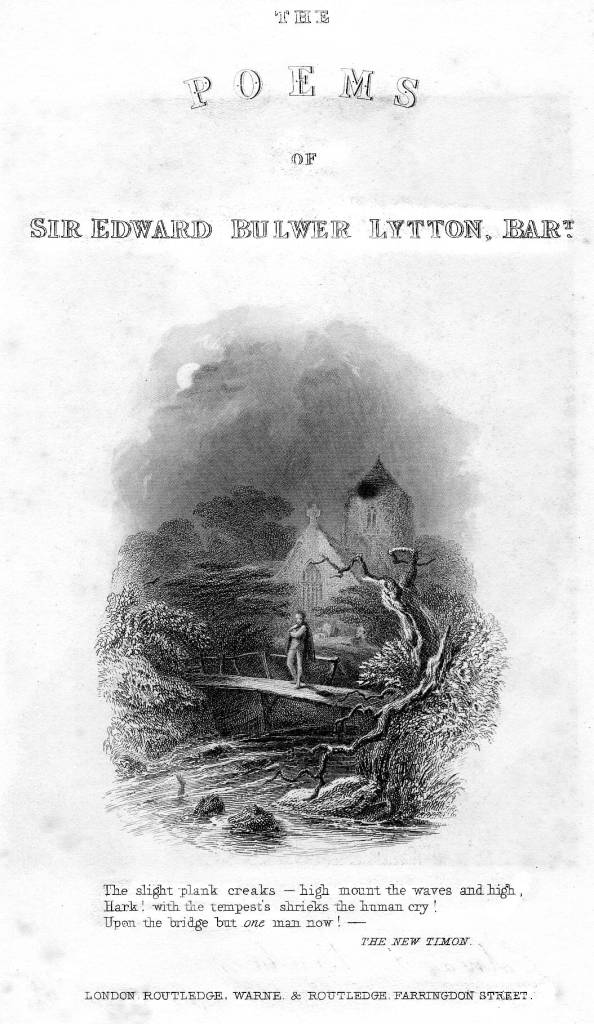
THE POEMS OF
SIR EDWARD BULWER LYTTON, BART.
The slight plank creaks—high mount the waves and high,
Hark! with the tempest's shrieks the human cry!
Upon the bridge but one man now!——
THE NEW TIMON.
LONDON ROUTLEDGE, WARNE AND ROUTLEDGE FARRINGDON STREET.
THE
POETICAL WORKS
OF
SIR EDWARD BULWER LYTTON, BART. M.P.
A NEW EDITION
LONDON:
ROUTLEDGE, WARNE, & ROUTLEDGE,
FARRINGDON STEEET;
NEW YORK: 56, WALKER STREET.
1860.
PREFATORY NOTE.
In this collection of the Author's Poems will be found some not before printed, and some entirely re-written from the more imperfect productions of earlier years. Few, if any, that have previously appeared, have escaped revision and alteration.
CONTENTS.
[Pg 1]
THE NEW TIMON.
While lamps yet twinkled, dawning crept the day.
Home from the hell the pale-eyed gamester steals;
Home from the ball flash jaded Beauty's wheels;
The lean grimalkin, who, since night began,
Hath hymn'd to love amidst the wrath of man,
Scared from his raptures by the morning star,
Flits finely by, and threads the area bar;
From fields suburban rolls the early cart;
As rests the revel, so awakes the mart.
Transfusing Mocha from the beans within,
Bright by the crossing gleams the alchemic tin,—
There halts the craftsman; there, with envious sigh,
The houseless vagrant looks, and limps foot-weary by.
Where the grim palace wears the prison's frown,
As mindful still, amidst a gaudier race,
Of the veil'd Genius of the mournful Place—
Of floors no majesty but Griefs had trod,
And weary limbs that only knelt to God.[A]
If stones had language—could that street convey!
Why yell the human bloodhounds panting there?—
To drown the Stuart's last forgiving prayer.[B]
[Pg 2]Again the bloodhounds!—whither would they run?
To lick the feet of Stuart's ribald son.
There, through the dusk-red towers, amidst his ring
Of Vans and Mynheers, rode the Dutchman king;
And there—did England's Goneril thrill to hear
The shouts that triumph'd o'er her crownless Lear?
There, where the gaslight streams on Crockford's door,
Bluff Henry chuckled at the jests of More;
There, where you gaze upon the last H. B.,
Swift paused, and mutter'd, "Shall I have that see?"
There, where yon pile, for party's common weal,
Knits votes that serve, with hearts abhorring, Peel,
Blunt Walpole seized, and roughly bought, his man;—
Or, tired of Polly, St. John lounged to Anne.
Well, let the world change on,—still must endure
While Earth is Earth, one changeless race—the Poor!
Within that street, on yonder threshold stone,
What sits as stone-like?—Penury, claim thine own!
She sate, the homeless wanderer,—with calm eyes
Looking through tears, yet lifted to the skies;
Wistful, but patient, sorrowful, but mild,
As asking God when He would claim his child.
A face too youthful for so hush'd a grief;—
The worm that gnaw'd the core had spared the leaf;
Though worn the cheek, with hunger, or with care,
Yet still the soft fresh childlike bloom was there;
And each might touch you with an equal gloom,
The youth, the care, the hunger, and the bloom;—
As if, when round the cradle of the child
With lavish gifts the gentler fairies smiled,
One vengeful sprite, forgotten as the guest,
Had breathed a spell to disenchant the rest,
And prove how slight each favour, else divine,
If wroth the Urganda of the Golden Mine!
Dawn to day strengthen'd, pass'd a stranger by:
He saw and halted;—she beheld him not—
All round them slept, and silence wrapt the spot.
To this new-comer Nature had denied
The gifts that graced the outcast crouch'd beside:
With orient suns his cheek was swarth and grim,
And low the form, though lightly shaped the limb;
Yet life glow'd vigorous in that deep-set eye,
With a calm force that dared you to defy;
And the strong foot was planted on the stone
Firm as a gnome's upon his mountain throne;
[Pg 3]Simple his garb, yet what the wealthy wear,
And conscious power gave lordship to his air.
Long he gazed silent, and at last began:
"Poor homeless outcast—dost thou see me stand
Close by thy side, yet beg not? Stretch thy hand."
The voice was stern, abrupt, yet full and deep:
The outcast heard, and started as from sleep,
And meekly rose, and stretch'd the hand and sought
To murmur thanks—the murmur fail'd the thought.
He took the slight thin hand within his own:
"This hand hath nought of honest labour known;
And yet methinks thou'rt honest!—speak, my child."
And his face broke to beauty as it smiled.
But her unconscious eyes, cast down the while,
Met not the heart that open'd in the smile:
Again the murmur rose, and died in air.
"Nay, what thy mother and her home, and where?"
Lo, with those words, the rigid ice that lay
Layer upon layer within, dissolves away,
And tears come rushing from o'erchargèd eyes:—
"There is my mother—there her home—the skies!"
Oh, in that burst, what depth of lone distress!
O desolation of the motherless!
Yet through the anguish how survived the trust,
Home in the skies, though in the grave the dust!
The man was moved, and silence fell again;
Upsprung the sun—Light re-assumed the reign;—
Love ruled on high! Below, the twain that share
Men's builded empires—Mammon and Despair!
The stranger spoke: "Thy bitterer grief mine own;
Amidst the million, lonely as thou art,
Mine the full coffers, but the beggar'd heart.
Yet Gold—earth's demon, when unshared, receives
God's breath, and grows a god, when it relieves.
Trust still our common Father, orphan one,
And He shall guide thee, if thou trust the son.
Nay, follow, child." And on with passive feet,
Ghost-like she follow'd through the death-like street.
They paused at last a stately pile before;
The drowsy porter oped the noiseless door;
The girl stood wistful still without;—the pause
The guide divined, and thus rebuked the cause:—
"Enter, no tempter let thy penury fear;
I have a sister, and her home is here."
[Pg 4]
Beneath the roof of Fortune's favour'd son?
Ill stars predoom'd her, and she stole to birth
Fresh from the Heaven,—Law's outcast on the earth;
The child of Love betraying and betray'd,
The blossom open'd in the Upas shade;—
So ran the rumour; if the rumour lied,
The humble mother wept, but not denied:
Ne'er had the infant's slumber known a rest
On childhood's native shield—a father's breast.
Dead or neglectful, 'twas to her the same; }
But, oh, how dear!—yea, dearer for the shame, }
All that God hallows in a mother's name! }
Here, one proud refuge from a world's disdain,
Here the lost empress half resumes her reign;—
Here the deep-fallen Eve sees Eden's skies
Smile on the desert from the cherub's eyes.
Sweet to each human heart the right to love;
But 'tis the deluge consecrates the dove;
And haply scorn yet more the child endears,
Cradled in misery, and baptized with tears.
The sinless infant and the erring mother:
The one soon lost the smile which childhood wears,
Chill'd by the gloom it marvels at—but shares;
The other, by that purest love made pure,
Learn'd to redeem, by labouring to endure;
Who can divine what hidden music lies
In the frail reed, till winds awake its sighs?
There, kindness brought no holiday of mirth;
No kindred visited, no playmate came;—
Joy, the proud worldling, shunn'd the child of shame!
Yet in the lesson which, at stolen whiles,
'Twixt care and care, the respite-hour beguiles,
The mother's mind the polish'd trace betrays }
Of early culture and serener days; }
And gentle birth still moulds the delicate phrase. }
By converse, more than books (for books too poor),
Learn'd Lucy more than books themselves insure;
For if, in truth, the mother's heart had err'd,
Pure now the life, and holy was the word:
The fallen state no grov'ling change had wrought;
Meek if the bearing, lofty was the thought;
So much of noble in the lore instill'd,
You felt the soul had ne'er the error will'd;—
[Pg 5]That fraud alone had duped its wings astray
From their true instinct tow'rds empyreal day.
Thus life itself, if sadd'ning, still refined,
And through the heart the culture reach'd the mind.
As to the moon the tides attracted move,
So flow'd the intellect beneath the love.—
To nurse the sickness, to assuage the care,
To charm the sigh into the happier prayer;
Forestall the unutter'd wish with ready guess;
Wise in the exquisite tact of tenderness!
These Lucy's study;—and, in grateful looks,
Seraphs write lessons more divine than books.
Fair time, which dreams so gently steal away;
When Life—dark volume, with its opening leaf
Of Joy,—through fable dupes us into grief—
Tells of a golden Arcady;—and then
Read on,—comes truth;—the Iron world of men!
But from her life thy opening poet page
Was torn!—Its record had no Golden Age.
There the wan mother—there the last disease!
Dread to the poor the least suspense of health,—
Their hands their friends, their labour all their wealth:
Let the wheel rest from toil a single sun,
And all the humble clock-work is undone.
The custom lost, the drain upon the hoard,
The debt that sweeps the fragment from the board,
How mark the hunger round thee, and be brave—
Foresee thy orphan, and not fear the grave?
Lower and ever lower in the grade
Of penury fell the mother and the maid,
Till the grim close; when, as the midnight rain
Drove to the pallet through the broken pane,
The dying murmur'd: "Near,—thy hand,—more near!
I am not what scorn deem'd,—yet not severe
The doom which leaves me, in the hour of death,
The right to bless thee with my parting breath—
These, worn till now, wear thou, his daughter. Live
To see thy sire, and tell him—I forgive!"
Cold the child thrills beneath the hands that press
Her bended neck—slow slackens the caress—
Loud the roof rattles with the stormy gust;
The grief is silent, and the love is dust;
From the spent fuel God's bright spark is flown;
And there the Motherless, and Death—alone!
That trance, that pause, the tempest leaves behind:
Still, with a timid step, around she crept,
And sigh'd, "She sleeps!" and smiled. Too well she slept!
Dark strangers enter'd in the squalid cell;
Rude hirelings placed the pauper in the shell;
Harsh voices question'd of the name and age;
Ev'n paupers live upon the parish page.
She answers not, or sighs, and smiles, and keeps
The same meek language:—"Hush! my mother sleeps."
They thrust some scanty pence into her palm,
And led her forth, scarce marv'ling at her calm;
And bade her work, not beg—be good, and shun
All bad companions—so their work was done,
And the wreck left to drift amidst the roar
Of the Great Ocean with the rocky shore.
Melt the long shadows. Dawn is in the skies.
Low on the earth, while Night endures,—unguess'd
Hope folds the wing and slumbers on its nest;
Let but a sunbeam to the world be given—
And hark—it singeth at the gates of Heaven!
The step fell timid in each gorgeous room,
Vast, sumptuous, dreary as some Eastern pile,
Where mutes keep watch—a home without a smile;
Still as if silence reign'd there, like a law,
And left to pomp no attribute but awe;
Save when the swell of sombre festival
Jarr'd into joy the melancholy hall,
So some chance wind in mournful autumn wrings
Discordant notes, although from music-strings.
Wild were the wealthy master's moods and strange,
As one whose humour found its food in change;
Now for whole days content apart to dwell
With books and thought—his world the student's cell;
And now, with guests around the glittering board,
The hermit-Timon shone the Athenian lord.
There bloom'd the bright ephemerals of the hour,
Whom the fierce ferment forces into flower,
The gorgeous nurslings of the social life,
Sprung from our hotbeds—Vanity and Strife!
Lords of the senate, wrestlers for the state,
Grey-hair'd in youth, exhausted, worn,—and great;
Pale Book-men,—charming only in their style;
And Poets, jaundiced with eternal bile;—
[Pg 7]All the poor Titans our Cocytus claims,
With tortured livers, and immortal names:—
Such made the guests, Amphitryons well may boast,
But still the student travail'd in the host;—
These were the living books he loved to read,
Keys to his lore, and comments on his creed.
From them he rose with more confirm'd disdain
Of the thorn-chaplet and the gilded chain.
Oft, from such stately revels, to the shed
Where Hunger couch'd, the same dark impulse led;
Intent, the Babel, Art has built, to trace,
Here scan the height, and there explore the base;
That structure call'd "The Civilized," as vain
As its old symbol on the Shinar plain,
Where Pride collects the bricks and slime, and then
But builds the city to divide the men;
Swift comes the antique curse,—smites one from one,
Rends the great bond, and leaves the pile undone.
The vast expanse defeats the searching mind,
Blent in one mass each varying height and hue:—
Wouldst thou seize Nature, Artist?—bound the view!
But He, in truth, is banish'd from the ties
That curb the ardent, and content the wise;
From the pent heart the bubbling passions sweep,
To spread in aimless circles o'er the deep.
A soul at discord with the part it play'd;
A soul in social elements misplaced,
Bruised by the grate and yearning for the waste,
And wearing custom, as a pard the chain,
Now with dull torpor, now with fierce disdain.
Which nobler natures weave themselves around:
Those stars which make their own charm'd atmosphere;
Not wholly love, but yet more love than fear,
A mystic influence, which, we know not why,
Makes some on earth seem portions of our sky.
Those kinglier virtues which subject us most;
The ear inclined to every voice of grief,
The hand that oped spontaneous to relief,
The heart, whose impulse stay'd not for the mind }
To freeze to doubt what charity enjoin'd, }
But sprang to man's warm instinct for mankind; }
[Pg 8]Honour, truth's life-sap, with pervading power
Nurturing the stem to crown it with the flower;
And that true daring not alone to those
Whom fault or fate has marshall'd into foes;
But the rare valour that confronts with scorn
The monster shape, of Vice and Folly born,
Which some "the World," and some "Opinion," call,
Own'd by no heart, and yet enslaving all;
The bastard charter of the social state,
Which crowns the base to ostracise the great;
The eternal quack upon the itinerant stage,
This the "good Public," that "the enlighten'd Age,"
Ready alike to worship and revile,
To build the altar, or to light the pile;
Now "Down with Stuart and the Reign of Sin,"
Now "Long live Charles the Second and Nell Gwynne;"
Now mad for patriots—hot for revolution,
Now all for hanging and the Constitution.
Honour to him, who, self-complete, if lone,
Carves to the grave one pathway all his own;
And, heeding nought that men may think or say,
Asks but his soul if doubtful of the way.
Now view the contrast which the worse bestow'd.
Large was his learning, yet so vague and mix'd
It guided less the reason than unfix'd;
The dauntless impulse and the kingly will,
Prompted to good, but leapt the checks to ill;
Quick in revenge, and passionately proud,
His brightest hour still shone forth from a cloud,
And none conjecture on the next could form—
So play'd the sunbeam on the verge of storm.
Age sighs, and smiles, and trembles to recall.
From childhood fatherless and lone begun
His fiery race, beneath as fierce a sun,
Where all extremes of Love and Horror are,
Soft Camdeo's lotos bark, grim Moloch's gory car;
Where basks the noonday luminously calm,
O'er eldest grot and immemorial palm;
And in the grot, the Goddess of the Dead
And the couch'd strangler, list the wanderer's tread,
And where the palm leaves stir with breeze-like sigh,
Sports the fell serpent with his deathful eye.
Uncurb'd, self-will'd to man had Morvale grown.
His sire (the offspring of an Indian maid
And English chief), whose orient hues betray'd
The Varna Sankara[C] of the mix'd embrace.
Carved by his sword a charter from disgrace;
Assumed the father's name, the Christian's life,
And his sins cursed him with an English wife:
A haughty dame, whose discontented charms
That merchant, Hymen, bargain'd to his arms.
In war he fell: his wife—the bondage o'er,
Loath'd the dark pledge the abhorrèd nuptials bore—
Yet young, her face more genial wedlock won,
And one bright daughter made more loath'd the son.
Widow'd anew, for London's native air,
And two tall footmen, sigh'd the jointured fair:
Wealth hers, why longer from its use exiled?—
She fled the land and the abandon'd child;
Yet oft the first-born, 'midst the swarthier race,
Gazed round and miss'd the fair unloving face.
In vain the coldness, nay, the hate had been,
Hate, by the eyes that love, is rarely seen.
With looks that ever on his own had smiled;
With rosy lips, caressing and caress'd;
Led by his hand and cradled on his breast:
But, as the cloud conceals and breaks in flame,
The gloom of youth the fire of man became.
Not his the dreams that studious life allows,
"Under the shade of melancholy boughs,"—
Dreams that to lids the Muse anoints belong,—
Rocking the passions on soft waves of song:
No poet he; adventure, wandering, strife,
War and the chase, wrung poetry from life.
Told o'er his rupees and perceived his end.
Life's business done—a million made—what still
Remain'd on earth? Wealth's last caprice—a Will!
The man was childless—but the world was wide;
He thought on Morvale, made his will,—and died.
They sought and found the unsuspecting heir
Crouch'd in the shade that near'd the tiger's lair;
His gun beside, the jungle round him—wild,
Lawless and fierce as Hagar's wandering child:—
[Pg 10]To this fresh nature the sleek life deceased
Left the bright plunder of the ravaged East.
Which comes when Nature man deserts for Art:
His northern blood, his English name, create
Strife in the soul, till then resign'd to fate;
The social world with blander falsehood graced,
Smiles on his hopes, and lures him from the waste.
Alas! the taint that sunburnt brow bespeaks,
Divides the Half-Caste from the world he seeks:
In him proud Europe sees the Paria's birth,
And haughty Juno spurns his barren hearth.
Half heathen, and half savage,—all estranged
Amidst his kind, the Ishmael roved unchanged.
Till wearied passion paused in its career:
Youth goads us on to action; lore of men
Brings thought—thought books—books quiet; well, and then?
Alas! we move but in the Hebrews' ring;[D]
Our onward steps but back the landmarks bring,
Until some few at least escape the thrall,
And breathe the space beyond the flaming wall:
Feel the large freedom which in faith is given,
And poise the wings that shall possess the heaven.
Closed that last refuge on the homeless son,
Till death approach'd, and Conscience, that sad star,
Which heralds night, and plays but on the bar
Of the Eternal Gate,—laid bare the crime,
And woke the soul upon the brink of time.
Haply if close, too closely, we would read
That sibyl page, the motive of the deed,
Remorse for him her life abandon'd, weaves
Fear for the dearer one her death bereaves;
And penitent lines consign'd, with eager prayer,
The lorn Calantha to a brother's care.
Not till long moons had waned in distant skies,
O'er the last mandate wept the Indian's eyes;
But the lost sister lived, the flower of yore
Bloom'd from the grave,—and earth was sweet once more;
Fair Florence holds the heart he yearns to meet;
Swift, when heart yearns to heart, how swift the feet!
[Pg 11]Well, and those arms have clasp'd a sister now!
Thy tears have fallen on a sister's brow!
Alas! a sister's heart thy doom forbade;
Thy lot as lonely, and thy hearth as sad.
Is that pale shade the Peri-child in truth,
Who shone, like Morning, on the hills of Youth?
Is that cold voice the same that rang through air,
Blithe as the bird sings in rebuke of care?
That dove brought nought of gladness to his ark;
No loving step, to meet him homeward, flew;
Still at his voice her pale cheek paler grew.
The greeting kiss, the tender trustful talk,—
Arm link'd in arm—the dear familiar walk;
The sweet domestic interchange of cares,
Memories and hopes—this union was not theirs.
Partly perchance the jealous laws that guard
The Eastern maids, their equal commune barr'd;
For still, in much the antique creed retain'd
Its hold, and India in the Alien reign'd:
That superstitious love which would secure
What the heart worships, for the world too pure;
And wrap with solemn mystery and divine,
From the crowd's gaze, the idol and the shrine,
In him was instinct,—generous if austere;
More priestly reverence, than dishonouring fear.
Yet wherefore shun no less, if this were all,
His lonely chamber than his crowded hall?
For days, for weeks, perchance, unseen, aloof
Far as the poles, beneath one common roof,
She drew around her the cold spells, which part
From forward sympathies the unsocial heart.
Yet, strange to say, each seem'd to each still dear;
And love in her but curb'd by stronger fear;
And love in him by some mysterious pride,
That sought the natural tenderness to hide:
Did she but name him, you beheld her raise
Moist eyes to heaven, as one who inly prays.
News of her varying health he daily sought,
And his mood alter'd with the tidings brought:
If worse than wonted, it was sad to view
That stern man's trembling lip and waning hue,—
Sad, yet the sadness with an awe was blent,—
No words e'er gave the struggling passion vent;
And still that passion seem'd not grief alone,
Some curse seem'd labouring in the stifled groan:
Some angrier chord the mix'd emotion wrench'd;
The brow was darken'd, and the hand was clench'd.
In so much love, and so much tenderness.
What sword, invisible to human eyes,
So sternly sever'd Nature's closest ties:
To leave each yearning unto each—apart—
All ice the commune, and all warmth the heart?
Gave the night's refuge,—more than refuge there?
At morn the orphan hostess had received
The orphan outcast,—heard her and believed,—
And Lucy wept her thanks, and turn'd to part;
But the sad tale had touch'd a woman's heart.
Calantha's youth was lone, her nature kind,
She knew no friend—she sigh'd a friend to find;
That chasten'd speech, the grace so simply worn,
Bespoke the nurture of the gentle-born;
And so she gazed upon the weeping guest,
Check'd the intended alms, and murmur'd "Rest,
For both are orphans,—I should shelter thee,
And, weep no more—thy smile shall comfort me."
Her grateful heart the saving hand repay.
Calantha loved her as the sad alone
Love what consoles them;—in that life her own
Seem'd to revive, and even hope to flower:
Ah, over Sorrow Youth has such sweet power!
The very menials linger'd as they went,
To spy the fairy to their dwelling sent,
To list her light step on the stair, or hark
Her song;—yes, now the dove was in the ark!
Ev'n the cold Morvale, spell'd at last, was found
Within the circle drawn his guest around;
Less rare his visits to Calantha grew,
And her eye shrunk less coldly from his view
The presence of the gentle third one brought
Respite to memory, gave fresh play to thought;
And as some child to strifeful parents sent,
Laps the long discord in its own content,
This happy creature seem'd to reach that home,
To say—"Love enters where the guileless come!"
It was not mirth, for mirth she was too still;
It was not wit, wit leaves the heart more chill;
But that continuous sweetness, which with ease
Pleases all round it, from the wish to please,—
This was the charm that Lucy's smile bestow'd;
The waves' fresh ripple from deep fountains flow'd;—
[Pg 13]Below exhaustless gratitude,—above,
Woman's meek temper, childhood's ready love.
And lonely thought stole musing on to prayer;
As some fair lake reflects, when day is o'er,
With clearer wave from farther glades the shore,
So, her still heart remember'd sorrows glass'd;
And o'er its hush lay trembling all the past,
Again she sees a mother's gentle face;
Again she feels a mother's soft embrace;
Again a mother's sigh of pain she hears,
And starts—till lo, the spell dissolves in tears!
Tears that too well the faithful grief reveal,
Which smiles, by day made duties, would conceal.
And all was life, but London's life, below;
As by the open casement half reclined
Calantha's languid form;—a gentle wind
Brought to her cheek a bloom unwonted there,
And stirr'd the light wave of the golden hair.
Hers was a beauty that made sad the eye,
Lovely in fading, like a twilight sky;
The shape so finely, delicately frail,
As form'd for climes unruffled by a gale;
The lustrous eye, through which looks forth the soul,
Bright and more brightly as it nears the goal;
The fever'd counterfeit of healthful bloom,
The rose so living yet so near the tomb;
The veil the Funeral Genius lends his bride,
When, fair as Love, he steals her to his side,
And leads her on till at the nuptial porch,
He murmurs, "Know me now!" and lowers the torch.
What made more sad the outward form's decay,
A soul of genius glimmer'd through the clay;
Oft through the languor of disease would break
That life of light Parnassian dreamers seek;
And music trembled on each aspen leaf
Of the boughs drooping o'er the fount of grief.
Death seems unnatural when it sighs—"Be still."
That wealth, which Nature prodigally gave,
Shall Life but garner for its heir the Grave?
What noble hearts that treasure might have bless'd!
How large the realm that mind should have possess'd!
[Pg 14]Love in the wife, and wisdom in the friend,
And earnest purpose for a generous end,
And glowing sympathy for thoughts of power
And playful fancy for the lighter hour;
All lost, all cavern'd in the sunless gloom
Of some dark memory, beetling o'er the tomb;—
Like bright-wing'd fairies, whom the hostile gnome
Has spell'd and dungeon'd in his rocky home,
The wanderer hears the solitary moan,
Nor dreams the fairy in the sullen stone.
Fresh as a morn of April bloom'd the guest:
April has tears, and mists the morn array;
The mists foretell the sun,—the tears the May.
Lo, as from care to care the soother glides,
How the home brightens where the heart presides!
Now hovering, bird-like, o'er the flowers,—at times
Pausing to chant Calantha's favourite rhymes,
Or smooth the uneasy pillow with light hand;
Or watch the eye, forestalling the demand,
Complete in every heavenly art—above
All, save the genius of inventive love.
To half the pomp of elder days the scene.
Gaze to thy left—there the Plantagenet
Look'd on the lists for Norman knighthood set;[E]
Bright issued forth, where yonder archway glooms,
Banner and trump, and steed, and waves of plumes,
As with light heart rides wanton Anne to brave
Tudor's grim love, the purple and the grave.
Gaze to the right, where now—neat, white, and low,
The modest Palace looks like Brunswick Row;[F]
There, echoed once the merriest orgies known,
Since the frank Norman won grave Harold's throne;
There, bloom'd the mulberry groves, beneath whose shade
His easy loves the royal Rowley made;
Where Villiers flaunted, and where Sedley sung,
And wit's loose diamonds dropp'd from Wilmot's tongue!
All at rest now—all dust!—wave flows on wave;
But the sea dries not!—what to us the grave?
It brings no real homily, we sigh,
Pause for awhile and murmur, "All must die!"
[Pg 15]Then rush to pleasure, action, sin once more,
Swell the loud tide, and fret unto the shore.
Roves listless—yet Time's Great the passers by!
Along the road still fleet the men whose names
Live in the talk the moment's glory claims.
There, for the hot Pancratia of Debate
Pass the keen wrestlers for that palm,—the State.
Now, "on his humble but his faithful steed,"
Sir Robert rides—he never rides at speed—
Careful his seat, and circumspect his gaze;
And still the cautious trot the cautious mind betrays.
Wise is thy heed!—how stout soe'er his back,
Thy weight has oft proved fatal to thy hack![G]
Next, with loose rein and careless canter view
Our man of men, the Prince of Waterloo;
O'er the firm brow the hat as firmly press'd,
The firm shape rigid in the button'd vest;
Within—the iron which the fire has proved,
And the close Sparta of a mind unmoved!
Divinely lavish, even where misspent,
That liberal sunshine of exuberant soul,
Thought, sense, affection, warming up the whole;
The heat and affluence of a genial power,
Rank in the weed as vivid in the flower;
Hush'd at command his veriest passions halt,
Drill'd is each virtue, disciplined each fault;
Warm if his blood—he reasons while he glows,
Admits the pleasure—ne'er the folly knows;
If Vulcan for our Mars a snare had set,
He had won the Venus, but escaped the net;
His eye ne'er wrong, if circumscribed the sight,
Widen the prospect and it ne'er is right,
Seen through the telescope of habit still,
States seem a camp, and all the world—a drill!
Beside his fellow-conquerors of mankind;
How knightly seems the iron image, shown
By Marlborough's tomb, or lost Napoleon's throne!
[Pg 16]Cold if his lips, no smile of fraud they wear,
Stern if his heart, still "Man" is graven there;
No guile—no crime his step to greatness made,
No freedom trampled, and no trust betray'd;
The eternal "I" was not his law—he rose
Without one art that honour might oppose,
And leaves a human, if a hero's, name,
To curb ambition while it lights to fame.
Walks yonder, swinging with a stalwart stride?
With that vast bulk of chest and limb assign'd
So oft to men who subjugate their kind;
So sturdy Cromwell push'd broad-shoulder'd on;
So burly Luther breasted Babylon;
So brawny Cleon bawl'd his Agora down;
And large-limb'd Mahmoud clutch'd a Prophet's crown!
The stage-mime's plastic lip your search defy—
He, like Lysander, never deems it sin
To eke the lion's with the fox's skin;
Vain every mesh this Proteus to enthrall,
He breaks no statute, and he creeps through all;—
First to the mass that valiant truth to tell,
"Rebellion's art is never to rebel,—
Elude all danger but defy all laws,"—
He stands himself the Safe Sublime he draws!
In him behold all contrasts which belong
To minds abased, but passions roused, by wrong;
The blood all fervour, and the brain all guile,
The patriot's bluntness, and the bondsman's wile.
One after one the lords of time advance,—
Here Stanley meets,—how Stanley scorns, the glance!
The brilliant chief, irregularly great,
Frank, haughty, rash,—the Rupert of Debate;
Nor gout, nor toil, his freshness can destroy,
And Time still leaves all Eton in the boy;—
First in the class, and keenest in the ring,
He saps like Gladstone, and he fights like Spring;
Ev'n at the feast, his pluck pervades the board,
And dauntless game-cocks symbolize their lord.
Lo where atilt at friend—if barr'd from foe—
He scours the ground, and volunteers the blow,
And, tired with conquest over Dan and Snob,
Plants a sly bruiser on the nose of Bob;
Decorous Bob, too friendly to reprove,
Suggests fresh fighting in the next remove,
[Pg 17]And prompts his chum, in hopes the vein to cool,
To the prim benches of the Upper School:
To the pure Saxon of that silver style;
In the clear style a heart as clear is seen,
Prompt to the rash—revolting from the mean.
Comes the calm "Johnny who upset the coach."[H]
How form'd to lead, if not too proud to please,—
His fame would fire you, but his manners freeze.
Like or dislike, he does not care a jot;
He wants your vote, but your affection not;
Yet human hearts need sun, as well as oats,
So cold a climate plays the deuce with votes.—
And while his doctrines ripen day by day,
His frost-nipp'd party pines itself away;—
From the starved wretch its own loved child we steal—
And "Free Trade" chirrups on the lap of Peel![I]—
But see our statesman when the steam is on,
And languid Johnny glows to glorious John!
When Hampden's thought, by Falkland's muses dress'd,
Lights the pale cheek, and swells the generous breast;
When the pent heat expands the quickening soul,—
And foremost in the race the wheels of genius roll!
Sage, scholar, bard?—The shades of men like these!
Seen in our walks;—with vulgar blame or praise,
Reviled or worshipp'd as our faction sways:
Some centuries hence, and from that praise or blame,
As light from vapour, breaks the steady flame,
And the trite Present which, while acted, seems
Time's dullest prose,—fades in the land of dreams,
Gods spring from dust, and Hero-Worship wakes
Out of that Past the humble Present makes.
And yet, what matter to ourselves the Great?
What the heart touches—that controls our fate!
From the full galaxy we turn to one,
Dim to all else, but to ourselves the sun;
And still, to each, some poor, obscurest life,
Breathes all the bliss, or kindles all the strife.
Wake up the countless dead!—ask every ghost
Whose influence tortured or consoled the most:
[Pg 18]How each pale spectre of the host would turn
From the fresh laurel and the glorious urn,
To point where rots beneath a nameless stone,
Some heart in which had ebb'd and flow'd its own!
Beheld and heeded not the Great pass by.
But now, why sudden that electric start?
She stands—the pale lips soundless, yet apart!
She stands, with claspèd hands and strainèd eye—
A moment's silence—one convulsive cry,
And sinking to the earth, a seeming death
Smites into chill suspense the senses and the breath:
Quick by the unconscious hostess knelt the guest,
Bathed the wan brows, and loosed the stifling vest;
As loosed the vest,—like one whose sleep of fear
Is keen with dreams that warn of danger near,—
Calantha's hand repell'd the friendly care,
And faintly clasp'd some token hoarded there,
Perchance some witness of the untold grief,—
Some sainted relic of a lost belief,
Some mournful talisman, whose touch recalls
The ghost of time in Memory's desolate halls,
And, like the vessels that, of old, enshrined
The soil of lands the exile left behind,—
Holds all youth rescues from that native shore
Of hope and passion, life shall tread no more.
The mind still trembled on the jarring chord,
And troubled reason flicker'd in the eye,
As gleams and wanes a star in some perturbèd sky.
Yet still, through all the fever of the brain,
Terror, more strong, can Frenzy's self restrain.
Few are her words, and if at times they seem
To touch the dark truths shadow'd on her dream,
She starts, with whitening lip—looks round in fear,
And murmurs, "Nay! my brother did not hear!"
Then smiles, as if the fear were laid at rest,
And clasps the token treasured at her breast,
And whispers, "Lucy, guard my sleep;—they say
That sleep is faithless, and that dreams betray!"
The brother's step glides noiseless o'er the floor,—
There meekly waits, until the welcome ray
Of Lucy's smile gives comfort to the day,
Till Lucy's whisper murmurs, "Be of cheer,"
And Pity dupes Affection's willing ear.
[Pg 19]Once, and but once, within the room he crept,
When all was silent, and they deem'd she slept,
Not softer to the infant's cradle steals
The mother's step;—she hears not, yet she feels,
As by strange instinct, the approach;—her frame
Convulsed and shuddering as he nearer came;
Till the wild cry,—the waiving hand convey
The frantic prayer, so bitter to obey;
And with stern brow, belying the wrung heart,
And voiceless lips compress'd, he turns him to depart.
Why one so mournful shrunk from one so kind.
Awe that had chill'd the gratitude she felt
For Morvale, now in pity learn'd to melt:
This tender patience in a man so stern,
This love untiring—fear the sole return,
This rough exterior, with this gentle breast,
Awoke a sympathy that would not rest;
The wistful eye, the changing lip, the tone
Whose accents droop'd, or gladden'd, from her own,
Haunted the woman's heart, which ever heaves
Its echo back to every sound that grieves.
Light as the gossamer its tissue spins
O'er freshest dews when summer morn begins,
Will Fancy weave its airy web above
The dews of Pity, in the dawn of Love.—
At length, Calantha's reason wakes;—the strife
Calms back,—the soul re-settles to the life.
Freed from her post, flies Lucy to rejoice
The anxious heart, so wistful for her voice;
Not at his wonted watch the brother found,
She seeks his door—no answer to her sound;
She halts in vain, till, eager to begin
The joyous tale, the bright shape glides within.
For the first time beheld, she views the lone
And gloomy rooms the master calls his own;
Not there the luxury elsewhere, which enthralls
With pomp the gazer in the rich man's halls;
Strange arms of Eastern warfare, quaintly piled,
Betray'd the man's fierce memory of the child,—
And litter'd books, in mystic scrolls enshrined
The solemn Sibyl of the elder Ind.
The girl treads fearful on the dismal floors,
And with amazèd eye the gloomy lair explores;
Thus, as some Peri strays where, couch'd in cells
With gods dethroned, the brooding Afrite dwells,
[Pg 20]From room to room her fairy footsteps glide,
Till, lo! she starts to see him by her side.—
With crimson cheek, and downcast eyes, that quail
Beneath his own, she hurries the glad tale,
Then turns to part—but as she turns, still round
She looks,—and lingers on the magic ground,
And eyes each antique relic with the wild
Half-pleased, half-timorous, wonder of a child;
And as a child's the lonely inmate saw,
And smiled to see the pleasure and the awe;
And soften'd into kindness his deep tone,
And drew her hand, half-shrinking, in his own,
And said, "Nay, pause and task the showman's skill,
What moves thee most?—come, question me at will."
Time's wing so swiftly never seem'd to fly;
Never before unto her gaze reveal'd
The Eastern fire, the Eastern calm conceal'd:
Child of the sun, and native of the waste,
Cramp'd in the formal chains it had embraced,
His heart leapt back to its old haunts afar,
As leaps the lion from the captive bar;
And, as each token flash'd upon the mind,
Back the bold deeds that life had left behind,
The dark eye blazed, the rich words roll'd along,
Vivid as light, and eloquent as song;
At length, with sudden pause, he check'd the stream,
And his soul darken'd from the gorgeous dream.
"So," with sad voice he said, "my youth went by,
Fresh was the wave, if fitful was the sky;
What is my manhood?—curl'd and congeal'd,
A stagnant water in a barren field:
Gall'd with strange customs,—in the crowd alone;
And courting bloodless hearts that freeze my own.
In the far lands, where first I breathed the air,—
Smile if thou wilt,—this rugged form was fair,
For the swift foot, strong arm, bold heart give grace
To man, when danger girds man's dwelling-place,—
Thou seest the daughter of my mother, now,
Shrinks from the outcast branded on my brow;
My boyhood tamed the panther in his den,
The wild beast feels man's kindness more than men.
Like with its like, they say, will intertwine,—
I have not tamed one human heart to mine!"—
He paused abruptly. Thrice his listener sought
To shape consoling speech from soothing thought,
But thrice she fail'd, and thrice the colour came
And went, as tenderness was check'd by shame!
[Pg 21]At length her dove-like eyes to his she raised,
And all the comfort words forbade, she gazed;
Moved by her childlike pity, but too dark
In hopeless thought than pity more to mark;
"Infant," he murmur'd, "not for others flow
The tears the wise, how hard soe'er, must know;
As yet, the Eden of a guileless breast,
Opes a frank home to every angel guest;
Soft Eve, look round!—The world in which thou art
Distrusts the angel, nor unlocks the heart—
Thy time will come!"—
Was gone,—the heart his wisdom wrong'd replied!
PART THE SECOND.
For those who seek, a Helicon thou art.
Let schoolboy Strephons bleat of flocks and fields,
Each street of thine a loftier Idyl yields;
Fed by all life, and fann'd by every wind,
There burns the quenchless Poetry—Mankind!
Yet not for me the Olympiad of the gay,
The reeking Season's dusty holiday:—
Soon as its summer pomp the mead assumes,
And Flora wanders through her world of blooms,
Vain the hot field-days of the vex'd debate,
When Sirius reigns,—let Tapeworm rule the state!
Vain Devon's cards, and Lansdowne's social feast,
Wit but fatigues, and Beauty's reign hath ceased.
His mission done, the monk regains his cell;
Nor even Douro's matchless face can spell.
Far from Man's works, escaped to God's, I fly,
And breathe the luxury of a smokeless sky.
Me, the still "London," not the restless "Town"
(The light plume fluttering o'er the helmèd crown),
Delights;—for there the grave Romance hath shed
Its hues; and air grows solemn with the Dead.
If, where the Lord of Rivers parts the throng,
And eastward glides by buried halls along,
My steps are led, I linger, and restore
To the changed wave the poet-shapes of yore;
[Pg 22]See the gilt barge, and hear the fated king
Prompt the first mavis of our Minstrel spring;[J]
Or mark, with mitred Nevile,[K] the array }
Of arms and craft alarm "the Silent way," }
The Boar of Gloucester, hungering, scents his prey! }
Or, landward, trace where thieves their festive hall
Hold by the dens of Law,[L] (worst thief of all!)
The antique Temple of the armèd Zeal
That wore the cross a mantle to the steel;
Time's dreary void the kindling dream supplies,
The walls expand, the shadowy towers arise,
And forth, as when by Richard's lion side,
For Christ and Fame, the Warrior-Phantoms ride!
Or if, less grave with thought, less rich with lore,
The later scenes, the lighter steps explore,
If through the haunts of living splendour led—
Has the quick Muse no empire but the Dead?
In each keen face, by Care or Pleasure worn,
Grief claims her sigh, or Vice invites her scorn;
And every human brow that veils a thought
Conceals the Castaly which Shakespeare sought.
Strew, as they glide, the summer world with flowers),
Who fly the solitude of sweets to drown
Nature's still whisper in the roar of Town;
Who tread with jaded step the weary mill—
Grind at the wheel, and call it "Pleasure" still;—
Gay without mirth, fatigued without employ,
Slaves to the joyless phantom of a joy;—
[Pg 23]Amidst this crowd was one who, absent long,
And late return'd, outshone the meaner throng;
And, truth to speak, in him were blent the rays
Which form a halo in the vulgar gaze;
Howden's fair beauty, Beaufort's princely grace,
Hertford's broad lands, and Courtney's vaunted race;
And Pembroke's learning in that polish'd page,
Writ by the Grace, 'the Manners and the Age!'
Still with sufficient youth to please the heart,
But old enough for mastery in the art;—
Renown'd for conquests in those isles which lie
In rosy seas beneath a Cnidian sky,
Where the soft Goddess yokes her willing doves,
And meets invasion with a host of Loves;
Yet not unlaurell'd in the war of wile
Which won Ulysses grave Minerva's smile,
For those deep arts the diplomat was known
Which mould the lips that whisper round a throne.
Arden's proud earldom, Arden's wide domain.
Kinsman with kinsman, race with race had vied
To snatch the prize, and in the struggle died;
Till all the rights the crowd of heirs made dim,
Death clear'd—and solved the tangled skein in him.
There was but ONE who in the bastard fame
Wealth gives its darlings, rivall'd Arden's name:
A rival rarely seen—felt everywhere,
With soul that circled bounty like the air,
Simple himself, but regal in his train,
Lavish of stores he seem'd but to disdain;
To art a Medici—to want a god,
Life's rougher paths grew level where he trod.
Much Arden (Arden had a subtle mind,
Which sought in all philosophy to find)
Loved to compare the different means by which
Enjoyment yields a harvest to the rich—
Himself already marvell'd to behold
How soon trite custom wears the gleam from gold;
Well, was his rival happier from its use
Than he (his candour whisper'd) from abuse?
He long'd to know this Morvale, and to learn:
They met—grew friends—the Sybarite and the stern.
Each had some fields in common: mostly those
From which the plant of human friendship grows.
Each had known strong vicissitudes in life;
The present ease, and the remember'd strife.
Each, though from differing causes, nursed a mind
At war with Fate, and chafed against his kind.
[Pg 24]Each with a searching eye had sought to scan
The solemn Future, soul predicts to man;
And each forgot how, cloud-like passions mar,
In the vex'd wave, the mirror of the star;—
How all the unquiet thoughts which life supplies
May swell the ocean but to veil the skies;
And dark to Man may grow the heaven that smiled
On the clear vision Nature gave the Child.
Each, too, in each, where varying most they seem,
Found that which fed half envy, half esteem.
As stood the Pilgrim of the waste before
The stream that parted from the enchanted shore,
Though on the opposing margent of the wave
Those fairy boughs but seeming fruitage gave;
Though his stern manhood in its simple power,
If cross'd the barrier, soon had scorn'd the bower;
Yet, as some monk, whom holier cloisters shade,
Views from afar the glittering cavalcade,
And sighs, as sense against his will recalls
Fame's knightly lists and Pleasure's festive halls,—
So, while the conscience chid, the charm enchain'd,
And the heart envied what the soul disdain'd.
An untaught force that awed his subtler mind—
Awed, yet allured;—that Eastern calm of eye
And mien—a mantle and a majesty,
At once concealing all the strife below
It shames the pride of lofty hearts to show,
And robing Art's lone outlaw with the air
Of nameless state the lords of Nature wear;—
This kingly mien contrasting this mean form,
This calm exterior with this heart of storm,
Touch'd with vague interest, undefined and strange,
The world's quick pupil whose career was change.
Rode the new friends; and cool and silent lay }
Through shadowy lanes the chance-directed way. }
As with slow pace and slacken'd rein they rode,
Men's wonted talk to deeper converse flow'd.
Climbs the tall bark and mounts the flying steed,
And (still to quote old Horace) hovers round
Our fretted roofs, forbears yon village ground?—
Think'st thou that Toil drives trouble from the door;
And does God's sun shine brightest on the Poor?"
Each state feels envy for the state below;
Kings for their subjects—for the obscure, the great:
The smallest circle guards the happiest state.
Earth's real wealth is in the heart;—in truth,
As life looks brightest in the eyes of youth,
So simple wants—the simple state most far
From that entangled maze in which we are,
Seem unto nations what youth is to man,"—
Said Arden, smiling. "Well, we disagree;
Even youth itself reflects no charms for me;
And all the shade upon my life bestow'd
Spreads from the myrtle which my boyhood sow'd."
His bright face fell,—he sigh'd. "And canst thou guess
Why all once coveted now fails to bless?—
Why all around me palls upon the eye,
And the heart saddens in the summer sky?
It is that youth expended life too soon:
A morn too glowing sets in storm at noon."
That second youth, to which ev'n follies guide;
Which to the wanderer Sense, when tired and spent,
Proclaims the fount by which to fix the tent?
The heart but rests when sense forbears to roam;
We win back freshness when Love smiles on Home;—
Home not to thee, O happy one! denied." }
}
"To me of all," the impatient listener cried, }
"Thy words but probe the wounds I vainly hide; }
That which I pine for, thou hast pictured now;—
The hearth, the home, the altar, and the vow;
The tranquil love, unintertwined with shame;
The child's sweet kiss;—the Father's holy name;
The link to lengthen a time-honour'd line;—
These not for me, and yet these should be mine."
"If," said the Indian, "counsel could avail,
Or pity soothe, a friend invites thy tale."
Can heal, nor wisdom whisper back to calm.
Yet hear the tale—thou wilt esteem me less—
But Grief, the Egoist, yearneth to confess.
I tell of guilt—and guilt all men must own,
Who but avow the loves their youth has known.
Preach as we will, in this wrong world of ours,
Man's fate and woman's are contending powers;
[Pg 26]Each strives to dupe the other in the game,—
Guilt to the victor—to the vanquish'd shame!"
He paused, and noting how austerely gloom'd
His friend's dark visage, blush'd, and thus resumed.
"Nay, I approve not of the code I find,
Not less the wrong to which the world is kind.
But, to be frank, how oft with praise we scan
Men's actions only when they deal with man;
Lo, gallant Lovelace, free from every art
That stains the honour or defiles the heart,—
With men;—but how, if woman the pursuit?
What lies degrade him, and what frauds pollute;
Yet still to Lovelace either sex is mild,
And new Clarissas only sigh—'How wild!'"
Strong Adam owns no equal in his Eve;
But worse the bondage in your bland disguise;
Europe destroys,—kind Asia only buys!
If dull the Harem, yet its roof protects,
And Power, when sated, still its slave respects.
With you, ev'n pity fades away with love,—
No gilded cage gives refuge to the dove;
Worse than the sin the curse it leaves behind:
Here the crush'd heart, or there the poison'd mind,—
Your streets a charnel or a market made,
For the lorn hunger, or the loathsome trade.
Pardon,—Pass on!"
"Behold, the Preface done,"
Arden resumed, "now opens Chapter One!"
LORD ARDEN'S TALE.
Hermes said 'Rise,' and Venus sigh'd 'Enjoy;'
My earlier dreams, like tints in rainbows given,
Caught from the Muse, glow'd but in clasping heaven;
The bird-like instinct of a sphere afar
Pined for the air, and chafed against the bar.
But can to Guelphs Augustan tastes belong?
Or Georgium Sidus look benign on song?
My short-lived Muse the ungenial climate tried,
Breathed some faint warbles, caught a cold, and died!
Wise kinsmen whisper'd 'Hush! forewarn'd in time;
The feet that rise are not the feet of Rhyme;
Your cards are good, but all is in the lead,
Play out the heart, and you are lost indeed:
Leave verse, my boy, to unaspiring men—
The eagle's pinion never sheds a pen!'
The aimless fancy and the restless mind;
The eyes, still won by whatsoe'er was bright,
But lost the star's to prize the diamond's light.
Man, like the child, accepts the bauble boon.
And clasps the coral where he ask'd the moon.
Forbid the pomp and royalty of heaven,—
To the born Poet still the earth is given;
Duped by each glare in which Corruption seems
To give the glory imaged on his dreams:
Thus, what had been the thirst for deathless fame,
Grew the fierce hunger for the Moment's name;
Ambition placed its hard desires in Power,
And saw no Jove but in the Golden Shower.
No miser I—no niggard of the store—
The end Olympus, but the means the ore:
I look'd below—there Lazarus crawl'd disdain'd;
I look'd aloft—there, who but Dives reign'd?
He who would make the steeps of power his home,
Must mask the Titan till he rules the Gnome.
If I insist on this, my soul's disease,
Excuse for fault thy practised sight foresees:
It makes the moral of my tale, in truth,
And boyhood sow'd the poison of my youth.
Bow'd from the height, still bask'd beneath the spring.
Pass by the Paphian follies of that day,—
When true love comes, it is to close our May.
Well, ere my boyish holiday was o'er,
The grim god came, and mirth was mine no more:
A well-born pauper, I seem'd doom'd to live
By what great men to well-born paupers give:
I had an uncle high in power and state,
Who ruled three kingdoms' and one nephew's fate.
This uncle loved, as English thanes will all,
An autumn's respite in his rural hall;
In slaughtering game, relax'd his rigid breast;
And so,—behold me martyr'd to his guest!
By a clear brook—through grassy solitude,
Leading the dance of light waves chanting low—
A little world of sunshine seem'd to grow
Out from the landscape—as with sudden spring
From bosk and brake—leapt the stream glittering.
Lo, the meek home, its porch with roses twined,
Green sward before, a sacred tower behind;
[Pg 28]On the green sward the year's last flowers were gay,
And the last glory of the golden day
Paused on the spire, that, shining, soar'd to cleave
Those clouds, the loveliest, that precede the eve.
Young fairies play'd—young voices laugh'd in glee;
One voice more mellow'd in its silver sound,
Yet blithe as rang the gladdest on the ground;
One shape more ripen'd, one sweet face more fair,
Yet not less happy, the Titania there.
Soft voice, fair face, I hear, I see ye still!
Shades and dim echoes from the blissful hill
Behind me left, to cast but darkness o'er
The waste slow-lengthening to the grave before!
I won my entrance, but conceal'd my name.
A village priest her father, poor and wise,
In aught that clears to mortal sight the skies,
But blind and simple as a child to all
The things that pass upon the earth we crawl;
The mask'd Lothario to his eyes appear'd
A student youth, by Alma Mater rear'd
The word to preach, the hunger to endure,
And see Ambition close upon a Cure;—
A modest youth, who own'd his learning slight,
And brought his taper to the master's light.
This tale believed, the good man's harmless pride
Was pleased the bashful neophyte to guide:
Spread out his books, and, moved to pity, press'd
The backward pupil to the daily guest.
My home, each noon I cross the happy stream,
And hail the eyes already watchful grown,
And clasp the hand that trembles in my own;
But not for guilt had I conceal'd my name,
The young warm passion nursed no thought of shame;
The spell that bound ennobled while it charm'd,
And Romeo's love Lothario's guile disarm'd;
And vain the guile had been!—impure desire
Round that chaste light but hover'd to expire:
Her angel nature found its own defence,
Ev'n in the instincts of its innocence;
As that sweet plant which opens every hue
Of its frank heart to eyes content to view,
But folds its leaves and shrinks in coy disdain
From the least touch that would the bloom profane.
[Pg 29]Link'd with the woman's Meekness, side by side,
Stood, not to lose but guard the angel, Pride;
Pride, with the shield for honour, not the heart,
Sacred from stain, not proof against the dart.
Brief,—then, such love it was my lot to win
As sways a life to every grief but—sin.
To boast a bride, yet not to own a shed;
To doom the famine, yet proclaim the bliss,
And seal the ruin in the nuptial kiss;—
Love shunn'd such madness for the loved one's sake;
What course could Prudence sanction Love to take?
Lenient I knew my kinsman to a vice;
But, oh, to folly Cato less precise!
And all my future, in my kinsman bound,
Shadow'd his humours—smiled in him or frown'd;
But uncles still, however high in state, }
Are mortal men—and Youth has hope to wait, }
And Love a conqueror's confidence in Fate.— }
A secret Hymen reconciled in one
Caution and bliss—if Mary could be won?
Hard task!—I said it was my lot to win
Sway o'er a life for grief;—this was not sin.
To her I told my name, rank, doubts, and fears,
And urged the prayer too long denied with tears—
'Reject'st thou still,' I cried, 'well, then to me
The pride to offer all life holds to thee;
I go to tell my love, proclaim my choice—
Clasp want, mar fate, meet ruin, and rejoice,
So that, at least, when next we meet, thy sigh
Shall own this truth—"He better loved than I."'
Look'd in my eyes—the sacrifice was made;
Alas, she had no mother!—Nature moved
That heart to this—she trusted, for she loved!
The sunnier spot allured the trailing vine.
My rising fortunes had the southern air,
And fruit might bless the plant that clamber'd there.
My smooth Clanalbin!—shrewd, if smooth, was he,
His soul was prudent, though his life was free;
Scapin to serve, and Machiavel to plot,
Red-hair'd, thin-lipp'd, sly, supple,—and a Scot!
To him the double project I confide,
To cloak the rite, and yet to clasp the bride;
[Pg 30]Long he resisted—solemnly he warn'd,
And urged the perils love had seen and scorn'd.
At length subdued, he groan'd a slow consent,
And pledged a genius practised to invent.
A priest was found—a license was procured,
Due witness hired, and secrecy assured;
All this his task:—'tis o'er;—and Mary's life
Bound up in one who dares not call her wife!
Of the abyss—doth not the instinct shrink?
The meaner tribe the coming storm foresees—
In the still calm the bird divines the breeze—
The ox that grazes shuns the poison-weed—
The unseen tiger frights afar the steed—
To man alone no kind foreboding shows
The latent horror or the ambush'd foes;
O'er each blind moment hangs the funeral pall,
Heaven shines, earth smiles—and night descends on all!
Foretold my future in those stars—her eyes!
O heavenly Moon, circling with magic hues
And mystic beauty all thy beams suffuse,
Is not in love thine own fair secret seen?
Love smooths the rugged—love exalts the mean:
Love in each ray inspires the hush'd alarm,
Love silvers every shadow into charm.
The tryst, encircling Paradise, was made,
How the heart heard afar the hurrying feet,
And swell'd to breathless words—'At last we meet!'
But Autumn fades—dark Winter comes, and then
Fate from Elysium calls me back to men;
We part!—not equal is the anguish;—she
Parts with all earth in that farewell to me;
For not the grate more bars the veilèd nun
From the fair world with which her soul has done,
Than love the heart, that vows, without recall,
To one,—fame, honour, memory, hope, and all!
But I!—behold me in the dazzling strife,
The gaud, the pomp, the joyous roar of life,—
Man, with man's heart insatiate, ever stirr'd
By the crowd's breath to conflict with the herd;
Which never long one thought alone can sway,—
The dream fades from us when we leap to-day.
[Pg 31]New scenes surround me, new ambitions seize,—
All life one fever,—who defy disease?—
Each touch contagion:—living with the rest,
The world's large pulse keeps time in every breast.
Yet still for her—for her alone, methought,
Its web of schemes the vulgar labour wrought:
To ransom fate—to soar, from serfdom, free,
Snap the strong chains of high-born penury;
And, grown as bold to earth as to the skies,
Proclaim the bliss of happy human ties:—
So, ever scheming, the soothed conscience deem'd!
Fate smiled, and speeded all for which I schemed.
My noble kinsman saw with grave applause
My sober'd moods, too wise to guess the cause.
''Tis well,' said he, one evening; 'you have caught
From me the ardour of the patriot's thought;
No more distinguish'd in the modes of vice,
Forsworn the race-course, and disdain'd the dice:
A nobler race, a mightier game await
The soul that sets its cast upon the state.
Thoughtful, poor, calm, yet eager; such, in truth,
He who is great in age should be in youth,
Lo, your commencement!'
Before the eyes it brighten'd—the Gazette!
Oh, how triumphant, Calendar of Fame!
Halo'd in type, emerged the aspirant's name!
Small, as befits a diplomat so new,'
Quoth my wise kinsman: 'but requiring all
Your natural gifts;—to rise not is to fall!
And harkye, stripling, you are handsome, young,
Active, ambitious, and from statesmen sprung!
Wed well—add wealth to power by me possess'd,
And sleep on roses,—I will find the rest!
But one false step,—pshaw, boy! I do not preach
Of saws and morals, his own code to each,—
By one false step, I mean one foolish thing,
And the wax melts, my Icarus, from your wing!
Let not the heart the watchful mind betray,—
Enough!—no answer!—sail the First of May!'
Station, career, fame, fortune, all begun!
Now, greater need than ever to conceal
The secret spring that moved the speeding wheel;
[Pg 32]And half forgetting that I wish'd forgot,
Each thought divides the absent from my lot.
One night, escaped my kinsman's hall, which blazed
With dames who smiled, and garter'd peers who praised,
I seek my lonely home,—ascend the stair,—
Gain my dim room,—what stranger daunts me there?
A grey old man!—I froze his look before; }
The Gorgon's eye scarce fix'd its victim more,— }
The bride's sad father on the bridegroom's floor! }
In the brief pause, how terrible and fast,
As on the drowning seaman, rush'd the past!
How had he learn'd my name,—abode,—the tie
That bound?—for all spoke lightning in his eye.
Lo, on the secret in whose darkness lay
Power, future, fortune, pour'd the hateful ray!
Thus silence ceased.
To seek, what found you?—cheeks no tears had stain'd!
Untroubled hearts, and conscience clear as day:
And lips that loved, where now they fear, to pray:
'Twixt kin and kin, sweet commune undefiled—
The grateful father—the confiding child!
What now that home?—behold! its change may speak
In hair thus silver'd—in this furrow'd cheek!
My child'—(he paused, and in his voice, not eyes,
Tears seek the vent indignant pride denies)
'My child—God pardon me!—I was too proud
To call her "daughter!"—what shall call the crowd?
Man—man, she cowers beneath a Father's eye,
And shuns his blessing—with one wish to die;
And I that death-bed will resign'd endure
If—speak the word—the soul that parts is pure?'
In the warm burst—cold wisdom hiss'd—'Reflect;
Thy fears had outstripp'd truth—as yet unknown,
The vows, the bond!—are these for thee to own?'
The father mark'd my pause, and changing cheek,
'Go on!—why falter if the truth thou speak?'
"Who dares deny it?"—Thou!—thy lip—thine eye—
Thy heart—thy conscience—these are what deny?
O Heaven, that I were not thy priest!'
Grew stern and dark—the natural Adam shook
The reverend form an instant;—like a charm
The pious memory stay'd the lifted arm;
[Pg 33]And shrunk to self-rebuke the threatening word,
'Man's not my weapons—I thy servant, Lord!'
Moved, I replied—'Could love suffice alone }
In this hard world,—the love to thee made known, }
A bliss to cherish, 'twere a pride to own: }
And if I pause, and if I falter—yet
I hide no shame, I strive with no regret.
Believe mine honour—wait the ripening hour;
Time hides the germ, the season brings the flower.'
Wildly he cried—'What words are these?—but one
Sentence I ask—her sire should call thee son!
Hist, let the heavens but hear us!—in her life
Another lives—if pure she is thy wife!
Now answer!'
The native manhood and the knightly name;
But shall I own it? the suspicious chill,
The world-wise know, froze up the arrested will.
Whose but her lips, sworn never to betray,
Had fail'd their oath, and dragg'd my name to day?
True, she had left the veil upon the shrine,
But set the snare to make confession mine.
Thus half resentment, half disdain, repell'd
The man's frank justice, and the truth withheld.
Yet, so invoked, I scorn'd at least the lie,
And met the question with this proud reply:—
'If thou dost doubt thy child, depart secure,
My love is sinless, and her soul is pure.
This by mine honour, and to Heaven, I swear!
Dost thou ask more?—then bid thy child declare;
What she proclaims as truth, myself will own;
What she withholds, alike I leave unknown;
What she demands, I am prepared to yield;
Now doubt or spurn me—but my lips are seal'd.'
I ceased, and stood with haughty mien and eye,
That seem'd all further question to defy;
He gazed, as if still spell'd in hope or fear,
And hungering for the word that fail'd the ear.
At last, and half unconscious, in the thrall
Of the cold awe, he groan'd—
Courage, poor child—there may be justice yet—
Justice, Heaven, justice!'
He turn'd, was gone!—that look of stern despair,
The uncertain footstep tottering down the stair,
The clapping door; and then that void and chill,
Which would be silence, were the conscience still;
[Pg 34]That sense of something gone, we would recall;
The soul's dim stun before it feels its fall.
One ruling senates must be just, he thought.
What chanced, untold—what follow'd may declare: }
Behold me summon'd to my uncle's chair! }
See his cold eye—I saw my ruin there! }
I saw and shrunk not, for a sullen pride
Embraced alike the kinsman and the bride:
Scorn'd here, the seeming snare by cunning set;
And there, coarse thraldom, with rebellion met.
You woo his child, to wed her you demur;
Who knows, perhaps (and such his shrewd surmise),
The noose is knit—you but conceal the ties!
Please to inform me, ere I go to court,
How stands the matter?—sir, my time is short.'
'Not to such ears should youth its faults avow;
And grant me pardon if I boldly speak,
Youth may have secrets honour shuns to seek.
I own I love, proclaim that love as pure!
If this be sin—its sentence I endure.
All else belongs unto that solemn shrine,
In the veil'd heart, which manhood holds divine.
Men's hearths are sacred, so our laws decree;
Are hearts less sacred? mine at least is free.
Suspect, disown, forsake me, if thou wilt;
I prize the freedom where thou seest the guilt.'
My kinsman's hand half-shaded the keen eye,
Which glanced askant;—he paused in his reply.
At length, perchance, his practised wit foresaw
Threats could not shake where interest fail'd to awe;
And judged it wise to construe for the best
The all I hid, the little I confess'd;
Calmly he answer'd—
Duper or duped, a well-bred man's discreet;
Take but this hint (one can't have all in life),
You lose the uncle if you win the wife.
In this, you choose Rank, Station, Power, Career;
In that, Bills, Babies,—and the Bench, I fear.
Hush;—'the least said' (old proverb, sir, but true!)—
As yet your fault indulgently I view.
[Pg 35]Words,—notes (sad stuff!)—some promise rashly made—
Action for breach—that scandal must be stay'd.
I trust such scrapes will teach you to beware;
'Twill cost some hundreds—that be my affair.
Depart at once—to-morrow—nay, to-day:
When fairly gone, there will be less to pay!'
So spoke the Statesman, whom experience told
The weight of passion in the scales of gold.
Pleased I escape, but how reprieve enjoy?
One word from her distrusted could destroy!
Yet that distrust the whispering heart belied,
Self ceased, and anger into pity died;
I thought of Mary in her desolate hour,
And shudder'd at the blast, and trembled for the flower.
Why not go seek her?—chide the impatient snare; }
Or if faith linger'd, win it to forbear? }
Now was the time, no jealous father there! }
Swift as the thought impell'd me, I obey'd!
'Tis night; once more I greet the moonlit shade;
Once more I see the happy murmuring rill;
The white cot bower'd beneath the pastoral hill!
An April night, when, after sparkling showers,
The dewy gems betray the cradled flowers,
As if some sylphid, startled from her bed
In the rath blossom by the mortal's tread,
Had left behind her pearly coronal.—
Bright shone the stars on Earth's green banquet-hall;
You seem'd, abroad, to see, to feel, to hear
The new life flushing through the virgin year;
The visible growth—the freshness and the balm;
The pulse of Nature throbbing through the calm;
As wakeful, over every happy thing,
Watch'd through the hush the Earth's young mother—Spring!
Calm from the lattice shot a steady ray; }
Calm on the sward its silvery lustre lay; }
And reach'd, to glad the glancing waves at play. }
I stood and gazed within the quiet room;—
Gazed on her cheek;—there, spring had lost its bloom!
Alone she sate! Alone!—that worn-out word,
So idly spoken, and so coldly heard;
Yet all that poets sing, and grief hath known,
Of hope laid waste, knells in that word—Alone!
Alone: he peoples with rich thoughts the spot.
The only loneliness—how dark and blind!—
Is that where fancy cannot dupe the mind;
[Pg 36]Where the heart, sick, despondent, tired with all,
Looks joyless round, and sees the dungeon wall;
When even God is silent, and the curse
Of torpor settles on the universe;
When prayer is powerless, and one sense of dearth
Abysses all, save solitude, on earth!
So sate the bride!—the drooping form, the eye
Vacant, yet fix'd,—that air which Misery,
The heart's Medusa, hardens into stone,
Sculptured the Death which dwelleth in the lone!
Oh, the wild burst of joy,—the life that came }
Swift, brightening, bounding through the lips and frame, }
When o'er the floors I stole, and whisper'd soft her name! }
'Come—come at last! Oh, rapture!'
Who can say
Why meaner natures hold mysterious sway
Over the nobler? Why mine orb malign
Ruled as a fate a spirit so divine;
Giving or light or darkness all its own
Unto a star so near the Sapphire Throne?
'Hush! say whose lips reveal'd
All these soft traitors swore to guard conceal'd—
Our love—my name?'
'Not I—not I—thy wife!
No, truth to thee more dear than fame, than life:
A friend, my father's friend, the secret told;
How guess'd I know not. Oh! if Love controll'd
My heart that hour—that bitter hour—when, there
Bent that old man who——Husband, hear my prayer
Have mercy on my father!—break, oh, break
This crushing silence!—bid his daughter speak,
And say, Thou'rt not dishonour'd?'
Tell all;—dishonour not alone in guilt!
Men's eyes dishonour in the fallen see;—
Speak, and dishonour thou inflict'st on me:
The debt, the want, the beggary, and the shame,—
The pauper branded on the noble's name!
Speak and inflict—I still can spurn—the doom;
Unveil the altar to prepare the tomb!
I, who already in my grasp behold,
Bright from Hesperian fields, the fruit of gold,
By which alone the glorious prize we gain,
Foil'd of the goal will die upon the plain.
[Pg 37]I own two brides, both dear alike, and see
In one Ambition—in the other Thee:
Destroy thy rival, and to her destroy'd
Succeeds despair to make the world a void.'
Then, with stern frankness to that shrinking ear,
I told my hopes,—in her my only fear;
Told, with a cheek no humbling blushes dyed,
How met the sire—how unavow'd the bride!
'Thus have I wrong'd—this cruel silence mine;
And now be truth, and truth is vengeance, thine!'
I ceased to speak; lo, she had ceased to weep;
Her white lips writhed, as Suffering in its sleep;
And o'er the frame a tremulous shudder went,
As every life-stream to the source was sent:
The very sense seem'd absent from the look,
And with the Heart, its temple, Reason shook!
So there was silence; such a silence broods
In winter nights, o'er frost-bound solitudes,
Darkness, and ice, and stillness all in one,—
The silence without life, the withering without sun.
But o'er that silence, as at night's full noon,
Through breathless cloud, shimmers the sudden moon;
A sad but heavenly smile a moment stirr'd,
And heralded the martyr's patient word:
'Fear not; pursue thy way to fortune, fame;
I will not soil thy glory with my shame.
Betray! avenge!—For ever, until thou
Proclaim the bond and ratify the vow,
Closed in this heart, as lamps within the tomb,
Shall waste the light, that lives amidst the gloom,—
That lives, for oh! the day shall come at length,
Though late, though slow,—(give hope, for hope is strength!)—
When, from a father's breast no more exiled,
The wife may ask forgiveness for the child?'"
Said Morvale;—"nay, man, spare me the reply;
Too much the Eve has moved me——"
"Not to feel
That for the serpent which thy looks reveal,"
Said Arden, sadly smiling; "yet in truth,
See how the grey world grafts its age on youth;
See how we learn to prize the bullion Vice,
Coin'd in all shapes, yet still but Avarice;
The stamp may vary,—you the coin may call
'Ambition,' 'Power,' 'Success,'—but Gold is all.
[Pg 38]Mine is the memoir of a selfish age:
Turn every leaf—slight difference in the page;
Through each, the same fierce struggle to secure
Earth's one great end—distinction from the Poor;
All our true wealth, like alchemists of old,
Fused in the furnace—for a grain of gold.
I take my orders, and my leave, set sail;
For weeks, for months, fond letters, long nor few,
Keep hope alive with love for ever new:
If she had suffer'd, she betray'd it not;
All save one sweetness—'that we loved' forgot.
She never named her father;—once indeed
The name was writ, but blurr'd;—it was decreed
That she should fill the martyr-measure,—hide
Not the dart only, but the bleeding side,
And, wholly generous in the offering made,
Veil even sorrow, lest it should upbraid.
In faith, in love, false hope, than all the rest;
But at the close some hastier lines appear,
Tremblingly writ, and stain'd with many a tear,
In which, less said than timorously implied
(The maid still blushing through the secret bride),
I heard her heart through that far distance beat:
The hour Eve's happiest daughter dreads to meet,—
The hour of Nature's agony was nigh,—
Husband and father, false one, where was I?
And still its ice the freezing silence kept:
Fear seized my soul, I could no longer brook
The voiceless darkness which the daylight took.
I feign'd excuse for absence;—left the shore:
Fair blow the winds;—behold her home once more!
On the rank grass the heedless floweret smiled;
Still by the porch you heard the ungrateful bee;
Still brawl'd the brooklet's unremembering glee;
But they—the souls of the sweet pastoral ground?
Green o'er the father rose the sullen mound!
Amidst his poor he slept; his end was known,—
Life's record rounded with the funeral stone:
[Pg 39]But she?—but Mary?—but my child?—what dews
Fall on their graves?—what herbs which heaven renews
Pall their pure clay?—Oh! were it mine at least
To weep, belovèd, where your relics rest!—
Bear with me, Morvale,—pity if you can—
These thoughts unman me—no, they prove me man!"
"Man of the cities," with a mutter'd scorn,
Groan'd the stern Nomad from the lands of Morn,—
"Man of the sleek, far-looking prudence, which
Beggars life's May, life's Autumn to enrich;
Which, the deed doing, halts not in its course,
But, the deed done, finds comfort in remorse.
Man, in whom sentiment, the bloodless shade
Of noble passion, alternates with trade,—
Hard in his error—feeble in his tears,
And huckstering love, yet prattling of the spheres!"
So mused the sombre savage, till the pale
And self-gnaw'd worldling nerved him to his tale:—
"The hireling watch'd the bed where Mary lay,
In stranger arms my first-born saw the day.
Below,—unseen his travail, all unknown
His war with Nature, sate the sire alone:
He had not thrust the one he still believed,
If silent, sinless, or in sin deceived—
He had not thrust her from a father's door;
So Shame came in, and cower'd upon the floor,
And face to face with Shame, he sate to hear
The groan above bring torture to his ear.
In that sad night, when the young mother slept,
Forth from his door the elder mourner crept;
Absent for days, none knowing whither bent,
Till back return'd abruptly as he went.
With a swift tremulous stride he climb'd the stair, }
Through the closed chamber gleam'd his silver hair, }
And Mary heard his voice soft—pitying—as in prayer! }
'Child, child, I was too hard!—But woe is wild;
Now I know all!—again I clasp my child!'
Within his arms, upon his heart again
His Mary lay, and strove for words in vain;
She strove for words, but better spoke through tears
The love the heart through silence vents and hears.
The scene, which dews from hireling eyes could draw;
So far;—her sob the pastor heard, and turn'd,
Waved his wan hand, nor what more chanced she learn'd.
From sleep to Heaven his soul had pass'd away;
[Pg 40]He had but lived to pardon and to bless
His child;—emotion kills in its excess,
And that task done, why longer on the rack
Stretch the worn frame?—God's mercy call'd him back.
The day they buried him, while yet the strife
Of sense and memory raged for death and life
In Mary's shatter'd brain, her father's friend,
Whose hand, perchance, had sped him to his end,
Whose zeal officious had explored, reveal'd
My name, the half, worse half, of all conceal'd,
Sought her, and saw alone: When gone, a change
Came o'er the victim, terrible and strange;
All grief seem'd hush'd—a stern tranquillity
Calm'd the wan brow and fix'd the glassy eye;
She spoke not, moved not, wept not,—on her breast
Slept Earth's new stranger—not more deep its rest.
They fear'd her in that mood—with noiseless tread
Stole from the room; and, ere the morn, she fled.
Gone the young Mother with her babe!—no trace;
As the wind goes, she vanish'd from the place;
They search'd the darkness of the wood, they pried
Into the secrets of the tempting tide,
In vain,—unseen on earth as in the wave,
Where life found refuge or despair a grave."
"And is this all?" said Morvale—
"No, my thought
Guess'd at the clue; her father's friend I sought,
A stern hard man, of Calvin's iron mould,
And yet I moved him, and his tale he told.
It seem'd (by me unmark'd), amidst the rest,
My uncle's board had known this homely guest.
Our evil star had led the guest, one day,
Where through the lone glade wound our lovers' way,
To view, with Age's hard, suspecting eyes,
The high-born courtier in the student's guise.
Thus, when the father, startled to vague fears,
By his child's waning cheek and unrevealing tears,
First to his brother priest for counsel came,
He urged stern question—track'd the grief to shame,
Guess'd the undoer, and disclosed the name.
In Mary's honour; but, to mine unjust,
Divined some fraud—explored, and found a clue,
There had been marriage, if the rites were due;
Had learn'd Clanalbin's name, as one whose eye
Had seen, whose witness might attest the tie.
This news to Mary's father was convey'd
The eve her infant on her heart was laid.
Till found Clanalbin—'Well, and he confess'd?'
I cried impatient;—my informer's eye
Flash'd fire—'Confess'd the fraud,' was his reply.
'The fraud!'—'The impious form, the vile disguise!
Mock priest, false marriage, hell's whole woof of lies!'
'Lies!—had the sound earth open'd its abyss
Beneath my feet, my soul had shudder'd less.
Lies!—but not mine!—his own!—not mine such ill.
O wife, I fly—to right, avenge, and claim thee still!'"
"Thy hand—I wrong'd thee," Morvale falter'd, while
His strong heart heaved—"Thou didst avenge the guile?
Thou found'st thy friend—thy witness—well! and he?"—
"Had spoken truth, the truth of perfidy.
This man had loved me in his own dark way,
Loved for past kindness in our wilder day,
Loved for the future, which, obscure for him,
Link'd with my fate, with that grew bright or dim.
I told thee how he warr'd with my intent,
The strong dissuasion, and the slow consent:
The slow consent but veil'd the labour'd wile;
That I might yet be great, he grovell'd to be vile.
'Twas a false Hymen—a mock priest—and she
The pure, dishonour'd—the dishonourer free!
Still to the father's heart the child restored;
This told to her by the hard zealot's tongue,
Had the last hope from spoil'd existence wrung;
Had driven the outcast through the waste to roam,
And with the altar shatter'd ev'n the home.
No! trust ev'n then,—ev'n then, hope, was not o'er:
One morn the wanderer reach'd Clanalbin's door.
O steadfast saint! amidst the lightning's scathe,
Still to the anchor clung the lingerer Faith;
Still through the tempest of a darken'd brain,
Where misery gnaw'd and memory rack'd in vain,
The last lone angel that deserts the grief
Of noble souls, survived and smiled,—Belief!
There had she come, herself myself to know,
And bow'd the head, and waited for the blow!
What matter how the villain soothed, or sought
To mask the crime?—enough that it was wrought;
She heard in silence,—when all said, all learn'd,
Still silent linger'd; then a flush return'd
To the pale cheek,—the Woman and the Wrong
Rear'd the light form,—the voice came clear and strong.
'Tell him my father's grave is closed; the dread
Of shame sleeps with him—dying with the dead:
[Pg 42]Tell him on earth we meet no more;—in vain
Would he redress the wrong, and clear the stain,
His child is nameless; and his bride—what now
To her, too late, the mockery of the vow?
I was his wife—his equal;—to endure
Earth's slander? Yes!—because my soul was pure!
Now, were he kneeling here,—fame, fortune won,—
My pride would bar him from the fallen one.
Say this; if more he seek my fate, reply—
'Once stain the ermine, and its fate—to die!'
I need not tell thee if my fury burst
Against the wretch—the accurser—the accurst!
I need not tell thee if I sought each trace
That lured false hope to woe's lorn resting-place;
If, when all vain,—gold, toil, and art essay'd,
Still in my sunlight stalk'd the avenging shade,
Lost to my life for ever;—on the ground
Where dwell the spectres,—Conscience—ever found!"
Pity can soothe not—counsel not avail,"
Said Morvale, moodily. "What bliss foregone!
What years of rich life wasted! What a throne
In the arch-heaven abandon'd! And for what?
Darkness and gold!—the slave's most slavish lot!
Thy choice forsook the light—the day divine—
God's loving air—for bondage and the mine!
Oh! what delight to struggle side by side
With one loved soother!—up the steep to guide
Her steps—as clinging to thy hardier form,
She treads the thorn and smiles upon the storm!
And when firm will and gallant heart had won
The hill-top opening to the steadfast sun,
Look o'er the perils of the vanquish'd way,
And bless the toil through which the victory lay,
And murmur—'Which the sweeter fate, to dare
With thee the evil, or with thee to share
The good?' Nay, haunting must thine error be;
Thee Camdeo gave the blest Amrita tree,[M]
The ambrosia of the gods,—to scorn the prize,
And choose the Champac[N] for its golden dyes:
[Pg 43]Thou hast forsaken—(thou must bear the grief)—
The immortal fruitage for the withering leaf!"
Who taunts the ordeal should the fire have tried.
If Fortune's priests had train'd thy soul, like mine, }
To worship Fortune's as the holiest shrine, }
Perchance my error, cynic, had been thine!" }
Know me thus weak,—I envy while I blame;
Thou hast been loved! And had I err'd like thee;
Mine had been crime, from which thy soul is free,
Thy gentler breast the traitor could forgive——"
"Never!" cried Arden—
"Does the Traitor live?"
And as the ear that hissing whisper thrill'd,
That calm stern eye the very life-blood chill'd;
For there, the instinct Cain bequeath'd us spoke,
And from the chain the wild's fierce savage broke.
"O yes!" the fiery Alien thus renew'd;
"I know how holy life by law is view'd;
I know how all life's glory may be marr'd,
If safe the clay, which, as life's all, ye guard.
Law—Law! what is it but the word for gold?
Revenge is crime, if taken—Law if sold!
Vile tongues, vile scribes, may rot your name away,
But Law protects you,—with a fine to pay!
The child dishonour'd, the adulterous wife,
Gold requites all, save this base garment—life!
So, life alone is sacred!—so, your law
Hems the worm's carcass with a godhead's awe:
So, if some mighty wrong with black despair
Blots out your sun, and taints to plague the air;
If with a human impulse shrinks the soul
Back from the dross which compensates the whole;
If from the babbling court, the legal toil,
And the lash'd lackey's guerdon, ye recoil,
And seize your vengeance with your own right arm,
How every dastard quivers with alarm!
Mine be the heart, that can itself defend—
Hate to the foe, devotion to the friend!—
The fearless trust, and the relentless strife:
Honour unsold, and wrong avenged with life!"
He ceased, with trembling lip and haughty crest,
The native heathen labouring in the breast!
As waves some pine, with all its storm of boughs,
O'er the black gulf Norwegian winds arouse,
Shook that strong spirit, gloomy and sublime,
Bending with troubled thought above the abyss of crime!
[Pg 44]
The moody Indian and the startled lord.
"And yet," resumed the first, with softer mien,
And lip that smiled, half mocking, yet serene,
"Not long thy sorrow dimm'd thy life;—unless
Men's envy wrong thee, thou mightst more confess
Of loves, perchance as true and as deceived;
Of rose-wreaths wither'd in the hands that weaved.
Talk to the world of Arden's dazzling lord, }
And tales of joyous love go round the board; }
Who, though adoring less, by beauty more adored?" }
If bounding man's life with the novel's end;
Where lovers married, ever after love—
To birds alone the turtle and the dove!
Where wicked men (if I be of the gang)
Repent, turn hermits, or cut throats and hang!
Our souls repent,—our lives but rarely change;
Grief halts awhile, then goads us on to range.
More woo'd than wooing, scarce I feign'd to feel—
What magic to the magnet draws the steel?
Wealth soon grew mine, the parasital fame
Conceal'd the nature while it deck'd the name;
Kinsman on kinsman died, each death brought gold;
In birth, wealth, fame, strange charms the sex behold!
The outward grace the life of courts bestows,
The tongue that learns unconsciously to gloze,
All drew to mine the fates I could but mar;
And Aphroditè was my native star!
Forgive the boast, not blessings these, but banes,
If spring sows only flowers, small fruit the autumn gains!
I mark my grave coevals gather round
Their harvest-home, with sheaves for garners bound;
And I, that planted but the garden, see
How the blooms fade! no harvest waits for me!"
The soft stream, gliding by the enamell'd shore,
Didst thou ne'er pause, and in some lovelier vale
Moor thy light prow, and furl thy silken sail?"
"But once," said Arden; "years on years had fled,
And half it soothed to think my Mary dead.
For I had sworn (could faith, could honour less?)
My hearth at least to priestly loneliness;
To wed no other while she lived, and be,
If found at last, for late atonement free.
[Pg 45]I kept the vow, till this ambiguous doom,
Half wed, half widow'd, took a funeral gloom;
So many years had pass'd, no tidings gain'd,
The chance so slight that yet the earth retain'd,
At length, though doubtful, I believed that time
Had from the altar ta'en the ban of crime.
Impulse, occasion, what you will, at last
Seized one warm moment to abjure the past.
Thought in each glance, and mind in every smile;
Genius was hers, with all the Iris dyes
That paint on cloud the arch that spans the skies;
Wild in caprice, impassion'd, and yet coy,
Woman when mournful, a frank child in joy;
The Phidian dream, in one concentring all }
The thousand spells with which the charmers thrall, }
And pleasing most the eye which years begin to pall. }
I do not say I loved her as, in truth,
We only love when life is in its youth;
But here at least I thought to fix my doom,
And from the weary waste reclaim a home.
Enough I loved, to woo, to win, to bind
To her my fate, if Heaven had so assign'd!
The nuptial day was fix'd, the plighting kiss
Glow'd on my lips;—that moment the abyss,
Which, hid by moss-grown time, yet yawn'd as wide
Beneath my feet, divorced me from her side.
A letter came—Clanalbin's hand; what made
Treason so bold to brave the man betray'd?
I break the seal—O Heaven! my Mary yet
Lived; in want's weeds the wretch his victim met;
Track'd to her home (a beggar's squalid cell!), }
Told all the penitence that lips could tell: }
'Come back and plead thyself, and all may yet be well!' }
Had I a choice? could I delay to choose?—
Here conscience dragg'd me, there it might excuse.
The war within, my later vows recall,
Breathe passionate prayer—for hopeless pardon sue,
And shape soft words to soothe the stern adieu.
So, as some soul the beckoning ghost obeys,
The haunting shadow of the vanish'd days
Lures to the grave of Youth my charmèd tread,
And sighs, 'At length thou shalt appease the Dead!'
New pomps spring round me,—I am Arden's heir!
The last pretender to the princely line,
Whose flag had waved from towers in Palestine,
Borne to our dark Walhalla,—left me poor
In all which sheds a blessing on the boor.—
Yes, thou art right! how, at each sickening grasp
For the heart's food, had gold befool'd my clasp!
Gorged with a satrap's treasure, the soul's dearth
Envied the pauper crawling to his hearth."
"But Mary—she—thy wife before Heaven's eye?"
"Lost as before!" was Arden's anguish-cry;
"Not beggary, famine—not her child (for whom,
What could she hope from earth?—as stern a doom!)
Could bow the steel of that proud chastity,
Which scorn'd as alms the atonement due from me!
Out of the sense of wrong her grandeur grown,
She look'd on shame from Sorrow as a throne.
Once more more she fled;—no sign!—again the same
Vain track—vain chase!—Not here was I to blame!"
Too far from Luxury lies the world of Woe!"
To one—my heart, if tortured, is resign'd;
So lately seen, oh! sure she liveth yet!
Once found—oh! strong thine eloquence, Regret!
The palace and the coronal, the gauds
With which our vanity our will defrauds,—
These may not tempt her, but the simple words
'I love thee still,' will touch on surer chords,
And youth rush back with that young melody,
To the lone moonlight and the trysting-tree!"
The huge town once more open'd on the way;
The whir of wheels, the galliard cavalcade;
The crowd of pleasure, and the roar of trade;
The solemn abbey soaring through the dun
And reeking air, in which sunk slow the sun;
The dusky trees, the sultry flakes of green;
The haunts where Fashion yawns away the spleen;—
Vista on vista widens to reveal
Ease on the wing, and Labour at the wheel!
The friends grew silent in that common roar,
The Real around them, the Ideal o'er;
[Pg 47]So the peculiar life of each, the unseen
Core of our being—what we are, have been—
The spirit of our memory and our soul
Sink from the sight, when merged amidst the whole;
Yet atom atom never can absorb,
Each drop moves rounded in its separate orb.
PART THE THIRD.
The star still trembled on the troubled deep,
O'er the waste ocean gleam'd its chilling glance,
To make more dark the desolate expanse.
Faint with too full a balm from Rhodian Vales;[O]
This light of life all squander'd upon one
Round whom hearts moved, as planets round a sun,
Mocks the lone doom his barren years endure,
As wasted treasure but insults the poor.
Back on his soul no faithful echoes cast
Those tones which make the music of the past.
No memories hallow, and no dreams restore
Love's lute, far heard from Youth's Hesperian shore;—
The flowers that Arden trampled on the sod,
Still left the odour where the step had trod;
Those flowers, so wasted!—had for him but smiled
One bud,—its breath had perfumed all the wild!
He own'd the moral of the reveller's life,
So Christian warriors own the sin of strife,—
But, oh! how few can lift the soul above
Earth's twin-born rulers,—Fame and Woman's Love!
Fate's barren hill-tops, gleam'd the coming sun;
From nature's face the veil of night withdrawn,
Earth smiled, and Heaven was open'd in the dawn!
What sways the life the moment doth bestow:
An impulse, instinct, look, touch, word, or sigh—
Unlocks the Hades, or reveals the sky.
[Pg 48]
The wonted life, recaptured to its chain;
In the calm chamber, Morvale sat, and eyed
Lucy's lithe shape, that seem'd on air to glide;
Eyed with complacent, not impassion'd, gaze;
So Age looks on, where some fair Childhood plays:
Far as soars Childhood from dim Age's scope,
Beauty to him who links it not with hope!
Our favourite song—'The Maiden and the King.'
Brother, thou lov'st not music, or, at least,
But some wild war-song that recalls the East.
Who loves not music, still may pause to hark
Nature's free gladness hymning in the lark:
As sings the bird sings Lucy! all her art
A voice in which you listen to a heart."
Avail her not—thus ran the simple lay:—
My sails are on the deep;
And far as yonder eagles go,
My flag on every keep.
Extendeth not the chart?
No sail can reach—no arms can win
The kingdom of a heart!"
A listener heard the sigh,
And thus the heart he did not hear,
Breathed back the soft reply:—
His sails are on the deep;
And far as yonder eagles go,
His flag on every keep;
Both slave and king thou art!
Who seeks to sway, must stoop to own
The kingdom of a heart!"
Beneath the lonely sky;
Oh, lonely not!—for angels hear
The humblest human sigh!
[Pg 49]
His banners from the keep;
The carnage triumphs on the plain;
The tempest on the deep.
An Outlaw sigh'd—"no more;
But still as greenly grows the vine
Around the cottage door!
And water from the spring!"
Before the humble cottage pray'd
The Man that was a King.
The gate to fairy ground?
He would not for the kingdom lost,
Have changed the kingdom found!
To thee all secrets of all hearts belong!
How had the lay, as in a mirror, glass'd
The sullen present and the joyless past,
Lock'd in the cloister of that lonely soul!—
Ere the song ceased, to Lucy's side he stole,
And, with the closing cadence, mournfully
Lifted his doubtful gaze:—so eye met eye.
Say, do its annals date not from a look?
In which two hearts, unguess'd perchance before,
Rush'd each to each, and were as two no more;
While all thy being—by some Power, above
Its will constrain'd—sigh'd, trembling, "This is Love."
Calantha's place was void—the witness gone;
They had not mark'd her sad step glide away,
When in sweet silence sank, less sweet, the lay;
For unto both abruptly came the hour
When springs the rose-fence round the fairy bower;
When earth shut out, all life transferr'd to one,
Each other life seems cloud before the sun;
It comes, it goes, we know if it depart
But by the warmer light and quicken'd heart.
Is Love a god?—a temple, then, the breast!
Not to the crowd in cold detail allow
Its delicate worship, its mysterious vow!
[Pg 50]Around the first sweet homage in the shrine
Let the veil fall, and but the Pure divine!
Coy as the violet shrinking from the sun,
The blush of Virgin Youth first woo'd and won;
And scarce less holy from the vulgar ear
The tone that trembles but with noble fear:
Near to God's throne the solemn stars that move
The proud to meekness, and the pure to love!
The episode of Life's hack chronicle!
Changed the abode, of late so stern and drear,
How doth the change speak—"Love hath enter'd here!"
How lightly sounds the footfall on the floor!
How jocund rings sweet laughter, hush'd no more!
Wide from two hearts made happy, wide and far,
Circles the light in which they breathe and are;
Liberal as noontide streams the ambient ray,
And fills each crevice in the world with day.
And the meek fear, when that dark man was by?
Lo! as young Una thrall'd the forest-king,
She leads the savage in her silken string;
Plays with the strength to her in service shown,
And mounts with infant whim the woman's throne!
Charm'd from his lonely moods and brooding mind,
And bound by one to union with his kind,
No more the wild man thirsted for the waste;
No more, 'mid joy, a joyless one, misplaced;
His very form assumed unwonted grace,
And bliss gave more than beauty to his face:
Let but delighted thought from all things cull
Sweet food and fair—hiving the Beautiful,
And lo! the form shall brighten with the soul!
The gods bloom only by joy's nectar bowl.
In that dark brow, the birthright of disgrace, }
And Europe's ban on Earth's primeval race. }
Not on the savage had the soft one smiled.
Ev'n as the young Venetian loved the Moor,
Love gains the shrine when Pity opes the door;
Love like the Poet, whom it teaches, where
Round it the Homely dwells, invents the Fair;
And takes a halo from the air it gilds
To crown a Seraph for the Heaven it builds.
[Pg 51]And both were children in this world of ours,
Maiden and savage! the same mountain flowers,
Not trimm'd in gardens, not exchanged their hues,
Fresh from the natural sun and hardy dews,
For the faint fragrance and the sickly dyes
Which, Art calls forth by walling out the skies:
So children both, each seem'd to have forgot
How poor the maid's—how rich the lover's lot;
Ne'er did the ignorant Indian pause in fear,
Lest friends should pity, and lest foes should sneer.
"What will the world say?"—question safe and sage;
The parrot's world should be his gilded cage;
But fly, frank wilding, with free wings unfurl'd,
Where thy mate carols—there, behold thy world!
And stranger still that no decorous pride
Warn'd her, the beggar, from the rich man's side.
Sneer, ye world-wise, and deem her ignorance art;
She saw her wealth (and blush'd not) in her heart!—
Saw through the glare of gold his lonely breast;
He had but gold, and hers was all the rest.
Calantha hail'd her brother's plighted bride: }
"Glad thou the heart which I made sad," she sigh'd. }
Since Arden's tale, but once the friends had met,
Nor known to one the other's rapture yet;
Some fancied clue, some hope awhile restored,
Had from the Babel lured the brilliant lord.
The wonted commune Morvale fail'd to miss,—
We want no confidant in happiness.
One night return'd the noble to his hall;
He found some lines, stern, brief, in Morvale's hand,—
Brief with dark meaning,—stern with rude command,—
Bidding his instant presence. Arden weigh'd }
Each word; some threat was in each word convey'd; }
A chill shot through his heart—foreboding he obey'd. }
The stream runs on,—why tarry at the brink?
Nay, let us halt, and in the pause between
Sorrow and joy, behold the quiet scene;—
The chamber stately in that calm repose,
Which Time's serene, sweet conqueror, Art bestows;
There, in bright shapes which claim our homage still,
Live the grand exiles from the Olympian Hill;
[Pg 52]Still the pale Queen Cithæron forests know,
Turns the proud eye, and lifts the deathful bow;
Still on the vast brow of the father-god,
Hangs the hush'd thunder of the awful nod;
Still fair, as when on Ida's mountain seen,
By Troy's young shepherd, Beauty's bashful Queen;
Still Ind's divine Iacchus laughing weaves
His crown of clustering grapes and glossy leaves;
Still thou, Arch-type of Song, ordain'd to soothe
The rest of Heroes, and with deathless youth
Crown the Celestial Brotherhood—dost hold,
Brimm'd with the drink of gods, the urn of gold!
Man's noblest conquest, as it slowly frees
Thought out of matter, labouring patient on,
Till springs a god-world from reluctant stone,
Charm'd Morvale more than all the pomp and glow
With which the Painter limns a world we know.
Of coolest draperies, through the shadowy room,
In moted shaft aslant, the curious ray
Forced lingering in, through tiers of flowers, its way,
Glanced on the lute (just hush'd, to leave behind
Elysian dreams, the music of the mind),
Play'd round the songstress, and with warmer flush
Steep'd the young cheek, unconscious of its blush,
And fell, as if in worship, at thy base,
O sculptured Psyche[P] of the soul-lit face,
Bending to earth resign'd the mournful eye,
Since earth must prove the pathway to the sky;
Doom'd here, below, Love's footprint to explore }
Till Jove relents, the destined wandering o'er, }
And in celestial halls, Soul meets with Love once more.[Q] }
Low mix'd with notes from Lucy's joyous birds,
Sole witnesses and fit—those airy things,
That, 'midst the bars, can still unfold the wings,
And soothe the cell with language, learn'd above;
As the caged bird—so on the earth is love!
[Pg 53]Their talk was of the future; from the height
Of Hope, they saw the landscape bathed in light,
And, where the golden dimness veil'd the gaze,
Guess'd out the spot, and mark'd the sites of happy days;
Till silence came, and the full sense and power
Of the blest Present,—the rich-laden Hour
That overshadow'd them, as some hush'd tree
With mellow fruitage bending heavily,—
What time, beneath the tender gloom reclined,
Dies on the lap of summer-noon the wind!
At such strange power in silence, to the hush
The maid restored the music, while she sought
Fresh banks for that sweet river—loving thought.
Of some sad tale, the rash desire presume;
What severs so the chords that should entwine
With one warm bond our sister's heart and thine?
Why does she love yet dread thee? what the grief
That shrinks from utterance and disdains relief?
Hast thou not been too stern?—nay, pardon! nay,
Let thy words chide me,—not thy looks dismay!"
"Not unto thee, beneath whose starry eye
Each wild wave hushes, did my looks reply;
They were the answer to mine own dark thought,
Which back the grief, thy smile had banish'd, brought.
Hath such sweet right, I lift the veil above
Home's shattered gods, and show what wounds belong
To writhing honour and revengeless wrong.—
All we call life, group'd, menacing and wild;
But to man's soul there is an inner life;
There, one soft vision smiled away the strife!
A fairy shape, that seem'd afar to stand
On the lost shores of Youth—the Fairy land;
A voice that call'd me 'brother;'—years had fled
Since my rough breast had pillow'd that sweet head,
Yet still my heart throbb'd with the pressure; still
Tears, such as mothers know, my eyes would fill;
Prayers, such as fathers pray, my soul would breathe;
The oak were sere but for that jasmine-wreath!
At length, wealth came; my footsteps left the wild,—
Again we met:—to woman grown the child:
[Pg 54]How did we meet?—that heart to me was dead!
The bird, far heard amidst the waste was fled!
With earthlier fires that breast had learn'd to burn;
And what yet left? but ashes in the urn:
Woo'd and abandon'd! all of love, hope, soul
Lavish'd—now lifeless!—well, were this the whole!
But the good name—the virgin's pure renown—
Woman's white robe, and Honour's starry crown,
Lost, lost, for ever!"
His trembling hand,—then, hurriedly and fast,
As one who from the knife of torture swerves,
Then spurns the pang, as pride the weakness nerves,
Resumed—"As yet that secret was withheld,
All that I saw, was sorrow that repell'd,—
A dreary apathy, whose death-like chill
Froze back my heart and left us sever'd still.
To crowds, the heart that Home rejects, will fly!—
Gay glides the dance, soft music fills the hall:
I fled, to find, the loneliness through all!
Thou know'st but half a brother's bond I claim,—
My mother's daughter bears her father's name;
My mother's heart had long denied her son,
And loath'd the tie that pride had taught to shun.
My sister's lips, forbid the bond to own,
Left the scorn'd life, a brother breathed, unknown.[R]
Not even yet the alien blood confest;
Who, in the swart hues of the Eastern guest
And unfamiliar name, could kindred trace
With the young Beauty of the Northern Race?—
Calm in the crowd I stood, when hark, a word
Smote on my ear, and stunn'd the soul that heard!
A sound, with withering laughter muttered o'er,
Blistering the name—O God!—a sister bore;
Nought clear, and nought defined, save scorn alone,—
Not heard the name scorn coupled with her own;
Somewhat of nuptials fix'd, of broken ties,
The foul cause hinted in the vile surmise,
[Pg 55]The gallant's fame for conquests, lightly won,
For homes dishonour'd, and for hearts undone:
Not one alone on whom my wrath could seize,
From lip to lip the dizzying slander flees;
No single ribald separate from the herd,
Through the blent hum one stinging tumult stirr'd;
One felt, unseen, infection circling there
A bodiless venom in the common air,
And as the air impalpable!—so seem
The undistinguished terrors of a dream,
Now clear, now dim, transform'd from shape to shape,
The gibbering spectres scare us and escape.
Between the souls which could no more unite,—
The lawful anger and the shaming fears,
Man's iron question, woman's burning tears;
All that, once utter'd, rend for aye the ties
Of the close bond God fashion'd in the skies.
I learn'd at last,—for 'midst my wrath, deep trust
In what I loved, left even passion just;
And I believed the word, the lip, the eye,
That to my horrid question flash'd reply;—
I learn'd at last that but the name was stain'd,
Honour was wreck'd, but Purity remain'd.
Oh pardon, pardon!—if a doubt that sears,
A word that stains, profane such holy ears!
So, oft amidst my loneliness, my heart
Hath communed with itself, and groan'd apart,—
Recall'd that night, and in its fierce despair,
Shaped some full vengeance from the desert air,—
That I forgot what angel, new from Heaven,
Sweet spotless listener, to my side was given!
My question sought; that truth not hard to gain;
And my brow darken'd as I breathed the threat
Fierce in her shrinking ear, 'that wrath should reach him yet!'
I left her speechless; when the morning came, }
With the fierce pang, writhed the self-tortured frame, }
The poison hid by Woe, drain'd by despairing Shame. }
For the false wooer, not herself, she feared;
'Accept,' she wrote 'O brother, sternly just,
The life I yield,—but holy be my dust!
Hear my last words, for, them Death sanctify!
Forbear his life for whom it soothes to die.
[Pg 56]And let my thought, the memory of old time,
The soul that flees the stain, nor knew the crime,
Strike down thine arm! and see me in the tomb,
Stand, like a ghost, between Revenge and Doom!'
The broken idol of my boyhood's love.
Echo'd each groan and writhed with every throe,
And cried, 'Live yet! O dove, but brood below,
Hide with thy wings the vengeance and the guilt,
And give my soul thy softness if thou wilt!'
And, as I spoke, the heavy eye unclosed,
The hand press'd mine, and in the clasp reposed,
The wan lip smiled, the weak frame seem'd to win
Strange power against the torture-fire within;
The leach's skill the heart's strong impulse sped,
She lived—she lived:—And my revenge was dead!
To leave the secret in its thunder-shroud,
To shun all question, to refuse all clue,
And close each hope that honour deems its due;
But while she lived!—the weak vow halted there,
Her life the shield to that it tainted mine to spare!
But to have sought the haunt where babblers meet,
But to have pluck'd one idler by the sleeve,
And asked, 'who woo'd yon fairhair'd bride, to leave?'
And street, and haunt, and every idler's tongue,
Had given the name with which the slander rung—
To me alone,—to me of all the throng,
The unnatural silence mask'd the face of wrong.
But I had sworn! and, of myself in dread,
From the loath'd scene, from mine own wrath, I fled.
Home! by our hearth the cleaving curse is shrined!
Distrust in her—and shame in me; and all
The unspoken past cold present hours recal;
And unconfiding hearts, and smiles but rife
With the bland hollowness of formal life!
In vain my sacrifice, she fears me still!
Vain her reprieve;—grief barr'd from vent can kill.
And then, and then (O joy through agony!)
My oath absolves me, and my arm is free!
The lofty soul may oft forgive, I own,
The lighter wrong that smites itself alone;
[Pg 57]But vile the nature, that when wrong hath marr'd
All the rich life it was our boast to guard
But weeps the broken heart and blasted name;—
Here the mean pardon were the manhood's shame;
And I were vilest of the vile, to live
To see Calantha's grave—and to forgive:
Forgive!"
The weeping listener shudder'd as she heard,
And sobb'd—
Hear thee, and tempt! Oh, never may'st thou know }
Beside one deed of Guilt—how blest is guiltless Woe!" }
Then, close, and closer, clinging to his side,
Frank as the child, and tender as the bride,
Words—looks—and tears themselves combine the balm,
Lull the fierce pang, and steal the soul to calm!
As holy herbs (that rocks with verdure wreathe,
And fill with sweets the summer air they breathe,)
In winter wither, only to reveal
Diviner virtues—charged with powers to heal,
So are the thoughts of Love!—if Heaven is fair,
Blooms for the earth, and perfumes for the air;—
Is the Heaven dark?—doth sorrow sear the leaf?
They fade from joy to anodynes for grief!
From theme to theme she lures his thought afar,
From the dark haunt in which its demons are;
And with the gentle instinct which divines
Interest more strong than aught which Self entwines
With its own suffering—changed the course of tears,
And led him, child-like, through her own young years.
The silent sorrows of a patient mind—
Grief's loveliest poem, a soft soul resign'd,
Charm'd and aroused——
"O tell me more!" he cried;
"Ev'n from the infant let me trace the bride.
Of thy dear life I am a miser grown,
And grudge each smile that did not gild my own;
Look back—thy Father? Canst thou not recal
His kiss, his voice? Fair orphan! tell me all."
Still o'er my mother's cheek the fever came;
Thus, from the record of each earlier year,
That household tie moved less of love than fear;
Some wild mysterious awe, some undefined
Instinct of woe was with the name entwined.
[Pg 58]Lived he?—I knew not; knew not till the last
Sad hours, when Memory struggled to the Past,
And she—my dying mother—to my breast
Clasp'd these twain relics—let them speak the rest!"
With that, for words no more she could command,
She placed a scroll—a portrait—in his hand;
And overcome by memories that could brook
Not ev'n love's comfort,—veil'd her troubled look,
And glided swiftly thence. Nor he detain'd:
Spell bound, his gaze upon the portrait strain'd:
That brow—those features! that bright lip, which smiled
Forth from the likeness!—Found Lord Arden's child!
The picture spoke as if from Mary's tomb,
Death in the smile and mockery in the bloom.
The scroll, unseal'd—address'd the obscurer name
That Arden bore, ere lands and lordship came;
And at the close, to which the Indian's eyes }
Hurried, these words:— }
"In peace thy Mary dies; }
Forgive her sternness in her sacrifice! }
It had one merit—that I loved! and till
Each pulse is hush'd shall love, yet fly, thee still.
Now take thy child! and when she clings with pride
To the strong shelter of a father's side,
Tell her, a mother bought the priceless right
To bless unblushing her she gave to light;
Bought it as those who would redeem a past
Must buy—by penance, faithful to the last.
Thorns in each path, a grave the only goal,
Glides mine, atoning, to my father's soul!"
As fleets the cloud-wrack, o'er the Indian past?
No more is Lucy free with her sweet dower }
Of love and youth! Another has the power }
To bar the solemn rite, to blast the marriage bower. }
"Will this proud Saxon of the princely line
Yield his heart's gem to alien hands like mine?
What though the blot denies his rank its heir: }
The more his pride will bid his love repair }
By loftiest nuptials—O supreme despair! }
Shall I divulge the secret! shall I rear,
Myself, the barrier,—and the bliss so near?"
"Mine be Man's honour—leave to God the rest!"
As thus his high resolve, a sudden cry }
Startled his heart. He turn'd: Calantha by! }
Why on the portrait glares her haggard eye? }
What mean that clouded brow—that changing cheek?
Thou know'st not!"
"Yes!"
And as the answer came,
With Death's strong terror shook the sister's frame,
A bitterer pang, an icier shudder, ran
Through his fierce nature—
"Dost thou know the man?
Ha! his own tale! O dull and blinded! how,
Flash upon flash, descends the lightning now!
Thou, his forsaken—his! And I—who—nay!
Look up Calantha; for, befal what may,
He shall——"
The promise, or the threat, was said
To ears already deafen'd as the dead!
His arm but breaks the fall: the panting breast
Yet heaves convulsive through the stifling vest.
The robe, relax'd, bids doubt—if doubt yet be—
Merge the last gleam in starless certainty!
Lo there, the fatal gift of love and woe
Miming without the image graved below—
The same each likeness by each sufferer worn,
Or differing but as noonday from the morn.
In Lucy's portrait, manhood's earliest youth
Shone from the clear eye with a light like truth.
There, play'd that fearless smile with which we meet
The sward that hides the swamp before our feet;
The bright on-looking to the Future, ere
Our sins reflect their own dark shadows there:—
Calantha's portrait spoke of one in whom,
Young yet in years; the heart had lost its bloom;
The lip of joy the lip of pride had grown;
It smiled—the smile we love to trust had flown.
In the collected eye and lofty mien
The graver power experience brings was seen;
Beautiful both; and if the manlier face
Had lost youth's candid and luxuriant grace,
A charm as fatal as the first it wore,
Pleased less—and yet enchain'd and haunted more.
Whose hand he had clasp'd, whose child he loved!—he loved!
This, out of all the universe—O Fate!
This, the dark orb, round which revolved his hate;
This, the swart star malign, whose baleful ray
Ruled in his House of Life; and day by day,
[Pg 60]And hour by hour, upon the tortured past
One withering, ruthless, demon influence cast!
There writhes the victim—there, unmasking, now
The invoked Alecto frowns from Arden's brow.
O'er that fierce nature, roused so late from sleep,
Course the black thoughts, and lash to storm the deep.
Love flies dismay'd—the sweet delusions, drawn
By Hope, fade ghost-like in the lurid dawn;
As when along the parch'd Arabian gloom
Life prostrate falls before the dread Simoom,
No human mercy the strong whirlwind faced,
And its wrath reign'd sole monarch of the waste!
Hurry hush'd footsteps through the house of woe.
That nameless chill, which tells of life that dies,
Broods o'er the chamber where Calantha lies.
Of the great Babel—reigns, dishallow'd, Night.
Not, as o'er Nature's world, She comes, to keep
Beneath the stars her solemn tryst with Sleep,
When move the twin-born Genii side by side,
And steal from earth its demons where they glide;
Lull'd the spent Toil—seal'd Sorrow's heavy eyes,
And dreams restore the dews of Paradise;
But Night, discrown'd and sever'd from her twin,
No pause for Travail, no repose for Sin,
Vex'd by one chafed rebellion to her sway,
Flits o'er the lamp-lit streets—a phantom day!
Alone sat Morvale in the House of Gloom,
Alone—no! Death was in the darken'd room;
All hush'd save where, at distance faintly heard,
Lucy's low sob the depth of silence stirr'd;
Or where, without, the swift wheels hurrying by,
Bear those who live—as if life could not die.
Alone he sat! and in his breast began
Earth's deadliest strife—the Angel with the Man!
Not his the light war with its feeble rage
Which prudent scruples with faint passions wage,
(The small heart-conflicts which disturb the wise,
Whom reason succours when the anger tries,
Such as to this meek social ring belong,
In conscience weak, but in discretion strong;)
But that known only to man's franker state,
In love a demigod—a fiend in hate,
Him, not the reason but the instincts lead,
Prompt in the impulse, ruthless in the deed.
For the fell hate—not his were Europe's laws.—
Some think dishonour, if it halt at crime,
A stingless asp,—what injury in the slime?
As if but this poor clay—this crumbling coil
Of dust for graves—were all the foul can soil!
As if the form were not the type (nor more
Than the mere type) of what chaste souls adore!
That Woman-Royalty, a spotless name,
For sires to boast—for sons unborn to claim,
That heavenly purity of thought—as free
From shame as sin, the soul's virginity,
If these be lost—why what remains?—the form?
Has that such worth?—Go, envy then the worm!
And India's memories blacken more the wrong;
In Eastern lands, by tritest tales convey'd,
How Honour guards from sight itself the maid;
Home's solemn mystery, jealous of a breath,
Screen'd by religion, and begirt with death:—
Again he cower'd beneath the hissing tongue,
Again the gibe of scurril laughter rung,
Again the Plague-breath air itself defiled,
And Mockery grinn'd upon his mother's child!
All the heart's chaste religion overthrown,
And slander scrawl'd upon the altar-stone!
The martyr leaning on the broken reed!
The life slow-poison'd in the thoughts that shed
Shame o'er the joyless earth;—and there, the dead!
Marvel not ye, the soft, the fair, the young,
Whose thoughts are chords to Love's sweet music strung,
Whose life the sterner genius—Hate, has spared,
If on his soul no torch but Atè's glared!
If in the foe was lost to sight the bride,
The foe's meek child!—that memory was denied!
The face, the tale, the sorrow, and the love, }
All fled—all blotted from the breast: Above }
The Deluge not one refuge for the Dove! }
There is no Lethé like one guilty dream,
It drowns all life that nears the leaden stream;
And if the guilt seem sacred to the creed,
Between the stars and earth, but stands the Deed!
So in his breast the Titan feud began:
Which shall prevail—the Angel or the Man?
The gloom, waves flickering to the open door, }
And Arden's step is on the fatal floor! }
Around he gazed, and hush'd his breath,—for Fear
Cast its own shadow on the wall,—a drear
And ominous prescience of the Death-king there
Breathed its chill horror to the heavy air;
O'er yon recess—which bars with draperied pall
The baffled gaze—the unbroken shadows fall.
The lurid embers on the hearth burn low;
The clicking time-piece sounds distinct and slow;
And the roused instinct hate's suspense foreshows
In the pale Indian's lock'd and grim repose.
His restless eye belied his ready smile:
"Return'd, I find thy mandate, and attend
To hear a mystery, or to serve a friend."
"Or front a foe!"
A stifled voice replied.
O'er Arden's temples flush'd the knightly pride.
"What means that word, which jars, not daunts, the ear?
I own no foe,—if foe there be, no fear."
Disdain the danger—when the foe is found!
What, if thou had'st a sister, whom the grave
To thy sole charge—a sacred orphan—gave—
What, if a traitor had, with mocking vows,
Won the warm heart, and woo'd the plighted spouse,
Then left—a scoff;—what, if his evil fame,
Alone sufficed to blast the virgin name,
What—hourly gazing on a life forlorn,
Amidst a solitude wall'd round with scorn,
Shame at the core—death gnawing at the cheek—
What, from the suitor, would the brother seek?"
Arden replied: "not doubtful were thy choice:
Were I that Suitor——"
"Ay?"
"I would prepare
To front the vengeance, or—the wrong repair."
That coward's die, which leaves to chance the life;
That mockery of all justice, framed to cheat
Right of its due—such vengeance thou wouldst meet!—
Be Europe's justice blind and insecure!
Stern Ind asks more—her son's revenge is sure!
[Pg 63]'Repair the wrong!'—Ay, in the Grave be wed!
Hark! the Ghost calls thee to the bridal bed!
Come (nay, this once thy hand!)—come!—from the shrine
I draw the veil!—Calantha, he is thine!
Man, see thy victim!—dust!—Joy—Peace and Fame, }
These murder'd first—the blow that smote the frame }
Was the most merciful!—at length it came. }
Here, by the corpse to which thy steps are led,
Beside thee, murderer, stands the brother of the Dead!"
Thor's northern sons—the Island Chivalry;
But in that hour strange terror froze his blood,
Those fierce eyes mark'd him shiver as he stood;
But oh! more awful than the living foe
That frown'd beside—the Dead that smiled below!
That smile which greets the shadow-peopled shore,
Which says to Sorrow—"Thou canst wound no more!"
Which says to Love that would rejoin—"Await!"
Which says to Wrong that would redeem—"Too late!"
That lingering halo of our closing skies
Cold with the sunset never more to rise!
Than this had borne, and drifted off to Time;
Though this but sport with a fond heart which Fate
Had given to master, but denied to mate,
Yet seem'd it as in that least sin arose
The shapes of all that Memory's deeps disclose;
The general phantom of a life whose waste
Had spoil'd each bloom by which its path was traced,
Sporting at will, and moulding sport to art,
With that sad holiness—the Human Heart!
Upon his lip the vain excuses died,
In vain his manhood struggled for its pride;
Up from the dead, with one convulsive throe,
He turn'd his gaze, and voiceless faced his foe:
Still, as if changed by horror into stone,
He saw those eyes glare doom upon his own;
Saw that remorseless hand glide sternly slow
To the bright steel the robe half hid below,—
Near, and more near, he felt the fiery breath
Breathe on his cheek; the air was hot with death,
And yet he sought nor flight—nor strove for prayer,
As one chance-led into a lion's lair,
Who sees his fate, nor deems submission shame,—
Unarm'd to combat, and unskill'd to tame,
What could this social world afford its child,
Against the roused Nemæan of the wild!
Of savage vengeance!—swiftly—suddenly,
As through two clouds a star—on the dread time
Shone forth an angel face and check'd the startled crime!
She stood, the maiden guest, the plighted bride,
The victim's daughter, by the madman's side;
Her airy clasp upon the murtherous arm,
Her pure eyes chaining with a solemn charm:
Like some blest thought of mercy, on a soul
Brooding on blood—the holy Image stole!
And, as a maniac in his fellest hour
Lull'd by a look whose calmness is its power,
Backward the Indian quail'd—and dropp'd the blade!—
To see the foeman kneeling to the maid;
As with new awe and wilder, Arden cried,
"Out from the grave, O com'st thou, injured bride!"
Then with a bound he reach'd the Indian—
"Lo!
I tempt thy fury, and invite thy blow;
But, by man's rights o'er men,—oh, speak! whose eyes
Ope, on life's brink, my youth's lost paradise?
The same—the same—(look, look!)—the same—lip, brow,
Form, aspect,—all and each—fresh, fair as now,
Bloom'd my heart's bride!"—
Silent the Indian heard,
Nor seem'd to feel the grasp, nor heed the word!
As when some storm-beat argosy glides free
From its vain wrath,—subsides a baffled sea,—
His heaving breast calm'd back—the tempest fell,
And the smooth surface veil'd the inward hell.
Yet his eye, resting on the wondering maid,
Somewhat of woe, perchance remorse, betray'd,
And grew to doubtful trouble—as it saw
Her aspect brightening slowly from its awe,
Gazing on Arden till shone out commix'd,
Doubt, hope, and joy, in the sweet eyes thus fix'd;—
Till on her memory all the portrait smil'd,
And voice came forth, "O Father, bless thy child!"
The mighty instinct forced its living way:
No need of further words;—all clear—all told;
A father's arms the happy child enfold:
Nature alone was audible!—and air
Stirr'd with the gush of tears, and gasps of murmur'd prayer!
As one the death-shaft pierces, droops his crest;
[Pg 65]His hands are clasp'd—one moment the sharp thrill
Shakes his strong limbs;—then all once more is still;
And form and aspect the firm calmness take
Which clothes his kindred savage at the stake.
So—as she turn'd her looks—the woe behind
That quiet mask, the girl's quick heart divined,—
"Father!" she cried—"Not all, not all on me
Lavish thy blessings!—Him, who saved me, see!
Him who from want—from famine—from a doom,
Frowning with terrors darker than the tomb,
Preserved thy child!"
She fell, and murmur'd—"Bliss is incomplete }
Unless thy heart can share—thy lips can greet!" }
Again the firm frame quiver'd;—roused again,
The bruisëd eagle struggled from the chain;
Till words found way, and with the effort grew
Man's crowning strength—Man's evil to subdue.
Thy world and mine, the eternal victory seen!
Thou, with light arts, my realm hast overthrown,
And, see, revenge but threats to bless thine own!
My home is desolate—my hearth a grave—
The Heaven one hour that seem'd like justice gave,
The arm is raised, the sacrifice prepared—
The altar kindles, and the victim's—spared!
Free as before to smite and to destroy,
Thou com'st to slaughter to depart in joy!
Warm'd at my heart—its root grew to the core,
Dear as its kindred bloom seen through the bar
By some long-thrall'd, and loneliest prisoner—
Now comes the garden's Lord, transplants the flower,
And spoils the dungeon to enrich the bower?
Lost the stern comfort, Nature's law and mine!
She calls thee 'Father,' and the long deferr'd,
Long-look'd for vengeance, withers at the word!
Take back thy child! Earth's gods to thee belong! }
To me the iron of the sense of wrong }
Heaven makes the heart which Earth oppresses—strong!" }
The Girl's full soul—"Divorce not thus thy bride!
Yes, Father, yes!—in woe thy Lucy won
This generous heart; shall joy not leave us one?"
(How charm'd that outcast Beauty's blinded eyes?)
Then, with the impulse of the human thought,
Prompt to atonement for the evil wrought,
"Hear her!" he said—"her words her father's heart
Echoes.—Not so—nor ever, may ye part!
Nobly, hast thou an elder right than mine
Won to this treasure;—still its care be thine;
Withhold thy pardon if thou wilt,—but take
The holiest offering wrong to man can make!"
Pointing with slow hand to the present dead,
And from slow lips comes heavily the breath:
"Behold, between us evermore—is Death!"
Which shuts the Exile from the promised land;
Can the dead victim's brother, undefiled,
From him who slew the sister take the child!"
With that, he bent him o'er the shuddering maid,
On her fair looks a solemn hand he laid;
Lifted eyes, tearless still—but dark with all
The cloud, that not in such soft dews can fall:
"If to the Dead an offering still must be,
All vengeance calls for be fulfill'd in me!
I make myself the victim!—Thou dread Power
Guiding to guilt the slow chastising hour,
Far from the injurer's hearth by her made pure,
Let this lone roof thy thunder-stroke allure!—
Oblivion closes round her darken'd mind;
If, when she wake, it be awhile for grief,
Soon dries the rain-drop on the April leaf!"
Within the folds which curtain'd round the dead!
So, the stern Dervish of the East inters
His sullen soul with Death in sepulchres!
Sleeps in the mercy of the brief suspense,
With gliding feet, the Father steals away.
Grief bends alone above the lonely clay;
But over grief and death th' Eternal Eye
Shines down,—and Hope lives ever in the sky.
[Pg 67]
PART THE FOURTH.
Glorious the life of cities to the strong!
What myriad charms, all differing, smile for all
The hardier Masks in the Great Carnival!
Amidst the vast disguise, some sign betrays
To each the appointed pleasure in the maze;
Ambition, pleasure, love, applause, and gold,
Allure the young, and baby[S] yet the old.
For here, the old, if nerves and stubborn will
Defy Experience, linger, youthful still,
Haunt the same rounds of idlesse, or of toil
That lure the freshest footsteps to the soil,
Still sway the Fashion or control the State,
Gay at the ball, or fierce at the debate.
It is not youth, it is the zest of life }
Surviving youth—in age itself as rife, }
That fits the Babel and enjoys the strife; }
But not for you our world's bright tumults are,
Soft natures, born beneath the Hesperus star,—
To us, the storm is but the native breath;
To you, the quickening of the gale is death;
Leave Strife to battle with its changeful clime,
And seek the peace which saves the weak, in time!
Not Man's but Nature's world be yours!—The shade
Where, all unseen, the cushat's nest is made,
Less lone to you than pomps which but bestow
The tinkling cymbal and the painted show.
There, throng the shapes that troop where Comus calls;
But not Sabrina more apart and lone
From the loud joy, on her pure coral throne,
Than thou, sad maiden!—round the holy tide
Swell the gay notes, the airy dancers glide;
But o'er the shadowy grot the waters roll,
And shut the revel from the unconscious soul!
Bend low to her now hail'd as Arden's heir?
If rumour doubts the birthright to his name,
The father's wealth redeems the mother's shame;
[Pg 68]And kindly thoughts o'er lordly pride prevail,
"The Earl's best lands are not in the entail!"
Of those dead worlds the light herb waves above;
Layer upon layer—those strata of the past,
Those gone creations buried in the last!
Their bloom, their life, their glory past away,
Speak in this relic of a vanish'd day.
There, in that guileless face, revived anew
The visions glistening through life's morning dew,
Fair Hope, pure Honour, undefilëd Truth—
The young shape stood before him as his youth![T]
And in this love his chastisement was found—
The thorns he had planted, here enclosed him round;
He, whom to see had been to love,—in vain
Here loved; that heart no answer gave again—
It lived upon the past,—it dwelt afar,
This new-found bond from what it loved the bar.
Her conscience chid, yet, while it chid, her thought
Still the cold past, to freeze the present, brought;
How love the sire round whom such shadows throng,
The mother's death-bed and the lover's wrong?
The dazzling gifts, which had through life beguiled
All other souls, are powerless with his child.
Vain the melodious tongue, and vain the mind,
Sparkling and free as wavelets in the wind;
The roseate wreath the handmaid Graces twine
Round sternest hearts,—soft infant, breaks on thine;
Child, candid, simple, frank, to her allied,
Far more, the nature sever'd from her side,
With its fresh instincts and wild verdure, fann'd
By fragrant winds, from haunted Fable-land;
Than all the garden graces which betray
By the bough's riches the worn tree's decay.
What charms the ear of Childhood?—not the page
Of that romance which wins the sober sage;
Not the dark truths, like warning ghosts, which pass
Along the pilgrim path of Rasselas;
Not wit's wrought crystal which, so coldly clear,
Reflects, in Zadig, learning's icy sneer;
Unreasoning, wondering, stronger far the thrall
Of Aimée's cave,[U] or young Aladdin's hall;
And so the childhood of the heart will find }
Charms in the poem of a child-like mind, }
To which the vision of the world is blind! }
[Pg 69]Ev'n as the savage, 'midst the desert's gloom,
Sees, hid from us, the golden fruitage bloom,
And, where the arid silence wraps us all,
Lists the soft lapse of the glad waterfall!
His moisten'd eyes;—Can softness be so stern?
That soul how gentle! but that smile how cold!
A marble shape the parent arms enfold!
No hurrying footstep bounds his own to meet,
No joyous smiles with morning's welcome greet,
Not him that heart—so bless'd with love—can bless, }
Lost the pure Eden of a child's caress; }
He saw—he felt, and suffer'd powerless! }
Remorse seized on him;—his gay spirit quail'd;
The cloud crept on,—it gather'd, it prevail'd.
The spectre of the past—the martyr bride,
Sat at his board, and glided by his side;
Sigh'd, "With the dead, Love the Consoler dies,"
And spoke his sentence in his child's cold eyes!
And now a strange and strong desire was born, }
With the young instinct of life's credulous morn, }
In that long sceptic-breast, so world-corrupt and worn. }
Her dead,—the green halls of the ghastly crowds—
To bear his Mary's dust; the dust to lay
By the clear rill, beside her father's clay,
Amidst those scenes which saw the rapture-strife
And growth of passion—life's sweet storm of life,
Consign the silent pulse, the mouldering heart,
Deaf to the joy to meet—the woe to part;
Rounding and binding there as into one
Sad page, the tale of all beneath the sun;
And there, before that grave—beneath the beam
Of the lone stars, and by that starlit stream,
To lead the pledge of the fresh morn of love,
And while the pardoning skies seem'd soft above,
Murmur, "For her sake, her, who, reconciled,
Hears us in heaven, give me thy heart, my child!"
But first—before his conscious soul could dare
For the consoling balm to pour the prayer,
Alone the shadows of the past to brave,
Alone to commune with the accusing grave,
And shrive repentance of its haunting gloom
Before Life's true Confessional—the Tomb;—
Such made his dream!—Oh! not in vain the creed
Of old that knit atonement with the dead!
The penitent offering, the lustrating tide,
The wandering, haunted, hopeful homicide,
[Pg 70]Who sees the spot to which the furies urge,
Where halt the hell-hounds, and where drops the scourge,
And the appeased Manes pitying sigh—
"Thou hast atoned! once more enjoy the sky!"
Round the new mound babbled the living rill;
A name, the name that Arden's wife should bear,
Sculptured the late and vain repentance there.
O'er the same bridge which once to rapture led,
Went the same steps their pathway to the dead:
Night after night the same lone shadow gave
A tremulous darkness to the hurrying wave;
Lost,—and then, lengthening from the neighbouring yews,
Dimm'd the wan shimmer of the moonlit dews,
Then gain'd a grave;—and from the mound was thrown,
Still as the shadow of yon funeral stone!
Through trees, stirs varying o'er each human mind;
Uprooting some, from some it doth but strew
Blossom and leaf, which spring restores anew;
From some, but shakes rich powers unknown in calm,
And wakes the trouble to extract the balm.
Let weaker natures suffer and despair,
Great souls snatch vigour from the stormy air;
Grief not the languor,—Grief the action brings;
And clouds the horizon but to nerve the wings.
The Indian, silent, rose, and went his way;
Palace and pomp and wealth and ease resign'd, }
As one new-born, he plunged amidst his kind, }
Whither, with what intent, he scarce divined. }
He turn'd to see, through mists obscure and dun,
The domes and spires of the vex'd Babylon;
Before him smiled the mead and waved the corn,
And Nature's music swell'd the hymns of Morn.
A sense of freedom, of the large escape
From the pent walls our customs round us shape;
The imperfect sympathies which curse the few,
Who ne'er the chase the many join pursue;
The trite convention, with its cold control,
Which thralls the habit, yet not links the soul;
—The sense of freedom pass'd into his breast,
But found no hope it flatter'd and caress'd;
So the sad captive, when at length made free,
Shrinks from the sunlight he had pined to see;
[Pg 71]Feels on the limb the custom of the chain,
Each step a struggle and each breath a pain,
And knows—return'd unto the world too late,
No smile shall greet him at his lonely gate;
Seal'd every eye, of old that watch'd and wept;
The world he knew has vanish'd while he slept!
As in the waste his earlier steps had known.
Forth went the peasant—Adam's curse begun;—
Home went the peasant in the western sun;
He heard the bleating fold, the lowing herd,
The last shrill carol of the nestling bird!
He saw the rare lights of the hamlet gleam
And fade;—the stars grow stiller on the stream;
Swart, by the woodland, cower'd the gipsy tent
Whence peer'd dark eyes that watch'd him as he went—
He paused and turn'd:—Him more the outlaws charm
Than the trim hostel and the happy farm.
Strangers, like him, from antique lands afar,
Aliens untamed where'er their wanderings are,
High Syrian sires of old;[V]—dark fragments torn
From the great creed of Isis,—now forlorn
In rags—all earth their foe, and day by day
Worn in the strife with social Jove away—
Wretched, 'tis true, yet less enslaved, their strife,
Than our false peace with all this masque of life,
Convention's lies,—the league with Custom made,
The crimes of glory, and the frauds of trade.
Rest and rude food the lawless Nomads yield;
The dews rise ghost-like from the whitening field,
And ghost-like on the wanderer glides the sleep
Through which the phantom Dreams their witching Sabbat keep!
The dark, fantastic groups,—resumed the way;
Before his steps the landscape spreads more free
And fresh from man;—ev'n as a broadening sea,
When, more and more the harbour left behind,
The lone sail drifts before the strengthening wind.
Behold the sun!—how stately from the East,
Bright from God's presence, comes the glorious Priest!
Deck'd as beseems the Mighty One to whom
Heaven gives the charge to hallow and illume!
How, as he comes,—through the Great Temple, Earth,
Peels the rich Jubilee of grateful mirth!
[Pg 72]The infant flowers their odour-censers swinging,
Through aislëd glades Air's Anthem-Chorus ringing;
While, like some soul lifted aloft by love,
High and alone the sky-lark halts above,
High, o'er the sparkling dews, the glittering corn,
Hymns his frank happiness and hails the morn!
And sees the world at smiling peace below,
Hamlet and farm, and thy best type, Desire
Of the sad Heart,—the heaven-ascending spire!
"How strong, how feeble, is thine art, O Man!
Thou coverest Earth with wonders—at thy hand
Curbs the meek water, blooms the subject land:
Why halts thy magic here?—Why only deck'd
Earth's sterile surface, mournful Architect?
Why art thou powerless o'er the world within?
Why raise the Eden, yet retain the sin?
Why, while the earth, thou but enjoy'st an hour,
Proclaims thy splendour and attests thy power,
Why o'er the spirit does thy sorcery cease?—
Lo the sweet landscape round thee lull'd in peace!
Why wakes each heart to sorrow, care, and strife?
Why with yon temple so at war the life?
Why all so slight the variance, or in grief
Or guilt,—the sum of suffering and relief,
Between the desert's son whose wild content
Redeems no waste, enthralls no element,
And ye the Magians?—ye the giant birth
Of Lore and Science—Brahmins of the Earth?
Behold the calm steer drinking in the stream,
Behold the glad bird glancing in the beam.
Say, know ye pleasure,—ye, the Eternal Heirs
Of stars and spheres—life's calm content, like theirs?
Your stores enrich, your powers exalt, the few,
And curse the millions wealth and power subdue;
And ev'n the few!—what lord of luxury knows
The joy in strife, the sweetness in repose,
Which bless the houseless Arab?—Still behind }
Ease waits Disgust, and with the falling wind }
Droop the dull sails ordain'd to speed the mind. }
Increasing wants the sum of care increase,
The piled-up knowledge but sepulchres peace,
Ye quell the instincts, the free love, frank hate,
And bid hard Reason hold the scales of Fate—
What is your gain?—from each slain instinct springs
A hydra passion, poisoning while it stings;
[Pg 73]Free love, foul lust;—the frank hate's manly strife
A plotting mask'd dissimulating life;—
Truth flies the world—one falsehood taints the sky
Each form a phantom, and each word a lie!
Who dared the strife, yet would denounce the blow.
What arms had I against this world to wield?
What mail the naked savage heart to shield?
To this hoar world I brought the trusts of youth,
Warm zeal for men, and fix'd repose in truth—
Amongst the young I look'd for young desires,
Love which adores, and Honour which aspires—
Amongst the old, for souls set free from all
The earthlier chains which young desires enthrall,
Serene and gentle both to soothe and chide,
The sires to pity, yet the seers to guide—
And lo! this civilised and boasted plan,
This order'd ring and harmony of man,
One hideous, cynic, levelling orgy, where
Youth Age's ice, and Age Youth's fever share—
The unwrinkled brow, the calculating brain,
The passion balanced with the weights of gain,
And Age more hotly clutching than the boy
At the lewd bauble and the gilded toy.
I own Earth's law—the conquer'd are the wrong,
Am I ambitious?—in this world I stand
Closed from the race, an Alien in the land.
Dare I to love?—O soul, O heart, forget
That dream, that frenzy!—what is left me yet?
Revenge!"—His dark eyes flash'd—yet straightway died
The passionate lightning—"No!—revenge denied!
All the wild man in the tame slave is dead,
The currents stagnate in the girded bed!
Back to my desert!—yet, O sorcerer's draught,
O smooth false world,—what soul that once has quaff'd,
Renounces not the ancient manliness?
Now, could the Desert the charm'd victim bless?
Can the caged bird, escaped from bondage, share
As erst the freedom of the hardy air?
Can the poor peasant, lured by Wealth's caprice
To marts and domes, find the old native peace
In the old hut?—on-rushing is the mind:
It ne'er looks back on what it leaves behind.
Once cut the cable and unfurl the sail,
And spreads the boundless sea, and drifts the hurrying gale!
Thy dreams thy comrades!—I escape to thee!
Within, the gates unbar, the airs expand,
No bound but Heaven confines the Spirit's Land!
Such luxury yet as what of Nature lives
In Art's lone wreck, the lingering instinct gives;
Joy in the sun, and mystery in the star,
Light of the Unseen, commune with the Far;
Man's law,—his fellow, ev'n in scorn, to save,
And hope in some just World beyond the Grave!"
Untired the step, though purposeless the way;
At night his pause was at the lowliest door,
The beggar'd heart makes brothers of the Poor;
They who most writhe beneath Man's social wrong,
But love the feeble when they hate the strong.
Laud not to me the optimists who call
Each knave a brother—Parasites of all—
Praise not as genial his indifferent eye,
Who lips the cant of mock philanthropy;
He who loathes ill must more than half which lies
In this ill world with generous scorn despise;
Yet of the wrong he hates, the grief he shares,
His lip rebuke, his soul compassion, wears;
The Hermit's wrath bespeaks the Preacher's hope
Who loves men most—men call the Misanthrope!
Where gnawing wants beset despairing crimes,
Both still betray'd the sojourn of his soul,
Here wise to cheer, there fearless to control.
His that strange power the Church's Fathers had
To awe the fierce and to console the sad;
For he, like them, had sinn'd;—like them had known
Life's wild extremes;—their trials were his own!
Were we as rich in charity of deed
As gold—what rock would bloom not with the seed?
We give our alms, and cry—"What can we more?"
One hour of time were worth a load of ore!
Give to the ignorant our own wisdom!—give
Sorrow our comfort,—lend to those who live
In crime, the counsels of our virtue,—share
With souls our souls, and Satan shall despair!
Alas, what converts one man, who would take
The cross and staff, and house with Guilt, could make!
The virtues Christians in themselves proclaim,
[Pg 75]There dwelt the Ancient Heathen;—still as strong
Doubts in Heaven's justice,—curses for man's wrong.
Revenge, denied indeed, still rankled deep
In thought—and dimm'd the day, and marr'd the sleep
And there were hours when from the hell within
Faded the angel that had saved from sin;
When the fell Fury, beckoning through the gloom,
Cried "Life for life—thou hast betray'd the tomb!"
For the grim Honour of the ancient time
Deem'd vengeance duty and forgiveness crime;
And the stern soul fanatic conscience scared,
For blood not shed, and injury weakly spared;—
Woe, if in hours like these, O more than woe,
Had the roused tiger met the pardon'd foe!
Soar'd from the soil and task'd the unanswering star,
Came more than Hope—that reflex-beam of Faith—
That fitful moonlight on the unknown path;
And not the glory of the joyous sun,
That fills with light whate'er it shines upon;
From which the smiles of God as brightly fall
On the lone charnel as the festive hall!
The chill wind moaneth through the woodlands sere;
At morn the mists lie mournful on the hill,—
The hum of summer's populace is still!
Hush'd the rife herbage, mute the choral tree,
The blithe cicala, and the murmuring bee;
The plashing reed, the furrow on the glass
Of the calm wave, as by the bank you pass
Scaring the lazy trout,—delight no more;
The god of fields is dead—Pan's lusty reign is o'er!
Solemn and earnest—yet to holier eyes
Not void of glory, arch the sober'd skies
Above the serious earth!—The changes wrought
Type our own change from passion into thought.
What though our path at every step is strewn
With leaves that shadow'd in the summer noon;
Through the clear space more vigorous comes the air,
And the star pierces where the branch is bare.
What though the birds desert the chiller light;
To brighter climes the wiser speed their flight.
So happy Souls at will expand the wing,
And, trusting Heaven, re-settle into Spring.
Vow'd to the Cross, and wise the Word to teach.
[Pg 76]A patriarch priest, from earth's worst tempters pure,
Gold and Ambition!—sainted and obscure!
Before his knee (the Gospel in his hands,
And sunshine at his heart), a youthful listener stands!
Our form, our woes;—that man might evermore }
In succouring woe-worn man, the God, made Man, adore! }
"My child," he said, "in the far-heathen days,
Hope was a dream, Belief an endless maze;
The wise perplex'd, yet still with glimpse sublime
Of ports dim-looming o'er the seas of Time
Guess'd Him unworshipp'd yet—the Power above
Or Dorian Phœbus, or Pelasgic Jove!
Guess'd the far realm, not won by Charon's oar
Not the pale joys the brave who gain abhor;
No cold Elysium where the very Blest
Envy the living and deplore the rest;[W]
Where ev'n the spirit, as the form, a ghost,
Dreams back life's conflicts on the shadowy coast,
Hears but the clashing steel, the armëd train,
And waves the airy spear, and murders hosts again!
More just the prescience of the eternal goal,
Which gleam'd 'mid Cyprian shades, on Zeno's soul,
Or shone to Plato in the lonely cave;
God in all space, and life in every grave!
Wise lore and high,—but for the few conceived;
By schools discuss'd, but not by crowds believed.
The angel-ladder touch'd the heavenly steep,
But at its foot the patriarchs did but sleep;
They did not preach to nations 'Lo your God;'
No thousands follow'd where their footsteps trod;
Not to the fisherman they said 'Arise!'
Not to the lowly they reveal'd the skies;—
Aloof and lone their shining course they ran
Like stars too high to gild the world of man:[X]
[Pg 77]Then, not for schools—but for the human kind—
The uncultured reason, the unletter'd mind;
The poor, the oppress'd, the labourer, and the slave,
God said, 'Be light!'—And light was on the Grave!
No more alone to sage and hero given,
Ope for all life the impartial Gates of Heaven!
Enough hath Wisdom dream'd, and Reason err'd,
All they would seek is found!—O'er Nature sleeps the Word!
So sternly claims the faith which founds the creed;
Because, reposed in faith the soul has calm;
The hope a haven, and the wound a balm;
Because the light, dim seen in Reason's Dream,
On all alike, through faith alone, could stream.
God will'd support to Weakness, joy to Grief,
And so descended from his throne—Belief!
Nor this alone—Have faith in things above,
The unseen Beautiful of Heavenly Love;
And from that faith what virtues have their birth,
What spiritual meanings gird, like air, the Earth!
A deeper thought inspires the musing sage!
To youth what visions—what delights to age!
A loftier genius wakens in the world,
To starrier heights more vigorous wings unfurl'd.
No more the outward senses reign alone,
The soul of Nature glides into our own.
To reason less is to imagine more;
They most aspire who meekly most adore!
'His sins be loosen'd who hath faith in me.'
Therefore he shunn'd the cavils of the wise,
And made no schools the threshold of the skies:
Therefore he taught no Pharisee to preach
His Word—the simple let the simple teach.
Upon the infant on his knee he smiled,
And said to Wisdom, 'Be once more a child!'"
By one unseen those Gospel accents heard;
Before the preacher bow'd the pilgrim's head:
"Heaven to this bourne my rescued steps hath led,
Grieving, perplex'd—benighted, yet with dim
Hopes in God's justice,—be my guide to Him!
In vain made man, I mourn and err!—restore
Childhood's pure soul, and ready trust, once more!"
The old man on the stranger gazed;—unto
The stranger's side the young disciple drew,
[Pg 78]And gently clasp'd his hand;—and on the three
The western sun shone still and smilingly;
But, round—behind them—dark and lengthening lay
The massive shadow of the closing day.
"See," said the preacher, "Darkness hurries on,
But Man, toil-wearied, grieves not for the Sun;
He knows the light that leaves him shall return,
And hails the night because he trusts the morn!
Believe in God as in the Sun,—and, lo!
Along thy soul, morn's youth restored shall glow!
As rests the earth, so rest, O troubled heart,
Rest, till the burthen of the cloud depart;
Rest, till the gradual veil, from Heaven withdrawn,
Renews thy freshness as it yields the dawn!"
He lists the sounds at which the Heavens unclose,
Gleam, through expanding bars, the angel-wings,
And floats the music borne from seraph-strings.
Holy the oldest creed which Nature gives,
Proclaiming God where'er Creation lives;
But there the doubt will come!—the clear design
Attests the Maker and suggests the Shrine;
But in that visible harmonious plan,
What present shows the future world to man?
What lore detects, beneath our crumbling clay,
A soul exiled, and journeying back to day;
What knowledge, in the bones of charnel urns,
The etherial spark, the undying thought, discerns?
How from the universal war, the prey
Of life on life, can love explore the way?
Search the material tribes of earth, sea, air,
And the fierce Self that strives and slays is there.
What but that Self to Man doth Nature teach?
Where the charm'd link that binds the all to each?
Where the sweet Law—(doth Nature boast its birth)—
"Good will to man, and charity to earth?"
Not in the world without, but that within,
Reveal'd, not instinct—soul from sense can win!
And where the Natural halts, where cramp'd, confined,
The seen horizon bounds the baffled mind,
The Inspired begins—the onward march is given;
Bridging all space, nor ending ev'n in Heaven!
There, veil'd on earth, we mark divinely clear,
Duty and end—the There explains the Here!
We see the link that binds the future band,
Foeman with foeman gliding hand in hand;
And feel that Hate is but an hour's—the son
Of earth, to perish when the earth is done—
[Pg 79]But Love eternal; and we turn below,
To hail the brother where we loathed the foe;
There, in the soft and beautiful Belief,
Flows the true Lethé for the lips of Grief;
There, Penury, Hunger, Misery, cast their eyes,
How soon the bright Republic of the Skies!
There, Love, heart-broken, sees prepared the bower,
And hears the bridal step, and waits the nuptial hour!
There, smiles the mother we have wept! there bloom
Again the buds asleep within the tomb;
There, souls regain what hearts had lost before
In that fix'd moment call'd the—Evermore!
The Indian woke, and on the world was morn!
All things seem'd new—rose-colour'd in the skies
Shone the hoar peaks of the old memories;
No more enshrouded with unbroken gloom
Calantha's injured name and early tomb—
No more with woe (how ill-suppress'd by pride!)
Thought sounds the gulf that parts the promised bride!
Faithful no less to Death, and true to Love,
This blooms again—that shall rejoin, above!
The Stoic courage had the wound conceal'd;
The Christian hope the wound's sharp torture heal'd.
As rude the waste, but now before him shone }
The star;—he rose, and cheerful journey'd on, }
Full of the God most with us when alone! }
As speed the cloud-wracks through the gusty air:
At times the wild blast dies—and high and far,
Through chasms of cloud, looks down the solemn star—
Or the majestic moon;—so watchfires mark
Some sleeping War dim-tented in the dark;
Or so, through antique Chaos and the storm
Of Matter, whirl'd and writhing into form,
Pale angels peer'd!
The winds leap forth, the cloven deeps reclose;
Mass upon mass, the hurtling vapours driven,
As one huge blackness walls the earth from heaven!—
In one of these brief lulls—you see, serene,
The village church spire 'mid its mounds of green,
The scattered roof-tops of the hamlet round,
And the swoll'n rill that girds the holy ground.
The dizzy pathway to a wanderer gave;
There, as he paused, from the lone churchyard, slow
Emerged a form the wanderer's eyes should know!
It gains the opposing margent of the stream,
Full on the face shines calm the crescent beam;
It halts upon the bridge! Now, Indian, learn
If in thy soul the heathen yet can yearn!
Swift runs the wave, the instinct and the hour,
The lonely night, when evil thoughts have power,
The foe before thee, and no things that live
To witness vengeance—Canst thou still forgive?
Scarce seen by each the face of each—when, deep
O'er the lost moon, the cloud's loud surges sweep;
Yea, as a sea devours the fated bark,
Vanish'd the heaven, and closed the abyss of dark!
You heard the roaring of the mighty blast,
The groaning trees uprooted as it pass'd
The wrath and madness of the starless rill,
Swell'd by each torrent rushing from the hill.
The slight plank creaks—high mount the waves and high,
Hark! with the tempest's shrieks the human cry!
Upon the bridge but one man now!—below,
The night of waters and the drowning foe!
The Indian heard the death-cry and the fall;
Still o'er the wild scene hung the funeral pall!
What eye can pierce the darkness of the wave? }
What hand guide rescue through the roaring grave? }
Not for such craven questions pause the brave! }
Again the moon!—again the churchyard's green,
Spire, hamlet, mead, and rill distinct are seen;
But on the bridge no form, no life! The beam
Shoots wan and broken on the tortured stream;
Vague, indistinct, what yonder moveth o'er
The troubled tide, and struggles to the shore?
Hark, where the sere bough of the tossing tree
Snaps in the grasp of some strong agony,
And the dull plunge, and stifled cry betray
Where the grim water-fiend reclasps his prey!
It moves again—the shadow shapes to form,
Lo! where yon bank shelves gradual, and the ray
Silvers the reed, it cleaves its vigorous way!—
Saved from the deep, but happier far to save,
The foeman wrests the foeman from the grave!
Still shines the moon—still halts the storm!—above
His sons, looks down divine the Father-Love!
[Pg 81]Upon the Indian's breast droops Arden's head,
Its marble beauty rigid as the dead.
What skill so fondly tends the soul's eclipse,
Chafes the stiff limb, and breathes in breathless lips?
Wooes back the flickering life, and when, once more,
The ebbing blood the wan cheek mantles o'er;
When stirs the pulse, when opes the glazing eye,
What voice of joy finds listeners in the sky?
"Bless thee, my God!—this mercy thine!—he lives:
Look in my heart, forgive, for it forgives!"
The nearest roof—prompt aid his prayer obtains;
Well known the noble stranger's mien—they bear
To the rude home, and ply the zealous care;
Life with the dawn comes sure, if faint and slow,
And all night long the foeman watch'd the foe!
Sleep pass'd, the waking is a veil more blind:
The soul, scared roughly from its mansion, glides
O'er mazy wastes through which the meteor guides.
The hireling pomp that swarms in Arden's hall,
Attends his lord,—dismay'd lest one so high,
A rural Galen should permit to die,
Departs in haste to seek the subtler skill
Which from the College takes the right to kill;
And summon Lucy to the solemn room
To watch the father's life,—fast by the mother's tomb.
Meanwhile such facile arts as nature yields,
Draughts from the spring and simples from the fields,
Learn'd in his savage youth, the Indian plies;
The fever slakes, the cloudy darkness flies;
O'er the vex'd vision steals the lulling rest,
And Arden wakes to sense on Morvale's breast!
A fearful footfall creeps, and lo! once more
Thou look'st, pale daughter, on thy father's foe!
Not with the lurid eye and menaced blow;
Not as when last, between the murtherous blade
And the proud victim, gleam'd the guardian maid—
Thy post is his!—that breast the prop supplies
That thine should yield;—as thine so watch those eyes,
Wistful and moist, that waning life above;
Recal the Heathen's hate!—behold the Christian's love!
When life is safe, can Fate then harm no more?
Who watch the couch, what danger threats anew?
How meet in pious duty and fond care,
In hours when through the eye the heart is bare?
How join in those soft sympathies, and yet
The earlier link, the tenderer bond forget?
How can the soul the magnet-charm withstand,
When chance brings look to look, and hand to hand!
No, Indian, no—if yet the power divine
Above the laws of our low world be thine;
If yet the Honour which thy later creed
Softens, not quells, revere the injured dead,
Fly, ere the full heart cries, "I love thee still"—
And find thy guardian in the angel—WILL!
That power was his!
The hazy rime of winter's dawning day:
Snake-like the curving mists betray'd the rill,
The last star gleam'd upon the Eastern hill,
Still slept beneath the leafless trees the herd;
Still mute the sharp note of the sunless bird;
No sound, no life; as to some hearth, bereft
By death, of welcome, since his wanderings left,
Comes back the traveller;—so to earth, forlorn
Returns the ungreeted melancholy Morn.
Spread the dim land beneath the waning star.
Alas! how wide the world his heart will find
Who leaves one spot—the heart's true home, behind!
He paused—one upward look upon the gloom
Of the closed casement, the love-hallow'd room,
Where yet, perchance, while happier Suffering slept
Its mournful vigil tender Duty kept;
One prayer! What mercy taught us prayer?—as dews
On drooping herbs—as sleep tired life renews,
As dreams that lead, and lap our griefs in Heaven,
To souls through Prayer, dew, sleep, and dream, are given!
So bow'd, not broken, and with manly will,
Onwards he strode, slow up the labouring hill!
Her sire's dim eyes the face of grief she wore;
Haply her woman heart divined the spell
Of her own power, by flight proclaim'd too well;
[Pg 83]And not in hours like these may self control
The generous empire of a noble soul:
Lo, her first thought, first duty—the soft reign
Of Woman—patience by the bed of pain!
As mute the father, yet to him made clear
The cause of flight untold to Lucy's ear;
Thus ran the lines that met, at morn, his eyes:—
"Farewell! my place a daughter now supplies!—
Thou hast pass'd the gates of Death, and bright once more
Smile round thy steps the sunlight and the shore.
Farewell; and if a soul, where hatred's gall
Melts into pardon that embalmeth all,
Can with forgiveness bless thee;—from remorse
Can pluck the stone which interrupts the course
Of thought to God;—and bid the waters rest
Calm in Heaven's smile,—poor fellow-man, be blest!
I, that can aid no more, now need an aid
Against myself; by mine own thoughts dismay'd:
I dare not face thy child—I may not dare
To commune with my heart—thy child is there!
I hear a voice that whispers hope, and start
In shame, to shun the tempter and depart.
How vile the pardon that I yield would seem,
If shaped and colour'd from the egoist's dream;
A barter'd compromise with thoughts that take
The path of conscience but for passion's sake—
If with the pardon I could say—'The Tomb
Devours the Past, so let the Moment bloom,
And see Calantha's brother reconciled,
Kneel to Calantha's lover, for his child!'
It may not be; sad sophists were our vain
Desires, if Right were not a code so plain;
In good or ill leave casusits on the shelf,
'He never errs who sacrifices self!'"
And lose!—twin souls thy mistress and thy foe!
How flash'd they, high and starry, through the dull
World's reeking air—earnest and beautiful!
Erring perchance, and yet divinely blind,
Such hero errors purify our kind!
One noble fault that springs from Self's disdain
May oft more grace in Angel eyes obtain,
Than a whole life, without a seeming flaw,
Which served but Heaven, because of Earth in awe,
Which in each act has loss or profit weigh'd,
And kept with Virtue the accounts of Trade!
He too was born, lost Idler, to be great,
The sins that dwarf'd, he had a soul to hate.
[Pg 84]Ambition, Ease, Example had beguiled,
And our base world in fawning had defiled;
Yet still, contrasting all he did, he dream'd;
And through the Wordling's life the Poet gleam'd.
His eye not blind to Virtue; to his ear
Still spoke the music of the banish'd sphere;
Still in his thought the Ideal, though obscured,
Shamed the rank meteor which his sense allured.
Wreck if he was, the ruin yet betray'd
The shatter'd fane for gods departed made;
And still, through weeds neglected and o'erthrown,
The blurr'd inscription show'd the altar-stone.
So scorn'd he not, as folly or as pride,
The lofty code which made the Indian's guide;
But from that hour a subtle change came o'er
The thoughts he veil'd, the outward mien he wore;
A mournful, weary gloom, a pall'd distaste
Of all the joys so warmly once embraced.
His eye no more looks onward. but its gaze
Rests where Remorse a life misspent surveys:
What costly treasures strew that waste behind;
What whirlwinds daunt the soul that sows the wind!
By the dark shape of what he is, serene
Stands the bright ghost of what he might have been:
Here the vast loss, and there the worthless gain—
Vice scorn'd, yet woo'd, and Virtue loved in vain.
Of some rich lute, made vocal by sweet skill,
To match the music strains its wild essay,
Feels its inferior art, and envying, pines away:
So, waked at last, and scarcely now confest,
Pined the still Poet in the Worldling's breast!
So with the Harmony of Good, compared
Its lesser self—so languish'd and despair'd.
And join'd life's movement with a heart unmoved.
No more loud cities ring with Arden's name,
Applaud his faults, and call his fashion "Fame!"
Disgust with all things robes him as he goes,
In that pale virtue, Vice, when weary, knows.
Yet his, at least, one rescue from the past;
His, one sweet comfort—Lucy's love at last!
That bed of pain o'er which she had watch'd and wept—
That grave, where Love forgot its wrongs and slept—
That touching sorrow and that still remorse
Unlock'd her heart, and gave the stream its course.
[Pg 85]From her own grief, by griefs more dark beguiled,
Rose the consoling Angel in the Child!
Yet still the calm disease, whose mute decay
No leech arrests, crept gradual round its prey.
Death came, came gently, on his daughter's breast,
Murm'ring, "Remember where this dust should rest."
They bear the last Lord of that haughty race
Where winds the wave round Mary's dwelling-place;
And side by side (oh, be it in the sky
As in the earth!)—the long-divided lie!
His nameless child to wealth at least the heir?
So Arden's will decreed—so sign'd the hand;
So ran the text—not so Law rules the land:
"I do bequeath unto my child,"[Y]—that word
Alone on strangers has the wealth conferr'd.
O'erjoy'd Law's heirs the legal blunder read,
And Justice cancels Nature from the deed.
O moral world! deal sternly if thou wilt
With the warm weakness as the wily guilt,
But spare the harmless! Wherefore shall the child
Be from the pale which shelters Crime exiled?
Why heap such barriers round the sole redress
Which sin can give to sinless wretchedness?
Why must the veriest stranger thrust aside
Our flesh—our blood, because a name's denied?
Give all thou hast to whomsoe'er thou please,
Foe, alien, knave, as whim so Law decrees;
But if thy heart speaks, if thy conscience cries—
"I give my child"—the law thy voice belies;
Chicanery balks all effort that atones,
And Justice robs the wretch that Nature owns!
Stood thy love-born in the world's wilderness,
O Lord of lands and towers, and princely sway!
O Dust, from whom with breath has pass'd away
[Pg 86]The humblest privilege the beggar finds
In rags that wrap his infant from the winds!
Where sleeps her mother by the magnate's side,
The orphan found a home. Her story known,
Men's hearts allow the right men's laws disown.
Though lost the birthright, and denied the name,
Her pastor-grandsire's virtues shield from shame;
Pity seeks kind pretext to pour its balms,
And yields light toils that saves the pride from alms.
A soft respect the orphan's steps attends,
And the sharp thorn at least the rose defends.
So flows o'ershadow'd, but not darksome by,
Her life's lone stream—the banks admit the sky
Day's quiet taskwork o'er, when Ev'ning grey
Lists the last carol on the quivering spray,
When lengthening shades reflect the distant hill,
And the near spire, upon the lullëd rill;
Her sole delight with pensive step to glide
Along the path that winds the wave beside,
A moment pausing on the bridge, to mark
Perchance the moonlight vista through the dark:
Or watch the eddy where the wavelets play
Round the chafed stone that checks their happy way,
Then onward stealing, vanish from the view,
Where the star shimmers on the solemn yew,
As shade from earth and starlight from the sky
Meet—and repose on Death's calm mystery.
Hark to the linnet!—On the world is May!
Green earth below and azure skies above;
May calling life to joy, and youth to love;
While Age, charm'd back to rosy hours awhile,
Hears the lost vow, and sees the vanish'd smile.
And does not May, lone Child, revive in thee,
Blossom and bud and mystic melody;
Does not the heart, like earth, imbibe the ray?
Does not the year's recal thy life's sweet May?
When like an altar to some happy bride,
Shone all creation by the loved one's side?
Yes, Exile, yes—that Empire is thine own,
Rove where thou wilt, awaits thee still thy throne!
Lo, where the paling cheek, the unconscious sigh,
The slower footstep, and the heavier eye,
Betray the burthen of sweet thoughts and mute,
The slight tree bows beneath the golden fruit!
And listening halts;—the boughs that circle round }
Vex'd by no wind, yet rustle with a sound, }
As if that gentle form had scared some lone
Unwonted step more timid than its own!
All still once more; perchance some daunted bird,
That loves the night, the murmuring leaves had stirr'd?
She nears the tomb—amaze!—what hand unknown
Has placed those pious flowers upon the stone?
Why beats her heart? why hath the electric mind,
Whose act, whose hand, whose presence there, divined?
Why dreading, yearning, turn those eyes to meet
The adored, the lost?—Behold him at her feet!
His, those dark eyes that seek her own through tears,
His hand that clasps, and his the voice she hears,
Broken and faltering—"Is the trial past?
Here, by the dead, art thou made mine at last?
Far—in far lands I heard thy tale!—And thou
Orphan and lone!—no bar between us now!
No Arden now calls up the wrong'd and lost;
Lo, in this grave appeased the upbraiding ghost!
Orphan, I am thy father now!—Bereft
Of all beside,—this heart at least is left.
Forgive, forgive—Oh, canst thou yet bestow
One thought on him, to whom thou art all below?
Who could desert but to remember more?
Canst thou the Heaven, the exile lost, restore?
Canst thou——"
Breath blent with breath—her soul her silence said;
Eye unto eye, and heart to heart reveal'd;—
And lip on lip the eternal nuptials seal'd!
Glides from its fount in heaven along the night—
Flows in still splendour through the funeral gloom
Of yews,—and widens as it clasps the tomb—
Through the calm glory hosts as calm above
Look on the grave—and by the grave is Love!
FOOTNOTES
[A] Where now stands St. James's palace stood the hospital dedicated to St. James, for the reception of fourteen leprous maidens.
[B] Charles the First attended divine service in the Royal Chapel immediately before he walked through the park to his scaffold at Whitehall. In the palace of St. James's, Monk and Sir John Granville schemed for the restoration of Charles II.
[C] The Sanscrit term, denoting the mixture or confusion of classes; applied to that large portion of the Indian population excluded from the four pure castes.
[D] According to Eastern commentators, the march of the Israelites in the Desert was in a charmed circle; every morning they set out on their journey, and every night found themselves on the same spot as that from which the journey had commenced.
[E] The Tilt-yard.
[F] Since this was written, to Buckingham Palace has been prefixed a front which is not without merit—in thrusting out of sight the other three sides of the building.
[G] The reader need scarcely be reminded, that these lines were written years before the fatal accident which terminated an illustrious life. If the lines be so inadequate to the subject, the author must state freely that he had the misfortune to differ entirely from the policy pursued by Sir Robert Peel at the time they were written; while if that difference forbade panegyric, his respect for the man checked the freedom of satire. The author will find another occasion to attempt, so far as his opinions on the one hand, and his reverence on the other, will permit—to convey a juster idea of Sir Robert Peel's defects or merits, perhaps as a statesman, at least as an orator.
[H] Lord Stanley's memorable exclamation on a certain occasion which now belongs to history,—"Johnny's upset the coach!" Never was coach upset with such perfect sang-froid on the part of the driver.
[I] Written before Sir Robert's avowed abandonment of protection. Prophetic.
[J] "One of the most remarkable pictures of ancient manners which has been transmitted to us, is that in which the poet Gower describes the circumstances under which he was commanded by King Richard II.—
'To make a book after his hest.'
The good old rhymer—— ... had taken boat, and upon the broad river he met the king in his stately barge.... The monarch called him on board his own vessel, and desired him to book 'some new thing.'—This was the origin of the Confessio Amantis."—Knight's London, vol. i. art. The Silent Highway.
[K] "What a picture Hall gives us of the populousness of the Thames, in the story which he tells us of the Archbishop of York (brother to the King-maker), after leaving the widow of Edward IV. in the sanctuary of Westminster, 'sitting below on the rushes all desolate and dismayed,' and when he opened his windows and looked on the Thames, he might see the river full of boats of the Duke of Gloucester his servants, watching that no person should go to sanctuary, nor none should pass unsearched."—Id. ibid.
[L] A favourite rendezvous a few years since (and probably even still) for the heroes of that fraternity, more dear to Mercury than to Themis, was held at Devereux Court, occupying a part of the site on which stood the residence of the Knights Templars.
[M] The Amrita is the name given by the mythologists of Thibet to the heavenly tree which yields its ambrosial fruits to the gods.
[N] The Champac, a flower of a bright gold-colour, with which the Indian women are fond of adorning their hair. Moore alludes to the custom in the "Veiled Prophet."
In her full lap the Champac's leaves of gold," &c.
[O] The perfumes from the island of Rhodes,—to which the roses that still bloom there gave the ancient name,—are wafted for miles over the surrounding seas.
[P] The Psyche of Naples, the most intellectual and (so to speak) the most Christian of all the dreams of beauty which Grecian art has embodied in the marble.
[Q] Every one knows, through the version of Mrs. Tighe, the lovely allegory of Eros and Psyche, which Apuleius—the neglected original, to whom all later romance writers are unconsciously indebted—has bequeathed to the delight of poets and the recognition of Christians.
[R] The reader will bear in mind these lines, important to the clearness of the story; and remember that Calantha bore a different name from her half-brother—that her mother's unnatural prejudice or pride of race had forbidden her ever to mention that brother's name; and that, therefore, her relationship to Morvale, until he sought her out, was wholly unknown to all: the reader will remember, also, that during Calantha's subsequent residence in Morvale's house, she lived as woman lives in the East, and was consequently never seen by her brother's guests.
[S] "At best it babies us."—Young.
[T] "For, oh! he stood before me as my youth."—Coleridge's Wallenstein.
[U] The beautiful story of Aimée—the delight of all children—is in the collection entitled "The Temple of the Fairies."
[V] According to the exploded hypothesis of Voltaire, that the Gipsies are a Syrian tribe, the remains of the long scattered fraternity of Isis.
[W] Whoever is well acquainted with the heathen learning must often have been deeply impressed with the mournful character of the mythological Elysium. Even the few admitted to the groves of asphodel, unpurified by death, retain the passions and pine with the griefs of life; they envy the mortal whom the poet brings to their moody immortality; and, amidst the disdained repose, sigh for the struggle and the storm.
[X] Not only were the lofty and cheering notions of the soul, that were cherished by the more illustrious philosophers of Greece, confined to a few, but even the grosser and dimmer belief in a future state, which the vulgar mythology implied, was not entertained by the multitude. Plato remarked that few, even in his day, had faith in the immortality of the soul; and indeed the Hades of the ancients was not for the Many. Amongst those condemned we find few criminals, except the old Titans, and such as imitated them in the one crime—blasphemy to the fabled gods: and the dwellers of Elysium are chiefly confined to the poets and the heroes, the oligarchy of earth.
[Y] If a man wishes to leave a portion to his natural child, his lawyer will tell him to name the child as if it were a stranger to his blood. If he says, "I leave to John Tompson, of Baker-street, £10,000," John Tompson may probably get the legacy; if he says, "I leave to my son, John Tompson, of Baker-street, £10,000," and the said John Tompson is his son (a natural one), it is a hundred to one if John Tompson ever touches a penny! Up springs the Inhuman Law, with its multiform obstacles, quibbles, and objections—proof of identity—evidence of birth!—Many and many a natural child has thus been robbed and swindled out of his sole claim upon redress—his sole chance of subsistence. In most civilised countries a father is permitted to own the offspring, whom, unless he do so, he has wronged at its very birth—whom, if he do not so, he wrongs irremedially; with us the error is denied reparation, and the innocence is sentenced to outlawry. Our laws, with relation to illegitimate children, are more than unjust—they are inhuman.
[Pg 88]
CONSTANCE; OR, THE PORTRAIT.
PART THE FIRST.
The loitering Angler sees reflected towers;
Adown the hill the stately shadows glide,
And force their frown upon the gentle tide:
Another shade, as stately and as slow,
Steals down the slope and dims the peace below:
There, side by side, your noiseless shadows fall,
Time-wearied Lord, and time-defying hall!
As Song's sweet Master fled the roar of Rome,
For the Bandusian fount and Sabine home,
A soul forsook the beaten tracks of life,
Sought the lone bye-path and escaped the strife;
And paused, reviving 'mid the haunts of youth,
To conjure fancies back, or muse on truth.
One home there is, from which, howe'er we stray,
True as a star, the smile pursues our way;
The home of thoughtful childhood's mystic tears,
Of earliest Sabbath bells on sinless ears,
Of noonday dreamings under summer trees,
And prayers first murmur'd at a mother's knees.
Ah! happy he, whose later home as man
Is made where Love first spoke, and Hope began,
Where haunted floors dear footsteps back can give,
And in our Lares all our fathers live!
And if used wisely, precious to the wise,
Wealth and high lineage;—Ruthven's name was known
Less for ancestral greatness than its own:
With boyhood's dreams the grand desire began
Which, nerved by labour, lifts from rank the man
[Pg 89]Ev'n as the eye in Art's majestic halls
Not on the frame but on the portrait falls;
So to each nobler life the gaze we bound,
Nor heed what casework clasps the picture round.
When the old glory first forsakes the goal?
When Knowledge halts and sees but cloud before;
When sour'd Experience whispers 'hope no more;'
When every onward footstep from our side
Parts the slow friend or hesitating guide;
When envy rots the harvest in the sheaf;
When faith in virtue seems the child's belief;
And life's last music sighs itself away
On some false lip, that kiss'd but to betray?
Thus from a world that wrong'd him, self-exiled,
The man resought the birthplace of the child.
Rest comes betimes, if toil commence too soon;
The brightest sun is stillest at the noon;
Weary at mid-day, genius halts the course,
And hails the respite which renews the force.
A life more shatter'd, sought more late repose;
In Seaton long had men and marts obey'd
The unerring hierarch in thy temple, Trade.
Trade, the last earth-god; whom the Olympian Power
Begot on Danaë, as the Golden Shower,
To whose young hands the weary Jove resign'd.
Some ages since, the scales that weigh mankind.
But that dire Fate, who Jove himself controll'd,
Still shakes the urn, although the lots are gold:
Reverses came, the whirlwind of a day
Swept the strong labours of a life away;
Rased out of sight whate'er is sold or bought,
And left but name and honour—men said "nought."
True, knavery whisper'd, "Only still disguise:
Credit is generous, if you blind its eyes;
The borrow'd prop arrests the house's fall,
And one rich chance may yet reconquer all."
There on his priest the earth-god lost control,
And from the wreck the merchant saved his soul
"Alone, I rose," he said; "I fall alone—
Nor one man's ruin shall accuse mine own."
And so, life passing from the gorgeous stage,
The curtain fell on Poverty and Age.
[Pg 90]
And one sweet voice gave music still to earth;
On Fortune's victim Nature pitying smiled;
"Still rich!" the father cried, and clasp'd his child.
Congeals the earth, to make more clear the star,
So the meek soul look'd lovelier from thine eyes,
Through the sharp winter of the alter'd skies.
Yet the soft child had memories unconfess'd,
And griefs that wept not on a father's breast.
In brighter days, such love as fancy knows
(That youngest love whose couch is in the rose)
Had sent the shaft, which, when withdrawn in haste,
Leaves not a scar by which the wound is traced;
But if it rest, more fatal grows the smart,
And deepening from the surface, gains the heart;
In truth, young Harcourt had the gifts that please,—
Wit without effort, beauty worn with ease;
The courtier's mien to veil the miser's soul,
And that self-love which brings such self-control.
High-born, but poor, no Corydon was he
To dream of love and cots in Arcady;
His tastes were like the Argonauts of old,
And only pastoral if the fleece was gold.
The less men feel, the better they can feign—
To act a Romeo, needs it Romeo's pain?
No, the calm master of the Histrio's art
Keeps his head coolest while he storms your heart;
Thus, our true mime no boundary overstept,
Charm'd when he smiled, and conquer'd when he wept.
Nor learn'd the courtship till the suit was press'd;
Then prudence woke, and judgment, grown austere, }
Join'd trade's slow caution with affection's fear, }
And whisper'd this wise counsel—"Wait a year!" }
In vain the lover pleaded to the maid;
"A year soon passes," Constance smiling said.
Just then—for Harcourt's service was the sword—
Duty ordain'd what gentle taste abhorr'd;
Cursed by a country which at times forgets
It boasts an empire where the sun ne'er sets,
Some isle, resentful of our lax control,
Rebels on purpose to distract his soul.
A month had scorch'd him on that hateful shore,
When paled those charms to which such faith he swore;
[Pg 91]News came that left to Constance not a grace,
The sire's reverses changed the daughter's face;—
"Oh heavens!—so handsome! Gone in one short hour!"
"What," quoth a friend, "The Lady?"
Cheer'd the dull hours with faithful self-deceit;
What though no tidings came to brighten time,
To doubt of Harcourt seem'd less grief than crime.
Easier to blame the elements unkind,
The distant clime, the ocean, and the wind,
Think them all leagued to intercept the scroll,
Than place distrust where soul confides in soul.
But ever foremost in her wish was yet
To hide remembrance lest it seem'd regret;
That in her looks this comfort still might be,
"Father, I smile—and joy yet lives for thee!"
Thus Seaton deem'd her childish fancy flown;
To the worn mind fresh hearts are realms unknown;
As we live on, the finer tints of truth
Fade from the landscape.—Age is blind to youth.
PART THE SECOND.
What time the noon invites of song to dream,
Where stately oak with silver poplar weaves
The hospitable shade of amorous leaves,
And, lightly swerved by winding shores askance,
The limpid river wreathes its flying dance,[A]
Young Constance came;—a bank with wild flowers drest
As for a fairy's sleep, her sylvan rest.
Behind, the woodlands, opening, left a glade,
With swards all sunshine in the midst of shade;
[Pg 92]Save where pale lilacs droop'd against the ray
Around the cot which meekly shunn'd the day:
But stern and high, above the deep repose
Of vale and wave, the towers of Ruthven rose;
Like souls unshelter'd because high they are,
The nearer heaven the more from peace afar;
Built by the mighty Architect, to form
Bulwarks for man, and battle with the storm;
To soar and suffer with defying crest,
And guard the humble, not partake their rest.
Dash'd the wave quicker to the gradual shore;
But swift, as, when some footfall nears her lair,
Starts the fond cushat from her tender care,
Silence came back, with wings that seem'd to brood
In watch more loving over solitude.
Charm'd into worlds beyond the marge of Time,
When a dim shadow o'er the herbage stole,
And light boughs stirr'd above the violet knoll;
In vain the shadow stole, the light bough stirr'd,
Her sense yet spell-bound by the magic word;
Spell-bound no less, his steps the stranger stay'd—
And gazed as Cymon on the sleeping Maid.—
And, oh! that brow so angel-clear from guile,
That childlike lip unconscious of its smile,
That virgin bloom where blushes went and came
From deeps of feeling never stirr'd by shame,
Seem'd like the Una of the Poet's page
Charm'd into life by some bright Archimage.
Not till each gaudier Venus crowds adore,
And desecrate adoring—dupes no more,
Comes the true Goddess, by her blushes known—
The dove her symbol, innocence her zone!
At the first glance her birth the Urania proves.
Heaven smiles, and Nature blossoms where she moves.
The favouring thicket closed her form from view.
Slow went she homeward up the sunlit ground;
Unseen he followed, where the woodlands wound;
The spell that first arrested now lured on,
And in that spell a frown from earth seem'd gone.
[Pg 93]As in the languid noon of summer day
Birds fold the pinion and suspend the lay—
So hopes lie silent in the human heart
Till all at once the choirs to music start,
From the long hush rejoicing wings arise,
Sport round the blooms, or glance into the skies.
Where the wall ceased amidst the circling wood,
When voices rude and sudden jarr'd his ear,
And thro' the din came woman's wail of fear;
Then all grew silent as he gain'd the door
Which gaped ajar;—he cross'd the threshold floor:
Now sounds more low;—he still pass'd on and saw,
Track'd to its covert, Want at bay with Law.—
The Daughter clinging to the Father's breast;
The Father's struggle from the clasp that press'd;
The hard officials, with familiar leer
And ribald comfort barb'd with cynic sneer;
On these, the Lord of lavish thousands glanced,
Law louted lowly as that Wealth advanced.
"And what this old Man's crime?"—"My orders say,"
Quoth Law, and smiled—"a debt he cannot pay!"
Then from his child the poor proud captive broke—
Sign'd to the door—raised moistening eyes, and spoke—
"I thank thee, Heaven! that in my prosperous time
I was not harsh to others—for this crime;
Sirs, I am ready!"—Ere the word was o'er,
The parchment fell in fragments on the floor.
"The crime is rased!" cried Wealth.—"My Lord," said Law,
"I humbly thank your Lordship, and withdraw."
Do one kind act, and all the world grows dear!
Say'st thou—"Alas, kind acts requited ill,
Made me loathe men!"—I answer, "Do them still."
On its own wings should Good itself upbuoy;
Rejoicing heaven, because it feels but joy.—
Where hope, revived, with Constance found a home;
Well did he soothe the griefs his host had known,
But well—too proud for pity—veil'd his own.
Silent, he watch'd the gentle daughter's soul,
Scann'd every charm, and peerless found the whole,
[Pg 94]He spoke not love; and if his looks betray'd,
The anxious Sire was wiser than the Maid.
Still, ever listening, on her lips he hung,
Hush'd when she spoke—enraptured when she sung;
And when the hues her favourite art bestow'd,
Like a new hope from the fair fancy glow'd,
As the cold canvas with the image warms,
As from the blank start forth the breathing forms,
So would he look within him, and compare
With those mute shapes the new-born phantoms there.
Upon the mind, as on the canvas rose,
The young fresh world the Ideal only knows;
The world of which both Art and Passion are
Builders;—to this so near—from this so far.
What music charm'd the verse on which she gazed!—
How doubly dear the poet that she praised!
And when he spoke, and from the affluent mind
That books had stored, and intercourse refined,
Pour'd forth the treasures,—still his choice addrest
To her mild heart what seem'd to please it best;
And yet the maiden dream'd not that he loved
Who flatter'd never, and at times reproved—
Reproved—but, oh, so tenderly! and ne'er
But for such faults as soils the purest bear;
A trust too liberal in our common race,
Dividing scarce the noble from the base,
A sight too dazzled by the outward hues—
A sense though clear, too timid to refuse;
Yielding the course that it would fain pursue,
Still to each guide that proffer'd it the clue;
And that soft shrinking into self—allied,
If half to Diffidence—yet half to Pride.
He loved her, and she loved him not; revered
His lofty nature, and in reverence fear'd.
The glorious gifts—the kingly mind she saw,
Yet seeing felt not tenderness, but awe.
And the dark beauty of his musing eye
Chill'd back the heart, from which it woo'd reply:
Harcourt—the gay—the prodigal of youth,
Still charm'd her fancy, while he chain'd her truth.
With hopes which robb'd the future of its dread;
Could he but live to see his child the bride
Of one so wise, so kind, lover at once and guide!
Silent at first, at last the deeps o'er-flow'd.
One eve they sate without their calm abode,
[Pg 95]Father and Child, and mark'd the vermeil glow
Of clouds that floated where the sun set slow;
But on the opposing towers of Ruthven shone
The last sweet splendour, and when gradual gone,
Left to the space above that grand decay
The rosiest tints, and last to fade away.
The Father mused; then with impulsive start
Turn'd and drew Constance closer to his heart,
Murmuring—"Ah, there, let but thy lot be cast,
And Fate withdraws all sadness from the past.
Blest be the storm that wreck'd us, here to find
One whom my soul had singled from mankind
If mine the palace still, and his the cot,—
For that sweet prize which Fortune withers not."
Then, wrapt too fondly in his tender dream
To note his listener, he pursues the theme.
Pale as the dead, she hears his gladness speak,
Sees the rare smile illume the careworn cheek;
Dear if the lover in her sunny day,
More dear the Sire since sunshine pass'd away.
How dare to say,—"No, let thy smile depart,
And take back sorrow from a daughter's heart?"
Came Ruthven's stately form, and footstep slow;
She saw—she fled—her chamber gain'd—and there
Sobb'd out that grief which youth believes despair.
Thenceforth her solitude was desolate;
Forebodings chill'd her as a shade from Fate.
At Ruthven's step her colour changed—and dread
Hush'd her low voice: such signs his hope misled.
Hope, to its own vain dreams the idle seer,
Whisper'd—"First love comes veil'd in virgin fear!"
And now, o'er Harcourt's image, as the rust
O'er the steel mirror, crept at length distrust.
The ordeal year already pass'd away,
And still no voice came o'er the dreary sea;
No faithful joy to cry—"The ordeal's past,
And loved as ever, thou art mine at last."
At least to one vague terror, gave relief:
For days, for weeks, some cause, unknown to all,
Had won the lonely Master from his hall.—
[Pg 96]Much Seaton marvell'd! half disposed to blame; }
"Gone, and no word ev'n absence to proclaim!" }
When, sudden as he went, the truant came. }
Franker his brow, and brighter was his look,
And with a warmer clasp his host's wan hand he took:
"Joy to thee, friend, thy race is not yet o'er,
Thy fortunes still thy genius shall restore:
Thy house from ruin reascends, to stand
Firm as of old, a column of the land.—
Joy, Seaton, joy!"—"O mock me not—Explain!
The bark once sunk beneath the obdurate main,
No tide throws up!"—"New galleons Fortune gives.
Fortune ne'er dies for him whose honour lives."—
"Is fortune not the usurer?—Kind while yet
The hand that borrows may repay the debt;
When all is lavish'd, she hath nought to lend!"
"But can she give not? Hast thou call'd me Friend?"
He paused, and glanced on Constance—while his breast
Heaved with the tumult which the lip represt.
Till she, but looking on her father's face,
In his joy joyous,—sprang from his embrace,
Before the Benefactor paused, and bow'd;
Falter'd a blessing, knelt, and wept aloud:
"Not there, not there, O Constance," Ruthven cried,
"Here be thy place—for ever side by side!
Thanks—and to me!—Ah no! the boon be thine,
Thy heart the generous, and the grateful mine.
Oh pardon—if my soul its suit delay'd
Till the world's dross the worldly equal made;
And left to thee to grant and me receive
Man's earliest treasures—Paradise and Eve!
Beloved one, speak! Not mine the silver tongue,
And toil leaves manhood nought that lures the young;
But in these looks is truth—these accents, love:
And in thy faith all that survive above
The graves of Time, as in Elysium meet!—
Hope flies to thee as to its last retreat."
Speechless she heard—till, as he paused, the voice
Of the fond Sire usurp'd and doom'd the choice:
"May she repay thee!" In his own he drew
Her hand and Ruthven's, smiled and join'd the two—
"Ah! could I make thee happy,"—thus she said
And ceased:—her sentence in his eyes she read—
Eyes that the rashness of delight reveal:
Love gave the kiss, and Fate received the seal.
[Pg 97]
PART THE THIRD.
An airy bridge divided worlds may span;
Fine as the hair which sways beneath a soul
By Azrael summon'd to the spectre goal,
It springs abrupt from that sharp point in time
Where, soft behind us in its orient clime,
Lies the lost garden-land of young Romance:
Beyond, with cloud upon the cold expanse,
Looms rugged Duty;—and betwixt them swell
Abysmal deeps, in which to fall were hell.
O thou, who tread'st along that trembling line,
The stedfast step, the onward gaze be thine!
Dread Memory most!—the light thou leav'st would blind,
Thy foot betrays thee if thou look behind!
At least she strove:—the chain may break at last.
Veil'd by the smile, Grief can so safely grieve:
Love that confides, a smile can so deceive:
And Ruthven kneeling at the altar's base
Guess'd not the idol which profaned the place;
But smiles forsake when secret hours bestow
The angry self-confessional of woe;
When trembling thought and stern-eyed conscience meet,
And truth rebukes ev'n duty for deceit.
Ah! what a world were this if all were known,
And smiles on others track'd to tears alone!
Oft, had he seem'd less lofty to her eye,
Her soul had spoken and confess'd its lie:
But sometimes natures least obscured by clay
Shine through an awe that scares the meek away;
And, near as life may seem to life,—alas!
Each hath closed portals, nought but love can pass.
Thus the resolve, in absence nursed, forsook
Her lip, and died, abash'd, before his look;
His foes his virtues—honour seem'd austere,
And all most reverenced most provoked the fear.
[Pg 98]
His genius glorying in its wonted vent;
New props are built, and new foundations laid,
And once more rose thy crowded temple—Trade!
Then back the sire and daughter bent their way,
There, where the troth was pledged, let Hymen claim the day!
With Constance came a friend of earlier years,
Partner of childhood's smiles and pangless tears;
Leaf intertwined with leaf, their youth together
Ripen'd to bloom through life's first April weather.
To Juliet Constance had no care untold,
Here grief found sympathy and wept consoled;
On woman's pitying heart could woman here
Mourn perish'd hope, or pour remorseful fear;
And breathe those prayers which woman breathes for one,
Who fading from her world is still its sun.
These made their commune, when from darkening skies,
Pale as lost joys, stars gleam'd on tearful eyes.
They guess'd not how the credulous gaze of love
Dwelt on the moon that rose their roof above,
Saw as on Latmos fall the enchanted beams—
And bless'd the Dian for Endymion's dreams.
And Seaton's new-born state the earliest news he learn'd:
What the emotions of this injured man?
He had a friend—and thus his letter ran:
"Back to this land, where merit starves obscure,
Where wisdom says—'Be anything but poor,'
Return'd, my eyes the path to wealth explore,
And straight I hear—'Constance is rich once more!'
Thou know'st, my friend, with what a dexterous craft
I 'scaped the cup a tenderer dupe had quaff'd;
For in the chalice misery holds to life,
What drop more nauseous than a dowerless wife?
Yet she was fair, and gentle, charming—all
That man would make his partner at a ball!
And, for the partner of a life, what more?
Plate at the board, a porter at the door!
Cupid and Plutus, though they oft divide,
If bound to Hymen should walk side by side;
A boon companion halves the longest way,—
When Plutus join'd, I own that Love was gay;
But Plutus left, where Hymen did begin,
The way look'd dreary and the God gave in:
[Pg 99]Now his old comrade once more is bestow'd,
And Cupid starts refresh'd upon the road.
'But how,' thou ask'st, 'how dupe again the ear,
In which thy voice slept silent for a year?
And how explain, how'—Why impute to thee
Questions whose folly thy quick glance can see?
Who loves is ever glad to be deceived,
Who lies the most is still the most believed.
Somewhat I trust to Eloquence and Art,
And where these fail—thank Heaven she has a heart!
More it disturbs me that some rumours run,
That Constance, too, can play the faithless one;
That, where round pastoral meads blue streamlets purl,
Chloë has found a Thyrsis—in an Earl!
And oh! that Ruthven! Hate is not for me;
Who loves not, hates not,—both bad policy!
Yet could I hate, through all the earth I know
But that one man my soul would honour so.
Through ties remote—by some Scotch grand-dam's side,
We are, if scarce related, yet allied;
And had his mother been a barren dame,
Mine were those lands, and mine that lordly name:
Nay, if he die without an heir, ev'n yet—
Oh, while I write, perchance the seal is set!
Farewell! a letter speeds to her retreat,
The prayer that wafts her Harcourt to her feet;
There to explain the past—his faith defend,
And claim, et cetera—Yours, in haste, my friend!"
Yet oh, each word seem'd vivid from the soul!
Fear, hope—reports that madden'd, yet could stir
No faith in one who ne'er could doubt of her:
Wild vows renew'd—complaints of no replies
To lines unwrit; the eloquence of lies!
And more than all, the assurance still too dear,
Of Love surviving that vast age—a year!
Such were the tidings to the maiden borne,
And—woe the day—upon her Bridal Morn!
The Love-star trembled on the ivied tower,
As through the frowning archway pass'd the bride,
With Juliet, whispering courage, by her side;
For Ruthven went before, that first of all
His voice might welcome to his father's hall:
[Pg 100]There, on the antique walls, the lamp from high
Show'd the stern wrecks of battle-storms gone by.
Gleam'd the blue mail, indented with the glaive,
Droop'd the dull banner, breezeless, on the stave;
Below the Gothic masks, grotesque and grim,
Carved from the stonework, like a wizard's whim,
Hung the accoutrements that lent a grace
To the old warrior-pastime of the chase.
Cross-bows by hands, long dust, once deftly borne;
The Hawker's glove, the Huntsman's soundless horn;
On the huge hearth the hospitable flame
Lit the dark portrait in its mouldering frame;
Statesmen in senates, knights in fields, renown'd,
On their new daughter ominously frown'd;
To the young Stranger, shivering to behold,
The Home she enter'd seem'd the tomb of old.
The charm that haunts what childhood's years have known,
How many dreams of fame beyond my sires,
Wing'd the proud thought that now no more aspires!
Here, while I paced, at the dusk twilight time,
As the deep church-bell toll'd the curfew chime;
In the dim Past my spirit seem'd to live,
To every relic some weird legend give;
And muse such hopes of glorious things to be,
As they, the Dead, mused once;—wild dreams—fulfill'd in thee!
Ah, never 'mid those early visions shone,
A face so sweet, my Constance, as thine own!
And what if all that charm'd me then, depart?
Clear, through the fading mists, smiles my soft heav'n—thy heart!
What, drooping still! Nay love, we are not all
So sad within, as this time-darken'd hall.
Come!"—and they pass'd (still Juliet by her side)
To a fair chamber, deck'd to greet the bride.
There, all of later luxury lent its smile,
To cheer, yet still beseem, the reverend pile.
What though the stately tapestry met the eyes,
Gay were its pictures, brilliant were its dyes;
There, graceful cressets from the gilded roof,
In mirrors glass'd the landscapes of the woof.
There, in the Gothic niche, the harp was placed,
There ranged the books most hallow'd by her taste;
Through the half-open casement you might view
The sweet soil prank'd with flowers of every hue;
And on the terrace, crowning the green mountain,
Gleam'd the fair statue, play'd the sparkling fountain:
[Pg 101]Within, without, all plann'd, all deck'd to greet
The Queen of all—whose dowry was deceit!
Soft breathed the air, soft shone the moon above—
All save the bride's sad heart, whispering Earth's Hymn to Love!
As Ruthven's hand sought hers, on Juliet's breast
She fell; and passionate tears, till then supprest,
Gush'd from averted eyes. To him the tears
Betray'd no secret that could rouse his fears—
For joy, as grief, the tender heart will melt—
The tears but proved how well his love was felt.
And, with the delicate thought that shunn'd to hear
Thanks for the cares, which cares themselves endear,
He whisper'd, "Linger not!" and closed the door,
And Constance sobbed—"Thank Heaven, alone with thee once more!"
And his glad heart from its full deeps o'erflow'd,
Pass'd is the Porch—he gains the balmy air,
Still crouch the night winds in their forest lair.
The moonlight silvers the unrustling pines,
On the hush'd lake the tremulous glory shines.
A stately shadow o'er the crystal brink,
Reflects the shy stag as its halt to drink;
And the slow cygnet, where it midway glides,
Breaks into sparkling rings the faintly heaving tides.
Wandering along his boyhood's haunts, he mused;
The hour, the heaven, the bliss his soul suffused;
It seem'd all hatred from the world had flown,
And left to Nature, Love and God alone!
Ev'n holiest passion holier render'd there,
His every thought breathed gentle as a prayer.
Still from yon lattice stream'd the unwelcome light—
"Why loitering yet, and wherefore linger I?"
And at that thought ev'n Nature pall'd his eye;
He miss'd that voice, which with low music fill'd
The starry heaven of the rapt thoughts it thrill'd;
He gain'd the hall—the lofty stair he wound—
Behold, the door of his heart's fairy-ground!
The tapestry veil'd him, as its folds, half-raised,
Gave to his eye the scene on which it gazed:
Still Constance wept—and hark what sounds are those
What awful secret those wild sobs disclose!—
[Pg 102]"No, leave me not!—I cannot meet his eyes!
O Heaven! must life be ever one disguise!
What seem'd indifference when we pledged the troth,
Now grown—O wretch!—to terrors that but loathe!
Oh that the earth might swallow me!" Again
Gush forth the sobs, while Juliet soothes in vain.
"Nay, nay, be cheer'd—we must not more delay;
Cease these wild bursts till I his steps can stay;
No, for thy sake—for thine—I must begone."
She 'scaped the circling arms, and Constance wept alone.
Where Ruthven stood behind the arras-screen,
Pass'd Juliet. Suddenly the startled bride
Look'd up, and lo, the Wrong'd One by her side!
They gazed in silence face to face: his own,
Sad, stern, and awful, chill'd her heart to stone.
At length the low and hollow accents stirr'd
His blanching lip, that writhed with every word:
"Hear me a moment, nor recoil to hear;
A love so hated wounds no more thine ear.
I thank thee—I—!" His lips would not obey
His pride,—and all the manly heart gave way.
Low at his feet she fell: the alter'd course
Of grief ran deep'ning into vain remorse;
"Forgive me!—O forgive!"
"Forgive!" he cried,
And passion rush'd in speech, till then denied.
"Vile mockery! Bid me in the desert live
Alone with treason—and then say 'Forgive!'
Thou dost not know the ruins thou hast made,
Faith in all things thy falsehood has betray'd!
Thou, the last refuge, where my baffled youth
Dream'd its safe haven, murmuring—'Here is Truth!'
Thou in whose smile I garner'd up my breast,
Exult! thy fraud surpasses all the rest.
No! close, my heart—grow marble! Human worth
Is not; and falsehood is the name for earth!"
The floor to feel the world indeed a waste;
For as the earth if God were not above,
Man's hearth without the Lares—Faith and Love!
But what his woe to hers?—for him at least
Conscience was calm, though ev'ry hope had ceased.
[Pg 103]But she!—all sorrow for herself had paused,
To live in that worse anguish she had caused:
"No, Ruthven, no! Thy pardon not for me;
But oh that Heaven may shed its peace on thee
So worthless I, so worthless thy regret;
Oh that repentance could requite thee yet!
Oh that a life that henceforth ne'er shall own,
One thought, one wish, one hope, but to atone,—
Obedience, honour——"
A faultless statue:—love but breathes the life!
Poor child! Nay, weep not; bitterer far, in truth,
Than mine, the fate to which thou doom'st thy youth:
For manhood's pride the love at last may quell,
But when could Woman with Indifference dwell?
No sorrow soothed, no joy enhanced since shared.
O Heaven—the solitude thy soul has dared!
But thou hast chosen! Vain for each regret;
All that is left—to seem that we forget.
No word of mine my wrongs shall e'er recall;
Thine, wealth and pomp, and reverence—take them all!
May they console thee, Constance, for a heart
That—but enough! So let the loathed depart;
These chambers thine, my step invades them not;
Sleep, if thou canst, as in thy virgin cot.
Henceforth all love has lost its hated claim;
If wed, be cheer'd; our wedlock but a name.
Much as thou scorn'st me, know this heart above
The power of beauty, when disarm'd of love.
And so, may Heaven forgive thee!"
Generous—too noble: can no distant day
Win thy forgiveness also, and restore
Thy trust, thy friendship, even though love be o'er?"
He paused a moment with a soften'd eye;—
"Alas! thou dreadest, while thou ask'st, reply:
If ever, Constance, that blest day should come,
When crowds can teach thee what the loss of Home;
If ever, when with those who court thee there,
The love that chills thee now, thou canst compare,
And feel that if thy choice thou couldst recall,
Him now unloved, thy love would choose from all
Why then, one word, one whisper!—oh, no more—"
And fearful of himself, he closed the door!
[Pg 104]
PART THE FOURTH.
'Tis our own eyes that give the rainbow's hue:
What we call Matter, in this outer earth,
Takes from our senses, those warm dupes, its birth.
How fair to sinless Adam Eden smiled;
But sin brought tears, and Eden was a wild!
Man's soul is as an everlasting dream,
Glassing life's fictions on a phantom stream:
To-day, in glory all the world is clad—
Wherefore, O Man?—because thy heart is glad.
To-morrow, and the self-same scene survey—
The same! Oh no—the pomp hath pass'd away!
Wherefore the change? Within, go, ask reply—
Thy heart hath given its winter to the sky!
Vainly the world revolves upon its pole;—
Light—Darkness—Seasons—these are in the soul!
Why seek we ever from ourselves to flee?
Pleased to deceive our sight, and loath to know,
We bear the climate with us where we go!
Each worse disease seeks cures for every ill;
To that great well, in which the Heart at strife,
Merges its own amidst the common life,—
Whatever name it take, or Public Zeal,
Or Self-Ambition, still as sure to heal,—
From his sad hearth his sorrows Ruthven bore;
Long shunn'd the strife of men, now sought once more.
Flock'd to his board the Magnates of the Hour
Who clasp for Fame its spectre-likeness—Power!
The busy, babbling, talking, toiling race—
The Word-besiegers of the Fortress—Place!
Waves, each on each, in sunlight hurrying on,
A moment gilded—in a moment gone;
For Honours fool but with deluding light—
The place it glides through, not the wave, is bright![B]
[Pg 105]The means, if not his ends, with these the same,
In Ruthven, Party hail'd a Leader's name!
Night after night the listening Senate hung
On that roused mind, by Grief to Action stung!
Night after night, when Action, spent and worn,
Left yet more sad the soul it had upborne;
The sight of Home the frown of Life renew'd—
The World gave Fame and Home a Solitude!
No heart to cherish, and no hand to guide,
Still, as if ev'n the very name of wife
Drew her soul upward into loftier life,
The solemn sense of woman's holiest tie
Arm'd every thought against the memory.
'Mid shatter'd Lares stood the Marriage Queen—
As on a Roman's hearth, with marble smile serene:
New to her sight that galaxy of mind
Which moves round men who light and guide their kind,
Where all shine equal in their joint degrees
And rank's harsh outlines vanish into ease.
As Power and Genius interchange their hues
So genial life the classic charm renews;
Some Scipio's wit a Terence may refine,
Some Cæsar's pomp exalt a Maro's line—
The polish'd have their flaws, but least espied
Amongst the polish'd is the angle pride;
And, howsoever Envy grudge their state,
Their own bland laws democratize the great.
That which should be her guardian planet there }
Now cold if radiant did the wife compare? }
If so, alas we lose the Chaldee's power
To shape the life if we neglect the hour.
And in the crowd was now their only meeting—
They who from crowds should so have hail'd retreating.
But in the crowd if eye encounter'd eye,
Whence came her blush, or wherefore heaved his sigh?
Ah! woe when lost the Heavenly confidence,
Man's gentle right, and woman's strong defence!—
Like the frank sunflower, Household Love to-day
Must ope its leaves;—what shades it, brings decay.
Interprets, all it knows not into ill.
[Pg 106]"Man's home is sacred," flattering proverbs say;
Yes, if you give the home to men's survey,
But if that sanctum be obscured or screen'd,
In every shadow doubt suggests a fiend:
So churchyards seen beneath a daylight sky
Are holy to the clown who saunters by;
But vex his vision by the glimmering light,
And straight the holiness expires in fright;
He hears a goblin in the whispering grass,
And cries "Heaven save us!"—at the Parson's ass!
"Was ever Lord so newly wed so cold?
Poor thing!—forsaken ere a year be told!
Doubtless some wanton—whom we know not, true,
But those proud sinners are so wary too!
Oh! for the good old days—one never heard
Of men so shocking under George the Third!"
So ran the gossip. With the gossip came
The brood it hatch'd—consolers to the dame.
The soft and wily wooers, who begin
Through sliding pity, the smooth ways to sin.
My lord is absent at the great debate,
Go, soothe his lady's unprotected state;
Go, gallant,—go, and wish the cruel Heaven
To thee such virtue, now so wrong'd, had given!
Yes, round her flock'd the young world's fairest ones,
The soft Rose-Garden's incense-breathing sons:
Roused from his calm, Lord Ruthven's watchful eye
Mark'd the new clouds that darken'd round his sky;
And raptured saw—though for his earth too far—
How fleets and fades each cloud before that stainless Star.
By him who knew not where the grief had been—
He knew not that an earlier love had steel'd
Her heart to his—that curse, at least conceal'd;
Enough of sorrow in his lonely lot—
The why, what matter—that she loved him not?
He near'd the brilliant cynosure of all:
"Deign" (thus he whisper'd) "to receive with grace
Him who may hold the honours of my race:—
When the last Ruthven dies, behold his heir!"
He said, she turn'd—O Heaven!—and Harcourt there!
Harcourt the same as when her glance he charm'd,
For surer conquest by compassion arm'd—
The same, save where a softer shadow, cast
O'er his bright looks, reflected the sad Past!
[Pg 107]Now, when unguarded and in crowds alone,
The Future dark—the household gods o'erthrown;
Now, when those looks (that seem, the while they grieve,
Ne'er to reproach)—can pity best deceive;
The sole affection she of right can claim—
Now, Virtue, tremble not—the Tempter came!
Sure of a heart whose sorrow spoke no change;
Pleased at the thought to bind again the chain—
For they who love not still can love to reign;
Calm in the deeper and more fell design
To sever those whom outward fetters join—
To watch the discord Scandal rumours round,
Fret every sore, and fester every wound;
Could he but make Dissension firm and sure,
Success would render larger schemes secure;
"Let Ruthven die but childless!" ran his prayer,
And in the lover's sigh cold avarice prompts the heir.
He came and daily came, and daily schemed—
Soft, grave, and reverent, but the friend he seem'd.
These distant cousins, from their earliest days,
To different goals had trod their varying ways:
If Ruthven oft with generous hand supplied
What were call'd luxuries, did Shoreditch decide,
But what no Jury of Mayfair could doubt
Are just the things life cannot live without;
Yet gifts are sometimes as offences view'd,
And envy is the mean man's gratitude;
And, truth to own, whate'er the one bestow'd,
More from his own large, careless nature flow'd
Than through the channels tenderer sources send,
When Favour equals—since it asks a Friend.
But Ruthven loved not, in the days gone by,
The cold, quick shrewdness of that stealthy eye,
That spendthrift recklessness, which still was not
The generous folly which itself forgot.
You love the prodigal; the miser loathe,
Yet oft the clockwork is the same in both:
Ope but the works—the penury and excess
Chime from one point—the central selfishness:—
And though men said (for those, who wear with ease
The vulgar vices, seldom much displease),
"His follies injure but himself alone!"
His follies spared no welfare but his own:
Mankind he deem'd the epitome of self,
And never laid that volume on the shelf.
[Pg 108]Somewhat of this, had Ruthven mark'd before—
Now he was less acute, or Harcourt more:
The first absorb'd in sorrow or in thought;
The last in craft's smooth lessons deeper taught.
Not over anxious to be undeceived
Ruthven reform in what was rot believed;
They held the same opinions on the state,
And were congenial—in the last debate;
Harcourt had wish'd to join the patriot crew
Who botch our old laws with a patch of new;
Ruthven the wish approved; and found the seat—
And so the Cousins' union grew complete.
With love as yet by eyes alone exprest:
From the past vows he dared not yet invoke
The ancient Voice;—yet of the past he spoke.
Whene'er expected least, he seem'd to glide
A faithful shadow to her haunted side.
But why relate how men their victims woo!—
He left undone no art that can undo.
She could the contrast of the Portraits trace?—
Could see the image of the soul in each
By thought reflected on the waves of speech—
Could listen here (as when the Master's ease
Glides with light touch along melodious keys)
To those rich sounds which, flung to every gale,
Genius awakes from Wisdom's music scale;
And there admire when lively Fashion wound
Its toy of small talk into jingling sound.
Like those French trifles, elegant enough,
Which serve at once for music and for snuff,
Some minds there are which men you ask to dine
Take out, wind up, and circle with the wine.
Two tunes they boast; this Flattery—Scandal that;
The one A sharp—the other something flat:
Such was the mind that for display and use
Cased in ricoco, Harcourt could produce—
Touch the one spring, an air that charm'd the town
Tripp'd out and jigg'd some absent virtue down;
Touch next the other, and the bauble plays
"Fly from the world" or "Once in happier days."
For Flattery, when a Woman's heart its aim,
Writes itself Sentiment—a prettier name.
And to be just to Harcourt and his art,
Few Lauzuns better play'd a Werter's part;
[Pg 109]He dress'd it well, and Nature kindly gave
His brow the paleness and his locks the wave.
Mournful his smile, unconscious seem'd his sigh;
You'd swear that Goethe had him in his eye.
Well these had duped when young Romance surveys
Life's outlines—lost amid its own soft haze.
Compared with Ruthven still doth Harcourt seem
The true Hyperion of the Delian dream.
Ah, ofttimes Love its own wild choice will blame,
Slip the blind bondage, yet doat on the same.
Was it thus wilful, Constance, still with thee,
Or did the reason set the fancy free?
PART THE FIFTH.
When the turf glistens with the fairy ring,
When oak and elm assume a livelier green,
And starry buds on water-flowers are seen;
When parent nests the new-fledged goldfinch leaves,
And earliest song in airiest meshes weaves;
When fields wave undulous with golden corn,
And August fills his Amalthæan horn—
The later summer shone on Ruthven's towers,
And Lord and wife (with guests to cheer the hours,
Not faced alone) to that grey pile return'd;
Harcourt with these, and Seaton, who had learn'd
Eno' to call him from his world of strife,
To watch that Home which makes the Woman's life.
Not ev'n to Juliet Constance had betray'd
Those griefs the House-gods if they cause should shade,
Nor friendship now in truth the grief could share— }
A dying parent needed Juliet's care, }
In climes where Death comes soft—in Tuscan air. }
And least to Seaton would his child have shown
One hidden wound; her heart still spared his own.
But when the father trembling at her side
Saw the smooth tempter, not the watchful guide,—
Saw through the quicksands flow each sever'd life,
Here the cold Lord and there the courted wife,
Then fearful, wrathful—yet uncertain still;
For warning ofttimes makes more sure the ill,
Or fires suspicion to believe the worst,
Or bids temptation be more fondly nurst;—
[Pg 110]Nought ripens evil like too prompt a blame,
And virtue totters if you sap its shame;—
Uncertain thus came Seaton, with the rest,
His prudence watchful, and his fears supprest,
Resolved to learn what fault, if fault were there,
Had outlaw'd Constance from a husband's care,
And left the heart (the soul's frail fort) unbarr'd,
For youth to storm. "Well age," he sigh'd, "shall guard."
Food brought no relish, slumber no repose:
The wasted form pined hour by hour away,
But still the proud lip struggled to be gay;
And Ruthven still the proud lip could deceive,
Till the proud man forgot the proud in smiling grieve!
Whence look'd the warder in its days of power;
Still, in the arch below, the eye could tell
Where on the steel-clad van the grim portcullis fell;
And from the arrow-headed casements, deep
Sunk in the walls of the abandon'd keep,
The gaze look'd kingly in its wide command
O'er all the features of the subject land;
From town and hamlet, copse and vale, arise
The hundred spires of Ruthven's baronies;
And town and hamlet, copse and vale, around,
Its arms of peace the azure Avon wound.
The lonely lady made her favourite bower—
From her more brilliant chambers crept a stair,
That, through a waste of ruin, ended there;
And there, unseen, unwitness'd, none intrude,
Nor vex the spirit from the solitude.
How, in what toil or luxury of mind,
Could she the solace or the Lethe find?
Music or books?—nay, rather, might be guess'd
The art her maiden leisure loved the best;
For there the easel and the hues were brought,
Though all unseen the fictions that they wrought.
Harcourt more bold the change in Constance made;
Sure, love lies hidden in that depth of shade!
That cheek how hueless, and that eye how dim,—
"Wherefore," he thought and smiled, "if not for him?"
[Pg 111]More now his manner and his words, disarm'd
Of their past craft, the anxious sire alarm'd.
True, there was nought in Constance to reprove,
But still what hypocrite like lawless love?
One eve, as in the oriel's arch'd recess
Pensive he ponder'd, linking guess with guess,
Words reach'd his ear—if indistinct—yet plain
Enough to pierce the heart and chill the vein.
'Tis Constance, answering in a faltering tone
Some suit; and what—was by the answer shown
"Yes!—in an hour," it said.—"Well, be it so."—
"The place?"—"Yon keep."—"Thou wilt not fail me!"—"No!"
'Tis said;—she first, then Harcourt, quits the room.
"Would," groan'd the Sire, "my child were in the tomb!"
He gasp'd for breath, the fever on his brow—
"Was it too late?—What boots all warning now?
If saved to-day—to-morrow, and the same }
Danger and hazard! had he spared the shame }
To leave the last lost Virtue but a name." }
Reach'd the still lake, and saw the master there;
Listless lay Ruthven, droopingly the boughs
Veil'd from the daylight melancholy brows;
Listless he lay, and with indifferent eye
Watch'd the wave darken as the cloud swept by.
The father bounded to the idler's side— }
"Awake, cold guardian of a soul!" he cried; }
"Why, sworn to cherish, fail'st thou ev'n to guide?" }
"Why?" echoed Ruthven's heart—his eye shot flame—
"Dare she complain, or he presume to blame?"
Thus ran the thought, he spoke not;—silent long
As Pride kept back the angry burst of wrong.
At length he rose, shook off the hand that prest,
And calmly said, "I listen for the rest—
Whatever charge be in thy words convey'd,
Speak;—I will answer when the charge is made!"
Who makes one seven-day labour-week of time,
Who deems reprieve a sloth, repose a dearth,
And strikes the Sabbath of the soul from earth;
In Seaton's life the Adam-curse was strong;
He loved each wind that whirl'd the sails along;
He loved the dust that wrapt the hurrying wheel;
And, form'd to act, but rarely paused to feel.
[Pg 112]Thus men who saw him move among mankind,
Saw the hard purpose and the scheming mind,
And the skill'd steering of a sober brain,
Prudence the compass and the needle gain.
But now, each layer of custom swept away,
The Man's great nature leapt into the day:
He stretch'd his arms, and terrible and wild,
His voice went forth—"I gave thee, Man, my child;
I gave her young and innocent—a thing
Fresh from the Heaven, no stain upon its wing;
One form'd to love, and to be loved, and now
(Few moons have faded since the solemn vow)
How do I find thou hast discharged the trust?
Account!—nay, frown not—to thy God thou must,
Pale, wretched, worn, and dying: Ruthven, still
These lips should bless thee, couldst thou only kill.
But is that all?—Death is a holy name,
Tears for the dead dishonour not!—but Shame!
O blind, to bid her every hour compare
With thine his love—with thy contempt his care!
Yea, if the light'ning blast thee, I, the Sire,
Tell thee thy heart of steel attracts the fire;
Hadst thou but loved her, that meek soul I know—
Know all"—His passion falter'd in its flow;
He paused an instant, then before the feet
Of Ruthven fell. "Have mercy! Save her yet!
Take back thy gold: say, did I not endure,
And can again, the burthen of the poor?
But she—the light, pride, angel, of my life—
God speaks in me—O husband, save thy wife!"
A gleam of horror on his senses broke;
"From whom? What! know'st thou not who made the first,
Though fading fancy, youth's warm visions nurst?
This Harcourt—this"—he stopp'd abrupt—appall'd!
Those words how gladly had his lips recall'd;
For at the words—the name—all life seem'd gone
From Ruthven's image:—as a shape of stone,
Speechless and motionless he stood! At length
The storm suspended burst in all its strength:
"And this to me—at last to me!" he cried,
"Thine be the curse, who hast love to hate allied:
Why, when my life on that one hope I cast,
Why didst thou chain my future to her past—
Why not a breath to say, 'She loved before;
Pause yet to question, if the love be o'er!'
[Pg 113]Didst thou not know how well I loved her—how
Worthy the Altar was the holy vow?
That in the wildest hour my suit had known,
Hadst thou but said, 'Her heart is not her own,'
Thou hadst left the chalice with a taste of sweet?
I—I had brought the Wanderer to her feet—
Had seen those eyes through grateful softness shine,
Nor turn'd—O God!—with loathing fear from mine;
And from the sunshine of her happy breast
Drawn one bright memory to console the rest!—
But now, thy work is done—till now, methought,
There was one plank to which the shipwreck'd caught.
Forbearance—patience might obtain at last
The distant haven—see! the dream is past—
She loves another! In that sentence—hark
The crowning thunder!—the last gleam is dark;
Time's wave on wave can but the more dissever;
The world's vast space one void for ever and for ever!"
Convinced whose fault had shaped the daughter's fate,
The father heard; and in his hands he veil'd
His face abash'd, and voice to courage fail'd;
For how excuse—and how console? And so,
As when the tomb shuts up the ended woe,
Over that burst of anguish closed the drear
Abyss of silence—sound's chill sepulchre!
At length he dared the timorous looks to raise,
But gone the form on which he fear'd to gaze.
Calm at his feet the wave crept murmuring;
Calm sail'd the cygnet with its folded wing;
Gently above his head the lime-tree stirr'd,
The green leaves rustling to the restless bird;
But he who, in the beautiful of life,
Alone with him should share the heart at strife,
Had left him there to the earth's happy smile—
Ah! if the storms within earth's calmness could beguile!
Through which one purpose still its clue could find,
Lord Ruthven sought his home. "Yes, mine no more,"
So mused his soul, "to hope or to deplore;
No more to watch the heart's Aurora break
O'er that loved face, the light to life to speak—
No more, without a weakness that degrades,
Can Fancy steal from Truth's eternal shades!
[Pg 114]Yes, we must part! But if one holier thought
Still guards that shrine my fated footstep sought,
Perchance, at least, I yet her soul may save,
And leave her this one hope—a husband's grave!"
He winds the stairs, and midway halts to meet
His rival passing from that mystic room,
With a changed face, half sarcasm and half gloom.
Writhed Ruthven's lip—his hands he clench'd;—his breast
Heaved with man's natural wrath; the wrath the man supprest.
"Her name, at least, I will not make the gage
Of that foul strife whose cause a husband's rage."
So, with the calmness of his lion eye,
He glanced on Harcourt, and he pass'd him by.
Why beats so loud the heart so stern before? }
He nerved his pride—one effort, and 'tis o'er. }
Thus, with a quiet mien, he enters:—there
Kneels Constance yonder—can she kneel in prayer?
What object doth that meek devotion chain
In yon dark niche? Before his steps can gain
Her side, she starts, confused, dismay'd, and pale,
And o'er the object draws the curtain veil.
But there the implements of art betray
What thus the conscience dare not give to day.
A portrait? whose but his, the loved and lost,
Of a sweet past the melancholy ghost?
So Ruthven guess'd—more dark his visage grown,
And thus he spoke:—"Once more we meet alone.
Once more—be tranquil—hear me! not to upbraid,
And not to threat, thy presence I invade;
But if the pledge I gave thee I have kept,
If not the husband's rights the wife hath wept,
If thou hast shared whatever gifts be mine—
Wealth, honour, freedom, all unbought, been THINE,
Hear me—O hear me, for thy father's sake!
For the full heart that thy disgrace would break!
By all thine early innocence—by all
The woman's Eden—wither'd with her fall—
I, whom thou hast denied the right to guide,
Implore the daughter, not command the bride;
Protect—nor only from the sin and shame,
Protect from slander—thine, my Mother's—name!
For hers thou bearest now! and in her grave
[Pg 115]Her name thou honourest, if thine own thou save!
I know thou lov'st another! Dost thou start?
From him, as me—the time hath come to part;
And ere for ever I relieve thy view—
The one thou lov'st must be an exile too.
Be silent still, and fear not lest my voice
Betray thy secret—Flight shall seem his choice;
A fair excuse—a mission to some clime,
Where—weep'st thou still? For thee there's hope in time!
This heart is not of iron, and the worm
That gnaws the thought, soon ravages the form;
And then, perchance, thy years may run the course
Which flows through love undarken'd by remorse.
And now, farewell for ever!" As he spoke,
From her cold silence with a bound she broke,
And clasp'd his hand. "Oh, leave me not! or know,
Before thou goest, the heart that wrong'd thee so,
But wrongs no more."
Harcourt but now hath left thee! Well—deny!"
"Yes, he hath left me!" "And he urged the suit
That—but thou madden'st me! false lips, be mute!"
—"He urged the suit—it is for ever o'er;
Dead with the folly youth's crude fancies bore,
One word, nay less, one gesture" (and she blush'd)
"Struck dumb the suit, the scorn'd presumption crush'd."
—"What! and yon portrait curtain'd with such care?"
"There did I point and say 'My heart is there!'"
And half delight—his steps the curtain near.
He lifts the veil: that face—It is his own!
But not the face her later gaze had known;
Not stern, nor sad, nor cold,—but in those eyes,
The wooing softness love unmix'd supplies;
The fond smile beaming the glad lips above,
Bright as when radiant with the words "I love."
An instant mute—oh, canst thou guess the rest?
The next his Constance clinging to his breast;
All from the proud reserve, at once allied
To the girl's modesty, the woman's pride,
Melting in sobs and happy tears—and words
Swept into music from long-silent chords.
Then came the dear confession, full at last.
Then stream'd life's Future on the fading Past;
And as a sudden footstep nears the door,
As a third shadow dims the threshold floor—
[Pg 116]As Seaton, entering in his black despair,
Pauses the tears, the joy, the heaven to share—
The happy Ruthven raised his princely head,
"Give her again—this day in truth we wed!"
In merry sunbeams and green quivering leaves,
A joy-bell ringing through a cloudless air
Knells Harcourt's hopes and welcomes Ruthven's heir.
FOOTNOTES
[A] Imitated from Horace (Lib. ii., Od. 3).
Umbram hospitalem consociare amant
Ramis, et obliquo laborat
Lympha fugax trepidare rivo.—Horat. Carm., ii. 3.
[B] Schiller.
[Pg 117]
MILTON.
IN FOUR PARTS.
[Pg 118]
ADVERTISEMENT TO THE READER.
This Poem was originally composed in very early youth. It was first published in 1831, and though unfortunately coupled with a very jejune and puerile burlesque called 'The Siamese Twins' (which to my great satisfaction has been long since forgotten), it was honoured by a very complimentary notice in the Edinburgh Review, and found general favour with those who chanced to read it. In the present edition, although the conception and the general structure remain the same, many passages have been wholly re-written, and the diction throughout carefully revised, and often materially altered. I have sought, in short, from an affection for the subject (too partial it may be) to give to the ideas which visited me in the freshness of youth, whatever aid from expression they could obtain in the taste and culture of mature manhood. No doubt, however, faults of exuberance in form, as in fancy, still remain, and betray the age in which we scarcely look beyond the Spring that delights us, nor comprehend that the multitude of the blossoms can be injurious to the bearing of the tree. Nevertheless, such faults may find more indulgence among my younger readers than those of an opposite nature, incident to the style, closer and more compressed, which my present theories of verse have led me to adopt in most of the poems I have composed of late years.
It will be observed that the design of this poem is that of a picture. It is intended to portray the great Patriot Poet in the three cardinal divisions of life—Youth, Manhood, and Age. The first part is founded upon the well-known, though ill-authenticated, tradition of the Italian lady or ladies seeing Milton asleep under a tree in the gardens of his college, and leaving some tributary verses beside the sleeper. Taking full advantage of this legend, and presuming to infer from Milton's Italian verses (as his biographers have done before me) that in his tour through Italy he did not escape the influence of the master passion, I have ventured to connect, by a single thread of romantic fiction, the segments of a poem in which narrative after all is subservient to description. This idea belongs to the temerity of youth, but I trust it has been subjected to restrictions more reverent than those ordinarily imposed on poetic licence.
[Pg 119]
MILTON.
PART THE FIRST.
On summer eve by haunted stream."—L'Allegro.
Silent and sultry glow'd the breezeless noon;
Along the flowers the bee went murmuring;
Life in its myriad forms was on the wing;
Play'd on the green leaves with the quiv'ring beam,
Sang from the grove, and sparkled from the stream,
When, where yon beech-tree veil'd the soft'ning ray,
On violet-banks young Milton dreaming lay.
Doubled each charm in the clear glass of youth;
And the vague spirit of unsettled love
Roved through the visions that precede the truth,
While Poesy's low voice so hymn'd through all
That ev'n the very air was musical.
On locks whose gold reflected back the gleaming;
On Thought's fair temple in majestic brows
On Love's bright portal—lips that smiled in dreaming.
Or of his own Sabrina chastely "sitting
Under the glassy cool translucent wave,"
The loose train of her amber tresses knitting?
Or that far shadow, yet but faintly view'd,
Where the Four Rivers take their parent springs,
Which shall come forth from starry solitude,
In the last days of angel-visitings,
[Pg 120]When, soaring upward from the nether storm,
The Heaven of Heavens shall earthly guest receive,
And in the long-lost Eden smile thy form,
Fairer than all thy daughters, fairest Eve?
With those that haunt that spirit-world—the brain?
Can shapes material vie with forms of air,
Nature with Phantasy?—O question vain!
Lo, by the Dreamer, fresh from heavenly hands,
Youth's dream-inspirer—Virgin Woman stands.
She came, a stranger from the Southern skies,
And careless o'er the cloister'd garden stray'd,
Till, pausing, violets on the bank to cull,
Over the Dreamer bent the Beautiful.
Silent she stood, and gazed away her heart.
Like purple Mænad fruits, when down the glade
Shoots the warm sunbeam,—into darksome glow
Light kiss'd the ringlets wreathing brows of snow;
And softer than the rosy hues that flush
Her native heaven, when Tuscan morns arise,
The sweet cheek brighten'd with the sweeter blush,
As virgin love from out delighted eyes
Dawn'd as Aurora dawns.—
And still the sleeper dream'd beneath the shade.
To the still chamber where her Eros slept;
While the light gladden'd round his face serene,[A]
As light doth ever,—when Love first is seen.
Or with his breath her breathing fused and blending,
That, like a bird we startle from the spray,
Pass'd the light Sleep with sudden wings away?
Sighing he woke, and waking he beheld;
The sigh was silenced, as the look was spell'd;
Look charming look, the love that ever lies
In human hearts, like light'ning in the air,
Flash'd in the moment from those meeting eyes,
And open'd all the Heaven!
For either, light should but forewarn the gaze;
Woe follows love, as darkness doth the blaze!
[Pg 121]
Moment in time that centred years in feeling.
As when to Thetis, on her cavern'd shore,
Knelt her young King,—he rose, and murmur'd, kneeling.
Low though the murmur, it dissolved the charm
Which had in silence chain'd the modest feet;
And maiden shame and woman's swift alarm
Crimson'd her cheek and in her pulses beat:
She turn'd, and, as a spell that leaves the place
It fill'd with phantom beauty cold and bare,
She fled;—and over disenchanted space
Rush'd back the common air!
With sterner truths foreshadow'd Minstrel dreams;
Yet never vanish'd from the Minstrel's eye
That meteor blended with the morning beams.
Time waned, and ripe became the long desire,
Which, nursed in youth, with restless manhood grew
A passion—to behold that heart of Earth,
Yet trembling with the silver Mantuan lyre,
To knightly arms by Tasso tuned anew:—
So the fair Pilgrim left his father's hearth.
Into his soul he drunk the lofty lore,
Floating like air around the clime of song;
Beheld the starry sage,[B] what time he bore
For truth's dear glory the immortal wrong;
Communed majestic with majestic minds;
And all the glorious wanderer heard or saw
Or felt or learn'd or dream'd, were as the winds
That swell'd the sails of his triumphant soul;
As then, ev'n then, with ardour yet in awe,
It swept Time's ocean to its distant goal.
O'er such a spot as ye, I ween, might see,
When basking in the summer's breathless noon,
With upward face beneath the drowsy tree;
While golden dreams the willing soul receives,
And Elf-land glimmers through the checkering leaves.
Lapp'd in the quiet of the lulling air;
[Pg 122]Still, but how happy! like a living thing
All love itself—all love around it seeing;
And drinking from the earth, as from a spring,
The hush'd delight and essence of its being.
And round the spot (a wall of glossy shade)
The interlaced and bowering trees reposed;
And through the world of foliage had been made
Green lanes and vistas, which at length were closed
By fount, or fane, or statue white and hoar,
Startling the heart with the fond dreams of yore.
And near, half-glancing through its veil of leaves,
An antique temple stood in marble grace;
Where still, if fondly wise, the heart conceives
Faith in the lingering Genius of the Place:
Seen wandering yet perchance at earliest dawn
Or greyest eve—with Nymph or bearded Faun.
Dainty with mosses was the grass you press'd,
Through which the harmless lizard glancing crept.
And—wearied infants on Earth's gentle breast—
In every nook the little field-flowers slept.
But ever when the soft air draws its breath
(Breeze is a word too rude), with half-heard sigh,
From orange-shrubs and myrtles—wandereth
The Grove's sweet Dryad borne in fragrance by.
And aye athwart the alleys fitfully
Glanced the fond moth enamour'd of the star;
And aye, from out her watch-tower in the tree,
The music which a falling leaf might mar,
So faint—so faëry seem'd it—of the bird
Transform'd at Daulis thrillingly was heard.
And in the centre of that spot, which lay
A ring embosom'd in the wood's embrace,
A fountain, clear as ever glass'd the day,
Breathed yet a fresher luxury round the place;
But now it slept, as if its silver shower,
And the wide reach of its aspiring sound,
Were far too harsh for that transparent hour:—
Yet—like a gnome that mourneth underground—
You caught the murmur of the rill which gave
The well's smooth calm the passion of its wave;
Ev'n as man's heart that still, with secret sigh,
Stirs through each thought that would reflect the sky.
Shaped as for courts in loving Chivalry,
Such as Boccacio placed, 'mid alleys green,
Listening to tales in careless Fiesolé!
[Pg 123]Dress'd as for nymphs, the classic banquet there
Was spread on grassy turfs, with coolest fruit
And drinks Falernian—while the mellow air
Heaved to the light swell of the amorous lute;
And by the music lovers grew more bold,
And Beauty blush'd to secrets, murmuring told.
Who yielded not to him—that English guest.
Nor by sweet lips, half wooing to be won,
Were words that thrill and smiles that sigh suppress'd;
And fair with lofty brow, and locks of gold,
And manhood stately with a Dorian grace,
He seem'd like some young Spartan, when of old
The simple sons of thoughtful Hercules
On Elis stood, and look'd the lords of Greece.
Oh! little dream'd those flatterers as they gazed
On him—the radiant cynosure of all,
While on their eyes his youth's fresh glory blazed,
What that bright heart was destined to befall!
That worst of wars—the Battle of the Soil—
Which leaves but Crime unscath'd on either side!
The daily fever, and the midnight toil;
The hope defeated, and the name belied;
Wrath's fierce attack, and Slander's slower art,
The watchful viper of the evil tongue;—
The sting which pride defies, but not the heart—
The noblest heart is aye the easiest wrung:
The flowers, the fruit, the summer of rich life,
Cast on the sands and weariest paths of earth;
The march—but not the action—of the strife
Without;—and Sorrow coil'd around his hearth:
The film, the veil, the shadow, and the night,
Along those eyes which now in all survey
A tribute and a rapture;—the despite
Of Fortune wreak'd on his declining day;
The clouds slow-labouring upward round his heart;—
Oh! little dream'd they this!—nor less what light
Should through those clouds—a new-born glory—start;
And from the spot man's mystic Father trod,
Circling the round Earth with a solemn ray,
Cast its great shadow to the Throne of God!
Yet still our wanderer linger'd there alone—
[Pg 124]For round his eye, and in his heart, there lay
The tender spells which cleave to solitude.
Who, when some gay delight hath pass'd away,
Feels not a charmèd musing in his mood,
A poesy of thought, which yearns to pour
Still worship to the Spirit of the Hour?
Ah! they who bodied into deity
The rosy Hours, I ween, did scarcely err.
Sweet hours, ye have a life, and holily
That life is worn! and when no rude sounds stir
The quiet of our hearts—we inly hear
The hymnlike music of your floating voices,
Telling us mystic tidings of the sphere
Where hand in hand your linkèd choir rejoices,
And filling us with calm and solemn thought,
Diviner far than all our earth-born lore hath taught.
Against the pillar of a sleeping tree;
When, hark! the still boughs rustled, and there went
A murmur and a sigh along the air,
And a light footstep, like a melody,
Pass'd by the flowers. He turn'd;—What Nymph is there?
What Hamadryad from the green recess
Emerging into beauty like a star?—
He gazed—sweet Heaven! 'tis she whose loveliness
Had in his England's gardens first (and far
From these delicious groves) upon him beam'd,
And look'd to life the wonders he had dream'd.
* * * * * *
* * * * * *
* * * * * *
Of Hesperus hung his rosy lamp on high;
Love's earliest beacon, from our storms afar,
Lit in the loneliest watch-tower of the sky,
Perchance by souls that, ere this world was made,
Were the first lovers the first stars survey'd.
And Mystery o'er their twilight meeting threw
The charm that nought like mystery doth bestow:
Her name—her birth—her home he never knew;
And she—his love was all she sought to know.
[Pg 125]And when in anxious or in tender mood
He pray'd her to disclose at least her name,
A look from her the unwelcome prayer subdued
So sad the cloud that o'er her features came:
Her lip grew blanch'd, as with an ominous fear,
And all her heart seem'd trembling in her tear.
So worshipp'd he in silence and sweet wonder,
Pleased to confide, contented not to know;
And Hope, life's checkering moonlight, smiled asunder
Doubts, which, like clouds, rise ever from below.
And thus his love grew daily, and perchance
Was all the stronger circled by romance.
He found a name for her, if not her own,
Haply as soft, and to her heart as dear—
"Zoe"—name stolen from the tuneful Greek,
It meaneth 'life,' when common lips do speak—
And more on those that love;—sweet language known
To lovers, sacred to themselves alone;
Words, like Egyptian symbols, set apart
For the mysterious Priesthood of the Heart.
Rarely so hallow'd, Time, creep slowly on—
Ev'n I would linger in my truant rhyme,
Nor tell too soon how soon those hours were gone.
Flowers bloom again—leaves glad once more the tree—
Poor life, there comes no second Spring to thee!
PART THE SECOND.
Uror amans intus, flammaque totus eram.
Interea misero quæ jam mihi sola placebat
Ablata est oculis non reditura meis."—Milt. Eleg. vii.
From the fine tissues of Philosophy?—
Mounts to one goal, each guess that upward leads,
Whether it soar in some impassion'd sigh
Or some still thought; alike, it doth but tend
To Light that draws it heavenward.—'Tis but one
Great law that from the violet lifts the dew
At dawn and twilight to the amorous sun,
Or calls the mist, which navies glimmer through,
From the vast hush of an unfathom'd sea.
[Pg 126]The Athenian guess'd that when our souls descend
From some lost realm (sad aliens here to be),
Dim broken memories of the state before
Form what we call our 'reason';[C]—nothing taught
But all remember'd;—gleams from elder lore,
Pallid revivals of sublimer thought,
Which, though by fits and dreamily recall'd,
Make all the light our sense receives below;
Like the vague hues down-floating—disenthrall'd
From their bright birthplace, the lost Iris-bow.
How judge?—The instant that we leave the ground
Of the hard Positive, who saith "I know?"
Conjecture, fancy, faith—'tis these we task,
When Reason passes but an inch the bound
In which our senses draw the captive's breath.
And never yet Philosopher severe
Strove for a glimpse beyond the Bridge of Death,
But straight he enter'd on that atmosphere
Poets illume:—Let Logic prove the Known;
Truths that we know not, if we would explore,
We must imagine! Link, then, evermore
Together—each so desolate alone,
O Poesy, O Knowledge!—
Of all those memories which to parent skies
Mount struggling back—(as to their source above,
In upward showers, imprison'd founts arise;)
Oh, is not Love the strongest and the clearest?
Love, and thine eyes instinctive seek the Heaven;
Love, and a hymn from every star thou hearest;
Love, and a world beyond the sense is given;
Love, and how many a glorious sleeping power
Wakes in thy breast and lifts thyself from thee;
Love, and, till then so wedded to the Hour,
Thy thoughts go forth and ask Eternity!
Is from thine eyes, O soul, no more conceal'd;
Look beyond Death, and through thy tears behold
There, where Love goes—thine ancient home reveal'd.
Like to the Roc-bird in the Orient Tale,
That builds its nest in pathless pinnacles,
[Pg 127]And there collects and there conceals the wealth,
Which paves the surface of the Diamond Vale,
Love hoards aloof the glories that it stealeth;
And gems, but found in life's enchanted dells,
On airy heights that kiss the heaven concealeth.
Rifled and coin'd in passion; the soft grass,
The bee's blue palace in the violet's bell;
The sighing leaves which, as the day departs,
The light breeze stirreth with a gentle swell;
The stiller boughs blent in one emerald mass,
Whence, rarely floating liquid Eve along,
Some unseen linnet sent its vesper song;
All furnish'd them with images and words,
And thoughts which spoke not, but lay hush'd like prayer;
Their love made life one melody, like birds,
And circled earth with its own rosy air.
What in that lovely climate doth the breast
Interpret not into some sound of love?
Canst thou ev'n gaze upon the hues that rest,
Like the god's smile, upon the pictured dream
Limn'd on mute canvas by the golden Claude,
Nor feel thy pulses as to music move?—
Nor feel thy soul by some sweet presence awed?
Nor know that presence by its light,—and deem
The Landscape breathing with a Voice Divine,
"Love, for the land on which ye gaze is mine?"
The real sky, and earth, and wave, and air:
The turf on which Egeria's steps had been,
The shade, stream, grotto, which had known her care.
Still o'er them floated an inspiring breath—
The fragrance and the melody of song—
The legend—glory—verse—that vanquish'd death
Still through the orange glades were borne along,
And sunk into their souls to swell the hoard
Of those rich thoughts the miser Passion stored!
Which burn'd within them, all undyingly;
No scene to steep their passion in romance,
No spell from outward nature to enhance
The nature at their bosoms: all the same
Their love had been if cast upon a rock,
And frown'd on from the Arctic's haggard sky.
[Pg 128]Nay, ev'n the vices and the cares, which move
Like waves o'er that foul ocean of dull life,
That rolls through cities in a sullen strife
With heaven, had raged on them, nor in the shock
Crumbled one atom from their base of love.
And, like still waters, poesy lay deep
Within the hush'd yet haunted soul of each;
And the fair moon, and all the stars that steep
Heaven's silence and its spirit in delight,
Had with that tide a sympathy and speech!
For them there was a glory in the night,
A whisper in the forest, and the air;
Love is the priest of Nature, and can teach
A world of mystery to the few that share,
With self-devoted faith, the wingèd Flamen's care.
Nurses the stream, unsought, and oft unseen;
And if it flow not through the tide of art,
Nor woo the glittering daylight—you may ween
It slumbers, but not ceases; and, if check'd
The egress of rich words, it flows in thought,
And in its silent mirror doth reflect
Whate'er Affection to its banks has brought.
This makes her love so glowing and so tender,
Dyeing it in such deep and dreamlike hues;
Earth—Heaven—creative Genius—all that render,
In man, their wealth and homage to the muse;
Do but, in her, enrich the heart, and throng
To centre there what men disperse in song.
O treasure! which awhile the world outweighs
That blessèd human heart Youth calls its own!
Measure the space some envied Cæsar sways
With that which stretches from the heavenly throne
Into the Infinite;—and then compare
All after-conquests in the dim and dull
Bounds of the Real, with the realms that were
Youth's, when its reign was o'er the Beautiful!
He who loves nobly and is nobly loved
Is lord of the Ideal. Could it last!
It doth—it doth! lasts mournful but unmoved,
In the still Ghost-land that reflects the Past.
Age will forget its wintry yesterday,
But not one sunbeam that rejoiced its May;
Showing, perchance, that all which we resume
Of this hard life, beyond the Funeral River,
Are the fair blossoms of the age of bloom;
And hearts mourn most the things that live for ever.
[Pg 129]
Who rules the stars and deeps, since first they met.
'Tis eve once more, that earliest hour, serene
With the last light, before the sun hath set;
And Zoe waits her lover on the hill,
Waits, looking forth afar:—The parting ray
Of the reluctant Day-god linger'd still;
Aslant it glinted through the pinewood boughs,
Broadly to rest upon the ruins grey,
That at her feet in desolate glory lay.
Through chasm and chink, the myrtle's glossy green,
Votive of old to Cytheræa's brows—
Rose over wrecks, and smiled: And there, like Grief
Close-neighbouring Love, the aloe forced between
Myrtle with myrtle clasp'd—its barbèd leaf.
Where Zoe stands, the Cæsar's Palace stood,
And from that lofty terrace ye survey,
Naked within their thunder-riven tomb,
The bones of that dead Titaness call'd Rome.
Beyond, the Tiber, through the Latian Plain
With many a lesser sepulchre bestrew'd,
Mourn'd songless onward to the Tyrrhene main;
Around, in amphitheatre afar
The hills lay basking in the purple sky;
Till all grew grey, and Maro's shepherd-star
Look'd through the silence with a loving eye.
And soft from silver clouds stole forth the Moon,
Hush'd as if still she watch'd Endymion.
* * * * * *
* * * * * *
* * * * * *
The wild acanthus clomb the shatter'd stone,
Mocking the sculptured mimicry—which there
Was graven on the pillar'd pomp o'erthrown,[D]
Flowerless, if green, the herbage type-like decks
Art that will flower not over Glory's wrecks.
How air and moonbeam interchange delight!
How like the homeward bird my soul hath flown
Unto its rest!—O glorious is the night,
[Pg 130]Glorious with stars, and starry thoughts, and Thee!"
Her sweet voice paused; then from the swelling heart
Sigh'd—"Joy to meet, but O despair to part!"
Thou cam'st emerging from the depth of dreams,
As rose the Venus from her native sea;
And at thy coming, Light with all his beams
Illumed Creation's golden Jubilee.
What, if my life be wrench'd from youth too soon
To find in duty Manhood's troubled doom,—
Lo, where yon star clings ever through the gloom
Fast by the labouring melancholy moon,
So shine, unsever'd from thy pilgrim's side,
And gift his soul with an immortal bride."
Trembling she heard—no answer but a sigh—
Sighing, still trembled; tenderly he raised
Her downcast cheek, and sought the wish'd-for eye.
On the long lashes hung slow-gathering tears:
And that subdued, despondent thought which wears
Woe, as a Nun the fatal funeral veil,
Silent and self-consuming—cast its gloom
O'er the sad face yet sadder for its bloom.
He gazed, and felt within him, as he gazed,
His heart beneath the dire foreboding quail,
Ev'n as the gifted melancholy seer
Knows by his shudder when a grief is near.
"Thou answerest not—yet my soul trusts in thee;
Albeit—as if for child of earth too fair
Thy love vouchsafed, thy life conceal'd from me,
Nymph-like, thou comest out of starry air,—
And I, content the Beautiful to see,
Presumed till now no hardier human prayer.
But now, the spell the hour appointed breaks,
Now in these lips a power that thralls me speaks;
I seek mine England, canst thou leave thy Rome?
Start not—but let this hand still rest in thine;
Canst thou not say 'thy home shall be my home,'
Canst thou not say 'thy People shall be mine?'"
"What dost thou ask—must it all end in this!
Art thou not happy, Ingrate? Rest, O, rest,
England has toil—Italia happiness!"
And as she spoke—a loftier light than pride
Flash'd from his eye, and thus the man replied,—
"Hear and approve me—In my father's land
Age-long have men, as Heathens, bow'd the knee
[Pg 131]To the dire Statue with the sceptred hand,
Which Force enthrones for Thought's idolatry.
But now I hear the signal-sound afar,
Like the first clarion waking sleep to war,
When slumbering armies gird a doomèd town.
Dread with the whirlwind, glorious with the light,
Strong with the thunderbolt, comes rushing down
Truth:—Let the mountains reel beneath her might!
Vigour and health her angry wings dispense,
And speed the storm, to clear the pestilence.
For this, at morn, when through the gladd'ning air
Larks rise to heaven—arose my freeman's prayer.
For this, has Night in solemn prophet-dreams
Limn'd Time's great morrow—now its day-star gleams!
Yea, ere I loved thee, ere a sigh had ask'd
Ev'n if the love of woman were for me,
A Shape of queenlier grief than ever task'd
The votive hearts of antique Chivalry,
Born to command the sword, inspire the song,
Unveil'd her beauty, and reveal'd her wrong.
The Cause she pleads for with the world began;
The realm torn from her is the Soul of Man—
And her great name despoil'd is—Liberty!
And now she calls me with imperial voice
Homeward o'er land and ocean to her cause;
Sworn to her service at mine own free choice,
Shall I be recreant when the sword she draws?"
Too bright for sorrow as too bold for fear;
She look'd upon the depth of that large eye
Whence (ev'n when lost to daylight) starry clear
Shone earth's sublimest soul;—then tremblingly
On his young arm her gentle hand she laid,
And in the simple movement more was said
Of the weak woman's heart, than ever yet
Of that sweet mystery man's rude speech hath told.
The touch rebuked him as he thrill'd to it;
Back to their deep the stormier passions roll'd,
And left his brow (as when the heaven above
Smiles through departing cloud) serene with love.
"Come then—companion in this path sublime;
Link life with life, and strengthen soul with soul;
If vain the hope that lights the onward time;
If back to darkness fade the phantom goal;
If Dreams, that now seem prophet-visions, be
Dreams, and no more—still let me cling to thee!
[Pg 132]Still, seeing thee, have faith in human worth,
And feel the Beautiful yet lives for earth!
Come, though from marble domes and myrtle bowers,
Come, though to lowly roofs and northern skies;
In its own fancies Love has regal towers,
And orient sunbeams in belovèd eyes.
Trust me, whatever fate my soul may gall,
Thou at thy woman-choice shalt ne'er repine;
Trust me, whatever storm on me may fall,
This man's true breast shall ward the bolt from thine.
Hark, where the bird from yon dark ilex breathes
Soul into night,—so be thy love to me!
Look, where around the bird the ilex wreathes
Still, sheltering boughs,—so be my love to thee!
O dweller in my heart, the music thine!
And the deep shelter—wilt thou scorn it? mine!"
He ceased, and drew her closer to his breast;
Soft from the ilex sang the nightingale:
Thy heart, O woman, in its happy rest
Hush'd a diviner tale!
And o'er her bent her lover; and the gold
Of his rich locks with her dark tresses blended;
And still, and calm, and tenderly, the lone
And mellowing night upon their forms descended;
And thus, amid the ghostly walls of old,
Seen through that silvery, moonlit, lucent air,
They seem'd not wholly of an earth-born mould,
But suited to the memories breathing there—
Two Genii of the mix'd and tender race,
Their charmèd homes in lonely coverts singling,
Last of their order, doom'd to haunt the place,
And bear sweet being interfused and mingling,
Draw through their life the same delicious breath,
And fade together into air in death.
Oh! what then burn'd within her, as her fond
And pure lips yearn'd to breathe the enduring vow?
All was forgot, save him before her now—
A blank, a non-existence, lay beyond—
All was forgot—all feeling, thought, but this—
For ever parted, or for ever his!
The cleft stone sighing to the curious air?
The night-bird rustling, or the fragment's fall,
Soft amid weeds, from Cæsar's ruin'd wall?
* * * * * *
* * * * * *
* * * * * *
With low wild cry despairing:—In the shade
Of that dark tree where still the night-bird sang,
Stood a stern image statue-like, and made
A shadow in the shadow;—locks of snow
Crown'd, with the awe of age, the solemn brow;
Lofty its look with passionless command,
As some old chief's of grand inhuman Rome:
Calm from its stillness moved the beckoning hand,
And low from rigid lips it murmur'd "Come!"—
* * * * * *
* * * * * *
* * * * * *
PART THE THIRD.
Against Heaven's hand or will, nor bate a jot
Of heart or hope, but still bear up, and steer
Right onward. What supports me, dost thou ask?
The conscience, friend."—MILTON'S Sonnet to Cyriack Skinner.
Still on the ear the halted thunder rings;
And still in halls, where purple tyrants feast,
Glares the red warning to inebriate kings.
Midnight is past: the lamp with steadfast light
A silent cell, a mighty toil illumes;
And hot and lurid on the student's sight
Flares the still ray which, like himself, consumes
Its life in gilding darkness. Damp and chill
Gather the dews on aching temples wan,
Wrung from the frame which fails the unconquer'd will
In the fierce struggle between soul and man.
To starlit founts and dryad-haunted trees,
The SWEET DELUSION wafts the dreamy soul;
But with slow step and steadfast eyes that strain
Dazzled and scathed, towards the far-flaming goal
He braved the storm, and labour'd up the plain
O doubtful labour, but O glorious pain!
On the doom'd sight the gradual darkness steals
Bates he a jot of heart and hope?—he feels
[Pg 134]But in his loss a world's eternal gain.[E]
Blame we or laud the Cause, all human life
Is grander by one grand self-sacrifice;
While earth disputes if righteous be the strife,
The martyr soars beyond it to the skies.
Yes, though when Freedom had her temple won
She rear'd a scaffold to obscure a shrine;
And, by the human sacrifice of one,
Sullied the million,—who could then define
The subtle tints where good and evil blend?—
There comes no rainbow when the floods descend!
Who, just escaped the chain and prison-bar,
Halts on the bridge to guess where glides the stream;
Who plays the casuist 'mid the roar of war;
Or in the arena builds the Academe?
Whate'er their errors, lightly those condemn
Who, had they felt not, fought not, glow'd and err'd,
Had left us what their fathers left to them—
Either the thraldom of the passive herd
Stall'd for the shambles at the master's word,
Or the dread overleap of walls that close,
And spears that bristle:—And the last they chose.
Calm from the hills their children gaze to-day,
And breathe the airs to which they forced the way.
Whate'er our state-creed, venerate in thee?
Purpose heroic; and majestical
Disdain of self;—the soul in which we see
Conviction, welding, from the furnace-zeal,
Duty, the iron mainspring of the mind;
Ardour, if fierce, yet fired for England's weal;
And man's strong heart-throb beating for mankind.
These move our homage, doubtful though we be
If ev'n thy pen acquits the headman's steel,
When thy page cites the crownless Dead—and pleads
Defence for nations in a judgeless cause:
Judgeless, for time shall ne'er decide what deeds
Damn or absolve the hosts whom Freedom leads
O'er the pale border-land of dying laws
Into the vague world of Necessity.
[Pg 135]
Through clouds fast gathering, shines a single star;
Large on the haze of his receding sight
It spreads, and spreads, and floods all space with light;
Nature's last glorious mournful smile on him
Ev'n while on earth so near the Seraphim.
Now from the blaze he veils with tremulous hand
The scorching eyes:—and now the starlight fades:
Midnight and cloud resettle on the Land,
And o'er her champion's vision rush the shades.
Out from the gloom that Fate on each bestows;
There is no PRESENT to a hope sublime;
Man has eternity, and Nations time!
PART THE FOURTH.
Seasons return, but not to me returns
Day, or the sweet approach of even or morn,
Or sight of vernal bloom, or summer's rose,
Or flocks, or herds, or human face divine;
But cloud instead, and ever-during dark
Surrounds me."—Paradise Lost, Book III.
In darkness, and with danger compass'd round,
And solitude; yet not alone, while thou
Visit'st my slumbers nightly, or when morn
Purples the east."—Paradise Lost, Book VII.
The swallow twitter'd in the autumn heaven;
Dumb on the crisp earth fell the yellowing leaves,
Or, in small eddies, fitfully were driven
Down the bleak waste of the remorseless air.
Out, from the widening gaps in dreary boughs,
Alone the laurel smiled,—as freshly fair
As its own chaplet on immortal brows,
When Fame, indifferent to the changeful sun,
Sees waning races wither, and lives on.—
An old man sate before that deathless tree
Which bloom'd his humble dwelling-place beside;
The last pale rose which lured the lingering bee
To the low porch it scantly blossom'd o'er,
Nipp'd by the frost-air had that morning died.
[Pg 136]The clock faint-heard beyond the gaping door,
Low as a death-watch, click'd the moments' knell;
And through the narrow opening you might see
Uncertain foot-prints on the sanded floor
(Uncertain foot-prints which of blindness tell);
The rude oak board, the morn's untasted fare;
The scatter'd volumes and the pillow'd chair,
In which, worn out with toil and travel past,
Life, the poor wanderer, finds repose at last.
Waving thin locks from musing temples pale;
Felt the quick sun through cloud and azure going,
And the light dance of leaves upon the gale,
In that mysterious symbol-change of earth
Which looks like death, though but restoring birth.
Seasons return; for him shall not return
Day, or the sweet approach of even or morn.
Whatever garb the mighty mother wore,
Nature to him was changeless evermore.—
List, not a sigh!—though fall'n on evil days,
With darkness compass'd round—those sightless eyes
Need not the sun; nightly he sees the rays,
Nightly he walks the bowers of Paradise.
High, pale, still, voiceless, motionless, alone,
Death-like in calm as monumental stone,
Lifting his looks into the farthest skies,
He sate: And as when some tempestuous day
Dies in the hush of the majestic eve,
So on his brow—where grief has pass'd away,
Reigns that dread stillness grief alone can leave.
A timorous trembling step;—from the far clime
The Pilgrim Woman came: long year on year,
In brain-sick thought that takes no heed of time,
How had she pined to gaze upon that brow
Last seen in youth, when she was young:—And Now!
And now! O words that make the sepulchre
Of all our Past! Life sheds no sadder tear
Than, when recalling what the Hours inter
Of hopes, of passions, of the things that made
Our hearts once quicken with tumultuous bliss,
We feel what worlds within ourselves can fade,
Sighing "And now!"—Alas the nothingness
Even of love—had it no life but this!
[Pg 137]
Two young slight forms across the threshold crept
And reach'd the blind grey man, and kiss'd his hand,
And then a moment o'er his lips there stray'd
The old, familiar, sweet yet stately smile.
On either side the children took their stand,
And all the three were silent for awhile:
Till one, the gentler, whisper'd some soft word,
Mingling her young locks with that silvery hair;
And the old man the child's meek voice obey'd,
Rose,—lingering yet to breathe the gladsome air—
Or catch the faint note of the neighbouring bird;
Then leaning on the two, his head he bow'd,
And from the daylight pensive pass'd away.
Sharp swept the wind, the thrush forsook the spray,
And the poor Pilgrim wept at last aloud.
Deep organ-tones; with solemn pomp of sound
Meet to bear up the disimprison'd soul
From mortal homage in material piles,
To blend with Angel Halleluiahs!—Round
The charmèd place the notes melodious roll
As with a visible flood: adown the aisles
Of Nature's first cathedrals (vistas dim,
Through leafless woodlands), far and farther float
On to the startled haunts of toiling men,
The marching music-tides: the heavenly note
Thrills through the reeking air of alleys grim;
Awes wolf-eyed Guilt close skulking in its den;
Lulls Childhood, wailing with white lips for bread,
On the starved breast of nerveless Penury;
Fever lies soothed upon its burning bed:
Indignant Worth stills its world-weary sigh;
The widow'd bride looks upward from the dead,
And deems she hears his welcome to the sky.
On, the grand music, more and more remote,
Bore the grey blind man's soul, itself a hymn,
Till lost in air amid the Seraphim.
Back to our youth returns at last in dreams;
The intermediate restless pilgrimage
Vexing the earth with toils, the air with schemes,
Pays our hard tribute to the work-day world.
That done, as some storm-shatter'd argosy
[Pg 138]Puts to the port from whence its sail unfurl'd,
The soul regains the first familiar shore,
And greets the quiet it disdain'd before.
He who in youth from purple poetry
Flush'd the grey clouds in this cold common sky,
After his shadeless undelusive noon
Shall mark the roseate hues, which morning wore,
Herald the eve, and gird his setting sun;
And the last Hesperus shine on Helicon.
O long (yet nobly, since for man) resign'd
Nature's most sovereign, care's most soothing boon;
Again, again, with vervain fillets bind
Anointed brows—O Mage supreme of song!
Again before the enchanted crystal glass
Let the celestial phantoms glide along—
Thou, whose sweet tears yet hallow Lycidas;
Thou, who the soul of Plato didst unsphere,
By chaste Sabrina's beryl-paven cell!
If now no more thou deign'st to charm the ear
"With measures ravish'd from Apollo's shell,"
Re-wake the harp which mournful willows hide
Left by the captives of Jerusalem;
For thou hast thought of Sion, and beside
The streams of Babylon, hast wept—like them!
(As to the Priest[F] who chronicled the time),
"One Milton!—The blind Teacher"—be it so.
Neglect and ruin make but more sublime
The last lone column which survives the dearth
Of a lost city,—when it lifts on high.
Above the waste and solitude of earth
Its front: and soars, the Neighbour of the Sky.
An Angel bends from every cloud that rolls;
Life has no mystery from our sight more far
Than the still joy in solemn Poet-souls.
As some vast river, fresh'ning lands unknown
Where never yet a human footstep trod,
Leave the grand Song to flow majestic on
And hymn delight, from all its waves, to God.
A great man's bones;—and when the rest were gone,
Veil'd, and in sable widow-'d weeds array'd,
An aged woman knelt upon the stone.
[Pg 139]Low as she pray'd, the wailing notes were sweet
With the strange music of a foreign tongue:
Thrice to that spot came feeble, feebler feet,
Thrice on that stone were humble garlands hung.
On the fourth day some formal hand in scorn
The flowers that breathed of priestcraft cast away;
But the poor stranger came not with the morn,
And flowers forbidden deck'd no more the clay.
A heart was broken!—and a spirit fled!
Whither—let those who love and hope decide—
But in the faith that Love rejoins the dead,
The heart was broken ere the garland died.
FOOTNOTES
[A] In the story of Cupid and Psyche, told in Apuleius, it is said that the lamp itself gladdened at the aspect of the god.—"Cujus aspectu lucernæ quoque lumen hilaratum increbuit."
[B] Galileo—according to the popular legend of Milton's visit to him.
[C] Plato.
[D] The foliage of the Corinthian capital is borrowed from the acanthus.
[E] The Council of State ordered, January 1649-50, "That Mr. Milton do prepare something in answer to the book of Salmasius, and when he hath done itt, bring itt to the Council." He was present, says his biographer, at the discussion which led to the order, and though warned that the loss of sight would be the certain consequence of obeying it, did so.—He called to mind, to use his own image, the two destinies the oracle announced to Achilles:—"If he stay before Troy, he will return to his land no more, but have everlasting glory—if he withdraw, long will be his life and short his fame."
[F] Burnett.
[Pg 140]
EVA.
A TRUE STORY.
I.
THE MAIDEN'S HOME.
A jasmine round the door;
A hill to shelter from the gale;
A silver brook before.
Oh, sweet the jasmine's buds of snow,
In mornings soft with May;
Oh, silver-clear the waves that flow,
Reflecting heaven, away!
A sweeter bloom to Eva's youth
Rejoicing Nature gave;
And heaven was mirror'd in her truth
More clear than on the wave.
Oft to that lone sequester'd place
My boyish steps would roam,
There was a look in Eva's face
That seem'd a smile of home.
And oft I paused to hear at noon
A voice that sang for glee;
Or mark the white neck glancing down,—
The book upon the knee.—
II.
THE IDIOT BOY.
A cloud himself,—the Wandering One!
A vacant wonder in the eyes,—
The mind, a blank, unwritten scroll;—
The light was in the laughing skies,
And darkness in the Idiot's soul.
[Pg 141]He touch'd the book upon her knee—
He look'd into her gentle face—
"Thou dost not tremble, maid, to see
Poor Arthur by thy dwelling-place.
I know not why, but where I pass
The aged turn away;
And if my shadow vex the grass,
The children cease from play.
My only playmates are the wind,
The blossom on the bough!
"Why are thy looks so soft and kind?
Thou dost not tremble—thou!"
Though none were by, she trembled not—
Too meek to wound, too good to fear him;
And, as he linger'd on the spot,
She hid the tears that gush'd to hear him.—
III.
PRAYER OF ARTHUR'S FATHER.
"O Maiden, do not scorn my prayer:
I have a hapless idiot son,
To all my wealth the only heir;
And day by day, in shine or rain,
He wanders forth, to gaze again
Upon those eyes, whose looks of kindness
Still haunt him in his world of blindness;
A sunless world!—all arts to yield
Light to the mind from childhood seal'd
Have been explored in vain.
Few are his joys on earth;—above,
For every ill a cure is given—
God grant me life to cheer with love
The wanderer's guileless path to Heaven."
He paused—his heart was full—"And now,
What brings the suppliant father here?
Yes, few the joys that life bestows
On him whose life is but repose—
One night, from year to year;—
Yet not so dark, O maid, if thou
Couldst let his shadow catch thy light,
Couldst to his lip that smile allow
Which comes but at thy sight;
Couldst—(for the smile is still so rare,
And oh, so innocent the joy!)
His presence, though it pain thee, bear,
Nor fear the harmless idiot boy!"
[Pg 142]Then Eva's father, from her brow
Parted the golden locks, descending
To veil the sweet face, downwards bending:—
And, pointing to the swimming eyes,
The dew-drops glist'ning on the cheek,
"Mourner!" the happier father cries,
"These tears her answer speak!"
In mornings soft with May;
Oh, silver-clear the waves that flow
In summer skies away;—
But sweeter looks of kindness seem
O'er human trouble bow'd,
And gentle hearts reflect the beam
Less truly than the cloud.
IV.
THE YOUNG TEACHER.
She spoke, and glories in the sky—
The Eternal life the Father keeps,
For those who learn from Him to die.
So simply did the maiden speak—
So simply and so earnestly,
You saw the light begin to break,
And Soul the Heaven to see;
You saw how slowly, day by day,
The darksome waters caught the ray
Confused and broken—come and gone—
The beams as yet uncertain are,
But still the billows murmur on,
And struggle for the star.
V.
THE STRANGER SUITOR.
A Stranger from a sunnier clime;
The lore that Hellas taught to Rome,
The wealth that Wisdom works from Time,
Which ever, in its ebb and flow,
Heaves to the seeker on the shore
The waifs of glorious wrecks below,
The argosies of yore;—
Each gem that in that dark profound
The Past,—the Student's soul can find;
Shone from his thought, and sparkled round
The Enchanted Palace of the Mind.
[Pg 143]In man's best years, his form was fair,
Broad brow with hyacinth locks of hair;
A port, though stately, not severe;
An eye that could the heart control;
A voice whose music to the ear,
Became a memory to the soul.
It seem'd as Nature's hand had done
Her most to mould her kingly son;
But oft beneath the sunlit Nile
The grim destroyer waits its prey,
And dark, below that fatal smile,
The lurking demon lay.
She roved with him the lonely vale;
How trustful by the tender moon,
She blushed to hear a tenderer tale.
O happy Earth! the dawn revives,
Day after day, each drooping flower—
Time to the heart once only gives
The joyous Morning Hour.
"To him—oh, wilt thou pledge thy youth,
For whom the world's false bloom is o'er?
My heart shall haven in thy truth,
And tempt the faithless wave no more.
In my far land, a sun more bright
Sheds rose-hues o'er a tideless sea;
But cold the wave, and dull the light,
Without the sunshine found in thee.
Say, wilt thou come, the Stranger's bride,
To that bright land and tideless sea?
There is no sun but by thy side—
My life's whole sunshine smiles in thee!"
Averted glow'd the happy face;
A softer hue, a mightier charm,
Grew mellowing o'er the hour—the place;
Along the breathing woodlands moved
A PRESENCE dream-like and divine—
How sweet to love and be beloved,
To lean upon a heart that's thine!
Silence was o'er the earth and sky—
By silence Love is answer'd best—
Her answer was the downcast eye,
The rose-cheek pillow'd on his breast.
What rustles through the moonlit brake?
What sudden spectre meets their gaze?
[Pg 144]What face, the hues of life forsake,
Gleams ghost-like in the ghostly rays?
You might have heard his heart that beat,
So heaving rose its heavy swell—
No more the Idiot—at her feet,
The Dark One, roused to reason, fell.
Loosed the last link that thrall'd the thought,
The lightning broke upon the blind—
The jealous love the cure had wrought,
The Heart in waking woke the Mind.
VI.
THE MARRIAGE.
Cheerily, clearly, to and fro;
Gaily go the young girls, bringing
Flowers the fairest June may know.
Maiden, flowers that bloom'd and perish'd
Strew'd thy path the bridal day;
May the Hope thy soul has cherish'd,
Bloom when these are pass'd away!
The daughter's parting kiss is given;
The tears a happy bride may shed,
Like dews ascend to heaven;
And leave the earth from which they rise,
But balmier airs, and rosier dyes.
VII.
THE HERMIT.
Thy father's holy dust is laid;
The brook glides on, the jasmine blows;
But where art thou, the wandering wife,
And what the bliss, and what the woes,
Glass'd in the mirror-sleep of life?
For whether life may laugh or weep,
Death the true waking—life the sleep.
None know! afar, unheard, unseen—
The present heeds not what has been;
This herded world together press'd,
Can miss no straggler from the rest—
Not so! Nay, all one heart may find,
Where Memory lives, a saint enshrined—
Some altar-hearth, in which our shade
The Household-god of Thought is made,
[Pg 145]And each slight relic hoarded yet
With faith more solemn than regret.
Who tenants thy forsaken cot—
Who tends thy childhood's favourite flowers—
Who wakes, from every haunted spot,
The Ghosts of buried Hours?
'Tis He whose sense was doom'd to borrow
From thee the Vision and the Sorrow—
To whom the Reason's golden ray,
In storms that rent the heart was given;
The peal that burst the clouds away
Left clear the face of heaven!
And wealth was his, and gentle birth,
A form in fair proportions cast;
But lonely still he walk'd the earth—
The Hermit of the Past.
It was not love—that dream was o'er!
No stormy grief, no wild emotion;
For oft, what once was love of yore,
The memory soothes into devotion!
He bought the cot:—The garden flowers—
The haunts his Eva's steps had trod,
Books—thought—beguiled the lonely hours,
That flow'd in peaceful waves to God.
VIII.
DESERTION.
In that far land, by that bright sea;
She sits, a Statue of Despair,
Whose smile an Angel seem'd to be—
An angel that could never die,
Its home the heaven of that blue eye!
The smile is gone for ever there—
She sits, the Statue of Despair!
She knows it all—the hideous tale—
The wrong, the perjury, and the shame;—
Before the bride had left her vale,
Another bore the nuptial name;
Another lives to claim the hand
Whose clasp, in thrilling, had defiled:
Another lives, O God, to brand
The Bastard's curse upon her child!
Another!—through all space she saw
The face that mock'd th' unwedded mother's!
In every voice she heard the Law,
That cried, "Thou hast usurp'd another's!"
[Pg 146]And who the horror first had told?—
From his false lips in scorn it came—
"Thy charms grow dim, my love grows cold;
My sails are spread—Farewell."
Rigid in voiceless marble there—
Come, sculptor, come—behold Despair!
Its smiles she sees, its voice she hears—
The marble melted from the breast,
And all the Mother gush'd in tears.
IX.
THE INFANT-BURIAL
Heavily heaving to and fro;
Sadly go the mourners, bringing
Dust to join the dust below.
Through the church-aisle, lighted dim,
Chanted knells the ghostly hymn,
Dies iræ, dies illa,
Solvet sæclum in favillâ!
Mother! flowers that bloom'd and perish'd,
Strew'd thy path the bridal day;
Now the bud thy grief has cherish'd,
With the rest has pass'd away!
Leaf that fadeth—bud that bloometh,
Mingled there, must wait the day
When the seed the grave entombeth
Bursts to glory from the clay.
Dies iræ, dies illa,
Solvet sæclum in favillâ!
Happy are the old that die,
With the sins of life repented;
Happier he whose parting sigh
Breaks a heart, from sin prevented!
Let the earth thine infant cover
From the cares the living know;
Happier than the guilty lover—
Memory is at rest below!
Memory, like a fiend, shall follow,
Night and day, the steps of Crime;
Hark! the church-bell, dull and hollow,
Shakes another sand from time!
Through the church-aisle, lighted dim,
Chanted knells the ghostly hymn;
[Pg 147]Hear it, False One, where thou fliest,
Shriek to hear it when thou diest—
Dies iræ, dies illa,
Solvet sæclum in favillâ!
X.
THE RETURN.
The jasmine round the door,
The hill still shelters from the gale,
The brook still glides before.
The Hermit-dweller see!
In musing silence bending down,
The book upon his knee.
A cloud herself,—the Wand'ring One!—
A vacant sadness in the eyes,
The mind a razed, defeatured scroll;
The light is in the laughing skies,
And darkness, Eva, in thy soul!
The beacon shaken in the storm,
Had struggled still to gleam above
The last sad wreck of human love,
Upon the dying child to shed
One ray—extinguish'd with the dead:
O'er earth and heaven then rush'd the night!
A wandering dream, a mindless form—
A Star hurl'd headlong from its height,
Guideless its course, and quench'd its light.
Yet still the native instinct stirr'd
The darkness of the breast—
She flies, as flies the wounded bird
Unto the distant nest.
O'er hill and waste, from land to land,
Her heart the faithful instinct bore;
And there, behold the Wanderer stand
Beside her Childhood's Home once more!
XI.
LIGHT AND DARKNESS.
When sunset gilds the western hill,
Oft by the porch, with jasmine sweet,
Or by the brook, with noiseless feet,
Two silent forms are seen;
[Pg 148]So silent they—the place so lone—
They seem like souls when life is gone,
That haunt where life has been:
And his to watch, as in the past
Her soul had watch'd his soul.
Alas! her darkness waits the last,
The grave the only goal!
It is not what the leech can cure—
An erring chord, a jarring madness:
A calm so deep, it must endure—
So deep, thou scarce canst call it sadness;
A summer night, whose shadow falls
On silent hearths in ruin'd halls.
Yet, through the gloom, she seem'd to feel
His presence like a happier air,
Close by his side she loved to steal,
As if no ill could harm her there!
And when her looks his own would seek,
Some memory seem'd to wake the sigh,
Strive for kind words she could not speak,
And bless him in the tearful eye.
O sweet the jasmine's buds of snow,
In mornings soft with May,
And silver-clear the waves that flow
To shoreless deeps away;
But heavenward from the faithful heart
A sweeter incense stole;—
The onward waves their source desert,
But Soul returns to Soul!
[Pg 149]
THE FAIRY BRIDE.
A TALE[A]
PART I.
Or tread the glittering festal floor?
On chains of gold and cloth of pile,
The looks of high-born Beauty smile;
Nor peerless deeds, nor stainless line,
Can lift to fame the Poor!"
The sigh alone confess'd the truth;
He curb'd the thoughts that gall'd the breast—
High thoughts ill suit the russet vest;
Yet Arthur's Court, in all its pride,
Ne'er saw so fair a youth.
Sir Elvar took his lonely way;
Beneath an oak, whose gentle frown
Dimm'd noon's bright eyes, he laid him down
And watch'd a Fount that through the glade,
Sang, sparkling up to day.
'Twas thus his murmur'd musings ran—
"And as amidst the sunlight's glow,
The freshness of the fountain's flow—
So—(ah, they never mine may be!)—
Are Gold and Love to Man."
Seem'd stirring through the crystal tides;
A gleam, at first both dim and bright,
Trembled to shape, in limbs of light,
Gilded to sunbeams by the hair
That glances where IT glides;[B]
The Fairy of the Fountain rose:
The halo quivering round her, grew
More steadfast as the shape shone through—
O sure, a second, softer Morn
The Elder Daylight knows!
Such love its happy self betray'd
As only haunts that tender race,
With flower or fount, their dwelling-place—
The darling of the earth and skies
She rose—that Fairy Maid!
Sigh'd back her murmur, murmurously—
"A love more true than minstrel sings,
A wealth that mocks the pomp of kings,
To him who wins the Fairy's hand
A Fairy's dower shall be.
Whose sense the charms of earth allure?
If human love hath yet been thine,
Farewell,—our laws forbid thee mine.
The Children of the Star and Song,
We may but bless the Pure!"
Entranced the glorious Merlin's eyes—
Through childhood, to this happiest hour,
All free from human Beauty's power,
My heart unresting still hath been
A prophet in its sighs.
Sweet love, that second life, to me,
Yet over earth, and through the heaven,
The thoughts that pined for love were driven:—
I see thee—and I feel I sought
Through Earth and Heaven for thee!"
[Pg 151]
PART II.
That hides the Fairy's bridal bower;
If thou art young, go seek the glade,
And win thyself some fairy maid;
And rosy lips shall tell the tale
In some enchanted hour.
The Fairy clasp'd the Mortal's hand—
"Our laws forbid thee to delay—
Not ours the life of every day!—
And Man, alas! may rarely be
The Guest of Fairy-land.
The stateliest of his stately train:
Henceforth thy wish shall be thy mine—
Each toy that gold can purchase, thine—
A fairy's coffers are the heart
A mortal cannot drain."
These sunny looks be all my gold!"
"Nay! if in courts thy thoughts can stray
Along the fairy-forest way,
Wish but to see thy bride once more—
Thy bride thou shalt behold.
Thy union with thine elfin bride;
If ever by a word—a tone—
Thou mak'st our tender secret known,
The spell will vanish from thy breast—
The Fairy from thy side.
The meanest charm thou find'st in me,
If"—here his lips the sweet lips seal,
Low-murmuring, "Love can ne'er reveal—
It cannot breathe to mortal ear
The charms it finds in thee!"
[Pg 152]
PART III.
The Kingly Arthur holds to-day;
Around their Queen; in glittering row,
The Starry Hosts of Beauty glow.
Smile down, ye stars, on his renown
Who bears the wreath away!
O war-gems of that wondrous ring!—
Where lives the man to match the might
That lifts to song your meanest knight,
Who sees, preside on Glory's ground,
His Lady and his King?
Shines onward—shining up the throng?
Broider'd with pearls, his mantle's fold
Flows o'er the mail emboss'd with gold;
As rides, from cloud to cloud, a star,
The Bright One rode along!
The stranger's knightly pennon bore;
Twice fifty Pages, pacing slow,
Scatter his largess as they go;
Calm through the crowd he pass'd, and, there,
Rein'd in the Lists before.
The heralds made of birth and name.
Enough to wear the spurs of gold,
To share the pastime of the bold.
"Forwards!" their wands the Heralds raise,
And in the Lists he came.
Think of thy Lady's eyes above;
Now rouse thee for thy Queen's sweet sake,
Thou peerless Lancelot of the Lake!
Vain Gawaine's might, and Lancelot's vain!—
They know no Fairy's love.
He comes—the victor's wreath is won!
Low to his Queen Sir Elvar kneels,
The helm no more his face conceals;
And one pale form amidst the pomp,
Sobs forth—"My gallant son!"
PART IV.
That ever lured a lady's glance;
Sir Elvar is the wealthiest lord
That sits at good King Arthur's board;
The bravest in the joust or fight,
The lightest in the dance.
As his, this weary world has known;
For, every night before his eyes,
The charms that ne'er can fade arise—
A star unseen by all the rest—
A Life for him alone.
He walks apart with brows of gloom—
"The meanest knight in Arthur's hall
His lady-love may tell to all;
He shows the flower that glads his breast—
His pride to boast its bloom!
That e'er to man's embrace was given,
Must hide the gift as if in shame!
What boots a prize we dare not name?
The sun must shine if it would warm—
A cloud is all my heaven!"
A knight so fair should seem so cold;
What if a love for hope too high,
Has chain'd the lip and awed the eye?
A second joust—and surely now
The secret shall be told.
Whose glory dwells in Beauty's fame;
Each, for his lady's honour, arms—
His lance the test of rival charms.
Joy unto him whom Beauty gave
The right to gild her name!
First in the Lists his shield is seen;
A sunflower for device he took—
"Where'er thou shinest turns my look."
So as he paced the Lists, his eyes
Still sought the Sun—his Queen!
Lives there no fair thy lance to claim?"
No answer Elvar made the King;
Sullen he stood without the ring.
"Forwards!" An armèd whirlwind now
On horse and horseman came!
Down Tristan and stout Agrafrayn,—
Unscath'd, alone, amidst the field,
Great Lancelot bears his victor-shield;
The sunflower bright'ning through the shock,
And through that iron rain.
I, Lancelot of the Lake, proclaim,
That never sun and never air,
Or shone or breathed on form so fair
As hers—thrice, trumpets, sound it forth!—
Our Arthur's royal dame!"
Upon the thunder-blast it flies!
Still on his steed sits Lancelot,
And even echo answers not;
Till, as the stormy challenge ceased,
A voice was heard—"He lies!"
To where the daring answer came,
And lo! Sir Elvar's haughty crest!—
Fierce on the knight the gazers press'd;—
Their wands the sacred Heralds raise,—
Genevra weeps for shame.
(In smiles a king should wrath disguise),
"Know'st thou, in truth, a dame so fair,
Our Queen may not with her compare?
Genevra, weep, and hide thy head—
Sir Lancelot, yield the prize."
The dame he serves should peerless hold,
To loyal eye and faithful breast
The loved one is the loveliest."
The King replied, "Not crafty speech—
Bold deeds—excuse the bold!
A list!—Ho Lancelot, guard thy shield.
Her name?"—Sir Elvar's visage fell:
"A vow forbids the name to tell."
"Now out upon the recreant Knight
Who courts yet shuns the field!
By some light leman's taunting smile!
Whoe'er—so run the tourney's laws—
Would break a lance in Beauty's cause,
Must name the Highborn and the Chaste—
The nameless are the vile."
The scornful champion rein'd his steed;
Where o'er the Lists the seats were raised,
And jealous dames disdainful gazed,
He glanced, nor caught one gentle eye—
Courts grow not friends at need:
"Thy vow! I pledge thee mine in turn,
Ere the third sun shall sink,—or bring
A fair outshining yonder ring,
Or find mine oath as thine is now
Inflexible and stern.
Thy spurs, unfit for churls to wear,
Torn from thee;—through the crowd, which heard
Our Lady weep at vassal's word,
Shall hiss the hoot,—'Behold the knight,
Whose lips belie the fair!'
Thy doom; for on the rider's steed,
Though to the farthest earth he ride,—
Disgrace once mounted, clings beside;
And Mockery's barbèd shafts defy
Her victim's swiftest speed."
Sir Elvar took his lonely way:
Beneath the oak, whose gentle frown
Still dimm'd the noon, he laid him down,
And saw the Fount that through the glade
Sang sparkling up to day.
With sighs, with prayers, his elfin bride;—
What though the vow conceal'd the name,
Did not the boast the charms proclaim?
The spell has vanish'd from his breast,
The fairy from his side.
The holier beauty form'd for one;
It asks no wreath the arm can win;
Its lists—its world—the heart within;
All love, if sacred, haunts the shade—
The star shrinks from the sun!
Uprose the fatal dawn at last!
The Lists are set, the galleries raised,
And, scorn'd by all the eyes that gazed,
Alone he fronts the crowd again,
And hears the sentence pass'd.
Rude hands the hard command fulfil,
While rings the challenge—"Sun and air
Ne'er shone, ne'er breathed, on form so fair
As Arthur's Queen,"—a single horn
Came from the forest hill.
And yet so sweet,—it thrill'd along,
It hush'd the Champion on his steed,
Startled the rude hands from their deed,
Charm'd the stern Arthur on his throne,
And still'd the shouting throng.
They turn'd their eyes; and o'er the plain,
On palfrey white, a Ladye rode;
As woven light her mantle glow'd.
Two lovely shapes, in azure dress'd,
Walk'd first, and led the rein.
That vision from the Land of Dreams;
Veil'd was the gentle rider's face,
But not the two her path that grace.
How dim beside the charms they wore
All human beauty seems!
And thus the Fairy to the King:
"Not unto thee for ever dear,
By minstrel's song, to knighthood's ear
Beseems the wrath that wrongs the vow,
Which hallows ev'n a name.
Come, Queen, before the judgment throne;
Behold Sir Elvar's nameless bride!
Now, Queen, his doom thyself decide."
She raised her veil,—and all her light
Of beauty round them shone!
That never earth nor time could dim;—
Day grew more bright, and air more clear,
As Heaven itself were brought more near.—
And oh! his joy, who felt, the while,
That light but glow'd for him!
To arms: and Heaven defend the right!"—
Here spake the Queen, "The strife is past,"
And in the Lists her glove she cast,
"And I myself will crown thy brow,
Thou love-defended Knight!"
The changeful thousands shout his name;
And faithless beauty round him smiled,
How cold, beside the Forest's Child,
Who ask'd not love to bring renown,
And clung to love in shame!
"Not mine the guerdon! oh, not mine!"
Sadly the fated Fairy hears,
And smiles through unreproachful tears;
"Nay, keep the flowers, and be they sweet
When I—no more am thine!"
And ere his lips replied, was gone.
As on she went her charmèd way,
No mortal dared the steps to stay:
And when she vanish'd from the plain
All space seem'd left alone!
Shall bless thy love nor rouse thy pride!
He seeks the wood, he gains the spot—
The Tree is there, the Fountain not;—
Dried up:—its mirthful play is o'er.
Ah, where the Fairy Bride?
Who love are victims from the birth!
A fearful doom the fairy shrouds,
If once unveil'd by day to crowds.
The Fountain vanish'd from the glen,
The Fairy from the earth!
FOOTNOTES
[A] As the subject of this tale is suggested by one of the Fabliaux, the author has represented Arthur and Guenever, according to the view of their characters taken in those French romances—which he hopes he need scarcely say is very different from that taken in his maturer Poem upon the adventures and ordeal of the Dragon King.
[B] "With hair that gilds the water as it glides."—Marlowe, Edw. II.
[C] As Guenever is often called Genevra in the French romances, the latter name is here adopted for the sake of euphony.
[Pg 159]
THE BEACON.
Its steadfast light the Beacon gave!
Far beetling from the headland shore,
The rock behind, the surge before,—
How lone and stern and tempest-sear'd,
Its brow to Heaven the turret rear'd!
Type of the glorious souls that are
The lamps our wandering barks to light,
With storm and cloud round every star,
The Fire-Guides of the Night!
Around it scream'd the sea-fowl's brood;
The only sound, amidst the strife
Of wind, and wave, that spoke of life,
Except when Heaven's ghost-stars were pale,
The distant cry from hurrying sail.
From year to year the weeds had grown
O'er walls slow-rotting with the damp;
And, with the weeds, decay'd, alone,
The Warder of the lamp.
Fuel and food the boatmen bore;
And then so dreary was the scene,
So wild and grim the warder's mien,
So many a darksome legend gave
Awe to that Tadmor of the wave,
That scarce the boat the rock could gain,
Scarce heaved the pannier on the stone,
Than from the rock and from the main,
Th' unwilling life was gone.
[Pg 160]
To loathe the earth and doubt the heaven;
A tyrant foe (beloved in youth)
Had call'd the law to crush the truth;
Stripp'd hearth and home, and left to shame
The broken heart—the blacken'd name.
Dark exile from his kindred, then,
He hail'd the rock, the lonely wild:
Upon the man at war with men
The frown of Nature smiled.
The frame was bow'd, the locks were grey:
And the eternal sea and sky
Seem'd one still death to that dead eye;
And Terror, like a spectre, rose
From the dull tomb of that repose.
No sight, no sound, of human-kind;
The hours, like drops upon the stone!
What countless phantoms man may find
In that dark word—"Alone!"
With Thraldom in its narrowest cell;
The airy mind may pierce the bars,
Elude the chain, and hail the stars:
Canst thou no drearier dungeon guess
In space, when space is loneliness?
The body's freedom profits none,
The heart desires an equal scope;
All nature is a gaol to one
Who knows nor love nor hope!
A happy crew came gliding by,
With songs of mirth, and looks of glee—
A human sunbeam o'er the sea!
"O Warder of the Beacon," cried
A noble youth, the helm beside,
"This summer-day how canst thou bear
To guard thy smileless rock alone,
And through the hum of Nature hear
No heart-beat, save thine own?"
[Pg 161]
To hear no heart-heat, save my own;
Each moment, on this crowded earth,
The joy-bells ring some new-born birth;
Can ye not spare one form—but one,
The lowest—least beneath the sun,
To make the morning musical
With welcome from a human sound?"
"Nay," spake the youth,—"and is that all?
Thy comrade shall be found."
The awe of silence closed again;
But in the wassail hours of night,
When goblets go their rounds of light,
And in the dance, and by the side
Of her, yon moon shall mark his bride,
Before that Child of Pleasure rose,
The lonely rock—the lonelier one,
A haunting spectre—till he knows
The human wish is won!
Wave glides on wave its gentle chase;
Lone on the rock, the warder hears
The oar's faint music—hark! it nears—
It gains the rock; the rower's hand
Aids a gray, time-worn form to land.
"Behold the comrade sent to thee!"
He said—then went. And in that place
The Twain were left; and Misery
And Guilt stood face to face!
Stood the Betrayer—the Betray'd!
Oh, how through all those gloomy years,
When Guilt revolves what Conscience fears,
Had that wrong'd victim breathed the vow
That if but face to face—And now,
There, face to face with him he stood,
By the great sea, on that wild steep;
Around, the voiceless Solitude,
Below, the funeral Deep!
[Pg 162]
Pale writhe the lips, the murmurs fail,
And thrice he strives to speak—in vain!
The sun looks blood-red on the main,
The boat glides, waning less and less—
No Law lives in the wilderness,
Except Revenge—man's first and last!
Those wrongs—that wretch—could they forgive?
All that could sweeten life was past;
Yet, oh, how sweet to live!
There, o'er the steep rock seems to wind
The devious, scarce-seen path, a snake
In slime and sloth might, labouring, make.
With a wild cry he springs;—he crawls;
Crag upon crag he clears;—and falls
Breathless and mute; and o'er him stands,
Pale as himself, the chasing foe—
Mercy! what mean those claspèd hands,
Those lips that tremble so?
My hearth "is cold, my name is soil'd;
The wreck of what was Man, I stand
'Mid the lone sea and desert land!
Well, I forgive thee all; but be
A human voice and face to me!
O stay—O stay—and let me yet
One thing, that speaks man's language, know!—
The waste hath taught me to forget
That earth once held a foe!"
Look'd tearful down the angel-eyes;
Back to those walls to mark them go,
Hand clasp'd in hand—the Foe and Foe!
And when the sun sunk slowly there,
Low knelt the prayerless man in prayer.
He knelt, no more the lonely one;
Within, secure, a comrade sleeps;
That sun shall not go down upon
A desert in the deeps.
[Pg 163]
Forgot his God in loathing men,—
He knelt, and pray'd that God to spare
The Foe to grow the Brother there;
And, reconciled by Love to Heaven,
Forgiving—was he not forgiven?
"Yes, man for man thou didst create;
Man's wrongs, man's blessings can atone!
To learn how Love can spring from Hate—
Go, Hate,—and live alone."
THE LAY OF THE MINSTREL'S HEART.
Gives Eden to the young;
On Provence shone the Vesper star;
Beneath fair Marguerite's lattice-bar
The Minstrel, Aymer, sung—
But May is swift of wing;
The Heart whose sunshine lives in thee
One May from year to year shall see;
Thy love, eternal spring!"
All Heaven was in that Hour!
The Heart he pledged was leal and brave—
And what the pledge the Ladye gave?—
Her hand let fall a flower!
It is the hour to part!
He goes to guard the Saviour's grave;—
Her pledge, a flower, the Maiden gave,
And his—the Minstrel's heart!
What else—Man's Holy Land?
High deeds, that level Rank to Fame,
Have bought young Aymer's right to claim
The high-born Maiden's hand.
Their meed is in the sky.
The poison-dart, in Victory's hour,
Has pierced the Heart where lies the flower,
And hers its latest sigh!
Gives Eden to the young,
And harp and hymn proclaim the Bride,
Who smiles, Count Raimond, by thy side,—
The Maid whom Aymer sung!
A pale procession see!—
Turn, Marguerite, from the bridegroom turn—
Thine Aymer's heart—the funeral urn—
His pledge, comes back to thee!
Thy gift—the scentless flower!
Amid those garlands, fresh and fair,
That prank the hall and glad the air,
What does that wither'd flower?
No tears beseem the day.
The dead can ne'er to life return
"A marble tomb shall grace the Urn,"
She said, and turn'd away.
The World went on the same;
The Ladye smiled. Count Raimond's bride,
And flowers, like hers, that bloom'd and died,
Each May returning came.
The poison and the dart,
The tearful trust, the smiling wrong,
The tomb,—behold, O Child of Song,
The History of thy Heart!
[Pg 165]
Narrative Lyrics.
OR,
THE PARCÆ;
IN SIX LEAVES FROM THE SIBYL'S BOOK.
[Pg 166]
The Parcæ.—Leaf the First.
NAPOLEON AT ISOLA BELLA.
In the Isola Bella, upon the Lago Maggiore, where the richest vegetation of the tropics grows in the vicinity of the Alps, there is a lofty laurel-tree (the bay), tall as the tallest oak, on which, a few days before the battle of Marengo, Napoleon carved the word "BATTAGLIA." The bark has fallen away from the inscription, most of the letters are gone, and the few left are nearly effaced.
Wherein Calypso might have spell'd the Greek,
Or Flora piled her fragrant treasury,
Cull'd from each shore her Zephyr's wings could seek.—
From rocks, where aloes blow.
The hanging bowers of this soft Babylon;
An India mellows in the Lombard skies,
And changelings, stolen from the Lybian sun,
Smile to yon Alps of snow.
Arrested, stood the wondrous Corsican;
As if one glimpse the better angel gave
Of the bright garden-life vouschafed to man
Ere blood defiled the world.
While paused the car to which were harness'd kings;
And in the airs, that lovingly sigh'd forth
The balms of Araby, his eagle-wings
Their sullen thunder furl'd.
[Pg 167]
Dread with the awe of the Olympian nod,
A giant laurel spread its breathless boughs,
The prophet-tree of the dark Pythian god,
Shadowing the doom of thrones!
Stirs in the cells of that unfathom'd brain?
Comes back one memory of the musing boy,
Lone gazing o'er the yet unmeasured main,
Whose waifs are human bones?
Soft with the bloom of youth's unrifled spring,
When Hope first fills from founts divine the urn,
And rapt Ambition, on the angel's wing,
Floats first through golden air?
When thine own star the solemn ray denied,
And to a stage-mime,[A] for obscure retreat
From hungry Want, the destined Cæsar sigh'd?—
Still Fate, as then, asks prayer.
Inscribe thy wish upon the mystic rind;
Hath the warm human heart no tender vow
Link'd with sweet household names?—no hope enshrined
Where thoughts are priests of Peace.
Dread lest, like him, thou bear the thunder home!
Perchance ev'n now a Scipio dawns for thee,
Thou doomest Carthage while thou smitest Rome—
Write, write "Let carnage cease!"
"Peace" was our dauntless Falkland's latest sigh,
Navarre's frank Henry fed the forts he storm'd.
Wild Xerxes wept the Hosts he doom'd to die!
Ev'n War pays dues to Love!
Blends with the Beautiful of Nature! see
How the true Laurel of the Delian
Shelters the Grace!—Apollo's peaceful tree
Blunts ev'n the bolt of Jove.
As the mild Power may grant in coming years,
Some word to make thy memory gentle there;—
More than renown, kind thought for men endears
A Hero to Mankind.
The leaves, and hoarse winds groan'd along the wood;
The Pythian tree the damning sentence took,
And to the sun the battle-word of blood
Glared from the gashing rind.
Farewell, and pass upon thy gory way,
The direful skein the pausing Fates resume!
Let not the Elysian grove thy steps delay
From thy Promethean goal.
Till the last Battle on its bloody strand
Flung what were nobler had no life remain'd,—
The crownless front and the disarmèd hand
And the' foil'd Titan Soul;
Crumbles away from the majestic tree,
The indignant life-sap ebbing from the bark
Where the grim death-word to Humanity
Profaned the Lord of Day.
Aspires that tree—the Archetype of Fame,
The stem rejects all chronicle of ill;
The bark shrinks back—the tree survives the same—
The record rots away.
Baveno, Oct. 8, 1845.
[Pg 169]
The Parcæ.——Leaf the Second.
MAZARIN.
FAREWELL TO THE BEAUTIFUL, WITHOUT.
"I was walking, some days after, in the new apartments of his palace. I recognized the approach of the cardinal (Mazaria) by the sound of his slippered feet, which he dragged one after the other, as a man enfeebled by a mortal malady. I concealed myself behind the tapestry, and I heard him say, 'Il faut quitter tout cela!' ('I must leave all that!') He stopped at every step, for he was very feeble, and casting his eyes on each object that attracted him, he sighed forth, as from the bottom of his heart, 'II faut quitter tout cela! What pains have I taken to acquire these things! Can I abandon them without regret? I shall never see them more where I am about to go!'" &c.—Mémoires Inédits de Louis Henri, Comte de Brienne, Barrière's Edition, vol. ii. p. 115.
Gleam'd down, in lengthen'd rows;
Their life, like the Uranides,
A glory and repose.
From many a gorgeous frame;
One race will starve the living toil,
The next will gild the name.
The steadfast tapers shone
Upon the Painter's pomp of hue,
The Sculptor's solemn stone.
Within that ark, survey
Whate'er of elder Art sublime
Survives a world's decay!
Along the quiet floor;
An old man leaves his bed of death
To count his treasures o'er.
Amidst the eternal Art;
It were a sight to stir with pride
Some pining Painter's heart!
Sad Genius from the Hour,
To see the life of Genius smile
Upon the death of Power.
Is king-like in the land;
And France's proudest heads could fall
Beneath that spectre hand.
The canker-worm within;
And more than Bourbon's sceptre sways
The crook of Mazarin.
Than sceptre, or than crook,
The Art in which thine Italy
Still charm'd thy glazing look!
He crawls along the floor;
A dying man, who, ere he dies,
Would count his treasures o'er.
Smiled thy calm soul, Lorraine;
And, from the deeps of Raphael, rose
Celestial Love again.
The haggard owner sees
Thy cloth of gold and banquet halls,
Thou stately Veronese!
Creations not their own,
The Gods of Greece stand marble-pale
Around the Thunderer's throne.
There, Hermes treads the skies;
There, ever in the Serpent's fold,
Laocoon deathless dies.
Young Dian turns to draw
The arrowy death that waits the breast
Her slumber fail'd to awe.
And life's large labours done,
Stands, sad as Worth with mortal meeds,
Alcmena's mournful son.[B]
With mute immortal eyes;—
Here, clay that waits the hungry worm;
There, children of the skies.
The old Man, unresign'd,
Sigh'd forth: "Alas! and must I die,
And leave such life behind?
Alone defies decay!"
Still, while he sigh'd, the eternal Art
Smiled down upon the clay.
And crawl'd unto the porch,
He saw the Silent Genius stand
With the extinguish'd torch!
Ye stern remorseless Three;
What, from that changeful world, secures
Calm Immortality?
Or canvass, stone, or scroll;
From all material forms must pass
To forms afresh, the soul.
Duration can be sought;
A worm can waste the canvass;—Fate
Ne'er swept from Time, a Thought.
His Jove returns to air:
But wake one godlike shape from stone,
And Phidian thought is there!
Still Homer's thought would fire
Each deed that boasts sublimer worth,
And each diviner lyre.
Doth Thought transmitted run;—
Rays that to earth the nearest are,
Have longest left the sun.
[Pg 173]
The Parcæ.—Leaf the Third.
ANDRÉ CHÉNIER.
FAREWELL TO THE BEAUTIFUL, WITHIN.
"André Chénier, the original of whatever is truest to nature and genuine passion, in the modern poetry of France, died by the guillotine, July 27, 1794. In ascending the scaffold, he cried, 'To die so young!' 'And there was something here!' he added, striking his forehead, not in the fear of death, but the despair of genius!"—See Thiers, vol. iv. p. 83.
The dismal night, before
That morn on which the dungeon Earth
Shall wall the soul no more,
Where doomèd Genius lay,
The ever young Uranides
Around the Child of Clay.
Shone cheerful, thro' the night,
The stars—like beacons from the shores
Of the still Infinite.
The Pain-beguilers stole;
Apollo tuned his silver shell
And Hebè brimm'd the bowl.
That tint or stone bestows;
Creation kindled from his thought:
He call'd—and gods arose.
Upon the captive smiled,
As bright within those walls of woe
As on the sunlit child;
Which youthful dreamers see,
When Fancy first with murmurous wings
O'ershadows bards to be;
By high creative hymn;
From music born—as from their heaven
Are born the Seraphim.[C]
Upon the dungeon floor
He sate to count, poor child of clay,
The wealth of genius o'er;
But found beneath the soil;
The bright discoveries claim'd by thought,
As future crowns for toil.
To life, from out the air:
The Shape of Love his soul should form,
Then leave its birthright there!
From her melodious sea;
The last descendant of the skies
For man to bend the knee—
O hero gods of Fame!
And hears the praise that makes divine
The human holy name.
The song their lips repeat;
When heroes chant the strain, sublime;
When lovers breathe it, sweet.
He starts, as through the bars
Gleams wan the dawn that scares from Heaven
And Thought alike—its stars.
The jar of iron doors!
The gaoler's heavy footfall slow
Along the funeral floors!
The human shambles throng;
That muffled sullen thunder-sound—
The Death-cart grates along!
He groan'd forth unresign'd;
"Flit like a cloud athwart the sky,
And leave no wrack behind!
The Pythian fires my brain;
And tells me what my life should be;
A Prophet—and in vain!
Than ever Cæsar sway'd;
O conquests in that world of time
My grand desire survey'd!"—
Now glares the gaoler's torch:
"Come forth, the day is in the skies,
The Death-cart at the porch!"
The fairest lot of all;—
In golden poet-dreams to live,
And ere they fade—to fall!
Is oft an early tomb;
The Poem most secure of fame
Is—some wrong'd poet's doom!
[Pg 176]
The Parcæ.—Leaf the Fourth.
MARY STUART AND HER MOURNER.
"Mary Stuart perished at the age of forty-four years and two months. Her remains were taken from her weeping servants, and a green cloth, torn in haste from an old billiard table, was flung over her once beautiful form. Thus it remained unwatched and unattended, except by a poor little lap-dog, which could not be induced to quit the body of its mistress. This faithful little animal was found dead two days afterwards; and the circumstance made such an impression even on the hard-hearted minister of Elizabeth, that it was mentioned in the official despatches."
Mrs. Jamieson's Female Sovereigns—Mary Queen of Scots.
The corpse neglected lay;
This peopled world could spare not one
To watch beside the clay.
That e'er on mortals shone,
A sunbeam stray'd from fairy land
To fade upon a throne;—
Was destiny and death;
The Siren's voice that stirr'd a storm
In each melodious breath;—
To rot, unwept, away.
A star has vanish'd from the world;
And none to miss the ray!
A harsher truth might teach
To royal pomps, than priestly scorn
To royal sins can preach!
That hand how powerless now!
O God! and what a King—but take
A bauble from the brow?
The world methinks might spare
From millions, one to watch above
The dust of monarchs there.
What stirs the funeral pall?
What sound—it is not human woe—
Wails moaning through the hall?
One thing a vigil keeps;
More near and near to that still heart
It wistful, wondering creeps.
It hearkens for a breath—
It does not know that kindness dies,
And love departs from death.
Upon that icy hand.
And hears from lips, that speak no more,
The voice that can command.
No matter what had been
The pomp, the fall, the guilt, the worth,
The Dead was still a Queen.
It watch'd the senseless clay:—
Crouch'd on the breast of Death, and there
Moan'd its fond life away.
And human steps drew nigh,
The human pity shrunk abash'd
Before that faithful eye;
On those who could forsake;
Then turn'd to watch once more the look,
And strive the sleep to wake.
A cry, and both were still'd,—
Alike the soul that Hate had sped,
The life that Love had kill'd.
Thy crime secures thy sway:
But when thine eyes shall scan the tale
Those hireling scribes convey;
How one poor slave was found
Beside thy butcher'd rival's corse,
The headless and discrown'd;
Unloved, expiring hour,
When those who kneel around the throne
Shall fly the falling tower;
When thy sad eyes shall strain
Through vacant space, one thing to seek
One thing that loved—in vain?
Shall priest and noble crowd;
More worth the grief, that mourn'd beside
Thy victim's gory shroud!
[Pg 179]
The Parcæ.—Leaf the Fifth.
THE LAST DAYS OF ELIZABETH.
"Her delight is to sit in the dark, and sometimes, with shedding tears, to bewail Essex."—Contemporaneous Correspondence.
"She refused all consolation; few words she uttered, and they were all expressive of some hidden grief which she cared not to reveal. But sighs and groans were the chief vent which she gave to her despondency, and which, though they discovered her sorrows, were never able to ease or assuage them. Ten days and nights she lay upon the carpet leaning on cushions which her maids brought her," &c.—Hume.
Thou soft Medusa of the Fated Line[E]
Whose evil beauty look'd to death the brave;—
Discrownèd Queen, around whose passionate shame
Terror and Grief the palest flowers entwine,
That ever veil'd the ruins of a Name
With the sweet parasites of song divine!—
Arise, sad Ghost, arise,
And if Revenge outlive the Tomb,
Behold the Doomer brought to doom!
Lo, where thy mighty Murderess lies,
The sleepless couch—the sunless room,—
Through the darkness darkly seen
Rests the shadow of a Queen;
Ever on the lawns below
Flit the shadows to and fro,
Quick at dawn, and slow at noon,
Halving midnight with the moon:
In the palace, still and dun,
Rests that shadow on the floor;
All the changes of the sun
Move that shadow nevermore.
[Pg 180]
A keen and wistful gaze,
As if the memory seeks to trace
The sign of some lost dwelling-place
Beloved in happier days;—
Ah, what the clue supplies
In the cold vigil of a hireling's eyes?
Ah, sad in childless age to weep alone,
Look round and find no grief reflect our own!—
O Soul, thou speedest to thy rest away,
But not upon the pinions of the dove;
When death draws nigh, how miserable they
Who have outlived all love!
As on the solemn verge of Night
Lingers a weary Moon,
Thou wanest last of every glorious light
That bathed with splendour thy majestic noon:—
The stately stars that clustering o'er the isle
Lull'd into glittering rest the subject sea;—
Gone the great Masters of Italian wile,
False to the world beside, but true to thee!—
Burleigh, the subtlest builder of thy fame,—
The serpent craft of winding Walsingham;—
They who exalted yet before thee bow'd:
And that more dazzling chivalry—the Band
That made thy Court a Faëry Land,
In which thou wert enshrined to reign alone—
The Gloriana of the Diamond Throne;—
All gone,—and left thee sad amidst the cloud.
Who from thy smile, as laurels from the sun
Drank the immortal greenness of renown,
Succeeds the cold lip-homage scantly won
From the new race whose hearts already bear
The Wise-man's offerings to th' unworthy Heir.
Watching the glass in which the sands run low,—
Hovers keen Cecil with his falcon eyes,
And musing Bacon[F] bends his marble brow.—
But deem not fondly there
To weep the fate or pour th' averting prayer
Attend those solemn spies!
[Pg 181]Lo, at the Regal Gate
The impatient couriers wait;
To speed from hour to hour the nice account
That registers the grudged unpitied sighs
Vexing the friendless void, before
The Stuart's step shall reeling mount
Tudor's steep throne, red with his Mother's gore!
Poor Child of Clay, worn out with toil and years!
As, layer by layer, the granite of the heart
Dissolving, melteth to the weakest tears
That ever Village Maiden shed above
The grave that robb'd her quiet world of love.
Those weary limbs have lain;
And every hour has added more
Of heaviness to pain.
As gazing into dismal air
She sees the headless phantom there,
The victim round whose image twined
The last wild love of womankind;
That lightning flash'd from stormy hearts,
Which now reveals the deeps of Heaven,
And now remorseless, earthward darts,
Rives, and expires on what its stroke hath riven!
Th' unheeded anguish feebly flow;
And hear the broken word that dies
In moanings faint and low;—
But sadder still to mark the while,
The vacant stare—the marble smile,
And think, that goal of glory won.
How slight a shade between
The idiot moping in the sun
And England's giant Queen![G]
[Pg 182]
Lo, England white-robed for a holyday!
While, choral to the clarion's kingly blast,
Shout peals on shout along the Virgin's way,
As through the swarming streets rolls on the long array.
Mary is dead!—Look from your fire-won homes,
Exulting Martyrs!—on the mount shall rest
Truth's ark at last! th' avenging Lutheran comes
And clasps the Book ye died for to her breast![H]
With her, the flower of all the Land,
The high-born gallants ride,
And ever nearest of the band,
With watchful eye and ready hand,
Young Dudley's form of pride![I]
Ah, ev'n in that exulting hour,
Love half allures the soul from Power,—
To that dread brow in bending down
Throbs up, beneath the manlike crown,
The woman's heart wild beating,
While steals the whisper'd worship, paid
Not to the Monarch, but the Maid,
Through tromps and stormy greeting.
The lists are set, the trumpets sound,
Still as the stars, when to the breeze
Sway the proud crests of stately trees,
Bright eyes, from tier on tier around,
Look down, where on its famous ground
Murmurs and moves the bristling life
Of antique Chivalry!
"Forward!"[J]—the signal word is given—
Like cloud on cloud by tempest driven;
Steel lightens, and arm'd thunders close!
How plumes descend in flakes of snows;
[Pg 183]How the ground reels, as reels a sea,
Beneath the inebriate rapture-strife
Of jocund Chivalry!
Who is the Victor of the Day?
Thou of the delicate form and golden hair
And Manhood glorious in its midst of May;—
Thou who, upon thy shield of argent, bearest
The bold device, "The Loftiest is the Fairest!"
As bending low thy stainless crest,
"The Vestal thronèd by the West"
Accords the old Provençal crown
Which blends her own with thy renown;—
Arcadian Sidney—Nursling of the Muse,
Flower of divine Romance,[K] whose bloom was fed
By daintiest Helicon's most silver dews,
Alas! how soon thy lovely leaves were shed—
Thee lost, no more were Grace and Force united,
Grace but some flaunting Buckingham unmann'd,
And Force but crush'd what Freedom vainly righted—
Behind, lo Cromwell looms, and dusks the land
With the swart shadow of his giant hand.
Where, bright and broadening to the main,
Rolls on the scornful River,—
Stout hearts beat high on Tilbury's plain,—
Our Marathon for ever!
No breeze above, but on the mast
The pennon shook as with the blast.
Forth from the cloud the day-god strode;
Flash'd back from steel, the splendour glow'd,—
Leapt the loud joy from Earth to Heaven,
As through the ranks asunder riven,
The Warrior-Woman rode!
Hark, thrilling through the armèd Line
The martial accents ring,
"Though mine the Woman's form—yet mine,
"The Heart of England's King!"[L]
[Pg 184]Woe to the Island and the Maid!
The Pope has preach'd the New Crusade,[M]
His sons have caught the fiery zeal;
The Monks are merry in Castile;
Bold Parma on the Main;
And through the deep exulting sweep
The Thunder-Steeds of Spain.—
What meteor rides the sulphurous gale?
The Flames have caught the giant sail!
Fierce Drake is grappling prow to prow;
God and St. George for Victory now!
Death in the Battle and the Wind—
Carnage before and Storm behind—
Wild shrieks are heard above the hurtling roar
By Orkney's rugged strands, and Erin's ruthless shore.
Joy to the Island and the Maid!
Pope Sextus wept the Last Crusade!
His sons consumed before his zeal,—
The Monks are woeful in Castile;
Your Monument the Main,
The glaive and gale record your tale,
Ye Thunder-Steeds of Spain!
Its lonely ghost thou art!
Yea, like a ghost, whom charms to earth detain
(When, with the dawn, its kindred phantom train
Glide into peaceful graves)—to dust depart
Thy shadowy pageants; and the day unblest,
Seems some dire curse that keeps thee from thy rest.
Yet comfort, comfort to thy longing woe,
Thou wistful watcher by the dreary portal;
Now when most human, since most feeble, know,
That in the Human struggles the Immortal.
Oft sacred light illumes the parting soul;
And our last glimpse along the woof of years,
First reads the scheme that disinvolves the whole.
Yet, then, recall the Past!
Is reverence not the child of sympathy?
To feel for Greatness we must hear it sigh:
[Pg 185]On mortal brows those halos longest last
Which blend for one the rays that verge from all.
Few reign, few triumph; millions love and grieve:
Of grief and love let some high memory leave
One mute appeal to life, upon the stone—
That tomb from Time shall votive rites receive
When History doubts what ghost once fill'd a throne.
So,—indistinct while back'd by sunlit skies—
But large and clear against the midnight pall,
Thy human outline awes our human eyes.
Place, place, ye meaner royalties below,
For Nature's holiest—Womanhood and Woe!
Loves as the young,—loves on unto the last;
Grandest the heart when grander than the will—
Bow we before the soul, which through the Past,
Turns no vain glance towards fading heights of Pride,
But strains its humbled tearful gaze to see,
Love and Remorse—near Immortality,
And by the yawning Grave, stand side by side.
[Pg 186]
The Parcæ.—Leaf the Sixth.
CROMWELL'S DREAM.
The conception of this Ode originated in a popular tradition of Cromwell's earlier days. It is thus strikingly related by Mr. Forster, in his very valuable Life of Cromwell:—"He laid himself down, too fatigued in hope for sleep, when suddenly the curtains of his bed were slowly withdrawn by a gigantic figure, which bore the aspect of a woman, and which, gazing at him silently for a while, told him that he should, before his death, be the greatest man in England. He remembered when he told the story, and the recollection marked the current of his thoughts, that the figure had not made mention of the word King." Alteration has been made in the scene of the vision, and the age of Cromwell.
In the sharp whiteness of a wintry shroud;
Midnight yet moonless; and the winds ice-bound:
And a grey dusk—not darkness—reign'd around,
Save where the phantom of a sudden star
Peer'd o'er some haggard precipice of cloud:—
Where on the wold, the triple pathway cross'd,
A sturdy wanderer wearied, lone, and lost,
Paused and gazed round; a dwarf'd but aged yew
O'er the wan rime its gnome-like shadow threw;
The spot invited, and by sleep oppress'd,
Beneath the boughs he laid him down to rest.
A man of stalwart limbs and hardy frame,
Meet for the ruder time when force was fame,
Youthful in years—the features yet betray
Thoughts rarely mellow'd till the locks are grey:
Round the firm lips the lines of solemn wile
Might warn the wise of danger in the smile;
But the blunt aspect spoke more sternly still
That craft of craft—the Stubborn Will:
That which,—let what may betide—
Never halts nor swerves aside;
[Pg 187]From afar its victim viewing,
Slow of speed, but sure-pursuing;
Through maze, up mount, still hounding on its way,
Till grimly couch'd beside the conquer'd prey!
In unrevealing sleep;
And yet unknown the destined race,
Nor yet his Soul had walk'd with Grace;
Still, on the seas of Time
Drifted the ever-careless prime,—
But many a blast that o'er the sky
All idly seems to sweep,—
Still while it speeds, may spread the seeds
The toils of autumn reap:—
And we must blame the soil, and not the wind,
If hurrying passion leave no golden grain behind.
Bind him strong in the chain,
On his heart, on his brain,
Clasp the links of the evil Sleep!
Seize—seize—seize—
Ye fiends that dimly sweep
Up from the Stygian deep,
Where Death sits watchful by his brother's side!
Ye pale Impalpables, that are
Shadows of Truths afar,
Appearing oft to warn, but ne'er to guide,—
Hover around the calm, disdainful Fates,
Reveal the woof through which the spindle gleams:—
Open, ye Ebon gates!
Darken the moon—O Dreams!
Bind him strong in the chain,
On his heart, on his brain,
Clasp the links of the evil Sleep!
His eyes are open with a glassy stare,
On the fix'd brow the large drops gather chill,
And horror, like a wind, stirs through the lifted hair.
[Pg 188]Before him stands the Thing of Dread—
A giant shadow motionless and pale!
As those dim Lemur-Vapours that exhale
From the rank grasses rotting o'er the Dead,
And startle midnight with the mocking show
Of the still, shrouded bones that sleep below—
So the wan image which the Vision bore
Was outlined from the air, no more
Than served to make the loathing sense a bond
Between the world of life, and grislier worlds beyond.
Where the blank heath had spread, a smiling scene;
Soft woodlands sloping from a village green,[O]
And, waving to blue Heaven, the happy cornfields glow:
A modest roof, with ivy cluster'd o'er,
And Childhood's busy mirth beside the door.
But, yonder, sunset sleeping on the sod,
Bow Labour's rustic sons in solemn prayer;
And, self-made teacher of the truths of God,
The Dreamer sees the Phantom-Cromwell there!
"Art thou content, of these the greatest Thou,"
Murmur'd the Fiend, "the Master and the Priest?"
A sullen anger knit the Dreamer's brow,
And from his scornful lips the words came slow,
"The greatest of the hamlet, Demon, No!"
Loud laugh'd the Fiend—then trembled through the sky,
Where haply angels watch'd, a warning sigh;—
And darkness swept the scene, and golden Quiet ceased.
Shoots through the Night, up-leaps the unholy Day,
Spring from the earth the Dragon's armèd seed,
The ghastly squadron wheels, and neighs the spectre-steed.
Unnatural sounded the sweet Mother-tongue,
As loud from host to host the English war-cry rung;
Kindred with kindred blent in slaughter show
The dark phantasma of the Prophet-Woe!
[Pg 189]A gay and glittering band!
Apollo's lovelocks in the crest of Mars—
Light-hearted Valour, laughing scorn to scars—
A gay and glittering band,
Unwitting of the scythe—the lilies of the land!
Pale in the midst, that stately squadron boasts
A princely form, a mournful brow;
And still, where plumes are proudest, seen,
With sparkling eye and dauntless mien,
The young Achilles[P] of the hosts.
On rolls the surging war—and now
Along the closing columns ring—
"Rupert" and "Charles"—"The Lady of the Crown,"[Q]
"Down with the Roundhead Rebels, down!"
"St. George and England's king."
Whose souls of sullen zeal
Are made, by the Immortal Hand
Invulnerable steel!
A kneeling host,—a pause of prayer,
A single voice thrills through the air
"They come. Up, Ironsides!
For Truth and Peace unsparing smite!
Behold the accursed Amalekite!"
The Dreamer's heart beat high and loud,
For, calmly through the carnage-cloud,
The scourge and servant of the Lord,
This hand the Bible—that the sword—
The Phantom-Cromwell rides!
One moment lost—the darkness rolls away,
And, o'er the slaughter done,
Smiles, with his eyes of love, the setting Sun;
Death makes our foe our brother;
And, meekly, side by side,
Sleep scowling Hate and sternly smiling Pride,
On the kind breast of Earth, the quiet Mother!
Lo, where the victor sweeps along,
The Gideon of the gory throng,
Beneath his hoofs the harmless dead—
The aureole on his helmèd head—
Before him steel-clad Victory bending,
Around, from earth to heaven ascending
The fiery incense of triumphant song.
[Pg 190]So, as some orb, above a mighty stream
Sway'd by its law, and sparkling in its beam,—
A power apart from that tempestuous tide,
Calm and aloft, behold the Phantom-Conqueror ride!
Hero and Patriot?" murmur'd then the Fiend.
The unsleeping Dreamer answer'd, "Tempter, nay,
My soul stands breathless on the mountain's brow
And looks beyond!" Again swift darkness screen'd
The solemn Chieftain and the fierce array,
And armèd Glory pass'd, like happier Peace, away.
A chamber with funereal sables hung,
Wherein there lay a ghastly, headless thing
That once had been a king—
And by the corpse a living man, whose doom,
Had both been left to Nature's gradual law,
Were riper for the garner-house of gloom.[R]
Rudely beside the gory clay were flung
The Norman sceptre and the Saxon crown;[S]
So, after some imperial Tragedy
August alike with sorrow and renown,
We smile to see the gauds that moved our awe,
Purple and orb, in dusty lumber lie,—
Alas, what thousands, on the stage of Time,
Envied the baubles, and revered the Mine!
By dark-red gouts besprent, the sever'd head
Up to the Gazer's musing eyes, the while,
Look'd with its livid brow and stony smile.
On that sad scene, his gaze the Dreamer fed,
Familiar both the Living and the Dead;
Terror, and hate, and strife concluded there,
Calm in his six-feet realm the monarch lay;
And by the warning victim's mangled clay
The Phantom-Cromwell smiled,—and bending down
With shadowy fingers toy'd about the shadowy crown.
"Art thou content at last?—a Greater thou
[Pg 191]Than one to whom the loftiest bent the knee.
First in thy fierce Republic of the Free,
Avenger and Deliverer?"
The Dreamer, "who shall palter with the tide?—
Deliverer! Pilots who the vessel save
Leave not the helm while winds are on the wave.
The Future is the Haven of the Now!"
"True," quoth the Fiend—Again the darkness spread,
And night gave back to air the Doomsman and the Dead!
A lofty Senate stern with many a form
Not unfamiliar to the earlier strife;
Knit were the brows—and passion flush'd the hues,
And all were hush'd!—that, hush which is in life
As in the air, prophetic of a storm.
It spoke—and at the word
The Dreamer breathed an angry sigh;
And starting—clutch'd his sword;
An instinct bade him hate and fear
That unknown shape—as if a foe were near—
For, mighty in that mien of thoughtful youth,
Spoke Fraud's most deadly foe—a soul on fire with Truth;
A soul without one stain
Save England's hallowing tears;—the sad and starry Vane.
There enter'd on that conclave high
A solitary Man!
And rustling through the conclave high
A troubled murmur ran;
A moment more—loud riot all—
With pike and morion gleam'd the startled hall:
And there, where, since the primal date
Of Freedom's glorious morn,
The eternal People solemn sate,
The People's Champion spat his ribald scorn!
Dark moral to all ages!—Blent in one
The broken fasces and the shatter'd throne;
The deed that damns immortally is done;
And Force, the Cain of Nations-reigns alone!
[Pg 192]The veil is rent—the crafty soul lies bare!
"Behold," the Demon cried, "the Future Cromwell, there!
Art thou content, on earth the Greatest thou,
Apostate and Usurper?"—From his rest
The Dreamer started with a heaving breast,
The better angels of the human heart
Not dumb to his,—The Hell-Born laugh'd aloud,
And o'er the Evil Vision rush'd the cloud!
FOOTNOTES
[A] Talma.
[B] Certainly the sculptor of the Farnese Hercules well conceived that ideal character of the demi-god, which makes Aristotle (Prob. 30) class the grand Personification of Labour amongst the Melancholy. It is the union of mournful repose with colossal power, which gives so profound a moral sentiment to that masterpiece of art.
Neugebor'ne Seraphim."—Schiller.
[D] Libitina, the Venus who presided over funerals.
[E] Mary Stuart—"the soft Medusa" is an expression strikingly applied to her in her own day.
[F] See the correspondence maintained by Francis Bacon and Robert Cecil (the sons of Elizabeth's most faithful friends) with the Scottish court, during the Queen's last illness.
[G] "It was after labouring for nearly three weeks under a morbid melancholy, which brought on a stupor not unmixed with some indications of a disordered fancy, that the Queen expired."—Aikin's translation of a Latin letter (author unknown) to Edmund Lambert.
Robert Carey, who was admitted to an interview with Elizabeth in her last illness, after describing the passionate anguish of her sighs, observes, "that in all his lifetime before, he never knew her fetch a sigh but when the Queen of Scots was beheaded." Yet this Robert Carey, the well-born mendicant of her bounty, was the first whose eager haste and joyous countenance told James that the throne of the Tudors was at last vacant.
[H] "When she (Elizabeth) was conducted through London amidst the joyful acclamations of her subjects, a boy, who personated Truth, was let down from one of the triumphal arches, and presented to her a copy of the Bible. She received the book with the most gracious deportment, placed it next her bosom," &c.—Hume.
[I] Robert Dudley, afterwards the Leicester of doubtful fame, attended Elizabeth in her passage to the Tower. The streets, as she passed along, were spread with the finest gravel; banners and pennons, hangings of silk, of velvet, of cloth of gold, were suspended from the balconies; musicians and singers were stationed amidst the populace, as she rode along in her purple robes, preceded by her heralds, &c.
[J] The customary phrase was "Laissez aller."
[K] "The Life of Sir Philip Sidney," as Campbell finely expresses it, "was Poetry put in action." With him died the Provençal and the Norman—the Ideal of the Middle Ages.
[L] "I know I have but the body of a weak and feeble woman, but I have the heart of a king, and of a king of England, too."
She rode bareheaded through the ranks, a page bearing her helmet, mounted on a war-horse, clad in steel, and wielding a general's truncheon in her hand.
[M] "Sextus Quintus, the present Pope, famous for his capacity and his tyranny, had published a crusade against England, and had granted plenary indulgences to every one engaged in the present invasion."—Hume. This Pope was, nevertheless, Elizabeth's admirer as well as foe, and said, "If a son could be born from us two, he would be master of the world."
[N] Λαϐε, λαϐε, λαϐε, λαϐε, (seize, seize, seize).—Æschyl. Eumen., 125.
[O] The farm of St. Ives, where Cromwell spent three years, which he afterwards recalled with regret—though not unafflicted with dark hypochondria and sullen discontent. Here, as Mr. Forster impressively observes, "in the tenants that rented from him, in the labourers that served under him, he sought to sow the seeds of his after troop of Ironsides.... All the famous doctrines of his later and more celebrated years were tried and tested in the little farm of St. Ives.... Before going to their field-work in the morning, they (his servants) knelt down with their master in the touching equality of prayer; in the evening they shared with him again the comfort and exaltation of divine precepts."—Forster's Cromwell.
[P] Prince Rupert.
[Q] Henrietta Maria was the popular battle-cry of the Cavaliers.
[R] The reader will recall the well-known story of Cromwell opening the coffin of Charles with the hilt of a private soldier's sword, and, after gazing on the body for some time, observing calmly, that it seemed made for long life,—
He would have outlived me!"—Cromwell, a MS. tragedy.
[S] King Alfred's crown was actually sold after the execution of Charles the First.
[T] When Cromwell came down (leaving his musketeers without the door) to dissolve the Long Parliament, Vane was in the act of urging, through the last stage, the Bill that would have saved the republic—See Forster's spirited account of this scene, Life of Vane, p. 152.
[Pg 193]
KING ARTHUR.
[Pg 194]
PREFACE.
In prefixing to this poem a brief explanation of its design, I feel myself involuntarily compelled to refer to the more popular distinctions of Epic Fable, though I do not thereby presume to arrogate to my work that title of Epic which Time alone has the prerogative to confer.
Pope has, accurately and succinctly, defined the three cardinal divisions of Epic Fable to consist in the Probable, the Allegorical, and the Marvellous. For the Probable is indispensable to the vital interest of the action, the Marvellous is the obvious domain of creative invention, and the Allegorical is the most pleasing mode of insinuating some subtler truth, or clothing some profounder moral.
I accept these divisions, because they conform to the simplest principles of rational criticism; and though their combination does not form an Epic, it serves at least to amplify the region and elevate the objects of Romance.
It has been my aim so to blend these divisions, that each may harmonize with the other, and all conduce to the end proposed from the commencement. I have admitted but little episodical incident, and none that does not grow out of what Pope terms "the platform of the story." For the marvellous agencies I have not presumed to make direct use of that Divine Machinery which the war of the Christian Principle with the form of Heathenism might have suggested to the sublime daring of Milton, had he prosecuted his original idea of founding an heroic poem upon the legendary existence of Arthur;—and, on the other hand, the Teuton Mythology, however imaginative and profound, is too unfamiliar and obscure, to permit its employment as an open and visible agency;—such reference to it as occurs, is therefore rather admitted as an appropriate colouring to the composition, than made an integral part of the materials of the canvas: and, not to ask from the ordinary reader an erudition I should have no right to expect, the reference so made is in the simplest form, and disentangled from the necessity of other information than a few brief notes will suffice to afford.
In taking my subject from chivalrous romance, I take, then, those agencies from the Marvellous which chivalrous romance naturally and familiarly affords—the Fairy, the Genius, the Enchanter: not wholly, indeed, in the precise and literal spirit with which our nursery tales receive those creations of Fancy through the medium of French Fabliaux, but in the larger significations by which, in their conceptions of the Supernatural, our fathers often implied the secrets of Nature. For the Romance from which I borrow is the Romance of the North—a Romance, like the Northern mythology, full of typical [Pg 195] meaning and latent import. The gigantic remains of symbol-worship are visible amidst the rude fables of the Scandinavians, and what little is left to us of the earlier and more indigenous literature of the Cymrians, is characterized by a mysticism profound with parable. This fondness for an interior or double meaning is the most prominent attribute in that Romance popularly called The Gothic, the feature most in common with all creations that bear the stamp of the Northern fancy: we trace it in the poems of the Anglo-Saxons; it returns to us, in our earliest poems after the Conquest; it does not originate in the Oriental genius (immemorially addicted to Allegory), but it instinctively appropriates all that Saraconic invention can suggest to the more sombre imagination of the North—it unites to the Serpent of the Edda the flying Griffin of Arabia, the Persian Genius to the Scandinavian Trold,—and wherever it accepts a marvel, it seeks to insinuate a type. This peculiarity, which distinguishes the spiritual essence of the modern from the sensual character of ancient poetry, especially the Roman, is visible wherever a tribe allied to the Goth, the Frank, or the Teuton, carries with it the deep mysteries of the Christian faith. Even in sunny Provence it transfuses a subtler and graver moral into the lays of the joyous troubadour,[A]—and weaves "The Dance of Death" by the joyous streams, and through the glowing orange-groves, of Spain. Onwards, this under-current of meaning flowed, through the various phases of civilization:—it pervaded alike the popular Satire and the dramatic Mystery;—and, preserving its thoughtful calm amidst all the stirring passions that agitated mankind in the age subsequent to the Reformation, not only suffused the luxuriant fancy of the dreamy Spenser, but communicated to the practical intellect of Shakspere that subtle and recondite wisdom which seems the more inexhaustible the more it is examined, and suggests to every new inquirer some new problem in the philosophy of Human Life. Thus, in taking from Northern Romance the Marvellous, we are most faithful to the genuine character of that Romance, when we take with the Marvellous its old companion, the Typical or Allegorical. But these form only two divisions of the three which I have assumed as the components of the unity I seek to accomplish; there remains the Probable, which contains the Actual. To subject the whole poem to allegorical constructions would be erroneous, and opposed to the vital principle of a work of this kind, which needs the support of direct and human interest. The inner and the outer meaning of Fable should flow together, each acting on the other, as the thought and the action in the life of a man. It is true that in order clearly to interpret the action, we should penetrate to the thought. But if we fail of that perception, the action, though less comprehended, still impresses its reality on our senses, and make its appeal to our interest.
I have thus sought to maintain the Probable through that chain of incident in which human agencies are employed, and through those agencies the direct action of the Poem is accomplished; while the [Pg 196] Allegorical admits into the Marvellous the introduction of that subtler form of Truth, which if less positive than the Actual, is wider in its application, and ought to be more profound in its significance.
For the rest, it may perhaps be conceded that this poem is not without originality in the conception of its plot and the general treatment of its details. I am not aware of any previous romantic poem which it resembles in its main design, or in the character of its principal incidents;—and, though I may have incurred certain mannerisms of my own day, I yet venture to trust that, in the pervading form or style, the mind employed has been sufficiently in earnest to leave its own peculiar effigy and stamp upon the work. For the incidents narrated, I may, indeed, thank the nature of my subject, if many of them could scarcely fail to be new. The celebrated poets of chivalrous fable—Ariosto, Tasso, and Spenser, have given to their scenery the colourings of the West. The Great North from which Chivalry sprung—its polar seas, its natural wonders, its wild legends, its antediluvian remains—(wide fields for poetic description and heroic narrative)—have been, indeed, not wholly unexplored by poetry, but so little appropriated, that even after Tegner and Oehlenschläger, I dare to hope that I have found tracks in which no poet has preceded me, and over which yet breathes the native air of our National Romance.
For the Manners preserved through this poem, I naturally reject those which the rigid Antiquary would appropriate to the date of that Historical Arthur, of whom we know so little, and take those of the age in which the Arthur of Romance, whom we know so well, revived into fairer life at the breath of Minstrel and Fabliast. The anachronism of chivalrous manners and costume for the British chief and his Knighthood, is absolutely required by all our familiar associations. On the other hand, without affecting any precise accuracy in details, I have kept the country of the brave Prince of the Silures (or South Wales) somewhat more definitely in view, than has been done by the French Romance writers; while in portraying his Saxon foes, I have endeavoured to distinguish their separate nationality, without enforcing too violent a contrast between the rudeness of the heathen Teutons and the polished Christianity of the Cymrian Knighthood.[B]
[Pg 197]
May I be permitted to say a word as to the metre I have selected?—One advantage it has,—that while thoroughly English, and not uncultivated by the best of the elder masters, it has never been applied to a poem of equal length, and has not been made too trite and familiar, by the lavish employment of recent writers.[C] Shakspere has taught us its riches in the Venus and Adonis,—Spenser in The Astrophel,—Cowley has sounded its music amidst the various intonations of his irregular lyre. But of late years, if not wholly laid aside, it has been generally neglected for the more artificial and complicated Spenserian stanza, which may seem, at the first glance, to resemble it, but which to the ear is widely different in rhythm and construction.
The reader may perhaps remember that Dryden has spoken with emphatic praise of the "quatrain, or stanza of four in alternate rhyme." He says indeed, "that he had ever judged it more noble, and of greater dignity, both for the sound and number, than any other verse in use amongst us." That metre, in its simple integrity, is comprised in the stanza selected, ending in the vigour and terseness of the rhyming couplet, with which, for the most part, the picture should be closed or the sense clenched. And whatever the imperfection of my own treatment of this variety in poetic form, I hazard a prediction that it will be ultimately revived into more frequent use, especially in narrative, and that its peculiar melodies of rhythm and cadence, as well as the just and measured facilities it affords to expression, neither too diffuse nor too restricted, will be recognized hereafter in the hands of a more accomplished master of our language.
Here ends all that I feel called upon to say respecting a Poem which I now acknowledge as the child of my most cherished hopes, and to which I deliberately confide the task to uphold, and the chance to continue, its father's name.
To this work, conceived first in the enthusiasm of youth, I have patiently devoted the best powers of my maturer years;—if it be worthless, it is at least the worthiest contribution that my abilities enable me to offer to the literature of my country; and I am unalterably convinced, that on this foundation I rest the least perishable monument of those thoughts and those labours which have made the life of my life.
NOTE.
Of the notes inserted in the first edition I have retained only those which appeared to me absolutely necessary in explanation of the text. Among the notes omitted, was one appended to Book I., which defended at some length, and by numerous examples, two alleged peculiarities of style or mannerism:—I content myself here with stating briefly—
[Pg 198]
1st.—That in this work (as in my later ones generally) I have adopted what appears to me to have been the practice of Gray (judging from the editions of his Poems revised by himself), in the use of the capital initial. I prefix it—
First, to every substantive that implies a personification; thus War, Fame, &c., may in one line take the small initial as mere nouns, and in another line the capital initial, to denote that they are intended as personifications. This rule is clear—all personifications may be said to represent proper names: love, with a small l, means but a passion or affection; with a large L, Love represents some mythological power that presides over the passion or affection, and is as much a proper name as Venus, Eros, Camdeo, &c.
Secondly, I prefix the capital in those rare instances in which an adjective is used as a noun; as the Unknown, the Obscure,[D] &c. The capital here but answers the use of all printed inventions, in simplifying to the reader the author's meaning. If it be printed "he passed through the obscure," the reader naturally looks for the noun that is to follow the adjective; if the capital initial be used, as "He passed through the Obscure," the eye conveys to the mind without an effort the author's intention to use the adjective as a substantive.
Thirdly, I prefix the capital initial where it serves to give an individual application to words that might otherwise convey only a general meaning; for instance—
O'er the Fork'd Hill.
that is, the Forked Hill, par emphasis,—Parnassus.
The use of the capital in these instances seems to me warranted by common sense, and the best authorities in the minor niceties of our language.
With regard to the other point referred to in the omitted note, I would observe, that I have deliberately used the freest licence in the rapid change of tense from past to present, or vice versâ; as a privilege essential to all ease, spirit, force, and variety, in narrative poetry; and warranted by the uniform practice of Pope, Dryden, and Milton. I subjoin a few examples:—
Firm peace recover'd soon and wonted calm;
On to their morning's rural work they haste,
Among sweet dews and flowers, where any row
Of fruit-trees over-woody reach'd too far
Their pamper'd boughs, and needed hands to check
Fruitless embraces; or they led the vine
To wed the elm."
Milton's Paradise Lost, Book v., from line 209 to 216.
Here the tense changes three times.
Again:—
Of angels under watch, and to his state
And to his message high in honour rise,
For on some message high they guess'd him bound."
Ibid., Book v., from line 288 to 291.
[Pg 199]
Upstarted fresh; already closed the wound;
And unconcern'd for all she felt before,
Precipitates her flight along the shore:
The hell-hounds as ungorged with flesh and blood
Pursue their prey and seek their wonted food;
The fiend remounts his courser, mends his pace,
And all the vision vanish'd from the place."
Dryden's Theod. and Honor.
Pope—not without reason esteemed for verbal correctness and precision—far exceeds all in his lavish use of this privilege, as one or two quotations will amply suffice to show.
Drew from his seat the martial charioteer;
The vigorous Power[E] the trembling car ascends,
Fierce for revenge, and Diomed attends:
The groaning axle bent beneath the load," &c.
Pope's Iliad, Book v.
Next Eunomus and Thoon sunk to Hell.
Chersidamas, beneath the navel thrust,
Falls prone to earth, and grasps the bloody dust;
Cherops, the son of Hipposus, was near;
Ulysses reach'd him with the fatal spear;
But to his aid his brother Socus flies,
Socus the brave, the generous, and the wise;
Near as he drew the warrior thus began," &c.
Ibid.
To flank the navy and the shores defend.
Full on the front the pressing Trojans bear,
And Hector first came towering to the war.
Phœbus himself the rushing battle led,
A veil of clouds involves his radiant head—
The Greeks expect the shock; the clamours rise
From different parts and mingle in the skies
Dire was the hiss of darts by heaven flung,
And arrows, leaping from the bowstring, sung:
These drink the life of generous warrior slain—
Those guiltless fall and thirst for blood in vain."
Pope's Odyssey.
In the last quotation, brief as it is, the tense changes six times.
I ask indulgence of the reader if I take this occasion to add a very short comment upon three objections to this poem which have been brought under my notice:—
1—that it contains too much learning; 2—that it abounds too much with classical allusions; 3—that it indulges in rare words or archaisms.
I wish I could plead guilty to the honourable charge that it contains too much learning. A distinguished critic has justly observed, that the greatest obstacle which the modern writer attempting an Epic would [Pg 200] have to encounter, would be, in his utter impossibility to attain the requisite learning. For an Epic ought to embody the whole learning of the period in which it is composed; and in the present age that is beyond the aspiration of the most erudite scholar or the profoundest philosopher. Still, any attempt at an Heroic Poem must at least comprise all the knowledge which the nature of the subject will admit, and we cannot but observe that the greatest narrative poems are those in which the greatest amount of learning is contained. Beyond all comparison the most learned poems that exist, in reference to the age in which they are composed, are the "Iliad" and "Odyssey;" next to them, the "Paradise Lost;" next to that, the "Æneid," in which the chief charm of the six latter books is in that "exquisite erudition," which Müller so discriminately admires in Virgil; and after these, in point of learning, come perhaps the "Divine Comedy," and the "Fairy Queen." So that I have only to regret my deficiency of learning, rather than to apologize for the excess of it.
With regard to the classical allusions which I have permitted myself, I might shelter my practice under the mantles of our great masters in heroic song—Milton and Spenser; but in fact such admixture of the Classic with the Gothic muse is so essentially the characteristic of the minstrelsy of the middle ages, that without a liberal use of the same combination, I could not have preserved the colouring proper to my subject. And, indeed, I think the advice which one of the most elegant of modern critics has given to the painter, is equally applicable to the poet:—
Quodque refert specie veterum post sæcula mentem;
Splendidior quippe ex illis assurgit imago
Magnaque se rerum facies aperit meditanti."[F]
Lastly, the moderate use of archaisms has always been deemed admissible in a narrative poem of some length, and rather perhaps an ornament than a defect, where the action of the poem is laid in remote antiquity. And I may add that not only the revival of old, but the invention of new words, if sparingly resorted to, is among the least contestable of poetic licences—a licence freely recognized by Horace, elaborately maintained by Dryden, and tacitly sanctioned, age after age, by the practice of every poet by whom our language has been enriched. I have certainly not abused either of these privileges, for while I have only adopted three new words of foreign derivation, I do not think there are a dozen words in the whole poem which can be considered archaisms: and in the three or four instances in which such words are not to be found in Milton, Shakspere, or Spenser, they are taken from the Saxon element of our language, and are still popularly used in the northern parts of the island, in which that Saxon element is more tenaciously preserved.
If these matters do not seem to the reader of much importance, in reference to a poem of this design and extent, I will own to him confidentially, that I incline to his opinion. But I have met with no objections to the general composition of this work, more serious than those to which the above remarks are intended to reply. Some objections to special lines or stanzas which appeared to me prompted by a juster criticism, or which occurred to myself in reperusal, I have carefully endeavoured in this edition to remove.
FOOTNOTES
[A] Rien n'est plus commun dans la poésie provençale que l'allégorie; seulement elle est un jeu-d'esprit an lieu d'être une action.... Une autre analogie me parait plus spoutanée qu'imitée—la poésie des troubadours qu'on suppose frivole, a souvent retracée des sentiments graves et touchants," &c.—Villemain, Tableau du Moyen Age.
[B] In the more historical view of the position of Arthur, I have, however, represented it such as it really appears to have been,—not as the sovereign of all Britain, and the conquering invader of Europe (according to the groundless fable of Geoffrey of Monmouth), but as the patriot Prince of South Wales, resisting successfully the invasion of his own native soil, and accomplishing the object of his career in preserving entire the nationality of his Welsh countrymen. In thus contracting his sphere of action to the bounds of rational truth, his dignity, both moral and poetic, is obviously enhanced. Represented as the champion of all Britain against the Saxons, his life would have been but a notorious and signal failure; but as the preserver of the Cymrian Nationality—of that part of the British population which took refuge in Wales, he has a claim to the epic glory of success.
It is for this latter reason that I have gone somewhat out of the strict letter of history, in the poetical licence by which the Mercians are represented as Arthur's principal enemies (though, properly speaking, the Mercian kingdom was not then founded): the alliance between the Mercian and the Welsh, which concludes the Poem—is at least not contrary to the spirit of History—since in very early periods such amicable bonds between the Welsh and the Mercians were contracted, and the Welsh, on the whole, were on better terms with those formidable borderers than with the other branches of the Saxon family.
[C] Southey has used it in the "Lay of the Laureate" and "The Poet's Pilgrimage,"—not his best-known and most considerable poems.
[D] So Pope, "Spencer himself affects the Obsolete."
[E] In the corrupt and thoughtless mode of printing now in vogue, Power is of course printed with a small p, and the sense of the clearest of all English poets instantly becomes obscure.
It is not till one has read the line twice over that one perceives "the power" means "the God," which, when printed "the Power," is obvious at a glance.
[F] Du Fresnoy de Arte Graphicâ.
[Pg 201]
BOOK I.
ARGUMENT.
Opening—King Arthur keeps holiday in the Vale of Carduel—Pastimes—Arthur's sentiments on life, love, and mortal change—The strange apparition—The King follows the Phantom into the forest—His return—The discomfiture of his knights—the Court disperses—Night—The restless King ascends his battlements—His soliloquy—He is attracted by the light from the Wizard's tower—Merlin described—The King's narrative—The Enchanter's invocation—Morning—The Tilt-yard—Sports, knightly and national—Merlin's address to Arthur—The Three Labours enjoined—Arthur departs from Carduel—His absence explained by Merlin to the Council—Description of Arthur's three friends, Caradoc, Gawaine, and Lancelot—The especial love between Arthur and the last—Lancelot encounters Arthur—The parting of the friends.
And wondrous Merlin, and his wandering King,
The triple labour, and the glorious meeds
Sought in the world of Fable-land, I sing:
Go forth, O Song, amidst the banks of old,
And glide translucent over sands of gold.
Her starry wreaths the virgin jasmine weaves;
Now murmurous bees return with sunny hours;
And light wings rustic quick through glinting leaves;
Music in every bough; on mead and lawn
May lifts her fragrant altars to the dawn.
In air, in wave, on earth—above, below;
And o'er her new-born children, Nature's heart
Heaves with the gladness mothers only know;
On poet times the month of poets shone—
May deck'd the world, and Arthur fill'd the throne.
King Arthur held his careless holiday:—
The stream was blithe with many a silken sail,
The vale with many a proud pavilion gay;
While Cymri's dragon, from the Roman's hold,[1]
Spread with calm wing o'er Carduel's domes of gold.
A gradual mountain sloping to the plain;
Whose gloom but lent to light a charm the more,
As pleasure pleases most when neighbouring pain;
And all our human joys most sweet and holy,
Sport in the shadows cast from Melancholy.
Were gentle groups, discoursing gentle things;
Or listening idly where the skilful bard
Woke the sweet tempest of melodious strings;
Or whispering love—I ween, less idle they,
For love's the honey in the flowers of May.
Some, noiseless, snared the silver-scalèd prey;
Some wreathed the dance along the level shore;
And each was happy in his chosen way.
Not by one shaft is Care, the hydra kill'd,
So Mirth, determined, had his quiver fill'd.
Girt with the Hours that lead the jocund Spring,
When to its smile delight and flowers are born,
And clouds are rose-hued,—shone the Cymrian King.
Above that group, o'er-arch'd from tree to tree,
Thick garlands hung their odorous canopy;
Up sprang a sparkling fountain, silver-voiced,
And the bee murmur'd and the breezes play'd:
In their gay youth, the youth of May rejoiced—
And they in hers—as though that leafy hall
Chimed the heart's laughter with the fountain's fall.
And glancing gaily round the ring, quoth he—
"'Man,' say our sages, 'hath a fickle mind,
And pleasures pall, if long enjoyed they be.'
But I, methinks, like this soft summer-day,
'Mid blooms and sweets could wear the hours away;—
Taste, in the breath of Love, eternal spring;
Could age but keep the joys that youth has won,
The human heart would fold its idle wing!
If change there be in Fate and Nature's plan,
Wherefore blame us?—it is in Time, not Man."
Echo'd the murmur, "Time is but to blame:"
Each knight glanced amorous on his chosen fair,
And to the glance blush'd each assenting dame:
But thought had dimm'd the smile in Arthur's eye,
And the light speech was rounded by a sigh.
Right in the centre of the silken ring,
Sudden stood forth (none marking whence it came),
The gloomy shade of some Phantasmal Thing;
It stood, dim-outlined in a sable shroud,
And shapeless, as in noon-day hangs a cloud.
The stoutest heart beat tremulous and high:
"Arise," it mutter'd from the spectral veil,
"I call thee, King!" Then burst the wrathful cry,
Feet found the earth, and ready hands the sword,
And angry knighthood bristled round its lord.
Fronted the Image with a dauntless brow:
Then shrunk the Phantom, indistinct, along
The unbending herbage, noiseless, dark, and slow;
And, where the forest night at noonday made,
Glided,—as from the dial glides the shade.
To air; the revellers stood transfix'd to stone;
While from amidst them, palely pass'd the King,
Dragg'd by a will more royal than his own:
Onwards he went; the invisible control
Compell'd him, as a dream compels the soul.
They saw, and sought to speak, but voice was dumb:
So Death some warrior from his armèd train
Plucks forth defenceless when his hour is come.
He gains the wood; their sight the shadows bar,
And darkness wraps him as the cloud a star.
That bound the circle: as from heavy sleep
Starts the hush'd war-camp at the trumpet's blast,
Fierce into life the voiceless revellers leap;
Swift to the wood the glittering tumult springs,
And through the vale the shrill BON-LEF-HER rings.[2]
All press confusedly to the signal cry—
So from the Rock of Birds[3] the shout of war
Sends countless wings in clamour through the sky—
The cause a word, the track a sign affords,
And all the forest gleams with starry swords.
Gathering together, and from far, the herd,
So round the margin of the woodland-maze
Pale beauty circles, trembling if a bird
Flutter a bough, or if, without a sound,
Some leaf fall breezeless, eddying to the ground.
Speeded the golden chariot of the day,
When a white plume came glancing through the trees,
The serried branches groaningly gave way,
And, with a bound, delivered from the wood,
Safe, in the sun-light, royal Arthur stood.
Some laugh'd aloud, and clapp'd their snowy hands:
Some ran, some knelt, some turn'd aside and broke
Into glad tears:—But all unheeding stands
The King; and shivers in the glowing light;
And his breast heaves as panting from a fight.
Speak the stern will, the soul to valour true;
It shames man not to feel man's human fear,
It shames man only if the fear subdue;
And masking trouble with a noble guile,
Soon the proud heart restores the kingly smile.
Nor curious wonder, of the portents seen:
"Bootless his search," he lightly said, "and vain
As haply had the uncourteous summons been.
Some mocking sport, perchance, of merry May."
He ceased; and, shuddering, turn'd his looks away.
Drop, one by one, the seekers from the chace,
With mangled plumes and mantles dreadly rent;—
Sore bleed the Loves in Elphin's blooming face:
Madoc, whose dancing scarcely brush'd the dew,
O grief! limps, crippled by a stump of yew!
And stock and stone, with vest, and face, and limb,
That had some wretch denied the place was made
For sprites, a sprite had soon been made of him!
And sure, nought less than some demoniac power
Had looks so sweet bewitch'd to lines so sour.
Him whose warm smile a life had well repaid,
For noble hearts a noble chief can draw
Into that circle where all self doth fade;
Lost in the sea a hundred waters roll,
And subject natures merge in one great soul.
"What saw, what heard the King?" Nay, gentles, what
Saw or heard ye?"—"The forest and the sky,
The rustling branches,"—"And the Phantom not?
No more," quoth Arthur, "of a thriftless chace.
For cheer so stinted brief may be the grace.
And graver cares to Carduel now recall:
Gawaine, my steed;—Sweet ladies, gentle rest,
And dreams of happy morrows to ye all."
Now stirs the movement on the busy plain;
To horse—to boat; and homeward winds the train.
More and more faint the plash of dipping oar;
Voices, and music, and the steed's shrill neigh,
From the grey twilight dying more and more;
Till over stream and valley, wide and far,
Reign the sad silence and the solemn star.
Careless who hears, sings on the unheeded fountain;
Save where the thin clouds wanly, slowly roll
O'er the mute darkness of the forest mountain—
Where, haply, busied with unholy rite,
Still glides that Phantom, and dismays the night.
O'er the lull'd city sheds the ambrosial wreaths,
Wet with the dews of Eden; Bliss and Woe
Are equals, and the lowest slave that breathes
Under the shelter of those healing wings,
Reigns, half his life, in realms too fair for Kings.
An exiled suppliant at the gate of dreams,
And vex'd, and wild, and fitful as a ray
Quivering upon the surge of stormy streams;
Thought broke in glimmering trouble o'er his breast,
And found no billow where its beam could rest.[4]
Pass'd from his chamber, wound the turret stair,
And from his castle's steep embattled crown
Bared his hot forehead to the fresh'ning air.
How Silence, like a god's tranquillity,
Fill'd with delighted peace the conscious sky!
Shone o'er the roofs below, the lands afar—
The vale so joyous with the mirth at noon;
The pastures virgin of the lust of war;
And the still river shining as it flows,
Calm as a soul on which the heavens repose.
Murmur'd the monarch; "Must the mountain home
Of those whose fathers, in a ruder day,
With naked bosoms rush'd on shrinking Rome,
Yield this last refuge from the ruthless wave,
And what was Britain be the Saxon's slave?
Doom'd is the tree whose fruit was noble deeds—
Where the axe spared the thunder-bolt must fall,
And the wind scatter as it list the seeds!
Fate breathes, and kingdoms wither at the breath;
But kings are deathless, kingly if their death!"
Where the dark forest clothed the mount with awe
Gazed, and then proudly turn'd;—when lo, hard by,
From a lone turret in his keep, he saw
Through the horn casement, a clear steadfast light,
Lending meek tribute to the orbs of night.
Sent its pure streamlet through the world of air:
The wanderer oft, benighted on his way,
Saw it, and paused in superstitious prayer;
For well he knew the beacon and the tower,
And the great Master of the spells of power.
Reigns, compass'd with the ring of pleasing dread,
Which the true wizard, whether bard or sage,
Draws round him living, and commands when dead—
The solemn Merlin—from the midnight won
The hosts that bow'd to starry Solomon.
As with a father's smile it met his gaze;
It cheer'd, it soothed, it warm'd him while it glow'd;
Brought back the memory of young hopeful days,
When the child stood by the great prophet's knee,
And drank high thoughts to strengthen years to be.
Seem'd to reproach him for secreted care,
Seem'd to ask back the old familiar right
Of lore to counsel, or of love to share;
The prompt heart answers to the voiceless call,
And the step quickens o'er the winding wall.
The walls, down-shelving to the castle base;
A slender drawbridge, swung from brink to brink,
Alone gives fearful access to the place;
Now, from that tower, the chains the drawbridge raise,
And leave the gulf all pathless to the gaze.
Fix'd to the stone, to those who dare to win
The enchanter's cell, supplies the note to warn
The mighty weaver of dread webs within.
Loud sounds the horn, the chain descending clangs,
And o'er the abyss the dizzy pathway hangs;
And closes back, the gloomy threshold cross'd;
There sate the wizard on a Druid throne,
Where sate Duw-Iou,[5] ere his reign was lost;
His wand uplifted in his solemn hand,
And the weird volume on its brazen stand.
Hang, as if bow'd beneath the load sublime
Of spoils from Nature's fading boundaries brought,
Or the dusk treasure-house of orient Time;
And the unutterable calmness shows
The toil's great victory by the soul's repose.
Moor'd in the port (the gold of Ophir won),
And heeds no more the billow and the breeze,
And the clouds wandering o'er the wintry sun,
So calmly Wisdom eyes (its voyage o'er)
The traversed ocean from the beetling shore.
As o'er an Alp, their diadem of snow;
And, as an Alp, a hundred years had fled,
And left as firm the giant form below;
So in the hush of some Chaonian grove,
Sat the grey father of Pelasgic Jove.
With downcast looks, the King inclined the knee;
The enchanter smiled, and, bending from his throne,
Drew to his breast his pupil tenderly;
And press'd his lips on that young forehead fair,
And with large hand smooth'd back the golden hair!
"What," said the prophet, "doth my Arthur seek
From the grey wisdom which the young despise?
The young, perchance, are right!—Fair infant, speak!"
Thrice sigh'd the monarch, and at length began:
"Can wisdom ward the storms of fate from man?
What tree is sacred from the lightning flame?"
"Son," said the seer, "the laurel!—even Fate,
Which blasts Ambition, but illumines Fame.
Say on."—The King smiled sternly, and obey'd—
Track we the steps which track'd the warning shade.
Will-less I went," the monarch thus pursued,
"Before me still, but darkly visible,
The Phantom glided through the solitude;
At length it paused,—a sunless pool was near,
As ebon black, and yet as chrystal clear.
What seem'd a hand sign'd beckoning to the wave;
I look'd below, and never realms undone
Show'd war more awful than the mirror gave;
There rush'd the steed, there glanced on spear the spear,
And spectre-squadrons closed in fell career.
Throng'd there the Briton; there the Saxon wheel'd;
I saw it vanish from that nether air—
I saw it trampled on that noiseless field;
On pour'd the Saxon hosts—we fled—we fled!
And the Pale Horse[6] rose ghastly o'er the dead.
Pass'd o'er the pool—the demon war was gone;
City on city stretch'd, and land on land;
The wondrous landscape broadening, lengthening on,
Till that small compass in its clasp contain'd
All this wide isle o'er which my fathers reign'd.
On bloody floors there was a throne of state;
And in the land there dwelt one race—our foes;
And on the single throne the Saxon sate!
And Cymri's crown was on his knitted brow;
And where stands Carduel, went the labourer's plough.
And call'd my people as a king should call;
Pale in the hollow mountains I discern'd
Rude scatter'd stragglers from the common thrall;
Kingless and armyless, by crag and cave,—
Ghosts on the margin of their country's grave.
I heard the tramp, I saw the Saxon steel;
Aloft, red Murder like a deluge sweeps,
Nor rock can save, nor cavern can conceal;
Hill after hill, the waves devouring rise,
Till in one mist of carnage closed my eyes!
'O king, who dreamest, amid sweets and bloom,
Life, like one summer holiday, can glide,
Blind to the storm-cloud of the coming doom;
Arthur Pendragon, to the Saxon's sway
Thy kingdom and thy crown shall pass away.'
Usurp'st thus?' I cried, and lo the space
Was void!—Amidst the horror of the trees,
And by the pool, which mirror'd back the face
Of Dark in crystal darkness—there I stood,
And the sole spectre was the Solitude!
The trouble seized the soul, and seal'd the sense;
I knew no more, till in the blessed beam,
Life sprung to loving Nature for defence;
Vale, flower, and fountain laugh'd in jocund spring,
And pride came back,—again I was a king!
(As with light wing the skylark from its nest
Lures the invading step) I led the throng
From the dark brood of terror in my breast;
Still frown'd the vision on my haunted eye,
And blood seem'd reddening in the azure sky.
Without whose will not ev'n a sparrow falls,
If to my sight the fearful truth was given,
If thy dread hand hath graven on these walls
The Chaldee's doom, and to the stranger's sway
My kingdom and my crown shall pass away,—
Life, while my life one man from chains can save;
While earth one refuge, or the cave one lair,
Yields to the closing struggle of the brave!—
Mine the last desperate but avenging hand;
If reft the sceptre, not resign'd the brand!"
To these iced veins the glow of youth once more;
The healthful throb of one great human heart
Baffles more fiends than all a magian's lore;
Brave child——" Young arms embracing check'd the rest,
And youth and age stood mingled breast to breast.
From the embrace, and round from vault to floor
Mysterious echoes answered as he spoke;
And flames twined snake-like round the wand he bore.
And freezing winds tumultuous swept the cell,
As from the wings of hosts invisible:
The airy space below the Sapphire Throne,
To the swift axle of this earthly ball—
Yea, to the deep, where evermore alone
Hell's king with memory of lost glory dwells.
And from that memory weaves his hell of hells;—
And speed the whirlwind round the reeling bark—
Or dart destroying in the forkèd glare,
Or rise—the bloodless People of the Dark,
In the pale shape of Dreams—when to the bed
Of Murder glide the simulated dead,—
Wait the high mission, and attend the word;
Whether to pierce the mountain with the gnome,
Or soar to heights where never wing'd the bird;
So that the secret and the boon ye wrest
From Time's cold grasp, or Fate's reluctant breast!"
Shook to its rack'd foundations, as when all
Corycia's caverns and the Delphic steep
Shook to the foot-tread of invading Gaul;[7]
Or, as his path when flaming Ætna frees,
Shakes some proud city on Sicilian seas;
Swam dreamlike on his gaze the fading cell;
As falls the seaman, when the waves dash o'er
The plank that glideth from his grasp—he fell.
To eyes ungifted, deadly were the least
Of those last mysteries, Nature yields her priest.
Scatters o'er herb and flower the orient dew;
The larks to heaven, and souls to thought return—
Life, in each source, leaps rushing forth anew,
Fills every grain in Nature's boundless plan,
And wakes new fates in each desire of man.
Each scheme, each wish, each fancy, and each end,
That morn calls forth, say, who can span the scope?
Who track the arrow which the soul may send?
One morning woke Olympia's youthful son,
And long'd for fame—and half the world was won.
The falcon, hoodwink'd, basks upon the wall;
The tilt-yard echoes with the clarion's swell,
And lusty youth comes thronging to the call;
And martial sports (the daily wont) begin,
The page must practise if the knight would win.
Some, with blunt lance, in mimic tourney charge;
Here skirs the pebble from the poisèd sling,
Or flies the arrow rounding to the targe;
While Age and Fame sigh smiling to behold
The young leaves budding to replace the old.
Of polish'd Chivalry, the primal ten[8]
Athletic contests, known in elder courts
Ere knighthood rose from the great Father-men.
Beyond the tilt-yard spread the larger space,
For the strong wrestle, and the breathless race;
Some ply the staff, and some the sword and shield;
And some that falchion with its thunder-blow
Which Heus[9] the Guardian, taught the Celt, to wield;
Heus, who first guided o'er "the Hazy Main"
Our Titan[10] sires from Defrobanni's plain.
Why yet doth Arthur dream day's prime away?
Still in charm'd slumber lies the quiet King;
On his own couch the merry sunbeams play,
Gleam o'er the arms hung trophied from the wall;
And Cymri's antique crown surmounting all.
(That herald, or that follower, to the gate
Of all our knowledge)—and his startled eye
Fell where beside his couch the prophet sate;
And with that sight rush'd back the mystic cell,
The awful summons, the arrested spell.
From pomp, from pleasure, to high toils and brave;
From yonder wall the arms of knighthood take,
But leave the crown the knightly arms may save;
O'er mount and vale, go, pilgrim, forth alone,
And win the gifts which shall defend a throne.
Rounds his revolving course, O King, return
To man's first, noblest birthright, TOIL:—so won
In Grecian fable, to the ambrosial urn
Of joyous Hebè, and the Olympian grove,
The labouring son Alemena bore to Jove.
By the wise brain which toil hath stored and skill'd,
Valour is school'd and glory is secured,
And the large ends of fame and fate fulfill'd:
But hear the gifts thy year of proof must gain,
To fail in one leaves those achieved in vain.
Hid in the Lake of Argent Music-Falls,
Where springs a forest from a single stem,
And moon-lit waters close o'er Cuthite halls—
First taste the herb that grows upon a grave,
Then see the bark that wafts thee down the wave.
Of Thor was cradled,—now the jealous care
Of the fierce dwarf whose home is on the deep,
Where drifting ice-rocks clash in lifeless air;
And War's pale Sisters smile to see the shock
Stir the still curtains round the couch of Lok.
Which opes its entrance at the faintest breath,
But hath no egress; where remorseless Fate
Sits, weaving life, within the porch of Death;
Earth's childlike guide shall wait thee in the gloom,
With golden locks, and looks that light the tomb.
And in those gifts appease the Powers of wrath;
Be danger braved, and be delight defied,
From grief take wisdom, and from wisdom faith;—
And though dark wings hang o'er these threaten'd halls,
Though war's red surge break thundering round thy walls,
See to thy sons, thy Cymrians, many a woe;
Yet from thy loins a race of kings shall rise,
Whose throne shall shadow all the seas that flow;
Whose empire, broader than the Cæsar won,
Shall clasp a realm where never sets the sun:
A thought of beauty and a type of fame;—
Not the faint memory of some mouldering page,
But by the hearths of men a household name:
Theme to all song, and marvel to all youth—
Beloved as Fable, yet believed as Truth.
"Let the woe fall on feeble kings who fail
Their country's need! When eagles spread the wing,
They face the sun, not tremble at the gale:
And, if ordain'd heaven's mission to perform,
They bear the thunder where they cleave the storm."
Show'd lapsing noon—in Carduel's council-hall,
To the high princes of the Dragon race,
The mighty Prophet, whom the awe of all
As Fate's unerring oracle adored,—
Told the self exile of the parted lord;
On high emprise to distant regions bound;
The cause must wisdom for success conceal;
For each sage counsel is, as fate, profound:
And none may trace the travail in the seed
Till the blade burst to glory in the deed.
For the upholding of the chiefless throne;
To strengthen peace and yet prepare for war;
Lest the fierce Saxon (Arthur's absence known)
Loose death's pale charger from the broken rein,
To its grim pastures on the bloody plain.
Leave we the wondering babblers in the mart;
The grief, the guess, the hope, the doubt, and all
That stir a nation to its inmost heart,
When some portentous Chance, unseen till then,
Strides in the circles of unthinking men.[11]
Opes midway on the hill, the lonely King,
Forth issuing, guides his barded charger down
The steep descent. Amidst the pomp of spring
Lapses the lucid river; jocund May
Waits in the vale to strew with flowers his way.
As when in tourneys rode the royal knight),
His arms flash sunshine back; the azure fold
Of the broad mantle, like a wave of light,
Floats tremulous, and leaves the sword-arm free.—
Fair was that darling of all Poetry!
The limpid mirror of a stately soul;
Bright with young hope, but grave with purpose high;
Sweet to encourage, steadfast to control;
An eye from which subjected hosts might draw,
As from a double fountain, love and awe.
Gleam'd in the sunlight, lending gold to gold.
Nor fairer face, in Parian marble shaped,
Beam'd gracious down from Delian shrines of old;
Albeit in bolder majesty look'd forth
The hardy soul of the chivalric North
The steel flow'd pliant as a silken vest;
Strength was so supple that like grace it show'd,
And force was only by its ease confest;
Ev'n as the storms in gentlest waters sleep,
And in the ripple flows the mighty deep.
O'er the green pleasaunce of the sunlit plain,
When a young footstep from the forest sprang,
And a light hand was on the charger's rein;
Surprised, the adventurer halts,—but pleased surveys
The friendly face that smiles upon his gaze.
Three he loved best; young Caradoc the mild,
Whose soul was fill'd with song; and frank Gawaine,[12]
Whom mirth for ever, like a fairy child,
Lock'd from the cares of life; but neither grew
Close to his heart, like Lancelot the true.
Pleased: but young Lancelot, or grave or gay.
As yet life's sea had roll'd not with a wave
To rend the plank from those twin hearts away;
At childhood's gate instinctive love began,
And warm'd with every sun that led to man.
The same song thrill'd them with the same delight;
Where in the aisle their maiden arms had hung,
The same moon lit them through the watchful night;
The same day bound their knighthood to maintain
Life from reproach, and honour from a stain.
The soul has rivals where the heart has not;
So Lancelot loved his Arthur more than fame,
And Arthur more than life his Lancelot.
Lost here Art's mean distinctions! knightly troth,
Frank youth, high thoughts, crown'd Nature's kings in both.[13]
"From yonder forest, sought at dawn of day."
"Why from the forest?" "Prince and brother, what,
When the bird startled flutters from the spray,
Makes the leaves quiver? What disturbs the rill
If but a zephyr floateth from the hill?
By every tremor that can vex thine own?
What in that forest hadst thou seen or heard?
What was that shadow o'er thy sunshine thrown?
Thy lips were silent,—be the secret thine;
But half the trouble it conceal'd was mine.
'Twas mine to face it as thy heart had done.
'Twas mine——" "O brother," cried the King, "beware,
The fiend has snares it shames not man to shun;—
Ah, woe to eyes on whose recoiling sight
Opes the dark world beyond the veil of light!
Welcome Bal-huan back to yon sweet sky,[14]
The hunter's lively horn, the hound's deep bay,
May fill with joy the Vale of Melody,[15]
On spell-bound ears the Harper's tones may fall,
Love deck the bower, and Pleasure trim the hall—
The void, a life withdrawn bequeaths the soul;
No mirth shall greet thee in the buxom horn—
Nor flash in liquid sunshine from the bowl;
Sorrow shall sit where I have dwelt,—and be
A second Arthur in its truth to thee.
And the great Prophet of our race ordain;
So shall we drive invasion from our gates,
Guard life from shame, and Cymri from the chain;
No more than this my soul to thine may tell—
Forgive,—Saints shield thee!—now thy hand—farewell!"
Loose the soul's link, the grave-surviving vow?
Wilt thou find fragrance ev'n in glory's wreath,
If valour weave it for thy single brow?
No!—not farewell! What claim more strong than brother
Canst thou allow?"—"My Country is my Mother!"—
Friendship submissive bow'd—its voice was still'd;
As when some mighty bard with sudden chords
Strikes down the passion he before had thrill'd,
Making grief awe;—so rush'd that sentence o'er
The soul it master'd;—Lancelot urged no more;
He waved farewell, and turn'd his face away;
His sorrow only by his silence shown:—
Thus, when from earth glides summer's golden day,
Music forsakes the boughs, and winds the stream;
And life, in deep'ning quiet, mourns the beam.
[Pg 218]
BOOK II.
ARGUMENT.
Introductory reflections—Arthur's absence—Caradoc's suspended epic—The deliberations of the three friends—Merlin seeks them—The trial of the enchanted forest—Merlin's soliloquy by the fountain—The return of the knights from the forest—Merlin's selection of the one permitted to join the King—The narrative returns to Arthur—The strange guide allotted to him—He crosses the sea, and arrives at the court of the Vandal—Ludovick, the Vandal King, described—His wily questions—Arthur's answers—The Vandal seeks his friend Astutio—Arthur leaves the court—Conference between Astutio and Ludovick—Astutio's profound statesmanship and subtle schemes—The Ambassador from Mercia—His address to Ludovick—The Saxons pursue Arthur—Meanwhile the Cymrian King arrives at the sea-shore—Description of the caves that intercept his progress—He turns inland—The Idol-shrine—The wolf and the priest.
Will childlike fondness write some cherish'd name,
Lull'd on the margin, while the wavelet plays,
And tides still dreaming on:—Alas! the same
On human hearts Affection prints a trace;
The sands record it, and the tides efface.
Whispers, "Be soothed, the absent shall return;"
If Death divides, a moment from the goal,
Love stays the step, and decks, but leaves, the urn,
Vowing remembrance;—let the year be o'er,
And see, remembrance smiles like joy, once more!
Still Beauty trims for stealthy steps the bower;
By lips as gay the Hirlas horn[1] is quaft;
To the dark bourne still flies as fast the hour,
As when in Arthur men adored the sun;
And Life's large rainbow took its hues from One!
And hadst thou ventured but to hint the doubt
That loyal subjects ever ceased to mourn,
And that without him, earth was joy without,—
Thou soon hadst join'd in certain warm dominions
The hornèd friends of pestilent opinions.
Fall the night-dews; that the broad-spreading beech
Curtains thy sleep; that in the paths of dread,
Lonely thou wanderest,—so thy steps may reach
Renown,—that bridge which spans the midnight sea,
And joins two worlds,—Time and Eternity!
Haunting Time's river from the vocal reeds,
Or link'd not less in human souls together
With ends, which make the poetry of deeds;
For either poetry alike can shine—
From Hector's valour as from Homer's line.
Gawaine, and Caradoc, and Lancelot!
Gawaine's light lip had lost its laughing glee
And gentle Caradoc had half forgot
That famous epic which his muse had hit on,
Of Trojan Brut—from whom the name of Briton.
Comes to this isle, and seeks to build a city,
Which Devils, then the Freeholders, destroy;
Till the sweet Virgin on Sir Brut takes pity,
And bids that Saint who now speaks Welsh on high,[3]
Baptize the astonish'd heathen in the Wye!
And to the Saint the Trojan built a chapel,
Where masses daily were for Priam said:—
While thrice a week, the priests, that golden apple
By which three fiends, as goddesses disguised,
Bewitch'd Sir Paris, anathematized.
Slept on the shelf—(a not uncommon fate);
Ah, who shall tell, if, ere resumed and ended,
That kind of poem be not out of date?
For of all ladies there are none who chuse
Such freaks and turns of fashion, as the Muse.
Some griefs there are which grief alone can guess,
And so we leave whate'er he felt untold;
Light steps profane the heart's deep loneliness.
I, too, had once a friend, in happier years!
He fled,—he owed,—forgot;—Forgive these tears!—
Upon their absent Arthur; what the cause
Of his self-exile, and its ends, could be;
Much did they ponder, hesitate, and pause
In high debate if loyal love might still
Pursue his wanderings, though against his will.
And next the ignorance of the path and goal;
So, thus for weeks they communed and remain'd;
Till o'er the woods a mellower verdure stole;
The bell-flower clothed the river-banks; the moon
Stood in the breathless firmament of June;
They sate, and heard the vesper-bell afar
Swing from the dim Cathedral, and the fount
Hymn low its own sweet music to the star
Lone in the west—they saw a shadow pass
Where the pale beam shot silvering o'er the grass.
Majestic Merlin, and with reverence rose;
"Knights," said the soothsayer, smiling, "be of cheer
If yet alone (the stars themselves his foes)
Wanders the King,—now, of his faithful three
One, Fate permits; the choice with Fate must be.
Return as dies in air the vesper chime;
The fiend the forest populace obey
Hath not o'er mortals empire in the time
When holy sounds the wings of Heaven invite,
And prayer hangs charm-like on the wheels of Night.
Here will I tarry till your steps return."
Ne'er leapt the captive from the prison grate
With livelier gladness to the smiles of morn,
Than sprang those rivals to the forest-gloom,
And its dark arms closed round them like a tomb.
The prophet stood, and bent a wistful eye
Along its starlit shimmer;—"Ev'n as now,"
He murmur'd, "didst thou lift thyself on high,
O symbol of my soul, and make thy course
One upward struggle to thy mountain source—
Thy sparkling showers, and ask'd my restless heart
What secrets Nature to the herd denied,
But might to earnest hierophant impart;
Then, in the boundless space around and o'er,
Thought whisper'd—'Rise, O seeker, and explore;
In the least drop can race succeed to race,
Yet one death-slumber in its dreamless reign
Clasp all the illumed magnificence of space—
Life crowd the drop—from air's vast seas effaced—
The leaf a world—the firmament a waste?'—
The glorious answer murmur'd—'Soul of Man,
Let the fount teach thee, and its struggle bring
Truth to thy yearnings!—whither I began,
Thither I tend; my law is to aspire:
Spirit thy source, be spirit thy desire.'
And, on the margin of my mortal grave,
My soul, already in an air divine
Ev'n in its terrors,—starlit, seeks to cleave
Up to the height on which its source must be—
And falls again, in earthward showers, like thee.
Upward for ever, ever, evermore,
Can all eternity not bring more near?
Is it in vain that I have sought to soar?
Vain as the Has been, is the long To be?
Type of my soul, O fountain, answer me!"
Scentless to day, awoke, and bloom'd, and breathed;
Fed by the falling of the fountain's showers,
Round its green marge the grateful garland wreathed;
The fount might fail its source on high to gain—
But ask the blossom if it soared in vain!
Thought grew resign'd, serene, though mournful still.
Now ceased the vesper, and the branches now
Stirr'd on the margin of the forest hill—
And Gawaine came into the starlit space—
Slow was his step, and sullen was his face.
"What hear?"—"The light leaf dropping on the sward."
And now, with front elate and hopeful eye,
Stood, in the starlight, Caradoc the bard;
The prophet smiled on that fair face (akin
Poet and prophet), "Child of Song, begin."
Close where a little torrent forced its way
Through broad-leaved water-sedge, and alder damp;
Above the glow-worm, from some lower spray
Of the near mountain-ash, the silver song
Of night's sweet chorister came clear and strong;
Ne'er pour'd the thrush more musical delight
Through noon-day laurels, than that nightingale
In the lone forest to the ear of Night—
Ev'n as the light web by Arachne spun,
From bough to bough suspended in the sun,
Midway in air my soul arrested hung
In the melodious meshes; never aught
To mortal lute was so divinely sung!
Surely, O prophet, these the sound and sign,
Which make the lot, the search determines mine,"
"The worm but lent its funeral torch the ray;
The night-bird's joy but hail'd the fatal guide,
In the bright glimmer, to its thoughtless prey.
And thou, bold-eyed one—in the forest, what
Met thy firm footstep?"—Out spoke Lancelot—
Ne'er mark'd before—a dark yet lucid wave;
High from a blasted oak the night-owl screech'd,
An otter crept from out its water-cave,
The owl grew silent when it heard my tread—
The otter mark'd my shadow, and it fled.
The enchanter cried, "for thee the omens smile;
On thee propitious Fate hath fix'd the choice;
And thou the comrade in the glorious toil.
In death the poet only music heard;
But death gave way when life's firm soldier stirr'd.
But let the night the champion nerve with prayer;
Higher and higher from the heron borne,
Wheels thy brave falcon to the heavenliest air,
Poises his wings, far towering o'er the foe,
And hangs aloft, before he swoops below;
To land thy guide, receive this chrystal ring;
See, in the chrystal moves a fairy hand,
Still, where it moveth, moves the wandering King—
Or east, or north, or south, or west, where'er
Points the sure hand, thy onward path be there!
The light heart boundeth o'er the stormiest wave;
And thou, fair favourite[4] in the Fairy court,
To whom its King a realm in fancy gave;
Fear not from glory exiled long to be,
What toil to others, Nature brings to thee."
Spoke the benign enchanter; and the twain,
Less favour'd, heart and comfort from his speech
Hopeful conceived; the prophet up the plain,
Gathering weird simples, pass'd—to Carduel they;
And song escapes to Arthur's lonely way.
Enjoin'd) the royal knight, deep musing, rode;
Winding green margins, till more near and near
Unto the main the exulting river flow'd.
Here too a guide, when reach'd the mightier wave,
The heedful promise of the prophet gave.
Soars from a lonely rock a snow-white dove:
No bird more beauteous to immortal lands
Bore Psyche rescued side by side with Love.
Ev'n as some thought which, pure of earthly taint,
Springs from the chaste heart of a virgin saint.
Shakes the clear dewdrops of unsullying seas;
Then circling gently in slow-measured rings,
Nearer and nearer to its goal it flees,
And drooping, fearless, on that noble breast,
Murmuring low joy, it coos itself to rest.
And bland caress, the guileless trust repaid;
When, gently gliding from his hand, the bird
Went fluttering where the hollow headlands made
A boat's small harbour; Arthur from the chain
Released the raft,—it shot along the main.
Floated the three, the steed, the bird, the man;
To favouring winds the little sail was given;
The shore fail'd gradual, dwindling to a span;
The steed bent wistful o'er the watery realm;
And the white dove perch'd tranquil at the helm.
Within the boat were rude provisions stored;
The yellow harvest from the wild bee reft,
Bread, roots, dried fish, the luxuries of a board
Health spreads for toil; while skins and flasks of reed
Yield, these the water, those the strengthening mead.
Light-swelling waves, bounded the bark its way:
At last the sun set reddening on a shore;
Walls on the cliff, and war-ships in the bay;
While from bright towers, o'erlooking sea and plain,
The Leopard-banners told the Vandal's reign.
Pour'd from its teeming breast, in tumult driven,
Now to, now fro, as thunder-clouds sent forth
To darken, burst,—and bursting, clear the heaven;
Ere yet the Nomad nations found repose,
And order dawn'd as Charlemain arose;
To yonder shores a wandering Vandal horde,
Whose chief exchanged his war-tent for a throne,
And shaped a sceptre from a conqueror's sword;
His sons, expell'd by rude intestine broil,
Sought that worst wilderness—the Stranger's soil.
With them was exiled, and with them return'd.
A prince of popular and patriot fame;
To roast his egg your house he would have burn'd!
A patriot soul no ties of kindred knows—
His kinsman's palace was the house he chose.
He watch'd the hazard with indifferent air,
Rebuked well-wishers with a gentle frown,
Then dropp'd the whisper—"What I win I share."
Who plays for power should make the odds so fall,
That one man's luck should seem the gain of all.
Too stern the ruler, or too feebly stern;
The supple kinsman slided to the helm,
And trimm'd the rudder with a dexterous turn;
A turn so dexterous, that it served to fling
Both overboard—the people and the king!
He seized the ship as he had cleared the prow;
Drop we the metaphor as he the mask:
And, while his gaping Vandals wonder'd how,
Behold the patriot to the despot grown,
Filch'd from the fight, and juggled to the throne!
Much did he promise, nought did he fulfil;
The trickster Fortune loves the hands that trick,
And smiled approving on her conjuror's skill!
The promised freedom vanish'd in a tax,
And bays, turn'd briars, scourged bewilder'd backs.
Known at the court; and courteously the king
Gives to his guest the hospitable rite;
Heralds the tromp, and harpers wake the string;
Rich robes of miniver the mail replace,
And the bright banquet sparkles on the dais.
Beside his chair of state, the Vandal lord
Made room for that fair stranger, as he strode
With a king's footstep, to the kingly board.
In robes so nobly worn, the wise old man
Saw some great soul, which cunning whisper'd "scan."
Ah eye urbane, a people-catching smile,
A brow of webs the everlasting weaver,
Where jovial frankness mask'd the serious guile;
Each word, well aim'd, he feather'd with a jest,
And, unsuspected, shot into the breast.
And press'd the goblet, which unties the tongue;
As the bowl circled so his speech increased,
And chose such flatteries as seduce the young;
Seeming in each kind question more to blend
The fondling father with the anxious friend.
The soul of knighthood loves the truth of man;
The boons he sought 'twas needful to suppress,
Not mask the seeker; so the prince began—
"Arthur my name, from Ynys Vel[5] I come,
And the steep homes of Cymri's Christendom.
A lonely pilgrim now o'er lands and seas,
I seek such fame as gallant deeds can bring,
And hope from danger gifts denied to ease;
Lore from experience, thought from toil to gain,
And learn as man how best as king to reign."
Then, careless, questioned of the Cymrian land:
"Was earth propitious to the corn and vine?
Was the sun genial?—were the breezes bland?
Did gold and gem the mountain mines conceal?"—
"Our soil bears manhood, and our mountains steel,"
All plains yield harvests, and all mines the gold."—
"Your hills are doubtless," quoth the Vandal, "crown'd
With castled tower, and fosse-defended hold?"—
"One hold the land—its mightiest fosse the sea;
And its strong walls the bosoms of the free."
But little suited to the listeners by;
So turn'd the subject, nor again renew'd
Sharp questions blunted by such bold reply.
Now ceased the banquet; to a chamber, spread
With fragrant heath, his guest the Vandal led.
And took his leave in blessings without number;
Bade every angel shelter from the cold,
And every saint watch sleepless o'er the slumber;
Then his own chamber sought, and rack'd his breast
To find some use to which to put the guest.
And much he marvell'd how that warlike race
Bow'd to a chief, whom never knightly sport,
The gallant tourney, nor the glowing chase
Allured; and least those glory-lighted dyes
Which make death lovely in a warrior's eyes.
For king to imitate and sage to praise;
Splendour and thrift in nicely-poised degrees,
Caution that guards, and promptness that dismays;
But Fraud will oftimes make the Fate it fears;—
Some day, found stifled by the mask it wears.
Did the host hold, that he proposed to take
A father's charge of his forsaken nation.
"He loved not meddling, but for Arthur's sake,
Would leave his own, his guest's affairs to mind."
An offer Arthur thankfully declined.
His last unwedded daughter to a Frank,
But still he had a wifeless son, thank Heaven!
Not yet provision'd as beseem'd his rank,
And one of Arthur's sisters——" Uther's son
Smiled, and replied—"Sir king, I have but one,
Not young."—"Alack! youth cannot last like riches."
"Not fair."—"Then youth is less to be deplored."
"A witch."[6]—"All women till they're wed are witches!
Wived to my son, the witch will soon be steady!"
"Wived to your son?—she is a wife already!"
That son, of all his house the favourite flower,
How had he sought to force it into fruit,
And graft the slip upon a lusty dower!
And this sole sister of a king so rich,
A wife already!—Saints consume the witch!
Occasion prompt to leave his royal guest,
And sought a friend who served him, as a book
Read in our illness, in our health dismiss'd;
For seldom did the Vandal condescend
To that poor drudge which monarchs call a friend!
Before the brain had reason'd out the heart;
But now he learned to look upon the earth
As peddling hucksters look upon the mart;
Took souls for wares, and conscience for a till;
And damn'd his fame to serve his master's will.
And kept his memory mapp'd in prim precision,
With histories, laws, and pedigrees of kings,
And moral saws, which ran through each division,
All neatly colour'd with appropriate hue—
The histories black, the morals heavenly blue!
"The golden medium" was his guiding star,
Which means "move on until you're uppermost,
And then things can't be better than they are!"
Brief, in two rules he summ'd the ends of man—
"Keep all you have, and try for all you can!"
Look'd from the lattice of his stately room;
The rainbow spann'd the ocean of the sky,
An arch of glory in the midst of gloom;
So light from dark by lofty souls is won,
And on the rain-cloud they reflect the sun.
Which at the threshold of the Vandal's towers
Had left his side, came circling from above,
Athwart the rainbow and the sparkling showers,
Flew through the open lattice, paused, and sprung
Where on the wall the abandon'd armour hung;
Then back to Arthur, and with querulous cries,
Peck'd at the clasp that bound the flowing vest,
Chiding his dalliance from the arm'd emprize,
So Arthur deem'd; and soon from head to heel
Blazed War's dread statue, sculptured from the steel.
Skimm'd the long gallery, shunn'd the thronging hall,
And, through deserted posterns, led the stride
Of its arm'd follower to the charger's stall;
Loud neigh'd the destrier[7] at the welcome clang
And drowsy horseboys into service sprang.
He deem'd it churlish in ungracious haste
Thus to depart, nor thank a host so kind;
But when the step the courteous thought retraced,
With breast and wing the dove opposed his way,
And warn'd with scaring scream the rash delay.
Paws with impatient hoof the barbèd steed;
Now yawn the sombre portals of the fort;
Creaks the hoarse drawbridge;—now the walls are freed.
Through dun woods hanging o'er the ocean tide,
Glimmers the steel, and gleams the angel-guide.
Sudden admits the ocean and the day.
Lo! the waves cleft before the gilded prow,
Where the tall war-ship, towering, sweeps to bay.
Why starts the King?—High over mast and sail,
The Saxon Horse rides ghastly in the gale!
He raised his reverent eyes, then shook the rein:
Bounded the barb, disdainful of the spur,
Clear'd the steep cliff, and scour'd along the plain.
Still, while he sped, the swifter wings that lead
Seem to rebuke for sloth the swiftening steed.
Had the good King; nor vainly warn'd the bird;
Nor idly fled the steed; as shall be seen,
If, where the Vandal and his friend conferr'd,
Awhile our path retracing, we relate
What craft deems guiltless when the craft of state.
Your cause for grief; the seedsman breaks the ground
For the new plant; new thrones that would extend
Their roots, must loosen all the earth around;
For trees and thrones no rule than this more true,
What most disturbs the old best serves the new.
Under the soil of Cymri's ancient stem;
And if the ground the thriving plant had won,
What prudent man will plants that thrive condemn?
Sir, in your move a master hand is seen,
Your well play'd bishop caught both tower and queen."
With watering eyes, and mouth that water'd too.
"Nay," quoth the sage; "a match means many games,
Replace the pieces, and begin anew.
You want this Cymrian's crown—the want is just."—
"But how to get it?"—"Sir, with ease, I trust.
(A well-known text—to witches not applied);
But let that pass:—great sir, to Anglia turn,
And mate your Vandal with a Saxon bride.
Her dower," cried Ludovick, "the dower's the thing."
"The lands and sceptre of the Cymrian King."
Bared the large purpose latent in his speech;
O'er Britain's gloomy history glibly ran;
Anglia's new kingdoms, he described them each;
But most himself to Mercia he addresses,
For Mercia's king, great man, hath two princesses!
And turn'd, return'd, and turn'd it o'er again;
Thus when a mercer would your greed engage
In some fair silk, or cloth of comely grain,
He spreads it out—upholds it to the day,
Then sighs "So cheap, too!"—and your soul gives way.
The last unconquer'd realm the Cymrian boasts;
He dwelt at length on Mercia's gathering power,
Swell'd, year by year, from Elbe's unfailing hosts.
Then proved how Mercia scarcely could retain
Beneath the sceptre what the sword might gain.
And Mercian warriors hard to keep afield;
And men fresh conquer'd stormy subjects are;
What can't be held 'tis no great loss to yield;
And still the Saxon might secure his end,
If where the foe had reign'd he left the friend.
As on that throne a son-in-law to place?"
While thus they saw their birds upon the wing
Ere hatched the egg,—as is the common case
With large capacious minds, the natural heirs
Of that vast property—the things not theirs!
"A Saxon chief has anchor'd in the bay,
From Mercia's king ambassador, and sues
The royal audience ere the close of day."
The wise old men upon each other stare,
"While monarchs counsel, thus the saints prepare,"
"Admit the noble Saxon," quoth the King.
The two laugh out, and rub their palms, the while
The herald speeds the ambassador to bring;
And soon a chief, fair-hair'd, erect, and tall,
With train and trumpet, strides along the hall.
Leash'd at his heels six bloodhounds grimly stalk'd;
A broad round shield was slung his breast before;
The floors reclang'd with armour as he walk'd;
He gained the dais; his standard-bearer spread
Broadly the banner o'er his helmèd head,
And hail'd Earl Harold from the Mercian king.
Full on the Vandal gazed the earl, and spoke:
"Greeting from Crida, Woden's heir, I bring,
And these plain words:—'The Saxon's steel is bare,
Red harvests wait it—will the Vandal share?
Crida would hound the Briton from the hill;
Stern hands have loosed the Pale Horse on the gale;
The Horse shall halt not till the winds are still.
Be ours your foemen,—be your foemen shown,
And we in turn will smite them as our own.
Your shores oppose the Cymrian's mountain sway;
Your armèd men stand idle in your hall;
Your vessels rot within your crowded bay:
Send three full squadrons to the Mercian bands—
Send seven tall war-ships to the Cymrian lands.
Of Vandal valour, Saxon men believe,
Our arms will solve all question to your crown;
If not, the heirs you banish we receive;
But one rude maxim Saxon bluntness knows—
We serve our friends, who are not friends are foes!
Of that brief speech wise Ludovick admired;
But still the matter did so nearly touch
The great state-objects recently desired,
That the sage brows dismiss'd in haste the frown,
And lips sore-smiling gulp'd resentment down.
And pray'd the envoy in his halls to rest;
And more, in truth, to please the earl had said,
But that the sojourn of the earlier guest
(For not the parting of the Cymrian known)
Forbade his heart too plainly to be shown.
Astutio, who the hall, when it begun,
Had left, to seek the prince (whom he proposed,
If yet the tidings to his ear had won
Of his foe's envoy, by some smooth pretext
To lull), came back with visage much perplext—
The Vandal stammer'd, stared, but versed in all
The quick resources of a wily head,
That out of evil still a good could call,
He did but pause, with more effect to wing
The stone that chance thus fitted to his sling.
And if still wavering, not our heart in fault.
Three days ago, the Cymrian king, disguised,
First drank our cup, and tasted of our salt,
And hence our zeal to aid you we represt,
Deeming your foe was still the Vandal's guest.
Arthur hath gone from us;—the host is free."
"Arthur—the Cymrian!" cried the envoy. "Peace;
In deeds, not words, men's love the Saxons see:
Gone!—whither wends he? But a word I need—
Leave to the rest my bloodhounds and my steed."
No slave to virtue, but its shade was he;
A tower of strength is in an honest name—
'Tis wise to seem what oft 'tis dull to be!
A kingly host a kingly guest betray!
The chafing Saxon brook'd not that delay—
His knights and squires with zeal as fierce inflamed,
And out he spoke,—"The hospitable law
We will not trench, whate'er the guest hath claim'd
Let the host yield! forgive, that, hotly stirr'd,
His course I question'd; I retract the word.
Your realm if wandering, guard him as you may;
This hearth not ours, nor this our realm;—no sin
To chase our foeman, whatsoe'er his way:
Up spear—forth sword! to selle each Saxon man—
Unleash the warhounds—stay us those who can!"
Rush'd to the doors the Saxon's fiery band;
Yell'd the gaunt bloodhounds loosen'd from the thrall;
Steeds neigh'd; leapt forth the falchion to the hand;
Low on the earth the bloodhounds track'd the scent,
And where they guided there the hunters went.
What course were best in such extremes to choose;
Nicely they weigh;—the Saxons pass the gates:
Finely refine;—the chase its prey pursues.
And while the chase pursues, to him, whose way
The dove directs, well pleased, returns the lay.
Lone by the beach of far-resounding seas;
Rock upon rock, behind, a Titan ring,
Closed round a gorge o'erhung with breathless trees,
A horror of still umbrage; and, before,
Wave-hollow'd caves arch'd, ruinous, the shore.
Long vistas opening through the streets of dark,
Seem'd like a city's skeleton; the homes
Of giant races vanish'd since the ark
Rested on Ararat: from side to side
Moan the lock'd waves that ebb not with the tide.
The deep gorge stretches to a night of pine,
Veer the white wings; and there the slacken'd hand
Guides the tired steed; deeplier the shades decline;
Dull'd with each step into the darker gloom
Follows the ocean's hollow-sounding boom.
And nostrils snorting fear; from out the shade
Loom the vast columns of a roofless fane,
Meet for some god whom savage man hath made:
A mighty pine-torch on the altar glow'd
And lit the goddess of the grim abode—
Glared on the wanderer with a stony eye;
The King breathed quick the Christian orison,
Spurr'd the scared barb, and pass'd abhorrent by—
Nor mark'd a figure on the floor reclined:
It watch'd, it rose, it crept, it dogg'd behind.
Had couch'd that man, and hunger'd for his prey.
Chieftain and priest of hordes that from the Rhine
Had track'd in carnage thitherwards their way;
Fell souls that still maintain'd their rites of yore,
And hideous altars rank with human gore.
Whose steps appal his gods, hath been foretold;
The fane must fall unless the blood shall flow;
Therefore three days, three nights he watch'd;—behold
At last the death-torch of the blazing pine
Darts on the foe the lightning of the shrine!
With practised foot and unrelaxing eye,
The steadfast Murder;—where the still leaf slept
The still leaf stirr'd not: as it glided by
The mosses gave no echo; not a breath!
Nature was hush'd as if in league with Death!
Of the deep gorge, with purpose like his own,
Did steps as noiseless to the blood-feast glide;
And as the man before his idol's throne
Had watch'd,—so watch'd, since daylight left the air,
A giant wolf within its leafy lair.
There still had cower'd and crouch'd the beast of prey;
With lurid eyes unwinking, spell-bound, clung
To the near ridge that faced the torchlit way;
As the steed pass'd, it rose! On either side,
Here glides the wild beast, there the man doth glide.
Paused Arthur, where his resting-place the dove
Seem'd to select,—his couch a mound below;
A bowering beech his canopy above:
From his worn steed the barded mail released,
And left it, reinless, to its herbage-feast.
And from his breast the hauberk's heavy load;
On the tree's trunk the trophied arms he placed,
And, ere to rest the weary limbs bestow'd,
Thrice sign'd the cross the fiends of night to scare,
And guarded helpless sleep with potent prayer.
Fearless of night and hopeful for the morn:
On Slumber's lap the head without a crown
Forgot the gilded trouble it had worn;
The Warrior slept—the browsing charger stray'd—
The dove, unsleeping, watch'd amidst the shade.
Death halts to strike: the crouching wild beast, here,
From the close crag prepares the rushing spring;
There, from the thicket creeping, near and near,
Steals the wild man, and listens for a sound—
Lifts the pale steel, and gathers for the bound.
Lists, scornful not, this undiurnal rhyme;
If, as thy steps to busier life depart,
Still in thine ear rings low the haunting chime,
When leisure suits once more forsake the throng,
Call childhood back, and redemand the song.
[Pg 236]
BOOK III.
ARGUMENT.
Arthur still sleeps—The sounds that break his rest—The war between the beast and the man—How ended—The Christian foe and the heathen—The narrative returns to the Saxons in pursuit of Arthur—Their chase is stayed by the caverns described in the preceding book, the tides having now advanced up the gorge through which Arthur passed, and blocked that pathway—The hunt is resumed at dawn—The tides have receded from the gorge—One of the hounds finds scent—The riders are on the track—Harold heads the pursuit—The beech-tree—The man by the water spring—The wood is left—The knight on the brow of the hill—Parley between the earl and the knight—The encounter—Harold's address to his men, and his foe—His foe's reply—The dove and the falcon—The unexpected succour—And conclusion of the fray—The narrative passes on to the description of the Happy Valley—in which the dwellers await the coming of a stranger—History of the Happy Valley—a colony founded by Etrurians from Fiesolè, forewarned of the destined growth of the Roman dominion—Its strange seclusion and safety from the changes of the ancient world—The law that forbade the daughters of the Lartian or ruling family to marry into other clans—Only one daughter (the queen) is left now, and the male line in the whole Lartian clan is extinct—The contrivance of the Augur for the continuance of the royal house, sanctioned by two former precedents—A stranger is to be lured into the valley—The simple dwellers therein to be deceived into believing him a god—He is to be married to the queen, and then, on the birth of a son, to vanish again amongst the gods (i.e. to be secretly made away with)—Two temples at the opposite ends of the valley give the only gates to the place—By the first, dedicated to Tina (the Etrurian Jove), the stranger is to be admitted—In the second, dedicated to Mantu (the god of the shades), he is destined to vanish—Such a stranger is now expected in the Happy Valley—He emerges, led by the Augur, from the temple of Tina—Ægle, the queen, described—Her stranger-bridegroom is led to her bower.
Beneath the beech his fearless couch had made;
Here, the fierce fangs prepared their deadly spring;
There, in the hand of Murder gleam'd the blade;
And not a sound to warn him from above;
Where, still unsleeping, watch'd the guardian dove!
Opening fell symphony of ghastly sound,
Jarring, yet blent, as if the dismal hell
Sent its strange anguish from the rent Profound:
Through all its scale the horrible discord ran,
Now mock'd the beast, now took the groan of man;
Of famine routed from its red repast;
Sharp shrilling pain; and fury from some soul
That fronts despair, and wrestles to the last.
Up sprang the King—the moon's uncertain ray
Through the still leaves just wins its glimmering way.
Forms that seem shadows, strife that seems the sport
Of things that oft some holy hermit saint
Lone in Egyptian plains (the dread resort
Of Nile's dethronèd demon gods) hath view'd;
The grisly tempters, born of Solitude:—
And haggard air, before the Cymrian lay
Writhing and interlaced with fang and limb,
As if one shape, what seem'd a beast of prey
And the grand form of Man!—The bird of Heaven
Wisely no note to warn the sleep had given;
Sprang the wild beast;—before the dreamer's breast
Defeated Murder found the hungry fang,
The wolf the steel:—so, starting from his rest,
The saved man woke to save! Nor time was here
For pause or caution; for the sword or spear;
From their fierce hold the buried fangs;—on high
Up-borne, the baffled terrors of its jaw
Gnash vain;—one yell howls, hollow, through the sky;
And dies abruptly, stifled to a gasp,
As the grim heart pants crushing in the grasp.
To which the strong arms lock'd the powerless foe!—
Nor oped the vice till breath's last anguish ceast;
'Tis done; and dumb the dull weight drops below.
The kindred form, which now the King surveys,
Those arms, all gentle as a woman's, raise.
He wipes the blood from face, and breast, and limb,
And joyful sees (for no humaner art
Which Christian knighthood knows, unknown to him)
That the fell fangs the nobler parts forbore,
And, thanks, sweet Virgin! life returns once more.
Toss'd the loose shaggy hair; and to his knee,—
His reeling feet—up stagger'd—Lo, where lies
The dead wild beast!—lo, in his saviour, see
The fellow-man, whom—with a feeble bound
He leapt, and snatch'd the dagger from the ground;
The weak limb fail'd him; gleam'd and dropp'd the blade;
The arm hung nerveless;—by the beast of prey
Murder, still baffled, fell:—Then, soothing, said
The gentle King—"Behold no foe in me!"
And knelt by Hate like pitying Charity.
And the mild hand clasp'd that which yearn'd to kill!
"Ha," gasp'd the gazing savage, "dost thou know
That I had doom'd thee in thy sleep?—that still
My soul would doom thee, could my hand obey?—
Wake thou, stern goddess—seize thyself the prey!"
"Whose rites ask innocent blood?—O brother, learn
In heaven, in earth, in each created thing,
One God, whom all call 'Father' to discern!"
"Can thy God suffer thy God's foe to live?"—
"God once had foes, and said to man, 'Forgive!'"
Fell on the ear, as sense again gave way
To swooning sleep; which woke but with the birds
In the cold clearness of the dawning day.—
Strung by that sleep, the savage scowl'd around;
Why droops his head? Kind hands his wounds have bound.
The wolf's glazed eye-ball mutely met his own;
Beyond, the pine-brand sent its sullen glow,
Circling blood-red the awful altar-stone;
Blood-red, as sinks the sun, from land afar,
Ere tempests wreck the Amalfian mariner;
For doom'd Aleppo, on the hopeless Moor
Glares the fierce orb from skies without a breath,
While the chalk'd signal on the abhorrèd door
Tells that the Pestilence is come!—the pine
Unheeded wastes upon the hideous shrine;
The idol calls in vain:—its realm is o'er;
The Dire Religion flies the altar-stone,
For love has breathed on what was hate before.
Lured by man's heart, by man's kind deeds subdued,
Him who had pardon'd, he who wrong'd pursued.
Baffled at first, and doubling to and fro,
At last, the war-dogs, snorting, seize the wind,
Burst on the scent, which gathers as they go;
Day wanes, night comes; the star succeeds the sun,
To light the hunt until the quarry's won.
The fretted arches of the giant caves;
For here the tides rush full upon the shore.
The failing scent is snatch'd amidst the waves,—
Waves block the entrance of the gorge unseen;
And roar, hoarse-surging, up the pent ravine.
With mail and man bow'd down; nor meet to breast
The hell of waters, whence no pathway leads,
And which no plummet sounds;—Reluctant rest
Checks the pursuit, till sullenly and slow
Back, threatening still, the hosts of Ocean go,—
Melt in the azure of the mellowing sky;
Then hark again the human hunt begun,
The ringing hoof, the hunter's cheering cry;
Round and around by sand, and cave, and steep,
The doubtful ban-dogs, undulating, sweep:
The unguarded portals of the gorge, and there
Far-wandering halts; and from a rocky cleft
Spreads his keen nostril to the whispering air;
Then, with trail'd ears, moves cowering o'er the ground,
The deep bay booming breaks:—the scent is found.
Pours the fresh wave of spears and tossing plumes;
On—on; and now the idol-shrine obscene
The dying pine-brand flickeringly illumes;
The dogs go glancing through the the shafts of stone,
Trample the altar, hurtle round the throne:
Then forth, hard breathing, down the gorge they swoop;
Soon the swart woods that close the far defile
Gleam with the shimmer of the steel-clad troop:
Glinting through leaves—now bright'ning through the glade,
Now lost, dispersed amidst the matted shade.
Whose sire from Afric's coast a sea-king bore,
And gave the Mercian, as his noblest meed,
When (beardless yet) to Norway's Runic shore,
Against a common foe, the Saxon Thane
Led three tall ships, and loosed them on the Dane:
Cranch'd the strong branches of the groaning oak.
Hark, with full peal, as suddenly supprest,
Behind, the ban-dog's choral joy-cry broke!
Led by the note, he turns him back, to reach,
Near the wood's marge, a solitary beech.
Where o'er the space the feathering branches bend,
The dogs, wedg'd close, with jaws that drip with gore,
Growl o'er the carcass of the wolf they rend.
Shamed at their lord's rebuke, they leave the feast—
Scent the fresh foot-track of the idol-priest;
Slowly they go—the watchful earl behind.
Here the soft earth a recent hoof betrays;
And still a footstep near the hoof they find;—
So on, so on—the pathway spreads more large,
And daylight rushes on the forest marge.
Back at the anger of the earl's quick cry;—
Near a small water spring, had paused to drink
A man half clad, who now, with kindling eye
And lifted knife, roused by the hostile sounds,
Plants his firm foot, and fronts the glaring hounds.
"Not thee I seek; my dogs chase nobler prey.
Speak, thou hast seen (if wandering here since morn)
A lonely horseman;—whither wends his way?"
"Track'st thou his step in love or hate?"—"Why, so
As hawk his quarry, or as man his foe."
And sullen turn'd to quench his thirst again,
The fierce earl chafed, but longer not delay'd;
For what he sought the earth itself made plain
In the clear hoof-prints; to the hounds he show'd
The clue, and, cheering as they track'd, he rode.
Rings through the echoing wood his lusty horn.
Now, o'er waste pastures where the wild bulls graze,
Now labouring up slow-lengthening headlands borne,
The steadfast hounds outstrip the horseman's flight,
And on the hill's dim summit fade from sight.
Fierce wrathful yells the foe at bay reveal.
On spurs the Saxon, till, like some pale star,
Gleams on the hill a lance—a helm of steel.
The brow is gain'd; a space of level land,
Bare to the sun—a grove at either hand;
And on the mound a knight upon his barb.
No need for herald there his tromp to sound!—
No need for diadem and ermine garb!
Nature herself has crown'd that lion mien;
And in the man the king of men is seen.
Its plumage blending with the plumèd crest.
Below the mount, recoiling, circling, move
The ban-dogs, awed by the majestic rest
Of the great foe; and, yet with fangs that grin,
And eyes that redden, raves the madding din.
Sits on the steed the rider, statue-like:
One stately hand upon his haunch, while one
Lifts the tall lance, disdainful ev'n to strike;
Calm from the roar obscene looks forth his gaze,
Calm as the moon at which the watch-dog bays.
Of the broad hill; and if his inmost heart
Ever confest to fear, fear touch'd it now;—
Not that chill pang which strife and death impart
To meaner men, but such religious awe
As from brave souls a foe admired can draw:
And pleased beheld spur midway up the hill
His knights and squires: again his horn he blew,
Then hush'd the hounds, and near'd the slope where still
The might of Arthur rested, as in cloud
Rests thunder; there his haughty crest he bow'd,
Pardon the Saxon Harold, nor disdain
To yield to warrior hand a kingly sword.
Behold my numbers! to resist were vain,
And flight——" Said Arthur, "Saxon, is a word
Warrior should speak not, nor a King have heard.
To chase a Saxon monarch from the plain,
More knightly sport shall Cymri's king provide,
And Cymrian tromps shall ring a nobler strain.
Warrior, forsooth! when first went warrior, say,
With hound and horn—God's image for the prey?"
Rose in his stirrups, shook his iron hand,
And cried—"Alfader! but for the respect
Arm'd numbers owe to one, my Saxon brand
Should—but why words? Ho, Mercia to the field!
Lance to the rest!—yield, scornful Cymrian, yield!"
Then down it broke, the thunder from that cloud!
And, ev'n as thunder by the thunder met,
O'er his spurr'd steed broad-breasted Harold bow'd;
Swift through the air the rushing armour flash'd,
And tempests in the shock commingling clash'd!
Through the pierced shield,—there, shivering in the hand,
The dove had stirr'd not on the Prince's crest,
And on his destrier bore him to the band,
Which, moving not, but in a steadfast ring,
With levell'd lances front the coming King.
Pluck'd from the selle, his battle-axe he shook—
Paused for an instant—breathed his foaming steed,
And chose his pathway with one lightning look:
On either side, behind the Saxon foes,
Cimmerian woods with welcome gloom arose;
He paused, and every voice cried—"Yield, brave King!"
Scarce died the word ere through the wall of steel
Flashes the breach, and backward reels the ring,
Plumes shorn, shields cloven, man and horse o'erthrown,
As the arm'd meteor flames and rushes on.
Unmoved and calm, had sate the faithful dove,
Serene as, braved for some beloved breast,
All peril finds the gentle hero,—Love;
But rising now, towards the dexter side
Where darkest droop the woods, the pinions guide.
And, ev'n forgetful of the dove, wheels round,
To front the foe that follows up the plain:
So when the lion, with a single bound,
Breaks through Numidian spears,—he halts before
His den,—and roots dread feet that fly no more.
In curving crescent, close, compact, and slow
Behind the earl; who feels a hero's love
Fill his large heart for that great hero foe:
Murmuring, "May Harold, thus confronting all,
Pass from the spear-storm to The Golden Hall!"[1]
Paling men's cheeks, and read by wizard seers,
Had not declared that Odin's threatened line,
And the large birthright of the Saxon spears,
Were cross'd by Skulda,[2] in the baleful skein
Of him who dares 'The Choosers of the Slain.'[3]
Singly to try the even-sworded strife,
Since his new gods, or Merlin's mighty charm,
Hath made a host, the were-geld of his life—
Not ours this shame!—here one, and there a field,
But men are waxen when the Fates are steel'd.
But ye are men, let manhood guide the blow;
Spare life, or but with life-defending hand
Strike—and Walhalla take that noble foe!
Sound trump, speed truce."—Sedately from the rest
Rode out the earl, and Cymri thus address'd:—
If the speech gall'd, the lance atones the word;
Yield, for thy valour wins the right to yield;
Unstain'd the scutcheon, though resign'd the sword.
Grant us the grace, which chance (not arms) hath won
Why strike the many who would save the one?"
By that chivalric speech, "too well the might
Of Mercia's famous Harold have I proved,
To deem it shame to yield as knight to knight;
But a king's sword is by a nation given;
Who guards a people holds his post from heaven.
Than life is dearer; were it but to show
That with my people thinks their King!—divine
Through me all Cymri!—Streams shall cease to flow,
Yon sun to shine, before to Saxon strife
One Cymrian yields his freedom save with life.
Return;—the rest we leave unto our cause
And the just Heavens!" All silent, Harold stood
And his heart smote him. Now, amidst that pause,
Arthur look'd up, and in the calm above
Behold a falcon wheeling round the dove!
(As was the Saxon wont), whate'er his way,
Had, in the woodland, slipp'd the hood it wore,
Unmark'd; and, when the bloodhounds bark'd at bay,
Lured by the sound, had risen on the wing,
Over the conflict vaguely hovering—
It caught the white plumes glancing where they went;
High in large circles to its height it soar'd,
Swoop'd;—the light pinion foil'd the fierce descent;
The falcon rose rebounding to the prey;
And closed escape—confronting still the way.
Round her and round, with every sweep more near,
The swift destroyer circles rapidly,
Fixing keen eyes that fascinate with fear,
A moment—and a shaft, than wing more fleet,
Hurls the pierced falcon at the Saxon's feet.
Its fluttering plumes, and roll'd its glazing eye;
But ev'n before the breath forsook the bird,
Ev'n while the arrow whistled through the sky,
Rush'd from the grove which screen'd the marksman's hand,
With yell and whoop, a wild barbarian band—
And huge clubs cloven from the knotted pine;
And spears like those by Thor's great children borne,
When Cæsar bridged with marching[4] steel the Rhine,
Countless they start, as if from every tree
Had sprung the uncouth defending deity;
Bear back the startled Harold on their way;
And roaring onward, mass succeeding mass,
Snatch the hemm'd Saxons from the King's survey.
On Arthur's crest the dove refolds its wing;
On Arthur's ear a voice comes murmuring,—
The priest beside him, leaning on his bow;
"Not till, in all, thou hast fulfill'd the law—
Thou hast saved the friend—now aid to shield the foe;"
And as a ship, cleaving the sever'd tides,
Right through the sea of spears the hero rides.
Where, like an islet in that stormy main,
Gleam'd Mercia's steel; and like a rock arose,
Breasting the breakers, the undaunted Thane;
He doff'd his helmet, look'd majestic round;
And dropp'd the murderous weapon on the ground;
Twined round the Saxon's neck the peaceful arm.
Strife stood arrested—the mild kingly face,
The loving gesture, like a holy charm,
Thrill'd through the ranks: you might have heard a breath!
So did soft Silence seem to bury Death.
Fell the full splendour of the heavenly ray;
The dove, dislodged, flew up—and rested now,
Poised in the tranquil and translucent day.
The calm wings seem'd to canopy the head;
And from each plume a parting glory spread.
And turn, reluctant, where the wand of Song
Points to the walls of Time's long gallery:
And the dim Beautiful of Eld—too long
Mouldering unheeded in these later days,
Starts from the canvass, bright'ning as we gaze.
As sure it smiled on sweet Albano's dreams;
He to whom Amor gave the roseate hue
And that harmonious colour-wand which seems
Pluck'd from the god's own wing!—Arcades and bowers,
Mellifluous waters, lapsing amidst flowers,
From murmurous founts, delightedly at play;
As if the Naiad held her joyous court
To greet the goddess whom the flowers obey;
And all her nymphs took varying shapes in glee,
Bell'd like the blossom—branching like the tree.
Of all the painted populace of air,
Whatever lulls the noonday while it sings
Or mocks the iris with its plumes,—is there—
Music and air so interfused and blent,
That music seems life's breathing element.
With some fair statue, on whose gleaming base
Beauty, not earth's, benignantly reposed,
As if the gods were native to the place;
And fair indeed the mortal forms, I ween,
Whose presence brings no discord to the scene!
Mine eye the lovely error must beguile;
So bloom'd the Hours, when from the heaving sea[5]
Came Aphroditè to the rosy isle.
What time they left Olympian halls above,
To greet on earth their best beguiler—Love?
Waiting their goddess of the silver bow?
Or shy Napææ,[6] startled from their sleep,
Where blue Cithæron guards sweet vales below,
Watching as home, from vanquished Ind afar,
Comes their loved Evian in the panther-car?
Whom wait, whom watch ye for, O lovely band,
With spears that, thyrsus-like, glance, wreath'd with flowers,
And garland-fetters, linking hand to hand,
And locks, from which drop blossoms on your way,
Like starry buds from the loose crown of May?
From all the ruder world that lies afar;
Deep, fathom-deep, the valley which they screen;
Deep, as in chasms of cloud a happy star!
What pass admits the stranger to your land?
Whom wait, whom watch ye for, O lovely band?
From whose rough bosoms sprang Imperial Rome,
Drew the slow-widening circle of the sword
Till kingdoms vanish'd in a robber's home,
A wise Etrurian chief, forewarn'd ('twas said)
By his dark Cære,[7] from the danger fled:
Left, with his household gods and chosen clan,
Intent beyond the Ausonian bounds to flee,
And Rome's dark shadow on the world of man.
So came the exiles to the rocky wall
Which, centuries after, frown'd on Hannibal
Of some huge Alp—a stray'd Etrurian fell;
The pious rites ordain'd to explore the ground,
And give the ashes to the funeral cell;
Slowly they gain'd the gulf, to scare away
A vulture ravening on the mangled clay;
The bird crept fluttering down a deep defile,
Through whose far end faint glimpses of a land,
Sunn'd by a softer daylight, sent a smile;
The Augur hail'd an omen in the sight,
And led the wanderers towards the glimmering light.
Long-drawn and hollow'd through primæval stone;
Rude was the path, but as, beyond the grave
Elysium shines, the glorious landscape shone,
Broadening and brightening—till their wonder sees
Bloom through the Alps the lost Hesperides.
Gather'd its pomp to lavish on the vale;
A wealth of wild sweets glitter'd on the sward,
Screen'd by the very snow-rocks from the gale;
Murmur'd clear waters, murmur'd joyous birds,
And o'er soft pastures roved the fearless herds.
And cries, "In Tina's name I bless the soil."[8]
With veilèd brows the exiles circle round;
Along the rod propitious lightnings coil;
The gods approve; rejoicing hands combine,
Swift springs a sylvan city from the pine.
Childhood's gay laugh—and woman's tender smile.
A chosen few the venturous steps retrace;
Love lightens toil for those who rest the while;
And, ere the winter stills the sadden'd bird,
The sweeter music of glad homes is heard;
The parting gifts of the old soil are home;
Soon Tusca's grape hangs flushing in the air,
And the glebe ripples with the golden corn;
Gleams on grey slopes the olive's silvery tree,
In her lone Alpine child,—far Fiesolè
Age rolls on age,—upon the antique world
Full many a storm hath graved its thunder scars;
Tombs only speak the Etrurian's language;[9]—hurl'd
To dust the shrines of Naith;[10]—the serpents hiss
On Asia's throne in lorn Persepolis;
On Delphi's steep the Pythian's voice is dumb;
Sad Athens leans upon her broken lyre;
From the doom'd East the Bethlem Star hath come;
But Rome an empire from an empire's loss
Gains in the god Rome yielded to the Cross!
Hoards, from all else, embedded in the stone,
One eldest treasure—fresh as when, sublime
O'er gods and men, Jove thunder'd from his throne—
The garb, the arts, the creed, the tongue, the same
As when to Tarquin Cuma's sibyl came.
Had closed the rocky portals of the place;
No egress opens to unhappier lands:
As tree on tree, so race succeeds to race,
From sleep the passions no temptations draw,
And strife bows childlike to the patriarch's law;
Gold had no use; with war expired renown;
From priest to priest mysterious reverence past;
From king to king the mild Saturnian crown:
Like dews, the rest came harmless into birth;
Like dews exhaling—after gladd'ning earth.
When can that warmth from heaven forsake the heart?
The Hister's[11] lyre still thrill'd with Camsee's lays,
Still urn and statue caught the Arretian art,
And hands, least skill'd, found leisure still to cull
Some flowers, in offering to the Beautiful.
Hence every home a temple for the Grace:
Who worships Nature finds in Art the rite;
And Beauty grows the Genius of the Place.
Enough this record of the happy land:
Whom watch, whom wait ye for, O lovely band?
The arch's key-stones, are the priest and king;
To guard all power inviolate from debate,
To curb all impulse, or direct its wing,
In antique forms to mould from childhood all;—
This guards more strongly than the Alpine wall.
Not so the daughters sprung from his embrace,
Law, strong as caste, their nuptial rite confined
To the pure circle of the Lartian race;
Hence with more awe the kingly house was view'd,
Hence nipp'd ambition bore no rival feud.
In the proud topmost boughs is serely shown;
While life yet shoots from every humbler spray—
So, of the royal tribe one branch alone
Remains; and all the honours of the race
Lend their last bloom to smile in Ægle's face.[12]
The charge of this sweet blossom from the bud),
Consults the annals archived in the shrine,
And, twice before, when fail'd the Lartian blood,
And no male heir was found, the guiding page
Records the expedient of the elder age.
That wakes aspiring thought and tempts to strife;
And (lowering awful reverence) rashly ope
The pales that mark the set degrees of life,
The priest (to whom the secret only known)
Unlock'd the artful portals of the stone;
Into the vale, return for ever o'er;
The gate, like Death's, reclosed upon the keep—
Earth left its ghost as on the Funeral shore.
And what more envied lot could earth provide
Than calm Elysium—with a living bride?
The gods had care of their Tagetian child![13]
The nuptial garlands for a god they weaved;
A god himself upon the maid had smiled,
A god himself renew'd the race divine,
And gave new monarchs to the Lartian line.
That lull'd the new-found Ammon of the Hour;
Like love's own star, upon the verge of night,
Trembled the torch that lit the bridal bower;
Soon as a son was born—his mission o'er—
The stranger vanish'd to his gods once more.
One (vow'd to Tina) in its walls conceal'd
The granite portals, by the former race
So deftly fashion'd,—not a chink reveal'd
Where (twice unbarr'd in all the ages flown)
The stony donjon mask'd the door of stone.
Of the long valley; where the surplus wave
Of the main stream a gloomy outlet found,
Split on sharp rocks beneath a night of cave,
And there, in torrents, down some lost ravine
Where Alps took root—fell heard, but never seen.
The cave's dark vault was curtain'd by the shrine;
Here by the priest (the sacred scrolls depose)
Was led the bridegroom when renew'd the line;
At night, that shrine his steps unprescient trod—
And morning came, and earth had lost the god!
Announced the coming of the heavenly spouse;
Nine days his steps had wander'd through the rock,
And his eye watch'd through unfamiliar boughs,
And not a foot-fall in those rugged ways!
The lone Alps wearied on his lonely gaze—
Streams from the temple; the mysterious swell
Of long-drawn music peals from aisle to porch:—
He leaves the bright hall where the Æsars[15] dwell,
He comes, o'er flowers and fountains to preside,
He comes, the god-spouse to the mortal bride—
Scatter your flowers before his welcome feet!
Lo, where the temple's holy gates expand,
Haste, O ye nymphs, the bright'ning steps to meet
Why start ye back?—What though the blaze of steel
The form of Mars, the expanding gates reveal—
Not that fierce god from whom Etruria fled;
Cull from far softer legends while ye gaze,
Not there the aspect mortal maid should dread!
Have ye no songs from kindred Castaly
Of that bright Wanderer from the Olympian[16] sky,
Hush'd in delight the nymph and breathless faun?
Or are your cold Etrurian minstrels mute
Of him whom Syria worshipp'd as the Dawn
And Greece as fair Adonis? Hail, O hail!
Scatter your flowers, and welcome to the vale!
Those forms of dark yet lustrous loveliness,[17]
That solemn seer who leads him by the hand;
The tongue unknown, the joy he cannot guess,
Blend in one marvel every sound and sight;
And in the strangeness doubles the delight.
She hears the cymbals clashing from afar—
So Ormuzd's music welcomed in the hour
When the sun hasten'd to his morning-star.
Smile, Star of Morn—he cometh from above!
And twilight melts around the steps of Love.
Sprang to the last kiss of her dying sire)
Those eyes by man's rude presence undefiled,
Had deepen'd into woman's. As a lyre
Hung on unwitness'd boughs, amidst the shade,
And but to air her soul its music made.
In a soft isle embraced by softest waters,
Linnet and lark the sentries to the towers,
And for the guard Etruria's infant daughters;
But stronger far than walls, the antique law,
And more than hosts, religion's shadowy awe.
Into the age, when on the heart's calm wave
The light winds tremble, and emotions new
Steal to the peace departing childhood gave;
When for the vague Beyond the captive pines,
And the soul misses—what it scarce divines.
Girt by young handmaids!—Near and nearer swelling
The cymbals sound before the steps that come
O'er rose and hyacinth to the bridal dwelling;
And clear and loud the summer air along
From virgin voices floats the choral song.
Their fragrant charms against the Evil Powers;
Lo where young hands the consecrated dews
From cuspèd vervain sprinkle round the flowers,
And o'er the robe, with broider'd palm-leaves sown,
That decks the daughter of the peaceful throne!
Lo, where the heart beats quick beneath the veil;
Lo, where the lids, cast tremulously down,
Cloud stars which Eros as his own might hail;
Oh, lovelier than Endymion's loveliest dream,
Joy to the heart on which those eyes shall beam!
The trellised gates fly back: the footsteps fall
Through jasmined galleries on the threshold floor;
And, in the Heart-Enchainer's golden thrall,
There, spell-bound halt;—So, first since youth began
Her eyes meet youth in the charm'd eyes of man!
There the twin flowers of the old world bloom forth;
The classic symbol of the gentle West,
And the bold type of the chivalric North.
What trial waits thee, Cymrian, sharper here
Than the wolf's death-fang or the Saxon's spear?
Girt by the stormy people of the wild,
Came to the confines of the Hesperus Star,
And the soft gardens of the Etrurian child;
Would ye, yet lingering in the wondrous vale,
Learn what time spares if sorrow can assail;
(Lost at these portals) did the king befall;
Pause till the hand has tuned the harp to love,
And notes that bring young listeners to the hall;
And he, whose sires in Cymri reign'd, shall sing
How Tusca's daughter loved the Cymrian King.
[Pg 254]
BOOK IV.
ARGUMENT.
Invocation to Love—Arthur, Ægle, and the Augur—Dialogue between the Cymrian and the Etrurian—Meanwhile Lancelot gains the sea-shore, where he meets with the Aleman priest and his sons, and hears tidings of Arthur—He tells them the tale of his own infancy—Crosses the sea—Lands on the coast of Brettannie—And is guided by the crystal ring in quest of Arthur towards the Alps—He finds the King's charger, which Arthur had left without the vaulted passage into the Happy Valley—But the rock-gate being closed, he cannot discover the King; and, winding by the foot of the Alps round the valley, gains a lake and a convent—The story now returns to Arthur and Ægle—Descriptive stanzas—A raven brings Arthur news from Merlin—The King resolves to quit the valley—He seeks and finds the Augur—Dialogue—Parting scene with Ægle—Arthur follows the Augur towards the fane of the funereal god.
And of primæval Chaos eldest born;
Thou, at whose birth broke forth the Founts of Light,
And o'er Creation flush'd the earliest Morn!
Life, in thy life, suffused the conscious whole;
And formless matter took the harmonious soul.
Linking, with flowers, in the still heart of man!
Dream to the bard, and marvel to the sage,
Glory and mystery since the world began.
Like the new moon, whose disk of silver sheen
But halves the circle Heaven completes unseen.
Dim shadows flit along the streams of Time;
Vainly our learning trifles with the vast
Unknown of ages!—Like the wizard's rhyme
We call the dead, and from the Tartarus
'Tis but the dead that rise to answer us!
They leave unsolved earth's mighty yesterday.
But wave thy wand—they bloom, they breathe again!
The link is found!—as we love, so loved they!
Warm to our clasp our human brothers start,
All centuries blend when heart speaks out to heart.
Ope at thy touch the far celestial gates;
Yet Terror flies with Joy before thy feet,
And, with the Graces, glide unseen the Fates.
Eos and Hesperus; one, with twofold light,
Bringer of day, and herald of the night.
The Tuscan Virgin in the Alpine bower,
The steel-clad wanderer, in his rapt amaze,
Led through the flowerets to that living flower:
Eye meeting eye, as in that blest survey
Two hearts, unspeaking, breathe themselves away!
A marble stillness on his solemn face;
Like some cold image of Necessity
When fated hands lay garlands on its base.
And slanted sunbeams, through the blossoms stealing,
Lit circled Childhood round the Virgin kneeling.
Well the mild grace became the lordly mien,
As, gently passing through the kneeling ring,
The warrior knelt with Childhood to the queen;
And on the hand, that thrill'd in his to be,
Press'd the pure kiss of courteous chivalry;
Speaking the homage of his frank delight.
Is there one common language to the young
That, with each word more troubled and more bright,
Stirr'd the quick blush—as when the south wind heaves
Into sweet storm the hush of rosy leaves?
Of Arthur moves; and, signing silently,
The handmaid children from the chamber glide,
And Ægle followeth slow, with drooping eye.—
Then on the King the soothsayer gazed and spoke,
And Arthur started as the accents broke;—
But in some dialect of remotest age;
Like that in which the far Saronides[1]
Exchanged dark riddles with the Samian sage.[2]
Ghostlike the sounds; a founder of his race
Seem'd in that voice the haunter of the place.
"If, as thy language, though corrupt, betrays
Thou art of those great tribes our records show
As the crown'd wanderers of untrodden ways
Whose eldest god, from pole to pole enshrined,
Gives Greece her Kronos and her Boudh to Ind;
Their giant roots to every farthest shore,
Sires of young nations in the stormy North,
And slumberous East; but most renown'd of yore
In purple Tyre;—if, of Phœnician race,
In truth thou art,—thrice welcome to the place!
Whose ports, perchance, yet glitter with the prows
Of Punic ships, when resting from their toil
In Luna's[3] gulf, the seabeat crews carouse.
Unless in sooth (and here he sigh'd) the day
Cære foretold hath come to Rasena!"[4]
"Or much—forgive me, hath my hearing err'd,
Or of that People quoted in thy text,
(Perish'd long since)—but dimly have I heard:
Phœnicians! True, that name is found within
Our scrolls;—they came to Mel Ynys for tin!
It springs from Brut, the famous Knight of Troy;
But if Sir Hector spoke in Welsh, I ne'er
Could clearly learn—meanwhile, I hear with joy,
My native language (pardon the remark)
Much as Noah spoke it when he left the ark.
That that fair lady has your own precision
In the dear music which, so long ago,
We taught—observe, not learn'd from—the Phœnician."
"Speak as your fathers spoke the maiden can,
O many-vowell'd, ear-afflicting man!"
The bliss that Northia[5] singles for your lot,
Fain would I learn what change the gods impose
On the old races and their sceptres?—what
The latest news from Rasena?"—"With shame
I own, grave sir, I never heard that name!"
Who then rules Italy?"—"The Ostrogoth."
"The Os——- the what?"—"Except the Papal states;
Unless the Goth, indeed, has ravish'd both
The Cæsar's throne and the apostle's chair—
Spite of the Knight of Thrace,—Sir Belisair."[6]
Groan'd the stunn'd Augur.—"Reverend sir, the Huns,
Franks, Vandals, Lombards,—all have warlike worth;
Nor least, I trust, old Cymri's Druid sons!"
"O, Northia, Northia! and the East?"—"In peace,
Under the Christian Emperor of Greece;
And worsted Satan!"—"Satan, who is he?"
Greatly the knight was shock'd in that fair place,
To find such ignorance of the powers that be:
So then, from Eve and Serpent he began;
And sketch'd the history of the Foe of Man.
Ægypt, and Typhon, and the serpent creed![7]
So, o'er the East the gods of Greece extend,
And Isis totters?"—"Truly, and indeed,"
Sigh'd Arthur, scandalized—"I see, with pain,
You have much to learn my monks could best explain—
Which I, no clerk, though Christian, can relate,
Occasion meet my sojourn may bestow;—
Now, wherefore, pray you, through yon granite gate
Have you, with signs of some distress endured,
And succour sought, my wandering steps allured?"
The slow-recovering Augur—"say if fair
The region seems to which those steps were led?
And next, the maid to whom you knelt compare
With those you leave. Are hers, in sober truth,
The charms that fix the roving heart of youth?"
Smiles the gay marvel of this gentle realm;
Of all earth's beauty that fair maid the queen;
And, might I place her glove upon my helm,
I would proclaim that truth with lance and shield,
In tilt and tourney, sole against a field!"
I rather guess than fully comprehend)
Answer again;—if right my reason gleans
From dismal harvests, and discerns the end
To which the beautiful and wise have come,
Hard are the fates beyond our Alpine home:
"War," said the Cymrian, with a mournful sigh:
"The fierce provoke, the free resist, the strife,
The daring perish and the dastard fly;
Amidst a storm we snatch our troubled breath,
And life is one grim battle-field of death."
Here, never smites the thunder-blast of war:
Here, all unknown the very name of foes;
Here, but with yielding earth men's contests are;
Our trophies—flower and olive, corn and wine:—
Accept a sceptre, be this kingdom thine!
Our laws her spouse, in whom the gods shall send,
Decree; the gods have sent thee;—what the skies
Allot, receive:—Here, shall thy wanderings end,
Here thy woes cease, and life's voluptuous day
Glide, like yon river through our flowers, away."
Indeed were fair beyond what dreams display;
But earth has duties which"——"Relate them not!"
Exclaim'd the Augur—"or at least delay,
Till better known the kingdom and the bride,
Then youth, and sense, and nature, shall decide."
To hint compulsion, and secure from flight,
Arose, resolved each scruple to beset
With all which melteth duty in delight—
Here, for awhile, we leave the tempted King,
And turn to him who owns the crystal ring.
When o'er the lone yet ever-haunted ways
Went frank-eyed Knighthood with the lifted lance,
And life with wonder charm'd adventurous days!
When light more rich, through prisms that dimm'd it, shone;
And Nature loom'd more large through the Unknown.
Her each free sport a miracle might be:
Enchantment clothed the forest with sweet awe;
Astolfo[8] spoke from out the bleeding tree;
The fairy wreath'd his dance in moonlit air;
On golden sands the mermaid sleek'd her hair—
(Soul with the sense now evermore at strife)
Wherever fancy wander'd man could reach—
And what is now call'd poetry was life.
If the old beauty from the world is fled,
Is it that Truth or that Belief is dead?
But whither best his later steps are gain'd,
Moved the sure index of the fairy ring,
And since, at least, a moon hath wax'd and waned
What time the pilgrim left the fatherland—
So towards his fresher footsteps veer'd the hand.
Hushes sweet Isca, and, like some fair nun
That yearns, earth-wearied, for the golden rest,
Sees with delighted calm her journey done;
And broader, brighter, as she nears her grave,
Melts in the deep;—all daylight on the wave.
Then, towards those lovely lands which yet retain
The Cymrian freedom, rode, and rested not
Till, loud on Devon, broke the rough'ning main.
Through rocks abrupt, the strong waves force their way,
Here cleave the land—there, hew the indented bay.
The dipping sea-gulls wheel'd with startled shriek;
Drawn on the sands lay coracles of hide,[10]
And all was desolate; when, towards the creek,
Near which he halts, he hears the plashing oar;
A boat shoots in; the seamen leap to shore.
One of mid years;—tall, huge of limb the three;
Scarce clad, with weapons of a northward clime;
Clubs, spears, and shields—the uncouth armoury
Of man, while yet the wild beast is his foe.
Yet something still the lords of earth may show;—
The front erect that looks upon the star:
While round each neck the twisted chains are seen
Of Teuton chiefs;—(and signs of chiefs they are
In Cymrian lands—where still the torque of gold[11]
Or decks the highborn or rewards the bold).
The Christian Knight the Saxon foemen fear'd.
"Why come ye hither?—nor compell'd by storms,
Nor proffering barter?" As he spoke they near'd
The noble knight;—and thus the elder said,
"Nought save his heart the Aleman hath led!
And thou the friend, of him who owns the dove?
Arthur the king,—who taught us to adore
By the man's deeds the God whose creed is love?"
Then Lancelot answer'd, with a moistening eye,
"Arthur's true knight and lealest friend am I."
Of him who honour'd thus the absent one:
And now behold them seated on the sand,
Frank faces smiling in the cordial sun;
The absent, there, seem'd present: to unite,
In loving bonds, his converts and his knight.
Already told—and we resume its flow
Where the mild hero charm'd the stormy throng
And twined the arm that shelter'd, round his foe:
Not meanly conquer'd but sublimely won—
Stern Harold vail'd his plume to Uther's son.
And Arthur sojourn'd with the savage race:
More easy such rude proselytes to bring
To Christian truth, than, in the wonderous place
Where now he rests, proud Wisdom he shall find!
For heaven dawns clearest on the simplest mind.
The heathen foe—the carnage-crimson'd fields;
With one fierce impulse those fierce converts glow'd,
And their wild war-howl chimed with clashing shields
But Arthur wisely shunn'd that last appeal
Of falling states,—the stranger's fatal steel.
And his two sons, a slow consent he gave:
Show'd by the prince the stars by which to steer,
They hew'd a pine and launch'd it on the wave;
Bringing rough forms but dauntless hearts to swell
The force that guards the fates of Carduel.
Questions the paths to which the King was led.
"Know," answered Faul (so hight the Aleman),
"That, in our father's days, our warriors spread
O'er lands wherein eternal summer dwells,
Beyond the snow-storm's siegeless pinnacles;
There lies a lake, some dead great city's grave,
Where, when the moon is at her full, behold
Pillar and palace shine up from the wave!
And o'er the lake, seen but by gifted seers,
Its phantom bark a silent phantom steers.
And saga-runes to wile our watch were sung,
That with the legends of our father's might
And wandering labours, this old tale was strung,
Then the roused King much question'd:—what we knew
We told, still question from each answer grew.
And the dove led him where the snow-storms sleep."
Then Lancelot rose, and led his destrier on,
And gain'd the boat, and motion'd to the deep,
His purpose well the Alemen divine,
And launch once more the bark upon the brine.
"Each wave that rolleth smooths its frown for me;
My sire and mother, by the lawless might
Of a fierce foe expell'd and forced to flee
From the fair halls of Benoic, paused to take
Breath for new woes, beside a Fairy's lake.
The hunted exiles gazed afar on home,
And saw the fires that dyed like blood the air
Pall with the pomp of hell the crashing dome.
They clung, they gazed—no word by either spoken;
And in that hush the sterner heart was broken.
The head that lean'd fell heavy on the sod;
She knelt—she kiss'd the lips,—the breath was flown!
She call'd upon a soul that was with God:
For the first time the wife's sweet power was o'er—
She who had soothed till then could soothe no more!
At last—(for I was all earth held of him
Who had been all to her, and now was not)—
She rose, and look'd with tearless eyes, but dim,
In the babe's face the father still to see;
And lo! the babe was on another's knee!—
And o'er the sleep another, watchful, smiled;—
The Fairy sate beside the lake's still deep,
And hush'd with chanted charms the orphan child!
Scared at the cry the startled mother gave,
It sprang, and, snow-like, melted in the wave.
Fed by the dews that fell from golden stars,
But through the lymph I saw the sunbeams shine,
Nor dream'd a world beyond the glist'ning spars;
Buoy'd by a charm that still endows and saves,
In stream or sea, the nurseling of the waves.
The fairy bore me, and her charge resign'd.
My mother took the veil of Christ—the Hours
With Arthur's life the orphan's life entwined.
O'er mine own element my course I take—
All oceans smile on Lancelot of the Lake!"
The curlews hover'd, as it shot to sea.
The wild men, lingering, watch'd the lessening float,
Till in the far expanse lost desolately,
Then slowly towards the hut they bent their way,
And the lone waves moan'd up the lifeless bay.
Gain'd man and steed; there food and rest they found
In humble roofs. The course, resumed once more,
Stretch'd inland o'er not unfamiliar ground:
The wanderer smiles, by tower and town, to see
Cymri's old oak rebloom in Brettanie.
Demands, delays him in the friendly land.
No tidings here of Arthur gain'd, his breast
Springs to the goal of the quick-moving hand,
Howbeit not barren of adventurous days,
Sweet danger found him in the devious ways.
What demon spells in lonely forests braving,
Leave we to songs yet vocal to the reed
On ev'ry bank, beloved by poets, waving;
Our task unborrow'd from the muse of old,
Takes but the tale by nobler bards untold.
The traces of the steps he tracks are found;
Fame, like a light, shines broadening on before
His path, and cleaves the shadows on the ground;
High deeds and gentle, bruited near and far,
Show where that soul went flashing as a star.
Here, castle, convent, town, and hamlet fade;
Lone, through the rolling mists, the hoof-tread falls;
Lone, earth's mute giants loom amidst the shade:
Yet still, as sure of hope, he tracks the king,
Up steep, through gorge, where guides the crystal ring.
He saw before him indistinctly pass
Through the dun fogs, what seem'd a phantom horse,
Like that which oft, amidst the dank morass,
Bestrid by goblin-meteor, starts the eye—
So fleshless flitting—wan and shadowy.
As the good knight, descending, seized the rein;
Dew-rusted mail the shrunken front array'd;
The rich selle rotted with the moulder-stain;
And on the selle were slung helm, axe, and mace;
And the great lance lay careless near the place.
Too well that helmet, with its dragon crest,
Speaks of the mighty owner; and too well
That steed, so oft by snowy hands carest,
When bright-eyed Beauty from the balcon bent
To crown the victor-lord of tournament.
By crag and combe, nought answering, and nought seen;
Return'd, the charger long refused the rein,
Clinging, poor slave, where last its lord had been.
At length the slow, reluctant hoofs obey'd
The soothing words; so went they through the shade:
Like the huge fosse of some Cyclopean town,
(While roaring round, invisible cataracts fall);
On the black rocks twilight comes ghostly down,
And deep and deeper still the windings go,
And dark and darker as to worlds below.
Through day pursued, till the last sunbeams fell
On a broad mere whose margin closed the way.
Hark! o'er the waters swung the holy bell
From a grey convent on the rising ground,
Amidst the subject hamlet stretch'd around.
Under the sacred roof of Christ receive,
We turn once more to Ægle and her guest.
Lo! the sweet valley in the flush of eve!
Lo! side by side, where through the rose-arcade,
Steals the love star, the hero and the maid!
Stirring the inmost soul's unquiet sleep;
So pierce soft star-beams, blending wave and skies,
Some holy fountain trembling to its deep!
Bright to each eye each human heart is bare,
And scarce a thought to start an angel there!
Is as the hallowing Naïad to the well—
The linking life between the forms of clay
And those ambrosia nurtures; from its spell
Fly earth's rank fogs, and Thought's ennobled flow
Shines with the shape that glides in light below.
Alas, but once can flower the Beautiful!
Hark, the wind rustles through the trembling boughs,
And the stem withers while the buds ye cull!
Brief though the prize, how few in after hours
Can say, "at least the Beautiful was ours!"
One by the roof-tree takes its root for ever,
Nor tempests rend, nor changeful seasons mar—
It clings the stronger for the storm's endeavour;
Beneath its shade the wayworn find their rest,
And in its boughs the calm bird builds its nest.
Bends its rich blossoms over lonely streams
In the untrodden ways of wild Romance,
On earth's far confines, like the Tree of Dreams,[13]
Few find the path;—O bliss! O woe to find!
What bliss the blossom!—ah! what woe the wind!
Branch,—stem all shatter'd; fragile as the bloom!
Yet this the love that charms us to recall
Life's golden holiday before the tomb;
Yea! this the love which age again lives o'er,
And hears the heart beat loud with youth once more!
Of the sweet waves which girt the rosy isle,
Flitted light shapes the inwoven alleys through:
Remotely mellow'd, musical the while,
Floated the hum of voices, and the sweet
Lutes chimed with timbrels to dim-glancing feet.
Of dreamy waters, and the snow-white steer
Near the opposing margin, motionless,
Stood, knee-deep, gazing wistful on its clear
And life-like shadow, shimmering deep and far,
Where on the lucid darkness fell the star.
Gleam'd one of those fair fancied images
Which art hath lost—no god of Idan race,
But the wing'd symbol which, by Caspian seas,
Or Susa's groves, its parable addrest
To the wild faith of Iran's Zendavest.[14]
The Genius touch'd, yet spurn'd the pedestal;
Behind, the foliage, in its purple mass,
Shut out the flush'd horizon; clasping all,
Nature's hush'd giants stood to guard and girth
The only home of peace upon the earth.
Came soft as murmur'd hymns at closing day,
The sweet sound seem'd the sweet air to rejoice—
To give the sole charm wanting,—to convey
The crowning music to the Musical;
As with the soul of love infusing all!
Which from the Augur's lips fell weird and cold,
Seem'd as the thread in fairy tales,[15] which strung
Enchanted pearls, won from the caves of old,
And woven round a sunbeam;—so was wrought
O'er cordial love the pure and delicate thought.
And coming to the present, paused and blush'd;
As if Time's wing were spell-bound evermore,
And Life, the restless, in the hour were hush'd:
The pause, the blush, said more than words, "And thou
Art found!—thou lov'st me!—Fate is powerless now!"
With its life's tendrils,—youth his pardon be,
If in his heaven no loftier star were shining—
If round the haven boom'd unheard the sea—
If in the wreath forgot the thorny crown,
And the harsh duties of severe renown.
As that entranced oblivion from the reign
Of the Great Curse, which glares in every beam
Of labouring suns to the stern race of Cain;
So life from earth did Nature here withdraw,
That the strange peace seem'd but earth's common law.
For all repose from toil (to strength the doom)
How sweet in that fair heathen soil to wake
The living palm God planted on the tomb!
And so, and long, did Passion's subtle art
Mask with the soul the impulse of the heart.
Of the old Gods,—the simple speech to hear
Tell of the Messenger whose beauteous feet
Had gilt the mountain-tops with tidings clear
Of veilless Heaven, while Ægle, thoughtful said,
"This, love makes plain—yes, love can ne'er be dead!"
Oft to the moon upturn their happy eyes—
Still, hand in hand, they range the lullèd isle.
Air knows no breeze, scarce sighing to their sighs;
No bird of night shrieks bode from drowsy trees,
Nought lives between them and the Pleïades;
Deeming the Reachless near;—the prophet race
Of the cold stars forewarn'd them not; the Ring
Of great Orion, who for the embrace
Of Morn's sweet Maid had died,[16] look'd calm above
The last unconscious hours of human love.
O'er the dark web its solemn thread enwove;
Mars shot no anger from his fatal throne,
No beam spoke trouble in the House of Love;
Their closing path the treacherous smile illumed;
And the stern Star-kings kiss'd the brows they doom'd.—
Of the small isle, alone the Cymrian stood
With his full heart,—when, suddenly, between
Him and the sun, the azure solitude
Was broken by a dark and rapid wing,
And a dusk bird swoop'd downward to the King.
(As now the raven, settling, touch'd his feet),
Was known the mystic messenger:—where, grim
O'er the Black Valley,[17] demon shadows fleet
Glass'd on the lake whose horror scares away
Each harmless wing that skims the golden day.
The weird bird muttering by the waves of dread;
Three days and nights upon the haunted ground
The raven's beak the solemn infant fed:
And ever after (so the legend ran)
The lone bird tended on the lonely man.
As fresh the lustrous ebon of the Bird,—
Less awe had credulous terror of the sage
Than that familiar by the Fiend conferr'd—
So thought the crowd; nor knew what holy lore
Lives in all things whose instinct is to soar.
Fixes the gaze of the recoiling King;
Slowly the hand, that trembles, cuts the tie
Which binds the white scroll gleaming from the wing,
And these the words, "Weak Loiterer from thy toil,
The Saxon's march is on thy father's soil."
Looses the ice-chains on the halted rill,
Smites the dumb snow-mass, and the cataracts run
In molten thunder down the clanging hill,
So from his heart the fetters burst; and strong
In its rough course the great soul rush'd along.
His glance darts round the everlasting steeps—
Not there escape!—the wildest fancy quails
Before those heights on which the whitening deeps
Of measureless heaven repose:—below their frown,
Planed as a wall, shears the smooth granite down.
Had o'er such rampires won to the abode:
But not for marvel paused the kindled King,
Swift, as Pelides stung to war, he strode;
While the dark herald, with its sullen scream,
Rose, and fled, dismal as an evil dream.
The ripple with the murmuring marge at play,
He loosed its chain, he gain'd the adverse shore,
Startled the groups that flutter'd round his way,
Awed by the knitted brow and flashing eyes
Of him they deem'd the native of the skies.
The granite path to Labour's world behind,
O'er trampled flowers, strode the stern Child of Strife,
He saw the melancholy priest reclined
Under the shade of hush'd Dodonian boughs,
Bending, o'er mystic scrolls, calm, mournful brows.—
Of the imperious Northman, "Rise, unbar
Your granite gates—the eagle seeks the sky,
The captive freedom, and the warrior war!"
Slow rose the Augur, and this answer gave,
"Man, see thy world—its outlet is the grave!
The Alps and Orcus guard ourselves—and thee!
To what new Mars shall Janus ope the gates?
Thou speak'st of war, and then demand'st the key!"
Scornful he turn'd—but thrill'd with wrath to feel
His sacred arm lock'd in a grasp of steel.
On my shamed soul a prophet's voice hath cried!
Nor Alps nor Orcus like a loyal heart
Ensures the secret trustful lips confide."
The Augur sneer'd—"A loyal heart, forsooth!
And what says Ægle of the stranger's truth?"
"Let Ægle judge the trust I hold from Heaven.
I faithless!—I—a King?—my labours over,
From mine own soil the surge of carnage driven,
And I will come, as kings should come, to claim
A mate for empire, and a meed for fame!"—
His guile scarce mask'd in his malignant gaze,
"Take, as thou say'st, an answer from thy bride—
Then, if still wearied of untroubled days—
No more from Mantu[18] Pales shall control;
And one free gate shall open on thy soul!"
And wrathful swept along, as o'er the sky
A cloud sweeps dark, secret with hoarded storm;
Behind him went the guest as silently;
Afar the gazing wonderers whisper'd, while
They cross'd the girdling wave and reach'd the isle.
Knits the dark riches of her lustrous hair;
Her heart springs eager to the magic hour
When to loved eyes 'tis glorious to be fair:
Gleams of a neck, proud as the swan's, escape
The light-spun tunic rounded to the shape.
Falls, and floats fragrant, from the violet crown.
What happy thought is in that breast presiding
Like some serenest bird that settles down
(Its wanderings over) on calm summer eves
Into its nest, amid the secret leaves?
Speaks of a bliss remote from human fear?
Speaks of a soul which like a star supplies
Its own circumfluent lustrous atmosphere;
Weaves beam on beam around its peace, and glows
Soft through the splendour which itself bestows?
Nor felt it as the shadow cast from God?
It seems so still in its sublime excess,
So brings all heaven around its hush'd abode,
That in its very beauty awe has birth,
Dismay'd by too much glory for the earth.
Her youth's stern guardian. "Child of Rasena,"
He said, "the lover on thy youth bestow'd
For the last time on earth thine eyes survey,
Unless thy power can chain the faithless breast,
And sated bliss deigns gracious to be blest."
Bent to the earth, and with the knightly truth
Of his right hand he clasp'd her own;—"to be
Thine evermore; youth mingled with thy youth,
Age with thine age; in thy grave mine; above,
Soul with thy soul—this is the Christian's love!
Thy lover speak of knighthood's holy vow—
That vow holds falsehood more abhorr'd than fear,—
And canst thou doubt both love and knighthood now?"
His words rush'd on—told of the threaten'd land,
The fates confided to the sceptred hand,
And the stern warning from the distant seer.
"Thine be my people—thine this bleeding soil;
Queen of my realm, its groaning murmurs hear!
Then ask thyself, what manhood's choice should be;
False to my country, were I worthy thee?"
Struck from those words of fire. Alas, poor child!
What, in thine isle of roses, shouldst thou know
Of earth's grave duties?—of that stormy wild
Of care and carnage—the relentless strife
Of man with happiness, and soul with life?
O'er one Saturnian Arcady of rest,
Snatch'd from the Age of Iron? Ever, yet,
Dwells that fine instinct in the noble breast,
Which each high truth intuitive receives,
And what the Reason grasps not, Faith believes.
And one press'd firmly on her swelling heart,
Passive she heard, and in her labouring mind
Strove with the dark enigma—"part!—to part!"
Till, having solved it by the beams that broke
From that clear soul on hers, struggling she spoke:—
Trust is my life—to trust thee is to live!
And ev'n farewell less bitter than thy sigh
For something Ægle is too poor to give.
Thou speak'st of dread and terror, strife and woe;
And I might wonder why they tempt thee so;
The heavens, than thankful to enjoy the earth?
But through its mist my soul, though faintly, sees
Where thine sweeps on beyond this mountain girth,
And, awed and dazzled, bending I confess
Life may have holier ends than happiness!
Of some bright good, all human joys above,
So does my heart its altar seek in thine,
Content to bleed:—Thee, not myself, I love!"
Sighing, she ceased; and yet still seem'd to sigh,
As doth the wave on which the zephyrs die.
Sorrow woke sorrow, and her face she bow'd:
As when the silver gates of heaven expand,
And on the earth descends the melting cloud,
So sunk the spirit from sublimer air,
And all the woman rush'd on her despair.
And see the sun—not thee! Will the sun shine,
Will the birds sing, flowers bloom, when thou art gone?
Desolate, desolate! Thy right hand in mine,
Swear, by the Past, thou wilt return!—Oh, say,
Say it again!"——voice died in sobs away!
On the last anguish of their lock'd embrace.
"Priest," cried the lover, "canst thou deem this prize
Lost to my future?—No, though round the place
Yon Alps took life, with all the dire array
Of demon legions, Love would force the way.
The promise fell, and o'er the unconscious frame
Wound the protecting arm.—"Since neither fear
Of the great Powers thou dost blaspheming name,
Nor the soft impulse native in man's heart
Restrains thee, doom'd one—hasten to depart.
Come, while those eyes by pitying slumbers bound,
See not thy shadow pass from earth!"——The priest
Spoke,—and now call'd the infant handmaids round;
But o'er that form with arms that vainly cling,
And words that idly comfort, bends the King.
I still am here;—this hand, these tears, are mine."
Then, when they sought to loose her from his hold,
He waived them back with a fierce jealous sign;
O'er her hush'd breath his listening ear he bow'd,
And the awed children round him wept aloud.
And his own name came, shaping life's first sigh,
His very heart seem'd breaking in the lips
Press'd to those faithful ones;—then tremblingly,
He rose;—he moved;—he paused;—his nerveless hand
Veil'd the dread agony of man unmann'd.
The priest's slight arm led forth the mighty King;
In vain wide air came fresh upon his cheek,
Passive he went in his great sorrowing;
Hate, the mute guide,—the waves of death, the goal;—
So, following Hermes, glides to Styx a soul.
[Pg 273]
BOOK V.
ARGUMENT.
The Council-hall in Carduel—The twelve Knights of the Round Table described, viz., the three Knights of Council, the three Knights of Battle, the three Knights of Eloquence, and the three Lovers—Merlin warns the chiefs of the coming Saxons, and enjoins the beacon-fires to be lighted—The story returns to Arthur—The dove has not been absent, though unseen—It comes back to Arthur—The Priest leads the King through the sepulchral valley into the temple of the Death-god—Description of the entrance of the temple, with the walls on which is depicted the progress of the guilty soul through the realms below—The cave, the raft, and the stream which conducts to the cataract—Arthur enters the boat, and the dove goes before him—Ægle awakes from her swoon, and follows the King to the temple—Her dialogue with the Augur—She disappears in the stream—Meanwhile Lancelot wanders in the valleys on the other side of the Alps, and is led to the cataract by the magic ring—The apparition of the dove—He follows the bird up the skirts of the cataract—He finds Arthur and Ægle, and conveys them to the convent—The Christian hymn, and the Etrurian dirge—Arthur and Lancelot seated by the lake—The Lady of the Lake appears in her pinnace to Lancelot—The King's sight is purged from its film by the bitter herb, and he enters the magic bark.
Beside the absent Arthur's ivory throne
(What time the earlier shades of evening fell),
Wan-silvering through the hush, the cresset shone
O'er the arch-seer,—as, 'mid the magnates there,
Rose his large front, august with prophet care;
The deathless Twelve of that heroic Ring,
Which, as the belt wherein Orion rests,
Girded with subject stars the starry king;
Without, strong towers guard Rome's elaborate wall;
Within is Manhood!—strongest tower of all.
Who, of maturer years and graver mien,
Wise in the past, conceived the things to be,
And temper'd impulse quick with thought serene;
Nor young, nor old—no dupes to rushing Hope,
Nor narrowing to tame Fear th' ignoble scope.
A cold but dauntless—calm but earnest man;
With deep eyes shining from a thoughtful face,
And spare slight form, for ever in the van
When ripening victories crown'd laborious deeds;
Reaper of harvest—sower not of seeds;
Which, like Apollo's shaft, strikes lifeless things
Into divine creation; but, the whole
Once rife, the skill which into concord brings
The jarring parts; shapes out the rudely wrought,
And calls the action living from the thought.
With the frank polish of chivalric courts;
Him from the right, no fear of wrong controll'd;
And toil he deem'd the sprightliest of his sports;
O'er War's dry chart, or Wisdom's mystic page,
Alike as smiling, and alike as sage;
That rose at once if insult touch'd the realm,
He spurn'd each state-craft, each deceiving art,
And rode to war, no vizor to his helm;
This proved his worth, this line his tomb may boast—
"Who hated Cymri, hated Aron most!"
Stern with dark beauty sits apart from all?
Ah, couldst thou shun thy friends, Elidir!—thou
Scorning all foes, before no foe shalt fall!
On thy wrong'd grave one hand appeasing lays
The humble flower—oh, could it yield the bays!
States may have found than thine a subtler brain,
But states shall honour many a formal fool,
And many a tawdry fawner courts may gain,
Ere King or People in their need shall see
A soul so grand as that which fled with thee!
Open as Truth, and yet as Truth profound;
Thy fault was genius—that eternal youth
Whose weeds but prove the richness of the ground—
And dull men envied thee, and false men fear'd,
And where soar'd genius, there convention sneer'd.
The bright race run—the laurel o'er thy grave!
But hands perfidious strung the ambush bow,
And the friend's shaft the rankling torture gave—
The last proud wish its agony to hide,
The stricken deer to covert crept and died.
(Glory, the bride of heroes) nobly vain,
Dark Mona's Owaine[3] shines with golden arms,
The Roland of the Cymrian Charlemain,
Scath'd by the storm the holy chief survives,
For Fame makes holy all its lightning rives.
Solid as iron, not yet wrought to steel,
In his plain manhood Cornwall's chief[4] is seen,
Who (if wild tales some glimpse of truth reveal)
Gave Northern standards to the Indian sun—
And wreaths from palms that shaded Evian won.
Sublime with eagle front, and that grey crown
Which Age, the arch-priest, sets on laurell'd brows;
Lo, Geraint, bending with a world's renown!
Yet those grey hairs one ribald scoffer found;—
The moon sways ocean and provokes the hound.
Whose hosts are thoughts, whose realm the human mind,
Who out of words evoke the souls of things,
And shape the lofty drama of mankind;
Wit charms the fancy, wisdom guides the sense;
To make men nobler—that is Eloquence!
The Lydian wave, thy pomp of period shines,
Resplendent Drudwas—glittering as it goes
High from the mount, but labouring through the mines,
And thence the tides, enriching while they run,
Glass every fruit that ripens to the sun.
Eliwlod's rush of manly sense along,
Fresh with the sparkles of a healthful beam,
And quick with impulse like a poet's song.
How listening crowds that knightly voice delights—
If from those crowds are banish'd all but knights!
Was Gawaine, courteous, blithe, and debonnair,
Arch Mercury's wit, with careless Cupid's face;
Frank as the sun, but searching as the air,
Who with bland parlance prefaced doughtiest blows,
And mildly arguing—arguing brain'd his foes.
"The Knights of Love;"[6] some type, the name conveys,
For where no lover, there methinks no knight;
All knights were lovers in King Arthur's days:
Caswallawn; Trystan of the lion rock;[7]
And, leaning on his harp, calm Caradoc!
Straight in one bond the divers natures blend—
So varying tints in tranquil sunshine play,
But form one iris if the rains descend;
And, fused in light against the clouds that lower,
Forbid the deluge while they own the shower!
Then the deep voice sonorous thrills aloud—
"In Carduel's vale the steers unheeded graze,
To jocund winds the yellowing corn is bow'd,
By hearths of mirth the waves of Isca flow,
And Heaven above smiles down on peace below.
And to the halls of Cymri's antique kings
A soul that sees the future in the hour
The desolation of its burthen brings;
Hollow sounds earth beneath the clanging tread:
Yon fields shall yield no harvest but the Dead!
The Meteor Horse shall pale autumnal skies—
From Rauran's lairs the joyous wolves shall leap—
From Eifle's crags the screaming eagles rise—
Yea! while I speak, these halls the havoc nears!
Red sets the sun behind the storm of spears!
Their march! No herald comes their war to tell!
No plea for slaughter, dress'd in clerkly lore,
Makes death seem justice! As the rain-clouds swell,
When air is stillest, in Bâl Huan's halls;
The herbage waves not till the tempest falls!
Of perish'd races—rock-saved; anchoring here
The ark of empire!
For your latest fanes,
For your last hearths, for all to freemen dear,
And to God sacred; take the shield and brand!
Accurst each Cymrian who survives hisland!"
Echo'd deep tones, hollow as blasts escaped
From Boreal caverns, and in every hand
The hilts of swords to sainted croziers shaped
Were grimly griped—as by that symbol sign
Hallowing the human wrath to war divine.
Of the pent passion; and the morning light
Of young Humanity flash'd o'er the brow
Dark with that wisdom which, like Nature's night,
Communes with stars and dreams; it flash'd and waned,
And the vast front its awful hush regain'd.
As deeds! The wind comes through the hollow oak,
And stirs the green woods that it wanders through,
Now wafts the seeds, now wings the levin-stroke,
Now kindles, now destroys:—that Wind am I,
Homeless on earth; the mystery of the sky!
Behold the sower tends and rears the seeds;
Behold the woodman shapes the fallen trunk;
The viewless voice hath waked the human deeds;
Born of the germs, flowers bloom and harvests spring;
The pine uprooted speeds the Ocean King.
Of errant emprize, but by Fate ordain'd,
For all lone labouring, worthy of his trust)
He whose young lips in thirst of glory drain'd
All that of arts Mavortian elder Rome
Taught, to assail the foe, or guard the home;
Bring angels round his wild and venturous way;
As one great orb gives life and light to air,
So times there are when all a people's day
Shines from a single life! This known, revere
The exile; mourn not—let his soul be here.
But heed this counsel (won or wrung from Fate),
Strong rolls the tide when curb'd its channels are,
Strong flows a force that but defends a state;
In Carduel's walls concentre Cymri's power,
And chain the Dragon to this charmèd tower.
Link fire to fire from Beli's Druid pile;
Rock call on rock, till blazes all the land
From Sabra's wave to Mona's parent isle!
Let Fredom write in characters of fire,
'Who climbs my throne ascends his funeral pyre!'"
The warrior senate. Sudden every shield
Leapt into lightning from the clashing sword;
And choral voices consentaneous peal'd—
"Hail to our guests! the wine of war is red;
Fire fight the banquet—steel prepare the bed!"
Unharm'd, unheeding, dreaming goes the King,
Where from the brief Elysium, Acheron
Awaits the victim whom its priest shall bring.
And where art thou, meek guardian of the brave?
Though fails the eagle, still the dove may save!
From his good steed the lord of knighthood sprung,
[And left it wistful by the dismal door,
Since the cragg'd roof too low descending hung
For the great war-horse in its barb'd array;
And little dream'd he of the long delay,—]
Motionless, folding on sharp rocks its wing,
With its soft eyes it watch'd, resign'd and sad,
Where fates, ordain'd for sorrow, led the King;
Nor did he miss (till earth regain'd the day)
The plumèd angel vanish'd from his way.
Miss'd was that faithful guide through stormier life.
Ah common lot! how oft, mid summer flowers,
We miss the soother of the winter strife;
How oft we mourn in Fortune's sunlit vale
Some silenced heart with which we shared the gale!
In some still foliage it had found its nest:
At night it hover'd where his steps had been,
Pale through the moonbeams in the air of rest;
By the lull'd wave and shadowy banks it pass'd,
Lingering where love with Ægle linger'd last.
And leafy gloom in which it shunn'd the day,
Beneath those boughs you might have heard it moan,
Low-wailing to itself its plaintive lay;
Till with the sun rose all the songs that fill
Morn with delight; and then the dove was still.
The King went heavily—a gleam of light
Shot through the gloaming of the cedarn glades,
And the dove glided to his breast: the sight
Came like a smile from Heaven upon the King,
And his heart warm'd beneath the brooding wing.
Sent from the soft touch of those plumes of down!
He was not all deserted in his grief,
The brows of Fate relax'd their iron frown;
And his soul quicken'd to that glorious power
Which fronts the future and subdues the hour;
As it it felt the tempest in the sky,
Trembling, it nestled to its shelter there,
Nor lifted to the light its drooping eye.
Not, as its wont, to guide it came; but brave
With him the ills from which it could not save.
Dull waves replace the fount, dark pines the bowers,
Grey-streeted tombs, far stretch'd on either hand,
Rear the dumb city of the Funeral Powers.
Massive and huge, behold the dome of dread,
Where the stern Death-god frowns above the dead.
With triglyphs wrought and ponderous pediment;
Such as yet greet the musing wanderer, where,
Near the old Fane to which Etruria sent
Her sovereign twelve, the thick-sown violet blooms,
In Castel d'Asso's vale of hero-tombs.[8]
They reach'd the Thebes-like porch;—the Augur here,
First entering, leaves the King. Within the nave
Now swell the flutes (which went before the bier
What time the funeral chaunt of Pagan Rome
Knell'd some throne-shatterer to his six-feet home).
There stand within the mute Auruspices,
In each pale hand a torch; and near the shrine
Sit on still thrones, the guardian deities;
Here Sethlans,[9] sovereign of life's fix'd domains—
There fatal Northia with the iron chains.
On his pale brow the inexorable peace
Which speaks of power beyond the shores of time;
Calm, not benign like the sweet gods of Greece,—
Calm as the mystery which in Memphian skies
Froze life's warm current from a sphinx's eyes.
Limn'd were the cavernous sepulchral walls;
Life-like they stalk'd, the Populace of Hell,
Through the pale pomp of Acherontian halls;
Distinct as when the Trojan's living breath
Vex'd the wide silence in the wastes of death.
From earth's warm threshold to the throne of doom;
Here the black genius to the dismal goal
Dragg'd the wan spectre from the unshelt'ring tomb;
While from the side it never more may warn
The better angel, sorrowing, fled forlorn.
The fiend drives on the abject cowering ghost
Where (closed the eighth) sev'n yawning gates reveal
The sev'nfold anguish that awaits the Lost;
By each the gryphon flaps his ravening wings,
And dire Chimæra whets her hungry stings.
Life of all life (in Tusca's later creed
Blent with the orient worship of the Sun,
Or His who loves the madding nymphs to lead
On the Fork'd Hill), abjures his genial smile,[10]
And, scowls transform'd, the Typhon of the Nile.
No glimpse of joy beyond makes horror less.
But that closed gate upon the exiled hell
Sets hell's last seal of misery—Hopelessness!
Nathless, despite the Dæmon's chasing thong,
Here, as if hoping still, the hopeless throng.
Of Theban soothsayer or Chaldean mage,
Thus kindling in the torches' breathless beam,
As if incarnate with resistless rage,
And hell's true malice, starts from wall to wall;
He signs the cross, and looks unmoved on all.
Holding a cypress-branch, the Augur stands;
The King's firm foot strides echoless the floors,
And with dull groan the temple veil expands;
Slow-moving on the brandish'd torches shine
Red o'er the wave that yawns behind the shrine;
Dark as Cocytus, the false smoothness flows;
But where the light fades—there is heard the shock
As hurrying down the headlong torrent goes;
With mocking oars, a raft sways, moor'd beside—
What keel save Charon's ploughs that dismal tide?
As welcome danger roused him and restored.—
"Friend," quoth the King, "methinks your streams might boast
A gentler margin and a fairer ford!"
"As birth to man," replied the priest, "the cave,
O guest, to thee! as death to man the wave.
There love, there sunny life;—and yonder"—"Fame,
Cymri, and God!" said Arthur. "Paynim, learn
Death has two victors, deathless both—THE NAME,
The soul; to each a realm eternal given,
This rules the earth, and that achieves the heaven."
The frail raft rock'd to his descending tread;
Upon the prow he fix'd the glowing brand,
And the raft drifted down the waves of dread.
So with his fortunes went confiding forth
The knightly Cæsar of the Christian North.
Rose, and sail'd slow before with doubtful wing;
The dun mists rolling round the vaults above,
Below, the gulf with torch-fires crimsoning;
Wan through the glare, or white amidst the gloom,
Glanced Heaven's mute daughter with the silver plume.
And from the stun of the first human ill
Labouring returns her soul!—As lightnings glance
O'er battle-fields, with sated slaughter still,
The fitful reason flickering comes and goes
O'er the past struggle—o'er the blank repose.
She gazed around, and all the living space
With one great loss seem'd lifeless!—then she strook
Her clench'd hand on her heart; and o'er her face
Settled ineffable that icy gloom,
Which only falls when hope abandons doom.
Why to the threshold moves that step serene?
The brow superb awes back the maiden band,
From the roused woman towers sublime the queen.
She pass'd the isle—and beam'd upon the crowd,
Bright as the May-moon when it bursts the cloud.
A hundred hands point, answering, to the fane.
As on she sweeps, behind her, fast and thick,
Gather the groups far following in her train.
Behind some bird unknown, of glorious dyes,
So swarm the meaner people of the skies.
She will, at least, behold that form once more;
See its last vestige from her world depart,
And mark the spot to haunt and wander o'er,
Rased in that impulse of the human breast
All the cold lessons on its leaves impress'd;—
All the vain swathes with which convention thralls;—
Nature breaks forth, and at her breath of fire
The elaborate snow-pile's molten temple falls;
And meaner priestcrafts fly before that Truth,
Whose name is Passion, and whose altar, Youth!
Sole aim to look the last on the adored:
She gains the fane—she treads the aisle—and there
The deathlights guide her to the bridal lord;
On, through pale groups around the yawning cave,
She comes—and looks upon the livid wave.
That fair, serene, undaunted, godlike brow—
Sees on the lurid deep the lonely bark
Drift through the circling horror;—sees, and now
On light's far verge it hovers, wanes, and fades,
As roars the hungering cataract up the shades.
On her the priest: strange though the marvel seem,
The old man, childless, loved her more than child;
She link'd each thought—she colour'd every dream;
But Love, the varying Genius, guides, in turn,
The soft to pity, to revenge the stern.
But that which, wrathful, feels, and shares, the wrong.
He in the faithless view'd alone the foe;
The weak he righted when he smote the strong:
In one dread crime a twofold virtue seen,
Here saved the land, and there avenged the queen.
"Ay, Ægle, blossom on the stem of kings,
Not to fresh altars glides the perjurer's soul,
Not to new maids the vows still thine he brings!
No rival mocks thee from the bloodless shore,
The dead, at least, are faithful evermore."
Whom men Prometheus call, relentless fell
The flashing fires of Zeus, and Heaven above
Open'd in flame, in flame expanded Hell;
While gazing dauntless on the Thunderer's frown,
Sunk from the Earth, the Earth's Light-bringer down;
And o'er one ruin burst the lightning shook,
Love, the Arch-Titan, in sublime despair,
Faced the rent Hades from the shatter'd rock;
And saw in Heaven, the future Heaven foreshown,
When Love shall reign where Force usurps the throne.
Beam'd on her front, and crown'd it with command;
The pale priest shrunk before her tranquil eye,
And the light touch of her untrembling hand—
"Enjoy," she said, with voice as clear as low,
"Enjoy thy hate; where love survives I go.
Kinder than life;—that severs, thou unitest!
To realms He spoke of goes this living breath,
A living soul, wherever space is brightest—
Fair Love—I trusted, now I claim, thy troth!
Blest be thy couch, for it hath room for both!"
Broke, in the strength of her sublime despair;
Swift as the meteor on the northern main
Fades from the ice-lock'd sea-kings' livid stare—
She sprang; the robe a sudden glimmer gave,
And o'er the vision swept the closing wave.
Our Lord's lone house beside the placid mere!
There pipes the careless shepherd to his fold,
Or from the crags the shy capellæ peer
Through the green rents of many a hanging brake,
Which sends its quivering shadow to the lake.
Wanders from dawn to eve the earnest knight;
And ever to the ring he turns his eye,
And ever does the ring perplex the sight;
The fairy hand that knew no rest before,
Rests now as fix'd as if its task were o'er.
The unmoving finger; yet, when gain'd the place,
No path for human foot the knight discern'd—
Abrupt and huge, the rocks enclosed the space.
His scath'd front veil'd in everlasting snows,
High above eagles Alpine Atlas rose.
For its fierce hurry to the lake it fed;
Check'd for a while in chasms conceal'd above,
Thence all its pomp the dazzling horror spread,
And from the beetling ridges, smooth and sheer,
Flash'd in one mass, down-roaring to the mere.
And daily there with wistful searching eyes
Wander'd the knight; each day no path to find.
What step can scale that ladder to the skies?
What portals yawn in those relentless walls?—
Still the hand points where still the cataract falls.
On rock and torrent;—from the tortured spray,
And through the mists, into cerulean air,
A dove descending rush'd its arrowy way;
Swift as a falling star, which, falling, brings
Woe on the helmet-crown of Dorian kings![11]
With plumage crisp'd with fear, and piercing plaint;
Oft had he heedful, in his wanderings, heard
Of the great Wrong-Redresser, whom a saint
In the dove's guise directed—"Hail," he cried,
"I greet the token—I accept the guide!"
(Warily veering towards the dexter flank
Of the huge chasm, through which leapt thundering
From Nature's heart her savage); on the bank
Of that fell stream, in root, and jag, and stone,
It traced the ladder to the glacier's throne.
As labouring after, crag on crag, the knight
(Close on the deafening roar, and whirling wind
Lash'd from the surges), through the vaporous night
Of the grey mists, loom'd up the howling wild;
Strong in the charm the fairy gave the child.
On stone and stem wash'd by the mighty spray,
He gains at length the inter-alpine bed,
Whose lock'd Charybdis checks the torrent's way,
And forms a basin o'er abysmal caves,
For the grim respite of the headlong waves.
Above less awful—as precipitous peak
And splinter'd ledge, and many a curve and cove
In the compress'd, indented margins, break
That crushing sense of power, in which we see
What, without Nature's God, would Nature be!
And, in the central torrent, giant pines,
Uprooted from the bordering wilderness
By some gone winter's blast—in flashing lines
Shot through the whirl—then, pluck'd to the profound,
Vanish'd and rose, swift eddying round and round.
O conquering Death!—what human, hueless face
Rests pillow'd on a silenced human heart?
What arm still clasps in more than love's embrace
That form for which yon vulture flaps its wing?
Kneel, Lancelot, kneel, thine eyes behold thy King!
Ere yet the torrent snatch'd the hurrying stream,
Beside a crag grey-shimmering from the wave,
And near the brink by which the pallid beam
Show'd one pent path along the rugged verge,
By which to leave the raft and 'scape the surge,—
The dove had given!—just won the refuge-place,
When, thrice emerging from the sheeted dark,
White glanced a robe, and livid rose a face!
He saw, he sprang, he near'd, he grasp'd the vest!
And both the torrent grappled to its breast.
Love and despair bestow upon the bold,
The strong man battled with the Titan's course,
Grip'd rock and layer, and ledge, with snatching hold,
Bruised, bleeding, broken, onwards, downwards driven,
No wave his treasure from his grasp had riven
(Into the pool, that check'd the Fury, hurl'd)
Shone, as he rose, through all the hurtling skies,
The dove's white wing; and ere the maëlstrom whirl'd
The madden'd waters to the central shock,
Show'd the gnarl'd roots of the redeeming rock.
The crags that shelter'd;—the wild billows gave
The failing limbs a force no more their own,
And as he turn'd and sunk, the swerving wave
Swoop'd round, dash'd on, and to the isthmus sped,
Still breast to breast, the living and the dead!
Ere, through slow veins congeal'd, pulsed back the blood;
The very wounds, the valour of the will,
The peaks that broke the fury of the flood
Had help'd to save; alas, the strong to save!
For Strength to toil, till Love re-opes the grave.
The fairy nursling bore his helpless load;
A chamois-hunter, in the vale descried,
Aided the convoy to the house of God.
Dark—wroth—convulsed, the earth-bound spirit lay;
Calm from the bier beside it, smiled the clay!
Song, cradled in the Celt's rough battle-shield;
Rather from thee should man, the soldier, learn
To hide the wounds—heroic while conceal'd;
From foes without the mean the palm may win,
What tries the noble is the war within!
When sense return'd, and solitary life
Sate in the Shadow!—shade or sun the same,
Toil hath brief respite; man is made for strife,
Woman for rest!—rest, bright with dreams, is given,
Child of the heathen, in the Christian heaven!
The simple monks the Christian's grave accord,
With lifted cross and swinging censer, glide
To passing bells—the hermits of the Lord;
And at that hour, in her own native vale,
Her own soft race their mystic loss bewail.
Lured, lingering by the clay it loved so well,
And listening to the two-fold dirge that met
In upper air;—here Nazarene anthems swell
Triumphal pæans!—there, the Alps behind,
Etrurian Næniæ,[12] load the lagging wind.
The notes that mourn the life, at best so brief,
With those that welcome to empyreal air
The bright escaper from a world of grief?
Marvelling what creed, beyond the happy vale,
Can teach the soul the loathèd Styx to hail!
[Pg 288]
No funeral rites appease thy tombless clay;
Unburied, glidest thou by the dismal coast,
O exile from the day?
Where the dull wave moans back the eternal wail,
Dost thou recall the summer suns of yore,
Thine own melodious vale?
And miss their last sweet daughter's holy face;
What hand shall wreathe with flowers the threshold doors?
What child renew the race?
Of all thy groves what rests?—the cypress tree!
As from the air a strain of music fades,
Dark silence buries thee!
Thy stranger bridegroom bears thee to his home,
Where the stars light the Æsars' nuptial fires
In Tina's azure dome;
Rapt thee aloft along the yielding air;
With amaranths fresh from heaven's eternal spring,
Bright Cupra[13] braids thy hair,
Far are the Æsars' joys from human woe:
But not the less forsaken and forlorn
Those thou hast left below!
The last spark dies upon the sacred hearth;
Art thou less lost, though heavenly arms enfold thee—
Art thou less lost to earth?
Time, with slow flutes, our leaden footsteps keep;
Sad earth, whate'er the happier heaven may gain,
Hath but a loss to weep.
Halleluiah to the Three;
Where, vain Death, oh, where thy stinging?
Where, O Grave, thy victory?
Rising from a stormy main;
When a captive breaks the prison,
Who but slaves would mourn the chain
Heavy with the years of sin:
When the sunlight leaves the dial,
And the solemn shades begin;—
With a sharper grief be wrung;
For the May wind strews the blossom,
And the angel takes the young!
From the joys that lead astray,
From the earth at war with heaven,
Soar, O happy soul, away!
In the falsehood or the tomb;
From the cloud that darkly shadeth;
From the canker in the bloom;
Where the rainbow spans the flood,
Where no moth the garb is fretting,
Where no worm is in the bud.
It was fashioned but to soar;
Let the wave pass from the river,
Into ocean evermore!
In thy fresh immortal birth;
By the Virgin mother kneeling,
Plead for those beloved on earth.
"Woe but borders unbelief!"
Comfort smiles in faith unshaken:
Shall thy glory be their grief?
From the prophet Future stream;
Bliss is daylight never ending,
Sorrow but a passing dream.
With the choral Seraphim,
Chaunt in notes that hail reunion,
Chaunt the Christian's funeral hymn;—
Halleluiah to the Three;
Where, vain Death, oh where thy stinging?
Where, O Grave, thy victory?
[Pg 290]
In our Lord's holy ground—between the walls
Of the grey convent and the verdant creeks
Of the sequester'd mere; afar the falls
Of the fierce torrent from her native vale,
Vex the calm wave, and groan upon the gale.
In its strange haven from the surge of Time?
There yet do Camsee's songs at sunset thrill,
At the same hour when here, the vesper chime
Hymns the sweet Mother? Ah, can granite gate,
Cataract, and Alp, exclude the steps of Fate?
What regions lie beyond, yet near, thy ken!
But couldst thou find them, where would be the worth?
Life but repeats its triple tale to men.
Three truths unite the children of the sod—
All love—all suffer—and all feel a God!
And from his bended eyes the veiling hand
Shut out the setting sun; thus, desolate,
He sate, with Memory in her spirit-land,
And took no heed of Lancelot's soothing words,
Vain to the oak, bolt-shatter'd, sing the birds!
Spring may give leaves, can spring reclose the core?
Comfort not sorrow—sorrow's self must bring
Its own stern cure!—All wisdom's holiest lore,
The "KNOW THYSELF" descends from heaven in tears;
The cloud must break before the horizon clears.
Bathed in the sunset, rested o'er the lake;
Now brooded o'er the grave beside the King;
Now with hush'd plumes, as if it fear'd to wake
Sleep, less serene than Death's, it sought his breast,
And o'er the heart of misery claim'd its nest.
Shines with the sheen pellucid; not a breeze!
And through the hush'd and argent atmosphere
Sharp rise the summits of the breathless trees.
When Lancelot saw, all indistinct and pale,
Glide o'er the liquid glass a mistlike sail.
And since (for grief unlocks the secret heart)
Briefly confess'd, the triple toil ordain'd
The knightly brother knew;—so with a start
He strain'd the eyes, to which a fairy gave
Vision of fairy forms, along the wave.
And spoke—"Arise, thy mission calls thee now!
Let the dead rest—still lives thy country!—look,
And nerve thy knighthood to redeem its vow.
This is the lake whose waves the falchion hide,
And yon the bark that becks thee to the tide!"
Nor saw the sail;—though nearer, clearer gliding,
The Fairy nurseling, by the vapoury shroud
And vapoury helm, beheld a phantom guiding.
"Not this," replied the King, "the lake decreed;
Where points thy hand, but floats a broken reed!
Where are the fiends that guard the enchanted boon
Behold, where rests the pilgrim's plumèd guide
On the cold grave—beneath the quiet moon!
So night gives rest to grief—with labouring day
Let the dove lead, and life resume, the way!"
In each mysterious Druid parable:—
"Oft in the things most simple to our eyes,
The real genii of our doom may dwell—
The enchanter spoke of trials to befal;
And the lone heart has trials worse than all!
In its own cells the demons it should brave;
And oft the calm of after glory flows
Clear round the marge of early passion's grave!"
And the dove came ere Lancelot ceased to speak,
To its lord's hand—a leaflet in its beak,
Recall'd the prophet words—and doubt was o'er;
He knew the lake that hid the boon he sought
Both by the grave, and by the herb it bore;
He took the bitter treasure from the dove,
And tasted Knowledge at the grave of Love,
And moor'd beside the marge, he saw the bark,
And by the sails that swell'd in windless skies,
The phantom Lady in the robes of dark.
O'er moonlit tracks she stretch'd the shadowy hand,
And lo, beneath the waters bloom'd the land!
Through which proud columns glisten far and wide,
On to the bark the mourner's footsteps go;
The pale King stands by the pale phantom's side;
And Lancelot sprang—but sudden from his reach
Glanced the wan skiff, and left him on the beach.
He saw the pinnace steal its noiseless way,
And on the mast there sate the steadfast dove,
With white plume shining in the steadfast ray—
Slow from the sight the airy vessel glides,
Till Heaven alone is mirror'd on the tides.
[Pg 293]
BOOK VI.
ARGUMENT.
Description of the Cymrian fire-beacons—Dialogue between Gawaine and Caradoc—The raven—Merlin announces to Gawaine that the bird selects him for the aid of the King—The knight's pious scruples—He yields reluctantly, and receives the raven as his guide—His pathetic farewell to Caradoc—He confers with Henricus on the propriety of exorcising the raven—Character of Henricus—The knight sets out on his adventures—The company he meets, and the obligation he incurs—The bride and the sword—The bride's choice and the hound's fidelity—Sir Gawaine lies down to sleep under the fairy's oak—What there befalls him—The fairy banquet—The temptation of Sir Gawaine—The rebuke of the fairies—Sir Gawaine, much displeased with the raven, resumes his journey—His adventure with the Vikings, and how he comforts himself in his captivity.
Crowning the hills round Cymri's Iscan home,
Rose the grey temple of the Faith Antique,
Before whose priests had paused the march of Rome,
When the Dark Isle reveal'd its drear abodes,
And the last Hades of Cimmerian gods;
Stretch'd o'er the steel-clad hush, their swordless hands,[1]
And dire Religion, horror-breathing, chain'd
The frozen eagles,—till the shuddering bands
Shamed into slaughter, broke the ghastly spell,
And, lost in reeks of carnage, sunk the hell
As if a breeze could shake the ruin down;
But storm on storm had sent its thunder-shock,
Nor reft the temple of its mystic crown—
So awe of Power Divine on human breasts
Vibrates for ever, and for ever rests.
Around the pyre assembled warriors stand;
A pause of prayer;—and suddenly the fire
Flings its broad banner reddening o'er the land.
Shoot the fierce sparks and groan the crackling pines,
Toss'd on the Wave of Shields the glory shines.
Glow the jagg'd rampires like a belt of light.
And to the stars springs up the dragon-hold,
With one lone image on the lonely height—
O'er those who saw a thrilling silence fell;
There, the still Prophet watch'd o'er Carduel!
Hill after hill the land's grey warders rose;
First to the Mount of Bards the splendour came,
Wreath'd with large halo Trigarn's stern repose;
On, post by post, the fiery courier rode,
Blood-red Edeirnion's dells of verdure glow'd;
When, o'er the dismal strata parch'd and bleak,
Like some revived volcano's lurid breath
Sprang the fierce fire-jet from the herbless peak;
Flash'd down on meeting streams the Basalt walls,
In molten flame Rhaiadyr's thunder falls.
And pass'd the watchword to the Fairies' Hill;
All Mona blazed—as if the isle divine
To Bel, the sun-god, drest her altars still;
Menai reflects the prophet hues, and far
To twofold ocean knells the coming war.
To quench the stars yet struggling with the glare
Blithe to his task, resplendent Golcun leapt—
The bearded giant rose on Moel-y-Gaer—
Rose his six giant brothers,—Eifle rose,
And great Eryri lit his chasms of snows.
But nobler altars flash'd in souls of men,
Sublimer than the mountain-tops, the brand
Found pyres in every lowliest hamlet glen
Soon on the rocks shall die the grosser fire—
Souls lit to freedom burn till suns expire.
(Sure of steel-harvests from the dragon seed)
Descend the mountain and the walls regain;
As suns to systems, there to each decreed
His glorious task,—to marshal star on star,
And weave with fate the harmonious pomp of war.
Gawaine the mirthful, Caradoc the mild,
And, as the watchfires thicken'd on their view.
War's fearless playmate raised his hand and smiled,
Pointing to splendours, linking rock to rock;—
And while he smiled—sigh'd earnest Caradoc.
No taller tapers ever lit to rest
Rome's stately Cæsar;—sigh'st thou, at the sight,
For cost o'er-lavish, when so mean the guest?"
"Was it for this the gentle Saviour died?
Is Cain so glorious?" Caradoc replied.
True to his fame, said golden-tongued Gawaine,
"The hawk may save his fledglings from the cat,
Nor yet deserve comparisons with Cain;
And Abel's fate, to hands unskill'd, proclaims
The use of practice in gymnastic games.
From Abel's death, the men of peace should learn
To add an inch of iron to their crooks
And strike, when struck, a little in return—
Had Abel known his quarterstaff, I wot,
Those Saxon Ap-Cains ne'er had been begot!"
Half laugh—half croak, was here discordant heard;
An ave rose—but died within his throat,
As close before him perch'd the enchanter's bird,
With head aslant, and glittering eye askew,
It near'd the knight—the knight in haste withdrew.
Mutter'd Sir Gawaine—"bird or fiend avaunt:
Oh, holy Abel, let this matter rest,
I do repent me of my foolish taunt!"
With that the cross upon his sword he kist,
And stared aghast—the bird was on his wrist.
The raven croak'd, and fix'd himself afresh;
"Avis damnata!—salus sit in Petro,"
Ten pointed claws here fasten'd on his flesh;
The knight, sore smarting, shook his arm—the bird
Peck'd in reproach, and kept its perch unstirr'd.
And smile he did in grave and placid wise—
"Let not thine evil thoughts, my friend, defile
The harmless wing descended from the skies."
"Skies!!!" said the knight—"black imps from skies descend
With claws like these!—the world is at an end!"
How, if a small and inoffensive raven
Dismay thee thus, couldst thou have track'd the chart
By which Æneas won his Alban-haven?
On Harpies, Scylla, Cerberus, reflect—
And undevour'd—rejoice to be but peckt."
In life as verse, the art is—to compare."
Gawaine turn'd short, gazed keenly, and breathed hard
As on the dark-robed magian stream'd the glare
Of the huge watch-fire—"Prophet," quoth Gawaine,
"My friend scorns pecking—let him try the pain!
Unworthy I to be his earthly rest!"
"Methought," said Merlin, "that thy King's emprize
Had found in thine a less reluctant breast;
Again is friendship granted to his side—
Thee the bird summons, be the bird thy guide."
Then on the raven,—who, demure and sly,
Turn'd on his master a respectful ear,
And on Gawaine a magisterial eye.
"What hath a king with ravens, seer, to do?"
"Odin, the king of half the world, had two.
Arm, take thy steed and with the dawn depart—
The bird will lead thee to the ocean coast;
Strange are thy trials, stalwart be thy heart."
"Seer," quoth Gawaine, "my heart I hope is tough
Nor needs a prop from this portentous chough.
A proverb much enforced in penal laws,[2]—
In certain quarters were we seen together
It might, I fear, suffice to damn my cause:
You cite examples apt and edifying—
Odin kept ravens!—well, and Odin's frying!"
The smile was sad, but lofty, calm, and cold—
"The straws," he said, "on passing winds upborne
Dismay the courser—is the man more bold?
Dismiss thy terrors, go thy ways, my son,
To do thy duty is the fiend to shun.
But for thy King's."—"Enough," replied the knight,
And bow'd his head. The bird rose jocundly,
Spread its dark wing and rested in the light—
"Sir Bard," to Caradoc the chosen said
In the close whisper of a knight well bred:
But ne'er expect to see thy friend again,
That bird carnivorous hath designs I know
Most Anthropophagous on doom'd Gawaine;
I leave you all the goods that most I prize—
Three steeds, six hawks, four gre-hounds, two blue eyes.
And when they're beaten, and your hands at leisure,
Set to your harp a ditty on my end—
The most appropriate were the shortest measure:
Forewarn'd by me all light discourses shun,
And mostly—jests on Adam's second son."
Long watch'd the minstrel with a wistful gaze,
Then join'd the musing seer—and both were still,
Still 'mid the ruins—girded with the rays:
Twin heirs of light and lords of time, grey Truth
That ne'er is young—and Song the only youth.
But first he sought one reverend friend—a bishop,
By him assoil'd and shrived, he felt his soul
Too clean for cooks that fry for fiends to dish up;
And then suggested, lighter and elater,
To cross the raven with some holy water.
Was lord high chancellor in things religious;
With him church militant in truth became
(Nam cedant arma togæ) church litigious;
He kept his deacons notably in awe
By flowers epistolar perfumed with law.
No man more mild, more suaviter in modo;
When knots grew tough, it was sublime to see
Such polish'd shears go clippingly in nodo;
A hand so supple, pliant, glib, and quick,
Ne'er smooth'd a band, nor burn'd a heretic.
And beg you not to smite too hard the other;
He seized his victims with a smile so meek,
And wept so fondly o'er his erring brother,
No wolf more righteous on a lamb could sup,
You vex'd his stream—he grieved—and eat you up.
Is wise and pious—fit for a beginning;
But sinful things, I fear me, but disclose,
In sin, perverted appetite for sinning;
Hopeless to cure—we only can detect it,
First cross the bird and then (he groan'd) dissect it!"
Had seem'd indulging in a placid doze,
And if he heard, he seem'd no jot to care
For threats of sprinkling his demoniac clothes,
But when the priest the closing words let drop
He hopp'd away as fast as he could hop.
Tracts against Arius—bulls against Pelagius,
The church of Cymri's controverse with Rome's—
Those fierce materials seem'd to be contagious,
For there, with open beak and glowering eye,
The bird seem'd croaking forth, "Dissect me! try!"
Relax'd; he gazed, recoil'd, and faltering said,
"'Tis clear the monster is the foe of man,
His beak how pointed! and his eyes how red!
Demons are spirits;—spirits, on reflexion,
Are forms phantasmal, that defy dissection."
"No," cried the Prelate, "ineffective here.
Try, but not now, a simple noster-pater,
Or chaunt a hymn. I dare not interfere;
Act for yourself—and say your catechism;
Were I to meddle, it would cause a schism."
Holds two opinions, both extremely able;
This makes the rubric rest on gowns of white,
That makes the church itself depend on sable;
Were I to exorcise that raven-back
'Twould favour white, and raise the deuce in black.[3]
Pay up your dues, and keep your mind at ease,
And call that creature—no, the other way—
When fairly out, a credo, if you please;—
Go,—pax vobiscum;—shut the door I beg,
And stay;—On Friday, flogging,—with an egg!"
And out, unsprinkled, flew the Stygian bird;
The bishop rose, and doubly lock'd the door;
His pen he mended, and his fire he stirr'd;
Then solved that problem—"Pons Diaconorum,"
White equals black, plus x y botherorum.
Still as he rode, from forest, mount, and vale,
Rung lively horns, and in the morning light
Flash'd the sheen banderoll, and the pomp of mail,
The welcome guests of War's blithe festival,
Keen for the feast, and summon'd to the hall.
And none to taunt from scurril churl unkind,
Oft asking, "if he did mistake the way?"—
Or hinting, "war was what he left behind;"
As noon came on, such sights and comments cease,
Lone through the pastures rides the knight in peace.
The bird went first in most indecent glee,
Now lost to sight, now gamb'ling back again—
Now munch'd a beetle, and now chaced a bee—
Now pluck'd the wool from meditative lamb,
Now pick'd a quarrel with a lusty ram.
With dire misgivings at that impish mirth:
Day wax'd—day waned—and still the dusky wing
Seem'd not to find one resting-place on earth.
"Saints," groan'd Gawaine, "have mercy on a sinner,
And move that devil—just to stop for dinner!"
Halted the wing, and seem'd awhile to muse;
Then dives at once into a dismal wood,
And grumbling much, the hungry knight pursues,
To hear (and hearing, hope once more revives),
Sweet-clinking horns, and gently-clashing knives.
Ladies and knights amidst the woodland feast;
Around them, reinless, steed and palfrey graze;
To earth leaps Gawaine—"I shall dine at least."
His casque he doffs—"Good knights and ladies fair,
Vouchsafe a famish'd man your feast to share."
"On two conditions, eat thy fill," quoth he;
"Before one dines, 'tis well to know the cost—
Thou'lt wed my daughter, and thou'lt fight with me."
"Sir Host," said Gawaine, as he stretch'd his platter,
"I'll first the pie discuss, and then—the matter."
His arch bright eye provoked the smile it found;
The men admired that vasty appetite,
Meet to do honour to the Table Round;
The host, reseated, sent the guest his horn,
Brimm'd with pure drinks distill'd from barley corn.
But long familiar to Milesian lays,
So huge that draught, it had dispatch'd with speed
Ten Irish chiefs in these degenerate days:
Sir Gawaine drain'd it, and Sir Gawaine laugh'd,
"Cool is your drink, though scanty is the draught;
Judged by your accent, mantles, beards, and wine,
(If wine this be) ye come from Huerdan's[4] shore,
To aid, no doubt, our kindred Celtic line;
Ye saw the watch-fires on our hills at night
And march to Carduel? read I, sirs, aright?"
And shows your lack of history and reflection;
Huerdan with Cymri is allied too long,
We come, my friend, to sever the connection:
But first (your bees are wonderful for honey),
Yield us your hives—in plainer words your money."
Your mines were rich in wealthier ore than ours."
"True," said the host, superbly, "were they wrought!
But shall Milesians waste in work their powers?
Base was that thought, the heartless insult masking,"
"Faith," said Gawaine, "gold's easier got by asking."
Unsprung the gentle dames, and fled affrighted;
High rose the din, than all the din rose higher
The croak of that curs'd raven quite delighted;
Sir Gawaine finish'd his last slice of boar,
And said, "Good friends, more business and less roar.
If you want fighting, gramercy! we'll fight."
"Ho," cried the host, "your dinner you must pay—
The two conditions."—"Host, you're in the right,
To fight I'm willing, but to wed I'm loth:
I choose the first."—"Your word is bound to both:
And then alone your honour is acquitted:
But conquer me, and then you must be wed;
You ate!—the contract in that act admitted."
"Host," cried the knight, half-stunn'd by all the clatter,
"I only said I would discuss the matter.
That thought alone King Arthur's knight shall bind."
Few moments more, and host and guest had closed—
For blows come quick when folks are so inclined:
They foin'd, they fenced, changed play, and hack'd, and hew'd—
Paused, panted, eyed each other and renew'd;
Clove the host's casque and bow'd him to his knee.
"Host," said the Cymrian to his fallen foe;
"But for thy dinner wolves should dine on thee;
Yield—thou bleed'st badly—yield and ask thy life."
"Content," the host replied—"embrace thy wife!"
"To what fell trap my wretched feet were carried!
My darkest dreams had ne'er this fate foreshown—
I sate to dine, I rise—and I am married!
O worse than Esau, miserable elf,
He sold his birthright—but he kept himself."
Mourn'd the lost knight, the host his daughter led,
Placed her soft hand in that of sad Gawaine—
"Joy be with both!"—the bridegroom shook his head!
"I have a castle which I won by force—
Mount, happy man, for thither wends our course:
Your bride, brave son, is worthy of your merit;
No man alive has Erin's maids accused,
And least that maiden, of a want of spirit;
She plies a sword as well as you, fair sir,
When out of hand, just try your hand on her."
To mark the bride by partial father praised,
But mounts his steed—the gleesome raven flies
Before; beside him rides the maid amazed:
"Sir Knight," said she at last, with clear loud voice,
"I hope your musings do not blame your choice?"
As with some effort be replied at all,
"Sith our two skeins in one the Fates have strung,
My thoughts were guessing when the shears would fall;
Much irks it me, lest vow'd to toil and strife,
I doom a widow where I make a wife.
Which well might fire our last new saint, Dubricius,
To-morrow's morn must snatch me from thine arms;
Led to far lands by auguries, not auspicious—
Wise to postpone a bond, how dear soever,
Till my return."—"Return! that may be never:
The yew will flourish where the lily fades;
The laidliest widows find consoling mates
With far less trouble than the comeliest maids;
Wherefore, Sir Husband, have a cheerful mind,
Whate'er may chance your wife will be resign'd."
But coldly pleased the knight's ungrateful ear,
But while devising still some vile retreat,
The trumpets flourish and the walls frown near;
Just as the witching night begins to fall
They pass the gates and enter in the hall.
When balmy sleep did wasted strength repair,
They led Sir Gawaine to the lady's bower,
Unbraced his mail, and left him with the fair;
Then first, demurely seated side by side,
The dolorous bridegroom gazed upon the bride.
To beauty none by nature were politer;
The bride was tall and buxom, fresh and young,
And while he gazed, his tearful eyes grew brighter;
"'For good, for better,' runs the sacred verse,
Sith now no better—let me brave the worse."
The lady smiled, and Gawaine's heart grew bolder,
When from the roof by some unseen command,
Flash'd down a sword and smote him on the shoulder—
The knight leapt up, sore-bleeding from the stroke,
While from the lattice caw'd the merriest croak!
Again had vanish'd; nought was to be seen—
He felt his shoulder, and remain'd aloof.
"Fair dame," quoth he, "explain what this may mean."
The bride replied not, hid her face and wept;
Slow to her side, with caution, Gawaine crept.
He bent to kiss the dew-drops from his rose,
When presto down the glaive enchanted shore—
Gawaine leapt back in time to save his nose.
"Ah, cruel father," groan'd the lady then,
"I hoped, at least, thou wert content with ten!"
Who fought and conquer'd my deceitful sire;
Married, as thou, to miserable me,
And doom'd, as thou, beneath the sword to expire—
By this device he gains their arms and steeds,
So where force fails him, there the fraud succeeds."
"Foul wizard bird, no doubt in league with him!
Have they no dread lest all good knights and dames
Save fiends their task, and rend them limb from limb?
But thou for Gawaine ne'er shalt be a mourner,
Thou keep the couch, and I—yon farthest corner!"
Went from his bride as far as he could go,
Then laid him down, intent upon the ceiling;
Noses, once lost, no second crop will grow—
So watch'd Sir Gawaine, so the lady wept,
Perch'd on the lattice-sill the raven slept.
Steps climb the stair, a hand unbars the door—
"Saints," cries the host, and stares upon the twain,
Amazed to see that living guest once more.—
"Did you sleep well?"—"Why, yes," replied the knight,
"One gnat, indeed;—but gnats were made to bite.
Now thanks, kind host, for board and bed and all—
Depart I must,"—the raven gave a caw.
"And I with thee," chimed in that damsel tall.
"Nay," said Gawaine, "I wend on ways of strife."
"Sir, hold your tongue—I choose it; I'm your wife."
And led him, fall'n of crest, adown the stair;
Buckled his mail, and girded on his brand,
Brimm'd full the goblet, nor disdain'd to share—
The host saith nothing or to knight or bride;
Forth comes the steed—a palfrey by its side.
His manchet to a hound with hungry face;
Sprung to his selle, and wish'd, too late, that sword
Had closed his miseries with a coup de grace.
They clear the walls, the open road they gain;
The bride rode dauntless—daunted much Gawaine.
But most on those ten lords—his time before,
Unhappy wights, who, as old Homer sings,
Had gone, "Proiapsoi," to the Stygian shore;
Then, each described and praised,—she smiled and said,
"But one live dog is worth ten lions dead."
When the bird beckon'd down a delving lane,
And there the bride provoked a new dispute:
That path was frightful—she preferr'd the plain.
"Dame," said the knight, "not I your steps compel—
Take thou the plain!—adieu! I take the dell."
The lady murmur'd, and regain'd his side;
"Little thou know'st of woman's faith, I ween,
All paths alike save those that would divide;
Ungrateful knight—too dearly loved!"—"But then,"
Falter'd Gawaine, "you said the same to ten!"
Slain for my sake, as I could die for thine;"
And while she spoke so lovely she appear'd
The knight did, blissful, towards her cheek incline—
But, ere a tender kiss his thanks could say,
A strong hand jerk'd the palfrey's neck away.
Had leapt a huge, black-brow'd, gigantic wight;
Sudden he swung the lady from her selle,
And seized that kiss defrauded from the knight,
While, with loud voice and gest uncouth, he swore
So fair a cheek he ne'er had kiss'd before!
And, quite forgetful of his wonted parle,
He did at once without a word proceed
To make a ghost of that presuming carle.
The carle, nor ghost nor flesh inclined to yield,
Took to his club, and made the bride his shield.
As high in air the knight his falchion rears;
The carle his laidly jaws distended wide,
And—"Ho," he laugh'd, "for me the sweet one fears,
Strike, if thou durst, and pierce two hearts in one,
Or yield the prize—by love already won."
Look'd this way, that, revolving where to smite;
Still as he look'd, and turn'd, the giant swung
The unknightly buckler round from left to right.
Then said the carle—"What need of steel and strife?
A word in time may often save a life,
Most ladies like an honest hearty wooer;
Abide the issue, she her choice shall make;
Dare you, sir rival, leave the question to her?
If so, resheath your sword, remount your steed,
I loose the lady, and retire."—"Agreed,"
And charm'd the fair so cheaply to deliver;
But ladies' hearts are hidden and occult,
Deep as the sea, and changeful as the river.
The carle released the fair, and left her free—
"Caw," said the raven, from the willow tree.
(No knight more winsome shone in Arthur's court:)
The carle's rough features were of homeliest grain,
As shaped by Nature in burlesque and sport;
The lady look'd and mused, and scann'd the two,
Then made her choice—the carle had spoken true.
Then touch'd his steed and slowly rode away—
"Bird," quoth Gawaine, as on the raven flies,
"Be peace between us, from this blessed day;
One single act has made me thine for life,—
Thou hast shown the path by which I lost a wife!"
He hears, behind, the carle's Stentorian cries;
He turns, he pales, he groans—"The carle repents!
No, by the saints, he keeps her or he dies!"
Here at his stirrups stands the panting wight—
"The lady's hound, restore the hound, sir knight."
And then perceived he that the dog he fed,
With grateful steps the kindly guest had found,
And there stood faithful.—"Friend," Sir Gawaine said,
"What's just is just! the dog must have his due,
The dame had hers, to choose between the two."
He'd nought to urge against the equal law;
He calls the hound, the hound disdains to hear,
He nears the hound, the hound expands his jaw;
The fangs were strong and sharp, that jaw within,
The carle drew back—"Sir knight, I fear you win."
"I took thy lesson, in return take mine;
All human ties, alas, are ropes of sand,
My lot to-day, to-morrow may be thine;
But never yet the dog our bounty fed
Betray'd the kindness, or forgot the bread."[5]
Nor deem'd it prudent longer to delay;
Tempt not the reflow, from the ebb just saved!
He spurr'd his steed, and vanish'd from the way.
Sure of rebuke, and troubled in his mind,
An alter'd man, the carle his fair rejoin'd,
Where merry monks spread no abstemious board;
Dainty the meat, and delicate the wine,
Sir Gawaine felt his sprightlier self restored;
When towards the eve the raven croak'd anew,
And spread the wing for Gawaine to pursue.
And took his leave and quaff'd his stirrup cup;
And briskly rode he through glen and glade,
Till the fair moon, to speak in prose, was up;
Then to the raven, now familiar grown,
He said—"Friend bird, night's made for sleep, you'll own.
For me a curtain and a grassy mound."
Straight to the oak the obedient raven flew,
And croak'd with merry, yet malignant sound.
The luckless knight thought nothing of the croak,
And laid him down beneath the Fairy's Oak.
Yet styled "the hollow oak of demon race;"[6]
But blithe Gwyn ab Nudd's elfin family
Were the gay demons of the slander'd place;
And ne'er in scene more elfin, near and far,
On dancing fairies glanced the smiling star.
Flash through the delicate birch and glossy elm,
Or prison'd Mawddach[7] clangs his triple chain
Of waters, fleeing to the happier realm,
Where his course broad'ning smiles along the land;—
So souls grow tranquil as their thoughts expand.
Of the lone mountain look'd on moonlit skies;
Wide glades far opening into swards of green,
With shimmering foliage of a thousand dyes,
And tedded tufts of heath, and ivyed boles
Of trees, and wild flowers scenting bosky knolls.
Or Irân's shy gazelle, on sheenest places,
Group'd still, or flitted the far alleys through;
The fairy quarry for the fairy chaces;
Or wheel'd the bat, brushing o'er brake and scaur,
Lured by the moth, as lures the moth the star.
His ears were tickled, and his nose was tweak'd;
Light feet ran quick his stalwart limbs along,
Light fingers pinch'd him, and light voices squeak'd.
He oped his eyes, the left and then the right,
Fair was the scene, and hideous was his fright!
Here on his breast they lead the morris-dance,
There, in each ray diagonal before him,
They wheel, leap, pirouette, caper, shoot askance,
Climb row on row each other's pea-green shoulder,
And point and mow upon the shock'd beholder.
With rose-bud lips, all dimpling o'er with glee;
And some had brows as ominous as Dido's,
When Ilion's pious traitor put to sea;
Some had bull heads, some lions', but in small,
And some (the finer drest) no heads at all.
To means fugacious, licet et licebit;
But he who settles in a fairy's court,
Loses that option, sedet et sedebit;
Thrice Gawaine strove to stir, nor stirr'd a jot,
Charms, cramps, and torments nail'd him to the spot.
Straightway betook him to his golden tongue—
"Angels," quoth he, "or fairies, with delight
I see the race my friends the bards have sung
Much honour'd that, in any way expedient,
You make a ball-room of your most obedient."
As when in summer noon, melodious bees
Cluster o'er jasmine roofs, or as the fall
Of silver bells, on the Arabian breeze;
What time with chiming feet in palmy shades
Move, round the soften'd Moor, his Georgian maids.
"And well, sir mortal, dost thou speak," quoth he,
"We elves are seldom froward to the gay,
Rise up, and welcome to our companie."
Sir Gawaine won his footing with a spring,
Low bow'd the knight, as low the fairy king.
And purple robe of pranksome butterfly,
Your royal rank," said Gawaine, "is reveal'd,
Yet more, methinks, by your majestic eye;
Of kings with mien august I know but two,
Men have their Arthur,—happier fairies, you."
Proclaim'd thee one of Arthur's peerless train;
Elsewhere alas!—our later age hath lost
The blithe good-breeding of King Saturn's reign,
When, some four thousand years ago, with Fauns,
We Fays made merry on Arcadian lawns.
And life is brief for fairies as for men."
"Ha," said Gawaine, "can fairies pass away?"
"Pass like the mist on Arran's wave, what then?
At least we're young as long as we survive;
Our years six thousand—I have number'd five.
As always happens when one meets a man—
Ho! stop that zephyr!—Robin, catch that beam!
And now, my friend, we'll feast it while we can."
The moonbeam halts, the zephyr bows his wing,
Light through the leaves the laughing people spring.
His brain grew dizzy, and his breath was gone;
He stopp'd at last, and such inviting fare
Never plump monk set lustful eyes upon.
Wild sweet-briars girt the banquet, but the brake
Oped where in moonlight rippled Bala's lake.
Such silver laughter—such arch happy faces—
Such sportive quarrels from excess of glee—
Hush'd up with such sly innocent embraces,
Might well make twice six thousand years appear
To elfin minds a sadly nipp'd career!
To do all honour to King Arthur's knight,
Smote with his rod the bank on which they leant,
And Fairy-land flash'd glorious on the sight;
Flash'd, through a silvery, soft, translucent mist,
The opal shafts and domes of amethyst;
And phosphor lights of myriad hues redouble;
There, in the blissful subterranean halls,
When morning wakes the world of human trouble,
Glide the gay race; each sound our discord knows,
Faint-heard above, but lulls them to repose.
But woke the latent mammon in the man,
While fairy treasures shone upon the knight,
His greedy thoughts on lands and castles ran.
He stretch'd his hands, he felt the fingers itch,
"Sir Fay," quoth he, "you must be monstrous rich!"
Than down rush'd darkness, flooding all the place;
His feet a fairy in a twinkling trips;
The angry winglets swarm upon his face;
Pounce on their prey the tiny torturers flew,
And sang this moral while they pinch'd him blue:
With a fairy's eye can see;
Woe to him who counts and measures
What the worth in coin may be.
For the spirit pure from stain;
Grasp them with a sordid passion
And they turn to leaves again.
Tramp and cramp him inch by inch;
Fair is fair,—to each his share
You shall preach, and we will pinch.
By their value in the mart;
In thy bosom, Earth, created
For the coffers of the heart.
Rifle but the blossom bells—
Like the wild bee, shape the honey
Into golden cloister-cells.
Stamp the lesson inch by inch!
Rightly merit, flesh and spirit,
This the preaching, that the pinch!
Fairy land was thine at will;
Every little star had lighted
Revels when the world was still.
To the topaz-paven halls—
Every wave had roll'd enchanted,
Chiming from our music-falls.
Clip him, nip him, inch by inch,
Sermons singing, wisdom bringing,
Point the moral with a pinch.
And the common earth is thine;
Count the traffic on the river,
Weigh the ingots in the mine;
With an eye upon the cost;
Gone the happy world of wonder!
Woe, thy fairy land is lost!
Custom cramps thee inch by inch,
And when care is, human fairies
Preach and—vanish, at a pinch!
Grey on the darkness broke the glimmering light;
Slowly assured he was not dead with fear
And pinches, cautious peer'd around the knight;
He found himself replaced beneath the oak,
And heard with rising wrath the chuckling croak.
Were these the inns to which thou wert to lead!
Now gash'd with swords, now claw'd by imps horrific;
Wives—wounds—cramps—pinches! Precious guide, indeed!
Ossa on Pelion piling, crime on crime:
Wretch, save thy throttle, and repent in time!"
(That raven liked not threats to life or limb!)
Then with due sense of the unjust affront,
Hopp'd supercilious forth, and summon'd him—
His mail once more the aching knight indued,
Limp'd to his steed, and ruefully pursued.
Flash'd through the boughs that overhung the way,
And down a path, as rough as path could be,
The bird flew sullen, delving towards the bay;
The moody knight dismounts, and leads with pain
The stumbling steed, oft backing from the rein.
"The bird will lead thee to the ocean coast,"
The wizard's words had clearly mark'd the goal;
The goal once won—of course the guide was lost;
While thus consoled, its croak the raven gave,
Folded its wings and hopp'd into a cave.
The bird unseen scream'd loud for him to follow—
His soul the knight committed to our Lord,
Stepp'd on—and fell ten yards into a hollow;
No time had he the ground thus gain'd to note,
Ere six strong hands laid gripe upon his throat.
The fourth stretch'd, opening on the golden sand;
Dull on the wave an anchor'd ship reposed;
A boat with peaks of brass lay on the strand;
And in that creek caroused the grisliest crew
Thor ever nurst, or Rana[9] ever knew.
From those strong hands he wrench'd himself away,
Sprang to his feet and dealt so dour his blows,
Cleft to the chin a grim Berseker lay,
A Fin fell next, and next a giant Dane—
"Ten thousand pardons!" said the bland Gawaine.
Too large majorities were stubborn things,
Nor long could one man strive against the rage
Of half a hundred thick-skull'd ocean kings—
Four felons crept between him and the rocks,
Lifted four clubs and fell'd him like an ox.
His feet were fetter'd and his arms were bound—
Below the ocean and above the skies;
Sails flapp'd—cords crackled; long he gazed around;
Still where he gazed, fierce eyes and naked swords
Peer'd through the flapping sails and crackling cords—
With hideous visage bush'd with tawny hair.
"Who plays at bowls must count upon a rub,"
Said the bruised Gawaine, with a smiling air;
"Brave sir, permit me humbly to suggest
You make your gyves too tight across the breast."
The knight resumed—"Your pleasant looks bespeak
A mind as gracious;—may I ask you why
You fish for Christians in King Arthur's creek?"
"The kings of creeks," replied that hideous man,
"Are we, the Vikings and the sons of Ran!
The dastard herdsmen fled before our feet,
Thee, Odin's raven guided to our hands;
Thrice happy man, Valhalla's boar to eat!
The raven's choice suggests it's God's idea,
And marks thee out—a sacrifice to Freya!"
Circled the raven with triumphal caw;
Then o'er the cliffs, still hoarse with glee, it fled.
Thrice a deep breath the knight relieved did draw,
Fair seem'd the voyage—pleasant seem'd the haven;
"Bless'd saints," he cried, "I have escaped the raven!"
[Pg 314]
BOOK VII.
ARGUMENT.
Arthur and the Lady of the Lake—They land on the Meteor Isle—which then sinks to the Halls below—Arthur beholds the Forest springing from a single stem—He tells his errand to the Phantom, and rejects the fruits that It proffers him in lieu of the Sword—He is conducted by the Phantom to the entrance of the caves, through which he must pass alone—He reaches the Coral Hall of the Three Kings—The Statue crowned with thorns—The Asps and the Vulture, and the Diamond Sword—The choice of the Three Arches—He turns from the first and second arch, and beholds himself, in the third, a corpse—The sleeping King rises at Arthur's question—"if his death shall be in vain?"—The Vision of times to be—Cœur de Lion and the age of Chivalry—The Tudors—Henry VII.—the restorer of the line of Arthur and the founder of civil Freedom—Henry VIII. and the Revolution of Thought—Elizabeth and the Age of Poetry—The union of Cymrian and Saxon, under the sway of "Crowned Liberty"—Arthur makes his choice, and attempts, but in vain, to draw the Sword from the Rock—The Statue with the thorn-wreath addresses him—Arthur called upon to sacrifice the Dove—His reply—The glimpse of Heaven—The trance which succeeds, and in which the King is borne to the sea shores.
An angel makes the cloud his noiseless car,
And, through cerulean silence, silent flies
From antique Hesper to some dawning star,
So still, so swift, along the windless tides
Her vapour-sail the Phantom Lady guides.
Amid the lull of lucent night they go;
Till, in the haven of an islet green,
Murmuring through reeds, the gentle waters flow:
The shooting pinnace gains the gradual strand,
Hush'd as a shadow glides the Shape to land.
When slowly, slowly sunk the meteor-isle,
Fathom on fathom, to the sparry floor
Of alabaster shaft and porphyr-pile,
Built as by Nereus for his own retreat,
Or the Nymph-mother of the silver feet.[1]
Went lengthening on in vista'd majesty;
The waters sapp'd not the enchanted walls,
Nor shut their roofless silence from the sky;
But every beam that lights this world of ours
Broke sparkling downward into diamond showers.
Its own strange life upon the startled King,
Round him, like air, the subtle waters flow'd;
As round the Naiad flows her native spring;
Domelike collapsed the azure;—moonlight clear
Fill'd the melodious silvery atmosphere—
Of sportive waves, within the waves at play,
And infant springs that bubble up the halls
Through sparry founts (on which the broken ray
Weaves its slight iris), hymning while they rise
To that smooth calm their restless life supplies,
That swell the deep while yearning to the stars:—
But overhead a trembling shadow stole,
A gloom that leaf-like quiver'd on the spars,
And that quick shadow, ever moving, fell
From a vast Tree with root immoveable;
Swept the long forest from that single stem!
And, flashing through the foliage, fruits or flowers
In jewell'd clusters, glow'd with every gem
Golgonda hideth from the greed of kings;
Or Lybian gryphons guard with drowsy wings.
There the mild topaz, wrath-assuaging, shone
Radiant as Mercy; like an angel's eye,
Or a stray splendour from the Father's throne
The sapphire chaste a heavenly lustre gave
To that blue heaven reflected on the wave.
Swart Afrite stole for scornful Peri's brow,
Such gems as, wasted on that Wonder-tree,
Paled Sheban treasures in each careless bough;
And every bough the gliding wavelet heaves,
Quivers to music with the quivering leaves.
Spoke;—and the waves and whispering leaves wore still,
"Ever I rise before the eyes that weep
When, born from sorrow, Wisdom wakes the will;
But few behold the shadow through the dark,
And few will dare the venture of the bark.
O'er which the waters undestroying flow,
Heark'ning the mysteries hymn'd from silver falls
Or from the springs that, gushing up below,
Gleam to the surface, whence to Heaven updrawn,
They form the clouds that harbinger the Dawn,—
That thou would'st bear to the terrestrial day?"
Then Arthur answer'd—and his quest he told,
The prophet mission which his steps obey—
"Here springs the forest from the single stem:
I seek the falchion welded from the gem!"
More worth one fruit that weighs a branchlet down,
Than all which mortals in the sword can see.
Thou ask'st the falchion to defend a crown—
But seize the fruit, and to thy grasp decreed
More realms than Ormuzd lavish'd on the Mede;
From Scythian wastes to Abyssinian caves;
From Nimrod's tomb in silenced Babylon
To Argive islands fretting Asian waves;
Than changed to sceptres the rude Lictor-rods,
And placed the worm call'd Cæsar with the gods!
Seize—and yoke kings to War's triumphant car!
The Child of Earth, no Genii here defy,
The fruits unguarded, and the fiends afar—
But dark the perils that surround the Sword,
And slight its worth—ambitious if its Lord;
Its blade would break in the Invader's clasp;
A weapon meeter for the sons of Toil,
When plough-shares turn to falchions in their grasp;—
Leave the rude boor to battle for his hearth—
Expand thy scope;—Ambition asks the Earth!"
"Panic like the Sun illumes an Universe;
But life and joy both Fame and Sun should bring;
And God ordains no glory for a curse.
The souls of kings should be the towers of law,
We right the balance, if the sword we draw!
Tiaras glittering over kneeling slaves;
Mine be the sword that freed at Marathon,
The unborn races by the Father-graves—
Or stay'd the Orient in the Spartan pass,
And carved on Time thy name, Leonidas."
Heard nor replied, but, indistinct and wan,
Went as a Dream that through the worlds of Sleep
Leads the charm'd soul of labour-wearied man;
And ev'n as man and dream, so, side by side,
Glideth the mortal with the gliding guide.
They pass,—till sudden, looms amid the waves,
A dismal rock, hugely and heavily,
With crags distorted vaulting horrent caves;
A single moonbeam through the hollow creeps:
Glides with the beam the Lady of the deeps.
Lay nestling warm—stir quick and quivering,
His soothing hand the crisped plumes caress'd;—
Slow went they on, the Lady and the King:
And, ever as they went, before their way
O'er prison'd waters lengthening stretch'd the ray.
The Lake's pale Hecate pauses. "Lo," she said,
"Within, the Genii thou invadest reign.
Alone thy feet the threshold floors must tread—
Lone is the path when glory is the goal;—
Pass to thy proof—O solitary soul!"
Shot from the unseen moon, still palely breaketh
The awe that rests with midnight on the way;
Faithful as Hope when Wisdom's self forsaketh—
The buoyant beam the lonely man pursued—
And, feeling God, he felt not Solitude.
(Born or of Runic or Arabian Song),
Affronts the progress through the gallery dim,
Into the sudden light which flames along
The waves, and dyes the stillness of their flood
To one red horror like a lake of blood.
Where time-long corals shape a mighty hall:
Three curtain'd arches on the dexter side,
And on the floors a ruby pedestal,
On which, with marble lips, that life-like smiled,
Stood the fair Statue of a crownèd Child:
And round its limbs coil'd foul the viper's brood;
Near to that Child a rough crag, deluge-torn,
Jagg'd, with sharp shadow abrupt, the luminous flood;
And a huge Vulture from the summit, there,
Watch'd, with dull hunger in its glassy stare.
Shone out the hilt-beam of the diamond glaive;
And all the hall one hue of crimson wreathed,
And all the galleries vista'd through the wave;
As flush'd the coral fathom-deep below,
Lit into glory from the ruby's glow.
Rigid the first, as Death;—with lightless eyes,
And brows as hush'd as deserts, when the storms
Lock the tornado in the Nubian skies;—
Dead on dead knees the large hands nerveless rest,
And dead the front droops heavy on the breast.
And aspect haughty with triumphant life,
Like a young Titan rear'd its crest on high,
Crown'd as for sway, and harness'd as for strife;
But, o'er one-half his image, there was cast
A shadow from the throne where sate the last.
Which neighbours waking in a summer's dawn,
When dreams, relaxing, scarce their captive keep;
Half o'er his face a veil transparent drawn,
Stirr'd with quick sighs unquiet and disturb'd,
Which told the impatient soul the slumber curb'd.
Then spoke the youthful Genius with the crown
And armour: "Hail to our august abode!
Guardless we greet the seeker of Renown.
In our least terror cravens Death behold,
But vainly frown our direst for the bold."
"On whose large aspects reigns the awe sublime
Of fabled judges, that o'er souls preside
In Rhadamanthian Halls?" "The Lords of Time,"
Answer'd the Giant, "And our realms are three,
The What has been, what is, and WHAT SHALL BE!
Over the life-blood that it freezes fast;
Haste, while the king that shall discrown me sleeps,
Nor lose the Present—lo, how dead the Past!
Accept the trials, Prince beloved by Heaven,
To the deep heart—(that nobler reason,) given.
The fruits that flush Ambition's dazzling tree,
The Conqueror's lust of blood-stain'd coronals;—
Again thine ordeal in thy judgment be!
Nor here shall empire need the arm of crime—
But Fate achieve the lot, thou ask'st from Time.
Choose right, and win from Fame the master-spell."
Then the concealing veils, as ceased the voice,
From the three arches with a clangor fell,
And clear as scenes with Thespian wonders rife
Gave to his view the Lemur-shapes of life.
Wherein his youth held careless holiday;
The stream is blithe with many a silken sail,
The vale with many a proud pavilion gay,
And in the centre of the rosy ring,
Reclines the Phantom of himself—the King.
Lay in the lap of Life's soft Arcady;
When the light love beheld no foe but Time,
When but from Pleasure heaved the prophet sigh,
And Luxury's prayer was as "a Summer day,
'Mid blooms and sweets to wear the hours away."
As once it was?" "Nay, I have wept since then,"
Answer'd the mortal with a mournful voice,
"When the dews fall, the stars arise for men!"
So turn'd he to the second arch to see
The imperial peace of tranquil majesty;—
Bright arms, and jewell'd vests, and purple stoles;
While silver winds, from many a music-string,
Rippled the wave of glittering banderolls:
From mitred priests and ermined barons, clear
Came the loud praise which monarchs love to hear!
And tower'd erect, with empire on his brow;
"Ay, here at once a Monarch may decide,
Be but the substance worthy of the show!
Show me the men whose toil the pomp creates,
Pomp is the robe,—Content the soul, of States!"
As slowly fill'd with squalid, ghastly forms;
Here, over fireless hearths cower'd shivering Age
And blew with feeble breath dead embers;—storms
Hung in the icy welkin; and the bare
Earth lay forlorn in Winter's charnel air.
Knelt by a rushing stream whose waves were gold,
And sought with lean strong hands to grasp the brook,
And clutch the glitter lapsing from the hold,
Till with mad laugh it ceased, and, tott'ring down,
Fell, and on frowning skies scowl'd back the frown.
But dwarf'd, pale mandrakes with a century's gloom
On infant brows, beneath a poison-tree
With skeleton fingers plied a ghastly loom,
Mocking in cynic jests life's gravest things,
They wove gay King-robes, muttering "What are Kings?"
Stalk'd all unheeded the Tartarean Guests;
Grim Discontent that loathes the Gods, and Woe
Clasping dead infants to her milkless breasts;
And madding Hate, and Force with iron heel,
And voiceless Vengeance sharp'ning secret steel.
Envy and Famine, halt with livid smile,
Listening the demon-orator Despair,
That, with a glozing and malignant guile,
Seems sent the gates of Paradise to ope,
And lures to Hell by simulating Hope.
Falter'd the King;—Replied the Genius—"Nay,
This is the state that sages most approve;
This is Man civilized!—the perfect sway
Of Merchant Kings;—the ripeness of the Art
Which cheapens men—the Elysium of the Mart.
The reign for which each race advancing sighs,
And none so clamour to be bought or sold
As those gaunt shadows—Trade's grim merchandize.
Dread not their curse—for their delirious sight
Hails in the yellow pest 'The march of Light.'"
"The antique chief, whose palace was the glen,
Whose crown the plumage of the eagle's wing,
Whose throne the hill-top, and whose subjects—men,
Than that last thraldom which precedes decay,
For Avarice reigns not till the hairs are grey.
When merchants reign'd—what left they to admire?
Which hath bequeath'd the nobler wealth to earth,
The steel of Sparta, or the gold of Tyre?
Beneath the night-shade let the mandrakes grow—
Hide from my sight that Lazar-house of woe."
The hardy Lord of heaven-taught Chivalry;
Lo the third arch and last!—In moonlight, rise
The Cymrian rocks dark-shining from the sea,
And all those rocks, some patriot war, far gone,
Hallows with grassy mound and starlit stone.
He sees himself, stretch'd lifeless on the sward,
And by the corpse, with sacred robes of white
Leans on his ivory harp a lonely Bard;
Yea, to the Dead the sole still watchers given
Are the Fame-Singer and the Hosts of Heaven.
Rests;—the pale right hand grasps the diamond glaive;
The brow, on which ev'n strife hath left no frown,
Calm in the halo Glory gives the Brave.
"Mortal, is this thy choice?" the Genius cried.
"Here Death; there Pleasure; and there Pomp!—decide!"
Save in the ends for which men die—and Death
Can oft achieve what Life may not fulfil,
And kindle earth with Valour's dying breath;
But oh, one answer to one terror deign,
My land—my people!—is that death in vain?"
Dreaming beside its brother king, arose.
Though dreaming still: as leaps the sudden storm
On sands Arabian, as with spasms and throes
Bursts the Fire-mount by soft Parthenopé,
Rose the veil'd Genius of the Things to be!
Shook to their roots in the far core of hell;
Deep howl'd to deep—the monumental throne
Of the dead giant rock'd;—each coral cell
Flash'd quivering billowlike. Unshaken smiled,
From the calm ruby base the thorn-crown'd Child.
Glided the Shadows of His own pale dreams;
The mortal saw the long procession march
Beside that image which his lemur seems:
An armèd King—three lions on his shield[2]—
First by the Bard-watch'd Shadow paused and kneel'd.
A red cross stamp'd; and, deep as from a sea
With all its waves, full voices murmur'd, "Rest
Ever unburied, Sire of Chivalry!
Ever by Minstrel watch'd, and Knight adored,
King of the halo-brow, and diamond sword!"
The reverent pilgrims, countless, clustering came;
They whom the seas of fabled Sirens girth,
Or Baltic freezing in the Boreal flame;
Or they, who watch the Star of Bethlem quiver
By Carmel's Olive mount, and Judah's river.
Ferrara sends her clarion-sounding son;
Comes from Iberian halls the turban'd Moor
With cymbals chiming to the clarion;
And, with large stride, amid the gaudier throng,
Stalks the vast Scald of Scandinavian song.
And all that gorgeous pageant left the space
Void as a heart that mourns the golden loss
Of young illusions beautiful. A Race
Sedate supplants upon the changeful stage
Light's early sires,—the Song-World's hero-age.
A noon-like quiet circles swarming bays,
Seas gleam with sails, and wall-less towns secure,
Rise from the donjon sites of antique days;
Lo, the calm sovereign of that sober reign!
Unarm'd,—with burghers in his pompless train.
And murmurs, "Father of the Tudor, hail!
To thee nor bays, nor myrtle wreath I bring;
But in thy Son, the Dragon-born prevail,
And in my rule Right first deposes Wrong,
And first the Weak undaunted face the Strong."
Shading the quick light of impatient eyes,
Strides on—and casts his sceptre, clattering, down,
And from the sceptre rushingly arise
Fierce sparks; along the heath they hissing run,
And the dull earth glows lurid as a sun.
Of ruin;—wind-borne, on the flames are driven:
But where, round falling shrines, they coil and flash,
A seraph's hand extends a scroll from heaven,
And the rude shape cries loud, "Behold, ye blind,
I who have trampled Men have freed the Mind!"
And, after two pale shadows, to the sound
Of lutes more musical than Helicon,
A manlike Woman march'd:—The graves around
Yawn'd, and the ghosts of Knighthood, more serene
In death, arose, and smiled upon the Queen.
Glide—than herself more royal—and the glow
Of their own lustre, each pale phantom warms
Into the lovely life the angels know,
And as they pass, each Fairy leaves its cell,
And Gloriana calls on Ariel!
Of orbs whose brightness makes her image bright,
Haught and imperious, through the borrow'd sheen,
Claims to herself the sovereignty of light;
And is herself so stately to survey,
That orbs which lend, but seem to steal, the ray.
Seem there to hold their last high jubilee—
One glorious Sabbat of enchanted Time,
Ere the dull spell seals the sweet glamoury.
And all those wonder-shapes in subject ring
Kneel where the Bard still sits beside the King.
As into night reluctant fades the Dream;
And lo, the smouldering embers left behind
From the old sceptre-flame, with blood-red beam,
Kindle afresh, and the thick smoke-reeks go
Heavily up from marching fires below.
Of trumpet-clangours—the strong shock of steel;
And fitful flashes light the fierce array
Of faces gloomy with the calm of zeal,
Or knightlier forms, on wheeling chargers borne;
Gay in despair, and meeting zeal with scorn.
That wore the shape of man—"And I"—It said
"I am thy Son; and if the Fates bestow
Blood on my soul and ashes on my head;
Time's is the guilt, though mine the misery—
This teach me, Father—to forgive and die!"
Crying—"Men's freedom is the heritage
Left by the Hero of the Diamond Sword,"
And others answer'd—"Nay, the knightly age
Leaves, as its heirloom, knighthood, and that high
Life in sublimer life called loyalty."
Shape like a sworded seraph—sweet and grave;
And when the war heaved distant down the air
And died, as dies a whirlwind, on the wave,
By the two forms upon the starry hill,
Stood the Arch Beautiful, august and still.
Type of the Hero-age!—thy sons are not
On the earth's thrones. They who, with stately lyre,
Make kingly thoughts immortal, and the lot
Of the hard life divine with visitings
Of the far angels—are thy race of Kings.
And, rendering service stately, freedom wise,
Knits to the throne of God our human laws—
Doth heir earth's humblest son with royalties
Born from the Hero of the diamond sword,
Watch'd by the Bard, and by the Brave adored.
Lifts his sad eyes—and murmurs, "Sing of Him!"
Doubtful the stranger bows his lofty head,
When down descend his kindred Seraphim;
Borne on their wings he soars from human sight,
And Heaven regains the Habitant of Light.
And swift-succeeding, dim-distinguish'd, crowd,
Swells slow the pausing pageant. Mount and vale
Mingle in gentle daylight, with one cloud
On the fair welkin, which the iris hues
Steal from its gloom with rays that interfuse.
Wearing the aspect of a youthful Queen:
And far outstretch'd along the unmeasured sea
Rests the vast shadow of her throne; serene
From the dumb icebergs to the fiery zone,
Rests the vast shadow of that guardian throne.
Blent with the Saxon, brother-like; and both
Saxon and Cymrian from that sovereign trace
Their hero line;—sweet flower of age-long growth;
The single blossom on the twofold stem;—
Arthur's white plume crests Cerdic's diadem.
Delights the sons whose sires the chords delighted;
Still the old music of the mountain tongue
Tells of a race not conquer'd but united;
That, losing nought, wins all the Saxon won,
And shares the realm "where never sets the sun."
But from that throne as calm the shadow falls;
And where Oppression threats and Sorrow groans
Justice sits listening in her gateless halls,
And ev'n, if powerless, still intent, to cure,
Whispers to Truth, "Truths conquer that endure."
And on the cloud still rests the Cymrian's eye;
"Alas," he murmur'd, "that one mist should shroud,
Perchance from sorrow, that benignant sky!"
But while he sigh'd the Vision vanishèd,
And left once more the lone Bard by the dead.
Lo, Cymri's Daughter on the Saxon's throne!
Free as their air thy Cymrian mountaineers,
And in the heavens one rainbow cloud alone,
Which shall not pass, until, the cycle o'er,
The soul of Arthur comes to earth once more.
"Ay, for in death I seize the life of fame,
And link the eternal millions with the dead,"
Replied the King—and to the sword he came
Large-striding;—grasp'd the hilt;—the charmèd brand
Clove to the rock, and stirr'd not to his hand.
Sit the Great Three with Silence for their reign,
Awful as earliest Theban kings entomb'd,
Or idols granite-hewn in Indian fane;
When lo, the dove flew forth, and circling round,
Dropp'd on the thorn-wreath which the Statue crown'd.
Up coil'd the darting Asps; the bird above;
Below the reptiles:—poison-fang and beak,
Nearer and nearer gather'd round the dove;
When with strange life the marble Image stirr'd,
And sudden pause the Asps—and rests the Bird.
Whose voice alone the enchanted sword unsheathes,
Mightier than yonder Shapes—eternally
Throned upon light, though crown'd with thorny wreaths;
Changeless amid the Halls of Time; my name
In heaven is Youth, and on the earth is Fame,
Asks every bloom in which thy heart delighted.
Thorns are my garlands—wouldst thou serve the shrine,
Drear is the faith to which thy vows are plighted.
The Asp shall twine, the Vulture watch the prey,
And Horror rend thee, let but Hope give way.
"Yea—for the thorn-wreath hath not dimm'd thy smile."
"Lo, thy first offering to the Vulture's wings,
And the Asp's fangs!"—the cold lips answer'd, while
Nearer and nearer the devourers came,
Where the Dove resting hid the thorns of fame.
The sweet companion of unfriended ways,
When danger threaten'd, ever at his side,
And ever, in the grief of later days,
Soothing his heart with its mysterious love,
Till Ægle's soul seem'd hovering in the Dove,—
And sudden from the slaughter snatch'd the prey;
"What!" said the Image, "can a moment's pang
To the poor worthless favourite of a day
Appal the soul that yearns for ends sublime,
Aid sighs for empire o'er the world's of Time?
Wilt thou forego the freedom of thy land?
Not one slight offering will thy heart accord?
The hero's prize is for the martyr's hand."
Safe on his breast the King replaced the guide,
Raised his majestic front, and thus replied:
Life;—and brave death prefer to ease and power;
But not for Fame or Cymri would I live
Soil'd by the stain of one dishonour'd hour;
And man's great cause was ne'er triumphant made,
By man's worst meanness—Trust for gain betray'd.
All blades are charmèd in the Patriot's grasp!
He spoke, and lo! the Statue's thorny wreath
Bloom'd into roses—and each baffled asp
Fell down and died of its own poison-sting,
Back to the crag dull-sail'd the death-bird's wing.
Unlocks the Eastern gates of Paradise,
Ineffable joy, in light and beauty borne,
Flow'd; and the azure of the distant skies
Stole through the crimson hues the ruby gave,
And slept, like Happiness, on Glory's wave.
He who thus values Honour more than Fame
Makes Fame itself his servant, not his lord;
And the man's heart achieves the hero's claim.
But by Ambition is Ambition tried,
None gain the guerdon who betray the guide!"
On the bright hilt-gem the obedient hand;
Swift at the touch, leapt forth the diamond blade,
And each long vista lighten'd with the brand;
The speaking marble bow'd its reverent head,
Rose the three Kings—the Dreamer and the Dead;
Hymn'd, "Hail, Fame-Conqueror in the Halls of Time;"
Deep as to hell the flaming vaults were riven;
High as to angels, space on space sublime
Open'd, and flash'd upon the mortal's eye
The Morning Land of Immortality.
Sank on his knees the King; and humbly veil'd
The Home of Seraphs from the human sight;
Then the freed soul forsook him, as it hail'd
Through Flesh, its prison-house,—the spirit-choir;
And fled as flies the music from the lyre.
For the dull form, abandon'd thus below,
Scarcely it felt the closing waves that buoy'd
Its limbs, light-drifting down the gentle flow—
And when the conscious life return'd again,
Lo, noon lay tranquil on the ocean main.
For the lost Lake and Ægle's distant grave;
But dark, behind, the silent headlands frown'd;
And bright, before him, smiled the murmuring wave;
His right hand rested on the falchion won;
And the Dove pruned her pinions in the sun.
[Pg 330]
BOOK VIII.
ARGUMENT.
Lancelot continues to watch for Arthur till the eve of the following day, when a Damsel approaches the Lake—Lancelot's discreet behaviour thereon, and how the Knight and the Damsel converse—The Damsel tells her tale—Upon her leaving Lancelot, the fairy ring commands the Knight to desert his watch, and follow the Maiden—The story returns to Arthur, who, wandering by the sea-shore, perceives a bark with the Raven flag of the sea-kings—The Dove enjoins him to enter it—The Ship is deserted, and he waits the return of the Crew—Sleep falls upon him—The consoling Vision of Ægle—What befalls Arthur on waking—Meanwhile Sir Gawaine pursues his voyage to the shrine of Freya, at which he is to be sacrificed—How the Hound came to bear him company—Sir Gawaine argues with the Viking on the inutility of roasting him—The Viking defends that measure upon philosophical and liberal principles, and silences Gawaine—The Ship arrives at its destination—Gawaine is conducted to the shrine of Freya—The Statue of the Goddess described—Gawaine's remarks thereon, and how he is refuted and enlightened by the Chief Priest—Sir Gawaine is bound, and in reply to his natural curiosity the Priest explains how he and the Dog are to be roasted and devoured—The sagacious proceedings of the Dog—Sir Gawaine fails in teaching the Dog the duty of Fraternization—The Priest re-enters, and Sir Gawaine, with much satisfaction, gets the best of the Argument—Concluding Stanzas to Nature.
Night pass'd, the noonday slept on wave and plain;
Lone by the lake watch'd patient Lancelot;
Like Faith assured that Love returns again.
Noon glided on to eve; when from the brake
Brushed a light step, and paused beside the lake.
The shy-eyed Virgin came! and, all unwitting
The unseen Knight, to the frank sunbeam gave
Her sunny hair—its snooded braids unknitting;
And, fearless, as the Naiad by her well,
Sleeked the loose tresses, glittering where they fell.
Oft from the cool fresh wave with coy retreat
Shrinking,—and glancing with arch looks around,
The crystal gleameth with her ivory feet,
Like floating swan-plumes, or the leaves that quiver
From water-lilies, under Himera's river.
As brought but death to the profane of yore,
When Dian's maids to angry quivers flying
Pierced the bold heart presuming to adore!
Alas! the careless archer they disdain,
Can slay as surely, though with longer pain.
Pure from all felon thoughts as Knights should be,
Revering, anger'd at his own delight,
The lone, unconscious, guardless modesty,
Rose, yet unseen, and to the copse hard by,
Stole with quick footstep and averted eye.
Scares the shy fawn, so with that faintest sound
The Virgin starts, and back from rosy brows
Flings wide the showering gold; and all around
Casts the swift trouble of her looks, to see
The white plume glisten through the rustling tree.
He caused, the Knight turns back his reverent gaze;
And in soft accents, tuned to Lady's ear
In gentle courts, her purposed flight delays;
So nobly timid in his look and tone
As if the power to harm were all her own.
If he offend, unwilling the offence,
For safer not upon the unsullying wave
Doth thy pure image rest, than Innocence
On the clear thoughts of noble men!" He said;
And low, with downcast lids, replied the maid.
Sounds the loathed language of the Saxon foe!]
"Though on mine ear the Cymrian accents fall,
And in my speech, O Cymrian, thou wilt know
The Daughter of the Saxon; marvel not,
That less I fear thee in this lonely spot
Or worn the aspect of my father-race."
Here to her eyes some tearful memory sprung,
And youth's glad sunshine vanish'd from her face;
Like the changed sky, the gleams of April leave,
Or the quick coming of an Indian eve.
Near the fair shape the gentle Cymrian drew,
Bent o'er the hand his pity dared to press,
And soothed the sorrow ere the cause he knew.
Frank were those times of trustful Chevisaunce,[1]
And hearts when guileless open to a glance.
She on the grassy bank, her sylvan throne,
He at her feet—and out from every brake
The Forest-Angels singing:—All alone
With Nature and the Beautiful—and Youth
Pure in each soul as, in her fountain, Truth!
"Daughter of Harold, Mercia's Earl, am I.
Small need to tell to Knighthood's Christian son
What creed of wrath the Saxons sanctify.
With songs first chaunted in some thunder-field,
Stern nurses rock'd me in my father's shield.
Years—sex, the same, was Crida's youngest child,
(Crida, the Mercian Ealder-King) our feet
Roved the same pastures when the Mead-month[2] smiled;
By the same hearth we paled to Saga runes,
When wolves descending howl'd to icy moons.
When air is still, with separate foliage bend;
But let a breezelet blow, and straight they seem
With trembling branches into one to blend:
So grew our natures,—when in calm, apart;
But in each care, commingling, heart to heart.
That hangs with silent wing in breathless heaven,
The plumes of mine the faintest zephyr stirr'd,
Light with each impulse by the moment given;
Blithe as the insect of the summer hours,
Child of the beam, and playmate of the flowers.
Home from fierce wars a British Woman-slave,
A lofty captive, who her sorrow wore
As Queens a mantle; yet not proud, though grave,
And grave as if with pity for the foe,
Too high for anger, too resign'd for woe.
And much we schemed to soothe the sense of thrall.
She learn'd to love us,—let our love replace
That she had lost,—and thank'd her God for all,
Even for chains and bondage:—awed we heard,
And found the secret in the Gospel Word.
Taught that bright soul whose shadow fell on mine;
Thus we were Christians;—but, as through the cave
Flow hidden river-springs, the Faith Divine
We dared not give to-day—in stealth we sung
Hymns to the Cymrian's God, in Cymri's tongue.
We did such names as saints have borne receive;
One name in truth, though with a varying sound;
Genevra I—and she sweet Genevieve,—
Words that escaped from other ears, unknown,
But spoke as if from angels to our own.
Listening high tales of Arthur's peerless fame,
But most such themes did my sweet playmate move;
To her the creed endear'd the champion's name,
With angel thoughts surrounded Christ's young chief,
And gave to Glory haloes from Belief.
Our feet, delighted in the new-found ways;
Smiling on us—and on the cross—she died,
And vanish'd in her grave our infant days;
We grew to woman when we learn'd to grieve,
And Childhood left the eyes of Genevieve.
Where thick the woodland girt the ruin'd hall
Of Cymrian kings, forgotten;—through the day
Still as the lonely nightingale midst all
The joyous choir that drown her murmur:—So
Mused Crida's daughter on the Saxon's foe.
One fatal morn her forest haunt she sought
Nor thence return'd: whether by lawless men
Captured, or flying of her own free thought,
From heathen shrines abhorr'd;—all search was vain,
Ne'er to our eyes that smile brought light again."
Ere faltering words rewove the tale once more;
"Roused from his woe, the wrathful Crida flew
To Thor's dark priests, and Odin's wizard lore.
Task'd was each rune that sways the demon hosts,
And the strong seid[3] compell'd revealing ghosts.
'That in the fate of her, the Thor-descended,
The Gods of Cymri wove a mystic thread,
With Arthur's life and Cymri's glory blended,
And Dragon-Kings, ordain'd in clouded years,
To seize the birthright of the Saxon spears.
Could Thor and Crida yet the web unweave,
Protect the Saxon's threaten'd gods;—alone
Regain the lost one, and exulting leave
To Hengist's race the ocean-girt abodes,
Till the Last Twilight[4] darken round the Gods.'
Convenes his Eorl-born and prepares his powers,
Relates the omens, and the tasks they bring,
And points the Valkyrs to the Cymrian towers.
Dreadest in war—and wisest in the hall,
Stands my great Sire—the Saxon's Herman-Saul.[5]
Departs—but first (for well he loved his child)
He drew me to his breast, and tenderly
Chiding my tears, he spoke, and speaking smil'd,
'Whate'er betides thy father or thy land,
Far from our dangers Astrild[6] woos thy hand.
Whose ocean war-steeds on the Baltic deeps
Range their blue pasture—for thy love shall bring
As nuptial-gifts, to Cymri's mountain keeps
Arm'd men and thunder. Happy is the maid,
Whose charms lure armies to her Country's aid
Of one who, vow'd to the meek Christian God,
Found the Earth's partner in the Heaven's worst foe!
For ne'er o'er blazing altars Slaughter trod
Redder with blood of saints remorsely slain,
Than Beorn, the Incarnate Fenris[7] of the main.
Of my dread father;—motionless I stood,
Rigid in horror, mutely bending down
The eyes that dared not weep.—So Solitude
Found me, a thing made soul-less by despair,
Till tears broke way, and with the tears flow'd prayer."
As Art hath imaged Faith, look'd up to heaven,
With eyes that glistening smiled. Along the lull
Of air, waves sigh'd—the winds of stealing Even
Murmur'd, birds sung, the leaflet rustling stirr'd;
His own loud heart was all the list'ner heard.
To loose the Valkyrs on the Cymrian foe,
Then came the galley which the sea-king's son
Sent for the partner of his realms of snow;
Shuddering, recoiling, forth I stole at night,
To the wide forest with wild thoughts of flight.
Lost Genevieve had mused lone hours away,
When halting wistful there, a strange and soft
Slumber fell o'er me, or, more sooth to say,
A slumber not, but rather on my soul
A life-dream clear as hermit-visions stole.
Robed in the spotless weeds thy Druids wear,
I heard a voice deep as when coming storm
Sends its first murmur through the heaving air:
'Return,' it said, 'return, and dare the sea,
The Eye that sleeps not looks from heaven on thee.'
Fled from my heart; I trusted and obey'd:
Weak still, my weakness leant on my belief;
I saw the sails unfurl, the headlands fade;
I saw my father, last upon the strand,
Veiling proud sorrow with his iron hand.
And half the dreaded course was glided o'er,
When, as the wolves, which night and winter rouse
In cavernous lairs, from seas without a shore
Clouds swept the skies; and the swift hurricane
Rush'd from the North along the maddening main.
With wild cry, shrilling through the wilder blast,
Uprose the seamen, ghostlike through the gloom,
Hurrying and helpless; while the sail-less mast
Now lightning-wreathed, now indistinct and pale
Bow'd, or, rebounding, groan'd against the gale,
In the great storm that snapp'd it. Over all
Swept the long surges, and a gurgling sound
Told where some wretch, that strove in vain to call
For aid, where all were aidless, through the spray
Emerging, gasp'd, and then was whirl'd away.
The symbol cross of Him who walk'd the seas,
Bow'd o'er that sign my head; and pray'd apart:
When through the darkness, on his crawling knees,
Crept to my side the chief, and crouch'd him there,
Mild as an infant, listening to my prayer.
Faltering he said, 'when round thee coil'd the blue
Lightning, and rush'd the billow-swoop, serene
And scathless smiling; surely then I knew
That, strong in charms or runes that guard and save,
Thou mock'st the whirlwind and the roaring grave!
And calm the raging Helheim of the deep.'
As from a voice within, I answer'd, 'Man,
Nor rune nor charm locks into mortal sleep
The Present God; by Faith all ills are braved;
Trust in that God; adore Him, and be saved."
Crept round the cross, amid the howling dark—
Dark, save when swift and sharp, and griding[8] through
The cloud-mass, clove the lightning, and the bark
Flash'd like a floating hell; low by that sign
All knelt, and voices hollow-chimed to mine.
With one long steadfast splendour——calmly o'er
The God-Cross resting: then the clouds were riven
And the rains fell; the whirlwind hush'd its roar,
And the smooth'd billows on the ocean's breast,
As on a mother's, sighing, sunk to rest.
Glad as the Heavenly Shepherd, smiled the sun;
Then to those grateful hearts my tale I told,
The heathen bonds the Christian maid should shun,
And pray'd in turn their aid my soul to save
From doom more dismal than a sinless grave.
And veer the prow from northern snows afar,
Soon gentler winds the murmuring canvas fill,
Fair floats the bark where guides the western star.
From coast to coast we pass'd, and peaceful sail'd
Into lone creeks, by yon blue mountains veil'd.
For stores and water, range the blithesome crew;
Lured by the smiling shores, one gentler band
I join'd awhile, then left them, to pursue
Mine own glad fancies, where the brooklet clear
Shot singing onwards to the sunlit mere.
Down the fresh rose-hues of her eloquent cheek;
Ere Lancelot spoke, the startled echo sent
Loud shouts reverberate, lengthening, plain to peak;
The sounds proclaim the savage followers near,
And straight the rose-hues pale,—but not from fear.
Raised to the Knight's, frankly and mournfully;
"Farewell," she said, "the wingèd moment flies,
Who shall say whither?—if this meeting be
Our last as first, O Christian warrior, take
The Saxon's greeting for the Christian's sake.
In the hot fray thy sword confront my Sire,
Strike not—remember me!" On her fair hand
The Cymrian seals his lips; wild thoughts inspire
Words which the lips may speak not:—but what truth
Lies hid when youth reflects its soul in youth!
And up the hill, oft pausing, languid wends.
As infant flame through humid fuel burns,
In Lancelot's heart with honour, love contends;
Longs to pursue, regain, and cry, "Where'er
Thou wanderest, lead me; Paradise is there!"
Of duty nerved the loyal sentinel:
So by the lake watch'd Lancelot;—at length
Upon the ring his looks, in drooping, fell,
And see, the hand, no more in dull repose,
Points to the path in which Genevra goes!
He doubts, he hopes, he moves, and still the ring
Repeats the sweet command, and bids the Knight
Pursue the Maid as if to find the King.
Yielding at last, though half remorseful still,
The Cymrian follows up the twilight hill.
The dove-led pilgrim wander'd,—needful food,
The Mænad's fruits from many a purple tree
Flush'd for the vintage, gave; with musing mood,
Lonely he strays till Æthra[9] sees again
Her starry children smiling on the main.
Before, a ship lay still with lagging sail;
A gilded serpent glitter'd from the beak,
Along the keel encoil'd with lengthening trail;
Black from a brazen staff, with outstretch'd wings
Soar'd the dread Raven of the Runic kings.
To the tall mast, and, murmuring, hover'd o'er;
But on the deck no watch, no pilot move,
Life-void the vessel as the lonely shore.
Far on the sand-beach drawn, a boat he spied,
And with strong hand he launch'd it on the tide.
Peers through the noiseless solitary shrouds;
So, for the crew's return, all patiently
He sate him down, and watch'd the phantom clouds
Flit to and fro, where o'er the slopes afar
Reign storm-girt Arcas,[10] and the Mother Star.
His own loved Ægle, lovelier than of old,
Oh, lovelier far—shone from the azure deep—
And like the angel dying saints behold,
Bent o'er his brow, and with ambrosial kiss
Breathed on his soul her own pure spirit-bliss.
"Behold how beautiful thy bride is now!
Who to yon Heaven from heathen Hades led
Me, thine Immortal? Mourner, it was thou!
Why shouldst thou mourn? In the empyreal clime
We know no severance, for we own no time.
We live in each;—all life's more happy hours
Bloom back for us;—all prophet Fancy mused
Fairest in days to come, alike are ours:
With me not yet—I ever am with thee,
Thy presence flows through my eternity.
To her baptized, reborn, through thy dear love,—
In the new buds that bloom for thee, be given
The fragrance of the primal flower above!
In Heaven we are not jealous!—But in aught
That heals remembrance and revives the thought,
Those who survive us in a closer chain;
In all that glads we feel ourselves enshrined;
In all that loves, our love but lives again."
Anew she kiss'd his brow, and at her smile
Night and Creation brighten'd! He the while,
And from the rapture woke![11]—All fiercely round
Group savage forms, amidst the lurid glare
Of lifted torches, red; fierce tongues resound,
Discordant, clamouring hoarse—as birds of prey
Scared by man's footstep in some desolate bay.
And the roar hush'd;—while to the Virgin's breast
Soft-cooing fled the Dove. His own great name
Rang through the ranks behind; quick footsteps press'd
(As through arm'd lines a warrior) to the spot,
And to the King knelt radiant Lancelot.
Leaves the crown'd Seeker of the Silver Shield;
Thy fates, O Gawaine, done to grievous wrong
By the black guide perfidious, be reveal'd,
Nearing, poor Knight, the Cannibalian shrine,
Where Freya scents thee, and prepares to dine.
One friend still shared the injured captive's lot;
For, as the vessel left the Cymrian haven,
The faithful hound, whom he had half forgot,
Swam to the ship, clomb up the sides on board,
Snarl'd at the Danes, and nestled by his lord.
New bonne bouche added to the destined roast
His floating larder had prepared for Freya,
Welcomed the dog, as Charon might a ghost;
Allow'd the beast to share his master's platter,
And daily eyed them both,—and thought them fatter!
Confronts his foe with arguings just and sage,
Whether in pearls from deeps Druidic strung,
Or link'd synthetic from the Stagirite's page,
Labouring to show him how absurd the notion,
That roasting Gawaine would affect the Ocean.
Posed all the lore Druidical or Attic;
"One truth," quoth he, "instructs the Sons of Ran
(A seaman race are always democratic),
That truth once known, all else is worthless lumber:
'The greatest pleasure of the greatest number.'
To Odin's greatest number can be given;
The will of freemen to the gods is holy;
The People's voice must be the voice of Heaven.
On selfish principles you chafe at capture,
But what are private pangs to public rapture?
Will have much mark'd effect upon the seas;
Let's grant you right:—all pleasure's in idea;
If thousands think it, you the thousands please.
Your private interest must not be the guide,
When interests clash majorities decide."
From whose free notions modern freedom flows,
Bore with such force of reasoning on the case,
They left the Knight dumbfounded at the close;
Foil'd in the weapons which he most had boasted,
He felt sound logic proved he should be roasted.
He, henceforth, silent lived his little hour;
Indulged at times such soothing meditations,
As, "Flesh is grass,"—and "Life is but a flower."
For men, like swans, have strains most edifying,
They never think of till the time for dying.
Sir Gawaine hears the joyous shout of "Land!"
Two Vikings lead him courteously on shore:
A crowd as courteous wait him on the strand.
Fifes, viols, trumpets braying, screaming, strumming,
Flatter his ears, and compliment his coming.
Form'd like a ship, and budded but of log;
Thither at once the hospitable bands
Lead the grave Knight and unsuspicious dog,
Which, greatly pleased to walk on land once more,
Swells with unprescient bark the tuneful roar.
Advance—and meet them at the porch divine;
With seven loud shrieks, they pounce upon the Knight,—
Whisk'd by the Priests behind the inmost shrine,
While the tall Priestess asks the congregation
To come at dawn to witness the oblation.
Yet as the rites, in truth, required preparing,
The flock obedient took themselves away;—
Meanwhile the Knight was on the Idol staring,
Not without wonder at the tastes terrestrial
Which in that image hail'd a shape celestial.
Based on a column of the bones of men,
Daub'd was her face with clots of human blood,
Her jaws as wide as is a tiger's den;
With giant fangs as strong and huge as those
That cranch the reeds, through which the sea-horse goes.
"A most majestic gentlewoman this!
Is it the Freya,[12] whom your scalds have sung,
Goddess of love and sweet connubial bliss?
If so—despite her very noble carriage,
Her charms are scarce what youth desires in marriage."
"In that sublime, symbolical creation,
The outward image but conveys the least
Of Freya's claims on human veneration—
But (thine own heart if Love hath ever glow'd in),
Thou'lt own that Love is quite as fierce as Odin!
Freya with Odin shares the rites of blood;—
In this—thou seest a hidden depth of morals,
But by the vulgar little understood;—
We do not roast thee in an idle frolic!
But as a type mysterious and symbolic."
They bind the victim to the Statue's base,
Then, to the Knight they link the wondering hound,
Some three yards distant—looking face to face.
"One word," said Gawaine—"ere your worships quit us,
How is it meant that Freya is to eat us?"
Such questions idle, and perhaps profane;
Yet much the wise will pardon to the bold—
When what they ask 'tis easy to explain—
Still typing Truth, and shaped with sacred art,
We place a furnace in the statue's heart.
Which gods to priests for godlike ends permit,
We lay the victim bound across the jaws,
And let him slowly turn upon a spit;
The jaws—(when done to what we think their liking)
Close;—all is over:—The effect is striking!"
The frozen Knight stared speechless and aghast,
Stared on those jaws to which he was subjacent,
And felt the grinders cranch on their repast.
Meanwhile the Priest said—"Keep your spirits up,
And ere I go, say when you'd like to sup?"
"Sup! pious Sir—no trouble there, I pray!
Good though I grant my natural appetite,
The thought of Freya's takes it all away:
As for the dog—poor, unenlighten'd glutton,
Blind to the future,—let him have his mutton."
The man hath said his thirtieth noster pater,
The dog has supp'd, and having pick'd his bone
(The meat was salted), feels a wish for water;
Puts out in vain a reconnoitring paw,
Feels the cord, smells it, and begins to gnaw.
Thou call'st on freemen—bah! expand thy scope;
"Aide-toi toi-même, et Dieu t'aidera!"
Doth thraldom bind thee?—gnaw thyself the rope.—
Whatever Laws, and Kings, and States may be;
Wise men in earnest can be always free.
Sir Gawaine mark'd the inventive work canine;
"Cords bind us both—the dog has gnaw'd his own;
O Dog skoinophagous[13]—a tooth for mine!—
And both may 'scape that too-refining Goddess
Who roasts to types what Nature meant for bodies."
And strives to show his own illegal ties;
Explaining how free dogs, themselves unbound,
With all who would be free should fraternize—
The dog look'd puzzled, lick'd the fetter'd hand,
Prick'd up his ears—but would not understand.
And did again to fate his soul resign;
When hark! a footstep, and an opening door,
And lo, once more, the Hierarch of the shrine,
The dog his growl at Gawaine's whisper ceased,
And dog and Knight, both silent, watch'd the priest.
No sacred comrades had that reverend man;
Beneath a load of sacred charcoal bent,
The Priest approach'd; when Gawaine thus began:
"It shames me much to see you thus bent double,
And feel myself the cause of so much trouble.
Afford no meaner scullion to prepare
The festive rites?—on you depends it wholly
To heat the oven and to dress the fare?"
"To hands less pure are given the outward things,
To Hierarchs only, the interior springs,"
All else intruding, wrath divine incur."
Sir Gawaine heard and not a sentence more
Sir Gawaine said, than—"Up and seize him, Sir,"
Sprung at the word, the dog; and in a trice
Griped the Priest's throat and lock'd it like a vice.
"You are not strangled from an idle frolic,
When bit the biter, you'll confess the bite
Is full of sense, mordacious but symbolic;
In roasting men, O culinary brother,
Learn this grand truth—'one turn deserves another!'"
Regain'd the vantage he had lost so long,
For sore, till then, had been his just despite
That Northern wit should foil his golden tongue.
Now, in debate how proud was his condition,
The opponent posed and by his own position!
Resumed benignantly the bland Gawaine,
While much the Priest, against the dog's proceeding
With stifling gasps protested, but in vain—
"Friend—(softly, dog; so—ho!) Thou must confess
Our selfish interests bid us coalesce.—
I pledge my troth to call the hound away,
If thou accede—a show of hands! if not
That dog at least I fear must have his day."
High in the air, both hands at once appear!
"Carried, nem. con.,—Dog, fetch him,—gently, here!"
Loosens the throat, to gripe the sacred vest.
"Priest," quoth Gawaine, "remember, but a sound,
And straight the dog—let fancy sketch the rest!"
The Priest, by fancy too dismay'd already,
Fumbles the knot with fingers far from steady.
Not liking such close contact to his Lord
(The best of friends are sometimes too officious,
And grudge all help save that themselves afford).
His hands set free, the Knight assists the Priest,
And, finis, funis, stands at last released.
The Knight then kicks aside the dog, of course;
Salutes the foe, and states the new conditions
The facts connected with the times enforce;
All coalitions nat'rally denote
The State-Metempsychosis—change of coat!
Next, when two parties, but concur pro temp.
Their joint opinions only should be spoke
By that which has most cause to fear the hemp.
Wherefore, my friend, this scarf supplies the gag
To keep the cat symbolic—in the bag!"
To prove his counter interest in the case,
The Knight had bound him with the victim's cable!
Closed up his mouth and cover'd up his face,
His sacred robe with hands profane had taken,
And left him that which Gawaine had forsaken.
Oh, the bright wonder of the Northern Night!
With Ocean's heart of music heaving there,
Under its starry robe!—and all the might
Of rock and shore, and islet deluge-riven,
Distinctly dark against the lustrous heaven!
Glad as when first the stars rejoicing sang,
And fresh as when from kindling Chaos forth
(A thought of God) the young Creation sprang;
When man in all the present Father found,
And for the Temple, paused and look'd around!
Thou never-silent Hymner unto God!
Thou Angel-Ladder lost amid the skies,
Though at the foot we dream upon the sod!
To thee the Priesthood of the Lyre belong—
They hear Religion and reply in Song!
Through all the sins and sorrows of his youth,
Let the Man echo what he heard as Child
From the far hill-tops of melodious Truth,
Leaving on troubled hearts some lingering tone
Sweet with the solace thou hast given his own!
[Pg 346]
BOOK IX.
ARGUMENT.
Invocation to the North—Winter, Labour, and Necessity, as agents of Civilization—The Polar Seas described—The lonely Ship; its Leader and Crew—Honour due from Song to the Discoverer!—The battle with the Walruses—The crash of the floating Icebergs—The ship ice-locked—Arthur's address to the Norwegian Crew—They abandon the vessel and reach land—The Dove finds the healing herb—Returns to the Ship, which is broken up for log-huts—The winter deepens—The sufferings and torpor of the crew—The effect of Will upon life—Will preserves us from ills our own, not from sympathy with the ills of others—Man in his higher development has a two-fold nature—in his imagination and his feelings—Imagination is lonely, Feeling social—The strange affection between the King and the Dove—The King sets forth to explore the desert; his joy at recognizing the print of human feet—The attack of the Esquimaux—The meeting between Arthur and his friend—The crew are removed to the ice-huts of the Esquimaux—The adventures of Sir Gawaine continued—His imposture in passing himself off as a priest of Freya—He exorcises the winds which the Norwegian hags had tied up in bags—And accompanies the Whalers to the North Seas—The storm—How Gawaine and his hound are saved—He delivers the Pigmies from the Bears, and finally establishes himself in the Settlement of the Esquimaux—Philosophical controversy between Arthur and Gawaine, relative to the Raven—Arthur briefly explains how he came into the Polar Seas in search of the Shield of Thor—Lancelot and Genevra having sailed for Carduel—Gawaine informs Arthur that the Esquimaux have a legend of a Shield guarded by a Dwarf—The first appearance of the Polar Sun above the horizon.
Form'd of the frost-gems ages[1] labour forth
From the blanch'd air,—crown'd with the pomp of light
I' the midst of dark,—stern Father of the North,
Thee I invoke, as, awed, my steps profane
The dumb gates opening on thy death-like reign!
Amidst the dusky, wan, Cimmerian waste,
By Ocean's farthest bounds—the spectre shore
Trod by the Dead, and vainly here embraced
The Phantom Mother. Pause, look round, survey
The ghastly realm beyond the shafts of Day.
Broods thy great hush above the seeds of Life!
Under the snow-mass cleaves thine icy breath,
And, with the birth of fairy forests rife,
Blushes the world of white;[3]—the green that glads
The wave, is but the march of myriads;
There, from the hollows of phantasmal isles,
The morse[4] emerging rears the face of man,
There, the huge bear scents, miles on desolate miles,
The basking seal;—and ocean shallower grows,
Where, through its world, a world, the kraken goes.
Of the great league and armament of Thought;—
When Eastern stars grew dim to drooping man,
And waned the antique light Prometheus brought,
The North beheld the new Alcides rise,
Unbind the Titan and relight the skies.
Labour, the stern Perfecter of Mankind,
Shaping the ends of human destiny
Out of the iron of the human mind:
For in our toils our fates we may survey!
And where rests Labour there begins decay.
Behold the Three that make us what we are!
Forced to invent—aspirers to the High,
Nerved to endure—the conquerors of the Far—
So the crude nebula in movement hurl'd,
Takes form in moving, and becomes a world.
Dim through the mist, a spectral skeleton!
Far in the wan verge of the solid skies
Hangs day and night the phantom of a moon;
And slowly moving on the horizon's brink
Floats the vast ice-field with its glassy blink.[5]
Drift the sea Andes—by the patient wrath
Of the strong waves uprooted from their site
In bays forlorn—and on their winter path
(Themselves a winter) glide, or heavily, where
They freeze the wind, halt in the inert air.
Life, the large awe of space without a sun;
Though in each atom life unseen doth dwell
And glad with gladness God the Living One.
He breathes—but breathless hang the airs that freeze!
He speaks—but noiseless list the silences!
Lone in the channel through the frozen steeps,
Like some bold thought launch'd on infinity
By early sage—comes glimmering up the deeps!
The dull wave, dirge-like, moans beneath the oar;
The dull air heaves with wings that glide before.
That guards the central vapour-home of Dark,
Into the heart of the vast Desolate,
Lone flies the Dove before the lonely bark.
While the crown'd seeker of the glory-spell
Looks to the angel and disdains the hell.
Lie shrunk and wither'd in the biting sky,
With filmy stare and lips of livid hue,
And sapless limbs that stiffen as they lie:
While the dire pest-scourge of the frozen zone[6]
Rots through the vein, and gnaws the knotted bone.
Of Rollo's Norman knighthood, dauntless steer
Along the deepening horror and advance
Upon the invisible foe, loud chanting clear
Some lusty song of Thor, the Hammer-God,
When o'er those iron seas the Thunderer trod,
The sick men lifted dim their languid eyes,
And palely smiled, and with convulsive tongue
Chimed to the choral chant, in hollow sighs;
Living or dying, those proud hearts the same
Swell to the danger, and foretaste the fame.
Time in that world seems dead. Nor jocund sun
Nor rosy Hesperus dawns; but visible Dark
Stands round the ghastly moon. For ever on
Labours the lonely bark, through lock'd defiles
That crisping coil around the drifting isles.
And ye, our England's sons, in the later day,
Whose valour to the shores of Hela gave
Names,—as the guides where suns deny the ray!
And, borne by hope and vivid strength of soul,
Made Man's last landmark Nature's farthest goal!
Of uncouth monsters, nor the fierce disease,
Nor horrible famine, nor the Stygian dearth
Of Orcus dead'ning adamantine seas,
Scared from the Spirit's grand desire,—TO KNOW!
The Galileos of new worlds below!
Honour to thee from all the lyres of song!
Honour to him who leads to Nature's heart
One footstep nearer! To the Muse belong
All who enact what in the song we read;
Man's noblest poem is Man's bravest deed.
Into a broader desert leads the Dove;
A larger ripple stirs the ocean's breast,
A hazier vapour undulates above;
Along the ice-fields move the things that live,
Large in the life the misty glamours give.
Gazing and stolid; while the dismal crane
Stalk'd curious near;—and on the hinder ground
Paused indistinct the Fenris of the main,
The insatiate bear,—to sniff the stranger blood,—
For Man till then had vanish'd since the flood,
The vast leviathans came up to breathe,
With their young giants leaping forth in glee,
Or leaving whirlpools where they sank beneath.
And round and round the bark the narwal[7] sweeps,
With white horn glistening through the sluggish deeps.
As near the icy marge a walrus lay,
Hurl'd his strong spear, and smote the beast, and sprung
Upon the frost-field on the wounded prey;—
Sprung and recoil'd—as writhing with the pangs,
The bulk crawl'd towards him with its flashing fangs.
Snorting wild wrath, the shapeless, grisly swarms—
Like moving mounts slow masses trail along;
Aghast the man beholds the larva-forms—
Flies—climbs the bark—the deck is scaled—is won;
And all the monstrous march heaves lengthening on.
Spears flash on flashing tusks; groan the strong planks
With the assault: front after front they rise
With their bright[8] stare; steel thins in vain their ranks,
And dyes with blood their birth-place and their grave;
Mass rolls on mass, as rolls on wave a wave.
Those grappling clamber up and load the decks,
With looks of wrath so human on the foe,
They seem to horror like the mangled wrecks
Of what were men in worlds before the Ark!
Thus raged the immane and monster war—when, hark,
In their slow courses meet two ice-rock isles
Clanging; the wide seas far-resounding reel;
The toppling ruin rolls in the defiles;
The pent tides quicken with the headlong shock:
Broad-billowing heave the long waves from the rock;
Plunges the stricken galley,—as a steed
Smit by the shaft runs reinless,—o'er the prows
Howl the lash'd surges; Man and monster freed
By power more awful from the savage fray,
Here roaring sink—there dumbly whirl away.
Spins in an eddy and then skirs along,—
Dragg'd round and round, emerged and vanishèd
The mighty ship amidst the mightier throng
Of the revolving hell. With abrupt spring
Bounding at last—on it shot maddening.
Shivering and splintering, hurtling each on each:
Narrower and narrower press the frowning passes:—
Jamm'd in the farthest gorge the bark may reach,
Where the grim Scylla rocks the direful way,
The fierce Charybdis flings her mangled prey.
The vessel groans—and with a dismal chime
Cracks to the cracking ice; asunder start
The brazen ribs:—and clogg'd and freezing, climb
Through cleft and chink, as through their native caves,
The gelid armies of the hardening waves.
The vanish'd many, the surviving few,
The Cymrian gave—then with a cheering face
He spoke, and breathed his soul into the crew:
"Ye whom the haught desire of Fame, whose air
Is storm, and tales of what your fathers were,
As made the valiant lift them to the gods,
Impell'd with me to spare all meaner foe,
And vanquish'd Nature in the fiend's abodes;—
Droop not nor faint!—Reserved, perchance, to give
Themes to such song as bids your Odin live:—
Bids us endure!—Of all they ask'd in life
Our death would rob their lofty shades—Renown!
The wave hath pluck'd us from the monster strife,
Lo where the icebay frees us from the wave,
And yields a port in what we deem'd a grave!
With grappling-hook, and cord, and iron band
To yon firm peak, the Ararat of our ark,
Then with good heart pierce to the vapour-land;
For the crane's scream, and the bear's welcome roar
Tell where the wave joins solid to the shore."
On the sharp ice,—drew from the frozen blocks
The mangled wreck;—with many a barbèd fang
And twisted cable to the horrent rocks
Moor'd: and then, shouting up the solitude
Their guiding star, the Dove's pale wing, pursued.
They see the silvery Arctic fox at play,
Sure sign of land,—aloft with ghastly shrieks,
Wheel the wan sea-gulls, luring to his prey
The ravening glaucus[9] sudden shooting o'er
The din of wings from the gray gleaming shore.
Which seems so like the frost-piles of the deep,
That where commenced the soil and ceased the sea
Shows dim, as is the bound between the sleep
And waking of some wretch whose palsied brain
Dulls him to ev'n the slow return of pain.
Patches of green miraculously isled
In the white desert. Oh! the rapture cry
That greeted God, and gladden'd through the wild!
The very sight suffices to restore,
Green Earth—green Earth—the Mother smiles once more!
That heal the slow plague of the sunless dearth
Bears to each sufferer whom the curse bereaves
Ev'n of all hope, save graves in that dear earth.
Woo'd by the kindly King they taste, to know
How to each ill God plants a cure below.
Once more the fearful sea—or from the bark
Shape ragged huts, and wait, slow-lingering there,
Till Eos issuing from the gates of Dark
Unlock the main? dread choice on either hand—
The liquid Acheron, or the Stygian land.
Once more he leads the sturdiest of the crew
Back to the wreck—the planks, asunder riven,
And such scant stores as yet the living few
May for new woes sustain, are shoreward borne;
And hasty axes shape the homes forlorn.
In the dark cells the weary labourers sleep;
Deaf to the fierce roar of the hungering bear,
And the dull thunders clanging on the deep—
Till on their waking sense the discords peal,
And to the numb hand cleaves unfelt the steel.
With the relentless iron Element?
More, day by day, the mounting snows debar
Ev'n search for food,—yet oft the human scent
Lures the wild beast, which, mangling while it dies,
Bursts on the prey, to fall itself the prize!
Shrinks from its breath, and with the loneliness
To Famine leaves the solitary feast.
Suffering halts patient in its last excess.
Closed in each tireless, lightless, foodless cave
Cowers a dumb ghost unconscious of its grave.
All—save the Soul of Arthur! That, sublime,
Hung on the wings of heavenward faith unfurl'd,
O'er the far light of the predicted Time;
Believe thou hast a mission to fulfil,
And human valour grows a Godhead's will!
Shall thy strong soul divinely dreaming go,
Unconscious as an eagle, entering heaven,
Where its still shadow skims the rooks below;
High beyond this, its actual world is wrought,
And its true life is in its sphere of thought.
Who, though himself invulnerably steel'd,
Can boast a breast indifferent to the dart
That threats the life his love in vain would shield?
When some large nature, curious, we behold
How twofold comes it from the glorious mould!
When it imagines how aloof from men!
How like the ancestral Adam ere the fall,
In Eden bowers the painless denizen!
But when it feels—the lonely heaven resign'd—
How social moves the man among mankind!
Restless with ills from which himself is free;
In that dun air the only living thing
He skirts the margin of the soundless sea;
No—not alone, the musing Wanderer strays;
For still the Dove smiles on the dismal ways.
Into that storm-beat heart, the gentle bird
Had built the halcyon's nest. How precious are
In desolate hours, the Affections!—How, unheard
Mid Noon's melodious myriads of delight,
Thrills the low note that steals the gloom from night!
To his caress, seem'd in those eyes to dwell,
That mellow murmur, like a human sighing,
Seem'd from those founts that lie i' the heart to swell.
Love wants not speech; from silence speech it builds,
Kindness like light speaks in the air it gilds.
It follow'd each quick movement of his soul.
As the soft shadow from the setting sun
Precedes the splendour passing to its goal,
Before his path the gentle herald glides,
Its life reflected from the life it guides.
Did Arthur hope? how gaily soar'd its wings!
Like to that sister spirit left above,
The half of ours, which, torn asunder, springs
Ever through space, yearning to join once more
The earthlier half, its own and Heaven's before;[11]
Which hath no voice and yet replies to all
That wakes the lightest smile, the faintest sigh,—
So did the instinct and the mystery thrall
To the earth's son the daughter of the air;
And pierce his soul—to place the sister there.
The solace of a sweet confessional:
The hopes—the fears which manly lips refuse
To speak to man, those leaves of thought that fall
With every tremulous zephyr from the Tree
Of Life, whirl'd from us down the darksome sea;—
Weak to reveal to Reason's sober eye,
The proudest yet will to the muse impart,
And grave in song the record of a sigh.
And hath the muse no symbol in the Dove?—
Both give what youth most miss'd in human love!
Seeking some track of hope—some savage prey
Which, famish'd, fronts and feeds the famishing;
Or some dim outlet in the darkling way
From the dumb grave of snows which form with snows
Wastes wide as realms through which a spectre goes.
That clothes sharp peaks—the print of human feet!
An awe thrill'd through him, and thus spoke in prayer,
"Thee, God, in man once more then do I greet?
Hast thou vouchsafed the brother to the brother,
Links which reweave thy children to each other?
Warm with the breath of soul, how faint so ever,
Yea, though their race but threat new ills to mine,
All hail the bond thy sons cannot dissever!
Bow'd to thy will, of life or death dispose,
But if not human friends, grant human foes!"
The guiding Dove, along the frozen plain
Of a mute river, winding vale-like through
Rocks lost in vapour from the voiceless main.
And as the man pursues, more thickly seen,
The foot-prints tell where man before has been.
Dim through the fog, behold a dwarf-like band
(As from the inner earth, its goblins) start;
Here threatening rush, there hoarsely gibbering stand!
Halts the firm hero; mild but undismay'd,
Grasps the charm'd hilt, but will not bare the blade.
Seems to command the peace, not shun the fray;
Daunted they back recoil, yet not relent;
As Indians round the forest lord at bay,
Beyond his reach they form the deathful ring,
And every shaft is fitted to the string.
Day's lofty child amid those dwarfs of Night,
Ev'n through the hides of beasts (its garb) it rears
The glorious aspect of a son of light.
Hush'd at that presence was the clamouring crowd;
Dropp'd every hand and every knee was bow'd.
And his own language smote the Cymrian's ear,
"What fates, unhappy one, a stranger bring
To shores,"—he started, stopp'd,—and bounded near;
Gazed on that front august, a moment's space,—
Rush'd,—lock'd the wanderer in a long embrace;
The lip he kiss'd—then kneeling, clasp'd the hand;
And gasping, sobbing, sought in vain to speak—
Meanwhile the King the beard-grown visage scann'd:
Amazed—he knew his Carduel's comely lord,
And the warm heart to heart as warm restored!
Claiming his care and perill'd for his sake,
Not yet the account that love demands and gives
The generous leader paused to yield and take;
Brief words his follower's wants and woes explain;—
"Light, warmth, and food.—Sat verbum," quoth Gawaine.
Quick sped the Knight; he spoke and was obey'd;
Vanish once more the goblin-visaged groups
And soon return caparison'd for aid;
Laden with oil to warm and light the air,
Flesh from the seal, and mantles from the bear.
Smiling as he was wont to smile of yore;
While Gawaine, blithesome as a bird of spring,
Sends his sweet laughter ringing to the shore;
Pains through that maze of questions, "How and Why?"
And lost in joy stops never for reply.
Led by one civilized majestic hound,
Who scarcely deign'd his followers to remark,
Save, when they touch'd him, by a snarl profound;
Teaching that plebs, as history may my readers,
How curs are look'd on by patrician leaders.
That scarcely feels the quick restoring skill;
Train'd with stern elements to wage the strife,
The pigmy race are Nature's conquerors still.
With practised hands they chafe the frozen veins,
And gradual loose the chill heart from its chains;
And with the cheerful oil revive the air.
Slow wake the eyes of Famine to behold
The smiling faces and the proffer'd fare;
Rank though the food, 'tis that which best supplies
The powers exhausted by the withering skies.
(Wrapp'd from the cold) athwart the vapoury shade,
Regain the vale, and show the homes that there
Art's earliest god, Necessity, hath made;
Abodes hewn out from winter, winter-proof,
Ice-blocks the walls, and hollow'd ice the roof![12]
Hide from the beasts the buried homes of men,
But in the dome is placed the artful door
Through which the inmate gains or leaves the den.
Down through the chasm each lowers the living load,
Then from the winter seals the pent abode.
The faithful lamp the whale or walrus gives,
Thus, Lord of Europe, in the heart of Night,
Unjoyous not, thy patient brother lives!
To thee desire, to him possession sent,
Thine worlds of wishes,—his that inch, Content!
Betray'd his tastes exotic and luxurious
The walls of ice in furry hangings dress'd
Form'd an apartment elegant if curious!
Like some gigantic son of Major Ursa
Turn'd inside out by barbarous vice versâ.
And having placed a slice of seal before him,
Quoth he, "Thou ask'st me for my tale, attend;
Then give me thine, Heus renovo dolorem!"
Therewith the usage villanous and rough,
Schemed in cold blood by that malignant chough;
The bridal roof with nose assaulting glaive;
The oak whose leaves with pinching imps were rife;
The atrocious trap into the Viking's cave;
The chief obdurate in his damn'd idea,
Of proving Freedom by a roast to Freya;
And diabolic if symbolic spit;
The hierarch's heresy on types and bodies;
And how at last he posed and silenced it;
All facts traced clearly to that corvus niger,
Were told with pathos that had touch'd a tiger,
In dulcet strains have sung Sir Gawaine's woes;
What now remains they bid the historic line
With Dorian dryness unadorn'd disclose;
So counsel all the powers of fancy stretch,
Then leave the judge to finish off the wretch!
Roved all the night, and at the dawn of day
Came unawares upon a squadron bound
To fish for whales, arrested in a bay
For want of winds, which certain Norway hags
Had squeezed from heaven and bottled up in bags.[13]
Behold a wanderer clad as Freya's priest,
They rush, and round him kneeling, they implore
The runes, by which the winds may be released:
The spurious priest a gracious answer made,
And told them Freya sent him to their aid;
And broil two portions of their choicest meat.
"The spell," quoth he, "our sacred arts afford
To free the wind is in the food we eat;
We dine, and dining exorcise the witches,
And loose the bags from their infernal stitches.
Haste, for the bags are awfully inflating!"
The ship is gain'd. Both priest and dog have dined;
The crews assembled on the decks are waiting.
A heavier man arose the audacious priest,
And stately stepp'd he west and stately east!
To charge a stout north-western with their blessing;
Then clear'd his throat and lustily began
A howl of vowels huge from Taliessin.
Prone fell the crews before the thundering tunes,
In words like mountains roll'd the enormous runes!
Yell'd as if heaven and earth were rent asunder;
The rocks Orphéan seem'd to dance along;
The affrighted whales plunged waves affrighted under;
Polyphlosboian, onwards booming bore
The deaf'ning, strident, rauque, Homeric roar!
By his own song the Knight sublimely stung
Caught the full œstro of the poet's fire,
And grew more stunning every note he sung!
In each dread blast a patriot's soul exhales,
And Norway quakes before the storm of Wales.
That blatant voice heroic burst the bags,
(For sure it might the caves of Boreas cleave
Much more the stitchwork of such losel hags!)
Or heaven, on any terms, resolved on peace;
The wind sprang up before the Knight would cease.
As Gawaine heard; for never since hath song
Found out the secret how the wind to raise!—
Around the charmer now the seamen throng,
And bribe his blest attendance on their toil,
With bales of bear-skin and with tuns of oil.
The artful Knight yet slowly seem'd to yield.—
Now through the ocean plunge the brazen prores;
They pass the threshold of the world congeal'd;
Surprise the snorting mammoths of the main;
And pile the decks with Pelions of the slain.
Pounce comes a storm unspeakably more hideous
Than that which drove upon the Lybian soil
Anchises' son, the pious and perfidious,
When whooping Notus, as the Nine assure us,
Rush'd out to play with Africus and Eurus.
Or grasp'd and gulph'd by the devouring sea,
Or on the ribs of hurrying icebergs hurl'd,
The sunder'd vessels vanish momently.
Scarce through the blasts which swept his own, Gawaine
Heard the crew shrieking "Chant the runes again!"
Fast to a plank he lash'd himself and hound;
Scarce done, than, presto, shooting out of sight,
The enormous eddy spun him round and round,
Along the deck a monstrous wave had pour'd,
Caught up the plank and toss'd it overboard.
What of the man—the man himself shall show.
"Like stone from sling," quoth Gawaine, "I was shot
Into a ridge of what they call a floe,[14]
There much amazed, but rescued from the waters,
Myself and hound took up our frigid quarters.
We peer'd about us on the sweltering deep,
And seeing nought, and being much confused,
Crept side by side and nestled into sleep.
The nearest kindred most avoid each other,
So to shun Death, we visited his brother,
A store of waifs portentous and nefarious;
Here a dead whale was at my elbow landed,
There a sick polypus, that sea-Briareus,
Stretch'd out its claws to incorporate my corpus;
While howl'd the hound half buried by a porpoise!
Around me scatter'd lay more piteous wrecks,
With every wave the accursed Tritons send
Some sad memento of submergent decks,
Prows, rudders, casks, ropes, blubber, hides, and hooks,
Sailors, salt beef, tubs, cabin boys, and cooks.
(Graves in the ice hewn out with mickle pain
By axe and bill, which with the waifs had flow'd
To that strange shore) I next collect the gain;
Placed in a hollow cleft—and cover'd o'er;—
Then Knight and hound proceeded to explore.
To a great isle of ice, our friend the floe,
When as the day (three hours its length!) declined,
Out bray'd a roar; I stared around, and lo
A flight of dwarfs about the size of sea-moths,
Chased by two bears that might have eat behemoths!
I rush'd to succour the Pigmæan nation,
In strife our valour, I have oft suspected,
Proportions safety to intoxication,
As drunken men securely walk on walls
From which the wretch who keeps his senses falls;
And strength divine seems breathed into the form;
The rill when swollen swallows up a plain,
The breeze runs mad before it blows a storm;
To do great deeds, first lose your wits,—then do them!
In fine—I burst upon the bears, and slew them!
In tugs which mean to say 'The Pigmy Nation
A vote of thanks respectfully proposes
From all the noses of the corporation!'
Your Highness knows 'Magister Artis Venter:'
On signs for breakfast my replies concenter!
Are skinn'd, and drawn, and quarter'd in a trice,
But Vulcan leaves Diana to the feasts,
And not a wood-nymph consecrates the ice—
Bear is but so-so, when 'tis cook'd the best,
But bear just skinn'd and perfectly undrest!
Stow'd in the cleft—for fuel quantum suff:
I draw the dwarfs—sore chattering, from their tasks,
Choose out the morsels least obdurely tough;
With these I load the Pigmies—bid them follow—
Regain the haven, and review the hollow.
It really was a spectacle affecting!
They shout, they sob, they leap—embrace the tail,
Peep in the jaws; then, round me re-collecting,
Draw forth these noselings from their hiding places,
Which serve as public speakers to their faces!
They rush once more upon the poor balæna,
Clutch—rend—gnaw—bolt the blubber; but the lean
Reject as drying to the duodena!
This done,—my broil they aid me to obtain,
And, while I eat—the noses go again!
Myself and hound across the ice defiles;
Regain their people and recite my deed,
Describe the monsters and display the spoils;
With royal rank my feats the dwarfs repay,
And build the palace which you now survey!
The oil you scent once floated in the whale;
I had a vision to illume the hall
With lights less fragrant,—human hopes are frail!
With cares ingenious from the bruins' fat,
I made some candles,—which the ladies ate!
And by the way our comrade, Lancelot?
I hope he found a raven in the ring!
Monstrum horrendum!—Sire, I question not
That in your justice you have heard enough
When we get home—to crucify that chough!"
"Methinks thy heart will soon absolve the raven,
Thy friend had perish'd in this icy isle
But for thy voyage to the Viking's haven,
In every ill which gives thee such offence,
Thou seest the raven, I the Providence!"
"So please you, Sire, you cannot find a thief
Who picks our pouch, but Providence hath led
His steps to pick it;—yet, to my belief,
There's not a judge who'd scruple to exhibit
That proof of Providence upon a gibbet!
We send the chough to Providence, in turn!
Yet in the hound and not the chough, indeed,
Your friendly sight should Providence discern;
For had the hound been just a whit less nimble,
Thanks to the chough, your friend had been a symbol!"
But for the chough thou never had'st been married;
But for the wife thou ne'er hadst seen the hound;—
The Ab initio to the chough is carried:
The hound is but the effect—the chough the cause,"
The generous Gawaine murmur'd his applause.
"For Lancelot next," quoth Arthur, "be at ease,
The task fulfill'd to which he was permitted,
The ring veer'd home—I left him on the seas.
Ere this, be sure he hails the Cymrian shore,
And gives to Carduel one great bulwark more."
From the scorn'd nuptials of the heathen fane;
Her Runic bark to his emprise supplying
The steed that bore him to the Northern main;
While she, with cheeks that blush'd and looks that fell,
Implored a Christian's home in Carduel.
And all the vestal thoughts that tend its shrine,
On Lancelot smiled—and answer'd, "Maid, depart;
Though o'er our roofs the thunder clouds combine,
Yet love shall guard, whatever war betide,
The Saxon's daughter—or the Cymrian's bride."
To Cymrian ports the lovers from the King;
Then on, the Seeker of the Shield, once more,
With patient soul pursued the heavenly wing.
Wild though that crew, his heart enthralls their own;—
The great are kings wherever they are thrown.
True Love, draws round the aisles behind the veil,
Could Arthur bare to that light joyous breast,—
Life hath its inward as its outward tale,
Our lips reveal our deeds,—our sufferings shun;
What we have felt, how few can tell to one!
The shield yet hidden in the caves of Lok,
Of these spoke Arthur,—"Certes," quoth Gawaine,
When the King ceased—"strange legends of a rock
Where a fierce Dwarf doth guard a shield of light,
Oft have I heard my pigmy friends recite;
In these warm relics of departed bears;
And while from Morpheus you decoy a nap,
My skill the grain shall gather from the tares.
The Pigmy tongue my erudite pursuits
Have traced ad unguem—to the nasal roots!"
How long they know not, guess not—night and dawn
Long since commingled in one livid hue:
Like that long twilight o'er the portals drawn,
Behind whose threshold spreads eternity!
When the sleep burst, and sudden in the sky
Of Freedom to the slave, like Hope upon
The hush of woe, or through the mists of death
A cheerful Angel—comes to earth the Sun!
Ice still on land—still vapour in the air,
But light—the victor Lord—but Light is there!
From the far hill as, gleam on gleam, arise
The spears of some great aiding armament—
Grow the dim splendours, broadening up the skies,
Till bright and brighter, the sublime array
Flings o'er the world the banners of the Day!
The dwarfs of night, the giants of the sea!
Each with the other linked in solemn ring,
Too blest for words!—Man's sever'd Family,
All made akin once more beneath those eyes
Which on their Father smiled in Paradise!
[Pg 365]
BOOK X.
ARGUMENT.
The Polar Spring—The Boreal Lights and apparition of a double sun—The Rocky Isle—The Bears—The mysterious Shadow from the Crater of the extinct Volcano—The Bears scent the steps of Man: their movements described—Arthur's approach—The Bears emerge from their coverts—The Shadow takes form and life—The Demon Dwarf described—His parley with Arthur—The King follows the Dwarf into the interior of the volcanic rock—The Antediluvian Skeletons—The Troll-Fiends and their tasks—Arthur arrives at the Cave of Lok—The Corpses of the armed Giants—The Valkyrs at their loom—The Wars that they weave—The Dwarf addresses Arthur—The King's fear—He approaches the sleeping Fiend, and the curtains close around him—Meanwhile Gawaine and the Norwegians have tracked Arthur's steps on the snow, and arrive at the Isle—Are attacked by the Bears—The noises and eruption from the Volcano—The re-appearance of Arthur—The change in him—Freedom and its characteristics—Arthur and his band renew their way along the coast; ships are seen—How Arthur obtains a bark from the Rugen Chieftain; and how Gawaine stores it—The Dove now leads homeward—Arthur reaches England; and, sailing up a river, enters the Mercian territory—He follows the Dove through a forest to the ruins built by the earliest Cimmerians—The wisdom and civilization of the ancestral Druidical races, as compared with their idolatrous successors at the time of the Roman Conquerors, whose remains alone are left to our age—Arthur lies down to rest amidst the moonlit ruins—The Dove vanishes—The nameless horror that seizes the King.
By dewy Hours, nor to cerulean halls
Melodious hymn'd, yet Light itself around
Her stately path, sheds starry coronals.
Sublime she comes, as when, from Dis set free,
Came, through the flash of Jove, Persephoné:
By steeds of fire her glorious chariot borne,
From Boreal courts the meteors flaming forth,
Ope heav'n on heav'n, before the mighty Morn:
And round the rebel giants of the night
On earth's last confines bursts the storm of light.
A second Sun[1] his lurid front uprears!
As if the first-born lost Hyperion,
Hurl'd down of old, from his Uranian spheres,
Rose from the hell-rocks on his writhings pil'd,
And glared defiance on his Titan child.
The reindeer roots his mosses from the snows;
The whirring sea-gulls shriek along the shore;
Through oozing rills the cygnet gleaming goes;
And, where the ice some happier verdure frees,
Laugh into light frank-eyed anemones.
Chaos of chasm and precipice and rock,
There, while the meteors on their revels shone,
Growling hoarse glee, in many a grauly flock,
With their huge young, the sea-bears sprawling play'd
Near the charr'd crater some mute Hecla made.
Like the lorn wrecks of a despairing race
Chased to their last hold by triumphant foes,
Darkness and Horror stood! But from the space
Within the cave, and o'er the ice-ground wan,
Quivers a Shadow vaguely mocking man.
The shape it took, each moment changefully;
As when the wind on Runic waves confuses
The weird boughs toss'd from some prophetic tree.
Fantastic, goblin-like, and fitful thrown,
Comes the strange Shadow from the drear Unknown.
Whose sense ne'er fails them when the scent is blood,
Sport in the shadow the Unseen One throws,
Nor hush their young to sniff the human food;
But, undisturbed as if their home were there,
Pass to and fro the light-defying lair.
When sudden halts the uncouth merriment.
Now man, in truth, draws near, man's steps invade
The men-devourers!—Snorting to the scent,
Lo, where they stretch dread necks of shaggy snow,
Grin with white fangs, and greed the blood to flow!
Low grumbling as the grisly ranks divide;
Some heave their slow bulk peering up the rock,
Some stand erect, and shift from side to side
The keen quick ear, the red dilating eye,
And steam the hard air with a hungry sigh.
On to their haunt direct, the dauntless stride,
With the sharp instinct of all savage things
That doubt a prey by which they are defied,
They send from each to each a troubled stare;
And huddle close, suspicious of the snare.
Creeps lumbering on, and, to his guidance slow
The shaggèd armies move, in cautious file;
Till one by one, in ambush for the foe,
Drops into chasm and cleft,—and vanishing
With stealthy murther girds the coming King!
Known by his silver herald in the Dove,
By his imperial tread, and front sublime
With power as tranquil as the lids of Jove,—
All shapes of death the realms around afford:—
From Fiends God guard him!—from all else his sword
And the small People of the world of snows:
Their food the seal, their camp, at night, the cleft,
His bold Norwegians follow where he goes;
Now in the rear afar, their chief they miss,
And grudge the danger which they deem a bliss.
Chased large Orion,—in the hour when sleep
Reflects its ghost-land stillest on the eye,
Had stol'n the lonely King; and o'er the deep
Sought, by the clue the dwarfmen-legends yield,
And the Dove's wing—the demon-guarded Shield.
Still lurks, unseen, the ambush horrible—
Nought stirs around beneath the twofold sun
Save that strange Shadow, where before it fell,
Still falling;—varying, quivering to and fro,
From the black cavern on the glaring snow.
Now crag and cliff move dire with savage life,
And rolling downward,—all the dismal ground
Shakes with the roar and bristles with the strife:
Not unprepared—(when ever are the brave?)
Stands the firm King, and bares the diamond glaive.
Light'ning along the air, the sea, the rock,
Bright as the arrow in that heavenly hand
Which slew the Python! Blinded halt the flock,
And the great roar, but now so rough and high,
Sinks into terror wailing timidly.
Of famine goad again the check'd array;
And close and closer in tumultuous ring,
Reels on the death-mass crushing towards its prey.
A dull groan tells where first the falchion sweeps—
When into shape the cave-born Shadow leaps!
Manlike, but sure not human! on its hair
The ice-barbs bristled: like a coming storm
The breath smote lifeless every wind in air;
Dread form deform'd, as ere the birth of Light,
Some son of Chaos and the Antique Night!
Knit in gnarl'd strength as by a monstrous chance,
Never chimera more grotesque and grim,
Paled Ægypt's priesthood with its own romance,
When, from each dire delirium Fancy knows,
Some Typhon-type of Powers destroying rose.
Conceived; the meteors from their dazzling play
Paused; and appall'd into their azure hold
Shrunk back with all their banners; not a ray
Broke o'er the dead sea and the doleful shore,
Winter's steel grasp lock'd the dumb world once more.
Left the King scatheless, and their leaders slain;
And round the giant dwarf the baleful brood
Came with low howls of terror, wrath, and pain,
As children round their father. They depart,
But strife remains; Fear and the Human Heart;
The horrent Image: "Child of hateful Day,
What madness snares thee to the glooms that shroud
The realms abandon'd to my secret sway?
Why on mine air first breathes the human breath?
Hath thy far world no fairer path to Death?"
That which alike through earth, or air, or wave,
Bears a bold thought to goals in noble deeds,"
Said the pale King. "And this, methinks, the cave
Which hides the Shield that rock'd the sleep of one
By whom ev'n Fable shows what deeds were done!
And tread where erst the Sire of freemen trod."[2]
"Ho!" laugh'd the dwarf, "Walhalla's child was He!
Man gluts the fiend when he assumes the god."—
"No god, Deceiver, though man's erring creeds
Make gods of men when godlike are their deeds;
Hath, ere his last illuminate Word Reveal'd,
Left some grand Memory on its airy throne,
Nor smote the nations when to names they kneel'd—
It is that each false god was some great truth!—
To races Heroes are as Bards to youth!"
Where from all sources Wisdom ever springs,
Had given unknown the subtle powers that wake
Our intuitions into cloudiest things,
Won but by those, who, after passionate dreams,
Taste the sharp herb and dare the solemn streams.
Rising behind Arcturus, cold and still
O'er Baltic headlands black with rigid pines,—
So on his knit and ominous brows a chill
And livid smile, revealed the gloomy night,
To leave the terror sterner for the light.
Of trophies wrested from the halls of Lok,
Yet wherefore singly face the hosts of Hell?
Return, and lead thy comrades to the rock;
Never to one, on earth's less dreadful field,
The prize of chiefs do War's fierce Valkyrs yield."
By men with men;—that, dare I with the rest:
In conflicts awful with no human strife,
Mightiest methinks, that soul the loneliest!
When starry charms from Afrite caves were won,
No Judah march'd with dauntless Solomon!"
Wild cumbering round his feet, with hungry stare
Greeding the man, his drooping visage bow'd;
"Go elsewhere, sons—your prey escapes the snare:
Yours but the food which flesh to flesh supplies;
Here not the mortal but the soul defies."
"Follow," he cried, and like a prison'd blast
Along the darkness, the reverberate din
Roll'd from the rough sides of the viewless Vast;
As goblin echoes, through the haunted hollow,
'Twixt groan and laughter, chimed hoarse-gibbering, "Follow!"
Till through the cave the white wing went its way;
Then on his breast he sign'd the cross, and mute,
With solemn prayer, he left the world of day.
Thick stood the night, save where the falchion gave
Its clear sharp glimmer lengthening down the cave.
Like subterranean lightning, fork'd and red:
From warring matter—wandering shot the star
Of poisonous gases; and the tortured bed
Of the' old Volcano show'd in trailing fires,
Where the numb'd serpent dragg'd its mangled spires.
Now glow'd the lava of the widening spaces;
Grinn'd from the rook the jaws of giant things,
The lurid skeletons of vanish'd races,
They who, perchance, ere man himself had birth,
Ruled the moist slime of uncompleted earth.
To which the monster-lizard of the Nile
Were prey too small,—whose dismal haunts were on
The swamps where now such golden harvests smile
As had sufficed those myriad hosts to feed
When all the Orient march'd behind the Mede.
Distinct as when the chaos was their home;
Half plant, half serpent, some subside away
Into gnarl'd roots (now stone)—more hideous some,
Half bird—half fish—seem struggling yet to spring,
Shark-like the maw, and dragon-like the wing.
With their fell tusks deep-stricken in the stone,
Herds,[4] that through all the thunders of the surge,
Had to the Ark which swept relentless on
(Denied to them)—knell'd the despairing roar
Of sentenced races time shall know no more.
Or through the arch immense of Dragon jaws,
And ever on the King, in watchful wrath,
Gazed the attendant Fiend, with artful pause
Where dread was deadliest; had the mortal one
Falter'd or quail'd, the Fiend his prey had won,
Arthur look'd steadfast, and the Fiend was foil'd.
Now, as along the skeleton world they move,
Strange noises jar, and flit strange shadows. Toil'd
The Troll's[5] swart people, in their inmost home
At work on ruin for the days to come.
Of iron murder for the limbs of war;
Who ripen hostile embryos, for the crash
Of earthquakes rolling slow to towers afar;
Or train from Hecla's fount the lurid rills,
To cities sleeping under shepherd hills;
With the full harvest of that crowning fire,
When for the sentenced Three—Time, Death, and Life—
Our globe itself shall be the funeral pyre;
And, awed, in orbs remote some race unknown
Shall miss one star, whose smile had lit their own!
Fierce with the murther-lust, scowl ravening,
And forms on which had never look'd the skies
Stalk near and nearer, swooping round the King,
Till from the blazing sword the foul array
Shrink back, and wolf-like follow on the way.
Frown o'er dull Phlegethons of fire below,
While, vague as worlds unform'd, sulphureous reeks
Roll on before them huge and dun,—they go.
Abrupt the vapours vanish, and the light
Bursts like a flood and rushes o'er the night.
Its walls of iron glittering into steel;
Wall upon wall reflected flings the shrine
Of armour! Vizorless the Corpses kneel,
Their glazed eyes fix'd upon a couch where, screen'd
With whispering curtains, sleeps the Kingly Fiend:
The tromps of Tubal, and had leapt to strife
Whose guilt provoked the Deluge: sepulchred
In their world's ruins, still a frown like life
Hung o'er vast brows,—and spears like turrets shone
In hands whose grasp had crush'd the Mastodon.
They whom the Teuton call the Valkyrs sate.
Shot through pale webs their spindles glistening;
Dread tissues woven out of human hate
For heavenly ends!—for there is spun the woe
Of every war that ever earth shall know.
Yawn'd, where each web, when once the woof was done,
Was scornful cast. Yet rising evermore
Out of the surface, wander'd airy on
(Till lost in upper space), pale wingèd seeds,
The future heaven-fruit of the hell-born deeds;
God shapes a good for his eternity.
Lo where the spindles, weaving crime on crime,
Form the world-work of Charlemains to be;—
How in that hall of iron lengthen forth
The fates that ruin, to rebuild, the North!
Hurries the thread that twines his Nation's doom;
And, farther down, the whirring spindles sing
Around the woof which from his Baltic home
Shall charm the avenging Norman, to control
The shatter'd races into one calm whole.
Grows the red creed of the Arabian horde;
Already here, the arm'd Chivalric Wrong
Which made the cross the symbol of the sword,
Which thy worst idol, Rome, to Judah gave,
And worshipp'd Mars upon the Saviour's grave!
Dreamless of thrones—and the fierce Visigoth[6]
Who on Colombia's golden armaments
Shall loose the hell-hounds,—nurse the age-long growth
Of Desolation—as the noiseless skein
Clasps in its web, thy far descendants, Cain!
In their rude Isle, the spell ordains the germ
Of what shall be a Name of wonder, wrought
From that fell feast which Glory gives the worm,
When Rome's dark bird shall shade with thunder wings
Calm brows that brood the doom of breathless kings![7]
Of Bards alone foresee, and none believe,
The lightning boarded from the farthest skies
Into the mesh the race-destroyers weave,
When o'er our marts shall graze a stranger's fold,
And the new Tarshish rot, as rots the old.
Weaves of a war—until the angel-blast
(Peal'd from the tromp that knells the doom of earth)
Shall start the livid legions from their last;
And man, with arm uplifted still to slay,
Reel on some Alp that rolls in smoke away!
"There is the prize thy visions would achieve!
There, where the hush'd inexorable ring
Murder the myriads in the webs they weave,
Behind the curtains of Incarnate War,
Whose lightest tremour topples thrones afar,—
Dare never draw aside,—go seek the Shield!
Yet be what follows known!—yon kneeling bands
Whose camps were Andes, and whose battle-field
Left plains, now empires, rolling seas of gore,
Shall near the clang and heap to life once more.
The never-baffled 'Choosers of the Slain;'
The Fiend thy hand shall wake, unclose the eyes
That flash'd on heavenly hosts their storms again,
And thy soul wither in the mighty frown
Before whose night an earlier sun sunk down.
Where now the Troll-fiends wait to rend their prey,
And each malign and monster skeleton,
Reclothed with life as in the giant day
When yonder seas were valleys, scent thy gore,
And grin with fangs that gnash for food once more.
Thrice strove the King for speech, and thrice in vain;
For he was man, and till our souls survive
The instincts born of flesh, shall Horror reign
In that Unknown beyond the realms of Sense,
Where the soul's darkness seems the man's defence.
Breaks the sweet morning star, and from its home
Smiles lofty peace, so through the phantom crowd
Of fears the Eos of the world to come,
Faith, look'd—revealing how earth-nourish'd are
The clouds, and how beyond their reach the star!
He sank—the dead the dreaming fiend revered,
And he, the living God! Then terror fled,
And all the king illumed the front he rear'd.
Firm to the couch on which the fiend reposed
He strode;—the curtains, murmuring, round him closed.
Raged fierce the war between the rival might
Of beast and man; the dwarf king's ravenous flock
And Norway's warriors led by Cymri's knight.
For by the foot-prints through the snows explored,
On to the rock the bands had track'd their lord.
Sullen and watchful still, the monsters go;
And solitude resettles on the wave,
But silence not; around, aloft, alow
Roar the couch'd beasts, and answering from the main,
Shrieks the shrill gull and booms the dismal crane.
Of its dead world within, sends voices forth,
Sounds direr far, than in its rayless gloom
Crash on the midnight of the farthest North.
From beasts our world hath lost, the strident yell,
The shout of giants and the laugh of hell.
Hurls down an avalanche;—all the crater-cave
Glows into swarthy red, and fire-showers leap
From rended summits, hissing to the wave
Through its hard ice; or in huge crags, wide-sounding
Spring where they crash—on rushing and rebounding.
On earth that rocks beneath them like a bark;
Loud and more loud the tumult swells with all
The Acheron of the discord. Swift and dark
From every cleft the smoke-clouds burst their way,
Rush through the void, and sweep from heaven the day.
And the great terror, senseless lay the band,
Till the arrested life, with throes at last,
Gasp'd back: and holy over sea and land
Silence and light reposed. They look'd above
And calm in calmèd air beheld the Dove!
And when they rush'd and reach'd him, shouting joy,
There came no answer from the corpse-like King;
And when his true knight raised him, heavily
Droop'd his pale front upon the faithful breast,
And the closed lids seem'd leaden in their rest.
And the bright falchion dim with foul dark gore;
And the strong pulse of the strong hand was hush'd;
Like a spent storm, that might, which seem'd before
Charged with the bolts of Jove, now from the sky
Drew breath more feeble than an infant's sigh.
Nor, whatsoe'er the fear or scorn had been,
Did the past passion leave its haggard trace;
But on the rigid beauty awe was seen,
As one who on the Gorgon's aspect fell
Had gazed, and freezing, yet survived the spell!
But through a new-made gorge the fires had cleft,
As if with fires themselves were forced the way,
Had rush'd the King;—and sense and sinew left
The form that struggled till the strife was o'er:
So faints the swimmer when he gains the shore.
Dimm'd, tarnish'd, grimed, and black with gore and smoke,
Still the pure metal, through each foul disguise,
Like starlight scatter'd on dark waters, broke;
Through gore, through smoke it shone—the silver Shield,
Clear as dawns Freedom from her battle-field!
(Borne to green inlets isled amid the snows
Where led the Dove), the King's reviving glance
Look'd languid round on watchful, joyful brows;
Ev'n while he slept, new flowers the earth had given,
And on his heart brooded the bird of heaven!
To his good knight the strife that won the Shield
Did Arthur tell; deep in his soul inurn'd
(As in the grave its secret) nor reveal'd
To mortal ear that mystery which for ever
Flow'd through his thought, as through the cave a river;
Whether to Wisdom, whatsoe'er its skill,
Till his last hour the struggle and the scath
Remain'd unutter'd and unutterable;
But aye, in solitude, in crowds, in strife,
In joy, that memory lived within his life:
Never regain'd the flash that youth had given,—
But as some shadow from a sacred pile
Darkens the earth from shrines that speak of heaven,
That gloom the grandeur of religion wore,
And seem'd to hallow all it rested o'er.
Never her real struggles into life
Hath History told! As it hath been shall be
The Apocalypse of Nations; nursed in strife
Not with the present, nor with living foes,
But where the centuries shroud their long repose.
The shield of empire, patient Force must win:
What made the Briton free? not crashing thrones
Nor parchment laws. The charter must begin
In Scythian tents, the steel of Nomad spears;
To date the freedom, count three thousand years!
And dance no more beneath the lazy palm.
Freedom's mild brow with noble care is grave,
Her bliss is solemn as her strength is calm;
And thought mature each childlike sport debars
The forms erect whose look is on the stars.
Flow'd back, enlarged to life, the lapsing waters;
Kiss'd from their slumber by the loving breeze,
Glide, in light dance, the Ocean's silver daughters—
And blithe and hopeful o'er the sunny strands,
Listing the long-lost billow, rove the bands.
Bursts on the solitude! more near and near
Come the white playmates of the buxom gales.—
The whistling cords, the sounds of man, they hear.
Shout answers shout;—light sparkles round the oar—
And from the barks the boat skims on to shore.
Leagued by old ties with Cymri's land and king,
Who, with the spring-time, to their wonted spoil
Of seals and furs had spread the canvas wing
To bournes their fathers never yet had known;—
And found, amazed, hearts bolder than their own.
Are borne: Bright-hair'd, above the gazing crews,
Lone on the loftiest deck, the leader stands,
To whom the King (his rank made known) renews
All that his tale of mortal hope and fear
Vouchsafes from truth to thrill a mortal's ear;
Craves one to waft where yet the fates may guide.—
With rugged wonder in his large survey,
That calm grand brow the son of Ægir[8] eyed,
And seem'd in awe, as of a god, to scan
Him who so moved his homage, yet was man.
Above the storms, and the wild roar of war,
The Northman answer'd, "Skalds in winter tell
Of the dire dwarf who guards the Shield of Thor,
For one whose race, with Odin's blent, shall be,
Lords of the only realm which suits the Free,
Place in thine own to pledge myself thy man.
Choose as thou wilt for thee and for thy band,
Amongst the sea-steeds in the stalls of Ran.
Need'st thou our arms against the Saxon foe?
Our flag shall fly where'er thy trumpets blow!"
Replied, proud-smiling. "Every father-land
Spurns from its breast the recreant sons that cling
For hope to standards winds not theirs have fann'd.
Thankful through thee our foe we reach;—and then
Cymri hath steel eno' for Cymrian men!"
Lured by a fragrant and delightsome smell
From roasts—not meant for Freya,—makes his round,
Shakes hands with all, and hopes their wives are well.
From spit to spit with easy grace he walks,
And chines astounded vanish while he talks.
His sage discernment delicately stores,
Rejects the blubber and disdains the ling
For hams of rein-deers and for heads of boars,
Connives at seal, to satisfy his men,
But childless leaves each loud-lamenting hen.
The large oars chiming to the chanting crew,
(His leal Norwegian band) the new-found friends
From brazen trumpets blare their loud adieu.
Forth bounds the ship, and Gawaine, while it quickens,
The wind propitiates—with three virgin chickens.
The vernal azure deepens in the sky;
Far from the Polar threshold smiles the way—
And lo, white Albion shimmers on the eye,
Nurse of all nations, who to breasts severe
Takes the rude children, the calm men to rear.
Not yet the task achieved, the mission done,
Why homeward steers the angel pilot's wing?
Of the three labours rests the crowning one;
Unreach'd the Iron Gates—Death's sullen hold—
Where waits the Child-guide with the locks of gold.
Glides o'er the entrance of an inland stream;
And rests at last on bowers of foliage, where
Thick forests close their ramparts on the beam,
And clasp with dipping boughs a grassy creek,
Whose marge slopes level with the brazen beak.
And girt the enchanted sword. Then, kneeling, said
The young Ulysses of the golden tongue,
"Not now to phantom foes the dove hath led:
For, if I err not, this a Mercian haven,
And from the dove peeps forth at last the raven!
Tempt the sure ambush of some Saxon host;
If out of sight, at least in reach of sound,
Let our stout Northmen follow up the coast;
Then if thou wilt, from each suspicious tree
Shake laurels down, but share them, Sire, with me!"
Alone the Pilgrim to his bourne must go;
But range the men conceal'd along the shore;
Set watch, from these green turrets, for the foe;
Moor'd to the marge where broadest hangs the bough,
Hide from the sun the glitter of the prow:—
And with dull murmur from its verdant waves,
O'er his high crest the billowy forest swept.
As towards some fitful light the swimmer cleaves
His stalwart way,—so through the woven shades
Where the pale wing now glimmers and now fades.
Hour after hour the King; till light at last
From skies long hid, in ambient silver flows
Through opening glades, the length of gloom is past,
And the dark pines receding stand around
A silent hill with antique ruins crown'd.
Of old volcanoes spent, the livid moon
Which through the life of planets lifeless creeps
Her ghostly way, deaf to the choral tune
Of spheres rejoicing, on those ruins old
Look'd down, herself a ruin,—hush'd and cold.
And knew the work of hands Cimmerian,
What time in starry robes, and awe array'd,
Grey Druids spoke the oracles of man—
Solving high riddles to Chaldean Mage,
Or the young wonder of the Samian Sage.
When Roman legions met the scythèd cars,
When purer founts sublime had lapsed away
Through the deep rents of unrecorded wars,
And bloodstain'd altars cursed the mountain sod,[9]
Where the first faith had hail'd the Only God.
Is of that later and corrupter time,—
Not in rude domeless fanes those Fathers knelt,
Who lured the Brahman from his burning clime,
Who charm'd lost science from each lone abyss,
And wing'd the shaft of Scythian Abaris.[10]
Saw angel tracks the earlier earth upon,
And as a rising sun, the morning face
Of Truth more near the flush'd horizon shone;
Filling ev'n clouds with many a golden light,
Lost when the orb is at the noonday height.
Perchance on earth of those diviner sires,
With noiseless step the lone descendant pass'd;
Not there were seen Bâl-huan's amber pyres;
No circling shafts with barbarous fragments strewn,
Spoke creeds of carnage to the spectral moon.
Ev'n in its mournful wrecks,—such Art foregone
As the first Builders, when their grand despair
Left Shinar's tower and city half undone,
Taught where they wander'd o'er the newborn world.—
Column, and vault, and roof, in ruin hurl'd,
So in the wrecks, the Lord of young Romance
By fallen pillars laid him musing down.
More large and large the moving shades advance,
Blending in one dim silence sad and wan
The past, the present, ruin and the man.
Life's gentlest influence, yet the likest death!
That nightly proof how little needs the soul
Light from the sense, or being from the breath,
When all life knows a life unknown supplies,
And airy worlds around a Spirit rise.
His eyes explore the watchful guardian's wing,
There, where it broods upon the moss-grown heap,
With plumes that all the stars are silvering.
Slow close the lids—reopening with a start
As shoots a nameless terror through his heart.
When waking at the dead of Dark, alone,
A sense of sudden solitude which chills
The blood;—a shrinking as from shapes unknown;
An instinct both of some protection fled,
And of the coming of some ghastly dread.
Lone lay the lifeless wrecks beneath the moon,
And the one loss gave all that seem'd before
Desolate,—twofold desolation!
How slight a thing, whose love our trust has been,
Alters the world, when it no more is seen!
As in that loss new might the terror took,
His veins congeal'd; and, interfused and dim,
Shadow and moonlight swam before his look;
Bristled his hair; and all the strong dismay
Seized as an eagle when it grasps its prey.
Lay crush'd beneath the intolerable Power;
Then over all, one flash, in lightning, rent
The veil between the Immortal and the Hour;
Life heard the voice of unembodied breath,
And Sleep stood trembling face to face with Death.
[Pg 382]
BOOK XI.
ARGUMENT.
The Siege of Carduel—The Saxon forces—Stanzas relative to Ludovick the Vandal, in explanation of the failure of his promised aid, and in description of the events in Vandal-land—The preparations of the Saxon host for the final assault on the City, under cover of the approaching night—The state of Carduel—Discord—Despondence—Famine—The apparent impossibility to resist the coming Enemy—Dialogue between Caradoc and Merlin—Caradoc hears his sentence, and is resigned—He takes his harp and descends into the town—The progress of Song; in its effects upon the multitude—Caradoc's address to the people he has roused, and the rush to the Council Hall—Meanwhile the Saxons reach the walls——The burst of the Cymrians—The Saxons retire into the plain between the Camp and the City, and there take their stand—The battle described—The single combat between Lancelot and Harold—Crida leads on his reserve; the Cymrians take alarm and waver—The prediction invented by the noble devotion of Caradoc—His fate—The enthusiasm of the Cymrians, and the retreat of the enemy to their Camp—The first entrance of a Happy Soul into Heaven—The Ghost that appears to Arthur, and leads him through the Cimmerian tomb to the Realm of Death—The sense of time and space are annihilated—Death, the Phantasmal Everywhere—Its brevity and nothingness—The condition of soul is life, whether here or hereafter—Fate and Nature identical—Arthur accosted by his Guardian Angel—After the address of that Angel (which represents what we call Conscience), Arthur loses his former fear both of the realm and the Phantom—He addresses the Ghost, which vanishes without reply to his question—The last boon—The destined Soother—Arthur recovering, as from a trance, sees the Maiden of the Tomb—Her description—The Dove is beheld no more—Strange resemblance between the Maiden and the Dove—Arthur is led to his ship, and sails at once for Carduel—He arrives on the Cymrian territory, and lands with Gawaine and the Maiden, near Carduel, amidst the ruins of a hamlet devastated by the Saxons—He seeks a Convent, of which only one tower, built by the Romans, remains—From the hill-top he surveys the walls of Carduel and the Saxon encampment—The appearance of the holy Abbess, who recognizes the King, and conducts him and his companions to the subterranean grottos built by the Romans for a summer retreat—He leaves the Maiden to the care of the Abbess, and concerts with Gawaine the scheme for attack on the Saxons—The Virgin is conducted to the cell of the Abbess—Her thoughts and recollections, which explain her history—Her resolution—She attempts to escape—Meets the Abbess, who hangs the Cross round her neck, and blesses her—She departs to the Saxon Camp.
From vale to mount one world of armour shines,
Round castled piles for which the forest fell,
Spreads the white war-town of the Teuton lines;
To countless clarions countless standards swell;
King Crida's hosts axe storming Carduel!
All the fierce tribes; from those whose fathers first,
With their red seaxes from the southward shores,
Carved realms for Hengist,—to the bands that burst
Along the Humber, on the idle wall
Rome built for manhood rotted by her thrall.
In Cymrian lands hail Teuton thrones to be:
Dark Jutland wails her absent populace,—
And large-limb'd sons, his waves no more shall see,
Leave Danube desolate! afar they roam
Where halts the Raven there to find a home!
Well said the Greek, "Not till his latest hour
Deem man secure from Fortune;" in our hands
We clutch the sunbeam when we grasp at power;—
No strength detains the unsubstantial prize,
The light escapes us as the moment flies.
And wisdom's seers his wiles did wisdom call,
And Force stood sentry at his castle gate,
And Mammon soothed the murmurers in the hall;
For Freedom's forms disguised the despot's thought—
He ruled by synods—and the synods bought!
The old in habit strike the gnarlèd root;
But vigorous faith—the young fresh sap of zeal,
Must make the life-blood of the planted shoot—
And new-born states, like new religions, need
Not the dull code, but the impassion'd creed.
What cause to hosts can Ludovick supply?
Swift flies the Element of Power, Belief,
From all foundations hollow'd to a lie.
One morn, a riot in the streets arose,
And left the Vandal crownless at the close.
"Defend the throne, my spearmen!" cried the king.
The spearmen arm'd, and forth the spearmen rush'd,
When, woe! they took to reason on the thing!
And then conviction smote them on the spot,
That for that throne they did not care a jot.
Thieves, gleemen, jugglers, beggars, swell'd the riot;
While, like the gods of Epicurus, cool
On crowd and crown the spearmen look'd in quiet,
Till all its heads that Hydra call'd "The Many,"
Stretch'd hissing forth without a stroke at any.
Disdain'd the Hydra as a fabled creature,
The vague invention of a Poet's lies,
Unknown to Pliny and the laws of Nature—
Nor till the fact was past philosophizing,
Saith he, "That's Hydra, there is no disguising!
So if not Hercules, assume his vizard."
The advice is good—the Vandal wrings his hands,
Kicks out the Sage—and rushes to a wizard.
The wizard waves his wand—disarms the sentry
And (wondrous man) enchants the mob—with entry.
Tripp'd by the slide of his own slippery feet.
The crown cajoled from Fortune by a trick,
Fortune, in turn, outcheated from the cheat;
Clapp'd her sly cap the glittering bauble on,
Cried "Presto!"—raised it—and the gaud was gone.
No royal heart the breath of danger woke;
To mean disguise habitual instinct flew,
And the king vanish'd in a craftsman's cloak.
While his brave princes scampering for their lives,
Relictis parmulis—forgot their wives!
Chose for his ministers some wild Chaldeans,—
Who told the sun to close the day at noon,
Nor sweat to death his betters the plebeians;
And bade the earth, unvex'd by plough and spade,
Bring forth its wheat in quarterns ready made.
The earth declined to bake the corn it grew;
King Mob then order'd that a second riot
Should teach Creation what it had to do.
"The sun shines on, the earth demands the tillage—
Down Time and Nature, and hurrah for pillage!"
Each patriot breast the fires of Brutus fill;
Gentle as lambs when riot reach'd the crown,
They raged like lions when it touch'd the till.
Rush'd all who boasted of a shop to rob,
And stout King Money soon dethroned King Mob.
That o'er the short tyrannic rise the tall,
The middle-sized a penal law enact
That henceforth height must be the same in all;
For being each born equal with the other,
What greater crime than to outgrow your brother?
So idly soar above the level wall?
Harmonious Order needs its music-scale;
The Equal were the discord of the All.
Let the wave undulate, the mountain rise;
Nor ask from Law what Nature's self denies.
Freedom's grand war for frenzy's goblin dream,
The hour runs on, and redemands from song,
And from our Father-land the mighty theme.
The Pale Horse rushes and the trumpets swell,
King Crida's hosts are storming Carduel!
The hardy women kneel to warrior gods.
For where the Saxon armaments invade,
All life abandons their resign'd abodes.
The tents they pitch the all they prize contain;
And each new march is for a new domain.
As slow to rest the red sun glides along;
And near and far, hammers, and clanking steel,
Neighs from impatient barbs, and runic song
Mutter'd o'er mystic fires by wizard priests,
Invite the Valkyrs to the raven feasts.
Thy hold, Pendragon, trembles to its fall!
Loftier the Roman tower uprears its form,
From the crush'd bastion and the shatter'd wall.
And but till night those iron floods delay
Their rush of thunder:—Blood-red sinks the day.
Within the walls (than all without more fell),
Discord with Babel tongues confounds the wise,
And spectral Panic, like a form of hell
Chased by a Fury, fleets,—or, stone-like, stands
Dull-eyed Despondence, palsying nerveless hands.
Whispers to all "'tis servile to obey,"
Robs order'd Union of its starry belt,
Rends chief from chief and tribe from tribe away,
And leaves the children wrangling for command
Round the wild death-throes of the Father-land.
Famine, stalks maddening with her wolfish stare;
And hearts, on whose stout anchors Faith had lean'd,
Bound at her look to treason from despair,
Shouting, "Why shrink we from the Saxon's thrall?
Is slavery worse than Famine smiting all?"
All phantoms stalk abroad; dissolve and droop
Light and the life of nations—while the wing
Of Carnage halts but for its rushing swoop.
Some moan, some rave, some laze the hours away;—
And down from Carduel blood-red sunk the day!
Alone with Thought, mused Caradoc the Bard,
When a voice smote him, and he turn'd and met
A gaze prophetic in its sad regard.
Beside him, solemn with his hundred years,
Stood the arch hierarch of the Cymrian seers.
When seeking signs to Glory's distant way,
Thou heard'st the night bird in her leafy bower,
Singing sweet death-chaunts to her shining prey,
While thy young poet-heart, with ravish'd breath,
Hung on the music, nor divined the death?"[1]
I heard again the ambrosial melody!"
"So," sigh'd the Prophet, "to the bard, unsought,
Come the far whispers of Futurity!
Like his own harp, his soul a wind can thrill,
And the chord murmur, though the hand be still.
Live, yet a music, in the hearts of all;
Arise and save thy country from its doom;
Arise, Immortal, at the angel's call!
The hour shall give thee all thy life implor'd,
And make the lyre more glorious than the sword.
Sound Geraint's tromp and Owaine's battle cry;
In vain where yon rude clamour storms the air,
The Council Chiefs stem madd'ning mutiny;
From Trystan's mail the lion heart is gone,
And on the breach stands Lancelot alone!
Fast into night the life of Freedom dies;
Awake, Light-Bringer, wake bright soul of song,
Kindler, reviver, re-creator rise!
Crown thy great mission with thy parting breath,
And teach to hosts the Bard's disdain of death!"
He heard, and knew his glory and his doom.
As when in summer's noon the lightning shock
Smites some fair elm in all its pomp of bloom,
'Mid whose green boughs each vernal breeze had play'd,
And air's sweet race melodious homes had made;
That sear'd the Fresh and still'd the Musical,
Yet on the sadness Thought sublimely broke:
Holy the tree on which the bolt doth fall!
Wild flowers shall spring the sacred roots around,
And nightly fairies tread the haunted ground;
Hear Legend murmuring of the days of yore;
There, virgin love more lasting deem the vow
Breathed in the shade of branches green no more;
And kind Religion keep the grand decay
Still on the earth while forests pass away.
"Some grateful tears may yet embalm my name,
Ever for human love my youth hath sigh'd
And human love's divinest form is fame.
Is the dream erring? shall the song remain?
Say, can one Poet ever live in vain?"
Along the Magian's soul, the awful rest
Stirr'd with the soft emotion: tenderly
He laid his hand upon the brows he blest,
And said, "Complete beneath a brighter sun
That course, The Beautiful, which life begun.
The blissful, infinite, empyreal space,
If then thy spirit stoopeth to recall
The ray it shed upon the human race,
See where the ray had kindled from the dearth,
Seeds that shall glad the garners of the earth!
Lost if his name, and wither'd if his wreath,
The thoughts he woke—an element remain
Fused in our light and blended with our breath;
All life more noble, and all earth more fair.
Because that soul refined man's common air!"[2]
His harp of ivory sheen, from shoulders broad,
Kissing the hand that doom'd his life, he sprung
Light from the shatter'd wall,—and swiftly strode
Where, herdlike huddled in the central space,
Droop'd, in dull pause, the cowering populace.
With the first stars, unseen amidst the glare
Cast from large pine-brands on the sullen mail
Of listless legions and the streaming hair
Of women, wailing for the absent dead,
Or bow'd o'er infant lips that moan'd for bread.
Swell'd, like a dirge, the hymn; and through the throng
Whose looks had lost all commerce with the sky,
With lifted rood the slow monks swept along,
And vanish'd hopeless; From those wrecks of man
Fled ev'n Religion: Then the Bard began.
Sad with the burthen of the Singer's soul
Into the heart it coil'd its lulling way;
Wave upon wave the golden river stole:
Hush'd to his feet forgetful Famine crept,
And Woe, reviving, veil'd the eyes that wept.
Telling of ills more dismal yet in store;
Rough with the iron of the grinding chain,
Dire with the curse of slavery evermore;
Wild shrieks from lips belov'd pale warriors hear,
Her child's last death-groan rends the mother's ear;
And men unquiet sought each other's eyes;
Loud into pomp sonorous swell the chords,
Like linkèd legions march the melodies;
Till the full rapture swept the Bard along,
And o'er the listeners rush'd the storm of song!
The Heroes call'd;—and Saints from earliest shrines;
And the Land spoke!—Mellifluous river-waves;
Dim forests awful with the roar of pines;
Mysterious caves from legion-haunted deeps;
And torrents flashing from untrodden steeps;—
All Nature spoke; the clarions of the wind;
The organ swell of the majestic sea;
The choral stars! the Universal Mind
Spoke, like the voice from which the world began,
"No chain for Nature and the Soul of Man!"
Burst from the Bard the Cymrian battle hymn!
That song which swell'd the anthems of the sky,
The Alleluia of the Seraphim;
When Saints led on the Children of the Lord,
And smote the Heathen with the Angel's sword.[3]
Leapt in each heart the lofty flame divine;
As into sunlight flash the molten rills,
Flash'd the glad claymores,[4] lightening line on line;
From cloud to cloud as thunder speeds along,
From rank to rank rush'd forth the choral song.—
To its own heaven that Alleluia rang,
Life to the spectres had return'd again;
And from the grave an armèd Nation sprang!
Then spoke the Bard,—each crest its plumage bow'd,
As the large voice went lengthening through the crowd
The sound earth quails beneath the hollow tread;
Your fathers rush'd upon the swords of Rome
And climb'd her war-ships, when the Cæsar fled!
The Saxons come! why wait within the wall?
They scale the mountain—let its torrents fall!
No mail defends the Cymrian Child of Song,[5]
But where the warrior—there the Bard shall be!
All fields of glory to the Bard belong!
His realm extends wherever godlike strife
Spurns the base death, and wins immortal life.
Where he bounds foremost on the Saxon spear!
Unarm'd he goes, that, falling, ev'n his fall
Shall bring no shame, and shall bequeath no fear!
Does his song cease?—avenge it by the deed,
And make his sepulchre—a nation freed!"
Led the grand army marshall'd by his song,
Into the hall—and on the wild debate,
King of all kings, A People, pour'd along;
And from the heart of man—the trumpet cry
Smote faction down, "Arms, arms, and Liberty!"—
On to the wall the surge of slaughter roll'd;
Slow up the mount—slow heaved its labouring way;
The moonlight rested on the domes of gold;
No warder peals alarum from the Keep,
And Death comes mute, as on the realm of Sleep;
And to the van, high-towering, Harold strode,
Sudden expand the brazen gates, and all
The awful arch as with the lava glow'd;
Torch upon torch the deathful sweep illumes,
The burst of armour and the flash of plumes!
The Saxon's death-knell in a hundred wars;
And Cador's laugh of triumph;—through the sky
Rush tossing banderolls swift as shooting stars,
Trystan's white lion—Lancelot's cross of red,
And Tudor's[6] standard with the Saxon's head.
The vengeful emblem of the Dragon Kings.
Full on the Saxon bursts the storm of spears;
Far down the vale the charging whirlwind rings,
While through the ranks its barbèd knightood clave,
All Carduel follows with its roaring wave.
And ivory harp, shone swordless Caradoc!
And ever floated in melodious might,
The clear song buoyant o'er the battle shock;
Calm as an eagle when the Olympian King
Sends the red bolt upon the tranquil wing.
Of their own jarr'd and multitudinous crowd,
Recoil'd the Saxons! As adown the height
Of some grey mountain, rolls the cloven cloud,
Smit by the shafts of the resistless day,—
Down to the vale sunk dun the rent array.
Halting their slow retreat, the Saxons stood:
There, as the wall-like ocean ere it fell
On Ægypt's chariots, gather'd up the flood;
There, in suspended deluge, solid rose,
And hung expectant o'er the hurrying foes!
King Crida stood,—o'er him, its livid mane
The horse whose pasture is the Valkyr's fields
Flung wide;—but, foremost through the javelin-rain,
Blazed Harold's helm, as when, through all the stars
Distinct, pale soothsayers see the dooming Mars.
Round the bright sweep closes the Saxon wall;
Snatch'd from the glimmer of the funeral sky,
Raves the blind murder; and enclasp'd with all
Its own stern hell, against the iron bar
Pants the fierce heart of the imprison'd War.
Of some large sword, the vex'd Obscure once more
Sparkled to light. In one tumultous clash
Merg'd every sound—as when the maëlstrom's roar
By dire Lofoden, dulls the seaman's groan,
And drowns the voice of tempests in its own.
And their hemm'd horsemen,—stubborn, but in vain,
Press through the levell'd spears; yet, man by man,
And shield to shield close-serried, they sustain
The sleeting hail against them hurtling sent,
From every cloud in that dread armament.
And o'er the dead men in their frowning sleep,
The rallying shouts of chiefs confronted rang,—
"Thor and Walhalla!"—answer'd swift and deep
By "Alleluia!" and thy chanted cry,
Young Bard sublime, "For Christ and Liberty!"
Stream'd where the battle, like the scornful main,
Ebb'd from the dismal wrecks its wrath had strewn.
Paused either host;—lo, in the central plain
Two chiefs had met, and in that breathless pause,
Each to its champion left a Nation's cause.
For never yet such danger thee befel,
Though loftier deeds than thine emblazon not
The peerless Twelve of golden Carduel,
Though oft thy breast hath singly stemm'd a field,—
As when thy claymore clang'd on Harold's shield!
Save by his deeds; by Cador's cloven crest;
By Modred's corpse; by rills of blood below,
And shrinking helms above;—when from the rest,
Spurring,—the steel of his uplifted brand
Drew down the lightning of that red right hand.
The strong shield clattering shivers at the stroke,
And the bright crest with all its plumage bends
As to the blast with all its boughs an oak:
As from the blast an oak with all its boughs,
Retowering slow, the crest sublime arose.
The axe that Odin taught his sons to wield,
Thrice through the air the circling iron sung,
Then crash'd resounding:—horse and horseman recl'd,
Though slant from sword and casque the weapon shore,
Down sword and casque the weight resistless bore.
Light leaves the heaven, and sense forsakes the breath;
Aloft the axe impatient whirrs again,—
The steed wild-snorting bounds and foils the death;
While on its neck the reins unheeded flow,
It shames and saves its Lord, and flies the foe.
Laugh'd hollow from his helm the scornful Thane.
Then towards the Christian knights he spurr'd his steed,
When midway in his rush—rushes again
The foe that rallied while he seem'd to fly,
As wheels the falcon ere it swoops from high;—
Into the crane's broad bosom, splits its own
On the sharp beak, and, clinging heart to heart,
Both in one plumage blent, spin whirling down,—
So in that shock each found, and dealt the blow;
Horse roll'd on horse, fell grappling foe on foe.
And on the Saxon's breast set firm his knee;
Then o'er the heathen host a shudder crept,
Rose all their voices,—wild and wailingly;
"Woe, Harold, woe!" as from one bosom came,
The groan of thousands, and the mighty name.
For at that name from Harold's vizor shone
Genevra's eyes! Back in its sheath the brand
He plunged:—sprang Harold—and the foe was gone,—
Lost where the Saxons rush'd along the plain,
To save the living or avenge the slain.
Again confused, the onslaught raged on high;
Again the war-shout swell'd above the fight,
Again the chant "for Christ and Liberty,"
When with fresh hosts unbreath'd, the Saxon king
Forth from the wall of shields leapt thundering.
Spread;—the Pale Horse went rushing down the wind.—
"On where the Valkyrs point to Carduel, on!
On o'er the corpses to the wolf consign'd!
On, that the Pale Horse, ere the night be o'er
Stall'd in yon tower, may rest his hoofs of gore!"
Fill'd by his word and kindled by his look—
(For helmless with his grey hair streaming wide,
He strided through the spears)—the mountains shook—
Shook the dim city—as that answer rang!
The fierce shout chiming to the buckler's clang!
New-born from earth,—leap forth the sudden bands:
As when the wind's invisible tremour runs
Through corn-sheaves ripening for the reaper's hands,
The glittering tumult undulating flows,
And the field quivers where the panic goes.
Strike with weak hands amazed; half turn to flee;
In vain with knightly charge the chiefs delay
The hostile mass that rolls resistlessly,
And the pale hoofs for aye had trampled down
The Cymrian freedom and the Dragon Crown,
Of names and states, the Bard! the hour was come
To prove the ends for which the lyre was given:—
Each thought divine demands its martyrdom.
"Where round the central standard rallying flock
The Dragon Chiefs—paused and spoke Caradoc!
Droop'd the wild murmur, bow'd the loftiest crest,
Meekly the haughty paladins group'd round
The swordless hero with the mailless breast,
Whose front, serene amid the spears, had taught
To humbled Force the chivalry of Thought.
I speak the oracular promise of the Past.
Fear not the Saxon! Till the judgment doom
Free on their hills the Dragon race shall last,
If from you heathen, ye this night can save
One spot not wider than a single grave.
'When where the Pale Horse crushes down the dead,
War's sons shall see the lonely child of peace
Grasp at the mane to fall beneath the tread—
There, where he falleth let his dust remain,
There, bid the Dragon rest above the slain;
Till on that spot their swords the grave have made,
And the Pale Horse shall melt in cloud away,
No stranger's step the sacred mound invade:
A people's life that single death shall save,
And all the land be hallow'd by a grave.'
Advance the Dragon, for the grave is mine."
He ceased: while yet the silver accents thrill'd
Each mailèd bosom down the listening line,
Bounded his steed, and like an arrow went
His plume, swift glancing through the armament.
On through the rushing barbs and levell'd spears;
On where, far streaming o'er the Teuton king,
Its horrent pomp the ghastly standard rears.
On rush'd to rescue all to whom his breath
Left what saves Nations,—the disdain of death!
All the roused host, but now so panic-chill'd,
All Cymri once more as one Cymrian,
With the last light of that grand spirit fill'd,
Through rank on rank, mow'd down, down trampled, sped,
And reach'd the standard—to defend the dead.
In the bright Christian's grasp the gonfanon;
Then from a dumb amaze the countless crowd
Swept,—and the night as with a sudden sun
Flash'd with avenging steel; life gain'd its goal,
And calm from lips proud-smiling went the soul!
Leapt from the selle each paladin and knight;
In one mute sign that where upon that spot
The foot was planted, God forbade the flight:
There shall the Father-land avenge the son,
Or heap all Cymri round the grave of one.
The Cymrian Dragon and the Teuton Steed,
The rival Powers that struggle for the North;
The gory Idol—the chivalric Creed;
Odin's and Christ's confronting flags unfurl'd,
As which should save and which destroy a world!
All Cymri set its last undaunted hope;
Through the steel bulwarks round them yawns the breach;
Vistas to freedom bright'ning onwards ope;
Crida in vain leads band on slaughter'd band,
In vain revived falls Harold's ruthless hand;
But if the horn that meets the spring should gore,
Awed with fierce pain, slinks snarling from the ground;—
So baffled in their midmost rush, before
The abrupt assault, the savage hosts give way;—
Yet will not own that man could thus dismay.
Strikes in yon arms"—the sullen murmurs run,
And fast and faster drives the Dragon wing—
And shrinks and cowers the ghastly gonfanon;
They flag—they falter—lo, the Saxons fly!—
Lone rests the Dragon in the dawning sky!
Where the pale hoofs one holy ground had trod,
There the hush'd victors round the martyr'd dead,
As round an altar, lift their hearts to God.
Calm is that brow as when a host it braved,
And smiles that lip as on the land it saved!
Ye far-off shadows from the spirit-clime,
If for that realm untrodden by the Hours,
Awhile we leave this lazar-house of Time;
With Song remounting to those native airs
Of which, though exiled, still we are the heirs.
The Immortal, men called Caradoc, arose.
Round the freed captive whose melodious hymn
Had hail'd each glimmer earth, the dungeon, knows,
Spread all the aisles by angel worship trod;
Blazed every altar, conscious of the God.
All space one rapt adoring ecstasy;
All the sweet stars with their untroubled shine,
Near and more near, enlarging through the sky;
All opening gradual on the eternal sight,
Joy after joy, the depths of their delight.
Paused on the marge of that wide happiness;
And as a lark that, poised amid the morn,
Shakes from its wing the dews—the plumes of bliss,
Sunn'd in the dawn of the diviner birth,
Shook every sorrow memory bore from earth:
Breaks into sparkles)—pour'd upon the soul
Its lambent, clear, translucent affluence,
And cold-eyed Reason loosed its hard control;
Each godlike guess beheld the truth it sought;
And Inspiration flash'd from what was Thought.
That fill the frail Proscenium of our deeds,
The unquiet actors on that stage, the brain,
Which, in the spangles of their tinsell'd weeds,
Mime the true soul's majestic royalties,
And strut august in Wonder's credulous eyes;—
Which seek a goddess but to clasp a cloud;
And human Passion that with fatal fires
Consumes the shrine to which its faith is vow'd;
And even Hope, that fairest nurse of Grief,
Crown'd with young flowers,—a blight in every leaf;
Their loud breath jars not on the calm above!
Only survived, as if the single germ
Of the new life's ambrosian being,—love.
Ah, if the bud can give such bloom to Time,
What is the flower when in its native clime?
Of all the vanish'd hosts of memory;
While broadening round, on splendour splendour shone,
To earth soft-pitying dropt the veilless eye,
And saw the shape, that love remember'd still,
Couch'd 'mid the ruins on the moonlit hill.
Things past and future, view'd the fates ordain'd;
The fame achieved amidst the Coral Hall;
From war and winter Freedom's symbol gain'd,
What rests?—the Spirit from its realm of bliss,
Shot, loving down,—the guide to Happiness!
Its glory left it as the earth it near'd,
In livid likeness as its corpse the same,
Wan with its wounds the awful ghost appear'd.
Life heard the voice of unembodied breath,
And Sleep stood trembling side by side with Death.
Which hath no egress, waiting thee, behold
Under the shadow of the brows of Fate,
The childlike playmate with the locks of gold."
Then rose the mortal, following, and, before,
Moved the pale shape the angel's comrade wore.
Immense with blind walls columnless, a tomb
For earlier kings, whose names had pass'd away,
Chill'd the chill moonlight with its mass of gloom,
Through doors ajar to every prying blast
By which to rot imperial dust had past.
Then strange and hard to human hear to tell
By language moulded but by thoughts that bring
Material images, what there befel!
The mortal enter'd Eld's dumb burial place,
And at the threshold, vanish'd Time and Space.
Rased and annihilate;—yea, space to eye
And soul was presenceless? What rest behind?
Thought and the Infinite! the eternal I,
And its true realm the Limitless, whose brink
Thought ever nears: What bounds us when we think?
Dipp'd but his brow beneath the beaker's brim,
And in that instant all the life of man
From youth to age roll'd its slow years on him,
And while the foot stood motionless—the soul
Swept with deliberate wing from pole to pole,
Closed on the substances or cheats of earth,
The Immaterial, for the things it glass'd,
Shaped a new vision from the matter's dearth:
Before the sight that saw not through the clay,
The undefined Immeasurable lay.
Like air impalpable, and yet not air;—
"Where am I led?" ask'd Life with hollow sigh.
"To Death, that dim phantasmal Every where,"
The Ghost replied. "Nature's circumfluent robe,
Girding all life—the globule or the globe."
Profane the world that lies beyond the tomb;
Where is the Spirit-race that peoples death?
My soul surveys but unsubstantial gloom,
A void—a blank—where none preside or dwell,
Nor woe nor bliss is here, nor heaven nor hell."
Replied the Dead; "the shadow of a shade;
Death can retain no spirit!—woe and bliss,
And heaven and hell, are for the living made;
An instant flits between life's latest sigh
And life's renewal;—that it is to die!
We can but see the swift flash of the goal;
Less than the space between two waves of air,
The void between existence and a soul;
Wherefore, look forth; and with calm sight endure
The vague, impalpable, inane Obscure:
From which emerge (the form itself unseen)
Vast adamantine brows sublimely bow'd
Over the dark,—relentlessly serene;
Thou canst not view the hand beneath the fold,
The work it weaveth none but God behold.
That hand shapes out the myriad pomps of life;
Receives the matter when resign'd the breath,
Calms into Law the elemental strife;
On each still'd atom forms afresh bestows
(No atom lost since first Creation rose).
But matter boundeth not the still one's power;
In every deed its presence thou displayest.
It prompts each impulse, guides each wingèd hour,
It spells the Valkyrs to their gory loom,
It calls the blessing from the bane they doom:
Wafts the first corn-seed to the herbless wild,
Alike directing through the doom of dark,
The age-long nation and the new-born child;
Here the dread Power, yet loftier tasks await,
And Nature, twofold, takes the name of Fate.
Or to all spirit the spiritual guide,
Alike with one harmonious being rife,
Form but the whole which only names divide;
Fate's crushing power, or Nature's gentle skill,
Alike one Good—from one all-loving Will."
Near the dark cloud the still brows bended o'er,
They come: a soft wind with continuous wing
Sighs through the gloom and trembles through the door,
"Hark to that air," the gentle Phantom said,
"In each faint murmur flit unseen the dead,—
As the old impulse flies to heaven or hell."
While spoke the Ghost, stood forth amidst the gloom,
A lucent Image, crown'd with asphodel,
The left hand bore a mirror crystal-bright,
A wand star-pointed glitter'd in the right.
Said the bright Image, with its low sweet voice,
"I who have led thee to each noble goal,
Mirror'd thy heart, and starward led thy choice?
To teach thee wisdom won in Labour's school,
I lured thy footsteps to the forest pool,
And woke the man from youth's voluptuous dream;
Glass'd on the crystal—let each stainless hour
Obey the wand I lift unto the beam;
And at the last, when yonder gates expand,
Pass with thine angel, Conscience, hand in hand."
Into the heart that hears, subsides away;
Then Arthur lifted his serenest eyes
Towards the pale Shade from the celestial day,
And said, "O thou in life belov'd so well,
Dream I or wake?—As those last accents fell,
Fears not of death, but that which death conceals,
Vanish;—my soul that trembled at thy shade,
Yearns to the far light which the shade reveals,
And sees how human is the dismal error
Thad hideth God, when veiling death with terror.
Under the pale buds of the almond-tree,
Shrinks from the wind that with an icy wing
Shakes showering down white flakes that seem to be
Winter's wan sleet,—till the quick sunbeam shows
That those were blossoms which he took for snows.
Of my mysterious travail guiding sent,
Dear as thou wert, I will not mourn for thee,
Thou wert not shaped for earth's hard element—
Our ends, our aims, our pleasure, and our woe,
Thou knew'st them all, but thine we could not know.
That none took heed, upon the plodding way,
What diamond dew was on the flowers of earth,
Till in thy soul drawn upward to the day.
But now, why gape the wounds upon thy breast?
What guilty hand dismiss'd thee to the Blest?
Say thou art with the Angels?"—As at night
Far off the pharos on the mountain-peak
Sends o'er dim ocean one pale path of light,
Lost in the wideness of the weltering Sea,
So, that one gleam along eternity
Fled, and the mortal stood amidst the cloud!
All dark above, lo at his feet reposed
Beneath the Brow's still terror o'er it bow'd,
With eyes that lit the gloom through which they smiled,
A Virgin shape, half woman and half child!
Bright in the shadow of the awful Power
Which did as Nature give the human breath,
As Fate mature the germ and nurse the flower
Of earth for heaven,—Toil's last and sweetest prize,
The destined Soother lifts her fearless eyes!
A subtler tide, a life ambrosial,
Bright as the fabled element which fills
The veins of Gods to whom in Ida's hall
Flush'd Hebe brims the urn. The transport broke
The charm that gave it—and the Dreamer woke.
And saw the granite of sepulchral walls;
Through open doors, along the desolate ground,
O'er coffin dust—the morning sunbeam falls;
On mouldering relics life its splendour flings,
The arms of warriors and the bones of kings.—
Whither the Phantom first had led the soul.
It was no dream! lo, round those locks of gold
Rest the young sunbeams like an auriole;
Lo, where the day, night's mystic promise keeps,
And in the tomb a life of beauty sleeps!
And, the lips smiling even in their sigh,
The Virgin woke! Oh, never yet was known,
In bower or plaisaunce under summer sky,
Life so enrich'd with nature's happiest bloom
As thine, thou young Aurora of the tomb!
Of all things lovely in that loveliest form,
Souls wear—the youth of woman! brows as pure
As Memphian skies that never knew a storm;
Lips with such sweetness in their honey'd deeps
As fills the rose in which a fairy sleeps;
Might look as to a heaven, and cease to grieve;
The very blush,—as day, when it departs,
Haloes in flushing, the mild cheek of eve,—
Taking soft warmth in light from earth afar,
Heralds no thought less holy than a star.
Divine how knighthood speaks to maiden fear!
Yet, is it fear which that young heart controuls
And leaves its music voiceless on the ear?—
Ye, who have felt what words can ne'er express,
Say then, is fear as still as happiness?
Her rosy finger on her lip, the maid
Seem'd to denote that on that coral shrine
Speech was to silence vow'd. Then from the shade
Gliding—she stood beneath the golden skies,
Fair as the dawn that brighten'd Paradise.
Yet, by some wild and wondrous glamoury,
Changed to the shape the new companion wore,
His soul the missing Angel seem'd to see;
And, soft and silent as the earlier guide,
The soft eyes thrill, the silent footsteps glide.
Adown the woodland slope she leads the king,—
And pausing oft, she turns to look behind,
As oft had turn'd the Dove upon the wing;
And oft he question'd, still to find reply
Mute on the lip, yet struggling to the eye.
To heaven, than those his whilom steps had won;
And sudden, lo! his galley's brazen prore
Beams from the greenwood burnish'd in the sun;
Up from the sward his watchful cruisers spring,
And loud-lipp'd welcome girds with joy the King.
All day, and deep into the heart of night,
Flies the glad bark before the favouring gale;
Now Sabra's virgin waters dance in light
Under the large full moon, on margents green,
Lone with charr'd wrecks where Saxon fires have been.
And from the crews the Cymrians and the maid
Pass with mute breath upon the mournful shore;
For, where yon groves the gradual hillock shade,
A convent stood when Arthur left the land.
God grant the shrine hath 'scaped the heathen's hand!
And casement gaps, the ghost-like starbeams peer;
Welcomed by night and ruin, hollow falls
The footstep of a King!—Upon the ear
The inexpressible hush of murder lay,—
Wide yawn'd the doors, and not a watch dog's bay!
Rests of the sacred pile but one grey tower,
A fort for luxury in the long-ago
Of gentile gods, and Rome's voluptuous power.
But far on walls yet spared, the moonbeams fell,—
Far on the golden domes of Carduel!
Then Gawaine pointed, where in lengthening line
The Saxon watch-fires from the haunted hill
(Shorn of its forest old) their blood-red shine
Fling over Isca, and with wrathful flush
Gild the vast storm-cloud of the armèd hush.
Doth no ghost whisper Crida—'Sleep no more!'
"Hark, where I stand, dark murder-chief, on thee
I launch the doom! ye airs, that wander o'er
Ruins and graveless bones, to Crida's sleep
Bear Cymri's promise, which her king shall keep!"
A light touch trembled,—turning he beheld
The maiden of the tomb; a wild alarm
Shone from her eyes; his own their terror spell'd.
Struggling for speech, the pale lips writhed apart,
And, as she clung, he heard her beating heart;
Which, comprehending not, he still could share,
Sudden sprang Gawaine—hark! a timorous cry
Pierced yon dim shadows! Arthur look'd, and where
On artful valves revolved the stony door,
A kneeling nun his knight is bending o'er.
As towards the spot the maid and monarch came,
On Arthur's brow the slanted moonbeams fell,
And the nun knew the King, and call'd his name,
And clasp'd his knees, and sobb'd through joyous tears,
"Once more; once more! our God his people hears!"
Known as a saint throughout the Christian land,
Arthur recall'd, and as a pious son
Honouring a mother—on that sacred hand
Bent low, in murmuring—"Say, what mercy saves
Thee, blest survivor in this shrine of graves?"
Mask'd in the masonry, adown a stair
That coil'd its windings to the grottoed floor
Of vaulted chambers desolately fair;
Wrought in the green hill, like an Oread's home,
For summer heats by some soft lord of Rome,
On paved mosaics, and long-silenced fount,
On marble waifs of the far Beautiful
By graceful spoiler garner'd from the mount
Of vocal Delphi, or the Elean town,
Or Sparta's rival of the violet-crown—
Of that new Power, upon whose Syrian Cross
Perish'd the antique Jove! And the grave sign
Of the glad faith (which, for the lovely loss
Of poet-gods, their own Olympus frees
To men!—our souls the new Uranides),
Grape-crown'd Iacchus, spoke the Saving Woe!
The place itself the sister's tale disclosed.
Here, while, amidst the hamlet doom'd below,
Raged the fierce Saxon—was retreat secured;
Nor gnaw'd the flame where those deep vaults immured.
The secret known;—kind hands with pious care
Supply such humble nurture as sustains
Lives most with fast familiar; thus and there
The patient sisters in their faith sublime,
Felt God was good, and waited for His time.
Slept in the starry peace, to the lone tower
The sainted abbess won her nightly way,
And gazed on Carduel!—'Twas the wonted hour
When from the opening door the Cymrian knight
Saw the pale shadow steal along the light.
And smooth'd his brow from times most anxious care;
Here—from the strife secure, might rest the maid
Not meet the tasks that morn must bring to share;
She, while he mused, the nun's mild aspect eyed,
And crept with woman's trust to woman's side.
Comes this fair stranger, that her eyes alone
Answer our mountain tongue?"—"May happier time,"
Replied the King, "her tale, her land, make known!
Meanwhile, O kind recluse, receive the guest
To whom these altars seem the native rest."
"Do speak a soul pure with celestial air;
And in the morrow's awful hour of dread
Her heart methinks will echo to our prayer,
And breathe responsive to the hymns that swell
The Christian's curse upon the infidel.
To this still world the friendly peasants bring,
'That grief and wrath for some lost heathen child,
Urge to yon walls the Mercian's direful king?'"—
"Nay," said the Cymrian, "doth ambition fail
When force needs falsehood, of the glozing tale?
By the long wandering and the scorch of day!"
Pale as a lily when the dewless morn,
Parch'd in the fiery dog-star, wanes away
Into the glare of noon without a cloud,
O'er the nun's breast that flower of beauty bow'd.
And breath came still, though heaved in sobbing sighs.
"Leave her," the sister said, "to needful rest,
And to such care as woman best supplies;
And may this charge a conqueror soon recall,
And change the refuge to a monarch's hall!"
The crowning guerdon of his mystic toil
To the kind nun the unwilling King resign'd;
Nor till his step was on his mountain soil
Did his large heart its lion calm regain,
And o'er his soul no thought but Cymri reign.
Quick they resolve the conflict's hardy scheme;
With half the Northmen, at the break of day
Shall Gawaine sail where Sabra's broadening stream
Admits a reeded creek, and, landing there,
Elude the fleet the neighbouring waters bear;
Wind round the tented hill, and win the wall;
With Arthur's name arouse the leaguer'd town,
Give the pent stream the cataract's rushing fall,
Sweep to the camp, and on the Pagan horde
Urge all of man that yet survives the sword.
Round to the rearward of the vast array
Where yet large fragments of the forest stand
To shroud with darkness the avenger's way;—
Thence, when least look'd for, burst upon the foe,
On war's own heart direct the sudden blow;
(Perplex'd, distraught) avail the heathen's power.
Dire was the peril, and the sole success
In the nice seizure of the season'd hour;
The high-soul'd rashness of the bold emprise;
The fear that smites the fiercest in surprise;
The hero heart by which those boons were won;
The stubborn strength of that supreme despair,
When victory lost is all a land undone;
In the Man's cause, and in the Christian's zeal,
And the just God that sanctions Freedom's steel.
The stranger guest the gentle abbess led;
Where the voluptuous hypocaust of yore
Left cells for vestal dreams saint-hallowèd.
Her own, austerely rude, affords the rest
To which her parting kiss consigns the guest.
The iron lamp the imaged cross displays;
And to that guide for souls, what mute distress
Lifts the imploring passion of its gaze?
Fear like remorse—and sorrow dark as sin?
Enter that mystic heart and look within!
Along the dark!—a silent starry love
Lighting young Fancy's virgin waves below,
But shed from thoughts that rest ensphered above!
Oh, flowers whose bloom had perfumed Carmel, weave
Wreathes for such love as lived in Genevieve!
A May noon resteth over ruins hoar;
A maiden muses on the forest hill,
A tomb's vast pile o'ershades the ruins hoar,
With doors now open to each prying blast,
Where once to rot imperial dust had pass'd;
And slumber drags her down its airy deep.
O wondrous trance! in Druid robes array'd,
What form benignant charms the life-like sleep?
What spells low-chaunted, holy-sweet, like prayer
Plume the light soul, and waft it through the air?
Bathed in ambrosial dews and liquid day;
Of floating wings, like heavenward instincts, freeing
Through azure solitudes a spirit's way.—
An absence of all earthly thought, desire,
Aim—hope, save those which love and which aspire;
Merged into some protective prescience;
Calm gladness, conscious of a charge consign'd
To the pure ward of guardian innocence;
And the felt presence, in that charge, of one
Whose smile to life is as to flowers the sun.
Dull, o'er the bounds of the departing trance,
Droops the lithe wing the airier life hath known;
Yet on the confines of the dream, the glance
Sees—where before he stood—the Enchanter stand,
Bend the vast brow and stretch the shadowy hand.
Fall words ambiguous, now with happy hours
And plighted love,—and now with threats austere
Of demon dangers—of malignant Powers
Whose force might yet the counter charm unbind,
If loosed the silence to her lips enjoin'd.
Of life's renew'd horizon—came the day;
Yet, ere the last gleams of the vision merge
Into earth's common light, their parting ray
On Arthur's brow the faithful memories leave,
And the Dove's heart still beats in Genevieve!
Till slowly, slowly waned the prescient power
That gave the guardian to the pilgrim's side;—
And only rested, with her human dower
Of gifts sublime to soothe, but weak to save,
And blind to warn,—the Daughter of the Grave.
Thoughts that did, like a second nature, make
Life to that life the Dove had hover'd o'er
Cling as an instinct,—and, for that dear sake,
Danger and Death had found the woman's love
In realms as near the Angels as the Dove.
To launch the bolt on that beloved life?
Shuddering she starts, again she hears the nun
Denounce the curse that arms the awful strife;
Again her lips the wild cry stifle,—"See
Crida's lost child, thy country's curse, in me!"
Fleet other spectres—from the ruin'd steep
Points the dread arm, and hisses through the air
The avenger's sentence on the father's sleep!
The dead seem rising from the yawning floor,
And the shrine steams as with a shamble's gore.
Lifts the pale courage of her calmèd brow;
With upward eyes, and murmuring lips, she stands,
Raising to heaven the new-born hope:—and now
Glides from the cell along the galleried caves,
Mute as a moonbeam flitting over waves.
The lamp she bore gleam'd on the door of stone;
Why halt? what hand detains?—she turn'd, and there,
On the nun's serge and brow rebuking, shone
The tremulous light; then fear her lips unchain'd
From that stern silence by the Dream ordain'd,
Sobbing, "Oh, stay me not! Oh, rather free
These steps that fly to save his Carduel!
Throne, altars, life—his life! In me, in me,
To these strange shrines, thy saints in mercy bring
Crida's lost Child!—Way, way to save thy king!"
Fused in that lambent atmosphere of soul,
Faith in the wise All-Good!—so melt the rays
Of varying Iris in the lucid whole
Of light;—"Thy people still to Thee are dear,
O Lord," she murmur'd, "and Thy hand is here!"
My fate unguess'd—misled and arm'd my sire;
When to his heart his child shall be restored,
Sure, war itself will in the cause expire!
Ruth come with joy,—and in that happy hour
Hate drop the steel, and Love alone have power?"
Round the bow'd neck she hung her sainted cross,
And said, "Go forth—O beautiful and blest!
And if my king rebuke me for thy loss,
Be my reply the gain that loss bestow'd,—
Hearths for his people, altars for his God!"
On the calm hill-top breath'd the dawning air;
One moment paused the steps of Hope, and o'er
The war's vast slumber look'd the Soul of Prayer.
So halts the bird that from the cage hath flown;—
A light bough rustled, and the Dove was gone.
[Pg 411]
BOOK XII.
ARGUMENT.
Preliminary Stanzas—Scene returns to Carduel—a day has passed since the retreat of the Saxons into their encampment—The Cymrians take advantage of the enemy's inactivity, to introduce supplies into the famished city—Watch all that day, and far into the following night, is kept round the corpse of Caradoc—Before dawn, the burial takes place—The Prophet by the grave of the Bard—Merlin's address to the Cymrians, whom he dismisses to the walls, in announcing the renewed assault of the Saxons—Merlin then demands a sacrifice from Lancelot—gives commissions to the two sons of Faul the Aleman, and takes Faul himself (to whom an especial charge is destined) to the city—The scene changes to the Temple Fortress of the Saxons—The superstitious panic of the heathen hosts at their late defeat—The magic divinations of the Runic priests—The magnetic trance of the chosen Soothsayer—The Oracle he utters—He demands the blood of a Christian maid—The pause of the priests and the pagan king—The abrupt entrance of Genevieve—Crida's joy—The priests demand the Victim—Genevieve's Christian faith is evinced by the Cross which the Nun had hung round her neck—Crida's reply to the priests—They dismiss one of their number to inflame the army, and so insure the sacrifice—The priests lead the Victim to the Altar, and begin their hymn, as the Soothsayer wakes from his trance—The interruption and the compact—Crida goes from the Temple to the summit of the tower without—The invading march of the Saxon troops under Harold described—The light from the Dragon Keep—The Saxons scale the walls, and disappear within the town—The irruption of flames from the fleet—The dismay of that part of the army that had remained in the camp—The flames are seen by the rest of the heathen army in the streets of Carduel—The approach of the Northmen under Gawaine—The light on the Dragon Keep changes its hue into blood-red, and the Prophet appears on the height of the tower—The retreat of the Saxons from the city—The joy of the Chief Priest—The time demanded by the compact has expired—He summons Crida to complete the sacrifice—Crida's answer—The Priest rushes back into the Temple—The offering is bound to the Altar—Faul! the gleam of the enchanted glaive—The appearance of Arthur—The War takes its last stand within the heathen temple—Crida and the Teuton kings—Arthur meets Crida hand to hand—Meanwhile Harold saves the Gonfanon, and follows the bands under his lead to the river-side—He addresses them, re-forms their ranks, and leads them to the brow of the hill—His embassy to Arthur—The various groups in the heathen temple described—Harold's speech—Arthur's reply—Merlin's prophetic address to the chiefs of the two races—The End.
Vocal for aye with Eld's first music-chaunt,
Where, mirror'd far adown the chrystal, gleam
The golden domes of Carduel and Romaunt;
Still one last look on knighthood's peerless ring,
On moonèd Dream-land and the Dragon King!—
Hold yet thy Sabbat, thou melodious spell!
Still to the circle of enchanted song
Charm the high Mage of Druid parable,
The Fairy, bard-led from her Caspian Sea,
And Genius, lured from caves in Araby!
Sought in the paths by earlier steps untrod,
Allure—yet ever, in the marvel-maze,
The flowers afar perfume the virgin sod;
The simplest leaf in fairy gardens cull,
And round thee opens all the Beautiful!
Soon lose the tints Hesperian Fancy weaves;
Soon the sweet river feels the icy chain,
And haunted forests shed their murmurous leaves;
The bough must wither, and the bird depart,
And winter clasp the world—as life the heart!
Before the Christian, and their war lay still;
From morn to eve the Cymrian riders spread
Where flocks yet graze on some remoter hill,
Pale, on the walls, fast-sinking Famine waits,
When hark, the droves come lowing through the gates!
All day, and far into the watch of night,
The grateful victors guard the sacred ground;
But in that hour when all his race of light
Leave Eos lone in heaven,—earth's hollow breast
Oped to the dawn-star and the singer's rest.
Still as a sudden shadow, Merlin came
Through the arm'd crowd; and paused before the dead,
And, looking on the face, thrice call'd the name.
Then, hush'd through all an awed compassion ran,
And all gave way to the old quiet man.
Had, like the singer, loved the lonely sage;
All felt, that there a father call'd a son
Out from that dreariest void,—bereavèd age;
Forgot the dread renown, the mystic art,
And saw but sacred there—the human heart!
And thrice he call'd the name,—then to the grave,
Hush'd as the nurse that bears a sleeping child
To its still mother's breast,—the form he gave:
With tender hand composed the solemn rest,
And laid the harp upon the silent breast.
From the dark couch, and so of none took heed;
But lifting to the twilight skies his face,
That secret soul which never man could read,
Far as the soul it miss'd, from human breath,
Rose—where Thought rises when it follows Death!
As hollow falls the mould, or swells the mound;
And (Cymri's warlike wont) upon the verge
The orbèd shields are placed in rows around;
Now o'er the dead, grass waves;—the rite is done;
And a new grave shall greet a rising sun.
On the Bard's grave his stand the Prophet took.
High o'er the crowd in all his pomp of age
August, a glory brighten'd from his look;
Hope flash'd in eyes illumined from his own,
Bright, as if there some sure redemption shone.
Lo, the eternal heir-looms of your land!
A realm's great treasure-house! The freeman's grave
The hero creed that to the swordless hand
Thought, when heroic, gives an army's might;—
And song to nations as to plants the light!
Ere war will scale them! Here, your task is o'er.
Your walls your camp, your streets your battle-field;
Each house a fortress!—One strong effort more
For God, for Freedom—for your shrines and homes!
After the Martyr the Deliverer comes!"
No lip presumed to question. Wonder hush'd
Its curious guess, and only Hope aloud
Spoke in the dauntless shout: each cheek was flush'd:
Each eye was bright;—each heart beat high; and all
Ranged in due ranks, resought the shatter'd wall:
The Prophet's whisper stay'd:—of these, the one
Of knightly port and arms, was Lancelot;
But in the ruder three, with garments won
From the wild beast,—long hair'd, large limb'd, again
See Rhine's strong sons, the convert Alemen!
The Prophet drew apart the Paladin,
And said, "What time, feud, worse than famine, found
The Cymrian race, like some lost child of sin
That courts, yet cowers from death;—serene through all
The jarring factions of the maddening hall,
With words sublimely proud. 'No post the man
Ennobles;—man the post! did He who died
To crown in death the end His birth began,
Assume the sceptre when the cross He braved?
Did He wear purple in the world He saved?
Place me, whose fathers led the hosts of Gaul,
Amongst the meanest children of your land;
Let me owe nothing to my fathers,—all
To such high deeds as raised, ere kings were known,
The boldest savage to the earliest throne!'
Went thy still footsteps from the raging hall,
Where, by the altar of the bright Belief
That spans this cloud-world when its sun-showers fall,
Assured at least thy bride in heaven to be,
Genevra pray'd—not life but death with thee.
And in your vow, scorning malignant Time,
Ye plighted two immortals! in those bands
Hope still wove flowers,—but earth was not their clime;
Then to the breach alone, resign'd, consoled,
Went Gaul's young hero.—Art thou now less bold?
Is on the march; each moment that delays
The foeman, speeds the conqueror on its wing;
If, till the hour is ripe, the Saxon stays
His rush, then idly wastes it on our wall,
Not ours the homes that burn, the shrines that fall!
The bright achiever of enchanted powers;
He comes a king,—no people but the slain,
And round his throne will crash his blazing towers.
This is not all; for him, the morn is rife
With one dire curse that threatens more than life;—
In victory's crown, chills youth itself to age!
Here magic fails—for over love and grief
There is no glamour in the brazen page
Born of the mind, o'er mind extends mine art;—
Beyond its circle beats the human heart!
Avert the curse; from misery save thy brother!"
"Thrice welcome death," cried Lancelot, "could it bring
The bliss to bless mine Arthur! As the mother
Lives in her child, the planet in the sky,
Thought in the soul, in Arthur so live I."
The maid thou lovest to her Saxon Sire."
Like a man lightning-stricken, Lancelot reel'd,
And as if blinded by the intolerant fire,
Cover'd his face with his convulsive hand,
And groan'd aloud, "What woe dost thou demand?
Can Cymri's king or Carduel's destiny
Need the lone offering of a loving heart,
Nothing to kings and states, but all to me?"
"Son," said the Prophet, "can the human eye
Trace by what wave light quivers from the sky;
Along the airy galleries of the brain;
Or say, can human wisdom test the worth
Of the least link in Fate's harmonious chain?
All doubt is cowardice—all trust is brave—
Doubt, and desert thy king;—believe and save."
And said, "Am I the sacrifice or she?
Risks she no danger from the heathen's rage,
She, the new Christian?"—"Danger more with thee!
Can blazing roofs and trampled altars yield
A shelter surer than her father's shield?
Thy heart's reward shall crown thine honour's test;
And the same fates that crush the heathen power
Restore the Christian to the conqueror's breast;
Yea, the same lights that gild the nuptial shrine
Of Arthur, shed a beam as bless'd on thine!"
With pale firm lip. "Go thou—I dare not—I!
Say, if I yield, that I abandon not!
Her form may leave a desert to my eye,
But here—but here!"—No more his lips could say,
He smote his bleeding heart, and went his way!
His look relaxing fell,—"Ah, child, lost child!
To thy young life no youth harmonious gave
Music;—no love thine exquisite griefs beguiled;
Thy soul's deep ocean hid its priceless pearl:—
And he is loved and yet repines! O churl!"
The stoic brows of the stern Alemen,
Their gaunt limbs strewn supine along the ground,
Still as gorged lions couch'd before the den
After the feast; their life no medium knows,—
Here headlong conflict, there inert repose!
Which of these arms could grapple with the bear?"
"My first-born," answer'd Faul, "outstrips the roe;
My youngest crushes in his grasp the bear."
"Thou, then, the swift one, gird thy loins, and rise:
See o'er the lowland where the vapour lies,
Amidst that haze explore a creek rush-grown,
Screen'd from the waters less remote, which lave
The Saxon's anchor'd barks, and near a lone
Grey crag where bitterns boom; within that creek
Gleams through green boughs a galley's brazen peak;
The bear's rough mantle o'er his rusted mail;
Tell him from me, to tarry till a light
Burst from the Dragon keep;—then crowd his sail,
Fire his own ship—and, blazing to the bay,
Cleave through yon fleet his red destroying way;
Moor'd each to each; let fire consume them all!
Then, the shore won, lead hitherwards the band
Between the Saxon camp and Cymrian wall.
What next behoves, the time itself will show,
Here counsel ceases;—there ye find the foe!"
But braced his belt and griped his spear, and straight
As the bird flies, he flew. "My son, to thee,"
Next said the Prophet, "a more urgent fate
And a more perilous duty are consign'd;
Mark, the strong arm requires the watchful mind.
Thou hast to thread the Saxon hosts alone;
Many are there whom thy far Rhine expels
His swarming war-hive,—and their tongue thine own;
Take from yon Teuton dead the mail'd disguise,
Thy speech their ears, thy garb shall dupe their eyes;
The rest shall danger to thy sense inspire,
And that quick light in the hard sloth of man
Coil'd, till sharp need strike forth the sudden fire.
The encampment traversed, where the woods behind
Slope their green gloom, thy stealthy pathway wind;
Clear'd for the hunter's sport in happier days;
Till scarce a mile from the last tent, a space
Clasping grey crommell stones, will close the maze.
There, in the centre of that Druid ring,
Arm'd men will stand around the Cymrian King:—
Keen watch, and wait, until from Carduel's tower,
High o'er the wood a starry light shall shine;
Not that the signal, though it nears the hour,
But when the light shall change its hues, and form
One orb, blood-dyed, as sunsets red with storm;
And round our walls their tides tempestuous roll,
To yon wood pile, the Saxon fortress, cleave;
Be Odin's Idol the Deliverer's goal.
Say to the King, 'In that funereal fane
Complete thy mission, and thy guide regain!'"
The son of Faul had donn'd, and bending now,
He kiss'd his father's cheek.—"And if I fail,"
He murmur'd, "leave thy blessing on my brow,
My father!" Then the convert of the wild
Look'd up to Heaven, and mutely bless'd his child.
Resumed the seer:—"On thine arm let my age
Lean, as shall thine upon their children!"—Then
The loreless savage—the all-gifted sage,
By the strong bonds of will and heart allied;
Went towards the towers of Carduel side by side.
Round Odin's shrine wild Priests, rune muttering,
Task the weird omens hateful to the skies;
Pale by the idol stands the grey-hair'd king;
And, from without, the unquiet armament
Booms in hoarse surge, its chafing discontent.
Shrunk from a foe, and fled the Cymrian sword)
The pride of man the wrath of gods had view'd;
Religious horror smote the palsied horde;
The field refused, till priest, and seid, and charm,
Explore the offence, and wrath divine disarm.
With mystic gums, before the Teuton god,
And waved o'er runes which Mimer's trunkless skull
Had whisper'd Odin—the Diviner's rod,
And rank with herbs which baleful odours breathed,
The bubbling hell-juice in the cauldron seethed.
Slinks back the wolf; when to her callow brood
Veers through still boughs, the owl; when from the bank
The glow-worm wanes; when heaviest droops the wood,
Ere the faint twitter of the earliest lark,—
Ere dawn creeps chill and timorous through the dark;
A flame leaps up from the dull fire's repose,
And shoots weird sparks along the runes, imprest
On stone and elm-bark, ranged in ninefold rows;
The vine's deep flush the purpling seid assumes,
And the strong venom coils in maddening fumes.
Swell'd the large veins, and writhed the foaming lips;
And as some swart and fateful planet glows
Athwart the disc to which it brings eclipse;
So that strange Pythian madness, whose control
Seems half to light and half efface the soul,
His breath that died in hollow gusts away,
Seized by the grasp of unseen tempests, shook
To its rack'd base the spirit-house of clay;
Till the dark Power made firm the crushing spell,
And from the man burst forth the voice of hell.
Under his knit brows glow his wrathful eyes!
At his dread feet a spectral Valkyr kneels,
And shrouds her face! And cloud is in the skies,
And neither sun nor star, nor day nor night,
But in the cloud a steadfast Cross of Light!
Its awful anger burns into the brain!
Spare me, O spare me! Speak, thy child obeys!
What rites appease thee, Father of the Slain?[2]
What direful omen do these signs foreshow?
What victim ask'st thou? Speak, the blood shall flow!'
And one appalling silence dusk'd the place,
As with a demon's wing. Anon arose,
Calm as a ghost, the soothsayer: form and face
Rigid with iron sleep! and hollow fell
From stonelike lips the hateful oracle.
A curse is cleaving to the Teuton race;
Before the Cross the stricken Valkyr cowers;
The Herr-god trembles on his column'd base;
A virgin's loss aroused the Teuton strife;
A virgin's love hath charm'd the Avenger's life;
Revives the Valkyr, and preserves the god.
Whet the quick steel—she comes, she comes, for whom
The runes glow'd blood-red to the soothsayer's rod!
O king, whose wrath the Odin-born array'd,
Regain the lost, and yield the Christian maid!"
To give it utterance, so, when ceased the sound,
The dull eye fix'd, and the faint shuddering
Stirr'd all the frame; then sudden on the ground
Fell heavily the lumpish inert clay,
From which the demon noiseless rush'd away.
The corpselike man; and sit them mutely down
In the still fire's red vaporous atmosphere;
The bubbling caldron sings and simmers on;
And through the reeks that from the poison rise,
Looks the wolf's blood-lust from those cruel eyes.
Rang loud from rank to rank, re-echoing deep;
Hark to the tramp of multitudes without!
Near and more near the thickening tumults sweep;
King Crida wrathful rose: "What steps profane
Thy secret thresholds, Father of the Slain?"
And loud, and loud the invading footsteps ring;
His hand impetuous flings apart the doors:—
"Who dare insult the god, and brave the king?"
Swift through the throng a bright-hair'd vision came;
Those stern lips falter with a daughter's name!
Fold o'er a daughter's head their tremulous joy!
Oh, to the natural worship of delight,
How came the monstrous dogma—"To destroy!"
Sure, Heaven foreshow'd its gospel to the wild
In earth's first bond—the father and the child!
The muttering priests, unmoved, each other eyed;
Then to the threshold came their measured pace:—
"Depart, Profane," their Pagan pontiff cried,
"Depart, Profane, too near your steps have trod
To altars darken'd with an angry God.
Her sisters tremble[3] at the Urdar spring;
The hour demands us—shun the veil that shrouds
The Priests, the God, the Victim, and the King."
Shuddering, the crowds retreat, and whispering low,
Spread the contagious terrors where they go.
And from their lock'd embrace unclasp'd his hands:
"Lo," said their chieftain, "how the gods provide
Themselves the offering which the shrine demands!
By Odin's son be Odin's voice obey'd;
The lost is found—behold, and yield the maid!"
Of the soul's giant war with Solitude,
From some bright dream which rapt his life away
Amidst the spheres, unclosed his eyes and view'd,
'Twixt sleep and waking, vaguely horrible,
The grisly tempter of the gothic hell;
The dreadful memory of his dismal god;
And, his eyes pleading ere his terrors spoke,
Look'd round the brows of that foul brotherhood.
Then his big voice came weak and strangely mild,
"What mean those words?—why glare ye on my child?
My flesh, my blood, mine age's youngest-born!
Why are ye mute? Why point to yonder shrine?
Ay,"—and here haughty with the joy of scorn,
He raised his front.—"Ay, be the voice obey'd!
Priests, ye forget,—it was a Christian maid!"
Those greedy looks, and mutteringly replied
Faint voices, "True, so said the Oracle!"
When the Arch-Elder, with an eager stride
Reach'd child and sire, and cried, "See Crida, there,
On the maid's breast the cross that Christians wear!"
With fears as yet vague, shapeless, undefined:
"Father," she murmur'd, "Father, let us leave
These dismal precincts; how those eyes unkind
Freeze to my soul; sweet father, let us go;
My heart to thine would speak! why frown'st thou so?"
Sign to thy country's wrathful gods accurst!
Back, priests of Odin, I am Odin's son,
And she my daughter; in my war-shield nurst,
Rear'd at your altars! Trample down the sign,
O child, and say—the Saxon's God is mine!"
And rob ambition of its carnage-prize,
Is it on thee those sombre brows are bent?
For thee the death-greed in those ravening eyes?
Thy task undone, thy gentle prayer unspoken?
Ay, press the cross: it is the martyr's token!
While one—(that trembled!)—clasp'd her father's knees;
As clings a wretch, that sinks in sight of land,
To reeds swept with him down the weltering seas,
And murmur'd, "Pardon; Him whose agony
Was earth's salvation, I may not deny!
'Father,'—in Him, in Christ, is my belief!"
Then Crida turn'd unto the priests,—"Ye see,"
Smiling, he said, "that I have done with grief:
Behold the victim! be the God obey'd!
The son of Odin dooms the Christian maid!"
And, where the gloom was darkest, stalk'd away.
But whispering low, still pause the hellish band;
And dread lest Nature yet redeem the prey,
And deem it wise against such chance to arm
The priesthood's puissance with the host's alarm;
From which the Virgin's blood alone can save;
Gird with infuriate fears the murtherous nets,
And plant an army to secure a grave;
The whispers cease—the doors one gleam of day
Give—and then close;—the blood-hound slinks away.
Through her blind tears, she seems to search through space
For him who had forsaken—circling stand
The solemn butchers; calm in every face
And death in every heart; till from the belt
Stretch'd one lean hand and grasp'd her where she knelt.
Which echo'd, shrilling back the sharp despair,
Through the waste gaps between the shafts of pine
To th' unseen father's ear. Before the glare
Of the weird fire, the sacrifice they chain
To stones impress'd with rune and shamble-stain.
Till from the trance that still his senses seals,
Awakes the soothsayer of the oracle;
At length with tortured spasms, and slowly, steals
Back the reluctant life—slow as it creeps
To one hard-rescued from the drowning deeps.
The gaunt long fingers put the shaggy hair,
And on the priests, the shrine, the sacrifice,
Dwelt the fix'd sternness of the glassy stare,
Before the god they led the demon-man,
And circling round the two their hymn began.
They did not hear the quick steps at the door,
Nor that loud knock nor that impatient cry;
Till shook,—till crash'd, the portals on the floor,—
Crash'd to the strong hand of the fiery thane;
And Harold's stride came clanging up the fane.—
As forms that glide through Elfheim's limber air;
Swift to the shrine—where on those robes of white
The gloomy hell fires scowl'd their sullen glare,
Through the death-chaunting choir,—she sprang,—she prest,
And bow'd her head upon the victim's breast;
With thee, my Geneviève!" The Elders raised
Their hands in wrath, when from as stern an eye
And brow erect as theirs, they shrunk amazed—
And Harold spoke, "Ye priests of Odin, hear!
Your gods are mine, their voices I revere.
Oracular dream, or runic galdra sought;
But ages ere from Don's ancestral waves
Such wizard signs the Scythian Odin brought,
A voice that needs no priesthood's sacred art,
Some earlier God placed in the human heart.
To dreams revealing no unworthy foe;
A warrior's god in Glory's clarion calls;
Where war-steeds snort, and hurtling standards flow;
But when weak women for strong men must die,
My Man's proud nature gives your Gods the lie!
But Odin's self stood where his image stands,
Against the god I would protect my child!
Ha, Crida!—come!—thy child in chains!—those hands
Lifted to smite!—and thou, whose kingly bann
Arms nations,—wake, O statue, into man!"
Had Crida listening strode: When ceased the Thane,
His voice, comprest and tremulous, replied,—
"The life thou plead'st for doth these shrines profane.
In Odin's son a father lives no more;
Yon maid adores the God our foes adore."
"Her God is mine, and if that faith is crime,
Be just—and take a twofold sacrifice!"
"Cease," cried the Thane,—"is this, ye Powers, a time
For kings and chiefs to lean on idle blades,—
Our leaders dreamers, and our victims maids?
I scorn no gods that worthy foes adore;
Brave was the arm that humbled Harold's crest,
And large the heart that did his child restore.
To all the valiant Gladsheim's Halls unclose;[4]
In Heaven the comrades were on Earth the foes.
Their traitor priests creep whispering coward fears;
Unnerve the arms and rot the hearts of men,
And filch the conquest from victorious spears?—
Yes, reverend elders, one such priest I found,
And cheer'd my bandogs on the meaner hound!"
"Depart, or dread the vengeance of the shrine;
Depart, or armies from these floors shall hear
How chiefs can mock what nations deem divine;
Then, let her Christian faith thy daughter boast,
And brave the answer of the Teuton host!"
Of the great Earl, as thus the Elder spoke;
But calm he answer'd, "Summon Odin's race;
On me and mine the Teuton's wrath invoke!
Let shuddering fathers learn what priests can dream,
And warriors judge if I their Gods blaspheme!
With mine own lithsmen, and such willing aid
As Harold's tromps arouse,—yon walls I seek;
Be Cymri's throne the ransom of the maid.
On Carduel's wall if Saxon standards wave,
Let Odin's arms the needless victim save!
Who serve the War God by the warlike deed;
Refuse me this, King Crida, and henceforth
Let chiefs more prized the Mercian armies lead;
For I, blunt Harold, join no cause with those
Who, wolves for victims, are as hares to foes!"
Whispering the Priests, and silent Crida, stood.
A living Thor to that barbarian horde
Was the bold Thane, and ev'n the men of blood
Felt Harold's loss amid the host's dismay
Would rend the clasp that link'd the wild array.
Endure the boasts, to bow the pride, of men;
The Well of Wisdom sinks in Hell's abode;
The Læca shines beside the bautasten,[5]
And Truth too oft illumes the eyes that scorn'd,
By the death-flash from which in vain it warn'd.
Vouchsafed, the nothingness of man to show!
The gods unsoften'd, march thy futile bands:
Till noon, we spare the victim;—seek the foe!
But when with equal shadows rests the sun—
The altar reddens, or the walls are won!"
Then towards the sister-twain, with pitying brow,
Whispering he came,—"Fair friend of Harold's child,
Let our own gods at least be with thee now;
Pray that the Asas bless the Teuton strife,
And guide the swords that strike for thy sweet life."
Not slay: He taught the weakest how to die;
For me, for me, a nation glut the grave!
That nation Christ's, and—No, the victim I!
Not now for life, my father, see me kneel,
But one kind look,—and then, how blunt the steel!"
Bending, he whisper'd in Genevra's ear,
"Thy presence is her safety! Time denies
All words but these;—hope in the brave; revere
The gods they serve;—by acts our faith we test;
The holiest gods are where the men are best."
"On every head within these walls, I set
Dread weregeld for the compact; blood for blood!"
Then o'er his brows he closed his bassinet,
Shook the black death-pomp of his shadowy plume,
And his arm'd stride was lost amidst the gloom.—
Gazed on the father, whose averted brows
Had more of darkness for her soul than lies
Under the lids of death. The murmurous
And lurid air buzzed with a ghostlike sound
From patient Murder's iron lip;—and round
Beauty sublimed into the type of soul,
Fresh from such stars as ne'er on Paphos beam'd,
When first on Love the chastening vision stole,—
The sister virgin coil'd her clasp of woe;
Ev'n as that Sorrow which the Soul must know
At last, from under his wide mantle's fold,
The strain'd arms lock'd on his loud-beating heart
(As if the anguish which the king controll'd,
The man could stifle),—Crida toss'd on high;—
And nature conquer'd in the father's cry!
On the soft upturn'd eyes prest his wild kiss;
And then recoiling, with a livid stare,
He faced the priests, and mutter'd, "Dotage this!
Crida is old,—come—come;" and from the ring
Beckon'd their chief, and went forth tottering.
Wound to the summit of the camp's rough tower,
King Crida pass'd. On moving armour shine
The healthful beams of the fresh morning hour;
He hears the barb's shrill neigh,—the clarion's swell,
And half his armies march to Carduel.
Wing'd for its feast, sails Harold's raven plume.
Now from the city's heart a shout is heard,
Wall, bastion, tower, their steel-clad life resume;
Far shout! faint forms! yet seem they loud and clear
To that strain'd eyeball and that feverish ear.
Gazed the stern priest, who stood with Crida there;
On sullen gloomy groups—discatter'd wide,
Grudging the conflict they refused to share,
Or seated round rude tents and pilèd spears;
Circling the mutter of rebellious fears;
On their broad breasts, waiting the deed of blood;
On these he gazed—to gloat on the alarms
That made him monarch of that multitude!
Not one man there had pity in his eye.
And the priest smiled,—then turn'd to watch the sky.
And Crida sees the ladders on the wall;
And dust-clouds gather round his gonfanon;
And through the dust-clouds glittering rise and fall
The meteor lights of helms, and shields, and glaives;
Up o'er the rampires mount the labouring waves;
And Cymri's angel cry wails like despair;
And from the Dragon Keep a light shines out,
Calm as a single star in tortured air,
To whose high peace, aloof from storms, in vain
Looks a lost navy from the violent main.
Now from the wall the Pale Horse lightens down;
And flash and vanish, file on file, the bands
Into the rent heart of the howling town;
And the Priest paling frown'd upon the sun,—
Though the sky deepen'd and the time rush'd on.
Ineffable cries of wonder, wrath, and fear;
With some strange light that scares the sunshine, glows
O'er Sabra's waves the crimson'd atmosphere;
And dun from out the widening, widening glare,
Like Hela's serpents, smoke-reeks wind through air.
Soar'd from the verge of the far forest-land,
He hears the crackling, as when vernal blasts
Shiver Groninga's pines—"Lo, the same hand,"
Cried the fierce priest, "which sway'd the soothsayer's rod,
Writes now the last runes of thine angry god!"
Confused, distraught, pale thousands spread the plain;
Some snatch their arms in haste, and yelling go
Where the fleets burn; some creep around the fane
Like herds for shelter; prone on earth lie some
Shrieking, "The Twilight of the Gods hath come!"
And seems the strife it gildeth to appall;
Flock back dim straggling Saxons, gazing down
The lurid valleys from the jagged wall,
Still as on Cuthite towers Chaldean seers,
When some red portent flamed into the spheres.
Gleams break;—steel flashes;—helms on helms arise;
Faint heard at first,—now near, now thunderous,—swell
The Cymrian mingled with the Baltic cries;
And, loud alike in each, exulting came
War's noblest music—a Deliverer's name.
Woe, Saxons, woe!" Then from the rampart height
Vanish'd each watcher; while the rescue-band
Sweep the clear slopes; and not a foe in sight!
And now the beacon on the Dragon Keep:
Springs from pale lustre into hues blood-deep:
Full on his form the beacon glory fell;
And joy revived each sinking Cymrian;
There, the still Prophet watch'd o'er Carduel!
Back o'er the walls, and back through gate and breach,
Now ebbs the war, like billows from the beach.
Swift follow'd by avenging, smiting brands,
And fear and flight are in the Saxon cries!
The portals vomit bands on hurtling bands;
And lo, wide streaming o'er the helms,—again
The Pale Horse flings on angry winds its mane!
By his own men, towers high one kingliest chief;
Deep through the distance roll his shout of scorn,
And the grand anguish of a hero's grief.
Bounded the Priest!—"The Gods are heard at last!—
Proud Harold flieth;—and the noon is past!
The grey-hair'd giant raised his awful head;
As, after calmest waters, the swift leap
Of the strong torrent rushes to its bed,—
So the new passion seized and changed the form,
As if the rest had braced it for the storm.
Age cramp'd no sinew in that mighty arm;
"Go," he said sternly, "where it fits thee, thou:
Thy post with Odin—mine with Managarm![6]
Let priests avert the dangers kings must dare;
My shrine yon Standard, and my Children—there!"
That brings a tempest when it sinks below;
Swift strides a chief amidst the jarring crowd;
Swift in stern ranks the rent disorders grow;
Swift, as in sails becalm'd swells forth the wind,
The wide mass quickens with the one strong mind.
Knelt; every thought wing'd for the Angel goal,
And ev'n the terror which the form had bow'd
Search'd but new sweetness where it shook the soul.
Self was forgot, and to the Eternal Ear
Prayer but for others spoke the human fear.
With the Invisible Holy, those young arms
Clasp'd round her neck, to childhood's happy union
In the old days recall'd her; such sweet charms
Did Comfort weave, that in the sister's breast
Grief like an infant sobb'd itself to rest.
The fires were fann'd as with a sudden wind;
While shrieking loud, "Hark, hark, the conquering foes!
Haste, haste, the victim to the altar bind!"
Rush'd to the shrine the haggard Slaughter-Chief.—
As the strong gusts that whirl the fallen leaf
Plunge on the prey of their delirious wrath,
Wrench'd from Genevra's clasp;—Lo, where she stands,
On earth no anchor,—is she less like Faith?
The same smile firmly sad, the same calm eye,
The same meek strength;—strength to forgive and die!
Hear us, and save!" the Pontiff call'd aloud;
"By the Child's blood we shed, thy children spare!"
And the knife glitter'd o'er the breast that bow'd.
Dropp'd blade;—fell priest!—blood chokes a gurgling groan;
Blood,—blood not Christian, dyes the altar-stone!
As if from Fate it came invisibly;
Where is the hand?—from what dark hush shall start
Foeman or fiend?—no shape appalls the eye,
No sound the ear!—ice-lock'd each coward breath;
The Power the Deathsman call'd, hath heard him—Death!
Fierce shrieks—loud feet—come rushing through the doors:
Women with outstretch'd arms and tossing hair,
And flying warriors, shake the solemn floors;
Thick as the birds storm-driven on the decks
Of some lone ship—the last an ocean wrecks.
Shrill'd cries, "The fires around us and behind,
And the last Fire-God and the Flaming-Sword!"[7]
And from without, like that destroying wind
In which the world shall perish, grides and sweeps
Victory—swift-cleaving through the battle deeps!—
Through crashing ranks it drives in iron rain;
Borne on the wings of fire it blazes on;
It halts its storm before the fortress fane;
And through the doors, and through the chinks of pine,
Flames its red breath upon the paling shrine.
Of the wild hour, the priests a voice have found;
To pious horror show their sacred dead,
Invoke the vengeance, and explore the ground,
When, like the fiend in monkish legends known,
Sprang a grim image on the altar-stone!
Over the brows, the forest buffalo
With horn impending arm'd the grisly crest,
From which the swart eye sent its savage glow:
Long shall the Saxon dreams that shape recall,
And ghastly legends teem with tales of Faul![8]
Faul led to Harold's tent the Saxon maid,
The wrathful Thane had chased the skulking priest
From the paled ranks, that evil Bode[9] dismay'd:—
And the grim tidings of the rite to come
Flew lip to lip through that awed Heathendom.
Scarce to her father's heart Genevra sprung
Than (while most soften'd) her impassion'd prayer
Pierced to its human deeps; and, roused and stung
By that keen pity, keenest in the brave,—
Strength felt why strength is given, and rush'd to save:—
Follow'd the tutor'd furtive Aleman;
On, when the portals crash'd, still heeded not,
Stole his light step behind the striding Thane.
From coign to shaft the practised glider crept,
A shadow, lost where shadows darkest slept.
He who once lurk'd to slay, kept watch to save;—
Now there he stood! And the same altar shrined
The wild man, the wild god! and up the nave
Flight flow'd on flight; and near and loud, the name
Of "Arthur" borne as on a whirlwind came.
While yet shrunk back the priests—the savage leapt,
And with quick steel gash'd the strong cords that tied;
When round them both the rallying vengeance swept;
Raised every arm;—O joy!—the enchanted glaive
Shines o'er the threshold! is there time to save?
Into the centre of the murderous throng!
Dread herald of dread steps! the conscious halls
Quake where the falchion flames and flies along;
Though crowd on crowd behold the falchion cleave!—
The Silver Shield rests over Geneviève!
The fulgent splendour from the arms divine
Paled the hell-fires round God's elected Man,
And burst like Truth upon the demon-shrine.
Among the thousands stood the Conquering One,
Still, lone, and unresisted as a sun!
Saxon and Cymrian struggle hand in hand;
For there the war, in its fast ebbing tide,
Flings its last prey—there, Crida takes his stand;
There his co-monarchs hail a funeral pyre
That opes Walhalla from the grave of fire.
With meaner beasts, that dyes the howling water
Which whirls it onward, with a waste of blood,
And gripes a stay with fangs that leave the slaughter,—
So where halts Crida, groans and falls a foe—
And deep in gore his steps receding go.
Broad space (through which, around the golden ring
That crownlike clasps the sweep of his grey hair,)
Shine the tall helms of many a Teuton king;
Lord of the West—broad-breasted Chevaline;
And Ymrick's son of Hengist's giant line;
And Elrid, honour'd in Northumbrian homes;
And many a sire whose stubborn soul for ever
Shadows the fields where England's thunder comes.
High o'er them all his front grey Crida rears,
As some old oak whose crest a forest clears.
And knows the arch-invader of the land;
Swift through the chiefs—swift path his falchion frees;
Corpse falls on corpse before the avenger's hand;
For fair-hair'd Ælla, Cantia's maids shall wail;
Hurl'd o'er the dead, rings Elrid's crashing mail;
And from the death-blow snatch their bleeding lord;
And now behold, O fearful Geneviève,
O'er thy doom'd father shines the charmèd sword,
And shaking, as it shone, the glorious blade,
The hand for very wrath the death delay'd.
And foot to foot! Destroyer of my shrines,
And murderer of my people! Ay, recoil
Before the doom thy quailing soul divines!
Ay—turn thine eyes,—nor hosts nor flight can save!
Thy foe is Arthur—and these halls thy grave!"
Where through the throng had pierced a woman's cry,
"Flight for a chief, by Saxon warriors crown'd,
And from a Walloon!—this is my reply!"
And, both hands heaving up the sword enorme,
Swept the swift orbit round the luminous form;
And shattering clinks in splinters on the floor;
The foot unsteadied by the blow's spent force,
Slides on the smoothness of the soil of gore;
Gore, quench the blood-thirst! guard, O soil, the guest!
For Freedom's heel is on the Invader's breast!
When, swift before the bosom of the foe,
She sprang, she came, she knelt,—the guardian maid!
And startling vengeance from the righteous blow,
Cried, "Spare, oh spare, this sacred life to me,
A father's life!—I would have died for thee!"
Without the idol temple, fast and far,
Like rolling storm-wrecks, shatter'd by the gales,
Fly the dark fragments of the Heathen War,
Where, through the fires that flash from camp to wave,
Escape the land that locks them in its grave?
Dismay'd amidst the marts of Carduel,
The Saxons rush'd without the walls to meet
The Vikings' swords, which their mad terrors swell
Into a host—assaulted, rear and van,
The foe scarce smote before the flight began.
Unnerved by omen, priest, and shapeless fear,
And less by man than their own barbarous creeds
Appall'd,—a God in every shout they hear,
And in their blazing barks behold unfurl'd,
The wings of Muspell[10] to consume the world.
And the stout few that gird the gonfanon,
Build a steel bulwark on the midmost plain,
That stems all Cymri,—so Despair fights on.
When from the camp the new volcanoes spring,
With sword and fire he comes,—the Dragon King!
Melts the last barrier; through the clearing space,
On towards the camp the Cymrian chiefs compel
The ardent followers from the tempting chase;
Through Crida's ranks to Arthur's side they gain,
And blend two streams in one resistless main.
Of recreant lithsmen—Harold's iron soul
Sees the storm sweep beyond it o'er the plain;
And lofty duties, yet on earth, control
The yearnings for Walhalla:—Where the day
Paled to the burning ships—he tower'd away.
But captive not—the Pale Horse dragg'd its mane.
Beside the fire-reflecting waves, forlorn,
As ghosts that gaze on Phlegethon—the Thane
Saw listless leaning o'er the silent coasts,
The spectre wrecks of what at morn were hosts.
The trumpet music of his manly voice,
At length he spoke: "And are ye then so vile!
A death of straw! Is that the Teuton's choice?
By all our gods, I hail that reddening sky,
And bless the burning fleets which flight deny!
As when it crested Hengist's helmet crown!
What ye have lost—an hour can yet regain;
Life has no path so short as to renown!
Shrunk if your ranks,—when first from Albion's shore
Your sires carved kingdoms, were their numbers more?
Where fly?—what path can lead ye from the foes?
Where hide?—what cavern will not vengeance seek?
What shun ye? Death?—Death smites ye in repose!
Back to your king: from Hela snatch the brave—
We best escape, when most we scorn, the grave."
The listless ranks reform their slow array,
Sullen but stern they labour up the hill,
And gain the brow!—In smouldering embers lay
The castled camp, and slanting sunbeams shed
Light o'er the victors—quiet o'er the dead.
Waved with the glitter of the Cymrian spears;
The temple fort the Dragon standard crown'd;
And Christian anthems peal'd on Pagan ears;
The Mercian halts his bands—their front surveys;
No fierce eye kindles to his fiery gaze.
Clouds every brow,—like men compell'd to die,
Who see no hope that can elude the doom,
Prepared to fall but powerless to defy.
Not those the ranks, yon ardent hosts to face!
The Hour had conquer'd earth's all-conquering race.
Doubling the numbers with extended wing;
"Here halt," he said, "to yonder hosts I go
With terms of peace or war to Cymri's king."
He turn'd, and towards the Victor's bright array,
With tromp and herald, strode his bitter way.
Sacred, the host disparts its hushing wave.
Moved by the sight of that renownèd chief,
Joy stills the shout that might insult the brave;
And princeliest guides the stately foeman bring,
Where Odin's temple shrines the Christian king.
Lies crush'd before the Cross of Nazareth.
Crouch'd on the splinter'd fragments of their god,
Silent as clouds from which the tempest's breath
Has gone,—the butchers of the priesthood rest.—
Each heavy brow bent o'er each stony breast.
The haught repose of captive Teuton kings;
With eyes disdainful of the chains that bound,
And fronts superb—as if defeat but flings
A kinglier grandeur over fallen power:—
So suns shine larger in their setting hour.
On the gnarl'd pillar of the fort of pine,
The Saturn of the Titan armament,
His looks averted from the alter'd shrine
Whence iron Doom the antique Faith has hurl'd,
For that new Jove who dawns upon the world!
And one lay calm on the low-bended head
Of the forgiving child, whose young embrace
Clasp'd that grey wreck of Empire! All had fled
The heart of pride:—Thrones, hosts, the gods! yea all
That scaled the heaven, strew'd Hades with their fall!
Steals through the dearth,—resettling on the breast;
The bird returning with the silenced sky,
Sings in the ruin, and rebuilds its nest;
Home came the Soother that the storm exiled,—
And Crida's hand lay calm upon his child!
Mourning her father's in her Country's woes;
And near her, hushing iron footsteps, stealeth
The noblest knight the wondrous Table knows—
Whispering low comfort into thrilling ears—
When Harold's plume floats up the flash of spears.
Repels the yearning arms, the eager start;
Man amidst men, his haughty thoughts deny
To foes the triumph o'er his father's heart;
Quickly he turn'd—where shone amidst his ring
Of subject planets, the Hyperion King.
And Owaine comely with the battle-scar,
And Geraint's lofty age, to venturous youth
Glory and guide, as to proud ships a star,
And Gawaine sober'd to his gravest smile,—
Lean on the spears that lighten through the pile.
Blocks hewn from man, which love with life inspired;
There, by the Cross, from eyes serene with Fate,
Look'd into space the Mage! and carnage-tired,
On Ægis shields, like Jove's still thunders, lay
Thine ocean giants, Scandinavia!
Shone, as round Genius marching at the van
Of nations;—where the victories of the soul
Stamp'd Nature's masterpiece, perfected Man:
Fair as young Honour's vision of a king
Fit for bold hearts to serve, free lips to sing!
Gathering in one, Renown's converging rays;
But, in the hour of triumph, turn, from all
War's victor pomp, his memory and his gaze;
Miss that last boon the mission should achieve,
And rest where droops the dove-like Genevieve.
A loftier grandeur calms yet more his brow;
And leaning lightly on his sheathless sword,
Listening he stood, while spoke the Earl:—"I bow
Not to war's fortune, but the victor's fame;
Thine is so large, it shields thy foes from shame.
On yonder hills eno' of Saxon steel
Remains, to match the Cymrian Christendom;
Not slaves with masters, men with men would deal.
We cannot leave your land, our chiefs in gyves,—
While chains gall Saxons, Saxon war survives.
And in their name I pledge (no mean return)
A ransom worthy of both nations—Peace;
Peace with the Teuton! On your hills shall burn
No more the beacon; on your fields no more
The steed of Hengist plunge its hoofs in gore.
We cannot bind!) Peace with the Mercian men:
This is the ransom. Take it, and we pass
Friends from a foeman's soil: reject it,—then
Firm to this land we cling, as if our own,
Till the last Saxon falls, or Cymri's throne!"
And varying passions stir the murmurous groups;
Here, to the wiser; there, the haughtier choice:
Youth rears its crest; but age foreboding droops;
Chiefs yearn for fame; the crowds to safety cling;
The murmurs hush, and thus replies the King:—
So would I speak, could our conditions change.
Peace gives no shame, where war has brought no fear;
We fought for freedom,—we disdain revenge;
The freedom won, no cause for war remains,
And loyal Honour binds more fast than chains.
Hostage and oath, confirm, ye Teuton kings,
And ye are free! Where we, the Christians, fight,
Our Valkyrs sail with healing on their wings;
We shed no blood but for our fatherland!—
And so, frank soldier, take this soldier's hand!"
Bow'd the war plumed upon his raven crest;
Caught from those kingly words, one generous glow
Chased Hate's last twilight from each Cymrian breast;
Humbled, the captives hear the fetters fall,
Power's tranquil shadow—mercy, awes them all!
Slow looks, where Pride yet struggles, Crida rears;
On Crida's child rest Arthur's soft'ning eyes,
And Crida's child is weeping happy tears;
And Lancelot, closer at Genevra's side,
Pales at the compact that may lose the bride.
Come the deep accents of the Cymrian Mage,
Sublimely bending o'er the multitude
Thought's Atlas temples crown'd with Titan age,
O'er Druid robes the beard's broad silver streams,
As when the vision rose on virgin dreams.
Whose sires alike by golden rivers dwelt,
When sate the Asas on their hunter thrones;
When Orient vales rejoiced the shepherd Celt;
While Eve's young races towards each other drawn,
Roved lingering round the Eden gates of dawn.
After long woes shall bind your kindred races;
Here, the same God shall find the sacred domes;
And the same landmarks bound your resting-places,
What time, o'er realms to Heus and Thor unknown,
Both Celt and Saxon rear their common throne.
Writes on the leaves of kingdom-dooming stars;
Through Prydain's Isle of Pines, from sea to land,
Where yet Rome's eagle leaves the thunder scars,
The sceptre sword of Saxon kings shall reach,
And new-born nations speak the Teuton's speech;
All save the Cymrian's Ararat—Wild Wales![11]
Here Cymrian bards to fame and God shall sing—
Here Cymrian freemen breathe the hardy gales,
And the same race that Heus the Guardian led,
Rise from these graves—when God awakes the dead!"
Bow'd as the harvest which the south wind heaves,
When, while the breeze disturbs, the beam illumes,
And blessings gladden in the trembling sheaves.
He paused, and thus renew'd: "Thrice happy, ye
Founders of shrines and sires of kings to be!
Supple to truth, untameable by force,
Thy dauntless blood through Gwynedd's chiefs shall roll,[12]
Through Scotland's monarchs take its fiery course,
And flow with Arthur's, in the later days,
Through Ocean-Cæsars, either zone obeys.
Who braved thy sword, and yet forbore thy breast,
Who loved thy child, yet could the love forego
And give the sire;—thy looks supply the rest,
I read thine answer in thy generous glance!
Stand forth—bold child of Christian Chevisaunce!"
Young Lancelot's hand in Harold's cordial grasp,
While from his breast the frank-eyed father rears
The cheek that glows beneath the arms that clasp;
"Shrink'st thou," he said, "from bonds by fate reveal'd?—
Go—rock my grandson in the Cymrian's shield!"
Hearken, Pendragon, son of Odin, hear!
There is a mystery in the heart of things,
Which Truth and Falsehood seek alike with fear,
To Truth from heaven, to Falsehood, breathed from hell,
Comes yet to both the unquiet oracle.
Warn'd thee of fates commingling into one
The silver river and the mountain stream;
From Odin's daughter and Pendragon's son,
Shall rise the royalties of farthest years
Born to the birthright of the Saxon spears.
Blesses both races when fulfill'd by love;
From Cymri's Dragon England's power shall date,
And peace be born to Cymri from the Dove.[13]
Eternal links let nuptial garlands weave,
And Cymri's queen be Saxon Genevieve!"
And shadowy doubts from dark religion thrown,
Stern Crida, lingering, turn'd his face aside;
Then rise the elders from the idle stone;
From fallen chains the kindred Teutons spring,
Low murmurs rustle round the moody king;
The searching light of that imperious eye;
Warrior and priest, the prophet word compels;
And overmasters like a destiny—
When towards the maid the radiant conqueror drew,
And said, "Enslaver, it is mine to sue!"
The loftier attribute 'tis thine to boast.
The pride of kings is in the power to bless,
The kingliest hand is that which gives the most;
Priceless the gift I ask thee to bestow,—
But doubly royal is a generous foe!"
And the last hold in that rude heart was won:
"Hero, thy conquest makes no more my shame,
He shares thy glory who can call thee 'Son!'
So may this love-knot bind and bless the lands!"
Faltering he spoke—and join'd the plighted hands.
There, where the dove at last may fold the wing!
His mission ended, and his labours crown'd,
Fair as in fable stands the Dragon King—
Below the Cross, and by his prophet's side,
With Carduel's knighthood kneeling round his bride.
What lutes made joyaunce sweet in jasmine bowers,
Let others tell:—Slow sets the summer sun;
Slow fall the mists, and closing, droop the flowers;
Faint in the gloaming dies the vesper bell,—
And Dream-land sleeps round golden Carduel.
[Pg 442]
NOTES TO KING ARTHUR.
BOOK I.
Spread with calm wing o'er Carduel's domes of gold.
The Carduel of the Fabliaux is not easily ascertained: it is here identified with Caerleon on the Usk, the favourite residence of Arthur, according to the Welch poets. This must have been a city of no ordinary splendour in the supposed age of Arthur, while still fresh from the hands of the Roman; since, so late as the twelfth century, Giraldus Cambrensis, in his well-known description, speaks as an eye-witness of the many vestiges of its former splendour. "Immense palaces, ornamented with gilded roofs, in imitation of Roman magnificence, a tower of prodigious size, remarkable hot baths, relics of temples," &c. (Giraldus Cambrensis, Sir R. Hoare's translation, vol. i. p. 103.) Geoffrey of Monmouth (1. ix. c. 12) also mentions, admiringly, the gilt roofs of Caerleon, a subject on which he might be a little more accurate than in those other details in his notable chronicle, not drawn from the same ocular experience. The luxurious Romans, indeed, had bequeathed to the chiefs of Britain abodes of splendour and habits of refinement which had no parallel in the Saxon domination. Sir F. Palgrave truly remarks, that even in the fourteenth century the edifices raised in Britain by the Romans were so numerous and costly as almost to excel any others on this side of the Alps. Caerleon (Isca Augusta) was the Roman capital of Siluria, the garrison of the renowned Second or Augustan legion, and the Palatian residence of the Prætor. It was not, however, according to national authority, founded by the Romans, but by the mythical Belin Mawr, three centuries before Cæsar's invasion. It is scarcely necessary to observe, that the dragon was the standard of the Cymry (a word, by the way, which I trust my Welch readers will forgive me for spelling Cymri).
The Rock of Birds—Craig y Deryn—so called from the number of birds (chiefly those of prey) that breed on them.
[Pg 443]
"Qual d'acqua chiara il tremolante lume," &c.—Ariosto, canto viii., stanza 71.
Duw-Iou (the Taranus of Lucan), the most solemn and august, though not the most popular of the Druidical divinities; answering to the classic Jupiter.
The White Horse, the standard of the Saxons.
Heus is the same deity as Esus, or Hesus, mentioned in Lucan, the Mars of the Celts. According to the Welch triads, Heus (or Hu—Hu Gadarn; i. e. the mighty Guardian, or Inspector) brought the people of Cymry first into this isle, from the summer country called Defrobanni (in the Tauric Chersonese), over the Hazy Sea (the German Ocean). Davies, in his Celtic Researches, observes that some commentator, at least as old as the twelfth century, repeatedly explains the situation of Defrobanni as "that on which Constantinople now stands." "This comment," adds Davies, "would not have been made without some authority; it belongs to an age which possessed many documents relating to the history of the Britons which are now no longer extant."
It would be extremely important towards tracing the origin of the Cymry, if authentic and indisputable records of such traditions of their migration from the East can be found in their own legends at an age before learned conjecture could avail itself of the passages in Herodotus and Strabo, which relate to the Cimmerians, and tend to identify that people with our Cymrian ancestors. We find in the first (1. i. c. 14), that the Cimmerians, chased from their original settlements by the Nomadic Scythians, came to Lydia, where they took Sardis (except the citadel). In this account Strabo, on the authority of Callisthenes and Callinus, confirms Herodotus.
In flying from their Scythian foes, the Cimmerians took their course by the sea-coasts to Sinope, and the Cimmerian Bosphorus, and as, after this flight, the old Cimmerian league was broken up, and the tribes dispersed, this gives us the evident date for such migrations as Hu Gadarn is supposed to head; and the coincidence between Welch traditions (if genuinely ancient) and classical authority becomes very remarkable. For the additional corroboration of the hypothesis thus suggested, which is afforded by the identity between the Cimmerians of Asia and the Cimbri of Gaul, see Strabo (1. vii. p. 424, the Oxford edition, 1807). It is curious to note in Herodotus (1. iv. c. 11) that the same domestic feuds which destroyed the Cymrian empire in Britain destroyed the Cimmerians in their original home. While the Scythians invaded them, they quarrelled amongst themselves whether to fight or fly, and settled the dispute by fighting each other, and flying from the enemy.
[Pg 444]
"Our Titan sires,"—according to certain mythologists, the Celts, or Cimmerians, were the Titans.
Whom mirth for ever, like a fairy child,
Lock'd from the cares of life.
Some liberty, in the course of this poem, will be taken with the legendary character, less perhaps of the Gawaine of the Fabliaux, than of the Gwalchmai (Hawk of Battle) of the Welch bards. In both, indeed, this hero is represented as sage, courteous, and eloquent; but he is a livelier character in the Fabliaux than in the tales of his native land. The characters of many of the Cymrian heroes, indeed, vary according to the caprice of the poets. Thus Kai, in the Triads, one of the Three Diademed chiefs of battle and a powerful magician, is, in the French romances, Messire Queux, the chief of the cooks; and in the Mabinogion,[A] he is at one time but an unlucky knight of more valour than discretion, and at another time attains the dignity assigned to him in the Triads, and exults in supernatural attributes. And poor Gawaine himself, the mirror of chivalry, in most of the Fabliaux is, as Southey observes, "shamefully calumniated" in the Mort D'Arthur as the "false Gawaine." The Caradoc of this poem is not intended to be identified with the hero Caradoc Vreichvras. The name was sufficiently common in Britain (it is the right reading for Caractacus) to allow to the use of the poet as many Caradocs as he pleases.
Lancelot was, indeed, the son of a king, but a dethroned and a tributary one. The popular history of his infancy will be told in a subsequent book.
[Pg 445]
Bal-Huan, the sun. Those heaps of stone found throughout Britain (Crugiau or Carneu), were sacred to the sun in the Druid worship, and served as beacons in his honour on May eve. May was his consecrated month. The rocking-stones which mark these sanctuaries were called amber-stones.
Cwm-pPenllafar, the Vale of Melody—so called (as Mr. Pennant suggests) from the music of the hounds when in full cry over the neighbouring Rock of the Hunter.
NOTES TO BOOK II.
The Hirlas, or drinking-horn, made of the buffalo horn, enriched with gold or silver. The Hirlas song of "Owen Prince of Powys" is familiar to all lovers of Welch literature.
Caradoc's version of the descent of Brut differs somewhat from that of Geoffrey of Monmouth, but perhaps it is quite as true. According to Geoffrey, Brut is great-grandson to Æneas, and therefore not expelled from "flaming Troy." Caradoc follows his own (no doubt authentic) legends, also, as to the aboriginal population of the island, which, according to Geoffrey, were giants, not devils. The cursory and contemptuous way in which that delicious romance-writer speaks of these poor giants is inimitable—"Albion a nemine, exceptis paucis gigantibus, inhabitabatur."—"Albion was inhabited by nobody—except, indeed, a few giants!"
Saint bran, the founder of one of the three sacred lineages of Britain, was the first introducer of Christianity among the Cymry.
Gwyn-ab-nudd, the king of the fairies. He is, also, sometimes less pleasingly delineated as the king of the infernal regions; the Welch Pluto—much the same as, in the chivalric romance-writers, Proserpine is sometimes made the queen of the fairies.
[Pg 446]
Ynys Vel; one of the old Welch names for England.
The witch Mourge, or Morgana (historically Anna), was Arthur's sister.
Destrier;—This word has been objected to, but it is so familiarly used by our Anglo-Norman minstrels, as well as by the great Masters of romantic poetry, that I have ventured, though not without diffidence, to retain it. Montaigne, in his chapter on "the Warhorses called Destriers," derives the word from the Latin Dextrarius.
NOTES TO BOOK III.
Skulda, the Norna, or Destiny, of the Future.
The Valkyrs, the Choosers of the Slain, who ride before the battle, and select its victims; to whom, afterwards (softening their character), they administer in Walhalla.
Plut. in vit. Cæs.—Cæs. Comment. lib. iv.
Napææ, the most bashful of all the rural nymphs; their rare apparition was supposed to produce delirium in the beholder.
[Pg 447]
By his dark Cære, from the danger fled.
Cære of the twelve cities in the Etrurian league (though not originally an Etrurian population), imparted to the Romans their sacred mysteries: hence the word Cæremonia. This holy city was in close connection with Delphi. An interesting account of it under its earlier name "Agylla," will be found in Sir W. Gell's "Topography of Rome and its vicinity." The obscure passage in Plutarch's Life of Sylla, which intimates that the Etrurian soothsayers had a forewarning of the declining fates of their country, is well known to scholars; who have made more of it than it deserves.
I may as well observe that the adjective Lartian is derived from Lars (or lord), in contradistinction to the adjective Larian derived from Lar (or household god).
And cries, "In Tina's name I bless the soil."
Tina was the Jove of the Etrurians. The mode in which this people (whose mysterious civilization so tasks our fancy and so escapes from our researches) appropriated a colony, is briefly described in the text. The Augur made lines in the air due north, south, east, and west, marked where the lines crossed upon the earth; then he and the chiefs associated with him sate down, covered their heads, and waited some approving omen from the gods. The Etrurian Augurs were celebrated for their power over the electric fluid. The vulture was a popular bird of omen in the founding of colonies. See Niebuhr, Muller, &c.
The Etrurian language perished between the age of Augustus and that of Julian.—Leitch's Muller on Ancient Art.
Naith, the Egyptian goddess.
Hister, the Etruscan minstrel.—Camsee, Camese, or Camœse, the mythological sister of Janus (a national deity of the Etrurians), whose art of song is supposed to identify her with the Camœna or muse of the Latin poets.—Arretium, celebrated for the material of the Etruscan vases.
[Pg 448]
Lend their last bloom to smile in Ægle's face.
The Etrurians paid more respect to women than most of the classical nations, and admitted females to the throne. The Augur (a purely Etruscan name and office) was the highest power in the state. In the earlier Etruscan history, the Augur and the king were unquestionably united in one person. Latterly, this does not appear to have been necessarily (nor perhaps generally) the case. The king (whether we call him lars or lucumo), as well as the augur, was elected out of a certain tribe, or clan; but in the strange colony described in the poem, it is supposed that the rank has become hereditary in the family of the chief who headed it, as would probably have been the case even in more common-place settlements in another soil. Thus, the first Etrurian colonist, Tarchun, no doubt had his successors in his own lineage.
I cannot assert that Ægle is a purely Etruscan name; it is one common both with the Greeks and Latins. In Apollodorus (ii. 5) it is given to one of the Hesperides, and in Virgil (Eclog. vi. l. 20) to the fairest of the Naiads, the daughter of the sun; but it is not contrary to the conformation of the Etruscan language, as, by the way, many of the most popular Latinized Etruscan words are, such as Lucumo, for Lauchme; and even Porsena, or, as Virgil (contrary to other authorities) spells and pronounces it, Pors[~e]nna (a name which has revived to fresh fame in Mr. Macaulay's noble "Lays") is a sad corruption; for, as both Niebuhr and Sir William G. remark, the Etruscans had no o in their language. Pliny informs us that they supplied its place by the v. I apprehend that an Etrurian would have spelt Porsena Pvrsna.[B]
Tages—the tutelary genius of the Etrurians. They had a noble legend that Tages appeared to Tarchun, rising from a furrow beneath his plough, with a man's head and a child's body; sung the laws destined to regulate the Etrurian colonist, then sunk, and expired. In Ovid's Metamorphoses (xvi. 533) Tages is said to have first taught the Etrurians to foretell the future.
Mantu, or Mandu, the Etrurian God of the Shades.
Æsars, the name given collectively to the Etrurian deities.—Suet. Aug. 97. Dio. Cass. xxvi. p. 589.
Whatever the original cradle of the mysterious Etrurians, scholars, with one or two illustrious exceptions, are pretty well agreed that it must have been somewhere in the East; and the more familiar we become with the remains of their art, the stronger appears the evidence of their early and intimate connection with the Egyptians, though in themselves a race decidedly not Egyptian. See Micali, Stor. deg. Antich. Pop. But in referring to this delightful and learned writer, to whom I am under many obligations in this part of my poem, I must own, with such frankness as respect for so great an authority will permit, that I think many of his assumptions are to be taken with great qualification and reserve.
[Pg 449]
NOTES TO BOOK IV.
Saronides—the Druids of Gaul: "The Samian Sage"—Pythagoras.. The Augur is here supposed to speak Phœnician as the parent language of Arthur's native Celtic. See note 2.
Diodorus Siculus speaks with great respect of the Saronides as the Druid priests of Gaul; and Mr. Davis, in his Celtic Researches, insists upon it that Saronides is a British word, compounded from sêr, stars; and honydd, "one who discriminates or points out:" in fine, according to him, the Saronides are Seronyddion, i. e. astronomers. For the initiation of Pythagoras into the Druid mysteries, see Clem. Alex. Strom. L. i. Ex. Alex. Polyhist. It will be observed that the author here takes advantage of the well-known assertions of many erudite authorities that the Phœnician language is the parent of the Celtic, in order to obtain a channel of oral communication between Arthur and the Etrurian;[C] though, contented with those authorities, as sufficing for all poetic purpose, he prudently declines entering into a controversy equally abstruse and interminable, as to the affinity between the countrymen of Dido and the scattered remnants of the Briton. It is not surprising that the Augur should know Phœnician, for we have only to suppose that he maintained, as well as he could in his retreat, the knowledge common among his priestly forefathers. The intercourse between Etruria and the Phœnician states (especially Carthage) was too considerable not to have rendered the language of the last familiar to the learning of the first;—to say nothing of those more disputable affinities of origin and religion, which, if existing, would have made an acquaintance with Phœnicia necessary to the solution of their historical chronicles and sacred books. Nor, when the Augur afterwards assures Arthur that Ægle also understands Phœnician, is any extravagant demand made upon the credulity of the indulgent reader; for, those who have consulted such lights as research has thrown upon Etrurian records, are aware that their more high-born women appear to have received no ordinary mental cultivation.
[Pg 450]
Luna, a trading town on the gulf of Spezia, said to have been founded by the Etrurian Tarchun.—See Strabo, lib. v.; Cat. Orig. xxv. In a fragment of Ennius, Luna is mentioned. In Lucan's time it was deserted, "desertæ mœnia Lunæ."—Luc. i. 586.
Rasena was the name which the Etrurians gave to themselves.—Twiss's NIEBUHR, vol. i. c. vii. Muller, die Etrüsker: Dion. i. 30.
Northia, the Etrurian deity which corresponds with the Fortune of the Romans, but probably with something more of the sterner attributes which the Greek and the Scandinavian gave to the Fates. I cannot but observe here on the similarity in sound and signification between the Etrurian Northia and the Norna of the Scandinavians. Norna with the last is the general term applied to Fate. The Etrurian name for the deities collectively—Æsars, is not dissimilar to that given collectively to their deities by the Scandinavians; viz. Æsir, or Asas.
Belisarius, whose fame was then just rising under Justinian. The Ostrogoth, Theodoric, was on the throne of Italy.
Egypt, and Typhon, and the serpent creed!
It is clear that all which the bewildered Augur could comprehend, in the theological relations by which Arthur (no doubt with equal glibness and obscurity) relieves his historical narrative, would be that, in "worsting Satan," the Emperor of Greece is demolishing the Typhon worship of the Egyptians, and enforcing the adoration of the Dorian Apollo—that deity who had passed a probation on earth, and expiated a mysterious sin by descending to the shades; and it would require a more erudite teacher than we can presume Arthur to be, before the Augur would cease to confuse with the Pagan divinity the Divine Founder of the Christian gospel.
[Pg 451]
Sabrina, the Severn; whose legendary tale Milton has so exquisitely told in the Comus.—Isca, the Usk.
The ancient British boats, covered with coria or hydes—"The ancient Britons," as Mr. Pennant observes, "had them of large size, and even made short voyages in them, according to the accounts we receive from Lucan."—Pennant, vol. i. p. 303.
The twisted chain, or collar, denoted the chiefs of all the old tribes known as Gauls to the Romans. It is by this badge that the critics in art have rightly decided that the statue called "The Dying Gladiator" is in truth meant to personify a wounded Gaul. The collar, or torque, was long retained by the chiefs of Britain—and allusions to it are frequent in the songs of the Welsh.
According to the French romance-writers, Lancelot was the son of King Ban of Benoic, a tributary to the Cymrian crown. The Welch claim him, however, as a national hero, in spite of his name, which they interpret as a translation from one of their own—Paladr-ddelt, splintered spear. (Lady C. Guest's Mabinogion, vol. i. p. 91.) In a subsequent page, Lancelot tells the tale (pretty nearly as it is told in the French romance) which obtained him the title of "Lancelot of the Lake."—See note in Ellis's edition of Way's Fabliaux, vol. ii. p. 206.
And empty dreams on every leaf are spread."—Dryden.
Zendavest. Compare the winged genius of the Etrurians with the Feroher of the Persians, in the sculptured reliefs of Persepolis. (See Heeren's Historical Researches, art. Persians.) Micali, vol. ii. p. 174, points out some points of similarity between the Persian and Etrurian cosmogony. It was peculiar to the Etrurians, amongst the classic nations of Europe, to delineate their deities with wings. Even when they borrowed some Hellenic god, they still invested him with this attribute, so especially Eastern.
[Pg 452]
In a legend of Bretagne, a fairy weaves pearls round a sunbeam, to convince her lover of her magical powers.
Cwm Idwal (in Snowdonia). "A fit place to inspire murderous thoughts,—environed with horrible precipices shading a lake lodged in its bottom. The shepherds fable that it is the haunt of demons, and that no bird dare fly over its damned waters."—Pennant, vol. iii. p. 324.
Mantu, the God of the Shades—Pales, the Pastoral Deity.
NOTES TO BOOK V.
Three counselling knights were in the court of Arthur, which were Cynon the son of Clydno Eiddin, Aron the son of Kynfarch ap Meirchion-gul, and Llywarch hen the son of Elidir Lydanwyn, &c.—Note in Lady Charlotte Guest's edition of the Mabinogion, vol. i. p. 93. In the text, for the sake of euphony to English ears, for the name of Llywarch is substituted that of his father, Elidir.
Three knights of battle were in the court of Arthur; Cadwr the Earl of Cornwall, Lancelot du Lac, and Owaine the son of Urien Rheged; and this was their characteristic, that they would not retreat from battle, neither for spear, nor for arrow, nor for sword; and Arthur never had shame in battle the day he saw their faces there, &c.—Lady C. Guest's Mabinog., vol. i. p. 91. In the poem, for Lancelot of the Lake, whose fame is not yet supposed to be matured, is substituted the famous Geraint, the hero of a former generation.
Owaine's birth-place and domains are variously surmised: in the text they are ascribed to Mona (Anglesea). St. Palaye, concurrently both with French fabliasts and Welch bards, makes this hero very fond of the pomp and blazonry of arms, and attributes to him the introduction of buckles to spurs, furred mantles, and the use of gloves.
[Pg 453]
There were three golden-tongued knights in the court of Arthur—Gwalchmai (Gawaine), Drudwas, and Eliwlod.[D]—Lady C. Guest's Mabinog., note, vol. i. p. 118.
The three ardent lovers of the island of Britain—Caswallawn, Tristan, and Cynon (for the last, already placed amongst the counselling knights, Caradoc is substituted).—Lady C. Guest's Mabinog., vol. i. note to p. 94.
Trystan's birth-place, Lyonness, is supposed to have been that part of Cornwall since destroyed by the sea. See Southey's note to Morte d'Arthur, vol. ii. p. 477.
Castel d'Asso (the Castellum Axia, in Cicero), the name now given to the valleys near Viterbo, which formed the great burial-place of the Etrurians. Near these valleys, and, as some suppose, on the site of Viterbo, was Voltumna (Fanum Voltumnæ), at which the twelve sovereigns of the twelve dynasties, and the other chiefs of the Etrurians, met in the spring of every year. Views of the rock-temples at Norchea, in this neighbourhood, are to be seen in Inghirami's Etrusc. Antiq.
Sethlans, the Etrurian Vulcan. He appears sometimes to assume the attributes of Terminus, though in a higher and more ethereal sense—presiding over the bounds of life, as Terminus over those of the land.
Tinia, the Etrurian Bacchus (son of Tina), identified symbolically with the god of the infernal regions. In the funeral monuments he sometimes assumes the most fearful aspect. The above description of the Etrurian Hades, with its eight gates, is taken in each detail from vases and funeral monuments, most of which are cited by Micali.
[Pg 454]
In moonless nights, every eighth year, the Spartan Ephors consulted the heavens; if there appeared the meteor, which we call the shooting-star, they adjudged their kings to have committed some offence against the gods, and suspended them from their office till acquitted by the Delphic oracle, or Olympian priests.—Plut. Agis, 11; Muller's Dorians, b. iii. c. 6.
Næniæ, the funeral hymns borrowed by the Romans from the Etrurians.
Cupra, or Talna, corresponding with Juno, the nuptial goddess.
NOTES TO BOOK VI.
See Tacitus, lib. xiv. cap. 30, for the celebrated description of the attack on the Druids, in their refuge in Mona, under Publius Suetonius.
A proverb much enforced in penal laws.
In Welch laws it was sufficient to condemn a person to be found with notorious offenders.
If the celebrated controversy between Black and White, which divided the Cymrian church in King Arthur's days, should seem to suggest a parallel instance in our own,—the Author begs sincerely to say that he is more inclined to grieve than to jest at a schism which threatens to separate from so large a body of the upholders of the English church the abilities and learning of no despicable portion of the English clergy. There is a division more dangerous than that between theologian and theologian—viz., a division between the Pastors and their flocks—between the teaching of the pulpit and the sympathy of the audience. Far from the Author be the rash presumption to hazard any opinion as to matters of doctrine, on which—such as Regeneration by Baptism—it cannot be expected that, for the sake of expediency or even concord, the remarkable thinkers who have emerged from the schools of Oxford should admit of compromise;—but he asks, with the respect [Pg 455]due to zeal and erudition, whether it be worth while to inflame dispute, and risk congregations—for the colour of a gown?
Huerdan, i. e. Ireland, pronounced, in the Poem, as a dissyllable.
Betray'd the kindness or forgot the bread.
The whole of that part of Sir Gawaine's adventures, which includes the incidents of the sword and the hound, is borrowed (with alterations) from one of Le Grand's Fabliaux.
Yet styled the "hollow oak of demon race."
In the domain of Nannau (which now belongs to the Vaughans) was standing, to within a period comparatively recent, the legendary oak called Derwen Ceubren yr Ellyll—the hollow oak, the haunt of demons.
Mawddach, with its three waterfalls.
The deer in the park of Nannau are singularly small.
Ran, or Rana, the malignant goddess of the sea, in Scandinavian mythology.
NOTES TO BOOK VII.
Richard Cœur de Lion;—poetically speaking, the mythic Arthur was the Father of the age of adventure and knighthood—and the legends respecting him reigned with full influence in the period which Richard Cœur de Lion here (generally and without strict prosaic regard to chronology) represents; from the lay of the Troubadour and the song of the Saracen—to the final concentration or chivalric romance in the muse of Ariosto.[Pg 456]
NOTES TO BOOK VIII.
At Ragnarök, or the Twilight of the Gods, the Aser and the Giants are to destroy each other, and the whole earth is to be consumed.
Herman-Saul (or Saule), often corruptly written Irminsula, Armensula, &c., the name of the celebrated Teuton Idol, representing an armed warrior on a column, destroyed by Charlemagne, a.d. 772.
Astrild, the Cupid of the Northern Mythology.
Fenris, the Demon Wolf, Son of Asa Lok.
Griding.—Milton. "The griding sword with discontinuous wound," &c.
Her starry children smiling on the main.
Both the Pleiades and the Hyades are said to be the daughters of Æthra, one of the Oceanides, by Atlas.
[Pg 457]
Ursa Major and Ursa Minor, near the North Pole, supposed by the Poets to be Arcas and his mother.
The reader will perhaps perceive, that the above passage, containing the Vision of Ægle, is partially borrowed from the apparition of Clorinda, in Tasso.—Cant. xii.
Freya is the goddess of love, beauty, and Hymen; the Scandinavian Venus.
Id est, "rope-eating"—a compound adjective borrowed from such Greek as Sir Gawaine might have learned at the then flourishing college of Caerleon. The lessons of education naturally recur to us in our troubles.
NOTES TO BOOK IX.
The mountains of hard and perfect ice are the gradual production, perhaps, of many centuries.—Leslie's Polar Seas and Regions.
Blushes the world of white.
The phenomenon of the red snow on the Arctic mountains is formed by innumerable vegetable bodies; and the olive green of the Greenland Sea by Medusan animalcules, the number of which Mr. Scoresby illustrates by supposing that 80,000 persons would have been employed since the creation in counting it.—See Leslie.
The Morse, or Walrus, supposed to be the original of the Merman; from the likeness its face presents at a little distance to that of a human being.
[Pg 458]
The ice-blink seen on the horizon.
Though the fearful disease known by the name of the scurvy is not peculiar to the northern latitudes; and Dr. Budd has ably disproved (in the Library of Practical Medicine) the old theory that it originated in cold and moisture; yet the disease was known in the north of Europe from the remotest ages, while no mention is made of its appearance in more genial climates before the year 1260.
With their bright stare.
The eye of the Walrus is singularly bright.
The Larus Glaucus, the great bird of prey in the Polar regions.
Herbs which act as the antidotes to the scurvy (the cochlearia, &c.) are found under the snows, when all other vegetation seems to cease.
In allusion to the well-known Platonic fancy, that love is the yearning of the soul for the twin soul with which it was united in a former existence, and which it instinctively recognizes below. Schiller, in one of his earlier poems, has enlarged on this idea with earnest feeling and vigorous fancy.
The houses of the Esquimaux who received Captain Lyon were thus constructed:—the frozen snow being formed into slabs of about two feet long and half a foot thick; the benches were made with snow, strewed with twigs, and covered with skins; and the lamp suspended from the roof, fed with seal or walrus oil, was the sole substitute for the hearth, and furnished light and fire for cooking.
The Esquimaux were known to the settlers and pirates of Norway by the contemptuous name of dwarfs or pigmies—(Skrœllings).
[Pg 459]
Had squeezed from heaven and bottled up in bags.
A well-known popular superstition, not, perhaps, quite extinct at this day, amongst the Baltic mariners.
Into a ridge of what they call a floe.
The smaller kind of ice-field is called by the northern whale-fishers "a floe,"—the name is probably of very ancient date.
A salutation still in vogue among certain tribes of the Esquimaux.
NOTES TO BOOK X.
The apparition of two or more suns in the polar firmament is well known. Mr. Ellis saw six—they are most brilliant at daybreak—and though diminished in splendour, are still visible even after the appearance of the real sun.
Thor's visit to the realms of Hela and Lok forms a prominent incident in the romance of Scandinavian mythology.
Dr. Mantell, in his "Wonders of Geology," computes the length of the Iguanodon (formerly an inhabitant of the Wealds of Sussex) at one hundred feet.
The Deinotherium—supposed to have been a colossal species of hippopotamus.
In Scandinavian mythology, the evil spirits are generally called Trolls (or Trolds). The name is here applied to the malignant race of Dwarfs, whose homes were in the earth, and who could not endure the sun.
[Pg 460]
Visigoth, poeticè for the Spanish ravagers of Mexico and Peru.
Ægir, the God of the Ocean, the Scandinavian Neptune.
The testimony to be found in classical writers as to the original purity of the Druid worship, before it was corrupted into the idolatry which existed in Britain at the time of the Roman conquest, is strongly corroborated by the Welsh triads. These triads, indeed, are of various dates, but some bear the mark of a very remote antiquity—wholly distinct alike from the philosophy of the Romans and the mode of thought prevalent in the earlier ages of the Christian era; in short, anterior to all the recorded conquests over the Cymrian people. These, like proverbs, appear the wrecks and fragments of some primæval ethics, or philosophical religion. Nor are such remarkable alone for the purity of the notions they inculcate relative to the Deity; they have often, upon matters less spiritual, the delicate observation, as well as the profound thought, of reflective wisdom. It is easy to see in them how identified was the Bard with the Sage—that rare union which produces the highest kind of human knowledge. Such, perhaps, are the relics of that sublimer learning which, ages before the sacrifice of victims in wicker idols, won for the Druids the admiration of the cautious Aristotle, as ranking among the true enlighteners of men—such the teachers who (we may suppose to have) instructed the mystical Pythagoras; and furnished new themes for meditation to the musing Brahman. Nor were the Druids of Britain inferior to those with whom the Sages of the western and eastern world came more in contact. On the contrary, even to the time of Cæsar, the Druids of Britain excelled in science and repute those in Gaul; and to their schools the Neophytes of the Continent were sent.
In the Stanzas that follow the description of the more primitive Cymrians, it is assumed that the rude Druid remains now existent (as at Stonehenge, &c.), are coeval only with the later and corrupted state of a people degenerated to idol-worship, and that the Cymrians previously possessed an architecture, of which no trace now remains, more suited to their early civilization. If it be true that they worshipped the Deity only in his own works, and that it was not until what had been a symbol passed into an idol, that they deserted the mountain-top and the forest for the temple, they would certainly have wanted the main inducement to permanent and lofty architecture. Still it may be allowed, at least to a poet, to suppose that men so sensible as the primitive Saronides, would have held their schools and colleges in places more adapted to a northern climate than their favourite oak groves.
[Pg 461]
The arrow of Abaris (which bore him where he pleased) is supposed by some to have been the loadstone. And Abaris himself has been, by some ingenious speculators, identified with a Druid philosopher.
NOTES TO BOOK XI.
See Book ii. pp. 57, 58, from stanza xxvii. to stanza xxx.
Perhaps it is in this sense that Taliessin speaks in his mystical poem called "Taliessin's History," still extant:—
To the whole universe.
I shall remain till the day of doom
On the face of the earth."
The Bishops Germanus and Lupus, having baptized the Britains in the river Alyn, led them against the Picts and Saxons, to the cry of "Alleluia." The cry itself, uttered with all the enthusiasm of the Christian host, struck terror into the enemy, who at once took to flight. Most of those who escaped the sword perished in the river. This victory, achieved at Maes-Garmon, was called "Victoria Alleluiatica."—Brit. Eccles. Antiq., 335; Bed., lib. i. c. i. 20.
"The claymore of the Highlanders of Scotland was no other than the cledd mawr (cle'mawr) of the Welch."—Cymrodorion, vol. ii. p. 106.
No Cymrian bard, according to the primitive law, was allowed the use of weapons.
The old arms of the Tudors were three Saxons' heads.
[Pg 462]
Walloons,—the name given by the Saxons, in contumely, to the Cymrians.
The sublime idea of the nonentity of death, of the instantaneous transit of the soul from one phase and cycle of being to another, is earnestly insisted upon by the early Cymrian bards, in terms which seem borrowed from some spiritual belief anterior to that which does in truth teach that the life of man once begun, has not only no end, but no pause—and, in the triumphal cry of the Christian, "O grave, where is thy victory!"—annihilates death.
NOTES TO BOOK XII.
Vingolf. Literally, "The Abode of Friends;" the name for the place in which the heavenly goddesses assemble.
Father of the Slain, Valfader.—Odin.
"Her sisters tremble," &c.,—that is, the other two Fates (the Present and the Past) tremble at the Well of Life.
Gladsheim, Heaven: Walhalla ("the Hall of the Chosen") did not exclude brave foes who fell in battle.
The Scin Læca, or shining corpse, that was seen before the bautasten, or burial-stone of a dead hero, was supposed to possess prophetic powers, and to guard the treasures of the grave.
[Pg 463]
Managarm, the Monster Wolf (symbolically, war). "He will be filled with the blood of men who draw near their end," &c. (Prose Edda).
"And the last Fire-God and the Flaming Sword," i.e., Surtur the genius, who dwells in the region of fire (Muspelheim), whose flaming sword shall vanquish the gods themselves in the last day. (Prose Edda).
Faul is indeed the name of one of the malignant Powers peculiarly dreaded by the Saxons.
"Bode," Saxon word for Messenger.
Muspell, Fire; the final destroyer.
And their language they shall preserve;
Their land they shall lose,
Except Wild Wales!"
Prophecy of Taliessin.
This prediction refers to the marriage of the daughter of Griffith ap Llewellyn (Prince of Gwynedd, or North Wales, whose name and fate are not unfamiliar to those who have read the romance of "Harold, the last of the Saxon Kings") with Fleance. From that marriage descended the Stuarts, and indeed the reigning family of Great Britain.
[Pg 464]
And peace be born to Cymri from the Dove.
According to Welch genealogists, Arthur left no son: and I must therefore invite the believer in Merlin's prophecy to suppose that it was by a daughter that Arthur's line was continued, and the royalty of Britain restored to the Cymrian kings, through the House of Tudor; from the accession of which House may indeed be dated both the final and cordial amalgamation of the Welch with the English, and the rise of that power over the destinies of the civilized world, which England has since established. The reader will pardon me, by the way, if I have somewhat perplexed him, now and then, by a similarity between the names of "Genevieve" and "Genevra." Both are used by the writers of the French Fabliaux as synonymous with Guenever; and the more shrewd will perhaps perceive that the reason why the name of Lancelot's mistress has been made almost identical with that of Arthur's, is to vindicate the fidelity of the Cymrian Queen Guenever from that scandal which the levity of French romance has most improperly cast upon it, in connection with Lancelot. It is to be presumed that those ancient slanderers were misled by the confusion of names, and that it was his own Genevra, and not Arthur's Genevieve, who received Lancelot's homage.—But indeed my Lancelot is altogether a different personage from the Lancelot represented in the Fabliaux as Arthur's nephew.
FOOTNOTES
[A] I cannot quote the Mabinogion without expressing a grateful sense of the obligations Lady Charlotte Guest has conferred upon all lovers of our early literature, in her invaluable edition and translation of that interesting collection of British romances.
[B] Dryden, with an accurate delicacy of erudition for which one might scarcely give him credit, does not in his translation follow Virgil's quantity, Porsënna, but makes the word short, Porsëna.
[C] It may perhaps occur to the reader that Latin, with which Arthur (in an age so shortly subsequent to the Roman occupation of Britain) could scarcely fail to be well acquainted, might have furnished a better mode of communication between himself and the Augur. But the Latin language would have been very imperfectly settled at the time of the supposed Etrurian emigration; would have had small connection with the literature, sacred or profane, of the Etrurians; and would long have been despised as a rude medley of various tongues and dialects, by the proud and polished race which the Romans subjected.
[D] The w is to be pronounced as oo.
[Pg 465]
CORN-FLOWERS.
A COLLECTION OF POEMS.
Song is the twin of golden Contemplation,
The Harvest-flower of life."
BOOK I.
[Pg 466]
NOTE.
Most of the Poems in this First Book have been recently composed, and hitherto unpublished; and those which have appeared before, have been, some materially altered, all carefully revised.
In the Second Book some Poems were written in early life, and have been but little altered; others—chiefly of a more thoughtful character—are of later date, and are now printed for the first time.
[Pg 467]
CORN-FLOWERS.
BOOK I.
THE FIRST VIOLETS.
Which flowers reveal, when lips are coy to tell?
Whose youth has paused not, dreaming, in the vale
Where the rath violets dwell?
Under the leafless melancholy tree;
Not yet the cuckoo sings, nor glides the snake,
Nor wild thyme lures the bee;
All June seems golden in the April skies;
How sweet the days we yearn for,—till fulfill'd:
O distant Paradise,
Time doth no present to our grasp allow,
Say in the fix'd Eternal shall we seize
At last the fleeting Now?
Whither Hope wanders—maze without a clue;
Give their true witchery to the flowers;—thine own
Youth in their youth renew.
Lured and yet lost its glitter in thy grasp.
Do thy hoards glad thee more than those of old?
Those wither'd in thy clasp,
That thou wert rich—thy coffers are a lie;
Alas, poor fool, Joy is the wealth of men,
And Care their penury.
Empire and power?—O, wanderer, tempest-tost!
These once were thine, when life's gay spring inspired
Thy soul with glories lost.
When golden Dreamland lay within thy chart,
When Love bestow'd a realm indeed sublime—
The boundless human heart.
Hark the boughs rustling round the trysting-place!
Let air again with one dear breath be sweet,
Earth fair with one dear face.
To prank the world in summer's pomp of hue,
But what can flaunt beneath a fiercer sun
Worth what we lose in you?
We mark the lines that charm us most;—Retrace
Thy life;—recall its loveliest passage;—Look,
Dead violets keep the place!
THE IMAGE ON THE TIDE.
But my heart by thine,
Breathe not a word,
Lay thy hand in mine.
On the lake's clear tide,
Sleep the distant hill,
And the bank beside.
Intermingled flow;
The herb and the star
Imaged both below.
Through the shadowy light,
The far and the near
In my soul unite;
Like the bank and hill,
On the surface glass'd,
Though they tremble still;
Of this double whole;
The heav'n in the stream
On my soul thy soul.
(As the waters glass
The forest and mount
And the clouds that pass)
In that stilly deep,
Like the tranquil dreams
Of a hermit's sleep.
On my soul doth fall,—
And yet in the one
It reflects on All.
IS IT ALL VANITY?
Let fall its fardell of laborious care,
And the sharp cry of my great trouble vext
Unsympathizing air.
This upward path into the realm of snow!
Oh for one glimpse of the old happy soil
Fragrant with flowers below!
Wasting the wealth we never can recall,
Joy and life's lavish prime;—and our return?
Ashes, cold ashes, all!
Hopes that went forth to conquer worlds should hold,
How in a tomb the lamp Experience burns
Amidst the dust of old!—
Sporting in doubtful moonlight, one by one
Fade from the rising of the hard-eyed Real,
Like Fairies from the sun.
Knowledge exulting lone by shoreless seas
And Feelings tremulous to each emotion,
As May leaves to the breeze.
When boyhood's heart swells up to the Sublime,
And on the gaze the towers of Glory first
Flash from the peaks of Time!
Of joys in life's most common element,
Creeping from hour to hour in that calm sloth
Which Egoists call "Content?"
Who watch no beacon wane on hilltops grey,
Who bound their all, where from the human eye
The horizon fades away?
To drink life's tide unwitting where it flows;
Renounce the arduous palm, and only prize
The Cnidian vine and rose!
What hast thou left us, Stoic, in thy school?
"That pain or pleasure is but in the name?"
Go, prick thy finger, fool!
Charm'd this hard life like the free, zoneless Grace;
Pleasure is sweet, in spite of every sneer
On Zeno's wrinkled face.
Ye early priesthoods of the Isis, Truth,—
When light first glimmer'd from the Cuthite's towers;
When Thebes was in her youth?
When Hades open'd at Heraclean spells,
When Fate made Nature her interpreter
In leaves and murmuring wells?
Upward and up the infinite abyss?—
Like perish'd stars your arts themselves have gone
Noiseless to nothingness!
Kindling a flame to circumscribe a ground?
The belt of light that lures the spirit's wing
Hems the invoker round.
Can we the Garden's wanton child gainsay,
When from kind lips he culls their rosy spoil
And lives life's holiday?
Seize what the sense can give—it is thine all;
Disarm thee, Virtue, barren is thy strife;
Knowledge, thy torch let fall.
Love is but lust, if soul be only breath;
Who would put forth one billow from the shore
If the great sea be—Death?"
For ends its instinct rears from life hath striven,
Feeling beneath its patient webwork stir
Wings only freed in Heaven,
Solved is the riddle of the grand desire
Which ever, ever, for the Distant sighs,
And must perforce aspire.
Thou feel'st thy treasure when thou feel'st thy load;
Life without thought, the day without the morrow,
God on the brute bestow'd;
Flight from what is to live in what may be,
God gave the Soul.—Thy discontent with Time
Proves thine eternity.
[Pg 472]
THE TRUE JOY-GIVER.
Oh, the vintage feast divine,
When the God was in the bosom
And his rapture in the wine;
When the Mænad hymn'd the night;
And the Earth itself was drunken
With the worship of delight;
Whose orgies are upon
The hilltops of Parnassus,
The banks of Helicon;—
How often have I been
The bearer of the thyrsus,
When its wither'd leaves were green.
With the dewdrop and the star;
And chanting came the wood-nymph,
And flashing came the car.
Of the thyrsus that I bore,
When the wood-nymph chanted "Follow"
In the vintage-feast of yore.
Falernian slopes bestow;
Has the vineherd lost his cunning?
Has the summer lost its glow?
The Care-Dispeller trod,
Its vine-leaves wreathe no thyrsus,
Its fruits allure no god.
For ever young his priest;
The Boy-god of the Morning,
The conqueror of the East,
His vineyards bloom upon
The hilltops of Parnassus,
The banks of Helicon.
Are free to every age;
I have trod them with the Poet,
I have mapp'd them with the Sage;
To see, with humble eyes,
How the Gladness-bringer honours
The worship of the wise.
Lo, the sparkle of the fount;
Hark, the carol of the Mænads;
Lo, the car is on the Mount!
Your playmate I have been!"
"Go, madman," laughs Lyæus,
"Thy thyrsus then was green."
The gladness-givers glide;
And the wood-nymph murmurs "Follow,"
To the young man by my side.
BELIEF; THE UNKNOWN LANGUAGE.
AN IDYLL.
And straight the Shepherd-age came back to me;
When idylls breathed where Himera's waters flow,
Or on the Hœmus hill, or Rhodopè;[A]
Mourn'd their lost Bion on the Thracian streams;[B]
Or when Simæthea murmur'd to the moon
Of Myndian Delphis,[C]—old Sicilian themes.
Which back as clear translucent waters gave,
Behold, a Shape as beautiful as Hope,
And calm as Grief, bent, singing o'er the wave.
Natural as perfume to the violet.
All else was silent; not a zephyr's wing
Stirr'd from the magic of the charmer's net.
What the fine chain that link'd the floating measure?
Not mine, to say,—the language was unknown,
And sense was lost in undistinguish'd pleasure.
As twilight Hesper with a twilight shroud;
Or like the balm of a delicious rain
Press'd from the fleeces of a summer cloud.
And raised my looks to soft and childlike eyes,
Sighing? "What fountain, O thou nectar-bringer
Feeds thy full urn with golden melodies?
Oft heard, methinks, in Ida's starry grove,
When to thy feet the charmèd eagle stole,
And the dark thunder left the brows of Jove!"
And still the language flow'd in words unknown;
Only in those pure eyes my sense could see
How calm the soul that so perplex'd my own.
Dryads from trees, Nymphs murmur'd from the rills;
Murmur'd Mænalian Pan from dim repose
In the lush coverts of Pelasgic hills;
Bent, murmuring from his car, Hyperion;
Each thing regain'd the old Presiding Power,
And spoke,—and still the language was unknown.
Hear'st thou no voice to sense divinely dark?
The sweetest sounds that wander to the soul
Are in the Unknown Language.—Pause, and hark!
[Pg 475]
THE PILGRIM OF THE DESERT.
Wearily, wearily.
Sand, ever sand, not a gleam of the fountain;
Sun, ever sun, not a shade from the mountain;
Wave after wave flows the sea of the Desert,
Drearily, drearily.
Nightly and daily;
Labour had brothers to aid and beguile;
A tear for my tear, and a smile for my smile;
And the sweet human voices rang out; and the valleys
Echoed them gaily.
Careless reclining;
The sigh of my Leila was hush'd on my breast,
As the note of the last bird had died in its nest;
Calm look'd the stars on the buds of the spring-time,
Calm—but how shining!
Stirr'd the boughs o'er me;
Dropp'd from the almond-tree, sighing, the blossom;
Trembling the maiden sprang up from my bosom;
Then the step of a stranger came mute through the shadow,
Pausing before me.
As a king awe-compelling;
And the cold of his eye like the diamond was bright,
As if years from the hardness had fashion'd the light,
"A draught from thy spring for the way-weary Dervise,
And rest in thy dwelling."
And the stranger spell-bound me
With his tales, all the night, of the far world of wonder,
Of the ocean of Oman with pearls gleaming under;
And I thought, "O, how mean are the tents' simple shelter
And the valleys around me!"
By Afrites conceal'd;
Scared the serpents that watch in the ruins afar
O'er the hoards of the Persian in lost Chil-Menar;—
Alas! ill that night happy youth had more treasures
Than Ormus can yield.
In the rock hollow'd;
The flocks bleated low as I pass'd them ungrieving,
The almond-buds strew'd the sweet earth I was leaving;
Slowly went Age through the gloom of the gorges,
Lightly Youth follow'd.
Sun-lighted and wide;
Then I turn'd to my guest, but how languid his tread,
And the awe I had felt in his presence was fled,
And I cried, "Can thy age in the journey before me
Still keep by my side?"
"My mission is done."
As he spoke, came the gleam of the crescent and spear,
Chimed the bells of the camel more sweet and more near;—
"Go, and march with the Caravan, youth," sigh'd the Dervise,
"Fare thee well!"—he was gone.
Since that early time?
One by one the procession, replacing the guide,
Have dropp'd on the sands, or have stray'd from my side;
And I hear never more in the solitudes traversed
The camel-bell's chime.
But the sands have no track;
He who scorn'd what was near must advance to the far,
Who forsaketh the landmark must march by the star,
And the steps that once part from the peace of the valley
Can never come back.
Wearily, wearily;
Sand, ever sand—not a gleam of the fountain;
Sun, ever sun—not a shade from the mountain;
As a sea on a sea, flows the width of the Desert,
Drearily, drearily.
Lost vale, and lost maiden!
Enclosed in the garden the mortal was blest:
A world with its wonders lay round him unguest;
That world was his own when he tasted of knowledge—
Was it worth Aden?
THE KING AND THE WRAITH.
Rising up from a torrent in vapour and cloud?
Ghastly Phantom, obscuring the splendour of day
And enveloped in awe, as a corpse with a shroud?
And my life is thy breath;
Lo, thy likeness display'd
In the mirror of Death!
'Tis my form coming forth from the cloud that I see!
My voice?—can its sound be so dread to my ear?
My form?—can myself be so loathly to me?
Of himself till the last;
In the flicker of light
When the fuel is past!
For the likeness that fool'd me is fading away,
And I see, where the shape of a king was beheld,
But the coil of an earthworm that creeps into clay.
As thyself I depart;
And thy last looks, O Man,
See the worm that thou art!
[Pg 478]
LOVE AND DEATH.
O mild as the dove,
How like and how unlike
O Death and O Love!
The near to the far,
With the step in the dust,
And the eye on the star.
Of light or of gloom;
Now the rue on the altar,
The rose on the tomb.
Receiveth his breath,
The love that gave life
Yields a subject to Death.
Escaping above
Flies the soul re-deliver'd
By Death unto Love.
We enter on life;
And therefore in smiling
Depart from its strife.
By the tears it has shed;
And Death's surest sign
Is the smile of the dead.
The clearer its view,
The more it confoundeth
The shapes of the two;
Thou canst not dissever
The grave from the altar,
The Now from the Ever;
Thou gazest above,
In Death thou beholdest
The aspect of Love.
THE POET TO THE DEAD.
PART I.
RETROSPECTION FROM THE HALTING-PLACE.
Weary of the trodden ways;
And the landscape spreads more dreary
Where it stretches from my gaze.
When I started for the goal,
Midway in the course possessing
Adds a burthen to the soul.
From the slopèd sun reclin'd,
Let me look, before it fadeth
On the eastern hill behind;—
While the dewy morn was young;
While the mist with light contended
And the early skylark sung.
Rose together Love and Day;
Nature with her sun was lighted,
And my soul with Viola!
Naiad vanish'd from the streams!
Eve, torn from me at the portal
Of my Paradise of Dreams!
With a voice that chokes, I call.—
Well! the cave may hide the river,
But the ocean merges all.
Can no magic charm thy shade?
Come unto my human grieving,
Come, but as the human maid!
Where the lone wave glass'd the skies;
By the hands that once united;
By the welcome of the eyes;
When the full heart murmur'd low,
And with sighs the words were spoken
Ere the later tears did flow;
By the wanderings side by side;
By the love-denied possession;
And the heavenlier, so denied;
By the worship sacred yet;
To the soul so long deserted,
Come, as when of old we met;
In the trysting-place of yore,—
Hark a footfall! I have spell'd thee,
Lo, thy living smile once more!
PART II.
THE MEETING-PLACE OF OLD.
Now with dipping boughs at play,
Now with quicker music-gushes
Where the pebbles chafe the way.
Slopes the undulating hill;
And the slowness of its shadows
But at sunset gains the rill:
Not a glimpse of man's abode,
Yet the church-spire in the distance
Links the solitude with God.
In the golden hush of noon;
Nature's still heart overflowing
From the breathless lips of June.
Save from wooded deeps remote,
Mellowly and singly breaketh,
Mellowly, the cuckoo's note.
'Tis the trysting-place of yore;
Yes, my mighty grief hath spell'd thee,
Blooming—living—mine once more!
PART III.
LOVE UNTO DEATH.
Boy and maiden, hand in hand,
Where the path, in twain dividing,
Reach'd the Undiscover'd Land.
Oh, the embodied Dream of Youth,
With an angel's soul to guide me,
And a woman's heart to soothe!
Of the smile that lit the skies;
Liker Twilight in the sadness
Lurking deep in starry eyes!
In the formal garden set;
Nature in the shade had placed thee
With thy kindred violet;
Coming evèn ere the day;
All thy life a silent sweetness
Waning with a warmer ray.
Stood we, blindly, hand in hand,
Whispering of a happy morrow
In that undiscover'd land.
Grown ambitious but for me;
While my heart, if proudly swelling,
Beat—ah, not for Fame, but thee!
Life redundant over all.
Once again—O broken-hearted—
When the autumn leaves did fall,
Parting,—as depart the dead,
When the dark "Farewell for ever,"
Fades from marble lips, unsaid;
Lessens lone adown the sea,
Looks abandon'd Melancholy—
Did thy still eyes follow me!
Patient on the desert shore,
Gazing, gazing, till from ocean
Waned thy last hope evermore.
But to fetter was to slay;
As a statue they enshrined thee,
At a sepulchre to pray;
Bade the cold despair be brave;
Yes, the next morn at the altar!
But the next moon in the grave!
To the nuptial funeral shrine,
That to me they did restore thee,
And release thy soul to mine!
Nature's agonizing cry,
What can perjure to another
Faith—if firm eno' to die!
Gain as human love would see?
Darling—Pardon, I profane thee;
Angel, bend and comfort me!
[Pg 483]
PART IV.
LOVE AFTER DEATH.
At the well of life to drink,
Till the wave a sparkle loseth,
And the silver cord a link.
In the journey of the soul,
If the first draught waste the sources,
If the first touch break the bowl!—
Still thy distant shade was cast;
Ah! the heart was where the treasure,
And the Present with the Past.
Toil contending garlands sought,
Oft our force if but our fever,
And our swiftness flight from Thought.
Give me back the impulse free—
Hope that seem'd its own fruition,
Life contented but to be,
In the shepherd age of gold,
And the Venus rose enchanted
From the sunny seas of old.
Of an unresisted grief;
Can the lightning sear the laurel,
Or the winter fade its leaf?
Green as when the sap began,
Bolt and winter both defying,—
So be manhood unto man.
In the later times of gloom;
And the icy moon reflected
One still shadow o'er thy tomb.
Snows around me, stars above,
Came that second world of feeling,
Came that second birth of Love,
When o'er chaos moves the breath;
And a new-born dim creation
Rising, wid'ning, dawns from death.
From the anguish and the strife;
With a finer vision gifted
For the Spirituals of Life;
Upward mount in just degree,
Knitting even, if they gall us,
Life to Immortality;
With the common air we know,
Ansel hosts to heaven ascending
Up the ladder based below.
Did the sudden light illume;
Oh, what streams of solemn beauty
Take their sources in the tomb!
PART V.
THE PANTHEISM OF LOVE PASSING INTO THE IDEAL.
Wan the dead earth, wan the snow,
Wan the frost-beam dimly darting
Where the corn-seed lurk'd below;
At the fountain till the sea,
Wildly chafing, gently gliding,
Life has twofold lives for me;
Vex'd reflection of the crowd;
One the hush of forests glassing,
Or the changes of the cloud.
Dwell the ghosts that haunt the heart,
And the phantoms and the river
Make the Poet-World of Art.
Still thy vanish'd smile I see;
And each airy hall it buildeth
Is a votive shrine to thee!
That the homage may endure;
Do they scorn it?—only sadden'd
That thine altar is so poor.
As the seeker's days decline,
Should the Ideal not be nearer
As my soul approaches thine?
Fused through all creation flows;
Gazing where a sun had left me,
Lo, the myriad stars arose!
PART VI.
THE MEMORY OF LOVE ASSOCIATES ITS CONSOLATIONS WITH ITS HOPES.
From the arid wastes forlorn,
And the only tree that shadeth
Has the scant leaves of the thorn.
Not a voice to cheer is heard;
Hush! the thorn-leaves tremble o'er me,—
Hark, the carol of a bird!
Angel, as a link to thee,
Midway between earth and heaven
Hangs the delicate melody!
Is the pathway so forlorn?
Mercy over man presideth,
And—the bird sings from the thorn.
As the pausing-place I leave,
And the gentle wing precedes me
Through the lullèd airs of eve.
Bathing happy plumes in light,
Till the deafness of the slumber,
Till the blindness of the night.
Only with my life to lose;
Let my closing eyes perceive thee,
Fold thy wings amid the yews.
MIND AND SOUL.
Dust unto dust, the mortal to the clod;
But the high place, the altar that has shrined
Thine image,—spare, O God!
The humble reed that by the Shadowy River
Responds in music to the melody
Of spheres that hymn for ever,—
The airy girth of all things near and far;
Sense, though of sorrow,—memory, though of sin,—
Gleams through the dungeon bar,—
The solemn pang, nor soothe the parting breath,
Still let me seek for God amid the dark,
And face, unblinded, Death!
Rays of the Maker in the lamp of clay
Spirit and Mind?—strike the material brain,
And soul seems hurl'd away.
A nerve, and Plato drivels! Was it mind,
Or soul, that taught the wise one in the cave,
The freeman in the wind?
If soul! O wherefore can a touch destroy,
Or lock in Lethé's Acherontian dearth,
The Immortal's grief and joy?
Wherein, beneath the perishable brow,
Fancy invents, and Memory chronicles,
And Reason asks—as now:
But who shall find the palace of the soul?
Along what channels shall the source be sought,
The well-spring of the whole?
Where'er thou lookest, lo, how clear is Mind!
The laws that part the darkness from the day,
And the sweet Pleïads bind,
Of the Great Cause from whence the All began,
Gaze on the star, or bend above the flower,
Still speak of Mind to man.
Is but the shadow, who on earth can see?
What guess cleaves upward through the deeps of awe,
Unspeakable, to thee?
So lives the soul He breathed amidst the clay;
Round it the thoughts on starry axles roll,
Life flows and ebbs away.
And new Chaldeans shudder'd to explore
Amidst the maddening elements in vain
The harmonious Mind of yore,
Whether that life or wills or wrecks Creation?—
So lives, distinct, the god-spark we inherit,
When Mind is desolation.
[Pg 488]
THE GUARDIAN ANGEL.
The dream of some good spirit, aye at hand,
The seraph whispering to the exile soul
Tales of its native land?
The unseen watcher by the mother's side,
Born with the birth, companion to the grave,
The holy angel-guide?
I hear Love answer from the sunlit air,
"Still where my presence gilds the darkness—know
Life's angel-guide is there?"
Faith hymns from deeps beyond the palest star,
"I am the pilot to thy wandering bark,
Thy guide to shores afar."
From wave, from air, from every forest tree,
The murmur spoke, "Each thing thine eyes can greet
An angel-guide can be.
In all that lives a guide to God is given;
Ever thou hear'st some angel guardian's voice
When Nature speaks of Heaven!"
[Pg 489]
THE LOVE OF MATURER YEARS.
Can altar Nature's stern decree;
Or give me back the younger heart,
Whose tablets had been clear to thee.
That wraps the giant wrecks of old?
Thou wert not with me in the ark,
When o'er my life the deluge roll'd.
The careless waves in music flow
To me the ripple sighs the dirge
Of my lost native world below.
Above the Anio's torrent roar,
Thy life is in the life it gilds,
Born of the wave it trembles o'er.
If from thy side a step depart;
Thy sunlight beams from human eyes,
Thy world is in one human heart.
Since first the helpmate's task began,
Thou ask'st what more than love should need
The stern insatiate soul of Man.
Breathes o'er the brief Arcadia still;—
But when the Wanderer quits the vale,
But when the footstep scales the hill,
The Pilgrim's earnest eyes explore,
How shrinks the land of sweet Romance,
A speck—it was the world before!
The pastoral reeds of Arcady:
Lo, where the Spartan meets the Mede,
Near Tempé lies—Thermopylé!
Each scene that memory halts to scan,
Demands the toil, records the strife,—
And love but once is all to man.
Long ages since the Persian sung
"The zephyr to the rose should keep,
And youth should only love the young."
The trite, ungenerous moral scorn!
The diamond's home is in the mine,
The violet's birth beneath the thorn;
Than when to baubles shaped the ray;
There, safe at least the violet lives
From hands that clasp—to cast away.
Light still the caves denied the star;
Oh Eve, with Eden pleased to part,
Since Eden needs no comforter!
I hear thy music on the hill;
And bless the note for many an hour
When I too—am Arcadian still.
As kind as once it smiled on me,
I'll steal adown the mount of years,
And come—a youth once more, to thee.
When Memory sets her captive free,
When joy is in the skylark's song,
My blithesome steps shall bound to thee;
The width of nature's clouded sea,
A voice shall charm it home on shore,
To share the halcyon's nest with thee:
The varying chime that laws decree,
And, like my heart, attracted, shapes
Each wandering fancy back—to thee.
THE EVERLASTING GRAVE-DIGGER.
And saw a phantom ply the sexton's trade,
Pale o'er the charnel bow'd the phantom's face,
Noiseless the phantom spade
Gleam'd in the stars.
The labouring ghost disdainful paused and said,
"To dig the grave is Death my father's care,
I disinter the dead
Under the stars."
A skull with worms encircled, and a crown,
And mouldering shreds of Beauty's winding-sheet.
Chilling and cheerless down
Shimmer'd the stars.
The things disburied? spare the dread repose,
Or bring once more the monarch to his throne,
To Beauty's cheek the rose."
Cloud wrapt the stars,
Thou ask'st of Memory that which Faith must give;
Mine is the task to disinter the clay,
Hers to bid life revive,"—
Cloud left the stars.
[Pg 492]
THE DISPUTE OE THE POETS.
Out from its sacred grove on grassy slopes
Smiles a fair temple, vow'd to some sweet Power
Of Nature deified. In broad degrees
From flower-wreath'd porticos the shining stairs,
Through tiers of Myrtle in Corinthian urns,
Glide to the shimmer of an argent lake.
Calm rest the swans upon the glassy wave,
Save where the younger cygnets, newly-pair'd,
Through floating brakes of water-lilies, sail
Slowly in sunlight down to islets dim.
But farther on, the lake subsides away
Into the lapsing of a shadowy rill
Melodious with the chime of falls as sweet
As (heard by Pan in Arethusan glades)
The silvery talk of meeting Naïades.
The fane above them and the rill below,
Two forms recline; nor, e'er in Arcady
Did fairer Manhood win an Oread's love,
Or lift diviner brows to earliest stars.
Clustering and purple as the fruit o' the vine,
Seem'd like that Summer-Idol of rich life
Whom sensuous Greece, inebriate with delight,
From Orient myth and symbol-worship brought
To blue Cithæron blithe with bounding faun
And wood-nymph wild,—Nature's young Lord, Iacchus!
Bent o'er the sparkling brook, with careless hand
From sedge or sward, he pluck'd or reed or flower,
Casting away light wreaths on playful waves;
While,—as the curious ripple murmur'd round
Its odorous prey, and eddying whirl'd it on
O'er pebbles glancing sheen to sunny falls,—
He laugh'd, as childhood laughs, in such frank glee
The very leaves upon the ilex danced
Joyous, as at some mirthful wind in May.
And to the casual gaze severer far,
To that bright comrade-shape; by contrast seem'd
As serious Morn, star-crown'd on Spartan hills,
To Noon, when hyacinths flush through Enna's vales,
Or murmurous winglets hum 'mid Indian palms.
Such beauty his as the first Dorian bore
From the far birthplace of Homeric men,
Beyond the steeps of Boreal Thessaly,
When to the swart Pelasgic Autocthon
The blue-eyed Pallas came with lifted spear,
And, her twin type of the fair-featured North.
Phœbus, the archer with the golden hair.
Bright was the one as Syrian Adon-ai,
Charming the goddess born from roseate seas;
And while the other, leaning on his lyre,
Lifted the azure light of earnest eyes
From flower and wave to the remotest hill
On which the soft horizon melted down,
Ev'n so methought had gazed Endymion,
With looks estranged from the luxuriant day,
To the far Latmos steep—where holy dreams
Nightly renew'd the kisses of the Moon.
The words that seem'd to warm upon their lips,
As if such contest as two Nightingales
Wage, emulous in music, on the peace
That surely dwelt between them, had anon
Forced its mellifluous anger:—
That the fair Two were orphans, rear'd to youth
Song and the lyre, where ringdoves coo remote,
And loitering bees cull sweets in Hyblan dells:
And that their discord, as their union, grew
Out of their rivalry in lyre and song.
Therewith did each in the accustom'd war
Of pastoral singers in Sicilian noons
Strive for his Right—(O Memory aid me now!)
In the sweet quarrel of alternate hymns.
As the zephyr that rustles a leaf,
On my soul comes the joy of the beam,
And a zephyr can stir it to grief.
My voice but in music is heard;
By the sunny wave murmurs the reed;
From the sighing leaf carols the bird.—
But through the labyrinthine cells of Thought,
Not at the Porch, doth Isis hold her home,
Not to the Tyro are her mysteries taught;
Feed the vast ocean's stately ebb and flow;
The leaf is restless where the branch is slight,
Still are the boughs whose shades stretch far below.
With the dawn to the sun,
As the flash from the founts
Of the swift Helicon,
Wouldst thou question me more?
Ask the wave or the wing
Why it sparkle or soar!
The corn-flower opens as the sheaves are rife;
Song is the twin of golden Contemplation
The harvest-flower of life.
But when the wings the strength divine have won,
Full many a flight around the rock prepares
The Aspirer towards the Sun;
Till, all the plumes in light supreme unfurl'd,
It halts;—and knits unto the dome of heaven
This pendant ball—the World.
Free Harmonia's zoneless daughters,
Whom abrupt the Mœnad sees
By the marge of moonlit waters,
To no law but your sweet pleasure;
Wanton winds in loosen'd hair
Lifting gold that gilds the air;
Lurk the herbs that purge the eyes?
On what hill-tops should we cull
The moly of the Beautiful?
What the charm the soul to capture
In the cestus-belt of rapture,
When the senses, trembling under,
Glass the Shadow-land of Wonder,
And no human hand is stealing
O'er the music-scale of Feeling?
Stirring the waves that kiss'd the tuneful reeds,
And all the wealth of sweets in bells of flowers;
So that, methought, out from all life, the Muse
Murmur'd responses low, and echo'd "Feeling!"
Whose chosen haunts are in mysterious cells,
And alleys dim through gleaming laurel-trees
Dusking the shrine of Delphian oracles,—
Under whose whispering shade
Sits the lone Pythian Maid,
Whose soul is as the glass of human things;
While up from bubbling streams
In mists arise the Dreams
Pale with the future of tiara'd kings—
Say, what the charm which from ambrosial domes
Draws the Immortal to Time's brazen towers,
When on the soul the gentle Thunderer comes—
Comes but in golden showers?
When, through the sealèd portals of the sense,
Fluent as air the Glory glides unsought;
And the serene effulgent Influence
Rains all the wealth of heaven upon the thought?
The ilex-boughs droop'd heavy as the hush
In which the prophet Doves brood weird and calm
Amid Dodonian groves;—the broken light
On crispèd waves grew smooth; on earth, in heaven,
[Pg 496]The inexpressive majesty of Silence
Pass'd as some Orient sovereign to his throne,
When all the murmurs cease, and every brow
Bends down in awe, and not a breath is heard.
Yet spoke that stillness of the Eternal Mind
That thinks, and, thinking, evermore creates;
And Nature seem'd to answer Poesy
From her deep heart, in thought re-echoing "Thought."
With the careless reed of Pan—
Thou whose wanton youth descended
To the vales Arcadian,
At whose coming heavenlier joy
Lighteth even Jove's abode,
Ever blooming as the boy
Through thine ages as the god;
Fair Apollo, if the singer
Be like thee the gladness-bringer;
If the nectar he distil
Make the worn earth useful still;
As thyself when thou wert driven
To the Tempè from the heaven,
As the infant over whom
Saturn bends his brows of gloom,
Roves he not the world a-maying,
From his Idan halls exiled;
Or with Time repose in playing
As with Saturn's looks the child.
In wooded valleys green, came mellowly
Laughter and infant voices, borne perchance
From the light hearts of happy Children, sporting
Round some meek Mother's knee;—ev'n so, methought
Did the familiar, human, innocent, gladness
Through golden Childhood answer Song, "The Child."
And altars pure, appalling secret Crime,
Eternal Splendour, whose all-searching beams
Illume with life the universe of Time,
All our own fates thy shrine reveals to us;
Thither comes Wisdom from the thrones of earth,
The unraveller of the sphinx—blind Œdipus,
Who knows not ev'n his birth!
[Pg 497]On whom, Apollo, does thy presence shine
Through the clear daylight of translucent song?
Only to him who serveth at the shrine,
The priesthood can belong!
After due and deep probation,
Only dawns thy revelation
Unto the devout beseecher
Taught by thee to grow the teacher:
Shall the bearer of thy bow
Let the shafts at random go?
If the altar be divine,
Is the sacrifice a feast?
Should our hands the garland twine
For the reveller or the priest?
Broke the rich swell of fifes and choral lyres,
And the long melody of such large hymns,
As to the conquest of the Python-slayer,
Hallow'd thy lofty chant, Calliopé!
Thus from the penetralian aisles divine
The solemn God replied to Song, "The Priest."
The Protean shapes of airy Beauty?
Who tune the Teian's lyre of gold
To priestly hymns in temples cold?
Accept the playmate by thy side,
Ordain'd to charm thee, not to guide.
The stream reflects each curve on shore,
And Song alike thy good and error;
Let Wisdom be the monitor,
But Song should be the mirror.
To truth direct while Science goes
With measured pace and sober eye;
The simplest wild-flower more bestows
Than Egypt's lore, on Poesy.
Regrets the cloud that veils his skies;
To me, the Greek, the clouds are cars
From which bend down divinities!
Let Fancy make awhile the duller,
Its iris in the cloud shall play,
And weave thy world the pomp of colour.
Seem'd to flash forth the universe of hues
In the Sicilian summer: on the banks
Crocus, and hyacinth, and anemoné,
Superb narcissus, Cytherea's rose,
And woodbine lush, and lilies silver-starr'd;
And delicate cloudlets blush'd in lucent skies;
And yellowing sunbeams shot through purple waves;
And still from bough to bough the wings of birds,
And still from flower to flower the gorgeous dyes
Of the gay insect-revellers wandering went—
And as I look'd I murmur'd, "Singer, yes,
As colour to the world, so song to life!"
The wild Curetes strove,
By chant and cymbal clash, to drown
The infant cries of Jove.
But when, full-grown, the Thunder-king,
Triumphant o'er the Titan's fall,
And throned in Ida, look'd on all,
And all subjected saw;
Saw the sublime Uranian Ring,
And every joyous living thing,
Calm'd into love beneath his tranquil law;—
Then straight above, below, around,
His voice was heard in every sound;
The mountain peal'd it through the cave;
The whirlwind to the answering wave;
By loneliest stream, by deepest dell,
It murmur'd in mysterious Pan;
No less than in the golden shell
From which the falls of music well
O'er floors Olympian!
For Jove in all that breathes must dwell,
And speak through all to Man.
To lead men's souls into Elysian bowers,
To whose belief the alter'd earth is trod
Still by Kronidian Powers,
If through thy veins the purer tide hath been
Pour'd from the nectar-streams in Hebé's urn,
That thou mightst both without thee and within
Feel the pervading Jove—wouldst thou return
[Pg 499]To the dark time of old,
When Earth-born Force the Heir of Heaven controll'd,
And with thy tinkling brass aspire
To stifle Nature's music-choir,
And drown the voice of God?
That glid'st through hollow air thy way,
That fill'st the starry founts of Even,
And all the azure seas of Day;
Give to my song thy glorious flow,
That while it glads it may illume,
Whether it gild the iris' bow,
And part its rays amid the gloom;
Or whether, one broad tranquil stream,
It break in no fantastic dyes,
But calmly weaving beam on beam,
Make Heaven distinct to human eyes;
A truth that floats serene and clear,
'Twixt Gods and men an atmosphere;
Less seen itself than bringing all to sight,
And to man's soul what to man's world is Light.
Halted a moment o'er the roseate hill
Hush'd in pellucent air; and all the crests
Of the still groves, and all the undulous curves
Of far-off headlands stood distinctly soft
Against the unfathomable purple skies,
And linking in my thought the outward shows
Of Beauty with the inward types sublime,
By which through Beauty poets lead to Knowledge,
And are the lamps of Nature,
"Yes," I murmur'd,
"Song is to soul what unto life is Light!"
The disk of day sunk gradual, gradual down,
And in the homage of the old Religion
To the departing Sun,—the rival two
Ceased their dispute, and bent sweet serious brows
In chorus with the cusps of bended flowers,
Sighing their joint "Farewell, O golden Sun!"
Now Hesper came, the gentle shepherd-star,
Bright as when Moschus sung to it;—along
The sacred grove, and through the Parian shafts
[Pg 500]Of the pale temple, shot the glistening rays,
And trembled in the tremor of the wave:—
Then the fair rivals, as they silent rose,
Turn'd each to each in brotherlike embrace;
Lone amid starry solitude they stood,
In equal beauty clasp'd,—and both divine.[D]
GANYMEDE.
"When Ganymede was caught up to Heaven, he let fall his pipe, on which he was playing to his sheep."—Alexander Ross, Myst. Poet.
He sate, and on his reed the shepherd play'd.
Sunlight and calm: noon in the dreamy glade,
Noon on the lulling rill.
The noiseless eagle of the Heavenly King
Rested,—till rapt upon the rushing wing
Into the golden sky.
And the still brows of bended gods he saw,
In the quick instinct both of shame and awe
His hand the reed let fall.
Bears into heaven,—thy first ascent survey!
What charm'd thee most on earth is cast away;—
To soar—is to resign!
[Pg 501]
MEMNON.
Waking the rathe flowers in their Eastern bed,
Aurora still with her ambrosial tears,
Weeps for her Memnon dead.
Nursed on the marge of their enchanted shore,
And still the smile that then the Mother wore
Dimples the orient seas.
The fire consumed his ashes, glorious things
With joyous songs, and rainbow-tinted wings,
Rose from the funeral pile.
A music; and his Theban image broke
Into sweet sounds that with each sunrise spoke
The Mighty Mother's name.
Who is the Child of the Melodious Morn?
Who bids the ashes earth receives—adorn
With new-born choirs the air?
That ever answers with enchanted voices
Each rising sun that on its front rejoices?
Speak!—"I am Poetry!"
[Pg 502]
THE ANGEL AND THE CHILD.
Above a stormy deep,
I saw an Angel watching the wild sea;
Earth was that barren steep,
Time was that stormy deep,
And the opposing shore—Eternity!
Thy feet the waters lave,
The tide engulfs thee if thou dost delay."
"Unscathed I watch the wave,
Time not the Angel's grave,
I wait until the ocean ebbs away."
I saw an Infant rest,
Smiling upon the gloomy hell below.
"What is the Infant press'd,
O Angel, to thy breast?"
"The child God gave me, in The Long Ago.
The Angel's angel-birth,
Smiling each terror from the howling wild."
Never may I forget
The dream that haunts me yet,
Of Patience nursing Hope—the Angel and the Child
TO A WITHERED TREE IN JUNE.
What hast thou done
To win strange winter from the summer air,
Frost from the sun?
Unto the herd;
Tenderly gav'st thou shelter to the deer,
Home to the bird.
Thy smiles were gay,
Opening thy blossoms with the haste of love
To the young May.
Around thee gleam;
Feaster and darling of the gilded things
That dwell i' the beam.
How lonely now!
How bird and bee, light parasites, have fled
The leafless bough!
What hast thou done
To win strange winter from the summer air,
Frost from the sun?"
(Old truth and endless!)
"Never for evil done, but fortune flown,
Are we left friendless.
Doth Love depart!
We are not all forsaken till the worm
Creeps to the heart!
Can heal or hurt thee.
Nor boots it, if thy heart itself betray,
Who may desert thee!"
[Pg 504]
ON THE REPERUSAL OF LETTERS WRITTEN IN YOUTH.
Loom the pale scenes last view'd in summer skies,
Out from the mist the thoughts of sunny days
And golden youth arise.
Flies back the wondering and incredulous Mind,
In the still archives of lost hopes and fears
Your date and tale to find.
Epoch, and place, and image it recalls,
And owns the thoughts it never more can think,—
Dim pictures in dim halls!
And took your life as proudly from the sun
As if immortals!—schemed, aspired, and loved,
And sunk to rest;—sleep on!
Looks, and beholds no likeness!—Canst thou see
In the pale features of the phantom raised
One trace still true to thee?
By one whose world was but the shepherd's range.
What seas beyond thy vale, Arcadian,
Ebb and reflow with change!
Through shine or storm still roll the tides unfailing;
Each separate globule in the restless whole
In daily airs exhaling.
The same wild surface dash to shore the spray,
That seeming oneness every moment dies,
Drop after drop, away.
If self from self had no divine escape;
If each dead passion slept not in the tomb;
If childhood, age could shape.
New life is born, re-baptized in the past,—
In whom each change doth but as growth appear,
The loveliest change the last!
And still the aloe show but leaves of thorn;
Leaf upon leaf, and thorn on thorn, arise,
And lo—the flower is born!
THE DESIRE OF FAME.
WRITTEN AT THE AGE OF THIRTY.
My land the gift of no ignoble name.
And in that holier air have sought to live,
Sunn'd with the hope of Fame.
Denied my own, not worthier brows above,—
Foes quick to scoff, and friends afraid to praise,—
More active hate than love?
In the hard labour grudged its niggard meed,
And cull from far and juster lands alone
Few flowers from many a seed?
Strives for some end from this low world afar,
Still upward travels, though he miss the goal,
And strays—but towards a star.
The constant training for a glorious strife:
The athlete nurtured for the Olympian Game
Gains strength at least for life.
That soothe the life, and shall outlive the tomb—
A reverent listening for some angel wings
That cower above the gloom.
To serve with action, or their souls with truth,—
These are the ends for which the hope survives
The ignobler thirsts of youth.
From the sered branches on the desert plain,
Mock'd by the idle winds that waft; and all
Life's blooms, its last, in vain!
Who builds an altar let him worship there;
What needs the crowd? though lone the shrine may be,
Not hallow'd less the prayer.
When by the altar sleeps the funeral stone,
When gone the mists our human passions raise,
And Truth is seen alone:
And fawns its late repentance o'er the dead,
If gentle footsteps from some kindlier shore
Pause by the narrow bed.
Float to mine ear the evening gales along,
Recall some echo, in their years to be,
Of not all-perish'd song!
The student lamp, from now neglected fires,—
And one sad memory in the sons requite
What—I forgive the sires.
[Pg 507]
THE LOYALTY OF LOVE.
In vain I endeavour
To fly from thine image;
It haunts me for ever.
Now weary and pall;
I feel in thine absence
Bereft of mine all.
Thy looks are the sun;
I count but the moments
Thou shinest upon.
It is to control
Two mighty dominions,
The Heart and the Soul.
Each pang can beguile;
And feel that creation
Is lit by thy smile.
Needs care to retain—
Dost thou know when thou pain'st me
Or smile at the pain?
The doubt and the dread,
When some word that we pine for
Cold lips have not said!
The feelings we prove;
And we tremble to question
"If this can be love;"
Thy heart with mine own,
I mourn not my bondage,
I sigh for thy throne.
Too well I divine
That no love could defend thee
From sorrow like mine.
I most should deplore—
That the heart thou hadst broken
Could shield thee no more!
A LAMENT.
Sorrow, O sorrow!
There is not a leaf on the trysting-tree;
There is not a joy on the earth to me;
Sorrow, O sorrow!
When shalt thou be once again what thou wert?
Oh, the sweet yesterdays fled from the heart!
Have they a morrow?—
Here we stood, ere we parted, so close side by side;
Two lives that once part, are as ships that divide
When, moment on moment, there rushes between
The one and the other, a sea;—
Ah, never can fall from the days that have been
A gleam on the years that shall be!
LOST AND AVENGED.
I cannot escape it nor brave;
Dread ghost of a joy that I sought
To harrow my soul from its grave!
The cheerful Religion of Trust!
I centred my future in One,
And wake as it crumbles to dust!
For love that was true to the last.
The future restores us the dead,
The false we expel from the past.—
Thyself as I find thee to see,
Again there descends to my side
The angel I dreamt thee to be.
My soul hangs again on thy breath,
And murmurs that melt in a tear
Repeat "I am thine unto death!"
The limpid reflection of Truth;
Thy smile gives me back to the skies
That lit the ideals of youth.
Or is it that dream of my heart
Which glides from the reach of my scorn,
And soars from the clay that thou art?
(I know thou art vain of thy power,)
Thou hast blighted existence for me,
Thou hast left not a germ for the flower;
The music that tuned it is o'er;
The smile may return to my lips—
It fades from my heart evermore;
A shade from the wreck of my own,
Long years shalt thou sigh over all
Thou hast in a day overthrown.
Ah, none whom thy spells may control
Shall deck thee in hues from the sky,
And breathe in thy statue his soul.—
The brighter existence above,
The realm which to poets belong,
The throne they bestow where they love.
The moonlight depart from thy sea,
Explore through creation in vain
The fairy land vanish'd with me.
Thy charm, with my folly is o'er;
From the rank I assign'd thee in heaven
Descend to thy level once more.
Must my soul thus be sever'd from thine?
Ah, mourn—though I had not thy love—
The sin that bereaves thee of mine.
THE TREASURES BY THE WAYSIDE.
A TALE FOR SORROW.
I wander'd up the mountain way;
And with me went a joyous child,
The man in thought, the child at play,
Mine eyes with former tears were dim;
The child!—a stone, a flower, a leaf,
Had each its fairy wealth to him!
He bounded back to show the treasure;
I was not hard enough to chide,
Nor wise enough to share his pleasure.
Again his sullen guide to tease;
"They say you are a learnèd man—
So look, and tell me what are these?"
The various spoils scarce wander o'er;
Than straight they hail a sage's prize
In what seem'd infant toys before:
Had given a garden's wealth to find;
That stone had harden'd round a weed
The earliest deluge left behind.
Had pass'd unheeding on the wild;
And Nature had her wonders lent
As things of gladness to the child!
And sees its barren self alone;
While healing in the leaflet grows,
And Time blooms back within the stone.
Whose wisdom with delight is clad;
How clear should be to Gratitude
The golden duty—to be glad!
ADDRESS TO THE SOUL IN DESPONDENCY.
Unless thou abandon the strife;
Forsworn to the banners of Heaven,
If false in the battle of life.
The badge of the temple assume?
March on! if thy sign be the Cross,
Thy triumph must be at the Tomb.
If placed by his chief at the van?
As spirit, submit to the choice
The noble would welcome as man.
The Greek could exulting exclaim,
Resign'd to the Hades of Night,
To live in the air as a name.
Every pang in the present control,
Yet thou of a moment complain
In thine infinite life as a soul?
Their chalice embitter'd with gall?
If good be creation—believe
That good which is common to all!
Of the wise, half the riddles are clear
Were wisdom but perfect, perchance,
The rest might in love disappear.
May be but a type of the whole;
And storms which have darken'd the breast
May bring but its health to the soul.
The sheaf in the furrow foresee,—
Or thou guess the harvest of heaven
Where iron has enter'd in thee?
[Pg 513]
CORN-FLOWERS.
BOOK II.
THE SABBATH.
Yet yonder halts the quiet mill;
The whirring wheel, the rushing sail,
How motionless and still!
Thy strength the slave of Want may be;
The seventh thy limbs escape the chain—
A God hath made thee free!
This holy respite to the breast,
To breathe the gale, to watch the wave,
And know—the wheel may rest!
What image charms, to lift, thine eyes?
The spire reflected on the tide
Invites thee to the skies.
This rest from mortal toils is given;
Go, snatch the brief reprieve from earth
And pass—a guest to Heaven.
Of Power from old dominion hurl'd,
When rich and poor, with juster rule,
Shall share the alter'd world.
That fable hath but fool'd the hour;
Each age that ripens Power in Man,
But subjects Man to Power.
One bright republic shall be known;—
Man's world awhile hath surely ceased,
When God proclaims his own!
O Dives, from thy banquet-hall—
The seventh the Father opes the door,
And holds His feast for all!
THE HOLLOW OAK.
Thither came, when I was young, happy children trooping;
Dream I now, or hear I now—far, their mellow whooping?
There I lay beguiling time—when I lived romances;
Dropping pebbles in the wave, fancies into fancies;—
Where the merlin singeth low, with the hawk above her
Came a foot and shone a smile—woe is me, the Lover!
Musical amid the reeds murmurs on the river;
But the footstep and the smile?—woe is me for ever!
[Pg 515]
LOVE AND FAME.
WRITTEN IN EARLY YOUTH.
Soft moonlight through the casement stream'd,
And still, as it were yestermorn,
I dream the dream I dream'd.
I saw two forms from fairy land,
Along the moonbeam gently glide,
Until they halted, hand in hand,
My infant couch beside.
I heard their whisper'd voices breathe—
The one a crown of diamond wore,
The one a myrtle wreath;
"Twin brothers from the better clime,
A poet's spell hath lured to thee;
Say which shall, in the coming time,
Thy chosen fairy be?"
Could snatch the toy from either brow;
And found a leaf within my clasp,
One leaf—as fragrant now!
If both in life may not be won,
Be mine, at least, the gentler brother—
For he whose life deserves the one,
In death may gain the other.
[Pg 516]
LOVE AT FIRST SIGHT.
Flash'd from thy careless eyes,
And what before was shadow, took
The Light of summer skies.
The first-born love was in that look;
The Venus rose from out the deep
Of those inspiring eyes.
A spirit passes o'er,
Grew instinct with a glory not
In earth or heaven before.
Sweet trouble stirr'd the haunted spot,
And shook the leaves of every thought
Thy presence wander'd o'er!
As if in times of yore
Thy soul had been a part of mine,
Which claim'd it back once more.
Thy very self no longer thine,
But merged in that delicious life,
Which made us one of yore!
There murmur'd tones as sweet,
But round thee breathed the enchanted air
'Twas life and death to meet.
And henceforth thou alone wert fair,
And though the stars had sung for joy,
Thy whisper only sweet!
[Pg 517]
LOVE'S SUDDEN GROWTH.
The garden of my heart was dress'd;
A single tree has sprung to bloom,
Whose branches cast a tender gloom,
That shadows all the rest.
That seeks to reign alone;
As if the wind's melodious sighs,
The dews and sunshine of the skies,
Were only made for One!
Low murmur mystic things,
While hopes, those birds of other skies,
To dreams themselves chant low replies—
Ah, wherefore have they wings?
The glory leaves the air—
The dreams and birds will pass away,
The blossom wither from the spray—
One day—the stem be bare—
Coeval with the tree;
The sun, the frost, the bloom, the fall,
My fate, sweet tree, must share them all,
To live and die with thee!
[Pg 518]
THE LOVE-LETTER.
Of Lydian waters shine,
The welcome sign of mountain lands
That veil the silent mine;
That glideth now to thee,
Reveal the wealth as yet unwrought,
Which Love has heap'd in me!
To thy dear hands consign'd;
I thought to leave the lavish soul
No golden wish behind!
What life can scarce explore—
Enough, if guided by the grain,
Thy heart should seek the ore!
THE LANGUAGE OF THE EYES.
When the calm twilight leaves the heaven most holy;
Tell me, sweet eyes, from what divinest star
Did ye drink in your liquid melancholy?
Tell me, belovèd eyes!
The quiet moon, like Hope by Patience, hovers,
The star to which hath sped so many a sigh,
Since lutes in Lesbos hallow'd it to Lovers?
Was that your Fount, sweet Eyes?
Inspire the Heart, your dreaming priest, with gladness,
Bright Alchemists that turn to thoughts of gold
The leaden cares ye steal away from sadness,
Teach only me, sweet Eyes!
The cell where Love, the sleeper, yet lies hidden,
Loose not those arch lips from their rosy chain;
Be every answer, save your own, forbidden—
Feelings are words for Eyes!
[Pg 519]
DOUBT.
Like song to life, are gaily on the wing;
In every mead the handmaid hours prepare
The delicates of spring;[E]
But, if she love me not!
To me at this fair season still hath been
In every wild-flower an exhaustless treasure,
And, when the young-eyed violet first was seen,
Methought to breathe was pleasure;—
But, if she love me not!
How, in thy twilight, Doubt, at each unknown
Dim shape, the superstitious Love will start;
How Hope itself will tremble at its own
Light shadow on the heart!—
Ah, if she love me not!
Well; I will know the worst, and leave the wind
To drift or drown the venture on the wave;
Life has two friends in grief itself most kind—
Remembrance and the Grave—
Mine, if she love me not!
THE ASSURANCE.
Hark! hark! how the happy note swells
To and fro from the fairy bells,
With which the flowers melodiously
To their banquet halls invite the bee!—
"He is loved, he is loved—Jubilate!"
Murmurs the sound in her broken sleep—
"He is loved, he is loved—Jubilate!"
And those gossips, the winds, have come to scout
What the earth is so happy about,
And they catch the sound, and circle it round—
"He is loved, he is loved—Jubilate!"
Were in love with the stars ever since they could flow,
With a dimpled cheek and a joyous sigh,
Whisper it up to the list'ning sky,
"He is loved, he is loved—Jubilate!"
Where is the gloom that its glory wore?
Not a foe could offend, nor a friend betray,
Old Hatred hath gone to his grave to-day!
Hark! hark! his knell we toll,
Here's to the peace of his sinful soul!
On the earth below, in the heaven above,
Nothing is left me now but Love.
Love, Love, honour to Love,
I am loved, I am loved—Jubilate!
MEMORIES, THE FOOD OF LOVE.
When each can say to each, "Dost thou remember?"
Let us fill urns with rose-leaves in our May,
And hive the thrifty sweetness for December!
Till o'er the Past the conqueror spreads his reign?
That only land where human joys endure,
That dim elysium where they live again!
The bark on which we risk our all, should be.
A rill suffices for the idler's boat:
It needs an ocean for the argosy.
The sacred burial-ground of happy hours;
The past is holy with the haunting chime
Of dreamy sabbath bells from distant towers.
"If I shall love thee evermore as now!"
Feasting as fondly on the sure reply,
As if my lips were virgin of the vow.
Upon the heart that has forsworn its will:
But when the words hereafter we recall,
"Dost thou remember?" shall be sweeter still.
[Pg 521]
ABSENT, YET PRESENT.
That flows to the sea,
My soul rushes ever
In tumult to thee.
I am where thou art;
My heart in the distance
Beats close to thy heart.
I gaze on thy face;
I see thee, I hear thee,
I feel thine embrace.
The steel it draws to it,
Is the charm of thy soul on
The thoughts that pursue it.
The eyes that I miss,
And custom but heightens
The spell of thy kiss.
Though that may be owed,—
It is not from beauty,
Though that be bestow'd;
And all that I know,
Is that, without wherefore,
I worship thee so.
A tree to the ray,
As a dreamer forsaketh
The grief of the day,
Escapes unto thee;
O dream to the griever,
O light to the tree!
I am where thou art;
Hark, hear in the distance
The beat of my heart!
LOVERS' QUARRELS.
AN OLD MAXIM REFUTED.
Who preach'd the laughing moral,
That aught which deepens love can lie
In true love's lightest quarrel.
The safety of affection,
Nor sought, when angry fate drew near,
Love's altar for protection.
A vigil and a care,
Nor watch'd beside the heart's repose
In silence and in prayer;
To frighten back desire;
We have no need of gales so rough
To fan our steadier fire.
If tears those eyes must know;
But sweeter still to hear thee say,
"Thou never badst them flow."
When wrong itself has ceased,
And love, that all things may forgive,
Can ne'er forget the least.
There's pain enough around us;
The rose we wear upon the heart
Should have no thorn to wound us.
If memory wake, the while,
The bitter taunt—the darken'd brow,
The stinging of a smile.
Whatever else befall us,
When one the heart has raised to power
Exerts it but to gall us.
Some cloud, at times, must be,
I'm not so proud but I would cast
The fault alone on me.
All faith in human kindness,
Methinks if thou couldst change in aught,
The only bliss were blindness.
It ne'er shall bring regret,
Nor leave one look in all the past
'Twere mercy to forget.
To wound us is to harden;
And love is on the verge of hate,
Each time it stoops for pardon.
[Pg 524]
THE LAST SEPARATION.
When death has wrench'd my heart from thine;
The sun may smile thy grave above,
When clouds are dark on mine!
No instinct fires the silent heart—
And yet it seems a thought of gloom,
That even dust should part;
Thus hand in hand and side by side,
The rest we reach should, at the last,
The shapes we wore divide;
The self-same funeral boughs among,—
Nor o'er one grave, at daybreak, die
The night-bird's lonely song!
Is not where matter wastes away;
If soul at last regaineth soul,
What boots it where the dust decay?
For love is not the soul's alone:
It winds around the form we woo—
The mortal we have known!
The lips that every care assuage,
The hand that thrills the heart in youth,
And smoothes the couch in age;
Will twine its thoughts and weave its doom,
And still confound the life above
With death beneath the tomb!
What earthlier instincts we retain;
What link, to souls released, supplies
The old material chain?
May fade in that meridian shore;
And human love, like human hate,
Be memory—and no more!
Would all the promised heaven appear,
Did yearning love no more behold
What made its Eden here!
It haunts us in the shape it wore;
We give the angel in the skies
The mortal's smile of yore;
Material forms no more they know;
Not Heaven itself restores the shape
So fondly loved below!
But mine is still the human heart;
And in its faithful human love,
It mourns that dust should part!
THE POPE AND THE BEGGAR.
THE DESIRES THE CHAINS, THE DEEDS THE WINGS.
When reign'd that clay the Hierarch-Sire of Rome;
A hundred priests stood ranged the bier before,
Within St. Peter's dome.
And still the soul stood sullen by the clay:
"O soul, why to thy heavenlier native air
Dost thou not soar away?"
"In what life loved, death finds its weal or woe;
Slave to the clay's Desires, they drag me down
To the clay's rot below!"
They lower'd the corpse; and downwards from the sun
Both soul and body sunk—and darkness closed
Over that twofold one!
There lay, in rags, a beggar newly dead;
Above the dust no holy priest was found,
No pious prayer was said!
Hovering unseen by the proud passers by,
Form'd, upward, upward, upward, with bright wings,
A ladder to the sky!
Answer'd the choral cherubim, "His Deeds!"
Then his soul, sparkling sudden as a star,
Flash'd from its mortal weeds,
The gradual pinions, vanish'd like a smile!
Just then, swept by the solemn-visaged throng
From the Apostle's pile.
Under the curse of our good Pope, now gone!"
"Loved ye that Pope?" "He was our Church's pride,
And Rome's most holy son!"
In scorn or love! In what unguess'd-of things,
Desires or Deeds—do rags and purple find
The fetters or the wings!
THE BEAUTIFUL DESCENDS NOT.
Lone by the marge of music-haunted streams,
A youthful poet pray'd: "Descend from high,
Thou of whose face each youthful poet dreams.
Once more, Urania, to the earth be given
The beauty that makes beautiful the heaven."
A rushing Presence rapt him as he pray'd;
What he beheld I know not, but once more
The midnight heard him sighing to the shade,
"Again, again unto the earth be given
The beauty that makes beautiful the heaven."
"Her grace on thee Urania did bestow:
Unworthy he the loftier realms afar,
Who woos the gods above to earth below;
Rapt to the Beautiful thy soul must be,
And not the Beautiful debased to thee!"
THE LONG LIFE AND THE FULL LIFE.
IMITATED FROM CLAUDIAN'S "OLD MAN OF VERONA."
By moss-grown pales white gleaming cots are seen,
There dwelt a peasant in his eightieth year,
Dear to my childhood—now to memory dear;
In the same hut in which his youth had pass'd
Dwelt his calm age, till earth received at last;
Where first his infant footsteps tottering ran,
Propp'd on his staff crawl'd forth the hoary man;
That quiet life no varying fates befell,
The patriarch sought no Laban's distant well;
Of Rothschild's wealth, of Wellesley's mighty name
To that seal'd ear no faintest murmur came.
His grand event was when the barn took fire,
His world the parish, and his king the squire.
Nor clock nor kalend kept account with time,
Suns told his days, his weeks the sabbath chime;
His spring the jasmine silvering round his door,
And reddening apples spoke of summer o'er.
To him the orb that set o'er yonder trees,
Tired like himself, lit no antipodes;
And the vast world of human fears and hopes
Closed to his sight where yon horizon slopes,—
That beech which now o'ershadows half the way,
He saw it planted in my grandsire's day;
Rooted alike where first they braved the weather,
He and the oaks he loved grew old together.
Not ten miles distant stands our County-hall—
To him remoter than to thee Bengal;
And the next shire appear'd to him to be
What seas that closed on Franklin seem to thee.
The green old age still hearty at fourscore;
To him, or me—with half the world explored,
And half his years—did life the more afford?
There the grey hairs, and here the furrow'd breast!
Ask, first—is life a journey or a rest?
If rest, old Man, long life indeed was thine;
But if a journey—oh, how short to mine!
[Pg 528]
THE MIND AND THE HEART.
"MA VIE C'EST UN COMBAT."
Do men my patient labour find?
I still the murmur of my heart,
My one consoler is my mind.
To rouse the Falsehood and the Foe,
Can all the storms that chafe the well,
Disturb the silent Truth below?
O Pride, the hollow boast confess!
What slave would not reject a throne
If built amidst a wilderness?
The ghost of gentler years, arise,
With looks that yearn'd for every truth,
And wings that sought the farthest skies.
Before this waking world began,
How bright the radiant phantom seems
Beside the time-worn weary man!
That roused the quick aspiring Mind!
What glorious music Hope could call
From every Memory left behind!
The looks that Fancy rear'd above,
And all that took their kindred birth
From thought or feeling,—blent in love.
The mask from Falsehood's fatal brow;
And still as fondly I had gazed
On looks that freeze to marble now.
Replace the earlier heavenly ray,
That did but tremble o'er the soil,
To warm creation into May?
The heart its waning season shows,
And all the clearness of the sky
Foretells the coming of the snows.
And come, O iron rule of Mind,
I see the Golden Age depart,
And face the war it leaves behind.
Resign'd to Reason's stoic reign—
But oh, how much of what we call
Content—is nothing but Disdain!
THE LAST CRUSADER.
The land that girds the Saviour's grave;
Where Godfrey's crosier-standard rose,
He saw the crescent-banner wave.
The halo-light on Zion glow'd;
There Kedron, with a voice of wail,
By tombs[F] of saints and heroes flow'd;
The dimness of the distant hill;
There still the flowers that Sharon bore,
Calm air with many an odour fill.
The towers, the mount, the stream, the plain,
And thought of those whose blood had dyed
The earth with crimson streams in vain!
The Hosts, that over land and deep
The Hermit marshall'd on their way,
To see those towers, and halt to weep![G]
O'er burning wastes the cross to bear,
And rescue from the Paynim's hands
The empire of a sepulchre!
And vain the famine and the strife;
In vain the faith that bore the Cross,
The valour prodigal of life!
And guileless Godfrey's patient mind—
Like waves on shore, they reach'd the goal,
To die, and leave no trace behind!
"And art thou careless of thine own?
For us thy Son in Salem died,
And Salem is the scoffer's throne!
To godless hands the Holy Tomb?
Against thy saints the heathen rage—
Launch forth thy lightnings, and consume!"
A form flash'd, white-robed, from above;
All Heaven was in those looks of light,
But Heaven, whose native air is love.
"Thy God is of the shield and spear—
To bless the Quick and raise the Dead,
The Saviour-God descended here!
The hearts that seek, through blood, the Son;
O warrior! never by the sword
The Saviour's Holy Land is won!"
[Pg 531]
FOREBODINGS.
Lights that precede Funereal Destinies,
Ev'n as the Spectres of the Sun, before
He rises from the dearth of Arctic seas?
What demon presence haunts the haggard air?
What ice-wind checks the blood and lifts the hair?
A sick man's sickly dreams"—the Leech replies,
Then prates he much of viscera, spleen, and brain,
And lays the Ghost with Galen;—"To the wise
All things are matter;" well, we would be taught,
Come, Leech, dissect the brain;—Now show me Thought!
A slavery thus subjected and entire?
Must every crevice into light be still
Choked with the clod? Each dread, and each desire
Of things unknown, be track'd unto its germ
In some crazed fibre rotting to the worm?
Back every guess into the world of spirit,
And what were left the present to revere?
And where would fade the future we inherit?
Try Heaven and Hell by the physician's test,
And men know neither—while they well digest!
'Twixt Superstition in its shadowy terror
And still Religion in its starry awe?—
Truth when sublime flows least distinct from error;
Light of itself eludes our human eyes;
Let it take colour, and it spans the skies!
Never been prophets, murmuring weal or woe?
Beckoning no Sylla over seas of gore?
Warning no Julius of the fatal blow?
Seen in no mother-guise by that pale son
Who led the Mede, and sleeps in Marathon?[H]
Falls, as from Jove's the thunderbolt, obey;
Gaul's sceptic Cæsar had his guardian star,
Stout Cromwell's iron creed its chosen day.
'Tis in proportion as men's lives are great,
That, fates themselves,—they glass the shades of Fate.
Gazing into blue space long silent hours,
Would commune with his Genius: as the dew
Recruits the river, so the unseen Powers
Of Nature feed with thoughts spiritual, soul.—
Belief alone links knowledge to The Whole.
Terrible never to the noble sight!
Hail the dread lightning, if it lift the eyes
Up from the dust into the Infinite!
Look through thy grate, thou saddest captive, Doubt,
And thank the flash that shows a Heaven without.
ORAMA; OR, FATE AND FREEWILL.
I saw a phantom at the birth of morn:
Its robe was sable, but a fleecy white
Flow'd silvering o'er the garb of gloom; a horn
It held within its hand; no faintest breath
Stirr'd its wan lips—death-like, it seem'd not Death.
Of life, like water under icebergs, crept;
The pulses of my being seem'd to grow
One awe;—voice fled the body as it slept,
But from its startled depth arose the soul
And king-like spoke:—
"What art thou, that dost seem
To have o'er Immortality control?"
And the Shape answer'd, not by sound,
"A Dream!
A Dream, but not a Dream: the Shade of things
To come—a herald from the throne of Fate.
I ruled the hearts of earth's primæval kings,
I gave their life its impulse and its date:
[Pg 533]Grey Wisdom paled before me, and the stars
Were made my weird interpreters—my hand
Aroused the whirlwind of the destined wars,
And bow'd the nations to my still command.
A Dream, but not a Dream;—a type, a sign,
Pale with the Future, do I come to thee.
The lot of Man is twofold; gaze on thine,
And choose thy path into eternity."
Rolls from a ghostly hill, and gives to view
The various life of troubled human days,
So round the phantom, pale phantasma grew,
And landscapes rose on either side the still
River of Time, whose waves are human hours.—
"What," said my soul, "doth not the Omniscient Will
Foreshape, foredoom; if so, what choice is ours?"
The Ghost replied:—
"Deem'st thou the art divine
Less than the human? Doth inventive Man
All adverse means in one great end combine,
And close each circle where the thought began,
So that his genius, bent on schemes sublime,
Scarce notes the obstructions to its purposed goal,
But turns each discord of the changeful time
Into the music of a changeless whole?
And deem'st thou Him who breathes, and worlds arise,
But the blind agent of His own cold law?
Fool! doth yon river less reflect the skies
Because some wavelet eddies round a straw?
Still to Man's choice is either margin given
Beside the Stream of Time to wander free:
And still, as nourish'd by the dews of Heaven,
Glides the sure river to the solemn sea.
Choose as thou wilt!"—
Then luminously clear
Flash'd either margin from the vapoury shade;
What I beheld unmeet for mortal ear,—
Nor dare I tell the choice the mortal made.
But when the Shape had left me, and the dawn
Smote the high lattice with a starbeam pale,
As a blind man when from his sight withdrawn
The film of dark,—or as unto the gale
Leaps the live war-ship from the leaden calm,—
So joyous rose, look'd forth, and on to Fate
Bounded my soul! Yet nor the Olympian palm
Which fierce contestors hotly emulate,
[Pg 534]Nor roseate blooms in Cytherean dell,
Nor laurel shadowing murmurous Helicon,
Strain'd my desire divinely visible
In the lone course it was my choice to run.
Wherefore was then my joy?—That I was free!
Not my life doom'd, as I had deem'd till then,
An iron link of grim Necessity,—
A sand-grain wedged amidst the walls of men;
The good, the ill, the happiness or woe,
That waited, not a thraldom pre-decreed,
But from myself as from their germ to grow,—
Let the Man suffer, still the Slave was freed!
Predestine earth, and heavenly Mercy dies;
The voice of sorrow wastes its wail on air;
Freewill restores the Father to the skies,
Unlocks from ice the living realm of prayer,
And gives creation what the human heart
Gives to the creature, life to life replying.
O epoch in my being, and mine art,
Known but to me!—How oft do thoughts undying
Like rainbows, spring between the cloud and beam,
Colouring the world yet painted on—a dream.
FOOTNOTES
[A] Theocrit. Id. 7.
[B] Mosch, Id. 3; Epitaph on Bion.
[C] Theocrit. Id. 2.
[D] The reader will perceive that this poem is intended to illustrate a dispute which can never, perhaps, be critically solved—viz., whether the true business of the poet be to delight or to instruct;—and he will therefore be disposed to forgive me if he recognize certain thoughts or expressions freely borrowed from the various poets, who may be said to represent either side of the question. Among the moderns, Schiller especially has suggested ideas and illustrations on behalf of the more earnest creed professed by Lykegenes—while Goethe has been pressed to the aid of Anthios. The Greek poets have here and there suggested a line on either side. After this general acknowledgment of obligation, it would be but pedantic to specify each special instance of imitative paraphrase or direct translation.
[E] "The choicest delicates from yonder mead."—The Faithful Shepherdess.
[F] The valley Jehoshaphat, through which rolls the torrent of the Kedron, is studded with tombs.
[G] See Tasso, Ger. Lib. cant. iii. st. vi.
[H] Hippias, before the battle of Marathon, in which he was slain, dreamt a dream that he slept with his mother.—See Herodotus.
[Pg 535]
EARLIER POEMS.
CHIEFLY CRITICAL OR REFLECTIVE.[A]
[Pg 536]
EARLIER POEMS.
THE SOULS OF BOOKS.
High-roof'd with casements, through whose purple pane
Unwilling Daylight steals amidst the gloom,
Shy as a fearful stranger.
There THEY reign
(In loftier pomp than waking life had known),
The Kings of Thought!—not crown'd until the grave.
When Agamemnon sinks into the tomb,
The beggar Homer mounts the Monarch's throne!
Ye ever-living and imperial Souls,
Who rule us from the page in which ye breathe,
All that divide us from the clod ye gave!
Law—Order—Love—Intelligence—the Sense
Of Beauty—Music and the Minstrel's wreath!—
What were our wanderings if without your goals?
As air and light, the glory ye dispense,
Becomes our being—who of us can tell
What he had been, had Cadmus never taught
The art that fixes into form the thought—
Had Plato never spoken from his cell,
Or his high harp blind Homer never strung?—
Kinder all earth hath grown since genial Shakspeare sung!
The various murmur of the labouring crowd,
How still, within those archive-cells interr'd,
The Calm Ones reign!—and yet they rouse the loud
Passions and tumults of the circling world!
[Pg 537]From them, how many a youthful Tully caught
The zest and ardour of the eager Bar;
From them, how many a young Ambition sought
Gay meteors glancing o'er the sands afar—
By them each restless wing has been unfurl'd,
And their ghosts urge each rival's rushing car!
They made yon Preacher zealous for the truth;
They made yon Poet wistful for the star;
Gave Age its pastime—fired the cheek of Youth—
The unseen sires of all our beings are,—
I hear it beating through each purple line.
This is thyself, Anacreon—yet thou art
Wreath'd, as in Athens, with the Cnidian vine.
I ope thy pages, Milton, and, behold
Thy spirit meets me in the haunted ground!
Sublime and eloquent, as while, of old,
"It flamed and sparkled in its crystal bound;"[B]
These are yourselves—your life of life! The Wise
(Minstrel or Sage) out of their books are clay;
But in their books, as from their graves, they rise,
Angels—that, side by side, upon our way,
Walk with and warn us!
Hark! the world so loud
And they, the movers of the world, so still!
Scarce wraps the Poet, than at once there cease
Envy and Hate! "Nine cities claim him dead,
Through which the living Homer begg'd his bread!"
And what the charm that can such health distil
From wither'd leaves—oft poisons in their bloom?
We call some books immoral! Do they live?
If so, believe me, TIME hath made them pure.
In Books, the veriest wicked rest in peace—
God wills that nothing evil should endure;
The grosser parts fly off and leave the whole,
As the dust leaves the disembodied soul!
Come from thy niche, Lucretius! Thou didst give
Man the black creed of Nothing in the tomb!
Well, when we read thee, does the dogma taint?
No; with a listless eye we pass it o'er,
And linger only on the hues that paint
The Poet's spirit lovelier than his lore.
[Pg 538]None learn from thee to cavil with their God;
None commune with thy genius to depart
Without a loftier instinct of the heart.
Thou mak'st no Atheist—thou but mak'st the mind
Richer in gifts which Atheists best confute—
Fancy and Thought! 'Tis these that from the sod
Lift us! The life which soars above the brute
Ever and mightiest, breathes from a great Poet's lute!
Lo! that grim Merriment of Hatred;[C]—born
Of him—the Master-Mocker of Mankind,
Beside the grin of whose malignant spleen,
Voltaire's gay sarcasm seems a smile serene,—
Do we not place it in our children's hands,
Leading young Hope through Lemuel's fabled lands?—
God's and man's libel in that foul yahoo!—
Well, and what mischief can the libel do?
O impotence of Genius to belie
Its glorious task—its mission from the sky!
Swift wrote this book to wreak a ribald scorn
On aught the man should love or Priest should mourn—
And lo! the book, from all its ends beguiled,
A harmless wonder to some happy child!
Temples, at once, and Landmarks. In them, we
Who but for them, upon that inch of ground
We call "The Present," from the cell could see
No daylight trembling on the dungeon bar;
Turn, as we list, the globe's great axle round,
Traverse all space, and number every star,
And feel the Near less household than the Far!
There is no Past, so long as Books shall live!
A disinterr'd Pompeii wakes again
For him who seeks yon well; lost cities give
Up their untarnish'd wonders, and the reign
Of Jove revives and Saturn:—At our will
Rise dome and tower on Delphi's sacred hill;
Bloom Cimon's trees in Academe;[D]—along
Leucadia's headland sighs the Lesbian's song;
With Egypt's Queen once more we sail the Nile,
And learn how worlds are barter'd for a smile:—
Rise up, ye walls, with gardens blooming o'er,
Ope but that page—lo, Babylon once more!
[Pg 539]
And is this all? No: by each prophet-sage—
No; by the herald souls that Greece and Rome
Sent forth, like hymns, to greet the Morning Star
That rose on Bethlehem—by thy golden page,
Melodious Plato—by thy solemn dreams,
World-wearied Tully!—and above ye all,
By THIS, the Everlasting Monument
Of God to mortals, on whose front the beams
Flash glory-breathing day—our lights ye are
To the dark Bourne beyond; in you are sent
The types of Truths whose life is The To-come;
In you soars up the Adam from the fall;
In you the Future as the Past is given—
Ev'n in our death ye bid us hail our birth;—
Unfold these pages, and behold the Heaven,
Without one grave-stone left upon the Earth!
LA ROCHEFOUCAULD AND CONDORCET.
"All men revered him, and all women loved;"[E]—
Happier than Paris, when to him there came
The three Celestials—Learning, Love, and Fame,
He found the art to soothe them all, and see
The Golden Apple shared amidst the Three.
Yet he, this man, for whom the world assumed
Each rose that in Gargettian[F] gardens bloom'd,
Left to mankind a legacy of all
That from earth's sweetness can extract a gall.
With him, indeed, poor Love is but a name—
Virtue a mask—Beneficence a game.
The Eternal Egotist, the Human Soul,
Sees but in Self the starting-post and goal.
Nipp'd in the frost of that cold, glittering air,
High thoughts are dwarf'd, and youth's warm dreams despair!
He lived in luxury, and he died in peace,
And saints in powder wept at his decease!
Man loves this sparkling satire on himself;—
Gaze round—see Rochefoucauld on every shelf!
[Pg 540]Look on the other;—Penury made him sour,
His learnèd youth the hireling slave of power;
His Manhood cast amidst the stormiest time,
A hideous stage, half frenzy and all crime:—
Upon the Dungeon's floor of stone he died,
With Life's last Friend, his Horace, by his side!
Yet he—this Sage—who found the world so base,
Left what?—His "Progress of the Human Race."
A golden dream of man without a sin;
All virtue round him and all peace within!
Man does not love such portraits of himself,
And thrusts the unwelcome Flatterer from the shelf.
JEALOUSY AND ART.
So is flay'd Marsyas that of Jealousy:
With the bare fibres which for ever smart
Under the sunbeams that rejoice the sky.
Had Marsyas ask'd not with the god to vie,
The god had praised the cunning of his flute.
Thou stealest half Apollo's melody,
Tune but thy reed in concert with his lute.
Each should enrich the other—each enhance
By his own gift the common Beautiful:
That every colour more may charm the glance,
All varying flowers the garland-weavers cull;
Adorn'd by Contrast, Art no rival knows,—
The violet steals not perfume from the rose.
THE MASTER TO THE SCHOLAR.
Cold at its source and meagre in its flow;
But for the vulgar Many wouldst thou write,
How coarse the passion, and the thought how trite!
"Nor Few, nor Many—riddles from thee fall?"
Author, as Nature smiles—so write;—for All!
[Pg 541]
THE TRUE CRITIC.
A bias less to censure than to praise;
A quick perception of the arduous whole,
Where the dull eye some careless flaw surveys.
Every true critic—from the Stagirite
To Schlegel and to Addison—hath won
His fame by serving a reflected light,
And clearing vapour from a clouded sun.
Who envies him whose microscopic eyes
See but the canker in the glorious rose?
Not much I ween the Zoïlus we prize,
Though even Homer may at moments doze.
Praise not to me the sharp sarcastic sneer,
Mocking the Fane which Genius builds to Time.
High works are Sabbaths to the Soul! Revere
Even some rare discord in the solemn chime.
When on the gaze the Venus dawns divine,
The Cobbler comes the slipper to condemn;
The Slave alone descends into the mine
To work the dross—the Monarch wears the gem.
TALENT AND GENIUS.
This tasks the reason, that the soul delights.
Talent from sober judgment takes its birth,
And reconciles the pinion to the earth;
Genius unsettles with desires the mind,
Contented not till earth be left behind;
Talent, the sunshine on a cultured soil;
Ripens the fruit, by slow degrees, for toil;
Genius, the sudden Iris of the skies,
On cloud itself reflects its wondrous dyes:
And to the earth, in tears and glory, given,
Clasps in its airy arch the pomp of Heaven!
Talent gives all that vulgar critics need—
And frames a horn-book for the Dull to read;
Genius, the Pythian of the Beautiful,
Leaves its large truths a riddle to the Dull—
From eyes profane a veil the Isis screens,
And fools on fools still ask—"What Hamlet means?"
[Pg 542]
EURIPIDES.
Than thy twin Masters of the Grecian stage,
Lone, 'mid the loftier wonders of the Past,
Thou stand'st—more household to the Modern Age;—
Thou mark'st that change in Manners when the frown
Of the vast Titans vanish'd from the earth,
When a more soft Philosophy stole down
From the dark heavens to man's familiar hearth.
With thee came Love and Woman's influence o'er
Her sterner Lord; and Poesy, till then
A Sculpture, warm'd to Painting;[G] what before
Glass'd but the dim-seen Gods, grew now to men
Clear mirrors, and the Passions took their place,
Where a serene if solemn Awe had made
The scene a temple to the elder race:
The struggles of Humanity became
Not those of Titan with a God, nor those
Of the great Heart with that unbodied Name
By which our ignorance would explain our woes
And justify the Heavens,—relentless Fate;—
But, truer to the human life, thine art
Made thought with thought, and will with will debate,
And placed the God and Titan in the Heart;
Thy Phædra and thy pale Medea were
The birth of that most subtle wisdom, which
Dawn'd in the world with Socrates, to bear
Its last most precious offspring in the rich
And genial soul of Shakspeare. And for this
Wit blamed thee living, Dulness taunts thee dead.[H]
And yet the Pythian did not speak amiss
When in thy verse the latent truths she read,
[Pg 543]And hail'd thee wiser than thy tribe.[I] Of thee
All genius in our softer times hath been
The grateful echo; and thy soul we see
Still through our tears—upon the later Scene.
Doth the Italian for his frigid thought
Steal but a natural pathos,—hath the Gaul
To mimes that ape the form of heroes taught
One step that reels not underneath the pall
Of the dark Muse—this praise we give, nor more
They just remind us—thou hast lived before!
But that which made thee wiser than the Schools
Was the long sadness of a much-wrong'd life;
The sneer of satire, and the gibe of fools,
The broken hearth-gods and the perjured wife.
For Sorrow is the messenger between
The Poet and Men's bosoms:—Genius can
Fill with unsympathizing Gods the Scene,
But Grief alone can teach us what is Man!
THE BONES OF RAPHAEL.
When the author was in Rome, in the year 1833, the bones of Raphael were discovered, and laid for several days in state in one of the churches.
Along the chancel of the solemn pile;
And, with a softer day, the tapers beam'd
Upon the Bier within the vaulted aisle:—
And, mingled with the crowd, I halted there
And ask'd a Roman scholar by my side,
What sainted dust invoked the common prayer?
"Stranger!" the man, as in disdain, replied,
"Nine days already hath the Disinterr'd
Been given again to mortal eye, and all
The great of Rome, the Conclave and the Pope,
Have flock'd to grace the second funeral
Of him whose soul, until it fled, like Hope,
Gave Beauty to the World:—But haply thou,
A dweller of the North, hast never heard
Of one who, if no saint in waking life,
Communed in dreams with angels, and transferr'd
The heaven in which we trust his soul is now
To the mute canvas.—Underneath that pall
Repose the bones of Raphael!"
[Pg 544]Not a word
I answer'd, but in awe I drew more near,
And saw the crowd toil on in busy strife,
Eager which first should touch the holy bier,
I ask'd a boor, more earnest than the rest,
"Whose bones are these?"
"I know not what his name;
But, since the Pope and Conclave have been here,
Doubtless a famous Saint!"
The Boor express'd
The very thought the wandering stranger guess'd.
Which wiser, he, the Scholar, who had sneer'd
To hear the Stranger canonize the Dead;
Or they, the Boor, the Stranger, who revered
The Saint, where he the Artist?—Answer, Fame,
Whose Saints are not the Calendar's! Perchance
Tasso and Raphael, age to age, have given
The earth a lustre more direct from Heaven
Than San Gennaro, or thy Dennis, France;
Or English George!—Read History.[J]—
When the crowd
Were gone, I slipp'd some coins into the hand
Of a grave-visaged Priest, who took his stand
Beside the Bier, and bade him lift the shroud;
And there I paused, and gazed upon the all
The Worm had spared to Raphael.—He had died,
As sang the Alfieri of our land,
In the embrace of Beauty[K]—beautiful
Himself as Cynthia's lover!—That, the skull
Once pillow'd on soft bosoms, which still rise
With passionate life, in canvas;—in the void
Of those blank sockets shone the starry eyes,
That, like the stars, found home in heaven! The pall
With its dark hues, gave forth, in gleaming white,
The delicate bones; for still an undestroy'd
Beauty, amidst decay, appear'd to dwell
About the mournful relics; and the light,
In crownlike halo, lovingly did fall
On the broad brow,—the hush'd and ruin'd cell
Of the old Art—Nature's sweet Oracle!
Believe or not, no horror seem'd to wrap
[Pg 545]What has most horror for our life—the Dead:
The sleep slept soft, as in a mother's lap,
As if the Genius of the Grecian Death,
That with a kiss inhaled the parting breath,
That, wing'd for Heaven, stood by the charnel porch,
Lowering, with looks of love, th' extinguish'd torch,
Had taken watch beside the narrow bed;
And from the wrecks of the beloved clay
Had scared, with guardian eyes, each ghastlier shape away!
Come, Moralist, with truths of tritest worth,
And tell us how "to this complexion" all
That beautify the melancholy earth
"Must come at last!" The little and the low,
The mob of common men, rejoice to know
How the grave levels with themselves the great:
For something in the envy of the small
Still loves the vast Democracy of Death!
But flatter not yourselves—in death the fate
Of Genius still divides itself from yours:
Yea, ev'n upon the earth! For Genius lives
Not in your life—it does not breathe your breath,
It does not share your charnels;—but insures
In death itself the life that life survives!
Genius to you what most you value gave,
The noisy forum and the glittering mart,
The solid goods and mammon of the world,
In these your life—and these with life depart!
Grudge not what Genius to itself shall claim—
A life that lived but in the dreams of Art,
A world whose sunshine was the smile from Fame.
These die not, Moralist, when all are hurl'd,
Fasces and sceptre, in the common grave:—
Genius, in life or death, is still the same—
Death but makes deathless what Life ask'd—the Name.
[Pg 546]
THE ATHENIAN AND THE SPARTAN.
A DIALOGUE.
To Learning blind, to Beauty cold,—
Never for thee, with garlands crown'd,
The lyre and myrtle circle round;
Dull to the Lesbian ruby's froth,
Thou revellest in thy verjuice broth.
With Phidian art our temples shine,
Like mansions meet for gods divine;
Thou think'st thy gods despise such toys,
And shrines are made—for scourging boys,
As triflers, thou canst only see
The Drama's Kings—our glorious Three.
No Plato fires your youth to thinking,
Your nobler school,—in Helots drinking!
Contented as your sires before—
The Little makes ye loathe The More.
We, ever pushing forward, still
Take power, where powerless, from the will;
We, ever straining at the All,
With hands that grasp when feet may fall,[L]—
Earth, ocean,—near and far,—we roam,
Where Fame, where Fortune,—there a home!
You hold all progress degradation,
Improvement but degeneration,
And only wear your scarlet coat
When self-defence must cut a throat.
Yet ev'n in war, your only calling,
A snail would beat your best at crawling;
We slew the Mede at Marathon,
While you were gazing at the moon![M]
Pshaw, man, lay by these antique graces,
True wisdom hates such solemn faces!
Spartans, if only livelier fellows,
Would make ev'n us a little jealous!
Take models not from endless movement.
We found our sires the lords of Greece;—
Ask'd why? this answer—"Laws and Peace."
Enough for us to hold our own;
Who grasps at shadows risks the bone.
You're ever up, and ever down,—
There's something fix'd in True Renown.
The New has charms for men, I'm told;
Granted,—but all our gods are old.
Better to imitate a god
Than shift like men.
There is no sense in these laconics.
Ho, Dromio! bring my last Platonics.
This mode of arguing, though emphatic,
Is quite eclipsed by the Socratic.
I tell you, man is made for walking,
Not standing still.
Forward's my motto—life and motion!
Great Creeds—the Steadfast and Improving;
The one shall rot that would remain,
The one wear out in moving!
[Pg 548]
THE
PHILANTHROPIST AND THE MISANTHROPE.
A DIALOGUE.
A love that spreads from zone to zone:
No time the sacred fire can smother!
Where breathes the man, I hail the brother.
Man! how sublime,—from Heaven his birth—
The God's bright Image walks the earth!
And if, at times, his footstep strays,
I pity where I may not praise.
What history best excuses men?
Long wars for slight pretences made,
See murder but a glorious trade;
Each landmark from the savage state,
Doth virtue or a vice create?
Do ships speed plenty o'er the main?—
What swells the sail? The lust of gain!
What makes a law where laws were not?
Strength's wish to keep what Strength has got!
If rise a Few—the true Sublime,
Who lend the light of Heaven to Time,
What the return the Many make?
The poison'd bowl! the fiery stake!
Thou lov'st mankind,—come tell me, then,
Lov'st thou the past career of men?
If their dark Past my praise could find,
It is because—
Enough gone times: our own behold!
What lessons doth a past of woe
And crime upon our age bestow?
[Pg 549]How few amongst the tribes of earth
Are rescued from the primal wild;
What countless lands the ocean's girth,
By savage rites and gore defil'd!
Afric—a mart of human flesh;
Asia—a satrapy of slaves!
And yonder tracts from Nature fresh,
Worn empires fill with knaves?
Are men at home more good and wise?
My friend, thou read'st the daily papers;
Perchance, thou seest but laughing skies,
Where I but mists and vapours.
But much the same seems each disease.
What most improved? The doctor's fees!
The Law can still oppress the Weak,
The Proud still march before the Meek.
Still crabbed Age and heedless Youth;
Still Power perplex'd, asks "What is Truth?"
To no result our squabbles come:
To some what's best is worst to some.
The few the cake amongst them carve,
And labourers sweat and poets starve;
And Envy still on Genius feeds,
And not one modest man succeeds.
All much the same for prince and peasant—
I've done.—How dost thou love the Present?
Beyond, man's friend his eye must cast.
Must see him break each galling fetter;
To gain the best, desire the better—
From Discontent itself we borrow
The glorious yearnings for the morrow;
Science and Truth like waves advance
Upon the antique Ignorance.
They gain on that side—lose on this;
Pleased, after fifty ages, if
They gulp at last an inch of cliff.
To mine the truths you cannot batter;
Man's destinies are brightening slowly,
With them entwined each thought most holy.
[Pg 550]What though the Past my horror moves,
No Eden though the Present seems,
Who loves Mankind, their Future loves,
And trusts, and lives—
A truth to own, and yet deny;
But what between the extremes has made
The master-difference?
What wert thou, Wisdom, but for me?
Though thou the Past, the Present see,
Through ME alone, the eye can mark
The Future dawning on the dark.
I plant the tree, and till the soil;
I show the fruit,—where thou the toil;
Where thou despondest, I aspire—
Thine sad Content, mine bright Desire.
Under my earthlier name of Hope,
The love to things unborn is given,
But call me Faith—behold I ope
The flaming gates of Heaven!
Take ME from Man, and Man is both
The Dastard and the Slave;
And Love is lust, and Peace a sloth,
And all the Earth a Grave!
[Pg 551]
THE IDEAL WORLD.
[Pg 552]
ARGUMENT.
Section I.
The Ideal World—Its realm is everywhere around us—Its inhabitants are the immortal personifications of all beautiful thoughts—To that World we attain by the repose of the senses.
Section II.
Our dreams belong to the Ideal—The diviner love for which youth sighs, not attainable in life—But the pursuit of that love, beyond the world of the senses, purifies the soul, and awakes the Genius—Instances in Petrarch—Dante.
Section III.
Genius, lifting its life to the Ideal becomes itself a pure idea—It must comprehend all existence: all human sins and sufferings—But, in comprehending, it transmutes them—The Poet in his twofold being—The actual and the ideal—The influence of Genius over the sternest realities of earth—Over our passions—wars and superstitions—Its identity is with human progress—Its agency, even where unacknowledged, is universal.
Section IV.
Forgiveness to the errors of our benefactors.
Section V.
The Ideal is not confined to Poets—Algernon Sydney recognizes his Ideal in liberty, and believes in its triumph where the mere practical man could behold but its ruins—Yet liberty in this world must ever be an Ideal, and the land that it promises can be found but in death.
Section VI.
Yet all have two escapes into the Ideal World; viz. Memory and Hope—Example of Hope in youth, however excluded from action and desire—Napoleon's son.
Section VII.
Example of Memory as leading to the Ideal—Amidst life, however humble, and in a mind however ignorant—the village widow.
Section VIII.
Hence in Hope, Memory, and Prayer, all of us are Poets.
[Pg 553]
THE IDEAL WORLD.
There floats a world that girds us like the space;
On wandering clouds and gliding beams career
Its ever-moving, murmurous Populace.
There, all the lovelier thoughts conceived below,
Ascending live, and in celestial shapes.
To that bright World, O Mortal, wouldst thou go?—
Bind but thy senses, and thy soul escapes:
To care, to sin, to passion close thine eyes;
Sleep in the flesh, and see the Dreamland rise!
Hark, to the gush of golden waterfalls,
Or knightly tromps at Archimagian walls!
In the green hush of Dorian Valleys mark
The River Maid her amber tresses knitting:—
When glow-worms twinkle under coverts dark,
And silver clouds o'er summer stars are flitting,
With jocund elves invade "the Moone's sphere,
Or hang a pearl in every cowslip's ear;"[N]
Or, list! what time the roseate urns of dawn
Scatter fresh dews, and the first skylark weaves
Joy into song—the blithe Arcadian Faun
Piping to wood-nymphs under Bromian leaves,
While, slowly gleaming through the purple glade,
Come Evian's panther car, and the pale Naxian Maid.
All the fair children of creative creeds—
All the lost tribes of Phantasy are thine—
From antique Saturn in Dodonian haunts,
Or Pan's first music waked from shepherd reeds,
To the last sprite when heaven's pale lamps decline,
Heard wailing soft along the solemn Rhine.
[Pg 554]
With prophet shadows haunting poet eyes!
Thine the beloved illusions youth creates
From the dim haze of its own happy skies.
In vain we pine—we yearn on earth to win
The being of the heart, our boyhood's dream.
The Psyche and the Eros ne'er have been,
Save in Olympus, wedded!—As a stream
Glasses a star, so life the ideal love;
Restless the stream below—serene the orb above!
Ever the soul the senses shall deceive;
Here custom chill, there kinder fate bereave:
For mortal lips unmeet eternal vows!
And Eden-flowers for Adam's mournful brows!
We seek to make the moment's angel-guest
The household dweller at a human hearth;
We chase the bird of Paradise, whose nest
Was never found amid the bowers of earth.[O]
Yet loftier joys the vain pursuit may bring,
Than sate the senses with the boons of time;
The bird of Heaven hath still an upward wing,
The steps it lures are still the steps that climb,
And in the ascent, although the soil be bare,
More clear the daylight and more pure the air.
Let Petrarch's heart the human mistress lose,
He mourns the Laura, but to win the Muse:
Could all the charms which Georgian maids combine
Delight the soul of the dark Florentine,
Like one chaste dream of childlike Beatrice
Awaiting Hell's stern pilgrim in the skies,
Snatch'd from below to be the guide above,
And clothe Religion in the form of Love?[P]
Of tears and smiles—Jove's herald, Poetry!
Thou reflex image of all joy and woe—
Both fused in light by thy dear phantasy!
Lo! from the clay how Genius lifts its life,
And grows one pure Idea—one calm soul!
[Pg 555]True, its own clearness must reflect our strife;
True, its completeness must comprise our whole:
But as the sun transmutes the sullen hues
Of marsh-grown vapours into vermeil dyes,
And melts them later into twilight dews,
Shedding on flowers the baptism of the skies;
So glows the Ideal in the air we breathe—
So from the fumes of sorrow and of sin,
Doth its warm light in rosy colours wreathe
Its playful cloudland, storing balms within.
Man amongst men, descended from his throne!
The moth that chased the star now frets the fold,
Our cares, our faults, our follies are his own.
Passions as idle, and desires as vain,
Vex the wild heart, and dupe the erring brain.
From Freedom's field the recreant Horace flies
To kiss the hand by which his country dies;
From Mary's grave the mighty Peasant turns,
And hoarse with orgies rings the laugh of Burns.
While Rousseau's lips a lackey's vices own,—
Lips that could draw the thunder on a throne!
But when, from Life the Actual, Genius springs,
When, self-transform'd by its own Magic rod,
It snaps the fetters and expands the wings,
And drops the fleshly garb that veil'd the god,
How the mists vanish as the form ascends!—
How in its aureole every sunbeam blends!
By the Arch-Brightener of Creation seen,
How dim the crowns on perishable brows!
The snows of Atlas melt beneath the sheen,
Through Thebaid caves the rushing splendour flows,
Cimmerian glooms with Asian beams are bright,
And Earth reposes in a belt of light.
Now stern as Vengeance shines the awful form,
Arm'd with the bolt and glowing through the storm;
Sets the great deeps of human passion free,
And whelms the bulwarks that would breast the sea.
Roused by its voice the ghastly Wars arise,
Mars reddens earth, the Valkyrs pale the skies;
Dim Superstition from her hell escapes,
With all her shadowy brood of monster shapes;
Here Life itself lie scowl of Typhon[Q] takes;
There Conscience shudders at Alecto's snakes;
[Pg 556]From Gothic graves at midnight yawning wide,
In gory cerements gibbering spectres glide;
And where o'er blasted heaths the lightnings flame,
Black secret hags "do deeds without a name!"
Yet through its direst agencies of awe,
Light marks its presence and pervades its law,
And, like Orion when the storms are loud,
It links creation while it gilds a cloud.
By ruthless Thor, free Thought, frank Honour stand,
Fame's grand desire, and zeal for Fatherland;
The grim Religion of Barbarian Fear,
With some Hereafter still connects the Here,
Lifts the gross sense to some spiritual source,
And thrones some Jove above the Titan Force,
Till, love completing what in awe began,
From the rude savage dawns the thoughtful man.
Then, O behold the glorious Comforter!
Still bright'ning worlds, but gladd'ning now the hearth,
Or like the lustre of our nearest star,
Fused in the common atmosphere of earth.
It sports like hope upon the captive's chain;
Descends in dreams upon the couch of pain;
To wonder's realm allures the earnest child;
To the chaste love refines the instinct wild;
And as in waters the reflected beam,
Still where we turn, glides with us up the stream;
And while in truth the whole expanse is bright,
Yields to each eye its own fond path of light,
So over life the rays of Genius fall,—
Give each his track because illuming all.
In the true instinct of the grateful heart,
Upon the Sons of Song. The good they do
In the clear world of their Uranian art
Endures for ever; while the evil done
In the poor drama of their mortal scene,
Is but a passing cloud before the sun;
Space hath no record where the mist hath been.
Boots it to us, if Shakspeare err'd like man?
Why idly question that most mystic life?
Eno' the giver in his gifts to scan;
To bless the sheaves with which thy fields are rife,
Nor, blundering, guess through what obstructive clay
The glorious corn-seed struggled up to day.
[Pg 557]
The wings that float the loftier airs along.
Whoever lifts us from the dust we are,
Beyond the sensual to spiritual goals;
Who from the Moment and the Self afar
By deathless deeds allures reluctant souls,
Gives the warm life to what the Limner draws,
Plato but thought what godlike Cato was.[R]
Recall the wars of England's giant-born,
Is Elyot's voice—is Hampden's death in vain?
Have all the meteors of the vernal morn
But wasted light upon a frozen main?
Where is that child of Carnage, Freedom, flown?
The Sybarite lolls upon the Martyr's throne,
Lewd, ribald jests succeed to solemn zeal;
And things of silk to Cromwell's men of steel.
Cold are the hosts the tromps of Ireton thrill'd,
And hush'd the senates Vane's large presence fill'd.
In what strong heart doth the old manhood dwell?
Where art thou Freedom?—Look—in Sidney's cell!
There still as stately stands the living Truth,
Smiling on age as it had smiled on youth.
Her forts dismantled, and her shrines o'erthrown,
The headsman's block her last dread altar-stone,
No sanction left to Reason's vulgar hope—
Far from the wrecks expands her prophet's scope.
Millennial morns the tombs of Kedron gild,
The hands of saints the glorious walls rebuild,—
Till, each foundation garnish'd with its gem,
High o'er Gehenna flames Jerusalem!
Whose breath is heard in clarions—Liberty!
Sublimer for thy grand illusions past,
Thou spring'st to Heaven—Religion at the last.
Alike below, or commonwealths, or thrones,
Where'er men gather some crush'd victim groans;
Only in death thy real form we see,
All life is bondage—souls alone are free.
Thus through the waste the wandering Hebrews went,
Fire on the march, but cloud upon the tent.
At last on Pisgah see the prophet stand,
Before his vision spreads the Promised Land;
But where reveal'd the Canaan to his eye?—
Upon the mountain he ascends to die.
[Pg 558]
All have two portals to the Phantom sphere,—
Who hath not glided through those gates that ope,
Beyond the Hour, to Memory or to Hope!
Give Youth the Garden,—still it soars above—
Seeks some far glory—some diviner love.
Place Age amidst the Golgotha—its eyes
Still quit the graves, to rest upon the skies;
And while the dust, unheeded, moulders there,
Track some lost angel through cerulean air.
The crownless son of earth's last Charlemain—
Him, at whose birth laugh'd all the violet vales
(While yet unfallen stood thy sovereign star,
O Lucifer of Nations)—hark, the gales
Swell with the victor-shout from hosts, whose war
Rended the Alps, and crimson'd Memphian Nile—
"Way for the coming of the Conqueror's Son:
Woe to the Merchant-Carthage of the Isle!
Woe to the Scythian Ice-world of the Don!
O Thunder Lord, thy Lemnian bolts prepare,
The Eagle's eyrie hath its eagle heir!"
Hark, at that shout from north to south, grey Power
Quails on its weak, hereditary thrones;
And widow'd mothers prophesy the hour
Of future carnage to their cradled sons.
What! shall our race to blood be thus consign'd,
And Até claim an heirloom in mankind?
Are these red lots unshaken in the urn?
Years pass—approach, pale Questioner—and learn
Chain'd to his rock, with brows that vainly frown,
The fallen Titan sinks in darkness down!
And sadly gazing through his gilded grate,
Behold the child whose birth, was as a fate!
Far from the land in which his life began;
Wall'd from the healthful air of hardy man;
Rear'd by cold hearts, and watch'd by jealous eyes,
His guardians jailors, and his comrades spies.
Each trite convention courtly fears inspire
To stint experience and to dwarf desire,
Narrows the action to a puppet stage,
And trains the eaglet to the starling's cage.
On the dejected brow and smileless cheek,
What weary thought the languid lines bespeak:
Till drop by drop, from jaded day to day,
The sickly life-streams ooze themselves away.
That vaguest Infinite—the Dream of Fame;
Son of the sword that first made kings divine,
Heir to man's grandest royalty—a Name!
Then didst thou burst upon the startled world,
And keep the glorious promise of thy birth;
Then were the wings that bear the bolt unfurl'd,
A monarch's voice cried, "Place upon the Earth!"
A new Philippi gain'd a second Rome,
And the Son's sword avenged the greater Cæsar's doom.
And lowly roofs remote in hamlets green.
Oft in my boyhood where the moss-grown pale
Fenced quiet graves, a female form was seen;
Each eve she sought the melancholy ground,
And lingering paused, and wistful look'd around;
If yet some footstep rustled through the grass,
Timorous she shrunk, and watch'd the shadow pass.
Then, when the spot lay lone amidst the gloom,
Crept to one grave too humble for a tomb,
There silent bow'd her face above the dead,
For, if in prayer, the prayer was inly said;
Still as the moonbeam, paused her quiet shade,
Still as the moonbeam, through the yews to fade.
Whose dust thus hallow'd by so fond a care?
What the grave saith not—let the heart declare.
By yonder rill two plighted lovers stray'd.
In yonder shrine two lives were blent in one,
And joy-bells chimed beneath a summer sun.
Poor was their lot—their bread in labour found;
No parent bless'd them, and no kindred own'd;
They smiled to hear the wise their choice condemn;
They loved—they loved—and love was wealth to them!
Hark—one short week—again the holy bell!
Still shone the sun, but dirge-like boom'd the knell;
And when for that sweet world she knew before
Look'd forth the bride,—she saw a grave the more.
Full fifty years since then have pass'd away,
Her cheek is furrow'd, and her hair is grey.
Yet when she peaks of him (the times are rare),
Hear in her voice how youth still trembles there!
The very name of that young life that died,
Still heaves the bosom, and recalls the bride.
[Pg 560]Lone o'er the widow's hearth those years have fled,
The daily toil still wins the daily bread;
No books deck sorrow with fantastic dyes:
Her fond romance her woman heart supplies;
And, to the sabbath of still moments given,
(Day's taskwork done)—to memory, death, and heaven,
There may—(let poets answer me!) belong
Thoughts of such pathos as had beggar'd song.
While thou rememberest, life reclothes the clod;
While thou canst feel the electric chain of prayer,
Breathe but a thought, and be a soul with God!
Let not these forms of matter bound thine eye,
He who the vanishing point of Human things
Lifts from the landscape—lost amidst the sky,
Has found the Ideal which the poet sings—
Has pierced the pall around the senses thrown,
And is himself a poet—though unknown.
[Pg 561]
EPIGRAPH.
"COGITO—ERGO SUM."
Pass, murmuring low whate'er thine own has taught,
"I think, and therefore am,"—exclaim'd the Sage:
As now the Man, so henceforth be the page;
A life, because a thought.
A soul went forth, and here bequeaths its chart—
Here Doubt retains the question, Grief the groan,
And here may Faith still shine, as when she shone
And saved a sinking heart.
From rivers loud with Babel's madding throng,
From wells whence Lore invokes reluctant Truth,
And that blest pool the wings of angels smooth,
Life fills mine urns of song.
Of things experienced, suffer'd, felt, and seen;
Fruits shed or tempest-torn from changeful trees,
Shells murmuring back the tides in distant seas—
Signs where a Soul has been.
Echoes denied to gardens back may give;
Life speaks in all the forms which Thought can fill;
If thought once born can perish not—here still
I think, and therefore live!
FOOTNOTES
[A] These Poems, with one exception, have received but little alteration since they were first composed, and are taken from the little volume called "Eva, &c." The Poem called "The Ideal World," to which I refer as an exception, appeared in a much ruder form in the earlier editions of the "Pilgrims of the Rhine," to which it served as a Preface. I recast, and, indeed, re-wrote it for the last edition of that work, from which (with slight corrections, and the omission of the verses which connected the poem with the tale by which it was first accompanied) it is now reprinted.
[B] "Comus."
[C] "Gulliver's Travels."
[D] Plut. in "Vit. Cim."
[E] "The men respect you, and the women love you."—Such was the subtle compliment paid by Prior to one equally ambitious of either distinction; viz. Henry St. John, Lord Bolingbroke.
[F] Epicurean.
[G] The celebrated comparison between Sculpture and the Ancient Painting and the Modern Dramatic Poetry, is not applicable to Euripides, who has a warmth and colour of passion which few, indeed, of the moderns have surpassed, and from which most of the modern writers have mediately, if not directly, borrowed their most animated conceptions.
[H] Among the taunting accusations which Aristophanes, in his Comedy of the Frogs, lavishes upon Euripides, through the medium of Æschylus, is that of having introduced female love upon the stage! Æschylus, indeed, is made, very inconsistently, considering his Clytemnestra (Ran. 1. 1042) to declare that he does not know that he ever represented a single woman in love. At a previous period of the comedy, Euripides is also ridiculed, through a boast ironically assigned to his own lips, for having debased Tragedy by the introduction of domestic interest—(household things, οικεΐα πράγματα). Upon these and similar charges have later critics, partly in England, especially in Germany, sought by duller diatribes to perpetuate a spirit of depreciation against the only ancient tragic poet who has vitally influenced the later stage. The true merit of Euripides is seen in the very ridicule of Aristophanes.
[I] "Wise Sophocles, wiser Euripides, wisest of all, Socrates," was the well-known decision of the Delphian Oracle. Yet the wisdom of Euripides was not in the philosophical sentences with which he often mars the true philosophy of the drama. His wisdom is his pathos.
[J] Gibbon, after a powerful sketch of the fraud, the corruption, and the vices of George the Cappadocian, thus concludes:—"The odious stranger, disguising every circumstance of time and place, assumed the mask of a martyr, a saint, and a Christian hero; and the infamous George of Cappadocia has been transformed into the renowned St. George of England, the patron of arms, of chivalry, and the garter."—Gibbon's Decline and Fall, vol. iv. c. xxiii.
Raphael, who died in thy embrace?"—Byron.
[L] Thucyd. lib. 1, c. 68-71 (The Speech of the Corinthians).
[M] Herod. lib. 6, c. 120.
[N] Midsummer's Night Dream.
[O] According to a belief in the East, which is associated with one of the loveliest and most familiar of Oriental superstitions the bird of Paradise is never seen to rest upon the earth—and its nest is never to be found.
[P] It is supposed by many of the commentators on Dante, that in the form of his lost Beatrice, who guides him in his Vision of Heaven, the poet allegorizes Religious Faith.
[Q] The gloomy Typhon of Egypt assumes many of the mystic attributes of the Principle of Life which, in the Grecian Apotheosis of the Indian Bacchus, is represented in so genial a character of exuberant joy and everlasting youth.
[R] "What Plato thought, and godlike Cato was."—Pope.
FICTION.
STANDARD EDITION OF THE
NOVELS AND ROMANCES OF SIR EDWARD
BULWER LYTTON, BART., M.P.
Uniformly printed in crown 8vo, corrected and revised throughout, with new Prefaces.
20 vols. in 10, price £3 3s. cloth extra; or any volumes separately, in cloth binding, as under:—
| s. | d. | |
|---|---|---|
| RIENZI: The Last of the Tribunes | 3 | 6 |
| PAUL CLIFFORD | 3 | 6 |
| PELHAM: or, The Adventures of a Gentleman | 3 | 6 |
| EUGENE ARAM. A Tale | 3 | 6 |
| LAST OF THE BARONS | 5 | 0 |
| LAST DAYS OF POMPEII | 3 | 6 |
| GODOLPHIN | 3 | 0 |
| PILGRIMS OF THE RHINE | 2 | 6 |
| NIGHT AND MORNING | 4 | 0 |
| ERNEST MALTRAVERS | 3 | 6 |
| ALICE; or, The Mysteries | 3 | 6 |
| THE DISOWNED | 3 | 6 |
| DEVEREUX | 3 | 6 |
| ZANONI | 3 | 6 |
| LEILA; or, The Siege of Granada | 2 | 0 |
| HAROLD | 4 | 0 |
| LUCRETIA | 4 | 0 |
| THE CAXTONS | 4 | 0 |
| MY NOVEL (2 vols.) | 8 | 0 |
| Or the Set complete in 20 vols. | £3 | 11 | 6 | |
| " | half-calf extra | 5 | 5 | 0 |
| " | half-morocco | 5 | 11 | 6 |
"No collection of prose fictions, by any single author, contains the same variety of experience—the same amplitude of knowledge and thought—the same combination of opposite extremes, harmonized by an equal mastership of art; here, lively and sparkling fancies; there, vigorous passion or practical wisdom. These works abound in illustrations that teach benevolence to the rich, and courage to the poor; they glow with the love of freedom; they speak a sympathy with all high aspirations, and all manly struggle; and where, in their more tragic portraitures, they depict the dread images of guilt and woe, they so clear our judgment by profound analysis, while they move our hearts by terror or compassion, that we learn to detect and stifle in ourselves the evil thought which we see gradually unfolding itself into the guilty deed."—Extract from Bulwer Lytton and his Works.
The above are printed on superior paper, bound in cloth. Each volume is embellished with an Illustration; and this Standard Edition is admirably suited for private, select, and public Libraries.
The odd Numbers and Parts to complete volumes may be obtained; and the complete series is now in course of issue in Three-halfpenny Weekly Numbers, or in Monthly Parts, Sevenpence each.
THE LIBRARY EDITION OF
THE RIGHT HON. B. DISRAELI'S NOVELS.
Uniformly printed in crown 8vo. Price 3s. 6d. each, cloth extra.
THE YOUNG DUKE.
TANCRED.
VENETIA.
CONTARINI FLEMING.
HENRIETTA TEMPLE.
CONIGSBY.
SYBIL.
ALROY.
IXION.
VIVIAN GREY.
Standard and Popular Works.
A CHEAP RE-ISSUE OF THE STANDARD EDITION OF
BULWER LYTTON'S (SIR E.) NOVELS AND TALES.
Uniformly printed in crown 8vo, and bound, with
printed cloth covers and Illustrations.
List of the Series:—
Price 2s. 6d. each.
RIENZI.
PAUL CLIFFORD.
PELHAM.
EUGENE ARAM.
ZANONI.
ERNEST MALTRAVERS.
ALICE.
DISOWNED.
DEVEREUX.
LUCRETIA.
LAST DAYS OF POMPEII.
Price 3s. each.
NIGHT AND MORNING.
CAXTONS.
HAROLD
MY NOVEL (2 vols.)
Price 1s. 6d. each.
PILGRIMS OF THE RHINE.
LEILA.
Price 3s. 6d. boards.
THE LAST OF THE BARONS.
Price 2s. boards.
GODOLPHIN.
"England's greatest novelist."—Blackwood's Magazine.
THE RAILWAY EDITION OF
THE RIGHT HON. B. DISRAELI'S NOVELS.
In fcap 8vo, price 1s. 6d. each, boards.
THE YOUNG DUKE.
TANCRED.
VENETIA.
CONTARINI FLEMING.
CONIGSBY.
SYBIL.
ALROY.
IXION.
In fcap 8vo, price 2s. each, boards.
HENRIETTA TEMPLE.
VIVIAN GREY.
"We commend Messrs. Routledge's cheap edition of the right hon. gentleman's productions to every one of the 'New Generation' who wishes to make himself master of many suppressed passages in history, the every-day doings of the faërie realms of politics and fashion, and the profound views of a clear-sighted statesman on the tendencies and aspects of an age in which he has played, and is still playing, so conspicuous a part."—Morning Herald.
"Mr. Disraeli's novels sparkle like a fairy tale—the dialogues are wonderfully easy, and characterized by 'a turn of phrase that is peculiar to men of fashion, now that the wits' are defunct. His tales, too, abound in knowledge of the world, introduced in a natural and unobtrusive manner."—Literary Gazette.
TRANSCRIBER'S NOTE: Footnotes have been moved to the end of the book/poem in which they are referred. Other than that, the original text has been presented as such in this HTML version.