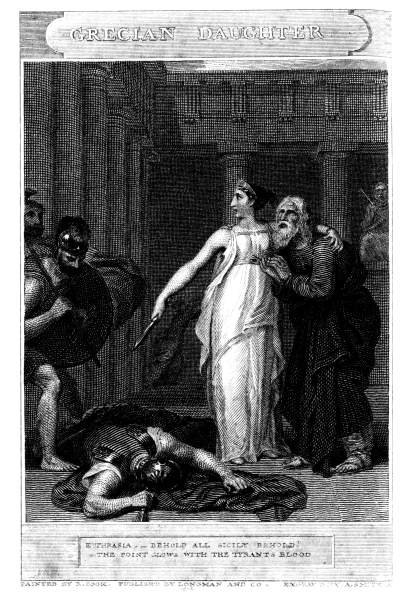
THE
GRECIAN DAUGHTER;
A TRAGEDY,
IN FIVE ACTS;
By ARTHUR MURPHY, Esq.
AS PERFORMED AT THE
THEATRE ROYAL, COVENT GARDEN.
PRINTED UNDER THE AUTHORITY OF THE MANAGERS
FROM THE PROMPT BOOK.
WITH REMARKS
BY MRS. INCHBALD.
LONDON:
PRINTED FOR LONGMAN, HURST, REES, AND ORME,
PATERNOSTER ROW.
WILLIAM SAVAGE, PRINTER,
BEDFORD BURY, LONDON.
REMARKS.
This tragedy has been so rapturously applauded on the stage, and so severely criticised in the closet, that it is a task of peculiar difficulty to speak either of its beauties or its defects, with any degree of certainty. To conciliate both the auditor and the reader, both the favourable and the unfavourable critic, the "Grecian Daughter" demands a set of Remarks for each side of the question—and the good-natured side shall have precedence.
This play had, on its first appearance, the most brilliant success, and still holds a place in the list of dramas performed during every season. There is a splendour of decoration, a glow of martial action, events of such deep interest, and, above all, a moral of such excellent tendency, which concludes the performance, that its attraction can readily be accounted for, without the slightest imputation upon the judgment of the public.
Perhaps, of all the events recorded in history, that filial piety, on which the fable of this play is founded, may be classed among the most affecting—yet it was one the most hazardous for a dramatist to adopt; for nothing less than complete skill could have given to this singular occurrence effectual force, joined to becoming delicacy. In this arduous effort Mr. Murphy has evinced the most exact judgment, and the nicest execution.[Pg 4]
If this tragedy has not the smooth flowing verse of Otway, Thomson, or Rowe, it possesses, in energy and fire, charms more theatrical; nor does the heroic so wholly engross every scene, but that it yields, at times, to melting pathos.
Another praise due to this production is, that wonderful events take place by the most natural agency. Incidents arise progressively from each other, till the last great incident of all, fills every mind with enthusiasm in the cause of virtue and justice—in the joy of an empire made free by the overthrow of its tyrant.
It is hardly possible to read this tragedy of the "Grecian Daughter," without laughing as well as crying. Some passages excite tears, whilst certain high-sounding sentences, with meaning insignificant, are irresistibly risible.
The popular story, from which the fable of this tragedy is produced, and the surprising event in the last scene—where a woman performs that which a whole army has in vain attempted—together with the powerful acting of Mrs. Barry in the part of Euphrasia, rendered this play greatly attractive when it was first performed; and as those causes of attraction still remain, or rather, an improvement is introduced by Mrs. Siddons's appearance in the Grecian Daughter, the play is still of use to the theatre.
The men's characters have been all sacrificed by the author to the valour of the woman—he has made his female do the deed of a man, and his best man perform the act of a child.
[Pg 5]Though Evander ranks as the first male character in this play, no actor likes to appear in the part. He would rather be inferior, and less infirm.
As Mr. Murphy had much theatrical experience as well as taste, it is astonishing that the personage most talked of, most praised, and by far the most perfect character in the whole drama, should never make his appearance!
Timoleon is a great warrior and a good man; and it seems wonderful how the audience, on the first night of the play, would quit the theatre without seeing him. Yet it was but modesty and respect in the author, not to bring so magnanimous a hero on the scene, to speak bad poetry.
The great tragic dramatist, Otway, wrote miserable comedies: Let it be no disgrace to Murphy that he has written an indifferent tragedy. By the merit of his comic scenes, his tragic ones are perhaps judged, and in the comparison lose half their value.
DRAMATIS PERSONÆ.
| Dionysius | Mr. Cory. |
| Evander | Mr. Kemble. |
| Philotas | Mr. C. Kemble. |
| Melanthon | Mr. Hull. |
| Phocion | Mr. Brunton. |
| Arcas | Mr. Davenport. |
| Greek Herald | Mr. Creswell. |
| Calippus | Mr. Klanert. |
| Greek Soldier | Mr. Field. |
| Officer | |
| Euphrasia | Mrs. Siddons. |
| Erixene | Mrs. Humphries. |
| SCENE,—Syracuse. | |
THE GRECIAN DAUGHTER.
ACT THE FIRST.
SCENE I.
Thus wilt thou spurn me, when a king distress'd,
A good, a virtuous, venerable king,
The father of his people, from a throne
Which long with ev'ry virtue he adorn'd,
Torn by a ruffian, by a tyrant's hand,
Groans in captivity? In his own palace
Lives a sequester'd prisoner? Oh! Philotas,
If thou hast not renounc'd humanity;
Let me behold my sovereign; once again
Admit me to his presence; let me see
My royal master.
Thy words are fruitless; Dionysius' orders
Forbid access; he is our sov'reign now;
'Tis his to give the law, mine to obey.
Detested spoiler!—his! a vile usurper!
Have we forgot the elder Dionysius,
Surnam'd the Tyrant? To Sicilia's throne
The monster waded through whole seas of blood.
Sore groan'd the land beneath his iron rod,
Till rous'd at length Evander came from Greece,
Like Freedom's Genius came, and sent the tyrant,
Stript of the crown, and to his humble rank
Once more reduc'd, to roam, for vile subsistence,
A wandering sophist through the realms of Greece.
All bend the knee; his the supreme dominion,
And death and torment wait his sovereign nod.
Now close encircled by the Grecian bands;
Timoleon leads them on; indignant Corinth
Sends her avenger forth, array'd in terror,
To hurl ambition from a throne usurp'd,
And bid all Sicily resume her rights.
Grown dim with age, thy eye pervades no more
The deep-laid schemes which Dionysius plans.
Know then, a fleet from Carthage even now
Stems the rough billow; and, ere yonder sun,
That now declining seeks the western wave,
Shall to the shades of night resign the world,
Thou'lt see the Punic sails in yonder bay,
Whose waters wash the walls of Syracuse.
Intent to plan, and circumspect to see
All possible events, he rushes on[Pg 9]
Resistless in his course! Your boasted master
Scarce stands at bay; each hour the strong blockade
Hems him in closer, and ere long thou'lt view
Oppression's iron rod to fragments shiver'd!
The good Evander then——
Will ne'er behold the golden time you look for!
Has the fell tyrant,—have his felon murderers——
Thy dark half-hinted purpose—lead me to him;
If thou hast murder'd him——
Thrice has the sun gone down, since last, these eyes
Have seen the good old king; say, why is this?
Wherefore debarr'd his presence? Thee, Philotas,
The troops obey, that guard the royal pris'ner;
Each avenue to thee is open; thou
Canst grant admittance; let me, let me see him.
Is ever wakeful; rent with all the pangs
That wait on conscious guilt.
Let Greece urge on her general assault.
Despatch some friend, who may o'erleap the walls,
And tell Timoleon, the good old Evander
Has liv'd three days, by Dionysius' order,
Lock'd up from ev'ry sustenance of nature,
And life, now wearied out, almost expires.
Lead me, Philotas, lead me to his prison.
Silent convey'd him up the steep ascent,
To where the elder Dionysius form'd,
On the sharp summit of the pointed rock,
Which overhangs the deep, a dungeon drear:
Cell within cell, a labyrinth of horror,
Deep cavern'd in the cliff, where many a wretch,
Unseen by mortal eye, has groan'd in anguish,
And died obscure, unpitied, and unknown.
Of horrid massacre. Full oft I've walk'd,
When all things lay in sleep and darkness hush'd.
Yes, oft I've walk'd the lonely sullen beach,
And heard the mournful sound of many a corse
Plung'd from the rock into the wave beneath,
That murmurs on the shore. And means he thus
To end a monarch's life? Oh! grant my pray'r;
My timely succour may protect his days;
The guard is yours——
And though I feel soft pity throbbing here;
Though each emotion prompts the gen'rous deed,
I must not yield; it were assur'd destruction!
Farewell, despatch a message to the Greeks;
I'll to my station; now thou know'st the worst.
[Exit.
How will her gentle nature bear the shock
Of a dear father, thus in ling'ring pangs
A prey to famine, like the veriest wretch
Whom the hard hand of misery hath grip'd!
In vain she'll rave, with impotence of sorrow;
Perhaps, provoke her fate: Greece arms in vain,
All's lost; Evander dies!
Our troops, that sallied to attack the foe,[Pg 11]
Retire disordered; to the eastern gate
The Greeks pursue: Timoleon rides in blood!
Arm, arm, and meet their fury!
Direct thy footsteps; Dionysius there
Marshals a chosen band.
Thy hardy veterans; haste, or all is lost!
[Exit.
Now give the Grecian sabre tenfold edge,
And save a virtuous king!
[Warlike Music.
Ye great assertors of a monarch's cause!
Let the wild tempest rage. Melanthon, ha!
Did'st thou not hear the vast tremendous roar?
Down tumbling from its base the eastern tow'r,
Burst on the tyrant's ranks, and on the plain
Lies an extended ruin.
Increase each hour, and gather round our heads.
Once more, Melanthon, once again, my father
Shall mount Sicilia's throne.
Would come with joy to ev'ry honest heart,
Would shed divinest blessings from its wing;
But no such hour in all the round of time,
I fear, the fates averse will e'er lead on.
Depress thy spirit? Lo! Timoleon comes
Arm'd with the pow'r of Greece; the brave, the just,
God-like Timoleon! ardent to redress,
He guides the war, and gains upon his prey.[Pg 12]
A little interval shall set the victor
Within our gates triumphant.
Forbode for thee. 'Would thou hadst left this place,
When hence your husband, the brave Phocion, fled,
Fled with your infant son!
Here I remain'd, while my brave, gen'rous Phocion,
Fled with my child, and from his mother's arms
Bore my sweet little one. Full well thou know'st
The pangs I suffer'd in that trying moment.
Did I not weep? Did I not rave and shriek,
And by the roots tear my dishevell'd hair?
Did I not follow to the sea-beat shore,
Resolv'd with him, and with my blooming boy,
To trust the winds and waves?
I e'er can doubt thy constancy and love.
Each secret image that my fancy form'd,
The gods can witness how I lov'd my Phocion,
And yet I went not with him. Could I do it?
Could I desert my father? Could I leave
The venerable man, who gave me being,
A victim here in Syracuse, nor stay
To watch his fate, to visit his affliction,
To cheer his prison hours, and with the tear
Of filial virtue bid ev'n bondage smile?
Shall merit heartfelt praise.
Go with my child, torn from this matron breast,
This breast that still should yield its nurture to him,
Fly with my infant to some happier shore,
If he be safe, Euphrasia dies content.
Till that sad close of all, the task be mine
To tend a father with delighted care,[Pg 13]
To smooth the pillow of declining age,
See him sink gradual into mere decay,
On the last verge of life watch ev'ry look,
Explore each fond unutterable wish,
Catch his last breath, and close his eyes in peace.
My heart misgives; Evander's fatal period——
And once again I shall behold him king.
To gild the clouds, that hover o'er your head,
Soon to rain sorrow down, and plunge you deeper
In black despair.
That glows within me, ne'er shall know despair.
No, I will trust the gods. Desponding man!
Hast thou not heard with what resistless ardour
Timoleon drives the tumult of the war?
Hast thou not heard him thund'ring at our gates?
The tyrant's pent up in his last retreat;
Anon thou'lt see his battlements in dust,
His walls, his ramparts, and his tow'rs in ruin;
Destruction pouring in on ev'ry side,
Pride and oppression at their utmost need,
And nought to save him in his hopeless hour.
[A flourish of Trumpets.
And o'er your sorrows cast a dawn of gladness.
Like a gay dream, are vanish'd into air.
Proudly elate, and flush'd with easy triumph
O'er vulgar warriors, to the gates of Syracuse
He urg'd the war, till Dionysius' arm
Let slaughter loose, and taught his dastard train
To seek their safety by inglorious flight.
Alarm this throbbing bosom, you will pardon
A frail and tender sex. Should ruthless war
Roam through our streets, and riot here in blood,
Where shall the lost Euphrasia find a shelter?
In vain she'll kneel, and clasp the sacred altar.
O let me then, in mercy let me seek
The gloomy mansion, where my father dwells;
I die content, if in his arms I perish.
The Greek recoils; like the impetuous surge
That dashes on the rock, there breaks, and foams,
And backward rolls into the sea again.
All shall be well in Syracuse: a fleet
Appears in view, and brings the chosen sons
Of Carthage. From the hill that fronts the main,
I saw their canvass swelling with the wind,
While on the purple wave the western sun
Glanc'd the remains of day.
Of war subside, the wild, the horrid interval
In safety let me sooth to dear delight
In a lov'd father's presence: from his sight,
For three long days, with specious feign'd excuse
Your guards debarr'd me. Oh! while yet he lives,
Indulge a daughter's love; worn out with age
Soon must he seal his eyes in endless night,
And with his converse charm my ear no more.
Evander mocks the injuries of time.
Calippus, thou survey the city round;
Station the centinels, that no surprise
Invade the unguarded works, while drowsy night
Weighs down the soldier's eye. Afflicted fair,
Thy couch invites thee. When the tumult's o'er,
Thou'lt see Evander with redoubled joy.
Though now unequal to the cares of empire
His age sequester him, yet honours high[Pg 15]
Shall gild the ev'ning of his various day.
They gush in tears, and my heart pours its tribute.
Unveil the face of things, do thou despatch
A well-oar'd galley to Hamilcar's fleet;
At the north point of yonder promontory,
Let some selected officer instruct him
To moor his ships, and issue on the land.
Then may Timoleon tremble: vengeance then
Shall overwhelm his camp, pursue his bands,
With fatal havoc, to the ocean's margin,
And cast their limbs to glut the vulture's famine,
In mingled heaps upon the naked shore.
[Exit Dionysius.
If Carthage comes, if her perfidious sons
List in his cause, the dawn of freedom's gone.
I fear to shock thee with the tale of horror!
Perhaps he dies this moment.—Since Timoleon
First form'd his lines round this beleagur'd city,
No nutriment has touch'd Evander's lips.
In the deep caverns of the rock imprison'd
He pines in bitterest want.
Well do your vital drops forget to flow.
Our fate allows us now.
Is that the tribute to a father due?
Blood is his due, Melanthon; yes, the blood,
The vile, black blood, that fills the tyrant's veins,[Pg 16]
Would graceful look upon my dagger's point.
Come, vengeance, come, shake off the feeble sex,
Sinew my arm, and guide it to his heart.
And thou, O filial piety, that rul'st
My woman's breast, turn to vindictive rage;
Assume the port of justice; show mankind
Tyrannic guilt hath never dar'd in Syracuse,
Beyond the reach of virtue.
Nor let him hear these transports of the soul,
These wild upbraidings.
Be hush'd to silence, when a father dies?
Shall not the monster hear his deeds accurst?
Shall he not tremble, when a daughter comes,
Wild with her griefs, and terible with wrongs;
Fierce in despair, all nature in her cause
Alarm'd and rous'd with horror?
Melanthon come; my wrongs will lend me force;
The weakness of my sex is gone; this arm
Feels tenfold strength; this arm shall do a deed
For Heav'n and earth, for men and gods to wonder at!
This arm shall vindicate a father's cause.
ACT THE SECOND.
SCENE I.
And o'er the solemn scene such stillness reigns,[Pg 17]
As 'twere a pause of nature; on the beach
No murmuring billow breaks; the Grecian tents
Lie sunk in sleep; no gleaming fires are seen;
All Syracuse is hush'd; no stir abroad,
Save ever and anon the dashing oar,
That beats the sullen wave. And hark!—Was that
The groan of anguish from Evander's cell,
Piercing the midnight gloom?—It is the sound
Of bustling prows, that cleave the briny deep.
Perhaps at this dead hour Hamilcar's fleet
Rides in the bay.
Of distant uproar chas'd affrighted sleep.
Comes echoing from the main. Save that report,
A death-like silence through the wide expanse
Broods o'er the dreary coast.
And seek repose; the duty of thy watch
Is now perform'd; I take thy post.
Your royal pris'ner?
A secret weakness? My heart inward melts
To see that suffering virtue. On the earth,
The cold, damp earth, the royal victim lies;
And while pale famine drinks his vital spirit,
He welcomes death, and smiles himself to rest.
Oh! 'would I could relieve him!
At close of day the sullen sky held forth
Unerring signals. With disastrous glare,
The moon's full orb rose crimson'd o'er with blood;[Pg 18]
And lo! athwart the gloom a falling star
Trails a long tract of fire!—What daring step
Sounds on the flinty rock? Stand there; what, ho!
Speak, ere thou dar'st advance. Unfold thy purpose:
Who and what art thou?
I bring no value to alarm thy fears:
It is a friend approaches.
Those plaintive notes?
No warrior to surprise thee on the watch.
An humble suppliant comes—Alas, my strength
Exhausted quite forsakes this weary frame.
What art thou? what thy errand? quickly say,
Wherefore alarm'st thou thus our peaceful watch?
The veriest wretch that ever groan'd in anguish,
Comes here to grovel on the earth before thee,
To tell her sad, sad tale, implore thy aid,
For sure the pow'r is thine, thou canst relieve
My bleeding heart, and soften all my woes.
Why, princess, thus anticipate the dawn?
Still sleep and silence wrap the weary world;
The stars in mid career usurp the pole;
The Grecian bands, the winds, the waves are hush'd;
All things are mute around us; all but you
Rest in oblivious slumber from their cares.
Guilt is at rest: I only wake to misery.
Oh! give him to me——If ever
The touch of nature throbb'd within your breast,
Admit me to Evander. In these caves
I know he pines in want; let me convey
Some charitable succour to a father.
Wert born in Greece:—Oh! by our common parent—
Nay, stay; thou shalt not fly; Philotas, stay;—
You have a father too; think, were his lot
Hard as Evander's; if by felon hands
Chain'd to the earth, with slow-consuming pangs
He felt sharp want, and with an asking eye
Implor'd relief, yet cruel men deny'd it,
Wouldst thou not burst thro' adamantine gates,
Thro' walls and rocks, to save him? Think, Philotas,
Of thy own aged sire, and pity mine.
Think of the agonies a daughter feels,
When thus a parent wants the common food,
The bounteous hand of nature meant for all.
Evander wants not; it is fruitless all;
Thy tears, thy wild entreaties, are in vain.
I understand thee;—butchers, you have shed
The precious drops of life.
Retire and seek the couch of balmy sleep,
In this dead hour, this season of repose.
Advise a wretch like me to know repose?
This is my last abode:—these caves, these rocks,[Pg 20]
Shall ring for ever with Euphrasia's wrongs.
Here will I dwell, and rave, and shriek, and give
These scatter'd locks to all the passing winds;
Call on Evander lost;—
And cruel gods, and cruel stars invoking,
Stand on the cliff in madness and despair.
My heart in pity bleeds.
No other fear assails this warlike breast.
I pity your misfortunes; yes, by Heav'n,
My heart bleeds for you.—Gods! you've touch'd my soul!
The gen'rous impulse is not giv'n in vain.
I feel thee, Nature, and I dare obey.
Oh! thou hast conquer'd.—Go, Euphrasia, go,
Behold thy father.
I'll bathe thy hand with tears, thou gen'rous man!
Thou wouldst convey, my partners of the watch
Will ne'er consent.
On any terms, oh! let me, let me see him.
Timoleon shall reward; the bounteous gods,
And thy own virtue shall reward the deed.
[Goes into the Cave.
The stubborn heart, and mould'st it to thy purpose.
'Would I could save them!—But tho' not for me
The glorious pow'r to shelter innocence,
Yet for a moment to assuage its woes,
Is the best sympathy, the purest joy
Nature intended for the heart of man,
When thus she gave the social gen'rous tear.
[Exit.
SCENE II.
A wretched pittance; one poor cordial drop
To renovate exhausted drooping age,
I ask no more.
Of scanty nourishment must pass these walls.
Our lives were forfeit else: a moment's parley
Is all I grant; in yonder cave he lies.
Oh! give me, give me rest.
It pierces here! it cleaves my very heart.
I shall expire, and never see him more.
Till the returning blood shall lend thee firmness.
And is there no relief?
You shall command. I will unbar the dungeon,
Unloose the chain that binds him to the rock,
And leave your interview without restraint.
[Opens a Cell in the back Scene.
The agonizing scene? [Rises.] I must behold him;
Nature, that drives me on, will lend me force.
Is that my father?
His vigour seems not yet exhausted quite.
You must be brief, or ruin will ensue.
—These ling'ring pangs—
I burn, I burn; alas! no place of rest:
[Rises and comes out.
Alas! I faint; I die.
Let me support you, sir.
Whoe'er thou art, I thank thee: that kind breeze
Comes gently o'er my senses—lead me forward:
And is there left one charitable hand
To reach its succour to a wretch like me?
The hand of death is on him.
A little onward to the air conduct me;
'Tis well;—I thank thee; thou art kind and good,
And much I wonder at this gen'rous pity.
That voice: art thou—alas! my eyes are dim!
Each object swims before me—No, in truth
I do not know thee.
A father's eyes! Giv'n to my last embrace!
Gods! do I hold her once again? Your mercies
Are without number.
[Falls on the Couch.
This excess of bliss
O'erpow'rs; it kills; Euphrasia—could I hope it?[Pg 23]
I die content—Art thou indeed my daughter?
Thou art; my hand is moisten'd with thy tears:
I pray you do not weep—thou art my child:
I thank you, gods! in my last dying moments
You have not left me—I would pour my praise;
But oh! your goodness overcomes me quite!
You read my heart; you see what passes there.
Bears down each feeble sense: restore him, Heaven!
Pass but a moment, and this busy globe,
Its thrones, its empires, and its bustling millions,
Will seem a speck in the great void of space.
Yet, while I stay, thou darling of my age!—
Nay, dry those tears.
I fear to ask it, where is virtuous Phocion?
Expos'd and helpless?
He fled to save my child.
Your boy is safe, Euphrasia?—Oh! my heart!
Alas! quite gone; worn out with misery;
Oh! weak, decay'd old man!
Will none relieve his want? A drop of water
Might save his life; and even that's deny'd him.
It is too much—assist me; bear me hence;
And lay me down in peace.
And those pale, quiv'ring lips! He clasps my hand:
What, no assistance! Monsters, will you thus
Let him expire in these weak, feeble arms?
Thou wish of innocence, affliction's friend,
Tir'd nature calls thee; come, in mercy come,
And lay me pillow'd in eternal rest.
My child—where art thou? give me; reach thy hand,
Why dost thou weep?—My eyes are dry—Alas!
Quite parch'd, my lips—quite parch'd, they cleave together.
[Exeunt.
'Twere time this interview should end: the hour
Now warns Euphrasia hence: what man could dare,
I have indulg'd—Philotas!—ha! the cell
Left void!—Evander gone!—What may this mean?
Philotas, speak.
Here to obey the savage tyrant's will,
And murder virtue that can thus behold
Its executioner, and smile upon him.
That piteous sight!
Delay undoes us both. The restless main
Glows with the blush of day.
The time requires
Without or further pause, or vain excuse,
That she depart this moment.
My voice shall warn her of th' approaching danger.
I dread th' event; and hark!—the wind conveys
In clearer sound the uproar of the main.
The fates prepare new havoc; on th' event
Depends the fate of empire. Wherefore thus
Delays Euphrasia? Ha! what means, Philotas,
That sudden haste, that pale, disorder'd look?
Ev'n the hard heart of tyranny would melt
To infant softness. Arcas, go, behold
The pious fraud of charity and love;
Behold that unexampled goodness; see
Th' expedient sharp necessity has taught her;
Thy heart will burn, will melt, will yearn to view
A child like her.
Wakes these emotions?
The father foster'd at his daughter's breast!
O! filial piety!—The milk design'd
For her own offspring, on the parent's lip
Allays the parching fever.
Has she then form'd, eluding all our care,
To minister relief?
Evander lies; and as his languid pow'rs
Imbibe with eager thirst the kind refreshment,
And his looks speak unutterable thanks,
Euphrasia views him with the tend'rest glance,
Ev'n as a mother doating on her child;
And, ever and anon, amidst the smiles
Of pure delight, of exquisite sensation,[Pg 26]
A silent tear steals down; the tear of virtue,
That sweetens grief to rapture. All her laws
Inverted quite, great nature triumphs still.
And learn, that, while your cruelty prepares
Unheard-of torture, virtue can keep pace
With your worst efforts, and can try new modes
To bid men grow enamour'd of her charms.
I now can hazard all. Let us preserve
Her father for her.
Transcends all praise. By Heav'n, he shall not die.
And first explore each avenue around,
Lest the fix'd sentinel obstruct your purpose.
[Exit Arcas.
Who feel for other's woes—She leads him forth,
And tremblingly supports his drooping age.
[Goes to assist him.
Enter Euphrasia and Evander.
Glows here about my heart. Conduct me forward;
At the last gasp preserved! Ha! dawning light!
Let me behold; in faith I see thee now;
I do indeed: the father sees his child.
'Tis speechless rapture!
Could I abandon that white hoary head,
That venerable form? Abandon him
To perish here in misery and famine?
Have triumph'd o'er me.
Take him, take your father;
Convey him hence; I do release him to you.
Indeed my senses are imperfect; yet
Methought I heard him! did he say release me?
Go with your daughter, with that wond'rous pattern
Of filial piety to after times.
Yes, princess, lead him forth; I'll point the path,
Whose soft declivity will guide your steps
To the deep vale, which these o'erhanging rocks
Encompass round. You may convey him thence
To some safe shelter. Yet a moment's pause;
I must conceal your flight from ev'ry eye.
Yes, I will save 'em, or perish in their cause.
[Exit Philotas.
I'm at the goal of life; if in the race
Honour has follow'd with no ling'ring step,
But there sits smiling with her laurel wreath,
To crown my brow, there would I fain make halt,
And not inglorious lay me down to rest.
Afford a refuge to thee?
There is no refuge for me.
Euphrasia's care has form'd a safe retreat;
There may'st thou dwell; it will not long be wanted.
Soon shall Timoleon with resistless force,
Burst yon devoted walls.
The brave Timoleon, with the pow'r of Greece;
Another day shall make this city his.
Oh! thou shalt reign in Sicily! my child
Shall grace her father's throne. Indulgent Heaven!
Pour down your blessings on this best of daughters;
To her and Phocion give Evander's crown;
Let them, oh! let them both in virtue wear it,
And in due time transmit it to their boy!
Lies hush'd in sleep; I'll marshall thee the way
Down the steep rock.
Do you, whose youthful spirit glows with life,
Do you go forth, and leave this mould'ring corpse.
To me had Heav'n decreed a longer date,
It ne'er had suffer'd a fell monster's reign,
Nor let me see the carnage of my people.
Farewell, Euphrasia; in one lov'd embrace
To these remains pay the last obsequies,
And leave me here to sink to silent dust.
Reject my prayer, nor trust your fate with me.
Though life's a burden I could well lay down,
Yet I will prize it, since bestow'd by thee.
Oh! thou art good; thy virtue soars a flight
For the wide world to wonder at; in thee,
Hear it all nature, future ages hear it,
The father finds a parent in his child.
[Exeunt.
ACT THE THIRD.
SCENE I.
Curse on their Punic faith! did they once dare
To grapple with the Greek? Ere yet the main
Was ting'd with blood, they turn'd their ships averse.
May storms and tempests follow in their rear,
And dash their fleet upon the Lybian shore!
Has storm'd the forts, and even now his fleet
Pursues its course, and steers athwart the bay.
I bear a mind to meet it undismay'd,
Unconquer'd ev'n by Fate.
Despair and terror fly. A panic spreads
From man to man, and superstition sees
Jove arm'd with thunder, and the gods against us.
Let instant victims at the altar bleed:
Let incense roll its fragrant clouds to Heav'n,
And pious matrons, and the virgin train,
In slow procession to the temple bear
The image of their gods.
The solemn sacrifice, the virgin throng,
Will gain the popular belief, and kindle
In the fierce soldiery religious rage.[Pg 30]
Away, my friends, prepare the sacred rites.
[Exeunt Calippus, &c.
Has he yet breath'd his last?
To-morrow's sun sees him a breathless corse.
No more shall deck his brow; and if the sand
Still loiter in the glass, thy hand, my friend,
May shake it thence.
Leave to thy faithful servant.
Thou little know'st the cares, the pangs of empire.
The ermin'd pride, the purple that adorns
A conqueror's breast, but serves, my friend, to hide
A heart that's torn, that's mangled with remorse.
Each object round me wakens horrid doubts;
The flatt'ring train, the sentinel that guards me,
The slave that waits, all give some new alarm,
And from the means of safety dangers rise.
Ev'n victory itself plants anguish here,
And round my laurels the fell serpent twines.
And sue for terms of peace?
No, though ambition teem with countless ills,
It still has charms of pow'r to fire the soul.
Though horrors multiply around my head,
I will oppose them all. The pomp of sacrifice,
But now ordain'd, is mockery to Heav'n.
'Tis vain, 'tis fruitless; then let daring guilt
Be my inspirer, and consummate all.
Where are those Greeks, the captives of my sword,
Whose desperate valour rush'd within our walls,
Fought near our person, and the pointed lance
Aim'd at my breast?
When the wide range of battle claims your sword,
Thus do ye come against a single life
To wage the war? Did not our buckler ring
With all your darts, in one collected volley,
Shower'd on my head? Did not your swords at once
Point at my breast, and thirst for regal blood?
An open foe in arms, I meant to slay
The foe of human kind. With rival ardour
We took the field; one voice, one mind, one heart;
All leagu'd, all covenanted: in yon camp
Spirits there are who aim, like us, at glory.
Whene'er you sally forth, whene'er the Greeks
Shall scale your walls, prepare thee to encounter
A like assault. By me the youth of Greece
Thus notify the war they mean to wage.
Whoe'er in battle shall become our pris'ner,
In torment meets his doom.
How vile the body to a mind that pants
For genuine glory. Twice three hundred Greeks
Have sworn like us, to hunt thee through the ranks;
Ours the first lot; we've fail'd; on yonder plain
Appear in arms, the faithful band will meet thee.
To die in misery. Impal'd alive,
The winds shall parch them on the craggy cliff.[Pg 32]
Selected from the rest, let one depart
A messenger to Greece, to tell the fate
Her chosen sons, her first adventurers met.
[Exit Dionysius.
Your forfeit lives? Philotas, thou conduct them
To the deep dungeon's gloom. In that recess,
'Midst the wild tumult of eventful war
We may ward off the blow. My friends, farewell:
That officer will guide your steps.
[All follow Philotas, except Phocion.
With every virtue. Wherefore venture hither?
Why with rash valour penetrate our gates?
Th' event of ling'ring war? With patience count
The lazy-pacing hours, while here in Syracuse
The tyrant keeps all that my heart holds dear;
For her dear sake, all danger sinks before me?
For her I burst the barriers of the gate,
Where the deep cavern'd rock affords a passage.
A hundred chosen Greeks pursu'd my steps,
We forc'd an entrance; the devoted guard
Fell victims to our rage; but in that moment
Down from the walls superior numbers came.
The tyrant led them on. We rush'd upon him,
If we could reach his heart, to end the war.
But Heav'n thought otherwise. Melanthon, say,—
I fear to ask it, lives Evander still?
Thou must withdraw thee hence; regain once more
Timoleon's camp! alarm his slumb'ring rage;
Assail the walls; thou with thy phalanx seek
The subterraneous path; that way at night
The Greeks may enter, and let in destruction
On the astonish'd foe.
My breath shall wake his rage; this very night
When sleep sits heavy on the slumb'ring city,
Then Greece unsheaths her sword, and great revenge
Shall stalk with death and horror o'er the ranks
Of slaughter'd troops a sacrifice to freedom!
But first let me behold Euphrasia.
Thy pent-up valour: to a secret haunt
I'll guide thy steps; there dwell, and in apt time
I'll bring Euphrasia to thy longing arms.
With firmer nerve shall bid me grasp the javelin;
Shall bid my sword with more than lightning's swiftness.
Blaze in the front of war, and glut its rage
With blow repeated in the tyrant's veins.
[Exeunt.
SCENE II.
Lo! the sad sepulchre where, hears'd in death,
The pale remains of my dear mother lie.
There, while the victims at yon altar bleed,
And with your pray'rs the vaulted roof resounds.
There let me pay the tribute of a tear,
A weeping pilgrim o'er Eudocia's ashes.
Pay this sad visit to the honour'd clay,[Pg 34]
That moulders in the tomb. These sacred viands
I'll burn an offering to a parent's shade,
And sprinkle with this wine the hallow'd mould.
That duty paid, I will return, my virgins.
[She goes into the Tomb.
And heal the pangs that desolate her soul.
Some dread calamity hangs o'er our heads.
In vain the tyrant would appease with sacrifice
Th' impending wrath of ill-requited Heav'n.
Ill omens hover o'er us: at the altar
The victim dropp'd, ere the divining seer
Had gor'd his knife. The brazen statues tremble,
And from the marble, drops of blood distil.
Now find the guilty head.
My heart expands; the pious act is done,
And I have paid my tribute to a parent.
Ah! wherefore does the tyrant bend his way?
No god there smiles propitious on his cause.
Fate lifts the awful balance; weighs his life,
The lives of numbers, in the trembling scale.
Do you retire,
Retire, Philotas; let me here remain,
And give the moments of suspended fate
To pious worship and to filial love.
And at the temple's entrance wait thy coming.
The purest ecstacy of soul. Come forth,
Thou man of woe, thou man of every virtue.
With a fond father's love to view thee? Thus
To mingle rapture in a daughter's arms?
Has giv'n new life. Thou from this vital stream
Deriv'st thy being; with unheard-of duty
Thou hast repaid it to thy native source.
Of all his goodness dwell within my heart,
Thou wilt not wonder.
In mix'd emotions!—Though departing hence,
After the storms of a tempestuous life,
Tho' I was entering the wish'd-for port,
Where all is peace, all bliss, and endless joy,
Yet here contented I can linger still
To view thy goodness, and applaud thy deeds,
Thou author of my life?—Did ever parent
Thus call his child before?—my heart's too full,
My old fond heart runs o'er; it aches with joy.
Nature and duty call'd me—Oh! my father,
How didst thou bear thy long, long suff'rings? How
Endure their barb'rous rage?
To this old frame, what Nature's hand must do.
In the worst hour of pain, a voice still whisper'd me,
"Rouse thee, Evander; self-acquitting conscience[Pg 36]
"Declares thee blameless, and the gods behold thee."
I was but going hence by mere decay,
To that futurity which Plato taught.
Thither, oh! thither was Evander going,
But thou recall'st me; thou!
Invites thee back to life.
Urge on the siege?
To scourge a guilty race. The Punic fleet,
Half lost, is swallow'd by the roaring sea.
The shatter'd refuse seek the Lybian shore,
To bear the news of their defeat to Carthage.
Moves o'er the deep, and mighty fleets are vanish'd.
Some busy footstep beats the hallow'd pavement.
Oh! sir, retire—Ye pow'rs!—Philotas!—ha!
Some new suspicion goads him. At yon gate
I stopp'd Calippus, as with eager haste
He bent his way to seek thee.—Oh! my sovereign,
My King, my injur'd master, will you pardon
The wrongs I've done thee?
[Kneels to Evander.
From the fierce trial of tyrannic pow'r,
Shines forth with added lustre.
My ardent zeal? there is no time to waste.
You must withdraw; trust to your faithful friends.
Pass but another day, and Dionysius
Falls from a throne usurp'd.
The forfeit of his crimes, what streams of blood[Pg 37]
Shall flow in torrents round! Methinks I might
Prevent this waste of nature—I'll go forth
And to my people show their rightful king.
Were fatal to our hopes; oppress'd, dismay'd,
The people look aghast, and, wan with fear,
None dare espouse your cause.
To act like men;—their king, I gave myself
To a whole people. I made no reserve;
My life was theirs; each drop about my heart
Pledg'd to the public cause; devoted to it;
That was my compact; is the subjects' less?
If they are all debas'd, and willing slaves,
The young but breathing to grow grey in bondage,
And the old sinking to ignoble graves,
Of such a race no matter who is king.
And yet I will not think it; no! my people
Are brave and gen'rous; I will trust their valour.
No plan is fix'd, and no concerted measure.
The fates are busy: wait the vast event.
Trust to my truth and honour. Witness, gods,
Here, in the temple of Olympian Jove,
Philotas swears——
Who feels the best emotions of the heart,
Truth, reason, justice, honour's fine excitements,
Acts by those laws, and wants no other sanction.
To thee, to all, will follow:—hark! a sound
Comes hollow murm'ring through the vaulted aisle.
It gains upon the ear. Withdraw, my father;
All's lost, if thou art seen.
Darts with the lightning's speed across the aisle.
Melanthon, Dion, and their brave associates,
Will show, that liberty has leaders still.
Anon I'll meet them there: my child, farewell;
Thou shalt direct me now.
[Exit Philotas.—Evander enters the Tomb. Eup. Coming forward.]
How my distracted heart throbs wild with fear!
What brings Calippus? wherefore? save me, Heaven!
Alarms suspicion: the king knows thy plottings,
Thy rooted hatred to the state and him.
His sov'reign will commands thee to repair
This moment to his presence.
The tyrant?—I obey. [Exit Calippus.] And, oh! ye pow'rs,
Ye ministers of Heaven, defend my father;
Support his drooping age; and when anon
Avenging justice shakes her crimson steel,
Oh! be the grave at least a place of rest;
That from his covert, in the hour of peace,
Forth he may come to bless a willing people,
And be your own just image here on earth.
[Exit.
ACT THE FOURTH.
SCENE I.
Nor yet Timoleon issues from his fleet.
There let him linger on the wave-worn beach;
Here the vain Greek shall find another Troy,
A more than Hector here. Though Carthage fly,
Ourself, still Dionysius, here remains.
And means the Greek to treat of terms of peace?
By Heav'n, this panting bosom hop'd to meet
His boasted phalanx on the embattled plain.
And doth he now, on peaceful councils bent,
Despatch his herald?—Let the slave approach.
Is equall'd only by the softer virtues
Of mild humanity, that sway his heart,
Sends me his delegate to offer terms,
On which ev'n foes may well accord; on which
The fiercest nature, though it spurns at justice,
May sympathize with his.
Thou shalt be heard.
With pity sees, the wild destructive havoc
Of ruthless war; he hath survey'd around
The heaps of slain that cover yonder field,
And, touch'd with gen'rous sense of human woe,
Weeps o'er his victories.
Then let the author of those ills thou speak'st of,
Let the ambitious factor of destruction,
Timely retreat, and close the scene of blood.
Why doth affrighted peace behold his standard
Uprear'd in Sicily? and wherefore here
The iron ranks of war, from which the shepherd
Retires appall'd, and leaves the blasted hopes
Of half the year, while closer to her breast
The mother clasps her infant?
To plead Timoleon's cause; not mine the office
To justify the strong, the righteous motives
That urge him to the war: the only scope
My deputation aims at, is to fix
An interval of peace, a pause of horror,
That they, whose bodies, on the naked shore,
Lie weltering in their blood, from either host
May meet the last sad rites to nature due,
And decent lie in honourable graves.
Let him, with those that live, embark for Greece,
And leave our peaceful plains; the mangled limbs
Of those he murder'd, from my tender care
Shall meet due obsequies.
Wages no war with those, who bravely die.
'Tis for the dead I supplicate; for them
We sue for peace; and to the living too
Timoleon would extend it, but the groans
Of a whole people have unsheath'd his sword.
A single day will pay the funeral rites.
To-morrow's sun may see both armies meet
Without hostility, and all in honour;
You to inter the troops who bravely fell;
We, on our part, to give an humble sod
To those, who gain'd a footing on the isle,
And by their death have conquer'd.
I grant thy suit: soon as to-morrow's dawn
Illume the world, the rage of wasting war
In vain shall thirst for blood.
Thou know'st my last resolve, and now farewell.
Some careful officer conduct him forth.
[Exit Herald.
An easy prey; a sacrifice to glut
My great revenge. Calippus, let each soldier
This night resign his wearied limbs to rest,
That ere the dawn, with renovated strength,
On the unguarded, unsuspecting foe,
Disarm'd, and bent on superstitious rites,
From every quarter we may rush undaunted,
Give the invaders to the deathful steel,
And by one carnage bury all in ruin.
My valiant friends, haste to your several posts,
And let this night a calm unruffled spirit
Lie hush'd in sleep: away, my friends, disperse.
Philotas, waits Euphrasia as we order'd?
Rage and despair, a thousand warring passions,
All rise by turns, and piecemeal rend my heart.
Yet ev'ry means, all measures must be tried,
To sweep the Grecian spoiler from the land,
And fix the crown unshaken on my brow.
Thy grief, thy tender duty to thy father,
Has touch'd me nearly. In his lone retreat,
Respect, attendance, every lenient care
To sooth affliction, and extend his life,
Evander has commanded.
Abridg'd his liberty; but to his person
All honour hath been paid.
Have mark'd thy ways, and will in time repay
Just retribution.
If here to meet him in a fond embrace,
Will calm thy breast, and dry those beauteous tears,
A moment more shall bring him to your presence.
Aged, infirm, worn out with toil and years—
No, let me seek him rather—If soft pity
Has touch'd your heart, oh! send me, send me to him.
Philotas shall conduct him; here I grant
The tender interview.
Ruin impends!—This will discover all!
I'll perish first.
[Aside.
Though much I languish to behold my father,
Yet now it were not fit—the sun goes down;
Night falls apace; soon as returning day—
Together you may serve the state and me.
Thou seest the havoc of wide wasting war;
And more, full well you know, are still to bleed.
Thou may'st prevent their fate.
And I will bless thee for it.
Torments have wrung the truth. Thy husband, Phocion—
Hath kindled up this war; with treacherous arts
Inflam'd the states of Greece; and now the traitor
Comes with a foreign aid to wrest my crown.
Erect her standard here.
Where'er my hero treads the paths of war,
List on his side; against the hostile javelin
Uprear his mighty buckler; to his sword
Lend the fierce whirlwind's rage, that he may come
With wreaths of triumph, and with conquest crown'd,
And a whole nation's voice
Applaud my hero with a love like mine!
On thy descendants fix'd Sicilia's crown?
Have I not vow'd protection to your boy?
Shall on a nobler basis found their rights;
On their own virtue, and a people's choice.
The father's valour shall protect his boy.
Accept our proffer'd grace. The terms are these;
Instant send forth a message to your husband;
Bid him draw off his Greeks! unmoor his fleet,
And measure back his way. Full well he knows
You and your father are my hostages;
And for his treason both may answer.
So meanly of my Phocion?—Dost thou deem him
Poorly wound up to a mere fit of valour,
To melt away in a weak woman's tear?
Oh! thou dost little know him; know'st but little
Of his exalted soul. With gen'rous ardour[Pg 44]
Still will he urge the great, the glorious plan,
And gain the ever honour'd bright reward,
Which fame entwines around the patriot's brow,
And bids for ever flourish on his tomb,
For nations freed, and tyrants laid in dust.
Than linger thus beneath the gripe of famine,
In a vile dungeon, scoop'd with barb'rous skill
Deep in the flinty rock; a monument
Of that fell malice, and that black suspicion,
That mark'd your father's reign; a dungeon drear,
Prepar'd for innocence!—Vice liv'd secure,
It flourish'd, triumph'd, grateful to his heart;
'Twas virtue only could give umbrage; then,
In that black period, to be great and good
Was a state crime; the pow'rs of genius then
Were a constructive treason.
Is fix'd; irrevocably fix'd.
May first be fix'd; the doom that ever waits
The fell oppressor, from a throne usurp'd
Hurl'd headlong down. Think of thy father's fate
At Corinth, Dionysius!
Evander dies; and thou, detested fair!
Thou shalt behold him, while inventive cruelty
Pursues his wearied life through every nerve.
I scorn all dull delay. This very night
Shall sate my great revenge.
[Exit.
Shall whelm thee down, no more to blast creation.
My father, who inhabit'st with the dead,
Now let me seek thee in the lonely tomb,
And tremble there with anxious hope and fear.
[Exit.
SCENE II.
My frame to dissolution.
Thy wonted firmness; in that dreary vault
A living king is number'd with the dead.
I'll take my post, near where the pillar'd aisle
Supports the central dome, that no alarm
Surprise you in the pious act.
[Exit.
They both are found; if in Evander's arms
Euphrasia meets my search, the fates atone
For all my suff'rings, all afflictions past.
Yes, I will seek them—ha!—the gaping tomb
Invites my steps—now, be propitious Heaven!
[He enters the Tomb.
Divine content can dwell, the heartfelt tear,
Which, as it falls, a father's trembling hand
Will catch, and wipe the sorrows from my eye,
Thou Pow'r supreme! whose all-pervading mind
Guides this great frame of things; who now behold'st me,
Who, in that cave of death, art full as perfect
As in the gorgeous palace, now, while night
Broods o'er the world, I'll to thy sacred shrine,[Pg 46]
And supplicate thy mercies to my father.
Who's there?—Evander?——Answer——tell me——speak——
Speak of Evander; tell me that he lives,
Or lost Euphrasia dies.
Art thou Euphrasia? 'tis thy Phocion, love;
Thy husband comes.
Inspir'd my heart, and guided all my ways.
Why in this place of woe? My tender little one,—
Say, is he safe? Oh! satisfy a mother;
Speak of my child, or I go wild at once!
Tell me his fate, and tell me all thy own.
In Sicily: Timoleon's gen'rous care
Protects him in his camp:—dispel thy fears;
The gods once more will give him to thy arms.
Here in Eudocia's tomb; let me conduct thee.
And have they then—Have the fell murderers—Oh!
[Faints away.
Thy Phocion calls; the gods will guard Evander,
And save him to reward thy matchless virtue.
Where is he? let me see him.
Thy father lives;—thou venerable man!
Behold!—I cannot fly to thy embrace.
Again I have him, gracious pow'rs! again
I clasp his hand, and bathe it with my tears.
Oh, let me thus, thus strain you to my heart.
By my Euphrasia sav'd! That sweet reflection
Exalts the bliss to rapture.
Why thus adventure forth! The strong alarm
O'erwhelm'd my spirits.
When all was dark, and awful silence round,
To throw me prostrate at the altar's foot,
And crave the care of Heav'n for thee and thine.
Melanthon there——
The tyrant's fury mounts into a blaze;
Unsated yet with blood, he calls aloud
For thee, Evander! thee his rage hath order'd
This moment to his presence.
His presence hath no terror for Evander.
I'll perish rather! But the time demands
Our utmost vigour. His policy has granted[Pg 48]
A day's suspense from arms; yet even now
His troops prepare, in the dead midnight hour,
With base surprise to storm Timoleon's camp.
To turn the hour of peace to blood and horror?
Becalms his looks, the rankling heart within
Teems with destruction.
Fly to Timoleon; I can grant a passport:
Rouse him to vengeance; on the tyrant turn
His own insidious arts, or all is lost.
Both shall attend my flight.
Th'attempt would hazard all.
We will remain, safe in the cave of death;
And wait our freedom from thy conqu'ring arm.
And give this arm the sinew that it boasted
At Tauromenium, when its force resistless
Mow'd down the ranks of war: I then might guide
The battle's rage, and, ere Evander die,
Add still another laurel to my brow.
Hath reap'd in earlier days.
When the great cause of liberty invites,
Remain inactive, unperforming quite?
Youth, second youth, rekindles in my veins:
Tho' worn with age, this arm will know its office;
Will show, that victory has not forgot
Acquaintance with this hand.—And yet—O shame[Pg 49]
It will not be: the momentary blaze
Sinks, and expires: I have survived it all;
Surviv'd my reign, my people, and myself.
Shall form their ranks around this sacred dome.
Taken in battle, wilt thou guard their lives?
This panting bosom! Yes, Euphrasia, yes;
A while I leave you to the care of Heaven.
Fell Dionysius tremble; ere the dawn
Timoleon thunders at your gates! the rage,
The pent-up rage, of twenty thousand Greeks,
Shall burst at once; and the tumultuous roar,
Alarm th'astonish'd world.
Attend my words: Tho' guilt may oft provoke,
As now it does, just vengeance on its head,
In mercy punish it. The rage of slaughter
Can add no trophy to the victor's triumph;
Bid him not shed unnecessary blood.
Conquest is proud, inexorable, fierce;
It is humanity ennobles all.
So thinks Evander, and so tell Timoleon.
[Exit, with Melanthon and Philotas.
Together we will seek the sacred altar,
And thank the God, whose presence fills the dome,
For all the wond'rous goodness lavish'd on us.
[Exeunt.
ACT THE FIFTH.
SCENE I.
Might view their camp, their stations, and their guards,
Their preparations for approaching night;—
Didst thou then mark the motions of the Greek?
A foe secure, and discipline relax'd.
My orders issued?
To gain recruited vigour from repose?
Let each brave officer, of chosen valour,
Forsake his couch, and with delib'rate spirit,
Meet at the citadel. An hour, at furthest,
Before the dawn; 'tis fix'd to storm their camp;
Haste, Calippus,
Fly to thy post, and bid Euphrasia enter.
[Exit Calippus.
Shall be dispos'd of. Curse on Phocion's fraud,
That from my pow'r withdrew their infant boy.
In him the seed of future kings were crush'd,
And the whole hated line at once extinguish'd.
A time to waste in the vain war of words.
A crisis big with horror is at hand.
I meant to spare the stream of blood, that soon
Shall deluge yonder plains. My fair proposals
Thy haughty spirit has with scorn rejected.
And now, by Heav'n, here, in thy very sight,
Evander breathes his last.
A crime to fill the measure of thy guilt,
Add that black murder to the dreadful list;—
With that complete the horrors of thy reign.
And to our presence leads Evander. All
Thy dark complottings, and thy treach'rous arts,
Have prov'd abortive.
And is Philotas false?—Has he betray'd him?
[Aside.
Of half my great revenge.
I saw life ebb apace. With studied art
We gave each cordial drop, alas, in vain;
He heav'd a sigh, invok'd his daughter's name,
Smil'd, and expir'd.
I gave the body to the foaming surge,
Down the steep rock despis'd.
And rend your scatter'd hair. No more Evander
Shall sway Sicilia's sceptre.
Now then, thou feel'st my vengeance.
Exult and triumph. Thy worst shaft is sped.
Yet still th'unconquer'd mind with scorn can view thee;
With the calm sunshine of the breast can see,
Thy pow'r unequal to subdue the soul,
Which virtue form'd, and which the gods protect.
This moment, bear her hence!—you know the rest:—
Go, see our will obey'd; that done, with all
A warrior's speed, attend me at the citadel;—
There meet the heroes, whom this night shall lead
To freedom, victory,—to glorious havoc,
And the destruction of the Grecian name.
[Exit.
These tears attest th'emotions of my heart.
But, oh! should Greece defer——
Phocion will bring relief; or should the tyrant
Assault their camp, he'll meet a marshall'd foe.
Let me conduct thee to the silent tomb.
Defenceless quite, may meet some ruffian stroke.
In the drear monument, should hostile steps
Dare to approach him, they must enter singly;
This guards the passage; man by man they die.
There may'st thou dwell amidst the wild commotion.
[Exeunt.
SCENE II.
Our toil and danger in the field of glory,
My fellow warriors, what no god could promise,
Fortune hath giv'n us. In his dark embrace
Lo! sleep envelops the whole Grecian camp.
Against a foe, the outcasts of their country,
Freebooters, roving in pursuit of prey,
Success by war or covert stratagem
Alike is glorious. Then, my gallant friends,
What need of words? The gen'rous call of freedom,
Your wives, your children, your invaded rights,
All that can steel the patriot breast with valour,
Expands and rouses in the swelling heart.
Follow th'impulsive ardour; follow me,
Your king, your leader: in the friendly gloom
Of night, assault their camp; your country's love,
And fame eternal, shall attend the men
Who march'd through blood and horror, to redeem,
From the invader's pow'r, their native land.
Hearts prodigal of blood, when honour calls,
Resolv'd to conquer or to die in freedom.
Hath veil'd her orb, our silent march begins.
The order thus:—Calippus thou lead forth
Iberia's sons with the Numidian bands,
And line the shore.—Perdiccas, be it thine[Pg 54]
To march thy cohorts to the mountain's foot,
Where the wood skirts the valley; there make halt
Till brave Amyntor stretch along the vale.
Ourself with the embodied cavalry
Clad in their mail'd cuirass, will circle round
To where their camp extends its furthest line;
Unnumber'd torches there shall blaze at once,
The signal of the charge; then, oh, my friends!
On every side let the wild uproar loose,
Bid massacre and carnage stalk around,
Unsparing, unrelenting; drench your swords
In hostile blood, and riot in destruction.
Away, my friends!
Rouse all the war! fly to your sev'ral posts,
And instant bring all Syracuse in arms!
[Exeunt.—Warlike music.
Scene III.
Shall we direct our steps? What sacred altar
Clasp on our knees?
Spreads the destruction wide. On ev'ry side
The victor's shouts, the groans of murder'd wretches,
In wild confusion rise. Once more descend
Eudocia's tomb; there thou may'st find a shelter.
Perhaps for the last time, a mother's urn.
This dagger there, this instrument of death,
Should fortune prosper the fell tyrant's arms,[Pg 55]
This dagger then may free me from his pow'r,
And that drear vault intomb us all in peace.
[Puts up the Dagger.
Of arms with clearer sound advances. Hark!
That sudden burst!—Again!—They rush upon us!
The portal opens; lo!—see there!—behold,
War, horrid war, invades the sacred fane!
No altar gives a sanctuary now.
[Warlike Music.
And brave them to the last.
Desist from the pursuit.
Tho' ev'ry god conspire, I will not yield.
If I must fall, the temple's pond'rous roof,
The mansion of the gods combin'd against me,
Shall first be crush'd, and lie in ruin with me.
Euphrasia here! Detested, treach'rous woman!
For my revenge preserv'd!—By Heaven, 'tis well;
Vengeance awaits thy guilt, and this good sword
Thus sends thee to atone the bleeding victims
This night has massacred.
Her life preserv'd may plead your cause with Greece,
And mitigate your fate.
My rage is up in arms;—by Heav'n, she dies.
The gods behold thee, horrible assassin!
Restrain the blow; it were a stab to Heav'n;[Pg 56]
All nature shudders at it!—Will no friend
Arm in a cause like this a father's hand?
Strike at this bosom rather. Lo! Evander
Prostrate and groveling on the earth before thee!
He begs to die:—exhaust the scanty drops
That lag about his heart;—but spare my child.
May the fiends seize Philotas! Treach'rous slave!
'Tis well thou liv'st; thy death were poor revenge
From any hand but mine.
[Offers to strike.
[Rushing before Evander.
I have provok'd your vengeance; through this bosom
Open a passage; first on me, on me
Exhaust your fury. Ev'ry pow'r above
Commands thee to respect that aged head:
His wither'd frame wants blood to glut thy rage:
Strike here; these veins are full; here's blood enough;
The purple tide will gush to glad thy sight.
Ha! the fierce tide of war
[A flourish of Trumpets.
This way comes rushing on.
[Goes to the Top of the Stage.
We'll perish thus together.
Close ev'ry passage, and repel their force.
Bring, bring me daggers!
And give him to my rage.
Inhuman villains!
[Stabs Dionysius.
Yes, first she strikes; an injur'd daughter's arm
Sends thee devoted to th' infernal gods.
[He falls.
Convulse the land; to its foundation shake
The groaning isle! May civil discord bear
Her flaming brand through all the realms of Greece;
And the whole race expire in pangs like mine!
[Dies.
Glows with the tyrant's blood. Ye slaves, [To the Guards.] look there;
Kneel to your rightful king: the blow for freedom
Gives you the rights of men! And, oh, my father,
My ever honour'd sire, it gives thee life!
[He embraces her.
Lo! there the wonders of Euphrasia's arm!
A spectacle for public view. Euphrasia!
Evander too!—Thus to behold you both——
And gaze with wonder there. The life I gave her,
Oh, she has us'd it for the noblest ends!
To fill each duty; make her father feel
The purest joy, the heart-dissolving bliss
To have a grateful child.—But has the rage
Of slaughter ceas'd?
To calm the uproar, and recal from carnage
His conqu'ring troops.
Thy sway shall bless the land. Not for himself
Timoleon conquers; to redress the wrongs
Of bleeding Sicily, the hero comes.
Thee, good Melanthon, thee, thou gen'rous man,
His justice shall reward. Thee too, Philotas,
Whose sympathizing heart could feel the touch
Of soft humanity, the hero's bounty,
His brightest honours, shall be lavish'd on thee.
Evander, too, will place you near his throne;
And show mankind, ev'n on this shore of being,
That virtue still shall meet its sure reward.
Are worth all dignities; my heart repays me.
I will commend ye both: for now, alas!
Thrones and dominions now no more for me.
To thee I give my crown: yes, thou, Euphrasia;
Shalt reign in Sicily. And, oh! ye Pow'rs,
In that bright eminence of care and peril,
Watch over all her ways; conduct and guide
The goodness you inspir'd; that she may prove,
If e'er distress like mine invade the land,
A parent to her people; stretch the ray
Of filial piety to times unborn,
That men may hear her unexampled virtue,
And learn to emulate "The Grecian Daughter."
THE END.
[Transcriber's Note: The following typographical errors in the original edition have been corrected. "Dia." has been changed to "Dio." in the speech beginning "Perdiccas, ere the morn's revolving light"; "Enp." has been changed to "Eup." in the speech beginning "Give me my father; here you hold him fetter'd;"; "Couduct me forward" has been changed to "Conduct me forward"; and a missing bracket has been added before the stage direction "To the Guards.".]